
×
Hero Background
English
Chinese
French
Japanese
Korean
German
Spanish

Virtual Engineering Market Size

ID: MRFR/ICT/10357-HCR
160 Pages
Aarti Dhapte
October 2025

Virtual Engineering Market Research Report Information By Software Type (Computer-Aided Design, Computer-Aided Engineering, Computer-Aided Manufacturing, Computer-Aided Engineering, Architecture, Engineering and Construction, Electronic Design Automation, Organization Size (SME’s and Large Enterprises), Application (Automation Design , Plant Design, Product Design, 3D Modelling), Industry Vertical (Aerospace & Defense, Automotive, Banking, IT & Telecommunication, Oil & Gas, Healthcare and Others) By Regions - Forecast Till 2035

Share:
Download PDF ×

We do not share your information with anyone. However, we may send you emails based on your report interest from time to time. You may contact us at any time to opt-out.

Virtual Engineering Market Infographic
Purchase Options

Virtual Engineering Size

Virtual Engineering Market Growth Projections and Opportunities

The Virtual Engineering market is dynamically influenced by a myriad of factors that collectively shape its landscape and drive its growth. One of the primary market factors is the rapid advancement in technology. As cutting-edge technologies like augmented reality (AR), virtual reality (VR), and artificial intelligence (AI) continue to evolve, they empower virtual engineering solutions with enhanced capabilities. This technological progress not only improves the efficiency of virtual engineering processes but also opens up new possibilities for innovation and problem-solving.

One of the other major market factors that directly influence the virtual engineering climate is globalization. The need to outsource engineering and construction products has also grown dramatically, especially when the businesses expand their product endeavor across borders. Virtual engineering makes remote teams’ collaboration costs-effective and timely since all of them get connected whereas relying on virtual engineering assures the productivity by making communication and interaction smooth throughout, irrespective of their location. This trend is especially applicable in fields including automotive, aerospace, and manufacturing industry where the distributed system is widely used to develop products.

The industry is impacted by cost consideration too, the latter of which also significantly influences virtual economy. The regular product development colour wheel may be a resourceful and time-consuming process. What is more, virtual engineering solutions offer a less expensive variant for the design and test phases as it automates production of prototypes that significantly decrease with their creation costs. Businesses are looking for opportunities to keep quality levels high but gain efficiencies and save money, thus costing issues make virtual engineering an attractive option.

The market of virtual engineering is also being affected by the growing attention to manners aimed at sustainability. Companies are subjected to increasing pressures in the reduction of environmental footprints and the technology plays a very important role in this. Virtual engineering facilitates simulations and analyses dedicated to optimizing energy consumption, material use, as well as the lifecycle of the products which brings sustainability in terms of things or processes produced. Along with the increasing significance and popularity of environmental issues, the mainstreaming solutions that involve virtual engineering into sustainable practice are considered an important driver, which leads to its implementation.

Another of the leading factors that influences the dynamics of virtual engineering market is compliance with regulations. Certain industrial sectors, including health care, aerospace and automotive have to satisfy stringent legislations as it can be dangerous without them. Virtual engineering tools offer a testing and validating environment that helps companies comply with the regulations under which all aspects of their production are tested for compliance purposes. The simulations and analysis of different scenarios ensure that the products which are manufacturing, tested and marketed meet industry standards, consequently minimizing losses because of regulatory drawbacks. Market competition is intensifying across various sectors, prompting companies to seek ways to differentiate themselves. Virtual engineering offers a competitive advantage by accelerating time-to-market, improving product quality, and fostering innovation. Businesses that integrate virtual engineering into their development processes can gain a strategic edge in delivering products that meet or exceed customer expectations. As the competitive landscape continues to evolve, the adoption of virtual engineering becomes a strategic imperative for companies aiming to stay ahead in their respective industries.
Virtual Engineering Market Size Graph
Author
Aarti Dhapte
Team Lead - Research

She holds an experience of about 6+ years in Market Research and Business Consulting, working under the spectrum of Information Communication Technology, Telecommunications and Semiconductor domains. Aarti conceptualizes and implements a scalable business strategy and provides strategic leadership to the clients. Her expertise lies in market estimation, competitive intelligence, pipeline analysis, customer assessment, etc.

Leave a Comment

FAQs

How much is the Virtual Engineering Market?

The Virtual Engineering Market size is expected to be valued at USD 552.3 Million in 2022.

What is the growth rate of the Virtual Engineering Market?

The global market is projected to grow at a CAGR of 15.9% during the forecast period, 2023-2032.

Which region held the largest market share in the Virtual Engineering Market?

North America had the largest share of the global market.

Who are the key players in the Virtual Engineering Market?

The key players in the market are Siemens PLM Software, Dassault Systems, Ansys, Autodesk, Inc., Altair Engineering, Inc., Hexagon AB (MSC Software), Bentley Systems, HCL Technologies, Carlson Software, PTC, IBM Corporation, Accenture, Capgemini, Bosch Rexroth, among others.

Which Software Tool in the Virtual Engineering Market?

The computer-Aided Designing (CAD) category dominated the market in 2022.

Market Summary

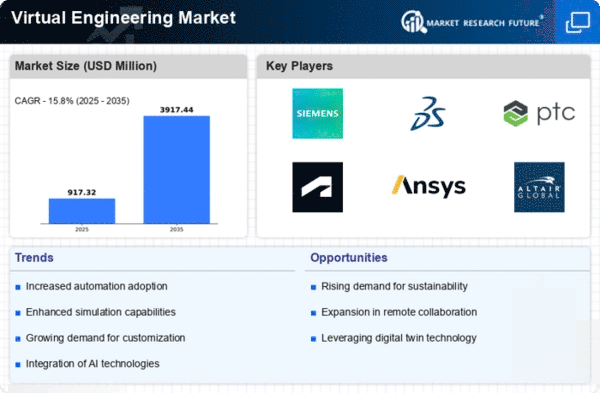
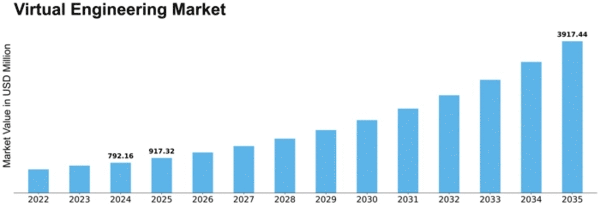
As per MRFR analysis, the Virtual Engineering Market Size was estimated at 792.16 USD Million in 2024. The Virtual Engineering industry is projected to grow from 903.47 in 2025 to 3917.44 by 2035, exhibiting a compound annual growth rate (CAGR) of 15.8 during the forecast period 2025 - 2035.

Key Market Trends & Highlights

The Virtual Engineering Market is experiencing robust growth driven by technological advancements and increasing demand for automation.

  • The integration of AI and Machine Learning is transforming the Virtual Engineering landscape, enhancing efficiency and innovation.
  • North America remains the largest market, while the Asia-Pacific region is emerging as the fastest-growing area for Virtual Engineering solutions.
  • Simulation stands as the largest segment, whereas Prototyping is witnessing rapid growth due to evolving industry needs.
  • Rising demand for automation and advancements in simulation technologies are key drivers propelling market expansion.

Market Size & Forecast

2024 Market Size 792.16 (USD Million)
2035 Market Size 3917.44 (USD Million)
CAGR (2025 - 2035) 15.8%
Largest Regional Market Share in 2024 North America

Major Players

<p>Siemens (DE), Dassault Systemes (FR), PTC (US), Autodesk (US), ANSYS (US), Altair (US), Hexagon (SE), Schneider Electric (FR), IBM (US)</p>

Market Trends

The Virtual Engineering Market is currently experiencing a transformative phase, driven by advancements in technology and the increasing demand for innovative solutions across various industries. This market encompasses a range of services and tools that facilitate the design, simulation, and analysis of engineering projects in a virtual environment. As organizations strive for efficiency and cost-effectiveness, the adoption of virtual engineering practices appears to be gaining momentum. Companies are leveraging these technologies to enhance collaboration, reduce time-to-market, and improve product quality. Furthermore, the integration of artificial intelligence and machine learning into virtual engineering processes is likely to revolutionize traditional engineering methodologies, enabling more accurate predictions and optimized designs. In addition, the growing emphasis on sustainability and environmental considerations is influencing the Virtual Engineering Market. Organizations are increasingly seeking ways to minimize their ecological footprint while maintaining competitive advantages. This trend suggests a shift towards more sustainable engineering practices, where virtual simulations can help assess the environmental impact of projects before implementation. As the market evolves, it seems poised to attract investments and innovations that align with these emerging priorities, ultimately reshaping the landscape of engineering as a whole.

Integration of AI and Machine Learning

The incorporation of artificial intelligence and machine learning technologies into virtual engineering processes is becoming more prevalent. This trend indicates a shift towards enhanced predictive capabilities and automated design optimization, which may lead to improved efficiency and reduced costs in engineering projects.

Focus on Sustainability

There is a growing emphasis on sustainable practices within the Virtual Engineering Market. Companies are increasingly utilizing virtual simulations to evaluate the environmental impact of their projects, suggesting a commitment to reducing their ecological footprint while maintaining operational efficiency.

Enhanced Collaboration Tools

The demand for advanced collaboration tools in virtual engineering is on the rise. As teams become more geographically dispersed, the need for effective communication and collaboration solutions appears to be critical, facilitating seamless project management and design processes.

Virtual Engineering Market Market Drivers

Expansion of Industry 4.0

The ongoing expansion of Industry 4.0 significantly influences the Global Virtual Engineering Market Industry. As manufacturing processes become increasingly digitized and interconnected, the need for virtual engineering solutions grows. Industry 4.0 emphasizes automation, data exchange, and smart manufacturing, all of which benefit from virtual engineering methodologies. For example, the integration of the Internet of Things (IoT) with virtual engineering allows for real-time monitoring and optimization of production processes. This synergy is expected to drive market growth, as organizations seek to leverage virtual engineering to enhance operational efficiency and innovation.

Market Growth Projections

The Global Virtual Engineering Market Industry is poised for remarkable growth, with projections indicating a rise from 792.1 USD Million in 2024 to 4015.5 USD Million by 2035. This trajectory suggests a robust CAGR of 15.9% from 2025 to 2035, reflecting the increasing integration of virtual engineering across various sectors. The growth is driven by factors such as technological advancements, cost efficiency, and sustainability initiatives. As industries continue to evolve and adapt to new challenges, the demand for virtual engineering solutions is expected to expand, solidifying its role as a cornerstone of modern engineering practices.

Technological Advancements

The Global Virtual Engineering Market Industry is propelled by rapid technological advancements in simulation and modeling tools. Innovations in software and hardware, such as high-performance computing and artificial intelligence, enhance the capabilities of virtual engineering. These technologies enable engineers to create more accurate models and simulations, leading to improved product designs and reduced time-to-market. For instance, the integration of AI in design processes allows for predictive analytics, which can optimize engineering workflows. As a result, the market is projected to reach 792.1 USD Million in 2024, reflecting the growing reliance on advanced technologies in engineering practices.

Growing Focus on Sustainability

Sustainability is becoming a pivotal concern within the Global Virtual Engineering Market Industry. As industries face increasing pressure to reduce their carbon footprints, virtual engineering offers a pathway to more sustainable practices. By enabling virtual testing and simulation, companies can minimize resource consumption and waste generation during the product development phase. This approach aligns with global sustainability goals and regulations, making virtual engineering an attractive option for environmentally conscious organizations. The industry's growth trajectory, with a projected CAGR of 15.9% from 2025 to 2035, indicates a strong alignment between virtual engineering and sustainability initiatives.

Rising Adoption in Emerging Markets

Emerging markets are witnessing a notable increase in the adoption of virtual engineering solutions, thereby driving the Global Virtual Engineering Market Industry. Countries in Asia-Pacific and Latin America are investing in advanced engineering technologies to enhance their manufacturing capabilities. This trend is fueled by the need for competitive advantage in global markets, prompting local companies to embrace virtual engineering for product development and innovation. As these regions continue to develop their industrial sectors, the market is likely to experience substantial growth, contributing to the overall expansion of the virtual engineering landscape.

Increased Demand for Cost Efficiency

Cost efficiency remains a critical driver for the Global Virtual Engineering Market Industry. Organizations are increasingly adopting virtual engineering solutions to minimize expenses associated with physical prototyping and testing. By utilizing virtual simulations, companies can identify design flaws early in the development process, thereby reducing material waste and labor costs. This shift towards virtual solutions is particularly evident in sectors such as automotive and aerospace, where the cost of physical prototypes can be exorbitant. The anticipated growth to 4015.5 USD Million by 2035 underscores the financial benefits that virtual engineering brings to organizations seeking to optimize their operations.

Market Segment Insights

By Application: Simulation (Largest) vs. Prototyping (Fastest-Growing)

<p>In the Virtual Engineering Market, the application segment is primarily driven by product design, simulation, testing, and prototyping. Among these, simulation holds the largest market share, establishing itself as a critical component in testing design hypotheses and functionalities before actual production. The importance of simulation in optimizing project timelines and costs is increasingly recognized, leading to its market dominance. On the other hand, the prototyping application is emerging as the fastest-growing segment due to the rapid advancements in technology and increasing need for quick design iterations. Companies are investing heavily in virtual prototyping to enhance product development cycles, thus driving significant growth in this area. The shift towards agile methodologies in engineering further catalyzes this trend, as teams prioritize quick feedback and iteration.</p>

<p>Testing: Simulation (Dominant) vs. Prototyping (Emerging)</p>

<p>In the realm of the Virtual Engineering Market, simulation stands as the dominant force in testing applications, allowing engineers to model and assess real-world performance without the associated risks and costs of physical prototypes. This capability not only improves accuracy and efficiency but also considerably shortens the product development cycle. In contrast, prototyping is gaining traction as an emerging application, driven by the necessity for rapid innovation. Virtual prototyping enables teams to visualize designs and functionalities, facilitating early-stage feedback and improvements. As a result, companies are increasingly prioritizing prototyping to stay competitive, ensuring they can swiftly adapt to market demands while minimizing resource investment.</p>

By End Use: Automotive (Largest) vs. Aerospace (Fastest-Growing)

<p>In the Virtual Engineering Market, the automotive sector holds the largest market share. This is largely driven by the increasing demand for vehicle automation and the integration of advanced technologies such as simulation and digital prototyping. Similarly, the aerospace industry is rapidly adopting virtual engineering solutions, which enhances design processes and reduces development lead times. The synergy between innovation and efficiency in these sectors solidifies their significance in the overall market share distribution.</p>

<p>Automotive: Dominant vs. Aerospace: Emerging</p>

<p>The automotive sector dominates the Virtual Engineering Market, leveraging cutting-edge simulation technologies to optimize design and manufacturing processes. Major automotive manufacturers are increasingly investing in virtual prototyping, which allows for analysis and validation of designs under various conditions. On the other hand, the aerospace industry, though emerging, is witnessing significant growth. The demand for lightweight materials and fuel-efficient designs is driving investments in virtual engineering solutions. Overall, while automotive leads in market stability, aerospace is rapidly evolving, focusing on reducing costs and improving safety through innovative virtual engineering approaches.</p>

By Technology: Computer-Aided Design (Largest) vs. Virtual Reality (Fastest-Growing)

<p>The Virtual Engineering Market is primarily driven by Computer-Aided Design (CAD), which holds the largest share due to its crucial role in engineering design processes across various industries. This segment is followed by Finite Element Analysis (FEA) and Computational Fluid Dynamics (CFD), which contribute significantly to the market, albeit at a smaller scale. Virtual Reality (VR), while a newer entrant, is rapidly gaining traction, capturing the interest of industries seeking innovative design and simulation solutions, enhancing the overall market dynamics. In terms of growth trends, Computer-Aided Design continues to expand as businesses digitize their design processes, ensuring accuracy and efficiency. Virtual Reality is emerging as a key player, with increased adoption in training, product visualization, and client interactions. The integration of advanced technologies, such as Artificial Intelligence and Machine Learning, further propels these segments, fostering innovation and improving operational capabilities.</p>

<p>Technology: CAD (Dominant) vs. VR (Emerging)</p>

<p>Computer-Aided Design (CAD) is a cornerstone of the Virtual Engineering Market, enabling engineers and architects to create precise and detailed models, streamlining the design process. Its dominance stems from its widespread application in manufacturing, construction, and product design, allowing for improved collaboration and efficiency. On the other hand, Virtual Reality (VR) is an emerging segment that offers immersive experiences, making it invaluable for prototyping and visualization. As organizations seek to enhance user engagement and training methodologies, VR is gaining momentum. While CAD provides a stable foundation, VR represents the innovative future of virtual engineering, promising heightened interactivity and enhanced user experiences across various sectors.</p>

By Service Type: Consulting (Largest) vs. Training (Fastest-Growing)

<p>The Virtual Engineering Market showcases a diverse distribution of service types, with consulting services leading in market share. Organizations are increasingly relying on expert consultation to navigate the complexities of virtual engineering, resulting in a strong position for consulting. In contrast, the training sector is gaining traction, driven by the rise in demand for skilled personnel who can utilize advanced virtual tools and technologies efficiently. This shift highlights the growing importance of education in technology-driven environments. As companies strive to enhance their digital capabilities, the training segment is witnessing accelerated growth. Organizations understand that investing in training programs is vital to stay competitive in the evolving landscape of virtual engineering. Support and maintenance services also play critical roles in ensuring the seamless operation of virtual platforms, with support services showing stable growth owing to ongoing customer demand for immediate assistance, while maintenance services are essential for long-term performance and reliability of systems.</p>

<p>Consulting (Dominant) vs. Support (Emerging)</p>

<p>Consulting remains the dominant service type in the Virtual Engineering Market, characterized by its foundational role in guiding companies through digital transformation. Consulting firms assist organizations in strategizing and implementing virtual engineering solutions, often resulting in long-term partnerships. In contrast, support services are steadily emerging due to the growing need for ongoing technical assistance in increasingly complex virtual environments. As companies adopt sophisticated engineering software, they seek reliable support to troubleshoot issues and optimize system performance. This dynamic not only fosters customer loyalty but also creates new opportunities for service providers to innovate their support offerings, thereby enhancing their market position.</p>

By Deployment Type: Cloud-Based (Largest) vs. Hybrid (Fastest-Growing)

<p>The Virtual Engineering Market is primarily segmented into On-Premises, Cloud-Based, and Hybrid deployment types. Currently, Cloud-Based deployment holds the largest market share due to its scalability, flexibility, and cost-effectiveness. Organizations prefer cloud solutions as they facilitate remote collaboration and real-time updates, which are vital in engineering processes. On-Premises solutions have a significant user base, particularly in industries that prioritize data security and regulatory compliance, while Hybrid models are gaining traction as they combine the benefits of both environments. Growth trends indicate a strong shift towards Cloud-Based and Hybrid solutions in the Virtual Engineering Market. The increasing need for remote work capabilities and collaborative tools has accelerated the adoption of these deployment models. As digital transformation initiatives drive organizations to innovate, Hybrid deployments are emerging as the fastest-growing option, allowing businesses to leverage existing on-premises infrastructure while adopting cloud technologies for greater efficiency and scalability.</p>

<p>On-Premises (Dominant) vs. Cloud-Based (Emerging)</p>

<p>On-Premises solutions remain a dominant force in the Virtual Engineering Market, especially among enterprises that handle sensitive data or operate in regulated industries. These traditional deployments offer enhanced security and control over data and systems, making them preferable for organizations that prioritize compliance and data sovereignty. However, they often require significant upfront investments and ongoing maintenance costs. In contrast, Cloud-Based solutions are rapidly emerging as a flexible and cost-effective alternative, appealing to businesses that value agility, scalability, and remote access. As cloud technology evolves, its capability to integrate with advanced engineering tools enhances its appeal to firms looking to streamline operations and improve collaborative efforts in engineering projects.</p>

Get more detailed insights about Virtual Engineering Market Research Report - Global Forecast till 2035

Regional Insights

North America : Innovation and Leadership Hub

North America continues to lead the Virtual Engineering Market, holding a significant share of 396.08M in 2025. The region's growth is driven by rapid technological advancements, increased investment in R&D, and a strong focus on digital transformation across industries. Regulatory support for innovation and sustainability further catalyzes market expansion, with companies increasingly adopting virtual engineering solutions to enhance efficiency and reduce costs. The competitive landscape is robust, with key players like Siemens, PTC, and Autodesk driving innovation. The U.S. stands out as a leader, supported by a strong ecosystem of technology firms and research institutions. Canada and Mexico are also emerging as important players, contributing to the region's overall market growth. The presence of major corporations ensures a continuous influx of cutting-edge technologies, solidifying North America's position in the global market.

Europe : Emerging Market with Potential

Europe's Virtual Engineering Market is poised for growth, with a market size of 210.0M in 2025. The region benefits from a strong emphasis on sustainability and innovation, driven by regulatory frameworks that encourage digital transformation. Countries like Germany and France are at the forefront, investing heavily in smart manufacturing and Industry 4.0 initiatives, which are key drivers for the adoption of virtual engineering solutions. The competitive landscape features prominent players such as Dassault Systemes and Siemens, who are leveraging advanced technologies to enhance product development processes. The presence of a skilled workforce and strong research institutions further supports market growth. As European companies increasingly recognize the value of virtual engineering, the region is expected to see a significant uptick in adoption rates, positioning itself as a vital player in the global market.

Asia-Pacific : Rapid Growth and Innovation

The Asia-Pacific region is rapidly emerging as a significant player in the Virtual Engineering Market, with a market size of 150.0M in 2025. The growth is fueled by increasing industrialization, a surge in manufacturing activities, and government initiatives promoting digital transformation. Countries like China and Japan are leading the charge, investing in advanced technologies to enhance productivity and efficiency in engineering processes. The competitive landscape is evolving, with local and international players vying for market share. Companies such as PTC and Autodesk are expanding their presence in the region, capitalizing on the growing demand for virtual engineering solutions. As the region continues to innovate and adopt new technologies, it is set to play a crucial role in shaping the future of The Virtual Engineering.

Middle East and Africa : Emerging Market with Challenges

The Middle East and Africa (MEA) region, with a market size of 36.08M in 2025, presents a unique landscape for the Virtual Engineering Market. The growth is driven by increasing investments in infrastructure and a push towards modernization across various sectors. However, challenges such as limited technological adoption and regulatory hurdles remain. Governments are beginning to recognize the importance of digital solutions, which is expected to catalyze market growth in the coming years. Countries like South Africa and the UAE are leading the way, with initiatives aimed at enhancing engineering capabilities through technology. The presence of key players is gradually increasing, as companies seek to tap into the region's potential. As awareness of virtual engineering benefits grows, the MEA region is likely to see a gradual but steady increase in market adoption, positioning itself as a future player in the global landscape.

Key Players and Competitive Insights

The Virtual Engineering Market is currently characterized by a dynamic competitive landscape, driven by rapid technological advancements and increasing demand for digital solutions across various industries. Key players such as Siemens (DE), Dassault Systemes (FR), and PTC (US) are strategically positioning themselves through innovation and partnerships, thereby enhancing their operational focus. Siemens (DE) emphasizes digital transformation and smart manufacturing, while Dassault Systemes (FR) leverages its 3D modeling capabilities to foster collaboration in product development. PTC (US) is concentrating on the integration of IoT and augmented reality into its engineering solutions, which collectively shapes a competitive environment that is increasingly reliant on technological prowess and collaborative ecosystems.

In terms of business tactics, companies are localizing manufacturing and optimizing supply chains to enhance efficiency and responsiveness to market demands. The competitive structure of the Virtual Engineering Market appears moderately fragmented, with several key players exerting influence through their innovative offerings and strategic initiatives. This fragmentation allows for a diverse range of solutions, catering to various industry needs while fostering healthy competition among established and emerging players.

In November 2025, Siemens (DE) announced a strategic partnership with a leading AI firm to enhance its digital twin technology, aiming to improve predictive maintenance capabilities for manufacturing clients. This move is significant as it underscores Siemens' commitment to integrating AI into its engineering solutions, potentially leading to increased operational efficiency and reduced downtime for clients. Such advancements may position Siemens as a frontrunner in the market, particularly in sectors where reliability and efficiency are paramount.

In October 2025, Dassault Systemes (FR) launched a new cloud-based platform designed to streamline collaboration among engineering teams globally. This initiative is crucial as it reflects the growing trend towards remote collaboration and digital workflows, enabling companies to innovate faster and reduce time-to-market. By enhancing its cloud offerings, Dassault Systemes is likely to attract a broader client base, particularly among small to medium enterprises seeking scalable solutions.

In September 2025, PTC (US) expanded its partnership with a major automotive manufacturer to integrate augmented reality into their design processes. This collaboration is pivotal as it highlights the increasing importance of immersive technologies in engineering, allowing for more intuitive design reviews and faster iterations. PTC's focus on augmented reality may not only enhance its product offerings but also solidify its position in the automotive sector, where rapid innovation is essential.

As of December 2025, the competitive trends in the Virtual Engineering Market are increasingly defined by digitalization, sustainability, and AI integration. Strategic alliances are shaping the landscape, enabling companies to pool resources and expertise to drive innovation. The shift from price-based competition to a focus on technological differentiation and supply chain reliability is evident, suggesting that future competitive advantages will hinge on the ability to innovate and adapt to evolving market demands.

Key Companies in the Virtual Engineering Market market include

Industry Developments

In November 2022, IBM revealed new tools to help organizations demolish data silos and integrate analytics to make data-driven decisions and quickly address unplanned interruptions. Through business intelligence planning, budgeting, reporting, forecasting, and dashboard capabilities, IBM Business Analytics Enterprise provides customers with a holistic view of data sources throughout their organization.

In November 2022, Bentley Systems announced the introduction of Bentley Infrastructure Cloud in November 2022, a collection of business solutions spanning the whole infrastructure value chain and lifecycle. Bentley Infrastructure Cloud's complete and evergreen digital twins will enable improved infrastructure creation, delivery, and maintenance.

Future Outlook

Virtual Engineering Market Future Outlook

<p>The Virtual Engineering Market is projected to grow at a 15.8% CAGR from 2024 to 2035, driven by advancements in AI, IoT, and demand for digital twin technologies.</p>

New opportunities lie in:

  • <p>Integration of AI-driven simulation tools for enhanced design accuracy.</p>
  • <p>Development of cloud-based virtual engineering platforms for remote collaboration.</p>
  • <p>Expansion into emerging markets with tailored virtual engineering solutions.</p>

<p>By 2035, the Virtual Engineering Market is expected to achieve substantial growth, solidifying its critical role in various industries.</p>

Market Segmentation

Virtual Engineering Market End Use Outlook

  • Automotive
  • Aerospace
  • Consumer Electronics
  • Industrial Equipment

Virtual Engineering Market Technology Outlook

  • Computer-Aided Design
  • Finite Element Analysis
  • Computational Fluid Dynamics
  • Virtual Reality

Virtual Engineering Market Application Outlook

  • Product Design
  • Simulation
  • Testing
  • Prototyping

Virtual Engineering Market Service Type Outlook

  • Consulting
  • Training
  • Support
  • Maintenance

Virtual Engineering Market Deployment Type Outlook

  • On-Premises
  • Cloud-Based
  • Hybrid

Report Scope

MARKET SIZE 2024792.16(USD Million)
MARKET SIZE 2025903.47(USD Million)
MARKET SIZE 20353917.44(USD Million)
COMPOUND ANNUAL GROWTH RATE (CAGR)15.8% (2024 - 2035)
REPORT COVERAGERevenue Forecast, Competitive Landscape, Growth Factors, and Trends
BASE YEAR2024
Market Forecast Period2025 - 2035
Historical Data2019 - 2024
Market Forecast UnitsUSD Million
Key Companies ProfiledSiemens (DE), Dassault Systemes (FR), PTC (US), Autodesk (US), ANSYS (US), Altair (US), Hexagon (SE), Schneider Electric (FR), IBM (US)
Segments CoveredApplication, End Use, Technology, Service Type, Deployment Type
Key Market OpportunitiesIntegration of artificial intelligence in design processes enhances efficiency in the Virtual Engineering Market.
Key Market DynamicsRising demand for advanced simulation tools drives innovation and competition in the Virtual Engineering Market.
Countries CoveredNorth America, Europe, APAC, South America, MEA

FAQs

How much is the Virtual Engineering Market?

The Virtual Engineering Market size is expected to be valued at USD 552.3 Million in 2022.

What is the growth rate of the Virtual Engineering Market?

The global market is projected to grow at a CAGR of 15.9% during the forecast period, 2023-2032.

Which region held the largest market share in the Virtual Engineering Market?

North America had the largest share of the global market.

Who are the key players in the Virtual Engineering Market?

The key players in the market are Siemens PLM Software, Dassault Systems, Ansys, Autodesk, Inc., Altair Engineering, Inc., Hexagon AB (MSC Software), Bentley Systems, HCL Technologies, Carlson Software, PTC, IBM Corporation, Accenture, Capgemini, Bosch Rexroth, among others.

Which Software Tool in the Virtual Engineering Market?

The computer-Aided Designing (CAD) category dominated the market in 2022.

  1. EXECUTIVE SUMMARY
    1. Market Attractiveness Analysis
      1. Global Virtual Engineering Market, by Software Type
      2. Global
  2. Virtual Engineering Market, by Deployment Type
  3. Global Virtual Engineering
  4. Market, by Organization Size
    1. Vertical
  5. Global Virtual Engineering Market, by Industry
  6. Global Virtual Engineering Market, by Industry Vertical
  7. Global Virtual Engineering Market, by Region
  8. MARKET INTRODUCTION
    1. Definition
    2. Scope of the Study
    3. Market Structure
    4. Key Buying Criteria
    5. Macro Factor Indicator Analysis
  9. RESEARCH METHODOLOGY
    1. Research Process
    2. Primary Research
    3. Secondary Research
    4. Market Size Estimation
    5. Forecast Model
    6. List of Assumptions
  10. MARKET DYNAMICS
    1. Introduction
    2. Drivers
      1. Adoption
      2. Robust Demand for Computer-Aided Design (CAD)
      3. Drivers Impact Analysis
    3. of Cloud Based Software
    4. Software
    5. Restraints
      1. Piracy
      2. Lack of Skilled Personnel
      3. Restraints Impact Analysis
    6. Issues
    7. Opportunities
      1. Rising Demand for 3D Modelling
    8. Impact
      1. Impact on the various engineering software demand
      2. Impact on technology development
    9. of COVID-19
    10. Impact on industry verticals
    11. YOY growth 2020-2030
  11. MARKET FACTOR ANALYSIS
    1. Value Chain Analysis/Supply
    2. Chain Analysis
    3. Porter’s Five Forces Model
    4. Bargaining Power
    5. of Suppliers
    6. Bargaining Power of Buyers
    7. Threat of New Entrants
    8. Threat of Substitutes
    9. Intensity of Rivalry
  12. GLOBAL VIRTUAL
  13. ENGINEERINGMARKET MARKET, BY SOFTWARE TYPE
    1. Introduction
    2. Computer-Aided
    3. Designing (CAD)
    4. Computer-Aided Manufacturing (CAM)
    5. Computer-Aided
    6. Engineering (CAE)
    7. Architecture, Engineering and Construction (AEC)
    8. Electronic Design Automation (EDA)
  14. GLOBAL VIRTUAL ENGINEERINGMARKET
  15. MARKET, BY DEPLOYMENT TYPE
    1. Introduction
    2. On-premises
    3. Cloud
  16. GLOBAL VIRTUAL ENGINEERINGMARKET MARKET, BY ORGANIZATION SIZE
    1. Introduction
    2. SME’s
    3. Large Enterprises
  17. GLOBAL VIRTUAL
  18. ENGINEERINGMARKET MARKET, BY APPLICATION
    1. Introduction
    2. Automation
    3. Design
    4. Plant Design
    5. Product Design
    6. 3D Modelling
    7. Others
  19. GLOBAL VIRTUAL ENGINEERINGMARKET, BY INDUSTRY VERTICAL
    1. Introduction
    2. Aerospace & Defense
    3. Automotive
    4. Banking
    5. IT & Telecommunication
    6. Oil & Gas
    7. Healthcare
    8. Others
  20. GLOBAL VIRTUAL ENGINEERINGMARKET,
    1. BY REGION
    2. Introduction
    3. North America
      1. Market Estimates
      2. Market Estimates &
      3. Market Estimates &
      4. Market Estimates &
      5. Market Estimates &
      6. Market Estimates & Forecast,
      7. US
      8. Canada
    4. & Forecast, by Country, 2019–2032
    5. Forecast, by Software type, 2019–2032
    6. Forecast, by Deployment type, 2019–2032
    7. Forecast, by Organization Size, 2019–2032
    8. Forecast, by Application, 2019–2032
    9. by Industry Vertical, 2019–2032
    10. & Forecast, by Software type, 2019–2032
    11. & Forecast, by Deployment type, 2019–2032
    12. & Forecast, by Organization Size, 2019–2032
    13. & Forecast, by Application, 2019–2032
    14. & Forecast, by Industry Vertical, 2019–2032
  21. Market Estimates & Forecast, by Software type, 2019–2032
  22. Market Estimates & Forecast, by Deployment type, 2019–2032
  23. Market Estimates & Forecast, by Organization Size, 2019–2032
  24. Market Estimates & Forecast, by Application, 2019–2032
  25. Market Estimates & Forecast, by Industry Vertical, 2019–2032
    1. Mexico
  26. Market Estimates & Forecast, by Software type, 2019–2032
  27. Market Estimates & Forecast, by Deployment type, 2019–2032
  28. Market Estimates & Forecast, by Organization Size, 2019–2032
  29. Market Estimates & Forecast, by Application, 2019–2032
  30. Market Estimates & Forecast, by Industry Vertical, 2019–2032
    1. Europe
      1. Market Estimates & Forecast, by Country, 2019–2032
      2. Market Estimates & Forecast, by Software type, 2019–2032
      3. Market Estimates & Forecast, by Deployment type, 2019–2032
      4. Market Estimates & Forecast, by Organization Size, 2019–2032
      5. Market Estimates & Forecast, by Application, 2019–2032
  31. Market Estimates & Forecast, by Industry Vertical, 2019–2032
    1. Germany
    2. Size, 2019–2032
    3. by Software type, 2019–2032
    4. by Deployment type, 2019–2032
    5. by Organization Size, 2019–2032
    6. by Application, 2019–2032
    7. by Industry Vertical, 2019–2032
    8. Estimates & Forecast, by Software type, 2019–2032
    9. Estimates & Forecast, by Deployment type, 2019–2032
    10. Estimates & Forecast, by Organization Size, 2019–2032
  32. Market Estimates & Forecast, by Software type, 2019–2032
  33. Market Estimates & Forecast, by Deployment type, 2019–2032
  34. Market Estimates & Forecast, by Organization Size, 2019–2032
  35. Market Estimates & Forecast, by Application, 2019–2032
  36. Market Estimates & Forecast, by Industry Vertical, 2019–2032
  37. UK
  38. Market Estimates & Forecast, by Software type, 2019–2032
  39. Market Estimates & Forecast, by Deployment type, 2019–2032
  40. Market Estimates & Forecast, by Organization Size, 2019–2032
  41. Market Estimates & Forecast, by Application, 2019–2032
  42. Market Estimates & Forecast, by Industry Vertical, 2019–2032
  43. France
  44. Market Estimates & Forecast, by Software type,
  45. Market Estimates & Forecast, by Deployment type,
  46. Market Estimates & Forecast, by Organization
  47. Market Estimates & Forecast, by Application,
  48. Market Estimates & Forecast, by Industry Vertical,
  49. Italy
  50. Market Estimates & Forecast,
  51. Market Estimates & Forecast,
  52. Market Estimates & Forecast,
  53. Market Estimates & Forecast,
  54. Market Estimates & Forecast,
  55. Spain
  56. Market
  57. Market
  58. Market
  59. Market Estimates & Forecast, by Application, 2019–2032
  60. Market Estimates & Forecast, by Industry Vertical, 2019–2032
    1. Rest of Europe
    2. Size, 2019–2032
    3. by Country, 2019–2032
    4. type, 2019–2032
    5. type, 2019–2032
    6. Size, 2019–2032
    7. by Software type, 2019–2032
    8. by Deployment type, 2019–2032
    9. by Organization Size, 2019–2032
    10. by Application, 2019–2032
    11. by Industry Vertical, 2019–2032
    12. & Forecast, by Software type, 2019–2032
    13. & Forecast, by Deployment type, 2019–2032
    14. & Forecast, by Organization Size, 2019–2032
    15. & Forecast, by Application, 2019–2032
    16. & Forecast, by Industry Vertical, 2019–2032
  61. Market Estimates & Forecast, by Software type,
  62. Market Estimates & Forecast, by Deployment type,
  63. Market Estimates & Forecast, by Organization
  64. Market Estimates & Forecast, by Application,
  65. Market Estimates & Forecast, by Industry Vertical,
    1. Asia-Pacific
      1. Market Estimates & Forecast,
      2. Market Estimates & Forecast, by Software
      3. Market Estimates & Forecast, by Deployment
      4. Market Estimates & Forecast, by Organization
      5. Market Estimates & Forecast, by Application,
      6. Market Estimates & Forecast, by Industry Vertical,
      7. China
      8. Japan
      9. India
  66. Market Estimates & Forecast, by Software type, 2019–2032
  67. Market Estimates & Forecast, by Deployment type, 2019–2032
  68. Market Estimates & Forecast, by Organization Size, 2019–2032
  69. Market Estimates & Forecast, by Application, 2019–2032
  70. Market Estimates & Forecast, by Industry Vertical, 2019–2032
    1. Rest of Asia-Pacific
    2. type, 2019–2032
    3. type, 2019–2032
    4. Size, 2019–2032
    5. & Forecast, by Software type, 2019–2032
    6. & Forecast, by Deployment type, 2019–2032
    7. & Forecast, by Organization Size, 2019–2032
    8. & Forecast, by Application, 2019–2032
    9. Forecast, by Industry Vertical, 2019–2032
  71. Market Estimates & Forecast, by Software
  72. Market Estimates & Forecast, by Deployment
  73. Market Estimates & Forecast, by Organization
  74. Market Estimates & Forecast, by Application,
  75. Market Estimates & Forecast, by Industry Vertical,
    1. Middle East and Africa
      1. Market Estimates
      2. Market Estimates
      3. Market Estimates
      4. Market Estimates
      5. Market Estimates &
    2. South America
  76. Market Estimates & Forecast, by Software type, 2019–2032
  77. Market Estimates & Forecast, by Deployment type, 2019–2032
  78. Market Estimates & Forecast, by Organization Size, 2019–2032
  79. Market Estimates & Forecast, by Application, 2019–2032
    1. Estimates & Forecast, by Industry Vertical, 2019–2032
  80. Market
  81. COMPETITIVE
    1. LANDSCAPE
    2. Introduction
    3. Key Developments & Growth Strategies
    4. Competitor Benchmarking
    5. Vendor Share Analysis, 2022 (% Share)
  82. COMPANY PROFILES
    1. Siemens PLM Software
    2. Dassault Systems
    3. Ansys
    4. Autodesk, Inc.
    5. Altair Engineering, Inc.
    6. Hexagon AB (MSC Software)
    7. Bentley Systems
    8. HCL Technologies
    9. Carlson Software
    10. PTC, IBM Corporation
    11. Accenture
    12. Bosch Rexroth
    13. Capgemini
    14. Others
      1. Financial Overview
      2. Organization Size/Services
      3. Key Developments
      4. SWOT Analysis
    15. Company Overview
    16. Offered
    17. Key Strategies


Virtual Engineering Market Segmentation

  • Global Virtual Engineering, By Software Type Outlook (USD Million, 2019-2032)

    • Computer-Aided Designing (CAD)
    • Computer-Aided Manufacturing (CAM)
    • Computer-Aided Engineering (CAE)
    • Architecture, Engineering and Construction (AEC)
    • Electronic Design Automation (EDA)Others
  • Global Virtual Engineering, By Deployment Type Outlook (USD Million, 2019-2032)

    • On-premises
    • Cloud
  • Global Virtual Engineering, By Organization Size Outlook (USD Million, 2019-2032)

    • SME’s
    • Large Enterprises
  • Global Virtual Engineering, By Application Outlook (USD Million, 2019-2032)

    • Automation Design
    • Plant Design
    • Product Design
    • 3D MODELLING
    • Others
  • Global Virtual Engineering, By Industry Vertical Outlook (USD Million, 2019-2032)

    • Commercial Industry Vertical

      • Retail
      • Healthcare
      • Industrial
      • Transportation & Logistics
      • Hospitality
      • Others
    • Defense Industry Vertical

Global Virtual Engineering Regional Outlook (USD Million, 2019-2032)

  • North America Outlook (USD Million, 2019-2032)

  • North America Virtual Engineering, By Software Type Outlook (USD Million, 2019-2032)

    • Computer-Aided Designing (CAD)
    • Computer-Aided Manufacturing (CAM)
    • Computer-Aided Engineering (CAE)
    • Architecture, Engineering and Construction (AEC)
    • Electronic Design Automation (EDA)Others
  • North America Virtual Engineering, By Deployment Type Outlook (USD Million, 2019-2032)

    • On-premises
    • Cloud
  • North America Virtual Engineering, By Organization Size Outlook (USD Million, 2019-2032)

    • SME’s
    • Large Enterprises
  • North America Virtual Engineering, By Application Outlook (USD Million, 2019-2032)

    • Automation Design
    • Plant Design
    • Product Design
    • 3D Modelling
    • Others
  • North America Virtual Engineering, By Industry Vertical Outlook (USD Million, 2019-2032)

    • Aerospace & Defense
    • Automotive
    • Banking
    • IT & Telecommunication
    • Oil & Gas
    • Healthcare
    • Others


    • US Outlook (USD Million, 2019-2032)

    • US Virtual Engineering, By Software Type Outlook (USD Million, 2019-2032)

      • Computer-Aided Designing (CAD)
      • Computer-Aided Manufacturing (CAM)
      • Computer-Aided Engineering (CAE)
      • Architecture, Engineering and Construction (AEC)
      • Electronic Design Automation (EDA)Others
    • US Virtual Engineering, By Deployment Type Outlook (USD Million, 2019-2032)

      • On-premises
      • Cloud
    • US Virtual Engineering, By Organization Size Outlook (USD Million, 2019-2032)

      • SME’s
      • Large Enterprises
    • US Virtual Engineering, By Application Outlook (USD Million, 2019-2032)

      • Automation Design
      • Plant Design
      • Product Design
      • 3D Modelling
      • Others
    • US Virtual Engineering, By Industry Vertical Outlook (USD Million, 2019-2032)

      • Aerospace & Defense
      • Automotive
      • Banking
      • IT & Telecommunication
      • Oil & Gas
      • Healthcare
      • Others
    • Canada Outlook (USD Million, 2019-2032)

    • Canada Virtual Engineering, By Software Type Outlook (USD Million, 2019-2032)

      • Computer-Aided Designing (CAD)
      • Computer-Aided Manufacturing (CAM)
      • Computer-Aided Engineering (CAE)
      • Architecture, Engineering and Construction (AEC)
      • Electronic Design Automation (EDA)
    • Canada Virtual Engineering, By Deployment Type Outlook (USD Million, 2019-2032)

      • On-premises
      • Cloud
    • Canada Virtual Engineering, By Organization Size Outlook (USD Million, 2019-2032)

      • SME’s
      • Large Enterprises
    • Canada Virtual Engineering, By Application Outlook (USD Million, 2019-2032)

      • Automation Design
      • Plant Design
      • Product Design
      • 3D Modelling
      • Others
    • Canada Virtual Engineering, By Industry Vertical Outlook (USD Million, 2019-2032)

      • Aerospace & Defense
      • Automotive
      • Banking
      • IT & Telecommunication
      • Oil & Gas
      • Healthcare
      • Others
    • Mexico Outlook (USD Million, 2019-2032)

    • Mexico Virtual Engineering, By Software Type Outlook (USD Million, 2019-2032)

      • Computer-Aided Designing (CAD)
      • Computer-Aided Manufacturing (CAM)
      • Computer-Aided Engineering (CAE)
      • Architecture, Engineering and Construction (AEC)
      • Electronic Design Automation (EDA)
    • Mexico Virtual Engineering, By Deployment Type Outlook (USD Million, 2019-2032)

      • On-premises
      • Cloud
    • Mexico Virtual Engineering, By Organization Size Outlook (USD Million, 2019-2032)

      • SME’s
      • Large Enterprises
    • Mexico Virtual Engineering, By Application Outlook (USD Million, 2019-2032)

      • Automation Design
      • Plant Design
      • Product Design
      • 3D Modelling
      • Others
    • Mexico Virtual Engineering, By Industry Vertical Outlook (USD Million, 2019-2032)

      • Aerospace & Defense
      • Automotive
      • Banking
      • IT & Telecommunication
      • Oil & Gas
      • Healthcare
      • Others
  • Europe Outlook (USD Million, 2019-2032)

  • Europe Virtual Engineering, By Software Type Outlook (USD Million, 2019-2032)

    • Computer-Aided Designing (CAD)
    • Computer-Aided Manufacturing (CAM)
    • Computer-Aided Engineering (CAE)
    • Architecture, Engineering and Construction (AEC)
    • Electronic Design Automation (EDA)
  • Europe Virtual Engineering, By Deployment Type Outlook (USD Million, 2019-2032)

    • On-premises
    • Cloud
  • Europe Virtual Engineering, By Organization Size Outlook (USD Million, 2019-2032)

    • SME’s
    • Large Enterprises
  • Europe Virtual Engineering, By Application Outlook (USD Million, 2019-2032)

    • Automation Design
    • Plant Design
    • Product Design
    • 3D Modelling
    • Others
  • Europe Virtual Engineering, By Industry Vertical Outlook (USD Million, 2019-2032)

    • Aerospace & Defense
    • Automotive
    • Banking
    • IT & Telecommunication
    • Oil & Gas
    • Healthcare
    • Others


    • Germany Outlook (USD Million, 2019-2032)

    • Germany Virtual Engineering, By Software Type Outlook (USD Million, 2019-2032)

      • Computer-Aided Designing (CAD)
      • Computer-Aided Manufacturing (CAM)
      • Computer-Aided Engineering (CAE)
      • Architecture, Engineering and Construction (AEC)
      • Electronic Design Automation (EDA)
    • Germany Virtual Engineering, By Deployment Type Outlook (USD Million, 2019-2032)

      • On-premises
      • Cloud
    • Germany Virtual Engineering, By Organization Size Outlook (USD Million, 2019-2032)

      • SME’s
      • Large Enterprises
    • Germany Virtual Engineering, By Application Outlook (USD Million, 2019-2032)

      • Automation Design
      • Plant Design
      • Product Design
      • 3D Modelling
      • Others
    • Germany Virtual Engineering, By Industry Vertical Outlook (USD Million, 2019-2032)

      • Aerospace & Defense
      • Automotive
      • Banking
      • IT & Telecommunication
      • Oil & Gas
      • Healthcare
      • Others
    • France Outlook (USD Million, 2019-2032)

    • France Virtual Engineering, By Software Type Outlook (USD Million, 2019-2032)

      • Computer-Aided Designing (CAD)
      • Computer-Aided Manufacturing (CAM)
      • Computer-Aided Engineering (CAE)
      • Architecture, Engineering and Construction (AEC)
      • Electronic Design Automation (EDA)
    • France Virtual Engineering, By Deployment Type Outlook (USD Million, 2019-2032)

      • On-premises
      • Cloud
    • France Virtual Engineering, By Organization Size Outlook (USD Million, 2019-2032)

      • SME’s
      • Large Enterprises
    • France Virtual Engineering, By Application Outlook (USD Million, 2019-2032)

      • Automation Design
      • Plant Design
      • Product Design
      • 3D Modelling
      • Others
    • France Virtual Engineering, By Industry Vertical Outlook (USD Million, 2019-2032)

      • Aerospace & Defense
      • Automotive
      • Banking
      • IT & Telecommunication
      • Oil & Gas
      • Healthcare
      • Others
    • UK Outlook (USD Million, 2019-2032)

    • UK Virtual Engineering, By Software Type Outlook (USD Million, 2019-2032)

      • Computer-Aided Designing (CAD)
      • Computer-Aided Manufacturing (CAM)
      • Computer-Aided Engineering (CAE)
      • Architecture, Engineering and Construction (AEC)
      • Electronic Design Automation (EDA)
    • UK Virtual Engineering, By Deployment Type Outlook (USD Million, 2019-2032)

      • On-premises
      • Cloud
    • UK Virtual Engineering, By Organization Size Outlook (USD Million, 2019-2032)

      • SME’s
      • Large Enterprises
    • UK Virtual Engineering, By Application Outlook (USD Million, 2019-2032)

      • Automation Design
      • Plant Design
      • Product Design
      • 3D Modelling
      • Others
    • UK Virtual Engineering, By Industry Vertical Outlook (USD Million, 2019-2032)

      • Aerospace & Defense
      • Automotive
      • Banking
      • IT & Telecommunication
      • Oil & Gas
      • Healthcare
      • Others


    • Rest of Europe Outlook (USD Million, 2019-2032)

    • Rest of Europe Virtual Engineering, By Software Type Outlook (USD Million, 2019-2032)

      • Computer-Aided Designing (CAD)
      • Computer-Aided Manufacturing (CAM)
      • Computer-Aided Engineering (CAE)
      • Architecture, Engineering and Construction (AEC)
      • Electronic Design Automation (EDA)
    • Rest of Europe Virtual Engineering, By Deployment Type Outlook (USD Million, 2019-2032)

      • On-premises
      • Cloud
      • 3D
    • Rest of Europe Virtual Engineering, By Organization Size Outlook (USD Million, 2019-2032)

      • SME’s
      • Large Enterprises
    • Rest of Europe Virtual Engineering, By Application Outlook (USD Million, 2019-2032)

      • Automation Design
      • Plant Design
      • Product Design
      • 3D Modelling
      • Others
    • Rest of Europe Virtual Engineering, By Industry Vertical Outlook (USD Million, 2019-2032)

      • Aerospace & Defense
      • Automotive
      • Banking
      • IT & Telecommunication
      • Oil & Gas
      • Healthcare
      • Others


  • Asia-Pacific Outlook (USD Million, 2019-2032)

  • Asia-Pacific Virtual Engineering, By Software Type Outlook (USD Million, 2019-2032)

    • Computer-Aided Designing (CAD)
    • Computer-Aided Manufacturing (CAM)
    • Computer-Aided Engineering (CAE)
    • Architecture, Engineering and Construction (AEC)
    • Electronic Design Automation (EDA)
  • Asia-Pacific Virtual Engineering, By Deployment Type Outlook (USD Million, 2019-2032)

    • On-premises
    • Cloud
  • Asia-Pacific Virtual Engineering, By Organization Size Outlook (USD Million, 2019-2032)

    • SME’s
    • Large Enterprises
  • Asia-Pacific Virtual Engineering, By Application Outlook (USD Million, 2019-2032)

    • Automation Design
    • Plant Design
    • Product Design
    • 3D Modelling
    • Others
  • Asia-Pacific Virtual Engineering, By Industry Vertical Outlook (USD Million, 2019-2032)

    • Aerospace & Defense
    • Automotive
    • Banking
    • IT & Telecommunication
    • Oil & Gas
    • Healthcare
    • Others


    • China Outlook (USD Million, 2019-2032)

    • China Virtual Engineering, By Software Type Outlook (USD Million, 2019-2032)

      • Computer-Aided Designing (CAD)
      • Computer-Aided Manufacturing (CAM)
      • Computer-Aided Engineering (CAE)
      • Architecture, Engineering and Construction (AEC)
      • Electronic Design Automation (EDA)
    • China Virtual Engineering, By Deployment Type Outlook (USD Million, 2019-2032)

      • On-premises
      • Cloud
    • China Virtual Engineering, By Organization Size Outlook (USD Million, 2019-2032)

      • SME’s
      • Large Enterprises
    • China Virtual Engineering, By Application Outlook (USD Million, 2019-2032)

      • Automation Design
      • Plant Design
      • Product Design
      • 3D Modelling
      • Others
    • China Virtual Engineering, By Industry Vertical Outlook (USD Million, 2019-2032)

      • Aerospace & Defense
      • Automotive
      • Banking
      • IT & Telecommunication
      • Oil & Gas
      • Healthcare
      • Others


    • India Outlook (USD Million, 2019-2032)

    • India Virtual Engineering, By Software Type Outlook (USD Million, 2019-2032)

      • Computer-Aided Designing (CAD)
      • Computer-Aided Manufacturing (CAM)
      • Computer-Aided Engineering (CAE)
      • Architecture, Engineering and Construction (AEC)
      • Electronic Design Automation (EDA)
    • India Virtual Engineering, By Deployment Type Outlook (USD Million, 2019-2032)

      • On-premises
      • Cloud
    • India Virtual Engineering, By Organization Size Outlook (USD Million, 2019-2032)

      • SME’s
      • Large Enterprises
    • India Virtual Engineering, By Application Outlook (USD Million, 2019-2032)

      • Automation Design
      • Plant Design
      • Product Design
      • 3D Modelling
      • Others
    • India Virtual Engineering, By Industry Vertical Outlook (USD Million, 2019-2032)

      • Aerospace & Defense
      • Automotive
      • Banking
      • IT & Telecommunication
      • Oil & Gas
      • Healthcare
      • Others


    • Japan Outlook (USD Million, 2019-2032)

    • Japan Virtual Engineering, By Software Type Outlook (USD Million, 2019-2032)

      • Computer-Aided Designing (CAD)
      • Computer-Aided Manufacturing (CAM)
      • Computer-Aided Engineering (CAE)
      • Architecture, Engineering and Construction (AEC)
      • Electronic Design Automation (EDA)
    • Japan Virtual Engineering, By Deployment Type Outlook (USD Million, 2019-2032)

      • On-premises
      • Cloud
    • Japan Virtual Engineering, By Organization Size Outlook (USD Million, 2019-2032)

      • SME’s
      • Large Enterprises
    • Japan Virtual Engineering, By Application Outlook (USD Million, 2019-2032)

      • Automation Design
      • Plant Design
      • Product Design
      • 3D Modelling
      • Others
    • Japan Virtual Engineering, By Industry Vertical Outlook (USD Million, 2019-2032)

      • Aerospace & Defense
      • Automotive
      • Banking
      • IT & Telecommunication
      • Oil & Gas
      • Healthcare
      • Others


    • Rest of Asia-Pacific Outlook (USD Million, 2019-2032)

    • Rest of Asia-Pacific Virtual Engineering, By Software Type Outlook (USD Million, 2019-2032)

      • Computer-Aided Designing (CAD)
      • Computer-Aided Manufacturing (CAM)
      • Computer-Aided Engineering (CAE)
      • Architecture, Engineering and Construction (AEC)
      • Electronic Design Automation (EDA)
    • Rest of Asia-Pacific Virtual Engineering, By Deployment Type Outlook (USD Million, 2019-2032)

      • On-premises
      • Cloud
    • Rest of Asia-Pacific Virtual Engineering, By Organization Size Outlook (USD Million, 2019-2032)

      • SME’s
      • Large Enterprises
    • Rest of Asia-Pacific Virtual Engineering, By Application Outlook (USD Million, 2019-2032)

      • Automation Design
      • Plant Design
      • Product Design
      • 3D Modelling
      • Others
    • Rest of Asia-Pacific Virtual Engineering, By Industry Vertical Outlook (USD Million, 2019-2032)

      • Aerospace & Defense
      • Automotive
      • Banking
      • IT & Telecommunication
      • Oil & Gas
      • Healthcare
      • Others
  • Rest of the World Outlook (USD Million, 2019-2032)

    • Middle East & Africa Outlook (USD Million, 2019-2032)

    • Middle East & Africa Virtual Engineering, By Software Type Outlook (USD Million, 2019-2032)

      • Computer-Aided Designing (CAD)
      • Computer-Aided Manufacturing (CAM)
      • Computer-Aided Engineering (CAE)
      • Architecture, Engineering and Construction (AEC)
      • Electronic Design Automation (EDA)
    • Middle East & Africa Virtual Engineering, By Deployment Type Outlook (USD Million, 2019-2032)

      • On-premises
      • Cloud
    • Middle East & Africa Virtual Engineering, By Organization Size Outlook (USD Million, 2019-2032)

      • SME’s
      • Large Enterprises
    • Middle East & Africa Virtual Engineering, By Application Outlook (USD Million, 2019-2032)

      • Automation Design
      • Plant Design
      • Product Design
      • 3D Modelling
      • Others
    • Middle East & Africa Virtual Engineering, By Industry Vertical Outlook (USD Million, 2019-2032)

      • Aerospace & Defense
      • Automotive
      • Banking
      • IT & Telecommunication
      • Oil & Gas
      • Healthcare
      • Others
    • South America Outlook (USD Million, 2019-2032)

    • South America Virtual Engineering, By Software Type Outlook (USD Million, 2019-2032)

      • Computer-Aided Designing (CAD)
      • Computer-Aided Manufacturing (CAM)
      • Computer-Aided Engineering (CAE)
      • Architecture, Engineering and Construction (AEC)
      • Electronic Design Automation (EDA)
    • South America Virtual Engineering, By Deployment Type Outlook (USD Million, 2019-2032)

      • On-premises
      • Cloud
    • South America Virtual Engineering, By Organization Size Outlook (USD Million, 2019-2032)

      • SME’s
      • Large Enterprises
    • South America Virtual Engineering, By Application Outlook (USD Million, 2019-2032)

      • Automation Design
      • Plant Design
      • Product Design
      • 3D Modelling
      • Others
    • South America Virtual Engineering, By Industry Vertical Outlook (USD Million, 2019-2032)

      • Aerospace & Defense
      • Automotive
      • Banking
      • IT & Telecommunication
      • Oil & Gas
      • Healthcare
      • Others


Infographic

Free Sample Request

Kindly complete the form below to receive a free sample of this Report

Get Free Sample

Customer Strories

Compare Licence

×
Features License Type
Single User Multiuser License Enterprise User
Price $4,950 $5,950 $7,250
Maximum User Access Limit 1 User Upto 10 Users Unrestricted Access Throughout the Organization
Free Customization
Direct Access to Analyst
Deliverable Format
Platform Access
Discount on Next Purchase 10% 15% 15%
Printable Versions