
×
Hero Background
English
Chinese
French
Japanese
Korean
German
Spanish

Virtual Desktop Market Analysis

ID: MRFR/SEM/1970-HCR
100 Pages
Shubham Munde
October 2025

Virtual Desktop Market Research Report Information By Product Type (Cloud-Based SaaS, IaaS Cloud-Based VD, Private Hosting Cloud-Based VDI, DaaS Cloud-Based VD), By Deployment (On-premise VDI, Cloud-based VDI), By Vertical (IT and Telecom, Manufacturing, BFSI, Logistics, Aerospace & Defense, Retail, Media & Entertainment)- Industry Size, Share and Forecast 2032

Share:
Download PDF ×

We do not share your information with anyone. However, we may send you emails based on your report interest from time to time. You may contact us at any time to opt-out.

Virtual Desktop Market Infographic
Purchase Options

Market Analysis

In-depth Analysis of Virtual Desktop Market Industry Landscape

The virtual desktop market is characterized by dynamic and evolving market dynamics that extensively impact its boom and trajectory. One of the important thing drivers is the growing trend of faraway work. As companies embody bendy painting preparations, the demand for virtual desktop infrastructure (VDI) rises. Virtual desktops allow employees to get entry to their digital workspaces from anywhere, fostering productiveness and collaboration. This fashion has been expanded by way of international events, making virtual desktop solutions an important issue of modern-day work environments. Cost performance is a dominant aspect influencing the market dynamics of virtual desktops. Businesses are increasingly drawn to the capability fee financial savings associated with VDI. By lowering the reliance on a good-sized hardware infrastructure and providing centralized control, virtual desktops contribute to operational performance. This fee-effectiveness appeals to organizations seeking to optimize their IT spending while preserving a scalable and flexible computing environment. Security considerations play a pivotal role in shaping the marketplace dynamics of virtual desktops. With the growing hazard of cyberattacks and information breaches, businesses prioritize strong cybersecurity measures. Virtual desktops deal with those worries by centralizing records garage and getting the right of entry to controls, improving average protection. The dynamic nature of cybersecurity threats drives continuous innovation in virtual desktop solutions as providers strive to stay in advance of evolving dangers and vulnerabilities. Regulatory compliance is an aspect that significantly affects the market dynamics of virtual desktops, specifically in industries with stringent facts and safety guidelines. Virtual desktop solutions provide a centralized approach to information management, aiding corporations in adhering to compliance requirements extra effectively. As guidelines evolve, virtual desktop companies adapt their offerings to make certain that organizations can meet these regulatory requirements even by leveraging the blessings of a flexible and scalable IT infrastructure. The economic landscape additionally plays a role in shaping the market dynamics of virtual desktops. Economic elements, which include GDP boom, industry investments, and enterprise expansions, affect the willingness of companies to put money into virtual desktop answers. During periods of monetary uncertainty, the marketplace may additionally revel in expanded demand for organizations searching for value-powerful and green IT solutions. Furthermore, personal possibilities and studies contribute to the market dynamics. As personnel an increasingly number of prioritize flexibility and seamless access to their virtual workspaces, virtual desktop solutions that provide a consumer-friendly enjoy advantage prominence. This person-centric approach affects the design and improvement of virtual desktop services, ensuring that they align with the evolving expectations of cease-customers.


Author
Shubham Munde
Research Analyst Level II

With a technical background in information technology & semiconductors, Shubham has 4.5+ years of experience in market research and analytics with the tasks of data mining, analysis, and project execution. He is the POC for our clients, for their consulting projects running under the ICT/Semiconductor domain. Shubham holds a Bachelor’s in Information and Technology and a Master of Business Administration (MBA). Shubham has executed over 150 research projects for our clients under the brand name Market Research Future in the last 2 years. His core skill is building the research respondent relation for gathering the primary information from industry and market estimation for niche markets. He is having expertise in conducting secondary & primary research, market estimations, market projections, competitive analysis, analysing current market trends and market dynamics, deep-dive analysis on market scenarios, consumer behaviour, technological impact analysis, consulting, analytics, etc. He has worked on fortune 500 companies' syndicate and consulting projects along with several government projects. He has worked on the projects of top tech brands such as IBM, Google, Microsoft, AWS, Meta, Oracle, Cisco Systems, Samsung, Accenture, VMware, Schneider Electric, Dell, HP, Ericsson, and so many others. He has worked on Metaverse, Web 3.0, Zero-Trust security, cyber-security, blockchain, quantum computing, robotics, 5G technology, High-Performance computing, data centers, AI, automation, IT equipment, sensors, semiconductors, consumer electronics and so many tech domain projects.

Leave a Comment

FAQs

What are the advantages offered by virtualization of desktop?

The advantages of virtual desktop include optimum utilization of energy & resources and cost-saving.

What is supposed to lead the demand for virtual desktop technology?

The demand is supposed to be driven by consumerization of IT.

At what rate is the market expected to expand during the review period?

The market is supposed to mark 21.20% CAGR over the review period.

How much revenue is the market expected to earn by 2023?

The market is supposed to earn USD 9.16 Bn.

what are the product type-based segments of the market?

The segments based on product type are Cloud-Based SaaS, Private Hosting Cloud-Based VDI, IaaS Cloud-Based VD, and DaaS Cloud-Based VD.

Market Summary

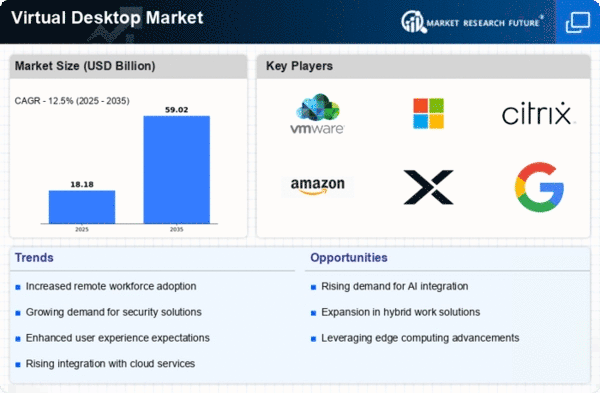
As per MRFR analysis, the Virtual Desktop Market Size was estimated at 16.16 USD Billion in 2024. The Virtual Desktop industry is projected to grow from 18.18 USD Billion in 2025 to 59.02 USD Billion by 2035, exhibiting a compound annual growth rate (CAGR) of 12.5 during the forecast period 2025 - 2035.

Key Market Trends & Highlights

The Virtual Desktop Market is experiencing robust growth driven by technological advancements and evolving work environments.

  • The market is witnessing increased adoption of cloud-based solutions, particularly in North America, which remains the largest market.
  • Security enhancements are becoming a focal point as organizations prioritize data protection in both remote work and healthcare segments.
  • Integration of AI and automation is gaining traction, especially within the public cloud segment, which is currently the largest.
  • Rising demand for remote work solutions and cost efficiency are key drivers propelling growth in the fastest-growing hybrid cloud segment.

Market Size & Forecast

2024 Market Size 16.16 (USD Billion)
2035 Market Size 59.02 (USD Billion)
CAGR (2025 - 2035) 12.5%
Largest Regional Market Share in 2024 North America

Major Players

<p>Microsoft (US), VMware (US), Citrix (US), Amazon (US), Nutanix (US), Google (US), IBM (US), Parallels (RU), Red Hat (US)</p>

Market Trends

The Virtual Desktop Market is currently experiencing a transformative phase characterized by rapid technological advancements and evolving user demands. Organizations are increasingly adopting virtual desktop infrastructure (VDI) solutions to enhance operational efficiency and facilitate remote work capabilities. This shift is driven by the need for flexibility, security, and cost-effectiveness in managing IT resources. As businesses continue to embrace digital transformation, the demand for scalable and reliable virtual desktop solutions is likely to grow, indicating a robust trajectory for the market. Moreover, the integration of artificial intelligence and machine learning into virtual desktop environments appears to be reshaping user experiences. These technologies enable personalized desktop environments, optimizing performance and resource allocation. Additionally, the rise of hybrid work models is influencing the design and deployment of virtual desktop solutions, as organizations seek to provide seamless access to applications and data from various locations. This evolving landscape suggests that the Virtual Desktop Market is poised for sustained growth, driven by innovation and changing workplace dynamics.

Increased Adoption of Cloud-Based Solutions

Organizations are progressively shifting towards cloud-based virtual desktop solutions, which offer enhanced scalability and flexibility. This trend allows businesses to reduce infrastructure costs while improving accessibility for remote employees.

Focus on Security Enhancements

As cyber threats continue to evolve, there is a growing emphasis on security within the Virtual Desktop Market. Companies are investing in advanced security measures to protect sensitive data and ensure compliance with regulations.

Integration of AI and Automation

The incorporation of artificial intelligence and automation technologies is transforming virtual desktop environments. These innovations facilitate improved user experiences and streamline IT management processes, making virtual desktops more efficient.

Virtual Desktop Market Market Drivers

Market Growth Projections

The Global Virtual Desktop Market Industry is poised for remarkable growth, with projections indicating a market size of 11.1 USD Billion in 2024 and an anticipated expansion to 92.1 USD Billion by 2035. This trajectory suggests a compound annual growth rate of 21.2% from 2025 to 2035, reflecting the increasing adoption of virtual desktop solutions across various sectors. Factors such as the rise of remote work, enhanced cybersecurity needs, and advancements in cloud technology contribute to this growth. The market's evolution indicates a robust demand for virtual desktop infrastructure, positioning it as a key player in the future of IT solutions.

Advancements in Cloud Technology

Advancements in cloud technology play a crucial role in shaping the Global Virtual Desktop Market Industry. The integration of cloud computing with virtual desktop solutions enables organizations to access applications and data seamlessly from any device. This flexibility enhances user experience and fosters collaboration among teams, regardless of geographical barriers. As cloud infrastructure continues to evolve, the capabilities of virtual desktops expand, making them more attractive to businesses. The ongoing innovation in cloud services is expected to contribute significantly to the market's growth, as organizations increasingly adopt hybrid and multi-cloud strategies to enhance their operational efficiency.

Increased Focus on Cybersecurity

In the context of the Global Virtual Desktop Market Industry, the heightened emphasis on cybersecurity significantly drives market growth. Virtual desktops offer enhanced security features, such as centralized data management and controlled access, which are crucial for protecting sensitive information. Organizations are increasingly aware of the risks associated with data breaches and cyber threats, prompting them to invest in secure virtual desktop solutions. This trend is likely to accelerate as businesses prioritize safeguarding their digital assets. The anticipated growth trajectory suggests that the market could expand to 92.1 USD Billion by 2035, driven by the need for robust cybersecurity measures.

Growing Adoption in Education Sector

The education sector's growing adoption of virtual desktops significantly influences the Global Virtual Desktop Market Industry. Educational institutions are increasingly implementing virtual desktop solutions to provide students and faculty with access to learning resources and applications from anywhere. This trend is particularly relevant in higher education, where remote learning and collaboration tools are essential. By utilizing virtual desktops, schools can reduce hardware costs and ensure that all users have access to the same software environment. As educational institutions continue to embrace digital transformation, the demand for virtual desktop solutions is expected to rise, further propelling market growth.

Rising Demand for Remote Work Solutions

The Global Virtual Desktop Market Industry experiences a notable surge in demand for remote work solutions. As organizations increasingly adopt flexible work arrangements, virtual desktops provide employees with secure access to applications and data from various locations. This trend is particularly evident in sectors such as technology and finance, where remote work has become a norm. The market is projected to reach 11.1 USD Billion in 2024, reflecting a growing reliance on virtual desktop infrastructure. This shift not only enhances productivity but also reduces operational costs, making it a compelling choice for businesses aiming to streamline their IT resources.

Cost Efficiency and Resource Optimization

Cost efficiency emerges as a pivotal driver within the Global Virtual Desktop Market Industry. By leveraging virtual desktop infrastructure, organizations can optimize their IT resources, reducing hardware costs and maintenance expenses. This model allows for centralized management of desktops, which simplifies updates and support, ultimately leading to lower operational costs. As businesses seek to maximize their return on investment, the appeal of virtual desktops becomes increasingly pronounced. The projected compound annual growth rate of 21.2% from 2025 to 2035 underscores the financial advantages that virtual desktop solutions offer, positioning them as a strategic choice for cost-conscious enterprises.

Market Segment Insights

By Application: Remote Work (Largest) vs. Healthcare (Fastest-Growing)

<p>The Virtual Desktop Market is significantly influenced by various application segments, with Remote Work being the largest contributor. This sector has seen widespread adoption as organizations shift to flexible working solutions. Following closely are sectors like Education and IT Services, which are also gaining traction, while Healthcare is noting increased utilization thanks to the need for remote patient management and data access. Each application segment plays a pivotal role in the market dynamics, reflecting changing work patterns and technology acceptance. In terms of growth trends, the demand for Virtual Desktops has accelerated in the Healthcare sector, positioning it as the fastest-growing segment. This growth is driven by the rise in telehealth services, where healthcare professionals require efficient and secure access to applications and patient information from remote locations. Meanwhile, Remote Work continues to expand as businesses recognize the benefits of virtualized technologies, enabling a seamless transition between in-office and remote working environments.</p>

<p>Remote Work: Dominant vs. Healthcare: Emerging</p>

<p>Remote Work remains the dominant player in the Virtual Desktop Market, characterized by its extensive adoption across various industries. This segment allows organizations to provide employees with secure access to organizational resources from anywhere, driving productivity and employee satisfaction. Features like centralized management and enhanced security are critical for its sustained growth. Conversely, Healthcare is emerging as a new powerhouse in this market. This segment is defined by a burgeoning demand for telemedicine and remote patient monitoring, necessitating the deployment of virtual desktop solutions. The shift towards digital health services has catalyzed investment in this sector, with providers seeking to optimize access to healthcare data and applications, thereby enhancing patient care and operational efficiency.</p>

By Deployment Model: Public Cloud (Largest) vs. Hybrid Cloud (Fastest-Growing)

<p>In the Virtual Desktop Market, the deployment model segment features distinct options, prominently including Public Cloud, Private Cloud, Hybrid Cloud, and On-Premises solutions. Public Cloud dominates the market due to its scalability and cost-effectiveness, making it favorable for businesses of all sizes. In contrast, Private Cloud retains a steady share, preferred by organizations requiring enhanced security and compliance, while On-Premises solutions have seen a decline as enterprises shift towards more flexible models.</p>

<p>Public Cloud (Dominant) vs. Hybrid Cloud (Emerging)</p>

<p>Public Cloud has established itself as the dominant deployment model in the Virtual Desktop Market, offering scalability, ease of management, and reduced operational costs. It provides businesses with a flexible infrastructure that can easily adjust to varying demands. On the other hand, Hybrid Cloud is emerging rapidly, driven by its unique capability to combine the benefits of both Public and Private Clouds. This model allows organizations to maintain control over sensitive data while leveraging the Public Cloud for scalability, thus catering to businesses that seek a balanced approach to their IT needs.</p>

By End User: Large Enterprises (Largest) vs. Small and Medium Enterprises (Fastest-Growing)

<p>In the Virtual Desktop Market, the distribution of market share is heavily skewed towards Large Enterprises, which represent the largest segment due to their extensive IT infrastructure and significant resource availability. In comparison, Small and Medium Enterprises (SMEs) are increasingly adopting virtual desktop solutions to enhance operational efficiency, although they currently hold a smaller share. Government and Educational Institutions also form notable segments, but they do not match the scale of the corporate landscape, with their needs being more specialized and often slower to adopt innovative solutions compared to the larger players.</p>

<p>Large Enterprises (Dominant) vs. Small and Medium Enterprises (Emerging)</p>

<p>Large Enterprises dominate the Virtual Desktop Market with robust demand driven by their need for reliable and scalable IT solutions. They possess the resources to invest in advanced virtual desktop infrastructures, which enables them to support a distributed workforce effectively. Conversely, Small and Medium Enterprises represent an emerging segment experiencing rapid growth, spurred by the increasing need for flexibility and cost efficiency in operations. SMEs are drawn to virtual desktops for their ability to reduce hardware costs and simplify IT management. This shift is propelled by technological advancements, allowing these smaller entities to leverage virtual desktop solutions with more ease and affordability.</p>

By Type: Desktop as a Service (Largest) vs. Virtual Desktop Infrastructure (Fastest-Growing)

<p>In the Virtual Desktop Market, the market share distribution reveals that Desktop as a Service (DaaS) commands the largest portion, driven by its cloud-based model that appeals to businesses seeking flexibility and efficiency. Virtual Desktop Infrastructure (VDI) follows closely, offering customizable solutions for enterprises with specific needs. Managed Desktop Services, while smaller in market share, complements these two segments by catering to organizations looking for comprehensive management options. Altogether, these segments highlight the diverse approaches organizations are adopting in their desktop virtualization strategies. Growth trends indicate that Desktop as a Service is firmly entrenched as the dominant offering, primarily due to its scalability and lower IT costs. On the other hand, Virtual Desktop Infrastructure is experiencing rapid growth as companies increasingly seek the benefits of centralized management and enhanced security. The demand for mobile workforces and the ongoing shift towards remote work are significant drivers, propelling both DaaS and VDI forward in this evolving market landscape.</p>

<p>Desktop as a Service (Dominant) vs. Managed Desktop Services (Emerging)</p>

<p>Desktop as a Service (DaaS) has emerged as the dominant player in the Virtual Desktop Market, thanks to its ability to deliver virtual desktops via the cloud, allowing organizations to scale their operations effortlessly. DaaS providers typically offer subscription models that appeal to organizations looking for cost-effective solutions without the need for extensive on-premises hardware. Managed Desktop Services, while classified as an emerging segment, is rapidly gaining traction as businesses recognize the value of outsourcing IT management to specialists. This approach not only reduces the burden on in-house IT teams but also enhances overall efficiency by leveraging expert resources. Both DaaS and Managed Desktop Services cater to the increasing demand for flexibility and security in desktop environments.</p>

By User Type: Corporate Users (Largest) vs. Individual Users (Fastest-Growing)

<p>In the Virtual Desktop Market, Corporate Users dominate the landscape, accounting for the largest share. This segment benefits from the rising need for efficient work solutions in large organizations, driving significant investments in virtual desktop infrastructure. Conversely, Individual Users represent the fastest-growing segment, propelled by the increasing demand for flexible work environments and personal computing solutions. As remote work becomes a norm, this category is increasingly gaining traction.</p>

<p>Corporate Users: Dominant vs. Individual Users: Emerging</p>

<p>Corporate Users are characterized by their need for robust, scalable solutions that enhance productivity and streamline operations. They typically require advanced security features, centralized management, and integration with existing IT infrastructure. On the other hand, Individual Users are emerging as a significant market segment, driven by rising personal and freelance work preferences. They seek user-friendly, cost-effective solutions that provide seamless access to their desktop environments from various devices. As the market evolves, both segments will continue to influence trends, with Corporate Users focusing on enterprise-level solutions, while Individual Users seek greater flexibility and personalization.</p>

Get more detailed insights about Virtual Desktop Market Research Report- Global Forecast 2035

Regional Insights

North America : Market Leader in Virtual Desktops

North America continues to lead the Virtual Desktop Market, holding a significant share of 8.0 in 2025. The region's growth is driven by increasing demand for remote work solutions, cloud computing advancements, and robust IT infrastructure. Regulatory support for digital transformation initiatives further catalyzes market expansion, as organizations seek to enhance productivity and security through virtual desktop solutions. The competitive landscape is dominated by key players such as Microsoft, VMware, and Citrix, all based in the US. These companies are continuously innovating to meet the evolving needs of businesses. The presence of major tech firms fosters a vibrant ecosystem, encouraging startups and smaller companies to enter the market, thus enhancing competition and driving technological advancements.

Europe : Emerging Market with Growth Potential

Europe's Virtual Desktop Market is poised for growth, with a market size of 4.5 in 2025. The region is experiencing a surge in demand for flexible work solutions, driven by the rise of remote work and digital transformation initiatives. Regulatory frameworks promoting cloud adoption and data security are also significant growth catalysts, enabling organizations to leverage virtual desktops for enhanced operational efficiency. Leading countries in this market include Germany, the UK, and France, where major players like VMware and Citrix are actively expanding their offerings. The competitive landscape is characterized by a mix of established firms and emerging startups, fostering innovation. As organizations increasingly prioritize digital solutions, the market is expected to witness substantial growth in the coming years.

Asia-Pacific : Rapidly Growing Virtual Desktop Market

The Asia-Pacific region is witnessing rapid growth in the Virtual Desktop Market, with a market size of 2.8 in 2025. This growth is fueled by increasing internet penetration, a rising number of remote workers, and government initiatives promoting digitalization. The demand for cost-effective and scalable IT solutions is driving organizations to adopt virtual desktops, enhancing productivity and collaboration across various sectors. Countries like China, India, and Australia are leading the charge, with significant investments from key players such as Microsoft and Amazon. The competitive landscape is evolving, with local startups emerging to cater to specific regional needs. As businesses continue to embrace digital transformation, the Virtual Desktop Market in Asia-Pacific is expected to expand significantly in the coming years.

Middle East and Africa : Emerging Market with Untapped Potential

The Middle East and Africa (MEA) region presents an emerging market for virtual desktops, with a market size of 0.86 in 2025. The growth is driven by increasing adoption of cloud technologies and a shift towards remote work solutions. Government initiatives aimed at enhancing digital infrastructure and promoting technology adoption are key factors contributing to market growth, as organizations seek to improve efficiency and reduce operational costs. Leading countries in this region include South Africa, UAE, and Saudi Arabia, where major players like IBM and Citrix are establishing a presence. The competitive landscape is characterized by a mix of global and local companies, fostering innovation and tailored solutions. As the region continues to develop its digital capabilities, the virtual desktop market is expected to gain traction in the coming years.

Key Players and Competitive Insights

The Virtual Desktop Market is currently characterized by a dynamic competitive landscape, driven by rapid technological advancements and an increasing demand for remote work solutions. Major players such as Microsoft (US), VMware (US), and Citrix (US) are at the forefront, each adopting distinct strategies to enhance their market positioning. Microsoft (US) focuses on integrating its Azure cloud services with its virtual desktop offerings, thereby promoting seamless user experiences and operational efficiency. VMware (US), on the other hand, emphasizes innovation through its Workspace ONE platform, which consolidates management of applications and devices, catering to the growing need for unified endpoint management. Citrix (US) continues to leverage its stronghold in secure remote access, enhancing its product suite to support hybrid work environments, which collectively shapes a competitive environment that is increasingly centered around user-centric solutions and cloud integration.

The business tactics employed by these companies reflect a concerted effort to optimize operations and enhance service delivery. The market structure appears moderately fragmented, with a blend of established players and emerging startups vying for market share. Key players are increasingly localizing their services to cater to regional demands, optimizing supply chains to ensure reliability and responsiveness. This collective influence of major companies fosters a competitive atmosphere where innovation and customer satisfaction are paramount.

In November 2025, Microsoft (US) announced a strategic partnership with a leading cybersecurity firm to bolster the security features of its virtual desktop solutions. This move is significant as it addresses growing concerns over data security in remote work settings, positioning Microsoft (US) as a leader in providing secure virtual environments. The partnership is likely to enhance customer trust and expand its user base, further solidifying its market dominance.

In October 2025, VMware (US) launched a new version of its Horizon platform, which integrates advanced AI capabilities for predictive analytics in user behavior. This strategic enhancement is crucial as it allows organizations to optimize resource allocation and improve user experiences. By leveraging AI, VMware (US) not only differentiates its offerings but also aligns with the broader trend of digital transformation in the workplace.

In September 2025, Citrix (US) expanded its global footprint by entering into a joint venture with a regional cloud service provider in Asia. This strategic move is indicative of Citrix's commitment to enhancing its service delivery in emerging markets, where demand for virtual desktop solutions is on the rise. The joint venture is expected to facilitate localized support and customization, thereby increasing Citrix's competitive edge in these regions.

As of December 2025, the Virtual Desktop Market is witnessing trends that emphasize digitalization, sustainability, and AI integration. Strategic alliances are increasingly shaping the competitive landscape, enabling companies to pool resources and expertise. The shift from price-based competition to a focus on innovation, technology, and supply chain reliability is evident. Companies that can effectively differentiate themselves through advanced technological solutions and sustainable practices are likely to thrive in this evolving market.

Key Companies in the Virtual Desktop Market market include

Industry Developments

In 2024, Cisco and NVIDIA helped companies quickly put up secure Al Environments. These Firms have Created Data Center Infrastructures for Hybrid Workforces with AI-enhanced meetings, flexible working areas, and virtual-based Desktops.

In November 2023, Microsoft revealed the General Availability of its new Azure Virtual Desktop Market Web Client User Interface. Users can use this feature to Restore web client settings to their original values, select either light or dark themes, and view resources in grid or list formats.

In July 2023, Citrix partnered with Twilio, a top global provider of customer engagement software. This shows that Citrix is sincerely dedicated to offering integrated high-performance solutions through its DaaS, which would work well with the Twilio Flex operating environment.

In April 2023, Virtual Cable and Huawei Cloud Forge Technology Partnership to Catalyze Public Cloud Adoption in Digital Workplaces to Enhance the Safety, Productivity and Efficiency of Businesses. Virtual Cable is a company that specializes in workplace digitalization using UDS Enterprise software that supports desktop virtualization, application virtualization, and remote device access. Its team of professionals has developed tailored VDI solutions for each sector to make every user profile have an exclusive user experience adapted specifically to their requirements.

In Augst 2023, VMware Unveils New Integrations in its Anywhere Workspace Platform geared towards Artificial Intelligence (AI) Latest Artificial Intelligence (AI) integrations have been announced by VMware on its Anywhere Workspace platform. The latest Al integrations drive new vulnerability management use cases, automatically enhance team member experiences, and simplify application lifecycle management.

Agile Directive teamed up with Kasm Technologies in June 2023 to offer customers a digital workspace on demand, including virtual desktops, browser isolation technology, and secure remote access.

In September 2022, Amazon Web Services rolled out Amazon Workspace Core, an addition to its VDI solution portfolio. These are Application Program Interfaces (APIs) that third-party virtual desktop infrastructure software vendors utilize.

Nerdio and Rimo3 have signed a partnership agreement to simplify and accelerate the enterprise journey to Microsoft's public cloud in July 2022. This will make it easier for companies to adopt the Azure virtual desktop environment.

Future Outlook

Virtual Desktop Market Future Outlook

<p>The Virtual Desktop Market is projected to grow at a 12.5% CAGR from 2024 to 2035, driven by increasing remote work adoption, cloud computing advancements, and enhanced security needs.</p>

New opportunities lie in:

  • <p>Development of AI-driven virtual desktop management tools.</p>
  • <p>Expansion of subscription-based pricing models for enterprises.</p>
  • <p>Integration of advanced security protocols in virtual desktop solutions.</p>

<p>By 2035, the market is expected to be robust, reflecting substantial growth and innovation.</p>

Market Segmentation

Virtual Desktop Market Type Outlook

  • Desktop as a Service
  • Virtual Desktop Infrastructure
  • Managed Desktop Services

Virtual Desktop Market End User Outlook

  • Small and Medium Enterprises
  • Large Enterprises
  • Government
  • Educational Institutions

Virtual Desktop Market User Type Outlook

  • Individual Users
  • Corporate Users
  • Freelancers

Virtual Desktop Market Application Outlook

  • Remote Work
  • Education
  • Healthcare
  • IT Services
  • Software Development

Virtual Desktop Market Deployment Model Outlook

  • Public Cloud
  • Private Cloud
  • Hybrid Cloud
  • On-Premises

Report Scope

MARKET SIZE 202416.16(USD Billion)
MARKET SIZE 202518.18(USD Billion)
MARKET SIZE 203559.02(USD Billion)
COMPOUND ANNUAL GROWTH RATE (CAGR)12.5% (2024 - 2035)
REPORT COVERAGERevenue Forecast, Competitive Landscape, Growth Factors, and Trends
BASE YEAR2024
Market Forecast Period2025 - 2035
Historical Data2019 - 2024
Market Forecast UnitsUSD Billion
Key Companies ProfiledMicrosoft (US), VMware (US), Citrix (US), Amazon (US), Nutanix (US), Google (US), IBM (US), Parallels (RU), Red Hat (US)
Segments CoveredApplication, Deployment Model, End User, Type, User Type
Key Market OpportunitiesIntegration of artificial intelligence enhances user experience in the Virtual Desktop Market.
Key Market DynamicsRising demand for remote work solutions drives innovation and competition in the Virtual Desktop Market.
Countries CoveredNorth America, Europe, APAC, South America, MEA

FAQs

What are the advantages offered by virtualization of desktop?

The advantages of virtual desktop include optimum utilization of energy &amp; resources and cost-saving.

What is supposed to lead the demand for virtual desktop technology?

The demand is supposed to be driven by consumerization of IT.

At what rate is the market expected to expand during the review period?

The market is supposed to mark 21.20% CAGR over the review period.

How much revenue is the market expected to earn by 2023?

The market is supposed to earn USD 9.16 Bn.

what are the product type-based segments of the market?

The segments based on product type are Cloud-Based SaaS, Private Hosting Cloud-Based VDI, IaaS Cloud-Based VD, and DaaS Cloud-Based VD.

  1. MARKET INTRODUCTION
    1. INTRODUCTION
    2. SCOPE OF STUDY
      1. RESEARCH OBJECTIVE
      2. ASSUMPTIONS
      3. LIMITATIONS
    3. MARKET STRUCTURE
  2. RESEARCH METHODOLOGY
    1. RESEARCH NETWORK SOLUTION
    2. PRIMARY RESEARCH
    3. SECONDARY RESEARCH
    4. FORECAST MODEL
      1. MARKET DATA COLLECTION, ANALYSIS & FORECAST
      2. MARKET SIZE ESTIMATION
  3. MARKET DYNAMICS
    1. INTRODUCTION
    2. MARKET DRIVERS
    3. MARKET CHALLENGES
    4. MARKET OPPORTUNITIES
    5. MARKET RESTRAINTS
  4. EXECUTIVE SUMMARY
  5. MARKET FACTOR ANALYSIS
    1. PORTER’S FIVE FORCES ANALYSIS
    2. SUPPLY CHAIN ANALYSIS
  6. VIRTUAL DESKTOP MARKET, BY SEGMENTS
    1. INTRODUCTION
    2. MARKET STATISTICS
      1. BY PRODUCT TYPE
      2. BY DEPLOYMENT
      3. BY VERTICAL
      4. BY GEOGRAPHY
  7. COMPETITIVE ANALYSIS
    1. MARKET SHARE ANALYSIS
    2. COMPANY PROFILES
      1. VMware, INC. (U.S.)
      2. CITRIX SYSTEMS, INC. (U.S.)
      3. MICROSOFT, CORP. (U.S)
      4. DELL, INC. (U.S.)
      5. HEWLETT-PACKARD, INC. (U.S)
      6. IBM CORPORATION (U.S.)
      7. MOKAFIVE (U.S)
      8. RED HAT, INC. (U.S)
      9. GOOGLE, INC. (U.S.)
      10. NCOMPUTING CO.LTD (IRELAND)
      11. OTHERS
    3. List Of Tables
  8. Virtual Desktop Market, By Product Type
  9. Virtual Desktop Market, By Deployment
  10. Virtual Desktop Market, By Vertical
  11. Virtual Desktop Market, By Geography
  12. North America Virtual Desktop Market, By Product Type
  13. North America Virtual Desktop Market, By Deploymemnt
  14. North America Virtual Desktop Market, By Vertical
  15. U.S. Virtual Desktop Market, By Product Type
  16. U.S. Virtual Desktop Market, By Deployment
  17. U.S. Virtual Desktop Market, By Vertical
  18. Canada Virtual Desktop Market, By Product Type
  19. Canada Virtual Desktop Market, By Deployment
  20. Canada Virtual Desktop Market, By Vertical
  21. Europe Virtual Desktop Market, By Product Type
  22. Europe Virtual Desktop Market, By Deployment
  23. Europe Virtual Desktop Market, By Vertical
  24. Germany Virtual Desktop Market, By Product Type
  25. Germany Virtual Desktop Market, By Deployment
  26. Germany Virtual Desktop Market, By Vertical
  27. France Virtual Desktop Market, By Product Type
  28. France Virtual Desktop Market, By Deployment
  29. France Virtual Desktop Market, By Vertical
  30. U.K. Virtual Desktop Market, By Product Type
  31. U.K. Virtual Desktop Market, By Deployment
  32. U.K. Virtual Desktop Market, By Vertical
  33. Rest of Europe Virtual Desktop Market, By Product Type
  34. Rest of Europe Virtual Desktop Market, By Deployment
  35. Rest of Europe Virtual Desktop Market, By Vertical
  36. Asia-Pacific Virtual Desktop Market, By Product Type
  37. Asia-Pacific Virtual Desktop Market, By Deployment
  38. Asia-Pacific Virtual Desktop Market, By Vertical
  39. Middle East & Africa Virtual Desktop Market, By Product Type
  40. Middle East & Africa Virtual Desktop Market, By Deployment
  41. Middle East & Africa Virtual Desktop Market, By Vertical
    1. List of Figures
  42. Research Network Solution
  43. Virtual Desktop Market: By Product Type (%)
  44. Virtual Desktop Market: By Deployment (%)
  45. Virtual Desktop Market: By Vertical (%)
  46. Virtual Desktop Market: By Region
  47. North America Virtual Desktop Market, By Product Type (%)
  48. North America Virtual Desktop Market, By Deployment (%)
  49. North America Virtual Desktop Market, By Vertical (%)
  50. Europe Virtual Desktop Market, By Product Type (%)
  51. Europe Virtual Desktop Market, By Deployment (%)
  52. Europe Virtual Desktop Market, By Vertical (%)
  53. Asia-Pacific Virtual Desktop Market, By Product Type (%)
  54. Asia-Pacific Virtual Desktop Market, By Deployment (%)
  55. Asia-Pacific Virtual Desktop Market, By Vertical (%)
  56. Row Virtual Desktop Market, By Product Type (%)
  57. ROW VIRTUAL DESKTOP MARKET, BY DEPLOYMENT (%)
  58. ROW VIRTUAL DESKTOP MARKET, BY VERTICAL (%)

Virtual Desktop Market Segmentation

Market Segmentation Overview

  • Detailed segmentation data will be available in the full report
  • Comprehensive analysis by multiple parameters
  • Regional and country-level breakdowns
  • Market size forecasts by segment
Infographic

Free Sample Request

Kindly complete the form below to receive a free sample of this Report

Get Free Sample

Customer Strories

Compare Licence

×
Features License Type
Single User Multiuser License Enterprise User
Price $4,950 $5,950 $7,250
Maximum User Access Limit 1 User Upto 10 Users Unrestricted Access Throughout the Organization
Free Customization
Direct Access to Analyst
Deliverable Format
Platform Access
Discount on Next Purchase 10% 15% 15%
Printable Versions