
Request Free Sample ×

Kindly complete the form below to receive a free sample of this Report

* Please use a valid business email

Leading companies partner with us for data-driven Insights

clients tt-cursor
Hero Background
English
Chinese
French
Japanese
Korean
German
Spanish

Video Conferencing Market Share

ID: MRFR/ICT/10523-HCR
128 Pages
Ankit Gupta
Last Updated: April 06, 2026

Video Conferencing Market Size, Share and Research Report: By Component (Hardware and Software), Conference Type (Telepresence System, Integrated System, Desktop System, Service-based System), Deployment (Cloud and On-premises), Enterprise Type (Small and Medium Enterprises and Large Enterprises), Application (Small Room, Huddle Rooms, Middle Rooms, and Large Rooms), Industry (IT & Telecom, Government, Healthcare, Manufacturing, BFSI, Education, Media & Entertainment, and Others), By Region - Forecast Till 2035

Share:
Download PDF ×

We do not share your information with anyone. However, we may send you emails based on your report interest from time to time. You may contact us at any time to opt-out.

Video Conferencing Market Infographic
Purchase Options

Market Share

Video Conferencing Market Share Analysis

The transformative impact of technology on communication and collaboration is evident from remarkable trends in the Video Conferencing market. Widespread use of cloud-based video conferencing services represents a key trend within this market. Many organizations have resorted to using cloud solutions to facilitate seamless video meetings that allow people to connect from any location, device, or platform. Furthermore, there has been a shift in user expectations within the video conferencing market, which now tends to go beyond functional aspects only and look at the overall user experience. Among interesting trends are such as enhanced functionalities being built into video conferencing solutions. Modern platforms, beyond basic video and audio capabilities, now include screen sharing, virtual backgrounds, real-time chat, and collaboration tools, among other things. Additionally, hybrid meeting solutions, which can host both in-person and remote attendees, have become prominent in the Video Conferencing market. As a result of a move to hybrid work models, companies are adopting video conferencing products that integrate smoothly with physical conference rooms. Following the outbreak of the global pandemic, there was an unprecedented rise in remote working, leading to phenomenal growth in demand for video conferencing solutions. Security is another major focus area for the Video Conferencing market. With increased usage came increased concerns regarding virtual meeting security. This made video conferencing service providers implement firewalls such as end-to-end encryption, multiple authentication systems, and safe meeting commands. The integration of Artificial Intelligence (AI) and Machine Learning (ML) capabilities into video conferencing solutions is also taking place in the market. Interoperability has emerged as a key trend in the Video Conferencing market. Increasingly, there is a need for platforms that can be integrated with other collaboration tools and communication systems as they relate to different types of video conferencing platforms. This paper will discuss immersion technologies that institutions are adopting in their video conferences, such as virtual reality (VR) and augmented reality (AR). These make it more interactive so that participants feel like they are present at the venue.


Author
Author Profile
Ankit Gupta
Team Lead - Research

Ankit Gupta is a seasoned market intelligence and strategic research professional with over six plus years of experience in the ICT and Semiconductor industries. With academic roots in Telecom, Marketing, and Electronics, he blends technical insight with business strategy. Ankit has led 200+ projects, including work for Fortune 500 clients like Microsoft and Rio Tinto, covering market sizing, tech forecasting, and go-to-market strategies. Known for bridging engineering and enterprise decision-making, his insights support growth, innovation, and investment planning across diverse technology markets.

Leave a Comment

FAQs

What is the current valuation of the Video Conferencing Market in 2025?

<p>The Video Conferencing Market is valued at approximately 8.423 USD Billion in 2024.</p>

What is the projected market size for the Video Conferencing Market by 2035?

<p>The market is expected to reach a valuation of 30.18 USD Billion by 2035.</p>

What is the expected CAGR for the Video Conferencing Market during the forecast period 2025 - 2035?

<p>The anticipated CAGR for the Video Conferencing Market during the forecast period is 12.3%.</p>

Which companies are considered key players in the Video Conferencing Market?

<p>Key players include Zoom Video Communications, Microsoft Corporation, Cisco Systems, Google LLC, and RingCentral.</p>

What are the main components of the Video Conferencing Market?

<p>The main components are hardware, valued at 12.0 USD Billion, and software, projected to reach 18.18 USD Billion.</p>

How is the Video Conferencing Market segmented by conference type?

<p>The market segments include telepresence systems, integrated systems, desktop systems, and service-based systems, with values ranging from 5.5 to 8.0 USD Billion.</p>

What is the market valuation for cloud versus on-premises deployment in 2025?

Cloud deployment is projected to reach 18.0 USD Billion, while on-premises deployment is expected to be around 12.18 USD Billion.

How does the Video Conferencing Market perform across different enterprise types?

The market is segmented into small and medium enterprises, valued at 11.0 USD Billion, and large enterprises, projected to reach 19.18 USD Billion.

What applications are driving growth in the Video Conferencing Market?

Applications include small rooms, huddle rooms, middle rooms, and large rooms, with valuations ranging from 5.5 to 9.0 USD Billion.

Which industries are the largest consumers of video conferencing solutions?

The largest consumers include IT &amp; Telecom, Government, Healthcare, and BFSI, with market values ranging from 2.5 to 5.5 USD Billion.

Market Summary

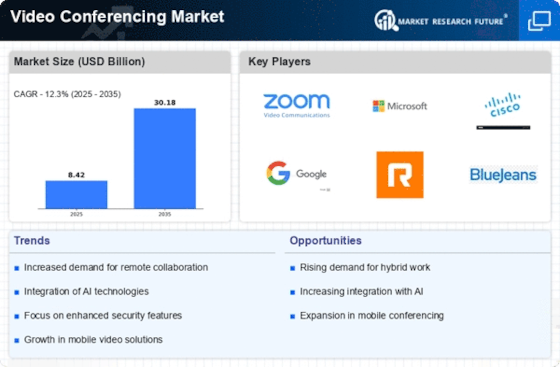
As per Market Research Future analysis, the Video Conferencing Market Size was estimated at 8.423 USD Billion in 2024. The Video Conferencing industry is projected to grow from 9.459 USD Billion in 2025 to 30.18 USD Billion by 2035, exhibiting a compound annual growth rate (CAGR) of 12.3% during the forecast period 2025 - 2035

Key Market Trends & Highlights

The Video Conferencing Market is experiencing robust growth driven by technological advancements and evolving work dynamics.

  • The integration of AI and automation is reshaping user experiences in video conferencing solutions. Security and privacy concerns are becoming paramount as organizations adopt remote collaboration tools. North America remains the largest market, while Asia-Pacific is emerging as the fastest-growing region in video conferencing. The increased demand for remote collaboration and the expansion of e-learning are key drivers propelling market growth.

Market Size & Forecast

2024 Market Size 8.423 (USD Billion)
2035 Market Size 30.18 (USD Billion)
CAGR (2025 - 2035) 12.3%
Largest Regional Market Share in 2024 North America

Major Players

Zoom Video Communications, Inc. (US), Microsoft Corporation (US), Cisco Systems, Inc. (US), Google LLC (US), RingCentral, Inc. (US), BlueJeans Network, Inc. (US), Logitech International S.A. (CH), Lifesize, Inc. (US), Pexip Holding ASA (NO)

Market Trends

The Video Conferencing Market is currently experiencing a transformative phase, characterized by rapid technological advancements and evolving user expectations. Organizations across various sectors are increasingly adopting video conferencing solutions to enhance collaboration, streamline communication, and improve productivity. This shift is driven by the need for flexible work arrangements and the desire for seamless connectivity among remote teams. As a result, the market is witnessing a surge in demand for high-quality video and audio capabilities, along with user-friendly interfaces that facilitate engagement and interaction. Furthermore, the integration of artificial intelligence and machine learning technologies into video conferencing platforms is reshaping the user experience, offering features such as real-time translation and automated meeting summaries. In addition to technological innovations, the Video Conferencing Market is also influenced by changing consumer preferences and the growing emphasis on sustainability. Companies are increasingly prioritizing eco-friendly solutions, which has led to the development of energy-efficient video conferencing systems. This trend reflects a broader commitment to corporate social responsibility and environmental stewardship. As organizations continue to navigate the complexities of a globalized workforce, the Video Conferencing Market is poised for sustained growth, driven by the convergence of technology, user-centric design, and a focus on sustainable practices.

Integration of AI and Automation

The incorporation of artificial intelligence and automation into video conferencing platforms is becoming more prevalent. These technologies enhance user experience by providing features such as virtual backgrounds, noise cancellation, and intelligent meeting scheduling. This trend indicates a shift towards more intuitive and efficient communication tools.

Focus on Security and Privacy

As video conferencing becomes integral to business operations, concerns regarding security and privacy are rising. Companies are increasingly investing in robust encryption methods and secure access protocols to protect sensitive information during virtual meetings. This focus on security suggests a growing awareness of the importance of safeguarding digital communications.

Rise of Hybrid Work Models

The emergence of hybrid work models is reshaping the Video Conferencing Market. Organizations are adopting flexible work arrangements that combine remote and in-office work, necessitating reliable video conferencing solutions. This trend highlights the need for tools that support seamless collaboration across diverse work environments.

Video Conferencing Market Market Drivers

Increased Demand for Remote Collaboration

The Video Conferencing Market experiences heightened demand for remote collaboration tools as organizations seek to enhance productivity and communication. This trend is driven by the need for seamless interaction among distributed teams. According to recent data, the market is projected to grow at a compound annual growth rate of approximately 12% over the next five years. Companies are increasingly adopting video conferencing solutions to facilitate meetings, training sessions, and client interactions, thereby reducing travel costs and time. The shift towards remote work has made video conferencing an essential component of daily operations, leading to a surge in the adoption of advanced features such as screen sharing, virtual backgrounds, and real-time collaboration tools. As businesses recognize the value of effective communication, the Video Conferencing Market is likely to witness sustained growth.

Expansion of E-Learning and Online Education

The expansion of e-learning and online education significantly impacts the Video Conferencing Market. Educational institutions are increasingly adopting video conferencing tools to facilitate remote learning, enabling students to attend classes from anywhere. This shift has led to a surge in demand for platforms that support interactive learning experiences, such as virtual classrooms and webinars. Data indicates that the e-learning market is expected to reach a valuation of over 300 billion dollars by 2025, further driving the need for effective video conferencing solutions. As educational institutions seek to enhance engagement and collaboration among students and instructors, the Video Conferencing Market is poised for substantial growth, catering to the evolving needs of the education sector.

Rising Importance of Global Business Operations

The rising importance of The Video Conferencing Industry. As companies expand their reach across borders, effective communication becomes paramount. Video conferencing solutions enable organizations to connect with clients, partners, and teams worldwide, fostering collaboration and innovation. The ability to conduct meetings in real-time, regardless of geographical location, enhances decision-making processes and accelerates project timelines. Market data suggests that businesses are increasingly investing in video conferencing technologies to support their global operations, with a projected increase in spending on communication tools. This trend underscores the critical role of video conferencing in facilitating international business interactions, thereby propelling the growth of the Video Conferencing Market.

Growing Focus on Employee Well-being and Work-Life Balance

The Video Conferencing Market is increasingly influenced by the growing focus on employee well-being and work-life balance. Organizations are recognizing the importance of mental health and job satisfaction, leading to the adoption of flexible work arrangements. Video conferencing tools facilitate this by enabling employees to participate in meetings from home or other locations, thus reducing commute times and stress. Research suggests that companies that prioritize employee well-being see higher productivity and lower turnover rates. As a result, the demand for video conferencing solutions that support flexible work environments is likely to rise. This trend not only enhances employee satisfaction but also contributes to the overall growth of the Video Conferencing Market.

Technological Advancements in Video Conferencing Solutions

Technological advancements play a pivotal role in shaping the Video Conferencing Market. Innovations such as high-definition video, artificial intelligence, and enhanced audio quality are transforming user experiences. The integration of features like virtual reality and augmented reality is also gaining traction, providing immersive meeting environments. Data indicates that the adoption of AI-driven tools for scheduling and transcription is on the rise, streamlining workflows and improving efficiency. Furthermore, the proliferation of mobile devices has made video conferencing more accessible, allowing users to connect from virtually anywhere. As technology continues to evolve, the Video Conferencing Market is expected to expand, catering to the diverse needs of businesses and individuals alike.

Market Segment Insights

By Component: Hardware (Largest) vs. Software (Fastest-Growing)

In the Video Conferencing Market, the component segment is divided primarily into hardware and software. The hardware segment occupies a substantial share of the market, driven by the demand for conferencing equipment such as cameras, microphones, and integrated devices. While hardware continues to lead, software solutions are rapidly gaining traction, driven by the surge in remote work and digital communication. This shift reflects how businesses are adapting to modern collaboration needs and the increasing reliance on virtual meeting platforms.

Components: Hardware (Dominant) vs. Software (Emerging)

Hardware in the video conferencing segment remains the dominant force, characterized by critical devices such as high-definition cameras and advanced microphones tailored for optimal virtual interactions. Its robustness in providing stable and high-quality connectivity makes it a preferred choice for organizations heavily investing in technology for effective communication. On the other hand, software is emerging rapidly as a vital component in the market, powered by innovations in user experience and integration with cloud services. The growing emphasis on remote collaboration and the proliferation of cloud-based video conferencing tools showcase its potential to reshape communication practices, making it indispensable for future interactions.

By Conference Type: Telepresence System (Largest) vs. Integrated System (Fastest-Growing)

In the video conferencing market, the distribution of market share among different conference types is distinctly defined. Telepresence systems hold the largest share as they provide a comprehensive immersive experience, making them the preferred choice for businesses seeking high-quality communication solutions. Following this, integrated systems are gaining traction due to their versatility and ease of use, catering to diverse environments, such as small offices and large enterprises. Desktop systems and service-based solutions, while significant, have traditionally taken a backseat to these larger categories. The growth trends within the conference type segment are primarily driven by the increasing demand for remote collaboration tools and the advancement of technology. Integrated systems are emerging as the fastest-growing segment, fueled by the shift towards agile work environments. The rise in hybrid working models has also contributed to the popularity of service-based systems that offer customizable solutions for various business needs, while telepresence systems continue to dominate in high-stakes corporate settings.

Telepresence System (Dominant) vs. Integrated System (Emerging)

Telepresence systems are recognized as the dominant force in the video conferencing market due to their ability to deliver lifelike interactions that enhance collaboration. These systems often utilize advanced cameras and high-definition displays, creating a virtual presence that feels almost real. Organizations invest in telepresence to improve communication in crucial meetings, ensuring clarity and engagement. On the other hand, integrated systems represent an emerging class of solutions that combine hardware and software to simplify installation and usage. They are designed to fit seamlessly into existing environments, making them an appealing choice for businesses that need flexible solutions. The rapid adoption of integrated systems is indicative of the ongoing demand for efficient and user-friendly conferencing options.

By Deployment: Cloud (Largest) vs. On-premises (Fastest-Growing)

The video conferencing market is significantly influenced by the deployment methods used by organizations. Currently, the cloud segment dominates the market, favored for its scalability, flexibility, and cost-effectiveness. Companies are increasingly turning to cloud-based solutions for video conferencing, aligning with the modern workforce's need for remote collaboration tools. On-premises solutions, while still relevant, capture a smaller share of the market but are witnessing a rise in adoption due to specific security and compliance requirements of industries such as finance and healthcare.

Deployment: Cloud (Dominant) vs. On-premises (Emerging)

The Cloud deployment method is experiencing widespread acceptance in the video conferencing market due to its ability to support large-scale, seamless collaboration across various geographical locations. It offers benefits such as easy integration, maintenance-free environments, and regular updates without additional costs, making it appealing for businesses of all sizes. In contrast, On-premises solutions, although has been grasping lesser market share, are emerging for businesses that prioritize data sovereignty, control, and customization. Many organizations within highly regulated industries are opting for on-premises settings to mitigate risk associated with third-party data management, positioning them as essential alternatives in specific market niches.

By Enterprise Type: Small and Medium Enterprises (Largest) vs. Large Enterprises (Fastest-Growing)

In the Video Conferencing Market, Small and Medium Enterprises (SMEs) capture the largest share, dominating the landscape with their increasing adoption of online collaboration tools. These SMEs leverage video conferencing solutions to enhance communication, optimize productivity, and reduce costs associated with travel and logistics. Contrastingly, Large Enterprises, while contributing a significant share, are exhibiting rapid growth due to the need for scalable, integrated solutions that facilitate remote work and global operations, adapting to an increasingly digital workplace.

Enterprise Collaboration: Small and Medium Enterprises (Dominant) vs. Large Enterprises (Emerging)

Small and Medium Enterprises (SMEs) are pivotal in the Video Conferencing Market, utilizing cost-effective solutions that fit their unique operational needs. Their agility and capability to quickly adopt innovative technologies allow them to maintain a dominant stance. Meanwhile, Large Enterprises are emerging forcefully, driven by the demand for comprehensive and robust video conferencing systems that support extensive networks and teams worldwide. These organizations are implementing advanced features such as artificial intelligence, security protocols, and analytics to enhance their communication capabilities, pushing them to be the fastest-growing segment as they adapt to evolving workplace demands.

By Application: Huddle Rooms (Largest) vs. Large Rooms (Fastest-Growing)

In the video conferencing market, the application segment showcases diverse use cases, with huddle rooms capturing the largest share due to their suitability for small teams. Huddle rooms are designed for agile collaboration and are increasingly adopted in organizations to facilitate quick meetings and brainstorming sessions. Meanwhile, large rooms, aimed at accommodating bigger groups, are gaining traction as companies transition towards hybrid working models, bringing a notable shift in focus towards larger scale collaboration spaces. The growth in this segment is attributed to the rise in remote work and the need for effective virtual collaboration tools. As organizations invest in advanced audio-visual technologies, the demand for large rooms equipped with comprehensive conferencing solutions is expanding rapidly. This trend is driven by an emphasis on seamless connectivity, user-friendly interfaces, and the necessity of engaging collaboration experiences, ultimately propelling large rooms as the fastest-growing segment in the video conferencing landscape.

Huddle Rooms (Dominant) vs. Large Rooms (Emerging)

Huddle rooms exemplify the dominant force in the video conferencing market, as they cater specifically to the needs of small team dynamics, facilitating rapid communication and project collaboration. These compact spaces are equipped with easy-to-use technology that encourages participation and minimizes barriers to communication. As organizations prioritize agile workflows, huddle rooms have become a staple in modern office designs. They foster creativity while ensuring that collaboration remains efficient and focused. On the other hand, large rooms represent an emerging opportunity within the landscape, specifically designed to handle larger groups and multimedia presentations. Equipped with sophisticated technology for high-quality visuals and sound, these rooms cater to training sessions and large meetings. The emphasis on creating more inclusive and engaging environments is positioning large rooms as essential components in the corporate strategy, thus making them a significant focus for future investment in the video conferencing market.

By Industry: IT & Telecom (Largest) vs. Healthcare (Fastest-Growing)

In the Video Conferencing Market, the IT &amp; Telecom industry currently holds the largest market share, reflecting its dependency on robust communication tools for collaboration and innovation. This segment is characterized by a high demand for effective remote working solutions and unified communications platforms, fueling its market leadership. Other notable segments include Government and BFSI, which also maintain significant shares due to increasing digitization requirements.

IT &amp; Telecom: Dominant vs. Healthcare: Emerging

The IT &amp; Telecom sector continues to dominate the Video Conferencing Market, driven by the necessity for seamless communication solutions among enterprises. This industry's ongoing adoption of advanced technologies like 5G and <a href="https://www.marketresearchfuture.com/reports/artificial-intelligence-market-1139">artificial intelligence enhances</a> video conferencing capabilities and user experiences. In contrast, the Healthcare sector is emerging rapidly, propelled by a growing need for telehealth solutions. The pandemic accelerated the adoption of remote consultations and virtual patient interactions, positioning healthcare providers to invest significantly in video conferencing tools to improve accessibility and patient engagement.

Get more detailed insights about Video Conferencing Market Research Report - Global Forecast till 2035

Regional Insights

North America : Technology Adoption Leader

North America is the largest market for video conferencing, holding approximately 45% of the global share. The region's growth is driven by the increasing adoption of remote work, advancements in internet infrastructure, and a surge in demand for virtual collaboration tools. Regulatory support for digital transformation initiatives further catalyzes market expansion, making it a hub for innovation and technology adoption. The United States leads the market, with significant contributions from Canada. Major players like Zoom, Microsoft, and Cisco dominate the competitive landscape, offering a range of solutions tailored to various sectors. The presence of these key players fosters a dynamic environment, encouraging continuous innovation and improvement in video conferencing technologies.

Europe : Emerging Market Dynamics

Europe is witnessing a rapid increase in the video conferencing market, accounting for approximately 30% of the global share. The growth is fueled by the rise of hybrid work models, regulatory initiatives promoting digital communication, and a strong emphasis on data privacy and security. Countries like Germany and the UK are at the forefront, driving demand for advanced video conferencing solutions that comply with stringent regulations. Leading countries in Europe include Germany, the UK, and France, where companies are increasingly adopting video conferencing tools to enhance productivity and collaboration. Key players such as Logitech and Pexip are making significant inroads, while local startups are also emerging, contributing to a competitive landscape that fosters innovation and diverse offerings.

Asia-Pacific : Rapid Growth Potential

Asia-Pacific is rapidly emerging as a significant player in the video conferencing market, holding around 20% of the global share. The region's growth is driven by increasing internet penetration, a growing number of remote workers, and investments in digital infrastructure. Countries like China and India are leading this growth, supported by government initiatives aimed at enhancing digital communication capabilities. China and India are the largest markets in the region, with a burgeoning demand for video conferencing solutions across various sectors, including education and corporate. The competitive landscape features both global giants and local players, fostering a diverse ecosystem. Companies like Zoom and Microsoft are expanding their presence, while regional firms are innovating to meet local needs, creating a vibrant market environment.

Middle East and Africa : Emerging Digital Landscape

The Middle East and Africa region is experiencing a gradual but steady growth in the video conferencing market, accounting for approximately 5% of the global share. The growth is driven by increasing investments in digital infrastructure, a rise in remote work, and government initiatives aimed at enhancing communication technologies. Countries like South Africa and the UAE are leading this trend, focusing on improving connectivity and digital services. In South Africa and the UAE, the demand for video conferencing solutions is growing across various sectors, including education and healthcare. The competitive landscape is characterized by a mix of international and local players, with companies like Cisco and Zoom establishing a strong foothold. Local startups are also emerging, contributing to the region's digital transformation and enhancing the availability of video conferencing solutions.

Key Players and Competitive Insights

The Video Conferencing Market is currently characterized by a dynamic competitive landscape, driven by rapid technological advancements and an increasing demand for remote collaboration solutions. Major players such as Zoom Video Communications, Inc. (US), Microsoft Corporation (US), and Cisco Systems, Inc. (US) are at the forefront, each adopting distinct strategies to enhance their market positioning. Zoom Video Communications, Inc. (US) continues to focus on innovation, particularly in enhancing user experience through AI-driven features. Meanwhile, Microsoft Corporation (US) leverages its extensive ecosystem, integrating Teams with other Microsoft 365 applications to create a seamless user experience. Cisco Systems, Inc. (US) emphasizes security and reliability, positioning its Webex platform as a trusted solution for enterprise clients. Collectively, these strategies contribute to a competitive environment that is increasingly centered around user-centric innovations and integrated solutions.
In terms of business tactics, companies are increasingly localizing their operations and optimizing supply chains to enhance service delivery and reduce latency. The Video Conferencing Market appears moderately fragmented, with a mix of established players and emerging startups vying for market share. This competitive structure allows for diverse offerings, catering to various customer needs, while the influence of key players like Google LLC (US) and RingCentral, Inc. (US) further intensifies the competition through strategic partnerships and technological advancements.
In August 2025, Zoom Video Communications, Inc. (US) announced a partnership with a leading AI firm to integrate advanced machine learning capabilities into its platform. This strategic move is likely to enhance Zoom's functionality, enabling features such as real-time language translation and improved meeting analytics, thereby solidifying its competitive edge in the market. The integration of AI is expected to attract a broader user base, particularly among international clients seeking efficient communication tools.
In September 2025, Microsoft Corporation (US) unveiled a new suite of features for Teams, focusing on enhanced collaboration tools and improved security protocols. This initiative underscores Microsoft's commitment to maintaining its leadership position in the market by addressing the evolving needs of businesses for secure and efficient communication. The emphasis on security is particularly pertinent, as organizations increasingly prioritize data protection in their digital transformation journeys.
In October 2025, Cisco Systems, Inc. (US) launched a new initiative aimed at promoting sustainable practices within its operations and product offerings. This move not only aligns with global sustainability trends but also positions Cisco as a forward-thinking leader in the Video Conferencing Market. By integrating sustainability into its core strategy, Cisco is likely to appeal to environmentally conscious consumers and businesses, thereby enhancing its brand reputation and market share.
As of October 2025, the Video Conferencing Market is witnessing a shift towards digitalization, with an increasing emphasis on AI integration and sustainability. Strategic alliances among key players are shaping the competitive landscape, fostering innovation and enhancing service offerings. The evolution of competitive differentiation appears to be moving away from price-based competition towards a focus on technological innovation, user experience, and supply chain reliability. This trend suggests that companies that prioritize these aspects will likely emerge as leaders in the increasingly competitive Video Conferencing Market.

Key Companies in the Video Conferencing Market include

Industry Developments

  • Q2 2024: Zoom Video Communications Appoints Former Google Executive Aparna Chennapragada to Board of Directors Zoom announced the appointment of Aparna Chennapragada, a former Google executive, to its Board of Directors, strengthening its leadership team as it continues to expand its video conferencing and collaboration offerings.
  • Q2 2024: Cisco Announces General Availability of Webex AI Assistant for Video Meetings Cisco launched its Webex AI Assistant, a new feature for its video conferencing platform, aiming to enhance meeting productivity with real-time transcription, translation, and automated note-taking.
  • Q2 2024: Zoom acquires Workvivo to expand employee experience platform Zoom completed the acquisition of Workvivo, an employee experience platform, to integrate new engagement and communication tools into its video conferencing suite.
  • Q2 2024: Microsoft Teams launches new AI-powered video conferencing features Microsoft announced the rollout of new AI-powered features for Teams, including real-time language translation and advanced meeting summaries, to improve the video conferencing experience for enterprise users.
  • Q3 2024: RingCentral and Avaya Announce Strategic Partnership to Deliver Unified Video Conferencing Market Solutions RingCentral and Avaya entered into a strategic partnership to jointly develop and market unified video conferencing solutions targeting enterprise customers.
  • Q3 2024: BlueJeans by Verizon Launches Next-Gen Video Conferencing Market Platform with Enhanced Security BlueJeans by Verizon introduced a new version of its video conferencing platform, featuring advanced security controls and improved user interface for business and government clients.
  • Q3 2024: Zoom launches Zoom Docs, a collaborative document platform integrated with video meetings Zoom launched Zoom Docs, a new collaborative document platform that integrates directly with its video conferencing service, aiming to compete with Google Workspace and Microsoft 365.
  • Q4 2024: Google Meet rolls out end-to-end encryption for enterprise video calls Google announced the rollout of end-to-end encryption for Google Meet enterprise video calls, enhancing privacy and security for business users.
  • Q4 2024: Hopin raises $50M Series C to expand video conferencing and virtual events platform Hopin secured $50 million in Series C funding to accelerate the development of its video conferencing and virtual events platform, focusing on new AI-driven features.
  • Q1 2025: Lifesize Appoints New CEO to Drive Growth in Video Conferencing Market Lifesize announced the appointment of a new CEO, signaling a renewed focus on innovation and growth in the competitive video conferencing sector.
  • Q1 2025: Pexip and Logitech Announce Partnership to Deliver Integrated Video Conferencing Market Solutions Pexip and Logitech formed a partnership to offer integrated video conferencing solutions, combining Pexip's software with Logitech's hardware for enterprise customers.
  • Q2 2025: Zoom secures major contract with UK government for secure video conferencing Zoom won a significant contract to provide secure video conferencing services to the UK government, expanding its presence in the public sector.

Future Outlook

Video Conferencing Market Future Outlook

The Video Conferencing Market is projected to grow at a 12.3% CAGR from 2025 to 2035, driven by technological advancements, remote work trends, and increasing demand for collaboration tools.

New opportunities lie in:

  • Integration of AI-driven analytics for user engagement insights.
  • Development of secure, scalable cloud-based conferencing solutions.
  • Expansion into emerging markets with localized service offerings.

By 2035, the market is expected to be robust, reflecting substantial growth and innovation.

Market Segmentation

Video Conferencing Market Industry Outlook

  • IT & Telecom
  • Government
  • Healthcare
  • Manufacturing
  • BFSI
  • Education
  • Media & Entertainment
  • Others

Video Conferencing Market Component Outlook

  • Hardware
  • Software

Video Conferencing Market Deployment Outlook

  • Cloud
  • On-premises

Video Conferencing Market Application Outlook

  • Small Room
  • Huddle Rooms
  • Middle Rooms
  • Large Rooms

Video Conferencing Market Conference Type Outlook

  • Telepresence System
  • Integrated System
  • Desktop System
  • Service-based System
  • Others

Video Conferencing Market Enterprise Type Outlook

  • Small and Medium Enterprises
  • Large Enterprises

Report Scope

MARKET SIZE 2024 8.423(USD Billion)
MARKET SIZE 2025 9.459(USD Billion)
MARKET SIZE 2035 30.18(USD Billion)
COMPOUND ANNUAL GROWTH RATE (CAGR) 12.3% (2025 - 2035)
REPORT COVERAGE Revenue Forecast, Competitive Landscape, Growth Factors, and Trends
BASE YEAR 2024
Market Forecast Period 2025 - 2035
Historical Data 2019 - 2024
Market Forecast Units USD Billion
Key Companies Profiled Zoom Video Communications, Inc. (US), Microsoft Corporation (US), Cisco Systems, Inc. (US), Google LLC (US), RingCentral, Inc. (US), BlueJeans Network, Inc. (US), Logitech International S.A. (CH), Lifesize, Inc. (US), Pexip Holding ASA (NO)
Segments Covered Component, Region - Forecast Till 2035
Key Market Opportunities Integration of artificial intelligence to enhance user experience in the Video Conferencing Market.
Key Market Dynamics Rising demand for seamless remote collaboration drives innovation and competition in the video conferencing market.
Countries Covered North America, Europe, APAC, South America, MEA

FAQs

What is the current valuation of the Video Conferencing Market in 2025?

<p>The Video Conferencing Market is valued at approximately 8.423 USD Billion in 2024.</p>

What is the projected market size for the Video Conferencing Market by 2035?

<p>The market is expected to reach a valuation of 30.18 USD Billion by 2035.</p>

What is the expected CAGR for the Video Conferencing Market during the forecast period 2025 - 2035?

<p>The anticipated CAGR for the Video Conferencing Market during the forecast period is 12.3%.</p>

Which companies are considered key players in the Video Conferencing Market?

<p>Key players include Zoom Video Communications, Microsoft Corporation, Cisco Systems, Google LLC, and RingCentral.</p>

What are the main components of the Video Conferencing Market?

<p>The main components are hardware, valued at 12.0 USD Billion, and software, projected to reach 18.18 USD Billion.</p>

How is the Video Conferencing Market segmented by conference type?

<p>The market segments include telepresence systems, integrated systems, desktop systems, and service-based systems, with values ranging from 5.5 to 8.0 USD Billion.</p>

What is the market valuation for cloud versus on-premises deployment in 2025?

Cloud deployment is projected to reach 18.0 USD Billion, while on-premises deployment is expected to be around 12.18 USD Billion.

How does the Video Conferencing Market perform across different enterprise types?

The market is segmented into small and medium enterprises, valued at 11.0 USD Billion, and large enterprises, projected to reach 19.18 USD Billion.

What applications are driving growth in the Video Conferencing Market?

Applications include small rooms, huddle rooms, middle rooms, and large rooms, with valuations ranging from 5.5 to 9.0 USD Billion.

Which industries are the largest consumers of video conferencing solutions?

The largest consumers include IT &amp; Telecom, Government, Healthcare, and BFSI, with market values ranging from 2.5 to 5.5 USD Billion.

  1. SECTION I: EXECUTIVE SUMMARY AND KEY HIGHLIGHTS
    1. | 1.1 EXECUTIVE SUMMARY
    2. | | 1.1.1 Market Overview
    3. | | 1.1.2 Key Findings
    4. | | 1.1.3 Market Segmentation
    5. | | 1.1.4 Competitive Landscape
    6. | | 1.1.5 Challenges and Opportunities
    7. | | 1.1.6 Future Outlook
  2. SECTION II: SCOPING, METHODOLOGY AND MARKET STRUCTURE
    1. | 2.1 MARKET INTRODUCTION
    2. | | 2.1.1 Definition
    3. | | 2.1.2 Scope of the study
    4. | | | 2.1.2.1 Research Objective
    5. | | | 2.1.2.2 Assumption
    6. | | | 2.1.2.3 Limitations
    7. | 2.2 RESEARCH METHODOLOGY
    8. | | 2.2.1 Overview
    9. | | 2.2.2 Data Mining
    10. | | 2.2.3 Secondary Research
    11. | | 2.2.4 Primary Research
    12. | | | 2.2.4.1 Primary Interviews and Information Gathering Process
    13. | | | 2.2.4.2 Breakdown of Primary Respondents
    14. | | 2.2.5 Forecasting Model
    15. | | 2.2.6 Market Size Estimation
    16. | | | 2.2.6.1 Bottom-Up Approach
    17. | | | 2.2.6.2 Top-Down Approach
    18. | | 2.2.7 Data Triangulation
    19. | | 2.2.8 Validation
  3. SECTION III: QUALITATIVE ANALYSIS
    1. | 3.1 MARKET DYNAMICS
    2. | | 3.1.1 Overview
    3. | | 3.1.2 Drivers
    4. | | 3.1.3 Restraints
    5. | | 3.1.4 Opportunities
    6. | 3.2 MARKET FACTOR ANALYSIS
    7. | | 3.2.1 Value chain Analysis
    8. | | 3.2.2 Porter's Five Forces Analysis
    9. | | | 3.2.2.1 Bargaining Power of Suppliers
    10. | | | 3.2.2.2 Bargaining Power of Buyers
    11. | | | 3.2.2.3 Threat of New Entrants
    12. | | | 3.2.2.4 Threat of Substitutes
    13. | | | 3.2.2.5 Intensity of Rivalry
    14. | | 3.2.3 COVID-19 Impact Analysis
    15. | | | 3.2.3.1 Market Impact Analysis
    16. | | | 3.2.3.2 Regional Impact
    17. | | | 3.2.3.3 Opportunity and Threat Analysis
  4. SECTION IV: QUANTITATIVE ANALYSIS
    1. | 4.1 Information and Communications Technology, BY Component (USD Billion)
    2. | | 4.1.1 Hardware
    3. | | 4.1.2 Software
    4. | 4.2 Information and Communications Technology, BY Conference Type (USD Billion)
    5. | | 4.2.1 Telepresence System
    6. | | 4.2.2 Integrated System
    7. | | 4.2.3 Desktop System
    8. | | 4.2.4 Service-based System
    9. | | 4.2.5 Others
    10. | 4.3 Information and Communications Technology, BY Deployment (USD Billion)
    11. | | 4.3.1 Cloud
    12. | | 4.3.2 On-premises
    13. | 4.4 Information and Communications Technology, BY Enterprise Type (USD Billion)
    14. | | 4.4.1 Small and Medium Enterprises
    15. | | 4.4.2 Large Enterprises
    16. | 4.5 Information and Communications Technology, BY Application (USD Billion)
    17. | | 4.5.1 Small Room
    18. | | 4.5.2 Huddle Rooms
    19. | | 4.5.3 Middle Rooms
    20. | | 4.5.4 Large Rooms
    21. | 4.6 Information and Communications Technology, BY Industry (USD Billion)
    22. | | 4.6.1 IT & Telecom
    23. | | 4.6.2 Government
    24. | | 4.6.3 Healthcare
    25. | | 4.6.4 Manufacturing
    26. | | 4.6.5 BFSI
    27. | | 4.6.6 Education
    28. | | 4.6.7 Media & Entertainment
    29. | | 4.6.8 Others
    30. | 4.7 Information and Communications Technology, BY Region (USD Billion)
    31. | | 4.7.1 North America
    32. | | | 4.7.1.1 US
    33. | | | 4.7.1.2 Canada
    34. | | 4.7.2 Europe
    35. | | | 4.7.2.1 Germany
    36. | | | 4.7.2.2 UK
    37. | | | 4.7.2.3 France
    38. | | | 4.7.2.4 Russia
    39. | | | 4.7.2.5 Italy
    40. | | | 4.7.2.6 Spain
    41. | | | 4.7.2.7 Rest of Europe
    42. | | 4.7.3 APAC
    43. | | | 4.7.3.1 China
    44. | | | 4.7.3.2 India
    45. | | | 4.7.3.3 Japan
    46. | | | 4.7.3.4 South Korea
    47. | | | 4.7.3.5 Malaysia
    48. | | | 4.7.3.6 Thailand
    49. | | | 4.7.3.7 Indonesia
    50. | | | 4.7.3.8 Rest of APAC
    51. | | 4.7.4 South America
    52. | | | 4.7.4.1 Brazil
    53. | | | 4.7.4.2 Mexico
    54. | | | 4.7.4.3 Argentina
    55. | | | 4.7.4.4 Rest of South America
    56. | | 4.7.5 MEA
    57. | | | 4.7.5.1 GCC Countries
    58. | | | 4.7.5.2 South Africa
    59. | | | 4.7.5.3 Rest of MEA
  5. SECTION V: COMPETITIVE ANALYSIS
    1. | 5.1 Competitive Landscape
    2. | | 5.1.1 Overview
    3. | | 5.1.2 Competitive Analysis
    4. | | 5.1.3 Market share Analysis
    5. | | 5.1.4 Major Growth Strategy in the Information and Communications Technology
    6. | | 5.1.5 Competitive Benchmarking
    7. | | 5.1.6 Leading Players in Terms of Number of Developments in the Information and Communications Technology
    8. | | 5.1.7 Key developments and growth strategies
    9. | | | 5.1.7.1 New Product Launch/Service Deployment
    10. | | | 5.1.7.2 Merger & Acquisitions
    11. | | | 5.1.7.3 Joint Ventures
    12. | | 5.1.8 Major Players Financial Matrix
    13. | | | 5.1.8.1 Sales and Operating Income
    14. | | | 5.1.8.2 Major Players R&D Expenditure. 2023
    15. | 5.2 Company Profiles
    16. | | 5.2.1 Zoom Video Communications, Inc. (US)
    17. | | | 5.2.1.1 Financial Overview
    18. | | | 5.2.1.2 Products Offered
    19. | | | 5.2.1.3 Key Developments
    20. | | | 5.2.1.4 SWOT Analysis
    21. | | | 5.2.1.5 Key Strategies
    22. | | 5.2.2 Microsoft Corporation (US)
    23. | | | 5.2.2.1 Financial Overview
    24. | | | 5.2.2.2 Products Offered
    25. | | | 5.2.2.3 Key Developments
    26. | | | 5.2.2.4 SWOT Analysis
    27. | | | 5.2.2.5 Key Strategies
    28. | | 5.2.3 Cisco Systems, Inc. (US)
    29. | | | 5.2.3.1 Financial Overview
    30. | | | 5.2.3.2 Products Offered
    31. | | | 5.2.3.3 Key Developments
    32. | | | 5.2.3.4 SWOT Analysis
    33. | | | 5.2.3.5 Key Strategies
    34. | | 5.2.4 Google LLC (US)
    35. | | | 5.2.4.1 Financial Overview
    36. | | | 5.2.4.2 Products Offered
    37. | | | 5.2.4.3 Key Developments
    38. | | | 5.2.4.4 SWOT Analysis
    39. | | | 5.2.4.5 Key Strategies
    40. | | 5.2.5 RingCentral, Inc. (US)
    41. | | | 5.2.5.1 Financial Overview
    42. | | | 5.2.5.2 Products Offered
    43. | | | 5.2.5.3 Key Developments
    44. | | | 5.2.5.4 SWOT Analysis
    45. | | | 5.2.5.5 Key Strategies
    46. | | 5.2.6 BlueJeans Network, Inc. (US)
    47. | | | 5.2.6.1 Financial Overview
    48. | | | 5.2.6.2 Products Offered
    49. | | | 5.2.6.3 Key Developments
    50. | | | 5.2.6.4 SWOT Analysis
    51. | | | 5.2.6.5 Key Strategies
    52. | | 5.2.7 Logitech International S.A. (CH)
    53. | | | 5.2.7.1 Financial Overview
    54. | | | 5.2.7.2 Products Offered
    55. | | | 5.2.7.3 Key Developments
    56. | | | 5.2.7.4 SWOT Analysis
    57. | | | 5.2.7.5 Key Strategies
    58. | | 5.2.8 Lifesize, Inc. (US)
    59. | | | 5.2.8.1 Financial Overview
    60. | | | 5.2.8.2 Products Offered
    61. | | | 5.2.8.3 Key Developments
    62. | | | 5.2.8.4 SWOT Analysis
    63. | | | 5.2.8.5 Key Strategies
    64. | | 5.2.9 Pexip Holding ASA (NO)
    65. | | | 5.2.9.1 Financial Overview
    66. | | | 5.2.9.2 Products Offered
    67. | | | 5.2.9.3 Key Developments
    68. | | | 5.2.9.4 SWOT Analysis
    69. | | | 5.2.9.5 Key Strategies
    70. | 5.3 Appendix
    71. | | 5.3.1 References
    72. | | 5.3.2 Related Reports
  6. LIST OF FIGURES
    1. | 6.1 MARKET SYNOPSIS
    2. | 6.2 NORTH AMERICA MARKET ANALYSIS
    3. | 6.3 US MARKET ANALYSIS BY COMPONENT
    4. | 6.4 US MARKET ANALYSIS BY CONFERENCE TYPE
    5. | 6.5 US MARKET ANALYSIS BY DEPLOYMENT
    6. | 6.6 US MARKET ANALYSIS BY ENTERPRISE TYPE
    7. | 6.7 US MARKET ANALYSIS BY APPLICATION
    8. | 6.8 US MARKET ANALYSIS BY INDUSTRY
    9. | 6.9 CANADA MARKET ANALYSIS BY COMPONENT
    10. | 6.10 CANADA MARKET ANALYSIS BY CONFERENCE TYPE
    11. | 6.11 CANADA MARKET ANALYSIS BY DEPLOYMENT
    12. | 6.12 CANADA MARKET ANALYSIS BY ENTERPRISE TYPE
    13. | 6.13 CANADA MARKET ANALYSIS BY APPLICATION
    14. | 6.14 CANADA MARKET ANALYSIS BY INDUSTRY
    15. | 6.15 EUROPE MARKET ANALYSIS
    16. | 6.16 GERMANY MARKET ANALYSIS BY COMPONENT
    17. | 6.17 GERMANY MARKET ANALYSIS BY CONFERENCE TYPE
    18. | 6.18 GERMANY MARKET ANALYSIS BY DEPLOYMENT
    19. | 6.19 GERMANY MARKET ANALYSIS BY ENTERPRISE TYPE
    20. | 6.20 GERMANY MARKET ANALYSIS BY APPLICATION
    21. | 6.21 GERMANY MARKET ANALYSIS BY INDUSTRY
    22. | 6.22 UK MARKET ANALYSIS BY COMPONENT
    23. | 6.23 UK MARKET ANALYSIS BY CONFERENCE TYPE
    24. | 6.24 UK MARKET ANALYSIS BY DEPLOYMENT
    25. | 6.25 UK MARKET ANALYSIS BY ENTERPRISE TYPE
    26. | 6.26 UK MARKET ANALYSIS BY APPLICATION
    27. | 6.27 UK MARKET ANALYSIS BY INDUSTRY
    28. | 6.28 FRANCE MARKET ANALYSIS BY COMPONENT
    29. | 6.29 FRANCE MARKET ANALYSIS BY CONFERENCE TYPE
    30. | 6.30 FRANCE MARKET ANALYSIS BY DEPLOYMENT
    31. | 6.31 FRANCE MARKET ANALYSIS BY ENTERPRISE TYPE
    32. | 6.32 FRANCE MARKET ANALYSIS BY APPLICATION
    33. | 6.33 FRANCE MARKET ANALYSIS BY INDUSTRY
    34. | 6.34 RUSSIA MARKET ANALYSIS BY COMPONENT
    35. | 6.35 RUSSIA MARKET ANALYSIS BY CONFERENCE TYPE
    36. | 6.36 RUSSIA MARKET ANALYSIS BY DEPLOYMENT
    37. | 6.37 RUSSIA MARKET ANALYSIS BY ENTERPRISE TYPE
    38. | 6.38 RUSSIA MARKET ANALYSIS BY APPLICATION
    39. | 6.39 RUSSIA MARKET ANALYSIS BY INDUSTRY
    40. | 6.40 ITALY MARKET ANALYSIS BY COMPONENT
    41. | 6.41 ITALY MARKET ANALYSIS BY CONFERENCE TYPE
    42. | 6.42 ITALY MARKET ANALYSIS BY DEPLOYMENT
    43. | 6.43 ITALY MARKET ANALYSIS BY ENTERPRISE TYPE
    44. | 6.44 ITALY MARKET ANALYSIS BY APPLICATION
    45. | 6.45 ITALY MARKET ANALYSIS BY INDUSTRY
    46. | 6.46 SPAIN MARKET ANALYSIS BY COMPONENT
    47. | 6.47 SPAIN MARKET ANALYSIS BY CONFERENCE TYPE
    48. | 6.48 SPAIN MARKET ANALYSIS BY DEPLOYMENT
    49. | 6.49 SPAIN MARKET ANALYSIS BY ENTERPRISE TYPE
    50. | 6.50 SPAIN MARKET ANALYSIS BY APPLICATION
    51. | 6.51 SPAIN MARKET ANALYSIS BY INDUSTRY
    52. | 6.52 REST OF EUROPE MARKET ANALYSIS BY COMPONENT
    53. | 6.53 REST OF EUROPE MARKET ANALYSIS BY CONFERENCE TYPE
    54. | 6.54 REST OF EUROPE MARKET ANALYSIS BY DEPLOYMENT
    55. | 6.55 REST OF EUROPE MARKET ANALYSIS BY ENTERPRISE TYPE
    56. | 6.56 REST OF EUROPE MARKET ANALYSIS BY APPLICATION
    57. | 6.57 REST OF EUROPE MARKET ANALYSIS BY INDUSTRY
    58. | 6.58 APAC MARKET ANALYSIS
    59. | 6.59 CHINA MARKET ANALYSIS BY COMPONENT
    60. | 6.60 CHINA MARKET ANALYSIS BY CONFERENCE TYPE
    61. | 6.61 CHINA MARKET ANALYSIS BY DEPLOYMENT
    62. | 6.62 CHINA MARKET ANALYSIS BY ENTERPRISE TYPE
    63. | 6.63 CHINA MARKET ANALYSIS BY APPLICATION
    64. | 6.64 CHINA MARKET ANALYSIS BY INDUSTRY
    65. | 6.65 INDIA MARKET ANALYSIS BY COMPONENT
    66. | 6.66 INDIA MARKET ANALYSIS BY CONFERENCE TYPE
    67. | 6.67 INDIA MARKET ANALYSIS BY DEPLOYMENT
    68. | 6.68 INDIA MARKET ANALYSIS BY ENTERPRISE TYPE
    69. | 6.69 INDIA MARKET ANALYSIS BY APPLICATION
    70. | 6.70 INDIA MARKET ANALYSIS BY INDUSTRY
    71. | 6.71 JAPAN MARKET ANALYSIS BY COMPONENT
    72. | 6.72 JAPAN MARKET ANALYSIS BY CONFERENCE TYPE
    73. | 6.73 JAPAN MARKET ANALYSIS BY DEPLOYMENT
    74. | 6.74 JAPAN MARKET ANALYSIS BY ENTERPRISE TYPE
    75. | 6.75 JAPAN MARKET ANALYSIS BY APPLICATION
    76. | 6.76 JAPAN MARKET ANALYSIS BY INDUSTRY
    77. | 6.77 SOUTH KOREA MARKET ANALYSIS BY COMPONENT
    78. | 6.78 SOUTH KOREA MARKET ANALYSIS BY CONFERENCE TYPE
    79. | 6.79 SOUTH KOREA MARKET ANALYSIS BY DEPLOYMENT
    80. | 6.80 SOUTH KOREA MARKET ANALYSIS BY ENTERPRISE TYPE
    81. | 6.81 SOUTH KOREA MARKET ANALYSIS BY APPLICATION
    82. | 6.82 SOUTH KOREA MARKET ANALYSIS BY INDUSTRY
    83. | 6.83 MALAYSIA MARKET ANALYSIS BY COMPONENT
    84. | 6.84 MALAYSIA MARKET ANALYSIS BY CONFERENCE TYPE
    85. | 6.85 MALAYSIA MARKET ANALYSIS BY DEPLOYMENT
    86. | 6.86 MALAYSIA MARKET ANALYSIS BY ENTERPRISE TYPE
    87. | 6.87 MALAYSIA MARKET ANALYSIS BY APPLICATION
    88. | 6.88 MALAYSIA MARKET ANALYSIS BY INDUSTRY
    89. | 6.89 THAILAND MARKET ANALYSIS BY COMPONENT
    90. | 6.90 THAILAND MARKET ANALYSIS BY CONFERENCE TYPE
    91. | 6.91 THAILAND MARKET ANALYSIS BY DEPLOYMENT
    92. | 6.92 THAILAND MARKET ANALYSIS BY ENTERPRISE TYPE
    93. | 6.93 THAILAND MARKET ANALYSIS BY APPLICATION
    94. | 6.94 THAILAND MARKET ANALYSIS BY INDUSTRY
    95. | 6.95 INDONESIA MARKET ANALYSIS BY COMPONENT
    96. | 6.96 INDONESIA MARKET ANALYSIS BY CONFERENCE TYPE
    97. | 6.97 INDONESIA MARKET ANALYSIS BY DEPLOYMENT
    98. | 6.98 INDONESIA MARKET ANALYSIS BY ENTERPRISE TYPE
    99. | 6.99 INDONESIA MARKET ANALYSIS BY APPLICATION
    100. | 6.100 INDONESIA MARKET ANALYSIS BY INDUSTRY
    101. | 6.101 REST OF APAC MARKET ANALYSIS BY COMPONENT
    102. | 6.102 REST OF APAC MARKET ANALYSIS BY CONFERENCE TYPE
    103. | 6.103 REST OF APAC MARKET ANALYSIS BY DEPLOYMENT
    104. | 6.104 REST OF APAC MARKET ANALYSIS BY ENTERPRISE TYPE
    105. | 6.105 REST OF APAC MARKET ANALYSIS BY APPLICATION
    106. | 6.106 REST OF APAC MARKET ANALYSIS BY INDUSTRY
    107. | 6.107 SOUTH AMERICA MARKET ANALYSIS
    108. | 6.108 BRAZIL MARKET ANALYSIS BY COMPONENT
    109. | 6.109 BRAZIL MARKET ANALYSIS BY CONFERENCE TYPE
    110. | 6.110 BRAZIL MARKET ANALYSIS BY DEPLOYMENT
    111. | 6.111 BRAZIL MARKET ANALYSIS BY ENTERPRISE TYPE
    112. | 6.112 BRAZIL MARKET ANALYSIS BY APPLICATION
    113. | 6.113 BRAZIL MARKET ANALYSIS BY INDUSTRY
    114. | 6.114 MEXICO MARKET ANALYSIS BY COMPONENT
    115. | 6.115 MEXICO MARKET ANALYSIS BY CONFERENCE TYPE
    116. | 6.116 MEXICO MARKET ANALYSIS BY DEPLOYMENT
    117. | 6.117 MEXICO MARKET ANALYSIS BY ENTERPRISE TYPE
    118. | 6.118 MEXICO MARKET ANALYSIS BY APPLICATION
    119. | 6.119 MEXICO MARKET ANALYSIS BY INDUSTRY
    120. | 6.120 ARGENTINA MARKET ANALYSIS BY COMPONENT
    121. | 6.121 ARGENTINA MARKET ANALYSIS BY CONFERENCE TYPE
    122. | 6.122 ARGENTINA MARKET ANALYSIS BY DEPLOYMENT
    123. | 6.123 ARGENTINA MARKET ANALYSIS BY ENTERPRISE TYPE
    124. | 6.124 ARGENTINA MARKET ANALYSIS BY APPLICATION
    125. | 6.125 ARGENTINA MARKET ANALYSIS BY INDUSTRY
    126. | 6.126 REST OF SOUTH AMERICA MARKET ANALYSIS BY COMPONENT
    127. | 6.127 REST OF SOUTH AMERICA MARKET ANALYSIS BY CONFERENCE TYPE
    128. | 6.128 REST OF SOUTH AMERICA MARKET ANALYSIS BY DEPLOYMENT
    129. | 6.129 REST OF SOUTH AMERICA MARKET ANALYSIS BY ENTERPRISE TYPE
    130. | 6.130 REST OF SOUTH AMERICA MARKET ANALYSIS BY APPLICATION
    131. | 6.131 REST OF SOUTH AMERICA MARKET ANALYSIS BY INDUSTRY
    132. | 6.132 MEA MARKET ANALYSIS
    133. | 6.133 GCC COUNTRIES MARKET ANALYSIS BY COMPONENT
    134. | 6.134 GCC COUNTRIES MARKET ANALYSIS BY CONFERENCE TYPE
    135. | 6.135 GCC COUNTRIES MARKET ANALYSIS BY DEPLOYMENT
    136. | 6.136 GCC COUNTRIES MARKET ANALYSIS BY ENTERPRISE TYPE
    137. | 6.137 GCC COUNTRIES MARKET ANALYSIS BY APPLICATION
    138. | 6.138 GCC COUNTRIES MARKET ANALYSIS BY INDUSTRY
    139. | 6.139 SOUTH AFRICA MARKET ANALYSIS BY COMPONENT
    140. | 6.140 SOUTH AFRICA MARKET ANALYSIS BY CONFERENCE TYPE
    141. | 6.141 SOUTH AFRICA MARKET ANALYSIS BY DEPLOYMENT
    142. | 6.142 SOUTH AFRICA MARKET ANALYSIS BY ENTERPRISE TYPE
    143. | 6.143 SOUTH AFRICA MARKET ANALYSIS BY APPLICATION
    144. | 6.144 SOUTH AFRICA MARKET ANALYSIS BY INDUSTRY
    145. | 6.145 REST OF MEA MARKET ANALYSIS BY COMPONENT
    146. | 6.146 REST OF MEA MARKET ANALYSIS BY CONFERENCE TYPE
    147. | 6.147 REST OF MEA MARKET ANALYSIS BY DEPLOYMENT
    148. | 6.148 REST OF MEA MARKET ANALYSIS BY ENTERPRISE TYPE
    149. | 6.149 REST OF MEA MARKET ANALYSIS BY APPLICATION
    150. | 6.150 REST OF MEA MARKET ANALYSIS BY INDUSTRY
    151. | 6.151 KEY BUYING CRITERIA OF INFORMATION AND COMMUNICATIONS TECHNOLOGY
    152. | 6.152 RESEARCH PROCESS OF MRFR
    153. | 6.153 DRO ANALYSIS OF INFORMATION AND COMMUNICATIONS TECHNOLOGY
    154. | 6.154 DRIVERS IMPACT ANALYSIS: INFORMATION AND COMMUNICATIONS TECHNOLOGY
    155. | 6.155 RESTRAINTS IMPACT ANALYSIS: INFORMATION AND COMMUNICATIONS TECHNOLOGY
    156. | 6.156 SUPPLY / VALUE CHAIN: INFORMATION AND COMMUNICATIONS TECHNOLOGY
    157. | 6.157 INFORMATION AND COMMUNICATIONS TECHNOLOGY, BY COMPONENT, 2024 (% SHARE)
    158. | 6.158 INFORMATION AND COMMUNICATIONS TECHNOLOGY, BY COMPONENT, 2024 TO 2035 (USD Billion)
    159. | 6.159 INFORMATION AND COMMUNICATIONS TECHNOLOGY, BY CONFERENCE TYPE, 2024 (% SHARE)
    160. | 6.160 INFORMATION AND COMMUNICATIONS TECHNOLOGY, BY CONFERENCE TYPE, 2024 TO 2035 (USD Billion)
    161. | 6.161 INFORMATION AND COMMUNICATIONS TECHNOLOGY, BY DEPLOYMENT, 2024 (% SHARE)
    162. | 6.162 INFORMATION AND COMMUNICATIONS TECHNOLOGY, BY DEPLOYMENT, 2024 TO 2035 (USD Billion)
    163. | 6.163 INFORMATION AND COMMUNICATIONS TECHNOLOGY, BY ENTERPRISE TYPE, 2024 (% SHARE)
    164. | 6.164 INFORMATION AND COMMUNICATIONS TECHNOLOGY, BY ENTERPRISE TYPE, 2024 TO 2035 (USD Billion)
    165. | 6.165 INFORMATION AND COMMUNICATIONS TECHNOLOGY, BY APPLICATION, 2024 (% SHARE)
    166. | 6.166 INFORMATION AND COMMUNICATIONS TECHNOLOGY, BY APPLICATION, 2024 TO 2035 (USD Billion)
    167. | 6.167 INFORMATION AND COMMUNICATIONS TECHNOLOGY, BY INDUSTRY, 2024 (% SHARE)
    168. | 6.168 INFORMATION AND COMMUNICATIONS TECHNOLOGY, BY INDUSTRY, 2024 TO 2035 (USD Billion)
    169. | 6.169 BENCHMARKING OF MAJOR COMPETITORS
  7. LIST OF TABLES
    1. | 7.1 LIST OF ASSUMPTIONS
    2. | | 7.1.1
    3. | 7.2 North America MARKET SIZE ESTIMATES; FORECAST
    4. | | 7.2.1 BY COMPONENT, 2025-2035 (USD Billion)
    5. | | 7.2.2 BY CONFERENCE TYPE, 2025-2035 (USD Billion)
    6. | | 7.2.3 BY DEPLOYMENT, 2025-2035 (USD Billion)
    7. | | 7.2.4 BY ENTERPRISE TYPE, 2025-2035 (USD Billion)
    8. | | 7.2.5 BY APPLICATION, 2025-2035 (USD Billion)
    9. | | 7.2.6 BY INDUSTRY, 2025-2035 (USD Billion)
    10. | 7.3 US MARKET SIZE ESTIMATES; FORECAST
    11. | | 7.3.1 BY COMPONENT, 2025-2035 (USD Billion)
    12. | | 7.3.2 BY CONFERENCE TYPE, 2025-2035 (USD Billion)
    13. | | 7.3.3 BY DEPLOYMENT, 2025-2035 (USD Billion)
    14. | | 7.3.4 BY ENTERPRISE TYPE, 2025-2035 (USD Billion)
    15. | | 7.3.5 BY APPLICATION, 2025-2035 (USD Billion)
    16. | | 7.3.6 BY INDUSTRY, 2025-2035 (USD Billion)
    17. | 7.4 Canada MARKET SIZE ESTIMATES; FORECAST
    18. | | 7.4.1 BY COMPONENT, 2025-2035 (USD Billion)
    19. | | 7.4.2 BY CONFERENCE TYPE, 2025-2035 (USD Billion)
    20. | | 7.4.3 BY DEPLOYMENT, 2025-2035 (USD Billion)
    21. | | 7.4.4 BY ENTERPRISE TYPE, 2025-2035 (USD Billion)
    22. | | 7.4.5 BY APPLICATION, 2025-2035 (USD Billion)
    23. | | 7.4.6 BY INDUSTRY, 2025-2035 (USD Billion)
    24. | 7.5 Europe MARKET SIZE ESTIMATES; FORECAST
    25. | | 7.5.1 BY COMPONENT, 2025-2035 (USD Billion)
    26. | | 7.5.2 BY CONFERENCE TYPE, 2025-2035 (USD Billion)
    27. | | 7.5.3 BY DEPLOYMENT, 2025-2035 (USD Billion)
    28. | | 7.5.4 BY ENTERPRISE TYPE, 2025-2035 (USD Billion)
    29. | | 7.5.5 BY APPLICATION, 2025-2035 (USD Billion)
    30. | | 7.5.6 BY INDUSTRY, 2025-2035 (USD Billion)
    31. | 7.6 Germany MARKET SIZE ESTIMATES; FORECAST
    32. | | 7.6.1 BY COMPONENT, 2025-2035 (USD Billion)
    33. | | 7.6.2 BY CONFERENCE TYPE, 2025-2035 (USD Billion)
    34. | | 7.6.3 BY DEPLOYMENT, 2025-2035 (USD Billion)
    35. | | 7.6.4 BY ENTERPRISE TYPE, 2025-2035 (USD Billion)
    36. | | 7.6.5 BY APPLICATION, 2025-2035 (USD Billion)
    37. | | 7.6.6 BY INDUSTRY, 2025-2035 (USD Billion)
    38. | 7.7 UK MARKET SIZE ESTIMATES; FORECAST
    39. | | 7.7.1 BY COMPONENT, 2025-2035 (USD Billion)
    40. | | 7.7.2 BY CONFERENCE TYPE, 2025-2035 (USD Billion)
    41. | | 7.7.3 BY DEPLOYMENT, 2025-2035 (USD Billion)
    42. | | 7.7.4 BY ENTERPRISE TYPE, 2025-2035 (USD Billion)
    43. | | 7.7.5 BY APPLICATION, 2025-2035 (USD Billion)
    44. | | 7.7.6 BY INDUSTRY, 2025-2035 (USD Billion)
    45. | 7.8 France MARKET SIZE ESTIMATES; FORECAST
    46. | | 7.8.1 BY COMPONENT, 2025-2035 (USD Billion)
    47. | | 7.8.2 BY CONFERENCE TYPE, 2025-2035 (USD Billion)
    48. | | 7.8.3 BY DEPLOYMENT, 2025-2035 (USD Billion)
    49. | | 7.8.4 BY ENTERPRISE TYPE, 2025-2035 (USD Billion)
    50. | | 7.8.5 BY APPLICATION, 2025-2035 (USD Billion)
    51. | | 7.8.6 BY INDUSTRY, 2025-2035 (USD Billion)
    52. | 7.9 Russia MARKET SIZE ESTIMATES; FORECAST
    53. | | 7.9.1 BY COMPONENT, 2025-2035 (USD Billion)
    54. | | 7.9.2 BY CONFERENCE TYPE, 2025-2035 (USD Billion)
    55. | | 7.9.3 BY DEPLOYMENT, 2025-2035 (USD Billion)
    56. | | 7.9.4 BY ENTERPRISE TYPE, 2025-2035 (USD Billion)
    57. | | 7.9.5 BY APPLICATION, 2025-2035 (USD Billion)
    58. | | 7.9.6 BY INDUSTRY, 2025-2035 (USD Billion)
    59. | 7.10 Italy MARKET SIZE ESTIMATES; FORECAST
    60. | | 7.10.1 BY COMPONENT, 2025-2035 (USD Billion)
    61. | | 7.10.2 BY CONFERENCE TYPE, 2025-2035 (USD Billion)
    62. | | 7.10.3 BY DEPLOYMENT, 2025-2035 (USD Billion)
    63. | | 7.10.4 BY ENTERPRISE TYPE, 2025-2035 (USD Billion)
    64. | | 7.10.5 BY APPLICATION, 2025-2035 (USD Billion)
    65. | | 7.10.6 BY INDUSTRY, 2025-2035 (USD Billion)
    66. | 7.11 Spain MARKET SIZE ESTIMATES; FORECAST
    67. | | 7.11.1 BY COMPONENT, 2025-2035 (USD Billion)
    68. | | 7.11.2 BY CONFERENCE TYPE, 2025-2035 (USD Billion)
    69. | | 7.11.3 BY DEPLOYMENT, 2025-2035 (USD Billion)
    70. | | 7.11.4 BY ENTERPRISE TYPE, 2025-2035 (USD Billion)
    71. | | 7.11.5 BY APPLICATION, 2025-2035 (USD Billion)
    72. | | 7.11.6 BY INDUSTRY, 2025-2035 (USD Billion)
    73. | 7.12 Rest of Europe MARKET SIZE ESTIMATES; FORECAST
    74. | | 7.12.1 BY COMPONENT, 2025-2035 (USD Billion)
    75. | | 7.12.2 BY CONFERENCE TYPE, 2025-2035 (USD Billion)
    76. | | 7.12.3 BY DEPLOYMENT, 2025-2035 (USD Billion)
    77. | | 7.12.4 BY ENTERPRISE TYPE, 2025-2035 (USD Billion)
    78. | | 7.12.5 BY APPLICATION, 2025-2035 (USD Billion)
    79. | | 7.12.6 BY INDUSTRY, 2025-2035 (USD Billion)
    80. | 7.13 APAC MARKET SIZE ESTIMATES; FORECAST
    81. | | 7.13.1 BY COMPONENT, 2025-2035 (USD Billion)
    82. | | 7.13.2 BY CONFERENCE TYPE, 2025-2035 (USD Billion)
    83. | | 7.13.3 BY DEPLOYMENT, 2025-2035 (USD Billion)
    84. | | 7.13.4 BY ENTERPRISE TYPE, 2025-2035 (USD Billion)
    85. | | 7.13.5 BY APPLICATION, 2025-2035 (USD Billion)
    86. | | 7.13.6 BY INDUSTRY, 2025-2035 (USD Billion)
    87. | 7.14 China MARKET SIZE ESTIMATES; FORECAST
    88. | | 7.14.1 BY COMPONENT, 2025-2035 (USD Billion)
    89. | | 7.14.2 BY CONFERENCE TYPE, 2025-2035 (USD Billion)
    90. | | 7.14.3 BY DEPLOYMENT, 2025-2035 (USD Billion)
    91. | | 7.14.4 BY ENTERPRISE TYPE, 2025-2035 (USD Billion)
    92. | | 7.14.5 BY APPLICATION, 2025-2035 (USD Billion)
    93. | | 7.14.6 BY INDUSTRY, 2025-2035 (USD Billion)
    94. | 7.15 India MARKET SIZE ESTIMATES; FORECAST
    95. | | 7.15.1 BY COMPONENT, 2025-2035 (USD Billion)
    96. | | 7.15.2 BY CONFERENCE TYPE, 2025-2035 (USD Billion)
    97. | | 7.15.3 BY DEPLOYMENT, 2025-2035 (USD Billion)
    98. | | 7.15.4 BY ENTERPRISE TYPE, 2025-2035 (USD Billion)
    99. | | 7.15.5 BY APPLICATION, 2025-2035 (USD Billion)
    100. | | 7.15.6 BY INDUSTRY, 2025-2035 (USD Billion)
    101. | 7.16 Japan MARKET SIZE ESTIMATES; FORECAST
    102. | | 7.16.1 BY COMPONENT, 2025-2035 (USD Billion)
    103. | | 7.16.2 BY CONFERENCE TYPE, 2025-2035 (USD Billion)
    104. | | 7.16.3 BY DEPLOYMENT, 2025-2035 (USD Billion)
    105. | | 7.16.4 BY ENTERPRISE TYPE, 2025-2035 (USD Billion)
    106. | | 7.16.5 BY APPLICATION, 2025-2035 (USD Billion)
    107. | | 7.16.6 BY INDUSTRY, 2025-2035 (USD Billion)
    108. | 7.17 South Korea MARKET SIZE ESTIMATES; FORECAST
    109. | | 7.17.1 BY COMPONENT, 2025-2035 (USD Billion)
    110. | | 7.17.2 BY CONFERENCE TYPE, 2025-2035 (USD Billion)
    111. | | 7.17.3 BY DEPLOYMENT, 2025-2035 (USD Billion)
    112. | | 7.17.4 BY ENTERPRISE TYPE, 2025-2035 (USD Billion)
    113. | | 7.17.5 BY APPLICATION, 2025-2035 (USD Billion)
    114. | | 7.17.6 BY INDUSTRY, 2025-2035 (USD Billion)
    115. | 7.18 Malaysia MARKET SIZE ESTIMATES; FORECAST
    116. | | 7.18.1 BY COMPONENT, 2025-2035 (USD Billion)
    117. | | 7.18.2 BY CONFERENCE TYPE, 2025-2035 (USD Billion)
    118. | | 7.18.3 BY DEPLOYMENT, 2025-2035 (USD Billion)
    119. | | 7.18.4 BY ENTERPRISE TYPE, 2025-2035 (USD Billion)
    120. | | 7.18.5 BY APPLICATION, 2025-2035 (USD Billion)
    121. | | 7.18.6 BY INDUSTRY, 2025-2035 (USD Billion)
    122. | 7.19 Thailand MARKET SIZE ESTIMATES; FORECAST
    123. | | 7.19.1 BY COMPONENT, 2025-2035 (USD Billion)
    124. | | 7.19.2 BY CONFERENCE TYPE, 2025-2035 (USD Billion)
    125. | | 7.19.3 BY DEPLOYMENT, 2025-2035 (USD Billion)
    126. | | 7.19.4 BY ENTERPRISE TYPE, 2025-2035 (USD Billion)
    127. | | 7.19.5 BY APPLICATION, 2025-2035 (USD Billion)
    128. | | 7.19.6 BY INDUSTRY, 2025-2035 (USD Billion)
    129. | 7.20 Indonesia MARKET SIZE ESTIMATES; FORECAST
    130. | | 7.20.1 BY COMPONENT, 2025-2035 (USD Billion)
    131. | | 7.20.2 BY CONFERENCE TYPE, 2025-2035 (USD Billion)
    132. | | 7.20.3 BY DEPLOYMENT, 2025-2035 (USD Billion)
    133. | | 7.20.4 BY ENTERPRISE TYPE, 2025-2035 (USD Billion)
    134. | | 7.20.5 BY APPLICATION, 2025-2035 (USD Billion)
    135. | | 7.20.6 BY INDUSTRY, 2025-2035 (USD Billion)
    136. | 7.21 Rest of APAC MARKET SIZE ESTIMATES; FORECAST
    137. | | 7.21.1 BY COMPONENT, 2025-2035 (USD Billion)
    138. | | 7.21.2 BY CONFERENCE TYPE, 2025-2035 (USD Billion)
    139. | | 7.21.3 BY DEPLOYMENT, 2025-2035 (USD Billion)
    140. | | 7.21.4 BY ENTERPRISE TYPE, 2025-2035 (USD Billion)
    141. | | 7.21.5 BY APPLICATION, 2025-2035 (USD Billion)
    142. | | 7.21.6 BY INDUSTRY, 2025-2035 (USD Billion)
    143. | 7.22 South America MARKET SIZE ESTIMATES; FORECAST
    144. | | 7.22.1 BY COMPONENT, 2025-2035 (USD Billion)
    145. | | 7.22.2 BY CONFERENCE TYPE, 2025-2035 (USD Billion)
    146. | | 7.22.3 BY DEPLOYMENT, 2025-2035 (USD Billion)
    147. | | 7.22.4 BY ENTERPRISE TYPE, 2025-2035 (USD Billion)
    148. | | 7.22.5 BY APPLICATION, 2025-2035 (USD Billion)
    149. | | 7.22.6 BY INDUSTRY, 2025-2035 (USD Billion)
    150. | 7.23 Brazil MARKET SIZE ESTIMATES; FORECAST
    151. | | 7.23.1 BY COMPONENT, 2025-2035 (USD Billion)
    152. | | 7.23.2 BY CONFERENCE TYPE, 2025-2035 (USD Billion)
    153. | | 7.23.3 BY DEPLOYMENT, 2025-2035 (USD Billion)
    154. | | 7.23.4 BY ENTERPRISE TYPE, 2025-2035 (USD Billion)
    155. | | 7.23.5 BY APPLICATION, 2025-2035 (USD Billion)
    156. | | 7.23.6 BY INDUSTRY, 2025-2035 (USD Billion)
    157. | 7.24 Mexico MARKET SIZE ESTIMATES; FORECAST
    158. | | 7.24.1 BY COMPONENT, 2025-2035 (USD Billion)
    159. | | 7.24.2 BY CONFERENCE TYPE, 2025-2035 (USD Billion)
    160. | | 7.24.3 BY DEPLOYMENT, 2025-2035 (USD Billion)
    161. | | 7.24.4 BY ENTERPRISE TYPE, 2025-2035 (USD Billion)
    162. | | 7.24.5 BY APPLICATION, 2025-2035 (USD Billion)
    163. | | 7.24.6 BY INDUSTRY, 2025-2035 (USD Billion)
    164. | 7.25 Argentina MARKET SIZE ESTIMATES; FORECAST
    165. | | 7.25.1 BY COMPONENT, 2025-2035 (USD Billion)
    166. | | 7.25.2 BY CONFERENCE TYPE, 2025-2035 (USD Billion)
    167. | | 7.25.3 BY DEPLOYMENT, 2025-2035 (USD Billion)
    168. | | 7.25.4 BY ENTERPRISE TYPE, 2025-2035 (USD Billion)
    169. | | 7.25.5 BY APPLICATION, 2025-2035 (USD Billion)
    170. | | 7.25.6 BY INDUSTRY, 2025-2035 (USD Billion)
    171. | 7.26 Rest of South America MARKET SIZE ESTIMATES; FORECAST
    172. | | 7.26.1 BY COMPONENT, 2025-2035 (USD Billion)
    173. | | 7.26.2 BY CONFERENCE TYPE, 2025-2035 (USD Billion)
    174. | | 7.26.3 BY DEPLOYMENT, 2025-2035 (USD Billion)
    175. | | 7.26.4 BY ENTERPRISE TYPE, 2025-2035 (USD Billion)
    176. | | 7.26.5 BY APPLICATION, 2025-2035 (USD Billion)
    177. | | 7.26.6 BY INDUSTRY, 2025-2035 (USD Billion)
    178. | 7.27 MEA MARKET SIZE ESTIMATES; FORECAST
    179. | | 7.27.1 BY COMPONENT, 2025-2035 (USD Billion)
    180. | | 7.27.2 BY CONFERENCE TYPE, 2025-2035 (USD Billion)
    181. | | 7.27.3 BY DEPLOYMENT, 2025-2035 (USD Billion)
    182. | | 7.27.4 BY ENTERPRISE TYPE, 2025-2035 (USD Billion)
    183. | | 7.27.5 BY APPLICATION, 2025-2035 (USD Billion)
    184. | | 7.27.6 BY INDUSTRY, 2025-2035 (USD Billion)
    185. | 7.28 GCC Countries MARKET SIZE ESTIMATES; FORECAST
    186. | | 7.28.1 BY COMPONENT, 2025-2035 (USD Billion)
    187. | | 7.28.2 BY CONFERENCE TYPE, 2025-2035 (USD Billion)
    188. | | 7.28.3 BY DEPLOYMENT, 2025-2035 (USD Billion)
    189. | | 7.28.4 BY ENTERPRISE TYPE, 2025-2035 (USD Billion)
    190. | | 7.28.5 BY APPLICATION, 2025-2035 (USD Billion)
    191. | | 7.28.6 BY INDUSTRY, 2025-2035 (USD Billion)
    192. | 7.29 South Africa MARKET SIZE ESTIMATES; FORECAST
    193. | | 7.29.1 BY COMPONENT, 2025-2035 (USD Billion)
    194. | | 7.29.2 BY CONFERENCE TYPE, 2025-2035 (USD Billion)
    195. | | 7.29.3 BY DEPLOYMENT, 2025-2035 (USD Billion)
    196. | | 7.29.4 BY ENTERPRISE TYPE, 2025-2035 (USD Billion)
    197. | | 7.29.5 BY APPLICATION, 2025-2035 (USD Billion)
    198. | | 7.29.6 BY INDUSTRY, 2025-2035 (USD Billion)
    199. | 7.30 Rest of MEA MARKET SIZE ESTIMATES; FORECAST
    200. | | 7.30.1 BY COMPONENT, 2025-2035 (USD Billion)
    201. | | 7.30.2 BY CONFERENCE TYPE, 2025-2035 (USD Billion)
    202. | | 7.30.3 BY DEPLOYMENT, 2025-2035 (USD Billion)
    203. | | 7.30.4 BY ENTERPRISE TYPE, 2025-2035 (USD Billion)
    204. | | 7.30.5 BY APPLICATION, 2025-2035 (USD Billion)
    205. | | 7.30.6 BY INDUSTRY, 2025-2035 (USD Billion)
    206. | 7.31 PRODUCT LAUNCH/PRODUCT DEVELOPMENT/APPROVAL
    207. | | 7.31.1
    208. | 7.32 ACQUISITION/PARTNERSHIP
    209. | | 7.32.1

Information and Communications Technology Market Segmentation

Information and Communications Technology By Component (USD Billion, 2025-2035)

  • Hardware
  • Software

Information and Communications Technology By Conference Type (USD Billion, 2025-2035)

  • Telepresence System
  • Integrated System
  • Desktop System
  • Service-based System
  • Others

Information and Communications Technology By Deployment (USD Billion, 2025-2035)

  • Cloud
  • On-premises

Information and Communications Technology By Enterprise Type (USD Billion, 2025-2035)

  • Small and Medium Enterprises
  • Large Enterprises

Information and Communications Technology By Application (USD Billion, 2025-2035)

  • Small Room
  • Huddle Rooms
  • Middle Rooms
  • Large Rooms

Information and Communications Technology By Industry (USD Billion, 2025-2035)

  • IT & Telecom
  • Government
  • Healthcare
  • Manufacturing
  • BFSI
  • Education
  • Media & Entertainment
  • Others
Infographic

Free Sample Request

Kindly complete the form below to receive a free sample of this Report

Get Free Sample

Customer Strories

Compare Licence

×
Features License Type
Single User Multiuser License Enterprise User
Price $4,950 $5,950 $7,250
Maximum User Access Limit 1 User Upto 10 Users Unrestricted Access Throughout the Organization
Free Customization
Direct Access to Analyst
Deliverable Format
Platform Access
Discount on Next Purchase 10% 15% 15%
Printable Versions