×
Request Free Sample ×

Kindly complete the form below to receive a free sample of this Report

* Please use a valid business email

Leading companies partner with us for data-driven Insights

clients tt-cursor
Hero Background
English
Chinese
French
Japanese
Korean
German
Spanish

Veterinary Ultrasound Market Trends

ID: MRFR/MED/4596-CR
188 Pages
Kinjoll Dey
August 2019

Veterinary Ultrasound Market Research Report By Application (Cardiology, Abdominal Imaging, Emergency and Critical Care, Reproductive Imaging), By Technology (2D Ultrasound, 3D Ultrasound, Doppler Ultrasound, Portable Ultrasound), By Animal Type (Small Animals, Large Animals, Exotic Animals), By End Use (Veterinary Clinics, Animal Hospitals, Research Institutions) and By Regional (North America, Europe, South America, Asia Pacific, Middle East and Africa) - Growth & Industry Forecast 2025 To 2035

Share:
Download PDF ×

We do not share your information with anyone. However, we may send you emails based on your report interest from time to time. You may contact us at any time to opt-out.

Veterinary Ultrasound Market Infographic
Purchase Options

Market Trends

Key Emerging Trends in the Veterinary Ultrasound Market

Zoonotic diseases, also known as zoonoses, present a considerable challenge as they are transmitted between animals and humans. The escalation of these diseases can be attributed to the expanding human population and the heightened demand for meat and dairy products, leading to rapid changes in livestock systems. The Center for Disease Control and Prevention reports that approximately 75% of emerging infectious diseases impacting humans originate from animals. Common zoonotic diseases include rabies, brucellosis, Ebola virus, Q fever, among others. Notably, the surge in zoonotic diseases is not only a health concern but also has profound economic implications. According to the World Bank, the direct costs of zoonotic diseases exceeded USD 20 billion, with indirect costs reaching USD 200 billion globally in 2014. Efforts to mitigate the impact of zoonotic diseases have gained momentum in recent years, with both governments and private associations actively involved in control measures. A noteworthy example is the collaborative initiative introduced in 2014 by six key associations: The Biotechnology and Biological Sciences Research Council (BBSRC), the Natural Environment Research Council (NERC), the Department for International Development (DFID), the Economic and Social Sciences Research Council (ESRC), the Defense Science and Technology Laboratory (DSTL), and the Medical Research Council (MRC). This joint effort resulted in the establishment of the Zoonoses and Emerging Livestock Systems (ZELS) research program, securing a substantial investment of USD 27.90 million from ZELS partners. The program encompasses 11 projects involving 19 UK institutions and over 30 overseas institutions, aiming to address the complexities of zoonotic diseases comprehensively. The escalating prevalence of zoonotic diseases significantly impacts the veterinary ultrasound market, creating a heightened demand for innovative and advanced products that offer enhanced accuracy for early diagnosis. As the global community recognizes the urgency of addressing zoonotic diseases, the veterinary ultrasound market plays a pivotal role in contributing to effective disease management. Early and accurate diagnosis facilitated by advanced ultrasound technologies is crucial for implementing timely interventions and preventing the spread of zoonotic diseases. The intersection of advancements in veterinary ultrasound technology and the ongoing efforts to control zoonotic diseases underscores the vital role played by the veterinary sector in safeguarding public health and promoting a holistic approach to disease management.


Author
Kinjoll Dey
Senior Research Analyst

He is an extremely curious individual currently working in Healthcare and Medical Devices Domain. Kinjoll is comfortably versed in data centric research backed by healthcare educational background. He leverages extensive data mining and analytics tools such as Primary and Secondary Research, Statistical Analysis, Machine Learning, Data Modelling. His key role also involves Technical Sales Support, Client Interaction and Project management within the Healthcare team. Lastly, he showcases extensive affinity towards learning new skills and remain fascinated in implementing them.

Leave a Comment

FAQs

What is the current valuation of the Veterinary Ultrasound Market?

<p>The Veterinary Ultrasound Market was valued at 1.185 USD Billion in 2024.</p>

What is the projected market size for the Veterinary Ultrasound Market by 2035?

<p>The market is projected to reach 2.679 USD Billion by 2035.</p>

What is the expected CAGR for the Veterinary Ultrasound Market during the forecast period 2025 - 2035?

<p>The expected CAGR for the Veterinary Ultrasound Market during 2025 - 2035 is 7.7%.</p>

Which application segments are driving growth in the Veterinary Ultrasound Market?

<p>Key application segments include Cardiology, Abdominal Imaging, Emergency and Critical Care, and Reproductive Imaging.</p>

What are the projected valuations for the Abdominal Imaging segment by 2035?

<p>The Abdominal Imaging segment is projected to grow from 0.4 USD Billion to 0.9 USD Billion by 2035.</p>

How does the market for small animals compare to large animals in the Veterinary Ultrasound Market?

<p>The market for small animals is projected to grow from 0.7105 USD Billion to 1.6105 USD Billion, whereas large animals are expected to grow from 0.3355 USD Billion to 0.7555 USD Billion.</p>

What technological advancements are influencing the Veterinary Ultrasound Market?

<p>Technological advancements in 2D, 3D, Doppler, and Portable Ultrasound are significantly influencing market growth.</p>

What is the expected growth for the Portable Ultrasound segment by 2035?

<p>The Portable Ultrasound segment is expected to grow from 0.355 USD Billion to 0.966 USD Billion by 2035.</p>

Which key players are leading the Veterinary Ultrasound Market?

<p>Key players in the market include GE Healthcare, Philips, Siemens Healthineers, and Fujifilm.</p>

What end-use segments are contributing to the Veterinary Ultrasound Market?

<p>End-use segments include Veterinary Clinics, Animal Hospitals, and Research Institutions, with varying growth projections.</p>

Market Summary

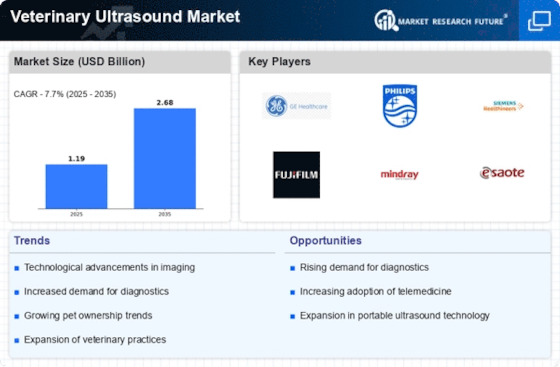
As per MRFR analysis, the Veterinary Ultrasound Market size was valued at USD 1.185 Billion in 2024. The market is projected to grow from USD 1.276 Billion in 2025 to USD 2.679 Billion by 2035, exhibiting a CAGR of 7.7% during the forecast period 2025-2035. North America led the market with over 42.19% share, generating around USD 0.5 billion in revenue.
 
The Veterinary Ultrasound Market is growing due to rising demand for advanced diagnostic imaging in animal healthcare, increasing pet ownership, and expanded use of ultrasound for reproductive and musculoskeletal assessments. Key trends include adoption of portable and 3D/4D ultrasound systems, integration of digital imaging technologies, and growing veterinary clinics worldwide.
 
The World Health Organization recognizes the global rise in companion animal populations, driving demand for improved veterinary diagnostic tools.

Key Market Trends & Highlights

The Veterinary Ultrasound Market is experiencing robust growth driven by technological advancements and increasing pet ownership.

  • North America remains the largest market for veterinary ultrasound, reflecting a strong demand for advanced imaging technologies. The Asia-Pacific region is emerging as the fastest-growing market, fueled by rising pet ownership and enhanced veterinary services. Abdominal imaging continues to dominate the market, while the emergency and critical care segment is witnessing rapid growth due to heightened awareness of animal health. Technological advancements and the integration of telemedicine in veterinary practices are key drivers propelling market expansion.

Market Size & Forecast

2024 Market Size 1.185 (USD Billion)
2035 Market Size 2.679 (USD Billion)
CAGR (2025 - 2035) 7.7%
Largest Regional Market Share in 2024 North America

Major Players

Companies such as <a href="https://www.gehealthcare.in/insights/article/how-veterinary-ultrasound-increases-practice-efficiency-and-efficacy">GE Healthcare</a> (US), Philips (NL), <a href="https://www.siemens-healthineers.com/en-au/veterinary">Siemens Healthineers</a> (DE), Fujifilm (JP), Mindray (CN), Esaote (IT), Samsung Medison (KR), Hitachi Medical Systems (JP), Boehringer Ingelheim (DE) are some of the major participants in the global market.

Market Trends

The Veterinary Ultrasound Market is currently experiencing a notable transformation, driven by advancements in technology and an increasing awareness of animal health. The integration of high-resolution imaging and portable ultrasound devices appears to enhance diagnostic capabilities, allowing veterinarians to provide more accurate assessments. This shift is likely to improve the overall quality of care for pets and livestock alike.

Furthermore, the growing trend of pet ownership and the rising demand for veterinary services contribute to the expansion of this market. As pet owners become more invested in their animals' health, the need for sophisticated diagnostic tools becomes increasingly apparent. In addition, the Veterinary Ultrasound Market seems to be influenced by the ongoing development of telemedicine and remote diagnostics.

This trend may facilitate access to veterinary care, particularly in rural areas where specialized services are limited. The potential for remote consultations and diagnostics could reshape how veterinary practices operate, making them more efficient and accessible.

Overall, the Veterinary Ultrasound Market is poised for growth, driven by technological innovations and changing consumer preferences, which may lead to enhanced veterinary practices and improved animal welfare.

Technological Advancements

The Veterinary Ultrasound Market is witnessing rapid technological progress, with innovations such as portable ultrasound devices and advanced imaging techniques. These developments enhance diagnostic accuracy and enable veterinarians to perform assessments in various settings, including remote locations.

According to the World Health Organization, veterinary diagnostic imaging is benefiting from portable ultrasound devices and high-resolution imaging systems, with over 55% of veterinary clinics in developed regions adopting advanced imaging tools.

Increased Pet Ownership

The rising trend of pet ownership is significantly impacting the Veterinary Ultrasound Market. As more individuals adopt pets, the demand for veterinary services, including diagnostic imaging, is likely to increase, prompting practices to invest in advanced ultrasound technology.

The UNICEF reports that pet ownership has risen globally, with over 67% of households in high-income countries owning at least one companion animal, driving demand for veterinary services.

Telemedicine Integration

The integration of telemedicine into veterinary practices is emerging as a key trend. This approach allows for remote consultations and diagnostics, potentially expanding access to veterinary care and making ultrasound services more widely available.

The World Health Organization highlights that telemedicine adoption in veterinary care is expanding rapidly, with remote diagnostics increasing access to veterinary services in rural and underserved regions by up to 40%.

Veterinary Ultrasound Market Market Drivers

Rising Pet Ownership Trends

The Veterinary Ultrasound Market is significantly influenced by the rising trends in pet ownership. As more households adopt pets, the demand for veterinary services, including ultrasound diagnostics, is on the rise. Recent statistics indicate that pet ownership has increased by approximately 20% over the last decade, leading to a corresponding increase in the need for advanced veterinary care.
 
This trend is particularly pronounced in urban areas, where pet owners are more likely to seek specialized veterinary services. Consequently, the Veterinary Ultrasound Market is poised for growth as veterinarians expand their diagnostic capabilities to cater to a larger pet population. The increasing awareness of pet health and wellness further propels this demand, suggesting a robust future for veterinary ultrasound technologies.

Growing Awareness of Animal Health

The Veterinary Ultrasound Market is benefiting from a growing awareness of animal health among pet owners. As individuals become more informed about the importance of regular veterinary check-ups and early disease detection, the demand for diagnostic tools such as ultrasound is increasing.
 
Educational campaigns and outreach programs have played a crucial role in promoting the significance of preventive care, which includes the use of ultrasound for non-invasive diagnostics. This heightened awareness is likely to drive the Veterinary Ultrasound Market forward, as more pet owners seek advanced diagnostic options to ensure their animals' well-being. The trend suggests a shift towards proactive health management, which could further stimulate the market for veterinary ultrasound technologies.

Increased Investment in Veterinary Healthcare

The Veterinary Ultrasound Market is witnessing increased investment in veterinary healthcare, which is a key driver of market growth. As veterinary practices expand and modernize, there is a growing need for advanced diagnostic equipment, including ultrasound machines. Investment in veterinary healthcare has been on the rise, with estimates indicating a growth rate of around 10% annually in veterinary spending.
 
This trend reflects a broader recognition of the value of animal health and the importance of high-quality veterinary services. As practices invest in state-of-the-art ultrasound technology, the Veterinary Ultrasound Market is likely to experience significant advancements in diagnostic capabilities. This influx of capital not only enhances the quality of care but also encourages innovation within the industry.

Integration of Telemedicine in Veterinary Practices

The integration of telemedicine into veterinary practices is reshaping the Veterinary Ultrasound Market. This trend allows veterinarians to conduct remote consultations and share ultrasound images with specialists, enhancing diagnostic accuracy and treatment planning. The convenience of telemedicine is appealing to pet owners, as it reduces the need for in-person visits while still providing access to high-quality veterinary care.
 
As telemedicine becomes more prevalent, the demand for veterinary ultrasound equipment that can easily interface with digital platforms is likely to increase. This shift not only improves access to veterinary services but also encourages the adoption of advanced ultrasound technologies, thereby driving growth in the Veterinary Ultrasound Market. The potential for remote diagnostics may lead to a more efficient use of resources in veterinary practices.

Technological Advancements in Veterinary Ultrasound

The Veterinary Ultrasound Market is experiencing a notable transformation due to rapid technological advancements. Innovations such as portable ultrasound devices and advanced imaging techniques are enhancing diagnostic capabilities. These developments allow veterinarians to perform more accurate assessments of animal health, leading to improved treatment outcomes.
 
The market for veterinary ultrasound equipment is projected to grow significantly, with estimates suggesting a compound annual growth rate of over 8% in the coming years. This growth is driven by the increasing demand for non-invasive diagnostic tools that provide real-time imaging. As technology continues to evolve, the Veterinary Ultrasound Market is likely to see further enhancements in image quality and ease of use, making these tools indispensable in veterinary practices.

Market Segment Insights

By Application: Abdominal Imaging (Largest) vs. Emergency and Critical Care (Fastest-Growing)

In the Veterinary Ultrasound Market, the application segment is primarily dominated by Abdominal Imaging, which plays a crucial role in diagnosing various organ-related conditions in animals. This segment captures a significant portion of the market share due to the increasing prevalence of gastrointestinal disorders among pets and livestock. On the other hand, the Emergency and Critical Care segment is experiencing rapid growth as the demand for timely diagnostics in critical situations escalates. This area is being propelled by the rising awareness of advanced <a title="veterinary care" href="https://www.marketresearchfuture.com/reports/veterinary-care-market-42285" target="_blank" rel="noopener">veterinary care</a> and the necessity for swift intervention during emergencies.

Reproductive Imaging (Dominant) vs. Cardiology (Emerging)

Reproductive Imaging has established itself as a dominant segment within the market share, widely utilized for pregnancy diagnosis and fertility assessments in animals, particularly in livestock and companion animals. Its importance is underscored by the growing emphasis on breeding programs and overall animal health management. In contrast, the Cardiology segment is emerging as a pivotal area, driven by increased recognition of heart diseases in pets. Veterinary professionals are increasingly adopting advanced imaging technologies for early diagnosis and treatment of cardiac issues, showcasing a progressive shift in veterinary practices towards comprehensive healthcare that includes cardiovascular diagnostics.

By Technology: 2D Ultrasound (Largest) vs. Portable Ultrasound (Fastest-Growing)

The Veterinary Ultrasound Market is primarily led by 2D ultrasound technology, which has established itself as the most widely adopted imaging modality. Sharing substantial market share, 2D ultrasound is favored for its cost-effectiveness and reliability in diagnosing various conditions in animals. In contrast, <a href="https://www.marketresearchfuture.com/reports/portable-ultrasound-market-24676">portable ultrasound</a> devices, while currently representing a smaller portion of the market, are rapidly gaining traction due to their convenience and ease of use in mobile veterinary practices. This shift in preference is reshaping diagnostic capabilities in veterinary medicine.

Technology: 2D Ultrasound (Dominant) vs. Portable Ultrasound (Emerging)

2D ultrasound technology remains dominant within the market share, providing crucial imaging services owing to its affordability and well-established methodologies. Its extensive use in general practice allows veterinarians to perform accurate assessments of soft tissue structures, leading to timely interventions for animal patients. Meanwhile, portable ultrasound systems are emerging as a significant trend, driven by advancements in miniaturization and battery technology. These systems enable veterinarians to bring ultrasound diagnostics directly to the field, enhancing accessibility and fostering quicker decision-making. The combination of portability with effective imaging technology positions portable systems as an essential tool for modern veterinary practices.

By Animal Type: Small Animals (Largest) vs. Large Animals (Fastest-Growing)

The Veterinary Ultrasound Market is primarily dominated by the Small Animals segment, which includes pets like dogs and cats. This segment captures a significant portion of the overall market share, reflecting the high demand for veterinary care among pet owners. Pet owners are increasingly seeking advanced diagnostic tools for their small animals, leading to more widespread adoption of ultrasound technologies in veterinary practices.

Small Animals (Dominant) vs. Large Animals (Emerging)

The Small Animals segment is characterized by a robust growth trajectory, driven by the rise in pet ownership and the increasing emphasis on pet health. This segment benefits from advancements in ultrasound technology, allowing for quicker and more accurate diagnoses in veterinary practices. In contrast, the Large Animals segment, which includes horses and livestock, is emerging as a rapidly growing area. This growth is fueled by a rising awareness of animal welfare and advancements in veterinary medicine, positioning large animals as a significant focus for market development.

By End Use: Veterinary Clinics (Largest) vs. Animal Hospitals (Fastest-Growing)

The Veterinary Ultrasound Market's end-use segment is predominantly led by <a href="https://www.marketresearchfuture.com/reports/veterinary-service-market-42245">veterinary clinics</a>, which hold the largest share due to their vast number and frequency of diagnostic procedures performed. These clinics often have established relationships with pet owners, leading to regular ultrasound examinations for various conditions. In contrast, animal hospitals, which cater to more complex cases and surgical interventions, are witnessing rapid growth as they expand their diagnostic capabilities to enhance patient outcomes, thus becoming a vital part of this market landscape.

Veterinary Clinics (Dominant) vs. Animal Hospitals (Emerging)

Veterinary clinics are the cornerstone of the market share, characterized by their accessibility and wide-ranging services for companion animals. They typically provide routine examinations and preventive care, resulting in frequent ultrasound usage for diagnosis. On the other hand, animal hospitals, while traditionally focused on treating severe cases, are emerging in the ultrasound sector, leveraging advanced technologies to provide specialized care for larger animals and exotic species. Their growth is driven by an increasing demand for advanced diagnostic tools, enabling them to cater to the complexities of animal treatments. The diverse needs of pet owners and the drive for better veterinary services make this emergent segment crucial for future market trajectories.

Get more detailed insights about Veterinary Ultrasound Market Research Report - Forecast till 2035

Regional Insights

The Veterinary Ultrasound Market is projected to experience significant growth across its various regional segments. In 2023, North America leads the market with a valuation of 0.45 USD Billion, which reflects its well-established veterinary services and technological advancements in ultrasound devices.

Europe follows with a considerable valuation of 0.3 USD Billion, mainly driven by rising pet ownership and expanding veterinary practices. The Asia-Pacific region, though currently at a valuation of 0.15 USD Billion, is expected to gain traction due to increasing awareness about animal health and advancements in veterinary technology.

South America and MEA, with values of 0.05 USD Billion each, show slower growth but represent emerging markets that hold potential due to the growing adoption of animal healthcare services. The majority holding in North America showcases its dominance in technology adoption and veterinary care quality, while the APAC region's significant growth potential could reshape the market landscape in the coming years.

Overall, the regional segmentation of the Veterinary Ultrasound Market illustrates diverse growth dynamics, emphasizing the need for tailored strategies to meet local demands and capitalize on emerging opportunities.

Key Players and Competitive Insights

The Veterinary Ultrasound Market has been exhibiting consistent growth driven by an increasing awareness of pet health and advancements in diagnostic imaging technology. Competitive insights within this market indicate that the landscape is characterized by a mix of established players and emerging companies, all striving to innovate and capture market share.
 
Factors such as the rising prevalence of veterinary healthcare practices, the growing demand for early diagnosis in animals, and an increase in pet ownership are contributing to the heightened competition among key stakeholders.It is crucial for companies within this space to leverage technology and develop products that cater to the evolving needs of veterinarians and pet owners alike. This competitive environment not only fosters innovation but also enhances the overall quality of veterinary care available in the marketplace.
 
Veterinary Ultrasound Market Systems have built a robust reputation in the Veterinary Ultrasound Market by focusing on advanced imaging systems that enhance diagnostic capabilities for veterinarians.Their strengths lie in their commitment to research and development, leading to the design of user-friendly devices with high-resolution imaging outputs, which significantly assist veterinary professionals in making informed decisions regarding animal health.
 
Furthermore, the company has been successful in establishing a strong distribution network, which enhances accessibility to its products across different regions.Coupled with excellent customer support and training programs that empower veterinary practitioners to utilize ultrasound technology effectively, Veterinary Ultrasound Market Systems has positioned itself favorably within a competitive landscape, allowing it to respond dynamically to market needs and drive growth.
 
Siemens Healthineers is another key player in the Veterinary Ultrasound Market, renowned for its sophisticated imaging technologies and commitment to enhancing animal healthcare. The company’s strength lies in its innovative approach to ultrasound technology, which includes the provision of tailored solutions to meet the specific demands of veterinary diagnostics.Siemens Healthineers focuses on providing a comprehensive range of ultrasound systems that incorporate advanced imaging technologies, delivering high-quality results for veterinarians.
 
Their market presence is bolstered by significant investment in research and development, ensuring their products are at the forefront of technology. Additionally, Siemens Healthineers emphasizes its commitment to training and support, allowing veterinary practitioners to leverage the full potential of their ultrasound solutions, thus improving patient outcomes and reinforcing their position within the highly competitive veterinary ultrasound market.

Key Companies in the Veterinary Ultrasound Market include

Industry Developments

The Veterinary Ultrasound Market is witnessing significant developments, including advancements in technology and increasing demand for veterinary imaging solutions. Companies like GE Healthcare and Siemens Healthineers are enhancing their ultrasound offerings to cater to the growing needs of veterinary practices. Meanwhile, Fujifilm and Philips are focusing on integrating advanced imaging technologies, improving diagnostic capabilities in animal healthcare. Recent mergers and acquisitions have also shaped the landscape, with key players such as Clarius Mobile Health and Esaote potentially entering into strategic partnerships to expand their market share and product portfolios.

The market is experiencing growth in valuation, driven by rising pet ownership and increasing investments in animal healthcare. Companies like Mindray and Samsung Medison are positioning themselves to meet the increasing demand through innovative product development. As the market expands, organizations are prioritizing research and development to introduce more sophisticated ultrasound systems, further boosting the growth potential of the veterinary ultrasound sector. The trend towards portable and affordable imaging solutions is notably impacting the competitive dynamics among major players like Heska Corporation and Boehringer Ingelheim, ensuring accessibility to advanced diagnostic tools in veterinary practices. 

Future Outlook

Veterinary Ultrasound Market Future Outlook

The Veterinary Ultrasound Market size is projected to reach USD 2.679 billion by 2035, growing at a CAGR of 7.7%

New opportunities lie in:

  • <p>Development of portable ultrasound devices for remote veterinary care.</p>
  • <p> </p>
  • <p>Integration of AI for enhanced diagnostic accuracy in ultrasound imaging.</p>
  • <p>Expansion of training programs for veterinary professionals in ultrasound technology.</p>

By 2035, the Veterinary Ultrasound Market is expected to be robust, driven by innovation and increased adoption.

Market Segmentation

Veterinary Ultrasound Market End Use Outlook

  • Veterinary Clinics
  • Animal Hospitals
  • Research Institutions

Veterinary Ultrasound Market Technology Outlook

  • 2D Ultrasound
  • 3D Ultrasound
  • Doppler Ultrasound
  • Portable Ultrasound

Veterinary Ultrasound Market Animal Type Outlook

  • Small Animals
  • Large Animals
  • Exotic Animals

Veterinary Ultrasound Market Application Outlook

  • Cardiology
  • Abdominal Imaging
  • Emergency and Critical Care
  • Reproductive Imaging

Report Scope

MARKET SIZE 2024 1.185(USD Billion)
MARKET SIZE 2025 1.276(USD Billion)
MARKET SIZE 2035 2.679(USD Billion)
COMPOUND ANNUAL GROWTH RATE (CAGR) 7.7% (2025 - 2035)
REPORT COVERAGE Revenue Forecast, Competitive Landscape, Growth Factors, and Trends
BASE YEAR 2024
Market Forecast Period 2025 - 2035
Historical Data 2019 - 2024
Market Forecast Units USD Billion
Key Companies Profiled GE Healthcare (US), Philips (NL), Siemens Healthineers (DE), Fujifilm (JP), Mindray (CN), Esaote (IT), Samsung Medison (KR), Hitachi Medical Systems (JP), Boehringer Ingelheim (DE)
Segments Covered Application, Technology, Animal Type, End Use, Regional
Key Market Opportunities Integration of artificial intelligence in Veterinary Ultrasound Market enhances diagnostic accuracy and operational efficiency.
Key Market Dynamics Technological advancements in imaging techniques drive demand for veterinary ultrasound systems across diverse animal healthcare settings.
Countries Covered North America, Europe, APAC, South America, MEA

FAQs

What is the current valuation of the Veterinary Ultrasound Market?

<p>The Veterinary Ultrasound Market was valued at 1.185 USD Billion in 2024.</p>

What is the projected market size for the Veterinary Ultrasound Market by 2035?

<p>The market is projected to reach 2.679 USD Billion by 2035.</p>

What is the expected CAGR for the Veterinary Ultrasound Market during the forecast period 2025 - 2035?

<p>The expected CAGR for the Veterinary Ultrasound Market during 2025 - 2035 is 7.7%.</p>

Which application segments are driving growth in the Veterinary Ultrasound Market?

<p>Key application segments include Cardiology, Abdominal Imaging, Emergency and Critical Care, and Reproductive Imaging.</p>

What are the projected valuations for the Abdominal Imaging segment by 2035?

<p>The Abdominal Imaging segment is projected to grow from 0.4 USD Billion to 0.9 USD Billion by 2035.</p>

How does the market for small animals compare to large animals in the Veterinary Ultrasound Market?

<p>The market for small animals is projected to grow from 0.7105 USD Billion to 1.6105 USD Billion, whereas large animals are expected to grow from 0.3355 USD Billion to 0.7555 USD Billion.</p>

What technological advancements are influencing the Veterinary Ultrasound Market?

<p>Technological advancements in 2D, 3D, Doppler, and Portable Ultrasound are significantly influencing market growth.</p>

What is the expected growth for the Portable Ultrasound segment by 2035?

<p>The Portable Ultrasound segment is expected to grow from 0.355 USD Billion to 0.966 USD Billion by 2035.</p>

Which key players are leading the Veterinary Ultrasound Market?

<p>Key players in the market include GE Healthcare, Philips, Siemens Healthineers, and Fujifilm.</p>

What end-use segments are contributing to the Veterinary Ultrasound Market?

<p>End-use segments include Veterinary Clinics, Animal Hospitals, and Research Institutions, with varying growth projections.</p>

  1. SECTION I: EXECUTIVE SUMMARY AND KEY HIGHLIGHTS |
    1. EXECUTIVE SUMMARY | |
      1. Market Overview | |
      2. Key Findings | |
      3. Market Segmentation | |
      4. Competitive Landscape | |
      5. Challenges and Opportunities | |
      6. Future Outlook 2
  2. SECTION II: SCOPING, METHODOLOGY AND MARKET STRUCTURE |
    1. MARKET INTRODUCTION | |
      1. Definition | |
      2. Scope of the study | | |
    2. RESEARCH METHODOLOGY | |
      1. Overview | |
      2. Data Mining | |
      3. Secondary Research | |
      4. Primary Research | | |
      5. Forecasting Model | |
      6. Market Size Estimation | | |
      7. Data Triangulation | |
      8. Validation 3
  3. SECTION III: QUALITATIVE ANALYSIS |
    1. MARKET DYNAMICS | |
      1. Overview | |
      2. Drivers | |
      3. Restraints | |
      4. Opportunities |
    2. MARKET FACTOR ANALYSIS | |
      1. Value chain Analysis | |
      2. Porter's Five Forces Analysis | | |
      3. COVID-19 Impact Analysis | | |
  4. SECTION IV: QUANTITATIVE ANALYSIS |
    1. Healthcare, BY Application (USD Billion) | |
      1. Cardiology | |
      2. Abdominal Imaging | |
      3. Emergency and Critical Care | |
      4. Reproductive Imaging |
    2. Healthcare, BY Technology (USD Billion) | |
      1. 2D Ultrasound | |
      2. 3D Ultrasound | |
      3. Doppler Ultrasound | |
      4. Portable Ultrasound |
    3. Healthcare, BY Animal Type (USD Billion) | |
      1. Small Animals | |
      2. Large Animals | |
      3. Exotic Animals |
    4. Healthcare, BY End Use (USD Billion) | |
      1. Veterinary Clinics | |
      2. Animal Hospitals | |
      3. Research Institutions |
    5. Healthcare, BY Region (USD Billion) | |
      1. North America | | |
      2. Europe | | |
      3. APAC | | |
      4. South America | | |
      5. MEA | | |
  5. SECTION V: COMPETITIVE ANALYSIS |
    1. Competitive Landscape | |
      1. Overview | |
      2. Competitive Analysis | |
      3. Market share Analysis | |
      4. Major Growth Strategy in the Healthcare | |
      5. Competitive Benchmarking | |
      6. Leading Players in Terms of Number of Developments in the Healthcare | |
      7. Key developments and growth strategies | | |
      8. Major Players Financial Matrix | | |
    2. Company Profiles | |
      1. GE Healthcare (US) | | |
      2. Philips (NL) | | |
      3. Siemens Healthineers (DE) | | |
      4. Fujifilm (JP) | | |
      5. Mindray (CN) | | |
      6. Esaote (IT) | | |
      7. Samsung Medison (KR) | | |
      8. Hitachi Medical Systems (JP) | | |
      9. Boehringer Ingelheim (DE) | | |
    3. Appendix | |
      1. References | |
      2. Related Reports 6 LIST OF FIGURES |
    4. MARKET SYNOPSIS |
    5. NORTH AMERICA MARKET ANALYSIS |
    6. US MARKET ANALYSIS BY APPLICATION |
    7. US MARKET ANALYSIS BY TECHNOLOGY |
    8. US MARKET ANALYSIS BY ANIMAL TYPE |
    9. US MARKET ANALYSIS BY END USE |
    10. CANADA MARKET ANALYSIS BY APPLICATION |
    11. CANADA MARKET ANALYSIS BY TECHNOLOGY |
    12. CANADA MARKET ANALYSIS BY ANIMAL TYPE |
    13. CANADA MARKET ANALYSIS BY END USE |
    14. EUROPE MARKET ANALYSIS |
    15. GERMANY MARKET ANALYSIS BY APPLICATION |
    16. GERMANY MARKET ANALYSIS BY TECHNOLOGY |
    17. GERMANY MARKET ANALYSIS BY ANIMAL TYPE |
    18. GERMANY MARKET ANALYSIS BY END USE |
    19. UK MARKET ANALYSIS BY APPLICATION |
    20. UK MARKET ANALYSIS BY TECHNOLOGY |
    21. UK MARKET ANALYSIS BY ANIMAL TYPE |
    22. UK MARKET ANALYSIS BY END USE |
    23. FRANCE MARKET ANALYSIS BY APPLICATION |
    24. FRANCE MARKET ANALYSIS BY TECHNOLOGY |
    25. FRANCE MARKET ANALYSIS BY ANIMAL TYPE |
    26. FRANCE MARKET ANALYSIS BY END USE |
    27. RUSSIA MARKET ANALYSIS BY APPLICATION |
    28. RUSSIA MARKET ANALYSIS BY TECHNOLOGY |
    29. RUSSIA MARKET ANALYSIS BY ANIMAL TYPE |
    30. RUSSIA MARKET ANALYSIS BY END USE |
    31. ITALY MARKET ANALYSIS BY APPLICATION |
    32. ITALY MARKET ANALYSIS BY TECHNOLOGY |
    33. ITALY MARKET ANALYSIS BY ANIMAL TYPE |
    34. ITALY MARKET ANALYSIS BY END USE |
    35. SPAIN MARKET ANALYSIS BY APPLICATION |
    36. SPAIN MARKET ANALYSIS BY TECHNOLOGY |
    37. SPAIN MARKET ANALYSIS BY ANIMAL TYPE |
    38. SPAIN MARKET ANALYSIS BY END USE |
    39. REST OF EUROPE MARKET ANALYSIS BY APPLICATION |
    40. REST OF EUROPE MARKET ANALYSIS BY TECHNOLOGY |
    41. REST OF EUROPE MARKET ANALYSIS BY ANIMAL TYPE |
    42. REST OF EUROPE MARKET ANALYSIS BY END USE |
    43. APAC MARKET ANALYSIS |
    44. CHINA MARKET ANALYSIS BY APPLICATION |
    45. CHINA MARKET ANALYSIS BY TECHNOLOGY |
    46. CHINA MARKET ANALYSIS BY ANIMAL TYPE |
    47. CHINA MARKET ANALYSIS BY END USE |
    48. INDIA MARKET ANALYSIS BY APPLICATION |
    49. INDIA MARKET ANALYSIS BY TECHNOLOGY |
    50. INDIA MARKET ANALYSIS BY ANIMAL TYPE |
    51. INDIA MARKET ANALYSIS BY END USE |
    52. JAPAN MARKET ANALYSIS BY APPLICATION |
    53. JAPAN MARKET ANALYSIS BY TECHNOLOGY |
    54. JAPAN MARKET ANALYSIS BY ANIMAL TYPE |
    55. JAPAN MARKET ANALYSIS BY END USE |
    56. SOUTH KOREA MARKET ANALYSIS BY APPLICATION |
    57. SOUTH KOREA MARKET ANALYSIS BY TECHNOLOGY |
    58. SOUTH KOREA MARKET ANALYSIS BY ANIMAL TYPE |
    59. SOUTH KOREA MARKET ANALYSIS BY END USE |
    60. MALAYSIA MARKET ANALYSIS BY APPLICATION |
    61. MALAYSIA MARKET ANALYSIS BY TECHNOLOGY |
    62. MALAYSIA MARKET ANALYSIS BY ANIMAL TYPE |
    63. MALAYSIA MARKET ANALYSIS BY END USE |
    64. THAILAND MARKET ANALYSIS BY APPLICATION |
    65. THAILAND MARKET ANALYSIS BY TECHNOLOGY |
    66. THAILAND MARKET ANALYSIS BY ANIMAL TYPE |
    67. THAILAND MARKET ANALYSIS BY END USE |
    68. INDONESIA MARKET ANALYSIS BY APPLICATION |
    69. INDONESIA MARKET ANALYSIS BY TECHNOLOGY |
    70. INDONESIA MARKET ANALYSIS BY ANIMAL TYPE |
    71. INDONESIA MARKET ANALYSIS BY END USE |
    72. REST OF APAC MARKET ANALYSIS BY APPLICATION |
    73. REST OF APAC MARKET ANALYSIS BY TECHNOLOGY |
    74. REST OF APAC MARKET ANALYSIS BY ANIMAL TYPE |
    75. REST OF APAC MARKET ANALYSIS BY END USE |
    76. SOUTH AMERICA MARKET ANALYSIS |
    77. BRAZIL MARKET ANALYSIS BY APPLICATION |
    78. BRAZIL MARKET ANALYSIS BY TECHNOLOGY |
    79. BRAZIL MARKET ANALYSIS BY ANIMAL TYPE |
    80. BRAZIL MARKET ANALYSIS BY END USE |
    81. MEXICO MARKET ANALYSIS BY APPLICATION |
    82. MEXICO MARKET ANALYSIS BY TECHNOLOGY |
    83. MEXICO MARKET ANALYSIS BY ANIMAL TYPE |
    84. MEXICO MARKET ANALYSIS BY END USE |
    85. ARGENTINA MARKET ANALYSIS BY APPLICATION |
    86. ARGENTINA MARKET ANALYSIS BY TECHNOLOGY |
    87. ARGENTINA MARKET ANALYSIS BY ANIMAL TYPE |
    88. ARGENTINA MARKET ANALYSIS BY END USE |
    89. REST OF SOUTH AMERICA MARKET ANALYSIS BY APPLICATION |
    90. REST OF SOUTH AMERICA MARKET ANALYSIS BY TECHNOLOGY |
    91. REST OF SOUTH AMERICA MARKET ANALYSIS BY ANIMAL TYPE |
    92. REST OF SOUTH AMERICA MARKET ANALYSIS BY END USE |
    93. MEA MARKET ANALYSIS |
    94. GCC COUNTRIES MARKET ANALYSIS BY APPLICATION |
    95. GCC COUNTRIES MARKET ANALYSIS BY TECHNOLOGY |
    96. GCC COUNTRIES MARKET ANALYSIS BY ANIMAL TYPE |
    97. GCC COUNTRIES MARKET ANALYSIS BY END USE |
    98. SOUTH AFRICA MARKET ANALYSIS BY APPLICATION |
    99. SOUTH AFRICA MARKET ANALYSIS BY TECHNOLOGY |
    100. SOUTH AFRICA MARKET ANALYSIS BY ANIMAL TYPE |
    101. SOUTH AFRICA MARKET ANALYSIS BY END USE |
    102. REST OF MEA MARKET ANALYSIS BY APPLICATION |
    103. REST OF MEA MARKET ANALYSIS BY TECHNOLOGY |
    104. REST OF MEA MARKET ANALYSIS BY ANIMAL TYPE |
    105. REST OF MEA MARKET ANALYSIS BY END USE |
    106. KEY BUYING CRITERIA OF HEALTHCARE |
    107. RESEARCH PROCESS OF MRFR |
    108. DRO ANALYSIS OF HEALTHCARE |
    109. DRIVERS IMPACT ANALYSIS: HEALTHCARE |
    110. RESTRAINTS IMPACT ANALYSIS: HEALTHCARE |
    111. SUPPLY / VALUE CHAIN: HEALTHCARE |
    112. HEALTHCARE, BY APPLICATION, 2024 (% SHARE) |
    113. HEALTHCARE, BY APPLICATION, 2024 TO 2035 (USD Billion) |
    114. HEALTHCARE, BY TECHNOLOGY, 2024 (% SHARE) |
    115. HEALTHCARE, BY TECHNOLOGY, 2024 TO 2035 (USD Billion) |
    116. HEALTHCARE, BY ANIMAL TYPE, 2024 (% SHARE) |
    117. HEALTHCARE, BY ANIMAL TYPE, 2024 TO 2035 (USD Billion) |
    118. HEALTHCARE, BY END USE, 2024 (% SHARE) |
    119. HEALTHCARE, BY END USE, 2024 TO 2035 (USD Billion) |
    120. BENCHMARKING OF MAJOR COMPETITORS 7 LIST OF TABLES |
    121. LIST OF ASSUMPTIONS | |
      1. |
    122. North America MARKET SIZE ESTIMATES; FORECAST | |
      1. BY APPLICATION, 2025-2035 (USD Billion) | |
      2. BY TECHNOLOGY, 2025-2035 (USD Billion) | |
      3. BY ANIMAL TYPE, 2025-2035 (USD Billion) | |
      4. BY END USE, 2025-2035 (USD Billion) |
    123. US MARKET SIZE ESTIMATES; FORECAST | |
      1. BY APPLICATION, 2025-2035 (USD Billion) | |
      2. BY TECHNOLOGY, 2025-2035 (USD Billion) | |
      3. BY ANIMAL TYPE, 2025-2035 (USD Billion) | |
      4. BY END USE, 2025-2035 (USD Billion) |
    124. Canada MARKET SIZE ESTIMATES; FORECAST | |
      1. BY APPLICATION, 2025-2035 (USD Billion) | |
      2. BY TECHNOLOGY, 2025-2035 (USD Billion) | |
      3. BY ANIMAL TYPE, 2025-2035 (USD Billion) | |
      4. BY END USE, 2025-2035 (USD Billion) |
    125. Europe MARKET SIZE ESTIMATES; FORECAST | |
      1. BY APPLICATION, 2025-2035 (USD Billion) | |
      2. BY TECHNOLOGY, 2025-2035 (USD Billion) | |
      3. BY ANIMAL TYPE, 2025-2035 (USD Billion) | |
      4. BY END USE, 2025-2035 (USD Billion) |
    126. Germany MARKET SIZE ESTIMATES; FORECAST | |
      1. BY APPLICATION, 2025-2035 (USD Billion) | |
      2. BY TECHNOLOGY, 2025-2035 (USD Billion) | |
      3. BY ANIMAL TYPE, 2025-2035 (USD Billion) | |
      4. BY END USE, 2025-2035 (USD Billion) |
    127. UK MARKET SIZE ESTIMATES; FORECAST | |
      1. BY APPLICATION, 2025-2035 (USD Billion) | |
      2. BY TECHNOLOGY, 2025-2035 (USD Billion) | |
      3. BY ANIMAL TYPE, 2025-2035 (USD Billion) | |
      4. BY END USE, 2025-2035 (USD Billion) |
    128. France MARKET SIZE ESTIMATES; FORECAST | |
      1. BY APPLICATION, 2025-2035 (USD Billion) | |
      2. BY TECHNOLOGY, 2025-2035 (USD Billion) | |
      3. BY ANIMAL TYPE, 2025-2035 (USD Billion) | |
      4. BY END USE, 2025-2035 (USD Billion) |
    129. Russia MARKET SIZE ESTIMATES; FORECAST | |
      1. BY APPLICATION, 2025-2035 (USD Billion) | |
      2. BY TECHNOLOGY, 2025-2035 (USD Billion) | |
      3. BY ANIMAL TYPE, 2025-2035 (USD Billion) | |
      4. BY END USE, 2025-2035 (USD Billion) |
    130. Italy MARKET SIZE ESTIMATES; FORECAST | |
      1. BY APPLICATION, 2025-2035 (USD Billion) | |
      2. BY TECHNOLOGY, 2025-2035 (USD Billion) | |
      3. BY ANIMAL TYPE, 2025-2035 (USD Billion) | |
      4. BY END USE, 2025-2035 (USD Billion) |
    131. Spain MARKET SIZE ESTIMATES; FORECAST | |
      1. BY APPLICATION, 2025-2035 (USD Billion) | |
      2. BY TECHNOLOGY, 2025-2035 (USD Billion) | |
      3. BY ANIMAL TYPE, 2025-2035 (USD Billion) | |
      4. BY END USE, 2025-2035 (USD Billion) |
    132. Rest of Europe MARKET SIZE ESTIMATES; FORECAST | |
      1. BY APPLICATION, 2025-2035 (USD Billion) | |
      2. BY TECHNOLOGY, 2025-2035 (USD Billion) | |
      3. BY ANIMAL TYPE, 2025-2035 (USD Billion) | |
      4. BY END USE, 2025-2035 (USD Billion) |
    133. APAC MARKET SIZE ESTIMATES; FORECAST | |
      1. BY APPLICATION, 2025-2035 (USD Billion) | |
      2. BY TECHNOLOGY, 2025-2035 (USD Billion) | |
      3. BY ANIMAL TYPE, 2025-2035 (USD Billion) | |
      4. BY END USE, 2025-2035 (USD Billion) |
    134. China MARKET SIZE ESTIMATES; FORECAST | |
      1. BY APPLICATION, 2025-2035 (USD Billion) | |
      2. BY TECHNOLOGY, 2025-2035 (USD Billion) | |
      3. BY ANIMAL TYPE, 2025-2035 (USD Billion) | |
      4. BY END USE, 2025-2035 (USD Billion) |
    135. India MARKET SIZE ESTIMATES; FORECAST | |
      1. BY APPLICATION, 2025-2035 (USD Billion) | |
      2. BY TECHNOLOGY, 2025-2035 (USD Billion) | |
      3. BY ANIMAL TYPE, 2025-2035 (USD Billion) | |
      4. BY END USE, 2025-2035 (USD Billion) |
    136. Japan MARKET SIZE ESTIMATES; FORECAST | |
      1. BY APPLICATION, 2025-2035 (USD Billion) | |
      2. BY TECHNOLOGY, 2025-2035 (USD Billion) | |
      3. BY ANIMAL TYPE, 2025-2035 (USD Billion) | |
      4. BY END USE, 2025-2035 (USD Billion) |
    137. South Korea MARKET SIZE ESTIMATES; FORECAST | |
      1. BY APPLICATION, 2025-2035 (USD Billion) | |
      2. BY TECHNOLOGY, 2025-2035 (USD Billion) | |
      3. BY ANIMAL TYPE, 2025-2035 (USD Billion) | |
      4. BY END USE, 2025-2035 (USD Billion) |
    138. Malaysia MARKET SIZE ESTIMATES; FORECAST | |
      1. BY APPLICATION, 2025-2035 (USD Billion) | |
      2. BY TECHNOLOGY, 2025-2035 (USD Billion) | |
      3. BY ANIMAL TYPE, 2025-2035 (USD Billion) | |
      4. BY END USE, 2025-2035 (USD Billion) |
    139. Thailand MARKET SIZE ESTIMATES; FORECAST | |
      1. BY APPLICATION, 2025-2035 (USD Billion) | |
      2. BY TECHNOLOGY, 2025-2035 (USD Billion) | |
      3. BY ANIMAL TYPE, 2025-2035 (USD Billion) | |
      4. BY END USE, 2025-2035 (USD Billion) |
    140. Indonesia MARKET SIZE ESTIMATES; FORECAST | |
      1. BY APPLICATION, 2025-2035 (USD Billion) | |
      2. BY TECHNOLOGY, 2025-2035 (USD Billion) | |
      3. BY ANIMAL TYPE, 2025-2035 (USD Billion) | |
      4. BY END USE, 2025-2035 (USD Billion) |
    141. Rest of APAC MARKET SIZE ESTIMATES; FORECAST | |
      1. BY APPLICATION, 2025-2035 (USD Billion) | |
      2. BY TECHNOLOGY, 2025-2035 (USD Billion) | |
      3. BY ANIMAL TYPE, 2025-2035 (USD Billion) | |
      4. BY END USE, 2025-2035 (USD Billion) |
    142. South America MARKET SIZE ESTIMATES; FORECAST | |
      1. BY APPLICATION, 2025-2035 (USD Billion) | |
      2. BY TECHNOLOGY, 2025-2035 (USD Billion) | |
      3. BY ANIMAL TYPE, 2025-2035 (USD Billion) | |
      4. BY END USE, 2025-2035 (USD Billion) |
    143. Brazil MARKET SIZE ESTIMATES; FORECAST | |
      1. BY APPLICATION, 2025-2035 (USD Billion) | |
      2. BY TECHNOLOGY, 2025-2035 (USD Billion) | |
      3. BY ANIMAL TYPE, 2025-2035 (USD Billion) | |
      4. BY END USE, 2025-2035 (USD Billion) |
    144. Mexico MARKET SIZE ESTIMATES; FORECAST | |
      1. BY APPLICATION, 2025-2035 (USD Billion) | |
      2. BY TECHNOLOGY, 2025-2035 (USD Billion) | |
      3. BY ANIMAL TYPE, 2025-2035 (USD Billion) | |
      4. BY END USE, 2025-2035 (USD Billion) |
    145. Argentina MARKET SIZE ESTIMATES; FORECAST | |
      1. BY APPLICATION, 2025-2035 (USD Billion) | |
      2. BY TECHNOLOGY, 2025-2035 (USD Billion) | |
      3. BY ANIMAL TYPE, 2025-2035 (USD Billion) | |
      4. BY END USE, 2025-2035 (USD Billion) |
    146. Rest of South America MARKET SIZE ESTIMATES; FORECAST | |
      1. BY APPLICATION, 2025-2035 (USD Billion) | |
      2. BY TECHNOLOGY, 2025-2035 (USD Billion) | |
      3. BY ANIMAL TYPE, 2025-2035 (USD Billion) | |
      4. BY END USE, 2025-2035 (USD Billion) |
    147. MEA MARKET SIZE ESTIMATES; FORECAST | |
      1. BY APPLICATION, 2025-2035 (USD Billion) | |
      2. BY TECHNOLOGY, 2025-2035 (USD Billion) | |
      3. BY ANIMAL TYPE, 2025-2035 (USD Billion) | |
      4. BY END USE, 2025-2035 (USD Billion) |
    148. GCC Countries MARKET SIZE ESTIMATES; FORECAST | |
      1. BY APPLICATION, 2025-2035 (USD Billion) | |
      2. BY TECHNOLOGY, 2025-2035 (USD Billion) | |
      3. BY ANIMAL TYPE, 2025-2035 (USD Billion) | |
      4. BY END USE, 2025-2035 (USD Billion) |
    149. South Africa MARKET SIZE ESTIMATES; FORECAST | |
      1. BY APPLICATION, 2025-2035 (USD Billion) | |
      2. BY TECHNOLOGY, 2025-2035 (USD Billion) | |
      3. BY ANIMAL TYPE, 2025-2035 (USD Billion) | |
      4. BY END USE, 2025-2035 (USD Billion) |
    150. Rest of MEA MARKET SIZE ESTIMATES; FORECAST | |
      1. BY APPLICATION, 2025-2035 (USD Billion) | |
      2. BY TECHNOLOGY, 2025-2035 (USD Billion) | |
      3. BY ANIMAL TYPE, 2025-2035 (USD Billion) | |
      4. BY END USE, 2025-2035 (USD Billion) |
    151. PRODUCT LAUNCH/PRODUCT DEVELOPMENT/APPROVAL | |
      1. |
    152. ACQUISITION/PARTNERSHIP | |

Healthcare Market Segmentation

Healthcare By Application (USD Billion, 2025-2035)

  • Cardiology
  • Abdominal Imaging
  • Emergency and Critical Care
  • Reproductive Imaging

Healthcare By Technology (USD Billion, 2025-2035)

  • 2D Ultrasound
  • 3D Ultrasound
  • Doppler Ultrasound
  • Portable Ultrasound

Healthcare By Animal Type (USD Billion, 2025-2035)

  • Small Animals
  • Large Animals
  • Exotic Animals

Healthcare By End Use (USD Billion, 2025-2035)

  • Veterinary Clinics
  • Animal Hospitals
  • Research Institutions
Infographic

Free Sample Request

Kindly complete the form below to receive a free sample of this Report

Get Free Sample

Customer Strories

Compare Licence

×
Features License Type
Single User Multiuser License Enterprise User
Price $4,950 $5,950 $7,250
Maximum User Access Limit 1 User Upto 10 Users Unrestricted Access Throughout the Organization
Free Customization
Direct Access to Analyst
Deliverable Format
Platform Access
Discount on Next Purchase 10% 15% 15%
Printable Versions