Request Free Sample ×

Kindly complete the form below to receive a free sample of this Report

* Please use a valid business email

Leading companies partner with us for data-driven Insights

clients tt-cursor
Hero Background
English
Chinese
French
Japanese
Korean
German
Spanish

Veterinary CBD Market Analysis

ID: MRFR/HC/6666-HCR
111 Pages
Vikita Thakur
March 2026

Veterinary CBD Market Research Report Insights and Industry Analysis by Source (Marijuana-Derived, Hemp-Derived); Product (Food-Grade, Therapeutic-Grade, Personal Care); Distribution Channel (E-Commerce, Retail Pharmacies, Vetcare Clinics) and Regions, Competitive Market Size, Share, Trends, and Forecast - 2035

Share:
Download PDF ×

We do not share your information with anyone. However, we may send you emails based on your report interest from time to time. You may contact us at any time to opt-out.

Veterinary CBD Market Infographic
Purchase Options

Market Analysis

In-depth Analysis of Veterinary CBD Market Industry Landscape

The veterinary CBD market is witnessing rapid growth driven by increasing awareness about the potential benefits of CBD in treating various ailments in animals. CBD, or cannabidiol, is a compound derived from the cannabis plant known for its therapeutic properties. The market for veterinary CBD products has expanded significantly in recent years, with projections indicating continued growth. Factors such as the legalization of cannabis products for medical and recreational use in many regions have contributed to this expansion.

Pet owners are increasingly turning to CBD products as alternative remedies for their pets' health issues, including pain management, anxiety relief, and support for aging-related conditions. This rising demand is a key driver shaping market dynamics. Despite growing acceptance, the regulatory environment surrounding veterinary CBD products remains complex and varies by region. This uncertainty can impact market growth and product availability, as companies navigate compliance issues. Companies in the veterinary CBD market are continuously innovating to develop new products tailored to the specific needs of different animal species. This includes CBD-infused treats, oils, topical creams, and supplements designed for pets of all sizes.

Veterinary CBD products are distributed through various channels, including veterinary clinics, pet stores, online retailers, and specialty dispensaries. The accessibility of these products through multiple channels contributes to market accessibility and visibility. The market is characterized by a mix of established players and new entrants, each vying for market share through product differentiation, branding, and marketing strategies. This competition fosters innovation and drives product quality improvements. Ongoing research into the therapeutic effects of CBD on animals fuels market growth by providing scientific evidence to support product efficacy and safety claims. This research also informs product development efforts, leading to the introduction of new formulations and delivery methods. Educating pet owners about the benefits, proper usage, and potential risks of CBD products is crucial for market expansion. Companies invest in educational initiatives to build trust and confidence among consumers, driving demand and market growth. As regulatory barriers evolve and market demand grows, companies are increasingly exploring opportunities for international expansion. This global expansion strategy aims to tap into new markets and diversify revenue streams.

Ensuring a consistent and reliable supply of high-quality CBD is essential for meeting market demand. Companies face challenges related to sourcing raw materials, extraction processes, and product formulation to maintain product quality and efficacy. The veterinary CBD market is fragmented, with a multitude of brands offering a wide range of products targeting different animal health needs. This fragmentation presents both opportunities and challenges for market players seeking to differentiate themselves and capture market share.


Author
Author Profile
Vikita Thakur
Senior Research Analyst

She holds an experience of about 5+ years in market research and business consulting projects for sectors such as life sciences, medical devices, and healthcare IT. She possesses a robust background in data analysis, market estimation, competitive intelligence, pipeline analysis market trend identification, and consumer behavior insights. Her expertise lies in technical Sales support, client interaction and project management, designing and implementing market research studies, conducting competitive analysis, and synthesizing complex data into actionable recommendations that drive business growth.

Leave a Comment

FAQs

What is the current valuation of the Veterinary CBD Market?

<p>The Veterinary CBD Market was valued at approximately 871.06 USD Million in 2024.</p>

What is the projected market size for the Veterinary CBD Market by 2035?

<p>The market is projected to reach around 1720.08 USD Million by 2035.</p>

What is the expected CAGR for the Veterinary CBD Market during the forecast period?

<p>The expected CAGR for the Veterinary CBD Market from 2025 to 2035 is 6.34%.</p>

Which companies are considered key players in the Veterinary CBD Market?

<p>Key players in the market include Pet Releaf, Canna-Pet, HolistaPet, King Kanine, VetCBD, Paw CBD, CBD Dog Health, and Pure Paws.</p>

What are the primary applications of Veterinary CBD products?

<p>The primary applications include Pain Management, Anxiety Relief, Anti-Inflammatory, Seizure Control, and Appetite Stimulation.</p>

How do Veterinary Clinics and Pet Owners contribute to the market?

Veterinary Clinics and Pet Owners are significant contributors, with market segments valued between 200.0 to 600.0 USD Million.

What types of formulations are available in the Veterinary CBD Market?

Formulations include Oils, Treats, Capsules, Topicals, and Powders, with Treats valued between 250.0 to 500.0 USD Million.

Which animal types are primarily targeted by Veterinary CBD products?

The primary animal types include Dogs, Cats, Horses, Rabbits, and Exotic Pets, with Dogs leading the segment valued between 300.0 to 600.0 USD Million.

What distribution channels are utilized in the Veterinary CBD Market?

Distribution channels include Online Sales, Retail Stores, Veterinary Clinics, Wholesale Distributors, and E-commerce Platforms.

What is the market outlook for Veterinary CBD products in the coming years?

The market outlook appears positive, with a projected growth trajectory leading to an estimated valuation of 1720.08 USD Million by 2035.

Market Summary

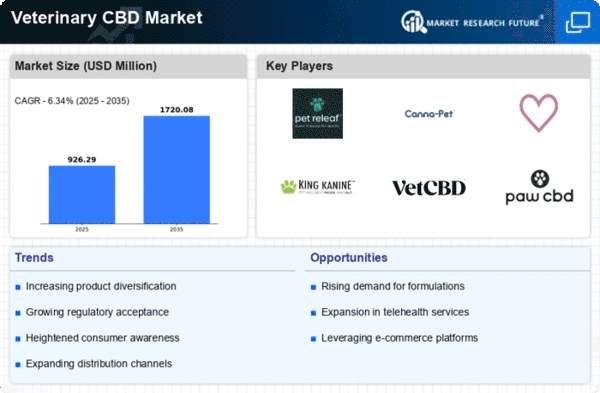
As per MRFR analysis, the Veterinary CBD Market Size was estimated at 871.06 USD Million in 2024. The Veterinary CBD industry is projected to grow from 936.26 in 2025 to 1720.08 by 2035, exhibiting a compound annual growth rate (CAGR) of 6.34% during the forecast period 2025 - 2035.

Key Market Trends & Highlights

The Veterinary CBD Market is experiencing notable growth driven by evolving consumer preferences and regulatory changes.

  • There is an increased acceptance of CBD products among veterinarians, enhancing their credibility in the market.
  • The expansion of product varieties is evident, catering to diverse pet needs and preferences.
  • Quality and safety standards are becoming a focal point, ensuring consumer trust and product efficacy.
  • Rising pet ownership and legislative changes favoring CBD use are significant drivers propelling market growth.

Market Size & Forecast

2024 Market Size 871.06 (USD Million)
2035 Market Size 1720.08 (USD Million)
CAGR (2025 - 2035) 6.34%
Largest Regional Market Share in 2024 North America

Major Players

Pet Releaf (US), Canna-Pet (US), HolistaPet (US), King Kanine (US), VetCBD (US), Paw CBD (US), CBD Dog Health (US), Pure Paws (US)

Market Trends

The Veterinary CBD Market is currently experiencing a notable evolution, driven by increasing awareness of the therapeutic benefits of cannabidiol for animals. Pet owners are becoming more informed about alternative treatments for various conditions, such as anxiety, pain, and inflammation. This shift in perception is fostering a growing acceptance of CBD products within veterinary practices. As a result, veterinarians are beginning to explore and recommend these products, which may lead to a broader integration of CBD into standard treatment protocols. Furthermore, the regulatory landscape appears to be gradually adapting, with some regions implementing clearer guidelines for the use of CBD in veterinary medicine. This evolving framework could potentially enhance consumer confidence and encourage further investment in research and development. In addition, the Veterinary CBD Market is witnessing a diversification of product offerings. Companies are increasingly developing a range of formulations, including oils, treats, and capsules, tailored to meet the specific needs of different animals. This variety not only caters to the preferences of pet owners but also addresses the unique health requirements of various species. Moreover, the emphasis on quality and safety is becoming paramount, with manufacturers focusing on sourcing high-quality ingredients and conducting rigorous testing. Such trends suggest a promising future for the Veterinary CBD Market, as it continues to expand and adapt to the changing landscape of pet care and wellness.

Increased Acceptance Among Veterinarians

There is a growing trend of veterinarians becoming more open to discussing and recommending CBD products for pets. This shift may stem from increased research supporting the efficacy of CBD in treating various ailments, leading to a more informed veterinary community.

Expansion of Product Varieties

The Veterinary CBD Market is seeing a rise in diverse product formulations, including oils, treats, and capsules. This expansion allows pet owners to choose products that best suit their animals' preferences and health needs.

Focus on Quality and Safety Standards

Manufacturers are placing greater emphasis on the quality and safety of CBD products. This trend includes sourcing premium ingredients and conducting thorough testing, which may enhance consumer trust and market growth.

Veterinary CBD Market Market Drivers

Increasing Pet Ownership

The rise in pet ownership globally is a notable driver for the Global Veterinary CBD Market Industry. As more households welcome pets into their lives, the demand for products that enhance pet health and well-being has surged. This trend is particularly evident in regions such as North America and Europe, where pet ownership rates have reached approximately 67% and 50%, respectively. With the Global Veterinary CBD Market projected to reach 750 USD Million in 2024, this growing pet population is likely to drive further interest in CBD products that address various health issues in pets.

Shift Towards Natural Remedies

A notable trend within the Global Veterinary CBD Market Industry is the shift towards natural and holistic remedies for pet health. Pet owners are increasingly seeking alternatives to traditional pharmaceuticals, often due to concerns about side effects and long-term impacts on their pets' health. CBD, derived from hemp, is perceived as a safer, more natural option. This shift is reflected in the growing number of CBD-infused products available for pets, including treats, oils, and supplements. As consumer preferences continue to evolve towards natural solutions, the market is poised for significant growth, aligning with the projected increase to 2500 USD Million by 2035.

Growing Awareness of CBD Benefits

There is an increasing awareness among pet owners regarding the potential benefits of CBD for pets, which is significantly influencing the Global Veterinary CBD Market Industry. Pet owners are becoming more informed about how CBD may alleviate conditions such as anxiety, pain, and inflammation in animals. This awareness is bolstered by educational campaigns and anecdotal evidence shared within communities. As a result, the market is expected to expand, with projections indicating a growth to 2500 USD Million by 2035. This heightened understanding of CBD's therapeutic properties is likely to encourage more pet owners to consider these products for their pets.

Rising Veterinary Recommendations

Veterinarians are increasingly recommending CBD products as part of holistic treatment plans, which is positively impacting the Global Veterinary CBD Market Industry. As more veterinary professionals recognize the potential benefits of CBD for managing various health issues in pets, their endorsements are likely to influence pet owners' purchasing decisions. This trend is supported by ongoing research into the efficacy of CBD in veterinary medicine, which may further validate its use. The growing acceptance among veterinarians could lead to a substantial increase in market demand, contributing to the anticipated growth trajectory of 11.57% CAGR from 2025 to 2035.

Regulatory Developments Favoring CBD Use

Recent regulatory changes in various countries are facilitating the growth of the Global Veterinary CBD Market Industry. Governments are increasingly recognizing the therapeutic potential of CBD, leading to the establishment of clearer guidelines for its use in veterinary medicine. For instance, the approval of CBD products for veterinary use in certain jurisdictions has opened new avenues for market expansion. This regulatory support is crucial, as it not only legitimizes CBD products but also instills confidence among consumers. As the market evolves, the anticipated compound annual growth rate of 11.57% from 2025 to 2035 suggests a robust future for CBD in veterinary applications.

Market Segment Insights

By Application: Pain Management (Largest) vs. Anxiety Relief (Fastest-Growing)

The Veterinary CBD Market is distinguished by its application segments, where <a href="https://www.marketresearchfuture.com/reports/pain-management-market-5975" target="_blank" title="pain management">Pain Management</a> holds the largest market share. This segment's dominance is attributed to the rising prevalence of chronic conditions in pets, notably arthritis and joint pain, leading to increased demand for effective pain-relief products. In contrast, Anxiety Relief has emerged as the fastest-growing application segment, driven by growing recognition of the therapeutic effects of CBD on anxiety disorders in animals, particularly during stressful situations like travel, thunderstorms, or separation from owners.

Pain Management (Dominant) vs. Anxiety Relief (Emerging)

Pain Management remains a dominant application in the Veterinary CBD Market due to its effectiveness in alleviating discomfort for pets suffering from various ailments. Veterinary professionals are increasingly incorporating CBD into treatment plans, following growing evidence of its benefits in pain alleviation without the severe side effects commonly associated with traditional medications. On the other hand, Anxiety Relief has positioned itself as an emerging segment, with more pet owners seeking holistic and natural alternatives for managing their pets' anxiety. The rising awareness of mental health in animals and the acceptance of CBD as a safe option has led to a significant uptick in product offerings designed for this purpose, appealing to concerned pet parents.

By End Use: Veterinary Clinics (Largest) vs. Pet Owners (Fastest-Growing)

<p>In the Veterinary CBD Market, the distribution of market share is significantly skewed towards Veterinary Clinics, as they are the primary adopters of CBD products for therapeutic use among animals. These clinics leverage CBD for various treatments, influencing the purchasing decisions and trends in this market segment. Meanwhile, Pet Owners, increasing their awareness of the benefits of CBD products, are rapidly becoming a substantial segment as they seek alternative solutions for their pets' health issues, marking them as the fastest-growing category.</p>

<p>Veterinary Clinics (Dominant) vs. Pet Owners (Emerging)</p>

<p>Veterinary Clinics are currently the dominant force in the Veterinary CBD Market due to their established relationship with pet owners and their authority in animal health care. These clinics are critical in recommending CBD products, as veterinarians provide insights based on their professional experience, making them trusted sources for pet owners. In contrast, Pet Owners represent an emerging segment that is witnessing explosive growth. As they increasingly turn to alternative and holistic approaches for their pets' wellness, education, and advocacy for CBD use have surged. This shift is evidenced by a growing number of online resources and communities, which serve to empower pet owners with knowledge and confidence in utilizing CBD products for their pets' therapeutic needs.</p>

By Formulation Type: Oils (Largest) vs. Treats (Fastest-Growing)

The Veterinary CBD Market is seeing a diverse range of formulation types, with oils leading the market due to their popularity among pet owners seeking natural remedies for health issues. Oils represent the largest share of the segment, catering to both dogs and cats, and providing an easy method of administration. Treats, on the other hand, are emerging as the fastest-growing formulation type, appealing to pet owners who prefer a palatable method for administering CBD to their pets, increasingly becoming a favored choice in households.

Oils (Dominant) vs. Treats (Emerging)

Oils, representing the dominant formulation in the Veterinary CBD Market, are favored for their versatile application and rapid onset of effects. Available in various concentrations, they provide flexibility in dosing for different pet sizes and conditions. This formulation is often preferred for pets with chronic issues due to its restorative properties. In contrast, treats represent an emerging segment that captivates the market with their convenience and appeal. Targeted at pet owners looking for easy, enjoyable ways to integrate CBD into their pets’ daily routine, treats are anticipated to see robust growth driven by innovation in flavors and formulations, tapping into the humanization trend in <a href="https://www.marketresearchfuture.com/reports/pet-care-market-842" target="_blank" title="pet care">pet care</a>.

By Animal Type: Dogs (Largest) vs. Cats (Fastest-Growing)

In the Veterinary CBD Market, dogs represent the largest segment, capturing a significant portion of market share. This dominance is primarily due to the increasing awareness among pet owners regarding the benefits of CBD for various health issues, such as anxiety and joint pain. Cats follow closely, driven by a growing interest and acceptance of alternative health treatments, making their segment a rapidly expanding area within the market. As the market evolves, the growth trends indicate a positive trajectory for both segments. The rising trend of natural and holistic pet care fuels the demand for CBD products specifically designed for dogs and cats. Furthermore, increasing endorsements from veterinarians and pet care influencers contribute to consumer confidence in CBD's efficacy for pets. These segments are expected to continue their growth trend as more research supports the health benefits of CBD for various animal types.

Dogs (Dominant) vs. Cats (Emerging)

Dogs have established a dominant position in the Veterinary CBD Market, owing to their widespread usage and the significant health benefits attributed to CBD products for them. Pet owners are increasingly turning to CBD for managing chronic pain, anxiety, and other health issues in dogs, reinforcing the segment's strong market presence. In contrast, cats represent an emerging segment that is becoming more prominent as awareness grows. Research indicates that CBD may assist with behaviors such as aggression and stress, which resonates well with cat owners. The increasing variety of products available for felines is contributing to their rapid market growth. As more pet owners seek holistic approaches to health care for their cats, this segment's potential for expansion in the Veterinary CBD Market is considerable.

By Distribution Channel: Online Sales (Largest) vs. Veterinary Clinics (Fastest-Growing)

The Veterinary CBD Market exhibits a diverse distribution channel landscape. Among the segments, Online Sales leads in market share due to the growing preference for e-commerce and convenience among pet owners. Veterinary Clinics follow closely, providing a crucial channel through which pet owners can obtain advice and products for their pets’ health needs. Other notable channels include Pet Stores, Pharmacies, and Direct Sales, although their shares are comparatively smaller.

Online Sales (Dominant) vs. Veterinary Clinics (Emerging)

Online Sales has established itself as the dominant distribution channel in the Veterinary CBD Market, driven by the convenience of online shopping and increasing consumer trust in purchasing pet health products online. This channel provides extensive product range accessibility and encourages purchasing through customer reviews and digital marketing strategies. On the other hand, Veterinary Clinics are an emerging channel, gaining traction as more veterinarians recognize the benefits of CBD products and start recommending them to pet owners. This trend is driven by growing awareness and acceptance of CBD in veterinary medicine, aiding clinics to play a pivotal role as trusted advisors and distributors.

Get more detailed insights about Veterinary CBD Market Research Report – Forecast till 2035

Regional Insights

North America : Market Leader in Veterinary CBD

North America continues to lead the Veterinary CBD market, holding a significant share of 500.0M in 2024. The growth is driven by increasing pet ownership, rising awareness of CBD benefits, and favorable regulatory frameworks. The region's demand is further fueled by a growing trend towards natural and holistic pet care solutions, with many pet owners seeking alternatives to traditional medications. Regulatory support for CBD products in veterinary applications has also catalyzed market expansion, making it a robust sector for investment and innovation. The competitive landscape in North America is characterized by key players such as Pet Releaf, Canna-Pet, and HolistaPet, which dominate the market with innovative product offerings. The U.S. remains the leading country, accounting for the majority of the market share, while Canada is also emerging as a significant player. The presence of established brands and a growing number of startups indicates a vibrant market, with continuous product development and marketing strategies aimed at educating consumers about the benefits of CBD for pets.

Europe : Emerging Market for CBD Products

Europe is witnessing a burgeoning Veterinary CBD market, valued at 250.0M in 2024. The growth is propelled by increasing pet ownership and a shift towards natural remedies for pet health. Regulatory changes across various countries are also playing a crucial role in shaping the market landscape, as more nations are beginning to recognize the therapeutic potential of CBD for animals. The demand for CBD products is expected to rise as awareness grows among pet owners regarding the benefits of these products, leading to a more favorable regulatory environment. Leading countries in this region include Germany, the UK, and France, where the market is expanding rapidly. The competitive landscape features both established companies and new entrants, with brands like HolistaPet and King Kanine gaining traction. The presence of a diverse range of products tailored for different pet needs is enhancing market appeal. As regulations evolve, the market is likely to see increased investment and innovation, further solidifying its position in the global Veterinary CBD landscape.

Asia-Pacific : Developing Veterinary CBD Sector

The Asia-Pacific region is emerging as a developing market for Veterinary CBD, with a market size of 100.0M in 2024. The growth is driven by increasing pet ownership and a rising trend towards natural health products for animals. Regulatory frameworks are gradually evolving, with countries like Australia and New Zealand leading the way in recognizing the benefits of CBD for pets. As awareness increases, the demand for CBD products is expected to rise, supported by a growing interest in holistic pet care solutions among consumers. Key players in this region are beginning to establish their presence, with local companies exploring partnerships with international brands. Countries such as Australia and Japan are at the forefront of this market, with a focus on product innovation and consumer education. The competitive landscape is still developing, but the potential for growth is significant as more pet owners seek alternative health solutions for their animals, paving the way for increased market activity and investment.

Middle East and Africa : Nascent Market with Growth Potential

The Middle East and Africa region is currently a nascent market for Veterinary CBD, valued at 21.06M in 2024. The growth potential is significant, driven by increasing pet ownership and a gradual shift towards natural health products. Regulatory frameworks are still in their infancy, but there is a growing recognition of the benefits of CBD for pets. As awareness increases, the demand for these products is expected to rise, supported by a burgeoning interest in holistic pet care solutions among consumers. Countries like South Africa and the UAE are beginning to explore the potential of CBD in veterinary applications. The competitive landscape is still developing, with few established players, but the market is attracting interest from both local and international companies. As regulations evolve and consumer awareness grows, the Veterinary CBD market in this region is poised for significant growth, presenting opportunities for investment and innovation.

Key Players and Competitive Insights

The Veterinary CBD Market is currently characterized by a dynamic competitive landscape, driven by increasing consumer awareness regarding the therapeutic benefits of CBD for pets. Key players are actively engaging in strategies that emphasize innovation, product diversification, and regional expansion. For instance, in November 2025, Pet Releaf (US) launched a new line of CBD-infused treats specifically formulated for senior dogs, reflecting a targeted approach to meet the needs of an aging pet population. Similarly, Canna-Pet (US) has focused on enhancing its digital presence, leveraging e-commerce platforms to reach a broader audience, which appears to be a critical factor in their growth strategy.The market structure is moderately fragmented, with several players vying for market share. Companies are increasingly localizing manufacturing to reduce costs and optimize supply chains. This tactic not only enhances operational efficiency but also allows for quicker response times to market demands. The collective influence of these key players shapes a competitive environment where agility and responsiveness are paramount, as they navigate the complexities of regulatory landscapes and consumer preferences.

In October HolistaPet (US) announced a strategic partnership with a leading veterinary clinic chain to conduct clinical trials on the efficacy of their CBD products. This collaboration is likely to bolster their credibility and provide valuable data to support product claims, potentially enhancing their market position. Furthermore, King Kanine (US) has been focusing on sustainability; in September 2025, they introduced eco-friendly packaging for their product line, which may resonate well with environmentally conscious consumers and differentiate them in a crowded market.VetCBD (US) has also made notable strides; in August 2025, they expanded their product offerings to include CBD oils specifically designed for cats, tapping into a previously underserved segment. This diversification strategy could significantly enhance their market reach and appeal to a broader customer base. Meanwhile, Paw CBD (US) has been investing in AI-driven analytics to better understand consumer behavior, which may provide them with a competitive edge in tailoring their marketing strategies and product development.

As of December the Veterinary CBD Market is witnessing trends that emphasize digitalization, sustainability, and the integration of advanced technologies such as AI. Strategic alliances are increasingly shaping the competitive landscape, as companies recognize the value of collaboration in enhancing product offerings and market reach. The shift from price-based competition to a focus on innovation and technology is evident, suggesting that future differentiation will hinge on the ability to deliver high-quality, reliable products that meet evolving consumer expectations.

Key Companies in the Veterinary CBD Market include

Industry Developments

    • In June 2019, Diamond CBD was introduced by PotNetwork Holding Inc., which is its subsidiary, and it has aimed to provide a large range of new lines of CBD oil products to the global market.


Future Outlook

Veterinary CBD Market Future Outlook

The Veterinary CBD Market is projected to grow at a 6.34% CAGR from 2025 to 2035, driven by increasing pet ownership, rising awareness of CBD benefits, and regulatory advancements.

New opportunities lie in:

  • Development of specialized CBD formulations for specific animal conditions
  • Expansion of e-commerce platforms for direct-to-consumer sales
  • Partnerships with veterinary clinics for integrated CBD treatment plans

By 2035, the Veterinary CBD Market is expected to be robust, reflecting substantial growth and innovation.

Market Segmentation

Veterinary CBD Market End Use Outlook

  • Veterinary Clinics
  • Pet Owners
  • Animal Shelters
  • Research Institutions
  • Online Retailers

Veterinary CBD Market Animal Type Outlook

  • Dogs
  • Cats
  • Horses
  • Rabbits
  • Exotic Pets

Veterinary CBD Market Application Outlook

  • Pain Management
  • Anxiety Relief
  • Anti-Inflammatory
  • Seizure Control
  • Appetite Stimulation

Veterinary CBD Market Formulation Type Outlook

  • Oils
  • Treats
  • Capsules
  • Topicals
  • Powders

Veterinary CBD Market Distribution Channel Outlook

  • Online Sales
  • Veterinary Clinics
  • Pet Stores
  • Pharmacies
  • Direct Sales

Report Scope

MARKET SIZE 2024 871.06(USD Million)
MARKET SIZE 2025 936.26(USD Million)
MARKET SIZE 2035 1720.08(USD Million)
COMPOUND ANNUAL GROWTH RATE (CAGR) 6.34% (2025 - 2035)
REPORT COVERAGE Revenue Forecast, Competitive Landscape, Growth Factors, and Trends
BASE YEAR 2024
Market Forecast Period 2025 - 2035
Historical Data 2019 - 2024
Market Forecast Units USD Million
Key Companies Profiled Pet Releaf (US), Canna-Pet (US), HolistaPet (US), King Kanine (US), VetCBD (US), Paw CBD (US), CBD Dog Health (US), Pure Paws (US)
Segments Covered Application, End Use, Formulation Type, Animal Type, Distribution Channel
Key Market Opportunities Growing acceptance of Veterinary CBD products among pet owners presents significant market expansion opportunities.
Key Market Dynamics Rising consumer demand for natural pet care products drives innovation and regulatory scrutiny in the Veterinary CBD Market.
Countries Covered North America, Europe, APAC, South America, MEA

FAQs

What is the current valuation of the Veterinary CBD Market?

<p>The Veterinary CBD Market was valued at approximately 871.06 USD Million in 2024.</p>

What is the projected market size for the Veterinary CBD Market by 2035?

<p>The market is projected to reach around 1720.08 USD Million by 2035.</p>

What is the expected CAGR for the Veterinary CBD Market during the forecast period?

<p>The expected CAGR for the Veterinary CBD Market from 2025 to 2035 is 6.34%.</p>

Which companies are considered key players in the Veterinary CBD Market?

<p>Key players in the market include Pet Releaf, Canna-Pet, HolistaPet, King Kanine, VetCBD, Paw CBD, CBD Dog Health, and Pure Paws.</p>

What are the primary applications of Veterinary CBD products?

<p>The primary applications include Pain Management, Anxiety Relief, Anti-Inflammatory, Seizure Control, and Appetite Stimulation.</p>

How do Veterinary Clinics and Pet Owners contribute to the market?

Veterinary Clinics and Pet Owners are significant contributors, with market segments valued between 200.0 to 600.0 USD Million.

What types of formulations are available in the Veterinary CBD Market?

Formulations include Oils, Treats, Capsules, Topicals, and Powders, with Treats valued between 250.0 to 500.0 USD Million.

Which animal types are primarily targeted by Veterinary CBD products?

The primary animal types include Dogs, Cats, Horses, Rabbits, and Exotic Pets, with Dogs leading the segment valued between 300.0 to 600.0 USD Million.

What distribution channels are utilized in the Veterinary CBD Market?

Distribution channels include Online Sales, Retail Stores, Veterinary Clinics, Wholesale Distributors, and E-commerce Platforms.

What is the market outlook for Veterinary CBD products in the coming years?

The market outlook appears positive, with a projected growth trajectory leading to an estimated valuation of 1720.08 USD Million by 2035.

  1. SECTION I: EXECUTIVE SUMMARY AND KEY HIGHLIGHTS
    1. | 1.1 EXECUTIVE SUMMARY
    2. | | 1.1.1 Market Overview
    3. | | 1.1.2 Key Findings
    4. | | 1.1.3 Market Segmentation
    5. | | 1.1.4 Competitive Landscape
    6. | | 1.1.5 Challenges and Opportunities
    7. | | 1.1.6 Future Outlook
  2. SECTION II: SCOPING, METHODOLOGY AND MARKET STRUCTURE
    1. | 2.1 MARKET INTRODUCTION
    2. | | 2.1.1 Definition
    3. | | 2.1.2 Scope of the study
    4. | | | 2.1.2.1 Research Objective
    5. | | | 2.1.2.2 Assumption
    6. | | | 2.1.2.3 Limitations
    7. | 2.2 RESEARCH METHODOLOGY
    8. | | 2.2.1 Overview
    9. | | 2.2.2 Data Mining
    10. | | 2.2.3 Secondary Research
    11. | | 2.2.4 Primary Research
    12. | | | 2.2.4.1 Primary Interviews and Information Gathering Process
    13. | | | 2.2.4.2 Breakdown of Primary Respondents
    14. | | 2.2.5 Forecasting Model
    15. | | 2.2.6 Market Size Estimation
    16. | | | 2.2.6.1 Bottom-Up Approach
    17. | | | 2.2.6.2 Top-Down Approach
    18. | | 2.2.7 Data Triangulation
    19. | | 2.2.8 Validation
  3. SECTION III: QUALITATIVE ANALYSIS
    1. | 3.1 MARKET DYNAMICS
    2. | | 3.1.1 Overview
    3. | | 3.1.2 Drivers
    4. | | 3.1.3 Restraints
    5. | | 3.1.4 Opportunities
    6. | 3.2 MARKET FACTOR ANALYSIS
    7. | | 3.2.1 Value chain Analysis
    8. | | 3.2.2 Porter's Five Forces Analysis
    9. | | | 3.2.2.1 Bargaining Power of Suppliers
    10. | | | 3.2.2.2 Bargaining Power of Buyers
    11. | | | 3.2.2.3 Threat of New Entrants
    12. | | | 3.2.2.4 Threat of Substitutes
    13. | | | 3.2.2.5 Intensity of Rivalry
    14. | | 3.2.3 COVID-19 Impact Analysis
    15. | | | 3.2.3.1 Market Impact Analysis
    16. | | | 3.2.3.2 Regional Impact
    17. | | | 3.2.3.3 Opportunity and Threat Analysis
  4. SECTION IV: QUANTITATIVE ANALYSIS
    1. | 4.1 Healthcare, BY Application (USD Million)
    2. | | 4.1.1 Pain Management
    3. | | 4.1.2 Anxiety Relief
    4. | | 4.1.3 Anti-Inflammatory
    5. | | 4.1.4 Seizure Control
    6. | | 4.1.5 Appetite Stimulation
    7. | 4.2 Healthcare, BY End Use (USD Million)
    8. | | 4.2.1 Veterinary Clinics
    9. | | 4.2.2 Pet Owners
    10. | | 4.2.3 Animal Shelters
    11. | | 4.2.4 Research Institutions
    12. | | 4.2.5 Online Retailers
    13. | 4.3 Healthcare, BY Formulation Type (USD Million)
    14. | | 4.3.1 Oils
    15. | | 4.3.2 Treats
    16. | | 4.3.3 Capsules
    17. | | 4.3.4 Topicals
    18. | | 4.3.5 Powders
    19. | 4.4 Healthcare, BY Animal Type (USD Million)
    20. | | 4.4.1 Dogs
    21. | | 4.4.2 Cats
    22. | | 4.4.3 Horses
    23. | | 4.4.4 Rabbits
    24. | | 4.4.5 Exotic Pets
    25. | 4.5 Healthcare, BY Distribution Channel (USD Million)
    26. | | 4.5.1 Online Sales
    27. | | 4.5.2 Retail Stores
    28. | | 4.5.3 Veterinary Clinics
    29. | | 4.5.4 Wholesale Distributors
    30. | | 4.5.5 E-commerce Platforms
    31. | 4.6 Healthcare, BY Region (USD Million)
    32. | | 4.6.1 North America
    33. | | | 4.6.1.1 US
    34. | | | 4.6.1.2 Canada
    35. | | 4.6.2 Europe
    36. | | | 4.6.2.1 Germany
    37. | | | 4.6.2.2 UK
    38. | | | 4.6.2.3 France
    39. | | | 4.6.2.4 Russia
    40. | | | 4.6.2.5 Italy
    41. | | | 4.6.2.6 Spain
    42. | | | 4.6.2.7 Rest of Europe
    43. | | 4.6.3 APAC
    44. | | | 4.6.3.1 China
    45. | | | 4.6.3.2 India
    46. | | | 4.6.3.3 Japan
    47. | | | 4.6.3.4 South Korea
    48. | | | 4.6.3.5 Malaysia
    49. | | | 4.6.3.6 Thailand
    50. | | | 4.6.3.7 Indonesia
    51. | | | 4.6.3.8 Rest of APAC
    52. | | 4.6.4 South America
    53. | | | 4.6.4.1 Brazil
    54. | | | 4.6.4.2 Mexico
    55. | | | 4.6.4.3 Argentina
    56. | | | 4.6.4.4 Rest of South America
    57. | | 4.6.5 MEA
    58. | | | 4.6.5.1 GCC Countries
    59. | | | 4.6.5.2 South Africa
    60. | | | 4.6.5.3 Rest of MEA
  5. SECTION V: COMPETITIVE ANALYSIS
    1. | 5.1 Competitive Landscape
    2. | | 5.1.1 Overview
    3. | | 5.1.2 Competitive Analysis
    4. | | 5.1.3 Market share Analysis
    5. | | 5.1.4 Major Growth Strategy in the Healthcare
    6. | | 5.1.5 Competitive Benchmarking
    7. | | 5.1.6 Leading Players in Terms of Number of Developments in the Healthcare
    8. | | 5.1.7 Key developments and growth strategies
    9. | | | 5.1.7.1 New Product Launch/Service Deployment
    10. | | | 5.1.7.2 Merger & Acquisitions
    11. | | | 5.1.7.3 Joint Ventures
    12. | | 5.1.8 Major Players Financial Matrix
    13. | | | 5.1.8.1 Sales and Operating Income
    14. | | | 5.1.8.2 Major Players R&D Expenditure. 2023
    15. | 5.2 Company Profiles
    16. | | 5.2.1 Pet Releaf (US)
    17. | | | 5.2.1.1 Financial Overview
    18. | | | 5.2.1.2 Products Offered
    19. | | | 5.2.1.3 Key Developments
    20. | | | 5.2.1.4 SWOT Analysis
    21. | | | 5.2.1.5 Key Strategies
    22. | | 5.2.2 Canna-Pet (US)
    23. | | | 5.2.2.1 Financial Overview
    24. | | | 5.2.2.2 Products Offered
    25. | | | 5.2.2.3 Key Developments
    26. | | | 5.2.2.4 SWOT Analysis
    27. | | | 5.2.2.5 Key Strategies
    28. | | 5.2.3 HolistaPet (US)
    29. | | | 5.2.3.1 Financial Overview
    30. | | | 5.2.3.2 Products Offered
    31. | | | 5.2.3.3 Key Developments
    32. | | | 5.2.3.4 SWOT Analysis
    33. | | | 5.2.3.5 Key Strategies
    34. | | 5.2.4 King Kanine (US)
    35. | | | 5.2.4.1 Financial Overview
    36. | | | 5.2.4.2 Products Offered
    37. | | | 5.2.4.3 Key Developments
    38. | | | 5.2.4.4 SWOT Analysis
    39. | | | 5.2.4.5 Key Strategies
    40. | | 5.2.5 VetCBD (US)
    41. | | | 5.2.5.1 Financial Overview
    42. | | | 5.2.5.2 Products Offered
    43. | | | 5.2.5.3 Key Developments
    44. | | | 5.2.5.4 SWOT Analysis
    45. | | | 5.2.5.5 Key Strategies
    46. | | 5.2.6 Paw CBD (US)
    47. | | | 5.2.6.1 Financial Overview
    48. | | | 5.2.6.2 Products Offered
    49. | | | 5.2.6.3 Key Developments
    50. | | | 5.2.6.4 SWOT Analysis
    51. | | | 5.2.6.5 Key Strategies
    52. | | 5.2.7 CBD Dog Health (US)
    53. | | | 5.2.7.1 Financial Overview
    54. | | | 5.2.7.2 Products Offered
    55. | | | 5.2.7.3 Key Developments
    56. | | | 5.2.7.4 SWOT Analysis
    57. | | | 5.2.7.5 Key Strategies
    58. | | 5.2.8 Pure Paws (US)
    59. | | | 5.2.8.1 Financial Overview
    60. | | | 5.2.8.2 Products Offered
    61. | | | 5.2.8.3 Key Developments
    62. | | | 5.2.8.4 SWOT Analysis
    63. | | | 5.2.8.5 Key Strategies
    64. | 5.3 Appendix
    65. | | 5.3.1 References
    66. | | 5.3.2 Related Reports
  6. LIST OF FIGURES
    1. | 6.1 MARKET SYNOPSIS
    2. | 6.2 NORTH AMERICA MARKET ANALYSIS
    3. | 6.3 US MARKET ANALYSIS BY APPLICATION
    4. | 6.4 US MARKET ANALYSIS BY END USE
    5. | 6.5 US MARKET ANALYSIS BY FORMULATION TYPE
    6. | 6.6 US MARKET ANALYSIS BY ANIMAL TYPE
    7. | 6.7 US MARKET ANALYSIS BY DISTRIBUTION CHANNEL
    8. | 6.8 CANADA MARKET ANALYSIS BY APPLICATION
    9. | 6.9 CANADA MARKET ANALYSIS BY END USE
    10. | 6.10 CANADA MARKET ANALYSIS BY FORMULATION TYPE
    11. | 6.11 CANADA MARKET ANALYSIS BY ANIMAL TYPE
    12. | 6.12 CANADA MARKET ANALYSIS BY DISTRIBUTION CHANNEL
    13. | 6.13 EUROPE MARKET ANALYSIS
    14. | 6.14 GERMANY MARKET ANALYSIS BY APPLICATION
    15. | 6.15 GERMANY MARKET ANALYSIS BY END USE
    16. | 6.16 GERMANY MARKET ANALYSIS BY FORMULATION TYPE
    17. | 6.17 GERMANY MARKET ANALYSIS BY ANIMAL TYPE
    18. | 6.18 GERMANY MARKET ANALYSIS BY DISTRIBUTION CHANNEL
    19. | 6.19 UK MARKET ANALYSIS BY APPLICATION
    20. | 6.20 UK MARKET ANALYSIS BY END USE
    21. | 6.21 UK MARKET ANALYSIS BY FORMULATION TYPE
    22. | 6.22 UK MARKET ANALYSIS BY ANIMAL TYPE
    23. | 6.23 UK MARKET ANALYSIS BY DISTRIBUTION CHANNEL
    24. | 6.24 FRANCE MARKET ANALYSIS BY APPLICATION
    25. | 6.25 FRANCE MARKET ANALYSIS BY END USE
    26. | 6.26 FRANCE MARKET ANALYSIS BY FORMULATION TYPE
    27. | 6.27 FRANCE MARKET ANALYSIS BY ANIMAL TYPE
    28. | 6.28 FRANCE MARKET ANALYSIS BY DISTRIBUTION CHANNEL
    29. | 6.29 RUSSIA MARKET ANALYSIS BY APPLICATION
    30. | 6.30 RUSSIA MARKET ANALYSIS BY END USE
    31. | 6.31 RUSSIA MARKET ANALYSIS BY FORMULATION TYPE
    32. | 6.32 RUSSIA MARKET ANALYSIS BY ANIMAL TYPE
    33. | 6.33 RUSSIA MARKET ANALYSIS BY DISTRIBUTION CHANNEL
    34. | 6.34 ITALY MARKET ANALYSIS BY APPLICATION
    35. | 6.35 ITALY MARKET ANALYSIS BY END USE
    36. | 6.36 ITALY MARKET ANALYSIS BY FORMULATION TYPE
    37. | 6.37 ITALY MARKET ANALYSIS BY ANIMAL TYPE
    38. | 6.38 ITALY MARKET ANALYSIS BY DISTRIBUTION CHANNEL
    39. | 6.39 SPAIN MARKET ANALYSIS BY APPLICATION
    40. | 6.40 SPAIN MARKET ANALYSIS BY END USE
    41. | 6.41 SPAIN MARKET ANALYSIS BY FORMULATION TYPE
    42. | 6.42 SPAIN MARKET ANALYSIS BY ANIMAL TYPE
    43. | 6.43 SPAIN MARKET ANALYSIS BY DISTRIBUTION CHANNEL
    44. | 6.44 REST OF EUROPE MARKET ANALYSIS BY APPLICATION
    45. | 6.45 REST OF EUROPE MARKET ANALYSIS BY END USE
    46. | 6.46 REST OF EUROPE MARKET ANALYSIS BY FORMULATION TYPE
    47. | 6.47 REST OF EUROPE MARKET ANALYSIS BY ANIMAL TYPE
    48. | 6.48 REST OF EUROPE MARKET ANALYSIS BY DISTRIBUTION CHANNEL
    49. | 6.49 APAC MARKET ANALYSIS
    50. | 6.50 CHINA MARKET ANALYSIS BY APPLICATION
    51. | 6.51 CHINA MARKET ANALYSIS BY END USE
    52. | 6.52 CHINA MARKET ANALYSIS BY FORMULATION TYPE
    53. | 6.53 CHINA MARKET ANALYSIS BY ANIMAL TYPE
    54. | 6.54 CHINA MARKET ANALYSIS BY DISTRIBUTION CHANNEL
    55. | 6.55 INDIA MARKET ANALYSIS BY APPLICATION
    56. | 6.56 INDIA MARKET ANALYSIS BY END USE
    57. | 6.57 INDIA MARKET ANALYSIS BY FORMULATION TYPE
    58. | 6.58 INDIA MARKET ANALYSIS BY ANIMAL TYPE
    59. | 6.59 INDIA MARKET ANALYSIS BY DISTRIBUTION CHANNEL
    60. | 6.60 JAPAN MARKET ANALYSIS BY APPLICATION
    61. | 6.61 JAPAN MARKET ANALYSIS BY END USE
    62. | 6.62 JAPAN MARKET ANALYSIS BY FORMULATION TYPE
    63. | 6.63 JAPAN MARKET ANALYSIS BY ANIMAL TYPE
    64. | 6.64 JAPAN MARKET ANALYSIS BY DISTRIBUTION CHANNEL
    65. | 6.65 SOUTH KOREA MARKET ANALYSIS BY APPLICATION
    66. | 6.66 SOUTH KOREA MARKET ANALYSIS BY END USE
    67. | 6.67 SOUTH KOREA MARKET ANALYSIS BY FORMULATION TYPE
    68. | 6.68 SOUTH KOREA MARKET ANALYSIS BY ANIMAL TYPE
    69. | 6.69 SOUTH KOREA MARKET ANALYSIS BY DISTRIBUTION CHANNEL
    70. | 6.70 MALAYSIA MARKET ANALYSIS BY APPLICATION
    71. | 6.71 MALAYSIA MARKET ANALYSIS BY END USE
    72. | 6.72 MALAYSIA MARKET ANALYSIS BY FORMULATION TYPE
    73. | 6.73 MALAYSIA MARKET ANALYSIS BY ANIMAL TYPE
    74. | 6.74 MALAYSIA MARKET ANALYSIS BY DISTRIBUTION CHANNEL
    75. | 6.75 THAILAND MARKET ANALYSIS BY APPLICATION
    76. | 6.76 THAILAND MARKET ANALYSIS BY END USE
    77. | 6.77 THAILAND MARKET ANALYSIS BY FORMULATION TYPE
    78. | 6.78 THAILAND MARKET ANALYSIS BY ANIMAL TYPE
    79. | 6.79 THAILAND MARKET ANALYSIS BY DISTRIBUTION CHANNEL
    80. | 6.80 INDONESIA MARKET ANALYSIS BY APPLICATION
    81. | 6.81 INDONESIA MARKET ANALYSIS BY END USE
    82. | 6.82 INDONESIA MARKET ANALYSIS BY FORMULATION TYPE
    83. | 6.83 INDONESIA MARKET ANALYSIS BY ANIMAL TYPE
    84. | 6.84 INDONESIA MARKET ANALYSIS BY DISTRIBUTION CHANNEL
    85. | 6.85 REST OF APAC MARKET ANALYSIS BY APPLICATION
    86. | 6.86 REST OF APAC MARKET ANALYSIS BY END USE
    87. | 6.87 REST OF APAC MARKET ANALYSIS BY FORMULATION TYPE
    88. | 6.88 REST OF APAC MARKET ANALYSIS BY ANIMAL TYPE
    89. | 6.89 REST OF APAC MARKET ANALYSIS BY DISTRIBUTION CHANNEL
    90. | 6.90 SOUTH AMERICA MARKET ANALYSIS
    91. | 6.91 BRAZIL MARKET ANALYSIS BY APPLICATION
    92. | 6.92 BRAZIL MARKET ANALYSIS BY END USE
    93. | 6.93 BRAZIL MARKET ANALYSIS BY FORMULATION TYPE
    94. | 6.94 BRAZIL MARKET ANALYSIS BY ANIMAL TYPE
    95. | 6.95 BRAZIL MARKET ANALYSIS BY DISTRIBUTION CHANNEL
    96. | 6.96 MEXICO MARKET ANALYSIS BY APPLICATION
    97. | 6.97 MEXICO MARKET ANALYSIS BY END USE
    98. | 6.98 MEXICO MARKET ANALYSIS BY FORMULATION TYPE
    99. | 6.99 MEXICO MARKET ANALYSIS BY ANIMAL TYPE
    100. | 6.100 MEXICO MARKET ANALYSIS BY DISTRIBUTION CHANNEL
    101. | 6.101 ARGENTINA MARKET ANALYSIS BY APPLICATION
    102. | 6.102 ARGENTINA MARKET ANALYSIS BY END USE
    103. | 6.103 ARGENTINA MARKET ANALYSIS BY FORMULATION TYPE
    104. | 6.104 ARGENTINA MARKET ANALYSIS BY ANIMAL TYPE
    105. | 6.105 ARGENTINA MARKET ANALYSIS BY DISTRIBUTION CHANNEL
    106. | 6.106 REST OF SOUTH AMERICA MARKET ANALYSIS BY APPLICATION
    107. | 6.107 REST OF SOUTH AMERICA MARKET ANALYSIS BY END USE
    108. | 6.108 REST OF SOUTH AMERICA MARKET ANALYSIS BY FORMULATION TYPE
    109. | 6.109 REST OF SOUTH AMERICA MARKET ANALYSIS BY ANIMAL TYPE
    110. | 6.110 REST OF SOUTH AMERICA MARKET ANALYSIS BY DISTRIBUTION CHANNEL
    111. | 6.111 MEA MARKET ANALYSIS
    112. | 6.112 GCC COUNTRIES MARKET ANALYSIS BY APPLICATION
    113. | 6.113 GCC COUNTRIES MARKET ANALYSIS BY END USE
    114. | 6.114 GCC COUNTRIES MARKET ANALYSIS BY FORMULATION TYPE
    115. | 6.115 GCC COUNTRIES MARKET ANALYSIS BY ANIMAL TYPE
    116. | 6.116 GCC COUNTRIES MARKET ANALYSIS BY DISTRIBUTION CHANNEL
    117. | 6.117 SOUTH AFRICA MARKET ANALYSIS BY APPLICATION
    118. | 6.118 SOUTH AFRICA MARKET ANALYSIS BY END USE
    119. | 6.119 SOUTH AFRICA MARKET ANALYSIS BY FORMULATION TYPE
    120. | 6.120 SOUTH AFRICA MARKET ANALYSIS BY ANIMAL TYPE
    121. | 6.121 SOUTH AFRICA MARKET ANALYSIS BY DISTRIBUTION CHANNEL
    122. | 6.122 REST OF MEA MARKET ANALYSIS BY APPLICATION
    123. | 6.123 REST OF MEA MARKET ANALYSIS BY END USE
    124. | 6.124 REST OF MEA MARKET ANALYSIS BY FORMULATION TYPE
    125. | 6.125 REST OF MEA MARKET ANALYSIS BY ANIMAL TYPE
    126. | 6.126 REST OF MEA MARKET ANALYSIS BY DISTRIBUTION CHANNEL
    127. | 6.127 KEY BUYING CRITERIA OF HEALTHCARE
    128. | 6.128 RESEARCH PROCESS OF MRFR
    129. | 6.129 DRO ANALYSIS OF HEALTHCARE
    130. | 6.130 DRIVERS IMPACT ANALYSIS: HEALTHCARE
    131. | 6.131 RESTRAINTS IMPACT ANALYSIS: HEALTHCARE
    132. | 6.132 SUPPLY / VALUE CHAIN: HEALTHCARE
    133. | 6.133 HEALTHCARE, BY APPLICATION, 2024 (% SHARE)
    134. | 6.134 HEALTHCARE, BY APPLICATION, 2024 TO 2035 (USD Million)
    135. | 6.135 HEALTHCARE, BY END USE, 2024 (% SHARE)
    136. | 6.136 HEALTHCARE, BY END USE, 2024 TO 2035 (USD Million)
    137. | 6.137 HEALTHCARE, BY FORMULATION TYPE, 2024 (% SHARE)
    138. | 6.138 HEALTHCARE, BY FORMULATION TYPE, 2024 TO 2035 (USD Million)
    139. | 6.139 HEALTHCARE, BY ANIMAL TYPE, 2024 (% SHARE)
    140. | 6.140 HEALTHCARE, BY ANIMAL TYPE, 2024 TO 2035 (USD Million)
    141. | 6.141 HEALTHCARE, BY DISTRIBUTION CHANNEL, 2024 (% SHARE)
    142. | 6.142 HEALTHCARE, BY DISTRIBUTION CHANNEL, 2024 TO 2035 (USD Million)
    143. | 6.143 BENCHMARKING OF MAJOR COMPETITORS
  7. LIST OF TABLES
    1. | 7.1 LIST OF ASSUMPTIONS
    2. | | 7.1.1
    3. | 7.2 North America MARKET SIZE ESTIMATES; FORECAST
    4. | | 7.2.1 BY APPLICATION, 2025-2035 (USD Million)
    5. | | 7.2.2 BY END USE, 2025-2035 (USD Million)
    6. | | 7.2.3 BY FORMULATION TYPE, 2025-2035 (USD Million)
    7. | | 7.2.4 BY ANIMAL TYPE, 2025-2035 (USD Million)
    8. | | 7.2.5 BY DISTRIBUTION CHANNEL, 2025-2035 (USD Million)
    9. | 7.3 US MARKET SIZE ESTIMATES; FORECAST
    10. | | 7.3.1 BY APPLICATION, 2025-2035 (USD Million)
    11. | | 7.3.2 BY END USE, 2025-2035 (USD Million)
    12. | | 7.3.3 BY FORMULATION TYPE, 2025-2035 (USD Million)
    13. | | 7.3.4 BY ANIMAL TYPE, 2025-2035 (USD Million)
    14. | | 7.3.5 BY DISTRIBUTION CHANNEL, 2025-2035 (USD Million)
    15. | 7.4 Canada MARKET SIZE ESTIMATES; FORECAST
    16. | | 7.4.1 BY APPLICATION, 2025-2035 (USD Million)
    17. | | 7.4.2 BY END USE, 2025-2035 (USD Million)
    18. | | 7.4.3 BY FORMULATION TYPE, 2025-2035 (USD Million)
    19. | | 7.4.4 BY ANIMAL TYPE, 2025-2035 (USD Million)
    20. | | 7.4.5 BY DISTRIBUTION CHANNEL, 2025-2035 (USD Million)
    21. | 7.5 Europe MARKET SIZE ESTIMATES; FORECAST
    22. | | 7.5.1 BY APPLICATION, 2025-2035 (USD Million)
    23. | | 7.5.2 BY END USE, 2025-2035 (USD Million)
    24. | | 7.5.3 BY FORMULATION TYPE, 2025-2035 (USD Million)
    25. | | 7.5.4 BY ANIMAL TYPE, 2025-2035 (USD Million)
    26. | | 7.5.5 BY DISTRIBUTION CHANNEL, 2025-2035 (USD Million)
    27. | 7.6 Germany MARKET SIZE ESTIMATES; FORECAST
    28. | | 7.6.1 BY APPLICATION, 2025-2035 (USD Million)
    29. | | 7.6.2 BY END USE, 2025-2035 (USD Million)
    30. | | 7.6.3 BY FORMULATION TYPE, 2025-2035 (USD Million)
    31. | | 7.6.4 BY ANIMAL TYPE, 2025-2035 (USD Million)
    32. | | 7.6.5 BY DISTRIBUTION CHANNEL, 2025-2035 (USD Million)
    33. | 7.7 UK MARKET SIZE ESTIMATES; FORECAST
    34. | | 7.7.1 BY APPLICATION, 2025-2035 (USD Million)
    35. | | 7.7.2 BY END USE, 2025-2035 (USD Million)
    36. | | 7.7.3 BY FORMULATION TYPE, 2025-2035 (USD Million)
    37. | | 7.7.4 BY ANIMAL TYPE, 2025-2035 (USD Million)
    38. | | 7.7.5 BY DISTRIBUTION CHANNEL, 2025-2035 (USD Million)
    39. | 7.8 France MARKET SIZE ESTIMATES; FORECAST
    40. | | 7.8.1 BY APPLICATION, 2025-2035 (USD Million)
    41. | | 7.8.2 BY END USE, 2025-2035 (USD Million)
    42. | | 7.8.3 BY FORMULATION TYPE, 2025-2035 (USD Million)
    43. | | 7.8.4 BY ANIMAL TYPE, 2025-2035 (USD Million)
    44. | | 7.8.5 BY DISTRIBUTION CHANNEL, 2025-2035 (USD Million)
    45. | 7.9 Russia MARKET SIZE ESTIMATES; FORECAST
    46. | | 7.9.1 BY APPLICATION, 2025-2035 (USD Million)
    47. | | 7.9.2 BY END USE, 2025-2035 (USD Million)
    48. | | 7.9.3 BY FORMULATION TYPE, 2025-2035 (USD Million)
    49. | | 7.9.4 BY ANIMAL TYPE, 2025-2035 (USD Million)
    50. | | 7.9.5 BY DISTRIBUTION CHANNEL, 2025-2035 (USD Million)
    51. | 7.10 Italy MARKET SIZE ESTIMATES; FORECAST
    52. | | 7.10.1 BY APPLICATION, 2025-2035 (USD Million)
    53. | | 7.10.2 BY END USE, 2025-2035 (USD Million)
    54. | | 7.10.3 BY FORMULATION TYPE, 2025-2035 (USD Million)
    55. | | 7.10.4 BY ANIMAL TYPE, 2025-2035 (USD Million)
    56. | | 7.10.5 BY DISTRIBUTION CHANNEL, 2025-2035 (USD Million)
    57. | 7.11 Spain MARKET SIZE ESTIMATES; FORECAST
    58. | | 7.11.1 BY APPLICATION, 2025-2035 (USD Million)
    59. | | 7.11.2 BY END USE, 2025-2035 (USD Million)
    60. | | 7.11.3 BY FORMULATION TYPE, 2025-2035 (USD Million)
    61. | | 7.11.4 BY ANIMAL TYPE, 2025-2035 (USD Million)
    62. | | 7.11.5 BY DISTRIBUTION CHANNEL, 2025-2035 (USD Million)
    63. | 7.12 Rest of Europe MARKET SIZE ESTIMATES; FORECAST
    64. | | 7.12.1 BY APPLICATION, 2025-2035 (USD Million)
    65. | | 7.12.2 BY END USE, 2025-2035 (USD Million)
    66. | | 7.12.3 BY FORMULATION TYPE, 2025-2035 (USD Million)
    67. | | 7.12.4 BY ANIMAL TYPE, 2025-2035 (USD Million)
    68. | | 7.12.5 BY DISTRIBUTION CHANNEL, 2025-2035 (USD Million)
    69. | 7.13 APAC MARKET SIZE ESTIMATES; FORECAST
    70. | | 7.13.1 BY APPLICATION, 2025-2035 (USD Million)
    71. | | 7.13.2 BY END USE, 2025-2035 (USD Million)
    72. | | 7.13.3 BY FORMULATION TYPE, 2025-2035 (USD Million)
    73. | | 7.13.4 BY ANIMAL TYPE, 2025-2035 (USD Million)
    74. | | 7.13.5 BY DISTRIBUTION CHANNEL, 2025-2035 (USD Million)
    75. | 7.14 China MARKET SIZE ESTIMATES; FORECAST
    76. | | 7.14.1 BY APPLICATION, 2025-2035 (USD Million)
    77. | | 7.14.2 BY END USE, 2025-2035 (USD Million)
    78. | | 7.14.3 BY FORMULATION TYPE, 2025-2035 (USD Million)
    79. | | 7.14.4 BY ANIMAL TYPE, 2025-2035 (USD Million)
    80. | | 7.14.5 BY DISTRIBUTION CHANNEL, 2025-2035 (USD Million)
    81. | 7.15 India MARKET SIZE ESTIMATES; FORECAST
    82. | | 7.15.1 BY APPLICATION, 2025-2035 (USD Million)
    83. | | 7.15.2 BY END USE, 2025-2035 (USD Million)
    84. | | 7.15.3 BY FORMULATION TYPE, 2025-2035 (USD Million)
    85. | | 7.15.4 BY ANIMAL TYPE, 2025-2035 (USD Million)
    86. | | 7.15.5 BY DISTRIBUTION CHANNEL, 2025-2035 (USD Million)
    87. | 7.16 Japan MARKET SIZE ESTIMATES; FORECAST
    88. | | 7.16.1 BY APPLICATION, 2025-2035 (USD Million)
    89. | | 7.16.2 BY END USE, 2025-2035 (USD Million)
    90. | | 7.16.3 BY FORMULATION TYPE, 2025-2035 (USD Million)
    91. | | 7.16.4 BY ANIMAL TYPE, 2025-2035 (USD Million)
    92. | | 7.16.5 BY DISTRIBUTION CHANNEL, 2025-2035 (USD Million)
    93. | 7.17 South Korea MARKET SIZE ESTIMATES; FORECAST
    94. | | 7.17.1 BY APPLICATION, 2025-2035 (USD Million)
    95. | | 7.17.2 BY END USE, 2025-2035 (USD Million)
    96. | | 7.17.3 BY FORMULATION TYPE, 2025-2035 (USD Million)
    97. | | 7.17.4 BY ANIMAL TYPE, 2025-2035 (USD Million)
    98. | | 7.17.5 BY DISTRIBUTION CHANNEL, 2025-2035 (USD Million)
    99. | 7.18 Malaysia MARKET SIZE ESTIMATES; FORECAST
    100. | | 7.18.1 BY APPLICATION, 2025-2035 (USD Million)
    101. | | 7.18.2 BY END USE, 2025-2035 (USD Million)
    102. | | 7.18.3 BY FORMULATION TYPE, 2025-2035 (USD Million)
    103. | | 7.18.4 BY ANIMAL TYPE, 2025-2035 (USD Million)
    104. | | 7.18.5 BY DISTRIBUTION CHANNEL, 2025-2035 (USD Million)
    105. | 7.19 Thailand MARKET SIZE ESTIMATES; FORECAST
    106. | | 7.19.1 BY APPLICATION, 2025-2035 (USD Million)
    107. | | 7.19.2 BY END USE, 2025-2035 (USD Million)
    108. | | 7.19.3 BY FORMULATION TYPE, 2025-2035 (USD Million)
    109. | | 7.19.4 BY ANIMAL TYPE, 2025-2035 (USD Million)
    110. | | 7.19.5 BY DISTRIBUTION CHANNEL, 2025-2035 (USD Million)
    111. | 7.20 Indonesia MARKET SIZE ESTIMATES; FORECAST
    112. | | 7.20.1 BY APPLICATION, 2025-2035 (USD Million)
    113. | | 7.20.2 BY END USE, 2025-2035 (USD Million)
    114. | | 7.20.3 BY FORMULATION TYPE, 2025-2035 (USD Million)
    115. | | 7.20.4 BY ANIMAL TYPE, 2025-2035 (USD Million)
    116. | | 7.20.5 BY DISTRIBUTION CHANNEL, 2025-2035 (USD Million)
    117. | 7.21 Rest of APAC MARKET SIZE ESTIMATES; FORECAST
    118. | | 7.21.1 BY APPLICATION, 2025-2035 (USD Million)
    119. | | 7.21.2 BY END USE, 2025-2035 (USD Million)
    120. | | 7.21.3 BY FORMULATION TYPE, 2025-2035 (USD Million)
    121. | | 7.21.4 BY ANIMAL TYPE, 2025-2035 (USD Million)
    122. | | 7.21.5 BY DISTRIBUTION CHANNEL, 2025-2035 (USD Million)
    123. | 7.22 South America MARKET SIZE ESTIMATES; FORECAST
    124. | | 7.22.1 BY APPLICATION, 2025-2035 (USD Million)
    125. | | 7.22.2 BY END USE, 2025-2035 (USD Million)
    126. | | 7.22.3 BY FORMULATION TYPE, 2025-2035 (USD Million)
    127. | | 7.22.4 BY ANIMAL TYPE, 2025-2035 (USD Million)
    128. | | 7.22.5 BY DISTRIBUTION CHANNEL, 2025-2035 (USD Million)
    129. | 7.23 Brazil MARKET SIZE ESTIMATES; FORECAST
    130. | | 7.23.1 BY APPLICATION, 2025-2035 (USD Million)
    131. | | 7.23.2 BY END USE, 2025-2035 (USD Million)
    132. | | 7.23.3 BY FORMULATION TYPE, 2025-2035 (USD Million)
    133. | | 7.23.4 BY ANIMAL TYPE, 2025-2035 (USD Million)
    134. | | 7.23.5 BY DISTRIBUTION CHANNEL, 2025-2035 (USD Million)
    135. | 7.24 Mexico MARKET SIZE ESTIMATES; FORECAST
    136. | | 7.24.1 BY APPLICATION, 2025-2035 (USD Million)
    137. | | 7.24.2 BY END USE, 2025-2035 (USD Million)
    138. | | 7.24.3 BY FORMULATION TYPE, 2025-2035 (USD Million)
    139. | | 7.24.4 BY ANIMAL TYPE, 2025-2035 (USD Million)
    140. | | 7.24.5 BY DISTRIBUTION CHANNEL, 2025-2035 (USD Million)
    141. | 7.25 Argentina MARKET SIZE ESTIMATES; FORECAST
    142. | | 7.25.1 BY APPLICATION, 2025-2035 (USD Million)
    143. | | 7.25.2 BY END USE, 2025-2035 (USD Million)
    144. | | 7.25.3 BY FORMULATION TYPE, 2025-2035 (USD Million)
    145. | | 7.25.4 BY ANIMAL TYPE, 2025-2035 (USD Million)
    146. | | 7.25.5 BY DISTRIBUTION CHANNEL, 2025-2035 (USD Million)
    147. | 7.26 Rest of South America MARKET SIZE ESTIMATES; FORECAST
    148. | | 7.26.1 BY APPLICATION, 2025-2035 (USD Million)
    149. | | 7.26.2 BY END USE, 2025-2035 (USD Million)
    150. | | 7.26.3 BY FORMULATION TYPE, 2025-2035 (USD Million)
    151. | | 7.26.4 BY ANIMAL TYPE, 2025-2035 (USD Million)
    152. | | 7.26.5 BY DISTRIBUTION CHANNEL, 2025-2035 (USD Million)
    153. | 7.27 MEA MARKET SIZE ESTIMATES; FORECAST
    154. | | 7.27.1 BY APPLICATION, 2025-2035 (USD Million)
    155. | | 7.27.2 BY END USE, 2025-2035 (USD Million)
    156. | | 7.27.3 BY FORMULATION TYPE, 2025-2035 (USD Million)
    157. | | 7.27.4 BY ANIMAL TYPE, 2025-2035 (USD Million)
    158. | | 7.27.5 BY DISTRIBUTION CHANNEL, 2025-2035 (USD Million)
    159. | 7.28 GCC Countries MARKET SIZE ESTIMATES; FORECAST
    160. | | 7.28.1 BY APPLICATION, 2025-2035 (USD Million)
    161. | | 7.28.2 BY END USE, 2025-2035 (USD Million)
    162. | | 7.28.3 BY FORMULATION TYPE, 2025-2035 (USD Million)
    163. | | 7.28.4 BY ANIMAL TYPE, 2025-2035 (USD Million)
    164. | | 7.28.5 BY DISTRIBUTION CHANNEL, 2025-2035 (USD Million)
    165. | 7.29 South Africa MARKET SIZE ESTIMATES; FORECAST
    166. | | 7.29.1 BY APPLICATION, 2025-2035 (USD Million)
    167. | | 7.29.2 BY END USE, 2025-2035 (USD Million)
    168. | | 7.29.3 BY FORMULATION TYPE, 2025-2035 (USD Million)
    169. | | 7.29.4 BY ANIMAL TYPE, 2025-2035 (USD Million)
    170. | | 7.29.5 BY DISTRIBUTION CHANNEL, 2025-2035 (USD Million)
    171. | 7.30 Rest of MEA MARKET SIZE ESTIMATES; FORECAST
    172. | | 7.30.1 BY APPLICATION, 2025-2035 (USD Million)
    173. | | 7.30.2 BY END USE, 2025-2035 (USD Million)
    174. | | 7.30.3 BY FORMULATION TYPE, 2025-2035 (USD Million)
    175. | | 7.30.4 BY ANIMAL TYPE, 2025-2035 (USD Million)
    176. | | 7.30.5 BY DISTRIBUTION CHANNEL, 2025-2035 (USD Million)
    177. | 7.31 PRODUCT LAUNCH/PRODUCT DEVELOPMENT/APPROVAL
    178. | | 7.31.1
    179. | 7.32 ACQUISITION/PARTNERSHIP
    180. | | 7.32.1

Healthcare Market Segmentation

Healthcare By Application (USD Million, 2025-2035)

  • Pain Management
  • Anxiety Relief
  • Anti-Inflammatory
  • Seizure Control
  • Appetite Stimulation

Healthcare By End Use (USD Million, 2025-2035)

  • Veterinary Clinics
  • Pet Owners
  • Animal Shelters
  • Research Institutions
  • Online Retailers

Healthcare By Formulation Type (USD Million, 2025-2035)

  • Oils
  • Treats
  • Capsules
  • Topicals
  • Powders

Healthcare By Animal Type (USD Million, 2025-2035)

  • Dogs
  • Cats
  • Horses
  • Rabbits
  • Exotic Pets

Healthcare By Distribution Channel (USD Million, 2025-2035)

  • Online Sales
  • Retail Stores
  • Veterinary Clinics
  • Wholesale Distributors
  • E-commerce Platforms
Infographic

Free Sample Request

Kindly complete the form below to receive a free sample of this Report

Get Free Sample

Customer Strories

Compare Licence

×
Features License Type
Single User Multiuser License Enterprise User
Price $4,950 $5,950 $7,250
Maximum User Access Limit 1 User Upto 10 Users Unrestricted Access Throughout the Organization
Free Customization
Direct Access to Analyst
Deliverable Format
Platform Access
Discount on Next Purchase 10% 15% 15%
Printable Versions