Request Free Sample ×

Kindly complete the form below to receive a free sample of this Report

* Please use a valid business email

Leading companies partner with us for data-driven Insights

clients tt-cursor
Hero Background
English
Chinese
French
Japanese
Korean
German
Spanish

Veterinary Artificial Insemination Market Share

ID: MRFR/HC/10837-HCR
128 Pages
Vikita Thakur
Last Updated: April 06, 2026

Veterinary Artificial Insemination Market Research Report: Size, Share, Trend Analysis By Product Type (Equipment, Reagents & Kits and Others), By End Users (Veterinary Hospitals, Veterinary Clinics and Others) And By Region (North America, Europe, Asia-Pacific, And Rest Of The World) - Growth Outlook & Industry Forecast 2025 To 2035

Share:
Download PDF ×

We do not share your information with anyone. However, we may send you emails based on your report interest from time to time. You may contact us at any time to opt-out.

Veterinary Artificial Insemination Market Infographic
Purchase Options

Market Share

Veterinary Artificial Insemination Market Share Analysis

In the Veterinary Artificial Insemination (AI) Market, companies employ diverse strategies to establish and strengthen their market share positioning. One of these is differentiation, where firms aim to develop unique artificial insemination technologies and services. The other strategy that stands out in this field is cost leadership. They provide affordable artificial insemination services targeting livestock keepers who are economically sensitive by positioning themselves as low-cost operators. Cost leadership typically implies streamlining supply chains, optimizing operational processes, and efficient AI practices. It enables a company to offer competitive prices to budget-conscious customers while also widening its market share by appealing to such customers. Niche targeting is a strategic approach for companies in the Veterinary AI Market, focusing on specific animal species, breeds, or reproductive services. The reason is that developing AI solutions specifically meant for certain livestock industries like dairy and beef cattle, swine, and poultry enables firms to become authorities in those sectors. Furthermore, collaborative strategies are key to positioning market share within the Veterinary AI Market. Strategic marketing and branding initiatives are essential in this market of Veterinary AI. Companies invest in telling success stories about their AI services. Effective marketing campaigns focus on factors such as increased reproductive efficiency, improved genetic traits, and enhanced breeding outcomes, which increase customer awareness of products. Expansion into international markets arises as one of the key strategies for businesses within the veterinary artificial insemination industry. In response to the global demand for advanced reproductive technologies used in animal breeding, companies are eyeing new geographies. Continuous innovation is necessary for maintaining competitiveness in the Veterinary AI Market due to its ever-changing nature.

Author
Author Profile
Vikita Thakur
Senior Research Analyst

She holds an experience of about 5+ years in market research and business consulting projects for sectors such as life sciences, medical devices, and healthcare IT. She possesses a robust background in data analysis, market estimation, competitive intelligence, pipeline analysis market trend identification, and consumer behavior insights. Her expertise lies in technical Sales support, client interaction and project management, designing and implementing market research studies, conducting competitive analysis, and synthesizing complex data into actionable recommendations that drive business growth.

Leave a Comment

FAQs

What is the current valuation of the Veterinary Artificial Insemination Market?

<p>The Veterinary Artificial Insemination Market was valued at 4.765 USD Billion in 2024.</p>

What is the projected market size for the Veterinary Artificial Insemination Market by 2035?

<p>The market is projected to reach 9.627 USD Billion by 2035.</p>

What is the expected CAGR for the Veterinary Artificial Insemination Market during the forecast period?

<p>The expected CAGR for the market from 2025 to 2035 is 6.6%.</p>

Which segments are included in the Veterinary Artificial Insemination Market?

<p>The market segments include Equipment, Reagents & Kits, and Others.</p>

What were the valuations for the Equipment segment in 2024 and its projected value in 2035?

<p>The Equipment segment was valued at 1.5 USD Billion in 2024 and is projected to reach 3.0 USD Billion by 2035.</p>

How do the valuations of Veterinary Hospitals and Clinics compare in the market?

<p>In 2024, Veterinary Hospitals were valued at 1.905 USD Billion, while Veterinary Clinics were valued at 1.425 USD Billion.</p>

What is the projected growth for the Reagents & Kits segment from 2024 to 2035?

The Reagents &amp; Kits segment is expected to grow from 2.0 USD Billion in 2024 to 4.0 USD Billion by 2035.

Who are the key players in the Veterinary Artificial Insemination Market?

Key players include Genus PLC, Zoetis Inc., Merck Animal Health, and Boehringer Ingelheim.

What is the projected value for the Others segment by 2035?

The Others segment is projected to reach 2.627 USD Billion by 2035.

What are the expected trends in the Veterinary Artificial Insemination Market by 2035?

The market is likely to experience growth driven by advancements in technology and increasing demand for veterinary services.

Market Summary

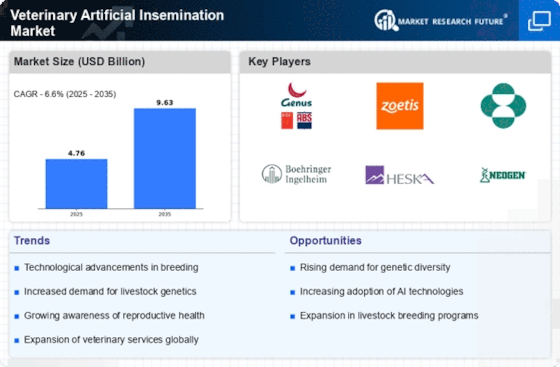
As per Market Research Future analysis, the Veterinary Artificial Insemination Market Size was estimated at 4.765 USD Billion in 2024. The Veterinary Artificial Insemination industry is projected to grow from 5.08 USD Billion in 2025 to 9.627 USD Billion by 2035, exhibiting a compound annual growth rate (CAGR) of 6% during the forecast period 2025 - 2035

Key Market Trends & Highlights

The Veterinary Artificial Insemination Market is experiencing robust growth driven by technological advancements and increasing demand for high-quality livestock.

  • Technological advancements are enhancing the efficiency and success rates of artificial insemination procedures. In North America, the market remains the largest, while the Asia-Pacific region is emerging as the fastest-growing area for veterinary artificial insemination. The equipment segment dominates the market, whereas the reagents and kits segment is witnessing the fastest growth due to rising demand. Key drivers include the increasing awareness of animal health and supportive government policies aimed at improving livestock quality.

Market Size & Forecast

2024 Market Size 4.765 (USD Billion)
2035 Market Size 9.627 (USD Billion)
CAGR (2025 - 2035) 6.6%
Largest Regional Market Share in 2024 North America

Major Players

Genus PLC (GB), Zoetis Inc. (US), <a href="https://www.merckvetmanual.com/management-and-nutrition/management-of-reproduction-sheep/artificial-insemination-in-sheep">Merck Animal Health</a> (US), <a href="https://www.boehringer-ingelheim.com/in/animal-health">Boehringer Ingelheim </a>(DE), Heska Corporation (US), Neogen Corporation (US), Allflex (FR), CooperSurgical (US)

Market Trends

The Veterinary Artificial Insemination Market is currently experiencing a notable transformation, driven by advancements in reproductive technologies and increasing awareness among livestock producers within the global artificial insemination market. This market appears to be expanding as farmers and veterinarians recognize the benefits of animal insemination, such as improved genetic quality and enhanced herd productivity. The integration of innovative techniques, including the use of sexed semen and embryo transfer, seems to be gaining traction, particularly in artificial insemination cattle services. Furthermore, the growing emphasis on animal welfare and sustainable farming practices may also contribute to the market's evolution, as stakeholders seek methods that align with ethical standards while maximizing output through veterinary artificial insemination practices. In addition, the Veterinary Artificial Insemination Market is likely to witness a rise in demand for specialized training and education for practitioners involved in artificial insemination services cattle. As the industry evolves, veterinarians may require updated knowledge and skills to effectively implement these advanced reproductive technologies. This trend suggests a shift towards more comprehensive veterinary services, where professionals not only perform insemination procedures but also provide guidance on herd management and reproductive health. Overall, the Veterinary Artificial Insemination Market appears poised for growth, driven by technological advancements and a commitment to improving livestock genetics and welfare.

Technological Advancements

The Veterinary Artificial Insemination Market is increasingly influenced by technological innovations shaping the broader artificial insemination market analysis. New reproductive technologies, such as sexed semen and advanced embryo transfer techniques, are becoming more prevalent in animal artificial breeding programs. These advancements may enhance breeding efficiency and genetic quality, appealing to livestock producers seeking to optimize their herds.

Focus on Animal Welfare

There is a growing emphasis on animal welfare within the Veterinary Artificial Insemination Market. Stakeholders are increasingly prioritizing ethical practices in animal insemination and breeding programs, reinforcing responsible adoption of artificial insemination veterinary solutions. This trend suggests that producers are looking for methods that not only improve productivity but also align with humane treatment of animals.

Education and Training Demand

The demand for specialized education and training in the Veterinary Artificial Insemination Market is on the rise. As new technologies emerge within the artificial insemination market, veterinarians may require updated skills to implement these methods effectively, particularly for large-scale artificial insemination cattle services. This trend indicates a shift towards more comprehensive veterinary services that encompass reproductive health and herd management.

Veterinary Artificial Insemination Market Market Drivers

Supportive Government Policies

Government policies play a crucial role in shaping the Veterinary Artificial Insemination Market. Many countries are implementing supportive regulations and initiatives aimed at promoting advanced breeding techniques, including artificial insemination. These policies often include funding for research and development, as well as subsidies for farmers adopting these technologies. For instance, some governments are providing financial incentives to encourage the use of artificial insemination as a means to enhance livestock quality and productivity. Such initiatives not only facilitate access to advanced reproductive technologies but also contribute to the overall growth of the Veterinary Artificial Insemination Market. As these supportive measures continue to evolve, they are likely to create a more favorable environment for the adoption of artificial insemination practices among livestock producers.

Increasing Awareness of Animal Health

The Veterinary Artificial Insemination Market is benefiting from a growing awareness of animal health and welfare among producers and consumers alike. As stakeholders become more informed about the benefits of artificial insemination, including its role in disease control and genetic improvement, the adoption of these practices is likely to rise. Enhanced animal health leads to better productivity and lower veterinary costs, which are appealing factors for livestock producers. Furthermore, regulatory bodies are increasingly emphasizing the importance of animal welfare, which aligns with the principles of artificial insemination that promote healthier breeding practices. This heightened awareness is expected to drive the Veterinary Artificial Insemination Market forward, as more producers recognize the long-term benefits of investing in advanced reproductive technologies.

Rising Demand for High-Quality Livestock

The Veterinary Artificial Insemination Market is experiencing a notable increase in demand for high-quality livestock. This trend is driven by the growing need for improved genetic traits in animals, which enhances productivity and disease resistance. Farmers and breeders are increasingly adopting artificial insemination techniques to ensure superior offspring, thereby maximizing their investment. According to recent data, the market for artificial insemination in livestock is projected to grow at a compound annual growth rate of approximately 6% over the next few years. This growth is indicative of a broader shift towards more efficient breeding practices, which are essential for meeting the rising global food demand. As such, the Veterinary Artificial Insemination Market is poised for expansion, reflecting the agricultural sector's commitment to innovation and sustainability.

Advancements in Reproductive Technologies

Technological innovations are significantly shaping the Veterinary Artificial Insemination Market. The introduction of advanced reproductive technologies, such as sexed semen and embryo transfer, is enhancing the efficiency and effectiveness of artificial insemination procedures. These technologies allow for better selection of desirable traits, which is crucial for livestock producers aiming to improve herd quality. Recent studies indicate that the use of sexed semen can increase the likelihood of producing female offspring, which are often more valuable in dairy production. As these technologies become more accessible, the Veterinary Artificial Insemination Market is likely to witness increased adoption rates among breeders and farmers, further driving market growth. The integration of these advancements not only improves reproductive outcomes but also aligns with the industry's focus on maximizing genetic potential.

Global Population Growth and Food Security

The Veterinary Artificial Insemination Market is significantly influenced by the challenges posed by global population growth and the corresponding demand for food security. As the world population continues to rise, the pressure on agricultural systems to produce sufficient food becomes increasingly pronounced. Artificial insemination offers a viable solution to enhance livestock productivity and ensure a stable food supply. By improving the genetic quality of livestock, producers can achieve higher yields and better resource efficiency. Recent projections suggest that the demand for meat and dairy products will increase substantially in the coming years, further underscoring the importance of advanced breeding techniques. Consequently, the Veterinary Artificial Insemination Market is likely to expand as stakeholders seek innovative solutions to meet the growing food demands of an ever-increasing population.


Market Segment Insights

By Type: Equipment (Largest) vs. Reagents & Kits (Fastest-Growing)

In the Veterinary Artificial Insemination Market, the distribution among the major types highlights a significant propensity towards Equipment, which stands as the largest segment. This dominance is driven by the ongoing advancements in technology that enhance the efficiency and reliability of artificial insemination procedures. Conversely, Reagents &amp; Kits are emerging rapidly, showcasing strong growth potential as veterinary practices increasingly focus on quality and precision in reproductive technologies. Other types in the segment continue to hold a smaller share but contribute to the diversification of available solutions within the market.

Market Position: Equipment (Dominant) vs. Reagents &amp; Kits (Emerging)

Equipment in the Veterinary Artificial Insemination Market is characterized by its significant adoption across various veterinary settings and its crucial role in ensuring successful insemination outcomes. These innovative tools facilitate precise semen handling, leading to improved fertility rates in livestock. On the other hand, Reagents &amp; Kits represent an emerging market segment, attracting attention for their ability to streamline processes and enhance accuracy in insemination protocols. As veterinary professionals seek to optimize their practices, the growing demand for high-quality reagents and comprehensive kits positions them as an essential part of modern insemination strategies, fostering growth and innovation in the sector.

By End User: Veterinary Hospitals (Largest) vs. Veterinary Clinics (Fastest-Growing)

The Veterinary Artificial Insemination Market exhibits a diverse distribution among its end user segments, with veterinary hospitals taking the lead in market share. These establishments, often equipped with state-of-the-art technology and comprehensive reproductive services, cater to a broad clientele, contributing significantly to revenue generation. In contrast, veterinary clinics, while smaller in scale, are rapidly increasing their prevalence in the market, capitalizing on the growing trend of pet ownership and the demand for reproductive services. This shift indicates a changing dynamic within the market as veterinary hospitals maintain dominance while clinics carve out a substantial niche. Growth trends within this segment have shown that veterinary clinics are emerging as a vital player in the veterinary artificial insemination landscape, driven by an increase in pet population and a rising awareness of animal reproductive health. Factors such as advancements in insemination techniques and rising investments in veterinary care are propelling clinics towards becoming the fastest-growing segment. The growing emphasis on animal breeding among pet owners and livestock farmers further fuels demand, indicating a positive outlook for veterinary clinics while still solidifying the existing prominence of veterinary hospitals.

Veterinary Hospitals (Dominant) vs. Veterinary Clinics (Emerging)

Veterinary hospitals are currently positioned as the dominant players in the veterinary artificial insemination market. These facilities not only offer a comprehensive suite of reproductive services but also benefit from extensive resources, including specialized veterinary staff and advanced reproductive technologies. This dominance is largely due to their established reputation and the ability to conduct complex insemination procedures, making them the preferred choice among breeders and animal owners. On the other hand, veterinary clinics are emerging as significant contributors to the market, particularly in urban areas where there is a burgeoning population of pet owners. They often provide more accessible services and cater to a growing client base, subsequently playing a crucial role in wider adoption of artificial insemination practices. This duality reflects a market in transition, as clinics leverage their local expertise to harness new opportunities.

Get more detailed insights about Veterinary Artificial Insemination Market Research Report—Global Forecast till 2035

Regional Insights

North America : Veterinary Innovation Leader

North America remains the largest contributor to the artificial insemination market, driven by advanced veterinary infrastructure and widespread adoption of veterinary artificial insemination technologies. The growth is driven by increasing pet ownership, advancements in reproductive technologies, and supportive regulatory frameworks. The demand for high-quality livestock and genetic improvement in animals further fuels this market. The U.S. and Canada are the primary contributors, with a growing focus on animal welfare and productivity. The competitive landscape in North America is robust, featuring key players like Zoetis Inc., Merck Animal Health, and Genus PLC. These companies are investing in research and development to enhance their product offerings. The presence of advanced veterinary services and a strong emphasis on animal health regulations contribute to the region's market strength. The integration of technology in veterinary practices is also a significant trend, enhancing service delivery and efficiency.

Europe : Emerging Market Dynamics

Europe is the second-largest market for veterinary artificial insemination, accounting for approximately 30% of the global market share. The region benefits from stringent regulations that ensure high standards in animal health and welfare. Countries like Germany and France are leading the market, driven by increasing demand for genetic improvement in livestock and pets. The European Union's policies on animal breeding and welfare further catalyze market growth, promoting innovative practices in artificial insemination. Leading countries in Europe include Germany, France, and the UK, where key players like Boehringer Ingelheim and Allflex are prominent. The competitive landscape is characterized by a mix of established companies and emerging startups focusing on technological advancements. The emphasis on sustainable practices and animal welfare is reshaping the market, with companies investing in eco-friendly solutions and advanced reproductive technologies to meet consumer demands.

Asia-Pacific : Rapidly Growing Market

Asia-Pacific is witnessing rapid growth in the veterinary artificial insemination market, holding about 20% of the global share. The region's growth is driven by rising livestock production, increasing disposable incomes, and a growing awareness of animal health. Countries like China and India are at the forefront, with significant investments in agricultural technology and veterinary services. The regulatory environment is evolving, with governments promoting modern breeding techniques to enhance productivity. China and India are the leading countries in this region, with a burgeoning demand for quality livestock and genetic improvement. The competitive landscape includes both local and international players, with companies like Neogen Corporation and Heska Corporation making significant inroads. The focus on improving animal genetics and productivity is leading to increased adoption of artificial insemination techniques, supported by government initiatives and funding for agricultural advancements.

Middle East and Africa : Emerging Market Potential

The Middle East and Africa region is emerging as a potential market for veterinary artificial insemination, holding approximately 5% of the global market share. The growth is driven by increasing livestock production and a rising demand for quality meat and dairy products. Countries like South Africa and Kenya are leading the way, with government initiatives aimed at improving agricultural practices and animal health. The regulatory landscape is gradually evolving to support modern breeding techniques and enhance food security. In this region, South Africa and Kenya are the primary markets, with a growing presence of both local and international companies. The competitive landscape is characterized by a mix of established players and new entrants focusing on innovative solutions. The emphasis on improving livestock genetics and productivity is driving the adoption of artificial insemination techniques, supported by training programs and awareness campaigns to educate farmers on best practices.

Key Players and Competitive Insights

The Veterinary Artificial Insemination Market is currently characterized by a dynamic competitive landscape, driven by advancements in reproductive technologies and increasing demand for genetic improvement in livestock. Key players such as Genus PLC (GB), Zoetis Inc. (US), and Merck Animal Health (US) are strategically positioned to leverage innovation and expand their market presence. Genus PLC (GB) focuses on genetic advancements and has been actively investing in research and development to enhance its product offerings. Meanwhile, Zoetis Inc. (US) emphasizes digital transformation, integrating data analytics into its services to optimize breeding outcomes. Merck Animal Health (US) is pursuing strategic partnerships to broaden its portfolio, indicating a trend towards collaborative innovation in the sector. The business tactics employed by these companies include localizing manufacturing and optimizing supply chains to enhance efficiency and responsiveness to market demands. The Veterinary Artificial Insemination Market appears moderately fragmented, with a mix of established players and emerging companies. The collective influence of these key players shapes the competitive structure, as they vie for market share through differentiated strategies and technological advancements. In August 2025, Genus PLC (GB) announced a partnership with a leading agricultural technology firm to develop a new line of genetically superior breeding stock. This strategic move is likely to enhance Genus's competitive edge by providing farmers with improved genetic options, thereby increasing productivity and profitability in livestock production. Such collaborations may also signal a shift towards more integrated solutions in the market. In September 2025, Zoetis Inc. (US) launched a new digital platform aimed at streamlining the artificial insemination process for veterinarians and farmers. This platform is expected to facilitate better data management and improve breeding success rates, reflecting Zoetis's commitment to leveraging technology for enhanced service delivery. The introduction of such digital solutions may redefine customer engagement and operational efficiency in the industry. In July 2025, Merck Animal Health (US) expanded its product line by acquiring a biotechnology firm specializing in reproductive health solutions. This acquisition is anticipated to bolster Merck's capabilities in the artificial insemination segment, allowing for a more comprehensive approach to animal health and breeding. The strategic importance of this move lies in Merck's ability to offer a wider array of solutions, potentially increasing its market share and reinforcing its position as a leader in the sector. As of October 2025, current competitive trends in the Veterinary Artificial Insemination Market include a pronounced focus on digitalization, sustainability, and the integration of artificial intelligence. Strategic alliances are increasingly shaping the landscape, as companies recognize the value of collaboration in driving innovation. Looking ahead, competitive differentiation is likely to evolve from traditional price-based competition towards a greater emphasis on technological advancements, innovative solutions, and reliable supply chains, positioning companies to better meet the evolving needs of the market.

Key Companies in the Veterinary Artificial Insemination Market include

Industry Developments

  • Recent industry developments highlight growing investments in animal insemination technologies and AI-driven reproductive tools, reinforcing innovation within the artificial insemination market analysis framework.

    Q1 2025: IMV Technologies announces acquisition of Conception Ro-Main Inc. In January 2025, IMV Technologies announced the acquisition of Conception Ro-Main Inc., a Canadian leader in high-tech swine production solutions, to enhance its Farm Animal business with AI-powered technologies and IoT solutions for sustainable pig farming. The acquisition is expected to be finalized in Q1 2025.

Future Outlook

Veterinary Artificial Insemination Market Future Outlook

The Veterinary Artificial Insemination Market is projected to grow at a 6.6% CAGR from 2025 to 2035, driven by technological advancements, increasing livestock productivity, and rising demand for genetic improvement.

New opportunities lie in:

  • <p>Development of mobile AI services for remote areas Integration of AI technology for precision breeding Expansion of training programs for veterinarians in AI techniques</p>

By 2035, the market is expected to be robust, reflecting substantial growth and innovation.

Market Segmentation

Veterinary Artificial Insemination Market Type Outlook

  • Equipment
  • Reagents & Kits
  • Others

Veterinary Artificial Insemination Market End User Outlook

  • Veterinary Hospitals
  • Veterinary Clinics
  • Others

Report Scope

MARKET SIZE 2024 4.765(USD Billion)
MARKET SIZE 2025 5.08(USD Billion)
MARKET SIZE 2035 9.627(USD Billion)
COMPOUND ANNUAL GROWTH RATE (CAGR) 6.6% (2025 - 2035)
REPORT COVERAGE Revenue Forecast, Competitive Landscape, Growth Factors, and Trends
BASE YEAR 2024
Market Forecast Period 2025 - 2035
Historical Data 2019 - 2024
Market Forecast Units USD Billion
Key Companies Profiled Genus PLC (GB), Zoetis Inc. (US), Merck Animal Health (US), Boehringer Ingelheim (DE), Heska Corporation (US), Neogen Corporation (US), Allflex (FR), CooperSurgical (US)
Segments Covered Product Type, End Users, Region
Key Market Opportunities Advancements in reproductive technologies enhance efficiency in the Veterinary Artificial Insemination Market.
Key Market Dynamics Technological advancements and regulatory changes drive growth in the Veterinary Artificial Insemination Market.
Countries Covered North America, Europe, APAC, South America, MEA

FAQs

What is the current valuation of the Veterinary Artificial Insemination Market?

<p>The Veterinary Artificial Insemination Market was valued at 4.765 USD Billion in 2024.</p>

What is the projected market size for the Veterinary Artificial Insemination Market by 2035?

<p>The market is projected to reach 9.627 USD Billion by 2035.</p>

What is the expected CAGR for the Veterinary Artificial Insemination Market during the forecast period?

<p>The expected CAGR for the market from 2025 to 2035 is 6.6%.</p>

Which segments are included in the Veterinary Artificial Insemination Market?

<p>The market segments include Equipment, Reagents & Kits, and Others.</p>

What were the valuations for the Equipment segment in 2024 and its projected value in 2035?

<p>The Equipment segment was valued at 1.5 USD Billion in 2024 and is projected to reach 3.0 USD Billion by 2035.</p>

How do the valuations of Veterinary Hospitals and Clinics compare in the market?

<p>In 2024, Veterinary Hospitals were valued at 1.905 USD Billion, while Veterinary Clinics were valued at 1.425 USD Billion.</p>

What is the projected growth for the Reagents & Kits segment from 2024 to 2035?

The Reagents &amp; Kits segment is expected to grow from 2.0 USD Billion in 2024 to 4.0 USD Billion by 2035.

Who are the key players in the Veterinary Artificial Insemination Market?

Key players include Genus PLC, Zoetis Inc., Merck Animal Health, and Boehringer Ingelheim.

What is the projected value for the Others segment by 2035?

The Others segment is projected to reach 2.627 USD Billion by 2035.

What are the expected trends in the Veterinary Artificial Insemination Market by 2035?

The market is likely to experience growth driven by advancements in technology and increasing demand for veterinary services.

  1. SECTION I: EXECUTIVE SUMMARY AND KEY HIGHLIGHTS
    1. | 1.1 EXECUTIVE SUMMARY
    2. | | 1.1.1 Market Overview
    3. | | 1.1.2 Key Findings
    4. | | 1.1.3 Market Segmentation
    5. | | 1.1.4 Competitive Landscape
    6. | | 1.1.5 Challenges and Opportunities
    7. | | 1.1.6 Future Outlook
  2. SECTION II: SCOPING, METHODOLOGY AND MARKET STRUCTURE
    1. | 2.1 MARKET INTRODUCTION
    2. | | 2.1.1 Definition
    3. | | 2.1.2 Scope of the study
    4. | | | 2.1.2.1 Research Objective
    5. | | | 2.1.2.2 Assumption
    6. | | | 2.1.2.3 Limitations
    7. | 2.2 RESEARCH METHODOLOGY
    8. | | 2.2.1 Overview
    9. | | 2.2.2 Data Mining
    10. | | 2.2.3 Secondary Research
    11. | | 2.2.4 Primary Research
    12. | | | 2.2.4.1 Primary Interviews and Information Gathering Process
    13. | | | 2.2.4.2 Breakdown of Primary Respondents
    14. | | 2.2.5 Forecasting Model
    15. | | 2.2.6 Market Size Estimation
    16. | | | 2.2.6.1 Bottom-Up Approach
    17. | | | 2.2.6.2 Top-Down Approach
    18. | | 2.2.7 Data Triangulation
    19. | | 2.2.8 Validation
  3. SECTION III: QUALITATIVE ANALYSIS
    1. | 3.1 MARKET DYNAMICS
    2. | | 3.1.1 Overview
    3. | | 3.1.2 Drivers
    4. | | 3.1.3 Restraints
    5. | | 3.1.4 Opportunities
    6. | 3.2 MARKET FACTOR ANALYSIS
    7. | | 3.2.1 Value chain Analysis
    8. | | 3.2.2 Porter's Five Forces Analysis
    9. | | | 3.2.2.1 Bargaining Power of Suppliers
    10. | | | 3.2.2.2 Bargaining Power of Buyers
    11. | | | 3.2.2.3 Threat of New Entrants
    12. | | | 3.2.2.4 Threat of Substitutes
    13. | | | 3.2.2.5 Intensity of Rivalry
    14. | | 3.2.3 COVID-19 Impact Analysis
    15. | | | 3.2.3.1 Market Impact Analysis
    16. | | | 3.2.3.2 Regional Impact
    17. | | | 3.2.3.3 Opportunity and Threat Analysis
  4. SECTION IV: QUANTITATIVE ANALYSIS
    1. | 4.1 Healthcare, BY Type (USD Billion)
    2. | | 4.1.1 Equipment
    3. | | 4.1.2 Reagents & Kits
    4. | | 4.1.3 Others
    5. | 4.2 Healthcare, BY End User (USD Billion)
    6. | | 4.2.1 Veterinary Hospitals
    7. | | 4.2.2 Veterinary Clinics
    8. | | 4.2.3 Others
    9. | 4.3 Healthcare, BY Region (USD Billion)
    10. | | 4.3.1 North America
    11. | | | 4.3.1.1 US
    12. | | | 4.3.1.2 Canada
    13. | | 4.3.2 Europe
    14. | | | 4.3.2.1 Germany
    15. | | | 4.3.2.2 UK
    16. | | | 4.3.2.3 France
    17. | | | 4.3.2.4 Russia
    18. | | | 4.3.2.5 Italy
    19. | | | 4.3.2.6 Spain
    20. | | | 4.3.2.7 Rest of Europe
    21. | | 4.3.3 APAC
    22. | | | 4.3.3.1 China
    23. | | | 4.3.3.2 India
    24. | | | 4.3.3.3 Japan
    25. | | | 4.3.3.4 South Korea
    26. | | | 4.3.3.5 Malaysia
    27. | | | 4.3.3.6 Thailand
    28. | | | 4.3.3.7 Indonesia
    29. | | | 4.3.3.8 Rest of APAC
    30. | | 4.3.4 South America
    31. | | | 4.3.4.1 Brazil
    32. | | | 4.3.4.2 Mexico
    33. | | | 4.3.4.3 Argentina
    34. | | | 4.3.4.4 Rest of South America
    35. | | 4.3.5 MEA
    36. | | | 4.3.5.1 GCC Countries
    37. | | | 4.3.5.2 South Africa
    38. | | | 4.3.5.3 Rest of MEA
  5. SECTION V: COMPETITIVE ANALYSIS
    1. | 5.1 Competitive Landscape
    2. | | 5.1.1 Overview
    3. | | 5.1.2 Competitive Analysis
    4. | | 5.1.3 Market share Analysis
    5. | | 5.1.4 Major Growth Strategy in the Healthcare
    6. | | 5.1.5 Competitive Benchmarking
    7. | | 5.1.6 Leading Players in Terms of Number of Developments in the Healthcare
    8. | | 5.1.7 Key developments and growth strategies
    9. | | | 5.1.7.1 New Product Launch/Service Deployment
    10. | | | 5.1.7.2 Merger & Acquisitions
    11. | | | 5.1.7.3 Joint Ventures
    12. | | 5.1.8 Major Players Financial Matrix
    13. | | | 5.1.8.1 Sales and Operating Income
    14. | | | 5.1.8.2 Major Players R&D Expenditure. 2023
    15. | 5.2 Company Profiles
    16. | | 5.2.1 Genus PLC (GB)
    17. | | | 5.2.1.1 Financial Overview
    18. | | | 5.2.1.2 Products Offered
    19. | | | 5.2.1.3 Key Developments
    20. | | | 5.2.1.4 SWOT Analysis
    21. | | | 5.2.1.5 Key Strategies
    22. | | 5.2.2 Zoetis Inc. (US)
    23. | | | 5.2.2.1 Financial Overview
    24. | | | 5.2.2.2 Products Offered
    25. | | | 5.2.2.3 Key Developments
    26. | | | 5.2.2.4 SWOT Analysis
    27. | | | 5.2.2.5 Key Strategies
    28. | | 5.2.3 Merck Animal Health (US)
    29. | | | 5.2.3.1 Financial Overview
    30. | | | 5.2.3.2 Products Offered
    31. | | | 5.2.3.3 Key Developments
    32. | | | 5.2.3.4 SWOT Analysis
    33. | | | 5.2.3.5 Key Strategies
    34. | | 5.2.4 Boehringer Ingelheim (DE)
    35. | | | 5.2.4.1 Financial Overview
    36. | | | 5.2.4.2 Products Offered
    37. | | | 5.2.4.3 Key Developments
    38. | | | 5.2.4.4 SWOT Analysis
    39. | | | 5.2.4.5 Key Strategies
    40. | | 5.2.5 Heska Corporation (US)
    41. | | | 5.2.5.1 Financial Overview
    42. | | | 5.2.5.2 Products Offered
    43. | | | 5.2.5.3 Key Developments
    44. | | | 5.2.5.4 SWOT Analysis
    45. | | | 5.2.5.5 Key Strategies
    46. | | 5.2.6 Neogen Corporation (US)
    47. | | | 5.2.6.1 Financial Overview
    48. | | | 5.2.6.2 Products Offered
    49. | | | 5.2.6.3 Key Developments
    50. | | | 5.2.6.4 SWOT Analysis
    51. | | | 5.2.6.5 Key Strategies
    52. | | 5.2.7 Allflex (FR)
    53. | | | 5.2.7.1 Financial Overview
    54. | | | 5.2.7.2 Products Offered
    55. | | | 5.2.7.3 Key Developments
    56. | | | 5.2.7.4 SWOT Analysis
    57. | | | 5.2.7.5 Key Strategies
    58. | | 5.2.8 CooperSurgical (US)
    59. | | | 5.2.8.1 Financial Overview
    60. | | | 5.2.8.2 Products Offered
    61. | | | 5.2.8.3 Key Developments
    62. | | | 5.2.8.4 SWOT Analysis
    63. | | | 5.2.8.5 Key Strategies
    64. | 5.3 Appendix
    65. | | 5.3.1 References
    66. | | 5.3.2 Related Reports
  6. LIST OF FIGURES
    1. | 6.1 MARKET SYNOPSIS
    2. | 6.2 NORTH AMERICA MARKET ANALYSIS
    3. | 6.3 US MARKET ANALYSIS BY TYPE
    4. | 6.4 US MARKET ANALYSIS BY END USER
    5. | 6.5 CANADA MARKET ANALYSIS BY TYPE
    6. | 6.6 CANADA MARKET ANALYSIS BY END USER
    7. | 6.7 EUROPE MARKET ANALYSIS
    8. | 6.8 GERMANY MARKET ANALYSIS BY TYPE
    9. | 6.9 GERMANY MARKET ANALYSIS BY END USER
    10. | 6.10 UK MARKET ANALYSIS BY TYPE
    11. | 6.11 UK MARKET ANALYSIS BY END USER
    12. | 6.12 FRANCE MARKET ANALYSIS BY TYPE
    13. | 6.13 FRANCE MARKET ANALYSIS BY END USER
    14. | 6.14 RUSSIA MARKET ANALYSIS BY TYPE
    15. | 6.15 RUSSIA MARKET ANALYSIS BY END USER
    16. | 6.16 ITALY MARKET ANALYSIS BY TYPE
    17. | 6.17 ITALY MARKET ANALYSIS BY END USER
    18. | 6.18 SPAIN MARKET ANALYSIS BY TYPE
    19. | 6.19 SPAIN MARKET ANALYSIS BY END USER
    20. | 6.20 REST OF EUROPE MARKET ANALYSIS BY TYPE
    21. | 6.21 REST OF EUROPE MARKET ANALYSIS BY END USER
    22. | 6.22 APAC MARKET ANALYSIS
    23. | 6.23 CHINA MARKET ANALYSIS BY TYPE
    24. | 6.24 CHINA MARKET ANALYSIS BY END USER
    25. | 6.25 INDIA MARKET ANALYSIS BY TYPE
    26. | 6.26 INDIA MARKET ANALYSIS BY END USER
    27. | 6.27 JAPAN MARKET ANALYSIS BY TYPE
    28. | 6.28 JAPAN MARKET ANALYSIS BY END USER
    29. | 6.29 SOUTH KOREA MARKET ANALYSIS BY TYPE
    30. | 6.30 SOUTH KOREA MARKET ANALYSIS BY END USER
    31. | 6.31 MALAYSIA MARKET ANALYSIS BY TYPE
    32. | 6.32 MALAYSIA MARKET ANALYSIS BY END USER
    33. | 6.33 THAILAND MARKET ANALYSIS BY TYPE
    34. | 6.34 THAILAND MARKET ANALYSIS BY END USER
    35. | 6.35 INDONESIA MARKET ANALYSIS BY TYPE
    36. | 6.36 INDONESIA MARKET ANALYSIS BY END USER
    37. | 6.37 REST OF APAC MARKET ANALYSIS BY TYPE
    38. | 6.38 REST OF APAC MARKET ANALYSIS BY END USER
    39. | 6.39 SOUTH AMERICA MARKET ANALYSIS
    40. | 6.40 BRAZIL MARKET ANALYSIS BY TYPE
    41. | 6.41 BRAZIL MARKET ANALYSIS BY END USER
    42. | 6.42 MEXICO MARKET ANALYSIS BY TYPE
    43. | 6.43 MEXICO MARKET ANALYSIS BY END USER
    44. | 6.44 ARGENTINA MARKET ANALYSIS BY TYPE
    45. | 6.45 ARGENTINA MARKET ANALYSIS BY END USER
    46. | 6.46 REST OF SOUTH AMERICA MARKET ANALYSIS BY TYPE
    47. | 6.47 REST OF SOUTH AMERICA MARKET ANALYSIS BY END USER
    48. | 6.48 MEA MARKET ANALYSIS
    49. | 6.49 GCC COUNTRIES MARKET ANALYSIS BY TYPE
    50. | 6.50 GCC COUNTRIES MARKET ANALYSIS BY END USER
    51. | 6.51 SOUTH AFRICA MARKET ANALYSIS BY TYPE
    52. | 6.52 SOUTH AFRICA MARKET ANALYSIS BY END USER
    53. | 6.53 REST OF MEA MARKET ANALYSIS BY TYPE
    54. | 6.54 REST OF MEA MARKET ANALYSIS BY END USER
    55. | 6.55 KEY BUYING CRITERIA OF HEALTHCARE
    56. | 6.56 RESEARCH PROCESS OF MRFR
    57. | 6.57 DRO ANALYSIS OF HEALTHCARE
    58. | 6.58 DRIVERS IMPACT ANALYSIS: HEALTHCARE
    59. | 6.59 RESTRAINTS IMPACT ANALYSIS: HEALTHCARE
    60. | 6.60 SUPPLY / VALUE CHAIN: HEALTHCARE
    61. | 6.61 HEALTHCARE, BY TYPE, 2024 (% SHARE)
    62. | 6.62 HEALTHCARE, BY TYPE, 2024 TO 2035 (USD Billion)
    63. | 6.63 HEALTHCARE, BY END USER, 2024 (% SHARE)
    64. | 6.64 HEALTHCARE, BY END USER, 2024 TO 2035 (USD Billion)
    65. | 6.65 BENCHMARKING OF MAJOR COMPETITORS
  7. LIST OF TABLES
    1. | 7.1 LIST OF ASSUMPTIONS
    2. | | 7.1.1
    3. | 7.2 North America MARKET SIZE ESTIMATES; FORECAST
    4. | | 7.2.1 BY TYPE, 2025-2035 (USD Billion)
    5. | | 7.2.2 BY END USER, 2025-2035 (USD Billion)
    6. | 7.3 US MARKET SIZE ESTIMATES; FORECAST
    7. | | 7.3.1 BY TYPE, 2025-2035 (USD Billion)
    8. | | 7.3.2 BY END USER, 2025-2035 (USD Billion)
    9. | 7.4 Canada MARKET SIZE ESTIMATES; FORECAST
    10. | | 7.4.1 BY TYPE, 2025-2035 (USD Billion)
    11. | | 7.4.2 BY END USER, 2025-2035 (USD Billion)
    12. | 7.5 Europe MARKET SIZE ESTIMATES; FORECAST
    13. | | 7.5.1 BY TYPE, 2025-2035 (USD Billion)
    14. | | 7.5.2 BY END USER, 2025-2035 (USD Billion)
    15. | 7.6 Germany MARKET SIZE ESTIMATES; FORECAST
    16. | | 7.6.1 BY TYPE, 2025-2035 (USD Billion)
    17. | | 7.6.2 BY END USER, 2025-2035 (USD Billion)
    18. | 7.7 UK MARKET SIZE ESTIMATES; FORECAST
    19. | | 7.7.1 BY TYPE, 2025-2035 (USD Billion)
    20. | | 7.7.2 BY END USER, 2025-2035 (USD Billion)
    21. | 7.8 France MARKET SIZE ESTIMATES; FORECAST
    22. | | 7.8.1 BY TYPE, 2025-2035 (USD Billion)
    23. | | 7.8.2 BY END USER, 2025-2035 (USD Billion)
    24. | 7.9 Russia MARKET SIZE ESTIMATES; FORECAST
    25. | | 7.9.1 BY TYPE, 2025-2035 (USD Billion)
    26. | | 7.9.2 BY END USER, 2025-2035 (USD Billion)
    27. | 7.10 Italy MARKET SIZE ESTIMATES; FORECAST
    28. | | 7.10.1 BY TYPE, 2025-2035 (USD Billion)
    29. | | 7.10.2 BY END USER, 2025-2035 (USD Billion)
    30. | 7.11 Spain MARKET SIZE ESTIMATES; FORECAST
    31. | | 7.11.1 BY TYPE, 2025-2035 (USD Billion)
    32. | | 7.11.2 BY END USER, 2025-2035 (USD Billion)
    33. | 7.12 Rest of Europe MARKET SIZE ESTIMATES; FORECAST
    34. | | 7.12.1 BY TYPE, 2025-2035 (USD Billion)
    35. | | 7.12.2 BY END USER, 2025-2035 (USD Billion)
    36. | 7.13 APAC MARKET SIZE ESTIMATES; FORECAST
    37. | | 7.13.1 BY TYPE, 2025-2035 (USD Billion)
    38. | | 7.13.2 BY END USER, 2025-2035 (USD Billion)
    39. | 7.14 China MARKET SIZE ESTIMATES; FORECAST
    40. | | 7.14.1 BY TYPE, 2025-2035 (USD Billion)
    41. | | 7.14.2 BY END USER, 2025-2035 (USD Billion)
    42. | 7.15 India MARKET SIZE ESTIMATES; FORECAST
    43. | | 7.15.1 BY TYPE, 2025-2035 (USD Billion)
    44. | | 7.15.2 BY END USER, 2025-2035 (USD Billion)
    45. | 7.16 Japan MARKET SIZE ESTIMATES; FORECAST
    46. | | 7.16.1 BY TYPE, 2025-2035 (USD Billion)
    47. | | 7.16.2 BY END USER, 2025-2035 (USD Billion)
    48. | 7.17 South Korea MARKET SIZE ESTIMATES; FORECAST
    49. | | 7.17.1 BY TYPE, 2025-2035 (USD Billion)
    50. | | 7.17.2 BY END USER, 2025-2035 (USD Billion)
    51. | 7.18 Malaysia MARKET SIZE ESTIMATES; FORECAST
    52. | | 7.18.1 BY TYPE, 2025-2035 (USD Billion)
    53. | | 7.18.2 BY END USER, 2025-2035 (USD Billion)
    54. | 7.19 Thailand MARKET SIZE ESTIMATES; FORECAST
    55. | | 7.19.1 BY TYPE, 2025-2035 (USD Billion)
    56. | | 7.19.2 BY END USER, 2025-2035 (USD Billion)
    57. | 7.20 Indonesia MARKET SIZE ESTIMATES; FORECAST
    58. | | 7.20.1 BY TYPE, 2025-2035 (USD Billion)
    59. | | 7.20.2 BY END USER, 2025-2035 (USD Billion)
    60. | 7.21 Rest of APAC MARKET SIZE ESTIMATES; FORECAST
    61. | | 7.21.1 BY TYPE, 2025-2035 (USD Billion)
    62. | | 7.21.2 BY END USER, 2025-2035 (USD Billion)
    63. | 7.22 South America MARKET SIZE ESTIMATES; FORECAST
    64. | | 7.22.1 BY TYPE, 2025-2035 (USD Billion)
    65. | | 7.22.2 BY END USER, 2025-2035 (USD Billion)
    66. | 7.23 Brazil MARKET SIZE ESTIMATES; FORECAST
    67. | | 7.23.1 BY TYPE, 2025-2035 (USD Billion)
    68. | | 7.23.2 BY END USER, 2025-2035 (USD Billion)
    69. | 7.24 Mexico MARKET SIZE ESTIMATES; FORECAST
    70. | | 7.24.1 BY TYPE, 2025-2035 (USD Billion)
    71. | | 7.24.2 BY END USER, 2025-2035 (USD Billion)
    72. | 7.25 Argentina MARKET SIZE ESTIMATES; FORECAST
    73. | | 7.25.1 BY TYPE, 2025-2035 (USD Billion)
    74. | | 7.25.2 BY END USER, 2025-2035 (USD Billion)
    75. | 7.26 Rest of South America MARKET SIZE ESTIMATES; FORECAST
    76. | | 7.26.1 BY TYPE, 2025-2035 (USD Billion)
    77. | | 7.26.2 BY END USER, 2025-2035 (USD Billion)
    78. | 7.27 MEA MARKET SIZE ESTIMATES; FORECAST
    79. | | 7.27.1 BY TYPE, 2025-2035 (USD Billion)
    80. | | 7.27.2 BY END USER, 2025-2035 (USD Billion)
    81. | 7.28 GCC Countries MARKET SIZE ESTIMATES; FORECAST
    82. | | 7.28.1 BY TYPE, 2025-2035 (USD Billion)
    83. | | 7.28.2 BY END USER, 2025-2035 (USD Billion)
    84. | 7.29 South Africa MARKET SIZE ESTIMATES; FORECAST
    85. | | 7.29.1 BY TYPE, 2025-2035 (USD Billion)
    86. | | 7.29.2 BY END USER, 2025-2035 (USD Billion)
    87. | 7.30 Rest of MEA MARKET SIZE ESTIMATES; FORECAST
    88. | | 7.30.1 BY TYPE, 2025-2035 (USD Billion)
    89. | | 7.30.2 BY END USER, 2025-2035 (USD Billion)
    90. | 7.31 PRODUCT LAUNCH/PRODUCT DEVELOPMENT/APPROVAL
    91. | | 7.31.1
    92. | 7.32 ACQUISITION/PARTNERSHIP
    93. | | 7.32.1

Healthcare Market Segmentation

Healthcare By Type (USD Billion, 2025-2035)

  • Equipment
  • Reagents & Kits
  • Others

Healthcare By End User (USD Billion, 2025-2035)

  • Veterinary Hospitals
  • Veterinary Clinics
  • Others
Infographic

Free Sample Request

Kindly complete the form below to receive a free sample of this Report

Get Free Sample

Customer Strories

Compare Licence

×
Features License Type
Single User Multiuser License Enterprise User
Price $4,950 $5,950 $7,250
Maximum User Access Limit 1 User Upto 10 Users Unrestricted Access Throughout the Organization
Free Customization
Direct Access to Analyst
Deliverable Format
Platform Access
Discount on Next Purchase 10% 15% 15%
Printable Versions