×
Request Free Sample ×

Kindly complete the form below to receive a free sample of this Report

* Please use a valid business email

Leading companies partner with us for data-driven Insights

clients tt-cursor
Hero Background

Tissue Microarray Market

ID: MRFR/LS/0706-CR
186 Pages
Rahul Gotadki
July 2019

Tissue Microarray Market Research Report Information by Procedure (Immunohistochemistry, Fluorescent In-Situ Hybridization and Frozen Tissue Array), Technology (DNA Microarray, Polymerase Chain Reaction (PCR), Next-Generation Sequencing, Northern Blotting and Western Blotting), Application (Oncology, Gene Expression Profiling, SNP Detection, Double-Stranded B-DNA Microarrays, Comparative Genomic Hybridization and Sequencing Bioinformatics), - Forecast till 2035

Share:
Download PDF ×

We do not share your information with anyone. However, we may send you emails based on your report interest from time to time. You may contact us at any time to opt-out.

Tissue Microarray Market Infographic
Purchase Options

Tissue Microarray Market Summary

As per MRFR analysis, the Tissue Microarray Market Size was estimated at 12.3 USD Billion in 2024. The Tissue Microarray industry is projected to grow from 13.54 USD Billion in 2025 to 35.34 USD Billion by 2035, exhibiting a compound annual growth rate (CAGR) of 10.07 during the forecast period 2025 - 2035.

Key Market Trends & Highlights

The Tissue Microarray Market is poised for substantial growth driven by technological advancements and increasing demand for personalized medicine.

  • North America remains the largest market for tissue microarrays, driven by robust healthcare infrastructure and research funding.
  • The Asia-Pacific region is emerging as the fastest-growing market, fueled by increasing investments in biotechnology and healthcare.
  • Immunohistochemistry continues to dominate the market, while fluorescent in situ hybridization is rapidly gaining traction as a fast-growing segment.
  • Technological advancements and the rising demand for personalized medicine are key drivers propelling market expansion.

Market Size & Forecast

2024 Market Size 12.3 (USD Billion)
2035 Market Size 35.34 (USD Billion)
CAGR (2025 - 2035) 10.07%

Major Players

Aperio Technologies (US), Thermo Fisher Scientific (US), Leica Biosystems (DE), Roche Diagnostics (CH), Agilent Technologies (US), BioGenex (US), Merck KGaA (DE), Abcam (GB), Cell Signaling Technology (US)

Tissue Microarray Market Trends

The Tissue Microarray Market is currently experiencing a notable evolution, driven by advancements in technology and increasing applications in research and diagnostics. This market encompasses a variety of products and services that facilitate the analysis of multiple tissue samples simultaneously, thereby enhancing the efficiency of pathological studies. The growing emphasis on personalized medicine and the need for high-throughput screening methods are propelling the demand for tissue microarrays. Furthermore, the integration of artificial intelligence and machine learning in data analysis is likely to transform the landscape of this market, offering more precise and rapid results. In addition, the rising prevalence of chronic diseases and the corresponding need for effective diagnostic tools are contributing to the expansion of the Tissue Microarray Market. Research institutions and pharmaceutical companies are increasingly adopting these technologies to streamline their workflows and improve the accuracy of their findings. As the market continues to evolve, collaborations between academic institutions and industry players may foster innovation and lead to the development of novel applications. Overall, the Tissue Microarray Market appears poised for growth, with a focus on enhancing research capabilities and improving patient outcomes.

Technological Advancements

The Tissue Microarray Market is witnessing rapid technological advancements that enhance the capabilities of tissue analysis. Innovations in imaging techniques and automation are streamlining processes, allowing for more efficient sample handling and data collection. These developments are likely to improve the accuracy and reliability of results, making tissue microarrays an increasingly attractive option for researchers.

Rising Demand for Personalized Medicine

There is a growing trend towards personalized medicine, which is influencing the Tissue Microarray Market significantly. As healthcare shifts towards tailored treatment plans, the need for precise diagnostic tools becomes paramount. Tissue microarrays facilitate the analysis of biomarkers, enabling healthcare professionals to make informed decisions based on individual patient profiles.

Collaborative Research Initiatives

Collaborative research initiatives between academic institutions and industry stakeholders are becoming more prevalent in the Tissue Microarray Market. These partnerships aim to leverage shared expertise and resources, fostering innovation and accelerating the development of new applications. Such collaborations may enhance the overall quality of research and lead to breakthroughs in disease understanding and treatment.

Tissue Microarray Market Drivers

Increasing Incidence of Cancer

The rising incidence of cancer worldwide is a critical driver for the Tissue Microarray Market. As cancer rates continue to escalate, there is an urgent need for effective diagnostic and therapeutic tools. Tissue microarrays play a vital role in cancer research by enabling the analysis of large numbers of tissue samples, which aids in understanding tumor biology and treatment responses. Recent statistics indicate that cancer cases are expected to rise by 70% over the next two decades, underscoring the necessity for advanced research tools. This growing demand for cancer research solutions is likely to propel the Tissue Microarray Market forward.

Collaborative Research Initiatives

Collaborative research initiatives among academic institutions, healthcare organizations, and biotechnology companies are fostering innovation within the Tissue Microarray Market. These partnerships facilitate the sharing of resources, expertise, and data, which accelerates the development of new applications and technologies. For example, joint projects focusing on cancer research are utilizing tissue microarrays to identify novel biomarkers and therapeutic targets. Such collaborations not only enhance the scientific understanding of diseases but also contribute to the commercialization of new diagnostic tools. The Tissue Microarray Market is likely to benefit from these initiatives, as they create a conducive environment for research and development.

Rising Demand for Personalized Medicine

The increasing focus on personalized medicine is significantly influencing the Tissue Microarray Market. As healthcare shifts towards tailored treatment approaches, the need for precise diagnostic tools becomes paramount. Tissue microarrays allow researchers to analyze multiple tissue samples simultaneously, providing insights into individual patient responses to therapies. This capability is particularly relevant in oncology, where understanding tumor heterogeneity is essential for effective treatment planning. Market data indicates that the demand for personalized medicine is expected to reach USD 2 trillion by 2030, further propelling the Tissue Microarray Market as it aligns with the goals of precision medicine.

Growing Investment in Research and Development

Investment in research and development is a significant factor driving the Tissue Microarray Market. Governments and private entities are increasingly allocating funds to support biomedical research, particularly in the fields of oncology and genomics. This financial backing is essential for the advancement of tissue microarray technologies, as it enables the exploration of new applications and methodologies. Data suggests that global spending on biomedical research is projected to exceed USD 200 billion by 2026, which will likely benefit the Tissue Microarray Market. Enhanced funding not only accelerates innovation but also fosters the development of more sophisticated and reliable tissue microarray systems.

Technological Advancements in Tissue Microarray Market

The Tissue Microarray Market is experiencing rapid technological advancements that enhance the efficiency and accuracy of tissue analysis. Innovations such as automated tissue microarray systems and advanced imaging techniques are streamlining workflows and improving data quality. For instance, the integration of artificial intelligence in image analysis is enabling more precise identification of biomarkers, which is crucial for cancer research. According to recent data, the market for automated systems is projected to grow at a compound annual growth rate of over 10% in the coming years. These advancements not only facilitate high-throughput screening but also reduce the time required for analysis, thereby driving the overall growth of the Tissue Microarray Market.

Market Segment Insights

By Procedure: Immunohistochemistry (Largest) vs. Fluorescent in Situ Hybridization (Fastest-Growing)

The Tissue Microarray Market is characterized by a diverse range of procedures, with Immunohistochemistry (IHC) leading the market share due to its widespread application in cancer diagnostics and other disease assessments. IHC offers high specificity and sensitivity, making it the most preferred choice among researchers and clinicians. In contrast, Fluorescent in Situ Hybridization (FISH) is carving out its space as the fastest-growing segment, driven by advancements in detection technologies and the increasing prevalence of genetic disorders, which necessitate precise localization of DNA or RNA within tissues.

Procedure: IHC (Dominant) vs. FISH (Emerging)

Immunohistochemistry (IHC) holds a dominant position in the Tissue Microarray Market, recognized for its capability to provide detailed information on protein expression in tissues, which is crucial for accurate diagnosis and treatment planning. Its robustness and reliability in various applications, including oncology and pathology, contribute to its preferred usage. Conversely, Fluorescent in Situ Hybridization (FISH) is emerging rapidly, especially among researchers focusing on genetic analysis, as it allows for real-time visualization of nucleic acids in tissues. The increase in the number of genetic studies and cancer research projects bolsters FISH's market presence, making it a key player in the evolving landscape of diagnostic procedures.

By Technology: Next-Generation Sequencing (Largest) vs. Polymerase Chain Reaction (PCR) (Fastest-Growing)

In the Tissue Microarray Market, Next-Generation Sequencing (NGS) holds the largest share due to its advanced capabilities and widespread adoption in research applications. This technology allows for high-throughput analysis and has become a preferred choice for complex genomic studies. Polymerase Chain Reaction (PCR), while historically significant, is experiencing rapid growth as advancements in technology enhance its efficiency and application in diagnostic settings. The increasing demand for precise genetic analysis facilitates the expansion of these technologies, impacting market dynamics significantly. The growth trends within the technology segment indicate a shift towards more sophisticated methodologies, such as NGS, which offers comprehensive insights beyond the capabilities of traditional techniques. Moreover, technological innovations and collaborations among key players are driving further adoption of PCR as a critical tool in molecular biology. The rise in genomic and proteomic research is expected to propel these technologies, making them vital in the evolving landscape of tissue microarrays.

Technology: Next-Generation Sequencing (Dominant) vs. Polymerase Chain Reaction (PCR) (Emerging)

Next-Generation Sequencing (NGS) is at the forefront of the Tissue Microarray Market as a dominant technology, known for its unparalleled ability to perform comprehensive genomic analyses. It integrates advanced algorithms and systems, leading to high-throughput capabilities that are not possible with traditional methods. NGS is pivotal for applications requiring extensive data, including cancer research and personalized medicine. On the other hand, Polymerase Chain Reaction (PCR) is emerging rapidly due to its enhanced precision and efficiency in DNA amplification. As a staple in molecular diagnostics, PCR is evolving with innovations like digital PCR, which provides greater sensitivity and quantification. Both technologies exhibit distinct advantages, with NGS dominating due to its broader applications, while PCR is establishing itself as a crucial tool in targeted analyses.

By Application: Oncology (Largest) vs. Gene Expression Profiling (Fastest-Growing)

The Tissue Microarray Market exhibits a diverse range of applications, with Oncology leading the segment due to its critical role in cancer research and diagnosis. Following Oncology, Gene Expression Profiling also shows significant market traction, particularly in personalized medicine and therapeutic response assessment. Other applications like SNP Detection and Comparative Genomic Hybridization contribute to the sector's robustness, although they do not match the dominating position of Oncology.

Oncology: Leading vs. Gene Expression Profiling: Emerging

Oncology remains the dominant application within the Tissue Microarray Market, serving as an essential tool for cancer diagnostics and treatment strategies. It leverages advanced microarray technologies for the detection and analysis of tumor markers, enabling targeted therapies. Conversely, Gene Expression Profiling is quickly emerging, driven by the increasing demand for personalized medicine. This application focuses on understanding gene expression variations attributable to diseases, thereby propelling research aimed at tailored therapeutic interventions. Together, these applications reflect the dynamic landscape of the tissue microarray sector, fostering innovation and comprehensive cancer care.

By End-user: Pharmaceutical and Biotechnological Companies (Largest) vs. Research Organizations (Fastest-Growing)

The tissue microarray market displays a diverse end-user landscape, with pharmaceutical and biotechnological companies holding the largest share. This segment capitalizes on advanced technology to streamline drug development processes and enhance R&D efficiencies. In contrast, research organizations, though smaller in market share, are rapidly expanding their presence due to increasing collaborations and funding focused on genomics and personalized medicine.

End-User: Pharmaceutical and Biotechnological Companies (Dominant) vs. Research Organizations (Emerging)

Pharmaceutical and biotechnological companies are the dominant end-users in the tissue microarray market, leveraging their extensive resources to foster innovation in drug discovery and development. Their need for high-throughput analysis and predictive modeling drives the adoption of tissue microarrays. On the other hand, research organizations are viewed as the emerging players, gaining momentum through specialized research projects and partnerships with academic institutions. Their agility in adapting to new trends in molecular biology fuels their rapid growth, allowing them to pursue novel applications in diagnostics and treatment verification, resulting in expanding capabilities and relevance in the market.

Get more detailed insights about Tissue Microarray Market

Regional Insights

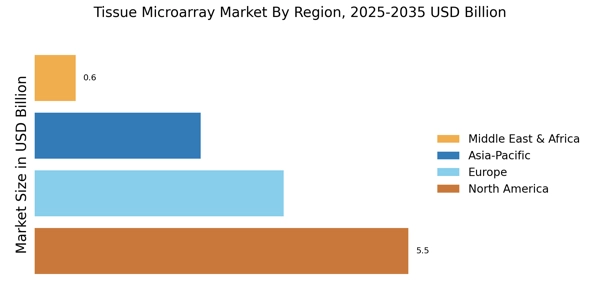
North America : Leading Innovation and Research

North America is the largest market for tissue microarrays, holding approximately 45% of the global share. The region's growth is driven by advanced healthcare infrastructure, increasing research activities, and a strong focus on personalized medicine. Regulatory support from agencies like the FDA further catalyzes market expansion, ensuring safety and efficacy in diagnostic tools. The United States is the primary contributor, with key players such as Thermo Fisher Scientific and Aperio Technologies leading the competitive landscape. Canada also plays a significant role, with growing investments in biotechnology and healthcare research. The presence of major companies enhances innovation and accessibility, making North America a hub for tissue microarray technologies.

Europe : Emerging Research and Development Hub

Europe is the second-largest market for tissue microarrays, accounting for about 30% of the global market share. The region benefits from robust healthcare systems, increasing funding for cancer research, and a growing emphasis on precision medicine. Regulatory frameworks, such as the EU Medical Device Regulation, ensure high standards for product safety and efficacy, driving market growth. Germany and the UK are the leading countries in this sector, with companies like Leica Biosystems and Roche Diagnostics making significant contributions. The competitive landscape is characterized by a mix of established firms and innovative startups, fostering a dynamic environment for advancements in tissue microarray technologies. Collaborative research initiatives further enhance the region's capabilities.

Asia-Pacific : Rapidly Growing Market Potential

Asia-Pacific is witnessing rapid growth in the tissue microarray market, driven by increasing healthcare expenditures, rising cancer prevalence, and advancements in biotechnology. The region holds approximately 20% of the global market share, with countries like China and Japan leading the way. Government initiatives aimed at improving healthcare infrastructure and research capabilities are significant growth catalysts. China is emerging as a key player, with substantial investments in healthcare and research. Japan also contributes significantly, with a focus on innovative diagnostic solutions. The competitive landscape includes both local and international companies, enhancing market dynamics and fostering innovation in tissue microarray technologies. Collaborative efforts between academia and industry further support growth in this region.

Middle East and Africa : Untapped Market with Potential

The Middle East and Africa (MEA) region represents an emerging market for tissue microarrays, currently holding about 5% of the global share. The growth is driven by increasing awareness of cancer diagnostics, improving healthcare infrastructure, and rising investments in research and development. Regulatory bodies are beginning to establish frameworks that support the adoption of advanced diagnostic technologies, which is crucial for market expansion. Countries like South Africa and the UAE are at the forefront, with growing healthcare sectors and increasing collaborations between public and private entities. The competitive landscape is still developing, with opportunities for both local and international players to establish a presence. As healthcare systems evolve, the demand for innovative diagnostic solutions, including tissue microarrays, is expected to rise significantly.

Tissue Microarray Market Regional Image

Key Companies in the Tissue Microarray Market market include

Industry Developments

    • In January 2017, Agilent technologies announced its collaboration with the Centre for Human Genetics of the University of Leuven and the University Hospital of Leuven in Belgium.
    • In July 2017, Horizon Discovery Group agreed to acquire GE Healthcare Dharmacon from parent General Electric for $85 million, creating a combined company focused on applying gene-editing and gene-modulation technologies in life science research.
    • In January 2017, Illumina Inc. announced the launch of a Single-Cell Sequencing Solution in collaboration with Bio-Rad. It is the first Next-Generation Sequencing (NGS) workflow for single-cell analysis providing researchers the ability to investigate the coordinated contribution of individual cells in tissue function, disease progression, and therapeutic response.

Future Outlook

Tissue Microarray Market Future Outlook

The Tissue Microarray Market is projected to grow at a 10.07% CAGR from 2024 to 2035, driven by advancements in personalized medicine, increasing cancer research, and technological innovations.

New opportunities lie in:

  • Development of automated tissue microarray platforms for enhanced throughput.
  • Expansion into emerging markets with tailored product offerings.
  • Strategic partnerships with biotech firms for co-development of diagnostic solutions.

By 2035, the Tissue Microarray Market is expected to be robust, reflecting substantial growth and innovation.

Market Segmentation

Tissue Microarray Market End-user Outlook

  • Pharmaceutical and Biotechnological Companies
  • Research Organization

Tissue Microarray Market Procedure Outlook

  • Immunohistochemistry
  • Fluorescent in Situ Hybridization
  • Frozen Tissue Array

Tissue Microarray Market Technology Outlook

  • DNA Microarray
  • Polymerase Chain Reaction (PCR)
  • Next-Generation Sequencing
  • Northern Blotting
  • Western Blotting

Tissue Microarray Market Application Outlook

  • Oncology
  • Gene Expression Profiling
  • SNP Detection
  • Double-Stranded B-DNA Microarrays
  • Comparative Genomic Hybridization
  • Sequencing Bioinformatics

Report Scope

MARKET SIZE 202412.3(USD Billion)
MARKET SIZE 202513.54(USD Billion)
MARKET SIZE 203535.34(USD Billion)
COMPOUND ANNUAL GROWTH RATE (CAGR)10.07% (2024 - 2035)
REPORT COVERAGERevenue Forecast, Competitive Landscape, Growth Factors, and Trends
BASE YEAR2024
Market Forecast Period2025 - 2035
Historical Data2019 - 2024
Market Forecast UnitsUSD Billion
Key Companies ProfiledMarket analysis in progress
Segments CoveredMarket segmentation analysis in progress
Key Market OpportunitiesAdvancements in personalized medicine drive demand for innovative applications in the Tissue Microarray Market.

Key Market DynamicsRising demand for personalized medicine drives innovation and competition in the Tissue Microarray Market.

Countries CoveredNorth America, Europe, APAC, South America, MEA

Market Highlights

Author
Rahul Gotadki
Assistant Manager

He holds an experience of about 7+ years in Market Research and Business Consulting, working under the spectrum of Life Sciences and Healthcare domains. Rahul conceptualizes and implements a scalable business strategy and provides strategic leadership to the clients. His expertise lies in market estimation, competitive intelligence, pipeline analysis, customer assessment, etc. In addition to the above, his other responsibility includes strategic tracking of high growth markets & advising clients on the potential areas of focus they could direct their business initiatives

Leave a Comment

FAQs

What is the current valuation of the Tissue Microarray Market as of 2024?

The Tissue Microarray Market was valued at 12.3 USD Billion in 2024.

What is the projected market size for the Tissue Microarray Market in 2035?

The market is projected to reach 35.34 USD Billion by 2035.

What is the expected CAGR for the Tissue Microarray Market during the forecast period 2025 - 2035?

The expected CAGR for the Tissue Microarray Market during the forecast period 2025 - 2035 is 10.07%.

Which segment is anticipated to have the highest valuation by procedure in 2035?

By 2035, the Immunohistochemistry segment is anticipated to reach 12.9 USD Billion.

What are the projected values for the DNA Microarray segment by 2035?

The DNA Microarray segment is projected to reach 7.5 USD Billion by 2035.

Download Free Sample

Kindly complete the form below to receive a free sample of this Report

Compare Licence

×
Features License Type
Single User Multiuser License Enterprise User
Price $4,950 $5,950 $7,250
Maximum User Access Limit 1 User Upto 10 Users Unrestricted Access Throughout the Organization
Free Customization
Direct Access to Analyst
Deliverable Format
Platform Access
Discount on Next Purchase 10% 15% 15%
Printable Versions