×
Hero Background
English
Chinese
French
Japanese
Korean
German
Spanish

Valley Fever Market Trends

ID: MRFR/Pharma/1339-HCR
80 Pages
Kinjoll Dey
October 2025

Valley Fever Market Research Report Information, by Types of Treatments (Fluconazole, Itraconazole, Voriconazole, Posaconazole, Others) by Site of Infection (Skin, Liver, Bones, Heart, Brain, Membranes That Surround the Brain and Spinal Cord, Others) - Forecast to 2035

Share:
Download PDF ×

We do not share your information with anyone. However, we may send you emails based on your report interest from time to time. You may contact us at any time to opt-out.

Valley Fever Market Infographic
Purchase Options

Market Trends

Key Emerging Trends in the Valley Fever Market

An unmistakable pattern in the Valley Fever market is the provincial variety in illness occurrence. Locales with dry environments, like the southwestern US, are encountering a higher predominance of Valley Fever. This geological focus essentially affects the interest for diagnostics, treatment, and preventive estimates in impacted regions. The market is seeing progresses in analytic advancements for Valley Fever. Controlled serological tests, sub-atomic diagnostics, and imaging strategies are upgrading the exactness and speed of analysis. These advancements add to more designated and proficient treatment methodologies. The treatment scene for Valley Fever is developing with the presentation of new antifungal prescriptions. Antifungal agents assume an essential part in dealing with the contamination, and progressing research is centered around growing more compelling and satisfactory medications. This pattern mirrors the persistent endeavors to work on helpful results for patients. A vital pattern is the investigation of immunization improvement for Valley Fever. Specialists are researching the plausibility of fostering an immunization to forestall the sickness, especially in high-risk districts. While immunization improvement is still in beginning phases, the potential for a preventive measure is gathering consideration in the healthcare local area. The reception of telemedicine and remote observing is influencing the Valley Fever market. Virtual counsels and remote observing apparatuses are demonstrating important in overseeing patients, particularly those in geologically distributed regions where admittance to specific healthcare might be restricted. This pattern adds to more open and patient-driven care. Regardless of progresses, challenges continue guaranteeing treatment availability, especially in asset compelled locales. Rationales, accessibility of antifungal medications, and healthcare foundation are basic factors that impact the fair dissemination of Valley Fever medicines.

Author
Kinjoll Dey
Research Analyst Level I

He is an extremely curious individual currently working in Healthcare and Medical Devices Domain. Kinjoll is comfortably versed in data centric research backed by healthcare educational background. He leverages extensive data mining and analytics tools such as Primary and Secondary Research, Statistical Analysis, Machine Learning, Data Modelling. His key role also involves Technical Sales Support, Client Interaction and Project management within the Healthcare team. Lastly, he showcases extensive affinity towards learning new skills and remain fascinated in implementing them.

Leave a Comment

FAQs

What is the current valuation of the Valley Fever Market as of 2024?

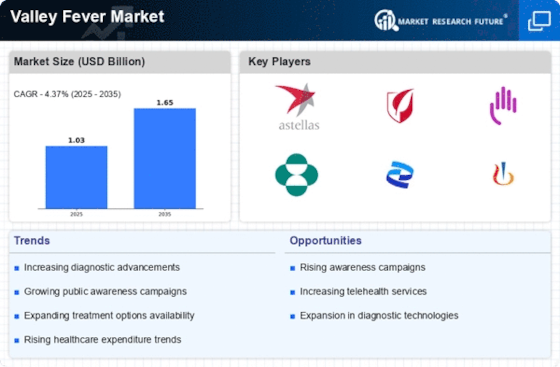
The Valley Fever Market was valued at 1.03 USD Billion in 2024.

What is the projected market valuation for the Valley Fever Market in 2035?

The market is projected to reach 1.649 USD Billion by 2035.

What is the expected CAGR for the Valley Fever Market during the forecast period 2025 - 2035?

The expected CAGR for the Valley Fever Market during 2025 - 2035 is 4.37%.

Which companies are considered key players in the Valley Fever Market?

Key players in the Valley Fever Market include Astellas Pharma, Gilead Sciences, Bristol-Myers Squibb, Merck & Co., Pfizer, Novartis, Amgen, Sanofi, and Eli Lilly and Company.

What are the main treatment types contributing to the Valley Fever Market?

The main treatment types include Fluconazole, Itraconazole, Voriconazole, Posaconazole, and others.

Market Summary

As per MRFR analysis, the Valley Fever Market Size was estimated at 1.03 USD Billion in 2024. The Valley Fever industry is projected to grow from 1.075 in 2025 to 1.649 by 2035, exhibiting a compound annual growth rate (CAGR) of 4.37 during the forecast period 2025 - 2035.

Key Market Trends & Highlights

The Valley Fever Market is experiencing notable growth driven by increased awareness and advancements in treatment options.

  • There is a marked increase in awareness and education regarding Valley Fever Market, particularly in North America. Advancements in diagnostic technologies are enhancing early detection and treatment outcomes in the Valley Fever Market. Research and development of new therapies are gaining momentum, especially in the Asia-Pacific region. The rising incidence of Valley Fever Market and increased research funding are key drivers propelling market growth.

Market Size & Forecast

2024 Market Size 1.03 (USD Billion)
2035 Market Size 1.649 (USD Billion)
CAGR (2025 - 2035) 4.37%
Largest Regional Market Share in 2024 North America

Major Players

<p>Astellas Pharma (JP), Gilead Sciences (US), Bristol-Myers Squibb (US), <a href="https://www.merckvetmanual.com/multimedia/table/signs-of-coccidioidomycosis-valley-fever-in-dogs">Merck &amp; Co</a>. (US), Pfizer (US), Novartis (CH), Amgen (US), <a href="https://www.sanofi.com/en/our-science/our-pipeline">Sanofi (FR)</a>, Eli Lilly and Company (US)</p>

Market Trends

The Valley Fever Market is currently experiencing a notable evolution, driven by a combination of increasing awareness and advancements in diagnostic technologies. As healthcare professionals and the general public become more informed about this fungal infection, the demand for effective treatments and preventive measures appears to be on the rise. This heightened awareness is likely to foster a more proactive approach to managing Valley Fever Market, potentially leading to earlier diagnosis and improved patient outcomes. Furthermore, the integration of innovative diagnostic tools may enhance the accuracy of detection, thereby facilitating timely interventions and reducing the burden of the disease on healthcare systems. In addition to advancements in diagnostics, the Valley Fever Market is also influenced by ongoing research into therapeutic options. Pharmaceutical companies are exploring novel antifungal agents and treatment regimens, which may offer improved efficacy and safety profiles. This research focus suggests a commitment to addressing the unmet medical needs of patients affected by Valley Fever Market. Moreover, collaborations between academic institutions and industry stakeholders could accelerate the development of new therapies, ultimately benefiting patients and healthcare providers alike. As the market continues to evolve, it is essential to monitor these trends closely to understand their implications for stakeholders across the healthcare spectrum.

Increased Awareness and Education

The growing recognition of Valley Fever Market among healthcare providers and the public is driving demand for better treatment options and preventive strategies. Educational initiatives are likely to play a crucial role in this trend.

Advancements in Diagnostic Technologies

Innovations in diagnostic methods are enhancing the ability to detect Valley Fever Market more accurately and swiftly. These advancements may lead to earlier interventions and improved patient management.

Research and Development of New Therapies

Ongoing research into new antifungal treatments is expected to expand the therapeutic landscape for Valley Fever Market. This trend indicates a commitment to addressing the needs of affected individuals.

Valley Fever Market Market Drivers

Increased Research Funding

Increased funding for research into Valley Fever Market is another significant driver for the Valley Fever Market. Government and private organizations are recognizing the need for better understanding and treatment of this disease, leading to enhanced research initiatives. For instance, funding from the National Institutes of Health has been directed towards studying the epidemiology and pathogenesis of Coccidioides. This influx of financial resources is likely to accelerate the development of new diagnostic tools and therapies, thereby expanding the market. As researchers uncover more about the disease, the Valley Fever Market may see a surge in innovative products aimed at prevention and treatment.

Rising Incidence of Valley Fever

The increasing incidence of Valley Fever Market, primarily caused by the fungus Coccidioides, is a critical driver for the Valley Fever Market. Recent data indicates that the number of reported cases has surged, particularly in endemic regions such as the southwestern United States. This rise in cases is likely attributed to environmental factors, including climate change, which may expand the geographical range of the fungus. As awareness of the disease grows, healthcare providers are more vigilant in diagnosing and reporting cases, further contributing to the market's expansion. The Valley Fever Market is thus positioned to experience growth as healthcare systems adapt to the rising demand for effective diagnostic and therapeutic solutions.

Advancements in Treatment Options

The Valley Fever Market is witnessing advancements in treatment options, which serve as a crucial driver for market growth. Recent developments in antifungal medications and therapies are providing healthcare professionals with more effective tools to combat Valley Fever Market. For example, the introduction of new azole antifungals has shown promise in treating severe cases of the disease. As treatment options expand, healthcare providers are better equipped to manage the disease, potentially leading to improved patient outcomes. This evolution in treatment modalities is likely to attract investment and interest in the Valley Fever Market, as pharmaceutical companies seek to develop and market innovative solutions.

Growing Public Health Initiatives

Public health initiatives aimed at raising awareness about Valley Fever Market are becoming increasingly prevalent, serving as a vital driver for the Valley Fever Market. Health departments and organizations are launching campaigns to educate the public about the risks associated with Valley Fever Market, particularly in high-risk areas. These initiatives often include information on prevention strategies and early symptoms, which can lead to earlier diagnosis and treatment. As more individuals become informed about the disease, the demand for diagnostic services and treatment options is likely to increase, thereby propelling the Valley Fever Market forward. The emphasis on public health education may also foster collaboration between various stakeholders, enhancing market growth.

Increased Collaboration Among Stakeholders

Increased collaboration among various stakeholders, including healthcare providers, researchers, and pharmaceutical companies, is emerging as a significant driver for the Valley Fever Market. Such partnerships are essential for sharing knowledge, resources, and expertise, which can lead to more effective strategies for managing Valley Fever Market. Collaborative efforts may include joint research projects, clinical trials, and educational programs aimed at improving awareness and treatment of the disease. As stakeholders work together, the Valley Fever Market is likely to benefit from a more coordinated approach to addressing the challenges posed by Valley Fever Market, ultimately enhancing market growth and innovation.

Market Segment Insights

By Types of Treatments: Fluconazole (Largest) vs. Itraconazole (Fastest-Growing)

<p>In the Valley Fever Market, the treatment landscape is primarily dominated by Fluconazole, which holds the largest market share. It has consistently remained the go-to option for patients due to its effectiveness and familiarity among healthcare providers. Following Fluconazole, Itraconazole has emerged as a significant contender, particularly due to its growing adoption in recent years, which reflects the changing preferences in treatment protocols. The growth trends in the Valley Fever Market treatment segment are noteworthy. Factors such as increased awareness of Valley Fever Market and its treatment alternatives have contributed to the rising demand for Itraconazole, marking it as the fastest-growing treatment option. Moreover, ongoing research and clinical developments surrounding these therapies are expected to drive adoption rates further, indicating a shift towards newer and potentially more effective treatment regimens.</p>

<p>Fluconazole (Dominant) vs. Voriconazole (Emerging)</p>

<p>Fluconazole has maintained a dominant position in the Valley Fever Market treatment market primarily due to its extensive clinical usage and established efficacy in combating fungal infections. It is preferred for its broad-spectrum effectiveness, ease of administration, and relatively moderate side effects. On the other hand, Voriconazole is emerging as a notable alternative treatment, gaining traction due to its enhanced anti-fungal potency and improved patient outcomes. It is preferred in complicated cases where Fluconazole may not be effective, thus creating a niche market. Voriconazole's growing acceptance can also be attributed to advancements in treatment protocols and its potential for addressing severe forms of Valley Fever Market, which positions it favourably against the backdrop of market innovation.</p>

By Site of Infection: Lungs (Largest) vs. Skin (Fastest-Growing)

<p>In the Valley Fever Market, the site of infection segment showcases a diverse distribution of cases. The majority of incidents are recorded in the lungs, which account for the largest share due to the primary nature of coccidioidomycosis as a respiratory disease. Skin infections, while less traditional, have shown a significant rise as awareness increases and diagnosis becomes more widespread, marking them as a noteworthy growing segment among affected populations.</p>

<p>Lungs (Dominant) vs. Skin (Emerging)</p>

<p>The lungs represent the dominant site of infection in the Valley Fever Market, characterized by a higher incidence rate and severe clinical presentations. This site's prominence arises from the fungus's natural route of entry via inhalation, leading to respiratory complications. In contrast, skin infections, although traditionally less recognized, are emerging as a significant concern. Their increase can be attributed to growing awareness and late-stage presentations of the disease, highlighting the need for necessary medical interventions. Both segments require distinct treatment approaches, with lung infections often necessitating rigorous antifungal therapies, while skin infections may demand a combination of topical and systemic treatments.</p>

By End-Use: Human (Largest) vs. Cattle (Fastest-Growing)

<p>The Valley Fever Market demonstrates a diverse distribution of end-use segments, with the Human segment holding the largest share due to an increasing incidence of the disease in various regions. This segment is driven by rising awareness and improvements in diagnostic methods leading to better detection. The Cattle segment, while comparatively smaller, is witnessing notable growth as farming practices evolve and more emphasis is placed on livestock health, particularly in regions where Valley Fever Market is endemic. Growth trends indicate a bright future for the Cattle segment as climate changes and increasing herd sizes contribute to the spread of diseases like Valley Fever Market. This trend is compounded by the need for effective prevention and treatment strategies in agricultural practices, as livestock health significantly impacts productivity. The human segment remains stable, backed by continuous medical advancements, whereas the cattle segment is poised for significant growth in the coming years.</p>

<p>Human (Dominant) vs. Cattle (Emerging)</p>

<p>In the Valley Fever Market, the Human segment stands out as the dominant end-use category, primarily due to its high prevalence and the critical need for effective diagnosis and treatment. Human health initiatives, coupled with a strong focus on research and development, have solidified this segment's position. Meanwhile, the Cattle segment is emerging as a key player, spurred by heightened awareness of Valley Fever Market's impact on livestock health and productivity. Farmers are increasingly seeking preventative measures and veterinary care to manage this disease, reflecting a shift towards more proactive livestock management strategies. This evolving landscape illustrates the contrast between the established human segment and the rapidly developing cattle sector, underscoring the importance of addressing Valley Fever Market across both ends of the spectrum.</p>

Get more detailed insights about Valley Fever Market Research Report- Forecast to 2035

Regional Insights

Key Companies in the Valley Fever Market market include

Industry Developments

  • In December 2019, UC Berkeley School of Public Health, A premier health Research Institute in California, announced the launch of new major research initiatives to tackle valley fever. A 5-year grant of 3.8 million USD is being provided by the National Institute of Health (NIH) for conducting the research.

Intended Audience

This report will be beneficial for every stakeholder of the Valley fever market such as :

  • Manufacturers of Valley Fever Market Drugs
  • Antifungal drug manufacturing companies
  • Suppliers and Distributors
  • Pharmaceutical and Biotechnology companies
  • Hospitals and laboratories
  • Research institutes
  • End users

Future Outlook

Valley Fever Market Future Outlook

<p>The Valley Fever Market is projected to grow at a 4.37% CAGR from 2024 to 2035, driven by increased awareness, improved diagnostics, and rising incidence rates.</p>

New opportunities lie in:

  • <p>Development of targeted antifungal therapies for resistant strains.</p><p>Expansion of telemedicine services for remote patient monitoring.</p><p>Investment in educational campaigns to raise awareness among healthcare providers.</p>

<p>By 2035, the Valley Fever Market is expected to achieve substantial growth, reflecting enhanced treatment options and increased public awareness.</p>

Market Segmentation

Valley Fever Market End-Use Outlook

  • Human
  • Cattle
  • Sheep and goats
  • Camel
  • Others

Valley Fever Market Site of Infection Outlook

  • Skin
  • Lungs
  • Liver
  • Bones
  • Heart
  • Brain
  • Membranes that Surround the Brain and Spinal Cord
  • Others

Valley Fever Market Types of Treatments Outlook

  • Fluconazole
  • Itraconazole
  • Voriconazole
  • Posaconazole
  • Others

Report Scope

MARKET SIZE 20241.03(USD Billion)
MARKET SIZE 20251.075(USD Billion)
MARKET SIZE 20351.649(USD Billion)
COMPOUND ANNUAL GROWTH RATE (CAGR)4.37% (2024 - 2035)
REPORT COVERAGERevenue Forecast, Competitive Landscape, Growth Factors, and Trends
BASE YEAR2024
Market Forecast Period2025 - 2035
Historical Data2019 - 2024
Market Forecast UnitsUSD Billion
Key Companies ProfiledMarket analysis in progress
Segments CoveredMarket segmentation analysis in progress
Key Market OpportunitiesAdvancements in diagnostic technologies enhance early detection and treatment options in the Valley Fever Market.
Key Market DynamicsRising awareness and diagnosis of Valley Fever drive demand for innovative treatment options and improved patient care.
Countries CoveredNorth America, Europe, APAC, South America, MEA

FAQs

What is the current valuation of the Valley Fever Market as of 2024?

The Valley Fever Market was valued at 1.03 USD Billion in 2024.

What is the projected market valuation for the Valley Fever Market in 2035?

The market is projected to reach 1.649 USD Billion by 2035.

What is the expected CAGR for the Valley Fever Market during the forecast period 2025 - 2035?

The expected CAGR for the Valley Fever Market during 2025 - 2035 is 4.37%.

Which companies are considered key players in the Valley Fever Market?

Key players in the Valley Fever Market include Astellas Pharma, Gilead Sciences, Bristol-Myers Squibb, Merck & Co., Pfizer, Novartis, Amgen, Sanofi, and Eli Lilly and Company.

What are the main treatment types contributing to the Valley Fever Market?

The main treatment types include Fluconazole, Itraconazole, Voriconazole, Posaconazole, and others.

  1. SECTION I: EXECUTIVE SUMMARY AND KEY HIGHLIGHTS
    1. EXECUTIVE SUMMARY
      1. Market Overview
      2. Key Findings
      3. Market Segmentation
      4. Competitive Landscape
      5. Challenges and Opportunities
      6. Future Outlook
  2. SECTION II: SCOPING, METHODOLOGY AND MARKET STRUCTURE
    1. MARKET INTRODUCTION
      1. Definition
      2. Scope of the study
    2. RESEARCH METHODOLOGY
      1. Overview
      2. Data Mining
      3. Secondary Research
      4. Primary Research
      5. Forecasting Model
      6. Market Size Estimation
      7. Data Triangulation
      8. Validation
  3. SECTION III: QUALITATIVE ANALYSIS
    1. MARKET DYNAMICS
      1. Overview
      2. Drivers
      3. Restraints
      4. Opportunities
    2. MARKET FACTOR ANALYSIS
      1. Value chain Analysis
      2. Porter's Five Forces Analysis
      3. COVID-19 Impact Analysis
  4. SECTION IV: QUANTITATIVE ANALYSIS
    1. Healthcare, BY Types of Treatments (USD Billion)
      1. Fluconazole
      2. Itraconazole
      3. Voriconazole
      4. Posaconazole
      5. Others
    2. Healthcare, BY Site of Infection (USD Billion)
      1. Skin
      2. Lungs
      3. Liver
      4. Bones
      5. Heart
      6. Brain
      7. Membranes that Surround the Brain and Spinal Cord
      8. Others
    3. Healthcare, BY End-Use (USD Billion)
      1. Human
      2. Cattle
      3. Sheep and goats
      4. Camel
      5. Others
    4. Healthcare, BY Region (USD Billion)
      1. North America
      2. Europe
      3. APAC
      4. South America
      5. MEA
  5. SECTION V: COMPETITIVE ANALYSIS
    1. Competitive Landscape
      1. Overview
      2. Competitive Analysis
      3. Market share Analysis
      4. Major Growth Strategy in the Healthcare
      5. Competitive Benchmarking
      6. Leading Players in Terms of Number of Developments in the Healthcare
      7. Key developments and growth strategies
      8. Major Players Financial Matrix
    2. Company Profiles
      1. Astellas Pharma (JP)
      2. Gilead Sciences (US)
      3. Bristol-Myers Squibb (US)
      4. Merck & Co. (US)
      5. Pfizer (US)
      6. Novartis (CH)
      7. Amgen (US)
      8. Sanofi (FR)
      9. Eli Lilly and Company (US)
    3. Appendix
      1. References
      2. Related Reports
  6. LIST OF FIGURES
    1. MARKET SYNOPSIS
    2. NORTH AMERICA MARKET ANALYSIS
    3. US MARKET ANALYSIS BY TYPES OF TREATMENTS
    4. US MARKET ANALYSIS BY SITE OF INFECTION
    5. US MARKET ANALYSIS BY END-USE
    6. CANADA MARKET ANALYSIS BY TYPES OF TREATMENTS
    7. CANADA MARKET ANALYSIS BY SITE OF INFECTION
    8. CANADA MARKET ANALYSIS BY END-USE
    9. EUROPE MARKET ANALYSIS
    10. GERMANY MARKET ANALYSIS BY TYPES OF TREATMENTS
    11. GERMANY MARKET ANALYSIS BY SITE OF INFECTION
    12. GERMANY MARKET ANALYSIS BY END-USE
    13. UK MARKET ANALYSIS BY TYPES OF TREATMENTS
    14. UK MARKET ANALYSIS BY SITE OF INFECTION
    15. UK MARKET ANALYSIS BY END-USE
    16. FRANCE MARKET ANALYSIS BY TYPES OF TREATMENTS
    17. FRANCE MARKET ANALYSIS BY SITE OF INFECTION
    18. FRANCE MARKET ANALYSIS BY END-USE
    19. RUSSIA MARKET ANALYSIS BY TYPES OF TREATMENTS
    20. RUSSIA MARKET ANALYSIS BY SITE OF INFECTION
    21. RUSSIA MARKET ANALYSIS BY END-USE
    22. ITALY MARKET ANALYSIS BY TYPES OF TREATMENTS
    23. ITALY MARKET ANALYSIS BY SITE OF INFECTION
    24. ITALY MARKET ANALYSIS BY END-USE
    25. SPAIN MARKET ANALYSIS BY TYPES OF TREATMENTS
    26. SPAIN MARKET ANALYSIS BY SITE OF INFECTION
    27. SPAIN MARKET ANALYSIS BY END-USE
    28. REST OF EUROPE MARKET ANALYSIS BY TYPES OF TREATMENTS
    29. REST OF EUROPE MARKET ANALYSIS BY SITE OF INFECTION
    30. REST OF EUROPE MARKET ANALYSIS BY END-USE
    31. APAC MARKET ANALYSIS
    32. CHINA MARKET ANALYSIS BY TYPES OF TREATMENTS
    33. CHINA MARKET ANALYSIS BY SITE OF INFECTION
    34. CHINA MARKET ANALYSIS BY END-USE
    35. INDIA MARKET ANALYSIS BY TYPES OF TREATMENTS
    36. INDIA MARKET ANALYSIS BY SITE OF INFECTION
    37. INDIA MARKET ANALYSIS BY END-USE
    38. JAPAN MARKET ANALYSIS BY TYPES OF TREATMENTS
    39. JAPAN MARKET ANALYSIS BY SITE OF INFECTION
    40. JAPAN MARKET ANALYSIS BY END-USE
    41. SOUTH KOREA MARKET ANALYSIS BY TYPES OF TREATMENTS
    42. SOUTH KOREA MARKET ANALYSIS BY SITE OF INFECTION
    43. SOUTH KOREA MARKET ANALYSIS BY END-USE
    44. MALAYSIA MARKET ANALYSIS BY TYPES OF TREATMENTS
    45. MALAYSIA MARKET ANALYSIS BY SITE OF INFECTION
    46. MALAYSIA MARKET ANALYSIS BY END-USE
    47. THAILAND MARKET ANALYSIS BY TYPES OF TREATMENTS
    48. THAILAND MARKET ANALYSIS BY SITE OF INFECTION
    49. THAILAND MARKET ANALYSIS BY END-USE
    50. INDONESIA MARKET ANALYSIS BY TYPES OF TREATMENTS
    51. INDONESIA MARKET ANALYSIS BY SITE OF INFECTION
    52. INDONESIA MARKET ANALYSIS BY END-USE
    53. REST OF APAC MARKET ANALYSIS BY TYPES OF TREATMENTS
    54. REST OF APAC MARKET ANALYSIS BY SITE OF INFECTION
    55. REST OF APAC MARKET ANALYSIS BY END-USE
    56. SOUTH AMERICA MARKET ANALYSIS
    57. BRAZIL MARKET ANALYSIS BY TYPES OF TREATMENTS
    58. BRAZIL MARKET ANALYSIS BY SITE OF INFECTION
    59. BRAZIL MARKET ANALYSIS BY END-USE
    60. MEXICO MARKET ANALYSIS BY TYPES OF TREATMENTS
    61. MEXICO MARKET ANALYSIS BY SITE OF INFECTION
    62. MEXICO MARKET ANALYSIS BY END-USE
    63. ARGENTINA MARKET ANALYSIS BY TYPES OF TREATMENTS
    64. ARGENTINA MARKET ANALYSIS BY SITE OF INFECTION
    65. ARGENTINA MARKET ANALYSIS BY END-USE
    66. REST OF SOUTH AMERICA MARKET ANALYSIS BY TYPES OF TREATMENTS
    67. REST OF SOUTH AMERICA MARKET ANALYSIS BY SITE OF INFECTION
    68. REST OF SOUTH AMERICA MARKET ANALYSIS BY END-USE
    69. MEA MARKET ANALYSIS
    70. GCC COUNTRIES MARKET ANALYSIS BY TYPES OF TREATMENTS
    71. GCC COUNTRIES MARKET ANALYSIS BY SITE OF INFECTION
    72. GCC COUNTRIES MARKET ANALYSIS BY END-USE
    73. SOUTH AFRICA MARKET ANALYSIS BY TYPES OF TREATMENTS
    74. SOUTH AFRICA MARKET ANALYSIS BY SITE OF INFECTION
    75. SOUTH AFRICA MARKET ANALYSIS BY END-USE
    76. REST OF MEA MARKET ANALYSIS BY TYPES OF TREATMENTS
    77. REST OF MEA MARKET ANALYSIS BY SITE OF INFECTION
    78. REST OF MEA MARKET ANALYSIS BY END-USE
    79. KEY BUYING CRITERIA OF HEALTHCARE
    80. RESEARCH PROCESS OF MRFR
    81. DRO ANALYSIS OF HEALTHCARE
    82. DRIVERS IMPACT ANALYSIS: HEALTHCARE
    83. RESTRAINTS IMPACT ANALYSIS: HEALTHCARE
    84. SUPPLY / VALUE CHAIN: HEALTHCARE
    85. HEALTHCARE, BY TYPES OF TREATMENTS, 2024 (% SHARE)
    86. HEALTHCARE, BY TYPES OF TREATMENTS, 2024 TO 2035 (USD Billion)
    87. HEALTHCARE, BY SITE OF INFECTION, 2024 (% SHARE)
    88. HEALTHCARE, BY SITE OF INFECTION, 2024 TO 2035 (USD Billion)
    89. HEALTHCARE, BY END-USE, 2024 (% SHARE)
    90. HEALTHCARE, BY END-USE, 2024 TO 2035 (USD Billion)
    91. BENCHMARKING OF MAJOR COMPETITORS
  7. LIST OF TABLES
    1. LIST OF ASSUMPTIONS
    2. North America MARKET SIZE ESTIMATES; FORECAST
      1. BY TYPES OF TREATMENTS, 2025-2035 (USD Billion)
      2. BY SITE OF INFECTION, 2025-2035 (USD Billion)
      3. BY END-USE, 2025-2035 (USD Billion)
    3. US MARKET SIZE ESTIMATES; FORECAST
      1. BY TYPES OF TREATMENTS, 2025-2035 (USD Billion)
      2. BY SITE OF INFECTION, 2025-2035 (USD Billion)
      3. BY END-USE, 2025-2035 (USD Billion)
    4. Canada MARKET SIZE ESTIMATES; FORECAST
      1. BY TYPES OF TREATMENTS, 2025-2035 (USD Billion)
      2. BY SITE OF INFECTION, 2025-2035 (USD Billion)
      3. BY END-USE, 2025-2035 (USD Billion)
    5. Europe MARKET SIZE ESTIMATES; FORECAST
      1. BY TYPES OF TREATMENTS, 2025-2035 (USD Billion)
      2. BY SITE OF INFECTION, 2025-2035 (USD Billion)
      3. BY END-USE, 2025-2035 (USD Billion)
    6. Germany MARKET SIZE ESTIMATES; FORECAST
      1. BY TYPES OF TREATMENTS, 2025-2035 (USD Billion)
      2. BY SITE OF INFECTION, 2025-2035 (USD Billion)
      3. BY END-USE, 2025-2035 (USD Billion)
    7. UK MARKET SIZE ESTIMATES; FORECAST
      1. BY TYPES OF TREATMENTS, 2025-2035 (USD Billion)
      2. BY SITE OF INFECTION, 2025-2035 (USD Billion)
      3. BY END-USE, 2025-2035 (USD Billion)
    8. France MARKET SIZE ESTIMATES; FORECAST
      1. BY TYPES OF TREATMENTS, 2025-2035 (USD Billion)
      2. BY SITE OF INFECTION, 2025-2035 (USD Billion)
      3. BY END-USE, 2025-2035 (USD Billion)
    9. Russia MARKET SIZE ESTIMATES; FORECAST
      1. BY TYPES OF TREATMENTS, 2025-2035 (USD Billion)
      2. BY SITE OF INFECTION, 2025-2035 (USD Billion)
      3. BY END-USE, 2025-2035 (USD Billion)
    10. Italy MARKET SIZE ESTIMATES; FORECAST
      1. BY TYPES OF TREATMENTS, 2025-2035 (USD Billion)
      2. BY SITE OF INFECTION, 2025-2035 (USD Billion)
      3. BY END-USE, 2025-2035 (USD Billion)
    11. Spain MARKET SIZE ESTIMATES; FORECAST
      1. BY TYPES OF TREATMENTS, 2025-2035 (USD Billion)
      2. BY SITE OF INFECTION, 2025-2035 (USD Billion)
      3. BY END-USE, 2025-2035 (USD Billion)
    12. Rest of Europe MARKET SIZE ESTIMATES; FORECAST
      1. BY TYPES OF TREATMENTS, 2025-2035 (USD Billion)
      2. BY SITE OF INFECTION, 2025-2035 (USD Billion)
      3. BY END-USE, 2025-2035 (USD Billion)
    13. APAC MARKET SIZE ESTIMATES; FORECAST
      1. BY TYPES OF TREATMENTS, 2025-2035 (USD Billion)
      2. BY SITE OF INFECTION, 2025-2035 (USD Billion)
      3. BY END-USE, 2025-2035 (USD Billion)
    14. China MARKET SIZE ESTIMATES; FORECAST
      1. BY TYPES OF TREATMENTS, 2025-2035 (USD Billion)
      2. BY SITE OF INFECTION, 2025-2035 (USD Billion)
      3. BY END-USE, 2025-2035 (USD Billion)
    15. India MARKET SIZE ESTIMATES; FORECAST
      1. BY TYPES OF TREATMENTS, 2025-2035 (USD Billion)
      2. BY SITE OF INFECTION, 2025-2035 (USD Billion)
      3. BY END-USE, 2025-2035 (USD Billion)
    16. Japan MARKET SIZE ESTIMATES; FORECAST
      1. BY TYPES OF TREATMENTS, 2025-2035 (USD Billion)
      2. BY SITE OF INFECTION, 2025-2035 (USD Billion)
      3. BY END-USE, 2025-2035 (USD Billion)
    17. South Korea MARKET SIZE ESTIMATES; FORECAST
      1. BY TYPES OF TREATMENTS, 2025-2035 (USD Billion)
      2. BY SITE OF INFECTION, 2025-2035 (USD Billion)
      3. BY END-USE, 2025-2035 (USD Billion)
    18. Malaysia MARKET SIZE ESTIMATES; FORECAST
      1. BY TYPES OF TREATMENTS, 2025-2035 (USD Billion)
      2. BY SITE OF INFECTION, 2025-2035 (USD Billion)
      3. BY END-USE, 2025-2035 (USD Billion)
    19. Thailand MARKET SIZE ESTIMATES; FORECAST
      1. BY TYPES OF TREATMENTS, 2025-2035 (USD Billion)
      2. BY SITE OF INFECTION, 2025-2035 (USD Billion)
      3. BY END-USE, 2025-2035 (USD Billion)
    20. Indonesia MARKET SIZE ESTIMATES; FORECAST
      1. BY TYPES OF TREATMENTS, 2025-2035 (USD Billion)
      2. BY SITE OF INFECTION, 2025-2035 (USD Billion)
      3. BY END-USE, 2025-2035 (USD Billion)
    21. Rest of APAC MARKET SIZE ESTIMATES; FORECAST
      1. BY TYPES OF TREATMENTS, 2025-2035 (USD Billion)
      2. BY SITE OF INFECTION, 2025-2035 (USD Billion)
      3. BY END-USE, 2025-2035 (USD Billion)
    22. South America MARKET SIZE ESTIMATES; FORECAST
      1. BY TYPES OF TREATMENTS, 2025-2035 (USD Billion)
      2. BY SITE OF INFECTION, 2025-2035 (USD Billion)
      3. BY END-USE, 2025-2035 (USD Billion)
    23. Brazil MARKET SIZE ESTIMATES; FORECAST
      1. BY TYPES OF TREATMENTS, 2025-2035 (USD Billion)
      2. BY SITE OF INFECTION, 2025-2035 (USD Billion)
      3. BY END-USE, 2025-2035 (USD Billion)
    24. Mexico MARKET SIZE ESTIMATES; FORECAST
      1. BY TYPES OF TREATMENTS, 2025-2035 (USD Billion)
      2. BY SITE OF INFECTION, 2025-2035 (USD Billion)
      3. BY END-USE, 2025-2035 (USD Billion)
    25. Argentina MARKET SIZE ESTIMATES; FORECAST
      1. BY TYPES OF TREATMENTS, 2025-2035 (USD Billion)
      2. BY SITE OF INFECTION, 2025-2035 (USD Billion)
      3. BY END-USE, 2025-2035 (USD Billion)
    26. Rest of South America MARKET SIZE ESTIMATES; FORECAST
      1. BY TYPES OF TREATMENTS, 2025-2035 (USD Billion)
      2. BY SITE OF INFECTION, 2025-2035 (USD Billion)
      3. BY END-USE, 2025-2035 (USD Billion)
    27. MEA MARKET SIZE ESTIMATES; FORECAST
      1. BY TYPES OF TREATMENTS, 2025-2035 (USD Billion)
      2. BY SITE OF INFECTION, 2025-2035 (USD Billion)
      3. BY END-USE, 2025-2035 (USD Billion)
    28. GCC Countries MARKET SIZE ESTIMATES; FORECAST
      1. BY TYPES OF TREATMENTS, 2025-2035 (USD Billion)
      2. BY SITE OF INFECTION, 2025-2035 (USD Billion)
      3. BY END-USE, 2025-2035 (USD Billion)
    29. South Africa MARKET SIZE ESTIMATES; FORECAST
      1. BY TYPES OF TREATMENTS, 2025-2035 (USD Billion)
      2. BY SITE OF INFECTION, 2025-2035 (USD Billion)
      3. BY END-USE, 2025-2035 (USD Billion)
    30. Rest of MEA MARKET SIZE ESTIMATES; FORECAST
      1. BY TYPES OF TREATMENTS, 2025-2035 (USD Billion)
      2. BY SITE OF INFECTION, 2025-2035 (USD Billion)
      3. BY END-USE, 2025-2035 (USD Billion)
    31. PRODUCT LAUNCH/PRODUCT DEVELOPMENT/APPROVAL
    32. ACQUISITION/PARTNERSHIP

Valley Fever Market Segmentation

Market Segmentation Overview

  • Detailed segmentation data will be available in the full report
  • Comprehensive analysis by multiple parameters
  • Regional and country-level breakdowns
  • Market size forecasts by segment
Infographic

Free Sample Request

Kindly complete the form below to receive a free sample of this Report

Get Free Sample

Customer Strories

Compare Licence

×
Features License Type
Single User Multiuser License Enterprise User
Price $4,950 $5,950 $7,250
Maximum User Access Limit 1 User Upto 10 Users Unrestricted Access Throughout the Organization
Free Customization
Direct Access to Analyst
Deliverable Format
Platform Access
Discount on Next Purchase 10% 15% 15%
Printable Versions