

Request Free Sample ×

Kindly complete the form below to receive a free sample of this Report

* Please use a valid business email

Leading companies partner with us for data-driven Insights

clients tt-cursor
Hero Background
English
Chinese
French
Japanese
Korean
German
Spanish

USIE CBCT Dental Imaging Market Trends

ID: MRFR/MED/1899-CR
93 Pages
Satyendra Maurya
February 2017

U.S., India & Europe CBCT Dental Imaging Market Research Report Information, by Type of Detector (Flat Panel Detectors, Image Intensifier), by Application (Dental Implants, Endodontics, Orthodontics and others) by End Users (Hospitals & Dental clinics, Academic & Research Institutes and others) - Growth & Industry Forecast 2025 To 2035

Share:
Download PDF ×

We do not share your information with anyone. However, we may send you emails based on your report interest from time to time. You may contact us at any time to opt-out.

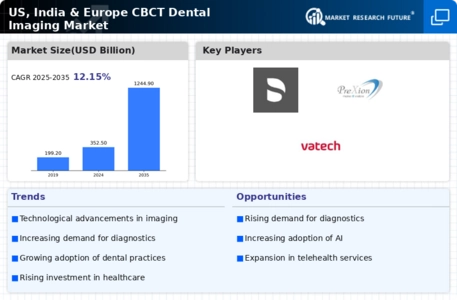
USIE CBCT Dental Imaging Market Infographic
Purchase Options

Market Trends

Key Emerging Trends in the USIE CBCT Dental Imaging Market

Dental procedures aren't just about fixing dental problems; there's also a specialized field called cosmetic dentistry that's gaining popularity. This area of dentistry focuses on improving overall facial beauty, and it's growing steadily because more people are interested in enhancing their appearance, especially with increased income. When people are unhappy with how their mouth or oral cavity looks, they might consider cosmetic dentistry. In this field, Cone Beam CT (CBCT) imaging technology is becoming essential, especially when combined with 3-dimensional clinical photography and accurate predictive alterations. This combination allows for precise diagnosis, planning, and treatment in various areas, including orthodontics, facial deformities, and dental and facial implant surgeries.

Certain institutes, like the Inland Institute Oral & Maxillofacial Surgery, are using advanced full-craniofacial cone-beam CT (computed tomography) technology to obtain highly accurate 3-D radiographic images. These images are crucial for diagnosing, planning, and carrying out oral and maxillofacial surgeries with precision. The growing use of CBCT in these cosmetic dentistry procedures is contributing to the expansion of the global CBCT imaging market.

To put it simply, dental procedures aren't only about fixing teeth; there's also a branch called cosmetic dentistry that's becoming more popular. This type of dentistry focuses on making people's faces look better, and it's growing because more people want to enhance their appearance, especially when they have the means to do so. When someone isn't happy with how their mouth looks, they might turn to cosmetic dentistry. In this field, a special kind of imaging called Cone Beam CT (CBCT) is becoming very important. It works even better when used with 3D photography and accurate predictive changes. This combination helps in making precise diagnoses, plans, and treatments in areas like fixing teeth, correcting facial deformities, and doing surgeries for dental and facial implants.

Certain institutes, like the Inland Institute Oral & Maxillofacial Surgery, are using super-advanced CT technology to get really accurate 3D images of the face and mouth. These detailed images are crucial for planning and carrying out surgeries in the mouth and face. The increasing use of CBCT in these cosmetic dentistry procedures is making the global CBCT imaging market grow.

Author
Author Profile
Satyendra Maurya
Research Analyst

An accomplished research analyst with high proficiency in market forecasting, data visualization, competitive benchmarking, and others. He holds a pronounced track record in research and consulting projects for sectors such as life sciences, medical devices, and healthcare IT. His capabilities in qualitative and quantitative analysis have resulted in positive client outcomes. Working on niche market trends, opportunities, sales, and forecasted value is part of his skill set.

Leave a Comment

FAQs

What is the current valuation of the US Cbct Dental Imaging Market?

<p>The US Cbct Dental Imaging Market was valued at 254.8 USD Million in 2024.</p>

What is the projected market valuation for the US Cbct Dental Imaging Market by 2035?

<p>The market is projected to reach 546.03 USD Million by 2035.</p>

What is the expected CAGR for the US Cbct Dental Imaging Market during the forecast period 2025 - 2035?

<p>The expected CAGR for the market during the forecast period 2025 - 2035 is 7.17%.</p>

Which application segment is anticipated to have the highest valuation in the US Cbct Dental Imaging Market?

<p>The Implantology segment is anticipated to have the highest valuation, projected between 70.0 and 150.0 USD Million.</p>

How do dental clinics contribute to the US Cbct Dental Imaging Market?

<p>Dental clinics contributed significantly, with a valuation range of 100.0 to 220.0 USD Million.</p>

What role do key players like Carestream Dental and Dentsply Sirona play in the market?

<p>Key players such as Carestream Dental and Dentsply Sirona are instrumental in driving innovation and market growth.</p>

What is the projected valuation for the Periodontics application segment by 2035?

<p>The Periodontics application segment is projected to reach between 54.8 and 116.03 USD Million by 2035.</p>

Which technology segment is expected to dominate the market in the coming years?

<p>The Cone Beam Computed Tomography segment is expected to dominate, with a projected valuation of 120.0 to 250.0 USD Million.</p>

What demographic segments are being targeted in the US Cbct Dental Imaging Market?

<p>The market targets various demographics, including Adults, Children, Elderly, and Special Needs, with valuations ranging from 42.8 to 220.0 USD Million.</p>

What are the anticipated trends in procedure types within the US Cbct Dental Imaging Market?

<p>Procedure types such as Surgical Guidance and Treatment Planning are expected to see significant growth, with valuations projected between 60.0 and 170.0 USD Million.</p>

Market Summary

As per analysis, the US Cbct Dental Imaging Market is projected to grow from USD 254.8 Million in 2024 to USD 546.03 Million by 2035, exhibiting a compound annual growth rate (CAGR) of 7.17% during the forecast period (2025 - 2035).

Key Market Trends & Highlights

The US Cbct Dental Imaging Market is poised for growth driven by technological advancements and increasing demand for preventive care.

  • Technological advancements are enhancing imaging quality and efficiency in the dental sector. Orthodontics remains the largest segment, while Implantology is recognized as the fastest-growing segment in the market. Dental clinics dominate the market, yet hospitals are emerging as the fastest-growing segment due to increased service offerings. Rising demand for minimally invasive procedures and regulatory support are key drivers propelling market expansion.

Market Size & Forecast

2024 Market Size 254.8 (USD Million)
2035 Market Size 546.03 (USD Million)
CAGR (2025 - 2035) 7.17%

Major Players

<a title="Carestream Dental " href="https://www.carestreamdental.com/en-gb/discover/extraoral/cbct3d-imaging-systems/?srsltid=AfmBOoqHwykKT45-NIoPvbaX-byobOOvSyczJjovQAEthH246yd3F8Us" target="_blank" rel="noopener">Carestream Dental </a>(US), Planmeca Oy (FI), Sirona Dental Systems (US), 3Shape (DK), Vatech (KR), Imaging Sciences International (US), NewTom (IT), Xoran Technologies (US), Dentsply Sirona (US)

Market Trends

The US CBCT Dental Imaging Market is currently experiencing a notable transformation, driven by advancements in technology and increasing demand for precise diagnostic tools. Cone Beam Computed Tomography (CBCT) has emerged as a preferred imaging modality among dental professionals due to its ability to provide high-resolution three-dimensional images. This technology enhances the accuracy of diagnoses and treatment planning, particularly in complex cases such as implantology and orthodontics. Furthermore, the growing awareness of oral health and the importance of early detection of dental issues contribute to the rising adoption of CBCT systems across various dental practices in the United States. In addition to technological advancements, regulatory support and reimbursement policies are playing a crucial role in shaping the US Cbct Dental Imaging Market. The integration of CBCT into dental education and training programs is also fostering a new generation of practitioners who are well-versed in utilizing this technology. As the market continues to evolve, it appears that the emphasis on patient-centered care and the pursuit of improved clinical outcomes will further drive the demand for CBCT imaging solutions. Overall, the landscape of dental imaging in the United States is poised for continued growth, reflecting the dynamic interplay of innovation, education, and regulatory frameworks.

Technological Advancements

The US Cbct Dental Imaging Market is witnessing rapid technological advancements that enhance imaging capabilities. Innovations in software and hardware are improving image quality and reducing radiation exposure. These developments are likely to attract more dental professionals to adopt CBCT systems, thereby expanding the market.

Regulatory Support

Regulatory bodies in the United States are increasingly recognizing the importance of CBCT technology in dental practices. Supportive policies and guidelines are being established to ensure safe and effective use of imaging systems. This regulatory backing may encourage more dental facilities to invest in CBCT technology.

Educational Integration

Dental education programs in the US are incorporating CBCT training into their curricula. This integration is preparing future dentists to utilize advanced imaging techniques effectively. As a result, the familiarity and comfort level with CBCT among new practitioners could lead to greater adoption in clinical settings.

USIE CBCT Dental Imaging Market Market Drivers

Regulatory Support

Regulatory support plays a crucial role in shaping the US Cbct Dental Imaging Market. The Food and Drug Administration (FDA) has established guidelines that ensure the safety and efficacy of dental imaging devices. This regulatory framework not only fosters innovation but also instills confidence among practitioners and patients alike. Compliance with these regulations is essential for manufacturers, as it can influence market entry and product development. Furthermore, the FDA's approval processes for new technologies can expedite their availability in the market, thereby enhancing competition. As regulatory bodies continue to support advancements in dental imaging, the US Cbct Dental Imaging Market is expected to grow, driven by a commitment to safety and quality.

Educational Integration

The integration of Cbct dental imaging into dental education is a significant driver for the US Cbct Dental Imaging Market. Educational institutions are increasingly incorporating advanced imaging technologies into their curricula, preparing future dental professionals to utilize these tools effectively. This trend is evident in dental schools across the United States, where students gain hands-on experience with Cbct systems. As a result, a new generation of dentists is emerging, well-versed in the latest imaging techniques. This educational emphasis not only enhances the skill set of dental graduates but also promotes the adoption of Cbct technology in clinical practice. Consequently, the US Cbct Dental Imaging Market is likely to benefit from a growing pool of skilled practitioners who are proficient in utilizing these advanced imaging modalities.

Technological Advancements

The US Cbct Dental Imaging Market is experiencing rapid technological advancements that enhance diagnostic capabilities. Innovations such as improved image resolution and faster scanning times are becoming prevalent. These advancements not only increase the accuracy of dental diagnoses but also improve patient comfort during procedures. The integration of artificial intelligence in image analysis is also gaining traction, potentially streamlining workflows and reducing human error. According to recent data, the market for dental imaging technology is projected to grow significantly, driven by these innovations. As dental practices adopt these advanced technologies, the US Cbct Dental Imaging Market is likely to witness a surge in demand, reflecting a broader trend towards digitalization in healthcare.

Increased Focus on Preventive Care

An increased focus on preventive care is emerging as a key driver in the US Cbct Dental Imaging Market. As healthcare shifts towards preventive measures, dental professionals are utilizing Cbct imaging to identify potential issues before they escalate. This proactive approach not only enhances patient outcomes but also reduces long-term treatment costs. The ability to detect conditions such as periodontal disease or dental caries at an early stage is becoming increasingly important. Consequently, the demand for Cbct imaging is likely to rise as practitioners emphasize preventive care strategies. This shift in focus aligns with broader healthcare trends, suggesting that the US Cbct Dental Imaging Market will continue to grow as preventive care becomes a priority in dental practices.

Rising Demand for Minimally Invasive Procedures

The increasing demand for minimally invasive dental procedures is significantly influencing the US Cbct Dental Imaging Market. Patients are increasingly seeking treatments that reduce recovery time and discomfort, leading to a preference for techniques that utilize Cbct imaging for precise diagnostics and treatment planning. This trend is supported by a growing awareness of the benefits of minimally invasive dentistry, including reduced trauma and improved outcomes. As dental professionals adopt Cbct technology to facilitate these procedures, the market is expected to expand. Data indicates that the demand for minimally invasive techniques is on the rise, suggesting that the US Cbct Dental Imaging Market will continue to evolve in response to patient preferences and clinical advancements.

Market Segment Insights

By Application: Orthodontics (Largest) vs. Implantology (Fastest-Growing)

In the US CBCT dental imaging market, the application segment is primarily dominated by orthodontics, which captures a significant share of the market due to the rising prevalence of malocclusion cases and the increasing demand for aesthetic dental treatments. Following this, implantology is witnessing rapid growth as practitioners increasingly utilize CBCT technology for precise implant placement and surgical planning, contributing to improved patient outcomes and streamlined workflows. Oral surgery, endodontics, and periodontics also represent crucial applications, although they exhibit a relatively smaller market share compared to orthodontics and implantology. The growth trends within the application segment of the US CBCT dental imaging market are driven by several factors. The increasing awareness of advanced dental imaging technologies among dental professionals and patients alike has led to a rise in early diagnosis and treatment planning. Additionally, technological advancements in CBCT systems enhance image accuracy and reduce radiation exposure, further propelling adoption rates particularly in orthodontics and implantology. The trend towards minimally invasive procedures across dental practices is also fostering growth, as practitioners rely on CBCT imaging to achieve optimal treatment outcomes efficiently.

Orthodontics (Dominant) vs. Implantology (Emerging)

The orthodontics application within the US CBCT dental imaging market stands out as the dominant segment due to its critical role in diagnosing and planning treatment for dental misalignments. This segment benefits from a high volume of procedures as more patients seek orthodontic solutions, from traditional braces to advanced aligner therapy. The advancements in CBCT technology, which provide 3D imaging for improved assessment, continue to make orthodontic procedures more effective and visually compelling for patients. On the other hand, implantology is emerging as a rapidly growing segment in the market. The utilization of CBCT scans in dental implant placements enhances accuracy and predictability in surgical procedures, making it increasingly popular among dental practitioners. The demand for dental implants is rising as patients seek out durable long-term solutions for tooth loss, further driving the growth of this segment.

By End Use: Dental Clinics (Largest) vs. Hospitals (Fastest-Growing)

In the US CBCT dental imaging market, 'Dental Clinics' represent the largest segment, reflecting a strong demand for advanced imaging technologies that enhance diagnostic accuracy and treatment planning. Hospitals follow closely, benefiting from increased referrals and the necessity for multi-disciplinary consultations, contributing to their significant market presence. Meanwhile, 'Research Institutions' and 'Academic Institutions' hold smaller shares, yet they play a crucial role in the development and dissemination of innovative imaging techniques within the dental community.

Dental Clinics (Dominant) vs. Hospitals (Emerging)

Dental Clinics are the dominant end-use segment in the US CBCT dental imaging market due to their focus on patient-centric care, integrating advanced imaging technologies to streamline diagnosis and treatment workflows. These clinics are heavily reliant on detailed imaging for procedures such as implantology and orthodontics, driving their demand for high-resolution 3D images. On the other hand, Hospitals, while positioned as an emerging segment, are witnessing rapid growth attributed to the rising number of dental surgeries performed in hospital settings. The collaboration among various healthcare professionals within hospitals fosters an increased need for advanced imaging tools, enhancing the trajectory of the hospitals segment.

By Technology: Cone Beam Computed Tomography (Largest) vs. Digital Radiography (Fastest-Growing)

In the US CBCT Dental Imaging Market, Cone Beam Computed Tomography (CBCT) holds the largest market share among the technology segments. Its advanced imaging capabilities significantly enhance diagnostics in dental practices, making it a preferred choice for many dental professionals. Following closely, Digital Radiography is witnessing rapid adoption due to its efficiency and effectiveness. The shift towards these technologies reflects the increasing demand for precise imaging solutions among practitioners and patients alike.

Technology: CBCT (Dominant) vs. Digital Radiography (Emerging)

Cone Beam Computed Tomography (CBCT) stands out in the US market for its comprehensive imaging features, providing detailed three-dimensional views that are crucial for treatment planning. Its dominance can be attributed to its precision, enabling dentists to make informed decisions regarding patient care. Conversely, Digital Radiography is emerging rapidly, driven by its advantages in reducing radiation exposure while delivering high-quality images quickly. This segment is appealing due to its cost-effectiveness and the growing emphasis on eco-friendly practices in dental imaging. Together, these technologies are reshaping the diagnostic landscape in dentistry.

By Patient Demographics: Adults (Largest) vs. Children (Fastest-Growing)

In the US Cbct Dental Imaging Market, the patient demographics segment reveals significant insights into the distribution among various age groups. Adults represent the largest portion of the market, driven by the need for comprehensive dental care and advanced imaging solutions. Following closely, children are emerging as the fastest-growing demographic due to increasing awareness of early dental interventions and preventive care measures.

Adults (Dominant) vs. Special Needs (Emerging)

In the landscape of patient demographics, adults stand out as the dominant segment, primarily benefiting from the advancements in dental imaging technology that cater to complex dental issues and treatment planning. Conversely, the special needs population is emerging as a crucial segment, necessitating specialized imaging solutions tailored to their unique requirements. This group often faces challenges, including anxiety and physical limitations, which drive the demand for more accommodating imaging technologies. Both segments highlight the industry's shift towards personalized care, enhancing overall patient outcomes.

By Procedure Type: Diagnostic Imaging (Largest) vs. Treatment Planning (Fastest-Growing)

In the US Cbct Dental Imaging Market, Diagnostic Imaging holds a significant portion of market share as its primary objective of providing comprehensive innovation in dental diagnostics. Contrarily, Treatment Planning, while currently smaller in share, is rapidly gaining traction due to increasing reliance on technology and demand for accuracy in treatment approaches. The other two segments, Surgical Guidance and Follow-up Imaging, also contribute to the market but remain overshadowed by these leading categories.

Diagnostic Imaging (Dominant) vs. Treatment Planning (Emerging)

Diagnostic Imaging, as the dominant procedure type, showcases a well-established presence within the dental imaging sector, facilitating accurate assessments and timely diagnosis for various dental conditions. This segment benefits from continuous technological advancements, enhancing image quality and reducing patient exposure to radiation. On the other hand, Treatment Planning is emerging rapidly, reflecting a growing trend towards personalized patient care. This segment utilizes detailed imaging insights to prepare tailored treatment options, responding to the increasing patient expectation for customized dental solutions. Both categories are pivotal to the overall market dynamics, but their characteristics and applications are actively shaping the future landscape of CBCT imaging in dentistry.

Get more detailed insights about U.S., India & Europe CBCT Dental Imaging Market Research Report- U.S., India and Europe- Forecast to 2035

Regional Insights

Key Players and Competitive Insights

The Cbct Dental Imaging Market in the US is characterized by a competitive landscape that is both dynamic and multifaceted. Key growth drivers include advancements in imaging technology, increasing demand for precise diagnostics, and a growing emphasis on patient-centric care. Major players such as Carestream Dental (US), Dentsply Sirona (US), and 3Shape (DK) are strategically positioned to leverage these trends. Carestream Dental (US) focuses on innovation through the development of advanced imaging solutions, while Dentsply Sirona (US) emphasizes a comprehensive portfolio that integrates digital workflows. 3Shape (DK) is known for its commitment to enhancing user experience and operational efficiency, collectively shaping a competitive environment that prioritizes technological advancement and customer satisfaction.
In terms of business tactics, companies are increasingly localizing manufacturing and optimizing supply chains to enhance operational efficiency. The market structure appears moderately fragmented, with several key players exerting influence over various segments. This fragmentation allows for a diverse range of offerings, yet the collective strategies of these companies indicate a trend towards consolidation and collaboration, particularly in technology integration and service delivery.
In December 2025, Carestream Dental (US) announced the launch of its latest CBCT imaging system, which incorporates AI-driven features aimed at improving diagnostic accuracy. This strategic move not only enhances their product offering but also positions them as a leader in the integration of AI within dental imaging, potentially attracting a broader customer base seeking cutting-edge technology.
In November 2025, Dentsply Sirona (US) entered into a partnership with a leading software company to develop a cloud-based platform for dental imaging. This collaboration is significant as it reflects a shift towards digital solutions that facilitate remote access and data sharing, thereby enhancing the overall efficiency of dental practices. Such strategic alliances are likely to redefine operational paradigms in the market.
In October 2025, 3Shape (DK) expanded its presence in the US market by acquiring a regional imaging technology firm. This acquisition is indicative of a broader trend where companies seek to bolster their technological capabilities and market reach through strategic mergers. By integrating new technologies and expertise, 3Shape (DK) aims to enhance its competitive edge in the rapidly evolving landscape of dental imaging.
As of January 2026, current competitive trends in the Cbct Dental Imaging Market are heavily influenced by digitalization, sustainability, and the integration of AI technologies. Strategic alliances are increasingly shaping the landscape, fostering innovation and collaboration among key players. Looking ahead, it is anticipated that competitive differentiation will evolve, with a pronounced shift from price-based competition to a focus on innovation, technological advancement, and supply chain reliability. This evolution underscores the importance of adaptability and forward-thinking strategies in maintaining a competitive advantage.

Key Companies in the USIE CBCT Dental Imaging Market include

Industry Developments

Future Outlook

USIE CBCT Dental Imaging Market Future Outlook

The US Cbct Dental Imaging Market is projected to grow at a 7.17% CAGR from 2025 to 2035, driven by technological advancements, increasing dental procedures, and rising awareness of oral health.

New opportunities lie in:

  • <p>Integration of AI-driven diagnostic tools for enhanced imaging accuracy. Expansion of tele-dentistry services utilizing CBCT technology. Development of portable CBCT units for remote dental practices.</p>

By 2035, the market is expected to be robust, reflecting substantial growth and innovation.

Market Segmentation

USIE CBCT Dental Imaging Market End Use Outlook

  • Dental Clinics
  • Hospitals
  • Research Institutions
  • Academic Institutions

USIE CBCT Dental Imaging Market Technology Outlook

  • Cone Beam Computed Tomography
  • Digital Radiography
  • 3D Imaging Software
  • Image Processing

USIE CBCT Dental Imaging Market Application Outlook

  • Orthodontics
  • Implantology
  • Oral Surgery
  • Endodontics
  • Periodontics

USIE CBCT Dental Imaging Market Procedure Type Outlook

  • Diagnostic Imaging
  • Treatment Planning
  • Surgical Guidance
  • Follow-up Imaging

USIE CBCT Dental Imaging Market Patient Demographics Outlook

  • Adults
  • Children
  • Elderly
  • Special Needs

Report Scope

MARKET SIZE 2024 254.8(USD Million)
MARKET SIZE 2025 274.98(USD Million)
MARKET SIZE 2035 546.03(USD Million)
COMPOUND ANNUAL GROWTH RATE (CAGR) 7.17% (2024 - 2035)
REPORT COVERAGE Revenue Forecast, Competitive Landscape, Growth Factors, and Trends
BASE YEAR 2024
Market Forecast Period 2025 - 2035
Historical Data 2019 - 2024
Market Forecast Units USD Million
Key Companies Profiled Carestream Dental (US), Planmeca Oy (FI), Sirona Dental Systems (US), 3Shape (DK), Vatech (KR), Imaging Sciences International (US), NewTom (IT), Xoran Technologies (US), Dentsply Sirona (US)
Segments Covered Application, End Use, Technology, Patient Demographics, Procedure Type
Key Market Opportunities Integration of artificial intelligence in US Cbct Dental Imaging enhances diagnostic accuracy and operational efficiency.
Key Market Dynamics Technological advancements and regulatory changes drive growth in the US Cone Beam Computed Tomography Dental Imaging Market.
Countries Covered US

FAQs

What is the current valuation of the US Cbct Dental Imaging Market?

<p>The US Cbct Dental Imaging Market was valued at 254.8 USD Million in 2024.</p>

What is the projected market valuation for the US Cbct Dental Imaging Market by 2035?

<p>The market is projected to reach 546.03 USD Million by 2035.</p>

What is the expected CAGR for the US Cbct Dental Imaging Market during the forecast period 2025 - 2035?

<p>The expected CAGR for the market during the forecast period 2025 - 2035 is 7.17%.</p>

Which application segment is anticipated to have the highest valuation in the US Cbct Dental Imaging Market?

<p>The Implantology segment is anticipated to have the highest valuation, projected between 70.0 and 150.0 USD Million.</p>

How do dental clinics contribute to the US Cbct Dental Imaging Market?

<p>Dental clinics contributed significantly, with a valuation range of 100.0 to 220.0 USD Million.</p>

What role do key players like Carestream Dental and Dentsply Sirona play in the market?

<p>Key players such as Carestream Dental and Dentsply Sirona are instrumental in driving innovation and market growth.</p>

What is the projected valuation for the Periodontics application segment by 2035?

<p>The Periodontics application segment is projected to reach between 54.8 and 116.03 USD Million by 2035.</p>

Which technology segment is expected to dominate the market in the coming years?

<p>The Cone Beam Computed Tomography segment is expected to dominate, with a projected valuation of 120.0 to 250.0 USD Million.</p>

What demographic segments are being targeted in the US Cbct Dental Imaging Market?

<p>The market targets various demographics, including Adults, Children, Elderly, and Special Needs, with valuations ranging from 42.8 to 220.0 USD Million.</p>

What are the anticipated trends in procedure types within the US Cbct Dental Imaging Market?

<p>Procedure types such as Surgical Guidance and Treatment Planning are expected to see significant growth, with valuations projected between 60.0 and 170.0 USD Million.</p>

  1. SECTION I: EXECUTIVE SUMMARY AND KEY HIGHLIGHTS
    1. | 1.1 EXECUTIVE SUMMARY
    2. | | 1.1.1 Market Overview
    3. | | 1.1.2 Key Findings
    4. | | 1.1.3 Market Segmentation
    5. | | 1.1.4 Competitive Landscape
    6. | | 1.1.5 Challenges and Opportunities
    7. | | 1.1.6 Future Outlook
  2. SECTION II: SCOPING, METHODOLOGY AND MARKET STRUCTURE
    1. | 2.1 MARKET INTRODUCTION
    2. | | 2.1.1 Definition
    3. | | 2.1.2 Scope of the study
    4. | | | 2.1.2.1 Research Objective
    5. | | | 2.1.2.2 Assumption
    6. | | | 2.1.2.3 Limitations
    7. | 2.2 RESEARCH METHODOLOGY
    8. | | 2.2.1 Overview
    9. | | 2.2.2 Data Mining
    10. | | 2.2.3 Secondary Research
    11. | | 2.2.4 Primary Research
    12. | | | 2.2.4.1 Primary Interviews and Information Gathering Process
    13. | | | 2.2.4.2 Breakdown of Primary Respondents
    14. | | 2.2.5 Forecasting Model
    15. | | 2.2.6 Market Size Estimation
    16. | | | 2.2.6.1 Bottom-Up Approach
    17. | | | 2.2.6.2 Top-Down Approach
    18. | | 2.2.7 Data Triangulation
    19. | | 2.2.8 Validation
  3. SECTION III: QUALITATIVE ANALYSIS
    1. | 3.1 MARKET DYNAMICS
    2. | | 3.1.1 Overview
    3. | | 3.1.2 Drivers
    4. | | 3.1.3 Restraints
    5. | | 3.1.4 Opportunities
    6. | 3.2 MARKET FACTOR ANALYSIS
    7. | | 3.2.1 Value chain Analysis
    8. | | 3.2.2 Porter's Five Forces Analysis
    9. | | | 3.2.2.1 Bargaining Power of Suppliers
    10. | | | 3.2.2.2 Bargaining Power of Buyers
    11. | | | 3.2.2.3 Threat of New Entrants
    12. | | | 3.2.2.4 Threat of Substitutes
    13. | | | 3.2.2.5 Intensity of Rivalry
    14. | | 3.2.3 COVID-19 Impact Analysis
    15. | | | 3.2.3.1 Market Impact Analysis
    16. | | | 3.2.3.2 Regional Impact
    17. | | | 3.2.3.3 Opportunity and Threat Analysis
  4. SECTION IV: QUANTITATIVE ANALYSIS
    1. | 4.1 Healthcare, BY Application (USD Million)
    2. | | 4.1.1 Orthodontics
    3. | | 4.1.2 Implantology
    4. | | 4.1.3 Oral Surgery
    5. | | 4.1.4 Endodontics
    6. | | 4.1.5 Periodontics
    7. | 4.2 Healthcare, BY End Use (USD Million)
    8. | | 4.2.1 Dental Clinics
    9. | | 4.2.2 Hospitals
    10. | | 4.2.3 Research Institutions
    11. | | 4.2.4 Academic Institutions
    12. | 4.3 Healthcare, BY Technology (USD Million)
    13. | | 4.3.1 Cone Beam Computed Tomography
    14. | | 4.3.2 Digital Radiography
    15. | | 4.3.3 3D Imaging Software
    16. | | 4.3.4 Image Processing
    17. | 4.4 Healthcare, BY Patient Demographics (USD Million)
    18. | | 4.4.1 Adults
    19. | | 4.4.2 Children
    20. | | 4.4.3 Elderly
    21. | | 4.4.4 Special Needs
    22. | 4.5 Healthcare, BY Procedure Type (USD Million)
    23. | | 4.5.1 Diagnostic Imaging
    24. | | 4.5.2 Treatment Planning
    25. | | 4.5.3 Surgical Guidance
    26. | | 4.5.4 Follow-up Imaging
  5. SECTION V: COMPETITIVE ANALYSIS
    1. | 5.1 Competitive Landscape
    2. | | 5.1.1 Overview
    3. | | 5.1.2 Competitive Analysis
    4. | | 5.1.3 Market share Analysis
    5. | | 5.1.4 Major Growth Strategy in the Healthcare
    6. | | 5.1.5 Competitive Benchmarking
    7. | | 5.1.6 Leading Players in Terms of Number of Developments in the Healthcare
    8. | | 5.1.7 Key developments and growth strategies
    9. | | | 5.1.7.1 New Product Launch/Service Deployment
    10. | | | 5.1.7.2 Merger & Acquisitions
    11. | | | 5.1.7.3 Joint Ventures
    12. | | 5.1.8 Major Players Financial Matrix
    13. | | | 5.1.8.1 Sales and Operating Income
    14. | | | 5.1.8.2 Major Players R&D Expenditure. 2023
    15. | 5.2 Company Profiles
    16. | | 5.2.1 Carestream Dental (US)
    17. | | | 5.2.1.1 Financial Overview
    18. | | | 5.2.1.2 Products Offered
    19. | | | 5.2.1.3 Key Developments
    20. | | | 5.2.1.4 SWOT Analysis
    21. | | | 5.2.1.5 Key Strategies
    22. | | 5.2.2 Planmeca Oy (FI)
    23. | | | 5.2.2.1 Financial Overview
    24. | | | 5.2.2.2 Products Offered
    25. | | | 5.2.2.3 Key Developments
    26. | | | 5.2.2.4 SWOT Analysis
    27. | | | 5.2.2.5 Key Strategies
    28. | | 5.2.3 Sirona Dental Systems (US)
    29. | | | 5.2.3.1 Financial Overview
    30. | | | 5.2.3.2 Products Offered
    31. | | | 5.2.3.3 Key Developments
    32. | | | 5.2.3.4 SWOT Analysis
    33. | | | 5.2.3.5 Key Strategies
    34. | | 5.2.4 3Shape (DK)
    35. | | | 5.2.4.1 Financial Overview
    36. | | | 5.2.4.2 Products Offered
    37. | | | 5.2.4.3 Key Developments
    38. | | | 5.2.4.4 SWOT Analysis
    39. | | | 5.2.4.5 Key Strategies
    40. | | 5.2.5 Vatech (KR)
    41. | | | 5.2.5.1 Financial Overview
    42. | | | 5.2.5.2 Products Offered
    43. | | | 5.2.5.3 Key Developments
    44. | | | 5.2.5.4 SWOT Analysis
    45. | | | 5.2.5.5 Key Strategies
    46. | | 5.2.6 Imaging Sciences International (US)
    47. | | | 5.2.6.1 Financial Overview
    48. | | | 5.2.6.2 Products Offered
    49. | | | 5.2.6.3 Key Developments
    50. | | | 5.2.6.4 SWOT Analysis
    51. | | | 5.2.6.5 Key Strategies
    52. | | 5.2.7 NewTom (IT)
    53. | | | 5.2.7.1 Financial Overview
    54. | | | 5.2.7.2 Products Offered
    55. | | | 5.2.7.3 Key Developments
    56. | | | 5.2.7.4 SWOT Analysis
    57. | | | 5.2.7.5 Key Strategies
    58. | | 5.2.8 Xoran Technologies (US)
    59. | | | 5.2.8.1 Financial Overview
    60. | | | 5.2.8.2 Products Offered
    61. | | | 5.2.8.3 Key Developments
    62. | | | 5.2.8.4 SWOT Analysis
    63. | | | 5.2.8.5 Key Strategies
    64. | | 5.2.9 Dentsply Sirona (US)
    65. | | | 5.2.9.1 Financial Overview
    66. | | | 5.2.9.2 Products Offered
    67. | | | 5.2.9.3 Key Developments
    68. | | | 5.2.9.4 SWOT Analysis
    69. | | | 5.2.9.5 Key Strategies
    70. | 5.3 Appendix
    71. | | 5.3.1 References
    72. | | 5.3.2 Related Reports
  6. LIST OF FIGURES
    1. | 6.1 MARKET SYNOPSIS
    2. | 6.2 US MARKET ANALYSIS BY APPLICATION
    3. | 6.3 US MARKET ANALYSIS BY END USE
    4. | 6.4 US MARKET ANALYSIS BY TECHNOLOGY
    5. | 6.5 US MARKET ANALYSIS BY PATIENT DEMOGRAPHICS
    6. | 6.6 US MARKET ANALYSIS BY PROCEDURE TYPE
    7. | 6.7 KEY BUYING CRITERIA OF HEALTHCARE
    8. | 6.8 RESEARCH PROCESS OF MRFR
    9. | 6.9 DRO ANALYSIS OF HEALTHCARE
    10. | 6.10 DRIVERS IMPACT ANALYSIS: HEALTHCARE
    11. | 6.11 RESTRAINTS IMPACT ANALYSIS: HEALTHCARE
    12. | 6.12 SUPPLY / VALUE CHAIN: HEALTHCARE
    13. | 6.13 HEALTHCARE, BY APPLICATION, 2024 (% SHARE)
    14. | 6.14 HEALTHCARE, BY APPLICATION, 2024 TO 2035 (USD Million)
    15. | 6.15 HEALTHCARE, BY END USE, 2024 (% SHARE)
    16. | 6.16 HEALTHCARE, BY END USE, 2024 TO 2035 (USD Million)
    17. | 6.17 HEALTHCARE, BY TECHNOLOGY, 2024 (% SHARE)
    18. | 6.18 HEALTHCARE, BY TECHNOLOGY, 2024 TO 2035 (USD Million)
    19. | 6.19 HEALTHCARE, BY PATIENT DEMOGRAPHICS, 2024 (% SHARE)
    20. | 6.20 HEALTHCARE, BY PATIENT DEMOGRAPHICS, 2024 TO 2035 (USD Million)
    21. | 6.21 HEALTHCARE, BY PROCEDURE TYPE, 2024 (% SHARE)
    22. | 6.22 HEALTHCARE, BY PROCEDURE TYPE, 2024 TO 2035 (USD Million)
    23. | 6.23 BENCHMARKING OF MAJOR COMPETITORS
  7. LIST OF TABLES
    1. | 7.1 LIST OF ASSUMPTIONS
    2. | | 7.1.1
    3. | 7.2 US MARKET SIZE ESTIMATES; FORECAST
    4. | | 7.2.1 BY APPLICATION, 2026-2035 (USD Million)
    5. | | 7.2.2 BY END USE, 2026-2035 (USD Million)
    6. | | 7.2.3 BY TECHNOLOGY, 2026-2035 (USD Million)
    7. | | 7.2.4 BY PATIENT DEMOGRAPHICS, 2026-2035 (USD Million)
    8. | | 7.2.5 BY PROCEDURE TYPE, 2026-2035 (USD Million)
    9. | 7.3 PRODUCT LAUNCH/PRODUCT DEVELOPMENT/APPROVAL
    10. | | 7.3.1
    11. | 7.4 ACQUISITION/PARTNERSHIP
    12. | | 7.4.1

US Healthcare Market Segmentation

Healthcare By Application (USD Million, 2026-2035)

  • Orthodontics
  • Implantology
  • Oral Surgery
  • Endodontics
  • Periodontics

Healthcare By End Use (USD Million, 2026-2035)

  • Dental Clinics
  • Hospitals
  • Research Institutions
  • Academic Institutions

Healthcare By Technology (USD Million, 2026-2035)

  • Cone Beam Computed Tomography
  • Digital Radiography
  • 3D Imaging Software
  • Image Processing

Healthcare By Patient Demographics (USD Million, 2026-2035)

  • Adults
  • Children
  • Elderly
  • Special Needs

Healthcare By Procedure Type (USD Million, 2026-2035)

  • Diagnostic Imaging
  • Treatment Planning
  • Surgical Guidance
  • Follow-up Imaging
Infographic

Free Sample Request

Kindly complete the form below to receive a free sample of this Report

Get Free Sample

Customer Strories

Compare Licence

×
Features License Type
Single User Multiuser License Enterprise User
Price $4,950 $5,950 $7,250
Maximum User Access Limit 1 User Upto 10 Users Unrestricted Access Throughout the Organization
Free Customization
Direct Access to Analyst
Deliverable Format
Platform Access
Discount on Next Purchase 10% 15% 15%
Printable Versions















