
Request Free Sample ×

Kindly complete the form below to receive a free sample of this Report

* Please use a valid business email

Leading companies partner with us for data-driven Insights

clients tt-cursor
Hero Background
English
Chinese
French
Japanese
Korean
German
Spanish

User Interface Services Market Trends

ID: MRFR/ICT/0580-HCR
110 Pages
Ankit Gupta
March 2026

User Interface Services Market Research Report: Information By Type (Mobile Interface, Human Machine Interface, JQuery UI, and Web Service Interface), By Application (Education, Government, Retail, Healthcare, Market Intelligence, and Consumer Electronics), and By Region (North America, Europe, Asia-Pacific, and Rest Of The World) – Market Forecast Till 2035.

Share:
Download PDF ×

We do not share your information with anyone. However, we may send you emails based on your report interest from time to time. You may contact us at any time to opt-out.

User Interface Services Market Infographic
Purchase Options

Market Trends

Key Emerging Trends in the User Interface Services Market

The User Interface Services Market, which is a part of the technology field with a number of similarities concerning competition and development, is characterized by the fierce rivalry and ever-changing nature of the business. Companies in this sector strive for success in the market by implementing very different market share positioning strategies, which ultimately leads to the carving out of the niche and competitive edge. Competition in this market can be extremely fierce; on the other hand, most companies are seeking to differentiate their offerings through things like unique features, great designs, or amazing user experience to stand out against their competitors. This mechanism helps the business to develop a way of being valued among consumers thus arousing their desire to choose them over the other.

Yet another highlighted tactic to take into account is cost leadership, the primary mechanism by which companies can reduce their prices for the competitor's user interface products. This may be by cutting procedures, using inexpensive technologies or accommodating better use and thus, reducing wastages. The manufactures can retain their market share and customers by means of offering low cost solutions that are of good quality as compared to their competitors. While it is important to trim costs in a challenging market, the organization should be careful to avoid cutting expenses significantly and maintaining service quality level. This will help to keep the company on footing.

User Interface Service Market is also utilizing the segmentation strategy where market segmentation is defined as the process of dividing an entire market or a group of people into smaller homogenous groups of same characteristics or buyer behaviors. Businesses determine certain market segments by engaging their offerings on grounds such as whether a company belongs to which industry vertical, character as well as the geographical location and this is done towards giving the market segments the relevant services. This targeted approach as opposed to a broad approach enables businesses to find solutions to diverse needs of customers in separate markets. It therefore makes the businesses experts in specific areas and cultivates customers loyalty by establishing itself as a specialist in the particular area.

Moreover, firms usually go for higher market shares via geographical diversification that comes alongside segmenting. The approach of expanding the territory or country offering by adjusting the usage interface services from one region to another can be considered as another strategy. Through the globalization of their business, organizations are able to attract new customers, increase the range of outlets, and obtain protection from limitations, which are connected with various fluctuations of the economies on the regional level.

Collaborative partnerships and strategic alliances are now an essential feature for almost all market players in User Interface Service industry. Companies start to see sense in teaming up with businesses who can supplement their offerings with the latest technologies, or diversify their product range for a new customer niche. Companies can harness one another’s powerful capabilities through partnerships, find common causes, and pool resources, ultimately elevating their market strategy by teaming up. An example of partnerships which could be put in place is joint technology integration, the co-development of products or the marketing of services jointly to increase the effect on the target audience as a whole.


Author
Author Profile
Ankit Gupta
Team Lead - Research

Ankit Gupta is a seasoned market intelligence and strategic research professional with over six plus years of experience in the ICT and Semiconductor industries. With academic roots in Telecom, Marketing, and Electronics, he blends technical insight with business strategy. Ankit has led 200+ projects, including work for Fortune 500 clients like Microsoft and Rio Tinto, covering market sizing, tech forecasting, and go-to-market strategies. Known for bridging engineering and enterprise decision-making, his insights support growth, innovation, and investment planning across diverse technology markets.

Leave a Comment

FAQs

What is the current valuation of the User Interface Services Market?

<p>The User Interface Services Market was valued at 23.12 USD Billion in 2024.</p>

What is the projected market size for the User Interface Services Market by 2035?

<p>The market is projected to reach 61.0 USD Billion by 2035.</p>

What is the expected CAGR for the User Interface Services Market during the forecast period?

<p>The expected CAGR for the User Interface Services Market from 2025 to 2035 is 9.22%.</p>

Which segments are included in the User Interface Services Market?

<p>The market includes segments such as Mobile Interface, Human Machine Interface, JQuery UI, and Web Service Interface.</p>

What are the projected valuations for the Mobile Interface segment by 2035?

<p>The Mobile Interface segment is projected to grow from 5.0 USD Billion to 13.0 USD Billion by 2035.</p>

How does the Human Machine Interface segment perform in terms of valuation?

<p>The Human Machine Interface segment is expected to increase from 6.0 USD Billion to 15.0 USD Billion by 2035.</p>

What applications are driving growth in the User Interface Services Market?

Key applications include Education, Government, Retail, Healthcare, Market Intelligence, and Consumer Electronics.

What is the projected growth for the Retail application segment by 2035?

The Retail application segment is anticipated to grow from 5.0 USD Billion to 15.0 USD Billion by 2035.

Who are the key players in the User Interface Services Market?

Key players include Adobe, Figma, Sketch, InVision, Axure, Balsamiq, Marvel, Framer, UXPin, and Proto.io.

What is the expected growth trajectory for the Web Service Interface segment?

The Web Service Interface segment is projected to expand from 8.12 USD Billion to 23.0 USD Billion by 2035.

Market Summary

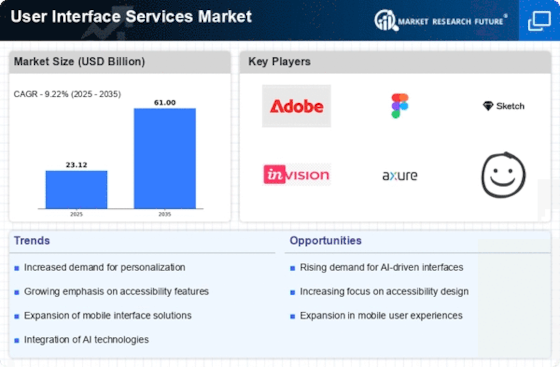
As per Market Research Future analysis, the User Interface Services Market was estimated at 23.12 USD Billion in 2024. The User Interface Services industry is projected to grow from 25.25 USD Billion in 2025 to 61.0 USD Billion by 2035, exhibiting a compound annual growth rate (CAGR) of 9.22% during the forecast period 2025 - 2035

Key Market Trends & Highlights

The User Interface Services Market is experiencing a dynamic evolution driven by user-centric design and technological advancements.

  • There is an increased focus on user-centric design, particularly in North America, which remains the largest market. Integration of advanced technologies is reshaping the landscape, especially in the rapidly growing Asia-Pacific region. Collaboration between design and development teams is becoming essential for delivering effective mobile interfaces, the largest segment. Rising demand for mobile applications and the growing importance of accessibility standards are key drivers propelling market growth.

Market Size & Forecast

2024 Market Size 23.12 (USD Billion)
2035 Market Size 61.0 (USD Billion)
CAGR (2025 - 2035) 9.22%
Largest Regional Market Share in 2024 Asia Pacific

Major Players

Adobe (US), Figma (US), Sketch (US), InVision (US), Axure (US), Balsamiq (US), Marvel (GB), Framer (US), UXPin (US), Proto.io (US)

Market Trends

The User Interface Services Market is currently experiencing a dynamic evolution, driven by the increasing demand for intuitive and engaging digital experiences. As organizations recognize the critical role of user interfaces in enhancing customer satisfaction and retention, investments in user interface design and development are on the rise. This market encompasses a wide range of services, including user experience research, interface design, usability testing, and ongoing support. Companies are increasingly prioritizing user-centric approaches, which appear to foster innovation and improve overall product quality. Furthermore, the integration of advanced technologies, such as artificial intelligence and machine learning, is reshaping the landscape, enabling more personalized and adaptive user experiences. In addition, the User Interface Services Market is likely to witness a surge in collaboration between design teams and developers, as agile methodologies gain traction. This collaborative approach may enhance the efficiency of the design process, allowing for quicker iterations and more responsive adaptations to user feedback. Moreover, the growing emphasis on accessibility and inclusivity in design practices suggests a shift towards creating interfaces that cater to diverse user needs. As the market continues to evolve, it seems poised for further growth, driven by technological advancements and an unwavering focus on user satisfaction.

Increased Focus on User-Centric Design

The User Interface Services Market is witnessing a pronounced shift towards user-centric design principles. Organizations are increasingly recognizing the importance of understanding user needs and preferences, leading to enhanced engagement and satisfaction. This trend emphasizes the necessity for thorough user research and testing, ensuring that interfaces are tailored to meet the expectations of diverse audiences.

Integration of Advanced Technologies

The incorporation of advanced technologies, such as artificial intelligence and machine learning, is transforming the User Interface Services Market. These technologies enable the creation of more personalized and adaptive user experiences, allowing interfaces to respond dynamically to user behavior. This trend suggests a future where interfaces are not only functional but also intelligent, enhancing overall usability.

Collaboration Between Design and Development Teams

There is a growing trend towards collaboration between design and development teams within the User Interface Services Market. Agile methodologies are fostering this collaboration, leading to more efficient workflows and quicker iterations. This synergy appears to enhance the overall quality of user interfaces, as feedback loops become more integrated into the design process.

User Interface Services Market Market Drivers

Rising Demand for Mobile Applications

The User Interface Services Market is experiencing a notable surge in demand for mobile applications. As more consumers rely on smartphones for daily tasks, businesses are compelled to enhance their mobile interfaces. This trend is reflected in the increasing number of mobile app downloads, which reached over 200 billion in 2023. Companies are investing in user interface services to ensure their applications are intuitive and engaging, thereby improving user retention rates. The emphasis on seamless user experiences is driving the growth of the User Interface Services Market, as organizations recognize that a well-designed interface can significantly impact customer satisfaction and loyalty.

Growing Importance of Accessibility Standards

Accessibility has become a critical focus within the User Interface Services Market. Organizations are increasingly required to comply with accessibility standards, such as the Web Content Accessibility Guidelines (WCAG). This shift is driven by a broader societal push for inclusivity, ensuring that digital products are usable by individuals with disabilities. As a result, companies are investing in user interface services that prioritize accessibility, which not only enhances user experience but also expands their customer base. The User Interface Services Market is likely to see continued growth as businesses recognize the value of accessible design in reaching diverse audiences.

Shift Towards Agile Development Methodologies

The User Interface Services Market is witnessing a shift towards agile development methodologies, which prioritize flexibility and rapid iteration. This approach allows teams to respond quickly to user feedback and changing market demands. As organizations adopt agile practices, the need for effective user interface services becomes paramount. Companies are increasingly collaborating with UI/UX designers to ensure that interfaces are not only functional but also aligned with user expectations. This trend is likely to drive growth in the User Interface Services Market, as agile methodologies facilitate continuous improvement and innovation in design.

Emergence of Artificial Intelligence in Design

The integration of artificial intelligence (AI) into design processes is transforming the User Interface Services Market. AI tools are being utilized to analyze user behavior and preferences, enabling designers to create more personalized experiences. This trend is evidenced by the increasing adoption of AI-driven design software, which is projected to grow at a compound annual growth rate of over 25% through 2026. By leveraging AI, companies can streamline their design processes, reduce time-to-market, and enhance the overall quality of user interfaces. The User Interface Services Market is thus poised for significant advancements as AI continues to evolve.

Increased Investment in User Experience Research

Investment in user experience (UX) research is becoming a cornerstone of the User Interface Services Market. Companies are recognizing that understanding user needs and behaviors is essential for creating effective interfaces. This trend is reflected in the growing budgets allocated to UX research, which are expected to increase by 15% annually over the next few years. By prioritizing user research, organizations can make informed design decisions that enhance usability and satisfaction. The User Interface Services Market is likely to benefit from this focus on research, as businesses strive to create interfaces that resonate with their target audiences.

Market Segment Insights

By Type: Mobile Interface (Largest) vs. Human Machine Interface (Fastest-Growing)

<p>In the User Interface Services Market, the segment distribution reveals a strong dominance of Mobile Interfaces, which cater to the increasing reliance on smartphones and mobile devices. This segment holds a substantial market share, thanks to the ongoing advancements in mobile technology and the demand for responsive, user-friendly applications. On the other hand, Human Machine Interfaces are gaining traction as more industries seek to integrate advanced technologies into their operations. This segment is growing rapidly, driven by automation trends and the need for more intuitive user experiences that enhance human interaction with machines. The growth in Mobile Interfaces is significantly influenced by the surge in mobile app development and the shift towards mobile-first strategies among businesses. Meanwhile, Human Machine Interfaces are benefiting from innovations in artificial intelligence and machine learning, which facilitate smoother interactions between humans and machines. As industries invest in these technologies, the demand for this segment is expected to rise, positioning it as one of the fastest-growing areas in the User Interface Services Market.</p>

<p>Mobile Interface (Dominant) vs. Human Machine Interface (Emerging)</p>

<p>The Mobile Interface segment stands out for its extensive application across various devices, providing a seamless experience in accessing information and services on-the-go. With user expectations shifting towards better accessibility and functionality, this segment has become crucial for businesses wanting to engage their customers effectively. Features like responsive design, ease of navigation, and speed are pivotal in capturing user interest and retention in this highly competitive landscape. In contrast, the Human Machine Interface segment is emerging as a key player in industries like manufacturing and healthcare, where the need for efficient machine interaction is paramount. Innovations like voice command, touchless controls, and augmented reality integrations are pushing this segment forward, making interfaces more user-friendly and efficient in operations. Both segments play distinct roles in shaping the future of user engagement.</p>

By Application: Education (Largest) vs. Healthcare (Fastest-Growing)

<p>In the User Interface Services Market, the application segment showcases a diverse distribution among various sectors. Education holds the largest market share, driven by its increasing adoption of digital learning platforms that enhance user interaction. Conversely, the healthcare sector is emerging rapidly as a key player, especially with the rise of telehealth solutions and user-centric designs that cater to patient needs.</p>

<p>Education: Established (Dominant) vs. Healthcare (Emerging)</p>

<p>The Education sector has established itself as a dominant force in user interface services, utilizing innovative technologies to improve the learning experience. With an emphasis on intuitive design and gamification, education platforms engage learners effectively, leading to higher retention rates. Healthcare, on the other hand, represents an emerging segment that is evolving quickly; the need for telemedicine solutions and patient engagement tools drives this growth. User interface services in healthcare focus on accessibility and ease of use, ensuring that both patients and professionals can navigate complex information efficiently.</p>

Get more detailed insights about User Interface Services Market Research Report- Global Forecast to 2035

Regional Insights

North America : Innovation and Leadership Hub

North America is the largest market for User Interface Services Market, holding approximately 45% of the global share. The region's growth is driven by rapid technological advancements, increasing demand for user-centric designs, and a strong presence of tech giants. Regulatory support for digital innovation further fuels this growth, making it a key player in the global landscape. The United States leads the market, with significant contributions from Canada. Major players like Adobe, Figma, and InVision are headquartered here, fostering a competitive environment. The focus on enhancing user experience and accessibility drives innovation, while collaborations among tech firms and startups create a vibrant ecosystem for UI services.

Europe : Emerging Market with Potential

Europe is the second-largest market for User Interface Services Market, accounting for around 30% of the global share. The region benefits from a strong emphasis on design standards and user experience regulations, which drive demand for high-quality UI services. Countries are increasingly adopting digital transformation strategies, supported by government initiatives aimed at enhancing digital skills and innovation. Leading countries include Germany, the UK, and France, where a mix of established firms and startups thrive. The competitive landscape is characterized by a focus on sustainability and user engagement. Key players like Sketch and Marvel are making significant strides, contributing to a dynamic market that prioritizes user-centric design and innovation.

Asia-Pacific : Rapid Growth and Adoption

Asia-Pacific is witnessing rapid growth in the User Interface Services Market, holding approximately 20% of the global share. The region's expansion is driven by increasing internet penetration, a growing tech-savvy population, and rising investments in digital infrastructure. Governments are promoting digital initiatives, which act as catalysts for market growth, enhancing the demand for innovative UI solutions. Countries like China, India, and Japan are at the forefront, with a burgeoning startup ecosystem and significant investments from established tech companies. The competitive landscape is vibrant, with local players emerging alongside global giants. This dynamic environment fosters innovation and collaboration, making Asia-Pacific a key player in the UI services market.

Middle East and Africa : Emerging Market with Opportunities

The Middle East and Africa region is gradually emerging in the User Interface Services Market, holding about 5% of the global share. The growth is driven by increasing smartphone penetration, a young population eager for digital solutions, and government initiatives aimed at boosting the tech sector. Regulatory frameworks are evolving to support digital innovation, creating opportunities for UI service providers. Leading countries include South Africa, UAE, and Nigeria, where a mix of local and international players are establishing a presence. The competitive landscape is characterized by a focus on mobile-first solutions and user engagement. As the region continues to invest in technology, the demand for user interface services is expected to rise significantly, fostering a vibrant market.

Key Players and Competitive Insights

Leading market players are investing heavily in research and development in order to expand their product lines, which will help the User Interface Services Market, grow even more. Market participants are also undertaking a variety of strategic activities to expand their footprint, with important market developments including new product launches, contractual agreements, mergers and acquisitions, higher investments, and collaboration with other organizations. To expand and survive in a more competitive and rising market climate, User Interface Services industry must offer cost-effective items.
Manufacturing locally to minimize operational costs is one of the key business tactics used by manufacturers in the User Interface Services industry to benefit clients and increase the market sector. In recent years, the User Interface Services industry has offered some of the most significant advantages to medicine. Major players in the User Interface Services Market, including Google LLC, Apple Inc., Microsoft Corporation, Samsung Group, Adobe Inc., Fujitsu Limited, Rossul, Intel Corporation, ARM Limited, Oracle, and LG Group, are attempting to increase market demand by investing in research and development operations.
Electricity and automation technology and solutions are offered by ABB Ltd (ABB). The business provides goods, systems, services, and solutions for electrification, motion, and industrial automation. Its offers harness power reliability, boost industrial productivity, and improve energy efficiency, and its solutions incorporate engineering know-how and software. ABB offers its goods directly to consumers as well as through third-party channel partners as distributors, installers, wholesalers, machine manufacturers, original equipment manufacturers, and system integrators.
The company offers customers in the utilities, industry, transportation, and infrastructure sectors throughout Asia, the Americas, the Middle East, Africa, and Europe industrial equipment and systems that are digitally connected and enabled. The headquarters of ABB are in Zurich, Switzerland. ABB India stated in August 2022 that it has expanded and upgraded its smart power factory in Bengaluru, Nelamangala, in order to meet the high demand for the company's solutions and energy management technology.
Energy management and automation business Schneider Electric SE (Schneider Electric), originally known as Schneider Electric SA, creates associated technologies and solutions for power distribution. Its main products and services include grid automation, solar and energy storage, medium voltage distribution, low voltage goods and systems, and basic power, cooling, and racking. Along with field and automation services, cloud services, consultancy, training, and services pertaining to energy and sustainability are also offered by the company.
The company provides services to many different industries, including banking and finance, food and beverage, life sciences, healthcare, marine, metals, mining, oil, and gas, vretail, as well as automotive and mobility. The corporation conducts business in several continents, including Africa, Europe, Asia-Pacific, South America, the Middle East, and North America. The headquarters of Schneider Electric are at Rueil-Malmaison, France. Schneider Electric updated their EcoStruxure domain design and platform, EcoStruxure Power, in October 2022.
The company claims that plant managers can experience a very realistic Power Operation training environment powered by ETAP's electrical digital twin thanks to the integration of ETAP Operator Training Software (eOTS) and EcoStruxure Power Operation energy management software.

Key Companies in the User Interface Services Market include

Industry Developments

January 2022: The most cutting-edge biofuel production facility to be developed in Spain will use an integrated control and safety system (ICSS) from Honeywell, according to a press release from Repsol. The business added that the new facility would use a range of Honeywell distributed control systems (DCS), fire and gas (F&G), emergency shutdown (ESD), and human-machine interface (HMI) solutions to carry out effective, environmentally friendly, and low-emission operations.

Future Outlook

User Interface Services Market Future Outlook

The User Interface Services Market is projected to grow at a 9.22% CAGR from 2025 to 2035, driven by technological advancements, increasing demand for user-centric designs, and the rise of mobile applications.

New opportunities lie in:

  • Integration of AI-driven design tools for enhanced user experience.
  • Expansion into emerging markets with localized UI solutions.
  • Development of cross-platform UI frameworks to streamline application deployment.

By 2035, the market is expected to be robust, reflecting substantial growth and innovation.

Market Segmentation

User Interface Services Market Type Outlook

  • Mobile Interface
  • Human Machine Interface
  • JQuery UI
  • Web Service Interface

User Interface Services Market Application Outlook

  • Education
  • Government
  • Retail
  • Healthcare
  • Market Intelligence
  • Consumer Electronics

Report Scope

MARKET SIZE 2024 23.12(USD Billion)
MARKET SIZE 2025 25.25(USD Billion)
MARKET SIZE 2035 61.0(USD Billion)
COMPOUND ANNUAL GROWTH RATE (CAGR) 9.22% (2025 - 2035)
REPORT COVERAGE Revenue Forecast, Competitive Landscape, Growth Factors, and Trends
BASE YEAR 2024
Market Forecast Period 2025 - 2035
Historical Data 2019 - 2024
Market Forecast Units USD Billion
Key Companies Profiled Adobe (US), Figma (US), Sketch (US), InVision (US), Axure (US), Balsamiq (US), Marvel (GB), Framer (US), UXPin (US), Proto.io (US)
Segments Covered Type, Application, Region
Key Market Opportunities Integration of artificial intelligence in User Interface Services Market enhances user experience and personalization.
Key Market Dynamics Rising demand for intuitive design drives innovation and competition in the User Interface Services Market.
Countries Covered North America, Europe, APAC, South America, MEA

FAQs

What is the current valuation of the User Interface Services Market?

<p>The User Interface Services Market was valued at 23.12 USD Billion in 2024.</p>

What is the projected market size for the User Interface Services Market by 2035?

<p>The market is projected to reach 61.0 USD Billion by 2035.</p>

What is the expected CAGR for the User Interface Services Market during the forecast period?

<p>The expected CAGR for the User Interface Services Market from 2025 to 2035 is 9.22%.</p>

Which segments are included in the User Interface Services Market?

<p>The market includes segments such as Mobile Interface, Human Machine Interface, JQuery UI, and Web Service Interface.</p>

What are the projected valuations for the Mobile Interface segment by 2035?

<p>The Mobile Interface segment is projected to grow from 5.0 USD Billion to 13.0 USD Billion by 2035.</p>

How does the Human Machine Interface segment perform in terms of valuation?

<p>The Human Machine Interface segment is expected to increase from 6.0 USD Billion to 15.0 USD Billion by 2035.</p>

What applications are driving growth in the User Interface Services Market?

Key applications include Education, Government, Retail, Healthcare, Market Intelligence, and Consumer Electronics.

What is the projected growth for the Retail application segment by 2035?

The Retail application segment is anticipated to grow from 5.0 USD Billion to 15.0 USD Billion by 2035.

Who are the key players in the User Interface Services Market?

Key players include Adobe, Figma, Sketch, InVision, Axure, Balsamiq, Marvel, Framer, UXPin, and Proto.io.

What is the expected growth trajectory for the Web Service Interface segment?

The Web Service Interface segment is projected to expand from 8.12 USD Billion to 23.0 USD Billion by 2035.

  1. SECTION I: EXECUTIVE SUMMARY AND KEY HIGHLIGHTS
    1. | 1.1 EXECUTIVE SUMMARY
    2. | | 1.1.1 Market Overview
    3. | | 1.1.2 Key Findings
    4. | | 1.1.3 Market Segmentation
    5. | | 1.1.4 Competitive Landscape
    6. | | 1.1.5 Challenges and Opportunities
    7. | | 1.1.6 Future Outlook
  2. SECTION II: SCOPING, METHODOLOGY AND MARKET STRUCTURE
    1. | 2.1 MARKET INTRODUCTION
    2. | | 2.1.1 Definition
    3. | | 2.1.2 Scope of the study
    4. | | | 2.1.2.1 Research Objective
    5. | | | 2.1.2.2 Assumption
    6. | | | 2.1.2.3 Limitations
    7. | 2.2 RESEARCH METHODOLOGY
    8. | | 2.2.1 Overview
    9. | | 2.2.2 Data Mining
    10. | | 2.2.3 Secondary Research
    11. | | 2.2.4 Primary Research
    12. | | | 2.2.4.1 Primary Interviews and Information Gathering Process
    13. | | | 2.2.4.2 Breakdown of Primary Respondents
    14. | | 2.2.5 Forecasting Model
    15. | | 2.2.6 Market Size Estimation
    16. | | | 2.2.6.1 Bottom-Up Approach
    17. | | | 2.2.6.2 Top-Down Approach
    18. | | 2.2.7 Data Triangulation
    19. | | 2.2.8 Validation
  3. SECTION III: QUALITATIVE ANALYSIS
    1. | 3.1 MARKET DYNAMICS
    2. | | 3.1.1 Overview
    3. | | 3.1.2 Drivers
    4. | | 3.1.3 Restraints
    5. | | 3.1.4 Opportunities
    6. | 3.2 MARKET FACTOR ANALYSIS
    7. | | 3.2.1 Value chain Analysis
    8. | | 3.2.2 Porter's Five Forces Analysis
    9. | | | 3.2.2.1 Bargaining Power of Suppliers
    10. | | | 3.2.2.2 Bargaining Power of Buyers
    11. | | | 3.2.2.3 Threat of New Entrants
    12. | | | 3.2.2.4 Threat of Substitutes
    13. | | | 3.2.2.5 Intensity of Rivalry
    14. | | 3.2.3 COVID-19 Impact Analysis
    15. | | | 3.2.3.1 Market Impact Analysis
    16. | | | 3.2.3.2 Regional Impact
    17. | | | 3.2.3.3 Opportunity and Threat Analysis
  4. SECTION IV: QUANTITATIVE ANALYSIS
    1. | 4.1 Information and Communications Technology, BY Type (USD Billion)
    2. | | 4.1.1 Mobile Interface
    3. | | 4.1.2 Human Machine Interface
    4. | | 4.1.3 JQuery UI
    5. | | 4.1.4 Web Service Interface
    6. | 4.2 Information and Communications Technology, BY Application (USD Billion)
    7. | | 4.2.1 Education
    8. | | 4.2.2 Government
    9. | | 4.2.3 Retail
    10. | | 4.2.4 Healthcare
    11. | | 4.2.5 Market Intelligence
    12. | | 4.2.6 Consumer Electronics
    13. | 4.3 Information and Communications Technology, BY Region (USD Billion)
    14. | | 4.3.1 North America
    15. | | | 4.3.1.1 US
    16. | | | 4.3.1.2 Canada
    17. | | 4.3.2 Europe
    18. | | | 4.3.2.1 Germany
    19. | | | 4.3.2.2 UK
    20. | | | 4.3.2.3 France
    21. | | | 4.3.2.4 Russia
    22. | | | 4.3.2.5 Italy
    23. | | | 4.3.2.6 Spain
    24. | | | 4.3.2.7 Rest of Europe
    25. | | 4.3.3 APAC
    26. | | | 4.3.3.1 China
    27. | | | 4.3.3.2 India
    28. | | | 4.3.3.3 Japan
    29. | | | 4.3.3.4 South Korea
    30. | | | 4.3.3.5 Malaysia
    31. | | | 4.3.3.6 Thailand
    32. | | | 4.3.3.7 Indonesia
    33. | | | 4.3.3.8 Rest of APAC
    34. | | 4.3.4 South America
    35. | | | 4.3.4.1 Brazil
    36. | | | 4.3.4.2 Mexico
    37. | | | 4.3.4.3 Argentina
    38. | | | 4.3.4.4 Rest of South America
    39. | | 4.3.5 MEA
    40. | | | 4.3.5.1 GCC Countries
    41. | | | 4.3.5.2 South Africa
    42. | | | 4.3.5.3 Rest of MEA
  5. SECTION V: COMPETITIVE ANALYSIS
    1. | 5.1 Competitive Landscape
    2. | | 5.1.1 Overview
    3. | | 5.1.2 Competitive Analysis
    4. | | 5.1.3 Market share Analysis
    5. | | 5.1.4 Major Growth Strategy in the Information and Communications Technology
    6. | | 5.1.5 Competitive Benchmarking
    7. | | 5.1.6 Leading Players in Terms of Number of Developments in the Information and Communications Technology
    8. | | 5.1.7 Key developments and growth strategies
    9. | | | 5.1.7.1 New Product Launch/Service Deployment
    10. | | | 5.1.7.2 Merger & Acquisitions
    11. | | | 5.1.7.3 Joint Ventures
    12. | | 5.1.8 Major Players Financial Matrix
    13. | | | 5.1.8.1 Sales and Operating Income
    14. | | | 5.1.8.2 Major Players R&D Expenditure. 2023
    15. | 5.2 Company Profiles
    16. | | 5.2.1 Adobe (US)
    17. | | | 5.2.1.1 Financial Overview
    18. | | | 5.2.1.2 Products Offered
    19. | | | 5.2.1.3 Key Developments
    20. | | | 5.2.1.4 SWOT Analysis
    21. | | | 5.2.1.5 Key Strategies
    22. | | 5.2.2 Figma (US)
    23. | | | 5.2.2.1 Financial Overview
    24. | | | 5.2.2.2 Products Offered
    25. | | | 5.2.2.3 Key Developments
    26. | | | 5.2.2.4 SWOT Analysis
    27. | | | 5.2.2.5 Key Strategies
    28. | | 5.2.3 Sketch (US)
    29. | | | 5.2.3.1 Financial Overview
    30. | | | 5.2.3.2 Products Offered
    31. | | | 5.2.3.3 Key Developments
    32. | | | 5.2.3.4 SWOT Analysis
    33. | | | 5.2.3.5 Key Strategies
    34. | | 5.2.4 InVision (US)
    35. | | | 5.2.4.1 Financial Overview
    36. | | | 5.2.4.2 Products Offered
    37. | | | 5.2.4.3 Key Developments
    38. | | | 5.2.4.4 SWOT Analysis
    39. | | | 5.2.4.5 Key Strategies
    40. | | 5.2.5 Axure (US)
    41. | | | 5.2.5.1 Financial Overview
    42. | | | 5.2.5.2 Products Offered
    43. | | | 5.2.5.3 Key Developments
    44. | | | 5.2.5.4 SWOT Analysis
    45. | | | 5.2.5.5 Key Strategies
    46. | | 5.2.6 Balsamiq (US)
    47. | | | 5.2.6.1 Financial Overview
    48. | | | 5.2.6.2 Products Offered
    49. | | | 5.2.6.3 Key Developments
    50. | | | 5.2.6.4 SWOT Analysis
    51. | | | 5.2.6.5 Key Strategies
    52. | | 5.2.7 Marvel (GB)
    53. | | | 5.2.7.1 Financial Overview
    54. | | | 5.2.7.2 Products Offered
    55. | | | 5.2.7.3 Key Developments
    56. | | | 5.2.7.4 SWOT Analysis
    57. | | | 5.2.7.5 Key Strategies
    58. | | 5.2.8 Framer (US)
    59. | | | 5.2.8.1 Financial Overview
    60. | | | 5.2.8.2 Products Offered
    61. | | | 5.2.8.3 Key Developments
    62. | | | 5.2.8.4 SWOT Analysis
    63. | | | 5.2.8.5 Key Strategies
    64. | | 5.2.9 UXPin (US)
    65. | | | 5.2.9.1 Financial Overview
    66. | | | 5.2.9.2 Products Offered
    67. | | | 5.2.9.3 Key Developments
    68. | | | 5.2.9.4 SWOT Analysis
    69. | | | 5.2.9.5 Key Strategies
    70. | | 5.2.10 Proto.io (US)
    71. | | | 5.2.10.1 Financial Overview
    72. | | | 5.2.10.2 Products Offered
    73. | | | 5.2.10.3 Key Developments
    74. | | | 5.2.10.4 SWOT Analysis
    75. | | | 5.2.10.5 Key Strategies
    76. | 5.3 Appendix
    77. | | 5.3.1 References
    78. | | 5.3.2 Related Reports
  6. LIST OF FIGURES
    1. | 6.1 MARKET SYNOPSIS
    2. | 6.2 NORTH AMERICA MARKET ANALYSIS
    3. | 6.3 US MARKET ANALYSIS BY TYPE
    4. | 6.4 US MARKET ANALYSIS BY APPLICATION
    5. | 6.5 CANADA MARKET ANALYSIS BY TYPE
    6. | 6.6 CANADA MARKET ANALYSIS BY APPLICATION
    7. | 6.7 EUROPE MARKET ANALYSIS
    8. | 6.8 GERMANY MARKET ANALYSIS BY TYPE
    9. | 6.9 GERMANY MARKET ANALYSIS BY APPLICATION
    10. | 6.10 UK MARKET ANALYSIS BY TYPE
    11. | 6.11 UK MARKET ANALYSIS BY APPLICATION
    12. | 6.12 FRANCE MARKET ANALYSIS BY TYPE
    13. | 6.13 FRANCE MARKET ANALYSIS BY APPLICATION
    14. | 6.14 RUSSIA MARKET ANALYSIS BY TYPE
    15. | 6.15 RUSSIA MARKET ANALYSIS BY APPLICATION
    16. | 6.16 ITALY MARKET ANALYSIS BY TYPE
    17. | 6.17 ITALY MARKET ANALYSIS BY APPLICATION
    18. | 6.18 SPAIN MARKET ANALYSIS BY TYPE
    19. | 6.19 SPAIN MARKET ANALYSIS BY APPLICATION
    20. | 6.20 REST OF EUROPE MARKET ANALYSIS BY TYPE
    21. | 6.21 REST OF EUROPE MARKET ANALYSIS BY APPLICATION
    22. | 6.22 APAC MARKET ANALYSIS
    23. | 6.23 CHINA MARKET ANALYSIS BY TYPE
    24. | 6.24 CHINA MARKET ANALYSIS BY APPLICATION
    25. | 6.25 INDIA MARKET ANALYSIS BY TYPE
    26. | 6.26 INDIA MARKET ANALYSIS BY APPLICATION
    27. | 6.27 JAPAN MARKET ANALYSIS BY TYPE
    28. | 6.28 JAPAN MARKET ANALYSIS BY APPLICATION
    29. | 6.29 SOUTH KOREA MARKET ANALYSIS BY TYPE
    30. | 6.30 SOUTH KOREA MARKET ANALYSIS BY APPLICATION
    31. | 6.31 MALAYSIA MARKET ANALYSIS BY TYPE
    32. | 6.32 MALAYSIA MARKET ANALYSIS BY APPLICATION
    33. | 6.33 THAILAND MARKET ANALYSIS BY TYPE
    34. | 6.34 THAILAND MARKET ANALYSIS BY APPLICATION
    35. | 6.35 INDONESIA MARKET ANALYSIS BY TYPE
    36. | 6.36 INDONESIA MARKET ANALYSIS BY APPLICATION
    37. | 6.37 REST OF APAC MARKET ANALYSIS BY TYPE
    38. | 6.38 REST OF APAC MARKET ANALYSIS BY APPLICATION
    39. | 6.39 SOUTH AMERICA MARKET ANALYSIS
    40. | 6.40 BRAZIL MARKET ANALYSIS BY TYPE
    41. | 6.41 BRAZIL MARKET ANALYSIS BY APPLICATION
    42. | 6.42 MEXICO MARKET ANALYSIS BY TYPE
    43. | 6.43 MEXICO MARKET ANALYSIS BY APPLICATION
    44. | 6.44 ARGENTINA MARKET ANALYSIS BY TYPE
    45. | 6.45 ARGENTINA MARKET ANALYSIS BY APPLICATION
    46. | 6.46 REST OF SOUTH AMERICA MARKET ANALYSIS BY TYPE
    47. | 6.47 REST OF SOUTH AMERICA MARKET ANALYSIS BY APPLICATION
    48. | 6.48 MEA MARKET ANALYSIS
    49. | 6.49 GCC COUNTRIES MARKET ANALYSIS BY TYPE
    50. | 6.50 GCC COUNTRIES MARKET ANALYSIS BY APPLICATION
    51. | 6.51 SOUTH AFRICA MARKET ANALYSIS BY TYPE
    52. | 6.52 SOUTH AFRICA MARKET ANALYSIS BY APPLICATION
    53. | 6.53 REST OF MEA MARKET ANALYSIS BY TYPE
    54. | 6.54 REST OF MEA MARKET ANALYSIS BY APPLICATION
    55. | 6.55 KEY BUYING CRITERIA OF INFORMATION AND COMMUNICATIONS TECHNOLOGY
    56. | 6.56 RESEARCH PROCESS OF MRFR
    57. | 6.57 DRO ANALYSIS OF INFORMATION AND COMMUNICATIONS TECHNOLOGY
    58. | 6.58 DRIVERS IMPACT ANALYSIS: INFORMATION AND COMMUNICATIONS TECHNOLOGY
    59. | 6.59 RESTRAINTS IMPACT ANALYSIS: INFORMATION AND COMMUNICATIONS TECHNOLOGY
    60. | 6.60 SUPPLY / VALUE CHAIN: INFORMATION AND COMMUNICATIONS TECHNOLOGY
    61. | 6.61 INFORMATION AND COMMUNICATIONS TECHNOLOGY, BY TYPE, 2024 (% SHARE)
    62. | 6.62 INFORMATION AND COMMUNICATIONS TECHNOLOGY, BY TYPE, 2024 TO 2035 (USD Billion)
    63. | 6.63 INFORMATION AND COMMUNICATIONS TECHNOLOGY, BY APPLICATION, 2024 (% SHARE)
    64. | 6.64 INFORMATION AND COMMUNICATIONS TECHNOLOGY, BY APPLICATION, 2024 TO 2035 (USD Billion)
    65. | 6.65 BENCHMARKING OF MAJOR COMPETITORS
  7. LIST OF TABLES
    1. | 7.1 LIST OF ASSUMPTIONS
    2. | | 7.1.1
    3. | 7.2 North America MARKET SIZE ESTIMATES; FORECAST
    4. | | 7.2.1 BY TYPE, 2025-2035 (USD Billion)
    5. | | 7.2.2 BY APPLICATION, 2025-2035 (USD Billion)
    6. | 7.3 US MARKET SIZE ESTIMATES; FORECAST
    7. | | 7.3.1 BY TYPE, 2025-2035 (USD Billion)
    8. | | 7.3.2 BY APPLICATION, 2025-2035 (USD Billion)
    9. | 7.4 Canada MARKET SIZE ESTIMATES; FORECAST
    10. | | 7.4.1 BY TYPE, 2025-2035 (USD Billion)
    11. | | 7.4.2 BY APPLICATION, 2025-2035 (USD Billion)
    12. | 7.5 Europe MARKET SIZE ESTIMATES; FORECAST
    13. | | 7.5.1 BY TYPE, 2025-2035 (USD Billion)
    14. | | 7.5.2 BY APPLICATION, 2025-2035 (USD Billion)
    15. | 7.6 Germany MARKET SIZE ESTIMATES; FORECAST
    16. | | 7.6.1 BY TYPE, 2025-2035 (USD Billion)
    17. | | 7.6.2 BY APPLICATION, 2025-2035 (USD Billion)
    18. | 7.7 UK MARKET SIZE ESTIMATES; FORECAST
    19. | | 7.7.1 BY TYPE, 2025-2035 (USD Billion)
    20. | | 7.7.2 BY APPLICATION, 2025-2035 (USD Billion)
    21. | 7.8 France MARKET SIZE ESTIMATES; FORECAST
    22. | | 7.8.1 BY TYPE, 2025-2035 (USD Billion)
    23. | | 7.8.2 BY APPLICATION, 2025-2035 (USD Billion)
    24. | 7.9 Russia MARKET SIZE ESTIMATES; FORECAST
    25. | | 7.9.1 BY TYPE, 2025-2035 (USD Billion)
    26. | | 7.9.2 BY APPLICATION, 2025-2035 (USD Billion)
    27. | 7.10 Italy MARKET SIZE ESTIMATES; FORECAST
    28. | | 7.10.1 BY TYPE, 2025-2035 (USD Billion)
    29. | | 7.10.2 BY APPLICATION, 2025-2035 (USD Billion)
    30. | 7.11 Spain MARKET SIZE ESTIMATES; FORECAST
    31. | | 7.11.1 BY TYPE, 2025-2035 (USD Billion)
    32. | | 7.11.2 BY APPLICATION, 2025-2035 (USD Billion)
    33. | 7.12 Rest of Europe MARKET SIZE ESTIMATES; FORECAST
    34. | | 7.12.1 BY TYPE, 2025-2035 (USD Billion)
    35. | | 7.12.2 BY APPLICATION, 2025-2035 (USD Billion)
    36. | 7.13 APAC MARKET SIZE ESTIMATES; FORECAST
    37. | | 7.13.1 BY TYPE, 2025-2035 (USD Billion)
    38. | | 7.13.2 BY APPLICATION, 2025-2035 (USD Billion)
    39. | 7.14 China MARKET SIZE ESTIMATES; FORECAST
    40. | | 7.14.1 BY TYPE, 2025-2035 (USD Billion)
    41. | | 7.14.2 BY APPLICATION, 2025-2035 (USD Billion)
    42. | 7.15 India MARKET SIZE ESTIMATES; FORECAST
    43. | | 7.15.1 BY TYPE, 2025-2035 (USD Billion)
    44. | | 7.15.2 BY APPLICATION, 2025-2035 (USD Billion)
    45. | 7.16 Japan MARKET SIZE ESTIMATES; FORECAST
    46. | | 7.16.1 BY TYPE, 2025-2035 (USD Billion)
    47. | | 7.16.2 BY APPLICATION, 2025-2035 (USD Billion)
    48. | 7.17 South Korea MARKET SIZE ESTIMATES; FORECAST
    49. | | 7.17.1 BY TYPE, 2025-2035 (USD Billion)
    50. | | 7.17.2 BY APPLICATION, 2025-2035 (USD Billion)
    51. | 7.18 Malaysia MARKET SIZE ESTIMATES; FORECAST
    52. | | 7.18.1 BY TYPE, 2025-2035 (USD Billion)
    53. | | 7.18.2 BY APPLICATION, 2025-2035 (USD Billion)
    54. | 7.19 Thailand MARKET SIZE ESTIMATES; FORECAST
    55. | | 7.19.1 BY TYPE, 2025-2035 (USD Billion)
    56. | | 7.19.2 BY APPLICATION, 2025-2035 (USD Billion)
    57. | 7.20 Indonesia MARKET SIZE ESTIMATES; FORECAST
    58. | | 7.20.1 BY TYPE, 2025-2035 (USD Billion)
    59. | | 7.20.2 BY APPLICATION, 2025-2035 (USD Billion)
    60. | 7.21 Rest of APAC MARKET SIZE ESTIMATES; FORECAST
    61. | | 7.21.1 BY TYPE, 2025-2035 (USD Billion)
    62. | | 7.21.2 BY APPLICATION, 2025-2035 (USD Billion)
    63. | 7.22 South America MARKET SIZE ESTIMATES; FORECAST
    64. | | 7.22.1 BY TYPE, 2025-2035 (USD Billion)
    65. | | 7.22.2 BY APPLICATION, 2025-2035 (USD Billion)
    66. | 7.23 Brazil MARKET SIZE ESTIMATES; FORECAST
    67. | | 7.23.1 BY TYPE, 2025-2035 (USD Billion)
    68. | | 7.23.2 BY APPLICATION, 2025-2035 (USD Billion)
    69. | 7.24 Mexico MARKET SIZE ESTIMATES; FORECAST
    70. | | 7.24.1 BY TYPE, 2025-2035 (USD Billion)
    71. | | 7.24.2 BY APPLICATION, 2025-2035 (USD Billion)
    72. | 7.25 Argentina MARKET SIZE ESTIMATES; FORECAST
    73. | | 7.25.1 BY TYPE, 2025-2035 (USD Billion)
    74. | | 7.25.2 BY APPLICATION, 2025-2035 (USD Billion)
    75. | 7.26 Rest of South America MARKET SIZE ESTIMATES; FORECAST
    76. | | 7.26.1 BY TYPE, 2025-2035 (USD Billion)
    77. | | 7.26.2 BY APPLICATION, 2025-2035 (USD Billion)
    78. | 7.27 MEA MARKET SIZE ESTIMATES; FORECAST
    79. | | 7.27.1 BY TYPE, 2025-2035 (USD Billion)
    80. | | 7.27.2 BY APPLICATION, 2025-2035 (USD Billion)
    81. | 7.28 GCC Countries MARKET SIZE ESTIMATES; FORECAST
    82. | | 7.28.1 BY TYPE, 2025-2035 (USD Billion)
    83. | | 7.28.2 BY APPLICATION, 2025-2035 (USD Billion)
    84. | 7.29 South Africa MARKET SIZE ESTIMATES; FORECAST
    85. | | 7.29.1 BY TYPE, 2025-2035 (USD Billion)
    86. | | 7.29.2 BY APPLICATION, 2025-2035 (USD Billion)
    87. | 7.30 Rest of MEA MARKET SIZE ESTIMATES; FORECAST
    88. | | 7.30.1 BY TYPE, 2025-2035 (USD Billion)
    89. | | 7.30.2 BY APPLICATION, 2025-2035 (USD Billion)
    90. | 7.31 PRODUCT LAUNCH/PRODUCT DEVELOPMENT/APPROVAL
    91. | | 7.31.1
    92. | 7.32 ACQUISITION/PARTNERSHIP
    93. | | 7.32.1

Information and Communications Technology Market Segmentation

Information and Communications Technology By Type (USD Billion, 2025-2035)

  • Mobile Interface
  • Human Machine Interface
  • JQuery UI
  • Web Service Interface

Information and Communications Technology By Application (USD Billion, 2025-2035)

  • Education
  • Government
  • Retail
  • Healthcare
  • Market Intelligence
  • Consumer Electronics
Infographic

Free Sample Request

Kindly complete the form below to receive a free sample of this Report

Get Free Sample

Customer Strories

Compare Licence

×
Features License Type
Single User Multiuser License Enterprise User
Price $4,950 $5,950 $7,250
Maximum User Access Limit 1 User Upto 10 Users Unrestricted Access Throughout the Organization
Free Customization
Direct Access to Analyst
Deliverable Format
Platform Access
Discount on Next Purchase 10% 15% 15%
Printable Versions