×
Request Free Sample ×

Kindly complete the form below to receive a free sample of this Report

* Please use a valid business email

Leading companies partner with us for data-driven Insights

clients tt-cursor
Hero Background

US Pressure Switch Market

ID: MRFR/Equip/12268-HCR
100 Pages
Garvit Vyas
October 2025

US Pressure Switch Market Research Report By Type (Electromechanical, Solid State), By Application (HVAC, Monitoring & Control, Safety & Alarm Systems, Hydraulics & Pneumatics), By Pressure Range (Below 100 Bars, 100 to 400 Bars, Above 400 Bars) - Forecast to 2035

Share:
Download PDF ×

We do not share your information with anyone. However, we may send you emails based on your report interest from time to time. You may contact us at any time to opt-out.

US Pressure Switch Market Infographic
Purchase Options

US Pressure Switch Market Summary

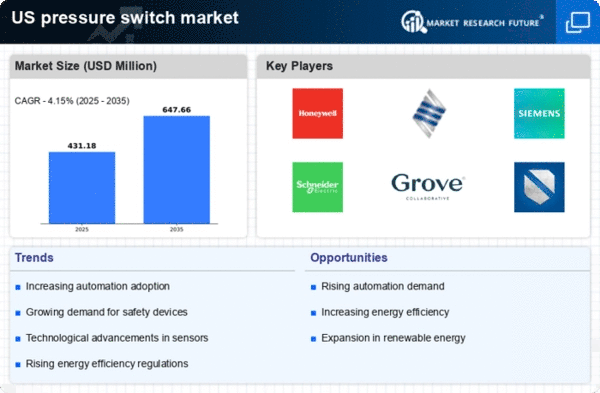
As per MRFR analysis, the US pressure switch market Size was estimated at 414.0 USD Million in 2024. The US pressure switch market is projected to grow from 431.18 USD Million in 2025 to 647.66 USD Million by 2035, exhibiting a compound annual growth rate (CAGR) of 4.15% during the forecast period 2025 - 2035.

Key Market Trends & Highlights

The US pressure switch market is experiencing robust growth driven by technological advancements and increasing demand across various sectors.

  • Technological advancements are enhancing the functionality and efficiency of pressure switches, making them more appealing to end-users.
  • The HVAC systems segment remains the largest, while the renewable energy segment is emerging as the fastest-growing area within the market.
  • Regulatory compliance and sustainability initiatives are becoming critical factors influencing market dynamics and product development.
  • Rising demand in industrial automation and increased focus on safety standards are key drivers propelling market expansion.

Market Size & Forecast

2024 Market Size 414.0 (USD Million)
2035 Market Size 647.66 (USD Million)
CAGR (2025 - 2035) 4.15%

Major Players

Honeywell (US), Emerson (US), Siemens (DE), Schneider Electric (FR), GROVE (US), Ashcroft (US), WIKA (DE), Barksdale (US), Kobold (DE)

US Pressure Switch Market Trends

The pressure switch market is currently experiencing notable growth, driven by advancements in technology and increasing demand across various sectors. Industries such as manufacturing, automotive, and HVAC are integrating sophisticated pressure control systems to enhance efficiency and safety. This trend appears to be fueled by the need for precise pressure management in applications ranging from industrial processes to consumer products. Furthermore, the ongoing emphasis on automation and smart technologies is likely to propel the adoption of advanced pressure switches, which offer enhanced functionality and reliability. In addition, regulatory standards and safety requirements are becoming more stringent, compelling manufacturers to invest in high-quality pressure switches. This shift suggests a growing awareness of the importance of safety and performance in industrial operations. As a result, companies are increasingly focusing on innovation and product development to meet these evolving demands. The pressure switch market seems poised for continued expansion, with opportunities emerging in sectors that prioritize energy efficiency and sustainable practices. Overall, the landscape appears dynamic, with various factors influencing growth and development in this sector.

Technological Advancements

The pressure switch market is witnessing rapid technological advancements, particularly in the realm of smart sensors and automation. These innovations enable more accurate pressure monitoring and control, which is essential for modern industrial applications. As industries seek to enhance operational efficiency, the integration of advanced pressure switches is becoming increasingly prevalent.

Regulatory Compliance

Regulatory compliance is a significant driver in the pressure switch market, as industries face stricter safety and performance standards. Manufacturers are compelled to develop products that not only meet these regulations but also exceed them, ensuring reliability and safety in various applications. This trend is likely to shape product development strategies moving forward.

Sustainability Initiatives

Sustainability initiatives are influencing the pressure switch market, as companies strive to reduce their environmental impact. The demand for energy-efficient solutions is prompting manufacturers to innovate and create pressure switches that minimize energy consumption while maintaining performance. This focus on sustainability is expected to drive future growth in the market.

US Pressure Switch Market Drivers

Growth in HVAC Systems

The pressure switch market is positively influenced by the expanding HVAC (Heating, Ventilation, and Air Conditioning) sector in the US. With increasing focus on energy efficiency and indoor air quality, HVAC systems are being upgraded and replaced at a rapid pace. According to industry reports, the HVAC market is projected to grow at a CAGR of around 5% through 2027, which directly correlates with the demand for pressure switches. These devices play a crucial role in ensuring optimal performance and safety in HVAC systems by monitoring and regulating pressure levels. As more residential and commercial buildings invest in advanced HVAC solutions, the pressure switch market is likely to see substantial growth.

Increased Focus on Safety Standards

The pressure switch market is being shaped by a heightened focus on safety standards across various industries. Regulatory bodies are implementing stricter guidelines to ensure the safe operation of equipment, particularly in sectors such as oil and gas, chemicals, and manufacturing. Compliance with these safety standards necessitates the use of reliable pressure monitoring devices, including pressure switches. As industries strive to meet these regulations, the demand for high-quality pressure switches is expected to rise. This trend not only enhances the market's growth potential but also encourages manufacturers to innovate and improve the reliability and accuracy of their products, thereby strengthening the pressure switch market.

Rising Demand in Industrial Automation

The pressure switch market is experiencing a notable surge in demand due to the increasing adoption of industrial automation across various sectors. Industries such as manufacturing, oil and gas, and water treatment are integrating automated systems to enhance efficiency and reduce operational costs. This trend is reflected in the projected growth of the automation market, which is expected to reach approximately $200 billion by 2026. As automation systems require reliable pressure monitoring and control, the pressure switch market is likely to benefit significantly from this industrial shift. The need for precise pressure control in automated processes is driving manufacturers to innovate and develop advanced pressure switch technologies, thereby expanding the market's potential.

Emerging Applications in Renewable Energy

The pressure switch market is witnessing new opportunities arising from the growing emphasis on renewable energy sources. As the US transitions towards sustainable energy solutions, applications in solar and wind energy are becoming increasingly prevalent. Pressure switches are essential in these systems for monitoring and controlling pressure in various components, such as hydraulic systems and fluid transfer processes. The renewable energy sector is expected to grow significantly, with investments projected to exceed $100 billion by 2030. This shift towards cleaner energy sources is likely to drive demand for pressure switches, as they are integral to the efficient operation of renewable energy systems, thereby expanding the market's scope.

Technological Innovations in Product Design

The pressure switch market is benefiting from ongoing technological innovations that enhance product design and functionality. Manufacturers are increasingly investing in research and development to create advanced pressure switches that offer improved accuracy, durability, and ease of integration into existing systems. Innovations such as digital pressure switches and smart sensors are gaining traction, providing users with real-time data and remote monitoring capabilities. This trend is likely to attract a broader customer base, as industries seek to leverage technology for better operational efficiency. As these innovations continue to evolve, the pressure switch market is expected to expand, driven by the demand for more sophisticated and reliable pressure monitoring solutions.


Market Segment Insights

By Type: Electromechanical (Largest) vs. Solid State (Fastest-Growing)

The US pressure switch market has demonstrated a diverse distribution in its segment values, with the electromechanical type commanding a significant share due to its longstanding applications and reliability in various industries. Its robustness and established technology allow it to dominate the market, appealing primarily to sectors that require durable solutions. On the other hand, solid-state pressure switches are rapidly gaining traction. Their rise can be attributed to increasing demand for compact and efficient devices that offer enhanced performance in modern applications, thus capturing a growing share of the market. Growth trends in the US pressure switch market indicate a shift towards solid-state technology, which is driven by advancements in electronics and a preference for more responsive and versatile solutions. Innovations in sensor technology and miniaturization are empowering manufacturers to design smaller, more efficient pressure switches. Consequently, applications in automation, HVAC, and automotive sectors are expanding, promoting a robust growth trajectory for the solid-state segment. As industries continue to innovate, the demand for solid-state pressure switches is poised to increase, positioning them as the fastest-growing segment in the market.

Electromechanical (Dominant) vs. Solid State (Emerging)

Electromechanical pressure switches retain their dominant position in the US pressure switch market due to their reliability and suitability for a variety of applications, including industrial processes and HVAC systems. These switches are valued for their mechanical mechanisms that provide consistent performance, even in challenging environments. Meanwhile, solid-state pressure switches are emerging as a compelling alternative, characterized by their compact size, faster response times, and lower power consumption. These switches are increasingly favored in modern automation and electronic applications, signaling a trend towards advanced technology that caters to specific industry needs. As both segments continue to evolve, the electromechanical type remains a robust choice while solid state is carving out its niche in the market.

By Pressure Range: 100 to 400 Bars (Largest) vs. Above 400 Bars (Fastest-Growing)

In the US pressure switch market, the segment distribution reveals that the range of 100 to 400 Bars holds the largest market share. This stability can be attributed to its wide application across various industries, making it a reliable choice for many manufacturers. In contrast, the segment above 400 Bars, while smaller in share, is gaining traction thanks to increasing demand for high-pressure applications, particularly in sectors like oil and gas, creating a distinct need for advanced pressure switch technologies. Looking at growth trends, the segment above 400 Bars is identified as the fastest-growing, driven by advancements in technology and an uptick in high-pressure system installations. The expanding oil and gas sector, which often requires robust and precise pressure management solutions, is a significant driver. Additionally, greater awareness regarding safety protocols further propels the demand for pressure switches that can handle extreme pressure conditions, perpetuating market expansion.

100 to 400 Bars (Dominant) vs. Above 400 Bars (Emerging)

The segment of 100 to 400 Bars is regarded as the dominant player in the US pressure switch market due to its versatility and widespread applications. Industries such as manufacturing, hydraulics, and automation frequently utilize pressure switches within this range for their reliability and performance in medium-pressure environments. Conversely, the above 400 Bars segment is emerging as a critical player, capitalizing on the need for advanced pressure solutions in specialized applications. Innovations in manufacturing processes and materials are allowing for pressure switches that offer enhanced durability and accuracy, catering to sectors that require high-pressure management, thus fostering its growth in the competitive landscape.

By Application: HVAC (Largest) vs. Monitoring & Control (Fastest-Growing)

The application segment of the US pressure switch market is characterized by distinct value distributions. HVAC represents the largest share, driven by its vital role in residential and commercial climate control systems. Following closely is the Monitoring & Control segment, which is gaining traction due to the increasing need for precise management of various operational parameters in industrial applications. Safety & Alarm Systems and Hydraulics & Pneumatics also contribute to the landscape but to a lesser extent. Growth trends within this application segment are influenced by technological advancements and rising demand for automation. HVAC continues to expand as new energy-efficient solutions are sought, while Monitoring & Control systems are rapidly evolving, thanks to IoT integration and smart technologies. The focus on safety in industrial operations further bolsters the Safety & Alarm Systems segment, creating a dynamic environment for all noted applications.

HVAC (Dominant) vs. Monitoring & Control (Emerging)

In the US pressure switch market, HVAC is regarded as the dominant application segment, primarily due to its robust implementation in heating, ventilation, and air conditioning systems. This segment benefits from ongoing investments in infrastructure and energy efficiency initiatives. Conversely, the Monitoring & Control segment is emerging rapidly, fueled by the need for enhanced operational efficiency and real-time data monitoring across industries. This segment leverages advanced technologies, including IoT and automation, to provide greater control and precision. While HVAC is foundational to various applications, Monitoring & Control is increasingly recognized for its ability to optimize processes and ensure safety, marking a significant shift in market dynamics.

Get more detailed insights about US Pressure Switch Market

Key Players and Competitive Insights

The pressure switch market is currently characterized by a dynamic competitive landscape, driven by technological advancements and increasing demand across various sectors, including HVAC, automotive, and industrial automation. Major players such as Honeywell (US), Emerson (US), and Siemens (DE) are strategically positioned to leverage their extensive product portfolios and innovative capabilities. Honeywell (US) focuses on integrating smart technologies into its pressure switch offerings, enhancing functionality and user experience. Emerson (US) emphasizes sustainability and energy efficiency in its product development, aligning with global trends towards greener solutions. Siemens (DE) is actively pursuing digital transformation initiatives, aiming to enhance operational efficiency and connectivity in its pressure switch solutions. Collectively, these strategies contribute to a competitive environment that prioritizes innovation and responsiveness to market needs.

Key business tactics within the pressure switch market include localizing manufacturing and optimizing supply chains to enhance responsiveness and reduce costs. The market structure appears moderately fragmented, with several key players holding substantial market shares while numerous smaller firms also contribute to the competitive dynamics. This fragmentation allows for a diverse range of products and innovations, fostering a competitive atmosphere where companies must continuously adapt to maintain their market positions.

In October 2025, Honeywell (US) announced the launch of its latest line of smart pressure switches, which incorporate IoT capabilities for real-time monitoring and data analytics. This strategic move is likely to enhance Honeywell's competitive edge by addressing the growing demand for connected devices in industrial applications. The integration of IoT technology not only improves operational efficiency but also positions Honeywell as a leader in the digital transformation of pressure switch solutions.

In September 2025, Emerson (US) unveiled a new initiative aimed at reducing the environmental impact of its manufacturing processes. This initiative includes the adoption of renewable energy sources and the implementation of circular economy principles in its production facilities. By prioritizing sustainability, Emerson (US) not only meets regulatory requirements but also appeals to environmentally conscious consumers, thereby strengthening its market position.

In August 2025, Siemens (DE) entered into a strategic partnership with a leading software company to enhance its pressure switch product line with advanced AI capabilities. This collaboration is expected to facilitate predictive maintenance and improve the overall reliability of pressure switch systems. By integrating AI, Siemens (DE) aims to differentiate its offerings in a competitive market, potentially leading to increased customer loyalty and market share.

As of November 2025, current trends in the pressure switch market are heavily influenced by digitalization, sustainability, and the integration of AI technologies. Strategic alliances are increasingly shaping the competitive landscape, enabling companies to pool resources and expertise to drive innovation. Looking ahead, it appears that competitive differentiation will evolve from traditional price-based competition to a focus on technological advancements, innovation, and supply chain reliability. Companies that successfully navigate these trends are likely to secure a stronger foothold in the market.

Key Companies in the US Pressure Switch Market market include

Future Outlook

US Pressure Switch Market Future Outlook

The Pressure Switch Market is projected to grow at a 4.15% CAGR from 2024 to 2035, driven by industrial automation, energy efficiency demands, and technological advancements.

New opportunities lie in:

  • Development of smart pressure switches with IoT integration
  • Expansion into renewable energy sectors for pressure monitoring
  • Customized solutions for niche applications in pharmaceuticals and food processing

By 2035, the pressure switch market is expected to achieve robust growth and innovation.

Market Segmentation

US Pressure Switch Market Type Outlook

  • Electromechanical
  • Solid State

US Pressure Switch Market Application Outlook

  • HVAC
  • Monitoring & Control
  • Safety & Alarm Systems
  • Hydraulics & Pneumatics

US Pressure Switch Market Pressure Range Outlook

  • Below 100 Bars
  • 100 to 400 Bars
  • Above 400 Bars

Report Scope

MARKET SIZE 2024 414.0(USD Million)
MARKET SIZE 2025 431.18(USD Million)
MARKET SIZE 2035 647.66(USD Million)
COMPOUND ANNUAL GROWTH RATE (CAGR) 4.15% (2024 - 2035)
REPORT COVERAGE Revenue Forecast, Competitive Landscape, Growth Factors, and Trends
BASE YEAR 2024
Market Forecast Period 2025 - 2035
Historical Data 2019 - 2024
Market Forecast Units USD Million
Key Companies Profiled Honeywell (US), Emerson (US), Siemens (DE), Schneider Electric (FR), GROVE (US), Ashcroft (US), WIKA (DE), Barksdale (US), Kobold (DE)
Segments Covered Type, Pressure Range, Application
Key Market Opportunities Integration of smart technology in pressure switch applications enhances efficiency and user control.
Key Market Dynamics Technological advancements drive innovation in pressure switch designs, enhancing efficiency and reliability across various applications.
Countries Covered US

Leave a Comment

Download Free Sample

Kindly complete the form below to receive a free sample of this Report

Compare Licence

×
Features License Type
Single User Multiuser License Enterprise User
Price $4,950 $5,950 $7,250
Maximum User Access Limit 1 User Upto 10 Users Unrestricted Access Throughout the Organization
Free Customization
Direct Access to Analyst
Deliverable Format
Platform Access
Discount on Next Purchase 10% 15% 15%
Printable Versions