Request Free Sample ×

Kindly complete the form below to receive a free sample of this Report

* Please use a valid business email

Leading companies partner with us for data-driven Insights

clients tt-cursor
Hero Background
English
Chinese
French
Japanese
Korean
German
Spanish

Ulnar Nerve Treatment Market Share

ID: MRFR/Pharma/1323-HCR
85 Pages
Satyendra Maurya
Last Updated: April 06, 2026

Ulnar Nerve Treatment Market Research Report Information, by Types of treatments (OTC pain relievers, nerve spasm drugs, physical therapy, surgery) by end users (Hospitals and Clinics, Research Centers, laboratories) - Growth & Industry Forecast 2025 To 2035

Share:
Download PDF ×

We do not share your information with anyone. However, we may send you emails based on your report interest from time to time. You may contact us at any time to opt-out.

Ulnar Nerve Treatment Market Infographic
Purchase Options

Market Share

Ulnar Nerve Treatment Market Share Analysis

A comprehensive analysis of the Ulnar Nerve Treatment market is essential for viable market share positioning. Companies need to dive into the pervasiveness of ulnar nerve disorders, patient demographics, and arising trends to frame the basis for informed strategic decisions. Staying competitive in the Ulnar Nerve Treatment market requires a pledge to development. Companies can invest in the improvement of novel therapies, high level surgical techniques, or state of the art clinical devices specifically designed for ulnar nerve disorders. Leading new and successful treatments is pivotal for catching market consideration and acquiring a bigger share. Building strategic associations with muscular surgeons, neurologists, and research institutions is essential. Partnerships work with information trade, facilitate research efforts, and add to a more comprehensive way to deal with addressing the complexities of ulnar nerve disorders, at last boosting market share. Ulnar nerve disorders are a worldwide concern, and companies can investigate opportunities for global expansion. By arriving at miscellaneous markets, companies can take advantage of various patient populations and healthcare systems, expanding their market share and establishing a stronger position. Offering cost-powerful ulnar nerve treatments without compromising quality is a key strategy. Streamlining creation processes, arranging positive supplier contracts, and carrying out productive distribution channels add to making treatments more reasonable, drawing in a more extensive patient base, and increasing market share. Investing in the continuous preparation and schooling of muscular surgeons, neurologists, and healthcare professionals is a one-of-a-kind strategy. Ensuring that clinical practitioners are very much informed about the latest advancements in ulnar nerve treatment creates an interest for an organization's products and solidifies its position as an innovator in the industry. The healthcare landscape is dynamic, with arising technologies and changing patient preferences. Companies that demonstrate versatility and adaptability in adjusting their strategies to line up with arising trends are better positioned to hold market share over the long haul.


Author
Author Profile
Satyendra Maurya
Research Analyst

An accomplished research analyst with high proficiency in market forecasting, data visualization, competitive benchmarking, and others. He holds a pronounced track record in research and consulting projects for sectors such as life sciences, medical devices, and healthcare IT. His capabilities in qualitative and quantitative analysis have resulted in positive client outcomes. Working on niche market trends, opportunities, sales, and forecasted value is part of his skill set.

Leave a Comment

FAQs

What is the projected market valuation of the Ulnar Nerve Treatment Market by 2035?

The Ulnar Nerve Treatment Market is projected to reach a valuation of 0.752 USD Million by 2035.

What was the market valuation of the Ulnar Nerve Treatment Market in 2024?

In 2024, the Ulnar Nerve Treatment Market was valued at 0.432 USD Million.

What is the expected CAGR for the Ulnar Nerve Treatment Market during the forecast period 2025 - 2035?

The expected CAGR for the Ulnar Nerve Treatment Market during the forecast period 2025 - 2035 is 5.14%.

Which companies are considered key players in the Ulnar Nerve Treatment Market?

Key players in the Ulnar Nerve Treatment Market include Medtronic, Stryker, Boston Scientific, Abbott Laboratories, Johnson & Johnson, B. Braun Melsungen AG, Zimmer Biomet, NuVasive, and Integra LifeSciences.

What are the main applications in the Ulnar Nerve Treatment Market?

The main applications in the Ulnar Nerve Treatment Market include Surgery, Physical Therapy, Medication, and Electrotherapy.

How does the market segment by end use look in terms of valuation?

By end use, the Ulnar Nerve Treatment Market segments include Hospitals, Clinics, Rehabilitation Centers, and Home Care, with valuations ranging from 0.086 to 0.304 USD Million.

What types of treatments are available in the Ulnar Nerve Treatment Market?

The Ulnar Nerve Treatment Market offers Surgical Treatment, Non-Surgical Treatment, and Alternative Therapies.

How is the Ulnar Nerve Treatment Market segmented by patient demographics?

The market is segmented by patient demographics, including Age Group, Gender, and Occupation, each with valuations around 0.086 to 0.152 USD Million.

What is the market performance based on the severity of the condition?

The Ulnar Nerve Treatment Market performance based on severity includes Mild, Moderate, and Severe conditions, with valuations from 0.0864 to 0.3048 USD Million.

What trends are anticipated in the Ulnar Nerve Treatment Market over the next decade?

Over the next decade, the Ulnar Nerve Treatment Market is likely to experience growth driven by advancements in treatment options and increasing awareness.

Market Summary

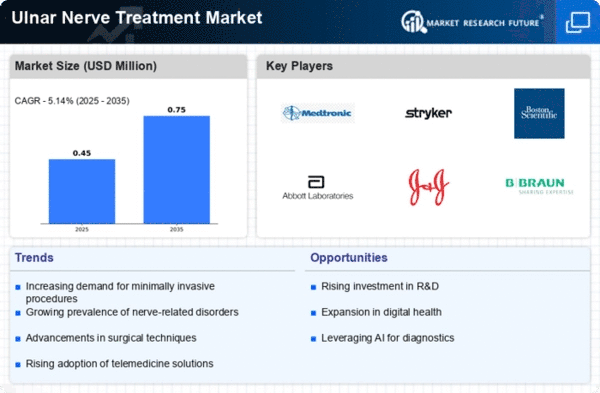
As per MRFR analysis, the Ulnar Nerve Treatment Market Size was estimated at 432 USD Million in 2024. The Ulnar Nerve Treatment industry is projected to grow from 459 USD Million in 2025 to 752 USD Million by 2035, exhibiting a compound annual growth rate (CAGR) of 5.14% during the forecast period 2025 - 2035.

Key Market Trends & Highlights

The Ulnar Nerve Treatment Market is experiencing robust growth driven by technological advancements and increasing awareness of nerve disorders.

  • Technological advancements in treatment methodologies are reshaping the Ulnar Nerve Treatment Market.
  • North America remains the largest market, while Asia-Pacific is emerging as the fastest-growing region in this sector.
  • Surgical treatment continues to dominate the market, whereas non-surgical options are witnessing the fastest growth.
  • The increasing incidence of ulnar nerve disorders and advancements in surgical techniques are key drivers propelling market expansion.

Market Size & Forecast

2024 Market Size 0.432 (USD Million)
2035 Market Size 0.752 (USD Million)
CAGR (2025 - 2035) 5.14%
Largest Regional Market Share in 2024 North America

Major Players

Medtronic (US), Stryker (US), Boston Scientific (US), Abbott (US), Johnson & Johnson (US), B. Braun (DE), Zimmer Biomet (US), NuVasive (US), Integra LifeSciences (US)

Market Trends

The Ulnar Nerve Treatment Market is currently experiencing a notable evolution, driven by advancements in medical technology and an increasing awareness of nerve-related disorders. As healthcare providers enhance their diagnostic and therapeutic capabilities, patients are presented with a broader array of treatment options. This market encompasses various modalities, including surgical interventions, physical therapy, and innovative non-invasive techniques. The growing prevalence of conditions such as cubital tunnel syndrome and ulnar neuropathy is likely to further stimulate demand for effective treatment solutions. Moreover, the integration of telemedicine and digital health platforms appears to be reshaping patient engagement and follow-up care, potentially improving outcomes and satisfaction levels. In addition, the Ulnar Nerve Treatment Market is influenced by ongoing research and development efforts aimed at refining existing therapies and discovering novel approaches. Collaboration between academic institutions and industry stakeholders seems to foster innovation, leading to the emergence of advanced surgical techniques and regenerative medicine applications. As the understanding of nerve physiology deepens, treatment paradigms may shift towards more personalized and targeted strategies. Overall, the market is poised for growth, with a focus on enhancing patient care and optimizing therapeutic efficacy.

Technological Advancements in Treatment

The Ulnar Nerve Treatment Market is witnessing a surge in technological innovations that enhance treatment efficacy. Minimally invasive surgical techniques and advanced imaging modalities are becoming increasingly prevalent, allowing for more precise interventions. These advancements not only improve patient outcomes but also reduce recovery times, making treatments more appealing to both patients and healthcare providers.

Rising Awareness of Nerve Disorders

There is a growing awareness regarding ulnar nerve disorders among the general population and healthcare professionals. Educational initiatives and advocacy efforts are likely contributing to increased diagnosis rates and subsequent treatment demand. As more individuals recognize the symptoms and seek medical advice, the Ulnar Nerve Treatment Market is expected to expand.

Integration of Telehealth Solutions

The integration of telehealth solutions into the Ulnar Nerve Treatment Market is transforming patient care. Remote consultations and follow-up appointments are becoming commonplace, facilitating access to specialists and improving patient engagement. This trend may lead to enhanced monitoring of treatment progress and better overall management of ulnar nerve conditions.

Ulnar Nerve Treatment Market Market Drivers

Market Growth Projections

The Global Ulnar Nerve Treatment Market Industry is projected to experience substantial growth over the coming years. With a market value of 339.1 USD Million in 2024, it is anticipated to reach 624.4 USD Million by 2035, indicating a robust expansion trajectory. The compound annual growth rate (CAGR) of 5.71% from 2025 to 2035 reflects the increasing demand for effective treatment options and the ongoing advancements in medical technology. This growth is driven by various factors, including the rising prevalence of ulnar nerve disorders, advancements in surgical techniques, and the aging population, all contributing to a dynamic market landscape.

Rising Geriatric Population

The aging population is a critical driver of the Global Ulnar Nerve Treatment Market Industry. Older adults are more susceptible to ulnar nerve disorders due to age-related changes in nerve function and increased prevalence of comorbidities. As the global population ages, the demand for effective treatment options is likely to rise. This demographic shift is expected to contribute to a compound annual growth rate (CAGR) of 5.71% from 2025 to 2035. Healthcare systems are increasingly focusing on addressing the needs of older patients, which may lead to enhanced treatment protocols and increased market opportunities.

Growing Awareness and Education

There is a notable increase in awareness and education regarding ulnar nerve disorders, which is positively impacting the Global Ulnar Nerve Treatment Market Industry. Healthcare professionals and patients are becoming more informed about the symptoms and treatment options available. Campaigns aimed at educating the public about the importance of early diagnosis and intervention are gaining momentum. This heightened awareness is likely to lead to earlier treatment seeking behaviors, thereby increasing market demand. As more individuals recognize the signs of ulnar nerve disorders, the market is poised for growth, reflecting a shift towards proactive healthcare.

Advancements in Surgical Techniques

Innovations in surgical techniques are significantly influencing the Global Ulnar Nerve Treatment Market Industry. Minimally invasive procedures, such as endoscopic ulnar nerve decompression, are gaining traction due to their reduced recovery times and lower complication rates. These advancements not only enhance patient outcomes but also encourage more healthcare providers to adopt these techniques. As a result, the market is expected to grow, with a projected value of 624.4 USD Million by 2035. The shift towards less invasive options aligns with patient preferences for quicker recovery and less postoperative discomfort, thereby driving market demand.

Increasing Prevalence of Ulnar Nerve Disorders

The Global Ulnar Nerve Treatment Market Industry is experiencing growth due to the rising incidence of ulnar nerve disorders, such as cubital tunnel syndrome and ulnar neuropathy. These conditions are becoming more prevalent, particularly among individuals engaged in repetitive activities or those with underlying health issues. As awareness of these disorders increases, more patients seek treatment options, contributing to market expansion. In 2024, the market is projected to reach 339.1 USD Million, reflecting a growing demand for effective treatment solutions. This trend is likely to continue as the population ages and the workforce becomes more aware of ergonomic health.

Technological Innovations in Treatment Devices

Technological advancements in treatment devices are shaping the Global Ulnar Nerve Treatment Market Industry. The introduction of new diagnostic tools and therapeutic devices, such as nerve stimulators and advanced imaging techniques, is enhancing the ability to diagnose and treat ulnar nerve conditions effectively. These innovations improve patient outcomes and streamline treatment processes, making them more efficient. As the market evolves, the integration of technology into treatment protocols is expected to drive growth, with an anticipated market value of 624.4 USD Million by 2035. This trend indicates a shift towards more precise and personalized treatment approaches.

Market Segment Insights

By Application: Surgery (Largest) vs. Electrotherapy (Fastest-Growing)

<p>In the Ulnar Nerve Treatment Market, the application segment reveals a distinct distribution of market share. Surgery remains the largest segment due to its effectiveness in addressing severe ulnar nerve compression and related disorders. Physical therapy and medication also contribute significantly but tend to cater to less severe cases or postoperative recovery. Electrotherapy, on the other hand, has been gaining traction as a non-invasive method preferred by patients seeking alternative treatments.</p>

<p>Surgery (Dominant) vs. Electrotherapy (Emerging)</p>

<p>Surgery has established itself as the dominant mode of ulnar nerve treatment, providing lasting solutions for patients suffering from severe conditions. It encompasses a variety of surgical procedures, including decompression and transposition techniques that ensure optimal recovery. Conversely, electrotherapy is emerging as a viable alternative, resonating with patients who favor non-invasive options. This modality employs electrical stimulation to alleviate pain and promote nerve function recovery. As awareness of electrotherapy's benefits increases, it is expected to attract a growing segment of the market, especially among those hesitant to pursue surgical interventions.</p>

By End Use: Hospitals (Largest) vs. Clinics (Fastest-Growing)

<p>The Ulnar Nerve Treatment Market demonstrates a diverse distribution of end-use segments, with hospitals accounting for the largest share. This dominance is attributed to their advanced technological resources, skilled healthcare professionals, and comprehensive treatment capabilities. Clinics serve as a significant segment but trail behind hospitals in terms of market presence, primarily focused on outpatient treatments and less complex procedures. In contrast, the clinics segment is witnessing rapid growth. This surge can be linked to an increased number of patients seeking outpatient care for ulnar nerve conditions, supported by trends towards minimally invasive treatments. Additionally, rehabilitation centers and home care options are gaining traction, responding to patient preferences for personalized and accessible treatment at home, paving the way for a more balanced market distribution in the future.</p>

<p>Hospitals (Dominant) vs. Clinics (Emerging)</p>

<p>Hospitals play a dominant role in the Ulnar Nerve Treatment Market due to their ability to offer a comprehensive range of advanced treatment options, such as surgical interventions and rehabilitation services under one roof. They are equipped with state-of-the-art facilities and skilled personnel, ensuring high-quality patient care. Conversely, clinics are emerging as a pivotal segment, addressing the urgent need for outpatient services that are often preferred for their convenience, affordability, and efficiency. With a focus on personalized care and shorter wait times, clinics are becoming increasingly attractive to patients. The rise in patient awareness and the shift towards proactive health management are further propelling the growth of clinics in this sector.</p>

By Type of Treatment: Surgical Treatment (Largest) vs. Non-Surgical Treatment (Fastest-Growing)

<p>In the Ulnar Nerve Treatment Market, the distribution of treatment types showcases surgical treatment as the largest segment. This dominance stems from an increase in surgical interventions for chronic cases, where invasive options provide definitive solutions. Conversely, non-surgical treatments are rapidly gaining traction, driven by a preference for minimally invasive options among patients, and their evolving efficacy in symptom relief. Alternative therapies also contribute to the market but remain a niche segment compared to the surgical and non-surgical approaches. The growth trends within this market indicate a shift towards more personalized treatment plans. Patients are increasingly opting for non-surgical treatments that can offer satisfactory results with fewer complications. Additionally, advances in technology and increased awareness of ulnar nerve conditions are bolstering the demand for these alternatives. As healthcare institutions adapt to patient preferences, non-surgical options are expected to see the highest growth rates in the forecast period as more patients seek these flexible treatment avenues.</p>

<p>Surgical Treatment: Dominant vs. Alternative Therapies: Emerging</p>

<p>Surgical treatment remains the dominant force in the Ulnar Nerve Treatment Market due to its ability to provide long-term relief for patients suffering from severe ulnar nerve compression. Techniques such as ulnar nerve transpositions have become standard, enhancing patient outcomes. In contrast, alternative therapies, while emerging, cater to a specific demographic looking for holistic or non-invasive methods. These therapies include acupuncture and physiotherapy and are characterized by lower risk profiles and varying degrees of effectiveness. The differing approaches illustrate the market's broad spectrum, where surgical options target severe cases, while alternative therapies appeal to patients seeking conservative management of their symptoms.</p>

By Patient Demographics: Age Group (Largest) vs. Gender (Fastest-Growing)

<p>In the Ulnar Nerve Treatment Market, the patient demographics reveal that the age group segment holds the largest share, particularly among older adults who experience a higher incidence of ulnar nerve disorders. This age group is accompanied by significant treatment needs, accounting for a substantial portion of the patient population seeking intervention. On the other hand, the gender segment, while historically showing a balanced male-to-female ratio, is witnessing rapid growth in treatment-seeking females, indicating demographic shifts in lifestyle and awareness concerning ulnar nerve treatments.</p>

<p>Age Group: 50+ (Dominant) vs. Gender: Female (Emerging)</p>

<p>The dominant age group in the Ulnar Nerve Treatment Market is individuals aged 50 and above, who are more susceptible to conditions like cubital tunnel syndrome, leading to increased demand for treatments. This demographic often has a higher prevalence of chronic health issues and lifestyle factors contributing to nerve damage. In contrast, the emerging female demographic is becoming more prominent in the treatment landscape, as awareness and advocacy for women's health issues increase. This shift is fueling a growing demand for customized treatment solutions that address specific conditions affecting women, thereby redefining market strategies and outreach.</p>

By Severity of Condition: Moderate (Largest) vs. Severe (Fastest-Growing)

<p>In the Ulnar Nerve Treatment Market, the distribution of market share among severity conditions shows that the 'Moderate' segment holds the largest share, reflecting the considerable number of patients who experience moderate symptoms and seek treatment. Meanwhile, the 'Severe' segment is emerging rapidly, capturing attention due to the rising incidence of severe ulnar nerve conditions that necessitate more intensive treatment approaches. As awareness of these conditions increases, so does the demand for effective intervention strategies among those experiencing severe symptoms. Growth trends indicate that advancements in treatment options and increasing awareness among healthcare providers are key drivers for this segment. As more patients are diagnosed with severe conditions, there is a surge in the demand for novel therapies and surgical options. The growing focus on personalized medicine and tailored treatment plans further bolsters the market for severe conditions, making it an area of significant potential for growth in the upcoming years.</p>

<p>Moderate (Dominant) vs. Severe (Emerging)</p>

<p>The 'Moderate' severity segment in the Ulnar Nerve Treatment Market is currently the dominant force due to its significant patient base and diverse treatment options available, including non-surgical interventions like physical therapy and corticosteroid injections. Patients in this group often respond well to conservative management strategies, leading to favorable outcomes without the need for invasive procedures. In contrast, the 'Severe' segment is emerging with increasing prominence, characterized by a more urgent need for surgical intervention and advanced therapies. This segment attracts attention from both healthcare providers and researchers as it encompasses patients with progressive ulnar nerve compression, warranting innovative treatments. The challenges inherent in managing severe cases drive the need for research and development of new therapeutic solutions, making this segment a focal point for future advancements in ulnar nerve treatment.</p>

Get more detailed insights about Ulnar Nerve Treatment Market Research Report- Global Forecast To 2035

Regional Insights

North America : Market Leader in Ulnar Treatments

North America holds a significant share of the Ulnar Nerve Treatment Market, accounting for 21.6% in 2024. The region's growth is driven by advanced healthcare infrastructure, increasing prevalence of nerve-related disorders, and a strong focus on innovative treatment solutions. Regulatory support and favorable reimbursement policies further enhance market dynamics, fostering a conducive environment for growth. The United States is the leading country in this market, hosting major players like Medtronic, Stryker, and Boston Scientific. The competitive landscape is characterized by continuous innovation and strategic partnerships among key players. The presence of a robust healthcare system and high patient awareness contribute to the region's dominance, making it a focal point for advancements in ulnar nerve treatments.

Europe : Emerging Market with Growth Potential

Europe represents a growing segment of the Ulnar Nerve Treatment Market, with a market share of 10.8% in 2024. The region is witnessing an increase in demand for advanced treatment options due to rising awareness of nerve disorders and an aging population. Regulatory frameworks are evolving to support innovative therapies, which is expected to drive market growth in the coming years. Leading countries in this region include Germany, France, and the UK, where key players like B. Braun and Zimmer Biomet are actively involved. The competitive landscape is marked by collaborations and mergers aimed at enhancing product offerings. The European market is poised for growth, supported by a strong emphasis on research and development in medical technologies.

Asia-Pacific : Rapidly Growing Healthcare Sector

The Asia-Pacific region is emerging as a significant player in the Ulnar Nerve Treatment Market, holding a market share of 7.2% in 2024. Factors such as increasing healthcare expenditure, rising awareness of nerve disorders, and improvements in healthcare infrastructure are driving market growth. Regulatory bodies are also focusing on enhancing the approval processes for medical devices, which is expected to further stimulate market demand. Countries like Japan, China, and India are leading the charge in this region, with a growing presence of key players such as Abbott and Integra LifeSciences. The competitive landscape is evolving, with local manufacturers gaining traction alongside established global companies. The region's potential for growth is substantial, driven by a combination of demographic changes and technological advancements in medical treatments.

Middle East and Africa : Untapped Market Potential

The Middle East and Africa represent an untapped market for Ulnar Nerve Treatments, with a market share of 3.6% in 2024. The region is experiencing gradual growth, driven by increasing healthcare investments and a rising prevalence of nerve-related disorders. Regulatory initiatives are being introduced to improve healthcare access and quality, which is expected to enhance market dynamics in the future. Countries like South Africa and the UAE are at the forefront of this market, with a growing interest from international players. The competitive landscape is characterized by a mix of local and global companies striving to establish a foothold. As healthcare infrastructure improves, the region is likely to see increased adoption of advanced treatment options for ulnar nerve conditions.

Key Players and Competitive Insights

The Ulnar Nerve Treatment Market is characterized by a competitive landscape that is increasingly shaped by innovation, strategic partnerships, and a focus on patient-centric solutions. Key players such as Medtronic (US), Stryker (US), and Boston Scientific (US) are at the forefront, leveraging their extensive research and development capabilities to enhance treatment modalities. Medtronic (US) has positioned itself as a leader in neuromodulation technologies, while Stryker (US) emphasizes its commitment to surgical innovations. Boston Scientific (US) appears to be focusing on expanding its product portfolio through strategic acquisitions, thereby enhancing its market presence. Collectively, these strategies contribute to a dynamic competitive environment, where companies are not only vying for market share but also striving to improve patient outcomes through advanced technologies.In terms of business tactics, companies are increasingly localizing manufacturing to reduce costs and improve supply chain efficiency. This approach is particularly relevant in the context of the Ulnar Nerve Treatment Market, which is moderately fragmented, with several players competing for dominance. The collective influence of these key players is significant, as they drive innovation and set industry standards, thereby shaping the overall market structure.

In November Medtronic (US) announced the launch of a new line of minimally invasive surgical instruments designed specifically for ulnar nerve decompression procedures. This strategic move is likely to enhance Medtronic's competitive edge by addressing the growing demand for less invasive treatment options, which are preferred by both patients and healthcare providers. The introduction of these instruments may also facilitate quicker recovery times, thereby improving patient satisfaction and outcomes.

In October Stryker (US) expanded its partnership with a leading telehealth provider to integrate remote monitoring capabilities into its ulnar nerve treatment solutions. This collaboration is indicative of a broader trend towards digital health solutions, which are becoming increasingly important in the management of nerve-related conditions. By enhancing its offerings with telehealth capabilities, Stryker is likely to improve patient engagement and adherence to treatment protocols, which could lead to better clinical outcomes.

In September Boston Scientific (US) completed the acquisition of a startup specializing in AI-driven diagnostic tools for nerve injuries. This acquisition is strategically significant as it positions Boston Scientific to leverage artificial intelligence in enhancing diagnostic accuracy and treatment personalization. The integration of AI into their product offerings may not only streamline clinical workflows but also provide a competitive advantage in a market that is rapidly evolving towards technology-driven solutions.

As of December the Ulnar Nerve Treatment Market is witnessing trends that emphasize digitalization, sustainability, and the integration of advanced technologies such as AI. Strategic alliances are increasingly shaping the competitive landscape, enabling companies to pool resources and expertise to drive innovation. Looking ahead, it is anticipated that competitive differentiation will evolve, with a shift from price-based competition to a focus on innovation, technology, and supply chain reliability. This transition underscores the importance of developing cutting-edge solutions that not only meet regulatory standards but also enhance patient care.

Key Companies in the Ulnar Nerve Treatment Market include

Industry Developments

The ulnar nerve treatment market involves the prominent functions of the key players operating in this market like Pfizer, Inc., Alkem Laboratories, Teva Pharmaceutical Industries Ltd., followed by others like Apotex, Inc., Amneal Pharmaceuticals LLC, Aurobindo Pharma, and Mylan N.V. To gain high market share in the global market industry, the key market players are actively involved in adding innovation for variation in products, services, and others like the periodic new product launches. Collaborations, partnerships, are market agreements are some of the important strategies followed by the market players.

OTC pain relievers, as a part of the market sub-segment, have been divided into acetaminophen and nonsteroidal anti-inflammatory drugs (NSAIDs), including ibuprofen (Motrin, Advil), and others like naproxen (Aleve, Naprosyn) or diclofinac gel. Nerve spams drugs, as a prominent inclusion are further sub-segmented into Baclofen (Lioresal), Cyclobenzaprine (Amrix), Metaxalone (Skelaxin), and others like Methocarbamol (Robaxin). The surgery segment has also been further sub-segmented into simple decompression (endoscopic), medial epicondylectomy, transpositions, amongst others to meet the rising needs of the global target audience.

The North American market dominates the market as the U.S. region is emerging as the major contributor in this region due to the invention of advanced technology, research, and developmental activities in this area. The market is facing other factors like the rising prevalence of disorders, and other chronic diseases. The Asian Pacific region is also a fast-growing market due to the growing health care expanse and an expansive patient base.


Future Outlook

Ulnar Nerve Treatment Market Future Outlook

The Ulnar Nerve Treatment Market is projected to grow at a 5.14% CAGR from 2025 to 2035, driven by technological advancements, increasing awareness, and rising incidence of nerve-related disorders.

New opportunities lie in:

  • Development of minimally invasive surgical techniques for ulnar nerve release.
  • Expansion of telehealth services for remote patient monitoring and consultations.
  • Investment in AI-driven diagnostic tools for early detection of ulnar nerve issues.

By 2035, the Ulnar Nerve Treatment Market is expected to be robust, reflecting significant advancements and increased accessibility.

Market Segmentation

Ulnar Nerve Treatment Market Treatment Type Outlook

  • Surgical Treatment
  • Non-Surgical Treatment
  • Physical Therapy
  • Medication

Ulnar Nerve Treatment Market Healthcare Setting Outlook

  • Hospitals
  • Outpatient Clinics
  • Rehabilitation Centers
  • Home Care

Ulnar Nerve Treatment Market Patient Demographics Outlook

  • Age Group
  • Gender
  • Occupation
  • Lifestyle

Ulnar Nerve Treatment Market Severity of Condition Outlook

  • Mild
  • Moderate
  • Severe
  • Chronic

Report Scope

MARKET SIZE 2024 0.432(USD Million)
MARKET SIZE 2025 0.459(USD Million)
MARKET SIZE 2035 0.752(USD Million)
COMPOUND ANNUAL GROWTH RATE (CAGR) 5.14% (2025 - 2035)
REPORT COVERAGE Revenue Forecast, Competitive Landscape, Growth Factors, and Trends
BASE YEAR 2024
Market Forecast Period 2025 - 2035
Historical Data 2019 - 2024
Market Forecast Units USD Million
Key Companies Profiled Medtronic (US), Stryker (US), Boston Scientific (US), Abbott (US), Johnson & Johnson (US), B. Braun (DE), Zimmer Biomet (US), NuVasive (US), Integra LifeSciences (US)
Segments Covered Treatment Type, Patient Demographics, Severity of Condition, Healthcare Setting
Key Market Opportunities Advancements in minimally invasive surgical techniques enhance patient outcomes in the Ulnar Nerve Treatment Market.
Key Market Dynamics Rising demand for minimally invasive procedures drives innovation in ulnar nerve treatment technologies and techniques.
Countries Covered North America, Europe, APAC, South America, MEA

FAQs

What is the projected market valuation of the Ulnar Nerve Treatment Market by 2035?

The Ulnar Nerve Treatment Market is projected to reach a valuation of 0.752 USD Million by 2035.

What was the market valuation of the Ulnar Nerve Treatment Market in 2024?

In 2024, the Ulnar Nerve Treatment Market was valued at 0.432 USD Million.

What is the expected CAGR for the Ulnar Nerve Treatment Market during the forecast period 2025 - 2035?

The expected CAGR for the Ulnar Nerve Treatment Market during the forecast period 2025 - 2035 is 5.14%.

Which companies are considered key players in the Ulnar Nerve Treatment Market?

Key players in the Ulnar Nerve Treatment Market include Medtronic, Stryker, Boston Scientific, Abbott Laboratories, Johnson &amp; Johnson, B. Braun Melsungen AG, Zimmer Biomet, NuVasive, and Integra LifeSciences.

What are the main applications in the Ulnar Nerve Treatment Market?

The main applications in the Ulnar Nerve Treatment Market include Surgery, Physical Therapy, Medication, and Electrotherapy.

How does the market segment by end use look in terms of valuation?

By end use, the Ulnar Nerve Treatment Market segments include Hospitals, Clinics, Rehabilitation Centers, and Home Care, with valuations ranging from 0.086 to 0.304 USD Million.

What types of treatments are available in the Ulnar Nerve Treatment Market?

The Ulnar Nerve Treatment Market offers Surgical Treatment, Non-Surgical Treatment, and Alternative Therapies.

How is the Ulnar Nerve Treatment Market segmented by patient demographics?

The market is segmented by patient demographics, including Age Group, Gender, and Occupation, each with valuations around 0.086 to 0.152 USD Million.

What is the market performance based on the severity of the condition?

The Ulnar Nerve Treatment Market performance based on severity includes Mild, Moderate, and Severe conditions, with valuations from 0.0864 to 0.3048 USD Million.

What trends are anticipated in the Ulnar Nerve Treatment Market over the next decade?

Over the next decade, the Ulnar Nerve Treatment Market is likely to experience growth driven by advancements in treatment options and increasing awareness.

  1. SECTION I: EXECUTIVE SUMMARY AND KEY HIGHLIGHTS
    1. | 1.1 EXECUTIVE SUMMARY
    2. | | 1.1.1 Market Overview
    3. | | 1.1.2 Key Findings
    4. | | 1.1.3 Market Segmentation
    5. | | 1.1.4 Competitive Landscape
    6. | | 1.1.5 Challenges and Opportunities
    7. | | 1.1.6 Future Outlook
  2. SECTION II: SCOPING, METHODOLOGY AND MARKET STRUCTURE
    1. | 2.1 MARKET INTRODUCTION
    2. | | 2.1.1 Definition
    3. | | 2.1.2 Scope of the study
    4. | | | 2.1.2.1 Research Objective
    5. | | | 2.1.2.2 Assumption
    6. | | | 2.1.2.3 Limitations
    7. | 2.2 RESEARCH METHODOLOGY
    8. | | 2.2.1 Overview
    9. | | 2.2.2 Data Mining
    10. | | 2.2.3 Secondary Research
    11. | | 2.2.4 Primary Research
    12. | | | 2.2.4.1 Primary Interviews and Information Gathering Process
    13. | | | 2.2.4.2 Breakdown of Primary Respondents
    14. | | 2.2.5 Forecasting Model
    15. | | 2.2.6 Market Size Estimation
    16. | | | 2.2.6.1 Bottom-Up Approach
    17. | | | 2.2.6.2 Top-Down Approach
    18. | | 2.2.7 Data Triangulation
    19. | | 2.2.8 Validation
  3. SECTION III: QUALITATIVE ANALYSIS
    1. | 3.1 MARKET DYNAMICS
    2. | | 3.1.1 Overview
    3. | | 3.1.2 Drivers
    4. | | 3.1.3 Restraints
    5. | | 3.1.4 Opportunities
    6. | 3.2 MARKET FACTOR ANALYSIS
    7. | | 3.2.1 Value chain Analysis
    8. | | 3.2.2 Porter's Five Forces Analysis
    9. | | | 3.2.2.1 Bargaining Power of Suppliers
    10. | | | 3.2.2.2 Bargaining Power of Buyers
    11. | | | 3.2.2.3 Threat of New Entrants
    12. | | | 3.2.2.4 Threat of Substitutes
    13. | | | 3.2.2.5 Intensity of Rivalry
    14. | | 3.2.3 COVID-19 Impact Analysis
    15. | | | 3.2.3.1 Market Impact Analysis
    16. | | | 3.2.3.2 Regional Impact
    17. | | | 3.2.3.3 Opportunity and Threat Analysis
  4. SECTION IV: QUANTITATIVE ANALYSIS
    1. | 4.1 Healthcare, BY Application (USD Million)
    2. | | 4.1.1 Surgery
    3. | | 4.1.2 Physical Therapy
    4. | | 4.1.3 Medication
    5. | | 4.1.4 Electrotherapy
    6. | 4.2 Healthcare, BY End Use (USD Million)
    7. | | 4.2.1 Hospitals
    8. | | 4.2.2 Clinics
    9. | | 4.2.3 Rehabilitation Centers
    10. | | 4.2.4 Home Care
    11. | 4.3 Healthcare, BY Type of Treatment (USD Million)
    12. | | 4.3.1 Surgical Treatment
    13. | | 4.3.2 Non-Surgical Treatment
    14. | | 4.3.3 Alternative Therapies
    15. | 4.4 Healthcare, BY Patient Demographics (USD Million)
    16. | | 4.4.1 Age Group
    17. | | 4.4.2 Gender
    18. | | 4.4.3 Occupation
    19. | 4.5 Healthcare, BY Severity of Condition (USD Million)
    20. | | 4.5.1 Mild
    21. | | 4.5.2 Moderate
    22. | | 4.5.3 Severe
    23. | 4.6 Healthcare, BY Region (USD Million)
    24. | | 4.6.1 North America
    25. | | | 4.6.1.1 US
    26. | | | 4.6.1.2 Canada
    27. | | 4.6.2 Europe
    28. | | | 4.6.2.1 Germany
    29. | | | 4.6.2.2 UK
    30. | | | 4.6.2.3 France
    31. | | | 4.6.2.4 Russia
    32. | | | 4.6.2.5 Italy
    33. | | | 4.6.2.6 Spain
    34. | | | 4.6.2.7 Rest of Europe
    35. | | 4.6.3 APAC
    36. | | | 4.6.3.1 China
    37. | | | 4.6.3.2 India
    38. | | | 4.6.3.3 Japan
    39. | | | 4.6.3.4 South Korea
    40. | | | 4.6.3.5 Malaysia
    41. | | | 4.6.3.6 Thailand
    42. | | | 4.6.3.7 Indonesia
    43. | | | 4.6.3.8 Rest of APAC
    44. | | 4.6.4 South America
    45. | | | 4.6.4.1 Brazil
    46. | | | 4.6.4.2 Mexico
    47. | | | 4.6.4.3 Argentina
    48. | | | 4.6.4.4 Rest of South America
    49. | | 4.6.5 MEA
    50. | | | 4.6.5.1 GCC Countries
    51. | | | 4.6.5.2 South Africa
    52. | | | 4.6.5.3 Rest of MEA
  5. SECTION V: COMPETITIVE ANALYSIS
    1. | 5.1 Competitive Landscape
    2. | | 5.1.1 Overview
    3. | | 5.1.2 Competitive Analysis
    4. | | 5.1.3 Market share Analysis
    5. | | 5.1.4 Major Growth Strategy in the Healthcare
    6. | | 5.1.5 Competitive Benchmarking
    7. | | 5.1.6 Leading Players in Terms of Number of Developments in the Healthcare
    8. | | 5.1.7 Key developments and growth strategies
    9. | | | 5.1.7.1 New Product Launch/Service Deployment
    10. | | | 5.1.7.2 Merger & Acquisitions
    11. | | | 5.1.7.3 Joint Ventures
    12. | | 5.1.8 Major Players Financial Matrix
    13. | | | 5.1.8.1 Sales and Operating Income
    14. | | | 5.1.8.2 Major Players R&D Expenditure. 2023
    15. | 5.2 Company Profiles
    16. | | 5.2.1 Medtronic (US)
    17. | | | 5.2.1.1 Financial Overview
    18. | | | 5.2.1.2 Products Offered
    19. | | | 5.2.1.3 Key Developments
    20. | | | 5.2.1.4 SWOT Analysis
    21. | | | 5.2.1.5 Key Strategies
    22. | | 5.2.2 Stryker (US)
    23. | | | 5.2.2.1 Financial Overview
    24. | | | 5.2.2.2 Products Offered
    25. | | | 5.2.2.3 Key Developments
    26. | | | 5.2.2.4 SWOT Analysis
    27. | | | 5.2.2.5 Key Strategies
    28. | | 5.2.3 Boston Scientific (US)
    29. | | | 5.2.3.1 Financial Overview
    30. | | | 5.2.3.2 Products Offered
    31. | | | 5.2.3.3 Key Developments
    32. | | | 5.2.3.4 SWOT Analysis
    33. | | | 5.2.3.5 Key Strategies
    34. | | 5.2.4 Abbott Laboratories (US)
    35. | | | 5.2.4.1 Financial Overview
    36. | | | 5.2.4.2 Products Offered
    37. | | | 5.2.4.3 Key Developments
    38. | | | 5.2.4.4 SWOT Analysis
    39. | | | 5.2.4.5 Key Strategies
    40. | | 5.2.5 Johnson & Johnson (US)
    41. | | | 5.2.5.1 Financial Overview
    42. | | | 5.2.5.2 Products Offered
    43. | | | 5.2.5.3 Key Developments
    44. | | | 5.2.5.4 SWOT Analysis
    45. | | | 5.2.5.5 Key Strategies
    46. | | 5.2.6 B. Braun Melsungen AG (DE)
    47. | | | 5.2.6.1 Financial Overview
    48. | | | 5.2.6.2 Products Offered
    49. | | | 5.2.6.3 Key Developments
    50. | | | 5.2.6.4 SWOT Analysis
    51. | | | 5.2.6.5 Key Strategies
    52. | | 5.2.7 Zimmer Biomet (US)
    53. | | | 5.2.7.1 Financial Overview
    54. | | | 5.2.7.2 Products Offered
    55. | | | 5.2.7.3 Key Developments
    56. | | | 5.2.7.4 SWOT Analysis
    57. | | | 5.2.7.5 Key Strategies
    58. | | 5.2.8 NuVasive (US)
    59. | | | 5.2.8.1 Financial Overview
    60. | | | 5.2.8.2 Products Offered
    61. | | | 5.2.8.3 Key Developments
    62. | | | 5.2.8.4 SWOT Analysis
    63. | | | 5.2.8.5 Key Strategies
    64. | | 5.2.9 Integra LifeSciences (US)
    65. | | | 5.2.9.1 Financial Overview
    66. | | | 5.2.9.2 Products Offered
    67. | | | 5.2.9.3 Key Developments
    68. | | | 5.2.9.4 SWOT Analysis
    69. | | | 5.2.9.5 Key Strategies
    70. | 5.3 Appendix
    71. | | 5.3.1 References
    72. | | 5.3.2 Related Reports
  6. LIST OF FIGURES
    1. | 6.1 MARKET SYNOPSIS
    2. | 6.2 NORTH AMERICA MARKET ANALYSIS
    3. | 6.3 US MARKET ANALYSIS BY APPLICATION
    4. | 6.4 US MARKET ANALYSIS BY END USE
    5. | 6.5 US MARKET ANALYSIS BY TYPE OF TREATMENT
    6. | 6.6 US MARKET ANALYSIS BY PATIENT DEMOGRAPHICS
    7. | 6.7 US MARKET ANALYSIS BY SEVERITY OF CONDITION
    8. | 6.8 CANADA MARKET ANALYSIS BY APPLICATION
    9. | 6.9 CANADA MARKET ANALYSIS BY END USE
    10. | 6.10 CANADA MARKET ANALYSIS BY TYPE OF TREATMENT
    11. | 6.11 CANADA MARKET ANALYSIS BY PATIENT DEMOGRAPHICS
    12. | 6.12 CANADA MARKET ANALYSIS BY SEVERITY OF CONDITION
    13. | 6.13 EUROPE MARKET ANALYSIS
    14. | 6.14 GERMANY MARKET ANALYSIS BY APPLICATION
    15. | 6.15 GERMANY MARKET ANALYSIS BY END USE
    16. | 6.16 GERMANY MARKET ANALYSIS BY TYPE OF TREATMENT
    17. | 6.17 GERMANY MARKET ANALYSIS BY PATIENT DEMOGRAPHICS
    18. | 6.18 GERMANY MARKET ANALYSIS BY SEVERITY OF CONDITION
    19. | 6.19 UK MARKET ANALYSIS BY APPLICATION
    20. | 6.20 UK MARKET ANALYSIS BY END USE
    21. | 6.21 UK MARKET ANALYSIS BY TYPE OF TREATMENT
    22. | 6.22 UK MARKET ANALYSIS BY PATIENT DEMOGRAPHICS
    23. | 6.23 UK MARKET ANALYSIS BY SEVERITY OF CONDITION
    24. | 6.24 FRANCE MARKET ANALYSIS BY APPLICATION
    25. | 6.25 FRANCE MARKET ANALYSIS BY END USE
    26. | 6.26 FRANCE MARKET ANALYSIS BY TYPE OF TREATMENT
    27. | 6.27 FRANCE MARKET ANALYSIS BY PATIENT DEMOGRAPHICS
    28. | 6.28 FRANCE MARKET ANALYSIS BY SEVERITY OF CONDITION
    29. | 6.29 RUSSIA MARKET ANALYSIS BY APPLICATION
    30. | 6.30 RUSSIA MARKET ANALYSIS BY END USE
    31. | 6.31 RUSSIA MARKET ANALYSIS BY TYPE OF TREATMENT
    32. | 6.32 RUSSIA MARKET ANALYSIS BY PATIENT DEMOGRAPHICS
    33. | 6.33 RUSSIA MARKET ANALYSIS BY SEVERITY OF CONDITION
    34. | 6.34 ITALY MARKET ANALYSIS BY APPLICATION
    35. | 6.35 ITALY MARKET ANALYSIS BY END USE
    36. | 6.36 ITALY MARKET ANALYSIS BY TYPE OF TREATMENT
    37. | 6.37 ITALY MARKET ANALYSIS BY PATIENT DEMOGRAPHICS
    38. | 6.38 ITALY MARKET ANALYSIS BY SEVERITY OF CONDITION
    39. | 6.39 SPAIN MARKET ANALYSIS BY APPLICATION
    40. | 6.40 SPAIN MARKET ANALYSIS BY END USE
    41. | 6.41 SPAIN MARKET ANALYSIS BY TYPE OF TREATMENT
    42. | 6.42 SPAIN MARKET ANALYSIS BY PATIENT DEMOGRAPHICS
    43. | 6.43 SPAIN MARKET ANALYSIS BY SEVERITY OF CONDITION
    44. | 6.44 REST OF EUROPE MARKET ANALYSIS BY APPLICATION
    45. | 6.45 REST OF EUROPE MARKET ANALYSIS BY END USE
    46. | 6.46 REST OF EUROPE MARKET ANALYSIS BY TYPE OF TREATMENT
    47. | 6.47 REST OF EUROPE MARKET ANALYSIS BY PATIENT DEMOGRAPHICS
    48. | 6.48 REST OF EUROPE MARKET ANALYSIS BY SEVERITY OF CONDITION
    49. | 6.49 APAC MARKET ANALYSIS
    50. | 6.50 CHINA MARKET ANALYSIS BY APPLICATION
    51. | 6.51 CHINA MARKET ANALYSIS BY END USE
    52. | 6.52 CHINA MARKET ANALYSIS BY TYPE OF TREATMENT
    53. | 6.53 CHINA MARKET ANALYSIS BY PATIENT DEMOGRAPHICS
    54. | 6.54 CHINA MARKET ANALYSIS BY SEVERITY OF CONDITION
    55. | 6.55 INDIA MARKET ANALYSIS BY APPLICATION
    56. | 6.56 INDIA MARKET ANALYSIS BY END USE
    57. | 6.57 INDIA MARKET ANALYSIS BY TYPE OF TREATMENT
    58. | 6.58 INDIA MARKET ANALYSIS BY PATIENT DEMOGRAPHICS
    59. | 6.59 INDIA MARKET ANALYSIS BY SEVERITY OF CONDITION
    60. | 6.60 JAPAN MARKET ANALYSIS BY APPLICATION
    61. | 6.61 JAPAN MARKET ANALYSIS BY END USE
    62. | 6.62 JAPAN MARKET ANALYSIS BY TYPE OF TREATMENT
    63. | 6.63 JAPAN MARKET ANALYSIS BY PATIENT DEMOGRAPHICS
    64. | 6.64 JAPAN MARKET ANALYSIS BY SEVERITY OF CONDITION
    65. | 6.65 SOUTH KOREA MARKET ANALYSIS BY APPLICATION
    66. | 6.66 SOUTH KOREA MARKET ANALYSIS BY END USE
    67. | 6.67 SOUTH KOREA MARKET ANALYSIS BY TYPE OF TREATMENT
    68. | 6.68 SOUTH KOREA MARKET ANALYSIS BY PATIENT DEMOGRAPHICS
    69. | 6.69 SOUTH KOREA MARKET ANALYSIS BY SEVERITY OF CONDITION
    70. | 6.70 MALAYSIA MARKET ANALYSIS BY APPLICATION
    71. | 6.71 MALAYSIA MARKET ANALYSIS BY END USE
    72. | 6.72 MALAYSIA MARKET ANALYSIS BY TYPE OF TREATMENT
    73. | 6.73 MALAYSIA MARKET ANALYSIS BY PATIENT DEMOGRAPHICS
    74. | 6.74 MALAYSIA MARKET ANALYSIS BY SEVERITY OF CONDITION
    75. | 6.75 THAILAND MARKET ANALYSIS BY APPLICATION
    76. | 6.76 THAILAND MARKET ANALYSIS BY END USE
    77. | 6.77 THAILAND MARKET ANALYSIS BY TYPE OF TREATMENT
    78. | 6.78 THAILAND MARKET ANALYSIS BY PATIENT DEMOGRAPHICS
    79. | 6.79 THAILAND MARKET ANALYSIS BY SEVERITY OF CONDITION
    80. | 6.80 INDONESIA MARKET ANALYSIS BY APPLICATION
    81. | 6.81 INDONESIA MARKET ANALYSIS BY END USE
    82. | 6.82 INDONESIA MARKET ANALYSIS BY TYPE OF TREATMENT
    83. | 6.83 INDONESIA MARKET ANALYSIS BY PATIENT DEMOGRAPHICS
    84. | 6.84 INDONESIA MARKET ANALYSIS BY SEVERITY OF CONDITION
    85. | 6.85 REST OF APAC MARKET ANALYSIS BY APPLICATION
    86. | 6.86 REST OF APAC MARKET ANALYSIS BY END USE
    87. | 6.87 REST OF APAC MARKET ANALYSIS BY TYPE OF TREATMENT
    88. | 6.88 REST OF APAC MARKET ANALYSIS BY PATIENT DEMOGRAPHICS
    89. | 6.89 REST OF APAC MARKET ANALYSIS BY SEVERITY OF CONDITION
    90. | 6.90 SOUTH AMERICA MARKET ANALYSIS
    91. | 6.91 BRAZIL MARKET ANALYSIS BY APPLICATION
    92. | 6.92 BRAZIL MARKET ANALYSIS BY END USE
    93. | 6.93 BRAZIL MARKET ANALYSIS BY TYPE OF TREATMENT
    94. | 6.94 BRAZIL MARKET ANALYSIS BY PATIENT DEMOGRAPHICS
    95. | 6.95 BRAZIL MARKET ANALYSIS BY SEVERITY OF CONDITION
    96. | 6.96 MEXICO MARKET ANALYSIS BY APPLICATION
    97. | 6.97 MEXICO MARKET ANALYSIS BY END USE
    98. | 6.98 MEXICO MARKET ANALYSIS BY TYPE OF TREATMENT
    99. | 6.99 MEXICO MARKET ANALYSIS BY PATIENT DEMOGRAPHICS
    100. | 6.100 MEXICO MARKET ANALYSIS BY SEVERITY OF CONDITION
    101. | 6.101 ARGENTINA MARKET ANALYSIS BY APPLICATION
    102. | 6.102 ARGENTINA MARKET ANALYSIS BY END USE
    103. | 6.103 ARGENTINA MARKET ANALYSIS BY TYPE OF TREATMENT
    104. | 6.104 ARGENTINA MARKET ANALYSIS BY PATIENT DEMOGRAPHICS
    105. | 6.105 ARGENTINA MARKET ANALYSIS BY SEVERITY OF CONDITION
    106. | 6.106 REST OF SOUTH AMERICA MARKET ANALYSIS BY APPLICATION
    107. | 6.107 REST OF SOUTH AMERICA MARKET ANALYSIS BY END USE
    108. | 6.108 REST OF SOUTH AMERICA MARKET ANALYSIS BY TYPE OF TREATMENT
    109. | 6.109 REST OF SOUTH AMERICA MARKET ANALYSIS BY PATIENT DEMOGRAPHICS
    110. | 6.110 REST OF SOUTH AMERICA MARKET ANALYSIS BY SEVERITY OF CONDITION
    111. | 6.111 MEA MARKET ANALYSIS
    112. | 6.112 GCC COUNTRIES MARKET ANALYSIS BY APPLICATION
    113. | 6.113 GCC COUNTRIES MARKET ANALYSIS BY END USE
    114. | 6.114 GCC COUNTRIES MARKET ANALYSIS BY TYPE OF TREATMENT
    115. | 6.115 GCC COUNTRIES MARKET ANALYSIS BY PATIENT DEMOGRAPHICS
    116. | 6.116 GCC COUNTRIES MARKET ANALYSIS BY SEVERITY OF CONDITION
    117. | 6.117 SOUTH AFRICA MARKET ANALYSIS BY APPLICATION
    118. | 6.118 SOUTH AFRICA MARKET ANALYSIS BY END USE
    119. | 6.119 SOUTH AFRICA MARKET ANALYSIS BY TYPE OF TREATMENT
    120. | 6.120 SOUTH AFRICA MARKET ANALYSIS BY PATIENT DEMOGRAPHICS
    121. | 6.121 SOUTH AFRICA MARKET ANALYSIS BY SEVERITY OF CONDITION
    122. | 6.122 REST OF MEA MARKET ANALYSIS BY APPLICATION
    123. | 6.123 REST OF MEA MARKET ANALYSIS BY END USE
    124. | 6.124 REST OF MEA MARKET ANALYSIS BY TYPE OF TREATMENT
    125. | 6.125 REST OF MEA MARKET ANALYSIS BY PATIENT DEMOGRAPHICS
    126. | 6.126 REST OF MEA MARKET ANALYSIS BY SEVERITY OF CONDITION
    127. | 6.127 KEY BUYING CRITERIA OF HEALTHCARE
    128. | 6.128 RESEARCH PROCESS OF MRFR
    129. | 6.129 DRO ANALYSIS OF HEALTHCARE
    130. | 6.130 DRIVERS IMPACT ANALYSIS: HEALTHCARE
    131. | 6.131 RESTRAINTS IMPACT ANALYSIS: HEALTHCARE
    132. | 6.132 SUPPLY / VALUE CHAIN: HEALTHCARE
    133. | 6.133 HEALTHCARE, BY APPLICATION, 2024 (% SHARE)
    134. | 6.134 HEALTHCARE, BY APPLICATION, 2024 TO 2035 (USD Million)
    135. | 6.135 HEALTHCARE, BY END USE, 2024 (% SHARE)
    136. | 6.136 HEALTHCARE, BY END USE, 2024 TO 2035 (USD Million)
    137. | 6.137 HEALTHCARE, BY TYPE OF TREATMENT, 2024 (% SHARE)
    138. | 6.138 HEALTHCARE, BY TYPE OF TREATMENT, 2024 TO 2035 (USD Million)
    139. | 6.139 HEALTHCARE, BY PATIENT DEMOGRAPHICS, 2024 (% SHARE)
    140. | 6.140 HEALTHCARE, BY PATIENT DEMOGRAPHICS, 2024 TO 2035 (USD Million)
    141. | 6.141 HEALTHCARE, BY SEVERITY OF CONDITION, 2024 (% SHARE)
    142. | 6.142 HEALTHCARE, BY SEVERITY OF CONDITION, 2024 TO 2035 (USD Million)
    143. | 6.143 BENCHMARKING OF MAJOR COMPETITORS
  7. LIST OF TABLES
    1. | 7.1 LIST OF ASSUMPTIONS
    2. | | 7.1.1
    3. | 7.2 North America MARKET SIZE ESTIMATES; FORECAST
    4. | | 7.2.1 BY APPLICATION, 2025-2035 (USD Million)
    5. | | 7.2.2 BY END USE, 2025-2035 (USD Million)
    6. | | 7.2.3 BY TYPE OF TREATMENT, 2025-2035 (USD Million)
    7. | | 7.2.4 BY PATIENT DEMOGRAPHICS, 2025-2035 (USD Million)
    8. | | 7.2.5 BY SEVERITY OF CONDITION, 2025-2035 (USD Million)
    9. | 7.3 US MARKET SIZE ESTIMATES; FORECAST
    10. | | 7.3.1 BY APPLICATION, 2025-2035 (USD Million)
    11. | | 7.3.2 BY END USE, 2025-2035 (USD Million)
    12. | | 7.3.3 BY TYPE OF TREATMENT, 2025-2035 (USD Million)
    13. | | 7.3.4 BY PATIENT DEMOGRAPHICS, 2025-2035 (USD Million)
    14. | | 7.3.5 BY SEVERITY OF CONDITION, 2025-2035 (USD Million)
    15. | 7.4 Canada MARKET SIZE ESTIMATES; FORECAST
    16. | | 7.4.1 BY APPLICATION, 2025-2035 (USD Million)
    17. | | 7.4.2 BY END USE, 2025-2035 (USD Million)
    18. | | 7.4.3 BY TYPE OF TREATMENT, 2025-2035 (USD Million)
    19. | | 7.4.4 BY PATIENT DEMOGRAPHICS, 2025-2035 (USD Million)
    20. | | 7.4.5 BY SEVERITY OF CONDITION, 2025-2035 (USD Million)
    21. | 7.5 Europe MARKET SIZE ESTIMATES; FORECAST
    22. | | 7.5.1 BY APPLICATION, 2025-2035 (USD Million)
    23. | | 7.5.2 BY END USE, 2025-2035 (USD Million)
    24. | | 7.5.3 BY TYPE OF TREATMENT, 2025-2035 (USD Million)
    25. | | 7.5.4 BY PATIENT DEMOGRAPHICS, 2025-2035 (USD Million)
    26. | | 7.5.5 BY SEVERITY OF CONDITION, 2025-2035 (USD Million)
    27. | 7.6 Germany MARKET SIZE ESTIMATES; FORECAST
    28. | | 7.6.1 BY APPLICATION, 2025-2035 (USD Million)
    29. | | 7.6.2 BY END USE, 2025-2035 (USD Million)
    30. | | 7.6.3 BY TYPE OF TREATMENT, 2025-2035 (USD Million)
    31. | | 7.6.4 BY PATIENT DEMOGRAPHICS, 2025-2035 (USD Million)
    32. | | 7.6.5 BY SEVERITY OF CONDITION, 2025-2035 (USD Million)
    33. | 7.7 UK MARKET SIZE ESTIMATES; FORECAST
    34. | | 7.7.1 BY APPLICATION, 2025-2035 (USD Million)
    35. | | 7.7.2 BY END USE, 2025-2035 (USD Million)
    36. | | 7.7.3 BY TYPE OF TREATMENT, 2025-2035 (USD Million)
    37. | | 7.7.4 BY PATIENT DEMOGRAPHICS, 2025-2035 (USD Million)
    38. | | 7.7.5 BY SEVERITY OF CONDITION, 2025-2035 (USD Million)
    39. | 7.8 France MARKET SIZE ESTIMATES; FORECAST
    40. | | 7.8.1 BY APPLICATION, 2025-2035 (USD Million)
    41. | | 7.8.2 BY END USE, 2025-2035 (USD Million)
    42. | | 7.8.3 BY TYPE OF TREATMENT, 2025-2035 (USD Million)
    43. | | 7.8.4 BY PATIENT DEMOGRAPHICS, 2025-2035 (USD Million)
    44. | | 7.8.5 BY SEVERITY OF CONDITION, 2025-2035 (USD Million)
    45. | 7.9 Russia MARKET SIZE ESTIMATES; FORECAST
    46. | | 7.9.1 BY APPLICATION, 2025-2035 (USD Million)
    47. | | 7.9.2 BY END USE, 2025-2035 (USD Million)
    48. | | 7.9.3 BY TYPE OF TREATMENT, 2025-2035 (USD Million)
    49. | | 7.9.4 BY PATIENT DEMOGRAPHICS, 2025-2035 (USD Million)
    50. | | 7.9.5 BY SEVERITY OF CONDITION, 2025-2035 (USD Million)
    51. | 7.10 Italy MARKET SIZE ESTIMATES; FORECAST
    52. | | 7.10.1 BY APPLICATION, 2025-2035 (USD Million)
    53. | | 7.10.2 BY END USE, 2025-2035 (USD Million)
    54. | | 7.10.3 BY TYPE OF TREATMENT, 2025-2035 (USD Million)
    55. | | 7.10.4 BY PATIENT DEMOGRAPHICS, 2025-2035 (USD Million)
    56. | | 7.10.5 BY SEVERITY OF CONDITION, 2025-2035 (USD Million)
    57. | 7.11 Spain MARKET SIZE ESTIMATES; FORECAST
    58. | | 7.11.1 BY APPLICATION, 2025-2035 (USD Million)
    59. | | 7.11.2 BY END USE, 2025-2035 (USD Million)
    60. | | 7.11.3 BY TYPE OF TREATMENT, 2025-2035 (USD Million)
    61. | | 7.11.4 BY PATIENT DEMOGRAPHICS, 2025-2035 (USD Million)
    62. | | 7.11.5 BY SEVERITY OF CONDITION, 2025-2035 (USD Million)
    63. | 7.12 Rest of Europe MARKET SIZE ESTIMATES; FORECAST
    64. | | 7.12.1 BY APPLICATION, 2025-2035 (USD Million)
    65. | | 7.12.2 BY END USE, 2025-2035 (USD Million)
    66. | | 7.12.3 BY TYPE OF TREATMENT, 2025-2035 (USD Million)
    67. | | 7.12.4 BY PATIENT DEMOGRAPHICS, 2025-2035 (USD Million)
    68. | | 7.12.5 BY SEVERITY OF CONDITION, 2025-2035 (USD Million)
    69. | 7.13 APAC MARKET SIZE ESTIMATES; FORECAST
    70. | | 7.13.1 BY APPLICATION, 2025-2035 (USD Million)
    71. | | 7.13.2 BY END USE, 2025-2035 (USD Million)
    72. | | 7.13.3 BY TYPE OF TREATMENT, 2025-2035 (USD Million)
    73. | | 7.13.4 BY PATIENT DEMOGRAPHICS, 2025-2035 (USD Million)
    74. | | 7.13.5 BY SEVERITY OF CONDITION, 2025-2035 (USD Million)
    75. | 7.14 China MARKET SIZE ESTIMATES; FORECAST
    76. | | 7.14.1 BY APPLICATION, 2025-2035 (USD Million)
    77. | | 7.14.2 BY END USE, 2025-2035 (USD Million)
    78. | | 7.14.3 BY TYPE OF TREATMENT, 2025-2035 (USD Million)
    79. | | 7.14.4 BY PATIENT DEMOGRAPHICS, 2025-2035 (USD Million)
    80. | | 7.14.5 BY SEVERITY OF CONDITION, 2025-2035 (USD Million)
    81. | 7.15 India MARKET SIZE ESTIMATES; FORECAST
    82. | | 7.15.1 BY APPLICATION, 2025-2035 (USD Million)
    83. | | 7.15.2 BY END USE, 2025-2035 (USD Million)
    84. | | 7.15.3 BY TYPE OF TREATMENT, 2025-2035 (USD Million)
    85. | | 7.15.4 BY PATIENT DEMOGRAPHICS, 2025-2035 (USD Million)
    86. | | 7.15.5 BY SEVERITY OF CONDITION, 2025-2035 (USD Million)
    87. | 7.16 Japan MARKET SIZE ESTIMATES; FORECAST
    88. | | 7.16.1 BY APPLICATION, 2025-2035 (USD Million)
    89. | | 7.16.2 BY END USE, 2025-2035 (USD Million)
    90. | | 7.16.3 BY TYPE OF TREATMENT, 2025-2035 (USD Million)
    91. | | 7.16.4 BY PATIENT DEMOGRAPHICS, 2025-2035 (USD Million)
    92. | | 7.16.5 BY SEVERITY OF CONDITION, 2025-2035 (USD Million)
    93. | 7.17 South Korea MARKET SIZE ESTIMATES; FORECAST
    94. | | 7.17.1 BY APPLICATION, 2025-2035 (USD Million)
    95. | | 7.17.2 BY END USE, 2025-2035 (USD Million)
    96. | | 7.17.3 BY TYPE OF TREATMENT, 2025-2035 (USD Million)
    97. | | 7.17.4 BY PATIENT DEMOGRAPHICS, 2025-2035 (USD Million)
    98. | | 7.17.5 BY SEVERITY OF CONDITION, 2025-2035 (USD Million)
    99. | 7.18 Malaysia MARKET SIZE ESTIMATES; FORECAST
    100. | | 7.18.1 BY APPLICATION, 2025-2035 (USD Million)
    101. | | 7.18.2 BY END USE, 2025-2035 (USD Million)
    102. | | 7.18.3 BY TYPE OF TREATMENT, 2025-2035 (USD Million)
    103. | | 7.18.4 BY PATIENT DEMOGRAPHICS, 2025-2035 (USD Million)
    104. | | 7.18.5 BY SEVERITY OF CONDITION, 2025-2035 (USD Million)
    105. | 7.19 Thailand MARKET SIZE ESTIMATES; FORECAST
    106. | | 7.19.1 BY APPLICATION, 2025-2035 (USD Million)
    107. | | 7.19.2 BY END USE, 2025-2035 (USD Million)
    108. | | 7.19.3 BY TYPE OF TREATMENT, 2025-2035 (USD Million)
    109. | | 7.19.4 BY PATIENT DEMOGRAPHICS, 2025-2035 (USD Million)
    110. | | 7.19.5 BY SEVERITY OF CONDITION, 2025-2035 (USD Million)
    111. | 7.20 Indonesia MARKET SIZE ESTIMATES; FORECAST
    112. | | 7.20.1 BY APPLICATION, 2025-2035 (USD Million)
    113. | | 7.20.2 BY END USE, 2025-2035 (USD Million)
    114. | | 7.20.3 BY TYPE OF TREATMENT, 2025-2035 (USD Million)
    115. | | 7.20.4 BY PATIENT DEMOGRAPHICS, 2025-2035 (USD Million)
    116. | | 7.20.5 BY SEVERITY OF CONDITION, 2025-2035 (USD Million)
    117. | 7.21 Rest of APAC MARKET SIZE ESTIMATES; FORECAST
    118. | | 7.21.1 BY APPLICATION, 2025-2035 (USD Million)
    119. | | 7.21.2 BY END USE, 2025-2035 (USD Million)
    120. | | 7.21.3 BY TYPE OF TREATMENT, 2025-2035 (USD Million)
    121. | | 7.21.4 BY PATIENT DEMOGRAPHICS, 2025-2035 (USD Million)
    122. | | 7.21.5 BY SEVERITY OF CONDITION, 2025-2035 (USD Million)
    123. | 7.22 South America MARKET SIZE ESTIMATES; FORECAST
    124. | | 7.22.1 BY APPLICATION, 2025-2035 (USD Million)
    125. | | 7.22.2 BY END USE, 2025-2035 (USD Million)
    126. | | 7.22.3 BY TYPE OF TREATMENT, 2025-2035 (USD Million)
    127. | | 7.22.4 BY PATIENT DEMOGRAPHICS, 2025-2035 (USD Million)
    128. | | 7.22.5 BY SEVERITY OF CONDITION, 2025-2035 (USD Million)
    129. | 7.23 Brazil MARKET SIZE ESTIMATES; FORECAST
    130. | | 7.23.1 BY APPLICATION, 2025-2035 (USD Million)
    131. | | 7.23.2 BY END USE, 2025-2035 (USD Million)
    132. | | 7.23.3 BY TYPE OF TREATMENT, 2025-2035 (USD Million)
    133. | | 7.23.4 BY PATIENT DEMOGRAPHICS, 2025-2035 (USD Million)
    134. | | 7.23.5 BY SEVERITY OF CONDITION, 2025-2035 (USD Million)
    135. | 7.24 Mexico MARKET SIZE ESTIMATES; FORECAST
    136. | | 7.24.1 BY APPLICATION, 2025-2035 (USD Million)
    137. | | 7.24.2 BY END USE, 2025-2035 (USD Million)
    138. | | 7.24.3 BY TYPE OF TREATMENT, 2025-2035 (USD Million)
    139. | | 7.24.4 BY PATIENT DEMOGRAPHICS, 2025-2035 (USD Million)
    140. | | 7.24.5 BY SEVERITY OF CONDITION, 2025-2035 (USD Million)
    141. | 7.25 Argentina MARKET SIZE ESTIMATES; FORECAST
    142. | | 7.25.1 BY APPLICATION, 2025-2035 (USD Million)
    143. | | 7.25.2 BY END USE, 2025-2035 (USD Million)
    144. | | 7.25.3 BY TYPE OF TREATMENT, 2025-2035 (USD Million)
    145. | | 7.25.4 BY PATIENT DEMOGRAPHICS, 2025-2035 (USD Million)
    146. | | 7.25.5 BY SEVERITY OF CONDITION, 2025-2035 (USD Million)
    147. | 7.26 Rest of South America MARKET SIZE ESTIMATES; FORECAST
    148. | | 7.26.1 BY APPLICATION, 2025-2035 (USD Million)
    149. | | 7.26.2 BY END USE, 2025-2035 (USD Million)
    150. | | 7.26.3 BY TYPE OF TREATMENT, 2025-2035 (USD Million)
    151. | | 7.26.4 BY PATIENT DEMOGRAPHICS, 2025-2035 (USD Million)
    152. | | 7.26.5 BY SEVERITY OF CONDITION, 2025-2035 (USD Million)
    153. | 7.27 MEA MARKET SIZE ESTIMATES; FORECAST
    154. | | 7.27.1 BY APPLICATION, 2025-2035 (USD Million)
    155. | | 7.27.2 BY END USE, 2025-2035 (USD Million)
    156. | | 7.27.3 BY TYPE OF TREATMENT, 2025-2035 (USD Million)
    157. | | 7.27.4 BY PATIENT DEMOGRAPHICS, 2025-2035 (USD Million)
    158. | | 7.27.5 BY SEVERITY OF CONDITION, 2025-2035 (USD Million)
    159. | 7.28 GCC Countries MARKET SIZE ESTIMATES; FORECAST
    160. | | 7.28.1 BY APPLICATION, 2025-2035 (USD Million)
    161. | | 7.28.2 BY END USE, 2025-2035 (USD Million)
    162. | | 7.28.3 BY TYPE OF TREATMENT, 2025-2035 (USD Million)
    163. | | 7.28.4 BY PATIENT DEMOGRAPHICS, 2025-2035 (USD Million)
    164. | | 7.28.5 BY SEVERITY OF CONDITION, 2025-2035 (USD Million)
    165. | 7.29 South Africa MARKET SIZE ESTIMATES; FORECAST
    166. | | 7.29.1 BY APPLICATION, 2025-2035 (USD Million)
    167. | | 7.29.2 BY END USE, 2025-2035 (USD Million)
    168. | | 7.29.3 BY TYPE OF TREATMENT, 2025-2035 (USD Million)
    169. | | 7.29.4 BY PATIENT DEMOGRAPHICS, 2025-2035 (USD Million)
    170. | | 7.29.5 BY SEVERITY OF CONDITION, 2025-2035 (USD Million)
    171. | 7.30 Rest of MEA MARKET SIZE ESTIMATES; FORECAST
    172. | | 7.30.1 BY APPLICATION, 2025-2035 (USD Million)
    173. | | 7.30.2 BY END USE, 2025-2035 (USD Million)
    174. | | 7.30.3 BY TYPE OF TREATMENT, 2025-2035 (USD Million)
    175. | | 7.30.4 BY PATIENT DEMOGRAPHICS, 2025-2035 (USD Million)
    176. | | 7.30.5 BY SEVERITY OF CONDITION, 2025-2035 (USD Million)
    177. | 7.31 PRODUCT LAUNCH/PRODUCT DEVELOPMENT/APPROVAL
    178. | | 7.31.1
    179. | 7.32 ACQUISITION/PARTNERSHIP
    180. | | 7.32.1

Healthcare Market Segmentation

Healthcare By Application (USD Million, 2025-2035)

  • Surgery
  • Physical Therapy
  • Medication
  • Electrotherapy

Healthcare By End Use (USD Million, 2025-2035)

  • Hospitals
  • Clinics
  • Rehabilitation Centers
  • Home Care

Healthcare By Type of Treatment (USD Million, 2025-2035)

  • Surgical Treatment
  • Non-Surgical Treatment
  • Alternative Therapies

Healthcare By Patient Demographics (USD Million, 2025-2035)

  • Age Group
  • Gender
  • Occupation

Healthcare By Severity of Condition (USD Million, 2025-2035)

  • Mild
  • Moderate
  • Severe
Infographic

Free Sample Request

Kindly complete the form below to receive a free sample of this Report

Get Free Sample

Customer Strories

Compare Licence

×
Features License Type
Single User Multiuser License Enterprise User
Price $4,950 $5,950 $7,250
Maximum User Access Limit 1 User Upto 10 Users Unrestricted Access Throughout the Organization
Free Customization
Direct Access to Analyst
Deliverable Format
Platform Access
Discount on Next Purchase 10% 15% 15%
Printable Versions