
×
Hero Background
English
Chinese
French
Japanese
Korean
German
Spanish

Tracking as a Service Market Analysis

ID: MRFR/ICT/10409-HCR
128 Pages
Aarti Dhapte
October 2025

Tracking as a Service Market Research Report Information By Deployment (On Cloud and On-premise), By End User (Retail, Manufacturing, E-commerce, Transportation and Logistics, Healthcare, and Other End-user Industries), and By Region (North America, Europe, Asia-Pacific, and Rest Of The World) – Market Forecast Till 2035

Share:
Download PDF ×

We do not share your information with anyone. However, we may send you emails based on your report interest from time to time. You may contact us at any time to opt-out.

Tracking as a Service Market Infographic
Purchase Options

Market Analysis

In-depth Analysis of Tracking as a Service Market Industry Landscape

The market dynamics of Tracking as a Service (TaaS) are experiencing notable shifts, driven by the increasing demand for real-time location tracking solutions across various industries. Tracking as a Service refers to the outsourcing of location tracking functionalities, allowing businesses to monitor and manage the movement of assets, vehicles, and even people. The current landscape of the TaaS market is characterized by several key trends and factors that highlight its significance in logistics, supply chain management, and other sectors.

One of the driving forces behind the TaaS market is the growing need for enhanced visibility and efficiency in tracking assets throughout their lifecycle. Businesses are recognizing the value of real-time location data in optimizing operations, reducing delays, and improving overall productivity. TaaS providers offer scalable and cost-effective solutions, enabling organizations to leverage advanced tracking technologies without the need for significant upfront investments in infrastructure.

The dynamics of the TaaS market are also influenced by the increasing integration of Internet of Things (IoT) devices and sensors. These devices play a crucial role in capturing and transmitting location data, providing accurate and up-to-date information for tracking purposes. The proliferation of IoT technology has expanded the scope of TaaS applications, allowing businesses to track a diverse range of assets, from shipments in transit to valuable equipment within a warehouse.

Moreover, the market dynamics are shaped by the rising demand for end-to-end visibility in supply chain management. As supply chains become more complex and global, businesses are seeking comprehensive tracking solutions that cover the entire logistics process. TaaS providers offer the capability to track shipments across different modes of transportation, monitor inventory in warehouses, and ensure timely and transparent delivery to end customers.

The role of geospatial analytics within TaaS is another factor influencing market dynamics. Geospatial analytics provide businesses with insights derived from location data, enabling them to make informed decisions and optimize route planning. TaaS solutions with integrated geospatial analytics empower organizations to analyze patterns, identify potential bottlenecks, and implement data-driven strategies for improving the efficiency of their operations.


Author
Aarti Dhapte
Team Lead - Research

She holds an experience of about 6+ years in Market Research and Business Consulting, working under the spectrum of Information Communication Technology, Telecommunications and Semiconductor domains. Aarti conceptualizes and implements a scalable business strategy and provides strategic leadership to the clients. Her expertise lies in market estimation, competitive intelligence, pipeline analysis, customer assessment, etc.

Leave a Comment

FAQs

What is the current valuation of the Tracking as a Service Market?

The market valuation was 2.259 USD Billion in 2024.

What is the projected market size for the Tracking as a Service Market by 2035?

The projected valuation for 2035 is 15.17 USD Billion.

What is the expected CAGR for the Tracking as a Service Market from 2025 to 2035?

The expected CAGR during the forecast period 2025 - 2035 is 18.9%.

Which companies are considered key players in the Tracking as a Service Market?

Key players include Verizon, AT&T, IBM, SAP, Oracle, Microsoft, Cisco, Geotab, and Fleet Complete.

How does the deployment segment of the market perform in terms of valuation?

The On Cloud deployment segment is projected to grow from 1.5 to 10.0 USD Billion, while On-premise is expected to rise from 0.759 to 5.17 USD Billion.

What are the main end-user industries for Tracking as a Service?

Main end-user industries include Retail, Manufacturing, E-commerce, Transportation and Logistics, Healthcare, and Other End-user Industries.

Market Summary

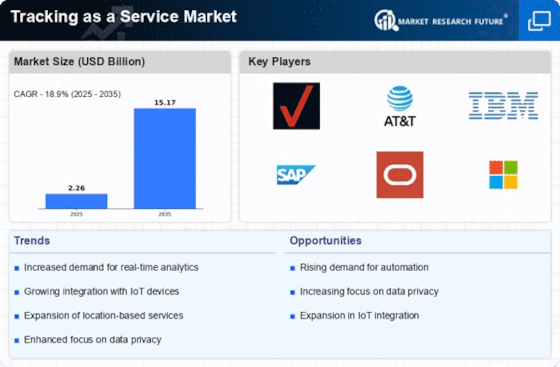
As per MRFR analysis, the Tracking as a Service Market Size was estimated at 2.259 USD Billion in 2024. The Tracking as a Service industry is projected to grow from 2.686 USD Billion in 2025 to 15.17 USD Billion by 2035, exhibiting a compound annual growth rate (CAGR) of 18.9 during the forecast period 2025 - 2035.

Key Market Trends & Highlights

The Tracking as a Service Market is experiencing robust growth driven by technological advancements and increasing demand for real-time data.

  • Cloud-based solutions are becoming increasingly prevalent, enhancing accessibility and scalability for businesses. The integration of advanced technologies, such as artificial intelligence, is transforming tracking capabilities across various sectors. North America remains the largest market, while the Asia-Pacific region is emerging as the fastest-growing area for tracking services. The rising demand for real-time data and the increased adoption of cloud technologies are key drivers propelling market expansion, particularly in the retail and e-commerce segments.

Market Size & Forecast

2024 Market Size 2.259 (USD Billion)
2035 Market Size 15.17 (USD Billion)
CAGR (2025 - 2035) 18.9%
Largest Regional Market Share in 2024 North America

Major Players

<p>Verizon (US), AT&amp;T (US), IBM (US), SAP (DE), Oracle (US), Microsoft (US), Cisco (US), Geotab (CA), Fleet Complete (CA)</p>

Market Trends

The Tracking as a Service Market is currently experiencing a notable evolution, driven by the increasing demand for real-time data and analytics across various sectors. Organizations are increasingly recognizing the value of tracking solutions to enhance operational efficiency, improve customer experiences, and optimize resource allocation. This market appears to be characterized by a growing emphasis on cloud-based solutions, which offer scalability and flexibility, allowing businesses to adapt to changing needs. Furthermore, the integration of advanced technologies such as artificial intelligence and machine learning is likely to enhance the capabilities of tracking services, providing deeper insights and predictive analytics. In addition, the rise of the Internet of Things (IoT) is influencing the Tracking as a Service Market, as more devices become interconnected, generating vast amounts of data that require effective tracking and management. This trend suggests a shift towards more comprehensive tracking solutions that can handle complex data streams. As organizations continue to prioritize data-driven decision-making, the demand for innovative tracking services is expected to grow, potentially leading to new market entrants and increased competition. Overall, the Tracking as a Service Market is poised for continued growth, driven by technological advancements and evolving customer needs.

Cloud-Based Solutions

The shift towards cloud-based tracking solutions is becoming increasingly prevalent, as organizations seek flexibility and scalability. These solutions allow businesses to access tracking services from anywhere, facilitating real-time data analysis and decision-making.

Integration of Advanced Technologies

The incorporation of artificial intelligence and machine learning into tracking services is enhancing their capabilities. This integration enables organizations to gain deeper insights, automate processes, and improve predictive analytics, thereby optimizing operational efficiency.

Impact of IoT

The proliferation of Internet of Things devices is significantly influencing the Tracking as a Service Market. As more devices connect and generate data, the need for comprehensive tracking solutions that can manage and analyze complex data streams is becoming essential.

Tracking as a Service Market Market Drivers

Rising Demand for Real-Time Data

The Tracking as a Service Market is experiencing a notable increase in demand for real-time data analytics. Businesses across various sectors are recognizing the value of immediate insights for decision-making processes. This trend is particularly evident in logistics and supply chain management, where timely tracking of assets can lead to enhanced operational efficiency. According to recent estimates, the market for real-time tracking solutions is projected to grow at a compound annual growth rate of approximately 20% over the next five years. This surge is driven by the need for businesses to optimize their operations and improve customer satisfaction through timely updates and transparency.

Integration of Artificial Intelligence

The Tracking as a Service Market is witnessing a transformative impact due to the integration of artificial intelligence (AI) technologies. AI enhances tracking solutions by enabling predictive analytics, anomaly detection, and automated reporting. This integration allows businesses to anticipate potential issues and optimize their tracking processes. As AI technologies continue to evolve, it is expected that the market for AI-driven tracking solutions will expand significantly, with projections indicating a growth rate of around 25% annually. This trend underscores the importance of leveraging advanced technologies to improve operational efficiency and reduce costs.

Increased Adoption of Cloud Technologies

The Tracking as a Service Market is significantly influenced by the widespread adoption of cloud technologies. Organizations are increasingly migrating their tracking solutions to cloud-based platforms, which offer scalability, flexibility, and cost-effectiveness. This transition allows businesses to access tracking data from anywhere, facilitating better collaboration and decision-making. As of 2025, it is estimated that over 60% of tracking solutions will be cloud-based, reflecting a shift towards more agile and responsive business models. The integration of cloud technologies not only enhances data accessibility but also supports the growing need for remote monitoring and management of assets.

Growing Regulatory Compliance Requirements

The Tracking as a Service Market is increasingly shaped by the need for compliance with regulatory standards. Various industries, including transportation and healthcare, are subject to stringent regulations that mandate accurate tracking and reporting of assets. This compliance requirement drives organizations to adopt tracking solutions that ensure adherence to legal standards. As regulations become more complex, the demand for reliable tracking services is expected to rise. By 2025, it is anticipated that compliance-related tracking solutions will account for a significant portion of the market, highlighting the critical role of regulatory frameworks in shaping industry dynamics.

Expansion of E-Commerce and Logistics Sectors

The Tracking as a Service Market is benefiting from the rapid expansion of e-commerce and logistics sectors. As online shopping continues to grow, the demand for efficient tracking solutions has surged. Consumers expect real-time updates on their orders, prompting businesses to invest in advanced tracking technologies. The logistics sector, in particular, is adopting tracking services to enhance supply chain visibility and improve delivery times. Recent data suggests that the e-commerce logistics market is projected to reach a valuation of over 500 billion by 2026, further driving the need for robust tracking solutions. This expansion presents significant opportunities for service providers in the tracking industry.

Market Segment Insights

Tracking as a Service Market Deployment Insights

<p>The Tracking as a Service Market segmentation, based on Deployment, includes On Cloud and On-premise. On cloud segment accounted for the largest revenue share in 2022. Due to the expanding privacy concerns across several industries, organisations are hesitant to put the solution into practise. A security gap might be made by attackers interfering with the tracking software.</p>

<p>Figure 2: Tracking as a Service Market, by Deployment, 2022 &amp; 2032 (USD Billion)</p>

<p>Deployment: Secondary Research, Primary Research, MRFR Database and Analyst Review</p>

Tracking as a Service Market End User Insights

<p>The Tracking as a Service Market segmentation, based on End User, includes Retail, Manufacturing, E-commerce, Transportation and Logistics, Healthcare, and Other End-user Industries. Transportation and logistics segment dominated the Tracking as a Service Market in 2022. Today's world depends heavily on transportation. To improve vehicle maintenance, the transportation and logistics sector has adopted<a href="https://www.marketresearchfuture.com/reports/track-trace-solution-market-9518"> tracking technologies.</a> A longer lifespan for cars is a result of improved maintenance. It may also help in preventing delays brought on by probable vehicle problems. Private companies like Uber, Lyft, and Roam that offer ride-sharing and car services have grown rapidly over the past few years.</p>

<p>Location data for tracking is a useful resource for these companies.</p>

Get more detailed insights about Tracking as a Service Market Statistics | Global Forecast - 2035

Regional Insights

North America : Market Leader in Innovation

North America is the largest market for Tracking as a Service Market, holding approximately 45% of the global market share. The region's growth is driven by increasing demand for real-time tracking solutions across various sectors, including logistics, healthcare, and automotive. Regulatory support for data privacy and security further catalyzes market expansion, ensuring compliance with standards such as GDPR and CCPA. The United States and Canada are the leading countries in this region, with major players like Verizon, AT&T, and IBM dominating the landscape. The competitive environment is characterized by continuous innovation and partnerships, enhancing service offerings. The presence of advanced technological infrastructure and a strong focus on IoT integration positions North America as a hub for Tracking as a Service Market solutions.

Europe : Emerging Market with Regulations

Europe is witnessing significant growth in the Tracking as a Service Market, accounting for approximately 30% of the global share. The region's expansion is fueled by stringent regulations on data protection and a rising demand for efficient logistics and fleet management solutions. Countries like Germany and the UK are at the forefront, leveraging regulatory frameworks to enhance service delivery and consumer trust. Germany, the UK, and France are the leading countries in this market, with key players such as SAP and Oracle establishing a strong presence. The competitive landscape is marked by collaborations between technology providers and regulatory bodies, ensuring compliance and innovation. The focus on sustainability and green logistics further propels the demand for tracking solutions in Europe.

Asia-Pacific : Rapid Growth and Adoption

Asia-Pacific is rapidly emerging as a significant player in the Tracking as a Service Market, holding around 20% of the global market share. The region's growth is driven by increasing urbanization, a booming e-commerce sector, and the rising adoption of IoT technologies. Countries like China and India are leading this trend, supported by favorable government initiatives and investments in digital infrastructure. China and India are the primary markets in this region, with a growing number of local and international players entering the space. The competitive landscape is evolving, with companies focusing on innovative solutions tailored to local needs. The presence of key players like Microsoft and Cisco further enhances the market dynamics, fostering a competitive environment that encourages technological advancements.

Middle East and Africa : Untapped Potential and Growth

The Middle East and Africa region is gradually emerging in the Tracking as a Service Market, currently holding about 5% of the global share. The growth is primarily driven by increasing investments in infrastructure and logistics, alongside a rising demand for efficient tracking solutions in various sectors. Countries like South Africa and the UAE are leading this growth, supported by government initiatives aimed at enhancing digital transformation. South Africa and the UAE are the key players in this region, with a growing number of startups and established companies entering the market. The competitive landscape is characterized by a mix of local and international players, focusing on innovative solutions to meet the unique challenges of the region. The presence of key players is gradually increasing, fostering a more competitive environment.

Key Players and Competitive Insights

Leading market players are investing heavily in research and development in order to expand their product lines, which will help the Tracking as a Service Market, grow even more. Market participants are also undertaking a variety of strategic activities to expand their global footprint, with important market developments including new product launches, contractual agreements, mergers and acquisitions, higher investments, and collaboration with other organizations. To expand and survive in a more competitive and rising market climate, Tracking as a Service industry must offer cost-effective items.

Manufacturing locally to minimize operational costs is one of the key business tactics used by manufacturers in the global Tracking as a Service industry to benefit clients and increase the market sector. In recent years, the Tracking as a Service industry has offered some of the most significant advantages to medicine. Major players in the Tracking as a Service Market, including Motorola Solutions, Wabco Holdings Inc., AT&T Inc., Zebra Technologies Corp., Verizon Communications, Geotab Inc., Blackline Safety Corp., Spider Tracks Limited, Honeywell International Inc., and Trimble Inc., are attempting to increase market demand by investing in research and development operations.

Housecall Pro is a mobile app developer that connects homeowners to back-end business operations. The company's platform, which specialises in business processes like project scheduling, technician dispatching, automatic receipts and invoicing, payment processing, customer databases, and custom marketing campaigns, allows clients to streamline their workflow and operations. In March 2022, Force by Mojio, the first fleet management system developed exclusively for small enterprises, was made available as a result of a collaboration between Mojio and Housecall Pro, the leading software platform for home service providers. The leading supplier of SaaS solutions as well as a connected mobility platform is Mojio.

The collaboration combines the all-in-one platform of Housecall Pro with the real-time telemetry data from Force by Mojio to make it simpler for home care providers to track their company vehicles, enhance operations, and modernise the customer experience.

Antares Vision SpA provides solutions for traceability and control systems. The group's commercial activities involve creating, producing, installing, and maintaining crucial systems for the most demanding clientele on the planet. The business offers products such as inspection systems, inspection machines, track-and-trace gadgets, and smart data management solutions. Its geographical divisions include Italy, Europe, North and South America, Asia, Oceania, Africa, and the Middle East. To provide a GS1-compliant traceability hub for the whole pharmaceutical supply chain in Lebanon, Rfxcel, a division of Antares Vision Group, and the Lebanese Ministry of Public Health inked a five-year partnership deal in September 2021.

Key Companies in the Tracking as a Service Market market include

Industry Developments

March 2022: The technology-enabled logistics and fulfilment platform Shiprocket reports the introduction of a new solution for seamless cross-border shipping to more than 220 nations, including the US, UK, Germany, and Australia. The company claims that unified tracking capabilities have enabled vendors to track all of their shipments, independent of the carrier they select, and to email and SMS their end customers with real-time tracking updates.

Future Outlook

Tracking as a Service Market Future Outlook

<p>The Tracking as a Service Market is projected to grow at 18.9% CAGR from 2024 to 2035, driven by advancements in IoT, demand for real-time data, and increased regulatory compliance.</p>

New opportunities lie in:

  • <p>Integration of AI-driven analytics for predictive tracking solutions.</p>
  • <p>Development of customizable tracking platforms for niche industries.</p>
  • <p>Expansion into emerging markets with tailored service offerings.</p>

<p>By 2035, the market is expected to be robust, driven by innovation and diverse applications.</p>

Market Segmentation

Tracking as a Service Market End User Outlook

  • Retail
  • Manufacturing
  • E-commerce
  • Transportation and Logistics
  • Healthcare
  • Other End-user Industries

Tracking as a Service Market Deployment Outlook

  • On Cloud
  • On-premise

Report Scope

MARKET SIZE 2024 2.259(USD Billion)
MARKET SIZE 2025 2.686(USD Billion)
MARKET SIZE 2035 15.17(USD Billion)
COMPOUND ANNUAL GROWTH RATE (CAGR) 18.9% (2024 - 2035)
REPORT COVERAGE Revenue Forecast, Competitive Landscape, Growth Factors, and Trends
BASE YEAR 2024
Market Forecast Period 2025 - 2035
Historical Data 2019 - 2024
Market Forecast Units USD Billion
Key Companies Profiled Market analysis in progress
Segments Covered Market segmentation analysis in progress
Key Market Opportunities Integration of advanced analytics and artificial intelligence in the Tracking as a Service Market.
Key Market Dynamics Rising demand for real-time data analytics drives innovation and competition in the Tracking as a Service Market.
Countries Covered North America, Europe, APAC, South America, MEA

FAQs

What is the current valuation of the Tracking as a Service Market?

The market valuation was 2.259 USD Billion in 2024.

What is the projected market size for the Tracking as a Service Market by 2035?

The projected valuation for 2035 is 15.17 USD Billion.

What is the expected CAGR for the Tracking as a Service Market from 2025 to 2035?

The expected CAGR during the forecast period 2025 - 2035 is 18.9%.

Which companies are considered key players in the Tracking as a Service Market?

Key players include Verizon, AT&amp;T, IBM, SAP, Oracle, Microsoft, Cisco, Geotab, and Fleet Complete.

How does the deployment segment of the market perform in terms of valuation?

The On Cloud deployment segment is projected to grow from 1.5 to 10.0 USD Billion, while On-premise is expected to rise from 0.759 to 5.17 USD Billion.

What are the main end-user industries for Tracking as a Service?

Main end-user industries include Retail, Manufacturing, E-commerce, Transportation and Logistics, Healthcare, and Other End-user Industries.

  1. SECTION I: EXECUTIVE SUMMARY AND KEY HIGHLIGHTS
    1. EXECUTIVE SUMMARY
      1. Market Overview
      2. Key Findings
      3. Market Segmentation
      4. Competitive Landscape
      5. Challenges and Opportunities
      6. Future Outlook 2
  2. SECTION II: SCOPING, METHODOLOGY AND MARKET STRUCTURE
    1. MARKET INTRODUCTION
      1. Definition
      2. Scope of the study
    2. RESEARCH METHODOLOGY
      1. Overview
      2. Data Mining
      3. Secondary Research
      4. Primary Research
      5. Forecasting Model
      6. Market Size Estimation
      7. Data Triangulation
      8. Validation 3
  3. SECTION III: QUALITATIVE ANALYSIS
    1. MARKET DYNAMICS
      1. Overview
      2. Drivers
      3. Restraints
      4. Opportunities
    2. MARKET FACTOR ANALYSIS
      1. Value chain Analysis
      2. Porter's Five Forces Analysis
      3. COVID-19 Impact Analysis
  4. SECTION IV: QUANTITATIVE ANALYSIS
    1. Information and Communications Technology, BY Deployment (USD Billion)
      1. On Cloud
      2. On-premise
    2. Information and Communications Technology, BY End User (USD Billion)
      1. Retail
      2. Manufacturing
      3. E-commerce
      4. Transportation and Logistics
      5. Healthcare
      6. Other End-user Industries
    3. Information and Communications Technology, BY Region (USD Billion)
      1. North America
      2. Europe
      3. APAC
      4. South America
      5. MEA
  5. SECTION V: COMPETITIVE ANALYSIS
    1. Competitive Landscape
      1. Overview
      2. Competitive Analysis
      3. Market share Analysis
      4. Major Growth Strategy in the Information and Communications Technology
      5. Competitive Benchmarking
      6. Leading Players in Terms of Number of Developments in the Information and Communications Technology
      7. Key developments and growth strategies
      8. Major Players Financial Matrix
    2. Company Profiles
      1. Verizon (US)
      2. AT&T (US)
      3. IBM (US)
      4. SAP (DE)
      5. Oracle (US)
      6. Microsoft (US)
      7. Cisco (US)
      8. Geotab (CA)
      9. Fleet Complete (CA)
    3. Appendix
      1. References
      2. Related Reports 6 LIST OF FIGURES
    4. MARKET SYNOPSIS
    5. NORTH AMERICA MARKET ANALYSIS
    6. US MARKET ANALYSIS BY DEPLOYMENT
    7. US MARKET ANALYSIS BY END USER
    8. CANADA MARKET ANALYSIS BY DEPLOYMENT
    9. CANADA MARKET ANALYSIS BY END USER
    10. EUROPE MARKET ANALYSIS
    11. GERMANY MARKET ANALYSIS BY DEPLOYMENT
    12. GERMANY MARKET ANALYSIS BY END USER
    13. UK MARKET ANALYSIS BY DEPLOYMENT
    14. UK MARKET ANALYSIS BY END USER
    15. FRANCE MARKET ANALYSIS BY DEPLOYMENT
    16. FRANCE MARKET ANALYSIS BY END USER
    17. RUSSIA MARKET ANALYSIS BY DEPLOYMENT
    18. RUSSIA MARKET ANALYSIS BY END USER
    19. ITALY MARKET ANALYSIS BY DEPLOYMENT
    20. ITALY MARKET ANALYSIS BY END USER
    21. SPAIN MARKET ANALYSIS BY DEPLOYMENT
    22. SPAIN MARKET ANALYSIS BY END USER
    23. REST OF EUROPE MARKET ANALYSIS BY DEPLOYMENT
    24. REST OF EUROPE MARKET ANALYSIS BY END USER
    25. APAC MARKET ANALYSIS
    26. CHINA MARKET ANALYSIS BY DEPLOYMENT
    27. CHINA MARKET ANALYSIS BY END USER
    28. INDIA MARKET ANALYSIS BY DEPLOYMENT
    29. INDIA MARKET ANALYSIS BY END USER
    30. JAPAN MARKET ANALYSIS BY DEPLOYMENT
    31. JAPAN MARKET ANALYSIS BY END USER
    32. SOUTH KOREA MARKET ANALYSIS BY DEPLOYMENT
    33. SOUTH KOREA MARKET ANALYSIS BY END USER
    34. MALAYSIA MARKET ANALYSIS BY DEPLOYMENT
    35. MALAYSIA MARKET ANALYSIS BY END USER
    36. THAILAND MARKET ANALYSIS BY DEPLOYMENT
    37. THAILAND MARKET ANALYSIS BY END USER
    38. INDONESIA MARKET ANALYSIS BY DEPLOYMENT
    39. INDONESIA MARKET ANALYSIS BY END USER
    40. REST OF APAC MARKET ANALYSIS BY DEPLOYMENT
    41. REST OF APAC MARKET ANALYSIS BY END USER
    42. SOUTH AMERICA MARKET ANALYSIS
    43. BRAZIL MARKET ANALYSIS BY DEPLOYMENT
    44. BRAZIL MARKET ANALYSIS BY END USER
    45. MEXICO MARKET ANALYSIS BY DEPLOYMENT
    46. MEXICO MARKET ANALYSIS BY END USER
    47. ARGENTINA MARKET ANALYSIS BY DEPLOYMENT
    48. ARGENTINA MARKET ANALYSIS BY END USER
    49. REST OF SOUTH AMERICA MARKET ANALYSIS BY DEPLOYMENT
    50. REST OF SOUTH AMERICA MARKET ANALYSIS BY END USER
    51. MEA MARKET ANALYSIS
    52. GCC COUNTRIES MARKET ANALYSIS BY DEPLOYMENT
    53. GCC COUNTRIES MARKET ANALYSIS BY END USER
    54. SOUTH AFRICA MARKET ANALYSIS BY DEPLOYMENT
    55. SOUTH AFRICA MARKET ANALYSIS BY END USER
    56. REST OF MEA MARKET ANALYSIS BY DEPLOYMENT
    57. REST OF MEA MARKET ANALYSIS BY END USER
    58. KEY BUYING CRITERIA OF INFORMATION AND COMMUNICATIONS TECHNOLOGY
    59. RESEARCH PROCESS OF MRFR
    60. DRO ANALYSIS OF INFORMATION AND COMMUNICATIONS TECHNOLOGY
    61. DRIVERS IMPACT ANALYSIS: INFORMATION AND COMMUNICATIONS TECHNOLOGY
    62. RESTRAINTS IMPACT ANALYSIS: INFORMATION AND COMMUNICATIONS TECHNOLOGY
    63. SUPPLY / VALUE CHAIN: INFORMATION AND COMMUNICATIONS TECHNOLOGY
    64. INFORMATION AND COMMUNICATIONS TECHNOLOGY, BY DEPLOYMENT, 2024 (% SHARE)
    65. INFORMATION AND COMMUNICATIONS TECHNOLOGY, BY DEPLOYMENT, 2024 TO 2035 (USD Billion)
    66. INFORMATION AND COMMUNICATIONS TECHNOLOGY, BY END USER, 2024 (% SHARE)
    67. INFORMATION AND COMMUNICATIONS TECHNOLOGY, BY END USER, 2024 TO 2035 (USD Billion)
    68. BENCHMARKING OF MAJOR COMPETITORS 7 LIST OF TABLES
    69. LIST OF ASSUMPTIONS
    70. North America MARKET SIZE ESTIMATES; FORECAST
      1. BY DEPLOYMENT, 2025-2035 (USD Billion)
      2. BY END USER, 2025-2035 (USD Billion)
    71. US MARKET SIZE ESTIMATES; FORECAST
      1. BY DEPLOYMENT, 2025-2035 (USD Billion)
      2. BY END USER, 2025-2035 (USD Billion)
    72. Canada MARKET SIZE ESTIMATES; FORECAST
      1. BY DEPLOYMENT, 2025-2035 (USD Billion)
      2. BY END USER, 2025-2035 (USD Billion)
    73. Europe MARKET SIZE ESTIMATES; FORECAST
      1. BY DEPLOYMENT, 2025-2035 (USD Billion)
      2. BY END USER, 2025-2035 (USD Billion)
    74. Germany MARKET SIZE ESTIMATES; FORECAST
      1. BY DEPLOYMENT, 2025-2035 (USD Billion)
      2. BY END USER, 2025-2035 (USD Billion)
    75. UK MARKET SIZE ESTIMATES; FORECAST
      1. BY DEPLOYMENT, 2025-2035 (USD Billion)
      2. BY END USER, 2025-2035 (USD Billion)
    76. France MARKET SIZE ESTIMATES; FORECAST
      1. BY DEPLOYMENT, 2025-2035 (USD Billion)
      2. BY END USER, 2025-2035 (USD Billion)
    77. Russia MARKET SIZE ESTIMATES; FORECAST
      1. BY DEPLOYMENT, 2025-2035 (USD Billion)
      2. BY END USER, 2025-2035 (USD Billion)
    78. Italy MARKET SIZE ESTIMATES; FORECAST
      1. BY DEPLOYMENT, 2025-2035 (USD Billion)
      2. BY END USER, 2025-2035 (USD Billion)
    79. Spain MARKET SIZE ESTIMATES; FORECAST
      1. BY DEPLOYMENT, 2025-2035 (USD Billion)
      2. BY END USER, 2025-2035 (USD Billion)
    80. Rest of Europe MARKET SIZE ESTIMATES; FORECAST
      1. BY DEPLOYMENT, 2025-2035 (USD Billion)
      2. BY END USER, 2025-2035 (USD Billion)
    81. APAC MARKET SIZE ESTIMATES; FORECAST
      1. BY DEPLOYMENT, 2025-2035 (USD Billion)
      2. BY END USER, 2025-2035 (USD Billion)
    82. China MARKET SIZE ESTIMATES; FORECAST
      1. BY DEPLOYMENT, 2025-2035 (USD Billion)
      2. BY END USER, 2025-2035 (USD Billion)
    83. India MARKET SIZE ESTIMATES; FORECAST
      1. BY DEPLOYMENT, 2025-2035 (USD Billion)
      2. BY END USER, 2025-2035 (USD Billion)
    84. Japan MARKET SIZE ESTIMATES; FORECAST
      1. BY DEPLOYMENT, 2025-2035 (USD Billion)
      2. BY END USER, 2025-2035 (USD Billion)
    85. South Korea MARKET SIZE ESTIMATES; FORECAST
      1. BY DEPLOYMENT, 2025-2035 (USD Billion)
      2. BY END USER, 2025-2035 (USD Billion)
    86. Malaysia MARKET SIZE ESTIMATES; FORECAST
      1. BY DEPLOYMENT, 2025-2035 (USD Billion)
      2. BY END USER, 2025-2035 (USD Billion)
    87. Thailand MARKET SIZE ESTIMATES; FORECAST
      1. BY DEPLOYMENT, 2025-2035 (USD Billion)
      2. BY END USER, 2025-2035 (USD Billion)
    88. Indonesia MARKET SIZE ESTIMATES; FORECAST
      1. BY DEPLOYMENT, 2025-2035 (USD Billion)
      2. BY END USER, 2025-2035 (USD Billion)
    89. Rest of APAC MARKET SIZE ESTIMATES; FORECAST
      1. BY DEPLOYMENT, 2025-2035 (USD Billion)
      2. BY END USER, 2025-2035 (USD Billion)
    90. South America MARKET SIZE ESTIMATES; FORECAST
      1. BY DEPLOYMENT, 2025-2035 (USD Billion)
      2. BY END USER, 2025-2035 (USD Billion)
    91. Brazil MARKET SIZE ESTIMATES; FORECAST
      1. BY DEPLOYMENT, 2025-2035 (USD Billion)
      2. BY END USER, 2025-2035 (USD Billion)
    92. Mexico MARKET SIZE ESTIMATES; FORECAST
      1. BY DEPLOYMENT, 2025-2035 (USD Billion)
      2. BY END USER, 2025-2035 (USD Billion)
    93. Argentina MARKET SIZE ESTIMATES; FORECAST
      1. BY DEPLOYMENT, 2025-2035 (USD Billion)
      2. BY END USER, 2025-2035 (USD Billion)
    94. Rest of South America MARKET SIZE ESTIMATES; FORECAST
      1. BY DEPLOYMENT, 2025-2035 (USD Billion)
      2. BY END USER, 2025-2035 (USD Billion)
    95. MEA MARKET SIZE ESTIMATES; FORECAST
      1. BY DEPLOYMENT, 2025-2035 (USD Billion)
      2. BY END USER, 2025-2035 (USD Billion)
    96. GCC Countries MARKET SIZE ESTIMATES; FORECAST
      1. BY DEPLOYMENT, 2025-2035 (USD Billion)
      2. BY END USER, 2025-2035 (USD Billion)
    97. South Africa MARKET SIZE ESTIMATES; FORECAST
      1. BY DEPLOYMENT, 2025-2035 (USD Billion)
      2. BY END USER, 2025-2035 (USD Billion)
    98. Rest of MEA MARKET SIZE ESTIMATES; FORECAST
      1. BY DEPLOYMENT, 2025-2035 (USD Billion)
      2. BY END USER, 2025-2035 (USD Billion)
    99. PRODUCT LAUNCH/PRODUCT DEVELOPMENT/APPROVAL
    100. ACQUISITION/PARTNERSHIP

Tracking as a Service Market Segmentation

Tracking as a Service Market Deployment Outlook (USD Billion, 2018-2032)

  • On Cloud
  • On-premise

Tracking as a Service Market End-user Outlook (USD Billion, 2018-2032)

  • Retail
  • Manufacturing
  • E-commerce
  • Transportation and Logistics
  • Healthcare
  • Other End-user Industries

Tracking as a Service Market Regional Outlook (USD Billion, 2018-2032)

  • North America Outlook (USD Billion, 2018-2032)

    • Tracking as a Service Market by Deployment
      • On Cloud
      • On-premise
    • Tracking as a Service Market by End-user
      • Retail
      • Manufacturing
      • E-commerce
      • Transportation and Logistics
      • Healthcare
      • Other End-user Industries
    • US Outlook (USD Billion, 2018-2032)

    • Tracking as a Service Market by Deployment
      • On Cloud
      • On-premise
    • Tracking as a Service Market by End-user
      • Retail
      • Manufacturing
      • E-commerce
      • Transportation and Logistics
      • Healthcare
      • Other End-user Industries
    • Canada Outlook (USD Billion, 2018-2032)

    • Tracking as a Service Market by Deployment
      • On Cloud
      • On-premise
    • Tracking as a Service Market by End-user
      • Retail
      • Manufacturing
      • E-commerce
      • Transportation and Logistics
      • Healthcare
      • Other End-user Industries
  • Europe Outlook (USD Billion, 2018-2032)

    • Tracking as a Service Market by Deployment
      • On Cloud
      • On-premise
    • Tracking as a Service Market by End-user
      • Retail
      • Manufacturing
      • E-commerce
      • Transportation and Logistics
      • Healthcare
      • Other End-user Industries
    • Germany Outlook (USD Billion, 2018-2032)

    • Tracking as a Service Market by Deployment
      • On Cloud
      • On-premise
    • Tracking as a Service Market by End-user
      • Retail
      • Manufacturing
      • E-commerce
      • Transportation and Logistics
      • Healthcare
      • Other End-user Industries
    • France Outlook (USD Billion, 2018-2032)

    • Tracking as a Service Market by Deployment
      • On Cloud
      • On-premise
    • Tracking as a Service Market by End-user
      • Retail
      • Manufacturing
      • E-commerce
      • Transportation and Logistics
      • Healthcare
      • Other End-user Industries
    • UK Outlook (USD Billion, 2018-2032)

    • Tracking as a Service Market by Deployment
      • On Cloud
      • On-premise
    • Tracking as a Service Market by End-user
      • Retail
      • Manufacturing
      • E-commerce
      • Transportation and Logistics
      • Healthcare
      • Other End-user Industries
    • Italy Outlook (USD Billion, 2018-2032)

    • Tracking as a Service Market by Deployment
      • On Cloud
      • On-premise
    • Tracking as a Service Market by End-user
      • Retail
      • Manufacturing
      • E-commerce
      • Transportation and Logistics
      • Healthcare
      • Other End-user Industries
    • Spain Outlook (USD Billion, 2018-2032)

    • Tracking as a Service Market by Deployment
      • On Cloud
      • On-premise
    • Tracking as a Service Market by End-user
      • Retail
      • Manufacturing
      • E-commerce
      • Transportation and Logistics
      • Healthcare
      • Other End-user Industries
    • Rest Of Europe Outlook (USD Billion, 2018-2032)

    • Tracking as a Service Market by Deployment
      • On Cloud
      • On-premise
    • Tracking as a Service Market by End-user
      • Retail
      • Manufacturing
      • E-commerce
      • Transportation and Logistics
      • Healthcare
      • Other End-user Industries
  • Asia-Pacific Outlook (USD Billion, 2018-2032)

    • Tracking as a Service Market by Deployment
      • On Cloud
      • On-premise
    • Tracking as a Service Market by End-user
      • Retail
      • Manufacturing
      • E-commerce
      • Transportation and Logistics
      • Healthcare
      • Other End-user Industries
    • China Outlook (USD Billion, 2018-2032)

    • Tracking as a Service Market by Deployment
      • On Cloud
      • On-premise
    • Tracking as a Service Market by End-user
      • Retail
      • Manufacturing
      • E-commerce
      • Transportation and Logistics
      • Healthcare
      • Other End-user Industries
    • Japan Outlook (USD Billion, 2018-2032)

    • Tracking as a Service Market by Deployment
      • On Cloud
      • On-premise
    • Tracking as a Service Market by End-user
      • Retail
      • Manufacturing
      • E-commerce
      • Transportation and Logistics
      • Healthcare
      • Other End-user Industries
    • India Outlook (USD Billion, 2018-2032)

    • Tracking as a Service Market by Deployment
      • On Cloud
      • On-premise
    • Tracking as a Service Market by End-user
      • Retail
      • Manufacturing
      • E-commerce
      • Transportation and Logistics
      • Healthcare
      • Other End-user Industries
    • Australia Outlook (USD Billion, 2018-2032)

    • Tracking as a Service Market by Deployment
      • On Cloud
      • On-premise
    • Tracking as a Service Market by End-user
      • Retail
      • Manufacturing
      • E-commerce
      • Transportation and Logistics
      • Healthcare
      • Other End-user Industries
    • Rest of Asia-Pacific Outlook (USD Billion, 2018-2032)

    • Tracking as a Service Market by Deployment
      • On Cloud
      • On-premise
    • Tracking as a Service Market by End-user
      • Retail
      • Manufacturing
      • E-commerce
      • Transportation and Logistics
      • Healthcare
      • Other End-user Industries
  • Rest of the World Outlook (USD Billion, 2018-2032)

    • Tracking as a Service Market by Deployment
      • On Cloud
      • On-premise
    • Tracking as a Service Market by End-user
      • Retail
      • Manufacturing
      • E-commerce
      • Transportation and Logistics
      • Healthcare
      • Other End-user Industries
    • Middle East Outlook (USD Billion, 2018-2032)

    • Tracking as a Service Market by Deployment
      • On Cloud
      • On-premise
    • Tracking as a Service Market by End-user
      • Retail
      • Manufacturing
      • E-commerce
      • Transportation and Logistics
      • Healthcare
      • Other End-user Industries
    • Africa Outlook (USD Billion, 2018-2032)

    • Tracking as a Service Market by Deployment
      • On Cloud
      • On-premise
    • Tracking as a Service Market by End-user
      • Retail
      • Manufacturing
      • E-commerce
      • Transportation and Logistics
      • Healthcare
      • Other End-user Industries
    • Latin America Outlook (USD Billion, 2018-2032)

    • Tracking as a Service Market by Deployment
      • On Cloud
      • On-premise
    • Tracking as a Service Market by End-user
      • Retail
      • Manufacturing
      • E-commerce
      • Transportation and Logistics
      • Healthcare
      • Other End-user Industries
Infographic

Free Sample Request

Kindly complete the form below to receive a free sample of this Report

Get Free Sample

Customer Strories

Compare Licence

×
Features License Type
Single User Multiuser License Enterprise User
Price $4,950 $5,950 $7,250
Maximum User Access Limit 1 User Upto 10 Users Unrestricted Access Throughout the Organization
Free Customization
Direct Access to Analyst
Deliverable Format
Platform Access
Discount on Next Purchase 10% 15% 15%
Printable Versions