
×
Request Free Sample ×

Kindly complete the form below to receive a free sample of this Report

* Please use a valid business email

Leading companies partner with us for data-driven Insights

clients tt-cursor
Hero Background
English
Chinese
French
Japanese
Korean
German
Spanish

Tortilla Market Trends

ID: MRFR/FnB/1789-CR
186 Pages
Varsha More
February 2021

Tortilla Market Size, Share, Industry Trend & Analysis Research Report Information By Type (Industrial, and Artisanal), by Processing Type (Fresh and Frozen), Product Type (Tortilla Mix, Pre-Cooked Tortilla, Tostadas, Tortilla Chips, Taco Shell, and Others), By Nature (Organic and Conventional), By Source (Corn and Wheat), By Category (Standard/Regular, and Gluten-Free), By Distribution Channel (B2B, and B2C), And By Region (North America, Europe, Asia-Pacific, South America, Middle East & Africa) - Forecast Till 2035

Share:
Download PDF ×

We do not share your information with anyone. However, we may send you emails based on your report interest from time to time. You may contact us at any time to opt-out.

Tortilla Market Infographic
Purchase Options

Market Trends

Key Emerging Trends in the Tortilla Market

The tortilla market is undergoing dynamic changes, reflecting shifting consumer preferences and a growing appetite for diverse and international cuisines. One prominent trend shaping this market is the increasing demand for healthier alternatives. The increasing awareness among the consumers due to health concerns has led to a visible trend toward whole-grain and multigrain tortillas as well as those made with alternative flours such as the almond, chickpea, and cassava flours. The focus on clean labels, free of artificial additives and preservatives, makes tortillas popular among consumers oriented on contemporary dietary trends.

The gluten free movement culture is slowly spreading in the tortilla market because of gluten sensitive consumer or those consumers who practice glutenfree diet. And there is an increase in the use of tortillas that are prepared from gluten-free grains such as corn, rice, and quinoa which is beneficial to celiac patients, or individuals intolerant to gluten. This is in line with the gluten-free movement advocated for by the food for sector the trend therefore is inclusive of the tortilla products.

The trend and convenience continue as a major driving force in the tortilla market; there is a growing demand for the ready-to-eat and easy-to-use types of products. The craze for wraps, burritos, and tacos for on-the-go meals is subsequently triggering manufacturers to launch tortillas in convenient models, inclusive of pre-minimize, pre-cooked, and individual wraps. Such a tendency corresponds to the ever-increasing fast-paced lifestyles aimed at convenient and flexible meal solutions.

An observed influence in the tortilla market is flavor innovation, specifically the development of tastes that are novel as well as strong. There are many flavors of tortilla you can find ranging from spicy jalapeño to savory garlic and herb flavored tortillas that have made various dishes present anecdotal idea. Furthermore, the change of color of tortillas through the integration of natural materials such as spinach, beet, and turmeric provides both visual aesthetic appeal as well as authentic color appeal targeting consumer’s requirements that looks bright and natural.

The sustainability revolution hence influences the tortilla market whereby consumers are now concerned with the environmental impact of their food options. As a result the demand for tortillas which are sourced and produced from sustainability and ethically is on the increase.

Digital platforms and social media have been gerenalizing the market trends of the tortilla market. Food influencers and bloggers showcase innovative recipes and creative uses of tortillas, influencing consumer preferences and driving experimentation in home kitchens. The visual appeal of tortilla-based dishes on social media platforms contributes to their popularity and encourages consumers to try new and exciting variations.

Author
Varsha More
Research Analyst

Experienced business professional with a demonstrated history of working in the CFnB industry. Skilled in market research, and market estimation. Strong professional with a Masters focused in marketing management.

Leave a Comment

FAQs

What is the current valuation of the Tortilla Market as of 2024?

<p>The overall market valuation of the Tortilla Market was 47189.5 USD Million in 2024.</p>

What is the projected market valuation for the Tortilla Market in 2035?

<p>The projected valuation for the Tortilla Market in 2035 is 75859.23 USD Million.</p>

What is the expected CAGR for the Tortilla Market during the forecast period 2025 - 2035?

<p>The expected CAGR for the Tortilla Market during the forecast period 2025 - 2035 is 4.41%.</p>

Who are the key players in the Tortilla Market?

<p>Key players in the Tortilla Market include Gruma, Mission Foods, Tortilla Land, Bimbo Bakeries USA, La Banderita, El Milagro, Tortilla Factory, and Casa Fiesta.</p>

What are the market segments for the Tortilla Market?

<p>The Tortilla Market segments include Type, Processing Type, Product Type, Nature, Source, Category, and Distribution Channel.</p>

What was the valuation of the Industrial and Artisanal segments in 2024?

<p>In 2024, the Industrial segment was valued at 28200.0 USD Million, while the Artisanal segment was valued at 18989.5 USD Million.</p>

How do the Fresh and Frozen processing types compare in terms of valuation?

<p>In 2024, the Fresh processing type was valued at 23500.0 USD Million, whereas the Frozen processing type was valued at 23689.5 USD Million.</p>

What are the projected valuations for different product types in the Tortilla Market?

<p>Projected valuations for product types include Pre-cooked tortilla at 15000.0 to 24000.0 USD Million and Tortilla chips at 12000.0 to 19000.0 USD Million.</p>

What is the valuation range for Organic and Conventional tortillas?

<p>The valuation range for Organic tortillas is 14147.85 to 23999.99 USD Million, while Conventional tortillas range from 33041.65 to 51859.24 USD Million.</p>

What are the expected valuations for B2B and B2C distribution channels?

<p>The expected valuations for B2B distribution channels range from 18856.5 to 30100.0 USD Million, while B2C channels range from 28333.0 to 45759.23 USD Million.</p>

Market Summary

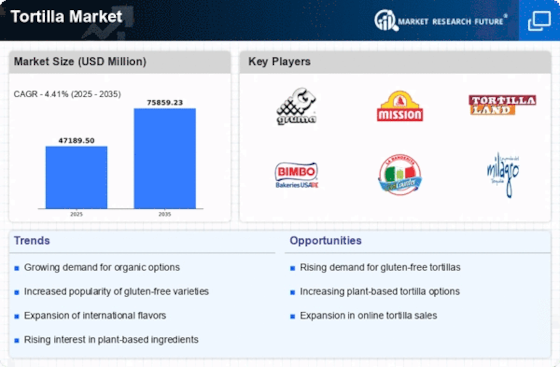
As per Market Research Future analysis, the Tortilla Market Size was estimated at 47189.5 USD Million in 2024. The Tortilla industry is projected to grow from USD 49270.56 Million in 2025 to USD 75859.23 Million by 2035, exhibiting a compound annual growth rate (CAGR) of 4.41% during the forecast period 2025 - 2035

Key Market Trends & Highlights

The Tortilla Market is experiencing a dynamic shift towards health-conscious and sustainable options, driven by diverse culinary influences.

  • Health-conscious choices are increasingly shaping consumer preferences in the North American Tortilla Market. Culinary diversity is fostering innovative flavors and formats, particularly in the Asia-Pacific region. The industrial segment remains the largest, while the artisanal segment is rapidly gaining traction due to rising consumer interest in authenticity. Convenience and on-the-go consumption are major drivers, alongside the growing demand for sustainable and innovative products.

Market Size & Forecast

2024 Market Size 47189.5 (USD Million)
2035 Market Size 75859.23 (USD Million)
CAGR (2025 - 2035) 4.41%
Largest Regional Market Share in 2024 North America

Major Players

Gruma (MX), Mission Foods (US), Tortilla Land (US), Bimbo Bakeries USA (US), La Banderita (US), El Milagro (US), Tortilla Factory (US), Casa Fiesta (US)

Market Trends

The Tortilla Market is currently experiencing a dynamic evolution, driven by shifting consumer preferences and an increasing demand for diverse culinary options. As health consciousness rises, many individuals are gravitating towards products that offer nutritional benefits, such as whole grain and gluten-free tortillas. This trend reflects a broader movement towards healthier eating habits, which appears to be influencing purchasing decisions across various demographics. Additionally, the growing popularity of international cuisines is propelling the demand for tortillas, as they are integral to numerous dishes beyond traditional Mexican fare. This expansion into new culinary territories suggests a promising future for the Tortilla Market, as it adapts to meet the tastes of a more globalized consumer base. Moreover, the Tortilla Market is witnessing a surge in innovation, with manufacturers exploring new flavors and ingredients to attract a wider audience. The introduction of organic and non-GMO options indicates a response to consumer desires for transparency and sustainability in food production. As the market continues to evolve, it is likely that companies will focus on enhancing product quality while also addressing environmental concerns. This dual approach may not only satisfy current consumer demands but also position the Tortilla Market favorably for future growth, as it aligns with broader trends in the food industry that prioritize health and sustainability.

Health-Conscious Choices

Consumers are increasingly opting for tortillas that offer health benefits, such as whole grain and gluten-free varieties. This trend reflects a broader shift towards nutritious eating, influencing purchasing behaviors.

Culinary Diversity

The Tortilla Market is expanding as consumers explore international cuisines. Tortillas are becoming essential in various dishes, indicating a growing acceptance and incorporation of diverse culinary practices.

Sustainability and Innovation

Manufacturers are responding to consumer demand for organic and non-GMO products. This focus on sustainability and quality is likely to shape future offerings in the Tortilla Market.

Tortilla Market Market Drivers

Culinary Diversity

Culinary diversity plays a pivotal role in shaping the Tortilla Market. As global cuisines become more accessible, consumers are increasingly experimenting with various types of tortillas, including corn, flour, and specialty varieties. The rise of ethnic restaurants and food trucks has further popularized diverse tortilla applications, from tacos to wraps. Market data indicates that the demand for specialty tortillas, such as those infused with herbs or spices, is on the rise, reflecting a broader trend towards unique flavor experiences. This culinary exploration suggests that the Tortilla Market could benefit from expanding its product lines to include innovative flavors and textures, appealing to adventurous eaters and food enthusiasts alike. The potential for growth in this segment may drive competition and encourage brands to differentiate themselves through unique offerings.

Health-Conscious Choices

The Tortilla Market is experiencing a notable shift towards health-conscious choices among consumers. As individuals increasingly prioritize nutrition, the demand for whole grain and gluten-free tortillas has surged. According to recent data, the market for gluten-free products is projected to grow at a compound annual growth rate of 9.5% over the next five years. This trend indicates that manufacturers are likely to innovate and diversify their product offerings to cater to health-oriented consumers. Additionally, the rise of plant-based diets has led to an increased interest in tortillas made from alternative ingredients such as chickpeas and lentils. This evolution in consumer preferences suggests that the Tortilla Market must adapt to meet the growing demand for healthier options, potentially reshaping the competitive landscape.

Sustainability and Innovation

Sustainability is becoming increasingly important within the Tortilla Market, as consumers express a preference for environmentally friendly products. The demand for organic and sustainably sourced ingredients is rising, prompting manufacturers to adopt eco-friendly practices in their production processes. Recent statistics indicate that the organic tortilla segment is expected to witness a growth rate of 7% annually, reflecting a shift towards more responsible consumption. Additionally, innovations in packaging, such as biodegradable materials, are gaining traction as brands seek to reduce their environmental footprint. This focus on sustainability not only aligns with consumer values but also presents an opportunity for the Tortilla Market to enhance brand loyalty and attract environmentally conscious consumers. As sustainability becomes a key differentiator, companies that prioritize eco-friendly practices may find themselves at a competitive advantage.

Cultural Influence and Globalization

Cultural influence and globalization are significantly impacting the Tortilla Market. As cultures blend and culinary traditions intermingle, the popularity of tortillas is expanding beyond traditional boundaries. The increasing availability of international cuisines in various regions has led to a heightened interest in tortillas as versatile food items. Market analysis indicates that the demand for tortillas in non-traditional markets is growing, driven by the rising popularity of Mexican and Latin American cuisines. This cultural exchange suggests that the Tortilla Market may experience growth opportunities in regions where tortillas were previously less common. As consumers become more adventurous in their food choices, the potential for market expansion appears promising, encouraging brands to explore new markets and adapt their offerings to local tastes.

Convenience and On-the-Go Consumption

The fast-paced lifestyle of modern consumers is driving the Tortilla Market towards convenience and on-the-go consumption. With an increasing number of individuals seeking quick meal solutions, ready-to-eat tortilla products are gaining popularity. Data suggests that the demand for pre-packaged tortilla wraps and snack options is on the rise, as consumers look for convenient meal alternatives that fit their busy schedules. This trend indicates that manufacturers may need to focus on developing portable and easy-to-prepare tortilla products, catering to the needs of time-strapped individuals. Furthermore, the growth of e-commerce platforms has made it easier for consumers to access a variety of tortilla products, enhancing convenience. As the Tortilla Market adapts to these changing consumer behaviors, the emphasis on convenience could lead to new product innovations and marketing strategies.

Market Segment Insights

By Type: Industrial (Largest) vs. Artisanal (Fastest-Growing)

<p>The Tortilla Market showcases a diverse range of products with distinct profiles, where the Industrial segment takes the lead in market share. This sector is characterized by high-volume production and efficiency, satisfying the demand of large retailers and food service providers. On the other hand, the Artisanal segment, while smaller, is experiencing significant growth as consumers increasingly seek authentic and handmade options that cater to niche markets and premium dining experiences.</p>

<p>Tortilla Type: Industrial (Dominant) vs. Artisanal (Emerging)</p>

<p>The Industrial tortilla segment is driven by its ability to produce large quantities at lower costs, making it the go-to choice for mass distribution and food service industries. These tortillas are typically made from traditional ingredients but undergo automated production processes to enhance consistency and shelf life. Conversely, the Artisanal segment is carving out its niche through premium quality and unique flavors. These tortillas are often made with organic or locally sourced ingredients, appealing to health-conscious consumers and gourmet establishments. The growing popularity of Ethnic cuisine and artisan food trends is propelling the Artisanal segment into the spotlight, signaling a shift in consumer preferences towards quality over quantity.</p>

By Processing Type: Fresh (Largest) vs. Frozen (Fastest-Growing)

<p>In the Tortilla Market, the processing type segment showcases a dynamic distribution of market share between Fresh and Frozen tortillas. Fresh tortillas dominate the market with a significant share, appreciated for their taste and quality. In contrast, Frozen tortillas are gaining traction among consumers seeking convenience and longer shelf life, marking a noticeable shift in preferences as consumers adapt to busy lifestyles.</p>

<p>Processing Type: Fresh (Dominant) vs. Frozen (Emerging)</p>

<p>Fresh tortillas are characterized by their bakery-style freshness, engaging consumers with their superior taste and texture. Traditionally, they represent the dominant segment in the Tortilla Market due to their widespread availability in local and specialty stores. On the other hand, the Frozen segment is emerging rapidly, appealing to a demographic prioritizing convenience and product accessibility. As consumers become more health-conscious and seek ready-to-prepare meal options, Frozen tortillas offer the desirable balance of long shelf life and minimal preparation time, positioning them as a significant player in the evolving Tortilla Market.</p>

By Product Type: Tortilla Chips (Largest) vs. Pre-cooked Tortilla (Fastest-Growing)

<p>In the Tortilla Market, the product type landscape is characterized by diverse offerings including tortilla mix, pre-cooked tortillas, tostadas, tortilla chips, taco shells, and others. Tortilla chips currently hold the largest market share, appealing to consumers due to their versatility and popularity as a snack. Meanwhile, pre-cooked tortillas are rapidly gaining traction, reflecting changing consumer preferences for convenience and ready-to-use products that enhance meal preparation and elevate culinary experiences.</p>

<p>Tortilla Chips (Dominant) vs. Pre-cooked Tortilla (Emerging)</p>

<p>Tortilla chips are a dominant segment in the Tortilla Market, renowned for their crispy texture and snack appeal. They cater to a wide audience, served with dips or as ingredients in various recipes, enhancing their market presence. On the other hand, pre-cooked tortillas are emerging as a significant contender, driven by their ease of use in preparing meals quickly and efficiently. Their convenience appeals to modern consumers who seek quick solutions without compromising on quality. As such, pre-cooked tortillas are not only gaining popularity but are also influencing product innovation, creating opportunities for growth and diversification within the segment.</p>

By Nature: Organic (Largest) vs. Conventional (Fastest-Growing)

<p>In the Tortilla Market, the Organic segment holds a significant market share due to the increasing consumer preference for healthier, natural food options. Organic tortillas are perceived as more nutritious and environmentally friendly, which resonates well with health-conscious consumers. Conversely, the Conventional segment, while traditionally dominant, is witnessing competitive pressure as more consumers shift towards organic products. Nonetheless, it maintains a robust share driven by its lower price point and widespread availability in various retail outlets.</p>

<p>Tortilla Market: Organic (Dominant) vs. Conventional (Emerging)</p>

<p>The Organic tortilla segment is characterized by its focus on natural ingredients, appealing to a health-oriented demographic. These products are free from synthetic pesticides and additives, attracting consumers who prioritize sustainability in their food choices. On the other hand, the Conventional segment is experiencing rapid growth as manufacturers innovate to enhance product quality while retaining affordability. This segment benefits from established supply chains and a broader distribution network, making it highly accessible. As awareness of food quality and sourcing increases, both segments are likely to see fluctuating preferences, with Organic maintaining dominance due to ongoing trends in health and wellness.</p>

By Source: Corn (Largest) vs. Wheat (Emerging)

<p>In the tortilla market, the source segment is primarily divided into two key categories: corn and wheat. Corn tortillas hold the largest share due to their traditional significance and widespread popularity, particularly in regions with a strong Hispanic influence. In contrast, wheat tortillas have been gaining traction, appealing to consumers seeking alternative options and varying taste profiles. The shift towards whole-grain and gluten-free diets has also influenced market dynamics, creating a niche for wheat tortillas that cater to health-conscious consumers.</p>

<p>Tortilla Source: Corn (Dominant) vs. Wheat (Emerging)</p>

<p>Corn tortillas are deeply ingrained in culinary traditions across Latin America and the United States, making them the dominant source in the tortilla market. Their structural properties, taste, and versatility allow them to adapt to many dishes, enhancing their market appeal. On the other hand, wheat tortillas are viewed as an emerging choice, capturing the interest of consumers looking for novel flavors and textures. Their softer, more pliable nature and adaptability in various cuisines position them as a competitive alternative, particularly among younger demographics and health-conscious buyers.</p>

By Category: Standard/Regular (Largest) vs. Gluten-Free (Fastest-Growing)

<p>In the Tortilla Market, the category segment is primarily dominated by the Standard/Regular tortillas, which have captured the largest share of the market. This segment is characterized by traditional recipes and widespread consumer acceptance, making it a staple in various cuisines. In contrast, Gluten-Free tortillas are gaining traction, appealing to health-conscious consumers and those with dietary restrictions. As a result, the market for Gluten-Free options is rapidly expanding, although its share still lags behind that of Standard/Regular tortillas.</p>

<p>Tortillas: Standard/Regular (Dominant) vs. Gluten-Free (Emerging)</p>

<p>Standard/Regular tortillas remain the dominant player in the Tortilla Market due to their established presence and strong consumer preference. They are made from traditional ingredients such as wheat flour and are available in various sizes and flavors, catering to a broad audience. On the other hand, Gluten-Free tortillas are emerging rapidly, driven by the increasing awareness of gluten intolerance and a growing desire for healthier alternatives. While still a smaller segment compared to Standard tortillas, the innovation in ingredient sourcing and production methods has enabled Gluten-Free options to gain popularity quickly, particularly among millennials and health-conscious buyers seeking diverse dietary options.</p>

By Distribution Channel: B2B (Largest) vs. B2C (Fastest-Growing)

<p>In the Tortilla Market, the distribution channel is primarily dominated by B2B sales, accounting for a significant share of market transactions. Businesses such as restaurants, catering services, and food retailers rely on bulk purchases to meet their tortilla supply needs. This channel's stable demand plays a crucial role in shaping production strategies and overall market dynamics. Conversely, B2C channels are emerging as a rapidly growing segment. With consumers increasingly gravitating towards ready-to-eat meals and snacks, the demand for tortillas in retail settings is witnessing notable acceleration. The shift in consumer preferences towards convenience foods greatly influences this trend, positioning B2C as a key player in the evolving tortilla landscape.</p>

<p>B2B (Dominant) vs. B2C (Emerging)</p>

<p>The B2B distribution channel in the Tortilla Market remains dominant, as it serves a wide range of commercial entities including restaurants, grocery stores, and food distribution companies. This channel benefits from bulk purchasing and long-term contracts, ensuring consistent supply and demand dynamics. In contrast, B2C is emerging rapidly as individual consumers increasingly seek out tortillas for home cooking and snacking. The rise of health-conscious trends and the popularity of Mexican cuisine have boosted consumer interest, leading retail outlets to expand their offerings. B2C's agility and responsiveness to market trends and consumer preferences reflect its potential for significant growth, making it a focal point for future market strategies.</p>

Tortilla Market Distribution Channel Insights

Based on Distribution Channel, the Tortilla Market has been segmented into B2B, and B2C. The B2B segment accounted for the market share of 50.67% in 2023 and is likely to register a CAGR of 4.06% during the projected period. The B2B mode of distribution in the tortilla industry is a critical segment that significantly impacts the overall supply chain and market dynamics. This distribution channel involves the sale of tortillas from manufacturers to other businesses, such as restaurants, hotels, <a href="https://www.marketresearchfuture.com/reports/catering-services-market-23311">catering services</a>, and food retailers, which then resell or use the tortillas in their offerings.

This mode is essential for ensuring a consistent and large-scale supply of tortillas to various points of consumption. The primary advantage of the B2B distribution channel is its ability to handle bulk orders efficiently, ensuring that large quantities of tortillas are delivered timely and with minimal logistical disruptions.

Get more detailed insights about Tortilla Market Research Report - Forecast till 2035

Regional Insights

North America : Market Leader in Tortillas

North America is the largest market for tortillas, accounting for approximately 60% of the global share. The region's growth is driven by increasing consumer demand for convenient and healthy food options, alongside a rising Hispanic population that favors traditional tortilla products. Regulatory support for food safety and quality standards further catalyzes market expansion, ensuring product integrity and consumer trust. The United States is the primary contributor to this market, with key players like Mission Foods and Gruma leading the competitive landscape. The presence of established brands and a growing trend towards organic and gluten-free tortillas are shaping the market dynamics. Additionally, innovations in packaging and distribution are enhancing accessibility, making tortillas a staple in various culinary applications.

Europe : Emerging Market Potential

Europe is witnessing a significant rise in tortilla consumption, driven by the increasing popularity of Mexican cuisine and the growing trend of international flavors. The market is projected to grow steadily, with countries like the UK and Germany leading the charge, holding approximately 25% and 15% of the market share, respectively. Regulatory frameworks promoting food diversity and quality are also contributing to this growth, encouraging manufacturers to innovate and expand their product lines. The competitive landscape in Europe features both local and international players, with brands like Old El Paso and Mission Foods making notable impacts. The presence of artisanal producers is also on the rise, catering to niche markets focused on organic and specialty tortillas. This diversification is enhancing consumer choice and driving market growth, as more consumers seek authentic and high-quality tortilla options.

Asia-Pacific : Emerging Market Dynamics

Asia-Pacific is emerging as a promising market for tortillas, driven by urbanization and changing dietary habits. The region is experiencing a shift towards convenience foods, with tortillas gaining popularity as a versatile meal option. Countries like Australia and Japan are leading this trend, holding approximately 20% and 10% of the market share, respectively. Regulatory initiatives aimed at enhancing food safety and quality are also fostering a conducive environment for market growth. The competitive landscape is characterized by a mix of local and international brands, with companies like Mission Foods and local manufacturers vying for market share. The increasing availability of tortillas in supermarkets and online platforms is enhancing consumer access, while innovative flavors and product variations are attracting a broader audience. This growth trajectory indicates a bright future for the tortilla market in the region.

Middle East and Africa : Untapped Market Opportunities

The Middle East and Africa region presents untapped opportunities for the tortilla market, driven by a growing interest in diverse cuisines and convenience foods. The tortilla chips market size is still in its nascent stages, with countries like South Africa and the UAE showing promising growth, holding approximately 10% and 5% of the market share, respectively. Regulatory frameworks are gradually evolving to support food safety and quality, which is essential for attracting both local and international players to the market. The competitive landscape is relatively fragmented, with a mix of local producers and international brands beginning to establish a foothold. The increasing availability of tortillas in retail outlets and the rise of food delivery services are enhancing consumer access. As awareness of tortilla-based products grows, the market is expected to expand, driven by innovation and consumer demand for convenient meal solutions.

Key Players and Competitive Insights

The Tortilla Market is characterized by a dynamic competitive landscape, driven by increasing consumer demand for diverse and convenient food options. Key players such as Gruma (Mexico), Mission Foods (US), and Bimbo Bakeries USA (US) are at the forefront, each employing distinct strategies to enhance their market presence. Gruma (Mexico), for instance, focuses on innovation in product development, particularly in gluten-free and organic tortillas, which aligns with the growing health-conscious consumer trend. Mission Foods (US) emphasizes regional expansion and has recently increased its production capacity to meet rising demand in North America. Bimbo Bakeries USA (US) leverages its extensive distribution network to ensure product availability, while also investing in sustainable practices to appeal to environmentally aware consumers. Collectively, these strategies contribute to a competitive environment that is increasingly focused on product differentiation and sustainability.
In terms of business tactics, companies are localizing manufacturing to reduce supply chain vulnerabilities and optimize logistics. The Tortilla Market appears moderately fragmented, with several regional players complementing the strategies of larger corporations. This fragmentation allows for niche market opportunities, particularly in specialty tortillas that cater to specific dietary preferences. The collective influence of these key players shapes a competitive structure where innovation and operational efficiency are paramount.
In August 2025, Gruma (Mexico) announced the launch of a new line of organic tortillas, which is expected to cater to the rising demand for healthier food options. This strategic move not only reinforces Gruma's commitment to health and wellness but also positions the company to capture a larger share of the market that is increasingly gravitating towards organic products. The introduction of these tortillas could potentially enhance brand loyalty among health-conscious consumers.
In September 2025, Mission Foods (US) unveiled a state-of-the-art production facility in Texas, aimed at increasing its output of traditional and specialty tortillas. This investment signifies Mission Foods' intent to solidify its market leadership by ensuring that it can meet the growing consumer demand efficiently. The facility is expected to incorporate advanced manufacturing technologies, which may lead to improved product quality and reduced production costs.
In July 2025, Bimbo Bakeries USA (US) entered into a partnership with a leading sustainability organization to enhance its environmental practices. This collaboration aims to reduce the carbon footprint of its tortilla production processes. By aligning with sustainability goals, Bimbo Bakeries USA not only addresses consumer preferences for eco-friendly products but also positions itself as a responsible corporate entity in a competitive market.
As of October 2025, the Tortilla Market is witnessing trends that emphasize digitalization, sustainability, and the integration of artificial intelligence in production processes. Strategic alliances are increasingly shaping the competitive landscape, allowing companies to pool resources and expertise. Looking ahead, it is likely that competitive differentiation will evolve from traditional price-based strategies to a focus on innovation, technological advancements, and supply chain reliability. This shift may redefine how companies engage with consumers, ultimately fostering a more resilient and responsive market.

Key Companies in the Tortilla Market include

Industry Developments

February 2024: The Company has announced a new partnership with Paniflower and Bat Agrar to significantly reduce the climate impact of the wheat used in its tortillas by 35%.

October 2023: Paulig has launched a new line of Santa Maria tortillas with up to 50% lower climate impact compared to their standard tortillas.

Future Outlook

Tortilla Market Future Outlook

The Tortilla Market is projected to grow at a 4.41% CAGR from 2025 to 2035, driven by increasing demand for convenience foods and health-conscious options.

New opportunities lie in:

  • Expansion of gluten-free tortilla lines to capture health-focused consumers.
  • Development of ready-to-eat tortilla meal kits for busy lifestyles.
  • Investment in sustainable packaging solutions to enhance brand appeal.

By 2035, the Tortilla Market is expected to solidify its position as a key player in the global food industry.

Market Segmentation

Tortilla Market Type Outlook

  • Industrial
  • Artisanal

Tortilla Market Nature Outlook

  • Organic
  • Conventional

Tortilla Market Source Outlook

  • Corn
  • Wheat

Tortilla Market Category Outlook

  • Standard/regular
  • Gluten-free

Tortilla Market Product Type Outlook

  • Tortilla mix
  • Pre-cooked tortilla
  • Tostadas
  • Tortilla chips
  • Taco shell
  • Others

Tortilla Market Processing Type Outlook

  • Fresh
  • Frozen

Tortilla Market Distribution Channel Outlook

  • B2B
  • B2C

Report Scope

MARKET SIZE 2024 47189.5(USD Million)
MARKET SIZE 2025 49270.56(USD Million)
MARKET SIZE 2035 75859.23(USD Million)
COMPOUND ANNUAL GROWTH RATE (CAGR) 4.41% (2025 - 2035)
REPORT COVERAGE Revenue Forecast, Competitive Landscape, Growth Factors, and Trends
BASE YEAR 2024
Market Forecast Period 2025 - 2035
Historical Data 2019 - 2024
Market Forecast Units USD Million
Key Companies Profiled Gruma (MX), Mission Foods (US), Tortilla Land (US), Bimbo Bakeries USA (US), La Banderita (US), El Milagro (US), Tortilla Factory (US), Casa Fiesta (US)
Segments Covered Type, Processing Type, Nature, Source, Category, Distribution Channel, Region
Key Market Opportunities Growing demand for gluten-free and organic tortillas presents new opportunities in the Tortilla Market.
Key Market Dynamics Rising consumer demand for healthier options drives innovation and competition in the tortilla market.
Countries Covered North America, Europe, APAC, South America, MEA

FAQs

What is the current valuation of the Tortilla Market as of 2024?

<p>The overall market valuation of the Tortilla Market was 47189.5 USD Million in 2024.</p>

What is the projected market valuation for the Tortilla Market in 2035?

<p>The projected valuation for the Tortilla Market in 2035 is 75859.23 USD Million.</p>

What is the expected CAGR for the Tortilla Market during the forecast period 2025 - 2035?

<p>The expected CAGR for the Tortilla Market during the forecast period 2025 - 2035 is 4.41%.</p>

Who are the key players in the Tortilla Market?

<p>Key players in the Tortilla Market include Gruma, Mission Foods, Tortilla Land, Bimbo Bakeries USA, La Banderita, El Milagro, Tortilla Factory, and Casa Fiesta.</p>

What are the market segments for the Tortilla Market?

<p>The Tortilla Market segments include Type, Processing Type, Product Type, Nature, Source, Category, and Distribution Channel.</p>

What was the valuation of the Industrial and Artisanal segments in 2024?

<p>In 2024, the Industrial segment was valued at 28200.0 USD Million, while the Artisanal segment was valued at 18989.5 USD Million.</p>

How do the Fresh and Frozen processing types compare in terms of valuation?

<p>In 2024, the Fresh processing type was valued at 23500.0 USD Million, whereas the Frozen processing type was valued at 23689.5 USD Million.</p>

What are the projected valuations for different product types in the Tortilla Market?

<p>Projected valuations for product types include Pre-cooked tortilla at 15000.0 to 24000.0 USD Million and Tortilla chips at 12000.0 to 19000.0 USD Million.</p>

What is the valuation range for Organic and Conventional tortillas?

<p>The valuation range for Organic tortillas is 14147.85 to 23999.99 USD Million, while Conventional tortillas range from 33041.65 to 51859.24 USD Million.</p>

What are the expected valuations for B2B and B2C distribution channels?

<p>The expected valuations for B2B distribution channels range from 18856.5 to 30100.0 USD Million, while B2C channels range from 28333.0 to 45759.23 USD Million.</p>

  1. SECTION I: EXECUTIVE SUMMARY AND KEY HIGHLIGHTS
    1. | 1.1 EXECUTIVE SUMMARY
    2. | | 1.1.1 Market Overview
    3. | | 1.1.2 Key Findings
    4. | | 1.1.3 Market Segmentation
    5. | | 1.1.4 Competitive Landscape
    6. | | 1.1.5 Challenges and Opportunities
    7. | | 1.1.6 Future Outlook
  2. SECTION II: SCOPING, METHODOLOGY AND MARKET STRUCTURE
    1. | 2.1 MARKET INTRODUCTION
    2. | | 2.1.1 Definition
    3. | | 2.1.2 Scope of the study
    4. | | | 2.1.2.1 Research Objective
    5. | | | 2.1.2.2 Assumption
    6. | | | 2.1.2.3 Limitations
    7. | 2.2 RESEARCH METHODOLOGY
    8. | | 2.2.1 Overview
    9. | | 2.2.2 Data Mining
    10. | | 2.2.3 Secondary Research
    11. | | 2.2.4 Primary Research
    12. | | | 2.2.4.1 Primary Interviews and Information Gathering Process
    13. | | | 2.2.4.2 Breakdown of Primary Respondents
    14. | | 2.2.5 Forecasting Model
    15. | | 2.2.6 Market Size Estimation
    16. | | | 2.2.6.1 Bottom-Up Approach
    17. | | | 2.2.6.2 Top-Down Approach
    18. | | 2.2.7 Data Triangulation
    19. | | 2.2.8 Validation
  3. SECTION III: QUALITATIVE ANALYSIS
    1. | 3.1 MARKET DYNAMICS
    2. | | 3.1.1 Overview
    3. | | 3.1.2 Drivers
    4. | | 3.1.3 Restraints
    5. | | 3.1.4 Opportunities
    6. | 3.2 MARKET FACTOR ANALYSIS
    7. | | 3.2.1 Value chain Analysis
    8. | | 3.2.2 Porter's Five Forces Analysis
    9. | | | 3.2.2.1 Bargaining Power of Suppliers
    10. | | | 3.2.2.2 Bargaining Power of Buyers
    11. | | | 3.2.2.3 Threat of New Entrants
    12. | | | 3.2.2.4 Threat of Substitutes
    13. | | | 3.2.2.5 Intensity of Rivalry
    14. | | 3.2.3 COVID-19 Impact Analysis
    15. | | | 3.2.3.1 Market Impact Analysis
    16. | | | 3.2.3.2 Regional Impact
    17. | | | 3.2.3.3 Opportunity and Threat Analysis
  4. SECTION IV: QUANTITATIVE ANALYSIS
    1. | 4.1 Food, Beverages & Nutrition, BY Type (USD Million)
    2. | | 4.1.1 Industrial
    3. | | 4.1.2 Artisanal
    4. | 4.2 Food, Beverages & Nutrition, BY Processing Type (USD Million)
    5. | | 4.2.1 Fresh
    6. | | 4.2.2 Frozen
    7. | 4.3 Food, Beverages & Nutrition, BY Product Type (USD Million)
    8. | | 4.3.1 Tortilla mix
    9. | | 4.3.2 Pre-cooked tortilla
    10. | | 4.3.3 Tostadas
    11. | | 4.3.4 Tortilla chips
    12. | | 4.3.5 Taco shell
    13. | | 4.3.6 Others
    14. | 4.4 Food, Beverages & Nutrition, BY Nature (USD Million)
    15. | | 4.4.1 Organic
    16. | | 4.4.2 Conventional
    17. | 4.5 Food, Beverages & Nutrition, BY Source (USD Million)
    18. | | 4.5.1 Corn
    19. | | 4.5.2 Wheat
    20. | 4.6 Food, Beverages & Nutrition, BY Category (USD Million)
    21. | | 4.6.1 Standard/regular
    22. | | 4.6.2 Gluten-free
    23. | 4.7 Food, Beverages & Nutrition, BY Distribution Channel (USD Million)
    24. | | 4.7.1 B2B
    25. | | 4.7.2 B2C
    26. | 4.8 Food, Beverages & Nutrition, BY Region (USD Million)
    27. | | 4.8.1 North America
    28. | | | 4.8.1.1 US
    29. | | | 4.8.1.2 Canada
    30. | | 4.8.2 Europe
    31. | | | 4.8.2.1 Germany
    32. | | | 4.8.2.2 UK
    33. | | | 4.8.2.3 France
    34. | | | 4.8.2.4 Russia
    35. | | | 4.8.2.5 Italy
    36. | | | 4.8.2.6 Spain
    37. | | | 4.8.2.7 Rest of Europe
    38. | | 4.8.3 APAC
    39. | | | 4.8.3.1 China
    40. | | | 4.8.3.2 India
    41. | | | 4.8.3.3 Japan
    42. | | | 4.8.3.4 South Korea
    43. | | | 4.8.3.5 Malaysia
    44. | | | 4.8.3.6 Thailand
    45. | | | 4.8.3.7 Indonesia
    46. | | | 4.8.3.8 Rest of APAC
    47. | | 4.8.4 South America
    48. | | | 4.8.4.1 Brazil
    49. | | | 4.8.4.2 Mexico
    50. | | | 4.8.4.3 Argentina
    51. | | | 4.8.4.4 Rest of South America
    52. | | 4.8.5 MEA
    53. | | | 4.8.5.1 GCC Countries
    54. | | | 4.8.5.2 South Africa
    55. | | | 4.8.5.3 Rest of MEA
  5. SECTION V: COMPETITIVE ANALYSIS
    1. | 5.1 Competitive Landscape
    2. | | 5.1.1 Overview
    3. | | 5.1.2 Competitive Analysis
    4. | | 5.1.3 Market share Analysis
    5. | | 5.1.4 Major Growth Strategy in the Food, Beverages & Nutrition
    6. | | 5.1.5 Competitive Benchmarking
    7. | | 5.1.6 Leading Players in Terms of Number of Developments in the Food, Beverages & Nutrition
    8. | | 5.1.7 Key developments and growth strategies
    9. | | | 5.1.7.1 New Product Launch/Service Deployment
    10. | | | 5.1.7.2 Merger & Acquisitions
    11. | | | 5.1.7.3 Joint Ventures
    12. | | 5.1.8 Major Players Financial Matrix
    13. | | | 5.1.8.1 Sales and Operating Income
    14. | | | 5.1.8.2 Major Players R&D Expenditure. 2023
    15. | 5.2 Company Profiles
    16. | | 5.2.1 Gruma (MX)
    17. | | | 5.2.1.1 Financial Overview
    18. | | | 5.2.1.2 Products Offered
    19. | | | 5.2.1.3 Key Developments
    20. | | | 5.2.1.4 SWOT Analysis
    21. | | | 5.2.1.5 Key Strategies
    22. | | 5.2.2 Mission Foods (US)
    23. | | | 5.2.2.1 Financial Overview
    24. | | | 5.2.2.2 Products Offered
    25. | | | 5.2.2.3 Key Developments
    26. | | | 5.2.2.4 SWOT Analysis
    27. | | | 5.2.2.5 Key Strategies
    28. | | 5.2.3 Tortilla Land (US)
    29. | | | 5.2.3.1 Financial Overview
    30. | | | 5.2.3.2 Products Offered
    31. | | | 5.2.3.3 Key Developments
    32. | | | 5.2.3.4 SWOT Analysis
    33. | | | 5.2.3.5 Key Strategies
    34. | | 5.2.4 Bimbo Bakeries USA (US)
    35. | | | 5.2.4.1 Financial Overview
    36. | | | 5.2.4.2 Products Offered
    37. | | | 5.2.4.3 Key Developments
    38. | | | 5.2.4.4 SWOT Analysis
    39. | | | 5.2.4.5 Key Strategies
    40. | | 5.2.5 La Banderita (US)
    41. | | | 5.2.5.1 Financial Overview
    42. | | | 5.2.5.2 Products Offered
    43. | | | 5.2.5.3 Key Developments
    44. | | | 5.2.5.4 SWOT Analysis
    45. | | | 5.2.5.5 Key Strategies
    46. | | 5.2.6 El Milagro (US)
    47. | | | 5.2.6.1 Financial Overview
    48. | | | 5.2.6.2 Products Offered
    49. | | | 5.2.6.3 Key Developments
    50. | | | 5.2.6.4 SWOT Analysis
    51. | | | 5.2.6.5 Key Strategies
    52. | | 5.2.7 Tortilla Factory (US)
    53. | | | 5.2.7.1 Financial Overview
    54. | | | 5.2.7.2 Products Offered
    55. | | | 5.2.7.3 Key Developments
    56. | | | 5.2.7.4 SWOT Analysis
    57. | | | 5.2.7.5 Key Strategies
    58. | | 5.2.8 Casa Fiesta (US)
    59. | | | 5.2.8.1 Financial Overview
    60. | | | 5.2.8.2 Products Offered
    61. | | | 5.2.8.3 Key Developments
    62. | | | 5.2.8.4 SWOT Analysis
    63. | | | 5.2.8.5 Key Strategies
    64. | 5.3 Appendix
    65. | | 5.3.1 References
    66. | | 5.3.2 Related Reports
  6. LIST OF FIGURES
    1. | 6.1 MARKET SYNOPSIS
    2. | 6.2 NORTH AMERICA MARKET ANALYSIS
    3. | 6.3 US MARKET ANALYSIS BY TYPE
    4. | 6.4 US MARKET ANALYSIS BY PROCESSING TYPE
    5. | 6.5 US MARKET ANALYSIS BY PRODUCT TYPE
    6. | 6.6 US MARKET ANALYSIS BY NATURE
    7. | 6.7 US MARKET ANALYSIS BY SOURCE
    8. | 6.8 US MARKET ANALYSIS BY CATEGORY
    9. | 6.9 US MARKET ANALYSIS BY DISTRIBUTION CHANNEL
    10. | 6.10 CANADA MARKET ANALYSIS BY TYPE
    11. | 6.11 CANADA MARKET ANALYSIS BY PROCESSING TYPE
    12. | 6.12 CANADA MARKET ANALYSIS BY PRODUCT TYPE
    13. | 6.13 CANADA MARKET ANALYSIS BY NATURE
    14. | 6.14 CANADA MARKET ANALYSIS BY SOURCE
    15. | 6.15 CANADA MARKET ANALYSIS BY CATEGORY
    16. | 6.16 CANADA MARKET ANALYSIS BY DISTRIBUTION CHANNEL
    17. | 6.17 EUROPE MARKET ANALYSIS
    18. | 6.18 GERMANY MARKET ANALYSIS BY TYPE
    19. | 6.19 GERMANY MARKET ANALYSIS BY PROCESSING TYPE
    20. | 6.20 GERMANY MARKET ANALYSIS BY PRODUCT TYPE
    21. | 6.21 GERMANY MARKET ANALYSIS BY NATURE
    22. | 6.22 GERMANY MARKET ANALYSIS BY SOURCE
    23. | 6.23 GERMANY MARKET ANALYSIS BY CATEGORY
    24. | 6.24 GERMANY MARKET ANALYSIS BY DISTRIBUTION CHANNEL
    25. | 6.25 UK MARKET ANALYSIS BY TYPE
    26. | 6.26 UK MARKET ANALYSIS BY PROCESSING TYPE
    27. | 6.27 UK MARKET ANALYSIS BY PRODUCT TYPE
    28. | 6.28 UK MARKET ANALYSIS BY NATURE
    29. | 6.29 UK MARKET ANALYSIS BY SOURCE
    30. | 6.30 UK MARKET ANALYSIS BY CATEGORY
    31. | 6.31 UK MARKET ANALYSIS BY DISTRIBUTION CHANNEL
    32. | 6.32 FRANCE MARKET ANALYSIS BY TYPE
    33. | 6.33 FRANCE MARKET ANALYSIS BY PROCESSING TYPE
    34. | 6.34 FRANCE MARKET ANALYSIS BY PRODUCT TYPE
    35. | 6.35 FRANCE MARKET ANALYSIS BY NATURE
    36. | 6.36 FRANCE MARKET ANALYSIS BY SOURCE
    37. | 6.37 FRANCE MARKET ANALYSIS BY CATEGORY
    38. | 6.38 FRANCE MARKET ANALYSIS BY DISTRIBUTION CHANNEL
    39. | 6.39 RUSSIA MARKET ANALYSIS BY TYPE
    40. | 6.40 RUSSIA MARKET ANALYSIS BY PROCESSING TYPE
    41. | 6.41 RUSSIA MARKET ANALYSIS BY PRODUCT TYPE
    42. | 6.42 RUSSIA MARKET ANALYSIS BY NATURE
    43. | 6.43 RUSSIA MARKET ANALYSIS BY SOURCE
    44. | 6.44 RUSSIA MARKET ANALYSIS BY CATEGORY
    45. | 6.45 RUSSIA MARKET ANALYSIS BY DISTRIBUTION CHANNEL
    46. | 6.46 ITALY MARKET ANALYSIS BY TYPE
    47. | 6.47 ITALY MARKET ANALYSIS BY PROCESSING TYPE
    48. | 6.48 ITALY MARKET ANALYSIS BY PRODUCT TYPE
    49. | 6.49 ITALY MARKET ANALYSIS BY NATURE
    50. | 6.50 ITALY MARKET ANALYSIS BY SOURCE
    51. | 6.51 ITALY MARKET ANALYSIS BY CATEGORY
    52. | 6.52 ITALY MARKET ANALYSIS BY DISTRIBUTION CHANNEL
    53. | 6.53 SPAIN MARKET ANALYSIS BY TYPE
    54. | 6.54 SPAIN MARKET ANALYSIS BY PROCESSING TYPE
    55. | 6.55 SPAIN MARKET ANALYSIS BY PRODUCT TYPE
    56. | 6.56 SPAIN MARKET ANALYSIS BY NATURE
    57. | 6.57 SPAIN MARKET ANALYSIS BY SOURCE
    58. | 6.58 SPAIN MARKET ANALYSIS BY CATEGORY
    59. | 6.59 SPAIN MARKET ANALYSIS BY DISTRIBUTION CHANNEL
    60. | 6.60 REST OF EUROPE MARKET ANALYSIS BY TYPE
    61. | 6.61 REST OF EUROPE MARKET ANALYSIS BY PROCESSING TYPE
    62. | 6.62 REST OF EUROPE MARKET ANALYSIS BY PRODUCT TYPE
    63. | 6.63 REST OF EUROPE MARKET ANALYSIS BY NATURE
    64. | 6.64 REST OF EUROPE MARKET ANALYSIS BY SOURCE
    65. | 6.65 REST OF EUROPE MARKET ANALYSIS BY CATEGORY
    66. | 6.66 REST OF EUROPE MARKET ANALYSIS BY DISTRIBUTION CHANNEL
    67. | 6.67 APAC MARKET ANALYSIS
    68. | 6.68 CHINA MARKET ANALYSIS BY TYPE
    69. | 6.69 CHINA MARKET ANALYSIS BY PROCESSING TYPE
    70. | 6.70 CHINA MARKET ANALYSIS BY PRODUCT TYPE
    71. | 6.71 CHINA MARKET ANALYSIS BY NATURE
    72. | 6.72 CHINA MARKET ANALYSIS BY SOURCE
    73. | 6.73 CHINA MARKET ANALYSIS BY CATEGORY
    74. | 6.74 CHINA MARKET ANALYSIS BY DISTRIBUTION CHANNEL
    75. | 6.75 INDIA MARKET ANALYSIS BY TYPE
    76. | 6.76 INDIA MARKET ANALYSIS BY PROCESSING TYPE
    77. | 6.77 INDIA MARKET ANALYSIS BY PRODUCT TYPE
    78. | 6.78 INDIA MARKET ANALYSIS BY NATURE
    79. | 6.79 INDIA MARKET ANALYSIS BY SOURCE
    80. | 6.80 INDIA MARKET ANALYSIS BY CATEGORY
    81. | 6.81 INDIA MARKET ANALYSIS BY DISTRIBUTION CHANNEL
    82. | 6.82 JAPAN MARKET ANALYSIS BY TYPE
    83. | 6.83 JAPAN MARKET ANALYSIS BY PROCESSING TYPE
    84. | 6.84 JAPAN MARKET ANALYSIS BY PRODUCT TYPE
    85. | 6.85 JAPAN MARKET ANALYSIS BY NATURE
    86. | 6.86 JAPAN MARKET ANALYSIS BY SOURCE
    87. | 6.87 JAPAN MARKET ANALYSIS BY CATEGORY
    88. | 6.88 JAPAN MARKET ANALYSIS BY DISTRIBUTION CHANNEL
    89. | 6.89 SOUTH KOREA MARKET ANALYSIS BY TYPE
    90. | 6.90 SOUTH KOREA MARKET ANALYSIS BY PROCESSING TYPE
    91. | 6.91 SOUTH KOREA MARKET ANALYSIS BY PRODUCT TYPE
    92. | 6.92 SOUTH KOREA MARKET ANALYSIS BY NATURE
    93. | 6.93 SOUTH KOREA MARKET ANALYSIS BY SOURCE
    94. | 6.94 SOUTH KOREA MARKET ANALYSIS BY CATEGORY
    95. | 6.95 SOUTH KOREA MARKET ANALYSIS BY DISTRIBUTION CHANNEL
    96. | 6.96 MALAYSIA MARKET ANALYSIS BY TYPE
    97. | 6.97 MALAYSIA MARKET ANALYSIS BY PROCESSING TYPE
    98. | 6.98 MALAYSIA MARKET ANALYSIS BY PRODUCT TYPE
    99. | 6.99 MALAYSIA MARKET ANALYSIS BY NATURE
    100. | 6.100 MALAYSIA MARKET ANALYSIS BY SOURCE
    101. | 6.101 MALAYSIA MARKET ANALYSIS BY CATEGORY
    102. | 6.102 MALAYSIA MARKET ANALYSIS BY DISTRIBUTION CHANNEL
    103. | 6.103 THAILAND MARKET ANALYSIS BY TYPE
    104. | 6.104 THAILAND MARKET ANALYSIS BY PROCESSING TYPE
    105. | 6.105 THAILAND MARKET ANALYSIS BY PRODUCT TYPE
    106. | 6.106 THAILAND MARKET ANALYSIS BY NATURE
    107. | 6.107 THAILAND MARKET ANALYSIS BY SOURCE
    108. | 6.108 THAILAND MARKET ANALYSIS BY CATEGORY
    109. | 6.109 THAILAND MARKET ANALYSIS BY DISTRIBUTION CHANNEL
    110. | 6.110 INDONESIA MARKET ANALYSIS BY TYPE
    111. | 6.111 INDONESIA MARKET ANALYSIS BY PROCESSING TYPE
    112. | 6.112 INDONESIA MARKET ANALYSIS BY PRODUCT TYPE
    113. | 6.113 INDONESIA MARKET ANALYSIS BY NATURE
    114. | 6.114 INDONESIA MARKET ANALYSIS BY SOURCE
    115. | 6.115 INDONESIA MARKET ANALYSIS BY CATEGORY
    116. | 6.116 INDONESIA MARKET ANALYSIS BY DISTRIBUTION CHANNEL
    117. | 6.117 REST OF APAC MARKET ANALYSIS BY TYPE
    118. | 6.118 REST OF APAC MARKET ANALYSIS BY PROCESSING TYPE
    119. | 6.119 REST OF APAC MARKET ANALYSIS BY PRODUCT TYPE
    120. | 6.120 REST OF APAC MARKET ANALYSIS BY NATURE
    121. | 6.121 REST OF APAC MARKET ANALYSIS BY SOURCE
    122. | 6.122 REST OF APAC MARKET ANALYSIS BY CATEGORY
    123. | 6.123 REST OF APAC MARKET ANALYSIS BY DISTRIBUTION CHANNEL
    124. | 6.124 SOUTH AMERICA MARKET ANALYSIS
    125. | 6.125 BRAZIL MARKET ANALYSIS BY TYPE
    126. | 6.126 BRAZIL MARKET ANALYSIS BY PROCESSING TYPE
    127. | 6.127 BRAZIL MARKET ANALYSIS BY PRODUCT TYPE
    128. | 6.128 BRAZIL MARKET ANALYSIS BY NATURE
    129. | 6.129 BRAZIL MARKET ANALYSIS BY SOURCE
    130. | 6.130 BRAZIL MARKET ANALYSIS BY CATEGORY
    131. | 6.131 BRAZIL MARKET ANALYSIS BY DISTRIBUTION CHANNEL
    132. | 6.132 MEXICO MARKET ANALYSIS BY TYPE
    133. | 6.133 MEXICO MARKET ANALYSIS BY PROCESSING TYPE
    134. | 6.134 MEXICO MARKET ANALYSIS BY PRODUCT TYPE
    135. | 6.135 MEXICO MARKET ANALYSIS BY NATURE
    136. | 6.136 MEXICO MARKET ANALYSIS BY SOURCE
    137. | 6.137 MEXICO MARKET ANALYSIS BY CATEGORY
    138. | 6.138 MEXICO MARKET ANALYSIS BY DISTRIBUTION CHANNEL
    139. | 6.139 ARGENTINA MARKET ANALYSIS BY TYPE
    140. | 6.140 ARGENTINA MARKET ANALYSIS BY PROCESSING TYPE
    141. | 6.141 ARGENTINA MARKET ANALYSIS BY PRODUCT TYPE
    142. | 6.142 ARGENTINA MARKET ANALYSIS BY NATURE
    143. | 6.143 ARGENTINA MARKET ANALYSIS BY SOURCE
    144. | 6.144 ARGENTINA MARKET ANALYSIS BY CATEGORY
    145. | 6.145 ARGENTINA MARKET ANALYSIS BY DISTRIBUTION CHANNEL
    146. | 6.146 REST OF SOUTH AMERICA MARKET ANALYSIS BY TYPE
    147. | 6.147 REST OF SOUTH AMERICA MARKET ANALYSIS BY PROCESSING TYPE
    148. | 6.148 REST OF SOUTH AMERICA MARKET ANALYSIS BY PRODUCT TYPE
    149. | 6.149 REST OF SOUTH AMERICA MARKET ANALYSIS BY NATURE
    150. | 6.150 REST OF SOUTH AMERICA MARKET ANALYSIS BY SOURCE
    151. | 6.151 REST OF SOUTH AMERICA MARKET ANALYSIS BY CATEGORY
    152. | 6.152 REST OF SOUTH AMERICA MARKET ANALYSIS BY DISTRIBUTION CHANNEL
    153. | 6.153 MEA MARKET ANALYSIS
    154. | 6.154 GCC COUNTRIES MARKET ANALYSIS BY TYPE
    155. | 6.155 GCC COUNTRIES MARKET ANALYSIS BY PROCESSING TYPE
    156. | 6.156 GCC COUNTRIES MARKET ANALYSIS BY PRODUCT TYPE
    157. | 6.157 GCC COUNTRIES MARKET ANALYSIS BY NATURE
    158. | 6.158 GCC COUNTRIES MARKET ANALYSIS BY SOURCE
    159. | 6.159 GCC COUNTRIES MARKET ANALYSIS BY CATEGORY
    160. | 6.160 GCC COUNTRIES MARKET ANALYSIS BY DISTRIBUTION CHANNEL
    161. | 6.161 SOUTH AFRICA MARKET ANALYSIS BY TYPE
    162. | 6.162 SOUTH AFRICA MARKET ANALYSIS BY PROCESSING TYPE
    163. | 6.163 SOUTH AFRICA MARKET ANALYSIS BY PRODUCT TYPE
    164. | 6.164 SOUTH AFRICA MARKET ANALYSIS BY NATURE
    165. | 6.165 SOUTH AFRICA MARKET ANALYSIS BY SOURCE
    166. | 6.166 SOUTH AFRICA MARKET ANALYSIS BY CATEGORY
    167. | 6.167 SOUTH AFRICA MARKET ANALYSIS BY DISTRIBUTION CHANNEL
    168. | 6.168 REST OF MEA MARKET ANALYSIS BY TYPE
    169. | 6.169 REST OF MEA MARKET ANALYSIS BY PROCESSING TYPE
    170. | 6.170 REST OF MEA MARKET ANALYSIS BY PRODUCT TYPE
    171. | 6.171 REST OF MEA MARKET ANALYSIS BY NATURE
    172. | 6.172 REST OF MEA MARKET ANALYSIS BY SOURCE
    173. | 6.173 REST OF MEA MARKET ANALYSIS BY CATEGORY
    174. | 6.174 REST OF MEA MARKET ANALYSIS BY DISTRIBUTION CHANNEL
    175. | 6.175 KEY BUYING CRITERIA OF FOOD, BEVERAGES & NUTRITION
    176. | 6.176 RESEARCH PROCESS OF MRFR
    177. | 6.177 DRO ANALYSIS OF FOOD, BEVERAGES & NUTRITION
    178. | 6.178 DRIVERS IMPACT ANALYSIS: FOOD, BEVERAGES & NUTRITION
    179. | 6.179 RESTRAINTS IMPACT ANALYSIS: FOOD, BEVERAGES & NUTRITION
    180. | 6.180 SUPPLY / VALUE CHAIN: FOOD, BEVERAGES & NUTRITION
    181. | 6.181 FOOD, BEVERAGES & NUTRITION, BY TYPE, 2024 (% SHARE)
    182. | 6.182 FOOD, BEVERAGES & NUTRITION, BY TYPE, 2024 TO 2035 (USD Million)
    183. | 6.183 FOOD, BEVERAGES & NUTRITION, BY PROCESSING TYPE, 2024 (% SHARE)
    184. | 6.184 FOOD, BEVERAGES & NUTRITION, BY PROCESSING TYPE, 2024 TO 2035 (USD Million)
    185. | 6.185 FOOD, BEVERAGES & NUTRITION, BY PRODUCT TYPE, 2024 (% SHARE)
    186. | 6.186 FOOD, BEVERAGES & NUTRITION, BY PRODUCT TYPE, 2024 TO 2035 (USD Million)
    187. | 6.187 FOOD, BEVERAGES & NUTRITION, BY NATURE, 2024 (% SHARE)
    188. | 6.188 FOOD, BEVERAGES & NUTRITION, BY NATURE, 2024 TO 2035 (USD Million)
    189. | 6.189 FOOD, BEVERAGES & NUTRITION, BY SOURCE, 2024 (% SHARE)
    190. | 6.190 FOOD, BEVERAGES & NUTRITION, BY SOURCE, 2024 TO 2035 (USD Million)
    191. | 6.191 FOOD, BEVERAGES & NUTRITION, BY CATEGORY, 2024 (% SHARE)
    192. | 6.192 FOOD, BEVERAGES & NUTRITION, BY CATEGORY, 2024 TO 2035 (USD Million)
    193. | 6.193 FOOD, BEVERAGES & NUTRITION, BY DISTRIBUTION CHANNEL, 2024 (% SHARE)
    194. | 6.194 FOOD, BEVERAGES & NUTRITION, BY DISTRIBUTION CHANNEL, 2024 TO 2035 (USD Million)
    195. | 6.195 BENCHMARKING OF MAJOR COMPETITORS
  7. LIST OF TABLES
    1. | 7.1 LIST OF ASSUMPTIONS
    2. | | 7.1.1
    3. | 7.2 North America MARKET SIZE ESTIMATES; FORECAST
    4. | | 7.2.1 BY TYPE, 2025-2035 (USD Million)
    5. | | 7.2.2 BY PROCESSING TYPE, 2025-2035 (USD Million)
    6. | | 7.2.3 BY PRODUCT TYPE, 2025-2035 (USD Million)
    7. | | 7.2.4 BY NATURE, 2025-2035 (USD Million)
    8. | | 7.2.5 BY SOURCE, 2025-2035 (USD Million)
    9. | | 7.2.6 BY CATEGORY, 2025-2035 (USD Million)
    10. | | 7.2.7 BY DISTRIBUTION CHANNEL, 2025-2035 (USD Million)
    11. | 7.3 US MARKET SIZE ESTIMATES; FORECAST
    12. | | 7.3.1 BY TYPE, 2025-2035 (USD Million)
    13. | | 7.3.2 BY PROCESSING TYPE, 2025-2035 (USD Million)
    14. | | 7.3.3 BY PRODUCT TYPE, 2025-2035 (USD Million)
    15. | | 7.3.4 BY NATURE, 2025-2035 (USD Million)
    16. | | 7.3.5 BY SOURCE, 2025-2035 (USD Million)
    17. | | 7.3.6 BY CATEGORY, 2025-2035 (USD Million)
    18. | | 7.3.7 BY DISTRIBUTION CHANNEL, 2025-2035 (USD Million)
    19. | 7.4 Canada MARKET SIZE ESTIMATES; FORECAST
    20. | | 7.4.1 BY TYPE, 2025-2035 (USD Million)
    21. | | 7.4.2 BY PROCESSING TYPE, 2025-2035 (USD Million)
    22. | | 7.4.3 BY PRODUCT TYPE, 2025-2035 (USD Million)
    23. | | 7.4.4 BY NATURE, 2025-2035 (USD Million)
    24. | | 7.4.5 BY SOURCE, 2025-2035 (USD Million)
    25. | | 7.4.6 BY CATEGORY, 2025-2035 (USD Million)
    26. | | 7.4.7 BY DISTRIBUTION CHANNEL, 2025-2035 (USD Million)
    27. | 7.5 Europe MARKET SIZE ESTIMATES; FORECAST
    28. | | 7.5.1 BY TYPE, 2025-2035 (USD Million)
    29. | | 7.5.2 BY PROCESSING TYPE, 2025-2035 (USD Million)
    30. | | 7.5.3 BY PRODUCT TYPE, 2025-2035 (USD Million)
    31. | | 7.5.4 BY NATURE, 2025-2035 (USD Million)
    32. | | 7.5.5 BY SOURCE, 2025-2035 (USD Million)
    33. | | 7.5.6 BY CATEGORY, 2025-2035 (USD Million)
    34. | | 7.5.7 BY DISTRIBUTION CHANNEL, 2025-2035 (USD Million)
    35. | 7.6 Germany MARKET SIZE ESTIMATES; FORECAST
    36. | | 7.6.1 BY TYPE, 2025-2035 (USD Million)
    37. | | 7.6.2 BY PROCESSING TYPE, 2025-2035 (USD Million)
    38. | | 7.6.3 BY PRODUCT TYPE, 2025-2035 (USD Million)
    39. | | 7.6.4 BY NATURE, 2025-2035 (USD Million)
    40. | | 7.6.5 BY SOURCE, 2025-2035 (USD Million)
    41. | | 7.6.6 BY CATEGORY, 2025-2035 (USD Million)
    42. | | 7.6.7 BY DISTRIBUTION CHANNEL, 2025-2035 (USD Million)
    43. | 7.7 UK MARKET SIZE ESTIMATES; FORECAST
    44. | | 7.7.1 BY TYPE, 2025-2035 (USD Million)
    45. | | 7.7.2 BY PROCESSING TYPE, 2025-2035 (USD Million)
    46. | | 7.7.3 BY PRODUCT TYPE, 2025-2035 (USD Million)
    47. | | 7.7.4 BY NATURE, 2025-2035 (USD Million)
    48. | | 7.7.5 BY SOURCE, 2025-2035 (USD Million)
    49. | | 7.7.6 BY CATEGORY, 2025-2035 (USD Million)
    50. | | 7.7.7 BY DISTRIBUTION CHANNEL, 2025-2035 (USD Million)
    51. | 7.8 France MARKET SIZE ESTIMATES; FORECAST
    52. | | 7.8.1 BY TYPE, 2025-2035 (USD Million)
    53. | | 7.8.2 BY PROCESSING TYPE, 2025-2035 (USD Million)
    54. | | 7.8.3 BY PRODUCT TYPE, 2025-2035 (USD Million)
    55. | | 7.8.4 BY NATURE, 2025-2035 (USD Million)
    56. | | 7.8.5 BY SOURCE, 2025-2035 (USD Million)
    57. | | 7.8.6 BY CATEGORY, 2025-2035 (USD Million)
    58. | | 7.8.7 BY DISTRIBUTION CHANNEL, 2025-2035 (USD Million)
    59. | 7.9 Russia MARKET SIZE ESTIMATES; FORECAST
    60. | | 7.9.1 BY TYPE, 2025-2035 (USD Million)
    61. | | 7.9.2 BY PROCESSING TYPE, 2025-2035 (USD Million)
    62. | | 7.9.3 BY PRODUCT TYPE, 2025-2035 (USD Million)
    63. | | 7.9.4 BY NATURE, 2025-2035 (USD Million)
    64. | | 7.9.5 BY SOURCE, 2025-2035 (USD Million)
    65. | | 7.9.6 BY CATEGORY, 2025-2035 (USD Million)
    66. | | 7.9.7 BY DISTRIBUTION CHANNEL, 2025-2035 (USD Million)
    67. | 7.10 Italy MARKET SIZE ESTIMATES; FORECAST
    68. | | 7.10.1 BY TYPE, 2025-2035 (USD Million)
    69. | | 7.10.2 BY PROCESSING TYPE, 2025-2035 (USD Million)
    70. | | 7.10.3 BY PRODUCT TYPE, 2025-2035 (USD Million)
    71. | | 7.10.4 BY NATURE, 2025-2035 (USD Million)
    72. | | 7.10.5 BY SOURCE, 2025-2035 (USD Million)
    73. | | 7.10.6 BY CATEGORY, 2025-2035 (USD Million)
    74. | | 7.10.7 BY DISTRIBUTION CHANNEL, 2025-2035 (USD Million)
    75. | 7.11 Spain MARKET SIZE ESTIMATES; FORECAST
    76. | | 7.11.1 BY TYPE, 2025-2035 (USD Million)
    77. | | 7.11.2 BY PROCESSING TYPE, 2025-2035 (USD Million)
    78. | | 7.11.3 BY PRODUCT TYPE, 2025-2035 (USD Million)
    79. | | 7.11.4 BY NATURE, 2025-2035 (USD Million)
    80. | | 7.11.5 BY SOURCE, 2025-2035 (USD Million)
    81. | | 7.11.6 BY CATEGORY, 2025-2035 (USD Million)
    82. | | 7.11.7 BY DISTRIBUTION CHANNEL, 2025-2035 (USD Million)
    83. | 7.12 Rest of Europe MARKET SIZE ESTIMATES; FORECAST
    84. | | 7.12.1 BY TYPE, 2025-2035 (USD Million)
    85. | | 7.12.2 BY PROCESSING TYPE, 2025-2035 (USD Million)
    86. | | 7.12.3 BY PRODUCT TYPE, 2025-2035 (USD Million)
    87. | | 7.12.4 BY NATURE, 2025-2035 (USD Million)
    88. | | 7.12.5 BY SOURCE, 2025-2035 (USD Million)
    89. | | 7.12.6 BY CATEGORY, 2025-2035 (USD Million)
    90. | | 7.12.7 BY DISTRIBUTION CHANNEL, 2025-2035 (USD Million)
    91. | 7.13 APAC MARKET SIZE ESTIMATES; FORECAST
    92. | | 7.13.1 BY TYPE, 2025-2035 (USD Million)
    93. | | 7.13.2 BY PROCESSING TYPE, 2025-2035 (USD Million)
    94. | | 7.13.3 BY PRODUCT TYPE, 2025-2035 (USD Million)
    95. | | 7.13.4 BY NATURE, 2025-2035 (USD Million)
    96. | | 7.13.5 BY SOURCE, 2025-2035 (USD Million)
    97. | | 7.13.6 BY CATEGORY, 2025-2035 (USD Million)
    98. | | 7.13.7 BY DISTRIBUTION CHANNEL, 2025-2035 (USD Million)
    99. | 7.14 China MARKET SIZE ESTIMATES; FORECAST
    100. | | 7.14.1 BY TYPE, 2025-2035 (USD Million)
    101. | | 7.14.2 BY PROCESSING TYPE, 2025-2035 (USD Million)
    102. | | 7.14.3 BY PRODUCT TYPE, 2025-2035 (USD Million)
    103. | | 7.14.4 BY NATURE, 2025-2035 (USD Million)
    104. | | 7.14.5 BY SOURCE, 2025-2035 (USD Million)
    105. | | 7.14.6 BY CATEGORY, 2025-2035 (USD Million)
    106. | | 7.14.7 BY DISTRIBUTION CHANNEL, 2025-2035 (USD Million)
    107. | 7.15 India MARKET SIZE ESTIMATES; FORECAST
    108. | | 7.15.1 BY TYPE, 2025-2035 (USD Million)
    109. | | 7.15.2 BY PROCESSING TYPE, 2025-2035 (USD Million)
    110. | | 7.15.3 BY PRODUCT TYPE, 2025-2035 (USD Million)
    111. | | 7.15.4 BY NATURE, 2025-2035 (USD Million)
    112. | | 7.15.5 BY SOURCE, 2025-2035 (USD Million)
    113. | | 7.15.6 BY CATEGORY, 2025-2035 (USD Million)
    114. | | 7.15.7 BY DISTRIBUTION CHANNEL, 2025-2035 (USD Million)
    115. | 7.16 Japan MARKET SIZE ESTIMATES; FORECAST
    116. | | 7.16.1 BY TYPE, 2025-2035 (USD Million)
    117. | | 7.16.2 BY PROCESSING TYPE, 2025-2035 (USD Million)
    118. | | 7.16.3 BY PRODUCT TYPE, 2025-2035 (USD Million)
    119. | | 7.16.4 BY NATURE, 2025-2035 (USD Million)
    120. | | 7.16.5 BY SOURCE, 2025-2035 (USD Million)
    121. | | 7.16.6 BY CATEGORY, 2025-2035 (USD Million)
    122. | | 7.16.7 BY DISTRIBUTION CHANNEL, 2025-2035 (USD Million)
    123. | 7.17 South Korea MARKET SIZE ESTIMATES; FORECAST
    124. | | 7.17.1 BY TYPE, 2025-2035 (USD Million)
    125. | | 7.17.2 BY PROCESSING TYPE, 2025-2035 (USD Million)
    126. | | 7.17.3 BY PRODUCT TYPE, 2025-2035 (USD Million)
    127. | | 7.17.4 BY NATURE, 2025-2035 (USD Million)
    128. | | 7.17.5 BY SOURCE, 2025-2035 (USD Million)
    129. | | 7.17.6 BY CATEGORY, 2025-2035 (USD Million)
    130. | | 7.17.7 BY DISTRIBUTION CHANNEL, 2025-2035 (USD Million)
    131. | 7.18 Malaysia MARKET SIZE ESTIMATES; FORECAST
    132. | | 7.18.1 BY TYPE, 2025-2035 (USD Million)
    133. | | 7.18.2 BY PROCESSING TYPE, 2025-2035 (USD Million)
    134. | | 7.18.3 BY PRODUCT TYPE, 2025-2035 (USD Million)
    135. | | 7.18.4 BY NATURE, 2025-2035 (USD Million)
    136. | | 7.18.5 BY SOURCE, 2025-2035 (USD Million)
    137. | | 7.18.6 BY CATEGORY, 2025-2035 (USD Million)
    138. | | 7.18.7 BY DISTRIBUTION CHANNEL, 2025-2035 (USD Million)
    139. | 7.19 Thailand MARKET SIZE ESTIMATES; FORECAST
    140. | | 7.19.1 BY TYPE, 2025-2035 (USD Million)
    141. | | 7.19.2 BY PROCESSING TYPE, 2025-2035 (USD Million)
    142. | | 7.19.3 BY PRODUCT TYPE, 2025-2035 (USD Million)
    143. | | 7.19.4 BY NATURE, 2025-2035 (USD Million)
    144. | | 7.19.5 BY SOURCE, 2025-2035 (USD Million)
    145. | | 7.19.6 BY CATEGORY, 2025-2035 (USD Million)
    146. | | 7.19.7 BY DISTRIBUTION CHANNEL, 2025-2035 (USD Million)
    147. | 7.20 Indonesia MARKET SIZE ESTIMATES; FORECAST
    148. | | 7.20.1 BY TYPE, 2025-2035 (USD Million)
    149. | | 7.20.2 BY PROCESSING TYPE, 2025-2035 (USD Million)
    150. | | 7.20.3 BY PRODUCT TYPE, 2025-2035 (USD Million)
    151. | | 7.20.4 BY NATURE, 2025-2035 (USD Million)
    152. | | 7.20.5 BY SOURCE, 2025-2035 (USD Million)
    153. | | 7.20.6 BY CATEGORY, 2025-2035 (USD Million)
    154. | | 7.20.7 BY DISTRIBUTION CHANNEL, 2025-2035 (USD Million)
    155. | 7.21 Rest of APAC MARKET SIZE ESTIMATES; FORECAST
    156. | | 7.21.1 BY TYPE, 2025-2035 (USD Million)
    157. | | 7.21.2 BY PROCESSING TYPE, 2025-2035 (USD Million)
    158. | | 7.21.3 BY PRODUCT TYPE, 2025-2035 (USD Million)
    159. | | 7.21.4 BY NATURE, 2025-2035 (USD Million)
    160. | | 7.21.5 BY SOURCE, 2025-2035 (USD Million)
    161. | | 7.21.6 BY CATEGORY, 2025-2035 (USD Million)
    162. | | 7.21.7 BY DISTRIBUTION CHANNEL, 2025-2035 (USD Million)
    163. | 7.22 South America MARKET SIZE ESTIMATES; FORECAST
    164. | | 7.22.1 BY TYPE, 2025-2035 (USD Million)
    165. | | 7.22.2 BY PROCESSING TYPE, 2025-2035 (USD Million)
    166. | | 7.22.3 BY PRODUCT TYPE, 2025-2035 (USD Million)
    167. | | 7.22.4 BY NATURE, 2025-2035 (USD Million)
    168. | | 7.22.5 BY SOURCE, 2025-2035 (USD Million)
    169. | | 7.22.6 BY CATEGORY, 2025-2035 (USD Million)
    170. | | 7.22.7 BY DISTRIBUTION CHANNEL, 2025-2035 (USD Million)
    171. | 7.23 Brazil MARKET SIZE ESTIMATES; FORECAST
    172. | | 7.23.1 BY TYPE, 2025-2035 (USD Million)
    173. | | 7.23.2 BY PROCESSING TYPE, 2025-2035 (USD Million)
    174. | | 7.23.3 BY PRODUCT TYPE, 2025-2035 (USD Million)
    175. | | 7.23.4 BY NATURE, 2025-2035 (USD Million)
    176. | | 7.23.5 BY SOURCE, 2025-2035 (USD Million)
    177. | | 7.23.6 BY CATEGORY, 2025-2035 (USD Million)
    178. | | 7.23.7 BY DISTRIBUTION CHANNEL, 2025-2035 (USD Million)
    179. | 7.24 Mexico MARKET SIZE ESTIMATES; FORECAST
    180. | | 7.24.1 BY TYPE, 2025-2035 (USD Million)
    181. | | 7.24.2 BY PROCESSING TYPE, 2025-2035 (USD Million)
    182. | | 7.24.3 BY PRODUCT TYPE, 2025-2035 (USD Million)
    183. | | 7.24.4 BY NATURE, 2025-2035 (USD Million)
    184. | | 7.24.5 BY SOURCE, 2025-2035 (USD Million)
    185. | | 7.24.6 BY CATEGORY, 2025-2035 (USD Million)
    186. | | 7.24.7 BY DISTRIBUTION CHANNEL, 2025-2035 (USD Million)
    187. | 7.25 Argentina MARKET SIZE ESTIMATES; FORECAST
    188. | | 7.25.1 BY TYPE, 2025-2035 (USD Million)
    189. | | 7.25.2 BY PROCESSING TYPE, 2025-2035 (USD Million)
    190. | | 7.25.3 BY PRODUCT TYPE, 2025-2035 (USD Million)
    191. | | 7.25.4 BY NATURE, 2025-2035 (USD Million)
    192. | | 7.25.5 BY SOURCE, 2025-2035 (USD Million)
    193. | | 7.25.6 BY CATEGORY, 2025-2035 (USD Million)
    194. | | 7.25.7 BY DISTRIBUTION CHANNEL, 2025-2035 (USD Million)
    195. | 7.26 Rest of South America MARKET SIZE ESTIMATES; FORECAST
    196. | | 7.26.1 BY TYPE, 2025-2035 (USD Million)
    197. | | 7.26.2 BY PROCESSING TYPE, 2025-2035 (USD Million)
    198. | | 7.26.3 BY PRODUCT TYPE, 2025-2035 (USD Million)
    199. | | 7.26.4 BY NATURE, 2025-2035 (USD Million)
    200. | | 7.26.5 BY SOURCE, 2025-2035 (USD Million)
    201. | | 7.26.6 BY CATEGORY, 2025-2035 (USD Million)
    202. | | 7.26.7 BY DISTRIBUTION CHANNEL, 2025-2035 (USD Million)
    203. | 7.27 MEA MARKET SIZE ESTIMATES; FORECAST
    204. | | 7.27.1 BY TYPE, 2025-2035 (USD Million)
    205. | | 7.27.2 BY PROCESSING TYPE, 2025-2035 (USD Million)
    206. | | 7.27.3 BY PRODUCT TYPE, 2025-2035 (USD Million)
    207. | | 7.27.4 BY NATURE, 2025-2035 (USD Million)
    208. | | 7.27.5 BY SOURCE, 2025-2035 (USD Million)
    209. | | 7.27.6 BY CATEGORY, 2025-2035 (USD Million)
    210. | | 7.27.7 BY DISTRIBUTION CHANNEL, 2025-2035 (USD Million)
    211. | 7.28 GCC Countries MARKET SIZE ESTIMATES; FORECAST
    212. | | 7.28.1 BY TYPE, 2025-2035 (USD Million)
    213. | | 7.28.2 BY PROCESSING TYPE, 2025-2035 (USD Million)
    214. | | 7.28.3 BY PRODUCT TYPE, 2025-2035 (USD Million)
    215. | | 7.28.4 BY NATURE, 2025-2035 (USD Million)
    216. | | 7.28.5 BY SOURCE, 2025-2035 (USD Million)
    217. | | 7.28.6 BY CATEGORY, 2025-2035 (USD Million)
    218. | | 7.28.7 BY DISTRIBUTION CHANNEL, 2025-2035 (USD Million)
    219. | 7.29 South Africa MARKET SIZE ESTIMATES; FORECAST
    220. | | 7.29.1 BY TYPE, 2025-2035 (USD Million)
    221. | | 7.29.2 BY PROCESSING TYPE, 2025-2035 (USD Million)
    222. | | 7.29.3 BY PRODUCT TYPE, 2025-2035 (USD Million)
    223. | | 7.29.4 BY NATURE, 2025-2035 (USD Million)
    224. | | 7.29.5 BY SOURCE, 2025-2035 (USD Million)
    225. | | 7.29.6 BY CATEGORY, 2025-2035 (USD Million)
    226. | | 7.29.7 BY DISTRIBUTION CHANNEL, 2025-2035 (USD Million)
    227. | 7.30 Rest of MEA MARKET SIZE ESTIMATES; FORECAST
    228. | | 7.30.1 BY TYPE, 2025-2035 (USD Million)
    229. | | 7.30.2 BY PROCESSING TYPE, 2025-2035 (USD Million)
    230. | | 7.30.3 BY PRODUCT TYPE, 2025-2035 (USD Million)
    231. | | 7.30.4 BY NATURE, 2025-2035 (USD Million)
    232. | | 7.30.5 BY SOURCE, 2025-2035 (USD Million)
    233. | | 7.30.6 BY CATEGORY, 2025-2035 (USD Million)
    234. | | 7.30.7 BY DISTRIBUTION CHANNEL, 2025-2035 (USD Million)
    235. | 7.31 PRODUCT LAUNCH/PRODUCT DEVELOPMENT/APPROVAL
    236. | | 7.31.1
    237. | 7.32 ACQUISITION/PARTNERSHIP
    238. | | 7.32.1

Food, Beverages & Nutrition Market Segmentation

Food, Beverages & Nutrition By Type (USD Million, 2025-2035)

  • Industrial
  • Artisanal

Food, Beverages & Nutrition By Processing Type (USD Million, 2025-2035)

  • Fresh
  • Frozen

Food, Beverages & Nutrition By Product Type (USD Million, 2025-2035)

  • Tortilla mix
  • Pre-cooked tortilla
  • Tostadas
  • Tortilla chips
  • Taco shell
  • Others

Food, Beverages & Nutrition By Nature (USD Million, 2025-2035)

  • Organic
  • Conventional

Food, Beverages & Nutrition By Source (USD Million, 2025-2035)

  • Corn
  • Wheat

Food, Beverages & Nutrition By Category (USD Million, 2025-2035)

  • Standard/regular
  • Gluten-free

Food, Beverages & Nutrition By Distribution Channel (USD Million, 2025-2035)

  • B2B
  • B2C
Infographic

Free Sample Request

Kindly complete the form below to receive a free sample of this Report

Get Free Sample

Customer Strories

Compare Licence

×
Features License Type
Single User Multiuser License Enterprise User
Price $4,950 $5,950 $7,250
Maximum User Access Limit 1 User Upto 10 Users Unrestricted Access Throughout the Organization
Free Customization
Direct Access to Analyst
Deliverable Format
Platform Access
Discount on Next Purchase 10% 15% 15%
Printable Versions