×
Request Free Sample ×

Kindly complete the form below to receive a free sample of this Report

* Please use a valid business email

Leading companies partner with us for data-driven Insights

clients tt-cursor
Hero Background
English
Chinese
French
Japanese
Korean
German
Spanish

Torque Vectoring Market Analysis

ID: MRFR/AT/5191-CR
138 Pages
Swapnil Palwe
January 2025

Torque Vectoring Market Research Report By Technology (Active Torque Vectoring, Passive Torque Vectoring, Mechanically Controlled Torque Vectoring), By Vehicle Type (Passenger Cars, Commercial Vehicles, Motorcycles, Heavy Trucks), By Drive System (All Wheel Drive, Rear Wheel Drive, Front Wheel Drive), By End Use (Personal Use, Fleet Use, Emergency Services) and By Regional (North America, Europe, South America, Asia Pacific, Middle East and Africa) - Forecast to 2035

Share:
Download PDF ×

We do not share your information with anyone. However, we may send you emails based on your report interest from time to time. You may contact us at any time to opt-out.

Torque Vectoring Market Infographic
Purchase Options

Market Analysis

In-depth Analysis of Torque Vectoring Market Industry Landscape

The Torque Vectoring market is influenced by a myriad of factors that collectively shape its dynamics and growth trajectory. One of the primary drivers of this market is the increasing demand for enhanced vehicle performance and stability. As automotive enthusiasts and consumers alike seek vehicles with superior handling capabilities, torque vectoring technology has emerged as a pivotal solution. This technology will ensure that there is fair distribution of torque on all the wheels hence has the capability to manage sharp corners and when the road conditions are unpredictable. This leads to the integration of torque vectoring systems into the vehicles by automotive manufacturers, thus, placing them ahead of the competitors in terms of differentiation, exclusivity and customer expectations.

Similarly, the governmental directives and the increasing importance on the automobile safety are to be considered as a critical factor in adding the torque vectoring systems. Regulators are promoting the implementation of enhanced standard safety features in vehicles as part of a general approach to making roads safer and reducing the number of accidents. Torque vectoring aids the stability and the control system in maintaining balance and consequently it helps to reduce accidents. The regulatory objectives are met. Hence torque vectoring systems is a must especially to automotive manufacturers who need to ensure compliance with safety standards and be successful in the competitive market.

The market also responds to tendency of the electric and hybrid vehicles. In the automotive industry that is striving to adopt more environmentally friendly and sustainable options, torque vectoring technology is very vital to the optimized functioning of electric and hybrid vehicles. The optimum in terms of power distribution of torque vectoring along with the increasing range and energy efficiency in the case of electric vehicles, eliminates the typical challenges of electric drivetrain dynamics. The trend is the reason for both the traditional players and new entrants of the automotive sector to invest in torque vectoring technology, giving electric and hybrid vehicles superior torque vectoring that ensures the best performance and driving experience.

The other factors also that determine this market are technological developments in sensor and control technologies. The control quality that determines efficient torque vectoring relies mainly on explicit sensors and advanced control systems. As sensor technologies continue to evolve, becoming more accurate and cost-effective, torque vectoring systems become more accessible for a broader range of vehicles. This technological progress not only enhances the performance of existing torque vectoring systems but also opens up opportunities for innovation and the development of more advanced and affordable solutions.


Author
Swapnil Palwe
Team Lead - Research

With a technical background as Bachelor's in Mechanical Engineering, with MBA in Operations Management , Swapnil has 6+ years of experience in market research, consulting and analytics with the tasks of data mining, analysis, and project execution. He is the POC for our clients, for their consulting projects running under the Automotive/A&D domain. Swapnil has worked on major projects in verticals such as Aerospace & Defense, Automotive and many other domain projects. He has worked on projects for fortune 500 companies' syndicate and consulting projects along with several government projects.

Leave a Comment

FAQs

What was the market size of the Torque Vectoring Market in 2023?

The Torque Vectoring Market was valued at 3.79 USD Billion in 2023.

What is the projected market size of the Torque Vectoring Market by 2032?

By 2032, the Torque Vectoring Market is projected to reach a value of 7.5 USD Billion.

What is the expected CAGR for the Torque Vectoring Market from 2024 to 2032?

The Torque Vectoring Market is expected to grow at a CAGR of 7.87% from 2024 to 2032.

Which region is expected to have the largest market share in the Torque Vectoring Market?

North America is anticipated to hold the largest market share, valued at 2.4 USD Billion by 2032.

What is the expected market size for Active Torque Vectoring technology in 2032?

The market for Active Torque Vectoring technology is expected to reach 3.0 USD Billion by 2032.

What is the projected value of Passive Torque Vectoring by 2032?

The projected value for Passive Torque Vectoring by 2032 is 2.4 USD Billion.

How much is the Mechanically Controlled Torque Vectoring market expected to grow by 2032?

The Mechanically Controlled Torque Vectoring market is expected to grow to 2.1 USD Billion by 2032.

Who are the key players in the Torque Vectoring Market?

Key players in the market include Delphi Technologies, Honda Motor Co., and Nissan Motor Corporation, among others.

What was the market size for the Europe region in 2023?

In 2023, the market size for the Europe region was valued at 1.1 USD Billion.

What challenges does the Torque Vectoring Market face amid current scenarios?

The market faces challenges such as supply chain disruptions and evolving consumer preferences.

Market Summary

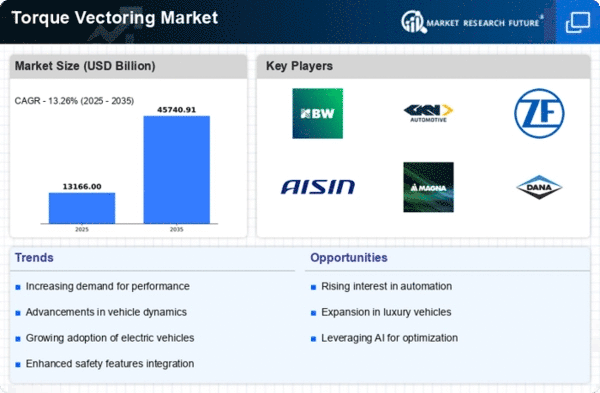
As per MRFR analysis, the Torque Vectoring Market Size was estimated at 11624.58 USD Billion in 2024. The Torque Vectoring industry is projected to grow from 13166.23 USD Billion in 2025 to 45740.91 USD Billion by 2035, exhibiting a compound annual growth rate (CAGR) of 13.26 during the forecast period 2025 - 2035.

Key Market Trends & Highlights

The Torque Vectoring Market is poised for substantial growth driven by technological advancements and evolving consumer preferences.

  • North America remains the largest market for torque vectoring systems, driven by a robust automotive industry.
  • Asia-Pacific is emerging as the fastest-growing region, fueled by increasing demand for advanced vehicle technologies.
  • Passenger vehicles dominate the market, while commercial vehicles are witnessing the fastest growth due to rising logistics needs.
  • The market is significantly driven by the rising demand for enhanced vehicle performance and the growing popularity of all-wheel drive systems.

Market Size & Forecast

2024 Market Size 11624.58 (USD Billion)
2035 Market Size 45740.91 (USD Billion)
CAGR (2025 - 2035) 13.26%
Largest Regional Market Share in 2024 North America

Major Players

BorgWarner (US), GKN Automotive (GB), ZF Friedrichshafen (DE), Aisin Seiki (JP), Magna International (CA), Dana Incorporated (US), Continental AG (DE), Nissan Motor Corporation (JP), Toyota Motor Corporation (JP)

Market Trends

The Torque Vectoring Market is currently experiencing a notable evolution, driven by advancements in automotive technology and increasing consumer demand for enhanced vehicle performance. This market encompasses systems that distribute torque to individual wheels, thereby improving traction, stability, and overall driving dynamics. As manufacturers strive to differentiate their offerings, the integration of torque vectoring systems is becoming more prevalent in both conventional and electric vehicles. This trend is further fueled by the growing emphasis on safety features and the desire for a more engaging driving experience. Moreover, the Torque Vectoring Market is likely to witness a shift towards more sophisticated systems that utilize artificial intelligence and machine learning. These technologies can optimize torque distribution in real-time, adapting to various driving conditions and enhancing vehicle responsiveness. As the automotive industry continues to evolve, the demand for innovative solutions that enhance performance and safety will likely propel the growth of the Torque Vectoring Market, making it a focal point for manufacturers and consumers alike.

Integration of Electric Vehicles

The rise of electric vehicles is significantly influencing the Torque Vectoring Market. As automakers increasingly adopt electric drivetrains, the need for advanced torque distribution systems becomes more pronounced. Electric vehicles often feature multiple motors, allowing for precise control of torque at each wheel, which enhances performance and efficiency.

Focus on Performance and Handling

There is a growing emphasis on performance and handling in the automotive sector, which is driving the adoption of torque vectoring systems. Consumers are seeking vehicles that offer superior driving dynamics, and torque vectoring technology provides a solution by improving cornering stability and traction, thereby enhancing the overall driving experience.

Advancements in Autonomous Driving

The development of autonomous driving technology is shaping the future of the Torque Vectoring Market. As vehicles become more automated, the integration of sophisticated torque vectoring systems is essential for ensuring safety and stability. These systems can adapt to various driving scenarios, making them crucial for the advancement of self-driving vehicles.

Torque Vectoring Market Market Drivers

Market Growth Projections

The Global Torque Vectoring Market Industry is projected to experience substantial growth over the next decade. With a market value of 4.17 USD Billion in 2024, it is anticipated to reach 9.41 USD Billion by 2035. This growth trajectory reflects a compound annual growth rate (CAGR) of 7.68% from 2025 to 2035, driven by various factors including technological advancements, increasing vehicle electrification, and heightened consumer demand for performance. The market's expansion indicates a robust future for torque vectoring technologies, positioning them as a critical component in the evolution of modern automotive engineering.

Regulatory Support for Emission Reduction

Regulatory support for emission reduction is influencing the Global Torque Vectoring Market Industry, as governments worldwide implement stricter emissions standards. Torque vectoring systems contribute to improved fuel efficiency and reduced emissions by optimizing power delivery to the wheels. This is particularly relevant in regions with stringent environmental regulations, where automakers are compelled to adopt technologies that enhance vehicle efficiency. As a result, the market is likely to benefit from increased investments in torque vectoring technologies, aligning with global sustainability goals and further driving market growth.

Rising Adoption of Electric and Hybrid Vehicles

The Global Torque Vectoring Market Industry is witnessing a notable increase in the adoption of electric and hybrid vehicles, which often utilize torque vectoring systems to optimize performance and efficiency. Electric drivetrains can independently control torque delivery to each wheel, enhancing traction and stability. This capability is particularly advantageous in electric SUVs and performance cars, where agility and responsiveness are paramount. The shift towards electrification is expected to contribute significantly to market growth, with projections indicating a market value of 9.41 USD Billion by 2035, as manufacturers increasingly incorporate torque vectoring in their electric vehicle designs.

Increasing Demand for Enhanced Vehicle Performance

The Global Torque Vectoring Market Industry experiences a surge in demand for enhanced vehicle performance, driven by consumer preferences for superior handling and stability. Torque vectoring technology allows for the distribution of torque to individual wheels, improving traction and cornering capabilities. This trend is particularly evident in high-performance vehicles, where manufacturers are integrating advanced torque vectoring systems to differentiate their offerings. As a result, the market is projected to reach 4.17 USD Billion in 2024, reflecting a growing recognition of the benefits of torque vectoring in enhancing driving dynamics.

Growing Interest in Autonomous Driving Technologies

The Global Torque Vectoring Market Industry is also being shaped by the growing interest in autonomous driving technologies. Torque vectoring plays a crucial role in enhancing the stability and control of autonomous vehicles, allowing for smoother navigation and improved safety. As manufacturers invest in developing self-driving capabilities, the integration of torque vectoring systems becomes increasingly vital. This trend is expected to drive demand for advanced torque vectoring solutions, as they are essential for achieving the high levels of performance and safety required in autonomous driving applications.

Technological Advancements in Automotive Engineering

Technological advancements in automotive engineering are propelling the Global Torque Vectoring Market Industry forward. Innovations in sensors, control algorithms, and electronic systems enable more precise torque distribution, enhancing vehicle dynamics. For instance, the integration of advanced driver-assistance systems (ADAS) with torque vectoring allows for real-time adjustments based on driving conditions. This synergy not only improves safety but also elevates the overall driving experience. As these technologies continue to evolve, the market is expected to grow at a CAGR of 7.68% from 2025 to 2035, indicating a robust future for torque vectoring solutions.

Market Segment Insights

By Application: Passenger Vehicle (Largest) vs. Commercial Vehicle (Fastest-Growing)

In the Torque Vectoring Market, the application segment is primarily dominated by passenger vehicles, which hold the largest share due to their high demand for performance and handling capabilities. This segment benefits from a strong consumer preference for advanced driving technologies, contributing to its notable market presence. In contrast, the commercial vehicle sector is exhibiting rapid growth, driven by increasing demand for efficiency and enhanced vehicle control, particularly in logistics and transportation services.

Passenger Vehicle (Dominant) vs. Commercial Vehicle (Emerging)

Passenger vehicles represent the dominant segment within the Torque Vectoring Market, characterized by escalating consumer interest in performance-enhancing technologies, such as improved traction and stability systems. These vehicles are increasingly equipped with advanced torque vectoring systems, enhancing their appeal among consumers seeking superior driving experiences. On the other hand, commercial vehicles are emerging as a significant market force, prompted by the need for operational efficiency and safety in freight transportation and delivery services. The integration of torque vectoring in this sector aims to provide better handling of heavy loads while ensuring superior road grip, thus contributing to its rapid growth in the market.

By Type: Active Torque Vectoring (Largest) vs. Dynamic Torque Vectoring (Fastest-Growing)

In the Torque Vectoring Market, Active Torque Vectoring currently holds the largest market share, benefiting from advancements in automotive technology and increasing consumer demand for enhanced vehicle performance. On the other hand, Dynamic Torque Vectoring is the fastest-growing segment, driven by its innovative capabilities to adaptively distribute torque based on real-time conditions, significantly improving vehicle handling and safety metrics. With the automotive industry’s shift toward electrification and autonomous driving, these technologies are proving essential for modern vehicles. The competition within the torque vectoring domain is fierce, with manufacturers increasingly focusing on integrating more sophisticated systems to cater to consumer preferences for versatility and performance. Active Torque Vectoring remains a popular choice among high-performance vehicles, while Dynamic Torque Vectoring attracts attention for its potential in emerging markets. As automotive manufacturers seek to differentiate their offerings, the growth potential for Dynamic Torque Vectoring appears promising, with ongoing research and development leading to increased adoption across various vehicle types.

Active Torque Vectoring (Dominant) vs. Passive Torque Vectoring (Emerging)

Active Torque Vectoring is recognized as the dominant player in the Torque Vectoring Market due to its ability to provide precise control over torque distribution to each wheel, enhancing vehicle dynamics and traction. Vehicles equipped with Active Torque Vectoring leverage real-time data to optimize performance across various driving conditions, making it a preferred choice for performance-oriented applications. In contrast, Passive Torque Vectoring serves as an emerging solution, offering a more cost-effective alternative for manufacturers looking to incorporate torque vectoring capabilities without high complexity. While Passive Torque Vectoring may not match the performance levels of its active counterpart, it provides adequate improvements in vehicle stability and handling, particularly for mid-range and economy vehicles. As technology evolves, both segments are expected to coexist, catering to different market needs and consumer preferences.

By Drive Type: All-Wheel Drive (Largest) vs. Rear-Wheel Drive (Fastest-Growing)

The Torque Vectoring Market showcases a pronounced distribution among different drive types, with All-Wheel Drive (AWD) taking the lead as the largest segment. This drive type caters to the increasing consumer preference for enhanced vehicle performance and safety under diverse driving conditions. Meanwhile, Front-Wheel Drive (FWD) holds a significant share due to its cost-effectiveness and suitability for urban vehicles, while Rear-Wheel Drive (RWD), albeit smaller in market share, is swiftly gaining traction in high-performance applications. Growth trends in the Torque Vectoring Market are largely propelled by advancements in automotive technology and heightened awareness of vehicle dynamics. All-Wheel Drive remains attractive for its superior grip and stability, appealing to consumers in regions with variable weather. Concurrently, Rear-Wheel Drive is emerging as the fastest-growing segment, fueled by the demand among performance enthusiasts and luxury car segments, who seek the benefits of torque distribution for improved handling and agility.

All-Wheel Drive (Dominant) vs. Rear-Wheel Drive (Emerging)

All-Wheel Drive (AWD) remains the dominant drive type within the Torque Vectoring Market, recognized for its ability to distribute torque to all wheels based on traction needs, thereby enhancing stability and control. This technology is especially revered in both off-road and adverse weather conditions, making it a preferred choice for SUVs and crossovers. Despite its higher complexity and cost, consumers favor AWD for the safety and performance benefits it affords. In contrast, Rear-Wheel Drive (RWD) is rapidly emerging as popular in the performance car segment, leveraging torque vectoring technology to provide a dynamic driving experience. With automakers focusing on performance and agility, RWD is expected to grow significantly as it offers superior handling characteristics while meeting the expectations of sports car enthusiasts.

By Component: Electronic Control Unit (Largest) vs. Sensors (Fastest-Growing)

In the Torque Vectoring Market, the Component segment showcases a dynamic market share distribution among its main parts: Electronic Control Units, Differentials, Sensors, and Actuators. The Electronic Control Unit stands as the largest segment, commanding a significant portion due to its crucial role in managing torque distribution across vehicles. Meanwhile, Sensors are rapidly gaining traction, representing the fastest-growing field within the segment, driven by the increasing integration of advanced technologies into automotive systems. Growth trends in the Torque Vectoring Market are influenced by advancements in automotive technologies and the rising demand for enhanced vehicle performance. The Electronic Control Unit benefits from its established presence in the market, but the emerging trend of adopting sophisticated Sensor technologies is noteworthy. This uptick reflects a broader industry shift towards smarter, more responsive vehicle dynamics, with automakers prioritizing innovations that lead to better stability and handling capabilities.

Electronic Control Unit (Dominant) vs. Sensors (Emerging)

The Electronic Control Unit is a cornerstone of the Torque Vectoring Market, playing a pivotal role in adjusting torque distribution among wheels to enhance vehicle performance and stability. As the dominant component, it integrates various functionalities, including real-time data processing from other components, thus making it essential for sophisticated torque vectoring systems. In contrast, Sensors, which are emerging as a vital component, provide critical feedback for the ECU to operate effectively. They enable the detection of wheel slip, vehicle speed, and other metrics, facilitating responsive adjustments for optimal performance. The growing focus on incorporating advanced Sensor technology reflects the automotive industry's trend toward enhanced monitoring and control, positioning them as essential for future developments in torque vectoring systems.

Get more detailed insights about Torque Vectoring Market Research Report-Global Forecast till 2035

Regional Insights

North America : Leading Market for Innovation

North America is poised to maintain its leadership in the torque vectoring market, holding a significant share of 5800.0. The region's growth is driven by increasing demand for advanced vehicle dynamics and enhanced safety features. Regulatory support for electric and hybrid vehicles further catalyzes market expansion, as manufacturers seek to improve performance and efficiency. The push for sustainability and innovation in automotive technology is also a key driver of growth. The competitive landscape in North America is robust, featuring key players such as BorgWarner, Dana Incorporated, and Continental AG. These companies are at the forefront of technological advancements, focusing on R&D to enhance torque vectoring systems. The presence of major automotive manufacturers and a strong supply chain network further solidifies North America's position as a hub for torque vectoring technology. The region's commitment to innovation ensures continued growth and market leadership.

Europe : Emerging Hub for Technology

Europe is emerging as a significant player in the torque vectoring market, with a market size of 3500.0. The region benefits from stringent regulations aimed at reducing emissions and enhancing vehicle safety, which drive the adoption of advanced technologies. The increasing focus on electric vehicles (EVs) and hybrid models is also a catalyst for growth, as manufacturers seek to optimize performance and efficiency through torque vectoring systems. Leading countries such as Germany, the UK, and France are at the forefront of this market, with key players like ZF Friedrichshafen and GKN Automotive leading the charge. The competitive landscape is characterized by innovation and collaboration among automotive manufacturers and technology providers. As the European market continues to evolve, the emphasis on sustainability and performance will drive further advancements in torque vectoring technology. "The European automotive industry is committed to achieving carbon neutrality by 2050, which will significantly influence technology adoption," stated a report from the European Commission.

Asia-Pacific : Rapidly Growing Market

Asia-Pacific is witnessing rapid growth in the torque vectoring market, with a market size of 2000.0. The region's expansion is fueled by increasing vehicle production and rising consumer demand for advanced automotive technologies. Governments are also implementing supportive policies to promote electric vehicles, which is expected to further drive the adoption of torque vectoring systems. The growing focus on safety and performance enhancements is a key factor in this growth trajectory. Countries like Japan, China, and South Korea are leading the charge in this market, with major players such as Aisin Seiki and Nissan Motor Corporation actively investing in R&D. The competitive landscape is becoming increasingly dynamic, with both established and emerging companies vying for market share. As the region continues to develop its automotive sector, the demand for innovative torque vectoring solutions is expected to rise significantly.

Middle East and Africa : Emerging Market Potential

The Middle East and Africa region is gradually emerging in the torque vectoring market, with a market size of 324.58. The growth is primarily driven by increasing vehicle sales and a rising interest in advanced automotive technologies. Governments in the region are beginning to recognize the importance of sustainable transportation, which is expected to catalyze the adoption of torque vectoring systems in the coming years. The focus on improving road safety and vehicle performance is also contributing to market growth. Countries like South Africa and the UAE are leading the way in this emerging market, with a growing number of automotive manufacturers exploring opportunities in torque vectoring technology. The competitive landscape is still developing, but there is potential for significant growth as more players enter the market. As the region's automotive industry evolves, the demand for innovative solutions will likely increase, paving the way for future advancements in torque vectoring technology.

Key Players and Competitive Insights

The Torque Vectoring Market is currently characterized by a dynamic competitive landscape, driven by advancements in automotive technology and increasing consumer demand for enhanced vehicle performance and safety. Key players such as BorgWarner (US), GKN Automotive (GB), and ZF Friedrichshafen (DE) are strategically positioned to leverage innovation and partnerships to maintain their competitive edge. BorgWarner (US) focuses on developing advanced torque vectoring systems that enhance vehicle handling and stability, while GKN Automotive (GB) emphasizes its commitment to sustainability through the development of lightweight and efficient driveline technologies. ZF Friedrichshafen (DE) is actively pursuing digital transformation initiatives to integrate smart technologies into its torque vectoring solutions, thereby enhancing user experience and operational efficiency.The market structure appears moderately fragmented, with several players competing on various fronts, including technology, pricing, and customer service. Key business tactics such as localizing manufacturing and optimizing supply chains are increasingly prevalent among these companies. This localized approach not only reduces operational costs but also enhances responsiveness to regional market demands, thereby strengthening their competitive positions. The collective influence of these key players shapes a landscape where innovation and strategic partnerships are paramount for success.

In November BorgWarner (US) announced a strategic partnership with a leading electric vehicle manufacturer to co-develop next-generation torque vectoring systems tailored for electric drivetrains. This collaboration is poised to enhance BorgWarner's market presence in the rapidly growing electric vehicle segment, aligning with the industry's shift towards electrification and sustainability. The partnership underscores the importance of innovation in meeting evolving consumer expectations and regulatory requirements.

In October GKN Automotive (GB) unveiled its latest torque vectoring technology, which incorporates artificial intelligence (AI) to optimize power distribution in real-time. This technological advancement is significant as it not only improves vehicle performance but also contributes to energy efficiency, addressing the growing demand for sustainable automotive solutions. GKN's focus on integrating AI into its products reflects a broader trend within the industry towards smart, connected vehicles.

In September ZF Friedrichshafen (DE) expanded its production capabilities by investing €50 million in a new facility dedicated to torque vectoring systems. This investment is indicative of ZF's commitment to scaling its operations and meeting the increasing demand for advanced driveline technologies. The new facility is expected to enhance ZF's production efficiency and capacity, positioning the company favorably in a competitive market.

As of December the Torque Vectoring Market is witnessing trends that emphasize digitalization, sustainability, and AI integration. Strategic alliances are increasingly shaping the competitive landscape, enabling companies to pool resources and expertise to drive innovation. The shift from price-based competition to a focus on technological advancement and supply chain reliability is evident, suggesting that future competitive differentiation will hinge on the ability to innovate and adapt to changing market dynamics.

Key Companies in the Torque Vectoring Market include

Industry Developments

Recent developments in the Torque Vectoring Market have been significant, with numerous companies enhancing their offerings to improve vehicle performance and efficiency. Delphi Technologies and BorgWarner are advancing their technologies, focusing on integrating electric vehicle capabilities, which are becoming crucial in the industry as consumers demand greener alternatives.

Honda Motor Co. and Nissan Motor Corporation continue to innovate in this space, with a commitment to developing advanced traction and stability systems. Moreover, Continental AG and ZF Friedrichshafen are strengthening their positions through strategic partnerships aimed at enhancing automotive safety and drivability.

In terms of mergers and acquisitions, Magna International has been active in acquiring companies that provide advanced torque vectoring solutions to strengthen its product portfolio. Meanwhile, Hyundai Mobis maintains a focus on integrating torque vectoring in electric vehicles, reflecting the ongoing transition in the automotive sector.

Recent market valuations have indicated a positive growth trend, propelled by the increasing demand for high-performance vehicles and the rise of electric mobility, further influencing the strategies of companies like Aisin Seiki and Voith GmbH as they adapt to shifting consumer preferences and technological advancements.

Future Outlook

Torque Vectoring Market Future Outlook

The Torque Vectoring Market is projected to grow at a 13.26% CAGR from 2025 to 2035, driven by advancements in automotive technology and increasing demand for enhanced vehicle performance.

New opportunities lie in:

  • Development of advanced torque vectoring systems for electric vehicles
  • Integration of torque vectoring with autonomous driving technologies
  • Expansion into emerging markets with tailored torque vectoring solutions

By 2035, the Torque Vectoring Market is expected to achieve substantial growth and innovation.

Market Segmentation

Torque Vectoring Market Type Outlook

  • Active Torque Vectoring
  • Passive Torque Vectoring
  • Dynamic Torque Vectoring

Torque Vectoring Market Component Outlook

  • Electronic Control Unit
  • Differential
  • Sensors
  • Actuators

Torque Vectoring Market Drive Type Outlook

  • All-Wheel Drive
  • Front-Wheel Drive
  • Rear-Wheel Drive

Torque Vectoring Market Application Outlook

  • Passenger Vehicle
  • Commercial Vehicle
  • Motorcycle
  • All-Terrain Vehicle

Report Scope

MARKET SIZE 202411624.58(USD Billion)
MARKET SIZE 202513166.23(USD Billion)
MARKET SIZE 203545740.91(USD Billion)
COMPOUND ANNUAL GROWTH RATE (CAGR)13.26% (2025 - 2035)
REPORT COVERAGERevenue Forecast, Competitive Landscape, Growth Factors, and Trends
BASE YEAR2024
Market Forecast Period2025 - 2035
Historical Data2019 - 2024
Market Forecast UnitsUSD Billion
Key Companies ProfiledBorgWarner (US), GKN Automotive (GB), ZF Friedrichshafen (DE), Aisin Seiki (JP), Magna International (CA), Dana Incorporated (US), Continental AG (DE), Nissan Motor Corporation (JP), Toyota Motor Corporation (JP)
Segments CoveredApplication, Type, Drive Type, Component
Key Market OpportunitiesIntegration of advanced artificial intelligence in Torque Vectoring systems enhances vehicle performance and safety.
Key Market DynamicsRising demand for enhanced vehicle performance drives innovation in torque vectoring technologies and competitive market dynamics.
Countries CoveredNorth America, Europe, APAC, South America, MEA

FAQs

What was the market size of the Torque Vectoring Market in 2023?

The Torque Vectoring Market was valued at 3.79 USD Billion in 2023.

What is the projected market size of the Torque Vectoring Market by 2032?

By 2032, the Torque Vectoring Market is projected to reach a value of 7.5 USD Billion.

What is the expected CAGR for the Torque Vectoring Market from 2024 to 2032?

The Torque Vectoring Market is expected to grow at a CAGR of 7.87% from 2024 to 2032.

Which region is expected to have the largest market share in the Torque Vectoring Market?

North America is anticipated to hold the largest market share, valued at 2.4 USD Billion by 2032.

What is the expected market size for Active Torque Vectoring technology in 2032?

The market for Active Torque Vectoring technology is expected to reach 3.0 USD Billion by 2032.

What is the projected value of Passive Torque Vectoring by 2032?

The projected value for Passive Torque Vectoring by 2032 is 2.4 USD Billion.

How much is the Mechanically Controlled Torque Vectoring market expected to grow by 2032?

The Mechanically Controlled Torque Vectoring market is expected to grow to 2.1 USD Billion by 2032.

Who are the key players in the Torque Vectoring Market?

Key players in the market include Delphi Technologies, Honda Motor Co., and Nissan Motor Corporation, among others.

What was the market size for the Europe region in 2023?

In 2023, the market size for the Europe region was valued at 1.1 USD Billion.

What challenges does the Torque Vectoring Market face amid current scenarios?

The market faces challenges such as supply chain disruptions and evolving consumer preferences.

  1. SECTION I: EXECUTIVE SUMMARY AND KEY HIGHLIGHTS
    1. | 1.1 EXECUTIVE SUMMARY
    2. | 1.1.1 Market Overview
    3. | 1.1.2 Key Findings
    4. | 1.1.3 Market Segmentation
    5. | 1.1.4 Competitive Landscape
    6. | 1.1.5 Challenges and Opportunities
    7. | 1.1.6 Future Outlook
  2. SECTION II: SCOPING, METHODOLOGY AND MARKET STRUCTURE
    1. | 2.1 MARKET INTRODUCTION
    2. | 2.1.1 Definition
    3. | 2.1.2 Scope of the study
    4. |-- 2.1.2.1 Research Objective
    5. |-- 2.1.2.2 Assumption
    6. |-- 2.1.2.3 Limitations
    7. | 2.2 RESEARCH METHODOLOGY
    8. | 2.2.1 Overview
    9. | 2.2.2 Data Mining
    10. | 2.2.3 Secondary Research
    11. | 2.2.4 Primary Research
    12. |-- 2.2.4.1 Primary Interviews and Information Gathering Process
    13. |-- 2.2.4.2 Breakdown of Primary Respondents
    14. | 2.2.5 Forecasting Model
    15. | 2.2.6 Market Size Estimation
    16. |-- 2.2.6.1 Bottom-Up Approach
    17. |-- 2.2.6.2 Top-Down Approach
    18. | 2.2.7 Data Triangulation
    19. | 2.2.8 Validation
  3. SECTION III: QUALITATIVE ANALYSIS
    1. | 3.1 MARKET DYNAMICS
    2. | 3.1.1 Overview
    3. | 3.1.2 Drivers
    4. | 3.1.3 Restraints
    5. | 3.1.4 Opportunities
    6. | 3.2 MARKET FACTOR ANALYSIS
    7. | 3.2.1 Value chain Analysis
    8. | 3.2.2 Porter's Five Forces Analysis
    9. |-- 3.2.2.1 Bargaining Power of Suppliers
    10. |-- 3.2.2.2 Bargaining Power of Buyers
    11. |-- 3.2.2.3 Threat of New Entrants
    12. |-- 3.2.2.4 Threat of Substitutes
    13. |-- 3.2.2.5 Intensity of Rivalry
    14. | 3.2.3 COVID-19 Impact Analysis
    15. |-- 3.2.3.1 Market Impact Analysis
    16. |-- 3.2.3.2 Regional Impact
    17. |-- 3.2.3.3 Opportunity and Threat Analysis
  4. SECTION IV: QUANTITATIVE ANALYSIS
    1. | 4.1 Automobile, BY Application (USD Billion)
    2. | 4.1.1 Passenger Vehicle
    3. | 4.1.2 Commercial Vehicle
    4. | 4.1.3 Motorcycle
    5. | 4.1.4 All-Terrain Vehicle
    6. | 4.2 Automobile, BY Type (USD Billion)
    7. | 4.2.1 Active Torque Vectoring
    8. | 4.2.2 Passive Torque Vectoring
    9. | 4.2.3 Dynamic Torque Vectoring
    10. | 4.3 Automobile, BY Drive Type (USD Billion)
    11. | 4.3.1 All-Wheel Drive
    12. | 4.3.2 Front-Wheel Drive
    13. | 4.3.3 Rear-Wheel Drive
    14. | 4.4 Automobile, BY Component (USD Billion)
    15. | 4.4.1 Electronic Control Unit
    16. | 4.4.2 Differential
    17. | 4.4.3 Sensors
    18. | 4.4.4 Actuators
    19. | 4.5 Automobile, BY Region (USD Billion)
    20. | 4.5.1 North America
    21. |-- 4.5.1.1 US
    22. |-- 4.5.1.2 Canada
    23. | 4.5.2 Europe
    24. |-- 4.5.2.1 Germany
    25. |-- 4.5.2.2 UK
    26. |-- 4.5.2.3 France
    27. |-- 4.5.2.4 Russia
    28. |-- 4.5.2.5 Italy
    29. |-- 4.5.2.6 Spain
    30. |-- 4.5.2.7 Rest of Europe
    31. | 4.5.3 APAC
    32. |-- 4.5.3.1 China
    33. |-- 4.5.3.2 India
    34. |-- 4.5.3.3 Japan
    35. |-- 4.5.3.4 South Korea
    36. |-- 4.5.3.5 Malaysia
    37. |-- 4.5.3.6 Thailand
    38. |-- 4.5.3.7 Indonesia
    39. |-- 4.5.3.8 Rest of APAC
    40. | 4.5.4 South America
    41. |-- 4.5.4.1 Brazil
    42. |-- 4.5.4.2 Mexico
    43. |-- 4.5.4.3 Argentina
    44. |-- 4.5.4.4 Rest of South America
    45. | 4.5.5 MEA
    46. |-- 4.5.5.1 GCC Countries
    47. |-- 4.5.5.2 South Africa
    48. |-- 4.5.5.3 Rest of MEA
  5. SECTION V: COMPETITIVE ANALYSIS
    1. | 5.1 Competitive Landscape
    2. | 5.1.1 Overview
    3. | 5.1.2 Competitive Analysis
    4. | 5.1.3 Market share Analysis
    5. | 5.1.4 Major Growth Strategy in the Automobile
    6. | 5.1.5 Competitive Benchmarking
    7. | 5.1.6 Leading Players in Terms of Number of Developments in the Automobile
    8. | 5.1.7 Key developments and growth strategies
    9. |-- 5.1.7.1 New Product Launch/Service Deployment
    10. |-- 5.1.7.2 Merger & Acquisitions
    11. |-- 5.1.7.3 Joint Ventures
    12. | 5.1.8 Major Players Financial Matrix
    13. |-- 5.1.8.1 Sales and Operating Income
    14. |-- 5.1.8.2 Major Players R&D Expenditure. 2023
    15. | 5.2 Company Profiles
    16. | 5.2.1 BorgWarner (US)
    17. |-- 5.2.1.1 Financial Overview
    18. |-- 5.2.1.2 Products Offered
    19. |-- 5.2.1.3 Key Developments
    20. |-- 5.2.1.4 SWOT Analysis
    21. |-- 5.2.1.5 Key Strategies
    22. | 5.2.2 GKN Automotive (GB)
    23. |-- 5.2.2.1 Financial Overview
    24. |-- 5.2.2.2 Products Offered
    25. |-- 5.2.2.3 Key Developments
    26. |-- 5.2.2.4 SWOT Analysis
    27. |-- 5.2.2.5 Key Strategies
    28. | 5.2.3 ZF Friedrichshafen (DE)
    29. |-- 5.2.3.1 Financial Overview
    30. |-- 5.2.3.2 Products Offered
    31. |-- 5.2.3.3 Key Developments
    32. |-- 5.2.3.4 SWOT Analysis
    33. |-- 5.2.3.5 Key Strategies
    34. | 5.2.4 Aisin Seiki (JP)
    35. |-- 5.2.4.1 Financial Overview
    36. |-- 5.2.4.2 Products Offered
    37. |-- 5.2.4.3 Key Developments
    38. |-- 5.2.4.4 SWOT Analysis
    39. |-- 5.2.4.5 Key Strategies
    40. | 5.2.5 Magna International (CA)
    41. |-- 5.2.5.1 Financial Overview
    42. |-- 5.2.5.2 Products Offered
    43. |-- 5.2.5.3 Key Developments
    44. |-- 5.2.5.4 SWOT Analysis
    45. |-- 5.2.5.5 Key Strategies
    46. | 5.2.6 Dana Incorporated (US)
    47. |-- 5.2.6.1 Financial Overview
    48. |-- 5.2.6.2 Products Offered
    49. |-- 5.2.6.3 Key Developments
    50. |-- 5.2.6.4 SWOT Analysis
    51. |-- 5.2.6.5 Key Strategies
    52. | 5.2.7 Continental AG (DE)
    53. |-- 5.2.7.1 Financial Overview
    54. |-- 5.2.7.2 Products Offered
    55. |-- 5.2.7.3 Key Developments
    56. |-- 5.2.7.4 SWOT Analysis
    57. |-- 5.2.7.5 Key Strategies
    58. | 5.2.8 Nissan Motor Corporation (JP)
    59. |-- 5.2.8.1 Financial Overview
    60. |-- 5.2.8.2 Products Offered
    61. |-- 5.2.8.3 Key Developments
    62. |-- 5.2.8.4 SWOT Analysis
    63. |-- 5.2.8.5 Key Strategies
    64. | 5.2.9 Toyota Motor Corporation (JP)
    65. |-- 5.2.9.1 Financial Overview
    66. |-- 5.2.9.2 Products Offered
    67. |-- 5.2.9.3 Key Developments
    68. |-- 5.2.9.4 SWOT Analysis
    69. |-- 5.2.9.5 Key Strategies
    70. | 5.3 Appendix
    71. | 5.3.1 References
    72. | 5.3.2 Related Reports

Automobile Market Segmentation

Automobile By Application (USD Billion, 2025-2035)

  • Passenger Vehicle
  • Commercial Vehicle
  • Motorcycle
  • All-Terrain Vehicle

Automobile By Type (USD Billion, 2025-2035)

  • Active Torque Vectoring
  • Passive Torque Vectoring
  • Dynamic Torque Vectoring

Automobile By Drive Type (USD Billion, 2025-2035)

  • All-Wheel Drive
  • Front-Wheel Drive
  • Rear-Wheel Drive

Automobile By Component (USD Billion, 2025-2035)

  • Electronic Control Unit
  • Differential
  • Sensors
  • Actuators
Infographic

Free Sample Request

Kindly complete the form below to receive a free sample of this Report

Get Free Sample

Customer Strories

Compare Licence

×
Features License Type
Single User Multiuser License Enterprise User
Price $4,950 $5,950 $7,250
Maximum User Access Limit 1 User Upto 10 Users Unrestricted Access Throughout the Organization
Free Customization
Direct Access to Analyst
Deliverable Format
Platform Access
Discount on Next Purchase 10% 15% 15%
Printable Versions