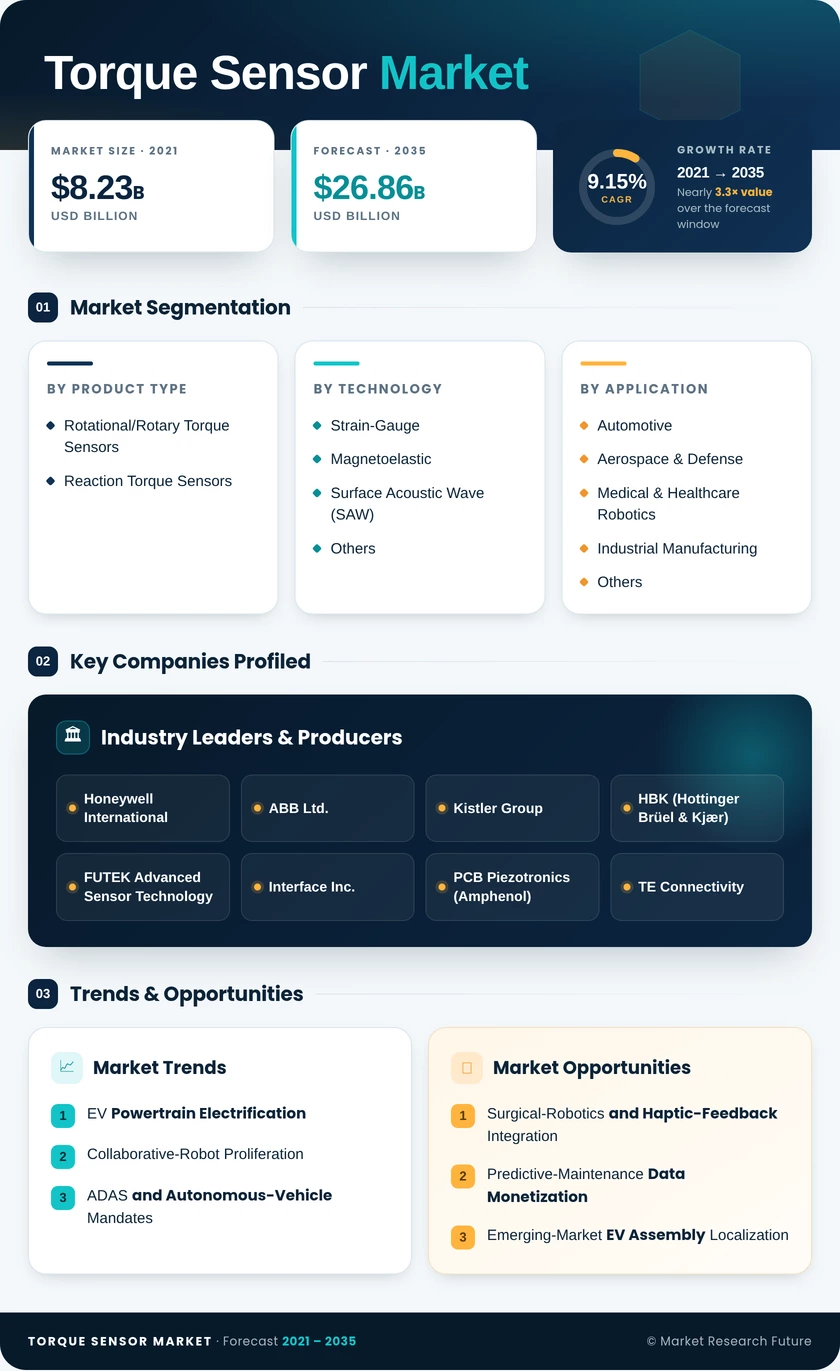
Segmentation Quick Reference
| Dimension | Sub-Segments | Dominant Segment | Fastest Growing Segment |
| Product Type | Rotational/Rotary Torque Sensors; Reaction Torque Sensors | Rotational/Rotary Torque Sensors | Reaction Torque Sensors |
| Technology | Strain-Gauge; Magnetoelastic; Surface Acoustic Wave (SAW); Others | Strain-Gauge | Surface Acoustic Wave (SAW) |
| Application | Automotive; Aerospace & Defense; Medical & Healthcare Robotics; Industrial Manufacturing; Others | Automotive | Medical & Healthcare Robotics |
| End-User Industry | OEM Test-Stand & QA; In-Process Monitoring; Aftermarket & Field Service; Others | OEM Test-Stand & QA | In-Process Monitoring |
| Geography | North America; Europe; Asia-Pacific; South America; Middle East & Africa | Asia-Pacific | South America |
Market Segmentation Overview
By Product Type
| Sub-Segment | Key Trend |
| Rotational/Rotary Torque Sensors | Dominant segment; driven by EV drivetrain and industrial shaft-speed measurement requirements |
| Reaction Torque Sensors | Fastest growing; propelled by collaborative-robot safety mandates and surgical-device calibration |
Rotational sensors remain the backbone of powertrain testing and continuous industrial monitoring, while reaction sensors are gaining traction in static-load and precision-assembly environments where cobot interaction and medical-device quality assurance demand high-resolution torque feedback.
By Technology
| Sub-Segment | Key Trend |
| Strain-Gauge | Market leader; established calibration ecosystem and broad OEM adoption |
| Magnetoelastic | Growing in automotive EPS; contactless operation eliminates wear-related drift |
| Surface Acoustic Wave (SAW) | Fastest growing; wireless, battery-free interrogation suited to harsh EV and wind-energy environments |
| Others | Includes optical, capacitive, and piezoelectric niche technologies |
Strain-gauge dominance reflects decades of standardization, but magnetoelastic and SAW platforms are eroding share as electrification and wireless connectivity reshape buyer priorities toward maintenance-free, EMI-resilient architectures.
By Application
| Sub-Segment | Key Trend |
| Automotive | Largest segment; EV powertrain, electric power-steering, and ADAS torque feedback |
| Aerospace & Defense | High-value test-cell demand for engine and flight-control actuation validation |
| Medical & Healthcare Robotics | Fastest growing; haptic-feedback surgical systems and rehabilitation exoskeletons |
| Industrial Manufacturing | Smart-factory inline quality assurance and predictive-maintenance integration |
| Others | Marine propulsion, energy infrastructure, consumer appliances |
Automotive dominance is sustained by the electrification wave, while medical robotics presents the highest growth trajectory due to expanding surgical-robot installed bases and tightening regulatory requirements for force-limited patient interaction.
By End-User Industry
| Sub-Segment | Key Trend |
| OEM Test-Stand & QA | Largest end-user; dynamometer labs for powertrain and component validation |
| In-Process Monitoring | Fastest growing; real-time 100% inline quality inspection replacing statistical sampling |
| Aftermarket & Field Service | Maintenance diagnostics and fleet torque-monitoring services |
| Others | Academic research institutions, government testing laboratories |
OEM test-stand demand provides a stable revenue base, while in-process monitoring is experiencing rapid adoption as manufacturers shift from batch-sampling to continuous torque verification on production lines.