Request Free Sample ×

Kindly complete the form below to receive a free sample of this Report

* Please use a valid business email

Leading companies partner with us for data-driven Insights

clients tt-cursor
Hero Background
English
Chinese
French
Japanese
Korean
German
Spanish

Tile Adhesive Market Analysis

ID: MRFR/CnM/1199-CR
111 Pages
Anshula Mandaokar
February 2021

Tile Adhesive Market Research Report Information By Type (Cementitious, Dispersion, and Reactive Tile Adhesive), By Polymer Chemistry (Acrylic, Vinyl Acetate Ethylene, Have-Veova, Epoxy, Styrene Butadiene, Polyurethane, and Others), By Application (Ceramic Tile, Vitrified Tiles, Natural Stone, Mosaic, and Glass), And By Region (North America, Europe, Asia-Pacific, And Rest Of The World) – Market Forecast Till 2035

Share:
Download PDF ×

We do not share your information with anyone. However, we may send you emails based on your report interest from time to time. You may contact us at any time to opt-out.

Tile Adhesive Market Infographic
Purchase Options

Market Analysis

In-depth Analysis of Tile Adhesive Market Industry Landscape

The Tile Adhesive Market works inside a powerful structure impacted by different elements that on the whole shape its direction and development. To acquire an exhaustive comprehension of this industry, taking into account the accompanying key pointers is fundamental: Development and Building Exercises: An essential driver in the Tile Adhesive Market is the degree of development and building exercises. The interest in tile adhesives is intently attached to patterns in private, business, and framework development. Market elements are fundamentally impacted by the general strength of the development business and the volume of tile establishments in different ventures. Rising Pattern of Tiled Surfaces: The growing trend of using tiles on a variety of surfaces has a significant impact on the dynamics of the Tile Adhesive Market. Tiles are progressively well known for deck, walls, and even roofs in both private and business spaces. This pattern intensifies the interest for successful tile glues, molding the market's elements. Benefits Over Customary Techniques: The market elements are impacted by the benefits that tile glues offer over customary strategies, for example, concrete mortar. Tile glues give faster and more productive establishment, better bond, and diminished restoring times. As manufacturers and project workers look for additional effective and dependable arrangements, the market for tile cements encounters development. Developments in adhesive formulation technology: Technological advancements in adhesive formulations are altering the dynamics of the Tile Adhesive Market. Makers are creating imaginative glue items with upgraded properties, like better adaptability, water obstruction, and broadened working times. The market answers these progressions as experts look for superior execution glues for different applications. Applications for Tiles of Various Kinds: The market elements are impacted by the assortment of tile applications, including clay, porcelain, glass, and normal stone tiles. Each kind of tile might require a particular cement definition in light of its qualities and the surface where it will be introduced. The market adjusts to these varieties, offering a scope of tile glues to meet different application needs. Natural Contemplations and Supportability: Developing natural mindfulness is influencing market elements, prompting a shift towards more maintainable tile glue arrangements. Water-based and low-VOC (unstable natural compound) details are acquiring ubiquity as ecological contemplations become fundamental to development rehearses. The dynamics of the market respond to the need for environmentally friendly adhesive options. Portion of the overall industry and Contest Among Producers: Market dynamics are significantly influenced by the landscape of competition and manufacturers' market shares. Driving makers frequently drive development, set industry guidelines, and impact valuing patterns. The elements of the Tile Adhesive Market are formed by the techniques of central parts, including item advancement, vital associations, and market extension endeavors. Construction Methods in Different Regions: The elements of the Tile Adhesive Market fluctuate across areas because of contrasts in development rehearses, compositional styles, and nearby inclinations. Local varieties impact the interest for explicit sorts of tile glues and plans. To tailor their products to the needs of the local market, suppliers and manufacturers must comprehend these geographical dynamics. Circulation Channels and Inventory network Proficiency: The productivity of dispersion channels and the general inventory network influence the accessibility and valuing of tile glues. The elements of the market are formed by variables, for example, operations, transportation expenses, and stock administration. To effectively navigate market dynamics, manufacturers and distributors must optimize supply chain processes. Specialized Applications and Customization: The market elements are affected by the interest in redid and specific tile cement arrangements. Certain applications, like pools, exteriors, or high-traffic regions, may require glue definitions with explicit properties. The market answers these requests by offering specific items customized to one-of-a-kind application prerequisites. Purchaser Inclinations and Tasteful Contemplations: Buyer inclinations and tasteful contemplations assume a critical part in forming the elements of the Tile Adhesive Market. As configuration patterns advance, shoppers look for cement arrangements that supplement their tasteful decisions. The market adjusts to these inclinations by offering various glue choices that take care of various plan styles and patterns.

Author
Author Profile
Anshula Mandaokar
Team Lead - Research

Anshula Mandaokar holds an academic degree in Chemical Engineering and has been contributing to the field for more than 5 years. She has expertise in Market Research and Business Consulting and serves as a Team Lead for a reputed Market Research firm under the Chemicals and Materials domain spectrum. She has worked on multiple projects, generating explicit results in a quick turnaround time. Her understanding of data interpretation justifies her role as a leader.

Leave a Comment

FAQs

What is the current valuation of the s tile adhesive market as of 2024?

<p>The s tile adhesive market was valued at 3.5 USD Billion in 2024.</p>

What is the projected market valuation for the s tile adhesive market in 2035?

<p>The market is projected to reach 5.7 USD Billion by 2035.</p>

What is the expected CAGR for the s tile adhesive market during the forecast period 2025 - 2035?

<p>The expected CAGR for the s tile adhesive market during 2025 - 2035 is 4.53%.</p>

Which application segments are expected to drive growth in the s tile adhesive market?

<p>The Flooring and Wall Tiling segments are anticipated to drive growth, with valuations of 2.2 USD Billion and 1.6 USD Billion respectively by 2035.</p>

How do the residential and commercial end-use segments compare in terms of market size?

<p>The residential segment is projected to reach 2.2 USD Billion, while the commercial segment is expected to reach 1.6 USD Billion by 2035.</p>

What types of adhesives dominate the s tile adhesive market?

<p>Cement-Based Adhesives dominate the market, with a projected valuation of 2.2 USD Billion by 2035.</p>

Who are the key players in the s tile adhesive market?

<p>Key players include Laticrete International Inc, Bostik, Mapei S.p.A., Henkel AG & Co. KGaA, and Sika AG.</p>

What is the expected growth for specialty applications in the s tile adhesive market?

<p>Specialty Applications are projected to grow to 0.4 USD Billion by 2035.</p>

How does the industrial end-use segment perform compared to institutional and infrastructure segments?

<p>The industrial segment is expected to reach 1.0 USD Billion, while institutional and infrastructure segments are projected at 0.8 USD Billion and 0.9 USD Billion respectively by 2035.</p>

What trends are influencing the s tile adhesive market in 2025?

<p>Trends include increasing demand for high-performance adhesives and innovations from key players like Ardex GmbH and Weber.</p>

Market Summary

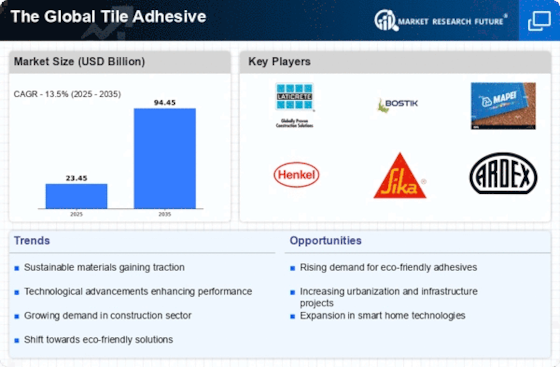
As per MRFR analysis, the Tile Adhesive Market Size was estimated at 23.45 USD Billion in 2024. The Tile Adhesive industry is projected to grow from 26.62 USD Billion in 2025 to 94.45 USD Billion by 2035, exhibiting a compound annual growth rate (CAGR) of 13.5% during the forecast period 2025 - 2035.

Key Market Trends & Highlights

The Tile Adhesive Market is experiencing a dynamic shift towards sustainability and innovation.

  • The market is increasingly driven by a focus on sustainability, with manufacturers prioritizing eco-friendly formulations. Technological innovations are enhancing product performance, leading to the development of advanced adhesive solutions. In North America, the demand for tile adhesives is robust, while the Asia-Pacific region is witnessing rapid growth due to urbanization. Key market drivers include rising construction activities and the increasing demand for aesthetic solutions, which are shaping consumer preferences.

Market Size & Forecast

2024 Market Size 23.45 (USD Billion)
2035 Market Size 94.45 (USD Billion)
CAGR (2025 - 2035) 13.5%
Largest Regional Market Share in 2024 Asia-Pacific

Major Players

Laticrete International Inc (US), Bostik (FR), Mapei S.p.A. (IT), Henkel AG &amp; Co. KGaA (DE), Sika AG (CH), Ardex GmbH (DE), Weber (FR), Fischer (DE), Dunlop Adhesives (GB), Raimondi (IT)

Market Trends

The Tile Adhesive Market is currently experiencing a dynamic evolution, driven by various factors that influence consumer preferences and industry standards. The increasing demand for durable and high-performance adhesives is evident, as construction and renovation activities continue to rise globally. This trend is further supported by the growing emphasis on sustainable building practices, which encourages the use of eco-friendly materials. As a result, manufacturers are innovating to develop products that not only meet performance criteria but also align with environmental regulations. Additionally, the expansion of the real estate sector, particularly in emerging economies, appears to bolster the market's growth potential. Moreover, advancements in technology are reshaping the Tile Adhesive Market landscape. The introduction of smart adhesives, which offer enhanced bonding capabilities and ease of application, is gaining traction among professionals in the construction industry. This shift towards innovation suggests that companies are likely to invest in research and development to stay competitive. Furthermore, the increasing popularity of DIY projects among consumers may also contribute to a rise in demand for user-friendly adhesive solutions. Overall, the Tile Adhesive Market seems poised for continued growth, driven by a combination of technological advancements and evolving consumer needs.

Sustainability Focus

The Tile Adhesive Market is witnessing a notable shift towards sustainable practices. Manufacturers are increasingly prioritizing eco-friendly materials and production processes, responding to consumer demand for environmentally responsible products. This trend not only aligns with global sustainability goals but also enhances brand reputation.

Technological Innovations

Technological advancements are significantly influencing the Tile Adhesive Market. The emergence of smart adhesives, which offer superior bonding properties and ease of use, is reshaping industry standards. This innovation is likely to attract both professionals and DIY enthusiasts, expanding the market's reach.

Rising DIY Culture

The growing popularity of DIY projects is impacting the Tile Adhesive Market positively. As more consumers engage in home improvement activities, the demand for accessible and effective adhesive solutions is increasing. This trend suggests a shift in purchasing behavior, favoring products that cater to non-professionals.

Tile Adhesive Market Market Drivers

Sustainability Initiatives

The Tile Adhesive Market is increasingly influenced by sustainability initiatives. As environmental concerns gain prominence, manufacturers are focusing on eco-friendly adhesive formulations. This shift is driven by regulatory pressures and consumer demand for sustainable products. For instance, the market for green building materials is projected to grow significantly, with tile adhesives being a key component. Companies are investing in research to develop adhesives that minimize environmental impact, such as those with low volatile organic compounds (VOCs). This trend not only aligns with global sustainability goals but also enhances brand reputation, potentially leading to increased market share in the Tile Adhesive Market.

Technological Advancements

Technological advancements play a crucial role in shaping the Tile Adhesive Market. Innovations in adhesive formulations and application techniques are enhancing performance characteristics, such as bond strength and curing time. For example, the introduction of polymer-modified adhesives has improved flexibility and durability, making them suitable for a variety of substrates. Additionally, automation in manufacturing processes is streamlining production, reducing costs, and improving product consistency. The integration of smart technologies, such as sensors for monitoring adhesive application, is also emerging. These advancements not only meet the evolving needs of consumers but also position companies competitively within the Tile Adhesive Market.

Expansion of Retail Channels

The Tile Adhesive Market is benefiting from the expansion of retail channels, which enhances product accessibility for consumers. The rise of e-commerce platforms and home improvement stores has made it easier for customers to purchase tile adhesives. This trend is particularly relevant as DIY projects gain popularity, with consumers increasingly opting for self-installation of tiles. Retailers are also offering a wider range of products, including specialized adhesives for different applications. This increased availability not only boosts sales but also encourages innovation within the Tile Adhesive Market, as companies strive to meet diverse consumer needs.

Rising Construction Activities

The Tile Adhesive Market is experiencing growth due to rising construction activities across various sectors. Urbanization and population growth are driving demand for residential and commercial buildings, which in turn increases the need for tile installations. According to recent data, the construction sector is expected to expand, with significant investments in infrastructure projects. This surge in construction activities directly correlates with the demand for tile adhesives, as they are essential for ensuring the durability and aesthetic appeal of tiled surfaces. Consequently, manufacturers in the Tile Adhesive Market are poised to benefit from this upward trend.

Increasing Demand for Aesthetic Solutions

The Tile Adhesive Market is witnessing an increasing demand for aesthetic solutions in interior and exterior design. Consumers are becoming more discerning about the visual appeal of their spaces, leading to a preference for high-quality tiles and adhesives that enhance overall aesthetics. This trend is particularly evident in the residential sector, where homeowners seek unique designs and finishes. As a result, manufacturers are developing specialized adhesives that cater to various tile types and applications, ensuring optimal performance while maintaining visual integrity. This focus on aesthetics is likely to drive growth in the Tile Adhesive Market.

Market Segment Insights

By Application: Flooring (Largest) vs. Wall Tiling (Fastest-Growing)

<p>The Tile Adhesive Market displays a diverse application spectrum, with Flooring being the most substantial segment in terms of share. As a popular choice in residential and commercial spaces, Flooring adhesives cater to a broad range of materials, including ceramics, vinyl, and stone. Wall Tiling has established itself as a key player as well, especially in modern interior design, enhancing <a href="https://www.marketresearchfuture.com/reports/aesthetics-market-3136" target="_blank" title="aesthetics">aesthetics</a> and functionality in residential projects. As the market evolves, trends such as urbanization and increased construction activities are driving the demand for tile adhesives across applications. Wall Tiling is witnessing rapid growth, fueled by the rising preference for stylish and durable wall finishes. Outdoor applications, while smaller, are also gaining traction due to increasing consumer focus on exterior aesthetics and performance under varying weather conditions.</p>

<p>Flooring (Dominant) vs. Outdoor (Emerging)</p>

<p>In the Tile Adhesive Market, Flooring applications remain dominant due to their extensive use in various environments, encompassing residential and commercial settings. The versatility of flooring adhesives allows for compatibility with multiple substrate types, making them favorable among contractors and homeowners alike. Conversely, Outdoor applications are emerging as a significant segment, attributed to the growing consumer demand for well-designed patios, outdoor kitchens, and landscaping. These products are specifically formulated to endure temperature fluctuations and moisture, enhancing durability. As trends shift towards outdoor living spaces, the adhesive technologies for these applications are becoming increasingly sophisticated, providing strength and reliability necessary for external installations.</p>

By End Use: Residential (Largest) vs. Commercial (Fastest-Growing)

<p>In the s tile adhesive market, the distribution of market share across various end-user segments is pivotal. The Residential segment stands out as the largest, driven by consistent demand for home renovations and new constructions. Meanwhile, the Commercial segment is rapidly gaining traction, fueled by the growing trend of urbanization and the rise of commercial projects, which are increasing the demand for innovative adhesive solutions.</p>

<p>Residential (Dominant) vs. Commercial (Emerging)</p>

<p>The Residential segment is characterized by its stability and robust demand, primarily due to ongoing home improvement projects and the increasing trend of stylish interior designs, where tiles are becoming a popular choice among homeowners. In contrast, the Commercial segment is emerging strongly, supported by a surge in large-scale infrastructure developments and commercial renovation projects that require high-performance adhesives. As businesses look to enhance their spaces, the demand for specialized tile adhesives that ensure durability and aesthetics is on the rise, indicating a positive growth trajectory for this segment.</p>

By Product Type: Cement-Based Adhesives (Largest) vs. Epoxy Adhesives (Fastest-Growing)

<p>In the s tile adhesive market, Cement-Based Adhesives hold the largest market share, owing to their widespread use in construction and tiling applications. This category is favored for its strong bonding capabilities and durability, leading to its dominance in both residential and commercial sectors. On the other hand, Epoxy Adhesives are emerging swiftly, driven by the escalating demand for high-performance bonding solutions. This segment is gaining traction particularly in specialized applications where robust durability and resistance to chemicals are crucial. Growth trends in the s tile adhesive market suggest an increasing preference for advanced adhesive formulations. Epoxy Adhesives are experiencing rapid growth due to innovations in their properties, such as improved adhesion and flexibility. Moreover, the rise in construction activities and renovation projects propels the demand for various adhesive types, while environmental regulations encourage the development of eco-friendly adhesive solutions across the market.</p>

<p>Cement-Based Adhesives (Dominant) vs. Epoxy Adhesives (Emerging)</p>

<p>Cement-Based Adhesives dominate the s tile adhesive market due to their established performance and versatility across various applications. They are the go-to choice for many professionals for both floor and wall installations, thanks to their strong bonding properties. In contrast, Epoxy Adhesives represent an emerging category that is gaining popularity for specialized applications. Their unique formulation allows them to provide superior adhesion and resistance against harsh conditions, making them suitable for industrial and outdoor use. As the demand for high-quality, resilient adhesive solutions rises, both segments are likely to play vital roles, with Cement-Based Adhesives continuing to lead while Epoxy Adhesives capture a growing portion of the market due to technological advancements.</p>

By Formulation: Water-based (Largest) vs. Polymer-modified (Fastest-Growing)

<p>In the US tile adhesive market, the formulation segment reveals a diverse distribution of market shares. Water-based adhesives hold a significant portion of the market due to their eco-friendliness and ease of use, catering primarily to residential applications. Solvent-based and cement-based formulations also maintain substantial shares, particularly within specialized industrial sectors. In contrast, polymer-modified adhesives are increasingly gaining traction, attributed to their superior bonding properties and versatility in varying climatic conditions. The growth trends in this segment are driven by several factors. The rising demand for environmentally conscious products has propelled water-based formulations to the forefront, while technological advancements in polymer-modified adhesives are making them the fastest-growing category. Increased durability and flexibility offered by these products are appealing to consumers involved in both residential and commercial construction projects, thereby enhancing their adoption rate across the market.</p>

<p>Water-based (Dominant) vs. Solvent-based (Emerging)</p>

<p>Water-based adhesives are characterized by their low volatile organic compounds and user-friendly application, making them the dominant choice in the US tile adhesive market, particularly for residential installations and DIY projects. Their eco-friendly nature aligns with the increasing consumer preference for sustainable construction materials. Solvent-based adhesives, while considered an emerging segment, are favored for their rapid drying time and robust adhesion capabilities, especially in outdoor and heavy-duty applications. However, growing environmental regulations and health concerns are challenges they face. As manufacturers innovate to enhance the performance of solvent-based products while mitigating environmental impact, they hold potential for growth in niche sectors, complementing the dominant position of water-based formulations.</p>

Get more detailed insights about Tile Adhesive Market Research Report - Forecast to 2035

Regional Insights

North America : Market Leader in Innovation

North America is the largest market for tile adhesives, holding approximately 35% of the global market share. The region's growth is driven by increasing construction activities, particularly in residential and commercial sectors, alongside a rising demand for eco-friendly products. Regulatory support for sustainable building practices further catalyzes market expansion, with initiatives promoting energy-efficient materials. The United States and Canada are the leading countries in this region, with major players like Laticrete International Inc and Mapei S.p.A. dominating the competitive landscape. The presence of established companies and a focus on innovation in adhesive technologies contribute to a robust market environment, ensuring a steady supply of high-quality products to meet growing consumer demands.

Europe : Diverse Market Dynamics

Europe is the second-largest market for tile adhesives, accounting for around 30% of the global share. The region's growth is propelled by stringent regulations promoting sustainability and energy efficiency in construction. Countries like Germany, France, and Italy remain central to expansion within the germany tile adhesive market and italy tile adhesive market, supported by increasing investments in infrastructure and renovation projects.

 
Germany leads the market, followed closely by France and Italy, with key players such as Henkel AG and Bostik significantly influencing the competitive landscape. The focus on innovative and environmentally friendly products is reshaping market dynamics, as manufacturers adapt to changing consumer preferences and regulatory requirements. This competitive environment fosters continuous improvement and product development.

Asia-Pacific : Emerging Market Potential

Asia-Pacific is witnessing rapid growth in the tile adhesive market, driven by urbanization and increasing construction activities. The region holds approximately 25% of the global market share, with strong momentum across the china tile adhesive market, india tile adhesive market, and japan tile adhesive market. . Government initiatives to boost infrastructure development and housing projects are significant catalysts for market expansion, alongside a growing preference for high-performance adhesives.

China is the largest market in this region, with India following closely. The competitive landscape is characterized by the presence of both local and international players, including Sika AG and Ardex GmbH. The focus on innovation and product differentiation is crucial as manufacturers strive to meet the diverse needs of a rapidly growing consumer base, ensuring a dynamic market environment.

Middle East and Africa : Untapped Market Opportunities

The Middle East and Africa region is emerging as a significant player in the tile adhesive market, holding about 10% of the global share. The growth is primarily driven by substantial investments in infrastructure projects and a booming construction sector, particularly in countries like the UAE and South Africa, strengthening the broader gcc tile adhesive market.

 
The UAE is leading the market, with South Africa also showing promising growth. Key players such as Fischer and Weber are establishing a strong presence, focusing on innovative solutions tailored to local market needs.

The competitive landscape is evolving, with an increasing number of manufacturers entering the market to capitalize on the growing demand for tile adhesives in construction and renovation projects, similar to expansion trends seen in the brazil tile adhesive market and mexico tile adhesive market.


Key Players and Competitive Insights

The Tile Adhesive Market is currently characterized by a dynamic competitive landscape, driven by increasing construction activities and a growing demand for innovative adhesive solutions. Key players such as Laticrete International Inc (US), Mapei S.p.A. (IT), and Henkel AG & Co. KGaA (DE) are strategically positioned to leverage their extensive product portfolios and technological advancements. Laticrete International Inc (US) focuses on innovation, particularly in eco-friendly products, while Mapei S.p.A. (IT) emphasizes regional expansion and partnerships to enhance its market presence. Henkel AG & Co. KGaA (DE) is actively pursuing digital transformation initiatives to streamline operations and improve customer engagement. Collectively, these strategies contribute to a competitive environment that is increasingly centered around sustainability and technological integration.
In terms of business tactics, companies are localizing manufacturing to reduce lead times and optimize supply chains. The market structure appears moderately fragmented, with several key players holding substantial market shares. This fragmentation allows for a diverse range of products and innovations, fostering competition among established brands and new entrants alike. The collective influence of these key players shapes market dynamics, as they continuously adapt to evolving consumer preferences and regulatory requirements.
In January 2026, Laticrete International Inc (US) announced the launch of a new line of eco-friendly tile adhesives designed to meet stringent environmental standards. This strategic move not only aligns with global sustainability trends but also positions Laticrete as a leader in the green building materials sector. The introduction of these products is likely to enhance customer loyalty and attract environmentally conscious consumers, thereby strengthening the company's market position.
In December 2025, Mapei S.p.A. (IT) expanded its manufacturing capabilities in Eastern Europe by opening a new facility in Poland. This expansion is significant as it allows Mapei to better serve the growing demand in the region while reducing transportation costs. The strategic location of the new plant is expected to enhance operational efficiency and improve supply chain responsiveness, ultimately benefiting Mapei's competitive edge in the market.
In November 2025, Henkel AG & Co. KGaA (DE) entered into a strategic partnership with a leading technology firm to integrate AI-driven solutions into its production processes. This collaboration aims to enhance product quality and optimize resource management. By leveraging AI, Henkel is likely to improve its operational efficiency and reduce costs, which could translate into a stronger market position as competition intensifies.
As of February 2026, current trends in the Tile Adhesive Market indicate a pronounced shift towards digitalization, sustainability, and AI integration. Strategic alliances are increasingly shaping the competitive landscape, enabling companies to pool resources and expertise. The focus appears to be shifting from price-based competition to differentiation through innovation, technology, and supply chain reliability. As these trends continue to evolve, companies that prioritize sustainable practices and technological advancements are likely to emerge as leaders in the market.

Key Companies in the Tile Adhesive Market include

Industry Developments

In February 2021, Laticrete introduced a glass tile and mosaic tile adhesive mortar onto the market. Glass Tile Adhesive Market Lite has been specially formulated to provide excellent adhesion for all glass tile applications, whether indoors or outdoors, on pools, spas, showers, and so on. Glass Tile Adhesive Market Lite meets the highest standard for polymer-modified adhesives.

In 2022, Sika AG set the market with its ground-breaking No-Slake tile adhesives. Tile professionals can benefit from shorter project timelines for all of SikaTile's Dustless Technology affiliated with tile installation jobs when these two innovations come together.

In March 2022, Bostik concluded a distribution agreement with DGE for Europe, the Middle East and Africa. The agreement entered into force as of January 2022 includes the engineering adhesives by Born2BondTM designed to 'by-the-dot' bonding applications in selected areas such as automotive, electronics, luxury packaging, medical devices and MRO, as well as Bostik’s Industrial Adhesives & Sealants used in manufacturing and assembling of components in various industries.

In Feb 2022, Arkema completed the acquisition of the Performance Adhesives business of Ashland, a very strong player in the US high-performance adhesives market. This operation represents an important milestone in Arkema's expanding the Adhesive Solutions segment and fits well within the Group's roadmap to become a pure Specialty Materials player in 2024.

In August 2021, Sika completed the purchase of Bexel International S.A. de C.V., which has a commanding market share in the manufacture of tile adhesives and stuccos in Mexico. The acquisition enhanced Sika's existing strengths in the large, fast-developing Mexican construction industry and also greatly diversified its manufacturing base.

In January 2021, Mapei South Africa broadened its range of C2 tile adhesives, adding a new member to the Kerabond family. Kerabond Plus is a C2E class cementitious, improved adhesion-enhanced open-time adhesive for ceramic and porcelain tiles. It is suitable for bonding all kinds of tiles (ceramic, porcelain, single-fired, terracotta, double-fired, Klinker, etc.) and mosaics on internal and external substrates.

Future Outlook

Tile Adhesive Market Future Outlook

The Tile Adhesive Market is projected to grow at a 13.5% CAGR from 2024 to 2035, driven by increasing construction activities, technological advancements, and rising demand for eco-friendly products.

New opportunities lie in:

  • <p>Expansion into emerging markets with tailored adhesive solutions. Development of smart adhesive technologies for enhanced performance. Partnerships with construction firms for integrated supply chain solutions.</p>

By 2035, the Tile Adhesive Market is expected to achieve robust growth and innovation.

Market Segmentation

Tile Adhesive Market Type Outlook

  • Cementitious
  • Reactive
  • Dispersion
  • Hybrid
  • Others

Tile Adhesive Market End Use Outlook

  • Residential
  • Commercial
  • Industrial
  • Institutional
  • Infrastructure

Tile Adhesive Market Application Outlook

  • Flooring
  • Wall Tiling
  • Countertops
  • Ceiling
  • Outdoor

Report Scope

MARKET SIZE 2024 23.45(USD Billion)
MARKET SIZE 2025 26.62(USD Billion)
MARKET SIZE 2035 94.45(USD Billion)
COMPOUND ANNUAL GROWTH RATE (CAGR) 13.5% (2024 - 2035)
REPORT COVERAGE Revenue Forecast, Competitive Landscape, Growth Factors, and Trends
BASE YEAR 2024
Market Forecast Period 2025 - 2035
Historical Data 2019 - 2024
Market Forecast Units USD Billion
Key Companies Profiled Laticrete International Inc (US), Bostik (FR), Mapei S.p.A. (IT), Henkel AG & Co. KGaA (DE), Sika AG (CH), Ardex GmbH (DE), Weber (FR), Fischer (DE), Dunlop Adhesives (GB), Raimondi (IT)
Segments Covered Application, Type, End Use
Key Market Opportunities Growing demand for eco-friendly and high-performance tile adhesives presents significant opportunities in the Tile Adhesive Market.
Key Market Dynamics Rising demand for eco-friendly tile adhesives drives innovation and competition among manufacturers in the market.
Countries Covered North America, Europe, APAC, South America, MEA

FAQs

What is the current valuation of the s tile adhesive market as of 2024?

<p>The s tile adhesive market was valued at 3.5 USD Billion in 2024.</p>

What is the projected market valuation for the s tile adhesive market in 2035?

<p>The market is projected to reach 5.7 USD Billion by 2035.</p>

What is the expected CAGR for the s tile adhesive market during the forecast period 2025 - 2035?

<p>The expected CAGR for the s tile adhesive market during 2025 - 2035 is 4.53%.</p>

Which application segments are expected to drive growth in the s tile adhesive market?

<p>The Flooring and Wall Tiling segments are anticipated to drive growth, with valuations of 2.2 USD Billion and 1.6 USD Billion respectively by 2035.</p>

How do the residential and commercial end-use segments compare in terms of market size?

<p>The residential segment is projected to reach 2.2 USD Billion, while the commercial segment is expected to reach 1.6 USD Billion by 2035.</p>

What types of adhesives dominate the s tile adhesive market?

<p>Cement-Based Adhesives dominate the market, with a projected valuation of 2.2 USD Billion by 2035.</p>

Who are the key players in the s tile adhesive market?

<p>Key players include Laticrete International Inc, Bostik, Mapei S.p.A., Henkel AG & Co. KGaA, and Sika AG.</p>

What is the expected growth for specialty applications in the s tile adhesive market?

<p>Specialty Applications are projected to grow to 0.4 USD Billion by 2035.</p>

How does the industrial end-use segment perform compared to institutional and infrastructure segments?

<p>The industrial segment is expected to reach 1.0 USD Billion, while institutional and infrastructure segments are projected at 0.8 USD Billion and 0.9 USD Billion respectively by 2035.</p>

What trends are influencing the s tile adhesive market in 2025?

<p>Trends include increasing demand for high-performance adhesives and innovations from key players like Ardex GmbH and Weber.</p>

  1. SECTION I: EXECUTIVE SUMMARY AND KEY HIGHLIGHTS
    1. | 1.1 EXECUTIVE SUMMARY
    2. | | 1.1.1 Market Overview
    3. | | 1.1.2 Key Findings
    4. | | 1.1.3 Market Segmentation
    5. | | 1.1.4 Competitive Landscape
    6. | | 1.1.5 Challenges and Opportunities
    7. | | 1.1.6 Future Outlook
  2. SECTION II: SCOPING, METHODOLOGY AND MARKET STRUCTURE
    1. | 2.1 MARKET INTRODUCTION
    2. | | 2.1.1 Definition
    3. | | 2.1.2 Scope of the study
    4. | | | 2.1.2.1 Research Objective
    5. | | | 2.1.2.2 Assumption
    6. | | | 2.1.2.3 Limitations
    7. | 2.2 RESEARCH METHODOLOGY
    8. | | 2.2.1 Overview
    9. | | 2.2.2 Data Mining
    10. | | 2.2.3 Secondary Research
    11. | | 2.2.4 Primary Research
    12. | | | 2.2.4.1 Primary Interviews and Information Gathering Process
    13. | | | 2.2.4.2 Breakdown of Primary Respondents
    14. | | 2.2.5 Forecasting Model
    15. | | 2.2.6 Market Size Estimation
    16. | | | 2.2.6.1 Bottom-Up Approach
    17. | | | 2.2.6.2 Top-Down Approach
    18. | | 2.2.7 Data Triangulation
    19. | | 2.2.8 Validation
  3. SECTION III: QUALITATIVE ANALYSIS
    1. | 3.1 MARKET DYNAMICS
    2. | | 3.1.1 Overview
    3. | | 3.1.2 Drivers
    4. | | 3.1.3 Restraints
    5. | | 3.1.4 Opportunities
    6. | 3.2 MARKET FACTOR ANALYSIS
    7. | | 3.2.1 Value chain Analysis
    8. | | 3.2.2 Porter's Five Forces Analysis
    9. | | | 3.2.2.1 Bargaining Power of Suppliers
    10. | | | 3.2.2.2 Bargaining Power of Buyers
    11. | | | 3.2.2.3 Threat of New Entrants
    12. | | | 3.2.2.4 Threat of Substitutes
    13. | | | 3.2.2.5 Intensity of Rivalry
    14. | | 3.2.3 COVID-19 Impact Analysis
    15. | | | 3.2.3.1 Market Impact Analysis
    16. | | | 3.2.3.2 Regional Impact
    17. | | | 3.2.3.3 Opportunity and Threat Analysis
  4. SECTION IV: QUANTITATIVE ANALYSIS
    1. | 4.1 Chemicals and Materials, BY Application (USD Billion)
    2. | | 4.1.1 Flooring
    3. | | 4.1.2 Wall Tiling
    4. | | 4.1.3 Countertops
    5. | | 4.1.4 Outdoor Applications
    6. | | 4.1.5 Specialty Applications
    7. | 4.2 Chemicals and Materials, BY End Use (USD Billion)
    8. | | 4.2.1 Residential
    9. | | 4.2.2 Commercial
    10. | | 4.2.3 Industrial
    11. | | 4.2.4 Institutional
    12. | | 4.2.5 Infrastructure
    13. | 4.3 Chemicals and Materials, BY Product Type (USD Billion)
    14. | | 4.3.1 Cement-Based Adhesives
    15. | | 4.3.2 Epoxy Adhesives
    16. | | 4.3.3 Polyurethane Adhesives
    17. | | 4.3.4 Acrylic Adhesives
    18. | | 4.3.5 Hybrid Adhesives
    19. | 4.4 Chemicals and Materials, BY Region (USD Billion)
    20. | | 4.4.1 North America
    21. | | | 4.4.1.1 US
    22. | | | 4.4.1.2 Canada
    23. | | 4.4.2 Europe
    24. | | | 4.4.2.1 Germany
    25. | | | 4.4.2.2 UK
    26. | | | 4.4.2.3 France
    27. | | | 4.4.2.4 Russia
    28. | | | 4.4.2.5 Italy
    29. | | | 4.4.2.6 Spain
    30. | | | 4.4.2.7 Rest of Europe
    31. | | 4.4.3 APAC
    32. | | | 4.4.3.1 China
    33. | | | 4.4.3.2 India
    34. | | | 4.4.3.3 Japan
    35. | | | 4.4.3.4 South Korea
    36. | | | 4.4.3.5 Malaysia
    37. | | | 4.4.3.6 Thailand
    38. | | | 4.4.3.7 Indonesia
    39. | | | 4.4.3.8 Rest of APAC
    40. | | 4.4.4 South America
    41. | | | 4.4.4.1 Brazil
    42. | | | 4.4.4.2 Mexico
    43. | | | 4.4.4.3 Argentina
    44. | | | 4.4.4.4 Rest of South America
    45. | | 4.4.5 MEA
    46. | | | 4.4.5.1 GCC Countries
    47. | | | 4.4.5.2 South Africa
    48. | | | 4.4.5.3 Rest of MEA
  5. SECTION V: COMPETITIVE ANALYSIS
    1. | 5.1 Competitive Landscape
    2. | | 5.1.1 Overview
    3. | | 5.1.2 Competitive Analysis
    4. | | 5.1.3 Market share Analysis
    5. | | 5.1.4 Major Growth Strategy in the Chemicals and Materials
    6. | | 5.1.5 Competitive Benchmarking
    7. | | 5.1.6 Leading Players in Terms of Number of Developments in the Chemicals and Materials
    8. | | 5.1.7 Key developments and growth strategies
    9. | | | 5.1.7.1 New Product Launch/Service Deployment
    10. | | | 5.1.7.2 Merger & Acquisitions
    11. | | | 5.1.7.3 Joint Ventures
    12. | | 5.1.8 Major Players Financial Matrix
    13. | | | 5.1.8.1 Sales and Operating Income
    14. | | | 5.1.8.2 Major Players R&D Expenditure. 2023
    15. | 5.2 Company Profiles
    16. | | 5.2.1 Laticrete International Inc (US)
    17. | | | 5.2.1.1 Financial Overview
    18. | | | 5.2.1.2 Products Offered
    19. | | | 5.2.1.3 Key Developments
    20. | | | 5.2.1.4 SWOT Analysis
    21. | | | 5.2.1.5 Key Strategies
    22. | | 5.2.2 Bostik (FR)
    23. | | | 5.2.2.1 Financial Overview
    24. | | | 5.2.2.2 Products Offered
    25. | | | 5.2.2.3 Key Developments
    26. | | | 5.2.2.4 SWOT Analysis
    27. | | | 5.2.2.5 Key Strategies
    28. | | 5.2.3 Mapei S.p.A. (IT)
    29. | | | 5.2.3.1 Financial Overview
    30. | | | 5.2.3.2 Products Offered
    31. | | | 5.2.3.3 Key Developments
    32. | | | 5.2.3.4 SWOT Analysis
    33. | | | 5.2.3.5 Key Strategies
    34. | | 5.2.4 Henkel AG & Co. KGaA (DE)
    35. | | | 5.2.4.1 Financial Overview
    36. | | | 5.2.4.2 Products Offered
    37. | | | 5.2.4.3 Key Developments
    38. | | | 5.2.4.4 SWOT Analysis
    39. | | | 5.2.4.5 Key Strategies
    40. | | 5.2.5 Sika AG (CH)
    41. | | | 5.2.5.1 Financial Overview
    42. | | | 5.2.5.2 Products Offered
    43. | | | 5.2.5.3 Key Developments
    44. | | | 5.2.5.4 SWOT Analysis
    45. | | | 5.2.5.5 Key Strategies
    46. | | 5.2.6 Fischer (DE)
    47. | | | 5.2.6.1 Financial Overview
    48. | | | 5.2.6.2 Products Offered
    49. | | | 5.2.6.3 Key Developments
    50. | | | 5.2.6.4 SWOT Analysis
    51. | | | 5.2.6.5 Key Strategies
    52. | | 5.2.7 Ardex GmbH (DE)
    53. | | | 5.2.7.1 Financial Overview
    54. | | | 5.2.7.2 Products Offered
    55. | | | 5.2.7.3 Key Developments
    56. | | | 5.2.7.4 SWOT Analysis
    57. | | | 5.2.7.5 Key Strategies
    58. | | 5.2.8 Weber (FR)
    59. | | | 5.2.8.1 Financial Overview
    60. | | | 5.2.8.2 Products Offered
    61. | | | 5.2.8.3 Key Developments
    62. | | | 5.2.8.4 SWOT Analysis
    63. | | | 5.2.8.5 Key Strategies
    64. | | 5.2.9 Dunlop Adhesives (GB)
    65. | | | 5.2.9.1 Financial Overview
    66. | | | 5.2.9.2 Products Offered
    67. | | | 5.2.9.3 Key Developments
    68. | | | 5.2.9.4 SWOT Analysis
    69. | | | 5.2.9.5 Key Strategies
    70. | 5.3 Appendix
    71. | | 5.3.1 References
    72. | | 5.3.2 Related Reports
  6. LIST OF FIGURES
    1. | 6.1 MARKET SYNOPSIS
    2. | 6.2 NORTH AMERICA MARKET ANALYSIS
    3. | 6.3 US MARKET ANALYSIS BY APPLICATION
    4. | 6.4 US MARKET ANALYSIS BY END USE
    5. | 6.5 US MARKET ANALYSIS BY PRODUCT TYPE
    6. | 6.6 CANADA MARKET ANALYSIS BY APPLICATION
    7. | 6.7 CANADA MARKET ANALYSIS BY END USE
    8. | 6.8 CANADA MARKET ANALYSIS BY PRODUCT TYPE
    9. | 6.9 EUROPE MARKET ANALYSIS
    10. | 6.10 GERMANY MARKET ANALYSIS BY APPLICATION
    11. | 6.11 GERMANY MARKET ANALYSIS BY END USE
    12. | 6.12 GERMANY MARKET ANALYSIS BY PRODUCT TYPE
    13. | 6.13 UK MARKET ANALYSIS BY APPLICATION
    14. | 6.14 UK MARKET ANALYSIS BY END USE
    15. | 6.15 UK MARKET ANALYSIS BY PRODUCT TYPE
    16. | 6.16 FRANCE MARKET ANALYSIS BY APPLICATION
    17. | 6.17 FRANCE MARKET ANALYSIS BY END USE
    18. | 6.18 FRANCE MARKET ANALYSIS BY PRODUCT TYPE
    19. | 6.19 RUSSIA MARKET ANALYSIS BY APPLICATION
    20. | 6.20 RUSSIA MARKET ANALYSIS BY END USE
    21. | 6.21 RUSSIA MARKET ANALYSIS BY PRODUCT TYPE
    22. | 6.22 ITALY MARKET ANALYSIS BY APPLICATION
    23. | 6.23 ITALY MARKET ANALYSIS BY END USE
    24. | 6.24 ITALY MARKET ANALYSIS BY PRODUCT TYPE
    25. | 6.25 SPAIN MARKET ANALYSIS BY APPLICATION
    26. | 6.26 SPAIN MARKET ANALYSIS BY END USE
    27. | 6.27 SPAIN MARKET ANALYSIS BY PRODUCT TYPE
    28. | 6.28 REST OF EUROPE MARKET ANALYSIS BY APPLICATION
    29. | 6.29 REST OF EUROPE MARKET ANALYSIS BY END USE
    30. | 6.30 REST OF EUROPE MARKET ANALYSIS BY PRODUCT TYPE
    31. | 6.31 APAC MARKET ANALYSIS
    32. | 6.32 CHINA MARKET ANALYSIS BY APPLICATION
    33. | 6.33 CHINA MARKET ANALYSIS BY END USE
    34. | 6.34 CHINA MARKET ANALYSIS BY PRODUCT TYPE
    35. | 6.35 INDIA MARKET ANALYSIS BY APPLICATION
    36. | 6.36 INDIA MARKET ANALYSIS BY END USE
    37. | 6.37 INDIA MARKET ANALYSIS BY PRODUCT TYPE
    38. | 6.38 JAPAN MARKET ANALYSIS BY APPLICATION
    39. | 6.39 JAPAN MARKET ANALYSIS BY END USE
    40. | 6.40 JAPAN MARKET ANALYSIS BY PRODUCT TYPE
    41. | 6.41 SOUTH KOREA MARKET ANALYSIS BY APPLICATION
    42. | 6.42 SOUTH KOREA MARKET ANALYSIS BY END USE
    43. | 6.43 SOUTH KOREA MARKET ANALYSIS BY PRODUCT TYPE
    44. | 6.44 MALAYSIA MARKET ANALYSIS BY APPLICATION
    45. | 6.45 MALAYSIA MARKET ANALYSIS BY END USE
    46. | 6.46 MALAYSIA MARKET ANALYSIS BY PRODUCT TYPE
    47. | 6.47 THAILAND MARKET ANALYSIS BY APPLICATION
    48. | 6.48 THAILAND MARKET ANALYSIS BY END USE
    49. | 6.49 THAILAND MARKET ANALYSIS BY PRODUCT TYPE
    50. | 6.50 INDONESIA MARKET ANALYSIS BY APPLICATION
    51. | 6.51 INDONESIA MARKET ANALYSIS BY END USE
    52. | 6.52 INDONESIA MARKET ANALYSIS BY PRODUCT TYPE
    53. | 6.53 REST OF APAC MARKET ANALYSIS BY APPLICATION
    54. | 6.54 REST OF APAC MARKET ANALYSIS BY END USE
    55. | 6.55 REST OF APAC MARKET ANALYSIS BY PRODUCT TYPE
    56. | 6.56 SOUTH AMERICA MARKET ANALYSIS
    57. | 6.57 BRAZIL MARKET ANALYSIS BY APPLICATION
    58. | 6.58 BRAZIL MARKET ANALYSIS BY END USE
    59. | 6.59 BRAZIL MARKET ANALYSIS BY PRODUCT TYPE
    60. | 6.60 MEXICO MARKET ANALYSIS BY APPLICATION
    61. | 6.61 MEXICO MARKET ANALYSIS BY END USE
    62. | 6.62 MEXICO MARKET ANALYSIS BY PRODUCT TYPE
    63. | 6.63 ARGENTINA MARKET ANALYSIS BY APPLICATION
    64. | 6.64 ARGENTINA MARKET ANALYSIS BY END USE
    65. | 6.65 ARGENTINA MARKET ANALYSIS BY PRODUCT TYPE
    66. | 6.66 REST OF SOUTH AMERICA MARKET ANALYSIS BY APPLICATION
    67. | 6.67 REST OF SOUTH AMERICA MARKET ANALYSIS BY END USE
    68. | 6.68 REST OF SOUTH AMERICA MARKET ANALYSIS BY PRODUCT TYPE
    69. | 6.69 MEA MARKET ANALYSIS
    70. | 6.70 GCC COUNTRIES MARKET ANALYSIS BY APPLICATION
    71. | 6.71 GCC COUNTRIES MARKET ANALYSIS BY END USE
    72. | 6.72 GCC COUNTRIES MARKET ANALYSIS BY PRODUCT TYPE
    73. | 6.73 SOUTH AFRICA MARKET ANALYSIS BY APPLICATION
    74. | 6.74 SOUTH AFRICA MARKET ANALYSIS BY END USE
    75. | 6.75 SOUTH AFRICA MARKET ANALYSIS BY PRODUCT TYPE
    76. | 6.76 REST OF MEA MARKET ANALYSIS BY APPLICATION
    77. | 6.77 REST OF MEA MARKET ANALYSIS BY END USE
    78. | 6.78 REST OF MEA MARKET ANALYSIS BY PRODUCT TYPE
    79. | 6.79 KEY BUYING CRITERIA OF CHEMICALS AND MATERIALS
    80. | 6.80 RESEARCH PROCESS OF MRFR
    81. | 6.81 DRO ANALYSIS OF CHEMICALS AND MATERIALS
    82. | 6.82 DRIVERS IMPACT ANALYSIS: CHEMICALS AND MATERIALS
    83. | 6.83 RESTRAINTS IMPACT ANALYSIS: CHEMICALS AND MATERIALS
    84. | 6.84 SUPPLY / VALUE CHAIN: CHEMICALS AND MATERIALS
    85. | 6.85 CHEMICALS AND MATERIALS, BY APPLICATION, 2024 (% SHARE)
    86. | 6.86 CHEMICALS AND MATERIALS, BY APPLICATION, 2024 TO 2035 (USD Billion)
    87. | 6.87 CHEMICALS AND MATERIALS, BY END USE, 2024 (% SHARE)
    88. | 6.88 CHEMICALS AND MATERIALS, BY END USE, 2024 TO 2035 (USD Billion)
    89. | 6.89 CHEMICALS AND MATERIALS, BY PRODUCT TYPE, 2024 (% SHARE)
    90. | 6.90 CHEMICALS AND MATERIALS, BY PRODUCT TYPE, 2024 TO 2035 (USD Billion)
    91. | 6.91 BENCHMARKING OF MAJOR COMPETITORS
  7. LIST OF TABLES
    1. | 7.1 LIST OF ASSUMPTIONS
    2. | | 7.1.1
    3. | 7.2 North America MARKET SIZE ESTIMATES; FORECAST
    4. | | 7.2.1 BY APPLICATION, 2025-2035 (USD Billion)
    5. | | 7.2.2 BY END USE, 2025-2035 (USD Billion)
    6. | | 7.2.3 BY PRODUCT TYPE, 2025-2035 (USD Billion)
    7. | 7.3 US MARKET SIZE ESTIMATES; FORECAST
    8. | | 7.3.1 BY APPLICATION, 2025-2035 (USD Billion)
    9. | | 7.3.2 BY END USE, 2025-2035 (USD Billion)
    10. | | 7.3.3 BY PRODUCT TYPE, 2025-2035 (USD Billion)
    11. | 7.4 Canada MARKET SIZE ESTIMATES; FORECAST
    12. | | 7.4.1 BY APPLICATION, 2025-2035 (USD Billion)
    13. | | 7.4.2 BY END USE, 2025-2035 (USD Billion)
    14. | | 7.4.3 BY PRODUCT TYPE, 2025-2035 (USD Billion)
    15. | 7.5 Europe MARKET SIZE ESTIMATES; FORECAST
    16. | | 7.5.1 BY APPLICATION, 2025-2035 (USD Billion)
    17. | | 7.5.2 BY END USE, 2025-2035 (USD Billion)
    18. | | 7.5.3 BY PRODUCT TYPE, 2025-2035 (USD Billion)
    19. | 7.6 Germany MARKET SIZE ESTIMATES; FORECAST
    20. | | 7.6.1 BY APPLICATION, 2025-2035 (USD Billion)
    21. | | 7.6.2 BY END USE, 2025-2035 (USD Billion)
    22. | | 7.6.3 BY PRODUCT TYPE, 2025-2035 (USD Billion)
    23. | 7.7 UK MARKET SIZE ESTIMATES; FORECAST
    24. | | 7.7.1 BY APPLICATION, 2025-2035 (USD Billion)
    25. | | 7.7.2 BY END USE, 2025-2035 (USD Billion)
    26. | | 7.7.3 BY PRODUCT TYPE, 2025-2035 (USD Billion)
    27. | 7.8 France MARKET SIZE ESTIMATES; FORECAST
    28. | | 7.8.1 BY APPLICATION, 2025-2035 (USD Billion)
    29. | | 7.8.2 BY END USE, 2025-2035 (USD Billion)
    30. | | 7.8.3 BY PRODUCT TYPE, 2025-2035 (USD Billion)
    31. | 7.9 Russia MARKET SIZE ESTIMATES; FORECAST
    32. | | 7.9.1 BY APPLICATION, 2025-2035 (USD Billion)
    33. | | 7.9.2 BY END USE, 2025-2035 (USD Billion)
    34. | | 7.9.3 BY PRODUCT TYPE, 2025-2035 (USD Billion)
    35. | 7.10 Italy MARKET SIZE ESTIMATES; FORECAST
    36. | | 7.10.1 BY APPLICATION, 2025-2035 (USD Billion)
    37. | | 7.10.2 BY END USE, 2025-2035 (USD Billion)
    38. | | 7.10.3 BY PRODUCT TYPE, 2025-2035 (USD Billion)
    39. | 7.11 Spain MARKET SIZE ESTIMATES; FORECAST
    40. | | 7.11.1 BY APPLICATION, 2025-2035 (USD Billion)
    41. | | 7.11.2 BY END USE, 2025-2035 (USD Billion)
    42. | | 7.11.3 BY PRODUCT TYPE, 2025-2035 (USD Billion)
    43. | 7.12 Rest of Europe MARKET SIZE ESTIMATES; FORECAST
    44. | | 7.12.1 BY APPLICATION, 2025-2035 (USD Billion)
    45. | | 7.12.2 BY END USE, 2025-2035 (USD Billion)
    46. | | 7.12.3 BY PRODUCT TYPE, 2025-2035 (USD Billion)
    47. | 7.13 APAC MARKET SIZE ESTIMATES; FORECAST
    48. | | 7.13.1 BY APPLICATION, 2025-2035 (USD Billion)
    49. | | 7.13.2 BY END USE, 2025-2035 (USD Billion)
    50. | | 7.13.3 BY PRODUCT TYPE, 2025-2035 (USD Billion)
    51. | 7.14 China MARKET SIZE ESTIMATES; FORECAST
    52. | | 7.14.1 BY APPLICATION, 2025-2035 (USD Billion)
    53. | | 7.14.2 BY END USE, 2025-2035 (USD Billion)
    54. | | 7.14.3 BY PRODUCT TYPE, 2025-2035 (USD Billion)
    55. | 7.15 India MARKET SIZE ESTIMATES; FORECAST
    56. | | 7.15.1 BY APPLICATION, 2025-2035 (USD Billion)
    57. | | 7.15.2 BY END USE, 2025-2035 (USD Billion)
    58. | | 7.15.3 BY PRODUCT TYPE, 2025-2035 (USD Billion)
    59. | 7.16 Japan MARKET SIZE ESTIMATES; FORECAST
    60. | | 7.16.1 BY APPLICATION, 2025-2035 (USD Billion)
    61. | | 7.16.2 BY END USE, 2025-2035 (USD Billion)
    62. | | 7.16.3 BY PRODUCT TYPE, 2025-2035 (USD Billion)
    63. | 7.17 South Korea MARKET SIZE ESTIMATES; FORECAST
    64. | | 7.17.1 BY APPLICATION, 2025-2035 (USD Billion)
    65. | | 7.17.2 BY END USE, 2025-2035 (USD Billion)
    66. | | 7.17.3 BY PRODUCT TYPE, 2025-2035 (USD Billion)
    67. | 7.18 Malaysia MARKET SIZE ESTIMATES; FORECAST
    68. | | 7.18.1 BY APPLICATION, 2025-2035 (USD Billion)
    69. | | 7.18.2 BY END USE, 2025-2035 (USD Billion)
    70. | | 7.18.3 BY PRODUCT TYPE, 2025-2035 (USD Billion)
    71. | 7.19 Thailand MARKET SIZE ESTIMATES; FORECAST
    72. | | 7.19.1 BY APPLICATION, 2025-2035 (USD Billion)
    73. | | 7.19.2 BY END USE, 2025-2035 (USD Billion)
    74. | | 7.19.3 BY PRODUCT TYPE, 2025-2035 (USD Billion)
    75. | 7.20 Indonesia MARKET SIZE ESTIMATES; FORECAST
    76. | | 7.20.1 BY APPLICATION, 2025-2035 (USD Billion)
    77. | | 7.20.2 BY END USE, 2025-2035 (USD Billion)
    78. | | 7.20.3 BY PRODUCT TYPE, 2025-2035 (USD Billion)
    79. | 7.21 Rest of APAC MARKET SIZE ESTIMATES; FORECAST
    80. | | 7.21.1 BY APPLICATION, 2025-2035 (USD Billion)
    81. | | 7.21.2 BY END USE, 2025-2035 (USD Billion)
    82. | | 7.21.3 BY PRODUCT TYPE, 2025-2035 (USD Billion)
    83. | 7.22 South America MARKET SIZE ESTIMATES; FORECAST
    84. | | 7.22.1 BY APPLICATION, 2025-2035 (USD Billion)
    85. | | 7.22.2 BY END USE, 2025-2035 (USD Billion)
    86. | | 7.22.3 BY PRODUCT TYPE, 2025-2035 (USD Billion)
    87. | 7.23 Brazil MARKET SIZE ESTIMATES; FORECAST
    88. | | 7.23.1 BY APPLICATION, 2025-2035 (USD Billion)
    89. | | 7.23.2 BY END USE, 2025-2035 (USD Billion)
    90. | | 7.23.3 BY PRODUCT TYPE, 2025-2035 (USD Billion)
    91. | 7.24 Mexico MARKET SIZE ESTIMATES; FORECAST
    92. | | 7.24.1 BY APPLICATION, 2025-2035 (USD Billion)
    93. | | 7.24.2 BY END USE, 2025-2035 (USD Billion)
    94. | | 7.24.3 BY PRODUCT TYPE, 2025-2035 (USD Billion)
    95. | 7.25 Argentina MARKET SIZE ESTIMATES; FORECAST
    96. | | 7.25.1 BY APPLICATION, 2025-2035 (USD Billion)
    97. | | 7.25.2 BY END USE, 2025-2035 (USD Billion)
    98. | | 7.25.3 BY PRODUCT TYPE, 2025-2035 (USD Billion)
    99. | 7.26 Rest of South America MARKET SIZE ESTIMATES; FORECAST
    100. | | 7.26.1 BY APPLICATION, 2025-2035 (USD Billion)
    101. | | 7.26.2 BY END USE, 2025-2035 (USD Billion)
    102. | | 7.26.3 BY PRODUCT TYPE, 2025-2035 (USD Billion)
    103. | 7.27 MEA MARKET SIZE ESTIMATES; FORECAST
    104. | | 7.27.1 BY APPLICATION, 2025-2035 (USD Billion)
    105. | | 7.27.2 BY END USE, 2025-2035 (USD Billion)
    106. | | 7.27.3 BY PRODUCT TYPE, 2025-2035 (USD Billion)
    107. | 7.28 GCC Countries MARKET SIZE ESTIMATES; FORECAST
    108. | | 7.28.1 BY APPLICATION, 2025-2035 (USD Billion)
    109. | | 7.28.2 BY END USE, 2025-2035 (USD Billion)
    110. | | 7.28.3 BY PRODUCT TYPE, 2025-2035 (USD Billion)
    111. | 7.29 South Africa MARKET SIZE ESTIMATES; FORECAST
    112. | | 7.29.1 BY APPLICATION, 2025-2035 (USD Billion)
    113. | | 7.29.2 BY END USE, 2025-2035 (USD Billion)
    114. | | 7.29.3 BY PRODUCT TYPE, 2025-2035 (USD Billion)
    115. | 7.30 Rest of MEA MARKET SIZE ESTIMATES; FORECAST
    116. | | 7.30.1 BY APPLICATION, 2025-2035 (USD Billion)
    117. | | 7.30.2 BY END USE, 2025-2035 (USD Billion)
    118. | | 7.30.3 BY PRODUCT TYPE, 2025-2035 (USD Billion)
    119. | 7.31 PRODUCT LAUNCH/PRODUCT DEVELOPMENT/APPROVAL
    120. | | 7.31.1
    121. | 7.32 ACQUISITION/PARTNERSHIP
    122. | | 7.32.1

Chemicals and Materials Market Segmentation

Chemicals and Materials By Application (USD Billion, 2025-2035)

  • Flooring
  • Wall Tiling
  • Countertops
  • Outdoor Applications
  • Specialty Applications

Chemicals and Materials By End Use (USD Billion, 2025-2035)

  • Residential
  • Commercial
  • Industrial
  • Institutional
  • Infrastructure

Chemicals and Materials By Product Type (USD Billion, 2025-2035)

  • Cement-Based Adhesives
  • Epoxy Adhesives
  • Polyurethane Adhesives
  • Acrylic Adhesives
  • Hybrid Adhesives
Infographic

Free Sample Request

Kindly complete the form below to receive a free sample of this Report

Get Free Sample

Customer Strories

Compare Licence

×
Features License Type
Single User Multiuser License Enterprise User
Price $4,950 $5,950 $7,250
Maximum User Access Limit 1 User Upto 10 Users Unrestricted Access Throughout the Organization
Free Customization
Direct Access to Analyst
Deliverable Format
Platform Access
Discount on Next Purchase 10% 15% 15%
Printable Versions