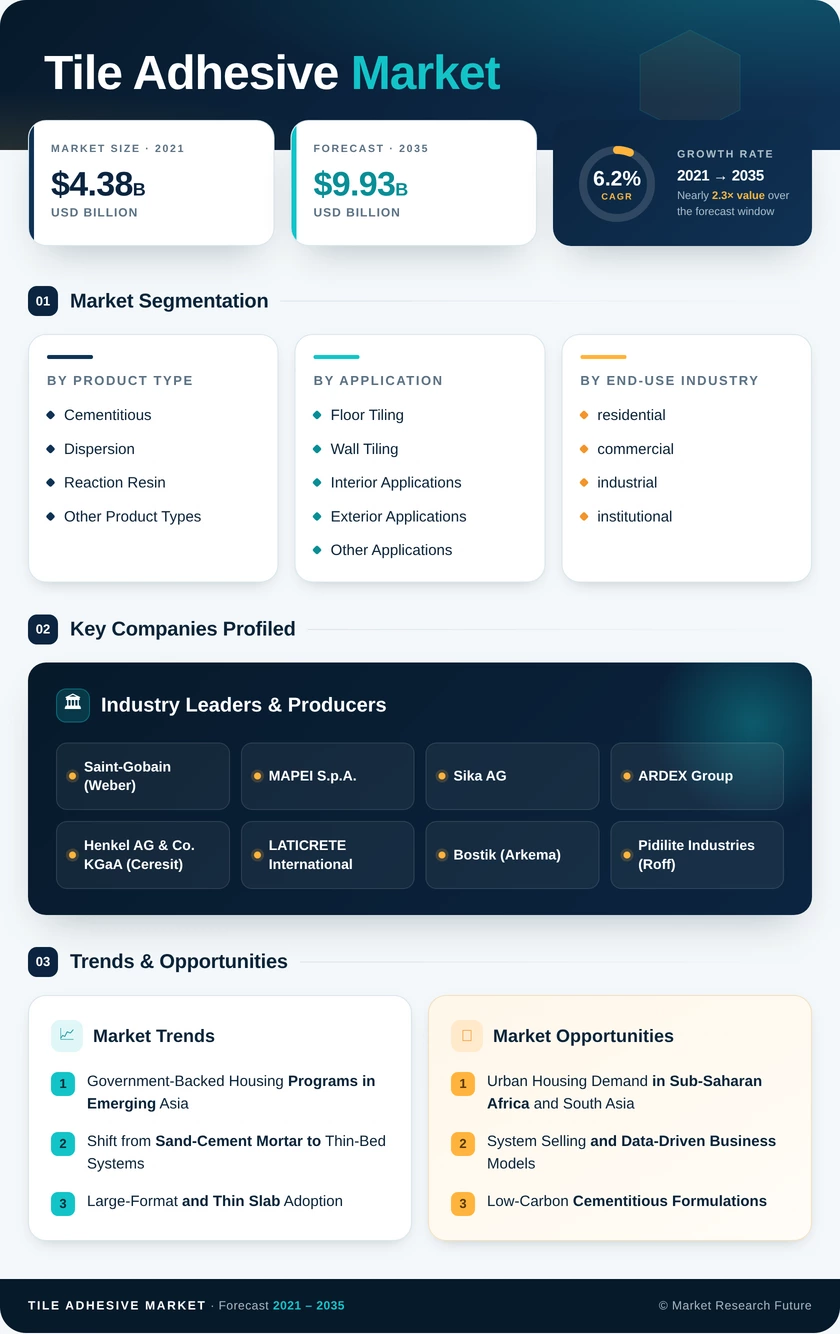
Tile Adhesive Market (2026 - 2035)

ID: MRFR/CnM/1199-CR 111 Pages Chitranshi Jaiswal Last Updated: November 07, 2026
Tile Adhesive Market Research Report Information By Product Type (Cementitious, Dispersion, Reaction Resin, and Other Product Types), By Application (Floor Tiling, Wall Tiling, Interior Applications, Exterior Applications, and Other Applications), By End-Use Industry (Residential, Commercial, Industrial, and Institutional), And By Region (North America, Europe, Asia-Pacific, and Rest of the World) – Market Forecast Till 2035.
Tile Adhesive Market
Market Size
Forecast Period2026-2035
CAGR (2026-2035)6.2%
2025 Market SizeUSD 5.44 Billion
2035 Market SizeUSD 9.93 Billion
Key Players
Saint-Gobain
MAPEI S.p.A.
Sika AG
ARDEX Group
Henkel AG & Co. KGaA
LATICRETE International
Opportunities
  • Urban Housing Demand in Sub-Saharan Africa and South Asia
  • System Selling and Data-Driven Business Models
  • Low-Carbon Cementitious Formulations
  1. 1 Market Summary | |
  2. 2 Key Report Takeaways | |
    1. 2.1 By Product Type | |
    2. 2.2 By Application | |
    3. 2.3 By End-use Industry | |
    4. 2.4 By Region | |
  3. 3 Market Size and Forecast (2021–2035) | |
  4. 4 Driver Impact Analysis | |
    1. 4.1 Government-Backed Housing Programs in Emerging Asia | |
    2. 4.2 Shift from Sand-Cement Mortar to Thin-Bed Systems | |
    3. 4.3 Large-Format and Thin Slab Adoption | |
    4. 4.4 EU Building Renovation Mandates | |
    5. 4.5 Gulf Giga-Projects and Hospitality Construction | |
    6. 4.6 Hygiene and Chemical-Resistance Specifications | |
    7. 4.7 Low-Emission Certification and Green Building Codes | |
  5. 5 Restraints Impact Analysis | |
    1. 5.1 Raw Material and Energy Cost Volatility | |
    2. 5.2 China Property-Sector Contraction | |
    3. 5.3 Persistence of Conventional Mortar in Price-Sensitive Markets | |
    4. 5.4 Skilled Installer Shortages | |
    5. 5.5 Tightening Chemical Regulation for Resin Systems | |
  6. 6 Opportunities | |
    1. 6.1 Urban Housing Demand in Sub-Saharan Africa and South Asia | |
    2. 6.2 System Selling and Data-Driven Business Models | |
    3. 6.3 Low-Carbon Cementitious Formulations | |
    4. 6.4 Ready-to-Use Products for European Renovation | |
    5. 6.5 High-Performance Exterior and Facade Systems | |
  7. 7 Regional Market Share and Country-Level Analysis | |
    1. 7.1 North America | | |
      1. 7.1.1 US | | |
      2. 7.1.2 Canada | | |
      3. 7.1.3 Mexico | |
    2. 7.2 Europe | | |
      1. 7.2.1 Germany | | |
      2. 7.2.2 UK | | |
      3. 7.2.3 France | | |
      4. 7.2.4 Italy | | |
      5. 7.2.5 Spain | | |
      6. 7.2.6 Nordic Countries | | |
      7. 7.2.7 Russia | | |
      8. 7.2.8 Rest of Europe | |
    3. 7.3 Asia-Pacific | | |
      1. 7.3.1 China | | |
      2. 7.3.2 India | | |
      3. 7.3.3 Japan | | |
      4. 7.3.4 South Korea | | |
      5. 7.3.5 ASEAN | | |
      6. 7.3.6 Rest of Asia-Pacific | |
    4. 7.4 South America | | |
      1. 7.4.1 Brazil | | |
      2. 7.4.2 Argentina | | |
      3. 7.4.3 Rest of South America | |
    5. 7.5 Middle East & Africa | | |
      1. 7.5.1 Saudi Arabia | | |
      2. 7.5.2 UAE | | |
      3. 7.5.3 South Africa | | |
      4. 7.5.4 Egypt | | |
      5. 7.5.5 Rest of MEA | |
  8. 8 Future Outlook (2026–2035) | |
    1. 8.1 Urbanization and Housing Delivery at Scale | |
    2. 8.2 Digital Specification and Installer Platforms | |
    3. 8.3 Low-Carbon Formulation and Embodied Carbon Reporting | |
    4. 8.4 Consolidation and System-Based Competition | |
  9. 9 Segmentation Analysis | |
    1. 9.1 By Product Type | | |
      1. 9.1.1 Cementitious | | |
      2. 9.1.2 Dispersion | | |
      3. 9.1.3 Reaction Resin | | |
      4. 9.1.4 Other Product Types | |
    2. 9.2 By Application | | |
      1. 9.2.1 Floor Tiling | | |
      2. 9.2.2 Wall Tiling | | |
      3. 9.2.3 Interior Applications | | |
      4. 9.2.4 Exterior Applications | | |
      5. 9.2.5 Other Applications | |
    3. 9.3 By End-use Industry | | |
      1. 9.3.1 residential | | |
      2. 9.3.2 commercial | | |
      3. 9.3.3 industrial | | |
      4. 9.3.4 institutional | |
  10. 10 Competitive Landscape | |
    1. 10.1 Market Concentration Overview | |
    2. 10.2 Competitive Benchmarking Matrix | |
    3. 10.3 Company Profiles | | |
      1. 10.3.1 Saint-Gobain (Weber) | | |
      2. 10.3.2 MAPEI S.p.A. | | |
      3. 10.3.3 Sika AG | | |
      4. 10.3.4 ARDEX Group | | |
      5. 10.3.5 Henkel AG & Co. KGaA (Ceresit) | | |
      6. 10.3.6 LATICRETE International | | |
      7. 10.3.7 Bostik (Arkema) | | |
      8. 10.3.8 Pidilite Industries (Roff) | | |
      9. 10.3.9 H.B. Fuller (TEC) | | |
      10. 10.3.10 Custom Building Products | |
  11. 11 Recent News & Developments | |
  12. 12 Report Scope and Methodology | |
  13. 13 Detailed Sources and Citations | |
  14. 14 Frequently Asked Questions (FAQs) | | LIST OF TABLES | |
  15. TABLE 1 Global Market Snapshot, 2025–2035 | |
  16. TABLE 2 Global Market Size & Forecast, by Revenue (USD Billion), 2021–2035 | |
  17. TABLE 3 Driver Impact Analysis, 2026–2035 | |
  18. TABLE 4 Restraints Impact Analysis, 2026–2035 | |
  19. TABLE 5 Regional Summary, 2025 | |
  20. TABLE 6 North America, by Country, 2025 | |
  21. TABLE 7 Europe, by Country, 2025 | |
  22. TABLE 8 Asia-Pacific, by Country, 2025 | |
  23. TABLE 9 South America, by Country, 2025 | |
  24. TABLE 10 Middle East & Africa, by Country, 2025 | |
  25. TABLE 11 Global Market, by Product Type, 2025 | |
  26. TABLE 12 Global Market, by Application, 2025 | |
  27. TABLE 13 Global Market, by End-use Industry, 2025 | |
  28. TABLE 14 Competitive Benchmarking Matrix, 2025 | |
  29. TABLE 15 Report Scope and Methodology | |
  30. TABLE 16 Detailed Sources and Citations | |
  31. TABLE 17 Segmentation Quick Reference | |
  32. TABLE 18 Product Type Sub-Segment Trends | |
  33. TABLE 19 Application Sub-Segment Trends | |
  34. TABLE 20 End-use Industry Sub-Segment Trends | | LIST OF FIGURES | |
  35. FIGURE 1 Market Dynamics Overview (Drivers, Restraints, Opportunities) | |
  36. FIGURE 2 Industry Value Chain Analysis | |
  37. FIGURE 3 Porter's Five Forces Analysis | |
  38. FIGURE 4 Global Market Size Trend, 2021–2035 (USD Billion) | |
  39. FIGURE 5 Market Share, by Product Type, 2025 | |
  40. FIGURE 6 Market Share, by Application, 2025 | |
  41. FIGURE 7 Market Share, by End-use Industry, 2025 | |
  42. FIGURE 8 Market Share, by Region, 2025 | |
  43. FIGURE 9 North America Share, by Country, 2025 | |
  44. FIGURE 10 Europe Share, by Country, 2025 | |
  45. FIGURE 11 Asia-Pacific Share, by Country, 2025 | |
  46. FIGURE 12 South America Share, by Country, 2025 | |
  47. FIGURE 13 Middle East & Africa Share, by Country, 2025 | |
  48. FIGURE 14 Competitive Landscape – Estimated Revenue Share Ranges, 2025 | |
  49. FIGURE 15 Competitive Positioning Matrix

Segmentation Quick Reference

DimensionSub-SegmentsDominant SegmentFastest Growing Segment
By Product TypeCementitious; Dispersion; Reaction Resin; Other Product TypesCementitious (45.6% share)Reaction Resin (7.0% CAGR)
By ApplicationFloor Tiling; Wall Tiling; Interior Applications; Exterior Applications; Other ApplicationsFloor Tiling (43.0% share)Exterior Applications (6.8% CAGR)
By End-use Industryresidential; commercial; industrial; institutionalresidential (49.0% share)commercial (6.5% CAGR)
By RegionNorth America; Europe; Asia-Pacific; South America; Middle East & AfricaAsia-Pacific (52.4% share)Asia-Pacific (7.0% CAGR)

Market Segmentation Overview

By Product Type

Sub-SegmentKey Trend
CementitiousPolymer modification extends use to porcelain and large formats
DispersionReady-to-use formats gain in interior renovation
Reaction ResinEpoxy demand rises in hospitals, food plants and pools
Other Product TypesHybrid and polyurethane systems serve niche substrates

Cementitious adhesives lead because they bond reliably to concrete and masonry at a price mass housing can absorb, and polymer modification keeps them relevant as tiles grow larger. Reaction Resin grows fastest since epoxy delivers the chemical resistance and zero absorption that hygiene audits demand. Dispersion products hold a focused interior role where dust-free application outweighs their higher cost.

By Application

Sub-SegmentKey Trend
Floor TilingLarge-format floors require deformable C2 S1 grades
Wall TilingLightweight dispersion and modified cementitious systems in wet rooms
Interior ApplicationsDecorative finishes expand in middle-income homes
Exterior ApplicationsFacades and terraces demand frost and UV resistance
Other ApplicationsPools and engineered stone need precise thermal matching

Floor Tiling leads because tile is the default floor finish in kitchens, bathrooms and lobbies, giving it the broadest demand base. Exterior Applications grow fastest as ventilated facades and terraces require crack-bridging, weather-resistant adhesives that carry higher value. Wall Tiling and Interior Applications remain steady complements tied to wet-room renovation.

By End-use Industry

Sub-SegmentKey Trend
residentialHousing programs in India, Indonesia and Brazil sustain volumes
commercialHotel, retail and office refits adopt large-format porcelain
industrialEpoxy-bonded floors spread in food and pharmaceutical plants
institutionalHospitals and schools prioritize hygiene and durability

The residential segment leads because public housing schemes specify tiled wet areas in every unit, and renovation keeps mature markets active. The commercial segment grows fastest as hospitality and retail owners refit with premium porcelain and stone needing deformable adhesives. Industrial and institutional buyers concentrate spending on high-performance epoxy systems where failure costs are high.


Download PDF ×

We do not share your information with anyone. However, we may send you emails based on your report interest from time to time. You may contact us at any time to opt-out.