
Request Free Sample ×

Kindly complete the form below to receive a free sample of this Report

* Please use a valid business email

Leading companies partner with us for data-driven Insights

clients tt-cursor
Hero Background
English
Chinese
French
Japanese
Korean
German
Spanish

Threat Intelligence Management Market Analysis

ID: MRFR/ICT/4572-HCR
100 Pages
Nirmit Biswas
March 2026

Threat Intelligence Management Market Size, Share and Research Report: By Component (Solutions and Services), By Enterprise Type (SMEs and Large Enterprises), And By Region (North America, Europe, Asia-Pacific, And Rest Of The World) –Market Forecast Till 2035.

Share:
Download PDF ×

We do not share your information with anyone. However, we may send you emails based on your report interest from time to time. You may contact us at any time to opt-out.

Threat Intelligence Management Market Infographic
Purchase Options

Market Analysis

In-depth Analysis of Threat Intelligence Management Market Industry Landscape

One of the main factors is the rising sophistication and frequency of digital threats to associations. The need for threat intelligence management has grown as network security becomes more complex. Proactive threat detection and moderation are driving interest in cutting-edge technology to stay ahead of emerging risks.

Mechanical advances shape the Threat Intelligence Management Market. Digital dangers are always evolving, therefore threat intelligence management must leverage cutting-edge technology for accurate threat identification. Artificial thinking and AI are becoming integrated into these setups, improving their ability to analyze large amounts of data and identify negative trends. As vendors develop increasingly advanced threat intelligence systems, the market evolves.

Administrative compliance greatly affects Threat Intelligence Management. Legislators and administrators are imposing strict information insurance and internet protection rules. Compliance with these rules is a legal obligation and essential to maintaining client confidence. Organizations are investing in threat intelligence management solutions to ensure compliance, avoid legal ramifications, and protect sensitive data from digital attacks.

Threat Intelligence Management market aspects depend on the serious scene. Competition is fierce with many businesses offering shifting threat intelligence agreements. Merchants will differentiate themselves by adding features, including threats, and providing simple interfaces. Merchants constantly improve their solutions to stay ahead in the fast-growing network safety sector.

Finance also affects the Threat Intelligence Management Market. Associations' financial stability affects their ability to invest in network security. During financial instability, firms may decrease costs, which may affect threat intelligence management advances. As economies recover, companies will invest in online security, fueling the Threat Intelligence Management Market.

International events and factors might affect markets. Connections between digital risks suggest that associations have similar vulnerabilities. Major digital events and worldwide pressures can increase awareness and urgency among enterprises to protect their network security, boosting threat intelligence management interest.

Threat Intelligence Management vendors must consider customer preferences and industry requirements. Some enterprises have particular danger situations and compliance demands. Threat intelligence sellers should tailor their solutions to these needs in banking, healthcare, government, and other fields. Sellers must understand and manage these industry nuances to get an edge and satisfy customer needs.


Author
Author Profile
Nirmit Biswas
Senior Research Analyst

With 5+ years of expertise in Market Intelligence and Strategic Research, Nirmit Biswas specializes in ICT, Semiconductors, and BFSI. Backed by an MBA in Financial Services and a Computer Science foundation, Nirmit blends technical depth with business acumen. He has successfully led 100+ projects for global enterprises and startups, including Amazon, Cisco, L&T and Huawei, delivering market estimations, competitive benchmarking, and GTM strategies. His focus lies in transforming complex data into clear, actionable insights that drive growth, innovation, and investment decisions. Recognized for bridging engineering innovation with executive strategy, Nirmit helps businesses navigate dynamic markets with confidence.

Leave a Comment

FAQs

What is the current valuation of the Threat Intelligence Management Market?

<p>The Threat Intelligence Management Market was valued at 10.3 USD Billion in 2024.</p>

What is the projected market size for the Threat Intelligence Management Market by 2035?

<p>The market is projected to reach 32.78 USD Billion by 2035.</p>

What is the expected CAGR for the Threat Intelligence Management Market during the forecast period?

<p>The expected CAGR for the Threat Intelligence Management Market from 2025 to 2035 is 11.1%.</p>

Which companies are considered key players in the Threat Intelligence Management Market?

<p>Key players include CrowdStrike, FireEye, Palo Alto Networks, IBM, Cisco, McAfee, ThreatConnect, Recorded Future, Digital Shadows, and Anomali.</p>

How are the components of the Threat Intelligence Management Market segmented?

<p>The market is segmented into Solutions, valued at 19.56 USD Billion, and Services, valued at 13.22 USD Billion.</p>

What is the market segmentation based on enterprise type?

<p>The market is segmented into SMEs, valued at 8.06 USD Billion, and Large Enterprises, valued at 24.72 USD Billion.</p>

How does the market valuation in 2024 compare to the projected valuation in 2035?

The market valuation in 2024 was 10.3 USD Billion, which is expected to grow to 32.78 USD Billion by 2035.

What trends are influencing the growth of the Threat Intelligence Management Market?

The growth appears to be influenced by increasing cyber threats and the need for advanced security solutions.

What role do key players like IBM and Cisco play in the market?

Companies like IBM and Cisco are likely to lead the market through innovative solutions and robust service offerings.

What factors contribute to the projected growth of the Threat Intelligence Management Market?

Factors contributing to growth may include rising demand for cybersecurity solutions and advancements in threat detection technologies.

Market Summary

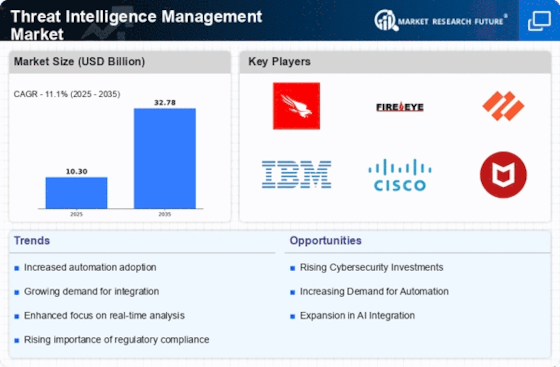
As per Market Research Future analysis, the Threat Intelligence Management Market Size was estimated at 10.3 USD Billion in 2024. The Threat Intelligence Management industry is projected to grow from 11.44 USD Billion in 2025 to 32.78 USD Billion by 2035, exhibiting a compound annual growth rate (CAGR) of 11.1% during the forecast period 2025 - 2035

Key Market Trends & Highlights

The Threat Intelligence Management Market is experiencing robust growth driven by technological advancements and increasing cybersecurity concerns.

  • The integration of Artificial Intelligence is transforming threat detection and response capabilities across the market. Real-time threat intelligence is becoming a focal point for organizations aiming to enhance their security posture. Collaboration and information sharing among stakeholders are fostering a more resilient cybersecurity ecosystem. Rising cybersecurity threats and regulatory compliance requirements are key drivers propelling market expansion, particularly in North America and Asia-Pacific, with solutions for large enterprises leading the way and services for SMEs growing rapidly.

Market Size & Forecast

2024 Market Size 10.3 (USD Billion)
2035 Market Size 32.78 (USD Billion)
CAGR (2025 - 2035) 11.1%
Largest Regional Market Share in 2024 North America

Major Players

CrowdStrike (US), FireEye (US), Palo Alto Networks (US), IBM (US), Cisco (US), McAfee (US), ThreatConnect (US), Recorded Future (US), Digital Shadows (GB), Anomali (US)

Market Trends

The Threat Intelligence Management Market is currently experiencing a dynamic evolution, driven by the increasing complexity of cyber threats and the growing need for organizations to enhance their security posture. As businesses become more reliant on digital infrastructure, the demand for robust threat intelligence solutions appears to be escalating. Organizations are recognizing the necessity of proactive measures to identify, analyze, and mitigate potential threats. This shift towards a more strategic approach to cybersecurity is fostering innovation within the market, as vendors strive to offer comprehensive solutions that integrate seamlessly with existing security frameworks. Moreover, the landscape of the Threat Intelligence Management Market is characterized by a diverse array of players, ranging from established technology firms to emerging startups. This diversity suggests a competitive environment where collaboration and partnerships may become increasingly vital. As organizations seek to leverage advanced technologies such as artificial intelligence and machine learning, the market is likely to witness a surge in the development of sophisticated tools that can provide actionable insights. The emphasis on real-time threat detection and response capabilities is expected to shape the future trajectory of the market, as businesses aim to stay ahead of evolving threats and safeguard their assets effectively.

Integration of Artificial Intelligence

The integration of artificial intelligence into threat intelligence management solutions is becoming more prevalent. AI technologies can enhance the ability to analyze vast amounts of data, identify patterns, and predict potential threats. This trend indicates a shift towards more automated and efficient threat detection processes, allowing organizations to respond swiftly to emerging risks.

Focus on Real-Time Threat Intelligence

There is a growing emphasis on real-time threat intelligence within the market. Organizations are increasingly seeking solutions that provide immediate insights into potential threats, enabling them to act quickly. This trend suggests a move away from traditional, static intelligence models towards more dynamic and responsive frameworks.

Collaboration and Information Sharing

Collaboration among organizations and information sharing regarding threats is gaining traction. This trend highlights the importance of collective defense strategies, where entities work together to enhance their threat intelligence capabilities. Such partnerships may lead to improved situational awareness and a more robust defense against cyber threats.

Threat Intelligence Management Market Market Drivers

Rising Cybersecurity Threats

The increasing frequency and sophistication of cyber threats is a primary driver for the Threat Intelligence Management Market. Organizations are facing a surge in cyberattacks, including ransomware, phishing, and advanced persistent threats. According to recent data, the global cost of cybercrime is projected to reach trillions of dollars annually, compelling businesses to invest in robust threat intelligence solutions. This heightened awareness of cybersecurity risks has led to a growing demand for threat intelligence management tools that can provide timely and actionable insights. As organizations strive to protect their assets and maintain customer trust, the need for effective threat intelligence management becomes paramount, driving market growth.

Adoption of Cloud-Based Solutions

The shift towards cloud computing is reshaping the Threat Intelligence Management Market. Organizations are increasingly adopting cloud-based threat intelligence solutions due to their scalability, flexibility, and cost-effectiveness. The cloud enables real-time data sharing and collaboration, allowing organizations to respond swiftly to emerging threats. Market data indicates that the cloud segment is anticipated to witness substantial growth, with many businesses migrating their threat intelligence operations to cloud platforms. This transition not only enhances operational efficiency but also facilitates the integration of advanced analytics and machine learning capabilities, further driving the demand for threat intelligence management solutions.

Growing Importance of Data Privacy

The rising emphasis on data privacy is a critical driver for the Threat Intelligence Management Market. As consumers become more aware of their data rights, organizations are compelled to prioritize data protection measures. This shift is prompting businesses to invest in threat intelligence management solutions that can help identify and mitigate potential data breaches. The market is witnessing an increase in demand for tools that provide insights into data vulnerabilities and threats. Furthermore, as data privacy regulations become more stringent, organizations are likely to enhance their threat intelligence capabilities to ensure compliance and protect sensitive information, thereby fueling market growth.

Regulatory Compliance Requirements

The evolving landscape of regulatory compliance is significantly influencing the Threat Intelligence Management Market. Organizations are increasingly required to adhere to stringent regulations regarding data protection and cybersecurity. Compliance frameworks such as GDPR, HIPAA, and PCI DSS necessitate the implementation of comprehensive threat intelligence strategies. Failure to comply can result in severe penalties and reputational damage. As a result, businesses are investing in threat intelligence management solutions to ensure they meet these regulatory requirements. The market is expected to expand as organizations seek to align their cybersecurity practices with compliance mandates, thereby enhancing their overall security posture.

Increased Investment in Cybersecurity

The escalating investment in cybersecurity initiatives is a significant factor propelling the Threat Intelligence Management Market. Organizations are recognizing the critical need to bolster their cybersecurity defenses in light of the growing threat landscape. Recent reports indicate that global spending on cybersecurity is projected to exceed hundreds of billions of dollars in the coming years. This surge in investment is driving the adoption of advanced threat intelligence management solutions that can provide organizations with the necessary tools to detect, analyze, and respond to threats effectively. As businesses allocate more resources to cybersecurity, the demand for threat intelligence management solutions is expected to rise, further contributing to market expansion.

Market Segment Insights

By Component: Solutions (Largest) vs. Services (Fastest-Growing)

In the Threat Intelligence Management Market, the distribution of market share among the component segment values reveals that Solutions consistently hold the largest share. This dominance is attributed to the increasing demand for advanced cybersecurity measures and integrated threat management capabilities, which push organizations toward adopting comprehensive solutions. On the other hand, Services are witnessing rapid growth, driven by the need for expert analysis and real-time threat assessment, making them crucial for organizations looking to bolster their security posture.

Components: Solutions (Dominant) vs. Services (Emerging)

Solutions are characterized by their robust, comprehensive offerings that integrate various threat intelligence features, enabling organizations to proactively identify and respond to potential cyber threats. This dominant position is supported by advancements in artificial intelligence and machine learning, which enhance the effectiveness of these solutions. Conversely, Services are emerging as a critical area in the market. They provide flexibility and personalized security strategies, tapping into the expertise of cybersecurity professionals. The shift towards managed services and outsourced threat intelligence is fostering growth in this segment, as more organizations seek specialized support to navigate the complex threat landscape.

By Enterprise Type: Large Enterprises (Largest) vs. SMEs (Fastest-Growing)

In the Threat Intelligence Management Market, the distribution of market share between Large Enterprises and Small and Medium Enterprises (SMEs) showcases a clear dominance of the former. Large Enterprises account for a substantial portion, attributed to their robust infrastructure and capacity to invest in comprehensive threat intelligence solutions. SMEs, while currently holding a smaller share, are rapidly gaining traction due to their increasing awareness of cybersecurity threats and the growing necessity for protective measures. The growth trends in Threat Intelligence Management Market are significantly influenced by the rising number of cyber threats and the evolving landscape of digital security. Large Enterprises are enhancing their threat management capabilities to mitigate complex risks, while SMEs are recognizing the need for effective solutions, propelled by increasing reliance on digital operations. This trend signifies a shift towards greater investment in threat intelligence by organizations of all sizes, indicating strong potential for future growth in this market segment.

Enterprise Type: Large Enterprises (Dominant) vs. SMEs (Emerging)

Large Enterprises in the Threat Intelligence Management Market are characterized by their advanced technological capabilities and extensive resources, enabling them to implement comprehensive threat intelligence strategies. They typically possess dedicated security teams and advanced systems to monitor, analyze, and respond to threats proactively. On the other hand, SMEs are emerging as a vital segment within this market, driven by their need for affordable and effective threat intelligence solutions. They often seek managed services or cloud-based solutions that provide flexibility and scalability, allowing them to secure their operations without the burden of significant investments in infrastructure. The contrast between these segments highlights a dynamic landscape where large players continue to innovate while smaller enterprises adapt to the realities of an increasingly hostile cyber environment.

Get more detailed insights about Threat Intelligence Management Market Research Report – Forecast till 2035

Regional Insights

North America : Cybersecurity Leadership and Innovation

North America is the largest market for Threat Intelligence Management Market, holding approximately 45% of the global share. The region's growth is driven by increasing cyber threats, regulatory requirements, and a strong focus on innovation. The demand for advanced threat detection and response solutions is rising, fueled by government initiatives and investments in cybersecurity infrastructure. The United States is the leading country in this market, with major players like CrowdStrike, FireEye, and Palo Alto Networks headquartered there. The competitive landscape is characterized by rapid technological advancements and strategic partnerships among key players. Canada also plays a significant role, contributing to the region's overall market strength.

Europe : Regulatory Framework and Growth

Europe is the second-largest market for Threat Intelligence Management Market, accounting for around 30% of the global market share. The region's growth is propelled by stringent data protection regulations like GDPR, which mandate robust cybersecurity measures. Additionally, the increasing frequency of cyberattacks has heightened the demand for threat intelligence solutions across various sectors. Leading countries in this region include the United Kingdom, Germany, and France, where companies are investing heavily in cybersecurity. The competitive landscape features key players such as Digital Shadows and Anomali, which are enhancing their offerings to meet regulatory requirements and combat evolving threats. The European market is characterized by a collaborative approach among businesses and governments to strengthen cybersecurity resilience.

Asia-Pacific : Rapid Growth and Adoption

Asia-Pacific is witnessing rapid growth in the Threat Intelligence Management Market, holding approximately 20% of the global share. The region's expansion is driven by increasing digital transformation initiatives, rising cyber threats, and government support for cybersecurity frameworks. Countries like China and India are leading this growth, with significant investments in cybersecurity infrastructure and talent development. The competitive landscape is evolving, with local players emerging alongside global giants. Key players such as IBM and Cisco are expanding their presence in the region, catering to the growing demand for advanced threat intelligence solutions. The focus on enhancing cybersecurity capabilities is evident as organizations prioritize risk management and compliance with international standards.

Middle East and Africa : Growing Awareness and Investment

The Middle East and Africa region is gradually emerging in the Threat Intelligence Management Market, holding about 5% of the global share. The growth is driven by increasing awareness of cybersecurity threats and the need for robust defense mechanisms. Governments are investing in cybersecurity initiatives, recognizing the importance of protecting critical infrastructure and sensitive data. Countries like the UAE and South Africa are at the forefront of this growth, with initiatives aimed at enhancing cybersecurity capabilities. The competitive landscape is characterized by a mix of local and international players, with a focus on tailored solutions to meet regional challenges. As organizations prioritize cybersecurity, the market is expected to expand significantly in the coming years.

Key Players and Competitive Insights

The Threat Intelligence Management Market is currently characterized by a dynamic competitive landscape, driven by the increasing sophistication of cyber threats and the growing demand for proactive security measures. Major players such as CrowdStrike (US), FireEye (US), and Palo Alto Networks (US) are strategically positioned to leverage their technological innovations and extensive threat intelligence capabilities. These companies focus on enhancing their product offerings through continuous innovation, strategic partnerships, and regional expansions, thereby shaping a competitive environment that emphasizes agility and responsiveness to emerging threats.In terms of business tactics, companies are increasingly localizing their operations and optimizing supply chains to enhance service delivery and responsiveness. The market appears moderately fragmented, with a mix of established players and emerging startups. This fragmentation allows for diverse offerings and competitive pricing, yet the collective influence of key players like IBM (US) and Cisco (US) tends to dominate market trends and customer preferences.
In August CrowdStrike (US) announced a strategic partnership with a leading cloud service provider to enhance its threat intelligence capabilities. This collaboration aims to integrate advanced machine learning algorithms into its platform, thereby improving real-time threat detection and response. The strategic importance of this partnership lies in its potential to bolster CrowdStrike's competitive edge by offering clients more robust and scalable security solutions, aligning with the growing trend of cloud adoption in cybersecurity.
In September FireEye (US) launched a new threat intelligence platform that utilizes AI-driven analytics to provide deeper insights into cyber threats. This initiative reflects FireEye's commitment to innovation and its focus on delivering actionable intelligence to clients. The introduction of this platform is likely to enhance FireEye's market position by attracting organizations seeking advanced analytical capabilities to combat increasingly complex cyber threats.
In July Palo Alto Networks (US) expanded its global footprint by acquiring a European cybersecurity firm specializing in threat intelligence. This acquisition not only strengthens Palo Alto's service offerings but also enhances its ability to address regional security challenges. The strategic move underscores the importance of geographic expansion in the competitive landscape, allowing Palo Alto to tap into new markets and diversify its client base.
As of October the competitive trends in the Threat Intelligence Management Market are increasingly defined by digitalization, AI integration, and a focus on sustainability. Strategic alliances are becoming pivotal in shaping the landscape, as companies seek to combine their strengths to deliver comprehensive solutions. Looking ahead, competitive differentiation is likely to evolve from traditional price-based competition to a focus on innovation, technological advancements, and supply chain reliability, reflecting the industry's shift towards more sophisticated and integrated security solutions.

Key Companies in the Threat Intelligence Management Market include

Industry Developments

August 2022: National Cyber Crypto Agency of Indonesia and Microsoft entered into a partnership in order to work under the Cyber Threat Intelligence Program of Microsoft. This partnership helped BSSN access the cyber threat intelligence of Microsoft in Indonesia and offer greater insight into the cyber infrastructure of criminals.

October 2021: The launch of its exceptional Cyberthreat Intelligence solutions by Blackberry Limited at the Blackberry Security Summit. It is fabricated to assist the organization detect and respond to cyberattacks. The solution offers threat intelligence that details the latest cyberattacks, threat actors, and malicious campaigns.

August 2017: Trend Micro acquired Synkn in order to make widespread security teams helping them to manage the threats related to open-source threat intelligence software.

Future Outlook

Threat Intelligence Management Market Future Outlook

The Threat Intelligence Management Market is projected to grow at 11.1% CAGR from 2025 to 2035, driven by increasing cyber threats, regulatory compliance, and demand for proactive security measures.

New opportunities lie in:

  • <p>Development of AI-driven threat detection platforms Expansion of managed threat intelligence services Integration of threat intelligence with IoT security solutions</p>

By 2035, the market is expected to be robust, reflecting substantial growth and innovation.

Market Segmentation

Threat Intelligence Management Market Component Outlook

  • Solutions
  • Services

Threat Intelligence Management Market Enterprise Type Outlook

  • SMEs
  • Large Enterprises

Report Scope

MARKET SIZE 2024 10.3(USD Billion)
MARKET SIZE 2025 11.44(USD Billion)
MARKET SIZE 2035 32.78(USD Billion)
COMPOUND ANNUAL GROWTH RATE (CAGR) 11.1% (2025 - 2035)
REPORT COVERAGE Revenue Forecast, Competitive Landscape, Growth Factors, and Trends
BASE YEAR 2024
Market Forecast Period 2025 - 2035
Historical Data 2019 - 2024
Market Forecast Units USD Billion
Key Companies Profiled CrowdStrike (US), FireEye (US), Palo Alto Networks (US), IBM (US), Cisco (US), McAfee (US), ThreatConnect (US), Recorded Future (US), Digital Shadows (GB), Anomali (US)
Segments Covered Component, Enterprise Type, Region
Key Market Opportunities Integration of artificial intelligence enhances proactive threat detection in the Threat Intelligence Management Market.
Key Market Dynamics Rising demand for proactive cybersecurity measures drives innovation and competition in the Threat Intelligence Management Market.
Countries Covered North America, Europe, APAC, South America, MEA

FAQs

What is the current valuation of the Threat Intelligence Management Market?

<p>The Threat Intelligence Management Market was valued at 10.3 USD Billion in 2024.</p>

What is the projected market size for the Threat Intelligence Management Market by 2035?

<p>The market is projected to reach 32.78 USD Billion by 2035.</p>

What is the expected CAGR for the Threat Intelligence Management Market during the forecast period?

<p>The expected CAGR for the Threat Intelligence Management Market from 2025 to 2035 is 11.1%.</p>

Which companies are considered key players in the Threat Intelligence Management Market?

<p>Key players include CrowdStrike, FireEye, Palo Alto Networks, IBM, Cisco, McAfee, ThreatConnect, Recorded Future, Digital Shadows, and Anomali.</p>

How are the components of the Threat Intelligence Management Market segmented?

<p>The market is segmented into Solutions, valued at 19.56 USD Billion, and Services, valued at 13.22 USD Billion.</p>

What is the market segmentation based on enterprise type?

<p>The market is segmented into SMEs, valued at 8.06 USD Billion, and Large Enterprises, valued at 24.72 USD Billion.</p>

How does the market valuation in 2024 compare to the projected valuation in 2035?

The market valuation in 2024 was 10.3 USD Billion, which is expected to grow to 32.78 USD Billion by 2035.

What trends are influencing the growth of the Threat Intelligence Management Market?

The growth appears to be influenced by increasing cyber threats and the need for advanced security solutions.

What role do key players like IBM and Cisco play in the market?

Companies like IBM and Cisco are likely to lead the market through innovative solutions and robust service offerings.

What factors contribute to the projected growth of the Threat Intelligence Management Market?

Factors contributing to growth may include rising demand for cybersecurity solutions and advancements in threat detection technologies.

  1. SECTION I: EXECUTIVE SUMMARY AND KEY HIGHLIGHTS
    1. | 1.1 EXECUTIVE SUMMARY
    2. | | 1.1.1 Market Overview
    3. | | 1.1.2 Key Findings
    4. | | 1.1.3 Market Segmentation
    5. | | 1.1.4 Competitive Landscape
    6. | | 1.1.5 Challenges and Opportunities
    7. | | 1.1.6 Future Outlook
  2. SECTION II: SCOPING, METHODOLOGY AND MARKET STRUCTURE
    1. | 2.1 MARKET INTRODUCTION
    2. | | 2.1.1 Definition
    3. | | 2.1.2 Scope of the study
    4. | | | 2.1.2.1 Research Objective
    5. | | | 2.1.2.2 Assumption
    6. | | | 2.1.2.3 Limitations
    7. | 2.2 RESEARCH METHODOLOGY
    8. | | 2.2.1 Overview
    9. | | 2.2.2 Data Mining
    10. | | 2.2.3 Secondary Research
    11. | | 2.2.4 Primary Research
    12. | | | 2.2.4.1 Primary Interviews and Information Gathering Process
    13. | | | 2.2.4.2 Breakdown of Primary Respondents
    14. | | 2.2.5 Forecasting Model
    15. | | 2.2.6 Market Size Estimation
    16. | | | 2.2.6.1 Bottom-Up Approach
    17. | | | 2.2.6.2 Top-Down Approach
    18. | | 2.2.7 Data Triangulation
    19. | | 2.2.8 Validation
  3. SECTION III: QUALITATIVE ANALYSIS
    1. | 3.1 MARKET DYNAMICS
    2. | | 3.1.1 Overview
    3. | | 3.1.2 Drivers
    4. | | 3.1.3 Restraints
    5. | | 3.1.4 Opportunities
    6. | 3.2 MARKET FACTOR ANALYSIS
    7. | | 3.2.1 Value chain Analysis
    8. | | 3.2.2 Porter's Five Forces Analysis
    9. | | | 3.2.2.1 Bargaining Power of Suppliers
    10. | | | 3.2.2.2 Bargaining Power of Buyers
    11. | | | 3.2.2.3 Threat of New Entrants
    12. | | | 3.2.2.4 Threat of Substitutes
    13. | | | 3.2.2.5 Intensity of Rivalry
    14. | | 3.2.3 COVID-19 Impact Analysis
    15. | | | 3.2.3.1 Market Impact Analysis
    16. | | | 3.2.3.2 Regional Impact
    17. | | | 3.2.3.3 Opportunity and Threat Analysis
  4. SECTION IV: QUANTITATIVE ANALYSIS
    1. | 4.1 Information and Communications Technology, BY Component (USD Billion)
    2. | | 4.1.1 Solutions
    3. | | 4.1.2 Services
    4. | 4.2 Information and Communications Technology, BY Enterprise Type (USD Billion)
    5. | | 4.2.1 SMEs
    6. | | 4.2.2 Large Enterprises
    7. | 4.3 Information and Communications Technology, BY Region (USD Billion)
    8. | | 4.3.1 North America
    9. | | | 4.3.1.1 US
    10. | | | 4.3.1.2 Canada
    11. | | 4.3.2 Europe
    12. | | | 4.3.2.1 Germany
    13. | | | 4.3.2.2 UK
    14. | | | 4.3.2.3 France
    15. | | | 4.3.2.4 Russia
    16. | | | 4.3.2.5 Italy
    17. | | | 4.3.2.6 Spain
    18. | | | 4.3.2.7 Rest of Europe
    19. | | 4.3.3 APAC
    20. | | | 4.3.3.1 China
    21. | | | 4.3.3.2 India
    22. | | | 4.3.3.3 Japan
    23. | | | 4.3.3.4 South Korea
    24. | | | 4.3.3.5 Malaysia
    25. | | | 4.3.3.6 Thailand
    26. | | | 4.3.3.7 Indonesia
    27. | | | 4.3.3.8 Rest of APAC
    28. | | 4.3.4 South America
    29. | | | 4.3.4.1 Brazil
    30. | | | 4.3.4.2 Mexico
    31. | | | 4.3.4.3 Argentina
    32. | | | 4.3.4.4 Rest of South America
    33. | | 4.3.5 MEA
    34. | | | 4.3.5.1 GCC Countries
    35. | | | 4.3.5.2 South Africa
    36. | | | 4.3.5.3 Rest of MEA
  5. SECTION V: COMPETITIVE ANALYSIS
    1. | 5.1 Competitive Landscape
    2. | | 5.1.1 Overview
    3. | | 5.1.2 Competitive Analysis
    4. | | 5.1.3 Market share Analysis
    5. | | 5.1.4 Major Growth Strategy in the Information and Communications Technology
    6. | | 5.1.5 Competitive Benchmarking
    7. | | 5.1.6 Leading Players in Terms of Number of Developments in the Information and Communications Technology
    8. | | 5.1.7 Key developments and growth strategies
    9. | | | 5.1.7.1 New Product Launch/Service Deployment
    10. | | | 5.1.7.2 Merger & Acquisitions
    11. | | | 5.1.7.3 Joint Ventures
    12. | | 5.1.8 Major Players Financial Matrix
    13. | | | 5.1.8.1 Sales and Operating Income
    14. | | | 5.1.8.2 Major Players R&D Expenditure. 2023
    15. | 5.2 Company Profiles
    16. | | 5.2.1 CrowdStrike (US)
    17. | | | 5.2.1.1 Financial Overview
    18. | | | 5.2.1.2 Products Offered
    19. | | | 5.2.1.3 Key Developments
    20. | | | 5.2.1.4 SWOT Analysis
    21. | | | 5.2.1.5 Key Strategies
    22. | | 5.2.2 FireEye (US)
    23. | | | 5.2.2.1 Financial Overview
    24. | | | 5.2.2.2 Products Offered
    25. | | | 5.2.2.3 Key Developments
    26. | | | 5.2.2.4 SWOT Analysis
    27. | | | 5.2.2.5 Key Strategies
    28. | | 5.2.3 Palo Alto Networks (US)
    29. | | | 5.2.3.1 Financial Overview
    30. | | | 5.2.3.2 Products Offered
    31. | | | 5.2.3.3 Key Developments
    32. | | | 5.2.3.4 SWOT Analysis
    33. | | | 5.2.3.5 Key Strategies
    34. | | 5.2.4 IBM (US)
    35. | | | 5.2.4.1 Financial Overview
    36. | | | 5.2.4.2 Products Offered
    37. | | | 5.2.4.3 Key Developments
    38. | | | 5.2.4.4 SWOT Analysis
    39. | | | 5.2.4.5 Key Strategies
    40. | | 5.2.5 Cisco (US)
    41. | | | 5.2.5.1 Financial Overview
    42. | | | 5.2.5.2 Products Offered
    43. | | | 5.2.5.3 Key Developments
    44. | | | 5.2.5.4 SWOT Analysis
    45. | | | 5.2.5.5 Key Strategies
    46. | | 5.2.6 McAfee (US)
    47. | | | 5.2.6.1 Financial Overview
    48. | | | 5.2.6.2 Products Offered
    49. | | | 5.2.6.3 Key Developments
    50. | | | 5.2.6.4 SWOT Analysis
    51. | | | 5.2.6.5 Key Strategies
    52. | | 5.2.7 ThreatConnect (US)
    53. | | | 5.2.7.1 Financial Overview
    54. | | | 5.2.7.2 Products Offered
    55. | | | 5.2.7.3 Key Developments
    56. | | | 5.2.7.4 SWOT Analysis
    57. | | | 5.2.7.5 Key Strategies
    58. | | 5.2.8 Recorded Future (US)
    59. | | | 5.2.8.1 Financial Overview
    60. | | | 5.2.8.2 Products Offered
    61. | | | 5.2.8.3 Key Developments
    62. | | | 5.2.8.4 SWOT Analysis
    63. | | | 5.2.8.5 Key Strategies
    64. | | 5.2.9 Digital Shadows (GB)
    65. | | | 5.2.9.1 Financial Overview
    66. | | | 5.2.9.2 Products Offered
    67. | | | 5.2.9.3 Key Developments
    68. | | | 5.2.9.4 SWOT Analysis
    69. | | | 5.2.9.5 Key Strategies
    70. | | 5.2.10 Anomali (US)
    71. | | | 5.2.10.1 Financial Overview
    72. | | | 5.2.10.2 Products Offered
    73. | | | 5.2.10.3 Key Developments
    74. | | | 5.2.10.4 SWOT Analysis
    75. | | | 5.2.10.5 Key Strategies
    76. | 5.3 Appendix
    77. | | 5.3.1 References
    78. | | 5.3.2 Related Reports
  6. LIST OF FIGURES
    1. | 6.1 MARKET SYNOPSIS
    2. | 6.2 NORTH AMERICA MARKET ANALYSIS
    3. | 6.3 US MARKET ANALYSIS BY COMPONENT
    4. | 6.4 US MARKET ANALYSIS BY ENTERPRISE TYPE
    5. | 6.5 CANADA MARKET ANALYSIS BY COMPONENT
    6. | 6.6 CANADA MARKET ANALYSIS BY ENTERPRISE TYPE
    7. | 6.7 EUROPE MARKET ANALYSIS
    8. | 6.8 GERMANY MARKET ANALYSIS BY COMPONENT
    9. | 6.9 GERMANY MARKET ANALYSIS BY ENTERPRISE TYPE
    10. | 6.10 UK MARKET ANALYSIS BY COMPONENT
    11. | 6.11 UK MARKET ANALYSIS BY ENTERPRISE TYPE
    12. | 6.12 FRANCE MARKET ANALYSIS BY COMPONENT
    13. | 6.13 FRANCE MARKET ANALYSIS BY ENTERPRISE TYPE
    14. | 6.14 RUSSIA MARKET ANALYSIS BY COMPONENT
    15. | 6.15 RUSSIA MARKET ANALYSIS BY ENTERPRISE TYPE
    16. | 6.16 ITALY MARKET ANALYSIS BY COMPONENT
    17. | 6.17 ITALY MARKET ANALYSIS BY ENTERPRISE TYPE
    18. | 6.18 SPAIN MARKET ANALYSIS BY COMPONENT
    19. | 6.19 SPAIN MARKET ANALYSIS BY ENTERPRISE TYPE
    20. | 6.20 REST OF EUROPE MARKET ANALYSIS BY COMPONENT
    21. | 6.21 REST OF EUROPE MARKET ANALYSIS BY ENTERPRISE TYPE
    22. | 6.22 APAC MARKET ANALYSIS
    23. | 6.23 CHINA MARKET ANALYSIS BY COMPONENT
    24. | 6.24 CHINA MARKET ANALYSIS BY ENTERPRISE TYPE
    25. | 6.25 INDIA MARKET ANALYSIS BY COMPONENT
    26. | 6.26 INDIA MARKET ANALYSIS BY ENTERPRISE TYPE
    27. | 6.27 JAPAN MARKET ANALYSIS BY COMPONENT
    28. | 6.28 JAPAN MARKET ANALYSIS BY ENTERPRISE TYPE
    29. | 6.29 SOUTH KOREA MARKET ANALYSIS BY COMPONENT
    30. | 6.30 SOUTH KOREA MARKET ANALYSIS BY ENTERPRISE TYPE
    31. | 6.31 MALAYSIA MARKET ANALYSIS BY COMPONENT
    32. | 6.32 MALAYSIA MARKET ANALYSIS BY ENTERPRISE TYPE
    33. | 6.33 THAILAND MARKET ANALYSIS BY COMPONENT
    34. | 6.34 THAILAND MARKET ANALYSIS BY ENTERPRISE TYPE
    35. | 6.35 INDONESIA MARKET ANALYSIS BY COMPONENT
    36. | 6.36 INDONESIA MARKET ANALYSIS BY ENTERPRISE TYPE
    37. | 6.37 REST OF APAC MARKET ANALYSIS BY COMPONENT
    38. | 6.38 REST OF APAC MARKET ANALYSIS BY ENTERPRISE TYPE
    39. | 6.39 SOUTH AMERICA MARKET ANALYSIS
    40. | 6.40 BRAZIL MARKET ANALYSIS BY COMPONENT
    41. | 6.41 BRAZIL MARKET ANALYSIS BY ENTERPRISE TYPE
    42. | 6.42 MEXICO MARKET ANALYSIS BY COMPONENT
    43. | 6.43 MEXICO MARKET ANALYSIS BY ENTERPRISE TYPE
    44. | 6.44 ARGENTINA MARKET ANALYSIS BY COMPONENT
    45. | 6.45 ARGENTINA MARKET ANALYSIS BY ENTERPRISE TYPE
    46. | 6.46 REST OF SOUTH AMERICA MARKET ANALYSIS BY COMPONENT
    47. | 6.47 REST OF SOUTH AMERICA MARKET ANALYSIS BY ENTERPRISE TYPE
    48. | 6.48 MEA MARKET ANALYSIS
    49. | 6.49 GCC COUNTRIES MARKET ANALYSIS BY COMPONENT
    50. | 6.50 GCC COUNTRIES MARKET ANALYSIS BY ENTERPRISE TYPE
    51. | 6.51 SOUTH AFRICA MARKET ANALYSIS BY COMPONENT
    52. | 6.52 SOUTH AFRICA MARKET ANALYSIS BY ENTERPRISE TYPE
    53. | 6.53 REST OF MEA MARKET ANALYSIS BY COMPONENT
    54. | 6.54 REST OF MEA MARKET ANALYSIS BY ENTERPRISE TYPE
    55. | 6.55 KEY BUYING CRITERIA OF INFORMATION AND COMMUNICATIONS TECHNOLOGY
    56. | 6.56 RESEARCH PROCESS OF MRFR
    57. | 6.57 DRO ANALYSIS OF INFORMATION AND COMMUNICATIONS TECHNOLOGY
    58. | 6.58 DRIVERS IMPACT ANALYSIS: INFORMATION AND COMMUNICATIONS TECHNOLOGY
    59. | 6.59 RESTRAINTS IMPACT ANALYSIS: INFORMATION AND COMMUNICATIONS TECHNOLOGY
    60. | 6.60 SUPPLY / VALUE CHAIN: INFORMATION AND COMMUNICATIONS TECHNOLOGY
    61. | 6.61 INFORMATION AND COMMUNICATIONS TECHNOLOGY, BY COMPONENT, 2024 (% SHARE)
    62. | 6.62 INFORMATION AND COMMUNICATIONS TECHNOLOGY, BY COMPONENT, 2024 TO 2035 (USD Billion)
    63. | 6.63 INFORMATION AND COMMUNICATIONS TECHNOLOGY, BY ENTERPRISE TYPE, 2024 (% SHARE)
    64. | 6.64 INFORMATION AND COMMUNICATIONS TECHNOLOGY, BY ENTERPRISE TYPE, 2024 TO 2035 (USD Billion)
    65. | 6.65 BENCHMARKING OF MAJOR COMPETITORS
  7. LIST OF TABLES
    1. | 7.1 LIST OF ASSUMPTIONS
    2. | | 7.1.1
    3. | 7.2 North America MARKET SIZE ESTIMATES; FORECAST
    4. | | 7.2.1 BY COMPONENT, 2025-2035 (USD Billion)
    5. | | 7.2.2 BY ENTERPRISE TYPE, 2025-2035 (USD Billion)
    6. | 7.3 US MARKET SIZE ESTIMATES; FORECAST
    7. | | 7.3.1 BY COMPONENT, 2025-2035 (USD Billion)
    8. | | 7.3.2 BY ENTERPRISE TYPE, 2025-2035 (USD Billion)
    9. | 7.4 Canada MARKET SIZE ESTIMATES; FORECAST
    10. | | 7.4.1 BY COMPONENT, 2025-2035 (USD Billion)
    11. | | 7.4.2 BY ENTERPRISE TYPE, 2025-2035 (USD Billion)
    12. | 7.5 Europe MARKET SIZE ESTIMATES; FORECAST
    13. | | 7.5.1 BY COMPONENT, 2025-2035 (USD Billion)
    14. | | 7.5.2 BY ENTERPRISE TYPE, 2025-2035 (USD Billion)
    15. | 7.6 Germany MARKET SIZE ESTIMATES; FORECAST
    16. | | 7.6.1 BY COMPONENT, 2025-2035 (USD Billion)
    17. | | 7.6.2 BY ENTERPRISE TYPE, 2025-2035 (USD Billion)
    18. | 7.7 UK MARKET SIZE ESTIMATES; FORECAST
    19. | | 7.7.1 BY COMPONENT, 2025-2035 (USD Billion)
    20. | | 7.7.2 BY ENTERPRISE TYPE, 2025-2035 (USD Billion)
    21. | 7.8 France MARKET SIZE ESTIMATES; FORECAST
    22. | | 7.8.1 BY COMPONENT, 2025-2035 (USD Billion)
    23. | | 7.8.2 BY ENTERPRISE TYPE, 2025-2035 (USD Billion)
    24. | 7.9 Russia MARKET SIZE ESTIMATES; FORECAST
    25. | | 7.9.1 BY COMPONENT, 2025-2035 (USD Billion)
    26. | | 7.9.2 BY ENTERPRISE TYPE, 2025-2035 (USD Billion)
    27. | 7.10 Italy MARKET SIZE ESTIMATES; FORECAST
    28. | | 7.10.1 BY COMPONENT, 2025-2035 (USD Billion)
    29. | | 7.10.2 BY ENTERPRISE TYPE, 2025-2035 (USD Billion)
    30. | 7.11 Spain MARKET SIZE ESTIMATES; FORECAST
    31. | | 7.11.1 BY COMPONENT, 2025-2035 (USD Billion)
    32. | | 7.11.2 BY ENTERPRISE TYPE, 2025-2035 (USD Billion)
    33. | 7.12 Rest of Europe MARKET SIZE ESTIMATES; FORECAST
    34. | | 7.12.1 BY COMPONENT, 2025-2035 (USD Billion)
    35. | | 7.12.2 BY ENTERPRISE TYPE, 2025-2035 (USD Billion)
    36. | 7.13 APAC MARKET SIZE ESTIMATES; FORECAST
    37. | | 7.13.1 BY COMPONENT, 2025-2035 (USD Billion)
    38. | | 7.13.2 BY ENTERPRISE TYPE, 2025-2035 (USD Billion)
    39. | 7.14 China MARKET SIZE ESTIMATES; FORECAST
    40. | | 7.14.1 BY COMPONENT, 2025-2035 (USD Billion)
    41. | | 7.14.2 BY ENTERPRISE TYPE, 2025-2035 (USD Billion)
    42. | 7.15 India MARKET SIZE ESTIMATES; FORECAST
    43. | | 7.15.1 BY COMPONENT, 2025-2035 (USD Billion)
    44. | | 7.15.2 BY ENTERPRISE TYPE, 2025-2035 (USD Billion)
    45. | 7.16 Japan MARKET SIZE ESTIMATES; FORECAST
    46. | | 7.16.1 BY COMPONENT, 2025-2035 (USD Billion)
    47. | | 7.16.2 BY ENTERPRISE TYPE, 2025-2035 (USD Billion)
    48. | 7.17 South Korea MARKET SIZE ESTIMATES; FORECAST
    49. | | 7.17.1 BY COMPONENT, 2025-2035 (USD Billion)
    50. | | 7.17.2 BY ENTERPRISE TYPE, 2025-2035 (USD Billion)
    51. | 7.18 Malaysia MARKET SIZE ESTIMATES; FORECAST
    52. | | 7.18.1 BY COMPONENT, 2025-2035 (USD Billion)
    53. | | 7.18.2 BY ENTERPRISE TYPE, 2025-2035 (USD Billion)
    54. | 7.19 Thailand MARKET SIZE ESTIMATES; FORECAST
    55. | | 7.19.1 BY COMPONENT, 2025-2035 (USD Billion)
    56. | | 7.19.2 BY ENTERPRISE TYPE, 2025-2035 (USD Billion)
    57. | 7.20 Indonesia MARKET SIZE ESTIMATES; FORECAST
    58. | | 7.20.1 BY COMPONENT, 2025-2035 (USD Billion)
    59. | | 7.20.2 BY ENTERPRISE TYPE, 2025-2035 (USD Billion)
    60. | 7.21 Rest of APAC MARKET SIZE ESTIMATES; FORECAST
    61. | | 7.21.1 BY COMPONENT, 2025-2035 (USD Billion)
    62. | | 7.21.2 BY ENTERPRISE TYPE, 2025-2035 (USD Billion)
    63. | 7.22 South America MARKET SIZE ESTIMATES; FORECAST
    64. | | 7.22.1 BY COMPONENT, 2025-2035 (USD Billion)
    65. | | 7.22.2 BY ENTERPRISE TYPE, 2025-2035 (USD Billion)
    66. | 7.23 Brazil MARKET SIZE ESTIMATES; FORECAST
    67. | | 7.23.1 BY COMPONENT, 2025-2035 (USD Billion)
    68. | | 7.23.2 BY ENTERPRISE TYPE, 2025-2035 (USD Billion)
    69. | 7.24 Mexico MARKET SIZE ESTIMATES; FORECAST
    70. | | 7.24.1 BY COMPONENT, 2025-2035 (USD Billion)
    71. | | 7.24.2 BY ENTERPRISE TYPE, 2025-2035 (USD Billion)
    72. | 7.25 Argentina MARKET SIZE ESTIMATES; FORECAST
    73. | | 7.25.1 BY COMPONENT, 2025-2035 (USD Billion)
    74. | | 7.25.2 BY ENTERPRISE TYPE, 2025-2035 (USD Billion)
    75. | 7.26 Rest of South America MARKET SIZE ESTIMATES; FORECAST
    76. | | 7.26.1 BY COMPONENT, 2025-2035 (USD Billion)
    77. | | 7.26.2 BY ENTERPRISE TYPE, 2025-2035 (USD Billion)
    78. | 7.27 MEA MARKET SIZE ESTIMATES; FORECAST
    79. | | 7.27.1 BY COMPONENT, 2025-2035 (USD Billion)
    80. | | 7.27.2 BY ENTERPRISE TYPE, 2025-2035 (USD Billion)
    81. | 7.28 GCC Countries MARKET SIZE ESTIMATES; FORECAST
    82. | | 7.28.1 BY COMPONENT, 2025-2035 (USD Billion)
    83. | | 7.28.2 BY ENTERPRISE TYPE, 2025-2035 (USD Billion)
    84. | 7.29 South Africa MARKET SIZE ESTIMATES; FORECAST
    85. | | 7.29.1 BY COMPONENT, 2025-2035 (USD Billion)
    86. | | 7.29.2 BY ENTERPRISE TYPE, 2025-2035 (USD Billion)
    87. | 7.30 Rest of MEA MARKET SIZE ESTIMATES; FORECAST
    88. | | 7.30.1 BY COMPONENT, 2025-2035 (USD Billion)
    89. | | 7.30.2 BY ENTERPRISE TYPE, 2025-2035 (USD Billion)
    90. | 7.31 PRODUCT LAUNCH/PRODUCT DEVELOPMENT/APPROVAL
    91. | | 7.31.1
    92. | 7.32 ACQUISITION/PARTNERSHIP
    93. | | 7.32.1

Information and Communications Technology Market Segmentation

Information and Communications Technology By Component (USD Billion, 2025-2035)

  • Solutions
  • Services

Information and Communications Technology By Enterprise Type (USD Billion, 2025-2035)

  • SMEs
  • Large Enterprises
Infographic

Free Sample Request

Kindly complete the form below to receive a free sample of this Report

Get Free Sample

Customer Strories

Compare Licence

×
Features License Type
Single User Multiuser License Enterprise User
Price $4,950 $5,950 $7,250
Maximum User Access Limit 1 User Upto 10 Users Unrestricted Access Throughout the Organization
Free Customization
Direct Access to Analyst
Deliverable Format
Platform Access
Discount on Next Purchase 10% 15% 15%
Printable Versions