Segmentation Quick Reference
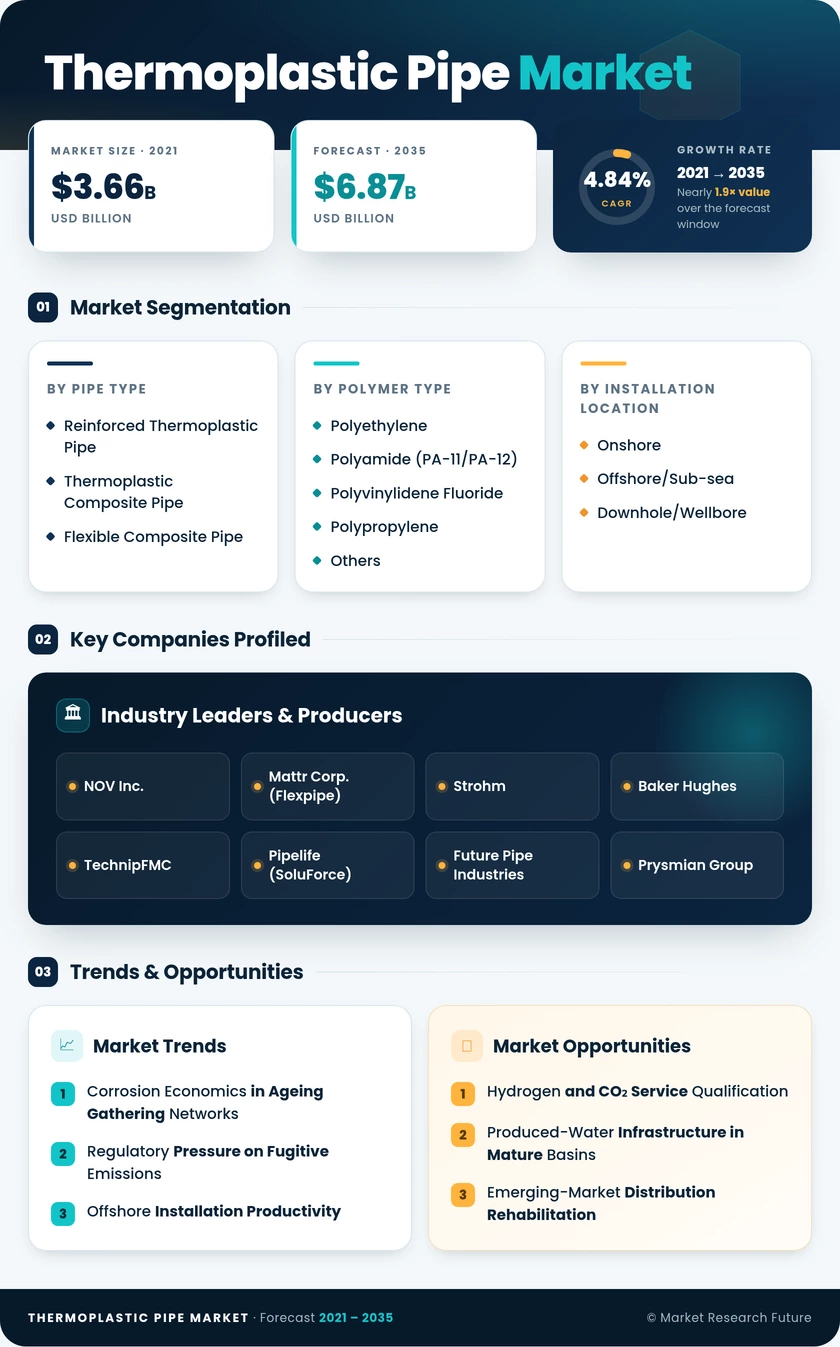
| Dimension | Sub-Segments | Dominant Segment | Fastest Growing Segment |
| Pipe Type | Reinforced Thermoplastic Pipe; Thermoplastic Composite Pipe; Flexible Composite Pipe | Reinforced Thermoplastic Pipe | Thermoplastic Composite Pipe |
| Polymer Type | Polyethylene; Polyamide (PA-11/PA-12); Polyvinylidene Fluoride; Polypropylene; Others | Polyethylene | Polyvinylidene Fluoride |
| Installation Location | Onshore; Offshore/Sub-sea; Downhole/Wellbore | Onshore | Offshore/Sub-sea |
| Application | Oil and Gas; Chemical and Process Industries; Water and Wastewater; Mining and Slurry; Others | Oil and Gas | Chemical and Process Industries |
| Geography | North America; Europe; Asia-Pacific; South America; Middle East & Africa | Asia-Pacific | Asia-Pacific |
Market Segmentation Overview
By Pipe Type
| Sub-Segment | Key Trend |
| Reinforced Thermoplastic Pipe | Aramid and steel-strip reinforcement pushing onshore pressure ratings toward 150 bar |
| Thermoplastic Composite Pipe | Subsea jumper and riser qualification opening deepwater tie-back applications |
| Flexible Composite Pipe | Semi-permanent produced-water transfer replacing temporary lay-flat runs |
Construction choice is the primary lever on installed cost. Reinforced systems carry the volume base while composite variants capture the premium offshore work where vessel-day savings dominate the economics.
By Polymer Type
| Sub-Segment | Key Trend |
| Polyethylene | PE100-RC grades enabling trenchless installation without sand bedding |
| Polyamide (PA-11/PA-12) | Preferred liner for hydrocarbon service and hydrogen permeation testing |
| Polyvinylidene Fluoride | Replacing lined steel in acid and halogenated chemical loops |
| Polypropylene | Industrial effluent and moderate-temperature process water |
| Others | Hybrid multilayer and specialty elastomer-backed constructions |
Polymer selection increasingly follows fluid chemistry rather than pressure alone. Fluoropolymers grow fastest despite carrying materially higher resin cost, because unplanned outage cost in process plants outweighs the capital premium.
By Installation Location
| Sub-Segment | Key Trend |
| Onshore | Gathering line and utility network substitution at scale |
| Offshore/Sub-sea | Installation-window compression and lightweight lay methods |
| Downhole/Wellbore | Tubing liners extending well life in corrosive completions |
Onshore duty supplies the volume floor. Offshore and downhole applications, though smaller, generate the qualification data that eventually unlocks broader specification acceptance.
By Application
| Sub-Segment | Key Trend |
| Oil and Gas | Methane rules and corrosion economics driving steel replacement |
| Chemical and Process Industries | Turnaround-window retrofits avoiding hot work permits |
| Water and Wastewater | Non-revenue water reduction programmes in emerging economies |
| Mining and Slurry | Abrasion-resistant liners for tailings and concentrate transfer |
| Others | Agriculture, irrigation and district energy distribution |
Oil and gas remains the revenue anchor, yet growth is diversifying. Chemical retrofit and municipal water together will account for a materially larger revenue slice by 2035 than they did in 2025.


 Noah Malgeri
Co-Founder

 Peter Groot koerkamp
Account and Business Manager

 Younghwan Choi
Senior Retail Manager

 Mark Irwin
Management Consultant

 Akif Moroglu
Strategy & Business Development Director

 Guilherme Gomes Martins
Product Management Director

 Joseph Aguayo
Sales Operations & Pricing Manager

 La Terria Dodd
Program Support Specialist

 Rob Kooiker
Group Product Manager HVAC & Fire Protection GMA