×
Request Free Sample ×

Kindly complete the form below to receive a free sample of this Report

* Please use a valid business email

Leading companies partner with us for data-driven Insights

clients tt-cursor
Hero Background
English
Chinese
French
Japanese
Korean
German
Spanish

Tendinitis Treatment Industry Analysis

ID: MRFR/Pharma/3789-CR
128 Pages
Rahul Gotadki
January 2018

Tendinitis Treatment Market Research Report Information: By Type (Achilles Tendinitis, Supraspinatus Tendinitis, Tennis or Golfer's Elbow, De Quervain's Tenosynovitis), By Treatment (Diagnosis, Therapy, Shock Wave Therapy or Surgery, Medical Devices, Devices), By End User (Hospitals & Clinics, Medical Research Centers, Academic Institutes) - Americas & Europe Forecast till 2035

Share:
Download PDF ×

We do not share your information with anyone. However, we may send you emails based on your report interest from time to time. You may contact us at any time to opt-out.

Tendinitis Treatment Industry Infographic
Purchase Options

Market Analysis

In-depth Analysis of Tendinitis Treatment Industry Industry Landscape

The market dynamics of Tendinitis Treatment within the Americas and Europe revolve around addressing the ordinary musculoskeletal circumstance characterized by infection of the tendons. Understanding the regional versions, treatment modalities, and demographic elements is essential in shaping the market panorama for tendinitis control. Market dynamics are inspired by the various incidences of tendinitis throughout the Americas and Europe. Demographic elements, consisting of age, lifestyle, and occupational choices, contribute to the incidence of tendinitis. Recognizing these regional nuances is important for tailoring remedy strategies and allocating healthcare sources successfully. The market dynamics are formed by using the diverse remedy modalities available for tendinitis, such as relaxation, physical remedy, medications (non-steroidal anti-inflammatory drugs - NSAIDs), corticosteroid injections, and, in a few instances, surgical intervention. Adherence to clinical guidelines and contemporary research findings informs healthcare practices and influences the selection of treatment modalities. Lifestyle and occupational factors notably affect market dynamics. Individuals engaged in repetitive or strenuous sports, which includes athletes or guide laborers, are greatly liable to tendinitis. Market strategies don't forget the effect of lifestyle selections and work-associated elements on the superiority of tendinitis and tailor interventions accordingly. Market dynamics contain efforts to grow patient schooling and cognizance about tendinitis, its threat factors, and the significance of early intervention. Empowering people to understand signs and searching for well-timed medical interests contributes to advanced results and an extra proactive technique for tendinitis control. Regional variations in healthcare infrastructure influence market dynamics. Disparities in access to specialized care, rehabilitation centers, and superior remedy alternatives might also impact the general management of tendinitis. The practices of healthcare specialists, including orthopedic experts, physiotherapists, and primary care physicians, significantly have an impact on market dynamics. Continuous schooling in the latest remedy modalities, rehabilitation techniques, and patient management methods is vital for optimizing tendinitis care. Effective ache control is an essential thing of market dynamics in Tendinitis Treatment. Balancing pain relief with the upkeep of features and mobility is a key attention. The market adapts based totally on the availability and usage of pain control strategies that align with patient preferences and universal treatment goals. The regulatory surroundings inside the Americas and Europe contribute to market dynamics. Approval tactics for new treatments, repayment guidelines, and regulatory compliance affect the accessibility of remedy alternatives. Market strategies need to align with local policies to ensure the successful introduction and adoption of Tendinitis Treatments.


Author
Rahul Gotadki
Assistant Manager

He holds an experience of about 7+ years in Market Research and Business Consulting, working under the spectrum of Life Sciences and Healthcare domains. Rahul conceptualizes and implements a scalable business strategy and provides strategic leadership to the clients. His expertise lies in market estimation, competitive intelligence, pipeline analysis, customer assessment, etc. In addition to the above, his other responsibility includes strategic tracking of high growth markets & advising clients on the potential areas of focus they could direct their business initiatives

Leave a Comment

FAQs

At what CAGR is the Americas & Europe tendinitis treatment market projected to grow in the forecast period (2024-2032)?

Americas & Europe tendinitis treatment market is projected to grow at approximately 3.84% CAGR during the assessment period (2024-2032).

How much is the Americas & Europe tendinitis treatment market worth in the future?

Americas & Europe tendinitis treatment market is estimated to reach a valuation of approx. USD 9.83 Billion by the end of 2032.

What was the value of the Americas & Europe Tendinitis treatment market in 2016?

The value of the Americas & Europe Tendinitis treatment market had reached USD 7,525.3 MN in 2016.

Which region holds the largest share in the Americas & Europe tendinitis treatment market?

North America holds the largest share in the Americas & Europe tendinitis treatment market.

Who are the top players in the Americas & Europe tendinitis treatment market?

Abbott (U.S.), AstraZeneca (U.K), Pfizer (U.S.), Bayer (Germany), GlaxoSmithKline plc (U.S.), Merck & Co. Inc. (Germany), Teva Pharmaceutical Industries (Israel), and Boehringer Ingelheim Pharmaceuticals, Inc. (Germany), are some of the top players operating in the Americas & Europe tendinitis treatment market.

Market Summary

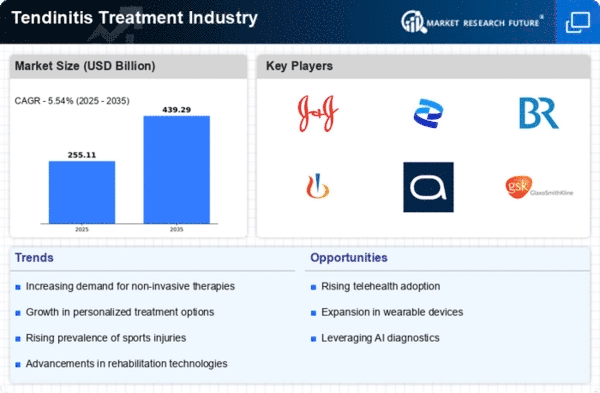
As per MRFR analysis, the Tendinitis Treatment market size was estimated at 241.72 USD Billion in 2024. The Tendinitis Treatment is projected to grow from 257.88 USD Billion in 2025 to 439.29 USD Billion by 2035, exhibiting a compound annual growth rate (CAGR) of 5.54 during the forecast period 2025 - 2035.

Key Market Trends & Highlights

The Tendinitis Treatment Industry is experiencing a shift towards personalized and non-invasive treatment options, driven by technological advancements and rising awareness.

  • Personalized treatment approaches are gaining traction, enhancing patient outcomes in the Tendinitis Treatment Industry.
  • Telehealth integration is becoming increasingly prevalent, facilitating remote consultations and follow-ups for patients.
  • The focus on non-invasive therapies is reshaping treatment paradigms, particularly in the North American market.
  • Rising prevalence of tendinitis and increased awareness are major drivers propelling growth in the physical therapy segment, while the surgical segment is rapidly expanding.

Market Size & Forecast

2024 Market Size 241.72 (USD Billion)
2035 Market Size 439.29 (USD Billion)
CAGR (2025 - 2035) 5.54%
Largest Regional Market Share in 2024 North America

Major Players

Johnson & Johnson (US), Pfizer (US), Bayer (DE), Novartis (CH), AbbVie (US), GlaxoSmithKline (GB), Sanofi (FR), Merck & Co. (US), Amgen (US)

Market Trends

The Tendinitis Treatment Industry is currently experiencing a notable evolution, driven by advancements in medical technology and a growing awareness of musculoskeletal disorders. As healthcare providers increasingly recognize the impact of tendinitis on patients' quality of life, there is a concerted effort to develop more effective treatment modalities. This includes a shift towards personalized medicine, where therapies are tailored to individual patient needs, potentially enhancing recovery outcomes. Furthermore, the integration of telehealth services is becoming more prevalent, allowing patients to access specialized care remotely, which may improve adherence to treatment protocols and facilitate ongoing monitoring of progress. In addition to technological advancements, the Tendinitis Treatment Industry is witnessing a rise in the utilization of non-invasive treatment options. Patients are increasingly seeking alternatives to traditional surgical interventions, leading to a greater emphasis on physical therapy, regenerative medicine, and pharmacological innovations. This trend suggests a broader movement towards holistic approaches that prioritize patient comfort and long-term health. As the industry continues to adapt to these changes, stakeholders must remain vigilant in understanding patient preferences and emerging treatment options to stay competitive in this dynamic landscape.

Personalized Treatment Approaches

The industry is moving towards personalized treatment strategies that cater to individual patient profiles. This trend emphasizes the importance of tailoring therapies based on specific needs, which may enhance recovery rates and patient satisfaction.

Telehealth Integration

The incorporation of telehealth services is becoming increasingly common, allowing patients to receive care remotely. This trend not only improves access to specialists but also supports ongoing management of tendinitis, potentially leading to better adherence to treatment plans.

Focus on Non-Invasive Therapies

There is a growing preference for non-invasive treatment options among patients. This shift is driving the development of alternatives to surgery, such as physical therapy and regenerative medicine, which prioritize patient comfort and long-term health outcomes.

Tendinitis Treatment Industry Market Drivers

Rising Prevalence of Tendinitis

The increasing incidence of tendinitis across the Global Americas and Europe Tendinitis Treatment Market Industry is a notable driver. Factors such as aging populations, sedentary lifestyles, and increased participation in sports contribute to this trend. For instance, the prevalence of tendinitis is expected to rise significantly, leading to a projected market value of 6.47 USD Billion in 2024. This growing patient population necessitates effective treatment options, thereby driving demand for various therapeutic modalities, including physical therapy and pharmacological interventions.

Increased Awareness and Education

Heightened awareness regarding tendinitis and its treatment options is driving growth in the Global Americas and Europe Tendinitis Treatment Market Industry. Educational campaigns by healthcare organizations and sports associations aim to inform the public about prevention and management strategies. This increased awareness is likely to lead to earlier diagnosis and treatment, which can improve patient outcomes. As a result, the market may experience a steady growth trajectory, with a projected CAGR of 1.67% from 2025 to 2035, reflecting the positive impact of education on treatment uptake.

Government Initiatives and Funding

Government initiatives aimed at improving healthcare access and funding for musculoskeletal disorders are influencing the Global Americas and Europe Tendinitis Treatment Market Industry. Various health departments are allocating resources to enhance treatment facilities and promote research into effective therapies. Such initiatives may lead to improved patient access to care and innovative treatment options. Consequently, this support is likely to bolster market growth, as increased funding can facilitate advancements in treatment technologies and enhance overall patient care.

Advancements in Treatment Modalities

Innovations in treatment modalities are transforming the Global Americas and Europe Tendinitis Treatment Market Industry. The introduction of minimally invasive procedures, regenerative medicine, and advanced physiotherapy techniques enhances patient outcomes. For example, platelet-rich plasma therapy has gained traction as a promising treatment option, potentially reducing recovery times. As these advanced treatments become more widely adopted, they are likely to contribute to the market's growth, with projections indicating a market value of 7.76 USD Billion by 2035.

Growing Demand for Non-Surgical Treatments

The shift towards non-surgical treatment options is a significant driver in the Global Americas and Europe Tendinitis Treatment Market Industry. Patients increasingly prefer conservative management strategies, such as physical therapy, corticosteroid injections, and over-the-counter medications, to avoid the risks associated with surgery. This trend is particularly evident among younger populations who are more health-conscious. As a result, the market is expected to expand, with a notable increase in the adoption of these non-invasive therapies, further contributing to the overall market growth.

Market Segment Insights

By Treatment Type: Physical Therapy (Largest) vs. Surgery (Fastest-Growing)

The Tendinitis Treatment Industry is characterized by diverse treatment types, with physical therapy holding a substantial share of the market. This segment has been the go-to approach for managing tendinitis, favored for its non-invasive nature and ability to promote recovery through exercises and rehabilitation. Perceived as the cornerstone of treatment, physical therapy is widely utilized in conjunction with other methods, thus reinforcing its dominance in the market.

Physical Therapy: Dominant vs. Surgery: Emerging

Physical therapy is established as the dominant treatment option in the Tendinitis Treatment Industry due to its emphasis on rehabilitation, functional recovery, and prevention of future injuries. It is widely recognized for its effectiveness in managing symptoms and improving mobility through personalized exercise regimens and manual techniques. On the other hand, surgery is emerging as a significant segment, particularly for severe cases of tendinitis where conservative treatments fail. Advancements in surgical techniques and minimally invasive procedures are contributing to its growth, catering to patients seeking swift recovery and resolution of persistent pain. Both therapy types, although differing in approach, reflect the industry's diverse treatment landscape.

By Severity Level: Moderate (Largest) vs. Severe (Fastest-Growing)

In the Tendinitis Treatment Industry, the severity levels of conditions being treated—Mild, Moderate, and Severe—show a clear distribution in market share. The Moderate segment captures the largest share, as this level often requires comprehensive treatment plans that combine both pharmacological and physical therapies. Mild cases, while frequent, usually don't necessitate extensive treatments, and hence, they occupy a smaller market segment. Conversely, the Severe category, which reflects the need for more invasive or intensive therapeutic measures, is drawing increasing attention due to the rising awareness of chronic musculoskeletal conditions. This shift points to a notable rise in demand for advanced treatment protocols and specialized care.

Mild (Emerging) vs. Moderate (Dominant)

The Mild severity level is becoming an emerging sector in the Tendinitis Treatment Industry as awareness of preventive care and early intervention grows. Patients with mild symptoms often seek non-invasive treatment options, which can include physical therapy and lifestyle modifications. In contrast, the Moderate segment remains dominant, characterized by a strong demand for a combination of treatments, including corticosteroid injections and rehabilitation programs. Moderate tendinitis cases frequently impact daily activities, warranting effective management strategies. Thus, while Mild is an emerging market segment, Moderate remains crucial due to its established treatment practices and higher patient interaction with healthcare providers.

By Patient Demographics: Age Group (Largest) vs. Gender (Fastest-Growing)

In the Tendinitis Treatment Industry, the distribution among patient demographics reveals that the Age Group segment holds the largest market share. Patients aged between 40 to 60 years represent a significant portion of the total patient population, as this age group is more prone to tendinitis due to age-related degeneration and overuse injuries. Gender distribution remains essential as well, with a notable percentage of females seeking treatment, likely attributable to higher participation in activities that increase the risk of tendinitis, such as dance or yoga.

Age Group: 40-60 (Dominant) vs. Gender: Females (Emerging)

The Age Group of 40-60 years stands as the dominant demographic in the Tendinitis Treatment Industry, primarily due to natural aging processes that increase vulnerability to musculoskeletal disorders. This age range is characterized by a high incidence of overuse injuries linked to both professional and recreational activities. On the other hand, the gender segment, particularly females, is emerging rapidly as more women engage in physical activities and sports that lead to tendinitis. Increased awareness, along with a growing trend in female participation in fitness and wellness programs, is driving this emerging demographic towards seeking treatment options more proactively.

By Duration of Condition: Chronic (Largest) vs. Acute (Fastest-Growing)

The Tendinitis Treatment Industry is segmented by the duration of the condition, categorizing patients into Acute, Subacute, and Chronic conditions. The Chronic segment holds the largest market share, largely due to the prevalence of long-lasting tendinitis cases that require ongoing management. Acute conditions, on the other hand, are more common in athletes or individuals engaging in sudden physical activities, contributing to a substantial market share that is expected to grow rapidly in the upcoming years.

Chronic (Dominant) vs. Acute (Emerging)

Chronic tendinitis represents a significant portion of the treatment landscape, with patients typically experiencing persistent pain and inflammation over a prolonged period. This condition often leads to more intensive treatment regimens, including physical therapy and potentially surgical interventions, resulting in higher healthcare utilization. In contrast, acute tendinitis, while less prevalent in terms of chronic impact, is seeing an emerging trend fueled by increasing participation in sports and high-intensity activities. This segment attracts a younger demographic, leading to a rapid growth potential in treatment approaches, often focusing on quick recovery solutions and preventative care initiatives.

By Anatomical Location: Shoulder (Largest) vs. Achilles (Fastest-Growing)

In the Tendinitis Treatment Industry, the market is primarily dominated by the shoulder segment, which holds the largest share due to its high prevalence of rotator cuff injuries among athletes and the aging population. The elbow, wrist, knee, and Achilles segments also contribute significantly to market dynamics, with elbow and wrist tendinitis being common among individuals engaged in repetitive overhead activities, and knee tendinitis prevalent in both young athletes and older adults. The growth trends in this industry are driven by increasing awareness regarding tendinitis treatment options and technological advancements in therapy methods. The Achilles segment is gaining traction, emerging as the fastest-growing area due to rising participation in sports and fitness activities leading to a higher incidence of Achilles tendon injuries. The overall segment is expected to benefit from an aging demographic and a growing emphasis on preventive healthcare.

Shoulder (Dominant) vs. Achilles (Emerging)

The shoulder segment, being the dominant player in the Tendinitis Treatment Industry, caters to an extensive patient demographic suffering from various conditions such as rotator cuff tendinitis and impingement syndrome. This segment is characterized by a well-established treatment framework, including physical therapy and corticosteroid injections. In contrast, the Achilles segment is deemed emerging, spurred by a notable increase in sports-related injuries and a marked focus on rehabilitation therapies. As more athletes and recreational participants seek effective treatment, the Achilles segment is benefitting from innovations like regenerative medicine and minimally invasive surgical options. Both segments exhibit unique characteristics, with the shoulder sustaining its stronghold while the Achilles rapidly evolves to address growing treatment demands.

Get more detailed insights about Americas & Europe Tendinitis Treatment Market - Forecast till 2035

Regional Insights

North America : Market Leader in Tendinitis Treatment

North America is poised to maintain its leadership in the Tendinitis Treatment Industry, holding a market size of $120.86M in 2025. Key growth drivers include an aging population, increased sports participation, and advancements in treatment technologies. Regulatory support from agencies like the FDA further enhances market dynamics, ensuring the availability of innovative therapies. The region's robust healthcare infrastructure and high healthcare expenditure also contribute to the growing demand for effective tendinitis treatments. The competitive landscape in North America is characterized by the presence of major players such as Johnson & Johnson, Pfizer, and AbbVie. These companies are actively engaged in research and development to introduce novel therapies and improve existing treatment options. The U.S. market, in particular, is a focal point for innovation, with significant investments directed towards clinical trials and product launches. This competitive environment fosters a continuous evolution of treatment modalities, ensuring that patients have access to the latest advancements in care.

Europe : Emerging Market with Growth Potential

Europe's Tendinitis Treatment Industry is on an upward trajectory, with a market size of €70.52M projected for 2025. The region benefits from a growing awareness of musculoskeletal disorders and an increasing emphasis on preventive healthcare. Regulatory frameworks, such as the European Medicines Agency's guidelines, facilitate the introduction of innovative treatments, driving market growth. Additionally, the rise in sports-related injuries among the youth population is contributing to the demand for effective tendinitis therapies. Leading countries in Europe include Germany, France, and the UK, where healthcare systems are increasingly prioritizing musculoskeletal health. The competitive landscape features key players like Bayer and Novartis, who are investing in research to develop advanced treatment options. Collaborative efforts between public health organizations and private sectors are also enhancing the availability of tendinitis treatments, ensuring that patients receive timely and effective care. The market is expected to continue evolving, driven by both innovation and regulatory support.

Asia-Pacific : Rapidly Growing Treatment Sector

The Asia-Pacific region is emerging as a significant player in the Tendinitis Treatment Industry, with a market size of $40.0M anticipated by 2025. Factors driving this growth include increasing urbanization, rising disposable incomes, and a growing awareness of health and wellness. Additionally, the prevalence of sports injuries and lifestyle-related conditions is propelling demand for effective treatment options. Regulatory bodies in countries like Australia and Japan are also enhancing the market environment by streamlining approval processes for new therapies. Countries such as China, Japan, and India are at the forefront of this growth, with expanding healthcare infrastructures and increasing investments in medical research. The competitive landscape is marked by both local and international players, including companies like Amgen and GlaxoSmithKline. These organizations are focusing on developing tailored treatment solutions to meet the diverse needs of the population, ensuring that advancements in tendinitis care are accessible across the region.

Middle East and Africa : Emerging Market with Untapped Potential

The Middle East and Africa (MEA) region is gradually emerging in the Tendinitis Treatment Industry, with a market size of $10.34M projected for 2025. The growth is driven by increasing healthcare investments, rising awareness of musculoskeletal disorders, and a growing population engaged in sports and physical activities. Regulatory initiatives aimed at improving healthcare access are also contributing to market expansion, as governments prioritize health infrastructure development. Leading countries in the MEA region include South Africa and the UAE, where healthcare systems are evolving to meet the rising demand for effective treatments. The competitive landscape is characterized by a mix of local and international players, with companies exploring partnerships to enhance their market presence. As the region continues to develop, there are significant opportunities for growth in tendinitis treatment, particularly in urban areas where healthcare access is improving.

Key Players and Competitive Insights

The Tendinitis Treatment Industry is currently characterized by a competitive landscape that is both dynamic and multifaceted. Key growth drivers include an increasing prevalence of musculoskeletal disorders, heightened awareness of treatment options, and advancements in therapeutic technologies. Major players such as Johnson & Johnson (US), Pfizer (US), and AbbVie (US) are strategically positioned to leverage their extensive research and development capabilities, focusing on innovative treatment modalities and expanding their product portfolios. These companies are actively engaging in partnerships and collaborations to enhance their market presence, thereby shaping a competitive environment that emphasizes innovation and patient-centric solutions.In terms of business tactics, companies are increasingly localizing manufacturing to reduce costs and improve supply chain efficiency. The market structure appears moderately fragmented, with a mix of large multinational corporations and smaller specialized firms. This fragmentation allows for diverse treatment options, yet the collective influence of key players like Bayer (DE) and Novartis (CH) is significant, as they drive trends in product development and market access strategies.

In November Johnson & Johnson (US) announced a strategic partnership with a leading telehealth provider to enhance patient access to tendinitis treatments through digital platforms. This move is likely to expand their reach and improve patient engagement, reflecting a broader trend towards digital health solutions in the industry. By integrating telehealth services, Johnson & Johnson aims to streamline treatment pathways and provide more personalized care, which could set a new standard in patient management for tendinitis.

In October Pfizer (US) launched a new biologic therapy specifically targeting chronic tendinitis, which has shown promising results in clinical trials. This introduction not only diversifies Pfizer's product offerings but also positions the company as a leader in innovative treatment options. The strategic importance of this launch lies in its potential to capture a significant market share, particularly among patients seeking advanced therapies that address the underlying causes of tendinitis rather than merely alleviating symptoms.

In September AbbVie (US) expanded its global footprint by acquiring a smaller biotech firm specializing in regenerative medicine for musculoskeletal disorders. This acquisition is indicative of AbbVie's commitment to enhancing its research capabilities and diversifying its treatment modalities. The strategic importance of this move lies in the potential to integrate cutting-edge regenerative therapies into their existing portfolio, thereby addressing a growing demand for holistic treatment approaches in the tendinitis space.

As of December current competitive trends in the Tendinitis Treatment Industry are increasingly defined by digitalization, sustainability, and the integration of artificial intelligence (AI) in treatment protocols. Strategic alliances are becoming more prevalent, as companies recognize the value of collaborative innovation in addressing complex healthcare challenges. Looking ahead, competitive differentiation is likely to evolve from traditional price-based competition towards a focus on innovation, technological advancements, and supply chain reliability. This shift underscores the importance of developing robust, patient-centered solutions that not only meet clinical needs but also enhance overall treatment experiences.

Key Companies in the Tendinitis Treatment Industry include

Industry Developments

November 2023 

Camber Pharmaceuticals expands its product portfolio with the inclusion of Naproxen Oral Suspension, which is indicated for treating the signs and symptoms of tendinitis. Naproxen is a nonsteroidal anti-inflammatory drug (NSAID) that works by reducing inflammation and pain.Hyloris Pharmaceuticals announces that it has received FDA approval for its new drug, HY01, for the treatment of chronic tendinitis. HY01 is a hyaluronic acid (HA) injection that works by lubricating and cushioning the tendons.Ortho Clinical Diagnostics announces that it has launched a new test, the Ortho Clinical Diagnostics Tendinitis Panel, which can be used to diagnose and monitor tendinitis.

The test measures the levels of three proteins that are involved in the development of tendinitis.

October 2023 

A new study published in the journal Orthopaedics & Sports Physical Therapy finds that a combination of physical therapy and platelet-rich plasma (PRP) injections is effective in reducing pain and improving function in patients with tendinitis. PRP is a blood product that contains high concentrations of platelets, which are cells that play a role in healing.Another study published in the journal Pain Physician finds that a new type of corticosteroid injection, called triamcinolone acetonide microparticles (TA microparticles), is effective in reducing pain and improving function in patients with chronic tendinitis.

TA microparticles are a long-acting form of corticosteroid that is released slowly over time.

September 2023 

The American Academy of Orthopaedic Surgeons (AAOS) releases a new clinical practice guideline for the management of tendinitis. The guideline recommends a combination of physical therapy, NSAIDs, and other treatments, such as corticosteroid injections or PRP injections, depending on the severity of the condition.The National Institute of Arthritis and Musculoskeletal and Skin Diseases (NIAMS) awards a grant to a team of researchers at the University of California, San Francisco to develop a new type of stem cell therapy for tendinitis. The therapy involves injecting stem cells into the affected tendon to promote healing.

Key Findings:

  • By type, Achilles tendinitis acquired the largest market share in 2016.
  • By treatment, diagnosis accounted for the largest market share in 2016 and is valued at USD 1200 million.
  • By end user, hospitals & clinics accounted for the largest market share of 41.8% in the Americas & Europe tendinitis market, in 2016.

Key Players in the Americas & Europe Tendinitis Treatment Market

Some of the key players in this market are: 

  • Abbott (U.S.)
  • Pfizer (U.S.)
  • AstraZeneca (U.K)
  • Bayer (Germany)
  • Merck & Co. Inc. (Germany)
  • GlaxoSmithKline plc (U.S.)
  • Teva Pharmaceutical Industries (Israel)
  • Boehringer Ingelheim Pharmaceuticals, Inc. (Germany)

Future Outlook

Tendinitis Treatment Industry Future Outlook

The Tendinitis Treatment Industry is projected to grow at a 5.54% CAGR from 2025 to 2035, driven by increasing prevalence of musculoskeletal disorders and advancements in treatment technologies.

New opportunities lie in:

  • Development of personalized treatment plans using AI analytics.
  • Expansion of telehealth services for remote patient monitoring.
  • Investment in regenerative medicine techniques for tendon repair.

By 2035, the Tendinitis Treatment Industry is expected to achieve substantial growth and innovation.

Market Segmentation

Tendinitis Treatment Industry Severity Level Outlook

  • Mild
  • Moderate
  • Severe

Tendinitis Treatment Industry Treatment Type Outlook

  • Physical Therapy
  • Medication
  • Surgery
  • Alternative Therapies

Tendinitis Treatment Industry Anatomical Location Outlook

  • Shoulder
  • Elbow
  • Wrist
  • Knee
  • Achilles

Tendinitis Treatment Industry Patient Demographics Outlook

  • Age Group
  • Gender
  • Activity Level
  • Occupation

Tendinitis Treatment Industry Duration of Condition Outlook

  • Acute
  • Subacute
  • Chronic

Report Scope

MARKET SIZE 2024241.72(USD Billion)
MARKET SIZE 2025257.88(USD Billion)
MARKET SIZE 2035439.29(USD Billion)
COMPOUND ANNUAL GROWTH RATE (CAGR)5.54% (2025 - 2035)
REPORT COVERAGERevenue Forecast, Competitive Landscape, Growth Factors, and Trends
BASE YEAR2024
Market Forecast Period2025 - 2035
Historical Data2019 - 2024
Market Forecast UnitsUSD Billion
Key Companies ProfiledJohnson & Johnson (US), Pfizer (US), Bayer (DE), Novartis (CH), AbbVie (US), GlaxoSmithKline (GB), Sanofi (FR), Merck & Co. (US), Amgen (US)
Segments CoveredTreatment Type, Severity Level, Patient Demographics, Duration of Condition, Anatomical Location
Key Market OpportunitiesIntegration of telehealth services for personalized Tendinitis Treatment management and patient engagement.
Key Market DynamicsRising demand for non-invasive treatments drives innovation and competition in the Tendinitis Treatment Industry.
Countries CoveredNorth America, Europe, APAC, South America, MEA

FAQs

At what CAGR is the Americas & Europe tendinitis treatment market projected to grow in the forecast period (2024-2032)?

Americas & Europe tendinitis treatment market is projected to grow at approximately 3.84% CAGR during the assessment period (2024-2032).

How much is the Americas & Europe tendinitis treatment market worth in the future?

Americas & Europe tendinitis treatment market is estimated to reach a valuation of approx. USD 9.83 Billion by the end of 2032.

What was the value of the Americas & Europe Tendinitis treatment market in 2016?

The value of the Americas & Europe Tendinitis treatment market had reached USD 7,525.3 MN in 2016.

Which region holds the largest share in the Americas & Europe tendinitis treatment market?

North America holds the largest share in the Americas & Europe tendinitis treatment market.

Who are the top players in the Americas & Europe tendinitis treatment market?

Abbott (U.S.), AstraZeneca (U.K), Pfizer (U.S.), Bayer (Germany), GlaxoSmithKline plc (U.S.), Merck & Co. Inc. (Germany), Teva Pharmaceutical Industries (Israel), and Boehringer Ingelheim Pharmaceuticals, Inc. (Germany), are some of the top players operating in the Americas & Europe tendinitis treatment market.

  1. SECTION I: EXECUTIVE SUMMARY AND KEY HIGHLIGHTS
    1. | 1.1 EXECUTIVE SUMMARY
    2. | 1.1.1 Market Overview
    3. | 1.1.2 Key Findings
    4. | 1.1.3 Market Segmentation
    5. | 1.1.4 Competitive Landscape
    6. | 1.1.5 Challenges and Opportunities
    7. | 1.1.6 Future Outlook
  2. SECTION II: SCOPING, METHODOLOGY AND MARKET STRUCTURE
    1. | 2.1 MARKET INTRODUCTION
    2. | 2.1.1 Definition
    3. | 2.1.2 Scope of the study
    4. |-- 2.1.2.1 Research Objective
    5. |-- 2.1.2.2 Assumption
    6. |-- 2.1.2.3 Limitations
    7. | 2.2 RESEARCH METHODOLOGY
    8. | 2.2.1 Overview
    9. | 2.2.2 Data Mining
    10. | 2.2.3 Secondary Research
    11. | 2.2.4 Primary Research
    12. |-- 2.2.4.1 Primary Interviews and Information Gathering Process
    13. |-- 2.2.4.2 Breakdown of Primary Respondents
    14. | 2.2.5 Forecasting Model
    15. | 2.2.6 Market Size Estimation
    16. |-- 2.2.6.1 Bottom-Up Approach
    17. |-- 2.2.6.2 Top-Down Approach
    18. | 2.2.7 Data Triangulation
    19. | 2.2.8 Validation
  3. SECTION III: QUALITATIVE ANALYSIS
    1. | 3.1 MARKET DYNAMICS
    2. | 3.1.1 Overview
    3. | 3.1.2 Drivers
    4. | 3.1.3 Restraints
    5. | 3.1.4 Opportunities
    6. | 3.2 MARKET FACTOR ANALYSIS
    7. | 3.2.1 Value chain Analysis
    8. | 3.2.2 Porter's Five Forces Analysis
    9. |-- 3.2.2.1 Bargaining Power of Suppliers
    10. |-- 3.2.2.2 Bargaining Power of Buyers
    11. |-- 3.2.2.3 Threat of New Entrants
    12. |-- 3.2.2.4 Threat of Substitutes
    13. |-- 3.2.2.5 Intensity of Rivalry
    14. | 3.2.3 COVID-19 Impact Analysis
    15. |-- 3.2.3.1 Market Impact Analysis
    16. |-- 3.2.3.2 Regional Impact
    17. |-- 3.2.3.3 Opportunity and Threat Analysis
  4. SECTION IV: QUANTITATIVE ANALYSIS
    1. | 4.1 Healthcare, BY Treatment Type (USD Billion)
    2. | 4.1.1 Physical Therapy
    3. | 4.1.2 Medication
    4. | 4.1.3 Surgery
    5. | 4.1.4 Alternative Therapies
    6. | 4.2 Healthcare, BY Severity Level (USD Billion)
    7. | 4.2.1 Mild
    8. | 4.2.2 Moderate
    9. | 4.2.3 Severe
    10. | 4.3 Healthcare, BY Patient Demographics (USD Billion)
    11. | 4.3.1 Age Group
    12. | 4.3.2 Gender
    13. | 4.3.3 Activity Level
    14. | 4.3.4 Occupation
    15. | 4.4 Healthcare, BY Duration of Condition (USD Billion)
    16. | 4.4.1 Acute
    17. | 4.4.2 Subacute
    18. | 4.4.3 Chronic
    19. | 4.5 Healthcare, BY Anatomical Location (USD Billion)
    20. | 4.5.1 Shoulder
    21. | 4.5.2 Elbow
    22. | 4.5.3 Wrist
    23. | 4.5.4 Knee
    24. | 4.5.5 Achilles
    25. | 4.6 Healthcare, BY Region (USD Billion)
    26. | 4.6.1 North America
    27. |-- 4.6.1.1 US
    28. |-- 4.6.1.2 Canada
    29. | 4.6.2 Europe
    30. |-- 4.6.2.1 Germany
    31. |-- 4.6.2.2 UK
    32. |-- 4.6.2.3 France
    33. |-- 4.6.2.4 Russia
    34. |-- 4.6.2.5 Italy
    35. |-- 4.6.2.6 Spain
    36. |-- 4.6.2.7 Rest of Europe
    37. | 4.6.3 APAC
    38. |-- 4.6.3.1 China
    39. |-- 4.6.3.2 India
    40. |-- 4.6.3.3 Japan
    41. |-- 4.6.3.4 South Korea
    42. |-- 4.6.3.5 Malaysia
    43. |-- 4.6.3.6 Thailand
    44. |-- 4.6.3.7 Indonesia
    45. |-- 4.6.3.8 Rest of APAC
    46. | 4.6.4 South America
    47. |-- 4.6.4.1 Brazil
    48. |-- 4.6.4.2 Mexico
    49. |-- 4.6.4.3 Argentina
    50. |-- 4.6.4.4 Rest of South America
    51. | 4.6.5 MEA
    52. |-- 4.6.5.1 GCC Countries
    53. |-- 4.6.5.2 South Africa
    54. |-- 4.6.5.3 Rest of MEA
  5. SECTION V: COMPETITIVE ANALYSIS
    1. | 5.1 Competitive Landscape
    2. | 5.1.1 Overview
    3. | 5.1.2 Competitive Analysis
    4. | 5.1.3 Market share Analysis
    5. | 5.1.4 Major Growth Strategy in the Healthcare
    6. | 5.1.5 Competitive Benchmarking
    7. | 5.1.6 Leading Players in Terms of Number of Developments in the Healthcare
    8. | 5.1.7 Key developments and growth strategies
    9. |-- 5.1.7.1 New Product Launch/Service Deployment
    10. |-- 5.1.7.2 Merger & Acquisitions
    11. |-- 5.1.7.3 Joint Ventures
    12. | 5.1.8 Major Players Financial Matrix
    13. |-- 5.1.8.1 Sales and Operating Income
    14. |-- 5.1.8.2 Major Players R&D Expenditure. 2023
    15. | 5.2 Company Profiles
    16. | 5.2.1 Johnson & Johnson (US)
    17. |-- 5.2.1.1 Financial Overview
    18. |-- 5.2.1.2 Products Offered
    19. |-- 5.2.1.3 Key Developments
    20. |-- 5.2.1.4 SWOT Analysis
    21. |-- 5.2.1.5 Key Strategies
    22. | 5.2.2 Pfizer (US)
    23. |-- 5.2.2.1 Financial Overview
    24. |-- 5.2.2.2 Products Offered
    25. |-- 5.2.2.3 Key Developments
    26. |-- 5.2.2.4 SWOT Analysis
    27. |-- 5.2.2.5 Key Strategies
    28. | 5.2.3 Bayer (DE)
    29. |-- 5.2.3.1 Financial Overview
    30. |-- 5.2.3.2 Products Offered
    31. |-- 5.2.3.3 Key Developments
    32. |-- 5.2.3.4 SWOT Analysis
    33. |-- 5.2.3.5 Key Strategies
    34. | 5.2.4 Novartis (CH)
    35. |-- 5.2.4.1 Financial Overview
    36. |-- 5.2.4.2 Products Offered
    37. |-- 5.2.4.3 Key Developments
    38. |-- 5.2.4.4 SWOT Analysis
    39. |-- 5.2.4.5 Key Strategies
    40. | 5.2.5 AbbVie (US)
    41. |-- 5.2.5.1 Financial Overview
    42. |-- 5.2.5.2 Products Offered
    43. |-- 5.2.5.3 Key Developments
    44. |-- 5.2.5.4 SWOT Analysis
    45. |-- 5.2.5.5 Key Strategies
    46. | 5.2.6 GlaxoSmithKline (GB)
    47. |-- 5.2.6.1 Financial Overview
    48. |-- 5.2.6.2 Products Offered
    49. |-- 5.2.6.3 Key Developments
    50. |-- 5.2.6.4 SWOT Analysis
    51. |-- 5.2.6.5 Key Strategies
    52. | 5.2.7 Sanofi (FR)
    53. |-- 5.2.7.1 Financial Overview
    54. |-- 5.2.7.2 Products Offered
    55. |-- 5.2.7.3 Key Developments
    56. |-- 5.2.7.4 SWOT Analysis
    57. |-- 5.2.7.5 Key Strategies
    58. | 5.2.8 Merck & Co. (US)
    59. |-- 5.2.8.1 Financial Overview
    60. |-- 5.2.8.2 Products Offered
    61. |-- 5.2.8.3 Key Developments
    62. |-- 5.2.8.4 SWOT Analysis
    63. |-- 5.2.8.5 Key Strategies
    64. | 5.2.9 Amgen (US)
    65. |-- 5.2.9.1 Financial Overview
    66. |-- 5.2.9.2 Products Offered
    67. |-- 5.2.9.3 Key Developments
    68. |-- 5.2.9.4 SWOT Analysis
    69. |-- 5.2.9.5 Key Strategies
    70. | 5.3 Appendix
    71. | 5.3.1 References
    72. | 5.3.2 Related Reports

Healthcare Market Segmentation

Healthcare By Treatment Type (USD Billion, 2025-2035)

  • Physical Therapy
  • Medication
  • Surgery
  • Alternative Therapies

Healthcare By Severity Level (USD Billion, 2025-2035)

  • Mild
  • Moderate
  • Severe

Healthcare By Patient Demographics (USD Billion, 2025-2035)

  • Age Group
  • Gender
  • Activity Level
  • Occupation

Healthcare By Duration of Condition (USD Billion, 2025-2035)

  • Acute
  • Subacute
  • Chronic

Healthcare By Anatomical Location (USD Billion, 2025-2035)

  • Shoulder
  • Elbow
  • Wrist
  • Knee
  • Achilles
Infographic

Free Sample Request

Kindly complete the form below to receive a free sample of this Report

Get Free Sample

Customer Strories

Compare Licence

×
Features License Type
Single User Multiuser License Enterprise User
Price $4,950 $5,950 $7,250
Maximum User Access Limit 1 User Upto 10 Users Unrestricted Access Throughout the Organization
Free Customization
Direct Access to Analyst
Deliverable Format
Platform Access
Discount on Next Purchase 10% 15% 15%
Printable Versions