
×
Request Free Sample ×

Kindly complete the form below to receive a free sample of this Report

* Please use a valid business email

Leading companies partner with us for data-driven Insights

clients tt-cursor
Hero Background
English
Chinese
French
Japanese
Korean
German
Spanish

Telematics Market Trends

ID: MRFR/ICT/0615-CR
193 Pages
Ankit Gupta
May 2025

Telematics Market Research Report Information By Component (Hardware,( GPS Tracking Devices, Sensors & Actuators , Communication Modules) ,Software,( Fleet Management Software, Navigation & Mapping Solutions , Telematics Data Analytics ) And Services(Consulting & Integration , Maintenance & Support)), By Connectivity Type (Satellite-Based Telematics , Cellular Network-Based Telematics And Bluetooth & Wi-Fi-Based Telematics), By Vehicle Type (Passenger Vehicles, Commercial Vehicles,( Light Commercial Vehicles (LCVs), Heavy Commercial Vehicles (HCVs) And Off-Highway Vehicles), By Application (FLEET MANAGEMENT, Vehicle Tracking & Monitoring, Driver Behavior Analysis, Predictive Maintenance, Infotainment & Navigation, Insurance Telematics (Usage-Based Insurance), Emergency & Roadside Assistance, And Others), and Region (North America, Europe, Asia-Pacific, Middle East & Africa, and South America) - Forecast till 2035

Share:
Download PDF ×

We do not share your information with anyone. However, we may send you emails based on your report interest from time to time. You may contact us at any time to opt-out.

Telematics Market Infographic
Purchase Options

Market Trends

Key Emerging Trends in the Telematics Market

Telematics, the coordination of media communications and informatics, assumes a significant part in upsetting the car business. One conspicuous market pattern is the flood in the reception of telematics frameworks in vehicles, enveloping everything from vehicles to trucks and, surprisingly, bikes. This far-reaching reconciliation is reshaping the way vehicles work and are made due. One of the critical drivers behind the telematics market's development is the developing mindfulness and accentuation on vehicle wellbeing and security.

Telematics frameworks offer ongoing following, empowering armada directors and vehicle proprietors to screen the area and status of their vehicles. This aides in prevention of robbery as well as helps in speedy recuperation in the event of unapproved use. Furthermore, the mix of ADAS with telematics adds to upgraded street wellbeing by furnishing drivers with constant alarms and alerts, decreasing the probability of mishaps. The abundance of information created by associated vehicles is an important asset for different partners, including insurance agency, car makers, and fleet administrators.

Telematics frameworks assemble information on driving way of behaving, vehicle execution, and upkeep needs. Dissecting this information can prompt assists with further developing vehicle proficiency, decrease upkeep costs, and work with the improvement of customized protection plans in view of individual driving propensities. With a rising number of gadgets becoming interconnected, vehicles are currently essential for a bigger environment of smart, associated gadgets. Telematics frameworks empower vehicles to speak with one another, share traffic and street condition data, and upgrade courses, at last prompting more productive and maintainable transportation.

In logistics, telematics frameworks are used to screen and streamline the development of merchandise, upgrading store network effectiveness and lessening costs. In medical care, telematics is utilized for distant patient checking and following the transportation of delicate clinical supplies, guaranteeing convenient conveyance, and keeping up with the respectability of these items.


Author
Ankit Gupta
Team Lead - Research

Ankit Gupta is a seasoned market intelligence and strategic research professional with over six plus years of experience in the ICT and Semiconductor industries. With academic roots in Telecom, Marketing, and Electronics, he blends technical insight with business strategy. Ankit has led 200+ projects, including work for Fortune 500 clients like Microsoft and Rio Tinto, covering market sizing, tech forecasting, and go-to-market strategies. Known for bridging engineering and enterprise decision-making, his insights support growth, innovation, and investment planning across diverse technology markets.

Leave a Comment

FAQs

What is the current valuation of the Telematics Market as of 2024?

<p>The Telematics Market was valued at 129.16 USD Million in 2024.</p>

What is the projected market valuation for the Telematics Market in 2035?

<p>The Telematics Market is projected to reach a valuation of 564.04 USD Million by 2035.</p>

What is the expected CAGR for the Telematics Market during the forecast period 2025 - 2035?

<p>The expected CAGR for the Telematics Market during the forecast period 2025 - 2035 is 14.5%.</p>

Which companies are considered key players in the Telematics Market?

<p>Key players in the Telematics Market include Verizon, AT&T, TomTom, Geotab, Fleet Complete, Teletrac Navman, Sierra Wireless, Trimble, and Continental.</p>

What are the main applications of telematics in the market?

<p>The main applications in the Telematics Market include Fleet Management, Insurance Telematics, Vehicle Tracking, Remote Diagnostics, and Driver Behavior Monitoring.</p>

How does the Automotive sector contribute to the Telematics Market?

The Automotive sector is projected to contribute between 40.0 and 180.0 USD Million to the Telematics Market.

What technologies are driving the Telematics Market?

Key technologies driving the Telematics Market include Global Navigation Satellite System, Cellular Network, Short Range Communication, Embedded Telematics, and Cloud Computing.

What components are included in the Telematics Market?

The Telematics Market comprises Hardware, Software, Services, Connectivity Modules, and Telematics Control Units.

What vehicle types are represented in the Telematics Market?

The Telematics Market includes various vehicle types such as Passenger Vehicles, Commercial Vehicles, Heavy Duty Vehicles, Two-Wheelers, and Electric Vehicles.

What is the expected growth trend for the Telematics Market in the coming years?

The Telematics Market is expected to experience robust growth, with a projected valuation increase to 564.04 USD Million by 2035.

Market Summary

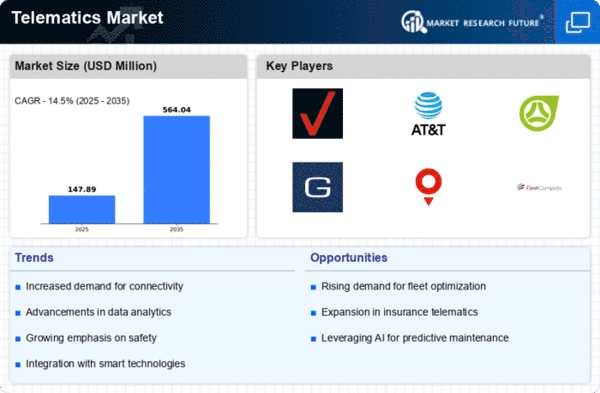
As per MRFR analysis, the Telematics Market Size was estimated at 129.16 USD Million in 2024. The Telematics industry is projected to grow from 145.5 USD Million in 2025 to 564.04 USD Million by 2035, exhibiting a compound annual growth rate (CAGR) of 14.5% during the forecast period 2025 - 2035.

Key Market Trends & Highlights

The Telematics Market is experiencing robust growth driven by technological advancements and increasing demand for connectivity.

  • The integration of AI and machine learning is transforming telematics solutions, enhancing data analysis and operational efficiency. North America remains the largest market, while Asia-Pacific is emerging as the fastest-growing region in telematics adoption. Fleet management continues to dominate the market, whereas insurance telematics is rapidly gaining traction due to evolving consumer needs. Rising demand for fleet management solutions and advancements in vehicle connectivity are key drivers propelling market expansion.

Market Size & Forecast

2024 Market Size 129.16 (USD Million)
2035 Market Size 564.04 (USD Million)
CAGR (2025 - 2035) 14.5%
Largest Regional Market Share in 2024 North America

Major Players

Verizon (US), AT&amp;T (US), Teletrac Navman (NZ), Geotab (CA), TomTom (NL), Fleet Complete (CA), Samsara (US), Trimble (US), Zebra Technologies (US)

Market Trends

The Telematics Market is currently experiencing a transformative phase, driven by advancements in technology and increasing demand for connectivity in vehicles. This sector encompasses a wide range of applications, including vehicle tracking, fleet management, and driver behavior analysis. As consumers and businesses alike seek enhanced safety, efficiency, and convenience, the integration of telematics solutions into everyday operations appears to be gaining momentum. Furthermore, the rise of electric vehicles and autonomous driving technologies is likely to further propel the adoption of telematics systems, as these innovations require sophisticated data management and communication capabilities. In addition to technological advancements, regulatory frameworks are evolving to support the growth of the Telematics Market. Governments worldwide are implementing policies aimed at improving road safety and reducing emissions, which may encourage the adoption of telematics solutions. The interplay between consumer preferences and regulatory requirements suggests a dynamic landscape where telematics solutions must adapt to meet diverse needs. As the market continues to evolve, stakeholders must remain vigilant to emerging trends and potential disruptions that could shape the future of telematics. The automotive telematics market is expanding rapidly due to rising demand for connected vehicles and real-time data analytics. Vehicle telematics plays a critical role in improving safety, navigation, and predictive maintenance across passenger and commercial vehicles. Vehicle telemetry data is increasingly used for predictive maintenance and driver behavior analysis. Advanced telematics solutions are enabling fleet operators to improve efficiency, reduce fuel consumption, and enhance driver safety. Modern telematics systems integrate GNSS, cellular connectivity, and cloud analytics to deliver real-time vehicle insights. 

Integration of AI and Machine Learning

The incorporation of artificial intelligence into telematics systems is becoming increasingly prevalent. AI technologies enhance data analysis capabilities, enabling more accurate predictions and insights regarding vehicle performance and driver behavior. This trend may lead to improved decision-making processes for fleet operators and individual users alike. Telematics software is gaining traction as fleet operators increasingly rely on data analytics and predictive maintenance platforms. Telematics tracking enables real-time monitoring of vehicle location, speed, and operational status. A telematics fleet management system integrates hardware, software, and connectivity to deliver end-to-end fleet monitoring. A telematics device installed in the vehicle collects location, speed, and engine data. Telematics devices are increasingly embedded in modern vehicles to support connected car functionalities. 

Focus on Data Privacy and Security

As telematics solutions collect vast amounts of data, concerns regarding data privacy and security are rising. Stakeholders are prioritizing the implementation of robust security measures to protect sensitive information. This trend indicates a growing awareness of the importance of safeguarding user data, which may influence the design and deployment of telematics systems. Each telematics system includes connectivity modules, sensors, and data processing software. The adoption of telematics in car systems is enhancing infotainment, safety, and navigation features. Automatic telematics functions enable vehicles to transmit data without manual intervention. Vehicle telemetry data is increasingly used for predictive maintenance and driver behavior analysis. A fleet telematics system supports real-time tracking, diagnostics, and compliance management. Navigation from telematics data improves route optimization and traffic management. To define telematics, it refers to the integration of telecommunications and informatics to transmit vehicle data in real time.

Expansion of Connected Vehicle Ecosystems

The development of connected vehicle ecosystems is gaining traction within the Telematics Market. This trend involves the integration of various technologies, such as vehicle-to-everything (V2X) communication, to enhance the overall driving experience. As connectivity becomes more ubiquitous, the potential for collaboration among different stakeholders in the automotive industry appears to be increasing.

Telematics Market Market Drivers

Market Growth Projections

The Global Telematics Market Industry is on a trajectory of remarkable growth, with projections indicating a rise from 129.2 USD Billion in 2024 to 681.8 USD Billion by 2035. This growth is underpinned by a compound annual growth rate of 16.33% from 2025 to 2035. Such figures suggest a robust demand for telematics solutions across various sectors, including automotive, logistics, and insurance. The increasing integration of telematics in everyday operations highlights its potential to transform industries by enhancing efficiency, safety, and connectivity. As the market evolves, stakeholders are likely to explore innovative applications and technologies to capitalize on this growth.

Advancements in IoT and Connectivity

The Global Telematics Market Industry is significantly influenced by advancements in Internet of Things (IoT) technologies and connectivity solutions. The proliferation of connected devices facilitates seamless data exchange between vehicles and infrastructure, enhancing the capabilities of telematics systems. For example, smart city initiatives leverage telematics to improve traffic management and reduce congestion. As connectivity becomes more robust, the market is poised for substantial growth, with projections indicating a rise to 681.8 USD Billion by 2035. This evolution suggests that the integration of IoT in telematics will not only enhance user experiences but also drive innovation across various sectors.

Growing Adoption of Electric Vehicles

The Global Telematics Market Industry is significantly impacted by the growing adoption of electric vehicles (EVs). As the automotive landscape shifts towards sustainability, telematics plays a crucial role in managing EV performance and optimizing charging infrastructure. For example, telematics systems can provide real-time data on battery health and charging patterns, enabling users to maximize efficiency. This trend aligns with the broader market growth, as the industry is projected to expand to 681.8 USD Billion by 2035. The integration of telematics in EVs not only enhances user experience but also supports the transition towards greener transportation solutions.

Rising Demand for Fleet Management Solutions

The Global Telematics Market Industry experiences a notable surge in demand for fleet management solutions. Companies increasingly seek to optimize their operations, reduce costs, and enhance safety through telematics technologies. For instance, the integration of GPS tracking and real-time data analytics allows fleet operators to monitor vehicle performance and driver behavior effectively. This trend is reflected in the projected market growth, with the industry expected to reach 129.2 USD Billion in 2024. As businesses recognize the value of telematics in improving efficiency, the adoption of these solutions is likely to accelerate, contributing significantly to the overall market expansion.

Increased Focus on Vehicle Safety and Compliance

The Global Telematics Market Industry is witnessing an increased emphasis on vehicle safety and regulatory compliance. Governments worldwide are implementing stringent regulations to ensure road safety, which drives the adoption of telematics solutions. For instance, telematics systems can monitor driver behavior, providing insights that help reduce accidents and improve compliance with safety standards. This focus on safety is likely to propel the market forward, as organizations invest in technologies that enhance their safety protocols. The anticipated compound annual growth rate of 16.33% from 2025 to 2035 underscores the importance of telematics in meeting these evolving safety requirements.

Emergence of Advanced Driver Assistance Systems (ADAS)

The Global Telematics Market Industry is increasingly shaped by the emergence of Advanced Driver Assistance Systems (ADAS). These systems utilize telematics to enhance vehicle safety and automate driving processes. Features such as lane-keeping assistance, adaptive cruise control, and collision avoidance rely heavily on real-time data provided by telematics solutions. As consumer demand for safer and more automated vehicles rises, the adoption of ADAS is expected to grow, driving the telematics market forward. This trend aligns with the projected market growth, as the industry is anticipated to reach 129.2 USD Billion in 2024, reflecting the critical role of telematics in advancing automotive technology.

Market Segment Insights

By Application: Fleet Management (Largest) vs. Insurance Telematics (Fastest-Growing)

In the Telematics Market, the application of Fleet Management commands a significant market share, being the largest segment. This can be attributed to the increasing adoption of telematics solutions by transportation and logistics companies, as they seek to optimize operational efficiency and enhance fleet safety. Insurance Telematics, on the other hand, is emerging rapidly, driven by the rising demand for usage-based insurance models where insurers leverage telematics data to assess risk and personalize premiums.

Fleet Management (Dominant) vs. Insurance Telematics (Emerging)

Fleet Management serves as the dominant application in the Telematics Market, characterized by robust solutions that facilitate vehicle tracking, route optimization, and real-time monitoring of fleet performance. Companies are integrating advanced telematics to enhance operational efficiency and reduce costs.Telematics vehicle tracking is widely adopted in logistics and transportation to enhance route optimization and theft prevention. The integration of telematics and fleet management is transforming how enterprises monitor vehicles, drivers, and fuel efficiency. Fleet telematics has become a core technology for optimizing operations and ensuring regulatory compliance. Fleet management telematics supports route planning, maintenance scheduling, and driver performance analysis. Telematics fleet management enables real-time visibility into large commercial vehicle fleets Conversely, Insurance Telematics is an emerging segment focusing on capturing driving behavior data to offer personalized insurance premiums based on actual usage and risk. This segment is gaining traction due to the push towards personalized insurance offerings and is propelled by advancements in data analytics and mobile connectivity. Although currently smaller in share, its potential for growth is substantial as more consumers lean towards smarter insurance solutions.

By End Use: Transportation (Largest) vs. Logistics (Fastest-Growing)

<p>The telematics market reveals a diverse distribution across various end-use segments, with transportation holding a significant market share due to its extensive application in fleet management, routing, and monitoring systems. Logistics is also prominent, leveraging telematics to enhance supply chain transparency and efficiency. The automotive sector is steadily integrating telematics solutions for improved vehicle performance and connectivity, while the construction and public sectors are gradually adopting these technologies to optimize operations and safety, albeit with smaller market shares overall. The growth trends indicate that logistics is emerging as the fastest-growing segment, driven by the rising demand for real-time tracking and analytics. Transportation remains dominant, propelled by an increased need for efficiency and cost-effectiveness in fleet operations. Both sectors benefit from advancements in IoT and big data analytics, enhancing their capabilities and fueling market expansion. The public sector is also beginning to harness telematics for smarter infrastructure management, indicating potential growth opportunities in future applications of telematics technology.</p>

<p>Transportation (Dominant) vs. Logistics (Emerging)</p>

<p>The transportation segment in the telematics market is characterized by its dominance, primarily focusing on fleet management solutions that enhance vehicle tracking, route optimization, and driver performance analytics. With an emphasis on reducing operational costs, increasing efficiency, and ensuring compliance with regulations, the transportation sector has been quick to adopt telematics technologies. In contrast, logistics is an emerging segment rapidly gaining traction as digital transformation reshapes supply chain management. The integration of telematics solutions facilitates improved tracking of goods, inventory management, and overall supply chain transparency, meeting the escalating customer demand for real-time information. As both segments evolve, there is a notable synergy, allowing logistics to benefit from the established foundations laid by the transportation sector.</p>

By Technology: Global Navigation Satellite System (Largest) vs. Cellular Network (Fastest-Growing)

The Telematics Market exhibits a diverse technology landscape, with the Global Navigation Satellite System (GNSS) dominating the segment due to its essential role in precise location tracking. Cellular networks also hold significant portions of the market share, enabling seamless connectivity for telematics solutions. Short Range Communication, Bluetooth Technology, and Wi-Fi Technology play key roles but contribute less compared to these two main technologies. The market's evolution is strongly influenced by the increasing demand for vehicle tracking and fleet management solutions, further augmented by advancements in communication infrastructure.

Technology: GNSS (Dominant) vs. Cellular Network (Emerging)

In the realm of telematics, the Global Navigation Satellite System (GNSS) is a dominant player, providing critical geolocation capabilities that support a wide variety of applications, such as navigation, vehicle tracking, and automated driving systems. GNSS systems are valued for their reliability and accuracy, solidifying their position as an indispensable component in the telematics ecosystem. Conversely, cellular networks are emerging rapidly due to their ability to enable real-time data transmission and communication for various telematics applications. With the rise of 5G and expanding cellular infrastructure, these networks are set to enhance connectivity and data exchange significantly within the telematics sector, positioning themselves as a vital technology in the ongoing transformation of vehicle communications.

By Component: Connectivity Modules (Largest) vs. Telematics Control Unit (Fastest-Growing)

<p>In the Telematics Market, the component segment is predominantly led by Connectivity Modules, which hold the largest share due to their critical role in enabling communication between vehicles and external systems. Hardware, including sensors and embedded systems, also plays a significant role but follows Connectivity Modules in market share. Software applications that facilitate data processing and analytics are gaining traction, while Services are crucial for deployment and maintenance. The Telematics Control Unit, a pivotal element within this segment, is emerging as the fastest-growing component as vehicles increasingly adopt connected technologies for enhanced performance and safety.</p>

<p>Telematics Control Unit (Dominant) vs. Services (Emerging)</p>

<p>The Telematics Control Unit (TCU) is a dominant player in the component segment, primarily responsible for processing vehicle data and managing connectivity functions. As the backbone of telematics systems, TCUs integrate various functionalities, allowing for real-time vehicle monitoring and data transmission. In contrast, Services, although emerging, are becoming increasingly vital as businesses prioritize the operational deployment of telematics solutions. Services encompass data management, system maintenance, and analytics support, thus improving overall telematics efficiency. As demand for connected vehicles rises, both TCUs and Services are crucial for transforming raw data into actionable insights, shaping the future of automotive technology.</p>

By Vehicle Type: Passenger Vehicle (Largest) vs. Electric Vehicle (Fastest-Growing)

<p>In the telematics market, passenger vehicles dominate the landscape, accounting for a significant share of the total market due to rising consumer demand for connected car technologies. Commercial vehicles and heavy-duty vehicles also contribute to the market share, driven by fleet management needs. Meanwhile, two-wheelers hold a smaller part but are important due to urban mobility solutions and cost efficiency. Telematics systems in these vehicles enhance driving experience, safety, and efficiency, appealing to both consumers and fleets.</p>

<p>Passenger Vehicle (Dominant) vs. Electric Vehicle (Emerging)</p>

<p>The passenger vehicle segment is recognized as the dominant player in the telematics market, characterized by a substantial adoption of connectivity features aimed at enhancing driver and passenger experience. This segment benefits from ongoing advancements in infotainment systems and safety features. On the other hand, the electric vehicle segment is emerging rapidly, propelled by growing environmental awareness and government incentives. As manufacturers innovate, electric vehicles are integrating sophisticated telematics solutions that improve charging management and route optimization, making this segment increasingly attractive to tech-savvy consumers.</p>

Get more detailed insights about Telematics Market Research Report - Global Forecast to 2035

Regional Insights

North America : Market Leader in Telematics

North America continues to lead the telematics market, holding a significant 65.0% share as of 2024. The region's growth is driven by increasing demand for fleet management solutions, enhanced connectivity, and regulatory support for vehicle safety and emissions standards. The rise in e-commerce and logistics has further fueled the need for real-time tracking and data analytics, making telematics an essential component for businesses. The competitive landscape is robust, with key players like Verizon, AT&T, and Geotab dominating the market. The U.S. and Canada are at the forefront, leveraging advanced technologies and infrastructure. Companies are investing heavily in R&D to innovate and improve service offerings, ensuring they remain competitive in this rapidly evolving sector.

Europe : Emerging Market with Growth Potential

Europe's telematics market is poised for growth, currently holding a 35.0% share. The region is witnessing a surge in demand for connected vehicle technologies, driven by stringent regulations on emissions and safety. The European Union's Green Deal and initiatives for smart mobility are significant catalysts, encouraging investments in telematics solutions that enhance efficiency and reduce environmental impact. Leading countries such as Germany, the UK, and France are at the forefront of this transformation, with major players like TomTom and Continental leading the charge. The competitive landscape is characterized by a mix of established firms and innovative startups, all vying to capture market share in this dynamic environment. The focus on sustainability and digitalization is reshaping the telematics landscape in Europe.

Asia-Pacific : Rapidly Growing Telecommunication Hub

The Asia-Pacific region is emerging as a significant player in the telematics market, currently holding a 25.0% share. The growth is driven by increasing vehicle production, urbanization, and the rising demand for smart transportation solutions. Governments are also implementing supportive policies to enhance road safety and reduce traffic congestion, further propelling the telematics sector forward. Countries like China, Japan, and Australia are leading the charge, with a competitive landscape featuring companies such as Teletrac Navman and Sierra Wireless. The region is witnessing a surge in partnerships between automotive manufacturers and telematics providers, aiming to integrate advanced technologies into vehicles. This collaboration is expected to enhance service offerings and drive market growth in the coming years.

Middle East and Africa : Emerging Market with Untapped Potential

The Middle East and Africa region represents an emerging market in the telematics sector, currently holding a modest 4.16% share. The growth is primarily driven by increasing investments in infrastructure and a growing awareness of the benefits of telematics in fleet management and logistics. Governments are beginning to recognize the importance of telematics for enhancing road safety and efficiency, leading to supportive regulations. Countries like South Africa and the UAE are at the forefront of this growth, with a competitive landscape that includes both local and international players. The presence of companies like Fleet Complete is indicative of the region's potential. As the market matures, increased adoption of telematics solutions is expected, driven by technological advancements and a focus on operational efficiency.

Key Players and Competitive Insights

The Telematics Market is currently characterized by a dynamic competitive landscape, driven by technological advancements and increasing demand for fleet management solutions. Key players such as Verizon (US), AT&T (US), and Geotab (CA) are strategically positioning themselves through innovation and partnerships. Verizon (US) focuses on enhancing its IoT capabilities, while AT&T (US) emphasizes its 5G network to support telematics applications. Geotab (CA) is leveraging data analytics to provide actionable insights for fleet operators, thereby shaping a competitive environment that prioritizes technological integration and customer-centric solutions.In terms of business tactics, companies are increasingly localizing manufacturing and optimizing supply chains to enhance operational efficiency. The market appears moderately fragmented, with several players vying for market share. However, the collective influence of major companies is significant, as they drive trends in digital transformation and sustainability, which are becoming essential for competitive differentiation.

In November Verizon (US) announced a partnership with a leading automotive manufacturer to integrate advanced telematics solutions into new vehicle models. This strategic move is likely to enhance Verizon's market presence and provide customers with enhanced connectivity features, thereby reinforcing its position as a leader in the telematics space. The collaboration underscores the importance of integrating telematics with automotive technology to meet evolving consumer demands.

In October Geotab (CA) launched a new AI-driven analytics platform aimed at improving fleet efficiency and reducing operational costs. This initiative is indicative of Geotab's commitment to innovation and reflects a broader trend within the industry towards leveraging artificial intelligence for enhanced decision-making. The platform's capabilities may provide Geotab with a competitive edge, as it allows fleet operators to optimize routes and monitor vehicle performance in real-time.

In September AT&T (US) expanded its telematics offerings by acquiring a software company specializing in fleet management solutions. This acquisition is expected to bolster AT&T's capabilities in providing comprehensive telematics services, thereby enhancing its competitive positioning. The move illustrates a trend towards consolidation in the market, as companies seek to broaden their service portfolios and enhance customer value through integrated solutions.

As of December the Telematics Market is witnessing trends such as digitalization, sustainability, and AI integration, which are reshaping competitive dynamics. Strategic alliances are increasingly important, as they enable companies to leverage complementary strengths and enhance their service offerings. Looking ahead, competitive differentiation is likely to evolve from price-based competition to a focus on innovation, technology, and supply chain reliability, as companies strive to meet the growing demands of a more connected and sustainable future.

Key Companies in the Telematics Market include

Industry Developments

November 2024 : NXP has introduced the i.MX 94 applications processor, a next-generation telematics and connectivity solution for software-defined vehicles (SDVs). It integrates high-performance processing, advanced security, and real-time networking, enabling efficient vehicle-to-cloud communication, over-the-air (OTA) updates, and intelligent telematics management while reducing system complexity and cost​.

June 2023 : Verizon Business launched Connected Car by Verizon for select BMW models in the U.S., offering voice, data, and unlimited Wi-Fi for $20/month. Features include Multi-Vehicle Connect for personalized settings across multiple BMWs and Number Share – Vehicle for seamless calling via BMW eSIM, enhancing in-car connectivity and infotainment.

Future Outlook

Telematics Market Future Outlook

The Telematics Market is projected to grow at a 14.5% CAGR from 2025 to 2035, driven by advancements in IoT, increased demand for fleet management, and regulatory support.

New opportunities lie in:

  • <p>Integration of AI-driven analytics for predictive maintenance solutions. Development of advanced driver-assistance systems (ADAS) for enhanced safety. Expansion of telematics services in emerging markets for fleet optimization.</p>

By 2035, the Telematics Market is expected to be robust, driven by innovation and strategic partnerships.

Market Segmentation

Telematics Market End Use Outlook

  • Transportation
  • Automotive
  • Construction
  • Healthcare
  • Agriculture

Telematics Market Component Outlook

  • Hardware
  • Software
  • Telematics Control Unit
  • Sensors
  • Connectivity Modules

Telematics Market Technology Outlook

  • Global Navigation Satellite System
  • Cellular Network
  • Short Range Communication
  • Bluetooth Technology
  • Wi-Fi Technology

Telematics Market Application Outlook

  • Fleet Management
  • Insurance Telematics
  • Vehicle Tracking
  • Remote Diagnostics
  • Driver Behavior Monitoring

Telematics Market Service Type Outlook

  • Data Analytics
  • Consulting Services
  • Integration Services
  • Maintenance Services
  • Support Services

Report Scope

MARKET SIZE 2024 129.16(USD Million)
MARKET SIZE 2025 145.5(USD Million)
MARKET SIZE 2035 564.04(USD Million)
COMPOUND ANNUAL GROWTH RATE (CAGR) 14.5% (2025 - 2035)
REPORT COVERAGE Revenue Forecast, Competitive Landscape, Growth Factors, and Trends
BASE YEAR 2024
Market Forecast Period 2025 - 2035
Historical Data 2019 - 2024
Market Forecast Units USD Million
Key Companies Profiled Verizon (US), AT&T (US), Teletrac Navman (NZ), Geotab (CA), TomTom (NL), Fleet Complete (CA), Samsara (US), Trimble (US), Zebra Technologies (US)
Segments Covered Application, End Use, Technology, Component, Service Type
Key Market Opportunities Integration of artificial intelligence in telematics enhances predictive maintenance and operational efficiency.
Key Market Dynamics Rising demand for connected vehicles drives innovation in telematics solutions and enhances competitive market dynamics.
Countries Covered North America, Europe, APAC, South America, MEA

FAQs

What is the current valuation of the Telematics Market as of 2024?

<p>The Telematics Market was valued at 129.16 USD Million in 2024.</p>

What is the projected market valuation for the Telematics Market in 2035?

<p>The Telematics Market is projected to reach a valuation of 564.04 USD Million by 2035.</p>

What is the expected CAGR for the Telematics Market during the forecast period 2025 - 2035?

<p>The expected CAGR for the Telematics Market during the forecast period 2025 - 2035 is 14.5%.</p>

Which companies are considered key players in the Telematics Market?

<p>Key players in the Telematics Market include Verizon, AT&T, TomTom, Geotab, Fleet Complete, Teletrac Navman, Sierra Wireless, Trimble, and Continental.</p>

What are the main applications of telematics in the market?

<p>The main applications in the Telematics Market include Fleet Management, Insurance Telematics, Vehicle Tracking, Remote Diagnostics, and Driver Behavior Monitoring.</p>

How does the Automotive sector contribute to the Telematics Market?

The Automotive sector is projected to contribute between 40.0 and 180.0 USD Million to the Telematics Market.

What technologies are driving the Telematics Market?

Key technologies driving the Telematics Market include Global Navigation Satellite System, Cellular Network, Short Range Communication, Embedded Telematics, and Cloud Computing.

What components are included in the Telematics Market?

The Telematics Market comprises Hardware, Software, Services, Connectivity Modules, and Telematics Control Units.

What vehicle types are represented in the Telematics Market?

The Telematics Market includes various vehicle types such as Passenger Vehicles, Commercial Vehicles, Heavy Duty Vehicles, Two-Wheelers, and Electric Vehicles.

What is the expected growth trend for the Telematics Market in the coming years?

The Telematics Market is expected to experience robust growth, with a projected valuation increase to 564.04 USD Million by 2035.

  1. SECTION I: EXECUTIVE SUMMARY AND KEY HIGHLIGHTS
    1. | 1.1 EXECUTIVE SUMMARY
    2. | | 1.1.1 Market Overview
    3. | | 1.1.2 Key Findings
    4. | | 1.1.3 Market Segmentation
    5. | | 1.1.4 Competitive Landscape
    6. | | 1.1.5 Challenges and Opportunities
    7. | | 1.1.6 Future Outlook
  2. SECTION II: SCOPING, METHODOLOGY AND MARKET STRUCTURE
    1. | 2.1 MARKET INTRODUCTION
    2. | | 2.1.1 Definition
    3. | | 2.1.2 Scope of the study
    4. | | | 2.1.2.1 Research Objective
    5. | | | 2.1.2.2 Assumption
    6. | | | 2.1.2.3 Limitations
    7. | 2.2 RESEARCH METHODOLOGY
    8. | | 2.2.1 Overview
    9. | | 2.2.2 Data Mining
    10. | | 2.2.3 Secondary Research
    11. | | 2.2.4 Primary Research
    12. | | | 2.2.4.1 Primary Interviews and Information Gathering Process
    13. | | | 2.2.4.2 Breakdown of Primary Respondents
    14. | | 2.2.5 Forecasting Model
    15. | | 2.2.6 Market Size Estimation
    16. | | | 2.2.6.1 Bottom-Up Approach
    17. | | | 2.2.6.2 Top-Down Approach
    18. | | 2.2.7 Data Triangulation
    19. | | 2.2.8 Validation
  3. SECTION III: QUALITATIVE ANALYSIS
    1. | 3.1 MARKET DYNAMICS
    2. | | 3.1.1 Overview
    3. | | 3.1.2 Drivers
    4. | | 3.1.3 Restraints
    5. | | 3.1.4 Opportunities
    6. | 3.2 MARKET FACTOR ANALYSIS
    7. | | 3.2.1 Value chain Analysis
    8. | | 3.2.2 Porter's Five Forces Analysis
    9. | | | 3.2.2.1 Bargaining Power of Suppliers
    10. | | | 3.2.2.2 Bargaining Power of Buyers
    11. | | | 3.2.2.3 Threat of New Entrants
    12. | | | 3.2.2.4 Threat of Substitutes
    13. | | | 3.2.2.5 Intensity of Rivalry
    14. | | 3.2.3 COVID-19 Impact Analysis
    15. | | | 3.2.3.1 Market Impact Analysis
    16. | | | 3.2.3.2 Regional Impact
    17. | | | 3.2.3.3 Opportunity and Threat Analysis
  4. SECTION IV: QUANTITATIVE ANALYSIS
    1. | 4.1 Information and Communications Technology, BY Application (USD Million)
    2. | | 4.1.1 Fleet Management
    3. | | 4.1.2 Insurance Telematics
    4. | | 4.1.3 Vehicle Tracking
    5. | | 4.1.4 Remote Diagnostics
    6. | | 4.1.5 Driver Behavior Monitoring
    7. | 4.2 Information and Communications Technology, BY End Use (USD Million)
    8. | | 4.2.1 Transportation
    9. | | 4.2.2 Logistics
    10. | | 4.2.3 Automotive
    11. | | 4.2.4 Construction
    12. | | 4.2.5 Public Sector
    13. | 4.3 Information and Communications Technology, BY Technology (USD Million)
    14. | | 4.3.1 Global Navigation Satellite System
    15. | | 4.3.2 Cellular Network
    16. | | 4.3.3 Short Range Communication
    17. | | 4.3.4 Embedded Telematics
    18. | | 4.3.5 Cloud Computing
    19. | 4.4 Information and Communications Technology, BY Component (USD Million)
    20. | | 4.4.1 Hardware
    21. | | 4.4.2 Software
    22. | | 4.4.3 Services
    23. | | 4.4.4 Connectivity Modules
    24. | | 4.4.5 Telematics Control Unit
    25. | 4.5 Information and Communications Technology, BY Vehicle Type (USD Million)
    26. | | 4.5.1 Passenger Vehicle
    27. | | 4.5.2 Commercial Vehicle
    28. | | 4.5.3 Heavy Duty Vehicle
    29. | | 4.5.4 Two-Wheeler
    30. | | 4.5.5 Electric Vehicle
    31. | 4.6 Information and Communications Technology, BY Region (USD Million)
    32. | | 4.6.1 North America
    33. | | | 4.6.1.1 US
    34. | | | 4.6.1.2 Canada
    35. | | 4.6.2 Europe
    36. | | | 4.6.2.1 Germany
    37. | | | 4.6.2.2 UK
    38. | | | 4.6.2.3 France
    39. | | | 4.6.2.4 Russia
    40. | | | 4.6.2.5 Italy
    41. | | | 4.6.2.6 Spain
    42. | | | 4.6.2.7 Rest of Europe
    43. | | 4.6.3 APAC
    44. | | | 4.6.3.1 China
    45. | | | 4.6.3.2 India
    46. | | | 4.6.3.3 Japan
    47. | | | 4.6.3.4 South Korea
    48. | | | 4.6.3.5 Malaysia
    49. | | | 4.6.3.6 Thailand
    50. | | | 4.6.3.7 Indonesia
    51. | | | 4.6.3.8 Rest of APAC
    52. | | 4.6.4 South America
    53. | | | 4.6.4.1 Brazil
    54. | | | 4.6.4.2 Mexico
    55. | | | 4.6.4.3 Argentina
    56. | | | 4.6.4.4 Rest of South America
    57. | | 4.6.5 MEA
    58. | | | 4.6.5.1 GCC Countries
    59. | | | 4.6.5.2 South Africa
    60. | | | 4.6.5.3 Rest of MEA
  5. SECTION V: COMPETITIVE ANALYSIS
    1. | 5.1 Competitive Landscape
    2. | | 5.1.1 Overview
    3. | | 5.1.2 Competitive Analysis
    4. | | 5.1.3 Market share Analysis
    5. | | 5.1.4 Major Growth Strategy in the Information and Communications Technology
    6. | | 5.1.5 Competitive Benchmarking
    7. | | 5.1.6 Leading Players in Terms of Number of Developments in the Information and Communications Technology
    8. | | 5.1.7 Key developments and growth strategies
    9. | | | 5.1.7.1 New Product Launch/Service Deployment
    10. | | | 5.1.7.2 Merger & Acquisitions
    11. | | | 5.1.7.3 Joint Ventures
    12. | | 5.1.8 Major Players Financial Matrix
    13. | | | 5.1.8.1 Sales and Operating Income
    14. | | | 5.1.8.2 Major Players R&D Expenditure. 2023
    15. | 5.2 Company Profiles
    16. | | 5.2.1 Verizon (US)
    17. | | | 5.2.1.1 Financial Overview
    18. | | | 5.2.1.2 Products Offered
    19. | | | 5.2.1.3 Key Developments
    20. | | | 5.2.1.4 SWOT Analysis
    21. | | | 5.2.1.5 Key Strategies
    22. | | 5.2.2 AT&T (US)
    23. | | | 5.2.2.1 Financial Overview
    24. | | | 5.2.2.2 Products Offered
    25. | | | 5.2.2.3 Key Developments
    26. | | | 5.2.2.4 SWOT Analysis
    27. | | | 5.2.2.5 Key Strategies
    28. | | 5.2.3 TomTom (NL)
    29. | | | 5.2.3.1 Financial Overview
    30. | | | 5.2.3.2 Products Offered
    31. | | | 5.2.3.3 Key Developments
    32. | | | 5.2.3.4 SWOT Analysis
    33. | | | 5.2.3.5 Key Strategies
    34. | | 5.2.4 Geotab (CA)
    35. | | | 5.2.4.1 Financial Overview
    36. | | | 5.2.4.2 Products Offered
    37. | | | 5.2.4.3 Key Developments
    38. | | | 5.2.4.4 SWOT Analysis
    39. | | | 5.2.4.5 Key Strategies
    40. | | 5.2.5 Fleet Complete (CA)
    41. | | | 5.2.5.1 Financial Overview
    42. | | | 5.2.5.2 Products Offered
    43. | | | 5.2.5.3 Key Developments
    44. | | | 5.2.5.4 SWOT Analysis
    45. | | | 5.2.5.5 Key Strategies
    46. | | 5.2.6 Teletrac Navman (AU)
    47. | | | 5.2.6.1 Financial Overview
    48. | | | 5.2.6.2 Products Offered
    49. | | | 5.2.6.3 Key Developments
    50. | | | 5.2.6.4 SWOT Analysis
    51. | | | 5.2.6.5 Key Strategies
    52. | | 5.2.7 Sierra Wireless (CA)
    53. | | | 5.2.7.1 Financial Overview
    54. | | | 5.2.7.2 Products Offered
    55. | | | 5.2.7.3 Key Developments
    56. | | | 5.2.7.4 SWOT Analysis
    57. | | | 5.2.7.5 Key Strategies
    58. | | 5.2.8 Trimble (US)
    59. | | | 5.2.8.1 Financial Overview
    60. | | | 5.2.8.2 Products Offered
    61. | | | 5.2.8.3 Key Developments
    62. | | | 5.2.8.4 SWOT Analysis
    63. | | | 5.2.8.5 Key Strategies
    64. | | 5.2.9 Continental (DE)
    65. | | | 5.2.9.1 Financial Overview
    66. | | | 5.2.9.2 Products Offered
    67. | | | 5.2.9.3 Key Developments
    68. | | | 5.2.9.4 SWOT Analysis
    69. | | | 5.2.9.5 Key Strategies
    70. | 5.3 Appendix
    71. | | 5.3.1 References
    72. | | 5.3.2 Related Reports
  6. LIST OF FIGURES
    1. | 6.1 MARKET SYNOPSIS
    2. | 6.2 NORTH AMERICA MARKET ANALYSIS
    3. | 6.3 US MARKET ANALYSIS BY APPLICATION
    4. | 6.4 US MARKET ANALYSIS BY END USE
    5. | 6.5 US MARKET ANALYSIS BY TECHNOLOGY
    6. | 6.6 US MARKET ANALYSIS BY COMPONENT
    7. | 6.7 US MARKET ANALYSIS BY VEHICLE TYPE
    8. | 6.8 CANADA MARKET ANALYSIS BY APPLICATION
    9. | 6.9 CANADA MARKET ANALYSIS BY END USE
    10. | 6.10 CANADA MARKET ANALYSIS BY TECHNOLOGY
    11. | 6.11 CANADA MARKET ANALYSIS BY COMPONENT
    12. | 6.12 CANADA MARKET ANALYSIS BY VEHICLE TYPE
    13. | 6.13 EUROPE MARKET ANALYSIS
    14. | 6.14 GERMANY MARKET ANALYSIS BY APPLICATION
    15. | 6.15 GERMANY MARKET ANALYSIS BY END USE
    16. | 6.16 GERMANY MARKET ANALYSIS BY TECHNOLOGY
    17. | 6.17 GERMANY MARKET ANALYSIS BY COMPONENT
    18. | 6.18 GERMANY MARKET ANALYSIS BY VEHICLE TYPE
    19. | 6.19 UK MARKET ANALYSIS BY APPLICATION
    20. | 6.20 UK MARKET ANALYSIS BY END USE
    21. | 6.21 UK MARKET ANALYSIS BY TECHNOLOGY
    22. | 6.22 UK MARKET ANALYSIS BY COMPONENT
    23. | 6.23 UK MARKET ANALYSIS BY VEHICLE TYPE
    24. | 6.24 FRANCE MARKET ANALYSIS BY APPLICATION
    25. | 6.25 FRANCE MARKET ANALYSIS BY END USE
    26. | 6.26 FRANCE MARKET ANALYSIS BY TECHNOLOGY
    27. | 6.27 FRANCE MARKET ANALYSIS BY COMPONENT
    28. | 6.28 FRANCE MARKET ANALYSIS BY VEHICLE TYPE
    29. | 6.29 RUSSIA MARKET ANALYSIS BY APPLICATION
    30. | 6.30 RUSSIA MARKET ANALYSIS BY END USE
    31. | 6.31 RUSSIA MARKET ANALYSIS BY TECHNOLOGY
    32. | 6.32 RUSSIA MARKET ANALYSIS BY COMPONENT
    33. | 6.33 RUSSIA MARKET ANALYSIS BY VEHICLE TYPE
    34. | 6.34 ITALY MARKET ANALYSIS BY APPLICATION
    35. | 6.35 ITALY MARKET ANALYSIS BY END USE
    36. | 6.36 ITALY MARKET ANALYSIS BY TECHNOLOGY
    37. | 6.37 ITALY MARKET ANALYSIS BY COMPONENT
    38. | 6.38 ITALY MARKET ANALYSIS BY VEHICLE TYPE
    39. | 6.39 SPAIN MARKET ANALYSIS BY APPLICATION
    40. | 6.40 SPAIN MARKET ANALYSIS BY END USE
    41. | 6.41 SPAIN MARKET ANALYSIS BY TECHNOLOGY
    42. | 6.42 SPAIN MARKET ANALYSIS BY COMPONENT
    43. | 6.43 SPAIN MARKET ANALYSIS BY VEHICLE TYPE
    44. | 6.44 REST OF EUROPE MARKET ANALYSIS BY APPLICATION
    45. | 6.45 REST OF EUROPE MARKET ANALYSIS BY END USE
    46. | 6.46 REST OF EUROPE MARKET ANALYSIS BY TECHNOLOGY
    47. | 6.47 REST OF EUROPE MARKET ANALYSIS BY COMPONENT
    48. | 6.48 REST OF EUROPE MARKET ANALYSIS BY VEHICLE TYPE
    49. | 6.49 APAC MARKET ANALYSIS
    50. | 6.50 CHINA MARKET ANALYSIS BY APPLICATION
    51. | 6.51 CHINA MARKET ANALYSIS BY END USE
    52. | 6.52 CHINA MARKET ANALYSIS BY TECHNOLOGY
    53. | 6.53 CHINA MARKET ANALYSIS BY COMPONENT
    54. | 6.54 CHINA MARKET ANALYSIS BY VEHICLE TYPE
    55. | 6.55 INDIA MARKET ANALYSIS BY APPLICATION
    56. | 6.56 INDIA MARKET ANALYSIS BY END USE
    57. | 6.57 INDIA MARKET ANALYSIS BY TECHNOLOGY
    58. | 6.58 INDIA MARKET ANALYSIS BY COMPONENT
    59. | 6.59 INDIA MARKET ANALYSIS BY VEHICLE TYPE
    60. | 6.60 JAPAN MARKET ANALYSIS BY APPLICATION
    61. | 6.61 JAPAN MARKET ANALYSIS BY END USE
    62. | 6.62 JAPAN MARKET ANALYSIS BY TECHNOLOGY
    63. | 6.63 JAPAN MARKET ANALYSIS BY COMPONENT
    64. | 6.64 JAPAN MARKET ANALYSIS BY VEHICLE TYPE
    65. | 6.65 SOUTH KOREA MARKET ANALYSIS BY APPLICATION
    66. | 6.66 SOUTH KOREA MARKET ANALYSIS BY END USE
    67. | 6.67 SOUTH KOREA MARKET ANALYSIS BY TECHNOLOGY
    68. | 6.68 SOUTH KOREA MARKET ANALYSIS BY COMPONENT
    69. | 6.69 SOUTH KOREA MARKET ANALYSIS BY VEHICLE TYPE
    70. | 6.70 MALAYSIA MARKET ANALYSIS BY APPLICATION
    71. | 6.71 MALAYSIA MARKET ANALYSIS BY END USE
    72. | 6.72 MALAYSIA MARKET ANALYSIS BY TECHNOLOGY
    73. | 6.73 MALAYSIA MARKET ANALYSIS BY COMPONENT
    74. | 6.74 MALAYSIA MARKET ANALYSIS BY VEHICLE TYPE
    75. | 6.75 THAILAND MARKET ANALYSIS BY APPLICATION
    76. | 6.76 THAILAND MARKET ANALYSIS BY END USE
    77. | 6.77 THAILAND MARKET ANALYSIS BY TECHNOLOGY
    78. | 6.78 THAILAND MARKET ANALYSIS BY COMPONENT
    79. | 6.79 THAILAND MARKET ANALYSIS BY VEHICLE TYPE
    80. | 6.80 INDONESIA MARKET ANALYSIS BY APPLICATION
    81. | 6.81 INDONESIA MARKET ANALYSIS BY END USE
    82. | 6.82 INDONESIA MARKET ANALYSIS BY TECHNOLOGY
    83. | 6.83 INDONESIA MARKET ANALYSIS BY COMPONENT
    84. | 6.84 INDONESIA MARKET ANALYSIS BY VEHICLE TYPE
    85. | 6.85 REST OF APAC MARKET ANALYSIS BY APPLICATION
    86. | 6.86 REST OF APAC MARKET ANALYSIS BY END USE
    87. | 6.87 REST OF APAC MARKET ANALYSIS BY TECHNOLOGY
    88. | 6.88 REST OF APAC MARKET ANALYSIS BY COMPONENT
    89. | 6.89 REST OF APAC MARKET ANALYSIS BY VEHICLE TYPE
    90. | 6.90 SOUTH AMERICA MARKET ANALYSIS
    91. | 6.91 BRAZIL MARKET ANALYSIS BY APPLICATION
    92. | 6.92 BRAZIL MARKET ANALYSIS BY END USE
    93. | 6.93 BRAZIL MARKET ANALYSIS BY TECHNOLOGY
    94. | 6.94 BRAZIL MARKET ANALYSIS BY COMPONENT
    95. | 6.95 BRAZIL MARKET ANALYSIS BY VEHICLE TYPE
    96. | 6.96 MEXICO MARKET ANALYSIS BY APPLICATION
    97. | 6.97 MEXICO MARKET ANALYSIS BY END USE
    98. | 6.98 MEXICO MARKET ANALYSIS BY TECHNOLOGY
    99. | 6.99 MEXICO MARKET ANALYSIS BY COMPONENT
    100. | 6.100 MEXICO MARKET ANALYSIS BY VEHICLE TYPE
    101. | 6.101 ARGENTINA MARKET ANALYSIS BY APPLICATION
    102. | 6.102 ARGENTINA MARKET ANALYSIS BY END USE
    103. | 6.103 ARGENTINA MARKET ANALYSIS BY TECHNOLOGY
    104. | 6.104 ARGENTINA MARKET ANALYSIS BY COMPONENT
    105. | 6.105 ARGENTINA MARKET ANALYSIS BY VEHICLE TYPE
    106. | 6.106 REST OF SOUTH AMERICA MARKET ANALYSIS BY APPLICATION
    107. | 6.107 REST OF SOUTH AMERICA MARKET ANALYSIS BY END USE
    108. | 6.108 REST OF SOUTH AMERICA MARKET ANALYSIS BY TECHNOLOGY
    109. | 6.109 REST OF SOUTH AMERICA MARKET ANALYSIS BY COMPONENT
    110. | 6.110 REST OF SOUTH AMERICA MARKET ANALYSIS BY VEHICLE TYPE
    111. | 6.111 MEA MARKET ANALYSIS
    112. | 6.112 GCC COUNTRIES MARKET ANALYSIS BY APPLICATION
    113. | 6.113 GCC COUNTRIES MARKET ANALYSIS BY END USE
    114. | 6.114 GCC COUNTRIES MARKET ANALYSIS BY TECHNOLOGY
    115. | 6.115 GCC COUNTRIES MARKET ANALYSIS BY COMPONENT
    116. | 6.116 GCC COUNTRIES MARKET ANALYSIS BY VEHICLE TYPE
    117. | 6.117 SOUTH AFRICA MARKET ANALYSIS BY APPLICATION
    118. | 6.118 SOUTH AFRICA MARKET ANALYSIS BY END USE
    119. | 6.119 SOUTH AFRICA MARKET ANALYSIS BY TECHNOLOGY
    120. | 6.120 SOUTH AFRICA MARKET ANALYSIS BY COMPONENT
    121. | 6.121 SOUTH AFRICA MARKET ANALYSIS BY VEHICLE TYPE
    122. | 6.122 REST OF MEA MARKET ANALYSIS BY APPLICATION
    123. | 6.123 REST OF MEA MARKET ANALYSIS BY END USE
    124. | 6.124 REST OF MEA MARKET ANALYSIS BY TECHNOLOGY
    125. | 6.125 REST OF MEA MARKET ANALYSIS BY COMPONENT
    126. | 6.126 REST OF MEA MARKET ANALYSIS BY VEHICLE TYPE
    127. | 6.127 KEY BUYING CRITERIA OF INFORMATION AND COMMUNICATIONS TECHNOLOGY
    128. | 6.128 RESEARCH PROCESS OF MRFR
    129. | 6.129 DRO ANALYSIS OF INFORMATION AND COMMUNICATIONS TECHNOLOGY
    130. | 6.130 DRIVERS IMPACT ANALYSIS: INFORMATION AND COMMUNICATIONS TECHNOLOGY
    131. | 6.131 RESTRAINTS IMPACT ANALYSIS: INFORMATION AND COMMUNICATIONS TECHNOLOGY
    132. | 6.132 SUPPLY / VALUE CHAIN: INFORMATION AND COMMUNICATIONS TECHNOLOGY
    133. | 6.133 INFORMATION AND COMMUNICATIONS TECHNOLOGY, BY APPLICATION, 2024 (% SHARE)
    134. | 6.134 INFORMATION AND COMMUNICATIONS TECHNOLOGY, BY APPLICATION, 2024 TO 2035 (USD Million)
    135. | 6.135 INFORMATION AND COMMUNICATIONS TECHNOLOGY, BY END USE, 2024 (% SHARE)
    136. | 6.136 INFORMATION AND COMMUNICATIONS TECHNOLOGY, BY END USE, 2024 TO 2035 (USD Million)
    137. | 6.137 INFORMATION AND COMMUNICATIONS TECHNOLOGY, BY TECHNOLOGY, 2024 (% SHARE)
    138. | 6.138 INFORMATION AND COMMUNICATIONS TECHNOLOGY, BY TECHNOLOGY, 2024 TO 2035 (USD Million)
    139. | 6.139 INFORMATION AND COMMUNICATIONS TECHNOLOGY, BY COMPONENT, 2024 (% SHARE)
    140. | 6.140 INFORMATION AND COMMUNICATIONS TECHNOLOGY, BY COMPONENT, 2024 TO 2035 (USD Million)
    141. | 6.141 INFORMATION AND COMMUNICATIONS TECHNOLOGY, BY VEHICLE TYPE, 2024 (% SHARE)
    142. | 6.142 INFORMATION AND COMMUNICATIONS TECHNOLOGY, BY VEHICLE TYPE, 2024 TO 2035 (USD Million)
    143. | 6.143 BENCHMARKING OF MAJOR COMPETITORS
  7. LIST OF TABLES
    1. | 7.1 LIST OF ASSUMPTIONS
    2. | | 7.1.1
    3. | 7.2 North America MARKET SIZE ESTIMATES; FORECAST
    4. | | 7.2.1 BY APPLICATION, 2025-2035 (USD Million)
    5. | | 7.2.2 BY END USE, 2025-2035 (USD Million)
    6. | | 7.2.3 BY TECHNOLOGY, 2025-2035 (USD Million)
    7. | | 7.2.4 BY COMPONENT, 2025-2035 (USD Million)
    8. | | 7.2.5 BY VEHICLE TYPE, 2025-2035 (USD Million)
    9. | 7.3 US MARKET SIZE ESTIMATES; FORECAST
    10. | | 7.3.1 BY APPLICATION, 2025-2035 (USD Million)
    11. | | 7.3.2 BY END USE, 2025-2035 (USD Million)
    12. | | 7.3.3 BY TECHNOLOGY, 2025-2035 (USD Million)
    13. | | 7.3.4 BY COMPONENT, 2025-2035 (USD Million)
    14. | | 7.3.5 BY VEHICLE TYPE, 2025-2035 (USD Million)
    15. | 7.4 Canada MARKET SIZE ESTIMATES; FORECAST
    16. | | 7.4.1 BY APPLICATION, 2025-2035 (USD Million)
    17. | | 7.4.2 BY END USE, 2025-2035 (USD Million)
    18. | | 7.4.3 BY TECHNOLOGY, 2025-2035 (USD Million)
    19. | | 7.4.4 BY COMPONENT, 2025-2035 (USD Million)
    20. | | 7.4.5 BY VEHICLE TYPE, 2025-2035 (USD Million)
    21. | 7.5 Europe MARKET SIZE ESTIMATES; FORECAST
    22. | | 7.5.1 BY APPLICATION, 2025-2035 (USD Million)
    23. | | 7.5.2 BY END USE, 2025-2035 (USD Million)
    24. | | 7.5.3 BY TECHNOLOGY, 2025-2035 (USD Million)
    25. | | 7.5.4 BY COMPONENT, 2025-2035 (USD Million)
    26. | | 7.5.5 BY VEHICLE TYPE, 2025-2035 (USD Million)
    27. | 7.6 Germany MARKET SIZE ESTIMATES; FORECAST
    28. | | 7.6.1 BY APPLICATION, 2025-2035 (USD Million)
    29. | | 7.6.2 BY END USE, 2025-2035 (USD Million)
    30. | | 7.6.3 BY TECHNOLOGY, 2025-2035 (USD Million)
    31. | | 7.6.4 BY COMPONENT, 2025-2035 (USD Million)
    32. | | 7.6.5 BY VEHICLE TYPE, 2025-2035 (USD Million)
    33. | 7.7 UK MARKET SIZE ESTIMATES; FORECAST
    34. | | 7.7.1 BY APPLICATION, 2025-2035 (USD Million)
    35. | | 7.7.2 BY END USE, 2025-2035 (USD Million)
    36. | | 7.7.3 BY TECHNOLOGY, 2025-2035 (USD Million)
    37. | | 7.7.4 BY COMPONENT, 2025-2035 (USD Million)
    38. | | 7.7.5 BY VEHICLE TYPE, 2025-2035 (USD Million)
    39. | 7.8 France MARKET SIZE ESTIMATES; FORECAST
    40. | | 7.8.1 BY APPLICATION, 2025-2035 (USD Million)
    41. | | 7.8.2 BY END USE, 2025-2035 (USD Million)
    42. | | 7.8.3 BY TECHNOLOGY, 2025-2035 (USD Million)
    43. | | 7.8.4 BY COMPONENT, 2025-2035 (USD Million)
    44. | | 7.8.5 BY VEHICLE TYPE, 2025-2035 (USD Million)
    45. | 7.9 Russia MARKET SIZE ESTIMATES; FORECAST
    46. | | 7.9.1 BY APPLICATION, 2025-2035 (USD Million)
    47. | | 7.9.2 BY END USE, 2025-2035 (USD Million)
    48. | | 7.9.3 BY TECHNOLOGY, 2025-2035 (USD Million)
    49. | | 7.9.4 BY COMPONENT, 2025-2035 (USD Million)
    50. | | 7.9.5 BY VEHICLE TYPE, 2025-2035 (USD Million)
    51. | 7.10 Italy MARKET SIZE ESTIMATES; FORECAST
    52. | | 7.10.1 BY APPLICATION, 2025-2035 (USD Million)
    53. | | 7.10.2 BY END USE, 2025-2035 (USD Million)
    54. | | 7.10.3 BY TECHNOLOGY, 2025-2035 (USD Million)
    55. | | 7.10.4 BY COMPONENT, 2025-2035 (USD Million)
    56. | | 7.10.5 BY VEHICLE TYPE, 2025-2035 (USD Million)
    57. | 7.11 Spain MARKET SIZE ESTIMATES; FORECAST
    58. | | 7.11.1 BY APPLICATION, 2025-2035 (USD Million)
    59. | | 7.11.2 BY END USE, 2025-2035 (USD Million)
    60. | | 7.11.3 BY TECHNOLOGY, 2025-2035 (USD Million)
    61. | | 7.11.4 BY COMPONENT, 2025-2035 (USD Million)
    62. | | 7.11.5 BY VEHICLE TYPE, 2025-2035 (USD Million)
    63. | 7.12 Rest of Europe MARKET SIZE ESTIMATES; FORECAST
    64. | | 7.12.1 BY APPLICATION, 2025-2035 (USD Million)
    65. | | 7.12.2 BY END USE, 2025-2035 (USD Million)
    66. | | 7.12.3 BY TECHNOLOGY, 2025-2035 (USD Million)
    67. | | 7.12.4 BY COMPONENT, 2025-2035 (USD Million)
    68. | | 7.12.5 BY VEHICLE TYPE, 2025-2035 (USD Million)
    69. | 7.13 APAC MARKET SIZE ESTIMATES; FORECAST
    70. | | 7.13.1 BY APPLICATION, 2025-2035 (USD Million)
    71. | | 7.13.2 BY END USE, 2025-2035 (USD Million)
    72. | | 7.13.3 BY TECHNOLOGY, 2025-2035 (USD Million)
    73. | | 7.13.4 BY COMPONENT, 2025-2035 (USD Million)
    74. | | 7.13.5 BY VEHICLE TYPE, 2025-2035 (USD Million)
    75. | 7.14 China MARKET SIZE ESTIMATES; FORECAST
    76. | | 7.14.1 BY APPLICATION, 2025-2035 (USD Million)
    77. | | 7.14.2 BY END USE, 2025-2035 (USD Million)
    78. | | 7.14.3 BY TECHNOLOGY, 2025-2035 (USD Million)
    79. | | 7.14.4 BY COMPONENT, 2025-2035 (USD Million)
    80. | | 7.14.5 BY VEHICLE TYPE, 2025-2035 (USD Million)
    81. | 7.15 India MARKET SIZE ESTIMATES; FORECAST
    82. | | 7.15.1 BY APPLICATION, 2025-2035 (USD Million)
    83. | | 7.15.2 BY END USE, 2025-2035 (USD Million)
    84. | | 7.15.3 BY TECHNOLOGY, 2025-2035 (USD Million)
    85. | | 7.15.4 BY COMPONENT, 2025-2035 (USD Million)
    86. | | 7.15.5 BY VEHICLE TYPE, 2025-2035 (USD Million)
    87. | 7.16 Japan MARKET SIZE ESTIMATES; FORECAST
    88. | | 7.16.1 BY APPLICATION, 2025-2035 (USD Million)
    89. | | 7.16.2 BY END USE, 2025-2035 (USD Million)
    90. | | 7.16.3 BY TECHNOLOGY, 2025-2035 (USD Million)
    91. | | 7.16.4 BY COMPONENT, 2025-2035 (USD Million)
    92. | | 7.16.5 BY VEHICLE TYPE, 2025-2035 (USD Million)
    93. | 7.17 South Korea MARKET SIZE ESTIMATES; FORECAST
    94. | | 7.17.1 BY APPLICATION, 2025-2035 (USD Million)
    95. | | 7.17.2 BY END USE, 2025-2035 (USD Million)
    96. | | 7.17.3 BY TECHNOLOGY, 2025-2035 (USD Million)
    97. | | 7.17.4 BY COMPONENT, 2025-2035 (USD Million)
    98. | | 7.17.5 BY VEHICLE TYPE, 2025-2035 (USD Million)
    99. | 7.18 Malaysia MARKET SIZE ESTIMATES; FORECAST
    100. | | 7.18.1 BY APPLICATION, 2025-2035 (USD Million)
    101. | | 7.18.2 BY END USE, 2025-2035 (USD Million)
    102. | | 7.18.3 BY TECHNOLOGY, 2025-2035 (USD Million)
    103. | | 7.18.4 BY COMPONENT, 2025-2035 (USD Million)
    104. | | 7.18.5 BY VEHICLE TYPE, 2025-2035 (USD Million)
    105. | 7.19 Thailand MARKET SIZE ESTIMATES; FORECAST
    106. | | 7.19.1 BY APPLICATION, 2025-2035 (USD Million)
    107. | | 7.19.2 BY END USE, 2025-2035 (USD Million)
    108. | | 7.19.3 BY TECHNOLOGY, 2025-2035 (USD Million)
    109. | | 7.19.4 BY COMPONENT, 2025-2035 (USD Million)
    110. | | 7.19.5 BY VEHICLE TYPE, 2025-2035 (USD Million)
    111. | 7.20 Indonesia MARKET SIZE ESTIMATES; FORECAST
    112. | | 7.20.1 BY APPLICATION, 2025-2035 (USD Million)
    113. | | 7.20.2 BY END USE, 2025-2035 (USD Million)
    114. | | 7.20.3 BY TECHNOLOGY, 2025-2035 (USD Million)
    115. | | 7.20.4 BY COMPONENT, 2025-2035 (USD Million)
    116. | | 7.20.5 BY VEHICLE TYPE, 2025-2035 (USD Million)
    117. | 7.21 Rest of APAC MARKET SIZE ESTIMATES; FORECAST
    118. | | 7.21.1 BY APPLICATION, 2025-2035 (USD Million)
    119. | | 7.21.2 BY END USE, 2025-2035 (USD Million)
    120. | | 7.21.3 BY TECHNOLOGY, 2025-2035 (USD Million)
    121. | | 7.21.4 BY COMPONENT, 2025-2035 (USD Million)
    122. | | 7.21.5 BY VEHICLE TYPE, 2025-2035 (USD Million)
    123. | 7.22 South America MARKET SIZE ESTIMATES; FORECAST
    124. | | 7.22.1 BY APPLICATION, 2025-2035 (USD Million)
    125. | | 7.22.2 BY END USE, 2025-2035 (USD Million)
    126. | | 7.22.3 BY TECHNOLOGY, 2025-2035 (USD Million)
    127. | | 7.22.4 BY COMPONENT, 2025-2035 (USD Million)
    128. | | 7.22.5 BY VEHICLE TYPE, 2025-2035 (USD Million)
    129. | 7.23 Brazil MARKET SIZE ESTIMATES; FORECAST
    130. | | 7.23.1 BY APPLICATION, 2025-2035 (USD Million)
    131. | | 7.23.2 BY END USE, 2025-2035 (USD Million)
    132. | | 7.23.3 BY TECHNOLOGY, 2025-2035 (USD Million)
    133. | | 7.23.4 BY COMPONENT, 2025-2035 (USD Million)
    134. | | 7.23.5 BY VEHICLE TYPE, 2025-2035 (USD Million)
    135. | 7.24 Mexico MARKET SIZE ESTIMATES; FORECAST
    136. | | 7.24.1 BY APPLICATION, 2025-2035 (USD Million)
    137. | | 7.24.2 BY END USE, 2025-2035 (USD Million)
    138. | | 7.24.3 BY TECHNOLOGY, 2025-2035 (USD Million)
    139. | | 7.24.4 BY COMPONENT, 2025-2035 (USD Million)
    140. | | 7.24.5 BY VEHICLE TYPE, 2025-2035 (USD Million)
    141. | 7.25 Argentina MARKET SIZE ESTIMATES; FORECAST
    142. | | 7.25.1 BY APPLICATION, 2025-2035 (USD Million)
    143. | | 7.25.2 BY END USE, 2025-2035 (USD Million)
    144. | | 7.25.3 BY TECHNOLOGY, 2025-2035 (USD Million)
    145. | | 7.25.4 BY COMPONENT, 2025-2035 (USD Million)
    146. | | 7.25.5 BY VEHICLE TYPE, 2025-2035 (USD Million)
    147. | 7.26 Rest of South America MARKET SIZE ESTIMATES; FORECAST
    148. | | 7.26.1 BY APPLICATION, 2025-2035 (USD Million)
    149. | | 7.26.2 BY END USE, 2025-2035 (USD Million)
    150. | | 7.26.3 BY TECHNOLOGY, 2025-2035 (USD Million)
    151. | | 7.26.4 BY COMPONENT, 2025-2035 (USD Million)
    152. | | 7.26.5 BY VEHICLE TYPE, 2025-2035 (USD Million)
    153. | 7.27 MEA MARKET SIZE ESTIMATES; FORECAST
    154. | | 7.27.1 BY APPLICATION, 2025-2035 (USD Million)
    155. | | 7.27.2 BY END USE, 2025-2035 (USD Million)
    156. | | 7.27.3 BY TECHNOLOGY, 2025-2035 (USD Million)
    157. | | 7.27.4 BY COMPONENT, 2025-2035 (USD Million)
    158. | | 7.27.5 BY VEHICLE TYPE, 2025-2035 (USD Million)
    159. | 7.28 GCC Countries MARKET SIZE ESTIMATES; FORECAST
    160. | | 7.28.1 BY APPLICATION, 2025-2035 (USD Million)
    161. | | 7.28.2 BY END USE, 2025-2035 (USD Million)
    162. | | 7.28.3 BY TECHNOLOGY, 2025-2035 (USD Million)
    163. | | 7.28.4 BY COMPONENT, 2025-2035 (USD Million)
    164. | | 7.28.5 BY VEHICLE TYPE, 2025-2035 (USD Million)
    165. | 7.29 South Africa MARKET SIZE ESTIMATES; FORECAST
    166. | | 7.29.1 BY APPLICATION, 2025-2035 (USD Million)
    167. | | 7.29.2 BY END USE, 2025-2035 (USD Million)
    168. | | 7.29.3 BY TECHNOLOGY, 2025-2035 (USD Million)
    169. | | 7.29.4 BY COMPONENT, 2025-2035 (USD Million)
    170. | | 7.29.5 BY VEHICLE TYPE, 2025-2035 (USD Million)
    171. | 7.30 Rest of MEA MARKET SIZE ESTIMATES; FORECAST
    172. | | 7.30.1 BY APPLICATION, 2025-2035 (USD Million)
    173. | | 7.30.2 BY END USE, 2025-2035 (USD Million)
    174. | | 7.30.3 BY TECHNOLOGY, 2025-2035 (USD Million)
    175. | | 7.30.4 BY COMPONENT, 2025-2035 (USD Million)
    176. | | 7.30.5 BY VEHICLE TYPE, 2025-2035 (USD Million)
    177. | 7.31 PRODUCT LAUNCH/PRODUCT DEVELOPMENT/APPROVAL
    178. | | 7.31.1
    179. | 7.32 ACQUISITION/PARTNERSHIP
    180. | | 7.32.1

Information and Communications Technology Market Segmentation

Information and Communications Technology By Application (USD Million, 2025-2035)

  • Fleet Management
  • Insurance Telematics
  • Vehicle Tracking
  • Remote Diagnostics
  • Driver Behavior Monitoring

Information and Communications Technology By End Use (USD Million, 2025-2035)

  • Transportation
  • Logistics
  • Automotive
  • Construction
  • Public Sector

Information and Communications Technology By Technology (USD Million, 2025-2035)

  • Global Navigation Satellite System
  • Cellular Network
  • Short Range Communication
  • Embedded Telematics
  • Cloud Computing

Information and Communications Technology By Component (USD Million, 2025-2035)

  • Hardware
  • Software
  • Services
  • Connectivity Modules
  • Telematics Control Unit

Information and Communications Technology By Vehicle Type (USD Million, 2025-2035)

  • Passenger Vehicle
  • Commercial Vehicle
  • Heavy Duty Vehicle
  • Two-Wheeler
  • Electric Vehicle
Infographic

Free Sample Request

Kindly complete the form below to receive a free sample of this Report

Get Free Sample

Customer Strories

Compare Licence

×
Features License Type
Single User Multiuser License Enterprise User
Price $ $ $3,000
Maximum User Access Limit 1 User Upto 10 Users Unrestricted Access Throughout the Organization
Free Customization
Direct Access to Analyst
Deliverable Format
Platform Access
Discount on Next Purchase 10% 15% 15%
Printable Versions