Request Free Sample ×

Kindly complete the form below to receive a free sample of this Report

* Please use a valid business email

Leading companies partner with us for data-driven Insights

clients tt-cursor
Hero Background
English
Chinese
French
Japanese
Korean
German
Spanish

Tank Cleaning Chemicals Market Size

ID: MRFR/CnM/12509-CR
128 Pages
Sejal Akre
Last Updated: March 26, 2026

Tank Cleaning Chemicals Market Research Report Information By Product (Vat Detergents, Acidic Cleaners, Pre-Solves, Odor Controllers, Specialty Products, and Others) By Tank (Chemical Tanks, Fuel Tanks, Water Transportation & Storage Tanks, Marine Tanks, Oil Tanks, Others) By End-User (Chemical, Petrochemical, Food & Beverages, Manufacturing, Marine, and Others) and By Region (North America, Europe, Asia-Pacific, South America, Middle East and Africa)-Global Forecast to 2035

Share:
Download PDF ×

We do not share your information with anyone. However, we may send you emails based on your report interest from time to time. You may contact us at any time to opt-out.

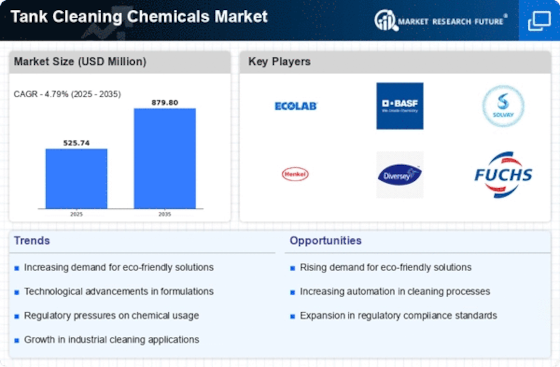
Tank Cleaning Chemicals Market Infographic
Purchase Options

Tank Cleaning Chemicals Size

Tank Cleaning Chemicals Market Growth Projections and Opportunities

The market for tank cleaning chemicals is influenced by various factors that contribute to its growth and dynamics within the industrial and maritime sectors. Safety, compliance, and environmental considerations are primary drivers impacting the market, as tank cleaning chemicals play a crucial role in maintaining the integrity and hygiene of storage tanks in various industries, including petrochemicals, food and beverage, and shipping. These chemicals are designed to remove residues, contaminants, and deposits, ensuring optimal tank performance, preventing corrosion, and meeting stringent safety and regulatory standards. The demand for effective and environmentally responsible tank cleaning solutions contributes to the growth of the market, addressing the evolving needs of industries globally.

Economic factors play a crucial role in the tank cleaning chemicals market. Industrial activities, manufacturing output, and global trade impact the demand for tank cleaning solutions, subsequently influencing the market for cleaning chemicals. During periods of economic growth, there is often an increase in production and transportation activities, leading to higher demand for efficient tank cleaning products. Conversely, economic downturns may result in reduced industrial operations and shipping activities, affecting the market negatively. Monitoring economic trends is essential for stakeholders in the industrial cleaning sector to make informed business decisions and adapt to market fluctuations.

Technological advancements contribute to innovation in the tank cleaning chemicals market. Continuous improvements in formulations, application methods, and safety features enhance the performance, efficiency, and environmental profile of these chemicals. Advanced tank cleaning chemicals may feature biodegradable formulations, reduced toxicity, and compatibility with different tank materials. Innovations in automation and cleaning equipment, such as robotic tank cleaners, contribute to the development of efficient and cost-effective tank cleaning solutions. Manufacturers that invest in cutting-edge technologies gain a competitive edge by offering high-performance and environmentally responsible cleaning solutions to meet the evolving needs of industries.

Environmental and regulatory considerations significantly influence the tank cleaning chemicals market. With an increasing focus on sustainability and environmental responsibility, there is a growing demand for cleaning products that minimize environmental impact. Tank cleaning chemicals that adhere to strict environmental regulations, such as those governing discharge and waste disposal, are favored by industries seeking eco-friendly solutions. Additionally, compliance with industry-specific regulations, such as those set by the maritime industry for ballast water treatment, influences the adoption of tank cleaning chemicals. Government initiatives promoting sustainable practices further contribute to the market dynamics, encouraging businesses to invest in compliant and environmentally responsible technologies for tank cleaning.

Consumer preferences for safety and efficiency significantly influence the tank cleaning chemicals market. Industries prioritize cleaning solutions that not only effectively remove contaminants but also ensure the safety of personnel and prevent damage to tanks and equipment. Tank cleaning chemicals that are easy to handle, reduce downtime, and minimize the need for manual cleaning efforts gain favor among users. The market is further driven by the demand for versatile cleaning solutions that can address the diverse needs of different industries, from oil and gas to food processing.

Market competition in the tank cleaning chemicals industry is shaped by factors such as pricing, performance features, and brand reputation. Competitive pricing strategies that consider production costs, formulations, and market demand influence a company's market position. Building a strong reputation for providing reliable, efficient, and environmentally friendly tank cleaning chemicals is crucial for attracting and retaining customers. Effective marketing strategies, technical support, and after-sales service contribute to brand loyalty. Manufacturers and distributors must navigate these competitive factors strategically to establish a strong presence in the tank cleaning chemicals market.
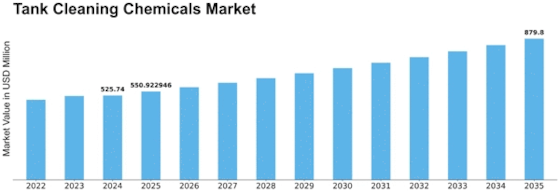

Tank Cleaning Chemicals Market Size Graph
Author
Author Profile
Sejal Akre
Senior Research Analyst

She has over 5 years of rich experience, in market research and consulting providing valuable market insights to client. Hands on expertise in management consulting, and extensive knowledge in domain including ICT, Automotive & Transportation and Aerospace & Defense. She is skilled in Go-to market strategy, industry analysis, market sizing, in depth company profiling, competitive intelligence & benchmarking and value chain amongst others.

Leave a Comment

FAQs

What is the projected market valuation for the Tank Cleaning Chemicals Market in 2035?

<p>The projected market valuation for the Tank Cleaning Chemicals Market in 2035 is 879.8 USD Million.</p>

What was the overall market valuation for the Tank Cleaning Chemicals Market in 2024?

<p>The overall market valuation for the Tank Cleaning Chemicals Market in 2024 was 525.74 USD Million.</p>

What is the expected CAGR for the Tank Cleaning Chemicals Market during the forecast period 2025 - 2035?

<p>The expected CAGR for the Tank Cleaning Chemicals Market during the forecast period 2025 - 2035 is 4.79%.</p>

Which companies are considered key players in the Tank Cleaning Chemicals Market?

<p>Key players in the Tank Cleaning Chemicals Market include Ecolab, BASF, Solvay, Henkel, Diversey Holdings, Fuchs Petrolub, Corteva, Kraton Corporation, and Clariant.</p>

What are the main product segments in the Tank Cleaning Chemicals Market?

<p>The main product segments in the Tank Cleaning Chemicals Market include Vat Detergents, Acidic Cleaners, Pre-Solves, Odor Controllers, Specialty Products, and Others.</p>

How did the segment of Vat Detergents perform in 2024?

In 2024, the segment of Vat Detergents was valued at 105.74 USD Million and is projected to reach 175.8 USD Million.

What is the valuation range for the Chemical Tanks segment in the Tank Cleaning Chemicals Market?

The valuation range for the Chemical Tanks segment is from 80.0 USD Million to 130.0 USD Million.

Which end-user segment had the highest valuation in 2024?

The Petrochemical end-user segment had the highest valuation in 2024, ranging from 130.0 USD Million to 210.0 USD Million.

What is the projected growth for the Oil Tanks segment by 2035?

The Oil Tanks segment is projected to grow from 100.0 USD Million in 2024 to 160.0 USD Million by 2035.

How does the performance of the Others segment compare across different categories?

The Others segment in the product category was valued at 145.0 USD Million in 2024 and is expected to reach 263.0 USD Million by 2035.

Market Summary

As per Market Research Future analysis, the Tank Cleaning Chemicals Market Size was estimated at 525.74 USD Million in 2024. The Tank Cleaning Chemicals industry is projected to grow from 550.93 USD Million in 2025 to 879.8 USD Million by 2035, exhibiting a compound annual growth rate (CAGR) of 4.79% during the forecast period 2025 - 2035

Key Market Trends & Highlights

The Tank Cleaning Chemicals Market is experiencing a dynamic shift towards sustainability and automation, driven by regulatory pressures and technological advancements.

  • North America remains the largest market for tank cleaning chemicals, reflecting a robust demand across various industries.
  • Asia-Pacific is emerging as the fastest-growing region, fueled by increasing industrial activities and infrastructure development.
  • Vat detergents dominate the market as the largest segment, while acidic cleaners are rapidly gaining traction due to their effectiveness.
  • Regulatory compliance pressure and rising demand from end-user industries are key drivers propelling market growth.

Market Size & Forecast

2024 Market Size 525.74 (USD Million)
2035 Market Size 879.8 (USD Million)
CAGR (2025 - 2035) 4.79%
Largest Regional Market Share in 2024 Asia Pacific

Major Players

Ecolab (US), BASF (DE), Solvay (BE), Henkel (DE), Diversey Holdings (US), Fuchs Petrolub (DE), Corteva (US), Kraton Corporation (US), Clariant (CH)

Market Trends

The Tank Cleaning Chemicals Market is currently experiencing a notable evolution, driven by increasing regulatory pressures and heightened awareness regarding environmental sustainability. Industries such as oil and gas, food and beverage, and chemicals are increasingly prioritizing the use of effective cleaning agents that not only ensure compliance with safety standards but also minimize ecological impact. This shift appears to be fostering innovation in product formulations, with manufacturers exploring biodegradable and non-toxic alternatives that align with global sustainability goals. Furthermore, the growing trend towards automation in cleaning processes suggests that the market may witness a rise in demand for specialized cleaning solutions that can be integrated into automated systems, enhancing efficiency and safety. In addition, the Tank Cleaning Chemicals Market seems to be influenced by the expansion of industrial activities in emerging economies. As these regions develop their infrastructure and industrial capabilities, the need for effective tank cleaning solutions is likely to increase. This could lead to a diversification of product offerings, catering to various sectors and applications. Moreover, the emphasis on operational efficiency and cost reduction may drive companies to invest in advanced cleaning technologies, which could further reshape the competitive landscape. Overall, the Tank Cleaning Chemicals Market is poised for growth, characterized by innovation, sustainability, and a response to evolving industrial needs.

Sustainability Focus

There is a growing emphasis on environmentally friendly cleaning agents within the Tank Cleaning Chemicals Market. Manufacturers are increasingly developing biodegradable and non-toxic formulations to meet regulatory requirements and consumer preferences for sustainable products.

Automation Integration

The trend towards automation in industrial cleaning processes is influencing the Tank Cleaning Chemicals Market. Companies are seeking specialized cleaning solutions that can seamlessly integrate with automated systems, enhancing operational efficiency and safety.

Emerging Market Expansion

The expansion of industrial activities in emerging economies is driving demand for tank cleaning solutions. As infrastructure develops, there is a potential for increased diversification in product offerings to cater to various sectors and applications.

Tank Cleaning Chemicals Market Market Drivers

Regulatory Compliance Pressure

The Tank Cleaning Chemicals Market is experiencing heightened pressure from regulatory bodies to adhere to stringent environmental and safety standards. This compliance is crucial as industries such as oil and gas, food and beverage, and pharmaceuticals face increasing scrutiny regarding their cleaning processes. The demand for eco-friendly and non-toxic cleaning agents is on the rise, as companies seek to avoid penalties and enhance their corporate image. In 2025, it is estimated that the market for environmentally compliant tank cleaning chemicals could reach a valuation of approximately 1.5 billion USD, reflecting a significant shift towards sustainable practices. This regulatory landscape is likely to drive innovation and investment in the development of advanced cleaning solutions that meet these evolving standards.

Rising Demand from End-User Industries

The Tank Cleaning Chemicals Market is significantly influenced by the rising demand from various end-user sectors, including petrochemicals, food processing, and pharmaceuticals. These industries require regular tank cleaning to maintain product quality and ensure operational efficiency. As production levels increase, so does the need for effective cleaning solutions. In 2025, the petrochemical sector alone is expected to account for over 40% of the total market share, driven by the need for stringent hygiene and safety standards. This growing demand is likely to propel the development of specialized cleaning chemicals tailored to the unique requirements of each sector, thereby fostering growth within the Tank Cleaning Chemicals Market.

Increased Focus on Operational Efficiency

The Tank Cleaning Chemicals Market is increasingly shaped by the focus on operational efficiency among businesses. Companies are recognizing that effective tank cleaning not only ensures compliance but also minimizes downtime and enhances productivity. As industries strive to optimize their operations, the demand for efficient cleaning solutions that can reduce time and labor costs is on the rise. In 2025, it is anticipated that the market for tank cleaning chemicals designed for rapid cleaning processes will expand significantly, potentially reaching a valuation of 1.2 billion USD. This trend indicates that businesses are willing to invest in high-performance cleaning chemicals that can deliver quick results, thereby driving growth in the Tank Cleaning Chemicals Market.

Growing Awareness of Health and Safety Standards

The Tank Cleaning Chemicals Market is increasingly influenced by the growing awareness of health and safety standards among companies. As organizations prioritize the well-being of their employees and the environment, there is a marked shift towards using safer, non-toxic cleaning agents. This trend is particularly evident in industries such as food and beverage, where stringent hygiene standards are paramount. In 2025, the market for health-conscious tank cleaning chemicals is projected to grow by approximately 5% annually, reflecting a broader commitment to safety and sustainability. This heightened awareness is likely to drive innovation in the formulation of cleaning chemicals, ensuring they meet both efficacy and safety requirements, thus shaping the future of the Tank Cleaning Chemicals Market.

Technological Advancements in Cleaning Solutions

The Tank Cleaning Chemicals Market is witnessing a surge in technological advancements that enhance the efficiency and effectiveness of cleaning processes. Innovations such as automated cleaning systems and advanced chemical formulations are becoming increasingly prevalent. These technologies not only reduce labor costs but also improve cleaning times and outcomes. For instance, the introduction of smart cleaning agents that can adapt to various contaminants is revolutionizing the industry. As of 2025, the market for technologically advanced tank cleaning chemicals is projected to grow at a compound annual growth rate of 6.5%, indicating a robust demand for innovative solutions. This trend suggests that companies investing in research and development will likely gain a competitive edge in the Tank Cleaning Chemicals Market.

Market Segment Insights

By Product: Vat Detergents (Largest) vs. Acidic Cleaners (Fastest-Growing)

<p>In the Tank Cleaning Chemicals Market, the segment distribution reveals that Vat Detergents hold a significant portion of the market, making them the largest segment by share. Following closely are Acidic Cleaners, which are witnessing a surge in adoption due to their efficiency in removing tough residues in tanks. Other segments, such as Pre-Solves, Odor Controllers, and Specialty Products, also contribute to the market, albeit to a lesser extent than the top two segments.</p>

<p>Vat Detergents (Dominant) vs. Acidic Cleaners (Emerging)</p>

<p>Vat Detergents are characterized by their strong effectiveness in breaking down greases, oils, and other types of contaminants that commonly accumulate in tanks, providing a reliable solution for tank cleaning operations. Their established presence in the market ensures a steady demand among industrial users. In contrast, Acidic Cleaners represent an emerging trend, gaining traction particularly in sectors where heavy residue from acidic substances is prevalent. Their growing popularity can be attributed to unique formulations designed to tackle specific cleaning challenges, making them a preferred choice for operators seeking quicker and more effective cleaning solutions.</p>

By Tank: Chemical Tanks (Largest) vs. Fuel Tanks (Fastest-Growing)

<p>The Tank Cleaning Chemicals Market exhibits diverse segment values, with Chemical Tanks leading in market share due to their extensive utilization across various industries. Following closely are Fuel Tanks and Water Transportation & Storage Tanks, which together constitute a significant portion of the market. Marine Tanks and Oil Tanks also contribute to the market dynamics, while the 'Others' category captures niche applications that play vital roles in specific operations. Understanding the distribution allows stakeholders to focus on the most promising segments for targeted strategies.</p>

<p>Chemical Tanks (Dominant) vs. Fuel Tanks (Emerging)</p>

<p>Chemical Tanks dominate the market primarily due to their widespread use in industrial applications, where the need for effective cleaning solutions is paramount. These tanks require robust and effective cleaning methods to ensure the integrity of the chemicals stored. On the other hand, Fuel Tanks are emerging rapidly, driven by the increase in fuel consumption and the need for compliance with environmental regulations. This segment is characterized by a growing demand for eco-friendly and efficient cleaning chemicals to ensure that fuel quality is maintained without harming the environment. As regulations tighten, both segments will see innovations aimed at improving cleanliness and sustainability.</p>

By End-User: Chemical (Largest) vs. Food & Beverages (Fastest-Growing)

<p>In the Tank Cleaning Chemicals Market, the End-User segment exhibits varied market share distributions, with the Chemical sector being the largest contributor. This sector's dominance is attributed to the extensive use of tank cleaning chemicals in various chemical manufacturing processes, where cleanliness and chemical compatibility are crucial. Following closely is the Food & Beverages sector, which is rapidly gaining traction due to increasing regulatory requirements for hygiene and quality assurance in food processing facilities. As consumers become more health-conscious, the demand for effective cleaning solutions in food-related applications escalates.</p>

<p>Chemical: Dominant vs. Food & Beverages: Emerging</p>

<p>The Chemical segment remains dominant in the Tank Cleaning Chemicals Market due to its extensive application in industries involving hazardous and non-hazardous substances. Chemicals are utilized to ensure residue-free tanks, thereby enhancing product purity and preventing cross-contamination. On the other hand, the Food & Beverages segment is emerging as a significant player, driven by stringent health regulations and the need for safe, effective cleaning solutions. This segment faces unique challenges, such as the necessity for non-toxic and biodegradable chemicals, positioning it for rapid growth as manufacturers increasingly focus on consumer safety and sustainability.</p>

Get more detailed insights about Tank Cleaning Chemicals Market Research Report — Global Forecast till 2035

Regional Insights

North America : Market Leader in Innovation

North America is the largest market for tank cleaning chemicals, holding approximately 40% of the global market share. The region's growth is driven by stringent environmental regulations and a rising focus on sustainability. The demand for eco-friendly cleaning solutions is increasing, supported by government initiatives promoting green technologies. Additionally, the oil and gas sector's recovery post-pandemic is fueling demand for effective cleaning solutions. The United States is the leading country in this market, with major players like Ecolab and Diversey Holdings dominating the landscape. The competitive environment is characterized by innovation and strategic partnerships among key players. Canada also plays a significant role, contributing to the market with its robust industrial sector. The presence of established companies ensures a steady supply of advanced cleaning solutions, catering to various industries.

Europe : Regulatory-Driven Market Growth

Europe is the second-largest market for tank cleaning chemicals, accounting for around 30% of the global share. The region's growth is significantly influenced by stringent regulations aimed at reducing environmental impact. The European Union's REACH regulations encourage the use of safer chemicals, driving demand for innovative cleaning solutions. Additionally, the increasing focus on sustainability and circular economy principles is shaping market dynamics, leading to a rise in eco-friendly products. Germany and France are the leading countries in this market, with key players like BASF and Henkel leading the charge. The competitive landscape is marked by a strong emphasis on research and development, with companies investing in sustainable technologies. The presence of numerous small and medium enterprises also fosters innovation, ensuring a diverse range of products. The market is expected to grow as companies adapt to regulatory changes and consumer preferences for greener solutions.

Asia-Pacific : Emerging Market Potential

Asia-Pacific is witnessing rapid growth in the tank cleaning chemicals market, holding approximately 20% of the global share. The region's expansion is driven by increasing industrialization and urbanization, particularly in countries like China and India. The rising demand for cleaning solutions in the oil and gas, food and beverage, and chemical industries is a significant growth driver. Additionally, government initiatives aimed at improving industrial safety and environmental standards are catalyzing market growth. China is the largest market in the region, followed by India, where the presence of key players like Solvay and Clariant is notable. The competitive landscape is evolving, with both multinational corporations and local companies vying for market share. The increasing focus on quality and efficiency in cleaning processes is pushing companies to innovate, leading to a diverse range of products tailored to meet specific industry needs. This dynamic environment presents significant opportunities for growth in the coming years.

Middle East and Africa : Resource-Rich Market Dynamics

The Middle East and Africa region is emerging as a significant player in the tank cleaning chemicals market, accounting for about 10% of the global share. The growth is primarily driven by the expanding industrial sector, particularly in oil and gas, which necessitates effective cleaning solutions. Additionally, increasing investments in infrastructure and manufacturing are contributing to the rising demand for tank cleaning chemicals. Regulatory frameworks are also evolving, promoting safer and more efficient cleaning practices. Countries like Saudi Arabia and South Africa are leading the market, with a growing presence of international players. The competitive landscape is characterized by a mix of local and global companies, with key players like Fuchs Petrolub and Corteva making strides in the region. The market is expected to grow as industries seek to enhance operational efficiency and comply with environmental regulations, creating opportunities for innovative cleaning solutions.

Key Players and Competitive Insights

The Tank Cleaning Chemicals Market is a highly competitive landscape characterized by intense rivalry, technological advancements, regulatory considerations, and a diverse range of players catering to various industry verticals. This dynamic environment is shaped by several key factors that influence the strategies and performances of market participants. One of the primary drivers of competition in this market is the increasing demand for efficient and environmentally friendly cleaning solutions. With stricter regulations governing industrial waste disposal and emissions, companies are compelled to innovate and develop products that not only deliver effective cleaning but also minimize environmental impact.
This has led to a surge in research and development activities aimed at creating biodegradable, non-toxic, and sustainable cleaning chemicals.
The major key players in the market includes CTC Chemtec Chemicals GmbH, Wilhelmsen, Star Marine Chemicals, Ecolab Inc., Ertek Chemicals, TECO Chemicals AS, Marine Care, Vecom Marine, A-One Chemicals and Equipment, Inc., and Accepta. hese companies invest significantly in research and development to create innovative cleaning formulations that meet evolving customer needs. They focus on developing environmentally friendly, biodegradable, and high-performance cleaning solutions that comply with regulatory standards while delivering superior cleaning efficacy. With a growing emphasis on sustainability and environmental stewardship, these companies prioritize eco-friendly practices in their manufacturing processes, packaging materials, and product formulations.
They promote sustainability certifications, green labeling, and eco-labeling to demonstrate their commitment to environmental responsibility and attract environmentally conscious customers. Kemira announced an expansion of its ferric sulfate water treatment chemicals production plant in Goole, UK, in November 2023. In order to meet a part of that demand increase driven by stricter Asset Management Plan (AMP) 7&8 regulations regarding phosphorus and other nutrient discharge from wastewater treatment facilities contained in the Water Industry National Environment Programme (WINEP) in the UK Coagulant product supply has been augmented with additional investment by almost 70k tons.
This development allows for a broader spectrum of chemicals used for purifying water supplies thereby facilitating growth within this sector.
CTC Chemtec Chemicals GmbH: CTC Chemtec Chemicals GmbH's success in the cleaning chemicals industry is underpinned by key strategies that have solidified its position as a global leader in tank cleaning solutions. The company's ISO 9001, 14001, and 45001 certifications serve as a testament to its unwavering dedication to producing high-quality products and delivering reliable services to clients worldwide. By investing in quality management systems and continuous employee training, CTC Chemtec Chemicals GmbH ensures that its products meet the highest standards of excellence.
CTC Chemtec Chemicals GmbH's expansive global reach and robust supply chain infrastructure enable it to supply original tank cleaning chemicals to clients across the world. This extensive network has contributed to the company's reputation as a major global supplier of cleaning chemicals, built on a foundation of trust, reliability, and exceptional service. With a strong emphasis on customer satisfaction and a culture of innovation, CTC Chemtec Chemicals GmbH remains at the forefront of the industry.
By prioritizing the needs of its clients and staying ahead of market trends through continuous research and development, the company ensures that its products and services consistently exceed expectations.
Star Marine Chemicals: Star Marine Chemicals prioritizes safety and quality by ensuring that most of its products carry the IMO (International Maritime Organization) certification, guaranteeing adherence to international maritime safety standards. The company's dedication to continuous improvement and innovation is evident through its substantial investments in research and development. By staying at the forefront of technology and product development, Star Marine Chemicals can introduce new and advanced solutions that cater to the changing requirements of its customers.
This commitment to innovation not only drives the company's growth but also enables it to provide cutting-edge products that enhance maritime safety and efficiency. 

Key Companies in the Tank Cleaning Chemicals Market include

Industry Developments

February  2023: CTC Chemtec Chemicals GmbH successfully expanded its business fields by venturing into professional cleaning agents for industrial and tanker cleaning. The company secured its first customer in the tanker interior cleaning sector, welcoming TWS Truck Wash GmbH & Co. KG from Hamburg as a valued partner. TWS Truck Wash GmbH & Co. KG specializes in cleaning food residues like cocoa butter, chocolate, gluten, palm oils, and fatty acids. This strategic collaboration marks a significant milestone for CTC Chemtec Chemicals GmbH, as it diversifies its product offerings and strengthens its presence in the cleaning industry.

April 2023: Marine Care, a global leader in tank cleaning solutions, announced today that the construction of its new production facility in Rotterdam has reached a major milestone. The bulk storage tanks, a crucial component of the facility, have been successfully placed, marking a significant step forward in the project's progress. In October 2023, CedarChem LLC was purchased by Solenis – a leading supplier of specialty chemicals for water-intensive industries. The main market for these products is industrial and municipal users who use them mostly in Southeastern United States.

This acquisition is one way that Solenis serves its customers through its immediate go-to-market approach where it delivers better chemical applications as well as wastewater treatment and service solutions. In September 2022, Toray Industries, Inc. established the Toray India Water Research Center in Chennai for this purpose. R&D on the application of the Japanese company’s membrane technology will be intensified by this institute to meet rising demands for the country’s provision of treatment.

Future Outlook

Tank Cleaning Chemicals Market Future Outlook

The Tank Cleaning Chemicals Market is projected to grow at 4.79% CAGR from 2025 to 2035, driven by increasing regulatory standards and demand for efficient cleaning solutions.

New opportunities lie in:

  • Development of eco-friendly cleaning agents for regulatory compliance.
  • Expansion into emerging markets with tailored product offerings.
  • Integration of IoT technology for real-time monitoring and efficiency.

By 2035, the market is expected to achieve robust growth, driven by innovation and strategic expansion.

Market Segmentation

Tank Cleaning Chemicals Market Tank Outlook

  • Chemical Tanks
  • Fuel Tanks
  • Water Transportation & Storage Tanks
  • Marine Tanks
  • Oil Tanks
  • Others

Tank Cleaning Chemicals Market Product Outlook

  • Vat Detergents
  • Acidic Cleaners
  • Pre-Solves
  • Odor Controllers
  • Specialty Products
  • Others

Tank Cleaning Chemicals Market End-User Outlook

  • Chemical
  • Petrochemical
  • Food & Beverages
  • Manufacturing
  • Marine
  • Others

Report Scope

MARKET SIZE 2024 525.74(USD Million)
MARKET SIZE 2025 550.93(USD Million)
MARKET SIZE 2035 879.8(USD Million)
COMPOUND ANNUAL GROWTH RATE (CAGR) 4.79% (2025 - 2035)
REPORT COVERAGE Revenue Forecast, Competitive Landscape, Growth Factors, and Trends
BASE YEAR 2024
Market Forecast Period 2025 - 2035
Historical Data 2019 - 2024
Market Forecast Units USD Million
Key Companies Profiled Ecolab (US), BASF (DE), Solvay (BE), Henkel (DE), Diversey Holdings (US), Fuchs Petrolub (DE), Corteva (US), Kraton Corporation (US), Clariant (CH)
Segments Covered Product, Tank, End-User, Region
Key Market Opportunities Growing demand for eco-friendly formulations in the Tank Cleaning Chemicals Market presents significant opportunities.
Key Market Dynamics Rising environmental regulations drive demand for eco-friendly tank cleaning chemicals across various industries.
Countries Covered North America, Europe, APAC, South America, MEA

FAQs

What is the projected market valuation for the Tank Cleaning Chemicals Market in 2035?

<p>The projected market valuation for the Tank Cleaning Chemicals Market in 2035 is 879.8 USD Million.</p>

What was the overall market valuation for the Tank Cleaning Chemicals Market in 2024?

<p>The overall market valuation for the Tank Cleaning Chemicals Market in 2024 was 525.74 USD Million.</p>

What is the expected CAGR for the Tank Cleaning Chemicals Market during the forecast period 2025 - 2035?

<p>The expected CAGR for the Tank Cleaning Chemicals Market during the forecast period 2025 - 2035 is 4.79%.</p>

Which companies are considered key players in the Tank Cleaning Chemicals Market?

<p>Key players in the Tank Cleaning Chemicals Market include Ecolab, BASF, Solvay, Henkel, Diversey Holdings, Fuchs Petrolub, Corteva, Kraton Corporation, and Clariant.</p>

What are the main product segments in the Tank Cleaning Chemicals Market?

<p>The main product segments in the Tank Cleaning Chemicals Market include Vat Detergents, Acidic Cleaners, Pre-Solves, Odor Controllers, Specialty Products, and Others.</p>

How did the segment of Vat Detergents perform in 2024?

In 2024, the segment of Vat Detergents was valued at 105.74 USD Million and is projected to reach 175.8 USD Million.

What is the valuation range for the Chemical Tanks segment in the Tank Cleaning Chemicals Market?

The valuation range for the Chemical Tanks segment is from 80.0 USD Million to 130.0 USD Million.

Which end-user segment had the highest valuation in 2024?

The Petrochemical end-user segment had the highest valuation in 2024, ranging from 130.0 USD Million to 210.0 USD Million.

What is the projected growth for the Oil Tanks segment by 2035?

The Oil Tanks segment is projected to grow from 100.0 USD Million in 2024 to 160.0 USD Million by 2035.

How does the performance of the Others segment compare across different categories?

The Others segment in the product category was valued at 145.0 USD Million in 2024 and is expected to reach 263.0 USD Million by 2035.

  1. SECTION I: EXECUTIVE SUMMARY AND KEY HIGHLIGHTS
    1. | 1.1 EXECUTIVE SUMMARY
    2. | | 1.1.1 Market Overview
    3. | | 1.1.2 Key Findings
    4. | | 1.1.3 Market Segmentation
    5. | | 1.1.4 Competitive Landscape
    6. | | 1.1.5 Challenges and Opportunities
    7. | | 1.1.6 Future Outlook
  2. SECTION II: SCOPING, METHODOLOGY AND MARKET STRUCTURE
    1. | 2.1 MARKET INTRODUCTION
    2. | | 2.1.1 Definition
    3. | | 2.1.2 Scope of the study
    4. | | | 2.1.2.1 Research Objective
    5. | | | 2.1.2.2 Assumption
    6. | | | 2.1.2.3 Limitations
    7. | 2.2 RESEARCH METHODOLOGY
    8. | | 2.2.1 Overview
    9. | | 2.2.2 Data Mining
    10. | | 2.2.3 Secondary Research
    11. | | 2.2.4 Primary Research
    12. | | | 2.2.4.1 Primary Interviews and Information Gathering Process
    13. | | | 2.2.4.2 Breakdown of Primary Respondents
    14. | | 2.2.5 Forecasting Model
    15. | | 2.2.6 Market Size Estimation
    16. | | | 2.2.6.1 Bottom-Up Approach
    17. | | | 2.2.6.2 Top-Down Approach
    18. | | 2.2.7 Data Triangulation
    19. | | 2.2.8 Validation
  3. SECTION III: QUALITATIVE ANALYSIS
    1. | 3.1 MARKET DYNAMICS
    2. | | 3.1.1 Overview
    3. | | 3.1.2 Drivers
    4. | | 3.1.3 Restraints
    5. | | 3.1.4 Opportunities
    6. | 3.2 MARKET FACTOR ANALYSIS
    7. | | 3.2.1 Value chain Analysis
    8. | | 3.2.2 Porter's Five Forces Analysis
    9. | | | 3.2.2.1 Bargaining Power of Suppliers
    10. | | | 3.2.2.2 Bargaining Power of Buyers
    11. | | | 3.2.2.3 Threat of New Entrants
    12. | | | 3.2.2.4 Threat of Substitutes
    13. | | | 3.2.2.5 Intensity of Rivalry
    14. | | 3.2.3 COVID-19 Impact Analysis
    15. | | | 3.2.3.1 Market Impact Analysis
    16. | | | 3.2.3.2 Regional Impact
    17. | | | 3.2.3.3 Opportunity and Threat Analysis
  4. SECTION IV: QUANTITATIVE ANALYSIS
    1. | 4.1 Chemicals and Materials, BY Product (USD Million)
    2. | | 4.1.1 Vat Detergents
    3. | | 4.1.2 Acidic Cleaners
    4. | | 4.1.3 Pre-Solves
    5. | | 4.1.4 Odor Controllers
    6. | | 4.1.5 Specialty Products
    7. | | 4.1.6 Others
    8. | 4.2 Chemicals and Materials, BY Tank (USD Million)
    9. | | 4.2.1 Chemical Tanks
    10. | | 4.2.2 Fuel Tanks
    11. | | 4.2.3 Water Transportation & Storage Tanks
    12. | | 4.2.4 Marine Tanks
    13. | | 4.2.5 Oil Tanks
    14. | | 4.2.6 Others
    15. | 4.3 Chemicals and Materials, BY End-User (USD Million)
    16. | | 4.3.1 Chemical
    17. | | 4.3.2 Petrochemical
    18. | | 4.3.3 Food & Beverages
    19. | | 4.3.4 Manufacturing
    20. | | 4.3.5 Marine
    21. | | 4.3.6 Others
    22. | 4.4 Chemicals and Materials, BY Region (USD Million)
    23. | | 4.4.1 North America
    24. | | | 4.4.1.1 US
    25. | | | 4.4.1.2 Canada
    26. | | 4.4.2 Europe
    27. | | | 4.4.2.1 Germany
    28. | | | 4.4.2.2 UK
    29. | | | 4.4.2.3 France
    30. | | | 4.4.2.4 Russia
    31. | | | 4.4.2.5 Italy
    32. | | | 4.4.2.6 Spain
    33. | | | 4.4.2.7 Rest of Europe
    34. | | 4.4.3 APAC
    35. | | | 4.4.3.1 China
    36. | | | 4.4.3.2 India
    37. | | | 4.4.3.3 Japan
    38. | | | 4.4.3.4 South Korea
    39. | | | 4.4.3.5 Malaysia
    40. | | | 4.4.3.6 Thailand
    41. | | | 4.4.3.7 Indonesia
    42. | | | 4.4.3.8 Rest of APAC
    43. | | 4.4.4 South America
    44. | | | 4.4.4.1 Brazil
    45. | | | 4.4.4.2 Mexico
    46. | | | 4.4.4.3 Argentina
    47. | | | 4.4.4.4 Rest of South America
    48. | | 4.4.5 MEA
    49. | | | 4.4.5.1 GCC Countries
    50. | | | 4.4.5.2 South Africa
    51. | | | 4.4.5.3 Rest of MEA
  5. SECTION V: COMPETITIVE ANALYSIS
    1. | 5.1 Competitive Landscape
    2. | | 5.1.1 Overview
    3. | | 5.1.2 Competitive Analysis
    4. | | 5.1.3 Market share Analysis
    5. | | 5.1.4 Major Growth Strategy in the Chemicals and Materials
    6. | | 5.1.5 Competitive Benchmarking
    7. | | 5.1.6 Leading Players in Terms of Number of Developments in the Chemicals and Materials
    8. | | 5.1.7 Key developments and growth strategies
    9. | | | 5.1.7.1 New Product Launch/Service Deployment
    10. | | | 5.1.7.2 Merger & Acquisitions
    11. | | | 5.1.7.3 Joint Ventures
    12. | | 5.1.8 Major Players Financial Matrix
    13. | | | 5.1.8.1 Sales and Operating Income
    14. | | | 5.1.8.2 Major Players R&D Expenditure. 2023
    15. | 5.2 Company Profiles
    16. | | 5.2.1 Ecolab (US)
    17. | | | 5.2.1.1 Financial Overview
    18. | | | 5.2.1.2 Products Offered
    19. | | | 5.2.1.3 Key Developments
    20. | | | 5.2.1.4 SWOT Analysis
    21. | | | 5.2.1.5 Key Strategies
    22. | | 5.2.2 BASF (DE)
    23. | | | 5.2.2.1 Financial Overview
    24. | | | 5.2.2.2 Products Offered
    25. | | | 5.2.2.3 Key Developments
    26. | | | 5.2.2.4 SWOT Analysis
    27. | | | 5.2.2.5 Key Strategies
    28. | | 5.2.3 Solvay (BE)
    29. | | | 5.2.3.1 Financial Overview
    30. | | | 5.2.3.2 Products Offered
    31. | | | 5.2.3.3 Key Developments
    32. | | | 5.2.3.4 SWOT Analysis
    33. | | | 5.2.3.5 Key Strategies
    34. | | 5.2.4 Henkel (DE)
    35. | | | 5.2.4.1 Financial Overview
    36. | | | 5.2.4.2 Products Offered
    37. | | | 5.2.4.3 Key Developments
    38. | | | 5.2.4.4 SWOT Analysis
    39. | | | 5.2.4.5 Key Strategies
    40. | | 5.2.5 Diversey Holdings (US)
    41. | | | 5.2.5.1 Financial Overview
    42. | | | 5.2.5.2 Products Offered
    43. | | | 5.2.5.3 Key Developments
    44. | | | 5.2.5.4 SWOT Analysis
    45. | | | 5.2.5.5 Key Strategies
    46. | | 5.2.6 Fuchs Petrolub (DE)
    47. | | | 5.2.6.1 Financial Overview
    48. | | | 5.2.6.2 Products Offered
    49. | | | 5.2.6.3 Key Developments
    50. | | | 5.2.6.4 SWOT Analysis
    51. | | | 5.2.6.5 Key Strategies
    52. | | 5.2.7 Corteva (US)
    53. | | | 5.2.7.1 Financial Overview
    54. | | | 5.2.7.2 Products Offered
    55. | | | 5.2.7.3 Key Developments
    56. | | | 5.2.7.4 SWOT Analysis
    57. | | | 5.2.7.5 Key Strategies
    58. | | 5.2.8 Kraton Corporation (US)
    59. | | | 5.2.8.1 Financial Overview
    60. | | | 5.2.8.2 Products Offered
    61. | | | 5.2.8.3 Key Developments
    62. | | | 5.2.8.4 SWOT Analysis
    63. | | | 5.2.8.5 Key Strategies
    64. | | 5.2.9 Clariant (CH)
    65. | | | 5.2.9.1 Financial Overview
    66. | | | 5.2.9.2 Products Offered
    67. | | | 5.2.9.3 Key Developments
    68. | | | 5.2.9.4 SWOT Analysis
    69. | | | 5.2.9.5 Key Strategies
    70. | 5.3 Appendix
    71. | | 5.3.1 References
    72. | | 5.3.2 Related Reports
  6. LIST OF FIGURES
    1. | 6.1 MARKET SYNOPSIS
    2. | 6.2 NORTH AMERICA MARKET ANALYSIS
    3. | 6.3 US MARKET ANALYSIS BY PRODUCT
    4. | 6.4 US MARKET ANALYSIS BY TANK
    5. | 6.5 US MARKET ANALYSIS BY END-USER
    6. | 6.6 CANADA MARKET ANALYSIS BY PRODUCT
    7. | 6.7 CANADA MARKET ANALYSIS BY TANK
    8. | 6.8 CANADA MARKET ANALYSIS BY END-USER
    9. | 6.9 EUROPE MARKET ANALYSIS
    10. | 6.10 GERMANY MARKET ANALYSIS BY PRODUCT
    11. | 6.11 GERMANY MARKET ANALYSIS BY TANK
    12. | 6.12 GERMANY MARKET ANALYSIS BY END-USER
    13. | 6.13 UK MARKET ANALYSIS BY PRODUCT
    14. | 6.14 UK MARKET ANALYSIS BY TANK
    15. | 6.15 UK MARKET ANALYSIS BY END-USER
    16. | 6.16 FRANCE MARKET ANALYSIS BY PRODUCT
    17. | 6.17 FRANCE MARKET ANALYSIS BY TANK
    18. | 6.18 FRANCE MARKET ANALYSIS BY END-USER
    19. | 6.19 RUSSIA MARKET ANALYSIS BY PRODUCT
    20. | 6.20 RUSSIA MARKET ANALYSIS BY TANK
    21. | 6.21 RUSSIA MARKET ANALYSIS BY END-USER
    22. | 6.22 ITALY MARKET ANALYSIS BY PRODUCT
    23. | 6.23 ITALY MARKET ANALYSIS BY TANK
    24. | 6.24 ITALY MARKET ANALYSIS BY END-USER
    25. | 6.25 SPAIN MARKET ANALYSIS BY PRODUCT
    26. | 6.26 SPAIN MARKET ANALYSIS BY TANK
    27. | 6.27 SPAIN MARKET ANALYSIS BY END-USER
    28. | 6.28 REST OF EUROPE MARKET ANALYSIS BY PRODUCT
    29. | 6.29 REST OF EUROPE MARKET ANALYSIS BY TANK
    30. | 6.30 REST OF EUROPE MARKET ANALYSIS BY END-USER
    31. | 6.31 APAC MARKET ANALYSIS
    32. | 6.32 CHINA MARKET ANALYSIS BY PRODUCT
    33. | 6.33 CHINA MARKET ANALYSIS BY TANK
    34. | 6.34 CHINA MARKET ANALYSIS BY END-USER
    35. | 6.35 INDIA MARKET ANALYSIS BY PRODUCT
    36. | 6.36 INDIA MARKET ANALYSIS BY TANK
    37. | 6.37 INDIA MARKET ANALYSIS BY END-USER
    38. | 6.38 JAPAN MARKET ANALYSIS BY PRODUCT
    39. | 6.39 JAPAN MARKET ANALYSIS BY TANK
    40. | 6.40 JAPAN MARKET ANALYSIS BY END-USER
    41. | 6.41 SOUTH KOREA MARKET ANALYSIS BY PRODUCT
    42. | 6.42 SOUTH KOREA MARKET ANALYSIS BY TANK
    43. | 6.43 SOUTH KOREA MARKET ANALYSIS BY END-USER
    44. | 6.44 MALAYSIA MARKET ANALYSIS BY PRODUCT
    45. | 6.45 MALAYSIA MARKET ANALYSIS BY TANK
    46. | 6.46 MALAYSIA MARKET ANALYSIS BY END-USER
    47. | 6.47 THAILAND MARKET ANALYSIS BY PRODUCT
    48. | 6.48 THAILAND MARKET ANALYSIS BY TANK
    49. | 6.49 THAILAND MARKET ANALYSIS BY END-USER
    50. | 6.50 INDONESIA MARKET ANALYSIS BY PRODUCT
    51. | 6.51 INDONESIA MARKET ANALYSIS BY TANK
    52. | 6.52 INDONESIA MARKET ANALYSIS BY END-USER
    53. | 6.53 REST OF APAC MARKET ANALYSIS BY PRODUCT
    54. | 6.54 REST OF APAC MARKET ANALYSIS BY TANK
    55. | 6.55 REST OF APAC MARKET ANALYSIS BY END-USER
    56. | 6.56 SOUTH AMERICA MARKET ANALYSIS
    57. | 6.57 BRAZIL MARKET ANALYSIS BY PRODUCT
    58. | 6.58 BRAZIL MARKET ANALYSIS BY TANK
    59. | 6.59 BRAZIL MARKET ANALYSIS BY END-USER
    60. | 6.60 MEXICO MARKET ANALYSIS BY PRODUCT
    61. | 6.61 MEXICO MARKET ANALYSIS BY TANK
    62. | 6.62 MEXICO MARKET ANALYSIS BY END-USER
    63. | 6.63 ARGENTINA MARKET ANALYSIS BY PRODUCT
    64. | 6.64 ARGENTINA MARKET ANALYSIS BY TANK
    65. | 6.65 ARGENTINA MARKET ANALYSIS BY END-USER
    66. | 6.66 REST OF SOUTH AMERICA MARKET ANALYSIS BY PRODUCT
    67. | 6.67 REST OF SOUTH AMERICA MARKET ANALYSIS BY TANK
    68. | 6.68 REST OF SOUTH AMERICA MARKET ANALYSIS BY END-USER
    69. | 6.69 MEA MARKET ANALYSIS
    70. | 6.70 GCC COUNTRIES MARKET ANALYSIS BY PRODUCT
    71. | 6.71 GCC COUNTRIES MARKET ANALYSIS BY TANK
    72. | 6.72 GCC COUNTRIES MARKET ANALYSIS BY END-USER
    73. | 6.73 SOUTH AFRICA MARKET ANALYSIS BY PRODUCT
    74. | 6.74 SOUTH AFRICA MARKET ANALYSIS BY TANK
    75. | 6.75 SOUTH AFRICA MARKET ANALYSIS BY END-USER
    76. | 6.76 REST OF MEA MARKET ANALYSIS BY PRODUCT
    77. | 6.77 REST OF MEA MARKET ANALYSIS BY TANK
    78. | 6.78 REST OF MEA MARKET ANALYSIS BY END-USER
    79. | 6.79 KEY BUYING CRITERIA OF CHEMICALS AND MATERIALS
    80. | 6.80 RESEARCH PROCESS OF MRFR
    81. | 6.81 DRO ANALYSIS OF CHEMICALS AND MATERIALS
    82. | 6.82 DRIVERS IMPACT ANALYSIS: CHEMICALS AND MATERIALS
    83. | 6.83 RESTRAINTS IMPACT ANALYSIS: CHEMICALS AND MATERIALS
    84. | 6.84 SUPPLY / VALUE CHAIN: CHEMICALS AND MATERIALS
    85. | 6.85 CHEMICALS AND MATERIALS, BY PRODUCT, 2024 (% SHARE)
    86. | 6.86 CHEMICALS AND MATERIALS, BY PRODUCT, 2024 TO 2035 (USD Million)
    87. | 6.87 CHEMICALS AND MATERIALS, BY TANK, 2024 (% SHARE)
    88. | 6.88 CHEMICALS AND MATERIALS, BY TANK, 2024 TO 2035 (USD Million)
    89. | 6.89 CHEMICALS AND MATERIALS, BY END-USER, 2024 (% SHARE)
    90. | 6.90 CHEMICALS AND MATERIALS, BY END-USER, 2024 TO 2035 (USD Million)
    91. | 6.91 BENCHMARKING OF MAJOR COMPETITORS
  7. LIST OF TABLES
    1. | 7.1 LIST OF ASSUMPTIONS
    2. | | 7.1.1
    3. | 7.2 North America MARKET SIZE ESTIMATES; FORECAST
    4. | | 7.2.1 BY PRODUCT, 2025-2035 (USD Million)
    5. | | 7.2.2 BY TANK, 2025-2035 (USD Million)
    6. | | 7.2.3 BY END-USER, 2025-2035 (USD Million)
    7. | 7.3 US MARKET SIZE ESTIMATES; FORECAST
    8. | | 7.3.1 BY PRODUCT, 2025-2035 (USD Million)
    9. | | 7.3.2 BY TANK, 2025-2035 (USD Million)
    10. | | 7.3.3 BY END-USER, 2025-2035 (USD Million)
    11. | 7.4 Canada MARKET SIZE ESTIMATES; FORECAST
    12. | | 7.4.1 BY PRODUCT, 2025-2035 (USD Million)
    13. | | 7.4.2 BY TANK, 2025-2035 (USD Million)
    14. | | 7.4.3 BY END-USER, 2025-2035 (USD Million)
    15. | 7.5 Europe MARKET SIZE ESTIMATES; FORECAST
    16. | | 7.5.1 BY PRODUCT, 2025-2035 (USD Million)
    17. | | 7.5.2 BY TANK, 2025-2035 (USD Million)
    18. | | 7.5.3 BY END-USER, 2025-2035 (USD Million)
    19. | 7.6 Germany MARKET SIZE ESTIMATES; FORECAST
    20. | | 7.6.1 BY PRODUCT, 2025-2035 (USD Million)
    21. | | 7.6.2 BY TANK, 2025-2035 (USD Million)
    22. | | 7.6.3 BY END-USER, 2025-2035 (USD Million)
    23. | 7.7 UK MARKET SIZE ESTIMATES; FORECAST
    24. | | 7.7.1 BY PRODUCT, 2025-2035 (USD Million)
    25. | | 7.7.2 BY TANK, 2025-2035 (USD Million)
    26. | | 7.7.3 BY END-USER, 2025-2035 (USD Million)
    27. | 7.8 France MARKET SIZE ESTIMATES; FORECAST
    28. | | 7.8.1 BY PRODUCT, 2025-2035 (USD Million)
    29. | | 7.8.2 BY TANK, 2025-2035 (USD Million)
    30. | | 7.8.3 BY END-USER, 2025-2035 (USD Million)
    31. | 7.9 Russia MARKET SIZE ESTIMATES; FORECAST
    32. | | 7.9.1 BY PRODUCT, 2025-2035 (USD Million)
    33. | | 7.9.2 BY TANK, 2025-2035 (USD Million)
    34. | | 7.9.3 BY END-USER, 2025-2035 (USD Million)
    35. | 7.10 Italy MARKET SIZE ESTIMATES; FORECAST
    36. | | 7.10.1 BY PRODUCT, 2025-2035 (USD Million)
    37. | | 7.10.2 BY TANK, 2025-2035 (USD Million)
    38. | | 7.10.3 BY END-USER, 2025-2035 (USD Million)
    39. | 7.11 Spain MARKET SIZE ESTIMATES; FORECAST
    40. | | 7.11.1 BY PRODUCT, 2025-2035 (USD Million)
    41. | | 7.11.2 BY TANK, 2025-2035 (USD Million)
    42. | | 7.11.3 BY END-USER, 2025-2035 (USD Million)
    43. | 7.12 Rest of Europe MARKET SIZE ESTIMATES; FORECAST
    44. | | 7.12.1 BY PRODUCT, 2025-2035 (USD Million)
    45. | | 7.12.2 BY TANK, 2025-2035 (USD Million)
    46. | | 7.12.3 BY END-USER, 2025-2035 (USD Million)
    47. | 7.13 APAC MARKET SIZE ESTIMATES; FORECAST
    48. | | 7.13.1 BY PRODUCT, 2025-2035 (USD Million)
    49. | | 7.13.2 BY TANK, 2025-2035 (USD Million)
    50. | | 7.13.3 BY END-USER, 2025-2035 (USD Million)
    51. | 7.14 China MARKET SIZE ESTIMATES; FORECAST
    52. | | 7.14.1 BY PRODUCT, 2025-2035 (USD Million)
    53. | | 7.14.2 BY TANK, 2025-2035 (USD Million)
    54. | | 7.14.3 BY END-USER, 2025-2035 (USD Million)
    55. | 7.15 India MARKET SIZE ESTIMATES; FORECAST
    56. | | 7.15.1 BY PRODUCT, 2025-2035 (USD Million)
    57. | | 7.15.2 BY TANK, 2025-2035 (USD Million)
    58. | | 7.15.3 BY END-USER, 2025-2035 (USD Million)
    59. | 7.16 Japan MARKET SIZE ESTIMATES; FORECAST
    60. | | 7.16.1 BY PRODUCT, 2025-2035 (USD Million)
    61. | | 7.16.2 BY TANK, 2025-2035 (USD Million)
    62. | | 7.16.3 BY END-USER, 2025-2035 (USD Million)
    63. | 7.17 South Korea MARKET SIZE ESTIMATES; FORECAST
    64. | | 7.17.1 BY PRODUCT, 2025-2035 (USD Million)
    65. | | 7.17.2 BY TANK, 2025-2035 (USD Million)
    66. | | 7.17.3 BY END-USER, 2025-2035 (USD Million)
    67. | 7.18 Malaysia MARKET SIZE ESTIMATES; FORECAST
    68. | | 7.18.1 BY PRODUCT, 2025-2035 (USD Million)
    69. | | 7.18.2 BY TANK, 2025-2035 (USD Million)
    70. | | 7.18.3 BY END-USER, 2025-2035 (USD Million)
    71. | 7.19 Thailand MARKET SIZE ESTIMATES; FORECAST
    72. | | 7.19.1 BY PRODUCT, 2025-2035 (USD Million)
    73. | | 7.19.2 BY TANK, 2025-2035 (USD Million)
    74. | | 7.19.3 BY END-USER, 2025-2035 (USD Million)
    75. | 7.20 Indonesia MARKET SIZE ESTIMATES; FORECAST
    76. | | 7.20.1 BY PRODUCT, 2025-2035 (USD Million)
    77. | | 7.20.2 BY TANK, 2025-2035 (USD Million)
    78. | | 7.20.3 BY END-USER, 2025-2035 (USD Million)
    79. | 7.21 Rest of APAC MARKET SIZE ESTIMATES; FORECAST
    80. | | 7.21.1 BY PRODUCT, 2025-2035 (USD Million)
    81. | | 7.21.2 BY TANK, 2025-2035 (USD Million)
    82. | | 7.21.3 BY END-USER, 2025-2035 (USD Million)
    83. | 7.22 South America MARKET SIZE ESTIMATES; FORECAST
    84. | | 7.22.1 BY PRODUCT, 2025-2035 (USD Million)
    85. | | 7.22.2 BY TANK, 2025-2035 (USD Million)
    86. | | 7.22.3 BY END-USER, 2025-2035 (USD Million)
    87. | 7.23 Brazil MARKET SIZE ESTIMATES; FORECAST
    88. | | 7.23.1 BY PRODUCT, 2025-2035 (USD Million)
    89. | | 7.23.2 BY TANK, 2025-2035 (USD Million)
    90. | | 7.23.3 BY END-USER, 2025-2035 (USD Million)
    91. | 7.24 Mexico MARKET SIZE ESTIMATES; FORECAST
    92. | | 7.24.1 BY PRODUCT, 2025-2035 (USD Million)
    93. | | 7.24.2 BY TANK, 2025-2035 (USD Million)
    94. | | 7.24.3 BY END-USER, 2025-2035 (USD Million)
    95. | 7.25 Argentina MARKET SIZE ESTIMATES; FORECAST
    96. | | 7.25.1 BY PRODUCT, 2025-2035 (USD Million)
    97. | | 7.25.2 BY TANK, 2025-2035 (USD Million)
    98. | | 7.25.3 BY END-USER, 2025-2035 (USD Million)
    99. | 7.26 Rest of South America MARKET SIZE ESTIMATES; FORECAST
    100. | | 7.26.1 BY PRODUCT, 2025-2035 (USD Million)
    101. | | 7.26.2 BY TANK, 2025-2035 (USD Million)
    102. | | 7.26.3 BY END-USER, 2025-2035 (USD Million)
    103. | 7.27 MEA MARKET SIZE ESTIMATES; FORECAST
    104. | | 7.27.1 BY PRODUCT, 2025-2035 (USD Million)
    105. | | 7.27.2 BY TANK, 2025-2035 (USD Million)
    106. | | 7.27.3 BY END-USER, 2025-2035 (USD Million)
    107. | 7.28 GCC Countries MARKET SIZE ESTIMATES; FORECAST
    108. | | 7.28.1 BY PRODUCT, 2025-2035 (USD Million)
    109. | | 7.28.2 BY TANK, 2025-2035 (USD Million)
    110. | | 7.28.3 BY END-USER, 2025-2035 (USD Million)
    111. | 7.29 South Africa MARKET SIZE ESTIMATES; FORECAST
    112. | | 7.29.1 BY PRODUCT, 2025-2035 (USD Million)
    113. | | 7.29.2 BY TANK, 2025-2035 (USD Million)
    114. | | 7.29.3 BY END-USER, 2025-2035 (USD Million)
    115. | 7.30 Rest of MEA MARKET SIZE ESTIMATES; FORECAST
    116. | | 7.30.1 BY PRODUCT, 2025-2035 (USD Million)
    117. | | 7.30.2 BY TANK, 2025-2035 (USD Million)
    118. | | 7.30.3 BY END-USER, 2025-2035 (USD Million)
    119. | 7.31 PRODUCT LAUNCH/PRODUCT DEVELOPMENT/APPROVAL
    120. | | 7.31.1
    121. | 7.32 ACQUISITION/PARTNERSHIP
    122. | | 7.32.1

Chemicals and Materials Market Segmentation

Chemicals and Materials By Product (USD Million, 2025-2035)

  • Vat Detergents
  • Acidic Cleaners
  • Pre-Solves
  • Odor Controllers
  • Specialty Products
  • Others

Chemicals and Materials By Tank (USD Million, 2025-2035)

  • Chemical Tanks
  • Fuel Tanks
  • Water Transportation & Storage Tanks
  • Marine Tanks
  • Oil Tanks
  • Others

Chemicals and Materials By End-User (USD Million, 2025-2035)

  • Chemical
  • Petrochemical
  • Food & Beverages
  • Manufacturing
  • Marine
  • Others
Infographic

Free Sample Request

Kindly complete the form below to receive a free sample of this Report

Get Free Sample

Customer Strories

Compare Licence

×
Features License Type
Single User Multiuser License Enterprise User
Price $4,950 $5,950 $7,250
Maximum User Access Limit 1 User Upto 10 Users Unrestricted Access Throughout the Organization
Free Customization
Direct Access to Analyst
Deliverable Format
Platform Access
Discount on Next Purchase 10% 15% 15%
Printable Versions