×
Request Free Sample ×

Kindly complete the form below to receive a free sample of this Report

* Please use a valid business email

Leading companies partner with us for data-driven Insights

clients tt-cursor
Hero Background
English
Chinese
French
Japanese
Korean
German
Spanish

Synthetic Paper Market Size

ID: MRFR/PCM/9600-HCR
128 Pages
Anshula Mandaokar
October 2025

Synthetic Paper Market Size, Share & Industry Analysis Research Report Information By Product (BOPP, HDPE, PET, and Others), By Application (Label and Non-Label), and By Region (North America, Europe, Asia-Pacific, and Rest of The World) – Market Forecast Till 2035

Share:
Download PDF ×

We do not share your information with anyone. However, we may send you emails based on your report interest from time to time. You may contact us at any time to opt-out.

Synthetic Paper Market Infographic
×
Synthetic Paper Market Infographic Full View
Purchase Options

Synthetic Paper Size

Synthetic Paper Market Growth Projections and Opportunities

Many market aspects shape synthetic paper market elements and development. Growing demand for eco-friendly paper is propelling the business. Synthetic paper, which is recyclable and sturdy, matches modern and client preferences for sustainable arrangements. Every 2022, synthetic paper market size was USD 0.8 billion. A 9.50% CAGR is expected for the synthetic paper sector from USD 0.9 Billion in 2023 to USD 1.8 Billion in 2032.

Mechanical developments also affect synthetic paper. Advanced manufacturing methods and materials have produced high-performance synthetic papers for various uses. High-level coatings and additional compounds make synthetic paper water, compound, and tear-safe for naming, packaging, and printing.

Global economic conditions affect synthetic paper sales. Synthetic paper interest rises as economies grow and firms demand bundling, unique materials, and names. Partnerships cut inconsequential spending during financial slumps, slowing market improvement.

Government policies and laws also affect markets. Synthetic paper has become due to strict environmental standards that reduce carbon footprint and increase sustainability. Due to territorial boycotts, synthetic paper can replace single-use plastics in many applications.

Purchaser behavior greatly impacts synthetic paper market factors. Buyers are more environmentally conscious and want affordable products and bundles. This client mindset shift has spurred synthetic paper sales, growing the market.

The synthetic paper industry is also competitive. Key companies, market tactics, and product leaps fuel market competition. Makers, providers, and end-clients collaborate to create a stable synthetic paper environment.

Market factors like unrefined commodity costs and accessibility affect synthetic paper. Unrefined materials like BOPP and HDPE can be affected by production network disruptions and international events. These variants affect synthetic paper costs and estimates.

Finally, mechanical disturbances and selected material breakthroughs confront synthetic paper with obstacles and fantastic opportunities. Computerized printing and smart bundling are altering printing and bundling. Synthetic paper benefits from new printing techniques but also faces competition from new materials.
Synthetic Paper Market Size Graph
Author
Anshula Mandaokar
Team Lead - Research

Anshula Mandaokar holds an academic degree in Chemical Engineering and has been contributing to the field for more than 5 years. She has expertise in Market Research and Business Consulting and serves as a Team Lead for a reputed Market Research firm under the Chemicals and Materials domain spectrum. She has worked on multiple projects, generating explicit results in a quick turnaround time. Her understanding of data interpretation justifies her role as a leader.

Leave a Comment

FAQs

How much is the Synthetic Paper market?

The Synthetic Paper Market size was valued at USD 0.99 Billion in 2024.

What is the growth rate of the Synthetic Paper market?

Synthetic Paper Market is projected to register a CAGR of 9.5% from 2025-2035

Which region held the largest market share in the Synthetic Paper market?

Asia Pacific had the largest share in the global market

Who are the key players in the Synthetic Paper market?

The key players in the market are Formosa Plastics Group, SIHL Group, B & F Plastics, Inc., Jindal Poly Films Ltd., Cosmo Films Ltd., Granwell Products, Inc., Transcendia, Inc., Valéron Strength Films, Toyobo Co., Ltd., and TechNova

Which Product led the Synthetic Paper market?

The BOPP Product dominated the market in 2022.

Which Application had the largest market share in the Synthetic Paper market?

The Non-Label Application had the largest share in the global market.

Market Summary

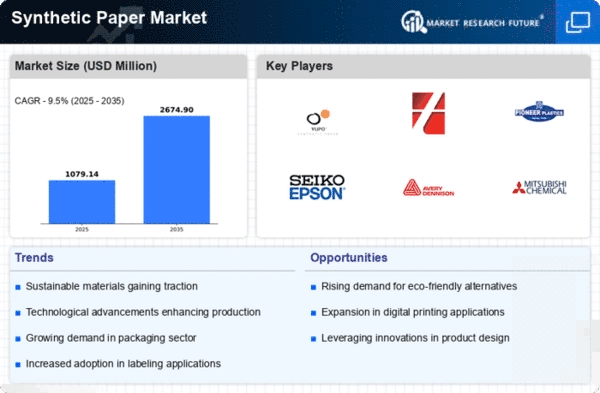
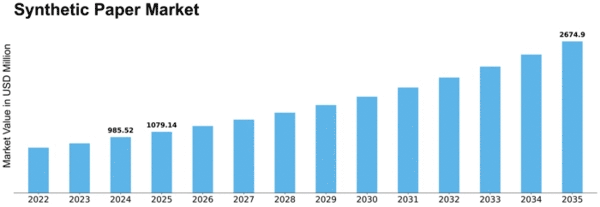
As per MRFR analysis, the Synthetic Paper Market Size was estimated at 985.52 USD Million in 2024. The Synthetic Paper industry is projected to grow from 1079.16 USD Million in 2025 to 2674.9 USD Million by 2035, exhibiting a compound annual growth rate (CAGR) of 9.5 during the forecast period 2025 - 2035.

Key Market Trends & Highlights

The Synthetic Paper Market is poised for robust growth driven by sustainability and technological advancements.

  • The market is experiencing a pronounced shift towards sustainability, influencing product development and consumer choices.
  • Technological advancements are enhancing the quality and functionality of synthetic paper, thereby expanding its applications.
  • North America remains the largest market, while Asia-Pacific is emerging as the fastest-growing region in the synthetic paper sector.
  • The increasing focus on sustainability initiatives and diverse application areas is driving market growth, particularly in the labels and packaging segments.

Market Size & Forecast

2024 Market Size 985.52 (USD Million)
2035 Market Size 2674.9 (USD Million)
CAGR (2025 - 2035) 9.5%
Largest Regional Market Share in 2024 North America

Major Players

<p>Yupo Corporation (JP), Transcendia Inc. (US), Pioneer Plastics (US), Seiko Epson Corporation (JP), Avery Dennison Corporation (US), Mitsubishi Chemical Corporation (JP), Sappi Lanaken (BE), Polyart (FR), Dai Nippon Printing Co. (JP)</p>

Market Trends

The Synthetic Paper Market is currently experiencing a notable transformation, driven by a confluence of environmental considerations and technological advancements. As consumers and businesses alike become increasingly aware of sustainability, the demand for eco-friendly alternatives to traditional paper products is on the rise. Synthetic paper, known for its durability and resistance to water and tearing, presents a viable solution for various applications, including packaging, labeling, and printing. This shift towards sustainable materials appears to be reshaping industry standards, prompting manufacturers to innovate and adapt their offerings to meet evolving consumer preferences. Moreover, the Synthetic Paper Market is witnessing a surge in applications across diverse sectors, including retail, food and beverage, and pharmaceuticals. The versatility of synthetic paper allows it to cater to a wide range of needs, from high-quality printing to long-lasting labels. As industries seek to enhance their branding and product visibility, the appeal of synthetic paper continues to grow. This trend suggests that the market may expand further as new technologies emerge, potentially leading to enhanced performance characteristics and broader acceptance in various sectors. Overall, the future of the Synthetic Paper Market appears promising, with ongoing developments likely to influence its trajectory in the coming years.

Sustainability Focus

The emphasis on sustainable practices is becoming increasingly pronounced within the Synthetic Paper Market. As environmental concerns gain traction, businesses are actively seeking alternatives that minimize ecological impact. Synthetic paper, often made from recyclable materials, aligns with these sustainability goals, making it an attractive option for companies aiming to enhance their green credentials.

Technological Advancements

Innovations in manufacturing processes and materials are significantly influencing the Synthetic Paper Market. Advances in polymer technology and printing techniques are enhancing the quality and functionality of synthetic paper products. This evolution not only improves performance but also expands the range of applications, allowing for greater customization and efficiency.

Diverse Applications

The versatility of synthetic paper is leading to its adoption across various industries. From packaging to labeling, the material's unique properties cater to a wide array of needs. As businesses recognize the benefits of synthetic paper, its presence in sectors such as retail, food service, and pharmaceuticals is likely to increase, driving market growth.

Synthetic Paper Market Market Drivers

Sustainability Trends

The Global Synthetic Paper Market Industry is increasingly influenced by sustainability trends as consumers and businesses alike prioritize eco-friendly materials. Synthetic paper, often made from recyclable materials, presents a viable alternative to traditional paper, which contributes to deforestation. As awareness of environmental issues rises, the demand for sustainable packaging and printing solutions is expected to grow. This shift is reflected in the projected market value of 0.99 USD Billion in 2024, with expectations to reach 2.67 USD Billion by 2035. The compound annual growth rate of 9.45% from 2025 to 2035 indicates a robust market response to sustainability initiatives.

Market Growth Projections

The Global Synthetic Paper Market Industry is poised for substantial growth, with projections indicating a rise from 0.99 USD Billion in 2024 to 2.67 USD Billion by 2035. This growth trajectory suggests a compound annual growth rate of 9.45% from 2025 to 2035, reflecting the increasing adoption of synthetic paper across various applications. The market's expansion is likely driven by factors such as sustainability trends, technological advancements, and the growing packaging industry. These projections underscore the potential for synthetic paper to become a dominant player in the materials market.

Growing Packaging Industry

The Global Synthetic Paper Market Industry is significantly driven by the expansion of the packaging sector. With the rise of e-commerce and retail, the demand for innovative and durable packaging solutions is surging. Synthetic paper, known for its strength and resistance to moisture, is increasingly favored for packaging applications, particularly in food and beverage sectors. This trend is expected to bolster market growth, as businesses seek materials that enhance product shelf life and appeal. The packaging industry's growth aligns with the overall market value projection, indicating a strong correlation between these sectors.

Technological Advancements

Technological advancements play a pivotal role in the Global Synthetic Paper Market Industry, enhancing the production processes and quality of synthetic papers. Innovations in polymer technology and printing techniques have led to the development of high-performance synthetic papers that are durable, water-resistant, and suitable for various applications. For instance, advancements in digital printing technology allow for more efficient and cost-effective production runs, catering to the growing demand for customized solutions. As these technologies continue to evolve, they are likely to attract new investments and expand the market further, contributing to the anticipated growth trajectory.

Increased Demand for Durable Materials

The Global Synthetic Paper Market Industry is experiencing heightened demand for durable materials across various sectors, including advertising, labeling, and outdoor applications. Synthetic paper's inherent properties, such as tear resistance and waterproof capabilities, make it an ideal choice for products that require longevity and resilience. As industries recognize the benefits of using synthetic paper for high-performance applications, the market is likely to expand. This trend is further supported by the projected market growth, with an increase from 0.99 USD Billion in 2024 to 2.67 USD Billion by 2035, highlighting the material's growing acceptance.

Regulatory Support for Eco-Friendly Materials

Regulatory support for eco-friendly materials is becoming a crucial driver for the Global Synthetic Paper Market Industry. Governments worldwide are implementing policies that encourage the use of sustainable materials, thereby promoting the adoption of synthetic paper. These regulations often aim to reduce plastic waste and promote recycling initiatives. As a result, manufacturers are increasingly investing in synthetic paper production to comply with these regulations and meet consumer demand for greener alternatives. This supportive regulatory environment is expected to facilitate market growth, aligning with the industry's projected expansion.

Market Segment Insights

By Application: Labels (Largest) vs. Packaging (Fastest-Growing)

<p>The synthetic paper market is significantly influenced by its various applications, with the labels segment commanding the largest market share. This segment benefits from the increasing demand for durable and high-quality labeling solutions across industries such as retail, logistics, and food and beverage. On the other hand, the packaging segment is experiencing rapid growth due to a shift towards eco-friendly practices and the rising demand for flexible packaging solutions that synthetic paper uniquely offers, enhancing its functionality and appeal. In terms of growth trends, the synthetic paper market is heavily shaped by technological advancements that improve the durability, print quality, and environmental sustainability of products. Innovations in material science are driving the creation of synthetic papers that are more resilient and versatile, catering to the evolving needs of the labeling and packaging industries. Additionally, the rise of e-commerce is fueling demand for efficient packaging solutions, ensuring that the synthetic paper market continues to expand and adapt to new trends.</p>

<p>Labels: Dominant vs. Packaging: Emerging</p>

<p>The labels segment in the synthetic paper market is characterized by its established presence and essential role in various industries, including consumer goods, healthcare, and logistics. Its dominance stems from the need for high-performance labeling solutions that withstand exposure to different environments while maintaining print integrity. Synthetic papers used for labels offer features like water and tear resistance, making them ideal for product identification and branding purposes. In contrast, the packaging segment, often viewed as an emerging force within this market, is quickly adapting to consumer demands for sustainable practices. As companies seek eco-friendly alternatives, synthetic paper is gaining traction for its lightweight, durable qualities that provide excellent protection for goods during transit while minimizing environmental impact.</p>

By End Use: Food and Beverage (Largest) vs. Consumer Goods (Fastest-Growing)

<p>In the Synthetic Paper Market, the end-use segment showcases a diverse distribution, with Food and Beverage leading in market share due to its extensive application in packaging and labeling. This segment capitalizes on the growing demand for sustainable and moisture-resistant packaging solutions, which synthetic papers are known for. Following closely, the Consumer Goods segment is experiencing rapid growth as brands seek innovative packaging options that enhance product appeal and shelf life. Pharmaceuticals, Electronics, and Textiles also contribute to the market, but their shares remain relatively smaller as compared to the leading segments.</p>

<p>Food and Beverage (Dominant) vs. Consumer Goods (Emerging)</p>

<p>The Food and Beverage segment stands out as the dominant player in the Synthetic Paper Market, attributed to its critical role in packaging perishable goods and beverages. This segment thrives on consumer preferences for sustainability and convenience, influencing manufacturers to adopt synthetic papers that offer durability and visual appeal. On the other hand, the Consumer Goods segment is emerging rapidly, driven by consumer trends favoring aesthetic and functional packaging. This sector is characterized by a shift towards biodegradable materials, with brands increasingly focusing on eco-friendly options that align with consumer values. Both segments are pivotal, but their dynamics differ significantly in terms of demand drivers and market positioning.</p>

By Material Type: Polypropylene (Largest) vs. Polyethylene (Fastest-Growing)

<p>The Synthetic Paper Market exhibits a diverse material type composition, with polypropylene being the largest segment, commanding a substantial market share. This segment is favored for its durability, resistance to moisture, and versatility in various applications. Polyethylene, while smaller in share compared to polypropylene, is rapidly gaining traction due to its lightweight nature and cost-effectiveness, making it a popular choice for various packaging solutions.</p>

<p>Polypropylene (Dominant) vs. Polyethylene (Emerging)</p>

<p>Polypropylene stands out in the Synthetic Paper Market as the dominant material type. Its properties, including superior tensile strength and weather resistance, make it ideal for various applications such as labels, signage, and packaging. In contrast, polyethylene represents an emerging segment that is quickly adapting to market demands with its lightweight characteristics and affordability. This emerging material appeals to manufacturers seeking cost-effective options without compromising quality. As sustainability concerns rise, both materials are being evaluated for their environmental impacts, driving innovation in the development of recycled and bio-based synthetic papers.</p>

By Thickness: Medium (Largest) vs. Thick (Fastest-Growing)

<p>In the Synthetic Paper Market, the thickness segment showcases a diverse distribution of market shares across 'Thin', 'Medium', 'Thick', and 'Ultra-Thick' categories. Among these, the 'Medium' thickness has captured the largest proportion due to its versatility and compatibility across various applications. 'Thick' paper, while smaller in share, is gaining traction as industries increasingly seek robust materials for packaging and advertising purposes. Growth trends in the thickness segment indicate a significant shift towards 'Thick' and 'Ultra-Thick' synthetic papers, driven by demand for durability and enhanced print quality. Innovations in manufacturing processes and materials are elevating the appeal of these thicker options. As sustainability becomes paramount, 'Ultra-Thick' papers made from recycled synthetics are emerging, aligning with eco-friendly initiatives and catering to environmentally conscious consumers.</p>

<p>Medium (Dominant) vs. Thick (Emerging)</p>

<p>The 'Medium' thickness segment is characterized by its broad utility in the synthetic paper market, making it the dominant choice for various applications, including labels, brochures, and signage. Its balanced characteristics allow for excellent printability and durability, rendering it suitable for high-quality graphics and everyday usage. Conversely, the 'Thick' segment is emerging rapidly, noted for its strength and premium finish. This segment appeals mainly to industries focusing on high-end packaging and luxury branding, where appearance and sturdiness are crucial. As brands continue to emphasize quality and product differentiation, the 'Thick' option is set to witness a surge, potentially reshaping market dynamics.</p>

By Surface Finish: Glossy (Largest) vs. Matte (Fastest-Growing)

<p>In the Synthetic Paper Market, the Surface Finish segment reveals diverse preferences among consumers. Glossy finishes hold the largest market share, primarily due to their appealing aesthetics and vibrant color reproduction, making them popular for applications in high-end packaging and advertising. Matte finishes, on the other hand, are capturing increasing attention, particularly in the realms of stationery and art prints, due to their elegant appearance and reduced glare. The growth trends within the Surface Finish segment are largely driven by evolving consumer preferences and technological advancements. Glossy synthetic papers continue to dominate driven by their visual impact, while matte finishes are emerging as the fastest-growing option in markets favoring understated elegance. Furthermore, the rise of eco-friendly and sustainable products is influencing manufacturers to innovate in these two finishes, enhancing product offerings to meet changing consumer demands.</p>

<p>Glossy (Dominant) vs. Matte (Emerging)</p>

<p>Glossy synthetic paper is characterized by its shiny, reflective surface that enhances color saturation and detail reproduction, making it a preferred choice for premium branding and marketing materials. Its dominance in the market stems from its ability to attract consumer attention and evoke a sense of luxury. In contrast, matte synthetic paper, which offers a non-reflective surface, is gaining popularity among environmentally aware consumers. It provides a tactile appeal and is often favored for printing products that require a more refined and sophisticated aesthetic, such as custom stationery and photo prints. The distinction between these two surfaces highlights not only their unique aesthetic attributes but also the target markets they serve, with glossy being the go-to for high-impact visuals and matte emerging in sectors focusing on sustainability and elegance.</p>

Get more detailed insights about Synthetic Paper Market Research Report—Global Forecast till 2035

Regional Insights

North America : Market Leader in Synthetic Paper

North America is poised to maintain its leadership in the synthetic paper market, holding a significant market share of 500.0. The region's growth is driven by increasing demand for eco-friendly packaging solutions and advancements in printing technologies. Regulatory support for sustainable materials further catalyzes market expansion, as businesses seek to comply with environmental standards and consumer preferences for greener products. The United States stands out as the primary market, with key players like Yupo Corporation, Transcendia Inc., and Avery Dennison Corporation leading the charge. The competitive landscape is characterized by innovation and strategic partnerships, enabling companies to enhance product offerings and meet diverse customer needs. As the market evolves, investments in R&D will be crucial for maintaining a competitive edge.

Europe : Emerging Market with Growth Potential

Europe is witnessing a notable rise in the synthetic paper market, with a market size of 250.0. The growth is fueled by increasing environmental awareness and the demand for sustainable packaging solutions. Regulatory frameworks across the EU are promoting the use of recyclable materials, which is driving innovation in synthetic paper production. This shift aligns with the region's commitment to reducing plastic waste and enhancing sustainability. Leading countries such as Germany, France, and the UK are at the forefront of this market, supported by key players like Sappi Lanaken and Polyart. The competitive landscape is dynamic, with companies focusing on product differentiation and technological advancements to capture market share. As the demand for eco-friendly products rises, the synthetic paper market in Europe is expected to flourish.

Asia-Pacific : Rapid Growth in Emerging Markets

Asia-Pacific is emerging as a significant player in the synthetic paper market, with a market size of 200.0. The region's growth is driven by rapid industrialization, increasing consumer demand for packaging solutions, and a shift towards sustainable materials. Governments are implementing policies to encourage the use of eco-friendly products, which is further propelling market growth. Countries like Japan, China, and India are leading the charge, with major companies such as Seiko Epson Corporation and Mitsubishi Chemical Corporation actively participating in the market. The competitive landscape is characterized by a mix of established players and new entrants, all vying for market share. As the region continues to develop, the demand for synthetic paper is expected to rise significantly, driven by both consumer and regulatory pressures.

Middle East and Africa : Niche Market with Growth Opportunities

The Middle East and Africa region represents a niche market in the synthetic paper sector, with a market size of 35.52. Growth in this region is primarily driven by increasing urbanization and a rising demand for packaging solutions in various industries. Regulatory initiatives aimed at reducing plastic waste are also encouraging the adoption of synthetic paper products, aligning with global sustainability trends. Countries like South Africa and the UAE are leading the market, with a growing presence of key players looking to capitalize on emerging opportunities. The competitive landscape is evolving, with both local and international companies exploring partnerships and innovations to enhance their market position. As awareness of sustainable practices increases, the synthetic paper market in this region is expected to gain traction.

Key Players and Competitive Insights

The Synthetic Paper Market is currently characterized by a dynamic competitive landscape, driven by increasing demand for sustainable packaging solutions and the growing need for durable, water-resistant materials across various applications. Key players such as Yupo Corporation (Japan), Transcendia Inc. (US), and Mitsubishi Chemical Corporation (Japan) are strategically positioned to leverage these trends. Yupo Corporation (Japan) focuses on innovation in product development, particularly in creating eco-friendly synthetic papers that cater to the packaging and labeling sectors. Meanwhile, Transcendia Inc. (US) emphasizes regional expansion and partnerships to enhance its market presence, while Mitsubishi Chemical Corporation (Japan) is investing in digital transformation initiatives to optimize its production processes and supply chain efficiency. Collectively, these strategies contribute to a competitive environment that is increasingly oriented towards sustainability and technological advancement.

In terms of business tactics, companies are localizing manufacturing to reduce lead times and enhance responsiveness to market demands. Supply chain optimization remains a critical focus, particularly in light of the increasing complexity of global logistics. The market structure appears moderately fragmented, with several key players exerting influence while also facing competition from smaller, niche manufacturers. This fragmentation allows for a diverse range of products and innovations, fostering a competitive atmosphere that encourages continuous improvement and adaptation.

In November 2025, Yupo Corporation (Japan) announced the launch of a new line of biodegradable synthetic paper, which is expected to significantly reduce environmental impact while maintaining the durability and versatility of traditional synthetic papers. This strategic move not only aligns with global sustainability goals but also positions Yupo as a leader in eco-friendly innovations within the market. The introduction of this product could potentially attract environmentally conscious consumers and businesses, thereby expanding Yupo's market share.

In October 2025, Transcendia Inc. (US) entered into a strategic partnership with a leading packaging company to co-develop sustainable packaging solutions utilizing synthetic paper. This collaboration is likely to enhance Transcendia's product offerings and strengthen its position in the sustainable packaging segment. By aligning with a well-established partner, Transcendia may also benefit from shared resources and expertise, facilitating faster market entry and innovation.

In September 2025, Mitsubishi Chemical Corporation (Japan) unveiled a new digital platform aimed at streamlining its supply chain operations for synthetic paper production. This initiative is indicative of the company's commitment to digital transformation, which is expected to enhance operational efficiency and reduce costs. By integrating advanced technologies into its processes, Mitsubishi could improve its competitive edge and responsiveness to market fluctuations.

As of December 2025, the Synthetic Paper Market is witnessing trends that emphasize digitalization, sustainability, and the integration of artificial intelligence in production processes. Strategic alliances are increasingly shaping the competitive landscape, enabling companies to pool resources and expertise for enhanced innovation. Looking ahead, competitive differentiation is likely to evolve from traditional price-based competition towards a focus on technological advancements, sustainability, and supply chain reliability. This shift underscores the importance of innovation as a key driver of market success.

Key Companies in the Synthetic Paper Market include

Industry Developments

  • Q2 2024: Dow launches new recyclable synthetic paper for packaging applications Dow announced the launch of a new recyclable synthetic paper product designed for packaging and labeling, aiming to meet growing demand for sustainable materials in the packaging industry.
  • Q1 2024: Mitsubishi Chemical Group opens new synthetic paper production facility in Singapore Mitsubishi Chemical Group inaugurated a new manufacturing facility in Singapore dedicated to the production of synthetic paper, expanding its capacity to serve the Asia-Pacific market.
  • Q2 2024: Yupo Corporation announces partnership with HP Indigo for digital printing on synthetic paper Yupo Corporation entered into a partnership with HP Indigo to develop and promote synthetic paper substrates optimized for digital printing applications.
  • Q3 2024: Cosmo Films appoints new CEO to lead synthetic paper business expansion Cosmo Films announced the appointment of a new CEO to oversee its synthetic paper division, signaling a strategic focus on expanding its presence in the global market.
  • Q2 2024: Polyplex Corporation Limited launches high-durability synthetic paper for outdoor signage Polyplex Corporation Limited introduced a new synthetic paper product engineered for outdoor signage, offering enhanced weather resistance and print quality.
  • Q1 2024: Toray Industries receives regulatory approval for food-contact synthetic paper in Europe Toray Industries obtained regulatory approval for its synthetic paper products to be used in food-contact applications within the European Union.
  • Q2 2025: Jindal Poly Films announces $50 million investment in synthetic paper production line Jindal Poly Films revealed plans to invest $50 million in a new synthetic paper production line at its Indian facility, aiming to increase output for export markets.
  • Q1 2025: Agfa-Gevaert signs multi-year supply contract for synthetic paper with major European retailer Agfa-Gevaert secured a multi-year contract to supply synthetic paper for in-store signage and promotional materials to a leading European retail chain.
  • Q2 2024: DuPont debuts antimicrobial synthetic paper for healthcare packaging DuPont launched a new antimicrobial synthetic paper product designed for use in healthcare packaging, targeting increased safety and hygiene requirements.
  • Q3 2024: Nan Ya Plastics Corporation announces IPO proceeds to fund synthetic paper R&D Nan Ya Plastics Corporation disclosed in its SEC filing that a portion of its recent IPO proceeds will be allocated to research and development of advanced synthetic paper materials.
  • Q2 2025: Sappi Limited acquires specialty synthetic paper business from European competitor Sappi Limited completed the acquisition of a European competitor's specialty synthetic paper business, expanding its product portfolio and market reach.
  • Q1 2025: Mitsui Chemicals and Avery Dennison form joint venture for synthetic paper labels Mitsui Chemicals and Avery Dennison announced the formation of a joint venture focused on developing and marketing synthetic paper-based label solutions for global packaging markets.

Future Outlook

Synthetic Paper Market Future Outlook

<p>The Synthetic Paper Market is projected to grow at a 9.5% CAGR from 2024 to 2035, driven by increasing demand for eco-friendly packaging and durable printing solutions.</p>

New opportunities lie in:

  • <p>Expansion into biodegradable synthetic paper products</p>
  • <p>Development of specialized synthetic paper for digital printing</p>
  • <p>Strategic partnerships with packaging companies for innovative solutions</p>

<p>By 2035, the Synthetic Paper Market is expected to achieve substantial growth and innovation.</p>

Market Segmentation

Synthetic Paper Market End Use Outlook

  • Food and Beverage
  • Consumer Goods
  • Pharmaceuticals
  • Electronics
  • Textiles

Synthetic Paper Market Thickness Outlook

  • Thin
  • Medium
  • Thick
  • Ultra-Thick

Synthetic Paper Market Application Outlook

  • Labels
  • Packaging
  • Printing
  • Stationery
  • Others

Synthetic Paper Market Material Type Outlook

  • Polypropylene
  • Polyethylene
  • Polyester
  • Cellulose
  • Others

Synthetic Paper Market Surface Finish Outlook

  • Glossy
  • Matte
  • Textured
  • Transparent

Report Scope

MARKET SIZE 2024985.52(USD Million)
MARKET SIZE 20251079.16(USD Million)
MARKET SIZE 20352674.9(USD Million)
COMPOUND ANNUAL GROWTH RATE (CAGR)9.5% (2024 - 2035)
REPORT COVERAGERevenue Forecast, Competitive Landscape, Growth Factors, and Trends
BASE YEAR2024
Market Forecast Period2025 - 2035
Historical Data2019 - 2024
Market Forecast UnitsUSD Million
Key Companies ProfiledYupo Corporation (JP), Transcendia Inc. (US), Pioneer Plastics (US), Seiko Epson Corporation (JP), Avery Dennison Corporation (US), Mitsubishi Chemical Corporation (JP), Sappi Lanaken (BE), Polyart (FR), Dai Nippon Printing Co. (JP)
Segments CoveredApplication, End Use, Material Type, Thickness, Surface Finish
Key Market OpportunitiesGrowing demand for eco-friendly packaging solutions drives innovation in the Synthetic Paper Market.
Key Market DynamicsRising demand for eco-friendly packaging drives innovation and competition in the synthetic paper market.
Countries CoveredNorth America, Europe, APAC, South America, MEA

FAQs

How much is the Synthetic Paper market?

The Synthetic Paper Market size was valued at USD 0.99 Billion in 2024.

What is the growth rate of the Synthetic Paper market?

Synthetic Paper Market is projected to register a CAGR of 9.5% from 2025-2035

Which region held the largest market share in the Synthetic Paper market?

Asia Pacific had the largest share in the global market

Who are the key players in the Synthetic Paper market?

The key players in the market are Formosa Plastics Group, SIHL Group, B &amp; F Plastics, Inc., Jindal Poly Films Ltd., Cosmo Films Ltd., Granwell Products, Inc., Transcendia, Inc., Valéron Strength Films, Toyobo Co., Ltd., and TechNova

Which Product led the Synthetic Paper market?

The BOPP Product dominated the market in 2022.

Which Application had the largest market share in the Synthetic Paper market?

The Non-Label Application had the largest share in the global market.

  1. SECTION I: EXECUTIVE SUMMARY AND KEY HIGHLIGHTS
    1. | 1.1 EXECUTIVE SUMMARY
  2. SECTION II: SCOPING, METHODOLOGY AND MARKET STRUCTURE
    1. | 2.1 MARKET INTRODUCTION
    2. | 2.2 RESEARCH METHODOLOGY
  3. SECTION III: QUALITATIVE ANALYSIS
    1. | 3.1 MARKET DYNAMICS
    2. | 3.2 MARKET FACTOR ANALYSIS
  4. SECTION IV: QUANTITATIVE ANALYSIS
    1. | 4.1 Packaging & Transport, BY Application (USD Million)
    2. | 4.2 Packaging & Transport, BY End Use (USD Million)
    3. | 4.3 Packaging & Transport, BY Material Type (USD Million)
    4. | 4.4 Packaging & Transport, BY Thickness (USD Million)
    5. | 4.5 Packaging & Transport, BY Surface Finish (USD Million)
    6. | 4.6 Packaging & Transport, BY Region (USD Million)
  5. SECTION V: COMPETITIVE ANALYSIS
    1. | 5.1 Competitive Landscape
    2. | 5.2 Company Profiles
    3. | 5.3 Appendix

Synthetic Paper Market Segmentation

Market Segmentation Overview

  • Detailed segmentation data will be available in the full report
  • Comprehensive analysis by multiple parameters
  • Regional and country-level breakdowns
  • Market size forecasts by segment
Infographic

Free Sample Request

Kindly complete the form below to receive a free sample of this Report

Get Free Sample

Customer Strories

Compare Licence

×
Features License Type
Single User Multiuser License Enterprise User
Price $4,950 $5,950 $7,250
Maximum User Access Limit 1 User Upto 10 Users Unrestricted Access Throughout the Organization
Free Customization
Direct Access to Analyst
Deliverable Format
Platform Access
Discount on Next Purchase 10% 15% 15%
Printable Versions