×
Request Free Sample ×

Kindly complete the form below to receive a free sample of this Report

* Please use a valid business email

Leading companies partner with us for data-driven Insights

clients tt-cursor
Hero Background
English
Chinese
French
Japanese
Korean
German
Spanish

Synthetic Aperture Radar Market Trends

ID: MRFR/AD/9475-HCR
110 Pages
Swapnil Palwe
October 2025

Synthetic Aperture Radar (SAR) Market Size, Share, Industry Trend & Analysis Research Report Information By Component (Receiver, Transmitter and Antenna), By Platform (Airborne Spacecraft, Aircraft and Unmanned Aerial Vehicle (UAV) and Ground), By Frequency Band (X Band, L Band, C Band, S Band, K, Ku, Ka Band, UHF/VHF Band ) By Application (Defense, Commercial, Public Safety, Environmental Monitoring, Natural Resource Exploration ), By Mode (Multimode and Single Mode), By Region -Forecast 2032

Share:
Download PDF ×

We do not share your information with anyone. However, we may send you emails based on your report interest from time to time. You may contact us at any time to opt-out.

Synthetic Aperture Radar Market Infographic
Purchase Options

Market Trends

Key Emerging Trends in the Synthetic Aperture Radar Market

The Synthetic Aperture Radar (SAR) market is experiencing notable trends and advancements, driven by the increasing demand for high-resolution imaging, surveillance, and reconnaissance capabilities across various industries. This market, essential for providing detailed and accurate radar images from airborne or spaceborne platforms, is shaped by key factors that reflect technological progress, expanding applications, and a growing need for real-time data. One of the primary drivers influencing the SAR market is the expanding scope of applications. Originally developed for military reconnaissance, SAR technology has found diverse applications in sectors such as agriculture, forestry, environmental monitoring, disaster management, and infrastructure development. The versatility of SAR in capturing detailed images, irrespective of weather conditions or time of day, makes it a valuable tool for a wide range of industries.

Technological advancements play a pivotal role in shaping the trends within the SAR market. The development of advanced SAR systems with higher resolution, improved image processing capabilities, and enhanced data analytics has expanded the market's capabilities. Miniaturization and integration of SAR sensors into smaller platforms, including unmanned aerial vehicles (UAVs) and small satellites, contribute to the accessibility and affordability of SAR data, fostering its adoption in various commercial applications.

The market is witnessing a growing demand for real-time or near-real-time SAR data. As industries increasingly rely on timely information for decision-making, the ability to acquire and process SAR imagery rapidly has become a significant trend. Applications such as disaster response, agricultural monitoring, and infrastructure management benefit from the availability of up-to-date SAR data, enabling more informed and timely decision-making.

The trend towards the development of high-resolution SAR satellites is influencing the market dynamics. High-resolution SAR imagery allows for detailed mapping and analysis, making it valuable for applications such as urban planning, environmental monitoring, and defense surveillance. The market is responding to the demand for sharper and more detailed images by introducing SAR systems with improved spatial resolution, enhancing their effectiveness in diverse sectors.

The SAR market is experiencing a shift towards data analytics and artificial intelligence (AI) integration. The sheer volume of data generated by SAR systems requires advanced analytics tools to extract meaningful insights. Integration with AI algorithms allows for automated image interpretation, change detection, and anomaly identification, streamlining the process of extracting actionable information from SAR data. This trend aligns with the broader industry push towards leveraging AI in remote sensing applications.

International collaborations and partnerships are playing a crucial role in shaping the SAR market. Governments, space agencies, and private entities are collaborating to deploy SAR satellites, share data, and collectively address global challenges. These partnerships enhance the availability of SAR data on a global scale, fostering international cooperation in disaster response, environmental monitoring, and scientific research.


Author
Swapnil Palwe
Team Lead - Research

With a technical background as Bachelor's in Mechanical Engineering, with MBA in Operations Management , Swapnil has 6+ years of experience in market research, consulting and analytics with the tasks of data mining, analysis, and project execution. He is the POC for our clients, for their consulting projects running under the Automotive/A&D domain. Swapnil has worked on major projects in verticals such as Aerospace & Defense, Automotive and many other domain projects. He has worked on projects for fortune 500 companies' syndicate and consulting projects along with several government projects.

Leave a Comment

FAQs

How The Synthetic Aperture Radar Market is Growing ?

Synthetic Aperture Radar Market Grow at a CAGR of 12.3% during the forecast, 2023–2030.

Who Are The Top Key Vendors of Synthetic Aperture Radar Market ?

synthetic aperture radar market are urthecast corp., thales group, skygeo, saab ab, raytheon company, ohb systems ag, northrop grumman corporation, lockheed martin corporation, leonardo s.p.a., iceye, general atomics, cobham plc, capella space, bae systems, and airbus S.A.S., and others.

In which Region Synthetic Aperture Radar Market Is Growing Globally ?

North America synthetic aperture radar market is a major players and Investing Major Shares in Synthetic Aperture Radar Market

which is Key Market Drivers of Synthetic Aperture Radar (SAR) Market ?

Increasing demand for synthetic aperture radar from military and defense sector

Market Summary

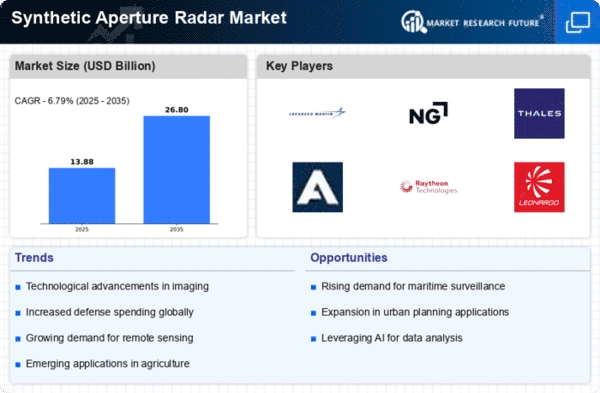
As per MRFR analysis, the Synthetic Aperture Radar Market Size was estimated at 13.0 USD Billion in 2024. The Synthetic Aperture Radar industry is projected to grow from 13.9 USD Billion in 2025 to 26.8 USD Billion by 2035, exhibiting a compound annual growth rate (CAGR) of 6.79 during the forecast period 2025 - 2035.

Key Market Trends & Highlights

The Synthetic Aperture Radar Market is poised for substantial growth driven by technological advancements and increasing demand across various sectors.

  • North America remains the largest market for Synthetic Aperture Radar, driven by robust defense spending and technological innovation.
  • The Asia-Pacific region is emerging as the fastest-growing market, fueled by increasing investments in infrastructure and surveillance capabilities.
  • The Earth Observation segment holds the largest share, while the Defense and Security segment is experiencing rapid growth due to heightened national security concerns.
  • Key market drivers include technological advancements in Synthetic Aperture Radar and a growing focus on environmental monitoring and disaster management.

Market Size & Forecast

2024 Market Size 13.0 (USD Billion)
2035 Market Size 26.8 (USD Billion)
CAGR (2025 - 2035) 6.79%
Largest Regional Market Share in 2024 North America

Major Players

Lockheed Martin (US), Northrop Grumman (US), Thales Group (FR), Airbus Defence and Space (DE), Raytheon Technologies (US), Leonardo S.p.A. (IT), Boeing (US), MDA (CA), Harris Corporation (US)

Market Trends

defense

Synthetic Aperture Radar Market Market Drivers

Increasing Demand for Earth Observation

The Global Synthetic Aperture Radar Industry is experiencing a surge in demand for earth observation applications. Governments and organizations are increasingly relying on SAR technology for monitoring environmental changes, urban development, and disaster management. For instance, the European Space Agency's Sentinel missions utilize SAR for land monitoring, providing critical data for climate studies. This trend is expected to drive the market's growth, with the market projected to reach 8.8 USD Billion in 2024. The need for accurate and timely data continues to fuel investments in SAR systems, indicating a robust future for the industry.

Market Segment Insights

By Application: Earth Observation (Largest) vs. Defense and Security (Fastest-Growing)

The Synthetic Aperture Radar (SAR) market displays a distinct segmentation by application, with Earth Observation accounting for the largest share. This segment is primarily driven by the increasing demand for high-resolution imaging and monitoring of terrestrial landscapes. Conversely, Defense and Security, while smaller in overall market share, is emerging rapidly due to the escalating need for surveillance, reconnaissance, and border protection initiatives across the globe. The strong reliance on SAR technology in these sectors underscores their importance to national security and strategic operations. In terms of growth trends, Earth Observation is witnessing a steady pace owing to advancements in satellite technology and the enhanced processing capabilities of SAR systems. Meanwhile, the Defense and Security segment is noted for its rapid expansion, propelled by rising geopolitical tensions and defense budgets. The push for enhanced situational awareness in security strategies and the integration of SAR in unmanned aerial vehicles are set to bolster this segment's growth further, solidifying its position as the fastest-growing application within the market.

Earth Observation (Dominant) vs. Disaster Management (Emerging)

In the Synthetic Aperture Radar market, Earth Observation stands as the dominant application, offering unparalleled capability for mapping, land use monitoring, and environmental analysis. Its robustness in providing detailed imagery and flexibility across various weather conditions makes it invaluable for sectors such as agriculture, forestry, and urban planning. This segment has long been at the forefront of SAR applications, continually benefitting from technological advancements and expanding data analytics techniques. On the other hand, Disaster Management is an emerging application that is gaining traction due to the increasing frequency of natural disasters and the consequential need for effective response strategies. SAR's ability to deliver critical data in post-disaster scenarios, such as damage assessment and resource allocation, positions it as a vital tool for disaster response agencies. As awareness of climate change impacts grows, the emphasis on disaster preparedness and the integration of SAR in early warning systems will further advance this segment.

By End Use: Military (Largest) vs. Government (Fastest-Growing)

The Synthetic Aperture Radar (SAR) market displays a distinctive segmentation among its end use, with the military sector commanding the largest market share. Military applications leverage SAR technology for surveillance, reconnaissance, and targeting, making it a staple investment for defense forces globally. Following the military, government agencies are also significant users, employing SAR systems for various purposes, including disaster management and environmental monitoring. As these agencies continue to invest in advanced technology, their demand for synthetic aperture radar systems grows. In contrast, the government segment is poised for remarkable growth, fueled by increasing investments in modernizing surveillance and reconnaissance capabilities. Heightened security concerns and the need for precise monitoring of natural resources are driving governments to adopt SAR technology at an accelerated pace. Furthermore, the rising demand for high-resolution imaging and real-time data in government operations emphasizes the importance of SAR systems, suggesting a shift toward greater reliance on these technologies in the coming years.

Military (Dominant) vs. Research Institutions (Emerging)

The military segment remains the dominant force in the Synthetic Aperture Radar market due to its extensive applications in defense operations, including reconnaissance, surveillance, and target acquisition. This sector benefits from significant government budgets allocated for military advancements and cutting-edge technology. In contrast, research institutions are emerging as a crucial player in this market, focusing on innovative applications of SAR technology in fields like environmental monitoring, climate research, and urban planning. These institutions leverage SAR's ability to provide high-resolution imaging and accurate data analysis, resulting in enhanced research capabilities. As collaboration between military and research entities increases, the dual-use nature of SAR technology promotes substantial advancements, benefiting both sectors.

By Platform: Airborne (Largest) vs. UAV (Fastest-Growing)

In the Synthetic Aperture Radar (SAR) market, the platform segment is diverse, comprising airborne, spaceborne, ground-based, maritime, and UAV categories. Among these, the airborne platform holds the largest market share due to its extensive deployment in military and civilian applications, providing high-resolution imagery and data collection capabilities. UAVs, although currently smaller in market share, are rapidly gaining traction due to their flexibility and lower operational costs, positioning them as a critical segment in the evolution of SAR technologies.

Airborne (Dominant) vs. UAV (Emerging)

The airborne platform is recognized for its expansive operational capabilities, enabling detailed reconnaissance and surveillance in varied environments. It is extensively used in defense, disaster management, and environmental monitoring. Conversely, UAVs are emerging rapidly within the SAR landscape due to advancements in technology, allowing for miniaturization and lower costs. Their ability to access hard-to-reach areas and conduct real-time data collection makes them increasingly popular, especially in commercial sectors such as agriculture and infrastructure inspection. Both segments are crucial, but their market strategies differ significantly, with airborne platforms focusing on high-stakes applications and UAVs targeting versatility.

By Frequency Band: L-band (Largest) vs. X-band (Fastest-Growing)

The Synthetic Aperture Radar (SAR) market is witnessing a dynamic segmentation based on frequency bands. The L-band currently holds the largest share due to its wide coverage and favorable propagation characteristics, making it suitable for various applications, including environmental monitoring and disaster management. Following closely are the C-band and X-band, with distinct applications in defense and civilian sectors, while the Ku-band and Ka-band are emerging with specialized functionalities, particularly in high-resolution imaging and communication purposes.

L-band (Dominant) vs. X-band (Emerging)

The L-band frequency, serving as the dominant segment in the Synthetic Aperture Radar market, is primarily favored for its ability to penetrate foliage and provide valuable data in challenging weather conditions. Its robust performance in applications such as agriculture monitoring, forestry management, and military reconnaissance solidifies its position. In contrast, the X-band is rapidly gaining traction as an emerging segment, particularly in high-resolution imaging applications. Recognized for its superior detail and rapid data acquisition capabilities, X-band systems are increasingly utilized in urban planning, disaster response, and surveillance operations, indicating a shift towards more specialized uses as demand for precise imaging intensifies.

Get more detailed insights about Synthetic Aperture Radar Market Research Report -Global Forecast till 2035

Regional Insights

border security

Key Players and Competitive Insights

The Synthetic Aperture Radar Market is characterized by a dynamic competitive landscape, driven by advancements in technology and increasing demand for high-resolution imaging across various sectors, including defense, agriculture, and environmental monitoring. Key players such as Lockheed Martin (US), Northrop Grumman (US), and Thales Group (FR) are strategically positioned to leverage their technological expertise and extensive experience in radar systems. Lockheed Martin (US) focuses on innovation and partnerships, particularly in developing next-generation radar systems that enhance surveillance capabilities. Northrop Grumman (US) emphasizes regional expansion and digital transformation, aiming to integrate AI and machine learning into their radar solutions. Thales Group (FR) is actively pursuing mergers and acquisitions to bolster its market presence and diversify its product offerings, thereby shaping a competitive environment that is increasingly collaborative yet fiercely competitive.The market's competitive structure appears moderately fragmented, with several key players vying for market share through various business tactics. Companies are localizing manufacturing to reduce costs and optimize supply chains, which enhances their responsiveness to market demands. This localized approach, combined with strategic partnerships, allows firms to adapt quickly to technological advancements and customer needs, thereby influencing the overall market dynamics.

In November Lockheed Martin (US) announced a collaboration with a leading tech firm to develop AI-driven analytics for their radar systems. This strategic move is likely to enhance the operational efficiency of their products, enabling real-time data processing and improved decision-making capabilities for end-users. Such innovations may position Lockheed Martin (US) as a frontrunner in the integration of AI within radar technology, potentially setting new industry standards.

In October Northrop Grumman (US) unveiled a new synthetic aperture radar system designed for unmanned aerial vehicles (UAVs). This development is significant as it reflects the growing trend towards unmanned systems in defense applications, allowing for enhanced surveillance capabilities while reducing operational risks. The introduction of this system may strengthen Northrop Grumman's (US) market position by catering to the increasing demand for UAV-based solutions.

In September Thales Group (FR) completed the acquisition of a smaller radar technology firm, which is expected to expand its product portfolio and enhance its technological capabilities. This acquisition underscores Thales Group's (FR) commitment to innovation and market expansion, potentially allowing it to offer more comprehensive solutions to its clients. The integration of new technologies from the acquired firm may also facilitate the development of next-generation radar systems, further solidifying Thales Group's (FR) competitive edge.

As of December current trends in the Synthetic Aperture Radar Market indicate a strong focus on digitalization, sustainability, and AI integration. Strategic alliances among key players are shaping the competitive landscape, fostering innovation and collaboration. The shift from price-based competition to a focus on technological advancement and supply chain reliability is evident, suggesting that future competitive differentiation will hinge on the ability to innovate and adapt to emerging technologies.

Key Companies in the Synthetic Aperture Radar Market include

Industry Developments

Future Outlook

Synthetic Aperture Radar Market Future Outlook

The Synthetic Aperture Radar Market is projected to grow at a 6.79% CAGR from 2025 to 2035, driven by advancements in technology, increasing <a href="https://www.marketresearchfuture.com/reports/defense-market-34071" target="_blank">defense</a> budgets, and demand for remote sensing applications.

New opportunities lie in:

  • Development of advanced imaging algorithms for enhanced data analysis.
  • Expansion into emerging markets with tailored radar solutions.
  • Partnerships with telecommunications for integrated satellite communication systems.

By 2035, the Synthetic Aperture Radar Market is expected to be robust, driven by innovation and strategic partnerships.

Market Segmentation

Synthetic Aperture Radar Market End Use Outlook

  • Government
  • Commercial
  • Research Institutions
  • Military
  • Aerospace

Synthetic Aperture Radar Market Platform Outlook

  • Airborne
  • Spaceborne
  • Ground-based
  • Maritime
  • UAV

Synthetic Aperture Radar Market Application Outlook

  • Earth Observation
  • Defense and Security
  • Environmental Monitoring
  • Agriculture
  • Disaster Management

Synthetic Aperture Radar Market Frequency Band Outlook

  • L-band
  • C-band
  • X-band
  • Ku-band
  • Ka-band

Report Scope

MARKET SIZE 202413.0(USD Billion)
MARKET SIZE 202513.9(USD Billion)
MARKET SIZE 203526.8(USD Billion)
COMPOUND ANNUAL GROWTH RATE (CAGR)6.79% (2025 - 2035)
REPORT COVERAGERevenue Forecast, Competitive Landscape, Growth Factors, and Trends
BASE YEAR2024
Market Forecast Period2025 - 2035
Historical Data2019 - 2024
Market Forecast UnitsUSD Billion
Key Companies ProfiledLockheed Martin (US), Northrop Grumman (US), Thales Group (FR), Airbus Defence and Space (DE), Raytheon Technologies (US), Leonardo S.p.A. (IT), Boeing (US), MDA (CA), Harris Corporation (US)
Segments CoveredApplication, End Use, Platform, Frequency Band
Key Market OpportunitiesAdvancements in satellite technology enhance capabilities in the Synthetic Aperture Radar Market.
Key Market DynamicsTechnological advancements in Synthetic Aperture Radar enhance imaging capabilities, driving demand across various sectors.
Countries CoveredNorth America, Europe, APAC, South America, MEA

FAQs

How The Synthetic Aperture Radar Market is Growing ?

Synthetic Aperture Radar Market Grow at a CAGR of 12.3% during the forecast, 2023–2030.

Who Are The Top Key Vendors of Synthetic Aperture Radar Market ?

synthetic aperture radar market are urthecast corp., thales group, skygeo, saab ab, raytheon company, ohb systems ag, northrop grumman corporation, lockheed martin corporation, leonardo s.p.a., iceye, general atomics, cobham plc, capella space, bae systems, and airbus S.A.S., and others.

In which Region Synthetic Aperture Radar Market Is Growing Globally ?

North America synthetic aperture radar market is a major players and Investing Major Shares in Synthetic Aperture Radar Market

which is Key Market Drivers of Synthetic Aperture Radar (SAR) Market ?

Increasing demand for synthetic aperture radar from military and defense sector

  1. SECTION I: EXECUTIVE SUMMARY AND KEY HIGHLIGHTS
    1. | 1.1 EXECUTIVE SUMMARY
    2. | 1.1.1 Market Overview
    3. | 1.1.2 Key Findings
    4. | 1.1.3 Market Segmentation
    5. | 1.1.4 Competitive Landscape
    6. | 1.1.5 Challenges and Opportunities
    7. | 1.1.6 Future Outlook
  2. SECTION II: SCOPING, METHODOLOGY AND MARKET STRUCTURE
    1. | 2.1 MARKET INTRODUCTION
    2. | 2.1.1 Definition
    3. | 2.1.2 Scope of the study
    4. |-- 2.1.2.1 Research Objective
    5. |-- 2.1.2.2 Assumption
    6. |-- 2.1.2.3 Limitations
    7. | 2.2 RESEARCH METHODOLOGY
    8. | 2.2.1 Overview
    9. | 2.2.2 Data Mining
    10. | 2.2.3 Secondary Research
    11. | 2.2.4 Primary Research
    12. |-- 2.2.4.1 Primary Interviews and Information Gathering Process
    13. |-- 2.2.4.2 Breakdown of Primary Respondents
    14. | 2.2.5 Forecasting Model
    15. | 2.2.6 Market Size Estimation
    16. |-- 2.2.6.1 Bottom-Up Approach
    17. |-- 2.2.6.2 Top-Down Approach
    18. | 2.2.7 Data Triangulation
    19. | 2.2.8 Validation
  3. SECTION III: QUALITATIVE ANALYSIS
    1. | 3.1 MARKET DYNAMICS
    2. | 3.1.1 Overview
    3. | 3.1.2 Drivers
    4. | 3.1.3 Restraints
    5. | 3.1.4 Opportunities
    6. | 3.2 MARKET FACTOR ANALYSIS
    7. | 3.2.1 Value chain Analysis
    8. | 3.2.2 Porter's Five Forces Analysis
    9. |-- 3.2.2.1 Bargaining Power of Suppliers
    10. |-- 3.2.2.2 Bargaining Power of Buyers
    11. |-- 3.2.2.3 Threat of New Entrants
    12. |-- 3.2.2.4 Threat of Substitutes
    13. |-- 3.2.2.5 Intensity of Rivalry
    14. | 3.2.3 COVID-19 Impact Analysis
    15. |-- 3.2.3.1 Market Impact Analysis
    16. |-- 3.2.3.2 Regional Impact
    17. |-- 3.2.3.3 Opportunity and Threat Analysis
  4. SECTION IV: QUANTITATIVE ANALYSIS
    1. | 4.1 Aerospace & Defense, BY Application (USD Billion)
    2. | 4.1.1 Earth Observation
    3. | 4.1.2 Defense and Security
    4. | 4.1.3 Environmental Monitoring
    5. | 4.1.4 Agriculture
    6. | 4.1.5 Disaster Management
    7. | 4.2 Aerospace & Defense, BY End Use (USD Billion)
    8. | 4.2.1 Government
    9. | 4.2.2 Commercial
    10. | 4.2.3 Research Institutions
    11. | 4.2.4 Military
    12. | 4.2.5 Aerospace
    13. | 4.3 Aerospace & Defense, BY Platform (USD Billion)
    14. | 4.3.1 Airborne
    15. | 4.3.2 Spaceborne
    16. | 4.3.3 Ground-based
    17. | 4.3.4 Maritime
    18. | 4.3.5 UAV
    19. | 4.4 Aerospace & Defense, BY Frequency Band (USD Billion)
    20. | 4.4.1 L-band
    21. | 4.4.2 C-band
    22. | 4.4.3 X-band
    23. | 4.4.4 Ku-band
    24. | 4.4.5 Ka-band
    25. | 4.5 Aerospace & Defense, BY Region (USD Billion)
    26. | 4.5.1 North America
    27. |-- 4.5.1.1 US
    28. |-- 4.5.1.2 Canada
    29. | 4.5.2 Europe
    30. |-- 4.5.2.1 Germany
    31. |-- 4.5.2.2 UK
    32. |-- 4.5.2.3 France
    33. |-- 4.5.2.4 Russia
    34. |-- 4.5.2.5 Italy
    35. |-- 4.5.2.6 Spain
    36. |-- 4.5.2.7 Rest of Europe
    37. | 4.5.3 APAC
    38. |-- 4.5.3.1 China
    39. |-- 4.5.3.2 India
    40. |-- 4.5.3.3 Japan
    41. |-- 4.5.3.4 South Korea
    42. |-- 4.5.3.5 Malaysia
    43. |-- 4.5.3.6 Thailand
    44. |-- 4.5.3.7 Indonesia
    45. |-- 4.5.3.8 Rest of APAC
    46. | 4.5.4 South America
    47. |-- 4.5.4.1 Brazil
    48. |-- 4.5.4.2 Mexico
    49. |-- 4.5.4.3 Argentina
    50. |-- 4.5.4.4 Rest of South America
    51. | 4.5.5 MEA
    52. |-- 4.5.5.1 GCC Countries
    53. |-- 4.5.5.2 South Africa
    54. |-- 4.5.5.3 Rest of MEA
  5. SECTION V: COMPETITIVE ANALYSIS
    1. | 5.1 Competitive Landscape
    2. | 5.1.1 Overview
    3. | 5.1.2 Competitive Analysis
    4. | 5.1.3 Market share Analysis
    5. | 5.1.4 Major Growth Strategy in the Aerospace & Defense
    6. | 5.1.5 Competitive Benchmarking
    7. | 5.1.6 Leading Players in Terms of Number of Developments in the Aerospace & Defense
    8. | 5.1.7 Key developments and growth strategies
    9. |-- 5.1.7.1 New Product Launch/Service Deployment
    10. |-- 5.1.7.2 Merger & Acquisitions
    11. |-- 5.1.7.3 Joint Ventures
    12. | 5.1.8 Major Players Financial Matrix
    13. |-- 5.1.8.1 Sales and Operating Income
    14. |-- 5.1.8.2 Major Players R&D Expenditure. 2023
    15. | 5.2 Company Profiles
    16. | 5.2.1 Lockheed Martin (US)
    17. |-- 5.2.1.1 Financial Overview
    18. |-- 5.2.1.2 Products Offered
    19. |-- 5.2.1.3 Key Developments
    20. |-- 5.2.1.4 SWOT Analysis
    21. |-- 5.2.1.5 Key Strategies
    22. | 5.2.2 Northrop Grumman (US)
    23. |-- 5.2.2.1 Financial Overview
    24. |-- 5.2.2.2 Products Offered
    25. |-- 5.2.2.3 Key Developments
    26. |-- 5.2.2.4 SWOT Analysis
    27. |-- 5.2.2.5 Key Strategies
    28. | 5.2.3 Thales Group (FR)
    29. |-- 5.2.3.1 Financial Overview
    30. |-- 5.2.3.2 Products Offered
    31. |-- 5.2.3.3 Key Developments
    32. |-- 5.2.3.4 SWOT Analysis
    33. |-- 5.2.3.5 Key Strategies
    34. | 5.2.4 Airbus Defence and Space (DE)
    35. |-- 5.2.4.1 Financial Overview
    36. |-- 5.2.4.2 Products Offered
    37. |-- 5.2.4.3 Key Developments
    38. |-- 5.2.4.4 SWOT Analysis
    39. |-- 5.2.4.5 Key Strategies
    40. | 5.2.5 Raytheon Technologies (US)
    41. |-- 5.2.5.1 Financial Overview
    42. |-- 5.2.5.2 Products Offered
    43. |-- 5.2.5.3 Key Developments
    44. |-- 5.2.5.4 SWOT Analysis
    45. |-- 5.2.5.5 Key Strategies
    46. | 5.2.6 Leonardo S.p.A. (IT)
    47. |-- 5.2.6.1 Financial Overview
    48. |-- 5.2.6.2 Products Offered
    49. |-- 5.2.6.3 Key Developments
    50. |-- 5.2.6.4 SWOT Analysis
    51. |-- 5.2.6.5 Key Strategies
    52. | 5.2.7 Boeing (US)
    53. |-- 5.2.7.1 Financial Overview
    54. |-- 5.2.7.2 Products Offered
    55. |-- 5.2.7.3 Key Developments
    56. |-- 5.2.7.4 SWOT Analysis
    57. |-- 5.2.7.5 Key Strategies
    58. | 5.2.8 MDA (CA)
    59. |-- 5.2.8.1 Financial Overview
    60. |-- 5.2.8.2 Products Offered
    61. |-- 5.2.8.3 Key Developments
    62. |-- 5.2.8.4 SWOT Analysis
    63. |-- 5.2.8.5 Key Strategies
    64. | 5.2.9 Harris Corporation (US)
    65. |-- 5.2.9.1 Financial Overview
    66. |-- 5.2.9.2 Products Offered
    67. |-- 5.2.9.3 Key Developments
    68. |-- 5.2.9.4 SWOT Analysis
    69. |-- 5.2.9.5 Key Strategies
    70. | 5.3 Appendix
    71. | 5.3.1 References
    72. | 5.3.2 Related Reports

Aerospace & Defense Market Segmentation

Aerospace & Defense By Application (USD Billion, 2025-2035)

  • Earth Observation
  • Defense and Security
  • Environmental Monitoring
  • Agriculture
  • Disaster Management

Aerospace & Defense By End Use (USD Billion, 2025-2035)

  • Government
  • Commercial
  • Research Institutions
  • Military
  • Aerospace

Aerospace & Defense By Platform (USD Billion, 2025-2035)

  • Airborne
  • Spaceborne
  • Ground-based
  • Maritime
  • UAV

Aerospace & Defense By Frequency Band (USD Billion, 2025-2035)

  • L-band
  • C-band
  • X-band
  • Ku-band
  • Ka-band
Infographic

Free Sample Request

Kindly complete the form below to receive a free sample of this Report

Get Free Sample

Customer Strories

Compare Licence

×
Features License Type
Single User Multiuser License Enterprise User
Price $4,950 $5,950 $7,250
Maximum User Access Limit 1 User Upto 10 Users Unrestricted Access Throughout the Organization
Free Customization
Direct Access to Analyst
Deliverable Format
Platform Access
Discount on Next Purchase 10% 15% 15%
Printable Versions