×
Hero Background
English
Chinese
French
Japanese
Korean
German
Spanish

Synthetic Aperture Radar Market Share

ID: MRFR/AD/9475-HCR
110 Pages
Swapnil Palwe
October 2025

Synthetic Aperture Radar (SAR) Market Research Report Information By Component (Receiver, Transmitter and Antenna), By Platform (Airborne Spacecraft, Aircraft and Unmanned Aerial Vehicle (UAV) and Ground), By Frequency Band (X Band, L Band, C Band, S Band, K, Ku, Ka Band, UHF/VHF Band ) By Application (Defense, Commercial, Public Safety, Environmental Monitoring, Natural Resource Exploration ), By Mode (Multimode and Single Mode), By Region -Forecast 2032

Share:
Download PDF ×

We do not share your information with anyone. However, we may send you emails based on your report interest from time to time. You may contact us at any time to opt-out.

Synthetic Aperture Radar Market Infographic
Purchase Options

Market Share

Synthetic Aperture Radar Market Share Analysis

The Synthetic Aperture Radar (SAR) market holds a pivotal position in the realm of remote sensing technologies, providing advanced imaging capabilities for various applications such as defense, agriculture, environmental monitoring, and disaster management. Companies operating in the SAR market employ diverse market share positioning strategies to distinguish themselves and thrive in this dynamic sector.

One key strategy involves technological innovation and differentiation. In response to the growing demand for high-resolution and real-time Earth observation data, companies within the SAR market invest significantly in research and development. This includes advancements in radar technology, signal processing algorithms, and data analytics to enhance the performance and capabilities of SAR systems. By staying at the forefront of technological advancements, companies aim to position themselves as leaders in providing cutting-edge SAR solutions, attracting customers seeking the most sophisticated and effective remote sensing technologies.

Collaboration and strategic partnerships play a crucial role in market share positioning within the SAR sector. Given the interdisciplinary nature of SAR applications, companies often collaborate with government agencies, research institutions, and industries requiring geospatial data. These partnerships contribute to the development of specialized SAR solutions tailored to specific needs, as well as expanding market reach through joint projects. By positioning themselves as key collaborators, companies can enhance their credibility and influence in the SAR market.

Furthermore, adherence to regulatory standards and international agreements is fundamental for market positioning in the SAR industry. As SAR systems often operate across borders, companies must comply with national and international regulations to ensure responsible and legal use of remote sensing data. Engaging with regulatory bodies, contributing to standards development, and demonstrating commitment to ethical data usage position companies as reliable and compliant providers. This commitment not only aligns with legal requirements but also instills confidence in customers regarding data integrity and privacy, contributing to market share growth.

Customer-centric strategies are pivotal for market share positioning in the SAR market, where end-users include government agencies, defense organizations, agriculture stakeholders, and environmental monitoring bodies. Understanding the diverse needs and application requirements of these customers allows companies to tailor their SAR solutions accordingly. Providing user-friendly interfaces, comprehensive training programs, and responsive customer support enhances the overall customer experience. Companies that prioritize customer satisfaction are more likely to build long-term relationships, secure repeat business, and strengthen their market share within the remote sensing industry.

Moreover, geographical expansion is a key strategy for market positioning in the SAR sector. As the demand for Earth observation data grows globally, companies seek to establish a strong presence in key markets. This involves adapting SAR solutions to meet regional requirements, forming partnerships with local entities, and participating in government and commercial projects. By strategically expanding their reach, companies can tap into emerging markets, address specific regional needs, and solidify their position as leading suppliers of SAR technologies.


Author
Swapnil Palwe
Team Lead - Research

With a technical background as Bachelor's in Mechanical Engineering, with MBA in Operations Management , Swapnil has 6+ years of experience in market research, consulting and analytics with the tasks of data mining, analysis, and project execution. He is the POC for our clients, for their consulting projects running under the Automotive/A&D domain. Swapnil has worked on major projects in verticals such as Aerospace & Defense, Automotive and many other domain projects. He has worked on projects for fortune 500 companies' syndicate and consulting projects along with several government projects.

Leave a Comment

FAQs

How The Synthetic Aperture Radar Market is Growing ?

Synthetic Aperture Radar Market Grow at a CAGR of 12.3% during the forecast, 2023–2030.

Who Are The Top Key Vendors of Synthetic Aperture Radar Market ?

synthetic aperture radar market are urthecast corp., thales group, skygeo, saab ab, raytheon company, ohb systems ag, northrop grumman corporation, lockheed martin corporation, leonardo s.p.a., iceye, general atomics, cobham plc, capella space, bae systems, and airbus S.A.S., and others.

In which Region Synthetic Aperture Radar Market Is Growing Globally ?

North America synthetic aperture radar market is a major players and Investing Major Shares in Synthetic Aperture Radar Market

which is Key Market Drivers of Synthetic Aperture Radar (SAR) Market ?

Increasing demand for synthetic aperture radar from military and defense sector

Market Summary

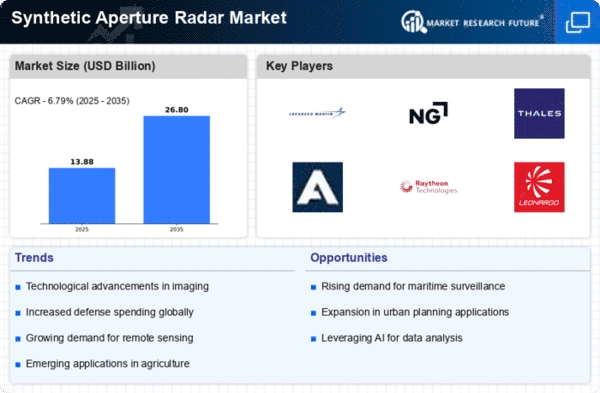
As per MRFR analysis, the Synthetic Aperture Radar Market Size was estimated at 13.0 USD Billion in 2024. The Synthetic Aperture Radar industry is projected to grow from 13.9 USD Billion in 2025 to 26.8 USD Billion by 2035, exhibiting a compound annual growth rate (CAGR) of 6.79 during the forecast period 2025 - 2035.

Key Market Trends & Highlights

The Synthetic Aperture Radar Market is poised for substantial growth driven by technological advancements and increasing applications across various sectors.

  • North America remains the largest market for synthetic aperture radar, driven by robust defense spending and technological innovation.
  • The Asia-Pacific region is emerging as the fastest-growing market, fueled by rising investments in remote sensing and environmental monitoring.
  • The Earth Observation segment dominates the market, while Military Surveillance is experiencing rapid growth due to heightened security concerns.
  • Key market drivers include growing defense expenditure and a rising focus on climate change monitoring, which are propelling demand for advanced radar technologies.

Market Size & Forecast

2024 Market Size 13.0 (USD Billion)
2035 Market Size 26.8 (USD Billion)
CAGR (2025 - 2035) 6.79%
Largest Regional Market Share in 2024 North America

Major Players

<p>Lockheed Martin (US), Northrop Grumman (US), Thales Group (FR), Airbus (DE), Leonardo (IT), Raytheon Technologies (US), Boeing (US), MDA (CA), Harris Corporation (US)</p>

Market Trends

The Synthetic Aperture Radar Market is currently experiencing a notable evolution, driven by advancements in technology and increasing demand across various sectors. This market encompasses a range of applications, including defense, environmental monitoring, and disaster management. The integration of artificial intelligence and machine learning into radar systems appears to enhance data processing capabilities, thereby improving the accuracy and efficiency of surveillance operations. Furthermore, the growing emphasis on national security and border control is likely to propel investments in radar technologies, fostering innovation and development within the industry. In addition, the rising awareness of climate change and the need for effective monitoring solutions may contribute to the expansion of the Synthetic Aperture Radar Market. Organizations are increasingly recognizing the value of high-resolution imaging for tracking environmental changes and managing natural resources. As a result, partnerships between government entities and private firms seem to be on the rise, facilitating the deployment of advanced radar systems. Overall, the market appears poised for growth, with a diverse array of applications and technological advancements shaping its future trajectory.

Technological Advancements

The Synthetic Aperture Radar Market is witnessing rapid technological advancements, particularly in the integration of artificial intelligence and machine learning. These innovations enhance data analysis and processing, leading to improved accuracy in target detection and tracking. As systems become more sophisticated, they are likely to offer enhanced capabilities for various applications, including surveillance and reconnaissance.

Increased Demand for Environmental Monitoring

There is a growing demand for Synthetic Aperture Radar systems in environmental monitoring. As concerns about climate change and natural disasters rise, organizations are seeking effective solutions for tracking environmental changes. This trend indicates a shift towards utilizing radar technology for resource management and disaster response, potentially expanding the market's reach.

Strategic Partnerships and Collaborations

The formation of strategic partnerships and collaborations between government agencies and private sector firms is becoming increasingly prevalent in the Synthetic Aperture Radar Market. These alliances aim to leverage expertise and resources, facilitating the development and deployment of advanced radar systems. Such collaborations may enhance innovation and drive market growth.

Synthetic Aperture Radar Market Market Drivers

Increasing Demand for Earth Observation

The Global Synthetic Aperture Radar Industry is experiencing a surge in demand for earth observation applications. Governments and organizations are increasingly relying on SAR technology for monitoring environmental changes, urban development, and disaster management. For instance, the European Space Agency's Sentinel missions utilize SAR for land monitoring, providing critical data for climate studies. This trend is expected to drive the market's growth, with the market projected to reach 8.8 USD Billion in 2024. The need for accurate and timely data continues to fuel investments in SAR systems, indicating a robust future for the industry.

Market Segment Insights

By Application: Earth Observation (Largest) vs. Military Surveillance (Fastest-Growing)

<p>In the Synthetic Aperture Radar market, the application segment shows a diverse landscape with Earth Observation holding the largest share. Following closely are Military Surveillance, Disaster Management, Environmental Monitoring, and Agriculture, each playing integral roles in the overall market dynamics. As environmental concerns rise and the need for effective surveillance deepens, these segments contribute to a substantial portion of market activities, with various applications harnessing the capabilities of SAR technology for enhanced insights.</p>

<p>Earth Observation (Dominant) vs. Military Surveillance (Emerging)</p>

<p>The Earth Observation application stands as a dominant force in the Synthetic Aperture Radar market, primarily driven by its utility in mapping and monitoring environmental changes, land use, and natural resources. With increasing emphasis on climate change and sustainable development, Earth Observation is being prioritized by governments and organizations globally. Conversely, Military Surveillance emerges as a rapidly growing application, fueled by advancements in defense technologies and the increasing need for real-time intelligence. As nations invest more in security measures and border control, Military Surveillance is expected to gain traction, ultimately enhancing situational awareness and operational effectiveness.</p>

By End Use: Defense (Largest) vs. Aerospace (Fastest-Growing)

<p>In the Synthetic Aperture Radar Market, the End Use segment showcases a diverse range of applications including Defense, Aerospace, Maritime, Transportation, and Telecommunications. Among these, Defense holds the largest share owing to its critical applications in surveillance, reconnaissance, and target tracking operations. Meanwhile, Aerospace is gradually gaining significance as a rapidly growing segment, driven by an increasing demand for advanced radar systems for aircraft and UAVs.</p>

<p>Defense (Dominant) vs. Aerospace (Emerging)</p>

<p>The Defense sector remains dominant in the Synthetic Aperture Radar market, primarily due to its extensive reliance on advanced imaging technologies for enhancing military operations and ensuring national security. Coupled with continuous advancements in surveillance and reconnaissance capabilities, this segment is sustaining robust demand. On the other hand, the Aerospace sector is emerging as a pivotal player, spurred by technological advancements in radar systems that cater to commercial and military aircraft, alongside unmanned aerial vehicles (UAVs). As the aerospace industry leans towards next-gen radar technologies, it is projected to experience rapid growth fueled by innovation and increasing investments.</p>

By Platform: Airborne (Largest) vs. Spaceborne (Fastest-Growing)

<p>In the Synthetic Aperture Radar Market, the platform segment exhibits a diverse market share distribution among its values. Airborne systems hold the largest share due to their versatility and effectiveness in reconnaissance and surveillance applications. Meanwhile, Spaceborne systems, although smaller in current market share, are witnessing rapid adoption owing to advancements in satellite technology and the increasing demand for global earth observation capabilities. Ground-based and Shipborne platforms contribute as well, catering to specific application needs across various sectors, but they hold comparatively lesser shares in the overall market context. The growth trends within the platform segment are heavily influenced by technological innovations and evolving defense and monitoring needs. Airborne platforms are experiencing sustained demand from military and commercial sectors looking for high-resolution imaging and reconnaissance capabilities. On the other hand, Spaceborne platforms represent an emerging frontier as satellite capabilities expand, with increasing reliance on data for climate monitoring, disaster management, and urban planning. Overall, the segment is poised for substantial growth as military and civilian applications expand, fostering robust competition and innovation in SAR technology.</p>

<p>Platform: Airborne (Dominant) vs. Spaceborne (Emerging)</p>

<p>Airborne Synthetic Aperture Radar systems are the dominant force in the market, prized for their mobility and adaptability across various terrains. These systems are largely deployed in military reconnaissance, search and rescue operations, and environmental monitoring, offering exceptional resolution and near-real-time data acquisition. Their ability to swiftly cover extensive areas and respond to dynamic situations makes them invaluable in tactical applications. In contrast, Spaceborne systems are emerging players, leveraged for broad-scale geographical surveillance and research applications. They rely on satellite orbits to deliver consistent data over vast regions, enabling ongoing monitoring for uses such as climate studies and natural disaster assessments. The advancement in satellite technology and increased investment in space exploration are fueling the growth of Spaceborne SAR, propelling it into a more prominent market position.</p>

By Frequency Band: L-band (Largest) vs. X-band (Fastest-Growing)

<p>In the Synthetic Aperture Radar market, the frequency bands exhibit distinct characteristics and market share distributions. The L-band is recognized as the largest segment, capturing a significant portion of the market due to its ability to penetrate foliage and its reliability in various environmental conditions. Meanwhile, the C-band accounts for a considerable share as well, favored for its balance between resolution and coverage. The X-band, although smaller in market share, is rapidly gaining traction due to its superior resolution capabilities in commercial applications. Growth trends in the Synthetic Aperture Radar market are being driven by advancements in technology and increasing demand from sectors such as defense, environmental monitoring, and infrastructure development. The X-band is emerging as a strong competitor owing to its high-resolution imagery and adaptability to new applications. This is complemented by the ongoing innovations in radar technology that enhance imaging performance, thus attracting attention from a range of industries seeking precise measurement and surveillance solutions.</p>

<p>L-band (Dominant) vs. Ku-band (Emerging)</p>

<p>The L-band is the dominant segment in the Synthetic Aperture Radar market, renowned for its versatility and ability to operate effectively in diverse weather conditions. Its applications span military reconnaissance, disaster management, and agricultural monitoring, making it a preferred choice in scenarios that require reliable performance over long distances. On the other hand, the Ku-band is being recognized as an emerging segment, increasingly utilized for high-resolution satellite imaging and telecommunications. Its advancement is fueled by the demand for higher frequency bands that offer improved resolution and data transmission rates. This dynamic positions the Ku-band as an exciting prospect, particularly for commercial and surveillance applications, where enhanced image quality and rapid data processing capabilities are imperative.</p>

By Technology: Multi-channel (Largest) vs. Interferometric (Fastest-Growing)

<p>In the Synthetic Aperture Radar (SAR) market, Multi-channel technology holds the largest share, leveraging its capabilities for enhanced imaging and resolution. Single-channel technology follows closely, although it lacks the advanced performance and data processing features of its multi-channel counterpart. Interferometric technology, meanwhile, is experiencing rapid growth due to its ability to provide high-precision measurements, making it a favorite in applications requiring detailed terrain and structural analysis. Polarimetric tech, although smaller in share, complements the other technologies by providing more in-depth information on target characteristics. Growth trends indicate a steady increase in demand for multi-channel systems as industries strive for superior imaging quality. Interferometric technology is becoming essential in fields such as environmental monitoring and disaster management, where precise spatial data is critical. The push for advanced mapping and surveillance solutions, combined with technological advancements in radar systems, is driving the market towards multi-channel and interferometric technologies, solidifying their positions within the sector.</p>

<p>Technology: Multi-channel (Dominant) vs. Interferometric (Emerging)</p>

<p>Multi-channel Synthetic Aperture Radar technology is currently dominating the market due to its superior imaging capabilities and ability to collect vast amounts of data while maintaining high resolution. This technology is favored by a variety of sectors, including defense and agriculture, for its comprehensive applications ranging from surveillance to crop monitoring. In contrast, interferometric technology is emerging as a vital player due to its ability to detect minute changes in surface movement, making it particularly impactful in geoscience and urban planning. As the need for precise and dynamic spatial data rises, the versatility and unique benefits of interferometric SAR technology position it well for future growth and innovation in various applications.</p>

Get more detailed insights about Synthetic Aperture Radar Market Research Report -Global Forecast till 2035

Regional Insights

North America : Market Leader in Innovation

North America is poised to maintain its leadership in the Synthetic Aperture Radar (SAR) market, holding a significant share of 6.5 billion in 2025. The region's growth is driven by increasing defense budgets, advancements in technology, and a rising demand for surveillance and reconnaissance capabilities. Regulatory support from government agencies further catalyzes market expansion, ensuring compliance with national security standards. The competitive landscape is robust, featuring key players such as Lockheed Martin, Northrop Grumman, and Raytheon Technologies. The U.S. remains the dominant force, leveraging its technological prowess and extensive R&D investments. Canada also plays a vital role, with companies like MDA contributing to the regional market. The presence of these industry leaders fosters innovation and drives the SAR market forward.

Europe : Emerging Market with Growth Potential

Europe is witnessing a growing interest in the Synthetic Aperture Radar (SAR) market, with a projected size of 3.5 billion by 2025. The region's growth is fueled by increasing investments in defense and security, alongside a focus on enhancing surveillance capabilities. Regulatory frameworks, such as the European Defence Fund, are encouraging collaboration among member states, thereby boosting market dynamics. Leading countries like France, Germany, and Italy are at the forefront of this growth, with companies such as Thales Group and Airbus driving innovation. The competitive landscape is characterized by strategic partnerships and collaborations aimed at enhancing technological capabilities. As Europe seeks to strengthen its defense posture, the SAR market is expected to expand significantly, supported by both governmental and private sector initiatives.

Asia-Pacific : Rapidly Growing Defense Sector

The Asia-Pacific region is emerging as a significant player in the Synthetic Aperture Radar (SAR) market, projected to reach 2.5 billion by 2025. The growth is driven by increasing defense expenditures, geopolitical tensions, and a rising demand for advanced surveillance systems. Countries are investing heavily in modernizing their military capabilities, which is further supported by favorable government policies and initiatives. Key players in this region include major countries like China, India, and Japan, with companies such as Boeing and Harris Corporation making substantial contributions. The competitive landscape is evolving, with a focus on technological advancements and partnerships to enhance SAR capabilities. As nations prioritize national security, the SAR market in Asia-Pacific is set for robust growth, reflecting the region's strategic importance in global defense.

Middle East and Africa : Emerging Market with Untapped Potential

The Middle East and Africa (MEA) region is gradually recognizing the potential of the Synthetic Aperture Radar (SAR) market, with a projected size of 0.5 billion by 2025. The growth is primarily driven by increasing security concerns, regional conflicts, and the need for advanced surveillance technologies. Governments are beginning to invest in defense modernization, which is expected to catalyze market growth in the coming years. Countries like the UAE and South Africa are leading the charge, with a focus on enhancing their military capabilities. The competitive landscape is still developing, with opportunities for both local and international players to enter the market. As the region continues to prioritize security and defense, the SAR market is likely to see significant growth, driven by both governmental initiatives and private sector investments.

Key Players and Competitive Insights

The Synthetic Aperture Radar Market is currently characterized by a dynamic competitive landscape, driven by advancements in technology and increasing demand for high-resolution imaging across various sectors, including defense, agriculture, and environmental monitoring. Key players such as Lockheed Martin (US), Northrop Grumman (US), and Thales Group (FR) are strategically positioned to leverage their technological expertise and extensive portfolios. Lockheed Martin (US) focuses on innovation through the development of next-generation radar systems, while Northrop Grumman (US) emphasizes partnerships with governmental agencies to enhance its market reach. Thales Group (FR) is actively pursuing regional expansion, particularly in Europe and Asia, to capitalize on emerging opportunities. Collectively, these strategies contribute to a competitive environment that is increasingly reliant on technological advancements and strategic collaborations.

In terms of business tactics, companies are localizing manufacturing and optimizing supply chains to enhance operational efficiency and reduce costs. The market structure appears moderately fragmented, with several key players holding substantial market shares. This fragmentation allows for a diverse range of offerings, yet the influence of major companies remains significant, as they set industry standards and drive innovation.

In November 2025, Lockheed Martin (US) announced a partnership with a leading satellite company to integrate synthetic aperture radar capabilities into their existing satellite systems. This strategic move is likely to enhance Lockheed Martin's position in the commercial sector, allowing for improved data collection and analysis capabilities, which could lead to increased market share in the growing satellite imaging market.

In October 2025, Northrop Grumman (US) unveiled a new radar system designed for unmanned aerial vehicles (UAVs), aimed at enhancing surveillance capabilities in military operations. This development not only showcases Northrop Grumman's commitment to innovation but also positions the company to meet the increasing demand for advanced UAV technologies in defense applications. The introduction of this system may provide a competitive edge in a market that is rapidly evolving towards automation and remote operations.

In September 2025, Thales Group (FR) secured a contract with a European government to supply advanced synthetic aperture radar systems for border surveillance. This contract underscores Thales's strategic focus on regional expansion and highlights the growing importance of security applications in the synthetic aperture radar market. By securing such contracts, Thales is likely to strengthen its foothold in Europe, enhancing its competitive position against other key players.

As of December 2025, current trends in the Synthetic Aperture Radar Market indicate a strong emphasis on digitalization, sustainability, and the integration of artificial intelligence (AI) into radar systems. Strategic alliances are increasingly shaping the competitive landscape, as companies collaborate to enhance technological capabilities and market reach. The shift from price-based competition to a focus on innovation, technology, and supply chain reliability is evident, suggesting that future competitive differentiation will hinge on the ability to deliver cutting-edge solutions that meet evolving customer needs.

Key Companies in the Synthetic Aperture Radar Market market include

Industry Developments

Future Outlook

Synthetic Aperture Radar Market Future Outlook

<p>The Synthetic Aperture Radar Market is projected to grow at a 6.79% CAGR from 2024 to 2035, driven by advancements in technology, increasing defense budgets, and demand for remote sensing applications.</p>

New opportunities lie in:

  • <p>Development of advanced imaging algorithms for enhanced data analysis.</p>
  • <p>Expansion into emerging markets with tailored radar solutions.</p>
  • <p>Partnerships with telecommunications for integrated satellite communication systems.</p>

<p>By 2035, the Synthetic Aperture Radar Market is expected to achieve substantial growth and innovation.</p>

Market Segmentation

Synthetic Aperture Radar Market End Use Outlook

  • Defense
  • Aerospace
  • Maritime
  • Transportation
  • Telecommunications

Synthetic Aperture Radar Market Platform Outlook

  • Airborne
  • Spaceborne
  • Ground-based
  • Shipborne

Synthetic Aperture Radar Market Technology Outlook

  • Single-channel
  • Multi-channel
  • Interferometric
  • Polarimetric

Synthetic Aperture Radar Market Application Outlook

  • Earth Observation
  • Military Surveillance
  • Disaster Management
  • Environmental Monitoring
  • Agriculture

Synthetic Aperture Radar Market Frequency Band Outlook

  • L-band
  • C-band
  • X-band
  • Ku-band

Report Scope

MARKET SIZE 202413.0(USD Billion)
MARKET SIZE 202513.9(USD Billion)
MARKET SIZE 203526.8(USD Billion)
COMPOUND ANNUAL GROWTH RATE (CAGR)6.79% (2024 - 2035)
REPORT COVERAGERevenue Forecast, Competitive Landscape, Growth Factors, and Trends
BASE YEAR2024
Market Forecast Period2025 - 2035
Historical Data2019 - 2024
Market Forecast UnitsUSD Billion
Key Companies ProfiledLockheed Martin (US), Northrop Grumman (US), Thales Group (FR), Airbus (DE), Leonardo (IT), Raytheon Technologies (US), Boeing (US), MDA (CA), Harris Corporation (US)
Segments CoveredApplication, End Use, Platform, Frequency Band, Technology
Key Market OpportunitiesAdvancements in satellite technology enhance capabilities in the Synthetic Aperture Radar Market.
Key Market DynamicsTechnological advancements in Synthetic Aperture Radar enhance imaging capabilities, driving demand across various sectors.
Countries CoveredNorth America, Europe, APAC, South America, MEA

FAQs

How The Synthetic Aperture Radar Market is Growing ?

Synthetic Aperture Radar Market Grow at a CAGR of 12.3% during the forecast, 2023–2030.

Who Are The Top Key Vendors of Synthetic Aperture Radar Market ?

synthetic aperture radar market are urthecast corp., thales group, skygeo, saab ab, raytheon company, ohb systems ag, northrop grumman corporation, lockheed martin corporation, leonardo s.p.a., iceye, general atomics, cobham plc, capella space, bae systems, and airbus S.A.S., and others.

In which Region Synthetic Aperture Radar Market Is Growing Globally ?

North America synthetic aperture radar market is a major players and Investing Major Shares in Synthetic Aperture Radar Market

which is Key Market Drivers of Synthetic Aperture Radar (SAR) Market ?

Increasing demand for synthetic aperture radar from military and defense sector

  1. EXECUTIVE SUMMARY
    1. Market Attractiveness Analysis
      1. Global Synthetic Aperture Radar Market, by Component
      2. Global Synthetic Aperture Radar Market, by Platform
      3. Global Synthetic Aperture Radar Market, by Frequency Band
      4. Global Synthetic Aperture Radar Market, by Application
      5. Global Synthetic Aperture Radar Market, by Mode
      6. Global Synthetic Aperture Radar Market, by Region
  2. MARKET INTRODUCTION
    1. Definition
    2. Scope of the Study
    3. Market Structure
  3. RESEARCH METHODOLOGY
    1. Research Process
    2. Primary Research
    3. Secondary Research
    4. Market Size Estimation
    5. List of Assumptions
  4. MARKET DYNAMICS
    1. Introduction
    2. Drivers
      1. Increasing demand for synthetic aperture radar from military and defense sector
      2. Driver Impact Analysis
    3. Restraints
      1. The Cost Involved in The Development of a Synthetic Aperture Radar
      2. Restraint Impact Analysis
    4. Opportunity
      1. Rising development of dual-band synthetic aperture radars
    5. Impact of COVID-19
      1. Impact on synthetic aperture radar Developments
      2. Covid-19 Impact on military and defense sector
  5. MARKET FACTOR ANALYSIS
    1. Value Chain Analysis/Supply Chain Analysis
    2. Porter’s Five Forces Model
      1. Bargaining Power of Suppliers
      2. Bargaining Power of Buyers
      3. Threat of New Entrants
      4. Threat of Substitutes
      5. Intensity of Rivalry
  6. GLOBAL SYNTHETIC APERTURE RADAR MARKET, BY COMPONENT
    1. Introduction
    2. Receiver
    3. Transmitter
    4. Antenna
  7. GLOBAL SYNTHETIC APERTURE RADAR MARKET, BY PLATFORM
    1. Introduction
    2. Others
    3. Airborne
      1. Spacecraft
      2. Aircraft
      3. Unmanned Aerial Vehicle (UAV)
    4. Ground
  8. GLOBAL SYNTHETIC APERTURE RADAR MARKET, BY FREQUENCY BAND
    1. Introduction
    2. X Band
    3. L Band
    4. C Band
    5. S Band
    6. K, Ku, Ka Band
    7. UHF/VHF Band
    8. Others
  9. GLOBAL SYNTHETIC APERTURE RADAR MARKET, BY APPLICATION
    1. Introduction
    2. Defense
    3. Commercial
    4. Public Safety
    5. Environmental Monitoring
    6. Natural Resource Exploration
    7. Others
  10. GLOBAL SYNTHETIC APERTURE RADAR MARKET, BY MODE
    1. Introduction
    2. Multimode
    3. Single Mode
  11. GLOBAL SYNTHETIC APERTURE RADAR MARKET, BY REGION
    1. Overview
    2. North America
      1. Market Size & Estimates, by Country, 2024-2030
      2. Market Size & Estimates, by Component, 2024-2030
      3. Market Size & Estimates, by Platform, 2024-2030
      4. Market Size & Estimates, by Frequency Band, 2024-2030
      5. Market Size & Estimates, by Application, 2024-2030
      6. Market Size & Estimates, by Mode, 2024-2030
      7. US
      8. Canada
      9. Mexico
    3. Europe
      1. Market Size & Estimates, by Country, 2024-2030
      2. Market Size & Estimates, by Component, 2024-2030
      3. Market Size & Estimates, by Platform, 2024-2030
      4. Market Size & Estimates, by Frequency Band, 2024-2030
      5. Market Size & Estimates, by Application, 2024-2030
      6. Germany
      7. UK
      8. France
      9. Rest of Europe
    4. Asia Pacific
      1. Market Size & Estimates, by Country, 2024-2030
      2. Market Size & Estimates, by Component, 2024-2030
      3. Market Size & Estimates, by Platform, 2024-2030
      4. Market Size & Estimates, by Frequency Band, 2024-2030
      5. Market Size & Estimates, by Application, 2024-2030
      6. Market Size & Estimates, by Mode, 2024-2030
      7. China
      8. Japan
      9. India
      10. Rest of Asia-Pacific
    5. Middle East & Africa
      1. Market Size & Estimates, by Component, 2024-2030
      2. Market Size & Estimates, by Platform, 2024-2030
      3. Market Size & Estimates, by Frequency Band, 2024-2030
      4. Market Size & Estimates, by Application, 2024-2030
      5. Market Size & Estimates, by Mode, 2024-2030
    6. South America
      1. Market Size & Estimates, by Component, 2024-2030
      2. Market Size & Estimates, by Platform, 2024-2030
      3. Market Size & Estimates, by Frequency Band, 2024-2030
      4. Market Size & Estimates, by Application, 2024-2030
      5. Market Size & Estimates, by Mode, 2024-2030
  12. COMPETITIVE LANDSCAPE
    1. Introduction
    2. Competitive Benchmarking
    3. Key Developments & Growth Strategies
      1. New Product Development
      2. Mergers & Acquisitions
      3. Contracts & Agreements
  13. COMPANY PROFILES
    1. UrtheCast Corp.
      1. Company Overview
      2. Financial Overview
      3. Products/Services/Solutions Offered
      4. Key Developments
      5. SWOT Analysis
      6. Key Strategies
    2. Thales Group
      1. Company Overview
      2. Financial Overview
      3. Products/Services/Solutions Offered
      4. Key Developments
      5. SWOT Analysis
      6. Key Strategies
    3. SkyGeo
      1. Company Overview
      2. Financial Overview
      3. Products/Services/Solutions Offered
      4. Key Developments
      5. SWOT Analysis
      6. Key Strategies
    4. Saab AB
      1. Company Overview
      2. Financial Overview
      3. Products/Services/Solutions Offered
      4. Key Developments
      5. SWOT Analysis
      6. Key Strategies
    5. Raytheon Company
      1. Company Overview
      2. Financial Overview
      3. Products/Services/Solutions Offered
      4. Key Developments
      5. SWOT Analysis
      6. Key Strategies
    6. OHB Systems AG
      1. Company Overview
      2. Financial Overview
      3. Products/Services/Solutions Offered
      4. Key Developments
      5. SWOT Analysis
      6. Key Strategies
    7. Northrop Grumman Corporation
      1. Company Overview
      2. Financial Overview
      3. Products/Services/Solutions Offered
      4. Key Developments
      5. SWOT Analysis
      6. Key Strategies
    8. Lockheed Martin Corporation
      1. Company Overview
      2. Financial Overview
      3. Products/Services/Solutions Offered
      4. Key Developments
      5. SWOT Analysis
      6. Key Strategies
    9. Leonardo S.p.A.
      1. Company Overview
      2. Financial Overview
      3. Products/Services/Solutions Offered
      4. Key Developments
      5. SWOT Analysis
      6. Key Strategies
    10. ICEYE
      1. Company Overview
      2. Financial Overview
      3. Products/Services/Solutions Offered
      4. Key Developments
      5. SWOT Analysis
      6. Key Strategies
    11. General Atomics
      1. Company Overview
      2. Financial Overview
      3. Products/Services/Solutions Offered
      4. Key Developments
      5. SWOT Analysis
      6. Key Strategies
    12. Cobham plc,
      1. Company Overview
      2. Financial Overview
      3. Products/Services/Solutions Offered
      4. Key Developments
      5. SWOT Analysis
      6. Key Strategies
    13. Capella Space
      1. Company Overview
      2. Financial Overview
      3. Products/Services/Solutions Offered
      4. Key Developments
      5. SWOT Analysis
      6. Key Strategies
    14. BAE Systems
      1. Company Overview
      2. Financial Overview
      3. Products/Services/Solutions Offered
      4. Key Developments
      5. SWOT Analysis
      6. Key Strategies
    15. Airbus S.A.S
      1. Company Overview
      2. Financial Overview
      3. Products/Services/Solutions Offered
      4. Key Developments
      5. SWOT Analysis
      6. Key Strategies
  14. LIST OF TABLES
  15. LIST OF ASSUMPTIONS
  16. GLOBAL SYNTHETIC APERTURE RADAR MARKET, BY COMPONENT, 2024-2030 (USD BILLION)
  17. GLOBAL SYNTHETIC APERTURE RADAR MARKET, BY PLATFORM, 2024-2030 (USD BILLION)
  18. GLOBAL SYNTHETIC APERTURE RADAR MARKET, BY FREQUENCY BAND, 2024-2030 (USD BILLION)
  19. GLOBAL SYNTHETIC APERTURE RADAR MARKET, BY APPLICATION, 2024-2030 (USD BILLION)
  20. GLOBAL SYNTHETIC APERTURE RADAR MARKET, BY REGION, 2024-2030 (USD BILLION)
  21. NORTH AMERICA: SYNTHETIC APERTURE RADAR MARKET, BY COUNTRY, 2024-2030 (USD BILLION)
  22. NORTH AMERICA: SYNTHETIC APERTURE RADAR MARKET, BY COMPONENT, 2024-2030 (USD BILLION)
  23. NORTH AMERICA: SYNTHETIC APERTURE RADAR MARKET, BY PLATFORM, 2024-2030 (USD BILLION)
  24. NORTH AMERICA: SYNTHETIC APERTURE RADAR MARKET, BY FREQUENCY BAND, 2024-2030 (USD BILLION)
  25. NORTH AMERICA: SYNTHETIC APERTURE RADAR MARKET, BY APPLICATION, 2024-2030 (USD BILLION)
  26. US: SYNTHETIC APERTURE RADAR MARKET, BY COMPONENT, 2024-2030 (USD BILLION)
  27. US: SYNTHETIC APERTURE RADAR MARKET, BY PLATFORM, 2024-2030 (USD BILLION)
  28. US: SYNTHETIC APERTURE RADAR MARKET, BY FREQUENCY BAND, 2024-2030 (USD BILLION)
  29. US: SYNTHETIC APERTURE RADAR MARKET, BY APPLICATION, 2024-2030 (USD BILLION)
  30. CANADA: SYNTHETIC APERTURE RADAR MARKET, BY COMPONENT, 2024-2030 (USD BILLION)
  31. CANADA: SYNTHETIC APERTURE RADAR MARKET, BY PLATFORM, 2024-2030 (USD BILLION)
  32. CANADA: SYNTHETIC APERTURE RADAR MARKET, BY FREQUENCY BAND, 2024-2030 (USD BILLION)
  33. CANADA: SYNTHETIC APERTURE RADAR MARKET, BY APPLICATION, 2024-2030 (USD BILLION)
  34. MEXICO: SYNTHETIC APERTURE RADAR MARKET, BY COMPONENT, 2024-2030 (USD BILLION)
  35. MEXICO: SYNTHETIC APERTURE RADAR MARKET, BY PLATFORM, 2024-2030 (USD BILLION)
  36. MEXICO: SYNTHETIC APERTURE RADAR MARKET, BY FREQUENCY BAND, 2024-2030 (USD BILLION)
  37. MEXICO: SYNTHETIC APERTURE RADAR MARKET, BY APPLICATION, 2024-2030 (USD BILLION)
  38. EUROPE: SYNTHETIC APERTURE RADAR MARKET, BY COUNTRY, 2024-2030 (USD BILLION)
  39. EUROPE: SYNTHETIC APERTURE RADAR MARKET, BY COMPONENT, 2024-2030 (USD BILLION)
  40. EUROPE: SYNTHETIC APERTURE RADAR MARKET, BY PLATFORM, 2024-2030 (USD BILLION)
  41. EUROPE: SYNTHETIC APERTURE RADAR MARKET, BY FREQUENCY BAND, 2024-2030 (USD BILLION)
  42. EUROPE: SYNTHETIC APERTURE RADAR MARKET, BY APPLICATION, 2024-2030 (USD BILLION)
  43. UK: SYNTHETIC APERTURE RADAR MARKET, BY COMPONENT, 2024-2030 (USD BILLION)
  44. UK: SYNTHETIC APERTURE RADAR MARKET, BY PLATFORM, 2024-2030 (USD BILLION)
  45. UK: SYNTHETIC APERTURE RADAR MARKET, BY FREQUENCY BAND, 2024-2030 (USD BILLION)
  46. UK: SYNTHETIC APERTURE RADAR MARKET, BY APPLICATION, 2024-2030 (USD BILLION)
  47. GERMANY: SYNTHETIC APERTURE RADAR MARKET, BY COMPONENT, 2024-2030 (USD BILLION)
  48. GERMANY: SYNTHETIC APERTURE RADAR MARKET, BY PLATFORM, 2024-2030 (USD BILLION)
  49. GERMANY: SYNTHETIC APERTURE RADAR MARKET, BY FREQUENCY BAND, 2024-2030 (USD BILLION)
  50. GERMANY: SYNTHETIC APERTURE RADAR MARKET, BY APPLICATION, 2024-2030 (USD BILLION)
  51. FRANCE: SYNTHETIC APERTURE RADAR MARKET, BY COMPONENT, 2024-2030 (USD BILLION)
  52. FRANCE: SYNTHETIC APERTURE RADAR MARKET, BY PLATFORM, 2024-2030 (USD BILLION)
  53. FRANCE: SYNTHETIC APERTURE RADAR MARKET, BY FREQUENCY BAND, 2024-2030 (USD BILLION)
  54. FRANCE: SYNTHETIC APERTURE RADAR MARKET, BY APPLICATION, 2024-2030 (USD BILLION)
  55. REST OF EUROPE: SYNTHETIC APERTURE RADAR MARKET, BY COMPONENT, 2024-2030 (USD BILLION)
  56. REST OF EUROPE: SYNTHETIC APERTURE RADAR MARKET, BY PLATFORM, 2024-2030 (USD BILLION)
  57. REST OF EUROPE: SYNTHETIC APERTURE RADAR MARKET, BY FREQUENCY BAND, 2024-2030 (USD BILLION)
  58. REST OF EUROPE: SYNTHETIC APERTURE RADAR MARKET, BY APPLICATION, 2024-2030 (USD BILLION)
  59. ASIA-PACIFIC: SYNTHETIC APERTURE RADAR MARKET, BY COUNTRY, 2024-2030 (USD BILLION)
  60. ASIA-PACIFIC: SYNTHETIC APERTURE RADAR MARKET, BY COMPONENT, 2024-2030 (USD BILLION)
  61. ASIA-PACIFIC: SYNTHETIC APERTURE RADAR MARKET, BY PLATFORM, 2024-2030 (USD BILLION)
  62. ASIA-PACIFIC: SYNTHETIC APERTURE RADAR MARKET, BY FREQUENCY BAND, 2024-2030 (USD BILLION)
  63. ASIA-PACIFIC: SYNTHETIC APERTURE RADAR MARKET, BY APPLICATION, 2024-2030 (USD BILLION)
  64. CHINA: SYNTHETIC APERTURE RADAR MARKET, BY COMPONENT, 2024-2030 (USD BILLION)
  65. CHINA: SYNTHETIC APERTURE RADAR MARKET, BY PLATFORM, 2024-2030 (USD BILLION)
  66. CHINA: SYNTHETIC APERTURE RADAR MARKET, BY FREQUENCY BAND, 2024-2030 (USD BILLION)
  67. CHINA: SYNTHETIC APERTURE RADAR MARKET, BY APPLICATION, 2024-2030 (USD BILLION)
  68. JAPAN: SYNTHETIC APERTURE RADAR MARKET, BY COMPONENT, 2024-2030 (USD BILLION)
  69. JAPAN: SYNTHETIC APERTURE RADAR MARKET, BY PLATFORM, 2024-2030 (USD BILLION)
  70. JAPAN: SYNTHETIC APERTURE RADAR MARKET, BY FREQUENCY BAND, 2024-2030 (USD BILLION)
  71. JAPAN: SYNTHETIC APERTURE RADAR MARKET, BY APPLICATION, 2024-2030 (USD BILLION)
  72. INDIA: SYNTHETIC APERTURE RADAR MARKET, BY COMPONENT, 2024-2030 (USD BILLION)
  73. INDIA: SYNTHETIC APERTURE RADAR MARKET, BY PLATFORM, 2024-2030 (USD BILLION)
  74. INDIA: SYNTHETIC APERTURE RADAR MARKET, BY FREQUENCY BAND, 2024-2030 (USD BILLION)
  75. INDIA: SYNTHETIC APERTURE RADAR MARKET, BY APPLICATION, 2024-2030 (USD BILLION)
  76. REST OF ASIA-PACIFIC: SYNTHETIC APERTURE RADAR MARKET, BY COMPONENT, 2024-2030 (USD BILLION)
  77. REST OF ASIA-PACIFIC: SYNTHETIC APERTURE RADAR MARKET, BY PLATFORM, 2024-2030 (USD BILLION)
  78. REST OF ASIA-PACIFIC: SYNTHETIC APERTURE RADAR MARKET, BY FREQUENCY BAND, 2024-2030 (USD BILLION)
  79. REST OF ASIA-PACIFIC: SYNTHETIC APERTURE RADAR MARKET, BY APPLICATION, 2024-2030 (USD BILLION)
  80. MIDDLE EASE & AFRICA: SYNTHETIC APERTURE RADAR MARKET, BY COMPONENT, 2024-2030 (USD BILLION)
  81. MIDDLE EASE & AFRICA: SYNTHETIC APERTURE RADAR MARKET, BY PLATFORM, 2024-2030 (USD BILLION)
  82. MIDDLE EASE & AFRICA: SYNTHETIC APERTURE RADAR MARKET, BY FREQUENCY BAND, 2024-2030 (USD BILLION)
  83. MIDDLE EAST & AFRICA: SYNTHETIC APERTURE RADAR MARKET, BY APPLICATION, 2024-2030 (USD BILLION)
  84. SOUTH AMERICA: SYNTHETIC APERTURE RADAR MARKET, BY COMPONENT, 2024-2030 (USD BILLION)
  85. SOUTH AMERICA: SYNTHETIC APERTURE RADAR MARKET, BY PLATFORM, 2024-2030 (USD BILLION)
  86. SOUTH AMERICA: SYNTHETIC APERTURE RADAR MARKET, BY FREQUENCY BAND, 2024-2030 (USD BILLION)
  87. SOUTH AMERICA: SYNTHETIC APERTURE RADAR MARKET, BY APPLICATION, 2024-2030 (USD BILLION)
  88. LIST OF FIGURES
  89. MARKET SYNOPSIS
  90. RESEARCH PROCESS OF MRFR
  91. TOP DOWN & BOTTOM-UP APPROACH
  92. GLOBAL SYNTHETIC APERTURE RADAR MARKET, BY COMPONENT, 2024-2030 (USD BILLION)
  93. GLOBAL SYNTHETIC APERTURE RADAR MARKET, BY PLATFORM, 2024-2030 (USD BILLION)
  94. GLOBAL SYNTHETIC APERTURE RADAR MARKET, BY FREQUENCY BAND, 2024-2030 (USD BILLION)
  95. GLOBAL SYNTHETIC APERTURE RADAR MARKET, BY APPLICATION, 2024-2030 (USD BILLION)
  96. GLOBAL SYNTHETIC APERTURE RADAR MARKET, BY REGION, 2024-2027 (USD BILLION)
  97. NORTH AMERICA: SYNTHETIC APERTURE RADAR MARKET, BY COUNTRY, 2024-2030 (USD BILLION)
  98. NORTH AMERICA: SYNTHETIC APERTURE RADAR MARKET, BY COMPONENT, 2024-2030 (USD BILLION)
  99. NORTH AMERICA: SYNTHETIC APERTURE RADAR MARKET, BY PLATFORM, 2024-2030 (USD BILLION)
  100. NORTH AMERICA: SYNTHETIC APERTURE RADAR MARKET, BY FREQUENCY BAND, 2024-2030 (USD BILLION)
  101. NORTH AMERICA: SYNTHETIC APERTURE RADAR MARKET, BY APPLICATION, 2024-2030 (USD BILLION)
  102. EUROPE: SYNTHETIC APERTURE RADAR MARKET, BY COUNTRY, 2024-2030 (USD BILLION)
  103. EUROPE: SYNTHETIC APERTURE RADAR MARKET, BY COMPONENT, 2024-2030 (USD BILLION)
  104. EUROPE: SYNTHETIC APERTURE RADAR MARKET, BY PLATFORM, 2024-2030 (USD BILLION)
  105. EUROPE: SYNTHETIC APERTURE RADAR MARKET, BY FREQUENCY BAND, 2024-2030 (USD BILLION)
  106. EUROPE: SYNTHETIC APERTURE RADAR MARKET, BY APPLICATION, 2024-2030 (USD BILLION)
  107. EUROPE: SYNTHETIC APERTURE RADAR MARKET, BY REGION, 2024-2027 (USD BILLION)
  108. ASIA-PACIFIC: SYNTHETIC APERTURE RADAR MARKET, BY COUNTRY, 2024-2030 (USD BILLION)
  109. ASIA-PACIFIC: SYNTHETIC APERTURE RADAR MARKET, BY COMPONENT, 2024-2030 (USD BILLION)
  110. ASIA-PACIFIC: SYNTHETIC APERTURE RADAR MARKET, BY PLATFORM, 2024-2030 (USD BILLION)
  111. ASIA-PACIFIC: SYNTHETIC APERTURE RADAR MARKET, BY FREQUENCY BAND, 2024-2030 (USD BILLION)
  112. ASIA-PACIFIC: SYNTHETIC APERTURE RADAR MARKET, BY APPLICATION, 2024-2027 (USD BILLION)
  113. MIDDLE EAST & AFRICA: SYNTHETIC APERTURE RADAR MARKET, BY COMPONENT, 2024-2030 (USD BILLION)
  114. MIDDLE EAST & AFRICA: SYNTHETIC APERTURE RADAR MARKET, BY PLATFORM, 2024-2030 (USD BILLION)
  115. MIDDLE EAST & AFRICA: SYNTHETIC APERTURE RADAR MARKET, BY FREQUENCY BAND, 2024-2030 (USD BILLION)
  116. MIDDLE EAST & AFRICA: SYNTHETIC APERTURE RADAR MARKET, BY APPLICATION, 2024-2027 (USD BILLION)
  117. SOUTH AMERICA: SYNTHETIC APERTURE RADAR MARKET, BY COMPONENT, 2024-2030 (USD BILLION)
  118. SOUTH AMERICA: SYNTHETIC APERTURE RADAR MARKET, BY PLATFORM, 2024-2030 (USD BILLION)
  119. SOUTH AMERICA: SYNTHETIC APERTURE RADAR MARKET, BY FREQUENCY BAND, 2024-2030 (USD BILLION)
  120. SOUTH AMERICA: SYNTHETIC APERTURE RADAR MARKET, BY APPLICATION, 2024-2027 (USD BILLION)'

Synthetic Aperture Radar Market Segmentation

Market Segmentation Overview

  • Detailed segmentation data will be available in the full report
  • Comprehensive analysis by multiple parameters
  • Regional and country-level breakdowns
  • Market size forecasts by segment
Infographic

Free Sample Request

Kindly complete the form below to receive a free sample of this Report

Get Free Sample

Customer Strories

Compare Licence

×
Features License Type
Single User Multiuser License Enterprise User
Price $4,950 $5,950 $7,250
Maximum User Access Limit 1 User Upto 10 Users Unrestricted Access Throughout the Organization
Free Customization
Direct Access to Analyst
Deliverable Format
Platform Access
Discount on Next Purchase 10% 15% 15%
Printable Versions