Request Free Sample ×

Kindly complete the form below to receive a free sample of this Report

* Please use a valid business email

Leading companies partner with us for data-driven Insights

clients tt-cursor
Hero Background
English
Chinese
French
Japanese
Korean
German
Spanish

Surfactants Market Share

ID: MRFR/CnM/0913-CR
111 Pages
Chitranshi Jaiswal
Last Updated: April 16, 2026

Surfactants Market Research Report Information By Substrate (Bio-based Surfactants and Biosurfactants(Glycolipids, Fatty Acids, Phospholipids, and Neutral Fats, Lipopeptides, and Polymeric Biosurfactants) Chemically Synthesized Bio-Based, Synthetic Surfactants), By Type (Cationic surfactants, Anionic surfactants(Linear alkyl benzene sulfonates, Fatty alcohol ether sulfates, Fatty alcohol sulfates, Sulfosuccinates), Non-Ionic Surfactants(Fatty Alcohol Ethoxylates), Alkyl Phenol Ethoxylates(Others) , and Amphoteric surfactants), By Application (Surface cleaners, Hair care, Skin care, Sanitizers, Emulsifiers, Dispersing Agents and Others), BY END-USE INDUSTRY (Household detergents, Personal Care, Institutional and Industrial Cleaners, Food Processing, Oilfield Chemicals, Agricultural Chemicals, Textiles, plastics, Paints and Coatings, adhesives and Others), and Region - Forecast till 2035

Share:
Download PDF ×

We do not share your information with anyone. However, we may send you emails based on your report interest from time to time. You may contact us at any time to opt-out.

Surfactants Market Infographic
Purchase Options

Market Share

Surfactants Market Share Analysis

Experts believe that the market for surfactants can expand at a decent rate of 8.75% between 2023 and 2032, and can potentially go from 41.6 billion USD in 2023 to 81.4 billion USD by 2032. Domestic sales increased throughout the epidemic, owing largely to product advances. Many countries' citizens are used to and even enjoy surfactants, which are very useful in numerous circumstances. The spread of the virus made cleaning and health the focus point among people, thereby, bolstering the demand for surfactants. There are many different kinds of additives in the market, such as detergents, anti-fog products, cloth softeners, glue, and emulsifiers. There is a growing need for methods that are better for the Earth, even in this part of the business world. Companies are now trying to come up with options to goods that are made using gasoline. Biosurfactants can be found in a lot of different products and can be used in a lot of different ways that other goods can't. Among the many fields that use them are the food and drink business, professional cleaning, home care, and many more. Innovations in bioengineering have probably led to the growth of the laundry business. Eco-friendly goods are becoming more popular, so this market area is expected to expand. Strong rules from various nations and a focus on eco-friendly goods will assist the market to expand. The chemical could be used for many things, such as anti-fogging products, cloth softeners, glue, and emulsifiers. Instead of manufactured products made from gasoline, companies are looking at other options. There are creative and unique ways that biosurfactants are used in the business sector, the home care sector, and the food and beverage sector. Personal care and home care product sales have gone risen tremendously in emerging countries like China, India, and Japan over the past couple of years. This led to the Asia-Pacific market to perform exceptionally well. The Asia-Pacific is now an extremely lucrative market owing to the presence of cheap workers and services. The demand for personal and home care products will rise immensely over the next few years, which will benefit the surfactant business.

Author
Author Profile
Chitranshi Jaiswal
Team Lead - Research

Chitranshi is a Team Leader in the Chemicals & Materials (CnM) and Energy & Power (EnP) domains, with 6+ years of experience in market research. She leads and mentors teams to deliver cross-domain projects that equip clients with actionable insights and growth strategies. She is skilled in market estimation, forecasting, competitive benchmarking, and both primary & secondary research, enabling her to turn complex data into decision-ready insights. An engineer and MBA professional, she combines technical expertise with strategic acumen to solve dynamic market challenges. Chitranshi has successfully managed projects that support market entry, investment planning, and competitive positioning, while building strong client relationships. Certified in Advanced Excel & Power BI she leverages data-driven approaches to ensure accuracy, clarity, and impactful outcomes.

Leave a Comment

FAQs

What is the current valuation of the Surfactants Market in 2025?

<p>The Surfactants Market is valued at approximately 45.24 USD Million in 2024.</p>

What is the projected market size for the Surfactants Market by 2035?

<p>The market is projected to reach around 101.49 USD Million by 2035.</p>

What is the expected CAGR for the Surfactants Market during the forecast period?

<p>The expected CAGR for the Surfactants Market from 2025 to 2035 is 7.62%.</p>

Which companies are considered key players in the Surfactants Market?

<p>Key players in the market include BASF, Dow, Huntsman, Clariant, Evonik, Stepan, Solvay, AkzoNobel, and Croda.</p>

What are the main segments of the Surfactants Market?

<p>The main segments include substrate, type, application, and end-use.</p>

How do bio-based surfactants perform in the market?

Bio-based surfactants had a valuation of 10.0 to 23.0 USD Million in 2024.

What is the market performance of anionic surfactants?

Anionic surfactants were valued between 15.0 and 35.0 USD Million in 2024.

What applications are driving growth in the Surfactants Market?

Applications such as hair care and skin care are projected to grow, with valuations of 10.0 to 22.0 USD Million and 8.0 to 18.0 USD Million, respectively.

What end-use segments are significant in the Surfactants Market?

Household detergents and personal care segments were valued at 10.0 to 23.0 USD Million and 8.0 to 18.0 USD Million, respectively, in 2024.

What trends are expected in the Surfactants Market by 2035?

The market is likely to experience substantial growth, potentially reaching 101.49 USD Million by 2035.

Market Summary

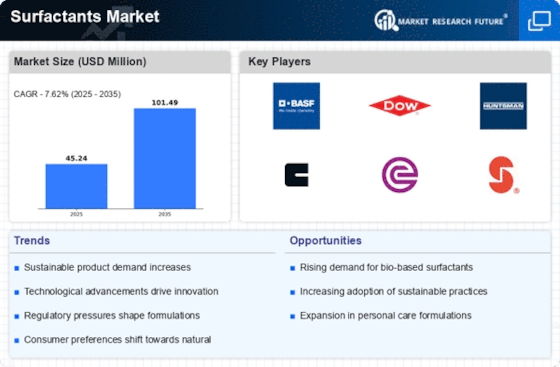
As per Market Research Future analysis, the Surfactants Market Size was estimated at 45.24 USD Million in 2024. The Surfactants industry is projected to grow from 48.69 USD Million in 2025 to 101.49 USD Million by 2035, exhibiting a compound annual growth rate (CAGR) of 7.62% during the forecast period 2025 - 2035

Key Market Trends & Highlights

The Surfactants Market is experiencing a dynamic shift towards sustainable and multifunctional solutions.

  • The market is witnessing a notable shift towards bio-based surfactants, particularly in North America, which remains the largest market. Asia-Pacific is emerging as the fastest-growing region, driven by increasing demand for synthetic surfactants in various applications. Cationic surfactants continue to dominate the market, while anionic surfactants are rapidly gaining traction due to their versatility. Key market drivers include the rising demand in personal care products and the growth in household cleaning products, which are significantly influencing market dynamics.

Market Size & Forecast

2024 Market Size 45.24 (USD Million)
2035 Market Size 101.49 (USD Million)
CAGR (2025 - 2035) 7.62%
Largest Regional Market Share in 2024 North America

Major Players

BASF (DE), Dow (US), Huntsman (US), Clariant (CH), Evonik (DE), Stepan (US), Solvay (BE), AkzoNobel (NL), Croda (GB)

Market Trends

The Surfactants Market is currently experiencing a dynamic evolution, driven by various factors including increasing consumer awareness regarding sustainability and environmental impact within the surfactants market. As industries strive to adopt greener practices, there is a noticeable shift towards bio-based surfactants, which are perceived as more environmentally friendly alternatives to traditional petrochemical-derived options. This transition appears to be influencing product formulations across sectors such as personal care, household cleaning, and industrial applications in the global surfactant market. Furthermore, the demand for multifunctional surfactants is on the rise, as manufacturers seek to enhance product performance while minimizing the number of ingredients used across the surfactant market. 

In addition to sustainability, the Surfactants Market is also shaped by technological advancements that facilitate the development of innovative products. The integration of digital technologies in manufacturing processes is likely to improve efficiency and reduce costs, thereby enhancing competitiveness. Moreover, the growing trend of customization in product offerings suggests that companies are increasingly focusing on meeting specific consumer needs. This evolving landscape indicates that the Surfactants Market is poised for continued growth, with opportunities emerging from both environmental considerations and technological innovations.

Shift Towards Bio-based Surfactants Market

There is a growing inclination towards bio-based surfactants as consumers and manufacturers alike prioritize sustainability. This trend reflects a broader commitment to reducing environmental footprints and promoting renewable resources.

Rise of Multifunctional Surfactants Market

The demand for multifunctional surfactants is increasing, as industries seek to streamline formulations while enhancing performance. This trend indicates a shift towards efficiency and effectiveness in product development.

Technological Innovations in Manufacturing

Advancements in technology are transforming the manufacturing landscape of surfactants. The integration of digital tools is likely to enhance production efficiency and foster the development of innovative products.

Surfactants Market Market Drivers

Rising Industrial Applications

The Surfactants Market is witnessing a notable increase in demand from various industrial applications. Industries such as textiles, agriculture, and oil recovery utilize surfactants for their unique properties, including wetting, dispersing, and emulsifying capabilities. In 2025, industrial applications are projected to constitute around 20% of the surfactants market, reflecting the growing recognition of surfactants as essential components in enhancing operational efficiency. For instance, in the textile industry, surfactants are employed to improve dye uptake and fabric treatment processes. Additionally, in agriculture, surfactants are used to enhance pesticide effectiveness. This diversification of applications underscores the importance of surfactants in the industrial sector, positioning it as a key driver for the Surfactants Market.

Growth in Household Cleaning Products

The Surfactants Market is significantly influenced by the expanding household cleaning products segment. With an increasing focus on cleanliness and hygiene, particularly in residential settings, the demand for effective cleaning agents is on the rise. In 2025, household cleaning products are expected to represent around 25% of the surfactants market, driven by the need for efficient and versatile cleaning solutions. This growth is further fueled by the trend towards eco-friendly and biodegradable cleaning products, prompting manufacturers to innovate and reformulate their offerings. The incorporation of surfactants enhances the efficacy of these products, allowing for better dirt removal and surface cleaning. Consequently, the household cleaning segment serves as a crucial driver for the Surfactants Market, as consumers prioritize both performance and environmental responsibility.

Expansion of the Food and Beverage Sector

The Surfactants Market is also experiencing growth due to the expansion of the food and beverage sector. Surfactants Market play a vital role in food processing, acting as emulsifiers, stabilizers, and foaming agents. As the food industry continues to evolve, with an increasing emphasis on convenience and quality, the demand for surfactants is projected to rise. In 2025, the food and beverage segment is anticipated to account for approximately 15% of the overall surfactants market. This growth is driven by the need for improved texture and stability in food products, as well as the rising popularity of processed and packaged foods. Therefore, the food and beverage sector emerges as a significant driver for the Surfactants Market, highlighting the versatility and essential nature of surfactants in various applications.

Increasing Demand in Personal Care Products

The Surfactants Market experiences a notable surge in demand driven by the personal care sector. Consumers increasingly seek products that offer enhanced cleansing and moisturizing properties, leading to a rise in the use of surfactants in shampoos, body washes, and facial cleansers. In 2025, the personal care segment is projected to account for approximately 30% of the total surfactants market, reflecting a growing consumer preference for high-quality formulations. This trend is further supported by the rising awareness of personal hygiene and grooming, particularly among younger demographics. As a result, manufacturers are compelled to innovate and develop surfactants that not only meet performance expectations but also align with consumer preferences for sustainability and safety. Thus, the personal care sector remains a pivotal driver for the Surfactants Market.

Technological Advancements in Surfactant Production

The Surfactants Market is significantly impacted by ongoing technological advancements in surfactant production processes. Innovations in manufacturing techniques, such as the development of more efficient catalysts and greener production methods, are enhancing the quality and sustainability of surfactants. In 2025, it is estimated that advancements in production technology could lead to a reduction in production costs by up to 15%, thereby making surfactants more accessible to various industries. Furthermore, these advancements facilitate the creation of specialized surfactants tailored to meet specific application needs, thereby expanding market opportunities. As industries increasingly prioritize sustainability, the shift towards eco-friendly production methods is likely to drive growth in the Surfactants Market, as manufacturers adapt to evolving consumer and regulatory demands.


Market Segment Insights

By Substrate: Bio-based Surfactants (Largest) vs. Synthetic (Fastest-Growing)

In the Surfactants Market, the substrate segment showcases a diverse distribution among its key categories. Bio-based Surfactants hold the largest market share, benefiting from rising demand for sustainable and environmentally friendly products. This segment is increasingly appealing to consumers and manufacturers alike, leading to a notable preference for bio-based formulations across various applications. Meanwhile, the Synthetic category is emerging as a significant player in terms of growth, particularly due to advancements in technology enabling the production of more efficient surfactants that meet specific performance requirements.

Bio-based Surfactants (Dominant) vs. Synthetic (Emerging)

Bio-based Surfactants are at the forefront of the surfactants market, characterized by their renewable ingredients derived from plant or animal sources. These surfactants offer excellent performance and biodegradability, making them a preferred choice for eco-conscious consumers and manufacturers. As sustainability becomes a central theme in various industries, this segment's dominance is further reinforced by an increasing regulatory push towards greener alternatives. Conversely, Synthetic Surfactants, while traditionally dominant in terms of volume due to their cost-effectiveness and performance reliability, are rapidly evolving. They leverage advanced chemical synthesis techniques to enhance efficiency and cater to growing market demands, establishing themselves as a crucial emerging category in the surfactants landscape.

By Type: Cationic Surfactants (Largest) vs. Anionic Surfactants (Fastest-Growing)

In the surfactants market, the segment distribution showcases a diverse array of functionalities offered by different surfactant types. Cationic surfactants hold the largest market share, primarily driven by their effectiveness in conditioning and antimicrobial applications. Conversely, anionic surfactants are witnessing rapid growth due to increasing demand in personal care and household cleaning products, where their excellent foaming and emulsifying properties are highly valued.

Cationic Surfactants: Dominant vs. Anionic Surfactants: Emerging

Cationic surfactants are characterized by their positive charge, making them particularly effective in hair care products where they provide conditioning and anti-static benefits. These surfactants dominate the market due to their widespread use in fabric softeners and disinfectants. On the other hand, anionic surfactants, which carry a negative charge, are enjoying significant growth due to their affordability and effective cleansing properties. Their application in personal care and household cleaning products has expanded rapidly, positioning them as an emerging segment in the surfactants market with broad utility in formulating various everyday products.

By Application: Surface Cleaner (Largest) vs. Hair Care (Fastest-Growing)

The surfactants market showcases a diverse range of applications, with surface cleaners being the largest segment. This segment benefits from a growing demand in both consumer and industrial cleaning products, largely driven by heightened hygiene awareness and an increase in household cleaning activities. Following surface cleaners, the hair care segment occupies a significant position, characterized by a diverse product offering that caters to various hair types and consumer preferences. In recent years, the surfactants market has experienced robust growth across several applications, particularly in hair care where innovative formulations and organic ingredients are shaping trends. Consumer preferences towards natural and eco-friendly products are accelerating the growth of hair care surfactants, positioning this segment as the fastest-growing within the surfactants market. The increasing emphasis on personal care and grooming is further contributing to this trend.

Surface Cleaner (Dominant) vs. Hair Care (Emerging)

The surface cleaner segment of the surfactants market is characterized by its extensive usage across various cleaning products, emphasizing efficacy and convenience. This dominant segment benefits from the rising consumer awareness regarding hygiene, especially post-pandemic, leading to sustained growth in the demand for household and industrial cleaning agents. Surface cleaners often contain a combination of surfactants such as anionic and non-ionic types that enhance cleaning power and reduce surface tension, making them popular among consumers. Conversely, the hair care segment is emerging, driven by demands for specialized products tailored to different hair types and conditions. This segment is seeing innovation through blends of natural and synthetic surfactants that cater to specific consumer needs, such as anti-dandruff or moisture retention. As consumers increasingly focus on personal grooming and wellness, the hair care surfactants are uniquely positioned for remarkable growth, appealing particularly to younger demographics who tend to favor natural ingredients.

By End-Use: Household Detergents (Largest) vs. Personal Care (Fastest-Growing)

In the surfactants market, Household Detergents are the largest segment, commanding a significant share of the overall market. This segment primarily includes laundry detergents and dishwashing soaps, which are essential household products across the globe. Personal Care, on the other hand, has emerged as the fastest-growing segment, driven by increasing consumer awareness regarding personal hygiene and grooming. Products in this category include shampoos, body washes, and facial cleansers that rely heavily on surfactants for their effectiveness. The growth in the Personal Care segment is attributed to evolving consumer preferences and rising disposable incomes, which enable consumers to spend more on quality personal care products. Additionally, the trend towards natural and organic surfactants is influencing this segment's expansion, as manufacturers strive to meet the demand for safer and more sustainable solutions. As the market evolves, the Household Detergents segment remains robust, driven by continuous innovations and product formulations that cater to various cleaning needs.

Household Detergents (Dominant) vs. Personal Care (Emerging)

Household Detergents represent a dominant force in the surfactants market, with a broad array of products that encompass both laundry and dishwashing applications. This segment benefits from established brand loyalty, as consumers consistently rely on trusted names for their cleaning needs. Manufacturers actively innovate to enhance product features, such as stain removal efficiency and eco-friendliness, which further strengthens market presence. In contrast, the Personal Care segment is characterized as an emerging powerhouse in the surfactants landscape, propelled by a surge in demand for personal hygiene products. As consumers prioritize quality and sustainability, brands are shifting towards more natural surfactant formulations, creating opportunities for growth. The dynamic nature of consumer preferences in personal care makes it a focal point for surfactant manufacturers aiming to expand their portfolios.

Get more detailed insights about Surfactants Market Research Report - Forecast to 2035

Regional Insights

North America : Innovation and Sustainability Focus

The North American surfactants market is driven by increasing demand for eco-friendly products and stringent regulations promoting sustainability. The region holds the largest market share at approximately 40%, with the U.S. being the primary contributor. The growth is further supported by advancements in technology and a shift towards bio-based surfactants, aligning with consumer preferences for greener alternatives. Leading countries in this region include the United States and Canada, where major players like Dow and BASF dominate the market. The competitive landscape is characterized by innovation and strategic partnerships among key players. Companies are investing in R&D to develop new formulations that meet regulatory standards and consumer demands, ensuring a robust market presence.

Europe : Regulatory Compliance Drives Growth

Europe is the second-largest market for surfactants, holding approximately 30% of the global share. The growth is fueled by stringent regulations such as REACH, which promote the use of safe and sustainable chemicals. The demand for surfactants in personal care and household products is on the rise, driven by consumer awareness and preference for environmentally friendly options. Germany, France, and the UK are the leading countries in this market, with key players like BASF and Evonik leading the charge. The competitive landscape is marked by innovation and compliance with regulatory standards, pushing companies to invest in sustainable practices. The presence of established manufacturers and a strong focus on R&D further enhance the market's growth potential.

Asia-Pacific : Emerging Markets Fuel Demand

The Asia-Pacific region is witnessing rapid growth in the surfactants market, driven by increasing industrialization and urbanization. This region holds a market share of approximately 25%, with China and India being the largest contributors. The demand for surfactants in various applications, including personal care and detergents, is rising due to changing consumer lifestyles and preferences for high-quality products. China, India, and Japan are the leading countries in this market, with a competitive landscape featuring both local and international players. Companies like Huntsman and Clariant are expanding their operations to cater to the growing demand. The market is characterized by a focus on innovation and the introduction of new products tailored to meet regional needs, ensuring sustained growth in the coming years.

Middle East and Africa : Resource-Rich Market Potential

The Middle East and Africa region is emerging as a potential market for surfactants, holding approximately 5% of the global share. The growth is driven by increasing demand in the oil and gas sector, as well as rising consumer awareness regarding personal care products. Countries like South Africa and the UAE are leading the market, supported by investments in infrastructure and industrial development. The competitive landscape is evolving, with both local and international players vying for market share. Companies are focusing on expanding their product offerings and enhancing distribution networks to meet the growing demand. The presence of key players like Solvay and AkzoNobel is significant, as they leverage their expertise to tap into the region's potential.

Key Players and Competitive Insights

The Surfactants Market is currently characterized by a dynamic competitive landscape, driven by increasing demand across various sectors such as personal care, household products, and industrial applications. Key players are actively engaging in strategies that emphasize innovation, sustainability, and regional expansion. For instance, BASF (DE) has been focusing on developing bio-based surfactants, which aligns with the growing consumer preference for environmentally friendly products. Similarly, Dow (US) is enhancing its portfolio through strategic partnerships aimed at advancing sustainable solutions, thereby reinforcing its market position. These strategies collectively contribute to a competitive environment that is increasingly shaped by the need for sustainable practices and innovative product offerings. In terms of business tactics, companies are localizing manufacturing to reduce lead times and optimize supply chains, which is particularly crucial in a market that is moderately fragmented. This approach not only enhances operational efficiency but also allows for better responsiveness to regional market demands. The competitive structure of the surfactants market indicates that while a few players dominate, there remains ample opportunity for smaller firms to carve out niches, particularly in specialty surfactants that cater to specific consumer needs. In August 2025, Clariant (CH) announced the launch of a new line of sustainable surfactants derived from renewable resources. This strategic move is significant as it not only addresses the rising demand for eco-friendly products but also positions Clariant as a leader in sustainability within the surfactants sector. The introduction of these products is likely to attract environmentally conscious consumers and enhance Clariant's competitive edge. In September 2025, Evonik (DE) revealed its plans to invest in a new production facility in Asia, aimed at increasing its capacity for specialty surfactants. This investment underscores Evonik's commitment to expanding its footprint in high-growth markets, particularly in Asia, where demand for surfactants is surging. Such strategic expansions are crucial for maintaining competitive advantage and meeting the evolving needs of customers in diverse regions. In October 2025, Stepan (US) announced a collaboration with a leading technology firm to integrate AI into its production processes. This initiative is poised to enhance operational efficiency and product quality, reflecting a broader trend of digital transformation within the industry. By leveraging AI, Stepan aims to optimize its supply chain and reduce costs, which could significantly impact its competitive positioning in the market. As of October 2025, the surfactants market is witnessing trends that emphasize digitalization, sustainability, and the integration of advanced technologies. Strategic alliances are increasingly shaping the competitive landscape, allowing companies to pool resources and expertise to innovate more effectively. Looking ahead, it appears that competitive differentiation will evolve from traditional price-based competition to a focus on innovation, technological advancements, and supply chain reliability, as companies strive to meet the demands of a more discerning consumer base.

Key Companies in the Surfactants Market include

Industry Developments

June 2020: DOW announced new-generation low cyclics and low-volatile silicone surfactants that support rigid polyurethane foam formulations, addressing key trends in energy efficiency and sustainability in the cold chain appliances.

Per management, the innovations help address the strong demand of the industry for additives and surfactants that support customers in the rigid polyurethane foam space to meet the emerging performance, sustainability and profitability challenges.

April 2024: Nouryon announced the launch of a new biodegradable personal care technology, Structure M3 co-surfactant at the 2024 in cosmetics global event in Paris, France. This new innovation enhances the functionality and appeal of a wide range of personal care formulations and was developed in response to customers increasing preference for more natural and milder ingredients.

Jan 2024 : Nouryon announced the launch of Berol® Nexus surfactant, at the 2024 ACI Annual Meeting and Industry Convention held in Orlando, Florida, US. The Company’s latest innovation, designed for the North American cleaning market, is a next-generation, multifunctional hydrotrope.

Future Outlook

Surfactants Market Future Outlook

The Surfactants Market is projected to grow at a 7.62% CAGR from 2025 to 2035, driven by increasing demand in personal care, household products, and industrial applications.

New opportunities lie in:

  • <p>Development of bio-based surfactants for eco-friendly products. Expansion into emerging markets with tailored formulations. Investment in advanced manufacturing technologies for cost efficiency.</p>

By 2035, the Surfactants Market is expected to achieve robust growth, reflecting evolving consumer preferences and technological advancements.

Market Segmentation

Surfactants Market Type Outlook

  • Cationic Surfactants
  • Anionic Surfactants
  • Non-ionic Surfactants
  • Amphoteric Surfactants

Surfactants Market End-Use Outlook

  • Household Detergents
  • Personal Care
  • Institutional and Industrial Cleaners
  • Food Processing
  • Oilfield Chemicals
  • Agricultural Chemicals
  • Textiles
  • Plastics
  • Paints and Coatings
  • Adhesives
  • Others

Surfactants Market Substrate Outlook

  • Bio-based Surfactants
  • Biosurfactants
  • Chemically Synthesized Bio-Based
  • Synthetic

Surfactants Market Application Outlook

  • Surface Cleaner
  • Hair Care
  • Skin Care
  • Sanitizer
  • Emulsifiers
  • Dispersing Agents
  • Others

Report Scope

MARKET SIZE 2024 45.24(USD Million)
MARKET SIZE 2025 48.69(USD Million)
MARKET SIZE 2035 101.49(USD Million)
COMPOUND ANNUAL GROWTH RATE (CAGR) 7.62% (2025 - 2035)
REPORT COVERAGE Revenue Forecast, Competitive Landscape, Growth Factors, and Trends
BASE YEAR 2024
Market Forecast Period 2025 - 2035
Historical Data 2019 - 2024
Market Forecast Units USD Million
Key Companies Profiled BASF (DE), Dow (US), Huntsman (US), Clariant (CH), Evonik (DE), Stepan (US), Solvay (BE), AkzoNobel (NL), Croda (GB)
Segments Covered Substrate, Type, Application, END-USE INDUSTRY
Key Market Opportunities Growing demand for bio-based surfactants driven by sustainability and regulatory pressures in the Surfactants Market.
Key Market Dynamics Rising demand for eco-friendly surfactants drives innovation and regulatory compliance in the surfactants market.
Countries Covered North America, Europe, APAC, South America, MEA

FAQs

What is the current valuation of the Surfactants Market in 2025?

<p>The Surfactants Market is valued at approximately 45.24 USD Million in 2024.</p>

What is the projected market size for the Surfactants Market by 2035?

<p>The market is projected to reach around 101.49 USD Million by 2035.</p>

What is the expected CAGR for the Surfactants Market during the forecast period?

<p>The expected CAGR for the Surfactants Market from 2025 to 2035 is 7.62%.</p>

Which companies are considered key players in the Surfactants Market?

<p>Key players in the market include BASF, Dow, Huntsman, Clariant, Evonik, Stepan, Solvay, AkzoNobel, and Croda.</p>

What are the main segments of the Surfactants Market?

<p>The main segments include substrate, type, application, and end-use.</p>

How do bio-based surfactants perform in the market?

Bio-based surfactants had a valuation of 10.0 to 23.0 USD Million in 2024.

What is the market performance of anionic surfactants?

Anionic surfactants were valued between 15.0 and 35.0 USD Million in 2024.

What applications are driving growth in the Surfactants Market?

Applications such as hair care and skin care are projected to grow, with valuations of 10.0 to 22.0 USD Million and 8.0 to 18.0 USD Million, respectively.

What end-use segments are significant in the Surfactants Market?

Household detergents and personal care segments were valued at 10.0 to 23.0 USD Million and 8.0 to 18.0 USD Million, respectively, in 2024.

What trends are expected in the Surfactants Market by 2035?

The market is likely to experience substantial growth, potentially reaching 101.49 USD Million by 2035.

  1. SECTION I: EXECUTIVE SUMMARY AND KEY HIGHLIGHTS |
    1. EXECUTIVE SUMMARY | |
      1. Market Overview | |
      2. Key Findings | |
      3. Market Segmentation | |
      4. Competitive Landscape | |
      5. Challenges and Opportunities | |
      6. Future Outlook 2
  2. SECTION II: SCOPING, METHODOLOGY AND MARKET STRUCTURE |
    1. MARKET INTRODUCTION | |
      1. Definition | |
      2. Scope of the study | | |
    2. RESEARCH METHODOLOGY | |
      1. Overview | |
      2. Data Mining | |
      3. Secondary Research | |
      4. Primary Research | | |
      5. Forecasting Model | |
      6. Market Size Estimation | | |
      7. Data Triangulation | |
      8. Validation 3
  3. SECTION III: QUALITATIVE ANALYSIS |
    1. MARKET DYNAMICS | |
      1. Overview | |
      2. Drivers | |
      3. Restraints | |
      4. Opportunities |
    2. MARKET FACTOR ANALYSIS | |
      1. Value chain Analysis | |
      2. Porter's Five Forces Analysis | | |
      3. COVID-19 Impact Analysis | | |
  4. SECTION IV: QUANTITATIVE ANALYSIS |
    1. Chemicals and Materials, BY Substrate (USD Million) | |
      1. Bio-based Surfactants | |
      2. Biosurfactants | |
      3. Chemically Synthesized Bio-Based | |
      4. Synthetic |
    2. Chemicals and Materials, BY Type (USD Million) | |
      1. Cationic Surfactants | |
      2. Anionic Surfactants | |
      3. Non-ionic Surfactants | |
      4. Amphoteric Surfactants |
    3. Chemicals and Materials, BY Application (USD Million) | |
      1. Surface Cleaner | |
      2. Hair Care | |
      3. Skin Care | |
      4. Sanitizer | |
      5. Emulsifiers | |
      6. Dispersing Agents | |
      7. Others |
    4. Chemicals and Materials, BY End-Use (USD Million) | |
      1. Household Detergents | |
      2. Personal Care | |
      3. Institutional and Industrial Cleaners | |
      4. Food Processing | |
      5. Oilfield Chemicals | |
      6. Agricultural Chemicals | |
      7. Textiles | |
      8. Plastics | |
      9. Paints and Coatings | |
      10. Adhesives | |
      11. Others |
    5. Chemicals and Materials, BY Region (USD Million) | |
      1. North America | | |
      2. Europe | | |
      3. APAC | | |
      4. South America | | |
      5. MEA | | |
  5. SECTION V: COMPETITIVE ANALYSIS |
    1. Competitive Landscape | |
      1. Overview | |
      2. Competitive Analysis | |
      3. Market share Analysis | |
      4. Major Growth Strategy in the Chemicals and Materials | |
      5. Competitive Benchmarking | |
      6. Leading Players in Terms of Number of Developments in the Chemicals and Materials | |
      7. Key developments and growth strategies | | |
      8. Major Players Financial Matrix | | |
    2. Company Profiles | |
      1. BASF (DE) | | |
      2. Dow (US) | | |
      3. Huntsman (US) | | |
      4. Clariant (CH) | | |
      5. Evonik (DE) | | |
      6. Stepan (US) | | |
      7. Solvay (BE) | | |
      8. AkzoNobel (NL) | | |
      9. Croda (GB) | | |
    3. Appendix | |
      1. References | |
      2. Related Reports 6 LIST OF FIGURES |
    4. MARKET SYNOPSIS |
    5. NORTH AMERICA MARKET ANALYSIS |
    6. US MARKET ANALYSIS BY SUBSTRATE |
    7. US MARKET ANALYSIS BY TYPE |
    8. US MARKET ANALYSIS BY APPLICATION |
    9. US MARKET ANALYSIS BY END-USE |
    10. CANADA MARKET ANALYSIS BY SUBSTRATE |
    11. CANADA MARKET ANALYSIS BY TYPE |
    12. CANADA MARKET ANALYSIS BY APPLICATION |
    13. CANADA MARKET ANALYSIS BY END-USE |
    14. EUROPE MARKET ANALYSIS |
    15. GERMANY MARKET ANALYSIS BY SUBSTRATE |
    16. GERMANY MARKET ANALYSIS BY TYPE |
    17. GERMANY MARKET ANALYSIS BY APPLICATION |
    18. GERMANY MARKET ANALYSIS BY END-USE |
    19. UK MARKET ANALYSIS BY SUBSTRATE |
    20. UK MARKET ANALYSIS BY TYPE |
    21. UK MARKET ANALYSIS BY APPLICATION |
    22. UK MARKET ANALYSIS BY END-USE |
    23. FRANCE MARKET ANALYSIS BY SUBSTRATE |
    24. FRANCE MARKET ANALYSIS BY TYPE |
    25. FRANCE MARKET ANALYSIS BY APPLICATION |
    26. FRANCE MARKET ANALYSIS BY END-USE |
    27. RUSSIA MARKET ANALYSIS BY SUBSTRATE |
    28. RUSSIA MARKET ANALYSIS BY TYPE |
    29. RUSSIA MARKET ANALYSIS BY APPLICATION |
    30. RUSSIA MARKET ANALYSIS BY END-USE |
    31. ITALY MARKET ANALYSIS BY SUBSTRATE |
    32. ITALY MARKET ANALYSIS BY TYPE |
    33. ITALY MARKET ANALYSIS BY APPLICATION |
    34. ITALY MARKET ANALYSIS BY END-USE |
    35. SPAIN MARKET ANALYSIS BY SUBSTRATE |
    36. SPAIN MARKET ANALYSIS BY TYPE |
    37. SPAIN MARKET ANALYSIS BY APPLICATION |
    38. SPAIN MARKET ANALYSIS BY END-USE |
    39. REST OF EUROPE MARKET ANALYSIS BY SUBSTRATE |
    40. REST OF EUROPE MARKET ANALYSIS BY TYPE |
    41. REST OF EUROPE MARKET ANALYSIS BY APPLICATION |
    42. REST OF EUROPE MARKET ANALYSIS BY END-USE |
    43. APAC MARKET ANALYSIS |
    44. CHINA MARKET ANALYSIS BY SUBSTRATE |
    45. CHINA MARKET ANALYSIS BY TYPE |
    46. CHINA MARKET ANALYSIS BY APPLICATION |
    47. CHINA MARKET ANALYSIS BY END-USE |
    48. INDIA MARKET ANALYSIS BY SUBSTRATE |
    49. INDIA MARKET ANALYSIS BY TYPE |
    50. INDIA MARKET ANALYSIS BY APPLICATION |
    51. INDIA MARKET ANALYSIS BY END-USE |
    52. JAPAN MARKET ANALYSIS BY SUBSTRATE |
    53. JAPAN MARKET ANALYSIS BY TYPE |
    54. JAPAN MARKET ANALYSIS BY APPLICATION |
    55. JAPAN MARKET ANALYSIS BY END-USE |
    56. SOUTH KOREA MARKET ANALYSIS BY SUBSTRATE |
    57. SOUTH KOREA MARKET ANALYSIS BY TYPE |
    58. SOUTH KOREA MARKET ANALYSIS BY APPLICATION |
    59. SOUTH KOREA MARKET ANALYSIS BY END-USE |
    60. MALAYSIA MARKET ANALYSIS BY SUBSTRATE |
    61. MALAYSIA MARKET ANALYSIS BY TYPE |
    62. MALAYSIA MARKET ANALYSIS BY APPLICATION |
    63. MALAYSIA MARKET ANALYSIS BY END-USE |
    64. THAILAND MARKET ANALYSIS BY SUBSTRATE |
    65. THAILAND MARKET ANALYSIS BY TYPE |
    66. THAILAND MARKET ANALYSIS BY APPLICATION |
    67. THAILAND MARKET ANALYSIS BY END-USE |
    68. INDONESIA MARKET ANALYSIS BY SUBSTRATE |
    69. INDONESIA MARKET ANALYSIS BY TYPE |
    70. INDONESIA MARKET ANALYSIS BY APPLICATION |
    71. INDONESIA MARKET ANALYSIS BY END-USE |
    72. REST OF APAC MARKET ANALYSIS BY SUBSTRATE |
    73. REST OF APAC MARKET ANALYSIS BY TYPE |
    74. REST OF APAC MARKET ANALYSIS BY APPLICATION |
    75. REST OF APAC MARKET ANALYSIS BY END-USE |
    76. SOUTH AMERICA MARKET ANALYSIS |
    77. BRAZIL MARKET ANALYSIS BY SUBSTRATE |
    78. BRAZIL MARKET ANALYSIS BY TYPE |
    79. BRAZIL MARKET ANALYSIS BY APPLICATION |
    80. BRAZIL MARKET ANALYSIS BY END-USE |
    81. MEXICO MARKET ANALYSIS BY SUBSTRATE |
    82. MEXICO MARKET ANALYSIS BY TYPE |
    83. MEXICO MARKET ANALYSIS BY APPLICATION |
    84. MEXICO MARKET ANALYSIS BY END-USE |
    85. ARGENTINA MARKET ANALYSIS BY SUBSTRATE |
    86. ARGENTINA MARKET ANALYSIS BY TYPE |
    87. ARGENTINA MARKET ANALYSIS BY APPLICATION |
    88. ARGENTINA MARKET ANALYSIS BY END-USE |
    89. REST OF SOUTH AMERICA MARKET ANALYSIS BY SUBSTRATE |
    90. REST OF SOUTH AMERICA MARKET ANALYSIS BY TYPE |
    91. REST OF SOUTH AMERICA MARKET ANALYSIS BY APPLICATION |
    92. REST OF SOUTH AMERICA MARKET ANALYSIS BY END-USE |
    93. MEA MARKET ANALYSIS |
    94. GCC COUNTRIES MARKET ANALYSIS BY SUBSTRATE |
    95. GCC COUNTRIES MARKET ANALYSIS BY TYPE |
    96. GCC COUNTRIES MARKET ANALYSIS BY APPLICATION |
    97. GCC COUNTRIES MARKET ANALYSIS BY END-USE |
    98. SOUTH AFRICA MARKET ANALYSIS BY SUBSTRATE |
    99. SOUTH AFRICA MARKET ANALYSIS BY TYPE |
    100. SOUTH AFRICA MARKET ANALYSIS BY APPLICATION |
    101. SOUTH AFRICA MARKET ANALYSIS BY END-USE |
    102. REST OF MEA MARKET ANALYSIS BY SUBSTRATE |
    103. REST OF MEA MARKET ANALYSIS BY TYPE |
    104. REST OF MEA MARKET ANALYSIS BY APPLICATION |
    105. REST OF MEA MARKET ANALYSIS BY END-USE |
    106. KEY BUYING CRITERIA OF CHEMICALS AND MATERIALS |
    107. RESEARCH PROCESS OF MRFR |
    108. DRO ANALYSIS OF CHEMICALS AND MATERIALS |
    109. DRIVERS IMPACT ANALYSIS: CHEMICALS AND MATERIALS |
    110. RESTRAINTS IMPACT ANALYSIS: CHEMICALS AND MATERIALS |
    111. SUPPLY / VALUE CHAIN: CHEMICALS AND MATERIALS |
    112. CHEMICALS AND MATERIALS, BY SUBSTRATE, 2024 (% SHARE) |
    113. CHEMICALS AND MATERIALS, BY SUBSTRATE, 2024 TO 2035 (USD Million) |
    114. CHEMICALS AND MATERIALS, BY TYPE, 2024 (% SHARE) |
    115. CHEMICALS AND MATERIALS, BY TYPE, 2024 TO 2035 (USD Million) |
    116. CHEMICALS AND MATERIALS, BY APPLICATION, 2024 (% SHARE) |
    117. CHEMICALS AND MATERIALS, BY APPLICATION, 2024 TO 2035 (USD Million) |
    118. CHEMICALS AND MATERIALS, BY END-USE, 2024 (% SHARE) |
    119. CHEMICALS AND MATERIALS, BY END-USE, 2024 TO 2035 (USD Million) |
    120. BENCHMARKING OF MAJOR COMPETITORS 7 LIST OF TABLES |
    121. LIST OF ASSUMPTIONS | |
      1. |
    122. North America MARKET SIZE ESTIMATES; FORECAST | |
      1. BY SUBSTRATE, 2025-2035 (USD Million) | |
      2. BY TYPE, 2025-2035 (USD Million) | |
      3. BY APPLICATION, 2025-2035 (USD Million) | |
      4. BY END-USE, 2025-2035 (USD Million) |
    123. US MARKET SIZE ESTIMATES; FORECAST | |
      1. BY SUBSTRATE, 2025-2035 (USD Million) | |
      2. BY TYPE, 2025-2035 (USD Million) | |
      3. BY APPLICATION, 2025-2035 (USD Million) | |
      4. BY END-USE, 2025-2035 (USD Million) |
    124. Canada MARKET SIZE ESTIMATES; FORECAST | |
      1. BY SUBSTRATE, 2025-2035 (USD Million) | |
      2. BY TYPE, 2025-2035 (USD Million) | |
      3. BY APPLICATION, 2025-2035 (USD Million) | |
      4. BY END-USE, 2025-2035 (USD Million) |
    125. Europe MARKET SIZE ESTIMATES; FORECAST | |
      1. BY SUBSTRATE, 2025-2035 (USD Million) | |
      2. BY TYPE, 2025-2035 (USD Million) | |
      3. BY APPLICATION, 2025-2035 (USD Million) | |
      4. BY END-USE, 2025-2035 (USD Million) |
    126. Germany MARKET SIZE ESTIMATES; FORECAST | |
      1. BY SUBSTRATE, 2025-2035 (USD Million) | |
      2. BY TYPE, 2025-2035 (USD Million) | |
      3. BY APPLICATION, 2025-2035 (USD Million) | |
      4. BY END-USE, 2025-2035 (USD Million) |
    127. UK MARKET SIZE ESTIMATES; FORECAST | |
      1. BY SUBSTRATE, 2025-2035 (USD Million) | |
      2. BY TYPE, 2025-2035 (USD Million) | |
      3. BY APPLICATION, 2025-2035 (USD Million) | |
      4. BY END-USE, 2025-2035 (USD Million) |
    128. France MARKET SIZE ESTIMATES; FORECAST | |
      1. BY SUBSTRATE, 2025-2035 (USD Million) | |
      2. BY TYPE, 2025-2035 (USD Million) | |
      3. BY APPLICATION, 2025-2035 (USD Million) | |
      4. BY END-USE, 2025-2035 (USD Million) |
    129. Russia MARKET SIZE ESTIMATES; FORECAST | |
      1. BY SUBSTRATE, 2025-2035 (USD Million) | |
      2. BY TYPE, 2025-2035 (USD Million) | |
      3. BY APPLICATION, 2025-2035 (USD Million) | |
      4. BY END-USE, 2025-2035 (USD Million) |
    130. Italy MARKET SIZE ESTIMATES; FORECAST | |
      1. BY SUBSTRATE, 2025-2035 (USD Million) | |
      2. BY TYPE, 2025-2035 (USD Million) | |
      3. BY APPLICATION, 2025-2035 (USD Million) | |
      4. BY END-USE, 2025-2035 (USD Million) |
    131. Spain MARKET SIZE ESTIMATES; FORECAST | |
      1. BY SUBSTRATE, 2025-2035 (USD Million) | |
      2. BY TYPE, 2025-2035 (USD Million) | |
      3. BY APPLICATION, 2025-2035 (USD Million) | |
      4. BY END-USE, 2025-2035 (USD Million) |
    132. Rest of Europe MARKET SIZE ESTIMATES; FORECAST | |
      1. BY SUBSTRATE, 2025-2035 (USD Million) | |
      2. BY TYPE, 2025-2035 (USD Million) | |
      3. BY APPLICATION, 2025-2035 (USD Million) | |
      4. BY END-USE, 2025-2035 (USD Million) |
    133. APAC MARKET SIZE ESTIMATES; FORECAST | |
      1. BY SUBSTRATE, 2025-2035 (USD Million) | |
      2. BY TYPE, 2025-2035 (USD Million) | |
      3. BY APPLICATION, 2025-2035 (USD Million) | |
      4. BY END-USE, 2025-2035 (USD Million) |
    134. China MARKET SIZE ESTIMATES; FORECAST | |
      1. BY SUBSTRATE, 2025-2035 (USD Million) | |
      2. BY TYPE, 2025-2035 (USD Million) | |
      3. BY APPLICATION, 2025-2035 (USD Million) | |
      4. BY END-USE, 2025-2035 (USD Million) |
    135. India MARKET SIZE ESTIMATES; FORECAST | |
      1. BY SUBSTRATE, 2025-2035 (USD Million) | |
      2. BY TYPE, 2025-2035 (USD Million) | |
      3. BY APPLICATION, 2025-2035 (USD Million) | |
      4. BY END-USE, 2025-2035 (USD Million) |
    136. Japan MARKET SIZE ESTIMATES; FORECAST | |
      1. BY SUBSTRATE, 2025-2035 (USD Million) | |
      2. BY TYPE, 2025-2035 (USD Million) | |
      3. BY APPLICATION, 2025-2035 (USD Million) | |
      4. BY END-USE, 2025-2035 (USD Million) |
    137. South Korea MARKET SIZE ESTIMATES; FORECAST | |
      1. BY SUBSTRATE, 2025-2035 (USD Million) | |
      2. BY TYPE, 2025-2035 (USD Million) | |
      3. BY APPLICATION, 2025-2035 (USD Million) | |
      4. BY END-USE, 2025-2035 (USD Million) |
    138. Malaysia MARKET SIZE ESTIMATES; FORECAST | |
      1. BY SUBSTRATE, 2025-2035 (USD Million) | |
      2. BY TYPE, 2025-2035 (USD Million) | |
      3. BY APPLICATION, 2025-2035 (USD Million) | |
      4. BY END-USE, 2025-2035 (USD Million) |
    139. Thailand MARKET SIZE ESTIMATES; FORECAST | |
      1. BY SUBSTRATE, 2025-2035 (USD Million) | |
      2. BY TYPE, 2025-2035 (USD Million) | |
      3. BY APPLICATION, 2025-2035 (USD Million) | |
      4. BY END-USE, 2025-2035 (USD Million) |
    140. Indonesia MARKET SIZE ESTIMATES; FORECAST | |
      1. BY SUBSTRATE, 2025-2035 (USD Million) | |
      2. BY TYPE, 2025-2035 (USD Million) | |
      3. BY APPLICATION, 2025-2035 (USD Million) | |
      4. BY END-USE, 2025-2035 (USD Million) |
    141. Rest of APAC MARKET SIZE ESTIMATES; FORECAST | |
      1. BY SUBSTRATE, 2025-2035 (USD Million) | |
      2. BY TYPE, 2025-2035 (USD Million) | |
      3. BY APPLICATION, 2025-2035 (USD Million) | |
      4. BY END-USE, 2025-2035 (USD Million) |
    142. South America MARKET SIZE ESTIMATES; FORECAST | |
      1. BY SUBSTRATE, 2025-2035 (USD Million) | |
      2. BY TYPE, 2025-2035 (USD Million) | |
      3. BY APPLICATION, 2025-2035 (USD Million) | |
      4. BY END-USE, 2025-2035 (USD Million) |
    143. Brazil MARKET SIZE ESTIMATES; FORECAST | |
      1. BY SUBSTRATE, 2025-2035 (USD Million) | |
      2. BY TYPE, 2025-2035 (USD Million) | |
      3. BY APPLICATION, 2025-2035 (USD Million) | |
      4. BY END-USE, 2025-2035 (USD Million) |
    144. Mexico MARKET SIZE ESTIMATES; FORECAST | |
      1. BY SUBSTRATE, 2025-2035 (USD Million) | |
      2. BY TYPE, 2025-2035 (USD Million) | |
      3. BY APPLICATION, 2025-2035 (USD Million) | |
      4. BY END-USE, 2025-2035 (USD Million) |
    145. Argentina MARKET SIZE ESTIMATES; FORECAST | |
      1. BY SUBSTRATE, 2025-2035 (USD Million) | |
      2. BY TYPE, 2025-2035 (USD Million) | |
      3. BY APPLICATION, 2025-2035 (USD Million) | |
      4. BY END-USE, 2025-2035 (USD Million) |
    146. Rest of South America MARKET SIZE ESTIMATES; FORECAST | |
      1. BY SUBSTRATE, 2025-2035 (USD Million) | |
      2. BY TYPE, 2025-2035 (USD Million) | |
      3. BY APPLICATION, 2025-2035 (USD Million) | |
      4. BY END-USE, 2025-2035 (USD Million) |
    147. MEA MARKET SIZE ESTIMATES; FORECAST | |
      1. BY SUBSTRATE, 2025-2035 (USD Million) | |
      2. BY TYPE, 2025-2035 (USD Million) | |
      3. BY APPLICATION, 2025-2035 (USD Million) | |
      4. BY END-USE, 2025-2035 (USD Million) |
    148. GCC Countries MARKET SIZE ESTIMATES; FORECAST | |
      1. BY SUBSTRATE, 2025-2035 (USD Million) | |
      2. BY TYPE, 2025-2035 (USD Million) | |
      3. BY APPLICATION, 2025-2035 (USD Million) | |
      4. BY END-USE, 2025-2035 (USD Million) |
    149. South Africa MARKET SIZE ESTIMATES; FORECAST | |
      1. BY SUBSTRATE, 2025-2035 (USD Million) | |
      2. BY TYPE, 2025-2035 (USD Million) | |
      3. BY APPLICATION, 2025-2035 (USD Million) | |
      4. BY END-USE, 2025-2035 (USD Million) |
    150. Rest of MEA MARKET SIZE ESTIMATES; FORECAST | |
      1. BY SUBSTRATE, 2025-2035 (USD Million) | |
      2. BY TYPE, 2025-2035 (USD Million) | |
      3. BY APPLICATION, 2025-2035 (USD Million) | |
      4. BY END-USE, 2025-2035 (USD Million) |
    151. PRODUCT LAUNCH/PRODUCT DEVELOPMENT/APPROVAL | |
      1. |
    152. ACQUISITION/PARTNERSHIP | |

Chemicals and Materials Market Segmentation

Chemicals and Materials By Substrate (USD Million, 2025-2035)

  • Bio-based Surfactants
  • Biosurfactants
  • Chemically Synthesized Bio-Based
  • Synthetic

Chemicals and Materials By Type (USD Million, 2025-2035)

  • Cationic Surfactants
  • Anionic Surfactants
  • Non-ionic Surfactants
  • Amphoteric Surfactants

Chemicals and Materials By Application (USD Million, 2025-2035)

  • Surface Cleaner
  • Hair Care
  • Skin Care
  • Sanitizer
  • Emulsifiers
  • Dispersing Agents
  • Others

Chemicals and Materials By End-Use (USD Million, 2025-2035)

  • Household Detergents
  • Personal Care
  • Institutional and Industrial Cleaners
  • Food Processing
  • Oilfield Chemicals
  • Agricultural Chemicals
  • Textiles
  • Plastics
  • Paints and Coatings
  • Adhesives
  • Others
Infographic

Free Sample Request

Kindly complete the form below to receive a free sample of this Report

Get Free Sample

Customer Strories

Compare Licence

×
Features License Type
Single User Multiuser License Enterprise User
Price $4,950 $5,950 $7,250
Maximum User Access Limit 1 User Upto 10 Users Unrestricted Access Throughout the Organization
Free Customization
Direct Access to Analyst
Deliverable Format
Platform Access
Discount on Next Purchase 10% 15% 15%
Printable Versions