×
Request Free Sample ×

Kindly complete the form below to receive a free sample of this Report

* Please use a valid business email

Leading companies partner with us for data-driven Insights

clients tt-cursor
Hero Background
English
Chinese
French
Japanese
Korean
German
Spanish

Surface Technology Market Trends

ID: MRFR/CnM/9448-CR
100 Pages
Priya Nagrale
September 2022

Surface Technology Market Research Report Information By Type (High Velocity Oxygen Fuel (HVOF) Coatings, Plasma, Ceramic Coatings, Anodizing, Vapor Phase Aluminate, Slurry Coatings, Others) Application (Aerospace, General Industrial, Automotive, Power Generation, Building & Construction, Oil & Gas Pipeline, Food & Beverages, Textile, Paper & Packaging, Metallurgy & Minerals, Others) Forecast 2032

Share:
Download PDF ×

We do not share your information with anyone. However, we may send you emails based on your report interest from time to time. You may contact us at any time to opt-out.

Surface Technology Market Infographic
×
Surface Technology Market Infographic Full View
Purchase Options

Market Trends

Key Emerging Trends in the Surface Technology Market

The surface technology market is witnessing significant trends that are reshaping its landscape. One of the prominent trends is the increasing demand for advanced surface coatings across various industries such as automotive, aerospace, electronics, and healthcare. These coatings are designed to enhance the durability, performance, and aesthetics of products, thereby driving their adoption. Moreover, there is a growing emphasis on environmentally friendly and sustainable surface treatments, leading to the development of eco-friendly coatings that minimize environmental impact while offering superior functionality.

Another notable trend is the rapid advancement in nanotechnology, which is revolutionizing surface treatments. Nanocoatings offer unparalleled properties such as enhanced scratch resistance, anti-corrosion capabilities, and self-cleaning functionalities. The growing application of nanotechnology in surface coatings is expected to fuel market growth as industries seek innovative solutions to improve product performance and longevity.

With the increased demand for meeting customer needs in terms of product quality and variety, AM technology has been upgraded from rapid prototyping to rapid manufacturing.

Furthermore, the surface technology market is witnessing a shift towards smart coatings embedded with functionalities such as self-healing, anti-microbial properties, and thermal management. These coatings are gaining traction particularly in the automotive and electronics sectors where there is a growing demand for intelligent surfaces that can adapt to changing conditions and provide added value to consumers.

In addition, the emergence of additive manufacturing or 3D printing technologies is opening up new avenues in surface treatment. Additive manufacturing allows for the production of complex geometries with customized surface properties, enabling manufacturers to create products with tailored surface functionalities to meet specific requirements. This trend is expected to drive the adoption of advanced surface treatments in industries ranging from healthcare to aerospace.

Moreover, the increasing focus on reducing maintenance costs and improving operational efficiency is driving the adoption of durable and long-lasting surface coatings. Industries are investing in coatings that offer superior protection against wear and tear, thereby extending the lifespan of components and reducing the need for frequent maintenance. This trend is particularly prominent in heavy industries such as manufacturing and construction, where equipment reliability is paramount.

Additionally, the surface technology market is witnessing a growing demand for bio-based coatings derived from renewable sources such as plant oils and biomass. These coatings offer a sustainable alternative to traditional petroleum-based coatings and are gaining traction due to their lower environmental footprint and biodegradability. With increasing regulatory pressure to reduce greenhouse gas emissions and minimize waste generation, bio-based coatings are expected to see widespread adoption across various industries.

Furthermore, the advent of Industry 4.0 and the Internet of Things (IoT) is driving the integration of smart coatings with sensors and data analytics capabilities. Smart coatings embedded with sensors can provide real-time monitoring of structural integrity, corrosion levels, and environmental conditions, allowing for proactive maintenance and predictive analytics. This trend is expected to transform the surface technology market, enabling industries to optimize asset performance and reduce downtime.

Author
Priya Nagrale
Senior Research Analyst

With an experience of over five years in market research industry (Chemicals & Materials domain), I gather and analyze market data from diverse sources to produce results, which are then presented back to a client. Also, provide recommendations based on the findings. As a Senior Research Analyst, I perform quality checks (QC) for market estimations, QC for reports, and handle queries and work extensively on client customizations. Also, handle the responsibilities of client proposals, report planning, report finalization, and execution

Leave a Comment

FAQs

What growth rate global surface technology market would register in the future?

The global surface technology market would register a growth of 4.98%.

Which industry will play a crucial role in taking the surface technology market ahead?

Automotive industry, will play a crucial role in taking the surface technology market ahead

What is the key restraining factor for the global surface technology market?

Fluctuations in raw material availability, is the key restraining factor for the global surface technology market

Which Asia-Pacific country would set the trend in the surface technology market?

China would set the trend in the surface technology market

Market Summary

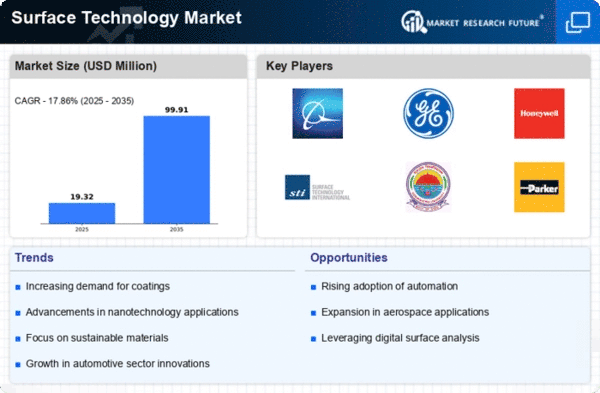
As per MRFR analysis, the Surface Technology Market was estimated at 16.39 USD Million in 2024. The Surface Technology industry is projected to grow from 19.31 USD Million in 2025 to 99.91 USD Million by 2035, exhibiting a compound annual growth rate (CAGR) of 17.86 during the forecast period 2025 - 2035.

Key Market Trends & Highlights

The Surface Technology Market is poised for robust growth driven by sustainability and technological advancements.

  • North America remains the largest market for surface technology, driven by extensive industrial applications.
  • The Asia-Pacific region is emerging as the fastest-growing market, fueled by rapid industrialization and innovation.
  • Coatings continue to dominate the market, while additive manufacturing is gaining traction as the fastest-growing segment.
  • Rising demand for advanced coatings and a growing focus on sustainability are key drivers propelling market expansion.

Market Size & Forecast

2024 Market Size 16.39 (USD Million)
2035 Market Size 99.91 (USD Million)
CAGR (2025 - 2035) 17.86%
Largest Regional Market Share in 2024 North America

Major Players

<p>Boeing (US), General Electric (US), Honeywell (US), Surface Technology International (GB), KUKA (DE), Parker Hannifin (US), 3M (US), Oerlikon (CH), Höganäs (SE)</p>

Market Trends

The Surface Technology Market is currently experiencing a dynamic evolution, driven by advancements in materials science and engineering. This sector encompasses a wide array of processes and technologies aimed at enhancing the surface properties of materials, thereby improving their performance and longevity. Industries such as automotive, aerospace, and electronics are increasingly adopting surface treatment techniques to meet stringent quality standards and enhance product durability. The growing emphasis on sustainability and eco-friendly practices is also influencing the market, as companies seek to minimize environmental impact while maximizing efficiency. In December 2025, the Surface Technology Market appears poised for further growth, with innovations in coatings, surface modification, and nanotechnology playing pivotal roles. The integration of smart technologies and automation into surface treatment processes suggests a shift towards more efficient and precise applications. Additionally, the rising demand for lightweight materials in various sectors indicates a potential expansion of surface technology applications. As industries continue to evolve, the Surface Technology Market is likely to adapt, presenting new opportunities and challenges for stakeholders across the globe.

Sustainability Initiatives

The Surface Technology Market is increasingly influenced by sustainability initiatives, as companies strive to adopt eco-friendly practices. This trend encompasses the development of environmentally safe coatings and surface treatments that reduce harmful emissions and waste. As regulatory pressures mount, organizations are likely to invest in sustainable technologies to enhance their market competitiveness.

Advancements in Nanotechnology

Recent advancements in nanotechnology are reshaping the Surface Technology Market, enabling the creation of innovative materials with enhanced properties. These developments allow for improved performance in various applications, such as corrosion resistance and wear protection. The potential for nanomaterials to revolutionize surface treatments suggests a promising future for this segment.

Integration of Smart Technologies

The integration of smart technologies into surface treatment processes is becoming increasingly prevalent. Automation and data analytics are enhancing precision and efficiency, allowing for real-time monitoring and adjustments. This trend indicates a shift towards more intelligent manufacturing practices, which could significantly impact the Surface Technology Market.

Surface Technology Market Market Drivers

Market Growth Projections

The Global Surface Technology Market Industry is poised for substantial growth, with projections indicating a market value of 235.94 USD Billion in 2024 and an anticipated increase to 541.32 USD Billion by 2035. This growth trajectory suggests a compound annual growth rate of 7.84% from 2025 to 2035, reflecting the increasing adoption of surface technologies across various sectors. The demand for innovative solutions that enhance material performance and sustainability is driving this expansion. As industries continue to evolve and prioritize advanced surface treatments, the market is likely to experience robust growth in the coming years.

Technological Advancements

The Global Surface Technology Market Industry is experiencing rapid advancements in technology, particularly in coating and surface treatment processes. Innovations such as nanotechnology and laser surface engineering are enhancing the performance and durability of materials. For instance, the introduction of advanced coatings that provide corrosion resistance and wear protection is becoming increasingly prevalent. These technological improvements are expected to drive market growth, as industries seek to enhance product longevity and reduce maintenance costs. As a result, the market is projected to reach 235.94 USD Billion in 2024, reflecting a growing demand for sophisticated surface solutions.

Growing Aerospace Applications

The aerospace industry is increasingly relying on advanced surface technologies to enhance the performance and safety of aircraft components. The Global Surface Technology Market Industry is benefiting from the demand for lightweight, durable materials that can withstand extreme conditions. Surface treatments such as thermal barrier coatings and anodizing are being employed to improve resistance to heat and corrosion. As air travel continues to expand globally, the need for innovative surface solutions is likely to grow. This sector's expansion is anticipated to play a crucial role in driving the market towards an estimated value of 541.32 USD Billion by 2035.

Rising Demand from Automotive Sector

The automotive sector is a major driver of the Global Surface Technology Market Industry, as manufacturers increasingly adopt advanced surface treatments to improve vehicle performance and aesthetics. The demand for lightweight materials with enhanced surface properties is on the rise, driven by the need for fuel efficiency and reduced emissions. Surface technologies such as electroplating and powder coating are being utilized to achieve these objectives. This trend is likely to contribute significantly to the market's growth, with projections indicating a compound annual growth rate of 7.84% from 2025 to 2035, as the automotive industry continues to evolve.

Emerging Markets and Global Expansion

Emerging markets are becoming increasingly important to the Global Surface Technology Market Industry, as industrialization and urbanization drive demand for advanced surface solutions. Countries in Asia-Pacific and Latin America are witnessing rapid growth in manufacturing sectors, leading to increased investments in surface technology. The expansion of industries such as electronics, construction, and consumer goods in these regions is likely to create new opportunities for surface technology providers. As these markets continue to develop, they are expected to contribute substantially to the overall market growth, further solidifying the industry's global presence.

Environmental Regulations and Sustainability

Increasing environmental regulations are prompting industries to adopt sustainable practices, thereby influencing the Global Surface Technology Market Industry. Companies are now focusing on eco-friendly surface treatments that minimize environmental impact while maintaining performance. For example, water-based coatings and biodegradable materials are gaining traction as alternatives to traditional solvents. This shift towards sustainability is not only a response to regulatory pressures but also aligns with consumer preferences for greener products. As industries adapt to these changes, the market is expected to see significant growth, driven by the demand for environmentally responsible surface technologies.

Market Segment Insights

By Application: Coatings (Largest) vs. Additive Manufacturing (Fastest-Growing)

<p>The Surface Technology Market is segmented primarily into Coatings, Plating, Surface Modification, Additive Manufacturing, and Cleaning. Coatings hold the largest market share due to their extensive applications across multiple industries, providing essential protection and aesthetic enhancements. Plating and surface modification also contribute significantly to market dynamics, especially in automotive and electronics sectors, while cleaning services play a crucial role in maintaining surface integrity, albeit with a smaller share than coatings. In recent years, the industry has seen a notable shift towards Additive Manufacturing, which is recognized as the fastest-growing segment within the market. This growth is fueled by advancements in 3D printing technologies and increasing demand for customized products. Additionally, the sustainability trend is driving innovations in coatings and surface modifications, enabling enterprises to meet stricter environmental regulations and consumer expectations.</p>

<p>Coatings (Dominant) vs. Additive Manufacturing (Emerging)</p>

<p>Coatings are the dominant force in the Surface Technology Market, offering a wide range of protective and decorative functions across various applications. Their versatility in terms of materials and functionalities ensures they remain a preferred choice for industries like aerospace, automotive, and construction. In contrast, Additive Manufacturing represents an emerging segment, leveraging cutting-edge 3D printing technologies to offer tailored surface solutions. This segment is characterized by its potential for rapid prototyping and customization, appealing to businesses looking for innovative manufacturing methods. As industries increasingly adopt digital manufacturing processes, the growing inclination toward sustainability and reduced waste further positions Additive Manufacturing as a key player for the future.</p>

By End Use Industry: Automotive (Largest) vs. Aerospace (Fastest-Growing)

<p>In the Surface Technology Market, the Automotive segment holds the largest share, driven by the increasing demand for enhanced durability and performance in vehicles. This segment benefits from advancements in coating technologies, which provide vehicles with protective finishes against environmental factors and wear. Meanwhile, the Aerospace segment is witnessing significant growth as manufacturers seek to improve fuel efficiency and reduce maintenance downtime. This shift reflects the industry's focus on lightweight materials and advanced coatings that enhance aerodynamic performance.</p>

<p>Coatings: Automotive (Dominant) vs. Aerospace (Emerging)</p>

<p>The Automotive coatings segment is dominant in the Surface Technology Market, characterized by innovations that enhance vehicle aesthetics and longevity. Automotive manufacturers are increasingly adopting advanced coatings that offer resistance to scratches, UV light, and corrosion, aligning with consumer demands for high-quality finishes. On the other hand, the Aerospace segment is emerging rapidly, driven by the need for specialized coatings that ensure safety and efficiency in harsh environments. Innovations in aerospace surface technology are focusing on lightweight and durable coatings that minimize maintenance while improving overall flight performance, positioning this segment as a key growth area in the industry.</p>

By Technology Type: Physical Vapor Deposition (Largest) vs. Chemical Vapor Deposition (Fastest-Growing)

<p>In the Surface Technology Market, the segmentation by technology type reveals a dynamic landscape. Physical Vapor Deposition (PVD) holds the largest market share, attributed to its extensive use across various industries such as electronics, automotive, and aerospace. Following closely are Chemical Vapor Deposition (CVD) technologies, which are gaining momentum due to their ability to produce high-quality coatings, making them highly sought after in advanced applications. This distribution indicates a strong preference for established technologies while still allowing room for innovative processes to grow. Growth trends within this segment suggest that while PVD remains predominant, CVD is emerging as the fastest-growing technology type driven by increasing demand in high-performance applications. Additionally, advancements in equipment and processes enhance the capabilities of CVD, attracting substantial investments. The emphasis on sustainability and eco-friendly solutions is steering the market favorably towards these technologies, hence facilitating their growth and adoption in modern manufacturing practices.</p>

<p>Physical Vapor Deposition (Dominant) vs. Thermal Spray Coating (Emerging)</p>

<p>Physical Vapor Deposition (PVD) is recognized as the dominant technology in the Surface Technology Market, favored for its precision and high-quality coatings that enhance surface performance. It excels in sectors like electronics and medical devices, where durability and aesthetics are of utmost importance. In contrast, Thermal Spray Coating is emerging as a notable technology due to its versatility and ability to apply coatings on complex geometries and large surfaces. This method is increasingly valued in automotive and aerospace applications, where protective coatings are essential for longevity and performance. Both technologies show promise; PVD leads with its established market presence, while Thermal Spray Coating is rapidly gaining traction in niche markets due to its adaptive capabilities.</p>

By Material Type: Metals (Largest) vs. Polymers (Fastest-Growing)

<p>In the Surface Technology Market, the distribution of market share shows that Metals serve as the largest segment due to their durability, strength, and various applications across industries like automotive and aerospace. Their established presence and wide-ranging use cases provide a significant volume of demand, contributing to their dominance in the market. Polymers, on the other hand, are rapidly gaining traction as they offer lightweight solutions, corrosion resistance, and versatility, making them increasingly popular among manufacturers looking for performance and cost-effectiveness. Growth trends indicate that the Surface Technology Market is characterized by an increasing shift towards advanced materials, with Polymers emerging as the fastest-growing segment. The rising demand for lightweight materials, especially in automotive and electronics, is propelling polymer innovations and their adoption. Additionally, the growing emphasis on sustainability and eco-friendly solutions is further driving market players to explore polymer-based technologies for enhanced performance and reduced environmental impact.</p>

<p>Metals (Dominant) vs. Nanomaterials (Emerging)</p>

<p>Metals are considered the dominant force in the Surface Technology Market, revered for their mechanical properties and reliability in various applications. Their resistance to wear, high thermal conductivity, and ability to be coated or treated make them indispensable in sectors such as manufacturing, defense, and construction. On the contrary, Nanomaterials represent an emerging segment that is gaining momentum due to their unique properties at the nano scale. These materials offer improved functionality, such as enhanced strength-to-weight ratios, increased surface area, and superior electrical and thermal properties. As industries continue to innovate, the integration of nanomaterials into surface technologies is expected to revolutionize applications, particularly in electronics, healthcare, and renewable energy, positioning them as a critical area of growth.</p>

Get more detailed insights about Surface Technology Market Research Report—Global Forecast till 2035

Regional Insights

North America : Market Leader in Surface Technology

North America continues to lead the Surface Technology Market, holding a significant share of 6.54 billion in 2024. The region's growth is driven by robust demand from aerospace, automotive, and electronics sectors, alongside stringent regulations promoting advanced surface treatments. The increasing focus on sustainability and innovation further propels market expansion, with government initiatives supporting research and development in surface technologies. The competitive landscape in North America is characterized by the presence of major players such as Boeing, General Electric, and Honeywell. These companies are at the forefront of technological advancements, leveraging their expertise to enhance product offerings. The U.S. remains the largest market, with Canada and Mexico also contributing to regional growth. The collaboration between industry and government entities fosters a conducive environment for innovation and market development.

Europe : Emerging Hub for Innovation

Europe's Surface Technology Market is projected to reach 4.92 billion by 2025, driven by increasing demand for high-performance materials and advanced manufacturing processes. Regulatory frameworks in the EU are pushing for sustainable practices, which is catalyzing innovation in surface treatments. The region's focus on reducing environmental impact and enhancing product durability is shaping market dynamics, with significant investments in R&D. Leading countries in Europe include Germany, the UK, and France, where companies like KUKA and Oerlikon are making substantial contributions. The competitive landscape is marked by a mix of established firms and innovative startups, fostering a vibrant ecosystem. The European market is characterized by collaboration between academia and industry, enhancing the region's position as a leader in surface technology advancements.

Asia-Pacific : Rapidly Growing Market Potential

The Asia-Pacific Surface Technology Market is expected to grow significantly, reaching 3.0 billion by 2025. This growth is fueled by rising industrialization, particularly in countries like China and India, where demand for advanced surface treatments is surging. The region is witnessing increased investments in manufacturing and infrastructure, supported by government initiatives aimed at enhancing technological capabilities and competitiveness. China stands out as a key player in the Asia-Pacific market, with numerous local and international companies investing in surface technology. The competitive landscape is evolving, with firms focusing on innovation and quality to meet the growing demand. Countries like Japan and South Korea are also pivotal, contributing to advancements in surface technology through research and development efforts, positioning the region for substantial growth in the coming years.

Middle East and Africa : Emerging Market with Potential

The Middle East and Africa (MEA) Surface Technology Market is projected to reach 1.93 billion by 2025, driven by increasing industrial activities and infrastructure development. The region is witnessing a shift towards advanced manufacturing processes, with governments investing in technology to enhance productivity. Regulatory support for sustainable practices is also emerging, creating opportunities for growth in surface technology applications across various sectors. Countries like South Africa and the UAE are leading the charge in adopting advanced surface technologies. The competitive landscape is characterized by a mix of local and international players, with companies focusing on innovation to capture market share. The MEA region's potential is further enhanced by strategic partnerships and collaborations aimed at fostering technological advancements and market penetration.

Key Players and Competitive Insights

The Surface Technology Market is currently characterized by a dynamic competitive landscape, driven by innovation, sustainability, and technological advancements. Key players such as Boeing (US), General Electric (US), and 3M (US) are actively shaping the market through strategic initiatives that emphasize digital transformation and operational efficiency. Boeing (US) focuses on enhancing its surface treatment capabilities to improve aircraft performance, while General Electric (US) invests in advanced coating technologies to meet the growing demand for energy-efficient solutions. 3M (US), on the other hand, leverages its extensive research and development resources to introduce innovative surface solutions that cater to diverse industrial applications, thereby reinforcing its competitive positioning.

The business tactics employed by these companies reflect a trend towards localizing manufacturing and optimizing supply chains to enhance responsiveness to market demands. The competitive structure of the Surface Technology Market appears moderately fragmented, with a mix of established players and emerging firms. This fragmentation allows for a diverse range of offerings, yet the collective influence of major companies like Honeywell (US) and Oerlikon (CH) is significant, as they drive technological advancements and set industry standards.

In November 2025, Honeywell (US) announced a strategic partnership with a leading aerospace manufacturer to develop next-generation surface coatings aimed at improving durability and performance in extreme environments. This collaboration is likely to enhance Honeywell's market presence and reinforce its commitment to innovation in surface technology. Similarly, in October 2025, Oerlikon (CH) unveiled a new line of environmentally friendly coatings designed to reduce carbon emissions during production. This initiative not only aligns with global sustainability goals but also positions Oerlikon as a leader in eco-friendly surface solutions.

Furthermore, in September 2025, 3M (US) launched a cutting-edge surface treatment technology that utilizes artificial intelligence to optimize application processes. This advancement is expected to streamline operations and reduce waste, thereby enhancing overall efficiency. The integration of AI into surface technology signifies a broader trend towards digitalization, which is reshaping competitive dynamics in the market.

As of December 2025, the Surface Technology Market is witnessing a shift towards digitalization, sustainability, and AI integration, which are defining current competitive trends. Strategic alliances among key players are increasingly shaping the landscape, fostering innovation and enhancing product offerings. Looking ahead, competitive differentiation is likely to evolve from traditional price-based competition to a focus on technological innovation, supply chain reliability, and sustainable practices. This transition underscores the importance of adaptability and forward-thinking strategies in maintaining a competitive edge in the rapidly evolving market.

Key Companies in the Surface Technology Market include

Industry Developments

February 2023- BASF has announced the opening of the biggest surface technology site in China. The company stated that its Surface Treatment global business unit, which functions under the Chemetall brand, established its state-of-the-art surface treatment manufacturing facility in Pinghu, Zhejiang Province, China, on November 22, 2023. The 60,000 m2 facility in Pinghu is BASF's first manufacturing facility in the Dushan Port Economic Development Zone and the biggest surface technology site across the globe.

The head of BASF's Coatings division, Uta Holzenkamp, said that in July 2023, the company grew its manufacturing capacity for automotive refinish coatings at its facility in Jiangmen, Guangdong Province. Now, the company is celebrating the inauguration of its latest surface technology facility in Pinghu. They are deliberately close to their clients, allowing them to cater to local demand with their advanced and proven solutions. The company focuses on being a growth-oriented leader in surface technology, offering sustainable solutions, expertise, services, and innovations that support their customers in several areas, including China, and in their key growth market.

He further added that it is the world's most rapidly growing market for surface technology, and China contributes to nearly 50% of the market in Asia. They feel that the Chinese market will witness substantial development rates in the medium to long term. By confining its advanced solutions and processes like Oxsilan thin-film technology, the company plans to empower its prominence in China. It can substantially shorten delivery times for their domestic customers.

The Pinghu site, built to be a smart factory, allows a high level of process automation and end-to-end digitalization of processes at the site for high efficiency in site logistics and production.

Objectives of the Study

    • To get a comprehensive overview of the global surface technology market
    • To get wide-ranging information about the key factors driving the market and market opportunities
    • To gain information regarding the key players in the industry, their product portfolio, strategies, and key developments
    • To gain insights about the key country/region in which the market is growing

Intended Audience

    • Industrial sector
    • Automotive Industry
    • Pakaging sector

Future Outlook

Surface Technology Market Future Outlook

<p>The Surface Technology Market is projected to grow at a 17.86% CAGR from 2024 to 2035, driven by advancements in materials science, increasing demand for durable coatings, and technological innovations.</p>

New opportunities lie in:

  • <p>Development of eco-friendly surface treatments for automotive applications.</p>
  • <p>Expansion of nanotechnology in electronics for enhanced performance.</p>
  • <p>Integration of AI-driven predictive maintenance solutions in manufacturing processes.</p>

<p>By 2035, the Surface Technology Market is expected to achieve substantial growth, driven by innovation and strategic investments.</p>

Market Segmentation

Surface Technology Market Application Outlook

  • Coatings
  • Plating
  • Surface Modification
  • Additive Manufacturing
  • Cleaning

Surface Technology Market Material Type Outlook

  • Metals
  • Polymers
  • Ceramics
  • Composites
  • Nanomaterials

Surface Technology Market Technology Type Outlook

  • Physical Vapor Deposition
  • Chemical Vapor Deposition
  • Thermal Spray Coating
  • Laser Surface Engineering
  • Electroplating

Surface Technology Market End Use Industry Outlook

  • Automotive
  • Aerospace
  • Electronics
  • Medical Devices
  • Construction

Report Scope

MARKET SIZE 202416.39(USD Million)
MARKET SIZE 202519.31(USD Million)
MARKET SIZE 203599.91(USD Million)
COMPOUND ANNUAL GROWTH RATE (CAGR)17.86% (2024 - 2035)
REPORT COVERAGERevenue Forecast, Competitive Landscape, Growth Factors, and Trends
BASE YEAR2024
Market Forecast Period2025 - 2035
Historical Data2019 - 2024
Market Forecast UnitsUSD Million
Key Companies ProfiledBoeing (US), General Electric (US), Honeywell (US), Surface Technology International (GB), KUKA (DE), Parker Hannifin (US), 3M (US), Oerlikon (CH), Höganäs (SE)
Segments CoveredApplication, End Use Industry, Technology Type, Material Type
Key Market OpportunitiesAdvancements in nanotechnology enhance performance and durability in the Surface Technology Market.
Key Market DynamicsTechnological advancements drive innovation in surface coatings, enhancing performance and sustainability across various industries.
Countries CoveredNorth America, Europe, APAC, South America, MEA

FAQs

What growth rate global surface technology market would register in the future?

The global surface technology market would register a growth of 4.98%.

Which industry will play a crucial role in taking the surface technology market ahead?

Automotive industry, will play a crucial role in taking the surface technology market ahead

What is the key restraining factor for the global surface technology market?

Fluctuations in raw material availability, is the key restraining factor for the global surface technology market

Which Asia-Pacific country would set the trend in the surface technology market?

China would set the trend in the surface technology market

  1. SECTION I: EXECUTIVE SUMMARY AND KEY HIGHLIGHTS
    1. | 1.1 EXECUTIVE SUMMARY
  2. SECTION II: SCOPING, METHODOLOGY AND MARKET STRUCTURE
    1. | 2.1 MARKET INTRODUCTION
    2. | 2.2 RESEARCH METHODOLOGY
  3. SECTION III: QUALITATIVE ANALYSIS
    1. | 3.1 MARKET DYNAMICS
    2. | 3.2 MARKET FACTOR ANALYSIS
  4. SECTION IV: QUANTITATIVE ANALYSIS
    1. | 4.1 Chemicals and Materials, BY Application (USD Million)
    2. | 4.2 Chemicals and Materials, BY End Use Industry (USD Million)
    3. | 4.3 Chemicals and Materials, BY Technology Type (USD Million)
    4. | 4.4 Chemicals and Materials, BY Material Type (USD Million)
    5. | 4.5 Chemicals and Materials, BY Region (USD Million)
  5. SECTION V: COMPETITIVE ANALYSIS
    1. | 5.1 Competitive Landscape
    2. | 5.2 Company Profiles
    3. | 5.3 Appendix

Surface Technology Market Segmentation

Market Segmentation Overview

  • Detailed segmentation data will be available in the full report
  • Comprehensive analysis by multiple parameters
  • Regional and country-level breakdowns
  • Market size forecasts by segment
Infographic

Free Sample Request

Kindly complete the form below to receive a free sample of this Report

Get Free Sample

Customer Strories

Compare Licence

×
Features License Type
Single User Multiuser License Enterprise User
Price $4,950 $5,950 $7,250
Maximum User Access Limit 1 User Upto 10 Users Unrestricted Access Throughout the Organization
Free Customization
Direct Access to Analyst
Deliverable Format
Platform Access
Discount on Next Purchase 10% 15% 15%
Printable Versions