Request Free Sample ×

Kindly complete the form below to receive a free sample of this Report

* Please use a valid business email

Leading companies partner with us for data-driven Insights

clients tt-cursor
Hero Background
English
Chinese
French
Japanese
Korean
German
Spanish

Superabsorbent Polymers Market Analysis

ID: MRFR/CnM/1424-HCR
111 Pages
Chitranshi Jaiswal
December 2024

Superabsorbent Polymers Market Research Report Information By Type (Sodium Polyacrylate, Polyacrylamide Copolymer, and Others), By Application (Health Care & Personal Care, Agriculture, Industry, Mining & Petroleum, and Others), And By Region (North America, Europe, Asia-Pacific, And Rest Of The World) –Market Forecast Till 2035

Share:
Download PDF ×

We do not share your information with anyone. However, we may send you emails based on your report interest from time to time. You may contact us at any time to opt-out.

Superabsorbent Polymers Market Infographic
Purchase Options

Market Analysis

In-depth Analysis of Superabsorbent Polymers Market Industry Landscape

The dynamics of the Superabsorbent Polymers (SAP) market show a fascinating interaction between a number of different factors that, taken as a whole, have an effect on the industry's development and trends. The following are key factors influencing the Superabsorbent Polymers Market: Developing Interest in Cleanliness Items: The rising interest for superabsorbent polymers in cleanliness items like diapers and grown-up incontinence items is one of the essential drivers of the SAP market. The capacity of SAP to retain and hold a lot of fluid makes it a vital part in upgrading the exhibition of these cleanliness things. Farming Applications: The agricultural sector is increasingly utilizing superabsorbent polymers, particularly in dry regions. Since SAPs are used in horticulture to improve crop yield, reduce water system recurrence, and further develop soil water maintenance, they are a viable option for cultivating's water board. Advancement and Item Improvement: Progressing innovative work endeavours inside the business are prompting the presentation of cutting edge SAP items with further developed execution attributes. Producers are zeroing in on creating bio-based and harmless to the ecosystem superabsorbent polymers, lining up with the developing accentuation on manageability across ventures. End-Client Enterprises: Healthcare, agriculture, and packaging are just a few of the various end-user industries that the Superabsorbent Polymers Market serves. The adaptability of SAPs adds to their far-reaching reception, as they offer remarkable advantages across different applications, driving interest from various areas. Natural Worries and Guidelines: Controllers are upholding severe rules in regard to the usage of superabsorbent polymers because of developing ecological mindfulness. Makers are adjusting to these guidelines by creating eco-accommodating other options and supportable creation cycles to address natural worries. Trends in Geographical Markets: Geologically, the Asia-Pacific district rules the Superabsorbent Polymers Market because of the rising populace, expanding extra cash, and a developing interest for cleanliness items. North America and Europe likewise contribute fundamentally to the piece of the pie, driven by a deeply grounded cleanliness item industry and the reception of cutting edge rural practices. Price Variability of Raw Materials: The market elements are affected by the unpredictability in the costs of natural substances utilized in the development of superabsorbent polymers. Vacillations in the costs of acrylic corrosive, a critical unrefined substance, influence the general expense structure for makers, influencing the seriousness of items on the lookout. Serious Scene: The Superabsorbent Polymers Market is portrayed by extreme rivalry among vital participants endeavoring to acquire an upper hand. To build their item contributions and lay out a more grounded traction on the lookout, organizations are investing their amounts of energy into vital unions, consolidations, and acquisitions.

Author
Author Profile
Chitranshi Jaiswal
Team Lead - Research

Chitranshi is a Team Leader in the Chemicals & Materials (CnM) and Energy & Power (EnP) domains, with 6+ years of experience in market research. She leads and mentors teams to deliver cross-domain projects that equip clients with actionable insights and growth strategies. She is skilled in market estimation, forecasting, competitive benchmarking, and both primary & secondary research, enabling her to turn complex data into decision-ready insights. An engineer and MBA professional, she combines technical expertise with strategic acumen to solve dynamic market challenges. Chitranshi has successfully managed projects that support market entry, investment planning, and competitive positioning, while building strong client relationships. Certified in Advanced Excel & Power BI she leverages data-driven approaches to ensure accuracy, clarity, and impactful outcomes.

Leave a Comment

FAQs

What is the projected market valuation of the Superabsorbent Polymers Market by 2035?

<p>The Superabsorbent Polymers Market is projected to reach a valuation of 29.17 USD Billion by 2035.</p>

What was the market valuation of Superabsorbent Polymers in 2024?

<p>In 2024, the Superabsorbent Polymers Market was valued at 10.91 USD Billion.</p>

What is the expected CAGR for the Superabsorbent Polymers Market during the forecast period 2025 - 2035?

<p>The expected CAGR for the Superabsorbent Polymers Market during the forecast period 2025 - 2035 is 9.35%.</p>

Which type of superabsorbent polymer had the highest market value in 2024?

<p>Sodium polyacrylate had the highest market value in 2024, valued at 4.36 USD Billion.</p>

What are the key applications of superabsorbent polymers?

<p>Key applications of superabsorbent polymers include Health Care & Personal Care, Agriculture, Industry, and Mining & Petroleum.</p>

Which company is a leading player in the Superabsorbent Polymers Market?

<p>BASF SE is one of the leading players in the Superabsorbent Polymers Market.</p>

What was the market value for the Agriculture application segment in 2024?

The market value for the Agriculture application segment in 2024 was 2.18 USD Billion.

How much is the Polyacrylamide copolymer segment projected to grow by 2035?

The Polyacrylamide copolymer segment is projected to grow to 8.45 USD Billion by 2035.

What is the market value for the Mining & Petroleum application segment in 2024?

In 2024, the Mining &amp; Petroleum application segment was valued at 1.09 USD Billion.

What is the projected market value for the Others segment in the Type category by 2035?

The Others segment in the Type category is projected to reach 9.47 USD Billion by 2035.

Market Summary

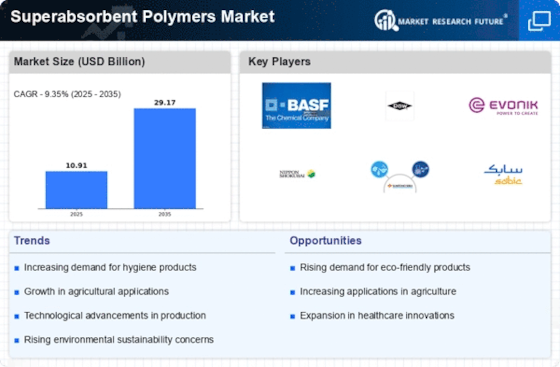
As per Market Research Future analysis, the Superabsorbent Polymers Market Size was estimated at 10.91 USD Billion in 2024. The Superabsorbent Polymers industry is projected to grow from 11.93 USD Billion in 2025 to 29.17 USD Billion by 2035, exhibiting a compound annual growth rate (CAGR) of 9.35% during the forecast period 2025 - 2035

Key Market Trends & Highlights

The Superabsorbent Polymers Market is experiencing robust growth driven by innovation and sustainability.

  • The demand for superabsorbent polymers in personal care products continues to rise, particularly in North America, which remains the largest market. Innovations in polymer technology are enhancing the performance and applications of superabsorbent polymers, especially in the Asia-Pacific region, the fastest-growing market. Sodium polyacrylate dominates the market, while polyacrylamide copolymer is emerging as the fastest-growing segment due to its versatility. Key market drivers include the increasing demand in hygiene products and the rising awareness of sustainable practices, particularly in agriculture.

Market Size & Forecast

2024 Market Size 10.91 (USD Billion)
2035 Market Size 29.17 (USD Billion)
CAGR (2025 - 2035) 9.35%
Largest Regional Market Share in 2024 North America

Major Players

BASF SE (DE), The Dow Chemical Company (US), Evonik Industries AG (DE), Nippon Shokubai Co., Ltd. (JP), Sumitomo Seika Chemicals Company, Limited (JP), SABIC (SA), LG Chem Ltd. (KR), Wanhua Chemical Group Co., Ltd. (CN), Kraton Corporation (US)

Market Trends

The Superabsorbent Polymers Market is currently experiencing notable growth, driven by increasing demand across various sectors, particularly in personal care and hygiene products. These polymers are characterized by their ability to absorb and retain large quantities of liquid relative to their own mass, making them essential in applications such as diapers, feminine hygiene products, and adult incontinence products. The rising awareness regarding hygiene and sanitation, coupled with a growing aging population, appears to be propelling the market forward. Furthermore, innovations in polymer technology are likely enhancing the performance and efficiency of these materials, thereby expanding their applications beyond traditional uses. In addition to personal care, the Superabsorbent Polymers Market is witnessing a surge in demand from the agricultural sector. These materials are increasingly utilized in soil management to improve water retention, which is particularly beneficial in arid regions. The potential for superabsorbent polymers to contribute to sustainable agricultural practices is becoming more recognized, suggesting a shift towards eco-friendly solutions. As environmental concerns continue to rise, the market may see further growth driven by the need for sustainable and efficient water management solutions in agriculture and other industries.

Rising Demand in Personal Care Products

The Superabsorbent Polymers Market is experiencing heightened demand in the personal care sector, particularly in products such as diapers and feminine hygiene items. This trend is largely influenced by increasing consumer awareness regarding hygiene and the necessity for effective absorbent materials.

Innovations in Polymer Technology

Advancements in polymer technology are likely enhancing the functionality and efficiency of superabsorbent materials. These innovations may lead to the development of new applications, expanding the market's reach beyond traditional uses.

Sustainable Agricultural Practices

The agricultural sector is increasingly adopting superabsorbent polymers for soil management, particularly in water-scarce regions. This trend suggests a growing recognition of the role these materials can play in promoting sustainable farming practices.

Superabsorbent Polymers Market Market Drivers

Growth in the Medical Sector

The Superabsorbent Polymers Market is also experiencing growth driven by the medical sector. Superabsorbent polymers are increasingly utilized in wound care products, surgical dressings, and other medical applications due to their excellent absorbent properties. The ability to manage exudate effectively is critical in wound healing, and superabsorbent polymers provide a solution that enhances patient comfort and promotes faster recovery. Market data indicates that the medical application segment is expected to grow significantly, driven by an aging population and increasing healthcare expenditures. This trend highlights the versatility of superabsorbent polymers and their potential to address diverse needs across various industries.

Advancements in Polymer Technology

Innovations in polymer technology are playing a pivotal role in shaping the Superabsorbent Polymers Market. Recent advancements have led to the development of new formulations that enhance the absorbency and efficiency of these materials. For instance, the introduction of cross-linked polymers has significantly improved the water retention capabilities of superabsorbent polymers. This technological evolution not only meets the growing consumer expectations for performance but also opens avenues for new applications across various sectors, including agriculture and medical fields. Market analysis suggests that these advancements could potentially lead to a compound annual growth rate (CAGR) of over 5% in the coming years, reflecting the industry's adaptability and innovation.

Expanding Applications in Agriculture

The Superabsorbent Polymers Market is witnessing an expansion in applications within the agricultural sector. These polymers are increasingly being used to improve soil moisture retention, which is crucial for enhancing crop yields, especially in arid regions. The ability of superabsorbent polymers to absorb and release water gradually makes them invaluable for farmers looking to optimize irrigation practices. Market trends suggest that the agricultural segment is poised for growth, with an increasing number of farmers adopting these technologies to combat water scarcity. This trend not only supports agricultural productivity but also contributes to the overall growth of the superabsorbent polymers market.

Increasing Demand in Hygiene Products

The Superabsorbent Polymers Market is experiencing a notable surge in demand, particularly within the hygiene products sector. This is largely attributed to the rising awareness regarding personal hygiene and health. Products such as diapers, feminine hygiene products, and adult incontinence products are increasingly utilizing superabsorbent polymers due to their superior absorbency and comfort. Market data indicates that the hygiene segment accounts for a substantial share of the overall superabsorbent polymers market, with projections suggesting continued growth as consumer preferences shift towards high-performance, absorbent materials. The increasing birth rates in certain regions further amplify the demand for baby diapers, thereby driving the superabsorbent polymers market forward.

Rising Awareness of Sustainable Practices

The Superabsorbent Polymers Market is increasingly influenced by the growing emphasis on sustainability and eco-friendly practices. As consumers become more environmentally conscious, there is a rising demand for biodegradable and sustainable superabsorbent polymers. Manufacturers are responding by developing products that not only meet performance standards but also align with environmental goals. This shift is particularly evident in the agricultural sector, where superabsorbent polymers are utilized to enhance water retention in soil, thereby promoting sustainable farming practices. Market data indicates that the demand for sustainable superabsorbent polymers is expected to rise, potentially leading to a significant transformation in product offerings within the industry.

Market Segment Insights

By Type: Sodium Polyacrylate (Largest) vs. Polyacrylamide Copolymer (Fastest-Growing)

In the Superabsorbent Polymers Market, Sodium polyacrylate holds the largest share, favored for its superior absorbent properties and cost-effectiveness. This polymer is commonly utilized in hygiene products such as diapers and adult incontinence products, leading to its dominance in market distribution compared to other types. <a href="https://www.marketresearchfuture.com/reports/polyacrylamide-market-7910">Polyacrylamide</a> copolymer, on the other hand, is gaining traction, particularly in agricultural applications and personal care products, marking a shift in the market dynamics towards multifunctionality and sustainability. The increasing demand for efficient absorbent materials, driven by rising hygiene standards and the need for water retention in agricultural practices, propels growth in this segment. Innovations in product formulations and the introduction of eco-friendly alternatives further contribute to the burgeoning popularity of polyacrylamide copolymer. As environmental impact becomes a focal point for consumers, these trends indicate a substantial shift towards sustainable practices within the Superabsorbent Polymers Market.

Sodium Polyacrylate (Dominant) vs. Polyacrylamide Copolymer (Emerging)

Sodium polyacrylate remains the dominant type within the Superabsorbent Polymers Market due to its widespread usage and dependable performance in moisture retention. Renowned for its ability to absorb and retain large amounts of fluid relative to its weight, it is predominantly used in personal hygiene products. Conversely, polyacrylamide copolymer is emerging as a competitive alternative, particularly recognized for its versatility in various applications including agriculture and health care. Its ability to offer enhanced properties, such as biodegradability and the capacity to promote soil moisture retention, positions it well in the market amid growing demand for sustainable solutions. Thus, while <a href="https://www.marketresearchfuture.com/reports/superabsorbent-polymers-market-1956">sodium polyacrylate</a> leads, polyacrylamide copolymer is carving a significant niche.

By Application: Health Care & Personal Care (Largest) vs. Agriculture (Fastest-Growing)

The Superabsorbent Polymers Market is prominently shaped by the Health Care &amp; Personal Care segment, which continues to dominate the landscape due to its extensive application in products like diapers, feminine hygiene products, and adult incontinence pads. This segment captures a significant market share, reflecting the advancing preferences towards high-absorbency materials for health-related personal care solutions. Meanwhile, the Agriculture segment, while smaller, is experiencing rapid growth owing to the rising demand for water-retaining polymers in soil enhancement and crop management, highlighting a shift towards sustainability in agricultural practices.

Health Care &amp; Personal Care: Dominant vs. Agriculture: Emerging

In the Superabsorbent Polymers Market, the Health Care &amp; Personal Care segment stands as the dominant player, fueled by the ever-increasing demand for effective absorbent products used in hygiene applications. This segment emphasizes quality and compliance with health standards, leading to consistent innovations in product formulations. Conversely, the Agriculture segment is categorized as emerging and is gaining traction due to the increasing focus on sustainable farming practices. The unique characteristics of superabsorbent polymers allow for better moisture retention in soil, aiding in crop growth and reducing irrigation needs, making it an attractive solution for growers looking to enhance productivity while conserving water.

Get more detailed insights about Superabsorbent Polymers Market Research Report - Forecast to 2035

Regional Insights

North America : Innovation and Demand Surge

The North American superabsorbent polymers market is driven by increasing demand in the hygiene and agricultural sectors. The region holds approximately 40% of the global market share, with the United States being the largest contributor, followed by Canada. Regulatory support for sustainable products and innovations in polymer technology are key growth catalysts. The rising awareness of environmental issues is also pushing manufacturers to develop biodegradable options. Leading countries in this region include the United States and Canada, with major players like The Dow Chemical Company and BASF SE dominating the market. The competitive landscape is characterized by significant investments in R&D and strategic partnerships aimed at enhancing product offerings. The presence of established companies ensures a robust supply chain and innovation pipeline, further solidifying North America's position in the superabsorbent polymers market.

Europe : Sustainability and Innovation Focus

Europe is witnessing a significant shift towards sustainable superabsorbent polymers, driven by stringent regulations and consumer demand for eco-friendly products. The region accounts for approximately 30% of the global market share, with Germany and France being the largest markets. Regulatory frameworks such as the European Green Deal are catalyzing innovation and investment in sustainable materials, pushing companies to adopt greener practices. Germany leads the market with key players like BASF SE and Evonik Industries AG, focusing on advanced polymer technologies. France and the UK are also significant contributors, with a growing emphasis on research and development. The competitive landscape is marked by collaborations between companies and research institutions to enhance product performance and sustainability, positioning Europe as a leader in the superabsorbent polymers market.

Asia-Pacific : Rapid Growth and Expansion

The Asia-Pacific region is rapidly emerging as a powerhouse in the superabsorbent polymers market, driven by increasing demand from the hygiene and agriculture sectors. This region holds approximately 25% of the global market share, with China and Japan being the largest contributors. The growing population and rising disposable incomes are fueling demand for personal care products, while agricultural applications are expanding due to the need for efficient water management solutions. China is the leading market, with significant investments from local manufacturers like Wanhua Chemical Group and Nippon Shokubai Co., Ltd. Japan follows closely, focusing on innovation and high-quality products. The competitive landscape is characterized by a mix of local and international players, with a strong emphasis on R&D to meet the diverse needs of consumers and industries in the region.

Middle East and Africa : Resource-Rich and Growing Demand

The Middle East and Africa region is witnessing a gradual increase in the demand for superabsorbent polymers, primarily driven by the agricultural sector and hygiene products. This region holds approximately 5% of the global market share, with countries like South Africa and Saudi Arabia leading the way. The growing focus on water conservation and efficient agricultural practices is propelling the adoption of superabsorbent polymers in farming applications. South Africa is emerging as a key player, with local companies exploring innovative uses of superabsorbent materials. Saudi Arabia is also investing in the development of these polymers to support its agricultural initiatives. The competitive landscape is evolving, with both local and international companies vying for market share, highlighting the potential for growth in this resource-rich region.

Key Players and Competitive Insights

The Superabsorbent Polymers Market is currently characterized by a dynamic competitive landscape, driven by increasing demand across various applications, particularly in hygiene products, agriculture, and medical sectors. Key players such as BASF SE (Germany), The Dow Chemical Company (United States), and Nippon Shokubai Co., Ltd. (Japan) are strategically positioning themselves through innovation and regional expansion. For instance, BASF SE (Germany) has been focusing on enhancing its product portfolio with sustainable solutions, while The Dow Chemical Company (United States) emphasizes digital transformation to optimize its operations. These strategies collectively contribute to a competitive environment that is increasingly focused on sustainability and technological advancement.
In terms of business tactics, companies are localizing manufacturing to reduce lead times and enhance supply chain efficiency. The market structure appears moderately fragmented, with several players vying for market share. However, the influence of major companies is substantial, as they leverage their resources to optimize production and innovate product offerings. This competitive structure allows for a diverse range of products, catering to various customer needs while fostering a climate of continuous improvement and adaptation.
In August 2025, Evonik Industries AG (Germany) announced the launch of a new line of bio-based superabsorbent polymers aimed at reducing environmental impact. This strategic move not only aligns with global sustainability trends but also positions Evonik as a leader in eco-friendly solutions within the market. The introduction of these products is likely to attract environmentally conscious consumers and businesses, thereby enhancing Evonik's market share.
In September 2025, LG Chem Ltd. (South Korea) revealed its plans to invest in advanced manufacturing technologies to increase production efficiency and reduce costs. This investment is significant as it reflects LG Chem's commitment to maintaining competitiveness in a rapidly evolving market. By enhancing its manufacturing capabilities, the company is poised to respond more effectively to fluctuating demand and improve its overall operational agility.
Moreover, in July 2025, Sumitomo Seika Chemicals Company, Limited (Japan) entered into a strategic partnership with a leading agricultural firm to develop superabsorbent polymers tailored for agricultural applications. This collaboration is indicative of a broader trend where companies are seeking synergies to enhance product offerings and penetrate new markets. Such partnerships may facilitate innovation and expedite the development of specialized products that meet specific industry needs.
As of October 2025, the competitive trends in the Superabsorbent Polymers Market are increasingly defined by digitalization, sustainability, and the integration of artificial intelligence in production processes. Strategic alliances are becoming more prevalent, enabling companies to leverage complementary strengths and enhance their market positions. Looking ahead, it appears that competitive differentiation will evolve from traditional price-based strategies to a focus on innovation, technological advancements, and supply chain reliability, thereby reshaping the landscape of the superabsorbent polymers industry.

Key Companies in the Superabsorbent Polymers Market include

Industry Developments

March 2021: BASF made a $30,1 million investment in an emerging hygiene business innovation center. It will expand its super absorbent capabilities by constructing a cutting-edge Super Absorbents Excellence Centre at its Verbund location in Antwerp, Belgium.

November 2020: Nippon Shokubai, LiveDo Corporation, and Total Care System, three Japanese companies, collaborated to create several innovations to support systems that recycle disposable diapers. The extremely absorbent polymers in old diapers have been the subject of novel recycling technologies developed by these three companies. The aforementioned method can be utilized with a wide variety of superabsorbent polymers that are available all over the world.

October 2018:  Nippon Shokubai, In its current site in Zwijndrecht, Netherlands, increased its superabsorbent polymer production capacity, where the plant can produce 1,000,000 tonnes of goods per year.

Future Outlook

Superabsorbent Polymers Market Future Outlook

The Superabsorbent Polymers Market is projected to grow at a 9.35% CAGR from 2025 to 2035, driven by increasing demand in hygiene products, agriculture, and medical applications.

New opportunities lie in:

  • Development of biodegradable superabsorbent polymers for eco-friendly products.
  • Expansion into emerging markets with tailored product offerings.
  • Investment in advanced manufacturing technologies to enhance production efficiency.

By 2035, the Superabsorbent Polymers Market is expected to achieve substantial growth and innovation.

Market Segmentation

Superabsorbent Polymers Market Type Outlook

  • Sodium polyacrylate
  • Polyacrylamide copolymer
  • Others

Superabsorbent Polymers Market Application Outlook

  • Health Care & Personal Care
  • Agriculture
  • Industry
  • Mining & Petroleum
  • Others

Report Scope

MARKET SIZE 2024 10.91(USD Billion)
MARKET SIZE 2025 11.93(USD Billion)
MARKET SIZE 2035 29.17(USD Billion)
COMPOUND ANNUAL GROWTH RATE (CAGR) 9.35% (2025 - 2035)
REPORT COVERAGE Revenue Forecast, Competitive Landscape, Growth Factors, and Trends
BASE YEAR 2024
Market Forecast Period 2025 - 2035
Historical Data 2019 - 2024
Market Forecast Units USD Billion
Key Companies Profiled BASF SE (DE), The Dow Chemical Company (US), Evonik Industries AG (DE), Nippon Shokubai Co., Ltd. (JP), Sumitomo Seika Chemicals Company, Limited (JP), SABIC (SA), LG Chem Ltd. (KR), Wanhua Chemical Group Co., Ltd. (CN), Kraton Corporation (US)
Segments Covered Type, Application, Region
Key Market Opportunities Growing demand for eco-friendly superabsorbent polymers in agriculture and hygiene applications presents significant market opportunities.
Key Market Dynamics Rising demand for eco-friendly products drives innovation in superabsorbent polymer formulations and applications.
Countries Covered North America, Europe, APAC, South America, MEA

FAQs

What is the projected market valuation of the Superabsorbent Polymers Market by 2035?

<p>The Superabsorbent Polymers Market is projected to reach a valuation of 29.17 USD Billion by 2035.</p>

What was the market valuation of Superabsorbent Polymers in 2024?

<p>In 2024, the Superabsorbent Polymers Market was valued at 10.91 USD Billion.</p>

What is the expected CAGR for the Superabsorbent Polymers Market during the forecast period 2025 - 2035?

<p>The expected CAGR for the Superabsorbent Polymers Market during the forecast period 2025 - 2035 is 9.35%.</p>

Which type of superabsorbent polymer had the highest market value in 2024?

<p>Sodium polyacrylate had the highest market value in 2024, valued at 4.36 USD Billion.</p>

What are the key applications of superabsorbent polymers?

<p>Key applications of superabsorbent polymers include Health Care & Personal Care, Agriculture, Industry, and Mining & Petroleum.</p>

Which company is a leading player in the Superabsorbent Polymers Market?

<p>BASF SE is one of the leading players in the Superabsorbent Polymers Market.</p>

What was the market value for the Agriculture application segment in 2024?

The market value for the Agriculture application segment in 2024 was 2.18 USD Billion.

How much is the Polyacrylamide copolymer segment projected to grow by 2035?

The Polyacrylamide copolymer segment is projected to grow to 8.45 USD Billion by 2035.

What is the market value for the Mining & Petroleum application segment in 2024?

In 2024, the Mining &amp; Petroleum application segment was valued at 1.09 USD Billion.

What is the projected market value for the Others segment in the Type category by 2035?

The Others segment in the Type category is projected to reach 9.47 USD Billion by 2035.

  1. SECTION I: EXECUTIVE SUMMARY AND KEY HIGHLIGHTS
    1. | 1.1 EXECUTIVE SUMMARY
    2. | | 1.1.1 Market Overview
    3. | | 1.1.2 Key Findings
    4. | | 1.1.3 Market Segmentation
    5. | | 1.1.4 Competitive Landscape
    6. | | 1.1.5 Challenges and Opportunities
    7. | | 1.1.6 Future Outlook
  2. SECTION II: SCOPING, METHODOLOGY AND MARKET STRUCTURE
    1. | 2.1 MARKET INTRODUCTION
    2. | | 2.1.1 Definition
    3. | | 2.1.2 Scope of the study
    4. | | | 2.1.2.1 Research Objective
    5. | | | 2.1.2.2 Assumption
    6. | | | 2.1.2.3 Limitations
    7. | 2.2 RESEARCH METHODOLOGY
    8. | | 2.2.1 Overview
    9. | | 2.2.2 Data Mining
    10. | | 2.2.3 Secondary Research
    11. | | 2.2.4 Primary Research
    12. | | | 2.2.4.1 Primary Interviews and Information Gathering Process
    13. | | | 2.2.4.2 Breakdown of Primary Respondents
    14. | | 2.2.5 Forecasting Model
    15. | | 2.2.6 Market Size Estimation
    16. | | | 2.2.6.1 Bottom-Up Approach
    17. | | | 2.2.6.2 Top-Down Approach
    18. | | 2.2.7 Data Triangulation
    19. | | 2.2.8 Validation
  3. SECTION III: QUALITATIVE ANALYSIS
    1. | 3.1 MARKET DYNAMICS
    2. | | 3.1.1 Overview
    3. | | 3.1.2 Drivers
    4. | | 3.1.3 Restraints
    5. | | 3.1.4 Opportunities
    6. | 3.2 MARKET FACTOR ANALYSIS
    7. | | 3.2.1 Value chain Analysis
    8. | | 3.2.2 Porter's Five Forces Analysis
    9. | | | 3.2.2.1 Bargaining Power of Suppliers
    10. | | | 3.2.2.2 Bargaining Power of Buyers
    11. | | | 3.2.2.3 Threat of New Entrants
    12. | | | 3.2.2.4 Threat of Substitutes
    13. | | | 3.2.2.5 Intensity of Rivalry
    14. | | 3.2.3 COVID-19 Impact Analysis
    15. | | | 3.2.3.1 Market Impact Analysis
    16. | | | 3.2.3.2 Regional Impact
    17. | | | 3.2.3.3 Opportunity and Threat Analysis
  4. SECTION IV: QUANTITATIVE ANALYSIS
    1. | 4.1 Chemicals and Materials, BY Type (USD Billion)
    2. | | 4.1.1 Sodium polyacrylate
    3. | | 4.1.2 Polyacrylamide copolymer
    4. | | 4.1.3 Others
    5. | 4.2 Chemicals and Materials, BY Application (USD Billion)
    6. | | 4.2.1 Health Care & Personal Care
    7. | | 4.2.2 Agriculture
    8. | | 4.2.3 Industry
    9. | | 4.2.4 Mining & Petroleum
    10. | | 4.2.5 Others
    11. | 4.3 Chemicals and Materials, BY Region (USD Billion)
    12. | | 4.3.1 North America
    13. | | | 4.3.1.1 US
    14. | | | 4.3.1.2 Canada
    15. | | 4.3.2 Europe
    16. | | | 4.3.2.1 Germany
    17. | | | 4.3.2.2 UK
    18. | | | 4.3.2.3 France
    19. | | | 4.3.2.4 Russia
    20. | | | 4.3.2.5 Italy
    21. | | | 4.3.2.6 Spain
    22. | | | 4.3.2.7 Rest of Europe
    23. | | 4.3.3 APAC
    24. | | | 4.3.3.1 China
    25. | | | 4.3.3.2 India
    26. | | | 4.3.3.3 Japan
    27. | | | 4.3.3.4 South Korea
    28. | | | 4.3.3.5 Malaysia
    29. | | | 4.3.3.6 Thailand
    30. | | | 4.3.3.7 Indonesia
    31. | | | 4.3.3.8 Rest of APAC
    32. | | 4.3.4 South America
    33. | | | 4.3.4.1 Brazil
    34. | | | 4.3.4.2 Mexico
    35. | | | 4.3.4.3 Argentina
    36. | | | 4.3.4.4 Rest of South America
    37. | | 4.3.5 MEA
    38. | | | 4.3.5.1 GCC Countries
    39. | | | 4.3.5.2 South Africa
    40. | | | 4.3.5.3 Rest of MEA
  5. SECTION V: COMPETITIVE ANALYSIS
    1. | 5.1 Competitive Landscape
    2. | | 5.1.1 Overview
    3. | | 5.1.2 Competitive Analysis
    4. | | 5.1.3 Market share Analysis
    5. | | 5.1.4 Major Growth Strategy in the Chemicals and Materials
    6. | | 5.1.5 Competitive Benchmarking
    7. | | 5.1.6 Leading Players in Terms of Number of Developments in the Chemicals and Materials
    8. | | 5.1.7 Key developments and growth strategies
    9. | | | 5.1.7.1 New Product Launch/Service Deployment
    10. | | | 5.1.7.2 Merger & Acquisitions
    11. | | | 5.1.7.3 Joint Ventures
    12. | | 5.1.8 Major Players Financial Matrix
    13. | | | 5.1.8.1 Sales and Operating Income
    14. | | | 5.1.8.2 Major Players R&D Expenditure. 2023
    15. | 5.2 Company Profiles
    16. | | 5.2.1 BASF SE (DE)
    17. | | | 5.2.1.1 Financial Overview
    18. | | | 5.2.1.2 Products Offered
    19. | | | 5.2.1.3 Key Developments
    20. | | | 5.2.1.4 SWOT Analysis
    21. | | | 5.2.1.5 Key Strategies
    22. | | 5.2.2 The Dow Chemical Company (US)
    23. | | | 5.2.2.1 Financial Overview
    24. | | | 5.2.2.2 Products Offered
    25. | | | 5.2.2.3 Key Developments
    26. | | | 5.2.2.4 SWOT Analysis
    27. | | | 5.2.2.5 Key Strategies
    28. | | 5.2.3 Evonik Industries AG (DE)
    29. | | | 5.2.3.1 Financial Overview
    30. | | | 5.2.3.2 Products Offered
    31. | | | 5.2.3.3 Key Developments
    32. | | | 5.2.3.4 SWOT Analysis
    33. | | | 5.2.3.5 Key Strategies
    34. | | 5.2.4 Nippon Shokubai Co., Ltd. (JP)
    35. | | | 5.2.4.1 Financial Overview
    36. | | | 5.2.4.2 Products Offered
    37. | | | 5.2.4.3 Key Developments
    38. | | | 5.2.4.4 SWOT Analysis
    39. | | | 5.2.4.5 Key Strategies
    40. | | 5.2.5 Sumitomo Seika Chemicals Company, Limited (JP)
    41. | | | 5.2.5.1 Financial Overview
    42. | | | 5.2.5.2 Products Offered
    43. | | | 5.2.5.3 Key Developments
    44. | | | 5.2.5.4 SWOT Analysis
    45. | | | 5.2.5.5 Key Strategies
    46. | | 5.2.6 SABIC (SA)
    47. | | | 5.2.6.1 Financial Overview
    48. | | | 5.2.6.2 Products Offered
    49. | | | 5.2.6.3 Key Developments
    50. | | | 5.2.6.4 SWOT Analysis
    51. | | | 5.2.6.5 Key Strategies
    52. | | 5.2.7 LG Chem Ltd. (KR)
    53. | | | 5.2.7.1 Financial Overview
    54. | | | 5.2.7.2 Products Offered
    55. | | | 5.2.7.3 Key Developments
    56. | | | 5.2.7.4 SWOT Analysis
    57. | | | 5.2.7.5 Key Strategies
    58. | | 5.2.8 Wanhua Chemical Group Co., Ltd. (CN)
    59. | | | 5.2.8.1 Financial Overview
    60. | | | 5.2.8.2 Products Offered
    61. | | | 5.2.8.3 Key Developments
    62. | | | 5.2.8.4 SWOT Analysis
    63. | | | 5.2.8.5 Key Strategies
    64. | | 5.2.9 Kraton Corporation (US)
    65. | | | 5.2.9.1 Financial Overview
    66. | | | 5.2.9.2 Products Offered
    67. | | | 5.2.9.3 Key Developments
    68. | | | 5.2.9.4 SWOT Analysis
    69. | | | 5.2.9.5 Key Strategies
    70. | 5.3 Appendix
    71. | | 5.3.1 References
    72. | | 5.3.2 Related Reports
  6. LIST OF FIGURES
    1. | 6.1 MARKET SYNOPSIS
    2. | 6.2 NORTH AMERICA MARKET ANALYSIS
    3. | 6.3 US MARKET ANALYSIS BY TYPE
    4. | 6.4 US MARKET ANALYSIS BY APPLICATION
    5. | 6.5 CANADA MARKET ANALYSIS BY TYPE
    6. | 6.6 CANADA MARKET ANALYSIS BY APPLICATION
    7. | 6.7 EUROPE MARKET ANALYSIS
    8. | 6.8 GERMANY MARKET ANALYSIS BY TYPE
    9. | 6.9 GERMANY MARKET ANALYSIS BY APPLICATION
    10. | 6.10 UK MARKET ANALYSIS BY TYPE
    11. | 6.11 UK MARKET ANALYSIS BY APPLICATION
    12. | 6.12 FRANCE MARKET ANALYSIS BY TYPE
    13. | 6.13 FRANCE MARKET ANALYSIS BY APPLICATION
    14. | 6.14 RUSSIA MARKET ANALYSIS BY TYPE
    15. | 6.15 RUSSIA MARKET ANALYSIS BY APPLICATION
    16. | 6.16 ITALY MARKET ANALYSIS BY TYPE
    17. | 6.17 ITALY MARKET ANALYSIS BY APPLICATION
    18. | 6.18 SPAIN MARKET ANALYSIS BY TYPE
    19. | 6.19 SPAIN MARKET ANALYSIS BY APPLICATION
    20. | 6.20 REST OF EUROPE MARKET ANALYSIS BY TYPE
    21. | 6.21 REST OF EUROPE MARKET ANALYSIS BY APPLICATION
    22. | 6.22 APAC MARKET ANALYSIS
    23. | 6.23 CHINA MARKET ANALYSIS BY TYPE
    24. | 6.24 CHINA MARKET ANALYSIS BY APPLICATION
    25. | 6.25 INDIA MARKET ANALYSIS BY TYPE
    26. | 6.26 INDIA MARKET ANALYSIS BY APPLICATION
    27. | 6.27 JAPAN MARKET ANALYSIS BY TYPE
    28. | 6.28 JAPAN MARKET ANALYSIS BY APPLICATION
    29. | 6.29 SOUTH KOREA MARKET ANALYSIS BY TYPE
    30. | 6.30 SOUTH KOREA MARKET ANALYSIS BY APPLICATION
    31. | 6.31 MALAYSIA MARKET ANALYSIS BY TYPE
    32. | 6.32 MALAYSIA MARKET ANALYSIS BY APPLICATION
    33. | 6.33 THAILAND MARKET ANALYSIS BY TYPE
    34. | 6.34 THAILAND MARKET ANALYSIS BY APPLICATION
    35. | 6.35 INDONESIA MARKET ANALYSIS BY TYPE
    36. | 6.36 INDONESIA MARKET ANALYSIS BY APPLICATION
    37. | 6.37 REST OF APAC MARKET ANALYSIS BY TYPE
    38. | 6.38 REST OF APAC MARKET ANALYSIS BY APPLICATION
    39. | 6.39 SOUTH AMERICA MARKET ANALYSIS
    40. | 6.40 BRAZIL MARKET ANALYSIS BY TYPE
    41. | 6.41 BRAZIL MARKET ANALYSIS BY APPLICATION
    42. | 6.42 MEXICO MARKET ANALYSIS BY TYPE
    43. | 6.43 MEXICO MARKET ANALYSIS BY APPLICATION
    44. | 6.44 ARGENTINA MARKET ANALYSIS BY TYPE
    45. | 6.45 ARGENTINA MARKET ANALYSIS BY APPLICATION
    46. | 6.46 REST OF SOUTH AMERICA MARKET ANALYSIS BY TYPE
    47. | 6.47 REST OF SOUTH AMERICA MARKET ANALYSIS BY APPLICATION
    48. | 6.48 MEA MARKET ANALYSIS
    49. | 6.49 GCC COUNTRIES MARKET ANALYSIS BY TYPE
    50. | 6.50 GCC COUNTRIES MARKET ANALYSIS BY APPLICATION
    51. | 6.51 SOUTH AFRICA MARKET ANALYSIS BY TYPE
    52. | 6.52 SOUTH AFRICA MARKET ANALYSIS BY APPLICATION
    53. | 6.53 REST OF MEA MARKET ANALYSIS BY TYPE
    54. | 6.54 REST OF MEA MARKET ANALYSIS BY APPLICATION
    55. | 6.55 KEY BUYING CRITERIA OF CHEMICALS AND MATERIALS
    56. | 6.56 RESEARCH PROCESS OF MRFR
    57. | 6.57 DRO ANALYSIS OF CHEMICALS AND MATERIALS
    58. | 6.58 DRIVERS IMPACT ANALYSIS: CHEMICALS AND MATERIALS
    59. | 6.59 RESTRAINTS IMPACT ANALYSIS: CHEMICALS AND MATERIALS
    60. | 6.60 SUPPLY / VALUE CHAIN: CHEMICALS AND MATERIALS
    61. | 6.61 CHEMICALS AND MATERIALS, BY TYPE, 2024 (% SHARE)
    62. | 6.62 CHEMICALS AND MATERIALS, BY TYPE, 2024 TO 2035 (USD Billion)
    63. | 6.63 CHEMICALS AND MATERIALS, BY APPLICATION, 2024 (% SHARE)
    64. | 6.64 CHEMICALS AND MATERIALS, BY APPLICATION, 2024 TO 2035 (USD Billion)
    65. | 6.65 BENCHMARKING OF MAJOR COMPETITORS
  7. LIST OF TABLES
    1. | 7.1 LIST OF ASSUMPTIONS
    2. | | 7.1.1
    3. | 7.2 North America MARKET SIZE ESTIMATES; FORECAST
    4. | | 7.2.1 BY TYPE, 2025-2035 (USD Billion)
    5. | | 7.2.2 BY APPLICATION, 2025-2035 (USD Billion)
    6. | 7.3 US MARKET SIZE ESTIMATES; FORECAST
    7. | | 7.3.1 BY TYPE, 2025-2035 (USD Billion)
    8. | | 7.3.2 BY APPLICATION, 2025-2035 (USD Billion)
    9. | 7.4 Canada MARKET SIZE ESTIMATES; FORECAST
    10. | | 7.4.1 BY TYPE, 2025-2035 (USD Billion)
    11. | | 7.4.2 BY APPLICATION, 2025-2035 (USD Billion)
    12. | 7.5 Europe MARKET SIZE ESTIMATES; FORECAST
    13. | | 7.5.1 BY TYPE, 2025-2035 (USD Billion)
    14. | | 7.5.2 BY APPLICATION, 2025-2035 (USD Billion)
    15. | 7.6 Germany MARKET SIZE ESTIMATES; FORECAST
    16. | | 7.6.1 BY TYPE, 2025-2035 (USD Billion)
    17. | | 7.6.2 BY APPLICATION, 2025-2035 (USD Billion)
    18. | 7.7 UK MARKET SIZE ESTIMATES; FORECAST
    19. | | 7.7.1 BY TYPE, 2025-2035 (USD Billion)
    20. | | 7.7.2 BY APPLICATION, 2025-2035 (USD Billion)
    21. | 7.8 France MARKET SIZE ESTIMATES; FORECAST
    22. | | 7.8.1 BY TYPE, 2025-2035 (USD Billion)
    23. | | 7.8.2 BY APPLICATION, 2025-2035 (USD Billion)
    24. | 7.9 Russia MARKET SIZE ESTIMATES; FORECAST
    25. | | 7.9.1 BY TYPE, 2025-2035 (USD Billion)
    26. | | 7.9.2 BY APPLICATION, 2025-2035 (USD Billion)
    27. | 7.10 Italy MARKET SIZE ESTIMATES; FORECAST
    28. | | 7.10.1 BY TYPE, 2025-2035 (USD Billion)
    29. | | 7.10.2 BY APPLICATION, 2025-2035 (USD Billion)
    30. | 7.11 Spain MARKET SIZE ESTIMATES; FORECAST
    31. | | 7.11.1 BY TYPE, 2025-2035 (USD Billion)
    32. | | 7.11.2 BY APPLICATION, 2025-2035 (USD Billion)
    33. | 7.12 Rest of Europe MARKET SIZE ESTIMATES; FORECAST
    34. | | 7.12.1 BY TYPE, 2025-2035 (USD Billion)
    35. | | 7.12.2 BY APPLICATION, 2025-2035 (USD Billion)
    36. | 7.13 APAC MARKET SIZE ESTIMATES; FORECAST
    37. | | 7.13.1 BY TYPE, 2025-2035 (USD Billion)
    38. | | 7.13.2 BY APPLICATION, 2025-2035 (USD Billion)
    39. | 7.14 China MARKET SIZE ESTIMATES; FORECAST
    40. | | 7.14.1 BY TYPE, 2025-2035 (USD Billion)
    41. | | 7.14.2 BY APPLICATION, 2025-2035 (USD Billion)
    42. | 7.15 India MARKET SIZE ESTIMATES; FORECAST
    43. | | 7.15.1 BY TYPE, 2025-2035 (USD Billion)
    44. | | 7.15.2 BY APPLICATION, 2025-2035 (USD Billion)
    45. | 7.16 Japan MARKET SIZE ESTIMATES; FORECAST
    46. | | 7.16.1 BY TYPE, 2025-2035 (USD Billion)
    47. | | 7.16.2 BY APPLICATION, 2025-2035 (USD Billion)
    48. | 7.17 South Korea MARKET SIZE ESTIMATES; FORECAST
    49. | | 7.17.1 BY TYPE, 2025-2035 (USD Billion)
    50. | | 7.17.2 BY APPLICATION, 2025-2035 (USD Billion)
    51. | 7.18 Malaysia MARKET SIZE ESTIMATES; FORECAST
    52. | | 7.18.1 BY TYPE, 2025-2035 (USD Billion)
    53. | | 7.18.2 BY APPLICATION, 2025-2035 (USD Billion)
    54. | 7.19 Thailand MARKET SIZE ESTIMATES; FORECAST
    55. | | 7.19.1 BY TYPE, 2025-2035 (USD Billion)
    56. | | 7.19.2 BY APPLICATION, 2025-2035 (USD Billion)
    57. | 7.20 Indonesia MARKET SIZE ESTIMATES; FORECAST
    58. | | 7.20.1 BY TYPE, 2025-2035 (USD Billion)
    59. | | 7.20.2 BY APPLICATION, 2025-2035 (USD Billion)
    60. | 7.21 Rest of APAC MARKET SIZE ESTIMATES; FORECAST
    61. | | 7.21.1 BY TYPE, 2025-2035 (USD Billion)
    62. | | 7.21.2 BY APPLICATION, 2025-2035 (USD Billion)
    63. | 7.22 South America MARKET SIZE ESTIMATES; FORECAST
    64. | | 7.22.1 BY TYPE, 2025-2035 (USD Billion)
    65. | | 7.22.2 BY APPLICATION, 2025-2035 (USD Billion)
    66. | 7.23 Brazil MARKET SIZE ESTIMATES; FORECAST
    67. | | 7.23.1 BY TYPE, 2025-2035 (USD Billion)
    68. | | 7.23.2 BY APPLICATION, 2025-2035 (USD Billion)
    69. | 7.24 Mexico MARKET SIZE ESTIMATES; FORECAST
    70. | | 7.24.1 BY TYPE, 2025-2035 (USD Billion)
    71. | | 7.24.2 BY APPLICATION, 2025-2035 (USD Billion)
    72. | 7.25 Argentina MARKET SIZE ESTIMATES; FORECAST
    73. | | 7.25.1 BY TYPE, 2025-2035 (USD Billion)
    74. | | 7.25.2 BY APPLICATION, 2025-2035 (USD Billion)
    75. | 7.26 Rest of South America MARKET SIZE ESTIMATES; FORECAST
    76. | | 7.26.1 BY TYPE, 2025-2035 (USD Billion)
    77. | | 7.26.2 BY APPLICATION, 2025-2035 (USD Billion)
    78. | 7.27 MEA MARKET SIZE ESTIMATES; FORECAST
    79. | | 7.27.1 BY TYPE, 2025-2035 (USD Billion)
    80. | | 7.27.2 BY APPLICATION, 2025-2035 (USD Billion)
    81. | 7.28 GCC Countries MARKET SIZE ESTIMATES; FORECAST
    82. | | 7.28.1 BY TYPE, 2025-2035 (USD Billion)
    83. | | 7.28.2 BY APPLICATION, 2025-2035 (USD Billion)
    84. | 7.29 South Africa MARKET SIZE ESTIMATES; FORECAST
    85. | | 7.29.1 BY TYPE, 2025-2035 (USD Billion)
    86. | | 7.29.2 BY APPLICATION, 2025-2035 (USD Billion)
    87. | 7.30 Rest of MEA MARKET SIZE ESTIMATES; FORECAST
    88. | | 7.30.1 BY TYPE, 2025-2035 (USD Billion)
    89. | | 7.30.2 BY APPLICATION, 2025-2035 (USD Billion)
    90. | 7.31 PRODUCT LAUNCH/PRODUCT DEVELOPMENT/APPROVAL
    91. | | 7.31.1
    92. | 7.32 ACQUISITION/PARTNERSHIP
    93. | | 7.32.1

Chemicals and Materials Market Segmentation

Chemicals and Materials By Type (USD Billion, 2025-2035)

  • Sodium polyacrylate
  • Polyacrylamide copolymer
  • Others

Chemicals and Materials By Application (USD Billion, 2025-2035)

  • Health Care & Personal Care
  • Agriculture
  • Industry
  • Mining & Petroleum
  • Others
Infographic

Free Sample Request

Kindly complete the form below to receive a free sample of this Report

Get Free Sample

Customer Strories

Compare Licence

×
Features License Type
Single User Multiuser License Enterprise User
Price $4,950 $5,950 $7,250
Maximum User Access Limit 1 User Upto 10 Users Unrestricted Access Throughout the Organization
Free Customization
Direct Access to Analyst
Deliverable Format
Platform Access
Discount on Next Purchase 10% 15% 15%
Printable Versions