Request Free Sample ×

Kindly complete the form below to receive a free sample of this Report

* Please use a valid business email

Leading companies partner with us for data-driven Insights

clients tt-cursor
Hero Background
English
Chinese
French
Japanese
Korean
German
Spanish

Super Absorbent Polymer Market Share

ID: MRFR/CnM/0828-HCR
137 Pages
Anshula Mandaokar
March 2026

Super Absorbent Polymer Market Size, Share & Industry Analysis Research Report Information By Type (Polyacrylamide Copolymer, Sodium Polyacrylate, Others), By End-Use (Personal Care, Building & Construction, Agriculture, Food Packaging, Others), And By Region (North America, Europe, Asia-Pacific, And Rest Of The World) – Market Forecast Till 2035

Share:
Download PDF ×

We do not share your information with anyone. However, we may send you emails based on your report interest from time to time. You may contact us at any time to opt-out.

Super Absorbent Polymer Market Infographic
Purchase Options

Market Share

Super Absorbent Polymer Market Share Analysis

In the polymer industry, one very critical segment is the Super Absorbent Polymer (SAP) Market, which employs various market share positioning strategies to deal with its highly competitive landscape. One of these basic strategies is by emphasizing how superabsorbent polymers are indispensable and can be used in various industries. Players within this market stress SAP's outstanding water-absorbing capabilities, which make it a vital ingredient in products like diapers, adult incontinence products, agriculture, and packaging materials. By 2050, the global population aged between 1 and 14 will be approximately 5.08 billion, according to World Bank Group's statistics. The super absorbent polymers market will, therefore, mainly expand through the personal hygiene applications section. The personal care industry uses super absorbent polymers for adult incontinence products, sanitary napkins, and baby diapers, among others. These goods attract considerable demand due to the growing global population. Technological breakthroughs and innovation greatly influence market share positioning for Super Absorbent Polymers. Firms invest heavily in research and development activities aimed at enhancing the absorption capacity, biodegradability, and cost-effectiveness of superabsorbent polymers. These may entail innovations such as coming up with new SAP formulations, improving production processes, or developing environmentally friendly alternatives. Strategic collaborations constitute another important model that involves forming alliances with key stakeholders, including diaper manufacturers, agricultural organizations, and hygiene product companies, among others. Through these partnerships, corporations are able to pool resources together, synchronize complementary expertise, and grapple with common hurdles during the implementation of environmentally friendly SAP solutions jointly. This association fosters the building of industrial standards and gives pioneers an opportunity to shape the direction taken by the sector into the future. Incorporation of sustainable practices into market share positioning has become a determinant factor in the Super Absorbent Polymer business strategy framework. Super absorbent polymers can only retain large amounts of fluid whenever they get exposed to atmospheres containing aqueous substances. Effective marketing and communication of the benefits of superabsorbent polymers play a crucial role in influencing market share. Differentiation is possible for businesses that successfully articulate the benefits they offer, like enhanced water retention in agriculture, better comfort in hygiene products, and lower environmental costs with competition around them. Expansion into new geographical territories and diversification of product mix are essential constituents of Super Absorbent Polymer's market share positioning strategies. This means that companies are likely to capitalize on expanding demand for SAP by looking for opportunities in different parts of the world and diversifying their product ranges.

Author
Author Profile
Anshula Mandaokar
Team Lead - Research

Anshula Mandaokar holds an academic degree in Chemical Engineering and has been contributing to the field for more than 5 years. She has expertise in Market Research and Business Consulting and serves as a Team Lead for a reputed Market Research firm under the Chemicals and Materials domain spectrum. She has worked on multiple projects, generating explicit results in a quick turnaround time. Her understanding of data interpretation justifies her role as a leader.

Leave a Comment

FAQs

What is the projected market valuation of the Super Absorbent Polymer Market by 2035?

<p>The projected market valuation for the Super Absorbent Polymer Market by 2035 is 28.2 USD Billion.</p>

What was the market valuation of the Super Absorbent Polymer Market in 2024?

<p>The overall market valuation of the Super Absorbent Polymer Market was 9.18 USD Billion in 2024.</p>

What is the expected CAGR for the Super Absorbent Polymer Market during the forecast period 2025 - 2035?

<p>The expected CAGR for the Super Absorbent Polymer Market during the forecast period 2025 - 2035 is 10.74%.</p>

Which application segments are projected to grow in the Super Absorbent Polymer Market?

<p>The application segments projected to grow include Agriculture, Medical, Personal Care, Industrial, and Consumer Goods, with valuations reaching up to 7.5 USD Billion.</p>

What are the key end-use segments in the Super Absorbent Polymer Market?

<p>Key end-use segments include Diapers, Adult Incontinence Products, Feminine Hygiene Products, Agricultural Products, and Wound Care, with Diapers expected to reach 10.5 USD Billion.</p>

Which material types dominate the Super Absorbent Polymer Market?

<p>Dominant material types in the market include Sodium Polyacrylate, Potassium Polyacrylate, and Polyacrylate Copolymers, with Sodium Polyacrylate projected to reach 11.34 USD Billion.</p>

What forms of Super Absorbent Polymers are available in the market?

Available forms of Super Absorbent Polymers include Granules, Powder, Sheets, Films, and Beads, with Granules expected to reach 9.0 USD Billion.

How is the distribution channel structured in the Super Absorbent Polymer Market?

The distribution channels include Online Retail, Offline Retail, Direct Sales, Distributors, and Wholesalers, with Offline Retail projected to reach 7.5 USD Billion.

Who are the key players in the Super Absorbent Polymer Market?

Key players in the Super Absorbent Polymer Market include BASF SE, The Dow Chemical Company, Nippon Shokubai Co., Ltd., and Evonik Industries AG.

What trends are influencing the growth of the Super Absorbent Polymer Market?

Trends influencing growth include increasing demand in personal care and medical applications, alongside advancements in material technology.

Market Summary

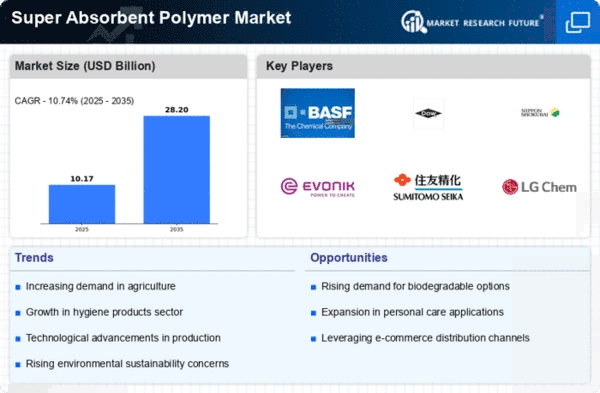
As per MRFR analysis, the Super Absorbent Polymer Market Size was estimated at 9.18 USD Billion in 2024. The Super Absorbent Polymer industry is projected to grow from 10.17 USD Billion in 2025 to 28.2 USD Billion by 2035, exhibiting a compound annual growth rate (CAGR) of 10.74% during the forecast period 2025 - 2035.

Key Market Trends & Highlights

The Super Absorbent Polymer Market is poised for robust growth driven by sustainability and technological advancements.

  • North America remains the largest market for super absorbent polymers, primarily due to its extensive use in hygiene products. The Asia-Pacific region is currently the fastest-growing market, fueled by increasing demand in agricultural applications. In the agricultural segment, super absorbent polymers are widely utilized, while the medical segment is experiencing rapid growth, particularly in adult incontinence products. Key market drivers include rising demand in hygiene products and environmental regulations promoting sustainability.

Market Size & Forecast

2024 Market Size 9.18 (USD Billion)
2035 Market Size 28.2 (USD Billion)
CAGR (2025 - 2035) 10.74%
Largest Regional Market Share in 2024 Asia-Pacific

Major Players

BASF SE (DE), The Dow Chemical Company (US), Nippon Shokubai Co., Ltd. (JP), Evonik Industries AG (DE), Sumitomo Seika Chemicals Co., Ltd. (JP), LG Chem Ltd. (KR), SABIC (SA), Kraton Corporation (US), Clariant AG (CH)

Market Trends

The super absorbent polymer market is currently experiencing a notable transformation, driven by various factors that influence its growth trajectory. The increasing demand for efficient water retention solutions in agriculture and horticulture is one of the primary catalysts supporting expansion in the super absorbent polymers market. This trend is further supported by rising awareness of sustainable practices, as these polymers contribute significantly to water conservation efforts. Additionally, the healthcare sector's reliance on these materials for products such as diapers, sanitary products, and wound dressings continues to expand, strengthening the presence of the specialty super absorbent polymer market in personal care and medical applications. Furthermore, innovations in polymer technology are likely to enhance product performance and efficiency, thereby attracting a broader customer base and positively influencing the overall super absorbent polymer market size.

In December 2025, the Super Absorbent Polymer Market appears poised for continued expansion, with emerging applications in various industries. The growing emphasis on eco-friendly materials may lead to the development of biodegradable alternatives, which could reshape consumer preferences. Moreover, the increasing focus on reducing environmental impact suggests that manufacturers may prioritize sustainable production methods. As the market evolves, it is essential to monitor these trends closely, as they may significantly influence future dynamics and competitive landscapes within the Super Absorbent Polymer Market.

Sustainability Initiatives

The Super Absorbent Polymer Market is witnessing a shift towards sustainable practices. Manufacturers are increasingly investing in the development of biodegradable polymers, which align with global environmental goals. This trend reflects a growing consumer preference for eco-friendly products, prompting companies to innovate and adapt their offerings.

Technological Advancements

Innovations in polymer technology are shaping the Super Absorbent Polymer Market. Enhanced production techniques and formulations are leading to improved performance characteristics, such as higher absorption rates and better retention capabilities. These advancements are likely to attract new applications across various industries.

Diverse Applications

The versatility of super absorbent polymers is expanding their applications beyond traditional uses. Industries such as agriculture, healthcare, and packaging are increasingly adopting these materials for their unique properties. This diversification indicates a robust potential for market growth as new sectors recognize the benefits of super absorbent polymers.

Super Absorbent Polymer Market Market Drivers

Diverse End-Use Industries

The Global Super Absorbent Polymer Market Industry benefits from its diverse applications across various end-use industries, including healthcare, agriculture, and consumer goods. This versatility allows for a broad customer base and mitigates risks associated with reliance on a single sector. For instance, in healthcare, super absorbent polymers are essential in wound care products, while in agriculture, they enhance soil moisture retention. The anticipated compound annual growth rate of 10.74% from 2025 to 2035 indicates a robust market outlook, driven by the continuous exploration of new applications and the adaptation of existing products to meet specific industry needs.

Growing Environmental Concerns

The Global Super Absorbent Polymer Market Industry is increasingly shaped by growing environmental concerns and the push for sustainable materials. Consumers and manufacturers alike are becoming more aware of the environmental impact of traditional materials, leading to a shift towards biodegradable and eco-friendly super absorbent polymers. This trend is particularly relevant as regulatory bodies implement stricter guidelines on plastic usage and waste management. The market's potential to reach 28.2 USD Billion by 2035 underscores the importance of sustainability in driving innovation and product development. Companies that prioritize eco-friendly solutions may find themselves at a competitive advantage in this evolving landscape.

Rising Demand in Hygiene Products

The Global Super Absorbent Polymer Market Industry experiences a notable surge in demand driven by the increasing consumption of hygiene products such as diapers and feminine hygiene items. The growing awareness of personal hygiene, particularly in developing regions, contributes to this trend. For instance, the market is projected to reach 9.18 USD Billion in 2024, reflecting a robust growth trajectory. As urbanization progresses and disposable income rises, consumers are likely to prioritize hygiene, further propelling the demand for super absorbent polymers. This trend indicates a potential for sustained growth in the industry as manufacturers innovate to meet evolving consumer preferences.

Agricultural Applications Expansion

The Global Super Absorbent Polymer Market Industry is witnessing an expansion in agricultural applications, particularly in water retention and soil management. Super absorbent polymers are increasingly utilized in agricultural practices to enhance soil moisture retention, thereby improving crop yields. This is particularly relevant in regions facing water scarcity, where efficient water usage is paramount. The incorporation of these polymers can lead to a reduction in irrigation frequency, which is crucial for sustainable farming. As the global population continues to grow, the demand for food production intensifies, suggesting that the agricultural sector will increasingly rely on super absorbent polymers to optimize resource use.

Technological Advancements in Production

Technological advancements in the production of super absorbent polymers are significantly influencing the Global Super Absorbent Polymer Market Industry. Innovations in manufacturing processes enhance the efficiency and effectiveness of these materials, leading to improved performance characteristics. For example, the development of new polymerization techniques allows for the creation of super absorbent polymers with superior absorption capacities and faster absorption rates. This not only meets the diverse needs of various applications but also positions manufacturers competitively in the market. As these technologies evolve, they are likely to drive down production costs, thereby expanding the market further.

Market Segment Insights

By Application: Agriculture (Largest) vs. Medical (Fastest-Growing)

In the Super Absorbent Polymer Market, the Application segment is subdivided into Agriculture, Medical, Personal Care, Industrial, and Consumer Goods. Among these, Agriculture holds the largest market share, primarily driven by the rising demand for effective water retention materials in agricultural applications. Medical applications also contribute significantly, focusing on wound care and hygiene products, while the Personal Care sector follows closely behind, utilizing super absorbent polymers in <a href="https://www.marketresearchfuture.com/reports/feminine-hygiene-market-7986">feminine hygiene products</a> and diapers.

Agriculture (Dominant) vs. Medical (Emerging)

Agriculture remains the dominant segment in the Super Absorbent Polymer Market due to its critical role in enhancing water retention in soil, which aids in addressing global water scarcity issues. In contrast, the Medical segment is emerging rapidly, attributed to the growing consumer awareness of hygiene and convenience in healthcare products. The medical applications focus on advanced wound care and absorbent materials for hygiene products. The distinct characteristics of these segments highlight agriculture's sustained demand against the fast-evolving innovations in the medical sector, positioning them strategically within the market.

By End Use: Diapers (Largest) vs. Adult Incontinence Products (Fastest-Growing)

The Super Absorbent Polymer (SAP) market showcases distinct end-use segments where diapers hold the largest share, primarily due to the ever-increasing demand from the global population and enhanced product designs. In contrast, adult incontinence products are witnessing rapid growth, fueled by an aging demographic and increasing awareness regarding personal hygiene and health issues. This dynamic shift illustrates the varying needs and preferences across different consumer segments within the market.

Diapers (Dominant) vs. Adult Incontinence Products (Emerging)

Diapers represent the dominant end-use segment in the Super Absorbent Polymer market, largely due to their adaptation of advanced materials that offer superior absorbency and comfort. These products cater primarily to infants and toddlers, making them indispensable in households around the world. Conversely, adult incontinence products are emerging as a significant market segment, driven by the increasing prevalence of incontinence among aging populations and heightened accessibility through retail channels and e-commerce. Innovations in product design, alongside a growing acceptance of these products, are contributing to their growth as manufacturers continue to enhance performance and comfort aspects.

By Material Type: Sodium Polyacrylate (Largest) vs. Potassium Polyacrylate (Fastest-Growing)

In the Super Absorbent Polymer Market, Sodium Polyacrylate holds a prominent market share as the leading material type due to its superior absorbent properties and widespread use in hygiene products such as diapers and adult incontinence items. This material type accounts for a significant portion of the market, reflecting its established demand and reliability among manufacturers and consumers alike. On the other hand, Potassium Polyacrylate is emerging as the fastest-growing segment within this market. Its properties, which allow for enhanced water retention and performance in various applications including agriculture and personal care, are driving rapid adoption. Additionally, innovative formulations and a growing emphasis on sustainability are propelling the demand for this material as manufacturers seek eco-friendly alternatives.

Sodium Polyacrylate (Dominant) vs. Potassium Polyacrylate (Emerging)

Sodium Polyacrylate is recognized for its effectiveness and reliability, making it the dominant player in the Super Absorbent Polymer Market. Its high absorbency makes it ideal for products such as hygiene items, showcasing exceptional performance in moisture management. Conversely, Potassium Polyacrylate is gaining traction as an emerging segment, characterized by its unique ability to hold larger amounts of water due to its enhanced ionic structure. This makes it particularly valuable in applications beyond hygiene, such as in agriculture for soil conditioning. As manufacturers increasingly explore the benefits of both materials, innovation within each segment is expected to shape future market dynamics.

By Form: Granules (Largest) vs. Powder (Fastest-Growing)

In the Super Absorbent Polymer Market, the 'Form' segment is primarily divided into granules, powder, sheets, and films. Granules currently hold the largest market share due to their versatility and optimal absorption properties, making them ideal for a wide range of applications including hygiene products and agriculture. Powder, on the other hand, is emerging rapidly in the market, driven by advancements in formulation technologies and increasing demand from industries seeking cost-effective solutions for absorbent materials.

Granules: Dominant vs. Powder: Emerging

Granules are recognized as the dominant form in the Super Absorbent Polymer Market, favored for their superior absorption capabilities and adaptability in various applications. They are widely used in products such as diapers and adult incontinence products, owing to their efficiency in liquid retention. In contrast, powder forms are quickly gaining traction as an emerging alternative, particularly in agricultural applications, thanks to innovations that enhance their performance and reduce production costs. The flexibility of powder SAP in custom formulations contributes to its growing popularity, positioning it as a competitive player in the market.

By Distribution Channel: Online Retail (Largest) vs. Offline Retail (Fastest-Growing)

In the Super Absorbent Polymer Market, the distribution channel landscape is diverse, with Online Retail holding the largest share due to the increasing preference for e-commerce solutions. This shift is attributed to convenience and a broader product range available at competitive prices. Conversely, Offline Retail remains a substantial segment, while Direct Sales, Distributors, and Wholesalers contribute to the market but share comparatively smaller portions of the overall distribution spectrum.

Offline Retail: Traditional (Dominant) vs. Direct Sales (Emerging)

In the realm of distribution channels for Super Absorbent Polymers, Offline Retail serves as the dominant player, primarily driven by established relationships with manufacturers and customers seeking immediate access to products. It offers a tangible shopping experience, ensuring customer satisfaction through personal interaction. However, the trend is slowly shifting towards Direct Sales, positioned as the emerging channel. This approach caters to specific client needs and offers more personalized services, tapping into niche markets and fostering closer connections between producers and end-users. As industries lean towards more tailored purchasing options, Direct Sales is poised for growth.

Get more detailed insights about Super Absorbent Polymer Market Research Report - Forecast to 2035

Regional Insights

North America : Innovation and Demand Growth

The North American super absorbent polymer market is projected to reach $2.75 billion by 2025, driven by increasing demand in the hygiene and agriculture sectors. Regulatory support for sustainable products and innovations in polymer technology are key growth catalysts. The region's focus on eco-friendly solutions is expected to enhance market dynamics, with a growing emphasis on biodegradable options. Leading countries like the US and Canada dominate the market, with major players such as The Dow Chemical Company and BASF SE driving competition. The presence of advanced manufacturing facilities and R&D centers further strengthens the competitive landscape. As companies innovate, the market is likely to see a surge in product offerings tailored to specific applications, enhancing overall market growth.

Europe : Sustainability and Innovation Focus

Europe's super absorbent polymer market is anticipated to reach €2.0 billion by 2025, propelled by stringent regulations promoting sustainable materials. The European Union's commitment to reducing plastic waste and enhancing recycling initiatives is a significant driver. Demand for eco-friendly products in the hygiene and agriculture sectors is also on the rise, aligning with consumer preferences for sustainable solutions. Germany, France, and the UK are leading countries in this market, with key players like Evonik Industries AG and Clariant AG actively participating. The competitive landscape is characterized by innovation, with companies investing in R&D to develop advanced materials. The focus on sustainability and compliance with regulations is expected to shape market dynamics, fostering a robust growth environment.

Asia-Pacific : Emerging Market Leader

Asia-Pacific is the largest market for super absorbent polymers, projected to reach $4.0 billion by 2025. The region's rapid urbanization, increasing birth rates, and rising disposable incomes are driving demand, particularly in the hygiene sector. Regulatory frameworks supporting the use of advanced materials are also contributing to market growth, making it a focal point for manufacturers. Countries like Japan, China, and South Korea are at the forefront, with major players such as Nippon Shokubai Co., Ltd. and LG Chem Ltd. leading the charge. The competitive landscape is marked by significant investments in production capacity and technological advancements. As the market evolves, the focus on innovation and sustainability will likely enhance the region's dominance in The Super Absorbent Polymer.

Middle East and Africa : Emerging Market Potential

The Middle East and Africa super absorbent polymer market is expected to reach $0.43 billion by 2025, driven by increasing demand in the hygiene and agricultural sectors. The region's growing population and rising awareness of hygiene products are key growth drivers. Additionally, government initiatives aimed at improving agricultural productivity are expected to boost demand for super absorbent polymers in soil management applications. Countries like South Africa and the UAE are leading the market, with a growing presence of key players such as SABIC and Kraton Corporation. The competitive landscape is evolving, with local manufacturers increasingly focusing on innovation and sustainability. As the market matures, opportunities for growth in various applications are likely to expand, positioning the region for future development.

Key Players and Competitive Insights

The Super Absorbent Polymer Market is currently characterized by a dynamic competitive landscape, driven by increasing demand across various applications, particularly in hygiene products and agriculture. Key players such as BASF SE (DE), The Dow Chemical Company (US), and Nippon Shokubai Co., Ltd. (JP) are strategically positioned to leverage their extensive R&D capabilities and global reach. These companies are focusing on innovation and sustainability, which are becoming critical differentiators in the market. Their collective strategies not only enhance their competitive edge but also contribute to shaping the overall market dynamics, as they respond to evolving consumer preferences and regulatory pressures.In terms of business tactics, companies are increasingly localizing manufacturing to reduce lead times and optimize supply chains. The market structure appears moderately fragmented, with several players vying for market share. However, the influence of major companies is substantial, as they set benchmarks for quality and innovation. This competitive structure encourages smaller firms to adopt niche strategies or seek partnerships to enhance their market presence.
In November BASF SE (DE) announced the launch of a new line of biodegradable super absorbent polymers aimed at the agricultural sector. This strategic move is significant as it aligns with the growing trend towards sustainable agricultural practices, potentially capturing a new customer base that prioritizes eco-friendly solutions. The introduction of these products may also enhance BASF's reputation as a leader in sustainability within the industry.
In October The Dow Chemical Company (US) expanded its production capacity for super absorbent polymers in North America. This expansion is likely to bolster Dow's market position by ensuring a more reliable supply chain and meeting the increasing demand from the hygiene sector. Such capacity enhancements are crucial for maintaining competitive advantage in a market where demand is expected to grow steadily.
In September Nippon Shokubai Co., Ltd. (JP) entered into a strategic partnership with a leading agricultural technology firm to develop advanced super absorbent polymers tailored for water retention in arid regions. This collaboration not only signifies Nippon's commitment to innovation but also highlights the potential for cross-industry partnerships to drive growth and address pressing environmental challenges.
As of December the competitive trends in the Super Absorbent Polymer Market are increasingly influenced by digitalization, sustainability, and the integration of AI technologies. Strategic alliances are becoming more prevalent, as companies recognize the value of collaboration in enhancing their capabilities. Looking ahead, it is anticipated that competitive differentiation will shift from traditional price-based competition to a focus on innovation, technological advancements, and supply chain reliability, thereby reshaping the market landscape.

Key Companies in the Super Absorbent Polymer Market include

Industry Developments

In October 2024, BASF's manufacture of superabsorbent polymers (SAP) in North America underwent significant capacity increases. This development increased production capacity and better allowed the company to meet increased demand for SAP, which is widely used in products such as feminine hygiene products, adult incontinence products, and diapers. The expansion would also help BASF satisfy its clients' growing expectations for high-performing, long-term solutions in the personal care and hygiene sectors.

In September 2024, The International Chemical Investors Group (ICIG) acquired Evonik's super absorbents business. This transaction is part of Evonik's strategy to concentrate on profitable enterprises that contribute to the green revolution.

In May 2024, PT. Nippon Shokubai Indonesia has achieved ISCC PLUS accreditation for making superabsorbent polymers, acrylates, and acrylic acid. This accreditation certifies the company's global supply chain by supporting the use of biomass-derived products to reduce environmental impact and promote a circular economy.

In  February 2024, BASF achieved a critical milestone with the start of production at its cutting-edge Superabsorbents Excellence Center in Antwerp, Belgium. This USD 27 million investment demonstrates the company's unwavering commitment to the hygiene business and its critical position in the acrylics value chain. The cutting-edge pilot plant, which is outfitted with cutting-edge data collecting and sensor technologies, intends to boost superabsorbent polymer innovation and speed up the transition from product development to large-scale manufacturing.

Using digitalization and sophisticated modeling, this facility is positioned to improve product performance and, when combined with its closeness to BASF's superabsorbent manufacturing in Antwerp, considerably cut time-to-market.

In February 2023, Nagase Viita Co., Ltd. reported the successful creation of a bio-based, high-biomass super absorbent polymer. Nagase plans to introduce this product in 2025, having made headway in developing mass manufacturing procedures and building a production system for the bio-based, highly absorbent polymer.

In February 2023, Nippon Shokubai Co., Ltd., located in Japan, gained ISCC PLUS accreditation for its goods, which include superabsorbent polymers, acrylic acid, and ethylene oxide. This accreditation encourages the use of biomass in product manufacture.

Future Outlook

Super Absorbent Polymer Market Future Outlook

The Super Absorbent Polymer Market is projected to grow at a 10.74% CAGR from 2025 to 2035, driven by increasing demand in hygiene products, agriculture, and industrial applications.

New opportunities lie in:

  • <p>Development of biodegradable super absorbent polymers for eco-friendly products. Expansion into emerging markets with tailored product offerings. Investment in advanced manufacturing technologies to enhance production efficiency.</p>

By 2035, the Super Absorbent Polymer Market is expected to achieve substantial growth and innovation.

Market Segmentation

Super Absorbent Polymer Market Form Outlook

  • Granules
  • Powder
  • Sheets
  • Films

Super Absorbent Polymer Market Type Outlook

  • Sodium Polyacrylate
  • Potassium Polyacrylate
  • Polyacrylate Copolymers
  • Natural Super Absorbent Polymers

Super Absorbent Polymer Market End Use Outlook

  • Diapers
  • Adult Incontinence Products
  • Feminine Hygiene Products
  • Agricultural Products
  • Wound Care

Super Absorbent Polymer Market Application Outlook

  • Agriculture
  • Medical
  • Personal Care
  • Industrial
  • Consumer Goods

Super Absorbent Polymer Market Distribution Channel Outlook

  • Online Retail
  • Offline Retail
  • Direct Sales
  • Distributors

Report Scope

MARKET SIZE 2024 9.18(USD Billion)
MARKET SIZE 2025 10.17(USD Billion)
MARKET SIZE 2035 28.2(USD Billion)
COMPOUND ANNUAL GROWTH RATE (CAGR) 10.74% (2025 - 2035)
REPORT COVERAGE Revenue Forecast, Competitive Landscape, Growth Factors, and Trends
BASE YEAR 2024
Market Forecast Period 2025 - 2035
Historical Data 2019 - 2024
Market Forecast Units USD Billion
Key Companies Profiled BASF SE (DE), The Dow Chemical Company (US), Nippon Shokubai Co., Ltd. (JP), Evonik Industries AG (DE), Sumitomo Seika Chemicals Co., Ltd. (JP), LG Chem Ltd. (KR), SABIC (SA), Kraton Corporation (US), Clariant AG (CH)
Segments Covered Application, End Use, Type, Form, Distribution Channel
Key Market Opportunities Growing demand for eco-friendly products drives innovation in the Super Absorbent Polymer Market.
Key Market Dynamics Rising demand for eco-friendly products drives innovation and competition in the Super Absorbent Polymer market.
Countries Covered North America, Europe, APAC, South America, MEA

FAQs

What is the projected market valuation of the Super Absorbent Polymer Market by 2035?

<p>The projected market valuation for the Super Absorbent Polymer Market by 2035 is 28.2 USD Billion.</p>

What was the market valuation of the Super Absorbent Polymer Market in 2024?

<p>The overall market valuation of the Super Absorbent Polymer Market was 9.18 USD Billion in 2024.</p>

What is the expected CAGR for the Super Absorbent Polymer Market during the forecast period 2025 - 2035?

<p>The expected CAGR for the Super Absorbent Polymer Market during the forecast period 2025 - 2035 is 10.74%.</p>

Which application segments are projected to grow in the Super Absorbent Polymer Market?

<p>The application segments projected to grow include Agriculture, Medical, Personal Care, Industrial, and Consumer Goods, with valuations reaching up to 7.5 USD Billion.</p>

What are the key end-use segments in the Super Absorbent Polymer Market?

<p>Key end-use segments include Diapers, Adult Incontinence Products, Feminine Hygiene Products, Agricultural Products, and Wound Care, with Diapers expected to reach 10.5 USD Billion.</p>

Which material types dominate the Super Absorbent Polymer Market?

<p>Dominant material types in the market include Sodium Polyacrylate, Potassium Polyacrylate, and Polyacrylate Copolymers, with Sodium Polyacrylate projected to reach 11.34 USD Billion.</p>

What forms of Super Absorbent Polymers are available in the market?

Available forms of Super Absorbent Polymers include Granules, Powder, Sheets, Films, and Beads, with Granules expected to reach 9.0 USD Billion.

How is the distribution channel structured in the Super Absorbent Polymer Market?

The distribution channels include Online Retail, Offline Retail, Direct Sales, Distributors, and Wholesalers, with Offline Retail projected to reach 7.5 USD Billion.

Who are the key players in the Super Absorbent Polymer Market?

Key players in the Super Absorbent Polymer Market include BASF SE, The Dow Chemical Company, Nippon Shokubai Co., Ltd., and Evonik Industries AG.

What trends are influencing the growth of the Super Absorbent Polymer Market?

Trends influencing growth include increasing demand in personal care and medical applications, alongside advancements in material technology.

  1. SECTION I: EXECUTIVE SUMMARY AND KEY HIGHLIGHTS |
    1. EXECUTIVE SUMMARY | |
      1. Market Overview | |
      2. Key Findings | |
      3. Market Segmentation | |
      4. Competitive Landscape | |
      5. Challenges and Opportunities | |
      6. Future Outlook 2
  2. SECTION II: SCOPING, METHODOLOGY AND MARKET STRUCTURE |
    1. MARKET INTRODUCTION | |
      1. Definition | |
      2. Scope of the study | | |
    2. RESEARCH METHODOLOGY | |
      1. Overview | |
      2. Data Mining | |
      3. Secondary Research | |
      4. Primary Research | | |
      5. Forecasting Model | |
      6. Market Size Estimation | | |
      7. Data Triangulation | |
      8. Validation 3
  3. SECTION III: QUALITATIVE ANALYSIS |
    1. MARKET DYNAMICS | |
      1. Overview | |
      2. Drivers | |
      3. Restraints | |
      4. Opportunities |
    2. MARKET FACTOR ANALYSIS | |
      1. Value chain Analysis | |
      2. Porter's Five Forces Analysis | | |
      3. COVID-19 Impact Analysis | | |
  4. SECTION IV: QUANTITATIVE ANALYSIS |
    1. Chemicals and Materials, BY Application (USD Billion) | |
      1. Agriculture | |
      2. Medical | |
      3. Personal Care | |
      4. Industrial | |
      5. Consumer Goods |
    2. Chemicals and Materials, BY End Use (USD Billion) | |
      1. Diapers | |
      2. Adult Incontinence Products | |
      3. Feminine Hygiene Products | |
      4. Agricultural Products | |
      5. Wound Care |
    3. Chemicals and Materials, BY Material Type (USD Billion) | |
      1. Sodium Polyacrylate | |
      2. Potassium Polyacrylate | |
      3. Polyacrylate Copolymers | |
      4. Cellulose-based Polymers | |
      5. Starch-based Polymers |
    4. Chemicals and Materials, BY Form (USD Billion) | |
      1. Granules | |
      2. Powder | |
      3. Sheets | |
      4. Films | |
      5. Beads |
    5. Chemicals and Materials, BY Distribution Channel (USD Billion) | |
      1. Online Retail | |
      2. Offline Retail | |
      3. Direct Sales | |
      4. Distributors | |
      5. Wholesalers |
    6. Chemicals and Materials, BY Region (USD Billion) | |
      1. North America | | |
      2. Europe | | |
      3. APAC | | |
      4. South America | | |
      5. MEA | | |
  5. SECTION V: COMPETITIVE ANALYSIS |
    1. Competitive Landscape | |
      1. Overview | |
      2. Competitive Analysis | |
      3. Market share Analysis | |
      4. Major Growth Strategy in the Chemicals and Materials | |
      5. Competitive Benchmarking | |
      6. Leading Players in Terms of Number of Developments in the Chemicals and Materials | |
      7. Key developments and growth strategies | | |
      8. Major Players Financial Matrix | | |
    2. Company Profiles | |
      1. BASF SE (DE) | | |
      2. The Dow Chemical Company (US) | | |
      3. Nippon Shokubai Co., Ltd. (JP) | | |
      4. Evonik Industries AG (DE) | | |
      5. Sumitomo Seika Chemicals Co., Ltd. (JP) | | |
      6. LG Chem Ltd. (KR) | | |
      7. SABIC (SA) | | |
      8. Kraton Corporation (US) | | |
      9. Clariant AG (CH) | | |
    3. Appendix | |
      1. References | |
      2. Related Reports 6 LIST OF FIGURES |
    4. MARKET SYNOPSIS |
    5. NORTH AMERICA MARKET ANALYSIS |
    6. US MARKET ANALYSIS BY APPLICATION |
    7. US MARKET ANALYSIS BY END USE |
    8. US MARKET ANALYSIS BY MATERIAL TYPE |
    9. US MARKET ANALYSIS BY FORM |
    10. US MARKET ANALYSIS BY DISTRIBUTION CHANNEL |
    11. CANADA MARKET ANALYSIS BY APPLICATION |
    12. CANADA MARKET ANALYSIS BY END USE |
    13. CANADA MARKET ANALYSIS BY MATERIAL TYPE |
    14. CANADA MARKET ANALYSIS BY FORM |
    15. CANADA MARKET ANALYSIS BY DISTRIBUTION CHANNEL |
    16. EUROPE MARKET ANALYSIS |
    17. GERMANY MARKET ANALYSIS BY APPLICATION |
    18. GERMANY MARKET ANALYSIS BY END USE |
    19. GERMANY MARKET ANALYSIS BY MATERIAL TYPE |
    20. GERMANY MARKET ANALYSIS BY FORM |
    21. GERMANY MARKET ANALYSIS BY DISTRIBUTION CHANNEL |
    22. UK MARKET ANALYSIS BY APPLICATION |
    23. UK MARKET ANALYSIS BY END USE |
    24. UK MARKET ANALYSIS BY MATERIAL TYPE |
    25. UK MARKET ANALYSIS BY FORM |
    26. UK MARKET ANALYSIS BY DISTRIBUTION CHANNEL |
    27. FRANCE MARKET ANALYSIS BY APPLICATION |
    28. FRANCE MARKET ANALYSIS BY END USE |
    29. FRANCE MARKET ANALYSIS BY MATERIAL TYPE |
    30. FRANCE MARKET ANALYSIS BY FORM |
    31. FRANCE MARKET ANALYSIS BY DISTRIBUTION CHANNEL |
    32. RUSSIA MARKET ANALYSIS BY APPLICATION |
    33. RUSSIA MARKET ANALYSIS BY END USE |
    34. RUSSIA MARKET ANALYSIS BY MATERIAL TYPE |
    35. RUSSIA MARKET ANALYSIS BY FORM |
    36. RUSSIA MARKET ANALYSIS BY DISTRIBUTION CHANNEL |
    37. ITALY MARKET ANALYSIS BY APPLICATION |
    38. ITALY MARKET ANALYSIS BY END USE |
    39. ITALY MARKET ANALYSIS BY MATERIAL TYPE |
    40. ITALY MARKET ANALYSIS BY FORM |
    41. ITALY MARKET ANALYSIS BY DISTRIBUTION CHANNEL |
    42. SPAIN MARKET ANALYSIS BY APPLICATION |
    43. SPAIN MARKET ANALYSIS BY END USE |
    44. SPAIN MARKET ANALYSIS BY MATERIAL TYPE |
    45. SPAIN MARKET ANALYSIS BY FORM |
    46. SPAIN MARKET ANALYSIS BY DISTRIBUTION CHANNEL |
    47. REST OF EUROPE MARKET ANALYSIS BY APPLICATION |
    48. REST OF EUROPE MARKET ANALYSIS BY END USE |
    49. REST OF EUROPE MARKET ANALYSIS BY MATERIAL TYPE |
    50. REST OF EUROPE MARKET ANALYSIS BY FORM |
    51. REST OF EUROPE MARKET ANALYSIS BY DISTRIBUTION CHANNEL |
    52. APAC MARKET ANALYSIS |
    53. CHINA MARKET ANALYSIS BY APPLICATION |
    54. CHINA MARKET ANALYSIS BY END USE |
    55. CHINA MARKET ANALYSIS BY MATERIAL TYPE |
    56. CHINA MARKET ANALYSIS BY FORM |
    57. CHINA MARKET ANALYSIS BY DISTRIBUTION CHANNEL |
    58. INDIA MARKET ANALYSIS BY APPLICATION |
    59. INDIA MARKET ANALYSIS BY END USE |
    60. INDIA MARKET ANALYSIS BY MATERIAL TYPE |
    61. INDIA MARKET ANALYSIS BY FORM |
    62. INDIA MARKET ANALYSIS BY DISTRIBUTION CHANNEL |
    63. JAPAN MARKET ANALYSIS BY APPLICATION |
    64. JAPAN MARKET ANALYSIS BY END USE |
    65. JAPAN MARKET ANALYSIS BY MATERIAL TYPE |
    66. JAPAN MARKET ANALYSIS BY FORM |
    67. JAPAN MARKET ANALYSIS BY DISTRIBUTION CHANNEL |
    68. SOUTH KOREA MARKET ANALYSIS BY APPLICATION |
    69. SOUTH KOREA MARKET ANALYSIS BY END USE |
    70. SOUTH KOREA MARKET ANALYSIS BY MATERIAL TYPE |
    71. SOUTH KOREA MARKET ANALYSIS BY FORM |
    72. SOUTH KOREA MARKET ANALYSIS BY DISTRIBUTION CHANNEL |
    73. MALAYSIA MARKET ANALYSIS BY APPLICATION |
    74. MALAYSIA MARKET ANALYSIS BY END USE |
    75. MALAYSIA MARKET ANALYSIS BY MATERIAL TYPE |
    76. MALAYSIA MARKET ANALYSIS BY FORM |
    77. MALAYSIA MARKET ANALYSIS BY DISTRIBUTION CHANNEL |
    78. THAILAND MARKET ANALYSIS BY APPLICATION |
    79. THAILAND MARKET ANALYSIS BY END USE |
    80. THAILAND MARKET ANALYSIS BY MATERIAL TYPE |
    81. THAILAND MARKET ANALYSIS BY FORM |
    82. THAILAND MARKET ANALYSIS BY DISTRIBUTION CHANNEL |
    83. INDONESIA MARKET ANALYSIS BY APPLICATION |
    84. INDONESIA MARKET ANALYSIS BY END USE |
    85. INDONESIA MARKET ANALYSIS BY MATERIAL TYPE |
    86. INDONESIA MARKET ANALYSIS BY FORM |
    87. INDONESIA MARKET ANALYSIS BY DISTRIBUTION CHANNEL |
    88. REST OF APAC MARKET ANALYSIS BY APPLICATION |
    89. REST OF APAC MARKET ANALYSIS BY END USE |
    90. REST OF APAC MARKET ANALYSIS BY MATERIAL TYPE |
    91. REST OF APAC MARKET ANALYSIS BY FORM |
    92. REST OF APAC MARKET ANALYSIS BY DISTRIBUTION CHANNEL |
    93. SOUTH AMERICA MARKET ANALYSIS |
    94. BRAZIL MARKET ANALYSIS BY APPLICATION |
    95. BRAZIL MARKET ANALYSIS BY END USE |
    96. BRAZIL MARKET ANALYSIS BY MATERIAL TYPE |
    97. BRAZIL MARKET ANALYSIS BY FORM |
    98. BRAZIL MARKET ANALYSIS BY DISTRIBUTION CHANNEL |
    99. MEXICO MARKET ANALYSIS BY APPLICATION |
    100. MEXICO MARKET ANALYSIS BY END USE |
    101. MEXICO MARKET ANALYSIS BY MATERIAL TYPE |
    102. MEXICO MARKET ANALYSIS BY FORM |
    103. MEXICO MARKET ANALYSIS BY DISTRIBUTION CHANNEL |
    104. ARGENTINA MARKET ANALYSIS BY APPLICATION |
    105. ARGENTINA MARKET ANALYSIS BY END USE |
    106. ARGENTINA MARKET ANALYSIS BY MATERIAL TYPE |
    107. ARGENTINA MARKET ANALYSIS BY FORM |
    108. ARGENTINA MARKET ANALYSIS BY DISTRIBUTION CHANNEL |
    109. REST OF SOUTH AMERICA MARKET ANALYSIS BY APPLICATION |
    110. REST OF SOUTH AMERICA MARKET ANALYSIS BY END USE |
    111. REST OF SOUTH AMERICA MARKET ANALYSIS BY MATERIAL TYPE |
    112. REST OF SOUTH AMERICA MARKET ANALYSIS BY FORM |
    113. REST OF SOUTH AMERICA MARKET ANALYSIS BY DISTRIBUTION CHANNEL |
    114. MEA MARKET ANALYSIS |
    115. GCC COUNTRIES MARKET ANALYSIS BY APPLICATION |
    116. GCC COUNTRIES MARKET ANALYSIS BY END USE |
    117. GCC COUNTRIES MARKET ANALYSIS BY MATERIAL TYPE |
    118. GCC COUNTRIES MARKET ANALYSIS BY FORM |
    119. GCC COUNTRIES MARKET ANALYSIS BY DISTRIBUTION CHANNEL |
    120. SOUTH AFRICA MARKET ANALYSIS BY APPLICATION |
    121. SOUTH AFRICA MARKET ANALYSIS BY END USE |
    122. SOUTH AFRICA MARKET ANALYSIS BY MATERIAL TYPE |
    123. SOUTH AFRICA MARKET ANALYSIS BY FORM |
    124. SOUTH AFRICA MARKET ANALYSIS BY DISTRIBUTION CHANNEL |
    125. REST OF MEA MARKET ANALYSIS BY APPLICATION |
    126. REST OF MEA MARKET ANALYSIS BY END USE |
    127. REST OF MEA MARKET ANALYSIS BY MATERIAL TYPE |
    128. REST OF MEA MARKET ANALYSIS BY FORM |
    129. REST OF MEA MARKET ANALYSIS BY DISTRIBUTION CHANNEL |
    130. KEY BUYING CRITERIA OF CHEMICALS AND MATERIALS |
    131. RESEARCH PROCESS OF MRFR |
    132. DRO ANALYSIS OF CHEMICALS AND MATERIALS |
    133. DRIVERS IMPACT ANALYSIS: CHEMICALS AND MATERIALS |
    134. RESTRAINTS IMPACT ANALYSIS: CHEMICALS AND MATERIALS |
    135. SUPPLY / VALUE CHAIN: CHEMICALS AND MATERIALS |
    136. CHEMICALS AND MATERIALS, BY APPLICATION, 2024 (% SHARE) |
    137. CHEMICALS AND MATERIALS, BY APPLICATION, 2024 TO 2035 (USD Billion) |
    138. CHEMICALS AND MATERIALS, BY END USE, 2024 (% SHARE) |
    139. CHEMICALS AND MATERIALS, BY END USE, 2024 TO 2035 (USD Billion) |
    140. CHEMICALS AND MATERIALS, BY MATERIAL TYPE, 2024 (% SHARE) |
    141. CHEMICALS AND MATERIALS, BY MATERIAL TYPE, 2024 TO 2035 (USD Billion) |
    142. CHEMICALS AND MATERIALS, BY FORM, 2024 (% SHARE) |
    143. CHEMICALS AND MATERIALS, BY FORM, 2024 TO 2035 (USD Billion) |
    144. CHEMICALS AND MATERIALS, BY DISTRIBUTION CHANNEL, 2024 (% SHARE) |
    145. CHEMICALS AND MATERIALS, BY DISTRIBUTION CHANNEL, 2024 TO 2035 (USD Billion) |
    146. BENCHMARKING OF MAJOR COMPETITORS 7 LIST OF TABLES |
    147. LIST OF ASSUMPTIONS | |
      1. |
    148. North America MARKET SIZE ESTIMATES; FORECAST | |
      1. BY APPLICATION, 2025-2035 (USD Billion) | |
      2. BY END USE, 2025-2035 (USD Billion) | |
      3. BY MATERIAL TYPE, 2025-2035 (USD Billion) | |
      4. BY FORM, 2025-2035 (USD Billion) | |
      5. BY DISTRIBUTION CHANNEL, 2025-2035 (USD Billion) |
    149. US MARKET SIZE ESTIMATES; FORECAST | |
      1. BY APPLICATION, 2025-2035 (USD Billion) | |
      2. BY END USE, 2025-2035 (USD Billion) | |
      3. BY MATERIAL TYPE, 2025-2035 (USD Billion) | |
      4. BY FORM, 2025-2035 (USD Billion) | |
      5. BY DISTRIBUTION CHANNEL, 2025-2035 (USD Billion) |
    150. Canada MARKET SIZE ESTIMATES; FORECAST | |
      1. BY APPLICATION, 2025-2035 (USD Billion) | |
      2. BY END USE, 2025-2035 (USD Billion) | |
      3. BY MATERIAL TYPE, 2025-2035 (USD Billion) | |
      4. BY FORM, 2025-2035 (USD Billion) | |
      5. BY DISTRIBUTION CHANNEL, 2025-2035 (USD Billion) |
    151. Europe MARKET SIZE ESTIMATES; FORECAST | |
      1. BY APPLICATION, 2025-2035 (USD Billion) | |
      2. BY END USE, 2025-2035 (USD Billion) | |
      3. BY MATERIAL TYPE, 2025-2035 (USD Billion) | |
      4. BY FORM, 2025-2035 (USD Billion) | |
      5. BY DISTRIBUTION CHANNEL, 2025-2035 (USD Billion) |
    152. Germany MARKET SIZE ESTIMATES; FORECAST | |
      1. BY APPLICATION, 2025-2035 (USD Billion) | |
      2. BY END USE, 2025-2035 (USD Billion) | |
      3. BY MATERIAL TYPE, 2025-2035 (USD Billion) | |
      4. BY FORM, 2025-2035 (USD Billion) | |
      5. BY DISTRIBUTION CHANNEL, 2025-2035 (USD Billion) |
    153. UK MARKET SIZE ESTIMATES; FORECAST | |
      1. BY APPLICATION, 2025-2035 (USD Billion) | |
      2. BY END USE, 2025-2035 (USD Billion) | |
      3. BY MATERIAL TYPE, 2025-2035 (USD Billion) | |
      4. BY FORM, 2025-2035 (USD Billion) | |
      5. BY DISTRIBUTION CHANNEL, 2025-2035 (USD Billion) |
    154. France MARKET SIZE ESTIMATES; FORECAST | |
      1. BY APPLICATION, 2025-2035 (USD Billion) | |
      2. BY END USE, 2025-2035 (USD Billion) | |
      3. BY MATERIAL TYPE, 2025-2035 (USD Billion) | |
      4. BY FORM, 2025-2035 (USD Billion) | |
      5. BY DISTRIBUTION CHANNEL, 2025-2035 (USD Billion) |
    155. Russia MARKET SIZE ESTIMATES; FORECAST | |
      1. BY APPLICATION, 2025-2035 (USD Billion) | |
      2. BY END USE, 2025-2035 (USD Billion) | |
      3. BY MATERIAL TYPE, 2025-2035 (USD Billion) | |
      4. BY FORM, 2025-2035 (USD Billion) | |
      5. BY DISTRIBUTION CHANNEL, 2025-2035 (USD Billion) |
    156. Italy MARKET SIZE ESTIMATES; FORECAST | |
      1. BY APPLICATION, 2025-2035 (USD Billion) | |
      2. BY END USE, 2025-2035 (USD Billion) | |
      3. BY MATERIAL TYPE, 2025-2035 (USD Billion) | |
      4. BY FORM, 2025-2035 (USD Billion) | |
      5. BY DISTRIBUTION CHANNEL, 2025-2035 (USD Billion) |
    157. Spain MARKET SIZE ESTIMATES; FORECAST | |
      1. BY APPLICATION, 2025-2035 (USD Billion) | |
      2. BY END USE, 2025-2035 (USD Billion) | |
      3. BY MATERIAL TYPE, 2025-2035 (USD Billion) | |
      4. BY FORM, 2025-2035 (USD Billion) | |
      5. BY DISTRIBUTION CHANNEL, 2025-2035 (USD Billion) |
    158. Rest of Europe MARKET SIZE ESTIMATES; FORECAST | |
      1. BY APPLICATION, 2025-2035 (USD Billion) | |
      2. BY END USE, 2025-2035 (USD Billion) | |
      3. BY MATERIAL TYPE, 2025-2035 (USD Billion) | |
      4. BY FORM, 2025-2035 (USD Billion) | |
      5. BY DISTRIBUTION CHANNEL, 2025-2035 (USD Billion) |
    159. APAC MARKET SIZE ESTIMATES; FORECAST | |
      1. BY APPLICATION, 2025-2035 (USD Billion) | |
      2. BY END USE, 2025-2035 (USD Billion) | |
      3. BY MATERIAL TYPE, 2025-2035 (USD Billion) | |
      4. BY FORM, 2025-2035 (USD Billion) | |
      5. BY DISTRIBUTION CHANNEL, 2025-2035 (USD Billion) |
    160. China MARKET SIZE ESTIMATES; FORECAST | |
      1. BY APPLICATION, 2025-2035 (USD Billion) | |
      2. BY END USE, 2025-2035 (USD Billion) | |
      3. BY MATERIAL TYPE, 2025-2035 (USD Billion) | |
      4. BY FORM, 2025-2035 (USD Billion) | |
      5. BY DISTRIBUTION CHANNEL, 2025-2035 (USD Billion) |
    161. India MARKET SIZE ESTIMATES; FORECAST | |
      1. BY APPLICATION, 2025-2035 (USD Billion) | |
      2. BY END USE, 2025-2035 (USD Billion) | |
      3. BY MATERIAL TYPE, 2025-2035 (USD Billion) | |
      4. BY FORM, 2025-2035 (USD Billion) | |
      5. BY DISTRIBUTION CHANNEL, 2025-2035 (USD Billion) |
    162. Japan MARKET SIZE ESTIMATES; FORECAST | |
      1. BY APPLICATION, 2025-2035 (USD Billion) | |
      2. BY END USE, 2025-2035 (USD Billion) | |
      3. BY MATERIAL TYPE, 2025-2035 (USD Billion) | |
      4. BY FORM, 2025-2035 (USD Billion) | |
      5. BY DISTRIBUTION CHANNEL, 2025-2035 (USD Billion) |
    163. South Korea MARKET SIZE ESTIMATES; FORECAST | |
      1. BY APPLICATION, 2025-2035 (USD Billion) | |
      2. BY END USE, 2025-2035 (USD Billion) | |
      3. BY MATERIAL TYPE, 2025-2035 (USD Billion) | |
      4. BY FORM, 2025-2035 (USD Billion) | |
      5. BY DISTRIBUTION CHANNEL, 2025-2035 (USD Billion) |
    164. Malaysia MARKET SIZE ESTIMATES; FORECAST | |
      1. BY APPLICATION, 2025-2035 (USD Billion) | |
      2. BY END USE, 2025-2035 (USD Billion) | |
      3. BY MATERIAL TYPE, 2025-2035 (USD Billion) | |
      4. BY FORM, 2025-2035 (USD Billion) | |
      5. BY DISTRIBUTION CHANNEL, 2025-2035 (USD Billion) |
    165. Thailand MARKET SIZE ESTIMATES; FORECAST | |
      1. BY APPLICATION, 2025-2035 (USD Billion) | |
      2. BY END USE, 2025-2035 (USD Billion) | |
      3. BY MATERIAL TYPE, 2025-2035 (USD Billion) | |
      4. BY FORM, 2025-2035 (USD Billion) | |
      5. BY DISTRIBUTION CHANNEL, 2025-2035 (USD Billion) |
    166. Indonesia MARKET SIZE ESTIMATES; FORECAST | |
      1. BY APPLICATION, 2025-2035 (USD Billion) | |
      2. BY END USE, 2025-2035 (USD Billion) | |
      3. BY MATERIAL TYPE, 2025-2035 (USD Billion) | |
      4. BY FORM, 2025-2035 (USD Billion) | |
      5. BY DISTRIBUTION CHANNEL, 2025-2035 (USD Billion) |
    167. Rest of APAC MARKET SIZE ESTIMATES; FORECAST | |
      1. BY APPLICATION, 2025-2035 (USD Billion) | |
      2. BY END USE, 2025-2035 (USD Billion) | |
      3. BY MATERIAL TYPE, 2025-2035 (USD Billion) | |
      4. BY FORM, 2025-2035 (USD Billion) | |
      5. BY DISTRIBUTION CHANNEL, 2025-2035 (USD Billion) |
    168. South America MARKET SIZE ESTIMATES; FORECAST | |
      1. BY APPLICATION, 2025-2035 (USD Billion) | |
      2. BY END USE, 2025-2035 (USD Billion) | |
      3. BY MATERIAL TYPE, 2025-2035 (USD Billion) | |
      4. BY FORM, 2025-2035 (USD Billion) | |
      5. BY DISTRIBUTION CHANNEL, 2025-2035 (USD Billion) |
    169. Brazil MARKET SIZE ESTIMATES; FORECAST | |
      1. BY APPLICATION, 2025-2035 (USD Billion) | |
      2. BY END USE, 2025-2035 (USD Billion) | |
      3. BY MATERIAL TYPE, 2025-2035 (USD Billion) | |
      4. BY FORM, 2025-2035 (USD Billion) | |
      5. BY DISTRIBUTION CHANNEL, 2025-2035 (USD Billion) |
    170. Mexico MARKET SIZE ESTIMATES; FORECAST | |
      1. BY APPLICATION, 2025-2035 (USD Billion) | |
      2. BY END USE, 2025-2035 (USD Billion) | |
      3. BY MATERIAL TYPE, 2025-2035 (USD Billion) | |
      4. BY FORM, 2025-2035 (USD Billion) | |
      5. BY DISTRIBUTION CHANNEL, 2025-2035 (USD Billion) |
    171. Argentina MARKET SIZE ESTIMATES; FORECAST | |
      1. BY APPLICATION, 2025-2035 (USD Billion) | |
      2. BY END USE, 2025-2035 (USD Billion) | |
      3. BY MATERIAL TYPE, 2025-2035 (USD Billion) | |
      4. BY FORM, 2025-2035 (USD Billion) | |
      5. BY DISTRIBUTION CHANNEL, 2025-2035 (USD Billion) |
    172. Rest of South America MARKET SIZE ESTIMATES; FORECAST | |
      1. BY APPLICATION, 2025-2035 (USD Billion) | |
      2. BY END USE, 2025-2035 (USD Billion) | |
      3. BY MATERIAL TYPE, 2025-2035 (USD Billion) | |
      4. BY FORM, 2025-2035 (USD Billion) | |
      5. BY DISTRIBUTION CHANNEL, 2025-2035 (USD Billion) |
    173. MEA MARKET SIZE ESTIMATES; FORECAST | |
      1. BY APPLICATION, 2025-2035 (USD Billion) | |
      2. BY END USE, 2025-2035 (USD Billion) | |
      3. BY MATERIAL TYPE, 2025-2035 (USD Billion) | |
      4. BY FORM, 2025-2035 (USD Billion) | |
      5. BY DISTRIBUTION CHANNEL, 2025-2035 (USD Billion) |
    174. GCC Countries MARKET SIZE ESTIMATES; FORECAST | |
      1. BY APPLICATION, 2025-2035 (USD Billion) | |
      2. BY END USE, 2025-2035 (USD Billion) | |
      3. BY MATERIAL TYPE, 2025-2035 (USD Billion) | |
      4. BY FORM, 2025-2035 (USD Billion) | |
      5. BY DISTRIBUTION CHANNEL, 2025-2035 (USD Billion) |
    175. South Africa MARKET SIZE ESTIMATES; FORECAST | |
      1. BY APPLICATION, 2025-2035 (USD Billion) | |
      2. BY END USE, 2025-2035 (USD Billion) | |
      3. BY MATERIAL TYPE, 2025-2035 (USD Billion) | |
      4. BY FORM, 2025-2035 (USD Billion) | |
      5. BY DISTRIBUTION CHANNEL, 2025-2035 (USD Billion) |
    176. Rest of MEA MARKET SIZE ESTIMATES; FORECAST | |
      1. BY APPLICATION, 2025-2035 (USD Billion) | |
      2. BY END USE, 2025-2035 (USD Billion) | |
      3. BY MATERIAL TYPE, 2025-2035 (USD Billion) | |
      4. BY FORM, 2025-2035 (USD Billion) | |
      5. BY DISTRIBUTION CHANNEL, 2025-2035 (USD Billion) |
    177. PRODUCT LAUNCH/PRODUCT DEVELOPMENT/APPROVAL | |
      1. |
    178. ACQUISITION/PARTNERSHIP | |

Chemicals and Materials Market Segmentation

Chemicals and Materials By Application (USD Billion, 2025-2035)

  • Agriculture
  • Medical
  • Personal Care
  • Industrial
  • Consumer Goods

Chemicals and Materials By End Use (USD Billion, 2025-2035)

  • Diapers
  • Adult Incontinence Products
  • Feminine Hygiene Products
  • Agricultural Products
  • Wound Care

Chemicals and Materials By Material Type (USD Billion, 2025-2035)

  • Sodium Polyacrylate
  • Potassium Polyacrylate
  • Polyacrylate Copolymers
  • Cellulose-based Polymers
  • Starch-based Polymers

Chemicals and Materials By Form (USD Billion, 2025-2035)

  • Granules
  • Powder
  • Sheets
  • Films
  • Beads

Chemicals and Materials By Distribution Channel (USD Billion, 2025-2035)

  • Online Retail
  • Offline Retail
  • Direct Sales
  • Distributors
  • Wholesalers
Infographic

Free Sample Request

Kindly complete the form below to receive a free sample of this Report

Get Free Sample

Customer Strories

Compare Licence

×
Features License Type
Single User Multiuser License Enterprise User
Price $4,950 $5,950 $7,250
Maximum User Access Limit 1 User Upto 10 Users Unrestricted Access Throughout the Organization
Free Customization
Direct Access to Analyst
Deliverable Format
Platform Access
Discount on Next Purchase 10% 15% 15%
Printable Versions