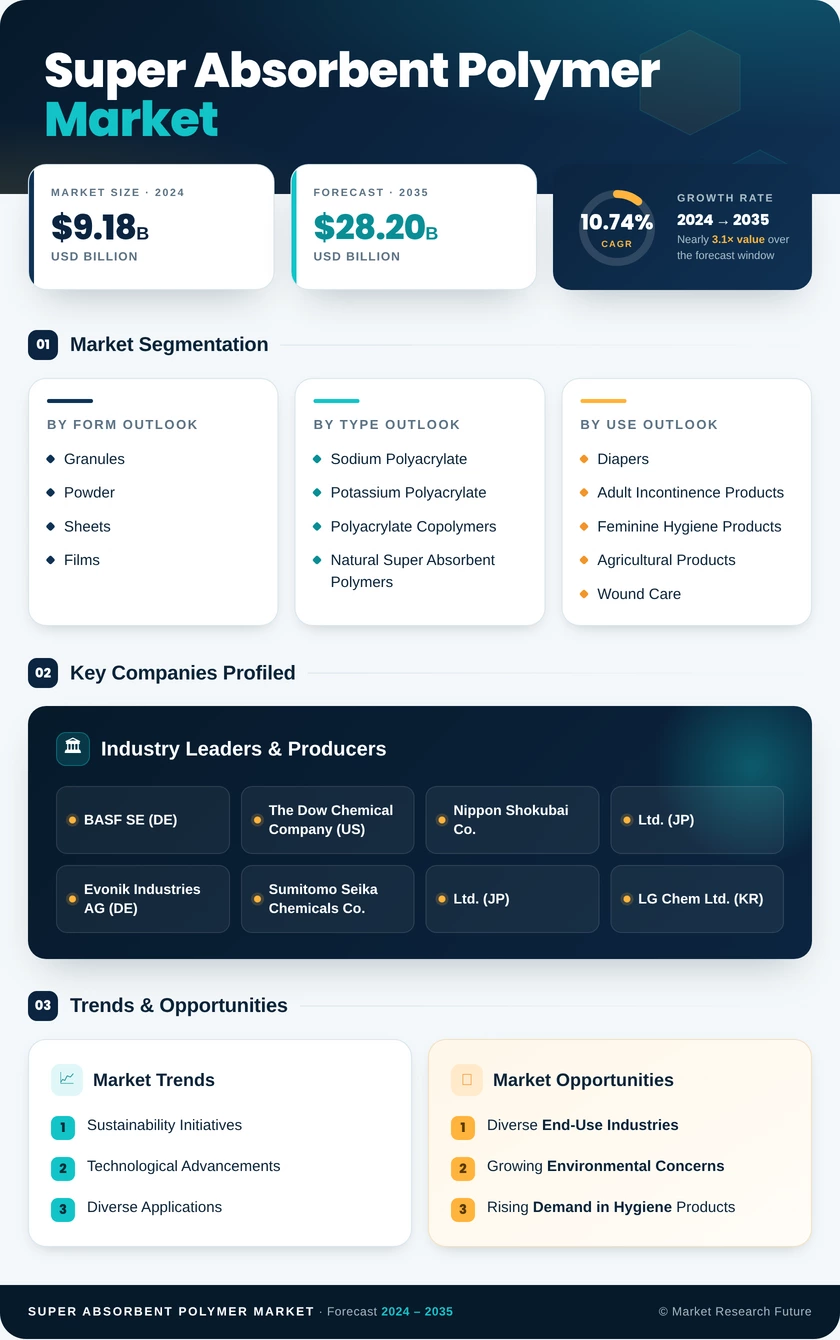
Super Absorbent Polymer Market (2026 - 2035)

ID: MRFR/CnM/0828-HCR 137 Pages Anshula Mandaokar Last Updated: October 30, 2026
Super Absorbent Polymer Market Size, Share & Industry Analysis Research Report Information By Type (Polyacrylamide Copolymer, Sodium Polyacrylate, Others), By End-Use (Personal Care, Building & Construction, Agriculture, Food Packaging, Others), And By Region (North America, Europe, Asia-Pacific, And Rest Of The World) – Market Forecast Till 2035
Super Absorbent Polymer Market
Market Size
Forecast Period2026-2035
CAGR (2026-2035)4.85%
2025 Market SizeUSD 9,215.0 Million
2035 Market SizeUSD 14,797.1 Million
Key Players
Nippon Shokubai
BASF
LG Chem
Evonik Industries
Sumitomo Seika Chemicals
Formosa Plastics
Opportunities
  • Bio-Attributed and Bio-Based Resin Grades
  • Emerging-Market Diaper Conversion in Africa and South Asia
  • Smart Incontinence and Data-Driven Care Models
  1. 1 Market Summary | |
  2. 2 Key Report Takeaways | |
    1. 2.1 By Product Type | |
    2. 2.2 By Polymerization Process | |
    3. 2.3 By Application | |
    4. 2.4 By End-User Industry | |
    5. 2.5 By Region | |
  3. 3 Market Size and Forecast (2021–2035) | |
    1. 3.1 Historical Market Size (2021–2025) | |
    2. 3.2 Forecast Market Size (2026–2035) | |
    3. 3.3 Year-over-Year Growth Analysis | |
  4. 4 Driver Impact Analysis | |
    1. 4.1 Ageing Populations and Adult Incontinence Uptake | |
    2. 4.2 Higher Resin Loading in Ultra-Thin Cores | |
    3. 4.3 Rising Diaper Penetration in Emerging Economies | |
    4. 4.4 Water-Retention Products in Drought-Prone Farming | |
    5. 4.5 Premiumization of Feminine Care | |
    6. 4.6 Cable Water-Blocking and Cold-Chain Demand | |
  5. 5 Restraints Impact Analysis | |
    1. 5.1 Acrylic Acid and Propylene Price Volatility | |
    2. 5.2 Falling Birth Rates in East Asia and Europe | |
    3. 5.3 Regulatory Pressure on Single-Use Disposables | |
    4. 5.4 Residual Monomer and Acrylamide Safety Scrutiny | |
    5. 5.5 High Capital Intensity of New Production Lines | |
  6. 6 Opportunities | |
    1. 6.1 Bio-Attributed and Bio-Based Resin Grades | |
    2. 6.2 Emerging-Market Diaper Conversion in Africa and South Asia | |
    3. 6.3 Smart Incontinence and Data-Driven Care Models | |
    4. 6.4 Agronomic Service Bundles | |
    5. 6.5 Diaper Recycling and Closed-Loop Recovery | |
  7. 7 Regional Market Share and Country-Level Analysis | |
    1. 7.1 North America | | |
      1. 7.1.1 United States | | |
      2. 7.1.2 Canada | | |
      3. 7.1.3 Mexico | |
    2. 7.2 Europe | | |
      1. 7.2.1 Germany | | |
      2. 7.2.2 United Kingdom | | |
      3. 7.2.3 France | | |
      4. 7.2.4 Italy | | |
      5. 7.2.5 Spain | | |
      6. 7.2.6 Nordic Countries | | |
      7. 7.2.7 Russia | | |
      8. 7.2.8 Rest of Europe | |
    3. 7.3 Asia-Pacific | | |
      1. 7.3.1 China | | |
      2. 7.3.2 India | | |
      3. 7.3.3 Japan | | |
      4. 7.3.4 South Korea | | |
      5. 7.3.5 ASEAN | | |
      6. 7.3.6 Rest of Asia-Pacific | |
    4. 7.4 South America | | |
      1. 7.4.1 Brazil | | |
      2. 7.4.2 Argentina | | |
      3. 7.4.3 Rest of South America | |
    5. 7.5 Middle East & Africa | | |
      1. 7.5.1 Saudi Arabia | | |
      2. 7.5.2 UAE | | |
      3. 7.5.3 South Africa | | |
      4. 7.5.4 Egypt | | |
      5. 7.5.5 Rest of MEA | |
  8. 8 Future Outlook (2026–2035) | |
    1. 8.1 Demographic Rebalancing Toward Adult Care | |
    2. 8.2 Bio-Attributed and Bio-Based Acrylic Acid | |
    3. 8.3 Circularity and End-of-Life Regulation | |
    4. 8.4 Water Scarcity and Digital Agriculture | |
  9. 9 Segmentation Analysis | |
    1. 9.1 By Product Type | | |
      1. 9.1.1 Polyacrylamide | | |
      2. 9.1.2 Acrylic Acid Based | | |
      3. 9.1.3 Others | |
    2. 9.2 By Polymerization Process | | |
      1. 9.2.1 Solution Polymerization | | |
      2. 9.2.2 Suspension/Inverse-Suspension Polymerization | | |
      3. 9.2.3 Gel Polymerization | |
    3. 9.3 By Application | | |
      1. 9.3.1 Baby Diapers | | |
      2. 9.3.2 Adult Incontinence Products | | |
      3. 9.3.3 Feminine Hygiene | | |
      4. 9.3.4 Agriculture Support | | |
      5. 9.3.5 Other Application | |
    4. 9.4 By End-User Industry | | |
      1. 9.4.1 Personal Care and Hygiene Manufacturers | | |
      2. 9.4.2 Agriculture Input Suppliers | | |
      3. 9.4.3 Healthcare Providers | | |
      4. 9.4.4 Other End-use Industries (Telecom and Power Cable Makers and Food and Pharmaceutical Cold-Chain Logistics) | |
  10. 10 Competitive Landscape | |
    1. 10.1 Market Concentration Analysis | |
    2. 10.2 Competitive Benchmarking Matrix | |
    3. 10.3 Company Profiles | | |
      1. 10.3.1 Nippon Shokubai | | |
      2. 10.3.2 BASF | | |
      3. 10.3.3 LG Chem | | |
      4. 10.3.4 Evonik Industries | | |
      5. 10.3.5 Sumitomo Seika Chemicals | | |
      6. 10.3.6 Formosa Plastics | | |
      7. 10.3.7 Yixing Danson Technology | | |
      8. 10.3.8 Satellite Chemical | | |
      9. 10.3.9 Wanhua Chemical | | |
      10. 10.3.10 Kao Corporation | | |
      11. 10.3.11 Songwon Industrial | |
  11. 11 Recent News & Developments | |
  12. 12 Report Scope and Methodology | |
  13. 13 Detailed Sources and Citations | |
  14. 14 Frequently Asked Questions (FAQs) | | LIST OF TABLES | |
  15. TABLE 1 Market Snapshot – Key Metrics, 2025–2035 | |
  16. TABLE 2 Global Market Size and Forecast, 2021–2035 (USD Million) | |
  17. TABLE 3 Driver Impact Analysis, 2026–2035 | |
  18. TABLE 4 Restraints Impact Analysis, 2026–2035 | |
  19. TABLE 5 Regional Summary, 2025 | |
  20. TABLE 6 North America Market, by Country, 2025 | |
  21. TABLE 7 Europe Market, by Country, 2025 | |
  22. TABLE 8 Asia-Pacific Market, by Country, 2025 | |
  23. TABLE 9 South America Market, by Country, 2025 | |
  24. TABLE 10 Middle East & Africa Market, by Country, 2025 | |
  25. TABLE 11 Global Market, by Product Type, 2025 | |
  26. TABLE 12 Global Market, by Polymerization Process, 2025 | |
  27. TABLE 13 Global Market, by Application, 2025 | |
  28. TABLE 14 Global Market, by End-User Industry, 2025 | |
  29. TABLE 15 Competitive Benchmarking Matrix, 2025 | |
  30. TABLE 16 Report Scope and Methodology | |
  31. TABLE 17 Detailed Sources and Citations | |
  32. TABLE 18 Segmentation Quick Reference | | LIST OF FIGURES | |
  33. FIGURE 1 Market Dynamics Overview – Drivers, Restraints and Opportunities | |
  34. FIGURE 2 Industry Value Chain Analysis | |
  35. FIGURE 3 Porter's Five Forces Analysis | |
  36. FIGURE 4 Global Market Size Trend, 2021–2035 (USD Million) | |
  37. FIGURE 5 Market Share by Product Type, 2025 | |
  38. FIGURE 6 Market Share by Polymerization Process, 2025 | |
  39. FIGURE 7 Market Share by Application, 2025 | |
  40. FIGURE 8 Market Share by End-User Industry, 2025 | |
  41. FIGURE 9 Regional Market Share, 2025 | |
  42. FIGURE 10 Country-Level Growth Comparison, 2026–2035 | |
  43. FIGURE 11 Competitive Landscape – Estimated Revenue Share Ranges, 2025

Segmentation Quick Reference

Dimension Sub-Segments Dominant Segment Fastest Growing Segment
By Product Type Polyacrylamide; Acrylic Acid Based; Others Acrylic Acid Based (77.6% share) Polyacrylamide (7.1% CAGR)
By Polymerization Process Solution Polymerization; Suspension/Inverse-Suspension Polymerization; Gel Polymerization Gel Polymerization (64.9% share) Solution Polymerization (5.5% CAGR)
By Application Baby Diapers; Adult Incontinence Products; Feminine Hygiene; Agriculture Support; Other Applications Baby Diapers (64.3% share) Adult Incontinence Products (5.8% CAGR)
By End-User Industry Personal Care and Hygiene Manufacturers; Agriculture Input Suppliers; Healthcare Providers; Other End-use Industries (Telecom and Power Cable Makers and Food and Pharmaceutical Cold-Chain Logistics) Personal Care and Hygiene Manufacturers (86.4% share) Agriculture Input Suppliers (6.5% CAGR)
By Region North America; Europe; Asia-Pacific; South America; Middle East & Africa Asia-Pacific (42.6% share) North America (5.6% CAGR)

Market Segmentation Overview

By Product Type

Sub-Segment Key Trend
Polyacrylamide Cross-linked grades for long-duration soil water retention
Acrylic Acid Based Surface-cross-linked grades for fluff-free cores
Others Starch-graft and cellulose blends in premium niche products

Acrylic Acid Based grades lead with a 77.6% share because their swelling capacity fits high-speed converting lines. Polyacrylamide grows fastest at a 7.1% CAGR as subsidized soil amendments in India and Australia need networks that hold water through droughts. Others remain limited by lower gel strength, though blending with acrylic resin keeps them relevant in Japanese premium lines.

By Polymerization Process

Sub-Segment Key Trend
Solution Polymerization Fine, low-dust particles with in-process monomer reduction
Suspension/Inverse-Suspension Polymerization Spherical particles for specialty and technical grades
Gel Polymerization Large belt lines delivering scale economies

Gel Polymerization holds 64.9% of revenue because single-pass belt reactors produce high-swelling particles without grinding. Solution Polymerization grows fastest at a 5.5% CAGR, driven by thin-diaper and pad makers that need sub-150 micron particles. Suspension/Inverse-Suspension Polymerization keeps a specialty role where particle shape matters more than energy cost.

By Application

Sub-Segment Key Trend
Baby Diapers Higher resin loading per unit in slimmer designs
Adult Incontinence Products Active-lifestyle and overnight briefs with heavier loads
Feminine Hygiene Sub-2 mm ultra-thin pad cores
Agriculture Support Seed coating and soil conditioning in dryland farming
Other Application Cable water-blocking yarns and cold-chain pads

Baby Diapers dominate with a 64.3% share, sustained by rising polymer content per unit even as developed-market births soften. Adult Incontinence Products grow fastest at a 5.8% CAGR, since ageing cohorts in Japan, Germany and Italy buy heavier, premium-priced briefs. Feminine Hygiene and Agriculture Support add specialty demand that improves supplier margin mix.

By End-User Industry

Sub-Segment Key Trend
Personal Care and Hygiene Manufacturers Long-term co-development and supply agreements
Agriculture Input Suppliers Digital agronomy proof of irrigation savings
Healthcare Providers Total-cost-of-ownership purchasing of incontinence pads
Other End-use Industries (Telecom and Power Cable Makers and Food and Pharmaceutical Cold-Chain Logistics) Fiber rollout and biologic drug distribution

Personal Care and Hygiene Manufacturers account for 86.4% of revenue, using multi-year contracts with leading producers to secure tailored grades and stable pricing. Agriculture Input Suppliers grow fastest at a 6.5% CAGR, as subsidies and plot-level data turn soil amendments into planned purchases. Healthcare Providers favor high-polymer pads that reduce change frequency and laundry loads.


Download PDF ×

We do not share your information with anyone. However, we may send you emails based on your report interest from time to time. You may contact us at any time to opt-out.