Request Free Sample ×

Kindly complete the form below to receive a free sample of this Report

* Please use a valid business email

Leading companies partner with us for data-driven Insights

clients tt-cursor
Hero Background
English
Chinese
French
Japanese
Korean
German
Spanish

Submarine Power Cable Market Analysis

ID: MRFR/EnP/4981-CR
117 Pages
Anshula Mandaokar
June 2021

Submarine Power Cable Market Research Report Information By Type (AC, DC), By Core Type (Single Core, Multi-Core), By Insulation Type (Cross-Linked Polyethylene (XLPE), Ethylene Propylene Rubber (EPR)), By Voltage (Up to 66 KV, 66 KV-220 KV, Above 220 KV), By Conductor Material (Copper, Aluminum), By End-Use (Offshore Wind Power Generation, Offshore Oil & Gas, Island Connection, Wave & Tidal Power Generation) And By Region (North America, Europe, Asia-Pacific, And Rest Of The World) – Market Forecast Till 2035

Share:
Download PDF ×

We do not share your information with anyone. However, we may send you emails based on your report interest from time to time. You may contact us at any time to opt-out.

Submarine Power Cable Market Infographic
Purchase Options

Market Analysis

In-depth Analysis of Submarine Power Cable Market Industry Landscape

The submarine power cable market is set to reach US$ 31.55 BN by 2032, at a 9.4% CAGR between years 2022-2032. As a result of ever-changing requirements within the energy industry, there are considerable market dynamics. This market is important for power transmission across water bodies, and has seen a surge in demand due to the focus on renewable sources of energy with growing interconnectivity among national grids. The clean energy trend has increased the number of offshore wind farms, which need effective submarine power cables for connection to onshore grids. This demand is one of the major factors driving market growth. Technology has played a key role in influencing the shape of submarine power cable market. It has brought many improvements in cable designs, materials and manufacturing processes with higher efficiency and reliability. HVDC technology, such as submarine power transmission with minimal losses is one of the popular usages. These technological advances fuel market development and spur research and development investments. The submarine power cable market is also greatly affected by the regulatory landscape. Many countries around the world are implementing policies aimed at supporting renewable energy and reducing carbon footprint thus increasing demand for submarine cables in offshore wind projects. Additionally, rules regarding the environmental impact of cable installation and operation have significant influence on market development. Companies in the submarine power cable industry must deal with a complex regulatory framework requiring environmental standards compliance and permit requests for cabling installations. As more competitors enter the submarine power cable segment, market competition is becoming fierce. Both well-known cable makers and newcomers are investing in increasing their production lines and improving the quality of products. This competitive environment can also be seen to encourage innovation and reduce cost, which makes submarine power cables more economically feasible for energy projects. Market participants are also looking at strategic alliances and collaborations to enhance their market positioning as well as meet the rising need for dependable quality submarine power transmission solutions. An additional factor that influences market dynamics is the geographical distribution of submarine power cable projects. Regions with great offshore wind power potential, like Europe and certain parts of Asia are seeing massive investments in submarine cable infrastructure. Submarine cable interconnection demand for cross-border energy trade continues to drive the market growth. Thus, it is necessary for market actors to accommodate the demand variations at a regional level in terms of regulatory environment and project specifications. The submarine power cable market dynamics are also dependent on challenges. Instituting and maintaining submarine cables are subject to engineering problems, logistics issues that need skills as well as toolkits. Concerns relating to cable damage, seabed conditions as well as marine life interactions requires continuous research and development efforts intended at avert risks. In order to sustain and rehabilitate the integrity of submarine cable installations, market stakeholders must invest in quality solutions.

Author
Author Profile
Anshula Mandaokar
Team Lead - Research

Anshula Mandaokar holds an academic degree in Chemical Engineering and has been contributing to the field for more than 5 years. She has expertise in Market Research and Business Consulting and serves as a Team Lead for a reputed Market Research firm under the Chemicals and Materials domain spectrum. She has worked on multiple projects, generating explicit results in a quick turnaround time. Her understanding of data interpretation justifies her role as a leader.

Leave a Comment

FAQs

What is the projected market valuation of the Submarine Power Cable Market by 2035?

<p>The Submarine Power Cable Market is projected to reach a valuation of 38.68 USD Billion by 2035.</p>

What was the market valuation of the Submarine Power Cable Market in 2024?

<p>In 2024, the overall market valuation was 14.4 USD Billion.</p>

What is the expected CAGR for the Submarine Power Cable Market during the forecast period 2025 - 2035?

<p>The expected CAGR for the Submarine Power Cable Market during the forecast period 2025 - 2035 is 9.4%.</p>

Which companies are considered key players in the Submarine Power Cable Market?

<p>Key players in the Submarine Power Cable Market include Nexans, Prysmian Group, General Cable, Sumitomo Electric Industries, LS Cable & System, ABB, Siemens, and Telefónica.</p>

What are the projected valuations for Single Core and Multi-Core submarine power cables by 2035?

<p>By 2035, Single Core submarine power cables are projected to reach 16.0 USD Billion, while Multi-Core cables may reach 22.68 USD Billion.</p>

What is the expected market size for Cross-linked polyethylene (XLPE) insulation type by 2035?

<p>The market size for Cross-linked polyethylene (XLPE) insulation type is expected to reach 17.5 USD Billion by 2035.</p>

How does the market for Copper and Aluminum conductor materials compare by 2035?

<p>By 2035, the market for Copper conductor materials is projected to be 23.2 USD Billion, whereas Aluminum is expected to reach 15.48 USD Billion.</p>

What are the anticipated market sizes for Offshore Wind Power Generation and Offshore Oil & Gas by 2035?

<p>By 2035, Offshore Wind Power Generation is anticipated to reach 10.08 USD Billion, while Offshore Oil & Gas may reach 11.52 USD Billion.</p>

What voltage categories are projected to have the highest market sizes by 2035?

<p>The voltage category of 66 KV-220 KV is projected to have a market size of 15.36 USD Billion by 2035, indicating strong demand.</p>

What trends are influencing the growth of the Submarine Power Cable Market?

<p>The growth of the Submarine Power Cable Market appears to be influenced by increasing investments in offshore renewable energy projects and advancements in cable technology.</p>

Market Summary

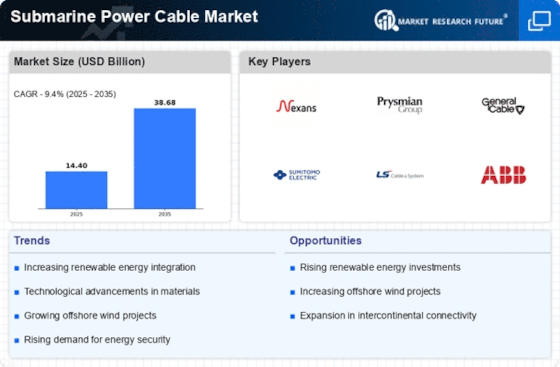
As per Market Research Future analysis, the Submarine Power Cable Market Size was estimated at 14.4 USD Billion in 2024. The Submarine Power Cable industry is projected to grow from 15.75 USD Billion in 2025 to 38.68 USD Billion by 2035, exhibiting a compound annual growth rate (CAGR) of 9.4% during the forecast period 2025 - 2035

Key Market Trends & Highlights

The Submarine Power Cable Market is experiencing robust growth driven by renewable energy initiatives and technological advancements.

  • North America remains the largest market for submarine power cables, driven by extensive offshore wind projects. Asia-Pacific is emerging as the fastest-growing region, fueled by increasing investments in renewable energy infrastructure. The Single Core segment dominates the market, while the Multi-Core segment is witnessing rapid growth due to its efficiency in power transmission. Key market drivers include the rising demand for renewable energy and government initiatives promoting sustainable energy solutions.

Market Size & Forecast

2024 Market Size 14.4 (USD Billion)
2035 Market Size 38.68 (USD Billion)
CAGR (2025 - 2035) 9.4%
Largest Regional Market Share in 2024 Europe

Major Players

<a href="https://www.nexans.no/en/products/Subsea-Cables.html">Nexans</a> (FR), Prysmian Group (IT), General Cable (US), Sumitomo Electric Industries (JP), LS Cable &amp; System (KR), ABB (CH), Siemens (DE), <a href="https://www.telefonica.com/en/communication-room/blog/submarine-cables-underwater-internet/">Telefónica</a> (ES)

Market Trends

The Submarine Power Cable Market is currently experiencing a transformative phase, driven by the increasing demand for renewable energy sources and the need for efficient power transmission across vast distances. As nations strive to meet their energy needs sustainably, the deployment of submarine cables has become a pivotal solution. These cables facilitate the connection of offshore wind farms and other renewable energy installations to the mainland grid, thereby enhancing energy security and reliability. Furthermore, advancements in cable technology are enabling longer transmission distances and improved efficiency, which may further stimulate market growth. In addition to renewable energy integration, the Submarine Power Cable Market is influenced by the rising investments in interconnectors between countries. These interconnectors allow for the exchange of electricity, promoting energy trading and enhancing grid stability. The increasing focus on reducing carbon emissions and transitioning to cleaner energy sources appears to be a driving force behind these investments. Moreover, the market is likely to benefit from government initiatives aimed at expanding infrastructure and supporting innovative technologies. Overall, the Submarine Power Cable Market seems poised for substantial growth as it adapts to the evolving energy landscape and addresses the challenges of modern power distribution.

Renewable Energy Integration

The integration of renewable energy sources into the power grid is a prominent trend within the Submarine Power Cable Market. As countries prioritize sustainability, the demand for submarine cables to connect offshore wind farms and solar installations to onshore grids is increasing. This trend reflects a broader shift towards cleaner energy solutions.

International Interconnectors

The development of international interconnectors is gaining traction in the Submarine Power Cable Market. These interconnectors facilitate electricity exchange between nations, enhancing energy security and promoting cross-border energy trading. This trend is likely to foster collaboration among countries in their energy strategies.

Technological Advancements

Technological advancements in cable design and materials are shaping the Submarine Power Cable Market. Innovations are leading to cables that can transmit power over longer distances with reduced losses. This trend indicates a move towards more efficient and reliable power transmission solutions.

Submarine Power Cable Market Market Drivers

Rising Energy Demand and Urbanization

The increasing energy demand driven by urbanization is a significant factor influencing the Submarine Power Cable Market. As populations grow and urban areas expand, the need for reliable and efficient energy transmission becomes paramount. Submarine power cables are essential for connecting remote energy sources, such as offshore wind farms, to densely populated regions. The International Energy Agency projects that global electricity demand will rise by 30% by 2040, further underscoring the necessity for robust submarine cable infrastructure. This trend indicates that the Submarine Power Cable Market will likely experience heightened activity as stakeholders seek to address the challenges posed by rising energy consumption and urban development.

Increasing Demand for Renewable Energy

The rising emphasis on renewable energy sources is a primary driver for the Submarine Power Cable Market. As nations strive to meet their energy needs sustainably, the integration of offshore wind farms and solar energy systems becomes crucial. Reports indicate that the offshore wind capacity is expected to reach over 200 GW by 2030, necessitating robust submarine power cables for efficient energy transmission. This shift towards renewables not only supports energy security but also aligns with global climate goals, thereby propelling the demand for submarine power cables. The Submarine Power Cable Market is likely to witness substantial growth as investments in renewable infrastructure increase, creating opportunities for manufacturers and service providers in this sector.

Government Initiatives and Policy Support

Government initiatives and supportive policies play a pivotal role in shaping the Submarine Power Cable Market. Many countries are implementing regulations and incentives to promote renewable energy projects, which often require submarine cables for effective energy transmission. For example, various governments are setting ambitious targets for offshore wind energy, which necessitates the deployment of extensive submarine cable networks. The commitment to reducing carbon emissions and enhancing energy infrastructure is likely to result in increased funding and support for submarine cable projects. This favorable policy environment is expected to stimulate growth in the Submarine Power Cable Market, attracting investments and fostering innovation.

Technological Innovations in Cable Design

Technological advancements in cable design and manufacturing are transforming the Submarine Power Cable Market. Innovations such as high-voltage direct current (HVDC) technology enable the transmission of electricity over long distances with minimal losses. The introduction of advanced materials and insulation techniques enhances the durability and efficiency of submarine cables. As a result, the market is witnessing a shift towards more efficient and reliable cable systems. The Submarine Power Cable is projected to grow at a CAGR of approximately 10% over the next few years, driven by these technological improvements. This trend suggests that companies investing in R&D for cable technology will likely gain a competitive edge in the Submarine Power Cable Market.

Expansion of International Interconnectors

The development of international interconnectors is significantly influencing the Submarine Power Cable Market. These interconnectors facilitate the exchange of electricity between countries, enhancing energy security and market efficiency. For instance, projects like the North Sea Wind Power Hub aim to connect multiple countries through a network of submarine cables, potentially delivering up to 70 GW of electricity. Such initiatives not only promote cross-border electricity trade but also optimize the use of renewable energy resources. The increasing number of interconnector projects indicates a growing recognition of the strategic importance of submarine power cables in achieving energy transition goals, thereby driving market growth.

Market Segment Insights

By Type: Single Core (Largest) vs. Multi-Core (Fastest-Growing)

<p>In the <a href="https://www.marketresearchfuture.com/reports/submarine-market-4571" target="_blank" title="submarine">Submarine</a> Power Cable Market, the market share is predominantly held by Single Core cables, known for their robustness and efficiency in high-voltage applications. This segment is favored for long-distance power transmission, leading to its substantial presence in underwater installations. Multi-Core cables, while having a smaller share, are gaining traction due to their flexibility and ability to facilitate multiple connections in a single laying operation.</p>

<p>Cable Type: Single Core (Dominant) vs. Multi-Core (Emerging)</p>

<p>Single Core cables are designed for high-capacity transmission, making them the dominant choice for large-scale offshore wind farms and interconnection projects, ensuring minimal losses over great distances. Conversely, Multi-Core cables are emerging as a versatile solution, catering to the increasing demand for complex marine applications. They allow for multiple circuits within a single cable, reducing installation time and costs. As technology advances, Multi-Core cables are expected to evolve, further enhancing their value in intricate electrical systems, thereby positioning themselves as a crucial component for modern submarine power grid configurations.</p>

By Insulation Type: Cross-linked Polyethylene (XLPE) (Largest) vs. Ethylene Propylene Rubber (EPR) (Fastest-Growing)

<p>In the Submarine Power Cable Market, Cross-linked Polyethylene (XLPE) holds the largest market share due to its superior electrical insulation properties and resistance to heat and moisture. This material is widely adopted in long-distance power transmission applications, making it a popular choice among manufacturers and utilities. Meanwhile, Ethylene Propylene Rubber (EPR) is emerging as a strong contender with its flexibility and capability to withstand extreme environmental conditions, though it currently commands a smaller market share than XLPE.</p>

<p>Insulation Type: XLPE (Dominant) vs. EPR (Emerging)</p>

<p>Cross-linked Polyethylene (XLPE) is recognized as the dominant insulation material in the Submarine Power Cable Market, thanks to its excellent thermal stability, low dielectric losses, and high resistance to electrical stress. Its ability to perform well in diverse environmental conditions makes it a preferred choice for deep-sea installations. On the other hand, Ethylene Propylene Rubber (EPR) is gaining traction as an emerging technology in this market. EPR's unique properties offer enhanced flexibility and resistance to ozone and weathering, making it suitable for dynamic applications and challenging underwater environments. As the demand for reliable and efficient power transmission grows, both materials will play critical roles in shaping the future of submarine power cable installations.</p>

By Conductor Material: Copper (Largest) vs. Aluminum (Fastest-Growing)

<p>In the Submarine Power Cable Market, the conductor material segment showcases a significant divide between copper and aluminum. Copper continues to lead in terms of market share due to its superior conductivity, durability, and reliability, making it the preferred choice for many high-capacity applications. On the other hand, aluminum is gaining momentum, particularly in cost-sensitive projects, owing to its lightweight properties and lower material cost. As a result, the market dynamics are shifting, with copper maintaining its dominance while aluminum emerges as a viable alternative in various applications.</p>

<p>Conductor Material: Copper (Dominant) vs. Aluminum (Emerging)</p>

<p>Copper is widely recognized as the dominant conductor material in submarine power cables, esteemed for its exceptional electrical conductivity, mechanical strength, and resistance to corrosion. This makes it ideal for long-distance power transmission under the sea, where performance reliability is crucial. In contrast, aluminum is positioned as an emerging choice, particularly in applications that prioritize cost efficiency without excessively compromising on performance. Although aluminum has a lower conductivity than copper, its lightweight nature and lower price point make it attractive for certain projects, especially as advancements in manufacturing processes aim to enhance its performance capabilities. This competitive dynamic brings both materials to the forefront of the submarine power cable market.</p>

By End Use: Offshore Wind Power Generation (Largest) vs. Offshore Oil & Gas (Fastest-Growing)

<p>The Submarine Power Cable Market's end-use segment reveals a dynamic landscape dominated by <a href="https://www.marketresearchfuture.com/reports/offshore-wind-power-market-22974" target="_blank" title="offshore wind power">Offshore Wind Power</a> Generation, which accounts for the largest market share. This segment has seen significant investment and infrastructural development, reflecting the global shift towards renewable energy sources. In comparison, Offshore Oil & Gas, although currently smaller in share, is emerging rapidly due to substantial capital flowing into oil extraction and gas transportation projects that require robust and reliable submarine cable technology. As the world leans towards sustainability, growth trends indicate a marked increase in investments in Offshore Wind Power Generation, propelled by governmental incentives and technology advancements. Simultaneously, Offshore Oil & Gas is experiencing a boost, fueled by the rising demand for energy and the need for innovative solutions to enhance resource extraction efficiency. This trend highlights a robust competition between traditional energy sources and emerging renewables in the submarine power cable landscape.</p>

<p>Offshore Wind Power Generation: Dominant vs. Offshore Oil & Gas: Emerging</p>

<p>Offshore Wind Power Generation stands as the dominant force in the submarine power cable market, reflecting the global transition towards sustainable energy solutions. This segment is characterized by large-scale projects and strategic investments, enabling the deployment of extensive wind farms located far from the shore. In contrast, the Offshore Oil & Gas segment is emerging as a critical player, driven by increasing energy demands and the necessity for advanced connectivity solutions in maritime operations. While Offshore Wind Power is often seen as the future of energy, Offshore Oil & Gas remains relevant due to its established infrastructure and ongoing technological enhancements. Both segments showcase distinct characteristics, with Offshore Wind Power focusing on renewable energy and Offshore Oil & Gas prioritizing efficiency and innovation.</p>

By Voltage: 66 KV-220 KV (Largest) vs. Above 220 KV (Fastest-Growing)

<p>In the Submarine Power Cable Market, the voltage segments reveal a diverse distribution of market share. The segment for 66 KV-220 KV holds the largest share, owing to its extensive use in medium to high voltage applications, bridging the gap between utility and renewable energy projects. This segment caters predominantly to offshore wind farms and power interconnections, solidifying its market leadership. The Above 220 KV segment, while smaller in the share, is rapidly gaining traction due to increasing investments in high-capacity transmission systems, particularly those aimed at supporting energy demands from large-scale offshore wind developments.</p>

<p>Voltage: 66 KV-220 KV (Dominant) vs. Above 220 KV (Emerging)</p>

<p>The 66 KV-220 KV segment is recognized as the dominant player in the Submarine Power Cable Market, characterized by its reliable performance in transferring medium to high voltages for underwater applications. This segment meets the rising needs of energy utilities and offshore renewable projects, ensuring efficient energy flow. Conversely, the Above 220 KV segment is emerging, driven by the escalating demand for robust infrastructure to accommodate high-capacity transmission. This demand is propelled by global initiatives towards renewable energy, emphasizing the necessity for advanced and resilient submarine cables capable of handling greater capacities, thereby enhancing grid connectivity and stability.</p>

Get more detailed insights about Submarine Power Cable Market Research Report—Global Forecast till 2035

Regional Insights

North America : Innovation and Infrastructure Growth

North America is witnessing significant growth in the submarine power cable market, driven by increasing investments in renewable energy and offshore wind projects. The region holds approximately 35% of the global market share, making it the largest market. Regulatory support, such as tax incentives for renewable energy projects, further fuels demand. The U.S. and Canada are the primary contributors to this growth, with a focus on enhancing grid connectivity and energy security. The competitive landscape in North America is characterized by the presence of major players like General Cable and ABB, which are actively involved in large-scale projects. The U.S. market is particularly robust, with states like California and Texas leading in offshore wind initiatives. Additionally, partnerships between government and private sectors are fostering innovation in cable technology, ensuring that the region remains at the forefront of submarine cable advancements.

Europe : Leading in Renewable Energy Initiatives

Europe is emerging as a powerhouse in the submarine power cable market, driven by ambitious renewable energy targets and cross-border electricity interconnections. The region accounts for approximately 30% of the global market share, making it the second-largest market. Regulatory frameworks, such as the European Green Deal, are catalyzing investments in offshore wind farms and interconnectors, enhancing energy security and sustainability across member states. Countries like the United Kingdom, Germany, and France are leading the charge, with significant projects underway to expand their submarine cable networks. Key players such as Prysmian Group and Siemens are heavily involved in these initiatives, ensuring the region's competitive edge. The collaborative efforts among EU nations to integrate renewable energy sources are further solidifying Europe's position as a leader in submarine power cable technology.

Asia-Pacific : Emerging Markets and Investments

The Asia-Pacific region is rapidly developing its submarine power cable market, driven by increasing energy demands and investments in renewable energy projects. This region holds approximately 25% of the global market share, with countries like Japan and South Korea leading the way. Government initiatives aimed at enhancing energy security and reducing carbon emissions are key drivers of this growth, alongside the rising demand for electricity in emerging economies. Japan and South Korea are at the forefront, with major players like Sumitomo Electric Industries and LS Cable & System actively participating in large-scale projects. The competitive landscape is evolving, with a focus on technological advancements and sustainability. Additionally, partnerships between governments and private sectors are fostering innovation, ensuring that the region can meet its growing energy needs while transitioning to greener solutions.

Middle East and Africa : Resource-Rich and Emerging Markets

The Middle East and Africa region is witnessing a burgeoning submarine power cable market, driven by increasing investments in energy infrastructure and renewable projects. This region holds approximately 10% of the global market share, with countries like South Africa and the UAE leading the charge. Regulatory support for renewable energy initiatives is catalyzing growth, as governments seek to diversify their energy sources and enhance grid connectivity. South Africa is focusing on expanding its renewable energy capacity, while the UAE is investing heavily in offshore wind projects. Key players such as Nexans and ABB are establishing a presence in the region, contributing to the competitive landscape. The collaboration between public and private sectors is essential for driving innovation and ensuring that the region can meet its energy demands sustainably.

Key Players and Competitive Insights

The Submarine Power Cable Market is currently characterized by a dynamic competitive landscape, driven by the increasing demand for renewable energy sources and the expansion of offshore wind farms. Key players such as Nexans (France), Prysmian Group (Italy), and Sumitomo Electric Industries (Japan) are strategically positioning themselves through innovation and regional expansion. These companies are not only enhancing their product offerings but are also focusing on sustainable practices, which appears to be a significant driver of competitive advantage in this sector. Their collective strategies suggest a trend towards greater collaboration and technological advancement, shaping a market that is increasingly interconnected and responsive to global energy needs.

In terms of business tactics, companies are localizing manufacturing to reduce costs and optimize supply chains, which is particularly crucial given the global nature of submarine cable projects. The market structure is moderately fragmented, with several key players exerting influence over regional markets. This fragmentation allows for a variety of competitive strategies, as companies seek to differentiate themselves through technological innovation and customer service excellence.

In August 2025, Prysmian Group (Italy) announced the launch of a new high-capacity submarine cable designed specifically for offshore wind applications. This strategic move not only reinforces Prysmian's commitment to renewable energy but also positions the company to capture a larger share of the growing offshore wind market. The introduction of this advanced cable technology is likely to enhance operational efficiency and reduce installation times, thereby providing a competitive edge.

In September 2025, Nexans (France) secured a significant contract for the supply of submarine cables for a major interconnection project in the North Sea. This contract underscores Nexans' strategic focus on expanding its footprint in the European energy market. By successfully executing such high-profile projects, Nexans is likely to strengthen its reputation as a leader in the submarine cable sector, while also contributing to the region's energy transition goals.

In July 2025, Sumitomo Electric Industries (Japan) announced a partnership with a leading renewable energy firm to develop innovative cable solutions for offshore wind farms. This collaboration is indicative of a broader trend towards strategic alliances in the industry, as companies recognize the need to pool resources and expertise to meet the increasing demands of the energy transition. Such partnerships may enhance technological capabilities and accelerate the development of next-generation submarine cables.

As of October 2025, the competitive trends in the Submarine Power Cable Market are increasingly defined by digitalization, sustainability, and the integration of advanced technologies such as AI. Strategic alliances are becoming more prevalent, reflecting a shift towards collaborative innovation. The competitive landscape is evolving from a focus on price-based competition to one that emphasizes technological differentiation, reliability in supply chains, and sustainable practices. This evolution suggests that companies that prioritize innovation and adaptability will likely emerge as leaders in the future.

Key Companies in the Submarine Power Cable Market include

Industry Developments

Jan. 2020 PT. PLN (Indonesia) has given Furukawa Electric Co., Ltd. a contract to provide engineering, procurement, and construction services for the construction of the 150kV underwater cable Sumatera-Bangka. The business would be able to grow its cable operations in Indonesia as a result.

Feb. 2022 A Memorandum of Understanding was signed by the independent cable construction and operator Inligo Networks and Indonesian telecommunications company Indostat Ooredoo Hutchison to develop an 18,000 km submarine cable connecting Indonesia, Singapore, Australia, Japan, and the United States.

In May 2023 Sumitomo Electric announces its plans to establish a new power cable factory in UK for supporting the goal of UK government of achieving Net zero 2050. Sumitomo Electric announced on 27th April 2023 to establish a new Power Cable factory in the Scottish Highlands, UK to support UK Government’s goal to achieve Net zero 2050.

December 2023- Prysmian Group, a leading Cables manufacturer, has attained a €630m ($674.81m) order from Italian transmission system operator Terna's subsidiary for its Adriatic Link project, a 1GW submarine interconnection project in the Adriatic Sea. Prysmian will propose, supply, deploy, and commission the submarine interconnection, which can transfer 1GW of energy between Italy's central-southern and central-northern areas. The high-voltage direct current bipolar cable line will expand for 250km and is anticipated to enhance the safety and strength of the country's electricity transmission grid. Total financing for the project is predicted to be €1.3 billion.

Terna international development director Giacomo Donnini stated that the Adriatic Link retains deliberate significance for the incorporation of renewable sources, therefore contributing to the decarbonization of the Italian energy system.

In April 2023, Sumitomo Electric Industries, Ltd. announced plans to establish a new Power Cable factory (high voltage cable manufacturing plant) in the Scottish Highlands to support the UK Government's goal to achieve Net zero in 2050.

In April 2023, Nexans successfully finalized the acquisition of Reka kaapeli oy, a leading Finnish manufacturer of high, medium, and low voltage cables, as part of its strategy to become a key player in electrification and contribute to carbon neutrality by 2030.

In April 2020, Prysmian Group completed the brand integration process after acquiring General Cable. The company introduced a multi-brand strategy and updated its visual identity and logos.

In October 2021, the Japanese IT conglomerate NEC announced plans to build a large submarine cable with 4 crore fiber optics for Facebook. The submarine will have 24 fiber pairs with a maximum bandwidth of 500 maps. Most countries have laws in place to protect underwater cables from harm because they are an important part of their economies. For example, the Australian Communication and Media Authority (ACMA) has established safety zones to prevent activities that could disrupt the cables that connect Australia and the rest of the world. It also legalizes new submarine cable installations.

In 2018, Europe's new offshore wind farm investments totaled EUR 10.3 billion, representing almost 24% of the total new power investments and a 37% increase from the 2017 levels. The United Kingdom financed USD 5.9 billion of wind investments in total, representing 22% of total financing activity for the construction of new onshore and offshore wind farms.

In 2023, UK businesses, led by BAE Systems, Rolls-Royce, and Babcock, secured USD 4.28 billion in contracts for the Detailed Design and Long Leads (D2L2) Phase, marking a milestone in the AUKUS program. The contracts will advance the design, prototyping, and procurement of main long-lead components for the first UK submarines, supporting thousands of skilled jobs and bolstering the domestic supply chain. The submarines, known as SSN-AUKUS, will replace the Astute-Class vessels and be the largest, most advanced attack submarines ever operated by the Royal Navy.

Construction will primarily occur in Barrow-in-Furness, with the aim of service entry in the late 2030s.

Future Outlook

Submarine Power Cable Market Future Outlook

The Submarine Power Cable Market is projected to grow at a 9.42% CAGR from 2024 to 2035, driven by renewable energy expansion, offshore wind projects, and increasing interconnectivity demands.

New opportunities lie in:

  • Investment in advanced cable manufacturing technologies to enhance efficiency.
  • Development of hybrid cable systems integrating power and data transmission.
  • Strategic partnerships with renewable energy firms for joint project ventures.

By 2035, the Submarine Power Cable Market is expected to be robust, driven by technological advancements and strategic collaborations.

Market Segmentation

Submarine Power Cable Market Type Outlook

  • Single Core
  • Multi-Core

Submarine Power Cable Market End Use Outlook

  • Offshore Wind Power Generation
  • Offshore Oil & Gas
  • Island Connection
  • Wave & Tidal Power Generation

Submarine Power Cable Market Voltage Outlook

  • Up to 66 KV
  • 66 KV-220 KV
  • Above 220 KV

Submarine Power Cable Market Insulation Type Outlook

  • Cross-linked polyethylene (XLPE)
  • Ethylene propylene rubber (EPR)

Submarine Power Cable Market Conductor Material Outlook

  • Copper
  • Aluminum

Report Scope

MARKET SIZE 202414.4(USD Billion)
MARKET SIZE 202515.76(USD Billion)
MARKET SIZE 203538.77(USD Billion)
COMPOUND ANNUAL GROWTH RATE (CAGR)9.42% (2024 - 2035)
REPORT COVERAGERevenue Forecast, Competitive Landscape, Growth Factors, and Trends
BASE YEAR2024
Market Forecast Period2025 - 2035
Historical Data2019 - 2024
Market Forecast UnitsUSD Billion
Key Companies ProfiledMarket analysis in progress
Segments CoveredMarket segmentation analysis in progress
Key Market OpportunitiesGrowing demand for renewable energy sources drives expansion in the Submarine Power Cable Market.
Key Market DynamicsRising demand for renewable energy drives investment in submarine power cable infrastructure and technological advancements.
Countries CoveredNorth America, Europe, APAC, South America, MEA

FAQs

What is the projected market valuation of the Submarine Power Cable Market by 2035?

<p>The Submarine Power Cable Market is projected to reach a valuation of 38.68 USD Billion by 2035.</p>

What was the market valuation of the Submarine Power Cable Market in 2024?

<p>In 2024, the overall market valuation was 14.4 USD Billion.</p>

What is the expected CAGR for the Submarine Power Cable Market during the forecast period 2025 - 2035?

<p>The expected CAGR for the Submarine Power Cable Market during the forecast period 2025 - 2035 is 9.4%.</p>

Which companies are considered key players in the Submarine Power Cable Market?

<p>Key players in the Submarine Power Cable Market include Nexans, Prysmian Group, General Cable, Sumitomo Electric Industries, LS Cable & System, ABB, Siemens, and Telefónica.</p>

What are the projected valuations for Single Core and Multi-Core submarine power cables by 2035?

<p>By 2035, Single Core submarine power cables are projected to reach 16.0 USD Billion, while Multi-Core cables may reach 22.68 USD Billion.</p>

What is the expected market size for Cross-linked polyethylene (XLPE) insulation type by 2035?

<p>The market size for Cross-linked polyethylene (XLPE) insulation type is expected to reach 17.5 USD Billion by 2035.</p>

How does the market for Copper and Aluminum conductor materials compare by 2035?

<p>By 2035, the market for Copper conductor materials is projected to be 23.2 USD Billion, whereas Aluminum is expected to reach 15.48 USD Billion.</p>

What are the anticipated market sizes for Offshore Wind Power Generation and Offshore Oil & Gas by 2035?

<p>By 2035, Offshore Wind Power Generation is anticipated to reach 10.08 USD Billion, while Offshore Oil & Gas may reach 11.52 USD Billion.</p>

What voltage categories are projected to have the highest market sizes by 2035?

<p>The voltage category of 66 KV-220 KV is projected to have a market size of 15.36 USD Billion by 2035, indicating strong demand.</p>

What trends are influencing the growth of the Submarine Power Cable Market?

<p>The growth of the Submarine Power Cable Market appears to be influenced by increasing investments in offshore renewable energy projects and advancements in cable technology.</p>

  1. SECTION I: EXECUTIVE SUMMARY AND KEY HIGHLIGHTS
    1. | 1.1 EXECUTIVE SUMMARY
    2. | | 1.1.1 Market Overview
    3. | | 1.1.2 Key Findings
    4. | | 1.1.3 Market Segmentation
    5. | | 1.1.4 Competitive Landscape
    6. | | 1.1.5 Challenges and Opportunities
    7. | | 1.1.6 Future Outlook
  2. SECTION II: SCOPING, METHODOLOGY AND MARKET STRUCTURE
    1. | 2.1 MARKET INTRODUCTION
    2. | | 2.1.1 Definition
    3. | | 2.1.2 Scope of the study
    4. | | | 2.1.2.1 Research Objective
    5. | | | 2.1.2.2 Assumption
    6. | | | 2.1.2.3 Limitations
    7. | 2.2 RESEARCH METHODOLOGY
    8. | | 2.2.1 Overview
    9. | | 2.2.2 Data Mining
    10. | | 2.2.3 Secondary Research
    11. | | 2.2.4 Primary Research
    12. | | | 2.2.4.1 Primary Interviews and Information Gathering Process
    13. | | | 2.2.4.2 Breakdown of Primary Respondents
    14. | | 2.2.5 Forecasting Model
    15. | | 2.2.6 Market Size Estimation
    16. | | | 2.2.6.1 Bottom-Up Approach
    17. | | | 2.2.6.2 Top-Down Approach
    18. | | 2.2.7 Data Triangulation
    19. | | 2.2.8 Validation
  3. SECTION III: QUALITATIVE ANALYSIS
    1. | 3.1 MARKET DYNAMICS
    2. | | 3.1.1 Overview
    3. | | 3.1.2 Drivers
    4. | | 3.1.3 Restraints
    5. | | 3.1.4 Opportunities
    6. | 3.2 MARKET FACTOR ANALYSIS
    7. | | 3.2.1 Value chain Analysis
    8. | | 3.2.2 Porter's Five Forces Analysis
    9. | | | 3.2.2.1 Bargaining Power of Suppliers
    10. | | | 3.2.2.2 Bargaining Power of Buyers
    11. | | | 3.2.2.3 Threat of New Entrants
    12. | | | 3.2.2.4 Threat of Substitutes
    13. | | | 3.2.2.5 Intensity of Rivalry
    14. | | 3.2.3 COVID-19 Impact Analysis
    15. | | | 3.2.3.1 Market Impact Analysis
    16. | | | 3.2.3.2 Regional Impact
    17. | | | 3.2.3.3 Opportunity and Threat Analysis
  4. SECTION IV: QUANTITATIVE ANALYSIS
    1. | 4.1 Energy & Power, BY Type (USD Billion)
    2. | | 4.1.1 Single Core
    3. | | 4.1.2 Multi-Core
    4. | 4.2 Energy & Power, BY Insulation Type (USD Billion)
    5. | | 4.2.1 Cross-linked polyethylene (XLPE)
    6. | | 4.2.2 Ethylene propylene rubber (EPR)
    7. | 4.3 Energy & Power, BY Conductor Material (USD Billion)
    8. | | 4.3.1 Copper
    9. | | 4.3.2 Aluminum
    10. | 4.4 Energy & Power, BY End Use (USD Billion)
    11. | | 4.4.1 Offshore Wind Power Generation
    12. | | 4.4.2 Offshore Oil & Gas
    13. | | 4.4.3 Island Connection
    14. | | 4.4.4 Wave & Tidal Power Generation
    15. | 4.5 Energy & Power, BY Voltage (USD Billion)
    16. | | 4.5.1 Up to 66 KV
    17. | | 4.5.2 66 KV-220 KV
    18. | | 4.5.3 Above 220 KV
    19. | 4.6 Energy & Power, BY Region (USD Billion)
    20. | | 4.6.1 North America
    21. | | | 4.6.1.1 US
    22. | | | 4.6.1.2 Canada
    23. | | 4.6.2 Europe
    24. | | | 4.6.2.1 Germany
    25. | | | 4.6.2.2 UK
    26. | | | 4.6.2.3 France
    27. | | | 4.6.2.4 Russia
    28. | | | 4.6.2.5 Italy
    29. | | | 4.6.2.6 Spain
    30. | | | 4.6.2.7 Rest of Europe
    31. | | 4.6.3 APAC
    32. | | | 4.6.3.1 China
    33. | | | 4.6.3.2 India
    34. | | | 4.6.3.3 Japan
    35. | | | 4.6.3.4 South Korea
    36. | | | 4.6.3.5 Malaysia
    37. | | | 4.6.3.6 Thailand
    38. | | | 4.6.3.7 Indonesia
    39. | | | 4.6.3.8 Rest of APAC
    40. | | 4.6.4 South America
    41. | | | 4.6.4.1 Brazil
    42. | | | 4.6.4.2 Mexico
    43. | | | 4.6.4.3 Argentina
    44. | | | 4.6.4.4 Rest of South America
    45. | | 4.6.5 MEA
    46. | | | 4.6.5.1 GCC Countries
    47. | | | 4.6.5.2 South Africa
    48. | | | 4.6.5.3 Rest of MEA
  5. SECTION V: COMPETITIVE ANALYSIS
    1. | 5.1 Competitive Landscape
    2. | | 5.1.1 Overview
    3. | | 5.1.2 Competitive Analysis
    4. | | 5.1.3 Market share Analysis
    5. | | 5.1.4 Major Growth Strategy in the Energy & Power
    6. | | 5.1.5 Competitive Benchmarking
    7. | | 5.1.6 Leading Players in Terms of Number of Developments in the Energy & Power
    8. | | 5.1.7 Key developments and growth strategies
    9. | | | 5.1.7.1 New Product Launch/Service Deployment
    10. | | | 5.1.7.2 Merger & Acquisitions
    11. | | | 5.1.7.3 Joint Ventures
    12. | | 5.1.8 Major Players Financial Matrix
    13. | | | 5.1.8.1 Sales and Operating Income
    14. | | | 5.1.8.2 Major Players R&D Expenditure. 2023
    15. | 5.2 Company Profiles
    16. | | 5.2.1 Nexans (FR)
    17. | | | 5.2.1.1 Financial Overview
    18. | | | 5.2.1.2 Products Offered
    19. | | | 5.2.1.3 Key Developments
    20. | | | 5.2.1.4 SWOT Analysis
    21. | | | 5.2.1.5 Key Strategies
    22. | | 5.2.2 Prysmian Group (IT)
    23. | | | 5.2.2.1 Financial Overview
    24. | | | 5.2.2.2 Products Offered
    25. | | | 5.2.2.3 Key Developments
    26. | | | 5.2.2.4 SWOT Analysis
    27. | | | 5.2.2.5 Key Strategies
    28. | | 5.2.3 General Cable (US)
    29. | | | 5.2.3.1 Financial Overview
    30. | | | 5.2.3.2 Products Offered
    31. | | | 5.2.3.3 Key Developments
    32. | | | 5.2.3.4 SWOT Analysis
    33. | | | 5.2.3.5 Key Strategies
    34. | | 5.2.4 Sumitomo Electric Industries (JP)
    35. | | | 5.2.4.1 Financial Overview
    36. | | | 5.2.4.2 Products Offered
    37. | | | 5.2.4.3 Key Developments
    38. | | | 5.2.4.4 SWOT Analysis
    39. | | | 5.2.4.5 Key Strategies
    40. | | 5.2.5 LS Cable & System (KR)
    41. | | | 5.2.5.1 Financial Overview
    42. | | | 5.2.5.2 Products Offered
    43. | | | 5.2.5.3 Key Developments
    44. | | | 5.2.5.4 SWOT Analysis
    45. | | | 5.2.5.5 Key Strategies
    46. | | 5.2.6 ABB (CH)
    47. | | | 5.2.6.1 Financial Overview
    48. | | | 5.2.6.2 Products Offered
    49. | | | 5.2.6.3 Key Developments
    50. | | | 5.2.6.4 SWOT Analysis
    51. | | | 5.2.6.5 Key Strategies
    52. | | 5.2.7 Siemens (DE)
    53. | | | 5.2.7.1 Financial Overview
    54. | | | 5.2.7.2 Products Offered
    55. | | | 5.2.7.3 Key Developments
    56. | | | 5.2.7.4 SWOT Analysis
    57. | | | 5.2.7.5 Key Strategies
    58. | | 5.2.8 Telefónica (ES)
    59. | | | 5.2.8.1 Financial Overview
    60. | | | 5.2.8.2 Products Offered
    61. | | | 5.2.8.3 Key Developments
    62. | | | 5.2.8.4 SWOT Analysis
    63. | | | 5.2.8.5 Key Strategies
    64. | 5.3 Appendix
    65. | | 5.3.1 References
    66. | | 5.3.2 Related Reports
  6. LIST OF FIGURES
    1. | 6.1 MARKET SYNOPSIS
    2. | 6.2 NORTH AMERICA MARKET ANALYSIS
    3. | 6.3 US MARKET ANALYSIS BY TYPE
    4. | 6.4 US MARKET ANALYSIS BY INSULATION TYPE
    5. | 6.5 US MARKET ANALYSIS BY CONDUCTOR MATERIAL
    6. | 6.6 US MARKET ANALYSIS BY END USE
    7. | 6.7 US MARKET ANALYSIS BY VOLTAGE
    8. | 6.8 CANADA MARKET ANALYSIS BY TYPE
    9. | 6.9 CANADA MARKET ANALYSIS BY INSULATION TYPE
    10. | 6.10 CANADA MARKET ANALYSIS BY CONDUCTOR MATERIAL
    11. | 6.11 CANADA MARKET ANALYSIS BY END USE
    12. | 6.12 CANADA MARKET ANALYSIS BY VOLTAGE
    13. | 6.13 EUROPE MARKET ANALYSIS
    14. | 6.14 GERMANY MARKET ANALYSIS BY TYPE
    15. | 6.15 GERMANY MARKET ANALYSIS BY INSULATION TYPE
    16. | 6.16 GERMANY MARKET ANALYSIS BY CONDUCTOR MATERIAL
    17. | 6.17 GERMANY MARKET ANALYSIS BY END USE
    18. | 6.18 GERMANY MARKET ANALYSIS BY VOLTAGE
    19. | 6.19 UK MARKET ANALYSIS BY TYPE
    20. | 6.20 UK MARKET ANALYSIS BY INSULATION TYPE
    21. | 6.21 UK MARKET ANALYSIS BY CONDUCTOR MATERIAL
    22. | 6.22 UK MARKET ANALYSIS BY END USE
    23. | 6.23 UK MARKET ANALYSIS BY VOLTAGE
    24. | 6.24 FRANCE MARKET ANALYSIS BY TYPE
    25. | 6.25 FRANCE MARKET ANALYSIS BY INSULATION TYPE
    26. | 6.26 FRANCE MARKET ANALYSIS BY CONDUCTOR MATERIAL
    27. | 6.27 FRANCE MARKET ANALYSIS BY END USE
    28. | 6.28 FRANCE MARKET ANALYSIS BY VOLTAGE
    29. | 6.29 RUSSIA MARKET ANALYSIS BY TYPE
    30. | 6.30 RUSSIA MARKET ANALYSIS BY INSULATION TYPE
    31. | 6.31 RUSSIA MARKET ANALYSIS BY CONDUCTOR MATERIAL
    32. | 6.32 RUSSIA MARKET ANALYSIS BY END USE
    33. | 6.33 RUSSIA MARKET ANALYSIS BY VOLTAGE
    34. | 6.34 ITALY MARKET ANALYSIS BY TYPE
    35. | 6.35 ITALY MARKET ANALYSIS BY INSULATION TYPE
    36. | 6.36 ITALY MARKET ANALYSIS BY CONDUCTOR MATERIAL
    37. | 6.37 ITALY MARKET ANALYSIS BY END USE
    38. | 6.38 ITALY MARKET ANALYSIS BY VOLTAGE
    39. | 6.39 SPAIN MARKET ANALYSIS BY TYPE
    40. | 6.40 SPAIN MARKET ANALYSIS BY INSULATION TYPE
    41. | 6.41 SPAIN MARKET ANALYSIS BY CONDUCTOR MATERIAL
    42. | 6.42 SPAIN MARKET ANALYSIS BY END USE
    43. | 6.43 SPAIN MARKET ANALYSIS BY VOLTAGE
    44. | 6.44 REST OF EUROPE MARKET ANALYSIS BY TYPE
    45. | 6.45 REST OF EUROPE MARKET ANALYSIS BY INSULATION TYPE
    46. | 6.46 REST OF EUROPE MARKET ANALYSIS BY CONDUCTOR MATERIAL
    47. | 6.47 REST OF EUROPE MARKET ANALYSIS BY END USE
    48. | 6.48 REST OF EUROPE MARKET ANALYSIS BY VOLTAGE
    49. | 6.49 APAC MARKET ANALYSIS
    50. | 6.50 CHINA MARKET ANALYSIS BY TYPE
    51. | 6.51 CHINA MARKET ANALYSIS BY INSULATION TYPE
    52. | 6.52 CHINA MARKET ANALYSIS BY CONDUCTOR MATERIAL
    53. | 6.53 CHINA MARKET ANALYSIS BY END USE
    54. | 6.54 CHINA MARKET ANALYSIS BY VOLTAGE
    55. | 6.55 INDIA MARKET ANALYSIS BY TYPE
    56. | 6.56 INDIA MARKET ANALYSIS BY INSULATION TYPE
    57. | 6.57 INDIA MARKET ANALYSIS BY CONDUCTOR MATERIAL
    58. | 6.58 INDIA MARKET ANALYSIS BY END USE
    59. | 6.59 INDIA MARKET ANALYSIS BY VOLTAGE
    60. | 6.60 JAPAN MARKET ANALYSIS BY TYPE
    61. | 6.61 JAPAN MARKET ANALYSIS BY INSULATION TYPE
    62. | 6.62 JAPAN MARKET ANALYSIS BY CONDUCTOR MATERIAL
    63. | 6.63 JAPAN MARKET ANALYSIS BY END USE
    64. | 6.64 JAPAN MARKET ANALYSIS BY VOLTAGE
    65. | 6.65 SOUTH KOREA MARKET ANALYSIS BY TYPE
    66. | 6.66 SOUTH KOREA MARKET ANALYSIS BY INSULATION TYPE
    67. | 6.67 SOUTH KOREA MARKET ANALYSIS BY CONDUCTOR MATERIAL
    68. | 6.68 SOUTH KOREA MARKET ANALYSIS BY END USE
    69. | 6.69 SOUTH KOREA MARKET ANALYSIS BY VOLTAGE
    70. | 6.70 MALAYSIA MARKET ANALYSIS BY TYPE
    71. | 6.71 MALAYSIA MARKET ANALYSIS BY INSULATION TYPE
    72. | 6.72 MALAYSIA MARKET ANALYSIS BY CONDUCTOR MATERIAL
    73. | 6.73 MALAYSIA MARKET ANALYSIS BY END USE
    74. | 6.74 MALAYSIA MARKET ANALYSIS BY VOLTAGE
    75. | 6.75 THAILAND MARKET ANALYSIS BY TYPE
    76. | 6.76 THAILAND MARKET ANALYSIS BY INSULATION TYPE
    77. | 6.77 THAILAND MARKET ANALYSIS BY CONDUCTOR MATERIAL
    78. | 6.78 THAILAND MARKET ANALYSIS BY END USE
    79. | 6.79 THAILAND MARKET ANALYSIS BY VOLTAGE
    80. | 6.80 INDONESIA MARKET ANALYSIS BY TYPE
    81. | 6.81 INDONESIA MARKET ANALYSIS BY INSULATION TYPE
    82. | 6.82 INDONESIA MARKET ANALYSIS BY CONDUCTOR MATERIAL
    83. | 6.83 INDONESIA MARKET ANALYSIS BY END USE
    84. | 6.84 INDONESIA MARKET ANALYSIS BY VOLTAGE
    85. | 6.85 REST OF APAC MARKET ANALYSIS BY TYPE
    86. | 6.86 REST OF APAC MARKET ANALYSIS BY INSULATION TYPE
    87. | 6.87 REST OF APAC MARKET ANALYSIS BY CONDUCTOR MATERIAL
    88. | 6.88 REST OF APAC MARKET ANALYSIS BY END USE
    89. | 6.89 REST OF APAC MARKET ANALYSIS BY VOLTAGE
    90. | 6.90 SOUTH AMERICA MARKET ANALYSIS
    91. | 6.91 BRAZIL MARKET ANALYSIS BY TYPE
    92. | 6.92 BRAZIL MARKET ANALYSIS BY INSULATION TYPE
    93. | 6.93 BRAZIL MARKET ANALYSIS BY CONDUCTOR MATERIAL
    94. | 6.94 BRAZIL MARKET ANALYSIS BY END USE
    95. | 6.95 BRAZIL MARKET ANALYSIS BY VOLTAGE
    96. | 6.96 MEXICO MARKET ANALYSIS BY TYPE
    97. | 6.97 MEXICO MARKET ANALYSIS BY INSULATION TYPE
    98. | 6.98 MEXICO MARKET ANALYSIS BY CONDUCTOR MATERIAL
    99. | 6.99 MEXICO MARKET ANALYSIS BY END USE
    100. | 6.100 MEXICO MARKET ANALYSIS BY VOLTAGE
    101. | 6.101 ARGENTINA MARKET ANALYSIS BY TYPE
    102. | 6.102 ARGENTINA MARKET ANALYSIS BY INSULATION TYPE
    103. | 6.103 ARGENTINA MARKET ANALYSIS BY CONDUCTOR MATERIAL
    104. | 6.104 ARGENTINA MARKET ANALYSIS BY END USE
    105. | 6.105 ARGENTINA MARKET ANALYSIS BY VOLTAGE
    106. | 6.106 REST OF SOUTH AMERICA MARKET ANALYSIS BY TYPE
    107. | 6.107 REST OF SOUTH AMERICA MARKET ANALYSIS BY INSULATION TYPE
    108. | 6.108 REST OF SOUTH AMERICA MARKET ANALYSIS BY CONDUCTOR MATERIAL
    109. | 6.109 REST OF SOUTH AMERICA MARKET ANALYSIS BY END USE
    110. | 6.110 REST OF SOUTH AMERICA MARKET ANALYSIS BY VOLTAGE
    111. | 6.111 MEA MARKET ANALYSIS
    112. | 6.112 GCC COUNTRIES MARKET ANALYSIS BY TYPE
    113. | 6.113 GCC COUNTRIES MARKET ANALYSIS BY INSULATION TYPE
    114. | 6.114 GCC COUNTRIES MARKET ANALYSIS BY CONDUCTOR MATERIAL
    115. | 6.115 GCC COUNTRIES MARKET ANALYSIS BY END USE
    116. | 6.116 GCC COUNTRIES MARKET ANALYSIS BY VOLTAGE
    117. | 6.117 SOUTH AFRICA MARKET ANALYSIS BY TYPE
    118. | 6.118 SOUTH AFRICA MARKET ANALYSIS BY INSULATION TYPE
    119. | 6.119 SOUTH AFRICA MARKET ANALYSIS BY CONDUCTOR MATERIAL
    120. | 6.120 SOUTH AFRICA MARKET ANALYSIS BY END USE
    121. | 6.121 SOUTH AFRICA MARKET ANALYSIS BY VOLTAGE
    122. | 6.122 REST OF MEA MARKET ANALYSIS BY TYPE
    123. | 6.123 REST OF MEA MARKET ANALYSIS BY INSULATION TYPE
    124. | 6.124 REST OF MEA MARKET ANALYSIS BY CONDUCTOR MATERIAL
    125. | 6.125 REST OF MEA MARKET ANALYSIS BY END USE
    126. | 6.126 REST OF MEA MARKET ANALYSIS BY VOLTAGE
    127. | 6.127 KEY BUYING CRITERIA OF ENERGY & POWER
    128. | 6.128 RESEARCH PROCESS OF MRFR
    129. | 6.129 DRO ANALYSIS OF ENERGY & POWER
    130. | 6.130 DRIVERS IMPACT ANALYSIS: ENERGY & POWER
    131. | 6.131 RESTRAINTS IMPACT ANALYSIS: ENERGY & POWER
    132. | 6.132 SUPPLY / VALUE CHAIN: ENERGY & POWER
    133. | 6.133 ENERGY & POWER, BY TYPE, 2024 (% SHARE)
    134. | 6.134 ENERGY & POWER, BY TYPE, 2024 TO 2035 (USD Billion)
    135. | 6.135 ENERGY & POWER, BY INSULATION TYPE, 2024 (% SHARE)
    136. | 6.136 ENERGY & POWER, BY INSULATION TYPE, 2024 TO 2035 (USD Billion)
    137. | 6.137 ENERGY & POWER, BY CONDUCTOR MATERIAL, 2024 (% SHARE)
    138. | 6.138 ENERGY & POWER, BY CONDUCTOR MATERIAL, 2024 TO 2035 (USD Billion)
    139. | 6.139 ENERGY & POWER, BY END USE, 2024 (% SHARE)
    140. | 6.140 ENERGY & POWER, BY END USE, 2024 TO 2035 (USD Billion)
    141. | 6.141 ENERGY & POWER, BY VOLTAGE, 2024 (% SHARE)
    142. | 6.142 ENERGY & POWER, BY VOLTAGE, 2024 TO 2035 (USD Billion)
    143. | 6.143 BENCHMARKING OF MAJOR COMPETITORS
  7. LIST OF TABLES
    1. | 7.1 LIST OF ASSUMPTIONS
    2. | | 7.1.1
    3. | 7.2 North America MARKET SIZE ESTIMATES; FORECAST
    4. | | 7.2.1 BY TYPE, 2025-2035 (USD Billion)
    5. | | 7.2.2 BY INSULATION TYPE, 2025-2035 (USD Billion)
    6. | | 7.2.3 BY CONDUCTOR MATERIAL, 2025-2035 (USD Billion)
    7. | | 7.2.4 BY END USE, 2025-2035 (USD Billion)
    8. | | 7.2.5 BY VOLTAGE, 2025-2035 (USD Billion)
    9. | 7.3 US MARKET SIZE ESTIMATES; FORECAST
    10. | | 7.3.1 BY TYPE, 2025-2035 (USD Billion)
    11. | | 7.3.2 BY INSULATION TYPE, 2025-2035 (USD Billion)
    12. | | 7.3.3 BY CONDUCTOR MATERIAL, 2025-2035 (USD Billion)
    13. | | 7.3.4 BY END USE, 2025-2035 (USD Billion)
    14. | | 7.3.5 BY VOLTAGE, 2025-2035 (USD Billion)
    15. | 7.4 Canada MARKET SIZE ESTIMATES; FORECAST
    16. | | 7.4.1 BY TYPE, 2025-2035 (USD Billion)
    17. | | 7.4.2 BY INSULATION TYPE, 2025-2035 (USD Billion)
    18. | | 7.4.3 BY CONDUCTOR MATERIAL, 2025-2035 (USD Billion)
    19. | | 7.4.4 BY END USE, 2025-2035 (USD Billion)
    20. | | 7.4.5 BY VOLTAGE, 2025-2035 (USD Billion)
    21. | 7.5 Europe MARKET SIZE ESTIMATES; FORECAST
    22. | | 7.5.1 BY TYPE, 2025-2035 (USD Billion)
    23. | | 7.5.2 BY INSULATION TYPE, 2025-2035 (USD Billion)
    24. | | 7.5.3 BY CONDUCTOR MATERIAL, 2025-2035 (USD Billion)
    25. | | 7.5.4 BY END USE, 2025-2035 (USD Billion)
    26. | | 7.5.5 BY VOLTAGE, 2025-2035 (USD Billion)
    27. | 7.6 Germany MARKET SIZE ESTIMATES; FORECAST
    28. | | 7.6.1 BY TYPE, 2025-2035 (USD Billion)
    29. | | 7.6.2 BY INSULATION TYPE, 2025-2035 (USD Billion)
    30. | | 7.6.3 BY CONDUCTOR MATERIAL, 2025-2035 (USD Billion)
    31. | | 7.6.4 BY END USE, 2025-2035 (USD Billion)
    32. | | 7.6.5 BY VOLTAGE, 2025-2035 (USD Billion)
    33. | 7.7 UK MARKET SIZE ESTIMATES; FORECAST
    34. | | 7.7.1 BY TYPE, 2025-2035 (USD Billion)
    35. | | 7.7.2 BY INSULATION TYPE, 2025-2035 (USD Billion)
    36. | | 7.7.3 BY CONDUCTOR MATERIAL, 2025-2035 (USD Billion)
    37. | | 7.7.4 BY END USE, 2025-2035 (USD Billion)
    38. | | 7.7.5 BY VOLTAGE, 2025-2035 (USD Billion)
    39. | 7.8 France MARKET SIZE ESTIMATES; FORECAST
    40. | | 7.8.1 BY TYPE, 2025-2035 (USD Billion)
    41. | | 7.8.2 BY INSULATION TYPE, 2025-2035 (USD Billion)
    42. | | 7.8.3 BY CONDUCTOR MATERIAL, 2025-2035 (USD Billion)
    43. | | 7.8.4 BY END USE, 2025-2035 (USD Billion)
    44. | | 7.8.5 BY VOLTAGE, 2025-2035 (USD Billion)
    45. | 7.9 Russia MARKET SIZE ESTIMATES; FORECAST
    46. | | 7.9.1 BY TYPE, 2025-2035 (USD Billion)
    47. | | 7.9.2 BY INSULATION TYPE, 2025-2035 (USD Billion)
    48. | | 7.9.3 BY CONDUCTOR MATERIAL, 2025-2035 (USD Billion)
    49. | | 7.9.4 BY END USE, 2025-2035 (USD Billion)
    50. | | 7.9.5 BY VOLTAGE, 2025-2035 (USD Billion)
    51. | 7.10 Italy MARKET SIZE ESTIMATES; FORECAST
    52. | | 7.10.1 BY TYPE, 2025-2035 (USD Billion)
    53. | | 7.10.2 BY INSULATION TYPE, 2025-2035 (USD Billion)
    54. | | 7.10.3 BY CONDUCTOR MATERIAL, 2025-2035 (USD Billion)
    55. | | 7.10.4 BY END USE, 2025-2035 (USD Billion)
    56. | | 7.10.5 BY VOLTAGE, 2025-2035 (USD Billion)
    57. | 7.11 Spain MARKET SIZE ESTIMATES; FORECAST
    58. | | 7.11.1 BY TYPE, 2025-2035 (USD Billion)
    59. | | 7.11.2 BY INSULATION TYPE, 2025-2035 (USD Billion)
    60. | | 7.11.3 BY CONDUCTOR MATERIAL, 2025-2035 (USD Billion)
    61. | | 7.11.4 BY END USE, 2025-2035 (USD Billion)
    62. | | 7.11.5 BY VOLTAGE, 2025-2035 (USD Billion)
    63. | 7.12 Rest of Europe MARKET SIZE ESTIMATES; FORECAST
    64. | | 7.12.1 BY TYPE, 2025-2035 (USD Billion)
    65. | | 7.12.2 BY INSULATION TYPE, 2025-2035 (USD Billion)
    66. | | 7.12.3 BY CONDUCTOR MATERIAL, 2025-2035 (USD Billion)
    67. | | 7.12.4 BY END USE, 2025-2035 (USD Billion)
    68. | | 7.12.5 BY VOLTAGE, 2025-2035 (USD Billion)
    69. | 7.13 APAC MARKET SIZE ESTIMATES; FORECAST
    70. | | 7.13.1 BY TYPE, 2025-2035 (USD Billion)
    71. | | 7.13.2 BY INSULATION TYPE, 2025-2035 (USD Billion)
    72. | | 7.13.3 BY CONDUCTOR MATERIAL, 2025-2035 (USD Billion)
    73. | | 7.13.4 BY END USE, 2025-2035 (USD Billion)
    74. | | 7.13.5 BY VOLTAGE, 2025-2035 (USD Billion)
    75. | 7.14 China MARKET SIZE ESTIMATES; FORECAST
    76. | | 7.14.1 BY TYPE, 2025-2035 (USD Billion)
    77. | | 7.14.2 BY INSULATION TYPE, 2025-2035 (USD Billion)
    78. | | 7.14.3 BY CONDUCTOR MATERIAL, 2025-2035 (USD Billion)
    79. | | 7.14.4 BY END USE, 2025-2035 (USD Billion)
    80. | | 7.14.5 BY VOLTAGE, 2025-2035 (USD Billion)
    81. | 7.15 India MARKET SIZE ESTIMATES; FORECAST
    82. | | 7.15.1 BY TYPE, 2025-2035 (USD Billion)
    83. | | 7.15.2 BY INSULATION TYPE, 2025-2035 (USD Billion)
    84. | | 7.15.3 BY CONDUCTOR MATERIAL, 2025-2035 (USD Billion)
    85. | | 7.15.4 BY END USE, 2025-2035 (USD Billion)
    86. | | 7.15.5 BY VOLTAGE, 2025-2035 (USD Billion)
    87. | 7.16 Japan MARKET SIZE ESTIMATES; FORECAST
    88. | | 7.16.1 BY TYPE, 2025-2035 (USD Billion)
    89. | | 7.16.2 BY INSULATION TYPE, 2025-2035 (USD Billion)
    90. | | 7.16.3 BY CONDUCTOR MATERIAL, 2025-2035 (USD Billion)
    91. | | 7.16.4 BY END USE, 2025-2035 (USD Billion)
    92. | | 7.16.5 BY VOLTAGE, 2025-2035 (USD Billion)
    93. | 7.17 South Korea MARKET SIZE ESTIMATES; FORECAST
    94. | | 7.17.1 BY TYPE, 2025-2035 (USD Billion)
    95. | | 7.17.2 BY INSULATION TYPE, 2025-2035 (USD Billion)
    96. | | 7.17.3 BY CONDUCTOR MATERIAL, 2025-2035 (USD Billion)
    97. | | 7.17.4 BY END USE, 2025-2035 (USD Billion)
    98. | | 7.17.5 BY VOLTAGE, 2025-2035 (USD Billion)
    99. | 7.18 Malaysia MARKET SIZE ESTIMATES; FORECAST
    100. | | 7.18.1 BY TYPE, 2025-2035 (USD Billion)
    101. | | 7.18.2 BY INSULATION TYPE, 2025-2035 (USD Billion)
    102. | | 7.18.3 BY CONDUCTOR MATERIAL, 2025-2035 (USD Billion)
    103. | | 7.18.4 BY END USE, 2025-2035 (USD Billion)
    104. | | 7.18.5 BY VOLTAGE, 2025-2035 (USD Billion)
    105. | 7.19 Thailand MARKET SIZE ESTIMATES; FORECAST
    106. | | 7.19.1 BY TYPE, 2025-2035 (USD Billion)
    107. | | 7.19.2 BY INSULATION TYPE, 2025-2035 (USD Billion)
    108. | | 7.19.3 BY CONDUCTOR MATERIAL, 2025-2035 (USD Billion)
    109. | | 7.19.4 BY END USE, 2025-2035 (USD Billion)
    110. | | 7.19.5 BY VOLTAGE, 2025-2035 (USD Billion)
    111. | 7.20 Indonesia MARKET SIZE ESTIMATES; FORECAST
    112. | | 7.20.1 BY TYPE, 2025-2035 (USD Billion)
    113. | | 7.20.2 BY INSULATION TYPE, 2025-2035 (USD Billion)
    114. | | 7.20.3 BY CONDUCTOR MATERIAL, 2025-2035 (USD Billion)
    115. | | 7.20.4 BY END USE, 2025-2035 (USD Billion)
    116. | | 7.20.5 BY VOLTAGE, 2025-2035 (USD Billion)
    117. | 7.21 Rest of APAC MARKET SIZE ESTIMATES; FORECAST
    118. | | 7.21.1 BY TYPE, 2025-2035 (USD Billion)
    119. | | 7.21.2 BY INSULATION TYPE, 2025-2035 (USD Billion)
    120. | | 7.21.3 BY CONDUCTOR MATERIAL, 2025-2035 (USD Billion)
    121. | | 7.21.4 BY END USE, 2025-2035 (USD Billion)
    122. | | 7.21.5 BY VOLTAGE, 2025-2035 (USD Billion)
    123. | 7.22 South America MARKET SIZE ESTIMATES; FORECAST
    124. | | 7.22.1 BY TYPE, 2025-2035 (USD Billion)
    125. | | 7.22.2 BY INSULATION TYPE, 2025-2035 (USD Billion)
    126. | | 7.22.3 BY CONDUCTOR MATERIAL, 2025-2035 (USD Billion)
    127. | | 7.22.4 BY END USE, 2025-2035 (USD Billion)
    128. | | 7.22.5 BY VOLTAGE, 2025-2035 (USD Billion)
    129. | 7.23 Brazil MARKET SIZE ESTIMATES; FORECAST
    130. | | 7.23.1 BY TYPE, 2025-2035 (USD Billion)
    131. | | 7.23.2 BY INSULATION TYPE, 2025-2035 (USD Billion)
    132. | | 7.23.3 BY CONDUCTOR MATERIAL, 2025-2035 (USD Billion)
    133. | | 7.23.4 BY END USE, 2025-2035 (USD Billion)
    134. | | 7.23.5 BY VOLTAGE, 2025-2035 (USD Billion)
    135. | 7.24 Mexico MARKET SIZE ESTIMATES; FORECAST
    136. | | 7.24.1 BY TYPE, 2025-2035 (USD Billion)
    137. | | 7.24.2 BY INSULATION TYPE, 2025-2035 (USD Billion)
    138. | | 7.24.3 BY CONDUCTOR MATERIAL, 2025-2035 (USD Billion)
    139. | | 7.24.4 BY END USE, 2025-2035 (USD Billion)
    140. | | 7.24.5 BY VOLTAGE, 2025-2035 (USD Billion)
    141. | 7.25 Argentina MARKET SIZE ESTIMATES; FORECAST
    142. | | 7.25.1 BY TYPE, 2025-2035 (USD Billion)
    143. | | 7.25.2 BY INSULATION TYPE, 2025-2035 (USD Billion)
    144. | | 7.25.3 BY CONDUCTOR MATERIAL, 2025-2035 (USD Billion)
    145. | | 7.25.4 BY END USE, 2025-2035 (USD Billion)
    146. | | 7.25.5 BY VOLTAGE, 2025-2035 (USD Billion)
    147. | 7.26 Rest of South America MARKET SIZE ESTIMATES; FORECAST
    148. | | 7.26.1 BY TYPE, 2025-2035 (USD Billion)
    149. | | 7.26.2 BY INSULATION TYPE, 2025-2035 (USD Billion)
    150. | | 7.26.3 BY CONDUCTOR MATERIAL, 2025-2035 (USD Billion)
    151. | | 7.26.4 BY END USE, 2025-2035 (USD Billion)
    152. | | 7.26.5 BY VOLTAGE, 2025-2035 (USD Billion)
    153. | 7.27 MEA MARKET SIZE ESTIMATES; FORECAST
    154. | | 7.27.1 BY TYPE, 2025-2035 (USD Billion)
    155. | | 7.27.2 BY INSULATION TYPE, 2025-2035 (USD Billion)
    156. | | 7.27.3 BY CONDUCTOR MATERIAL, 2025-2035 (USD Billion)
    157. | | 7.27.4 BY END USE, 2025-2035 (USD Billion)
    158. | | 7.27.5 BY VOLTAGE, 2025-2035 (USD Billion)
    159. | 7.28 GCC Countries MARKET SIZE ESTIMATES; FORECAST
    160. | | 7.28.1 BY TYPE, 2025-2035 (USD Billion)
    161. | | 7.28.2 BY INSULATION TYPE, 2025-2035 (USD Billion)
    162. | | 7.28.3 BY CONDUCTOR MATERIAL, 2025-2035 (USD Billion)
    163. | | 7.28.4 BY END USE, 2025-2035 (USD Billion)
    164. | | 7.28.5 BY VOLTAGE, 2025-2035 (USD Billion)
    165. | 7.29 South Africa MARKET SIZE ESTIMATES; FORECAST
    166. | | 7.29.1 BY TYPE, 2025-2035 (USD Billion)
    167. | | 7.29.2 BY INSULATION TYPE, 2025-2035 (USD Billion)
    168. | | 7.29.3 BY CONDUCTOR MATERIAL, 2025-2035 (USD Billion)
    169. | | 7.29.4 BY END USE, 2025-2035 (USD Billion)
    170. | | 7.29.5 BY VOLTAGE, 2025-2035 (USD Billion)
    171. | 7.30 Rest of MEA MARKET SIZE ESTIMATES; FORECAST
    172. | | 7.30.1 BY TYPE, 2025-2035 (USD Billion)
    173. | | 7.30.2 BY INSULATION TYPE, 2025-2035 (USD Billion)
    174. | | 7.30.3 BY CONDUCTOR MATERIAL, 2025-2035 (USD Billion)
    175. | | 7.30.4 BY END USE, 2025-2035 (USD Billion)
    176. | | 7.30.5 BY VOLTAGE, 2025-2035 (USD Billion)
    177. | 7.31 PRODUCT LAUNCH/PRODUCT DEVELOPMENT/APPROVAL
    178. | | 7.31.1
    179. | 7.32 ACQUISITION/PARTNERSHIP
    180. | | 7.32.1

Energy & Power Market Segmentation

Energy & Power By Type (USD Billion, 2025-2035)

  • Single Core
  • Multi-Core

Energy & Power By Insulation Type (USD Billion, 2025-2035)

  • Cross-linked polyethylene (XLPE)
  • Ethylene propylene rubber (EPR)

Energy & Power By Conductor Material (USD Billion, 2025-2035)

  • Copper
  • Aluminum

Energy & Power By End Use (USD Billion, 2025-2035)

  • Offshore Wind Power Generation
  • Offshore Oil & Gas
  • Island Connection
  • Wave & Tidal Power Generation

Energy & Power By Voltage (USD Billion, 2025-2035)

  • Up to 66 KV
  • 66 KV-220 KV
  • Above 220 KV
Infographic

Free Sample Request

Kindly complete the form below to receive a free sample of this Report

Get Free Sample

Customer Strories

Compare Licence

×
Features License Type
Single User Multiuser License Enterprise User
Price $4,950 $5,950 $7,250
Maximum User Access Limit 1 User Upto 10 Users Unrestricted Access Throughout the Organization
Free Customization
Direct Access to Analyst
Deliverable Format
Platform Access
Discount on Next Purchase 10% 15% 15%
Printable Versions