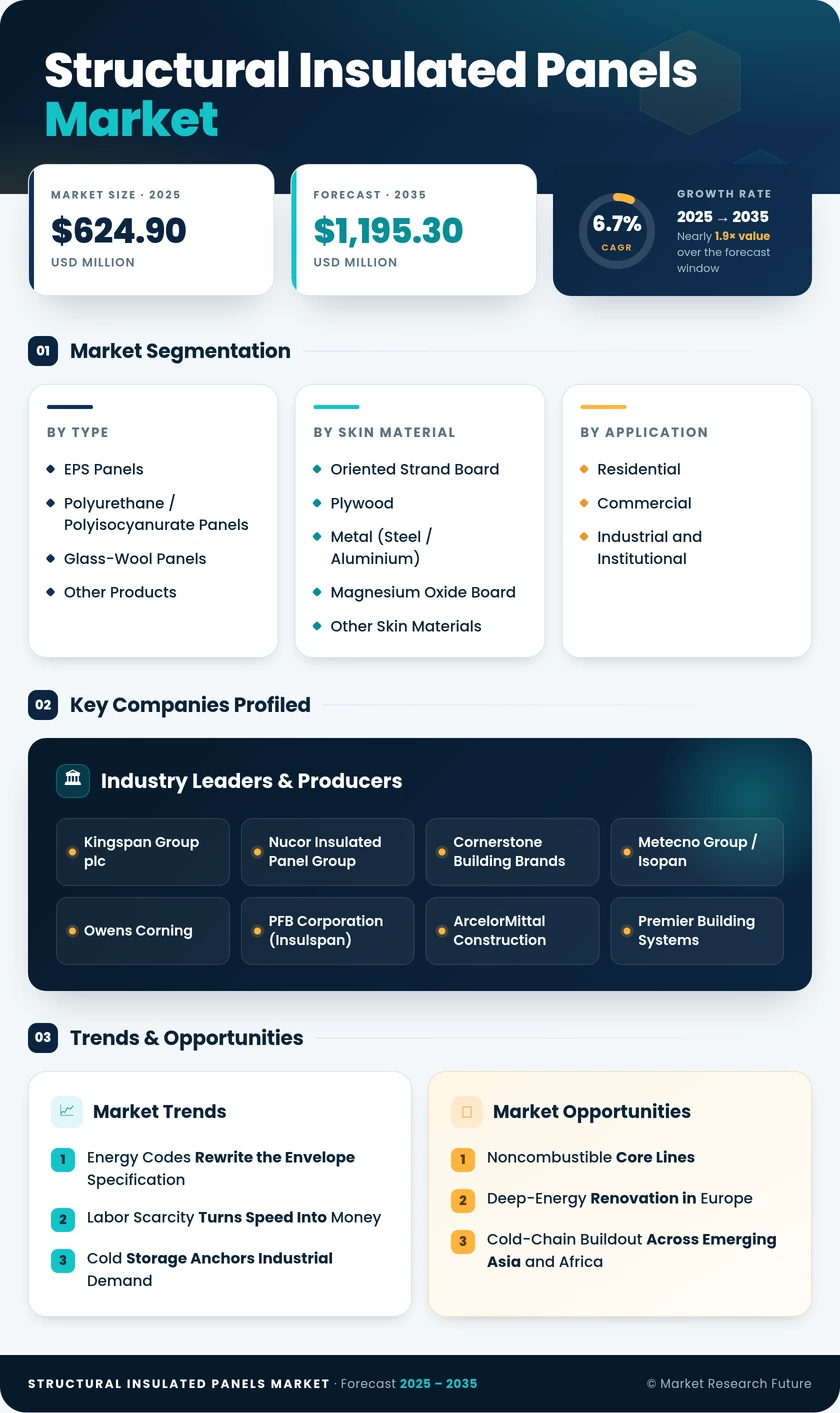
Segmentation Quick Reference
| Dimension | Sub-Segments | Dominant Segment | Fastest Growing Segment |
| By Product | EPS Panels; Polyurethane / Polyisocyanurate Panels; Glass-Wool Panels; Other Products | EPS Panels | Glass-Wool Panels |
| By Skin Material | Oriented Strand Board; Plywood; Metal (Steel / Aluminium); Magnesium Oxide Board; Other Skin Materials | Oriented Strand Board | Magnesium Oxide Board |
| By Application | Building Wall; Building Roof; Building Floor; Cold Storage & Other Applications | Building Wall | Building Roof |
| By End-User Industry | Residential; Commercial; Industrial and Institutional | Residential | Residential |
| By Geography | North America; Europe; Asia-Pacific; South America; Middle East & Africa | North America | Asia-Pacific |
Market Segmentation Overview
By Product
| Sub-Segment | Key Trend |
| EPS Panels | Retains cost leadership as feedstock volatility squeezes premium chemistries |
| Polyurethane / Polyisocyanurate Panels | Thin-section performance preserves rentable volume in refrigerated builds |
| Glass-Wool Panels | Expanding rapidly wherever combustibility restrictions apply to external walls |
| Other Products | Specialty acoustic, cleanroom and hybrid-core formats serving niche specifications |
Core selection is increasingly driven by thermal performance, fire compliance, and application-specific requirements. EPS panels remain widely adopted for their cost efficiency, while polyurethane/polyisocyanurate panels gain preference where higher insulation performance and thinner assemblies are required. Glass-wool panels are favored in applications with stringent fire-safety needs, while other products address specialized performance and regulatory requirements.
By Skin Material
| Sub-Segment | Key Trend |
| Oriented Strand Board | Familiarity with inspectors and lenders sustains residential dominance |
| Plywood | Preferred where moisture exposure or marine-grade durability is specified |
| Metal (Steel / Aluminium) | Industrial and cold-storage standard; benefits from upstream steel integration |
| Magnesium Oxide Board | Fastest growth on noncombustibility, though supplier quality varies widely |
| Other Skin Materials | Fibre cement and composite facings gaining architectural specification |
Skin material selection is increasingly shaped by structural performance, fire resistance, durability, and project-specific compliance requirements. Oriented Strand Board and plywood remain widely used in conventional construction, while metal skins are preferred for durability and industrial applications. Magnesium oxide boards are gaining attention where enhanced fire performance is required, while other skin materials serve specialized applications with distinct performance requirements.
By Application
| Sub-Segment | Key Trend |
| Building Wall | Largest envelope area and greatest thermal penalty from conventional framing |
| Building Roof | Unvented conditioned attic practice drives adoption in humid climates |
| Building Floor | Slab-edge and crawlspace performance requirements tighten under new codes |
| Cold Storage & Other Applications | Refrigerated capacity expansion in emerging economies sustains momentum |
Application demand follows surface area and code exposure together. Walls remain the anchor, but roof assemblies grow faster as designers consolidate three trades into a single factory-finished operation. Cold storage sits apart, driven by food-logistics capital cycles rather than building regulation.
By End-User Industry
| Sub-Segment | Key Trend |
| Residential | Code tightening applies simultaneously across all new dwellings |
| Commercial | Schedule compression value makes demand cyclical and rate-sensitive |
| Industrial and Institutional | Cold storage, schools and healthcare deliver steady, tender-led volume |
Residential construction supplies both scale and growth, an unusual combination created by simultaneous regulatory step-changes. Commercial buyers behave opportunistically, purchasing panels when financing costs make schedule savings material. Institutional procurement, though smaller, offers the most predictable multi-year visibility.
By Region
| Sub-Segment | Key Trend |
| North America | Code adoption plus framing-labour scarcity underpins the largest regional base |
| Europe | Renovation policy and embodied-carbon disclosure reshape specification |
| Asia-Pacific | Cold-chain and housing programmes drive the fastest regional expansion |
| South America | Agribusiness storage and import-substitution fabrication set the pace |
| Middle East & Africa | Giga-projects and grid instability convert efficiency into resilience spending |
Geographic performance correlates more closely with regulatory stringency than with raw construction volume. Mature regions convert codes into specification requirements; emerging regions convert capital projects into panel orders. That distinction determines which product and skin combinations succeed in each market.


 Noah Malgeri
Co-Founder
Noah Malgeri
Co-Founder

 Peter Groot koerkamp
Account and Business Manager
Peter Groot koerkamp
Account and Business Manager

 Younghwan Choi
Senior Retail Manager
Younghwan Choi
Senior Retail Manager

 Mark Irwin
Management Consultant
Mark Irwin
Management Consultant

 Akif Moroglu
Strategy & Business Development Director
Akif Moroglu
Strategy & Business Development Director

 Guilherme Gomes Martins
Product Management Director
Guilherme Gomes Martins
Product Management Director

 Joseph Aguayo
Sales Operations & Pricing Manager
Joseph Aguayo
Sales Operations & Pricing Manager

 La Terria Dodd
Program Support Specialist
La Terria Dodd
Program Support Specialist

 Rob Kooiker
Group Product Manager HVAC & Fire Protection GMA
Rob Kooiker
Group Product Manager HVAC & Fire Protection GMA