
Request Free Sample ×

Kindly complete the form below to receive a free sample of this Report

* Please use a valid business email

Leading companies partner with us for data-driven Insights

clients tt-cursor
Hero Background
English
Chinese
French
Japanese
Korean
German
Spanish

Stolen Vehicle Recovery Market Analysis

ID: MRFR/AT/6183-CR
188 Pages
Shubham Munde
April 2019

Stolen Vehicle Recovery Market Research Report Information By Technology (Ultrasonic, Radio Frequency Identification, Others), By Component (Ultrasonic Intruder Protection System (UIP), Backup Battery Siren (BBS), Central Locking System, Automatic Collision Detection System, Automatic Driver Recognition System (ADRS), Remote Keyless Entry System, Others), By Vehicle Type (Passenger Car, Commercial Vehicle), By Sales Channel (OEM, Aftermarket) And By Region –Market Forecast Till 2035

Share:
Download PDF ×

We do not share your information with anyone. However, we may send you emails based on your report interest from time to time. You may contact us at any time to opt-out.

Stolen Vehicle Recovery Market Infographic
Purchase Options

Market Analysis

In-depth Analysis of Stolen Vehicle Recovery Market Industry Landscape

Currently, vehicles use GPS antenna systems to send their real-time location information to GPS satellites. These satellites then transmit the signal to access points and servers. However, this technology is limited to tracking the location and status of vehicles. Cloud computing, on the other hand, can enhance the effectiveness of retrieving information about stolen vehicles compared to GPS-based trackers.

By utilizing cloud computing, tracking data can be sent to a cloud server through a GSM-enabled device. Storing all the data in a centralized server maintained in the cloud allows authorized users to access this information through a web portal. This web portal enables users to retrieve real-time data about their vehicles. Additionally, cloud computing facilitates data access from any remote location. Even if a vehicle owner loses their cell phone, they can still retrieve the real-time location of their vehicle from the cloud servers. This presents a significant opportunity for market players in the coming years. This approach of using cloud computing offers a more effective way to retrieve information about stolen vehicles compared to traditional GPS systems. With GPS antennas, vehicles send their real-time location information to satellites, which then relay the signal to access points and servers. However, this method has limitations, primarily focusing on tracking a vehicle's location and status.

Cloud computing changes the game by allowing tracking data to be transmitted to a cloud server through GSM-enabled devices. The key advantage lies in centralized data storage within the cloud. Authorized users can access this data through a web portal, gaining real-time insights into their vehicles. What makes cloud computing even more advantageous is its accessibility from any remote location. Even if a vehicle owner loses their cellphone, they can still retrieve their vehicle's real-time location from the cloud servers. This presents a significant opportunity for market players in the years to come.


Author
Author Profile
Shubham Munde
Team Lead - Research

Shubham brings over 7 years of expertise in Market Intelligence and Strategic Consulting, with a strong focus on the Automotive, Aerospace, and Defense sectors. Backed by a solid foundation in semiconductors, electronics, and software, he has successfully delivered high-impact syndicated and custom research on a global scale. His core strengths include market sizing, forecasting, competitive intelligence, consumer insights, and supply chain mapping. Widely recognized for developing scalable growth strategies, Shubham empowers clients to navigate complex markets and achieve a lasting competitive edge. Trusted by start-ups and Fortune 500 companies alike, he consistently converts challenges into strategic opportunities that drive sustainable growth.

Leave a Comment

FAQs

What is the current valuation of the Stolen Vehicle Recovery Market?

<p>The Stolen Vehicle Recovery Market was valued at 7.52 USD Billion in 2024.</p>

What is the projected market size for the Stolen Vehicle Recovery Market by 2035?

<p>The market is projected to reach 15.24 USD Billion by 2035.</p>

What is the expected CAGR for the Stolen Vehicle Recovery Market during the forecast period 2025 - 2035?

<p>The expected CAGR for the market during 2025 - 2035 is 6.63%.</p>

Which technology segments are included in the Stolen Vehicle Recovery Market?

<p>Key technology segments include Ultrasonic, Radio Frequency Identification, and Others, with valuations ranging from 1.5 to 8.24 USD Billion.</p>

What are the primary components contributing to the Stolen Vehicle Recovery Market?

<p>Components such as Ultrasonic Intruder Protection System and Backup Battery Siren are valued between 1.0 and 3.0 USD Billion.</p>

How do vehicle types influence the Stolen Vehicle Recovery Market?

<p>Passenger Cars and Commercial Vehicles are significant segments, with valuations of 4.52 to 9.24 USD Billion and 3.0 to 6.0 USD Billion, respectively.</p>

What sales channels are prevalent in the Stolen Vehicle Recovery Market?

The market is divided into OEM and Aftermarket sales channels, each valued between 3.76 and 7.62 USD Billion.

Who are the key players in the Stolen Vehicle Recovery Market?

Prominent players include LoJack, OnStar, Carfax, and Verizon Connect, among others.

What role does technology play in the growth of the Stolen Vehicle Recovery Market?

Technology advancements in tracking and recovery systems are likely to drive market growth significantly during the forecast period.

How does the market's growth potential compare across different segments?

The market's growth potential appears robust across various segments, particularly in technology and vehicle types, indicating diverse opportunities.

Market Summary

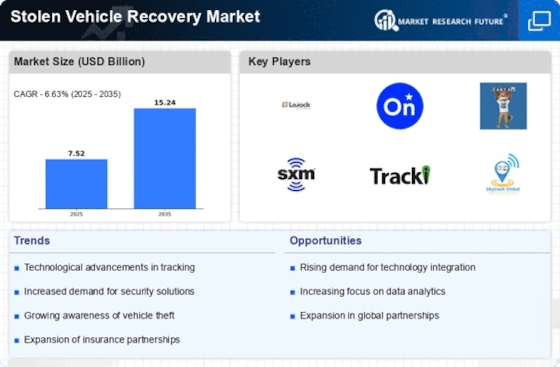
As per Market Research Future analysis, the Stolen Vehicle Recovery Market Size was estimated at 7.52 USD Billion in 2024. The Stolen Vehicle Recovery industry is projected to grow from 8.019 USD Billion in 2025 to 15.24 USD Billion by 2035, exhibiting a compound annual growth rate (CAGR) of 6.63% during the forecast period 2025 - 2035

Key Market Trends & Highlights

The Stolen Vehicle Recovery Market is experiencing robust growth driven by technological advancements and increasing consumer awareness.

  • North America remains the largest market for stolen vehicle recovery solutions, driven by high vehicle theft rates. Asia-Pacific is emerging as the fastest-growing region, fueled by rapid urbanization and rising disposable incomes. Radio Frequency Identification technology dominates the market, while Ultrasonic systems are gaining traction as the fastest-growing segment. Increasing vehicle theft rates and technological innovations are key drivers propelling market expansion.

Market Size & Forecast

2024 Market Size 7.52 (USD Billion)
2035 Market Size 15.24 (USD Billion)
CAGR (2025 - 2035) 6.63%
Largest Regional Market Share in 2024 North America

Major Players

LoJack (US), <a href="https://www.onstar.com/services/stolen-vehicle-assistance">OnStar</a> (US), Carfax (US), SiriusXM (US), Tracki (US), GPS Tracking (US), <a href="https://www.viper.com/">Viper</a> (US), Teletrac Navman (US), Verizon Connect (US)

Market Trends

The Stolen Vehicle Recovery Market is currently experiencing a notable evolution, driven by advancements in technology and increasing concerns regarding vehicle theft. The widespread adoption of vehicle recovery systems, including GPS-enabled stolen vehicle recovery systems and advanced stolen car trackers, has significantly transformed the market landscape.. This technological shift appears to enhance the efficiency of recovery operations, as law enforcement agencies and recovery services leverage real-time data to locate vehicles more effectively. As a result, stolen vehicle recovery capabilities are becoming more accurate, reliable, and widely adopted across both commercial and private vehicle segments. Furthermore, the growing awareness among consumers about the importance of vehicle security is likely to propel demand for recovery solutions, as individuals seek to protect their investments from theft. In addition to technological advancements, the Stolen Vehicle Recovery Market is influenced by regulatory frameworks and insurance policies that encourage the adoption of recovery systems. Governments worldwide are implementing stricter regulations to combat vehicle theft, which may lead to increased collaboration between law enforcement and recovery service providers. This synergy could foster a more robust recovery ecosystem, ultimately benefiting consumers. As the market continues to evolve, it is essential to monitor these trends and their implications for stakeholders involved in vehicle security and recovery services.

Technological Advancements

The Stolen Vehicle Recovery Market is witnessing a surge in technological innovations, particularly in GPS tracking and mobile applications. These advancements facilitate real-time monitoring and swift recovery of stolen vehicles, enhancing operational efficiency for recovery services.

Regulatory Influence

Government regulations are increasingly shaping the Stolen Vehicle Recovery Market. Stricter laws aimed at reducing vehicle theft are prompting collaboration between law enforcement and recovery service providers, potentially leading to improved recovery rates.

Consumer Awareness

There is a growing awareness among consumers regarding vehicle security, which is likely to drive demand for recovery solutions. As individuals recognize the importance of safeguarding their vehicles, the market for recovery services may expand.

Stolen Vehicle Recovery Market Market Drivers

Technological Innovations

Technological advancements play a crucial role in shaping the Stolen Vehicle Recovery Market. Innovations such as real-time GPS tracking, mobile applications, and advanced alarm systems have transformed how vehicles are monitored and recovered. The integration of artificial intelligence and machine learning into recovery systems enhances their effectiveness, allowing for quicker response times and improved recovery rates. Market data indicates that the adoption of these technologies has led to a significant increase in recovery rates, with some systems reporting recovery success rates exceeding 90%. As technology continues to evolve, the Stolen Vehicle Recovery Market is expected to witness further growth, driven by the demand for more sophisticated and reliable recovery solutions.

Growing Consumer Awareness

Consumer awareness regarding vehicle security and recovery options is on the rise, significantly impacting the Stolen Vehicle Recovery Market. As individuals become more informed about the risks associated with vehicle theft, they are increasingly seeking out recovery solutions to protect their investments. Educational campaigns and marketing efforts by recovery service providers have contributed to this heightened awareness. Data indicates that consumers are now more inclined to invest in recovery technologies, with a notable increase in inquiries and purchases of tracking devices and recovery services. This trend suggests that the Stolen Vehicle Recovery Market will continue to grow as consumers prioritize security and recovery in their vehicle purchasing decisions.

Increasing Vehicle Theft Rates

The rising incidence of vehicle theft is a primary driver for the Stolen Vehicle Recovery Market. According to recent statistics, vehicle thefts have surged by approximately 10% over the past year, prompting consumers and businesses to seek effective recovery solutions. This trend is particularly pronounced in urban areas, where the concentration of vehicles is higher, leading to increased opportunities for theft. As a result, the demand for advanced recovery systems, such as GPS tracking and immobilization technologies, is likely to grow. The Stolen Vehicle Recovery Market is thus positioned to expand as stakeholders recognize the necessity of investing in preventive measures and recovery solutions to mitigate losses associated with vehicle theft.

Insurance Industry Collaboration

The collaboration between the insurance sector and the Stolen Vehicle Recovery Market is becoming increasingly vital. Insurers are recognizing the benefits of offering recovery solutions as part of their policies, which can lead to reduced claims and lower premiums for policyholders. This trend is evident as many insurance companies now provide discounts for vehicles equipped with recovery systems. Market analysis suggests that this partnership not only enhances customer satisfaction but also drives the adoption of recovery technologies. As more insurers integrate recovery solutions into their offerings, the Stolen Vehicle Recovery Market is likely to experience a boost in demand, creating a win-win scenario for both insurers and consumers.

Regulatory Support and Incentives

Regulatory frameworks and government incentives are emerging as influential factors in the Stolen Vehicle Recovery Market. Governments are increasingly recognizing the economic impact of vehicle theft and are implementing policies to encourage the adoption of recovery technologies. Incentives such as tax breaks for consumers who install recovery systems or grants for businesses that invest in these technologies are becoming more common. This regulatory support not only fosters innovation within the industry but also encourages consumers to adopt recovery solutions. As these policies gain traction, the Stolen Vehicle Recovery Market is likely to benefit from increased investment and consumer participation, further driving market growth.

Market Segment Insights

By Technology: Radio Frequency Identification (Largest) vs. Ultrasonic (Fastest-Growing)

The Stolen Vehicle Recovery Market is increasingly characterized by the prominence of Radio Frequency Identification (RFID) technology, which holds the largest share due to its effective tracking capabilities and widespread adoption. Ultrasonic technology, while smaller in market share, is gaining traction owing to its innovative approach to recovery processes, and its share is expected to grow significantly as technology advances and user adoption rates increase.

Technology: RFID (Dominant) vs. Ultrasonic (Emerging)

In the Stolen Vehicle Recovery Market, Radio Frequency Identification (RFID) is the dominant technology, known for its reliability and efficiency in tracking and recovering stolen vehicles. It utilizes radio waves to identify and track tags attached to vehicles, providing instantaneous data. On the other hand, Ultrasonic technology, characterized by its use of sound waves for detection, is emerging rapidly. Its appeal lies in the ability to operate in various environments where traditional methods may fail, positioning it as a game-changer in vehicle recovery solutions. As this segment evolves, the integration of advanced technologies and better user interfaces will further enhance their positions in the market.

By Component: Ultrasonic Intruder Protection System (UIP) (Largest) vs. Remote Keyless Entry System (Fastest-Growing)

In the Stolen Vehicle Recovery Market, the component segment comprises various systems designed to enhance vehicle security. The largest share is held by the Ultrasonic Intruder Protection System (UIP), which effectively detects unauthorized access and enhances the overall security framework. Additionally, the Remote Keyless Entry System is emerging rapidly, gaining market share due to its convenience and growing popularity among consumers who prefer keyless operation to ensure ease of access while maintaining security. The growth trends in this segment are driven by increasing concerns over vehicle theft and advancements in technology. The popularity of smart vehicles and innovative protective mechanisms fuel the demand for sophisticated systems like the Automatic Driver Recognition System (ADRS) and Backup Battery Siren (BBS), which integrate seamlessly into modern vehicles. As vehicle security becomes more paramount, manufacturers are investing in the development and enhancement of these components to address consumer needs, creating a dynamic landscape for the overall market.

Ultrasonic Intruder Protection System (UIP) (Dominant) vs. Remote Keyless Entry System (Emerging)

The Ultrasonic Intruder Protection System (UIP) remains a dominant force in the Stolen Vehicle Recovery Market due to its robust capabilities to detect breaches effectively. This system utilizes ultrasonic sound waves to identify movement within the vehicle's perimeter, thus minimizing the risk of unauthorized tampering. On the other hand, the Remote Keyless Entry System is capturing the attention of consumers rapidly, characterized by its ease of use and integration with modern vehicle technologies. This system not only allows for keyless access but also enhances overall user convenience while providing substantial security features. As interest in automated and intelligent vehicle security systems rises, both UIP and Remote Keyless Entry are positioned well, catering to different consumer preferences and enhancing overall market engagement.

By Vehicle Type: Passenger Car (Largest) vs. Commercial Vehicle (Fastest-Growing)

In the Stolen Vehicle Recovery Market, the distribution of market share among vehicle types illustrates a significant lead for <a href="https://www.marketresearchfuture.com/reports/passenger-cars-market-42133">passenger cars</a>. This segment is favored due to its broad consumer base and heightened concern over personal vehicle theft, which drives demand for recovery solutions. The anticipated prevalence of passenger vehicles continues to make them the primary focus for the industry, highlighting the importance of specialized recovery technologies and services.

Passenger Car (Dominant) vs. Commercial Vehicle (Emerging)

The passenger car segment dominates the Stolen Vehicle Recovery Market due to its larger number of registrations and a heightened emphasis on personal safety and theft prevention. This segment appeals to private owners who often invest in advanced recovery systems, ensuring the protection of their vehicles. Conversely, commercial vehicles, while currently classified as emerging, are rapidly gaining traction. The rise in logistics and transportation services has initiated a shift towards enhanced security measures. As businesses increasingly recognize the financial impact of vehicle theft, investment in recovery technologies for commercial fleets is demonstrating substantial growth, suggesting that this segment may soon rival that of passenger cars in terms of market significance.

By Sales Channel: OEM (Largest) vs. Aftermarket (Fastest-Growing)

In the Stolen Vehicle Recovery Market, the sales channel segment is primarily divided into two categories: OEM and Aftermarket. OEM accounts for a significant portion of the market, leveraging established relationships with vehicle manufacturers and creating a trusted channel for recovery solutions. The Aftermarket segment, while smaller in share, is increasingly popular among consumers seeking cost-effective alternatives and innovative solutions not provided by OEMs.

Sales Channel: OEM (Dominant) vs. Aftermarket (Emerging)

The OEM segment is characterized by its strong association with vehicle manufacturers, providing tailored recovery solutions that integrate seamlessly with original vehicle systems. They maintain a dominant position in the market thanks to their reputation for reliability and quality. In contrast, the Aftermarket segment is emerging rapidly, catering to a growing demographic of budget-conscious consumers. This segment thrives on innovation and customization, offering diverse products that enhance vehicle recovery capabilities. With advancements in technology and increased consumer awareness, the Aftermarket is poised for substantial growth, driven by the demand for more flexible and varied recovery solutions.

Get more detailed insights about Stolen Vehicle Recovery Market Research Report - Global Forecast to 2035

Regional Insights

North America : Market Leader in Recovery Solutions

North America is the largest market for stolen vehicle recovery solutions, driven by high vehicle ownership rates and increasing theft incidents. The region holds approximately 60% of the global market share, with the U.S. being the primary contributor, followed by Canada. Regulatory support for vehicle tracking technologies and rising consumer awareness about vehicle security are key growth drivers. The competitive landscape is robust, featuring major players like LoJack, OnStar, and SiriusXM. These companies leverage advanced technologies such as GPS tracking and telematics to enhance recovery rates. The presence of established automotive manufacturers further strengthens the market, as they often integrate recovery solutions into their vehicles, ensuring a comprehensive approach to vehicle security.

Europe : Emerging Market with Regulations

Europe is witnessing significant growth in the stolen vehicle recovery market, driven by stringent regulations aimed at reducing vehicle theft. The region accounts for approximately 25% of the global market share, with the UK and Germany being the largest contributors. The European Union's initiatives to enhance vehicle security and promote the use of tracking technologies are pivotal in shaping market dynamics. Leading countries like the UK and Germany are home to several key players, including Carfax and Teletrac Navman. The competitive landscape is characterized by a mix of local and international companies, all striving to innovate and provide effective recovery solutions. The increasing adoption of connected vehicle technologies is expected to further propel market growth in the coming years.

Asia-Pacific : Rapid Growth in Emerging Markets

Asia-Pacific is rapidly emerging as a significant player in the stolen vehicle recovery market, driven by increasing vehicle ownership and rising crime rates. The region holds about 10% of the global market share, with countries like China and India leading the charge. Government initiatives to enhance public safety and promote vehicle tracking technologies are key growth catalysts in this region. China is at the forefront, with a growing number of local companies entering the market, alongside established players like GPS Tracking and Viper. The competitive landscape is evolving, with a focus on integrating advanced technologies such as IoT and AI into recovery solutions. As awareness of vehicle security increases, the demand for effective recovery systems is expected to surge in the coming years.

Middle East and Africa : Untapped Potential in Recovery Market

The Middle East and Africa region presents untapped potential in the stolen vehicle recovery market, driven by increasing vehicle theft rates and a growing middle class. The region currently holds about 5% of the global market share, with South Africa and the UAE being the largest markets. Government efforts to enhance security measures and promote vehicle tracking solutions are crucial for market growth. In South Africa, local companies are beginning to offer innovative recovery solutions, while the UAE is witnessing a rise in international players entering the market. The competitive landscape is still developing, with opportunities for growth as awareness of vehicle security increases. As the region continues to urbanize, the demand for effective recovery solutions is expected to rise significantly.

Key Players and Competitive Insights

The Stolen Vehicle Recovery Market is characterized by a dynamic competitive landscape, driven by technological advancements and increasing consumer demand for security solutions. Key players such as LoJack (US), OnStar (US), and SiriusXM (US) are at the forefront, leveraging innovative technologies and strategic partnerships to enhance their service offerings. LoJack (US) focuses on integrating advanced tracking technologies with law enforcement collaboration, while OnStar (US) emphasizes its connected vehicle services to provide real-time recovery solutions. SiriusXM (US) is expanding its reach through partnerships with automotive manufacturers, thereby embedding recovery solutions directly into vehicles, which collectively shapes a competitive environment that prioritizes technological integration and customer-centric services. In terms of business tactics, companies are increasingly localizing their operations to enhance responsiveness to regional market needs. This localization, coupled with supply chain optimization, allows for more efficient service delivery and cost management. The market appears moderately fragmented, with several players vying for market share, yet the influence of major companies remains substantial. Their collective strategies not only enhance their competitive positioning but also set industry standards that smaller players often strive to emulate. In August 2025, LoJack (US) announced a partnership with a leading automotive manufacturer to integrate its recovery technology into new vehicle models. This strategic move is likely to enhance LoJack's market penetration and brand visibility, as it positions the company as a key player in the OEM space. By embedding its technology directly into vehicles, LoJack may significantly reduce the time taken for recovery, thereby improving customer satisfaction and trust in its services. In September 2025, OnStar (US) launched an upgraded version of its vehicle recovery service, which utilizes AI-driven analytics to predict theft patterns and enhance recovery rates. This innovation not only demonstrates OnStar's commitment to leveraging technology for improved service delivery but also positions the company as a leader in proactive theft prevention. The integration of AI into their operations could potentially redefine industry standards for recovery services, making them more efficient and effective. In July 2025, SiriusXM (US) expanded its service offerings by introducing a subscription model that includes enhanced vehicle tracking and recovery features. This strategic shift towards a subscription-based model may allow SiriusXM to create a more predictable revenue stream while providing customers with flexible options tailored to their needs. Such a model could also foster customer loyalty, as users may be more inclined to remain subscribed for ongoing services. As of October 2025, the Stolen Vehicle Recovery Market is witnessing trends that emphasize digitalization, sustainability, and the integration of artificial intelligence. Strategic alliances among key players are increasingly shaping the competitive landscape, fostering innovation and enhancing service capabilities. The shift from price-based competition to a focus on technological differentiation and supply chain reliability is evident, suggesting that future competitive advantages will hinge on the ability to innovate and adapt to evolving consumer expectations.

Key Companies in the Stolen Vehicle Recovery Market include

Industry Developments

February 2019: Mitsubishi Electric, a Japanese multinational electronics and electrical equipment manufacturing company, has developed sensor-security technology to detect attacks on equipment sensors. This technology detects measurement-data inconsistencies by using a proprietary algorithm in sensor fusion algorithms. The fusion algorithms automatically combine multiple sensors to measure and control in-vehicle devices.

February 2019: Continental AG, a German multinational automotive parts manufacturer, has developed the in-vehicle server that acts as a fundamental component of modern electronic systems in vehicles. The in-vehicle server plays a crucial role as a network manager, allowing for wireless software updates and remote maintenance, which are essential for vehicle cybersecurity.

Future Outlook

Stolen Vehicle Recovery Market Future Outlook

The Stolen Vehicle Recovery Market is projected to grow at a 6.63% CAGR from 2025 to 2035, driven by technological advancements, increasing vehicle theft rates, and enhanced law enforcement collaboration.

New opportunities lie in:

  • <p>Integration of AI-driven analytics for predictive recovery solutions. Development of mobile applications for real-time vehicle tracking. Partnerships with insurance companies for streamlined recovery processes.</p>

By 2035, the market is expected to be robust, driven by innovation and strategic partnerships.

Market Segmentation

Stolen Vehicle Recovery Market Component Outlook

  • Ultrasonic Intruder Protection System (UIP)
  • Backup Battery Siren (BBS)
  • Central Locking System
  • Automatic Collision Detection System
  • Automatic Driver Recognition System (ADRS)
  • Remote Keyless Entry System
  • Others

Stolen Vehicle Recovery Market Technology Outlook

  • Ultrasonic
  • Radio Frequency Identification
  • Others

Stolen Vehicle Recovery Market Vehicle Type Outlook

  • Passenger Car
  • Commercial Vehicle

Stolen Vehicle Recovery Market Sales Channel Outlook

  • OEM
  • Aftermarket

Report Scope

MARKET SIZE 2024 7.52(USD Billion)
MARKET SIZE 2025 8.019(USD Billion)
MARKET SIZE 2035 15.24(USD Billion)
COMPOUND ANNUAL GROWTH RATE (CAGR) 6.63% (2025 - 2035)
REPORT COVERAGE Revenue Forecast, Competitive Landscape, Growth Factors, and Trends
BASE YEAR 2024
Market Forecast Period 2025 - 2035
Historical Data 2019 - 2024
Market Forecast Units USD Billion
Key Companies Profiled LoJack (US), OnStar (US), Carfax (US), SiriusXM (US), Tracki (US), GPS Tracking (US), Viper (US), Teletrac Navman (US), Verizon Connect (US)
Segments Covered Technology, Component, Vehicle Type, Sales Channel, Region –Market Forecast Till 2035
Key Market Opportunities Integration of advanced tracking technologies enhances recovery rates in the Stolen Vehicle Recovery Market.
Key Market Dynamics Rising technological advancements in tracking systems enhance recovery rates and reshape competitive dynamics in the stolen vehicle recovery market.
Countries Covered North America, Europe, APAC, South America, MEA

FAQs

What is the current valuation of the Stolen Vehicle Recovery Market?

<p>The Stolen Vehicle Recovery Market was valued at 7.52 USD Billion in 2024.</p>

What is the projected market size for the Stolen Vehicle Recovery Market by 2035?

<p>The market is projected to reach 15.24 USD Billion by 2035.</p>

What is the expected CAGR for the Stolen Vehicle Recovery Market during the forecast period 2025 - 2035?

<p>The expected CAGR for the market during 2025 - 2035 is 6.63%.</p>

Which technology segments are included in the Stolen Vehicle Recovery Market?

<p>Key technology segments include Ultrasonic, Radio Frequency Identification, and Others, with valuations ranging from 1.5 to 8.24 USD Billion.</p>

What are the primary components contributing to the Stolen Vehicle Recovery Market?

<p>Components such as Ultrasonic Intruder Protection System and Backup Battery Siren are valued between 1.0 and 3.0 USD Billion.</p>

How do vehicle types influence the Stolen Vehicle Recovery Market?

<p>Passenger Cars and Commercial Vehicles are significant segments, with valuations of 4.52 to 9.24 USD Billion and 3.0 to 6.0 USD Billion, respectively.</p>

What sales channels are prevalent in the Stolen Vehicle Recovery Market?

The market is divided into OEM and Aftermarket sales channels, each valued between 3.76 and 7.62 USD Billion.

Who are the key players in the Stolen Vehicle Recovery Market?

Prominent players include LoJack, OnStar, Carfax, and Verizon Connect, among others.

What role does technology play in the growth of the Stolen Vehicle Recovery Market?

Technology advancements in tracking and recovery systems are likely to drive market growth significantly during the forecast period.

How does the market's growth potential compare across different segments?

The market's growth potential appears robust across various segments, particularly in technology and vehicle types, indicating diverse opportunities.

  1. SECTION I: EXECUTIVE SUMMARY AND KEY HIGHLIGHTS
    1. | 1.1 EXECUTIVE SUMMARY
    2. | | 1.1.1 Market Overview
    3. | | 1.1.2 Key Findings
    4. | | 1.1.3 Market Segmentation
    5. | | 1.1.4 Competitive Landscape
    6. | | 1.1.5 Challenges and Opportunities
    7. | | 1.1.6 Future Outlook
  2. SECTION II: SCOPING, METHODOLOGY AND MARKET STRUCTURE
    1. | 2.1 MARKET INTRODUCTION
    2. | | 2.1.1 Definition
    3. | | 2.1.2 Scope of the study
    4. | | | 2.1.2.1 Research Objective
    5. | | | 2.1.2.2 Assumption
    6. | | | 2.1.2.3 Limitations
    7. | 2.2 RESEARCH METHODOLOGY
    8. | | 2.2.1 Overview
    9. | | 2.2.2 Data Mining
    10. | | 2.2.3 Secondary Research
    11. | | 2.2.4 Primary Research
    12. | | | 2.2.4.1 Primary Interviews and Information Gathering Process
    13. | | | 2.2.4.2 Breakdown of Primary Respondents
    14. | | 2.2.5 Forecasting Model
    15. | | 2.2.6 Market Size Estimation
    16. | | | 2.2.6.1 Bottom-Up Approach
    17. | | | 2.2.6.2 Top-Down Approach
    18. | | 2.2.7 Data Triangulation
    19. | | 2.2.8 Validation
  3. SECTION III: QUALITATIVE ANALYSIS
    1. | 3.1 MARKET DYNAMICS
    2. | | 3.1.1 Overview
    3. | | 3.1.2 Drivers
    4. | | 3.1.3 Restraints
    5. | | 3.1.4 Opportunities
    6. | 3.2 MARKET FACTOR ANALYSIS
    7. | | 3.2.1 Value chain Analysis
    8. | | 3.2.2 Porter's Five Forces Analysis
    9. | | | 3.2.2.1 Bargaining Power of Suppliers
    10. | | | 3.2.2.2 Bargaining Power of Buyers
    11. | | | 3.2.2.3 Threat of New Entrants
    12. | | | 3.2.2.4 Threat of Substitutes
    13. | | | 3.2.2.5 Intensity of Rivalry
    14. | | 3.2.3 COVID-19 Impact Analysis
    15. | | | 3.2.3.1 Market Impact Analysis
    16. | | | 3.2.3.2 Regional Impact
    17. | | | 3.2.3.3 Opportunity and Threat Analysis
  4. SECTION IV: QUANTITATIVE ANALYSIS
    1. | 4.1 Automobile, BY Technology (USD Billion)
    2. | | 4.1.1 Ultrasonic
    3. | | 4.1.2 Radio Frequency Identification
    4. | | 4.1.3 Others
    5. | 4.2 Automobile, BY Component (USD Billion)
    6. | | 4.2.1 Ultrasonic Intruder Protection System (UIP)
    7. | | 4.2.2 Backup Battery Siren (BBS)
    8. | | 4.2.3 Central Locking System
    9. | | 4.2.4 Automatic Collision Detection System
    10. | | 4.2.5 Automatic Driver Recognition System (ADRS)
    11. | | 4.2.6 Remote Keyless Entry System
    12. | | 4.2.7 Others
    13. | 4.3 Automobile, BY Vehicle Type (USD Billion)
    14. | | 4.3.1 Passenger Car
    15. | | 4.3.2 Commercial Vehicle
    16. | 4.4 Automobile, BY Sales Channel (USD Billion)
    17. | | 4.4.1 OEM
    18. | | 4.4.2 Aftermarket
    19. | 4.5 Automobile, BY Region (USD Billion)
    20. | | 4.5.1 North America
    21. | | | 4.5.1.1 US
    22. | | | 4.5.1.2 Canada
    23. | | 4.5.2 Europe
    24. | | | 4.5.2.1 Germany
    25. | | | 4.5.2.2 UK
    26. | | | 4.5.2.3 France
    27. | | | 4.5.2.4 Russia
    28. | | | 4.5.2.5 Italy
    29. | | | 4.5.2.6 Spain
    30. | | | 4.5.2.7 Rest of Europe
    31. | | 4.5.3 APAC
    32. | | | 4.5.3.1 China
    33. | | | 4.5.3.2 India
    34. | | | 4.5.3.3 Japan
    35. | | | 4.5.3.4 South Korea
    36. | | | 4.5.3.5 Malaysia
    37. | | | 4.5.3.6 Thailand
    38. | | | 4.5.3.7 Indonesia
    39. | | | 4.5.3.8 Rest of APAC
    40. | | 4.5.4 South America
    41. | | | 4.5.4.1 Brazil
    42. | | | 4.5.4.2 Mexico
    43. | | | 4.5.4.3 Argentina
    44. | | | 4.5.4.4 Rest of South America
    45. | | 4.5.5 MEA
    46. | | | 4.5.5.1 GCC Countries
    47. | | | 4.5.5.2 South Africa
    48. | | | 4.5.5.3 Rest of MEA
  5. SECTION V: COMPETITIVE ANALYSIS
    1. | 5.1 Competitive Landscape
    2. | | 5.1.1 Overview
    3. | | 5.1.2 Competitive Analysis
    4. | | 5.1.3 Market share Analysis
    5. | | 5.1.4 Major Growth Strategy in the Automobile
    6. | | 5.1.5 Competitive Benchmarking
    7. | | 5.1.6 Leading Players in Terms of Number of Developments in the Automobile
    8. | | 5.1.7 Key developments and growth strategies
    9. | | | 5.1.7.1 New Product Launch/Service Deployment
    10. | | | 5.1.7.2 Merger & Acquisitions
    11. | | | 5.1.7.3 Joint Ventures
    12. | | 5.1.8 Major Players Financial Matrix
    13. | | | 5.1.8.1 Sales and Operating Income
    14. | | | 5.1.8.2 Major Players R&D Expenditure. 2023
    15. | 5.2 Company Profiles
    16. | | 5.2.1 LoJack (US)
    17. | | | 5.2.1.1 Financial Overview
    18. | | | 5.2.1.2 Products Offered
    19. | | | 5.2.1.3 Key Developments
    20. | | | 5.2.1.4 SWOT Analysis
    21. | | | 5.2.1.5 Key Strategies
    22. | | 5.2.2 OnStar (US)
    23. | | | 5.2.2.1 Financial Overview
    24. | | | 5.2.2.2 Products Offered
    25. | | | 5.2.2.3 Key Developments
    26. | | | 5.2.2.4 SWOT Analysis
    27. | | | 5.2.2.5 Key Strategies
    28. | | 5.2.3 Carfax (US)
    29. | | | 5.2.3.1 Financial Overview
    30. | | | 5.2.3.2 Products Offered
    31. | | | 5.2.3.3 Key Developments
    32. | | | 5.2.3.4 SWOT Analysis
    33. | | | 5.2.3.5 Key Strategies
    34. | | 5.2.4 SiriusXM (US)
    35. | | | 5.2.4.1 Financial Overview
    36. | | | 5.2.4.2 Products Offered
    37. | | | 5.2.4.3 Key Developments
    38. | | | 5.2.4.4 SWOT Analysis
    39. | | | 5.2.4.5 Key Strategies
    40. | | 5.2.5 Tracki (US)
    41. | | | 5.2.5.1 Financial Overview
    42. | | | 5.2.5.2 Products Offered
    43. | | | 5.2.5.3 Key Developments
    44. | | | 5.2.5.4 SWOT Analysis
    45. | | | 5.2.5.5 Key Strategies
    46. | | 5.2.6 GPS Tracking (US)
    47. | | | 5.2.6.1 Financial Overview
    48. | | | 5.2.6.2 Products Offered
    49. | | | 5.2.6.3 Key Developments
    50. | | | 5.2.6.4 SWOT Analysis
    51. | | | 5.2.6.5 Key Strategies
    52. | | 5.2.7 Viper (US)
    53. | | | 5.2.7.1 Financial Overview
    54. | | | 5.2.7.2 Products Offered
    55. | | | 5.2.7.3 Key Developments
    56. | | | 5.2.7.4 SWOT Analysis
    57. | | | 5.2.7.5 Key Strategies
    58. | | 5.2.8 Teletrac Navman (US)
    59. | | | 5.2.8.1 Financial Overview
    60. | | | 5.2.8.2 Products Offered
    61. | | | 5.2.8.3 Key Developments
    62. | | | 5.2.8.4 SWOT Analysis
    63. | | | 5.2.8.5 Key Strategies
    64. | | 5.2.9 Verizon Connect (US)
    65. | | | 5.2.9.1 Financial Overview
    66. | | | 5.2.9.2 Products Offered
    67. | | | 5.2.9.3 Key Developments
    68. | | | 5.2.9.4 SWOT Analysis
    69. | | | 5.2.9.5 Key Strategies
    70. | 5.3 Appendix
    71. | | 5.3.1 References
    72. | | 5.3.2 Related Reports
  6. LIST OF FIGURES
    1. | 6.1 MARKET SYNOPSIS
    2. | 6.2 NORTH AMERICA MARKET ANALYSIS
    3. | 6.3 US MARKET ANALYSIS BY TECHNOLOGY
    4. | 6.4 US MARKET ANALYSIS BY COMPONENT
    5. | 6.5 US MARKET ANALYSIS BY VEHICLE TYPE
    6. | 6.6 US MARKET ANALYSIS BY SALES CHANNEL
    7. | 6.7 CANADA MARKET ANALYSIS BY TECHNOLOGY
    8. | 6.8 CANADA MARKET ANALYSIS BY COMPONENT
    9. | 6.9 CANADA MARKET ANALYSIS BY VEHICLE TYPE
    10. | 6.10 CANADA MARKET ANALYSIS BY SALES CHANNEL
    11. | 6.11 EUROPE MARKET ANALYSIS
    12. | 6.12 GERMANY MARKET ANALYSIS BY TECHNOLOGY
    13. | 6.13 GERMANY MARKET ANALYSIS BY COMPONENT
    14. | 6.14 GERMANY MARKET ANALYSIS BY VEHICLE TYPE
    15. | 6.15 GERMANY MARKET ANALYSIS BY SALES CHANNEL
    16. | 6.16 UK MARKET ANALYSIS BY TECHNOLOGY
    17. | 6.17 UK MARKET ANALYSIS BY COMPONENT
    18. | 6.18 UK MARKET ANALYSIS BY VEHICLE TYPE
    19. | 6.19 UK MARKET ANALYSIS BY SALES CHANNEL
    20. | 6.20 FRANCE MARKET ANALYSIS BY TECHNOLOGY
    21. | 6.21 FRANCE MARKET ANALYSIS BY COMPONENT
    22. | 6.22 FRANCE MARKET ANALYSIS BY VEHICLE TYPE
    23. | 6.23 FRANCE MARKET ANALYSIS BY SALES CHANNEL
    24. | 6.24 RUSSIA MARKET ANALYSIS BY TECHNOLOGY
    25. | 6.25 RUSSIA MARKET ANALYSIS BY COMPONENT
    26. | 6.26 RUSSIA MARKET ANALYSIS BY VEHICLE TYPE
    27. | 6.27 RUSSIA MARKET ANALYSIS BY SALES CHANNEL
    28. | 6.28 ITALY MARKET ANALYSIS BY TECHNOLOGY
    29. | 6.29 ITALY MARKET ANALYSIS BY COMPONENT
    30. | 6.30 ITALY MARKET ANALYSIS BY VEHICLE TYPE
    31. | 6.31 ITALY MARKET ANALYSIS BY SALES CHANNEL
    32. | 6.32 SPAIN MARKET ANALYSIS BY TECHNOLOGY
    33. | 6.33 SPAIN MARKET ANALYSIS BY COMPONENT
    34. | 6.34 SPAIN MARKET ANALYSIS BY VEHICLE TYPE
    35. | 6.35 SPAIN MARKET ANALYSIS BY SALES CHANNEL
    36. | 6.36 REST OF EUROPE MARKET ANALYSIS BY TECHNOLOGY
    37. | 6.37 REST OF EUROPE MARKET ANALYSIS BY COMPONENT
    38. | 6.38 REST OF EUROPE MARKET ANALYSIS BY VEHICLE TYPE
    39. | 6.39 REST OF EUROPE MARKET ANALYSIS BY SALES CHANNEL
    40. | 6.40 APAC MARKET ANALYSIS
    41. | 6.41 CHINA MARKET ANALYSIS BY TECHNOLOGY
    42. | 6.42 CHINA MARKET ANALYSIS BY COMPONENT
    43. | 6.43 CHINA MARKET ANALYSIS BY VEHICLE TYPE
    44. | 6.44 CHINA MARKET ANALYSIS BY SALES CHANNEL
    45. | 6.45 INDIA MARKET ANALYSIS BY TECHNOLOGY
    46. | 6.46 INDIA MARKET ANALYSIS BY COMPONENT
    47. | 6.47 INDIA MARKET ANALYSIS BY VEHICLE TYPE
    48. | 6.48 INDIA MARKET ANALYSIS BY SALES CHANNEL
    49. | 6.49 JAPAN MARKET ANALYSIS BY TECHNOLOGY
    50. | 6.50 JAPAN MARKET ANALYSIS BY COMPONENT
    51. | 6.51 JAPAN MARKET ANALYSIS BY VEHICLE TYPE
    52. | 6.52 JAPAN MARKET ANALYSIS BY SALES CHANNEL
    53. | 6.53 SOUTH KOREA MARKET ANALYSIS BY TECHNOLOGY
    54. | 6.54 SOUTH KOREA MARKET ANALYSIS BY COMPONENT
    55. | 6.55 SOUTH KOREA MARKET ANALYSIS BY VEHICLE TYPE
    56. | 6.56 SOUTH KOREA MARKET ANALYSIS BY SALES CHANNEL
    57. | 6.57 MALAYSIA MARKET ANALYSIS BY TECHNOLOGY
    58. | 6.58 MALAYSIA MARKET ANALYSIS BY COMPONENT
    59. | 6.59 MALAYSIA MARKET ANALYSIS BY VEHICLE TYPE
    60. | 6.60 MALAYSIA MARKET ANALYSIS BY SALES CHANNEL
    61. | 6.61 THAILAND MARKET ANALYSIS BY TECHNOLOGY
    62. | 6.62 THAILAND MARKET ANALYSIS BY COMPONENT
    63. | 6.63 THAILAND MARKET ANALYSIS BY VEHICLE TYPE
    64. | 6.64 THAILAND MARKET ANALYSIS BY SALES CHANNEL
    65. | 6.65 INDONESIA MARKET ANALYSIS BY TECHNOLOGY
    66. | 6.66 INDONESIA MARKET ANALYSIS BY COMPONENT
    67. | 6.67 INDONESIA MARKET ANALYSIS BY VEHICLE TYPE
    68. | 6.68 INDONESIA MARKET ANALYSIS BY SALES CHANNEL
    69. | 6.69 REST OF APAC MARKET ANALYSIS BY TECHNOLOGY
    70. | 6.70 REST OF APAC MARKET ANALYSIS BY COMPONENT
    71. | 6.71 REST OF APAC MARKET ANALYSIS BY VEHICLE TYPE
    72. | 6.72 REST OF APAC MARKET ANALYSIS BY SALES CHANNEL
    73. | 6.73 SOUTH AMERICA MARKET ANALYSIS
    74. | 6.74 BRAZIL MARKET ANALYSIS BY TECHNOLOGY
    75. | 6.75 BRAZIL MARKET ANALYSIS BY COMPONENT
    76. | 6.76 BRAZIL MARKET ANALYSIS BY VEHICLE TYPE
    77. | 6.77 BRAZIL MARKET ANALYSIS BY SALES CHANNEL
    78. | 6.78 MEXICO MARKET ANALYSIS BY TECHNOLOGY
    79. | 6.79 MEXICO MARKET ANALYSIS BY COMPONENT
    80. | 6.80 MEXICO MARKET ANALYSIS BY VEHICLE TYPE
    81. | 6.81 MEXICO MARKET ANALYSIS BY SALES CHANNEL
    82. | 6.82 ARGENTINA MARKET ANALYSIS BY TECHNOLOGY
    83. | 6.83 ARGENTINA MARKET ANALYSIS BY COMPONENT
    84. | 6.84 ARGENTINA MARKET ANALYSIS BY VEHICLE TYPE
    85. | 6.85 ARGENTINA MARKET ANALYSIS BY SALES CHANNEL
    86. | 6.86 REST OF SOUTH AMERICA MARKET ANALYSIS BY TECHNOLOGY
    87. | 6.87 REST OF SOUTH AMERICA MARKET ANALYSIS BY COMPONENT
    88. | 6.88 REST OF SOUTH AMERICA MARKET ANALYSIS BY VEHICLE TYPE
    89. | 6.89 REST OF SOUTH AMERICA MARKET ANALYSIS BY SALES CHANNEL
    90. | 6.90 MEA MARKET ANALYSIS
    91. | 6.91 GCC COUNTRIES MARKET ANALYSIS BY TECHNOLOGY
    92. | 6.92 GCC COUNTRIES MARKET ANALYSIS BY COMPONENT
    93. | 6.93 GCC COUNTRIES MARKET ANALYSIS BY VEHICLE TYPE
    94. | 6.94 GCC COUNTRIES MARKET ANALYSIS BY SALES CHANNEL
    95. | 6.95 SOUTH AFRICA MARKET ANALYSIS BY TECHNOLOGY
    96. | 6.96 SOUTH AFRICA MARKET ANALYSIS BY COMPONENT
    97. | 6.97 SOUTH AFRICA MARKET ANALYSIS BY VEHICLE TYPE
    98. | 6.98 SOUTH AFRICA MARKET ANALYSIS BY SALES CHANNEL
    99. | 6.99 REST OF MEA MARKET ANALYSIS BY TECHNOLOGY
    100. | 6.100 REST OF MEA MARKET ANALYSIS BY COMPONENT
    101. | 6.101 REST OF MEA MARKET ANALYSIS BY VEHICLE TYPE
    102. | 6.102 REST OF MEA MARKET ANALYSIS BY SALES CHANNEL
    103. | 6.103 KEY BUYING CRITERIA OF AUTOMOBILE
    104. | 6.104 RESEARCH PROCESS OF MRFR
    105. | 6.105 DRO ANALYSIS OF AUTOMOBILE
    106. | 6.106 DRIVERS IMPACT ANALYSIS: AUTOMOBILE
    107. | 6.107 RESTRAINTS IMPACT ANALYSIS: AUTOMOBILE
    108. | 6.108 SUPPLY / VALUE CHAIN: AUTOMOBILE
    109. | 6.109 AUTOMOBILE, BY TECHNOLOGY, 2024 (% SHARE)
    110. | 6.110 AUTOMOBILE, BY TECHNOLOGY, 2024 TO 2035 (USD Billion)
    111. | 6.111 AUTOMOBILE, BY COMPONENT, 2024 (% SHARE)
    112. | 6.112 AUTOMOBILE, BY COMPONENT, 2024 TO 2035 (USD Billion)
    113. | 6.113 AUTOMOBILE, BY VEHICLE TYPE, 2024 (% SHARE)
    114. | 6.114 AUTOMOBILE, BY VEHICLE TYPE, 2024 TO 2035 (USD Billion)
    115. | 6.115 AUTOMOBILE, BY SALES CHANNEL, 2024 (% SHARE)
    116. | 6.116 AUTOMOBILE, BY SALES CHANNEL, 2024 TO 2035 (USD Billion)
    117. | 6.117 BENCHMARKING OF MAJOR COMPETITORS
  7. LIST OF TABLES
    1. | 7.1 LIST OF ASSUMPTIONS
    2. | | 7.1.1
    3. | 7.2 North America MARKET SIZE ESTIMATES; FORECAST
    4. | | 7.2.1 BY TECHNOLOGY, 2025-2035 (USD Billion)
    5. | | 7.2.2 BY COMPONENT, 2025-2035 (USD Billion)
    6. | | 7.2.3 BY VEHICLE TYPE, 2025-2035 (USD Billion)
    7. | | 7.2.4 BY SALES CHANNEL, 2025-2035 (USD Billion)
    8. | 7.3 US MARKET SIZE ESTIMATES; FORECAST
    9. | | 7.3.1 BY TECHNOLOGY, 2025-2035 (USD Billion)
    10. | | 7.3.2 BY COMPONENT, 2025-2035 (USD Billion)
    11. | | 7.3.3 BY VEHICLE TYPE, 2025-2035 (USD Billion)
    12. | | 7.3.4 BY SALES CHANNEL, 2025-2035 (USD Billion)
    13. | 7.4 Canada MARKET SIZE ESTIMATES; FORECAST
    14. | | 7.4.1 BY TECHNOLOGY, 2025-2035 (USD Billion)
    15. | | 7.4.2 BY COMPONENT, 2025-2035 (USD Billion)
    16. | | 7.4.3 BY VEHICLE TYPE, 2025-2035 (USD Billion)
    17. | | 7.4.4 BY SALES CHANNEL, 2025-2035 (USD Billion)
    18. | 7.5 Europe MARKET SIZE ESTIMATES; FORECAST
    19. | | 7.5.1 BY TECHNOLOGY, 2025-2035 (USD Billion)
    20. | | 7.5.2 BY COMPONENT, 2025-2035 (USD Billion)
    21. | | 7.5.3 BY VEHICLE TYPE, 2025-2035 (USD Billion)
    22. | | 7.5.4 BY SALES CHANNEL, 2025-2035 (USD Billion)
    23. | 7.6 Germany MARKET SIZE ESTIMATES; FORECAST
    24. | | 7.6.1 BY TECHNOLOGY, 2025-2035 (USD Billion)
    25. | | 7.6.2 BY COMPONENT, 2025-2035 (USD Billion)
    26. | | 7.6.3 BY VEHICLE TYPE, 2025-2035 (USD Billion)
    27. | | 7.6.4 BY SALES CHANNEL, 2025-2035 (USD Billion)
    28. | 7.7 UK MARKET SIZE ESTIMATES; FORECAST
    29. | | 7.7.1 BY TECHNOLOGY, 2025-2035 (USD Billion)
    30. | | 7.7.2 BY COMPONENT, 2025-2035 (USD Billion)
    31. | | 7.7.3 BY VEHICLE TYPE, 2025-2035 (USD Billion)
    32. | | 7.7.4 BY SALES CHANNEL, 2025-2035 (USD Billion)
    33. | 7.8 France MARKET SIZE ESTIMATES; FORECAST
    34. | | 7.8.1 BY TECHNOLOGY, 2025-2035 (USD Billion)
    35. | | 7.8.2 BY COMPONENT, 2025-2035 (USD Billion)
    36. | | 7.8.3 BY VEHICLE TYPE, 2025-2035 (USD Billion)
    37. | | 7.8.4 BY SALES CHANNEL, 2025-2035 (USD Billion)
    38. | 7.9 Russia MARKET SIZE ESTIMATES; FORECAST
    39. | | 7.9.1 BY TECHNOLOGY, 2025-2035 (USD Billion)
    40. | | 7.9.2 BY COMPONENT, 2025-2035 (USD Billion)
    41. | | 7.9.3 BY VEHICLE TYPE, 2025-2035 (USD Billion)
    42. | | 7.9.4 BY SALES CHANNEL, 2025-2035 (USD Billion)
    43. | 7.10 Italy MARKET SIZE ESTIMATES; FORECAST
    44. | | 7.10.1 BY TECHNOLOGY, 2025-2035 (USD Billion)
    45. | | 7.10.2 BY COMPONENT, 2025-2035 (USD Billion)
    46. | | 7.10.3 BY VEHICLE TYPE, 2025-2035 (USD Billion)
    47. | | 7.10.4 BY SALES CHANNEL, 2025-2035 (USD Billion)
    48. | 7.11 Spain MARKET SIZE ESTIMATES; FORECAST
    49. | | 7.11.1 BY TECHNOLOGY, 2025-2035 (USD Billion)
    50. | | 7.11.2 BY COMPONENT, 2025-2035 (USD Billion)
    51. | | 7.11.3 BY VEHICLE TYPE, 2025-2035 (USD Billion)
    52. | | 7.11.4 BY SALES CHANNEL, 2025-2035 (USD Billion)
    53. | 7.12 Rest of Europe MARKET SIZE ESTIMATES; FORECAST
    54. | | 7.12.1 BY TECHNOLOGY, 2025-2035 (USD Billion)
    55. | | 7.12.2 BY COMPONENT, 2025-2035 (USD Billion)
    56. | | 7.12.3 BY VEHICLE TYPE, 2025-2035 (USD Billion)
    57. | | 7.12.4 BY SALES CHANNEL, 2025-2035 (USD Billion)
    58. | 7.13 APAC MARKET SIZE ESTIMATES; FORECAST
    59. | | 7.13.1 BY TECHNOLOGY, 2025-2035 (USD Billion)
    60. | | 7.13.2 BY COMPONENT, 2025-2035 (USD Billion)
    61. | | 7.13.3 BY VEHICLE TYPE, 2025-2035 (USD Billion)
    62. | | 7.13.4 BY SALES CHANNEL, 2025-2035 (USD Billion)
    63. | 7.14 China MARKET SIZE ESTIMATES; FORECAST
    64. | | 7.14.1 BY TECHNOLOGY, 2025-2035 (USD Billion)
    65. | | 7.14.2 BY COMPONENT, 2025-2035 (USD Billion)
    66. | | 7.14.3 BY VEHICLE TYPE, 2025-2035 (USD Billion)
    67. | | 7.14.4 BY SALES CHANNEL, 2025-2035 (USD Billion)
    68. | 7.15 India MARKET SIZE ESTIMATES; FORECAST
    69. | | 7.15.1 BY TECHNOLOGY, 2025-2035 (USD Billion)
    70. | | 7.15.2 BY COMPONENT, 2025-2035 (USD Billion)
    71. | | 7.15.3 BY VEHICLE TYPE, 2025-2035 (USD Billion)
    72. | | 7.15.4 BY SALES CHANNEL, 2025-2035 (USD Billion)
    73. | 7.16 Japan MARKET SIZE ESTIMATES; FORECAST
    74. | | 7.16.1 BY TECHNOLOGY, 2025-2035 (USD Billion)
    75. | | 7.16.2 BY COMPONENT, 2025-2035 (USD Billion)
    76. | | 7.16.3 BY VEHICLE TYPE, 2025-2035 (USD Billion)
    77. | | 7.16.4 BY SALES CHANNEL, 2025-2035 (USD Billion)
    78. | 7.17 South Korea MARKET SIZE ESTIMATES; FORECAST
    79. | | 7.17.1 BY TECHNOLOGY, 2025-2035 (USD Billion)
    80. | | 7.17.2 BY COMPONENT, 2025-2035 (USD Billion)
    81. | | 7.17.3 BY VEHICLE TYPE, 2025-2035 (USD Billion)
    82. | | 7.17.4 BY SALES CHANNEL, 2025-2035 (USD Billion)
    83. | 7.18 Malaysia MARKET SIZE ESTIMATES; FORECAST
    84. | | 7.18.1 BY TECHNOLOGY, 2025-2035 (USD Billion)
    85. | | 7.18.2 BY COMPONENT, 2025-2035 (USD Billion)
    86. | | 7.18.3 BY VEHICLE TYPE, 2025-2035 (USD Billion)
    87. | | 7.18.4 BY SALES CHANNEL, 2025-2035 (USD Billion)
    88. | 7.19 Thailand MARKET SIZE ESTIMATES; FORECAST
    89. | | 7.19.1 BY TECHNOLOGY, 2025-2035 (USD Billion)
    90. | | 7.19.2 BY COMPONENT, 2025-2035 (USD Billion)
    91. | | 7.19.3 BY VEHICLE TYPE, 2025-2035 (USD Billion)
    92. | | 7.19.4 BY SALES CHANNEL, 2025-2035 (USD Billion)
    93. | 7.20 Indonesia MARKET SIZE ESTIMATES; FORECAST
    94. | | 7.20.1 BY TECHNOLOGY, 2025-2035 (USD Billion)
    95. | | 7.20.2 BY COMPONENT, 2025-2035 (USD Billion)
    96. | | 7.20.3 BY VEHICLE TYPE, 2025-2035 (USD Billion)
    97. | | 7.20.4 BY SALES CHANNEL, 2025-2035 (USD Billion)
    98. | 7.21 Rest of APAC MARKET SIZE ESTIMATES; FORECAST
    99. | | 7.21.1 BY TECHNOLOGY, 2025-2035 (USD Billion)
    100. | | 7.21.2 BY COMPONENT, 2025-2035 (USD Billion)
    101. | | 7.21.3 BY VEHICLE TYPE, 2025-2035 (USD Billion)
    102. | | 7.21.4 BY SALES CHANNEL, 2025-2035 (USD Billion)
    103. | 7.22 South America MARKET SIZE ESTIMATES; FORECAST
    104. | | 7.22.1 BY TECHNOLOGY, 2025-2035 (USD Billion)
    105. | | 7.22.2 BY COMPONENT, 2025-2035 (USD Billion)
    106. | | 7.22.3 BY VEHICLE TYPE, 2025-2035 (USD Billion)
    107. | | 7.22.4 BY SALES CHANNEL, 2025-2035 (USD Billion)
    108. | 7.23 Brazil MARKET SIZE ESTIMATES; FORECAST
    109. | | 7.23.1 BY TECHNOLOGY, 2025-2035 (USD Billion)
    110. | | 7.23.2 BY COMPONENT, 2025-2035 (USD Billion)
    111. | | 7.23.3 BY VEHICLE TYPE, 2025-2035 (USD Billion)
    112. | | 7.23.4 BY SALES CHANNEL, 2025-2035 (USD Billion)
    113. | 7.24 Mexico MARKET SIZE ESTIMATES; FORECAST
    114. | | 7.24.1 BY TECHNOLOGY, 2025-2035 (USD Billion)
    115. | | 7.24.2 BY COMPONENT, 2025-2035 (USD Billion)
    116. | | 7.24.3 BY VEHICLE TYPE, 2025-2035 (USD Billion)
    117. | | 7.24.4 BY SALES CHANNEL, 2025-2035 (USD Billion)
    118. | 7.25 Argentina MARKET SIZE ESTIMATES; FORECAST
    119. | | 7.25.1 BY TECHNOLOGY, 2025-2035 (USD Billion)
    120. | | 7.25.2 BY COMPONENT, 2025-2035 (USD Billion)
    121. | | 7.25.3 BY VEHICLE TYPE, 2025-2035 (USD Billion)
    122. | | 7.25.4 BY SALES CHANNEL, 2025-2035 (USD Billion)
    123. | 7.26 Rest of South America MARKET SIZE ESTIMATES; FORECAST
    124. | | 7.26.1 BY TECHNOLOGY, 2025-2035 (USD Billion)
    125. | | 7.26.2 BY COMPONENT, 2025-2035 (USD Billion)
    126. | | 7.26.3 BY VEHICLE TYPE, 2025-2035 (USD Billion)
    127. | | 7.26.4 BY SALES CHANNEL, 2025-2035 (USD Billion)
    128. | 7.27 MEA MARKET SIZE ESTIMATES; FORECAST
    129. | | 7.27.1 BY TECHNOLOGY, 2025-2035 (USD Billion)
    130. | | 7.27.2 BY COMPONENT, 2025-2035 (USD Billion)
    131. | | 7.27.3 BY VEHICLE TYPE, 2025-2035 (USD Billion)
    132. | | 7.27.4 BY SALES CHANNEL, 2025-2035 (USD Billion)
    133. | 7.28 GCC Countries MARKET SIZE ESTIMATES; FORECAST
    134. | | 7.28.1 BY TECHNOLOGY, 2025-2035 (USD Billion)
    135. | | 7.28.2 BY COMPONENT, 2025-2035 (USD Billion)
    136. | | 7.28.3 BY VEHICLE TYPE, 2025-2035 (USD Billion)
    137. | | 7.28.4 BY SALES CHANNEL, 2025-2035 (USD Billion)
    138. | 7.29 South Africa MARKET SIZE ESTIMATES; FORECAST
    139. | | 7.29.1 BY TECHNOLOGY, 2025-2035 (USD Billion)
    140. | | 7.29.2 BY COMPONENT, 2025-2035 (USD Billion)
    141. | | 7.29.3 BY VEHICLE TYPE, 2025-2035 (USD Billion)
    142. | | 7.29.4 BY SALES CHANNEL, 2025-2035 (USD Billion)
    143. | 7.30 Rest of MEA MARKET SIZE ESTIMATES; FORECAST
    144. | | 7.30.1 BY TECHNOLOGY, 2025-2035 (USD Billion)
    145. | | 7.30.2 BY COMPONENT, 2025-2035 (USD Billion)
    146. | | 7.30.3 BY VEHICLE TYPE, 2025-2035 (USD Billion)
    147. | | 7.30.4 BY SALES CHANNEL, 2025-2035 (USD Billion)
    148. | 7.31 PRODUCT LAUNCH/PRODUCT DEVELOPMENT/APPROVAL
    149. | | 7.31.1
    150. | 7.32 ACQUISITION/PARTNERSHIP
    151. | | 7.32.1

Automobile Market Segmentation

Automobile By Technology (USD Billion, 2025-2035)

  • Ultrasonic
  • Radio Frequency Identification
  • Others

Automobile By Component (USD Billion, 2025-2035)

  • Ultrasonic Intruder Protection System (UIP)
  • Backup Battery Siren (BBS)
  • Central Locking System
  • Automatic Collision Detection System
  • Automatic Driver Recognition System (ADRS)
  • Remote Keyless Entry System
  • Others

Automobile By Vehicle Type (USD Billion, 2025-2035)

  • Passenger Car
  • Commercial Vehicle

Automobile By Sales Channel (USD Billion, 2025-2035)

  • OEM
  • Aftermarket
Infographic

Free Sample Request

Kindly complete the form below to receive a free sample of this Report

Get Free Sample

Customer Strories

Compare Licence

×
Features License Type
Single User Multiuser License Enterprise User
Price $4,950 $5,950 $7,250
Maximum User Access Limit 1 User Upto 10 Users Unrestricted Access Throughout the Organization
Free Customization
Direct Access to Analyst
Deliverable Format
Platform Access
Discount on Next Purchase 10% 15% 15%
Printable Versions