Top Industry Leaders in the Statistical Analytics Market
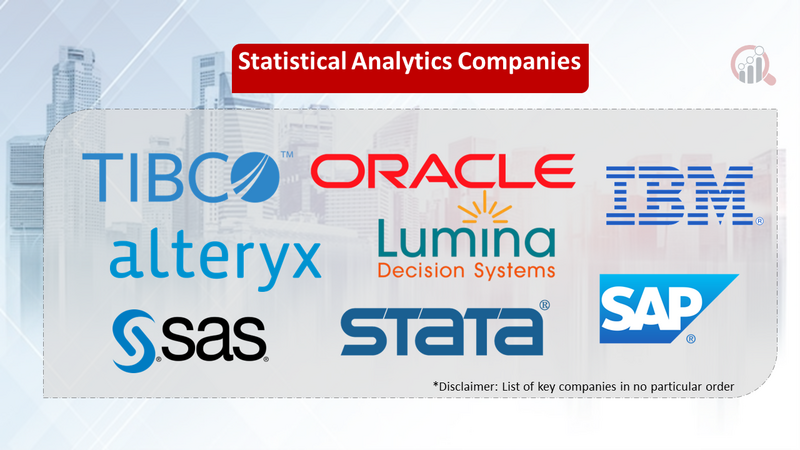
Competitive Landscape of Statistical Analytics Market: A Deep Dive
The statistical analytics market is experiencing explosive growth, propelled by surging data volumes, advancements in artificial intelligence and machine learning, and the insatiable appetite of businesses for data-driven insights. Navigating this dynamic landscape requires a clear understanding of the key players, their strategies, and the factors shaping market share.
Major Players:
- SAP SE (Germany)
- Lumina Decision Systems (U.S.)
- Alteryx (U.S.)
- International Business Machine (U.S.)
- SAS Institute (U.S.)
- Oracle Corporation (U.S.)
- Tibco Software Inc. (U.S.)
- Qlik Software (U.S.)
- StataCorp (U.S.)
- Plug & Score (U.S.)
Strategies for Market Domination:
- Product Innovation: Continuous development of advanced analytics features, integration of AI and machine learning, and expansion into cloud-based and mobile offerings are crucial for retaining and attracting customers.
- Strategic Partnerships: Collaborations with data providers, consulting firms, and technology giants open up new market segments and broaden solution portfolios.
- Acquisition Spree: Merging with niche players or smaller competitors allows established vendors to access new technologies, talent, and customer bases.
- Subscription and Freemium Models: Transitioning from perpetual licenses to subscription models fosters recurring revenue streams and wider user adoption, particularly for cloud-based solutions.
- Ease of Use and Democratization: Making statistical analytics accessible through user-friendly interfaces, drag-and-drop functionalities, and visual data storytelling capabilities expands the market beyond data scientists to business users.
Market Share Analysis:
- Revenue and Market Share: While established vendors like SAS hold significant market share by catering to large enterprises, cloud-based solutions from Microsoft and AWS are rapidly gaining traction due to their scalability and affordability.
- Geographical Distribution: North America and Europe dominate the market, but with the burgeoning data volumes in Asia-Pacific and Latin America, these regions present lucrative growth opportunities.
- Industry Verticals: Banking, finance, and insurance remain key sectors, but healthcare, retail, and manufacturing are increasingly adopting statistical analytics for optimizing operations and gaining customer insights.
New Entrants and Emerging Trends:
- Predictive Analytics and AI Integration: Companies are incorporating advanced algorithms and machine learning techniques for predictive modeling, risk assessment, and personalized recommendations.
- Big Data Analytics: Solutions capable of handling and analyzing massive, unstructured datasets are in high demand across industries.
- Data Visualization and Storytelling: Tools that translate complex data into compelling visual narratives are crucial for communicating insights to non-technical stakeholders.
- Self-Service Analytics: Empowering business users with intuitive tools for independent data exploration and analysis is a growing trend.
Investment Focus:
- Cloud-Based Solutions: Continued investment in cloud infrastructure, secure data storage, and scalable analytics platforms is paramount for remaining competitive.
- Talent Acquisition and Training: Recruiting and retaining data scientists, statisticians, and AI experts is crucial for developing cutting-edge solutions.
- Strategic Partnerships and Acquisitions: Collaborations and mergers are likely to accelerate as companies seek to broaden their reach and acquire new technologies.
- Open-Source Integration: Leveraging open-source libraries and frameworks can reduce development costs and attract a wider developer community.
Latest Company Updates:
- Dec 21, 2023: Microsoft acquires Databricks for $26.25 billion, a major move to strengthen its cloud analytics offerings and compete with Amazon Web Services (AWS) and Google Cloud Platform (GCP).
- Nov 30, 2023: IBM partners with SAP to develop a joint analytics solution for enterprise resource planning (ERP) systems, aiming to provide businesses with deeper insights into their operations.
- Nov 15, 2023: Google Cloud unveils Vertex AI Explainable AI (XAI) service to help developers understand and interpret the results of their AI models, addressing concerns about transparency and bias in AI-powered analytics.