×
Request Free Sample ×

Kindly complete the form below to receive a free sample of this Report

* Please use a valid business email

Leading companies partner with us for data-driven Insights

clients tt-cursor
Hero Background
English
Chinese
French
Japanese
Korean
German
Spanish

Stainless Steel IBCs Market Trends

ID: MRFR/PCM/10626-CR
111 Pages
Snehal Singh
August 2023

Stainless Steel IBC’s Market Research Report Information by Capacity (Up to 1,000 Ltrs, 1,001 to 1,500 Ltrs, 1,501 to 2,000 Ltrs and Above 2,000 Ltrs), By End-user (Industrial Chemicals, Petroleum & Lubricants, Food & Beverages, Construction, Pharmaceutical, and Others), And by Region (North America, South America, Europe, Asia Pacific, And Middle East & Africa) –Market Forecast Till 2035

Share:
Download PDF ×

We do not share your information with anyone. However, we may send you emails based on your report interest from time to time. You may contact us at any time to opt-out.

Stainless Steel IBCs Market Infographic
Purchase Options

Market Trends

Key Emerging Trends in the Stainless Steel IBCs Market

the industrial and logistics sectors' evolving needs. Rising Adoption in Chemical and Pharmaceutical Industries: There is a significant uptick in the adoption of Stainless Steel IBCs in the chemical and pharmaceutical industries. These industries require robust and contamination-resistant containers for the storage and transportation of chemicals and pharmaceutical products. Stainless Steel IBCs, known for their durability and corrosion resistance, meet these stringent requirements, driving their demand in these sectors. Shift Towards Sustainable Packaging Solutions: Sustainability is a driving force in the Stainless Steel IBC market. Companies are increasingly recognizing the environmental impact of packaging materials and are opting for reusable and recyclable options. Stainless Steel IBCs, being durable and long-lasting, are considered sustainable alternatives to single-use containers, aligning with the broader industry push towards eco-friendly packaging solutions. Increased Emphasis on Hygiene and Cleanability: Industries such as food and beverages, pharmaceuticals, and cosmetics are placing a heightened emphasis on hygiene and cleanability in their packaging solutions. Stainless Steel IBCs, with their smooth and non-porous surfaces, are easy to clean and maintain sanitary conditions. This trend is particularly crucial in applications where product purity is paramount. Customization to Meet Diverse Industry Requirements: The Stainless Steel IBC market is witnessing a trend towards customization. Manufacturers are offering IBCs with variable capacities, configurations, and additional features to meet the diverse requirements of different industries. Customization allows businesses to optimize their logistics and storage processes, contributing to increased efficiency. Integration of Smart Technologies: Industry 4.0 is making its mark on the Stainless Steel IBC market with the integration of smart technologies. IoT (Internet of Things) sensors and monitoring systems are being incorporated into Stainless Steel IBCs to enable real-time tracking of contents, conditions, and even predictive maintenance. This connectivity enhances supply chain visibility and improves overall operational efficiency. Global Supply Chain Challenges Impacting Demand: Similar to other industries, the Stainless Steel IBC market is not immune to global supply chain challenges. Disruptions in the supply chain, including raw material shortages and transportation issues, can impact the availability and pricing of Stainless Steel IBCs. Companies are navigating these challenges through strategic sourcing and diversification. Expansion of Food and Beverage Industry Driving Demand: With the global expansion of the food and beverage industry, there is a parallel increase in the demand for suitable packaging solutions. Stainless Steel IBCs are preferred in this industry due to their ability to maintain product integrity, resist corrosion from food products, and meet stringent hygiene standards. Focus on Lightweight Alternatives: While Stainless Steel IBCs are valued for their durability, there is a growing interest in exploring lightweight alternatives. Some industries are exploring the use of materials like composite alloys to achieve a balance between strength and weight, aiming to reduce transportation costs and enhance overall logistics efficiency.

Author
Snehal Singh
Assistant Manager - Research

High acumen in analyzing complex macro & micro markets with more than 6 years of work experience in the field of market research. By implementing her analytical skills in forecasting and estimation into market research reports, she has expertise in Packaging, Construction, and Equipment domains. She handles a team size of 20-25 resources and ensures smooth running of the projects, associated marketing activities, and client servicing.

Leave a Comment

FAQs

What is the projected market valuation for the Global Stainless Steel IBC's Market in 2035?

<p>The projected market valuation for the Global Stainless Steel IBC's Market in 2035 is 5073.07 USD Million.</p>

What was the overall market valuation for the Global Stainless Steel IBC's Market in 2024?

<p>The overall market valuation for the Global Stainless Steel IBC's Market in 2024 was 3092.64 USD Million.</p>

What is the expected CAGR for the Global Stainless Steel IBC's Market during the forecast period 2025 - 2035?

<p>The expected CAGR for the Global Stainless Steel IBC's Market during the forecast period 2025 - 2035 is 4.6%.</p>

Which companies are considered key players in the Global Stainless Steel IBC's Market?

<p>Key players in the Global Stainless Steel IBC's Market include Schutz Container System GmbH, Snyder Industries Inc, Mauser Packaging Solutions, and Greif Inc.</p>

What are the primary end-user segments for the Global Stainless Steel IBC's Market?

<p>Primary end-user segments for the Global Stainless Steel IBC's Market include Industrial Chemicals, Petroleum & Lubricants, Food & Beverages, and Pharmaceuticals.</p>

What was the market valuation for the Food & Beverages segment in 2024?

<p>The market valuation for the Food & Beverages segment in 2024 was 800.0 USD Million.</p>

How does the market valuation for the Pharmaceutical segment compare to others in 2024?

In 2024, the market valuation for the Pharmaceutical segment was 500.0 USD Million, indicating a robust demand compared to segments like Construction.

What capacity segment had the highest market valuation in 2024?

In 2024, the capacity segment '1,501 to 2,000 Liters' had the highest market valuation at 900.0 USD Million.

What is the market valuation for the 'Above 2,000 Liters' capacity segment in 2024?

The market valuation for the 'Above 2,000 Liters' capacity segment in 2024 was 792.64 USD Million.

What trends are expected to influence the Global Stainless Steel IBC's Market from 2025 to 2035?

Trends influencing the Global Stainless Steel IBC's Market from 2025 to 2035 may include increased demand from the Food &amp; Beverages and Pharmaceutical sectors.

Market Summary

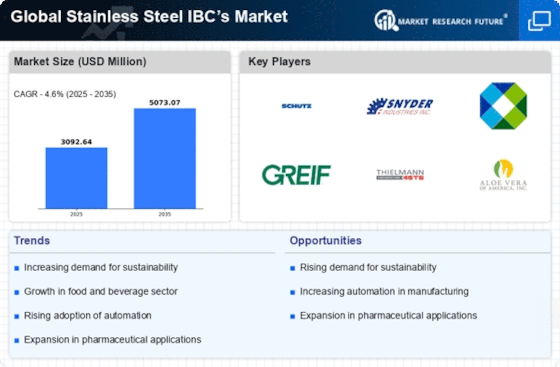
As per Market Research Future analysis, the Global Stainless Steel IBC’s Market Size was estimated at 3092.64 USD Million in 2024. The stainless steel IBC industry is projected to grow from USD 3234.97 Million in 2025 to USD 5073.07 Million by 2035, exhibiting a compound annual growth rate (CAGR) of 4.6% during the forecast period 2025 - 2035

Key Market Trends & Highlights

The Global Stainless Steel IBC Market is poised for robust growth driven by sustainability and technological advancements.

  • The market is increasingly influenced by sustainability initiatives, reflecting a broader global trend towards eco-friendly practices.
  • Technological advancements are enhancing the efficiency and functionality of stainless steel IBCs, catering to diverse industrial needs.
  • North America remains the largest market, while the Asia-Pacific region is emerging as the fastest-growing area for stainless steel IBCs.
  • The rising demand in the food and beverage sector, coupled with regulatory compliance, serves as a key driver for market expansion.

Market Size & Forecast

2024 Market Size 3092.64 (USD Million)
2035 Market Size 5073.07 (USD Million)
CAGR (2025 - 2035) 4.6%
Largest Regional Market Share in 2024 North America

Major Players

Schutz Container System GmbH (DE), Snyder Industries Inc (US), Mauser Packaging Solutions (DE), Greif Inc (US), Thielmann (DE), Aloe Vera of America Inc (US), BWAY Corporation (US), Cylindrical Containers Inc (US)

Market Trends

The Global Stainless Steel IBC’s Market is currently experiencing a notable transformation, driven by various factors that influence demand and supply dynamics. The increasing emphasis on sustainability and environmental responsibility has led to a growing preference for stainless steel intermediate bulk containers (IBCs) over traditional materials. This shift is largely attributed to the durability and recyclability of stainless steel, which aligns with the global push towards reducing plastic waste. Furthermore, industries such as food and beverage, pharmaceuticals, and chemicals are recognizing the advantages of stainless steel IBCs in terms of hygiene, safety, and compliance with stringent regulations. As a result, manufacturers are adapting their production processes to meet the evolving needs of these sectors, thereby enhancing their market presence. In addition to sustainability, technological advancements are playing a crucial role in shaping the Global Stainless Steel IBC’s Market. Innovations in design and manufacturing techniques are enabling the production of more efficient and cost-effective containers. This evolution not only improves the performance of IBCs but also expands their application range across various industries. Moreover, the increasing globalization of trade is likely to further boost the demand for stainless steel IBCs, as companies seek reliable and robust solutions for transporting goods across borders. Overall, the market appears poised for growth, with a focus on quality, efficiency, and environmental stewardship driving future developments.

Sustainability Focus

The emphasis on sustainability is reshaping the Global Stainless Steel IBC’s Market. Companies are increasingly opting for stainless steel due to its recyclability and reduced environmental impact compared to plastic alternatives. This trend reflects a broader commitment to eco-friendly practices across various industries.

Technological Advancements

Innovations in manufacturing processes are enhancing the efficiency and functionality of stainless steel IBCs. These advancements allow for the production of containers that are not only more durable but also tailored to meet specific industry requirements, thereby expanding their applicability.

Global Trade Expansion

The ongoing globalization of trade is likely to drive demand for stainless steel IBCs. As businesses seek reliable solutions for transporting goods internationally, the robustness and safety features of stainless steel containers make them an attractive option for various sectors.

Stainless Steel IBCs Market Market Drivers

Regulatory Compliance

The increasing stringency of regulations regarding material safety and environmental impact is expected to propel the demand for stainless steel IBCs. Industries such as chemicals, food, and pharmaceuticals are subject to rigorous compliance standards, which necessitate the use of high-quality, safe storage solutions. In 2023, regulatory bodies worldwide have intensified their focus on sustainable practices, leading to a shift towards materials that meet these standards. This regulatory landscape suggests that the Stainless Steel IBC's Market could experience growth as companies seek to align with compliance requirements and enhance their operational integrity.

Technological Innovations

Technological advancements in manufacturing processes are likely to enhance the efficiency and quality of stainless steel IBCs, thereby driving their market growth. Innovations such as automated welding and advanced surface treatments improve the durability and functionality of these containers. In 2023, the global market for industrial containers, including IBCs, was estimated at around 10 billion USD, with stainless steel products capturing a significant share due to their superior properties. This trend indicates that the Stainless Steel IBC's Market may benefit from ongoing technological improvements that cater to evolving industry needs.

Sustainability Initiatives

The increasing emphasis on sustainability within various industries appears to be a pivotal driver for the Stainless Steel IBC's Market. As companies strive to reduce their carbon footprint, the demand for recyclable and durable materials like stainless steel is likely to rise. Stainless steel IBCs are recognized for their longevity and recyclability, making them an attractive option for businesses aiming to enhance their environmental credentials. In 2023, the market for sustainable packaging solutions was valued at approximately 400 billion USD, indicating a robust growth trajectory. This trend suggests that the Stainless Steel IBC's Market could experience significant expansion as more companies adopt eco-friendly practices.

Pharmaceutical Industry Growth

The expansion of the pharmaceutical industry is anticipated to drive demand for stainless steel IBCs, which are essential for the safe transport and storage of sensitive materials. The stringent regulations governing pharmaceutical manufacturing and distribution necessitate the use of high-quality, non-reactive materials, making stainless steel an ideal choice. In 2023, the pharmaceutical sector was valued at over 1.5 trillion USD, with a projected growth rate of 5% annually. This growth suggests that the Stainless Steel IBC's Market could see increased adoption as pharmaceutical companies prioritize safety and compliance in their operations.

Rising Demand in Food and Beverage Sector

The food and beverage sector's growing demand for safe and hygienic storage solutions is likely to bolster the Stainless Steel IBC's Market. Stainless steel IBCs are favored for their ability to maintain product integrity and prevent contamination, which is crucial in food processing and distribution. In recent years, the food and beverage industry has seen a surge in the use of stainless steel containers, with a market share increase of approximately 15% in 2023. This trend indicates that the Stainless Steel IBC's Market is poised for growth as manufacturers seek reliable and compliant storage options.

Market Segment Insights

By Capacity: Up to 1,000 Liters (Largest) vs. Above 2,000 Liters (Fastest-Growing)

<p>The capacity segment of the Global Stainless Steel IBC's Market shows a diverse distribution of market share among the different capacity ranges. The category of Up to 1,000 Liters represents the largest share, appealing particularly to industries with lower volume needs. Meanwhile, capacities Above 2,000 Liters are gaining momentum, driven by the increasing demand for bulk storage solutions in sectors such as chemicals and food processing.</p>

<p>Up to 1,000 Liters (Dominant) vs. Above 2,000 Liters (Emerging)</p>

<p>The Up to 1,000 Liters segment is characterized by its popularity among small- to medium-sized enterprises that require agile, space-efficient storage solutions. These IBCs are ideal for transporting liquids in smaller quantities, making them the preferred choice in sectors like pharmaceuticals and cosmetics. In contrast, the Above 2,000 Liters segment is emerging rapidly, appealing to larger industrial operations that seek efficient bulk handling capabilities. This capacity range supports robust supply chains and aligns with the growing trend towards sustainability, as industries prefer fewer containers for transportation.</p>

By End User: Industrial Chemicals (Largest) vs. Food & Beverages (Fastest-Growing)

<p>The Global Stainless Steel IBC's Market reflects a diverse distribution of end-user segments, with industrial chemicals holding the largest market share. This segment benefits from a multitude of applications in various chemical processes, leading to significant demand for rust and corrosion-resistant containers. In contrast, the food and beverages sector, while smaller in current market share, showcases rapid growth trends fueled by the increasing need for safe and hygienic product storage. This shift aligns with consumer preferences for sustainable packaging that maintains product integrity. As industries continue to evolve, the growth trends in the end-user segments indicate a noteworthy shift towards sustainability and innovation. The petroleum and lubricants sector is also experiencing steady growth due to ongoing developments in eco-friendly lubricants. Meanwhile, the pharmaceutical sector is emerging, driven by the escalating demand for high-quality storage solutions that comply with stringent regulations. Together, these dynamics shape an evolving market landscape in the stainless steel IBC segment.</p>

<p>Industrial Chemicals (Dominant) vs. Pharmaceutical (Emerging)</p>

<p>The industrial chemicals segment stands out as the dominant player in the Global Stainless Steel IBC's Market, largely due to its extensive usage across various applications, including petrochemicals and specialty chemicals production. Its need for durable, reliable storage solutions is paramount, driving continual demand for stainless steel IBCs. Conversely, the pharmaceutical sector emerges as a growing segment within this market, necessitating stringent compliance with health regulations and quality control. The emergence of biopharmaceuticals and the increasing complexity of drug formulations place unique demands on packaging solutions. Stainless steel IBCs are particularly favored in this space due to their ability to maintain product integrity, coupled with their reusability and recyclability, aligning with the industry's commitment to sustainability.</p>

By Material Type: 304 Stainless Steel (Largest) vs. 316 Stainless Steel (Fastest-Growing)

<p>The stainless steel IBC market's material type segment is primarily dominated by 304 Stainless Steel, known for its excellent corrosion resistance and versatility. It holds the largest share in the market due to its widespread use across various industries including food and beverage, pharmaceuticals, and chemicals. Following closely is 316 Stainless Steel, which is being recognized for its superior corrosion resistance and ability to withstand harsh environments, hence it captures a significant yet smaller portion of the market compared to 304 stainless. Moreover, 316 Stainless Steel is emerging as the fastest-growing segment, driven by increasing demand in marine and chemical processing applications where higher corrosion resistance is paramount. As industries evolve, the focus on materials that offer durability and resilience in harsh conditions propels the growth of this segment rapidly, indicating a shift in consumer preference towards high-performance IBCs.</p>

<p>304 Stainless Steel (Dominant) vs. 316 Stainless Steel (Emerging)</p>

<p>304 Stainless Steel remains the dominant material in the stainless steel IBC market, celebrated for its balance of strength, corrosion resistance, and cost-effectiveness. Its widespread acceptance across multiple industries, including food processing and pharmaceuticals, reflects its reliability and suitability for various applications. In contrast, 316 Stainless Steel is regarded as the emerging choice, favored for its enhanced resistance to saltwater and acids, making it ideal for marine and chemical environments. While 304 caters to a broad market, 316 is becoming increasingly popular for applications where corrosion resistance is crucial, indicating a dynamic landscape where both materials have significant yet distinct roles in the IBC market.</p>

By Capacity: 1000 to 2000 Liters (Largest) vs. More than 3000 Liters (Fastest-Growing)

<p>In the stainless steel IBCs market, the capacity segment showcases a diverse distribution of preferences among different capacity categories. The 1000 to 2000 liters category holds the largest market share, appealing to a wide range of users in industries such as chemicals and food & beverages. Following it are segments like Less than 1000 Liters, which caters to smaller businesses and niche applications, while the More than 3000 Liters segment emerges as a growing segment fueled by the demand for larger storage solutions.</p>

<p>Capacity: 1000 to 2000 Liters (Dominant) vs. More than 3000 Liters (Emerging)</p>

<p>The 1000 to 2000 liters capacity segment is dominant in the stainless steel IBCs market, catering to medium to large-scale operations that require efficient storage and transportation of materials. This capacity range is favored for its versatility, accommodating various products across industries while ensuring safety and durability. Conversely, the More than 3000 Liters category is positioned as an emerging segment, driven by increased demand for bulk storage solutions and growing industrial processing needs. It is characterized by larger, robust designs that are increasingly sought after for their efficiency in managing bulk volumes, further enhancing operational workflows in various sectors.</p>

By Design Type: Standard Design (Largest) vs. Custom Design (Fastest-Growing)

<p>In the stainless steel IBCs market, the Design Type segment is characterized by various offerings, with Standard Design holding the largest share. This type continues to be widely adopted in various industries due to its versatility and cost-effectiveness, catering to a range of applications from food processing to chemicals. Custom Design, while currently a smaller portion of the market, exhibits significant potential for growth. It is increasingly preferred by businesses looking for tailored solutions that meet specific operational requirements, thus attracting more investments and innovation. Growth trends in the Design Type segment are driven by the rising demand for customized storage solutions and innovations in manufacturing techniques. The Custom Design segment is emerging as a strong contender, appealing particularly to businesses in niche markets. Factors such as heightened industry standards and the growing emphasis on efficiency are propelling this segment forward, as companies prioritize tailored solutions that enhance their operational efficiency and safety. The market is expected to see a dynamic shift towards these custom solutions, setting the stage for further diversification in design offerings.</p>

<p>Standard Design (Dominant) vs. Insulated Design (Emerging)</p>

<p>Standard Design IBCs are the backbone of the stainless steel IBCs market, known for their robustness, reliability, and adaptability across various industries. These containers are designed to meet universal specifications, which makes them readily available and cost-effective for bulk storage and transport. Their dominance is largely attributed to their widespread acceptance and trust among manufacturers. On the other hand, Insulated Design IBCs are emerging as a noteworthy alternative, especially in sectors that require temperature-sensitive storage solutions. These units are equipped with insulation features that help maintain the integrity of the contents, making them ideal for products susceptible to temperature fluctuations. As industries increasingly adopt stringent quality assurance measures, the insulated designs are likely to gain traction, carving out a significant niche in the stainless steel IBCs market.</p>

Get more detailed insights about Stainless Steel IBC’s Market Research Report—Global Forecast till 2035

Regional Insights

By Region, the Stainless-Steel IBC’s market is segmented into North America, South America, Europe, Asia Pacific, and Middle East and Africa. North America accounted for the largest market share of 35% in 2022 with a market value of USD 991.59 million; it is expected to register a CAGR of 4.34% during the forecast period. The Stainless-Steel IBC adhering to United Nation, or the U.S. Department of Transportation certification are anticipated to mitigate the risk associated with transportation of liquid products. This resulted in exponential sales of Stainless-Steel IBC in the voluminous industries.

The U.S. is expected to remain at the leading position in the global Stainless Steel IBC market during the assessment period. As per the U.S. Department of Energy office of Energy Efficiency & Renewable Energy, the U.S. is the top producer of chemicals in the world and accounting for 1/5th share of world's chemical production. Also, as per the report published by BASF, the chemical production in the U.S. is expected to increase by year over year growth of 4.5% in 2021-2022. Strong demand for the chemicals from automotive, energy sector and consumer goods industries will boost the market.

The pharmaceutical industry is also a significant contributor to the growth of the North American stainless steel IBCs market, as these containers are used to store and transport sensitive drugs and vaccines. In terms of region, the United States is expected to be the largest market for stainless steel IBCs in North America, due to the presence of many chemical, food & beverage, and pharmaceutical companies.

The European stainless steel IBCs market is also expected to grow in the coming years, driven by increasing demand from various industries such as chemical, food & beverage, and pharmaceuticals. Stainless steel IBCs are preferred over other materials due to their durability, corrosion resistance, and ability to withstand extreme temperatures. The chemical industry is a major user of stainless-steel IBCs in Europe, as they are used to transport and store a wide range of chemicals and hazardous materials.

The food & beverage industry also heavily relies on stainless steel IBCs for the storage and transportation of food products, as they meet the EU regulations for food contact. In terms of region, Western Europe is expected to be the largest market for stainless steel IBCs in Europe, due to the presence of many chemical, food & beverage, and pharmaceutical companies in countries like Germany, France, and the United Kingdom. Overall, stainless steel IBCs are a popular choice in Europe due to their many benefits, and the market is expected to continue growing in the coming years.

Asia-Pacific is expected to register the highest growth rate among the other regions during the forecasted period. China is dominating the Asia-Pacific market due to rising population, which drives up demand for metal IBC due to inherent development in healthcare and pharmaceutical industry. East Asian countries continue to offer significant opportunities for steel drums & IBC manufacturers. The demand for Stainless Steel IBCs Market in China, South Korea, and other East Asian countries is majorly driven by increased spending on trade activities and the growing demand for chemical packaging.

The growing investments in increasing production facilities is likely to create significant growth opportunities for market players over the course of the forecast period. In addition to East Asia, South Asia is likely to remain a lucrative region for the Stainless-Steel IBCs market on account of the expansion of end-use industries which are likely to push the demand during the assessment period.

Figure4: Global Stainless Steel IBC’s Market Size By Region 2022 & 2032 (USD Million)

The stainless-steel IBCs market in South America is growing rapidly due to increasing demand from food and beverage, pharmaceutical, and other industrial sectors. The demand for IBCs is expected to grow further in the coming years due to the rise in production and consumption of various food and beverage products, pharmaceuticals, and chemicals in the region. The region has many international manufacturing and distribution hubs, which has resulted in an increase in the demand for these containers. The major countries in South America that have increased their demand for stainless steel IBCs are Brazil, Colombia, Peru, Chile, and Argentina.

In Brazil, the demand is driven by the increasing production of food and beverage products, pharmaceuticals, and chemicals. Colombia is also a major contributor to the growth of the market due to its large pharmaceutical industry. The demand for stainless steel IBCs in Peru and Chile is increasing due to their rising food and beverage production. The demand in Argentina is also growing due to the increasing demand for various industrial products.

The chemical industry is a major user of stainless-steel IBCs in Brazil and Argentina, as they are used to transport and store a wide range of chemicals and hazardous materials. The food & beverage industry also heavily relies on stainless steel IBCs for the storage and transportation of food products, as they meet the regulations for food contact.

Growing industrialization and urbanization, especially in the emerging countries of the region, have spurred the demand for a variety of commodities, including chemicals, thus driving the demand for stainless steel IBCs. In terms of region, the Gulf Cooperation Council (GCC) countries are expected to be the largest market for stainless steel IBCs in the MEA region, due to the presence of many chemical, food & beverage, and pharmaceutical companies.

Countries like Saudi Arabia, UAE, and Qatar are expected to be the largest market for stainless steel IBCs in the Middle East, due to the presence of many oil and gas, chemical and food & beverage companies. The oil and gas industry are a major user of stainless-steel IBCs in the Middle East, as they are used to transport and store a wide range of chemicals and hazardous materials used in the oil and gas production processes.

The market for stainless steel IBCs in Africa is still relatively small compared to other regions, due to the lack of industrialization and economic development in some parts of the continent. Additionally, the high cost of stainless-steel IBCs may also be a barrier for some companies in Africa.

Key Players and Competitive Insights

The global Stainless Steel IBC market is characterized by the presence of many global, regional, and local vendors. The market is highly competitive with all the players competing to gain market share. Intense competition, rapid advances in technology, frequent changes in government policies, and environmental regulations are key factors that confront market growth. The vendors compete based on cost, product quality, reliability, and aftermarket service. It is crucial for the vendors to provide cost-efficient and high-quality Stainless-Steel IBC, to survive and succeed in an intensely competitive market environment.The growth of the market vendors is dependent on the market conditions, government support, and industry development. Thus, the vendors should focus on expanding geographically and increasing the product reach. Thielmann US LLC, Precision IBC, Inc, Automationstechnik GmbH., Sharpsville Container Corporation, Hoover Ferguson Group, Snyder Industries Inc., Snyder Industries Co., Ltd, Metano IBC Services Inc., SCHÄFER WERKE Group, Custom Metalcraft and many more are the major companies in the market, which compete in terms of availability, quality, price, and technology. They primarily focus on the development of Stainless-Steel IBC in the market.Although the international players are dominating the market, regional and foreign players with small market shares also have a presence. The international players may strengthen their presence worldwide through acquisitions during the forecast period.

Key Companies in the Stainless Steel IBCs Market include

Industry Developments

  • In July 2022, the company launched SCHÄFER Cube, a reusable container made of stainless steel. The SCHÄFER Cube has ADR certification and is approved under UN 31 A/Y for the transport of hazardous goods up to 2.0 kg/litre. The low dead-space design of the container’s draining outlet enables optimum residual emptying and its low construction means up to 44 Cubes can be accommodated in a standard truck trailer. A new UN approval for land and sea transport complements the product portfolio in the frameless container segment. A special feature of the new stackable 1,000-litre reusable IBC for liquids and paste-like substances is its basic dimensions of 1,200 x 1,000 mm. These industrial pallet dimensions guarantee efficient space utilization during transport and storage.
  • In 2021, THIELMANN is delighted to announce that the organization has joined collectively with different main keg furnish chain gamers to structure the Steel Keg Association. The Steel Keg Association is a marketing-focused non-profit company that ambitions to expand the quantity of beer and different liquids served from stainless metal kegs. These companions encompass BLEFA, Hillebrand Gori, Micro Matic, MicroStar Logistics, and Schaefer Container Systems.
  • In November 2021: Precision IBC, Inc. ("Precision IBC"), a leading provider of stainless steel and poly intermediate bulk containers (IBC), has acquired Metano IBC Services ("Metano"), an intermediate bulk container rental company with operations in New Jersey. The acquisition of Metano enhances Precision IBC's rental footprint in the Northeast U.S. and supports its efforts to provide competitive and tailored rental solutions across diverse industries.
  • In Aug 2021, Sharpsville Container Corporation (SCC) acquired the product lines of EF Britten (EFB), a manufacturer and provider of DOT-39 and DOT-4B cylinders, stainless steel, and brass valves. This acquisition complements SCC’s existing SCC product line offerings of DOT-39 high-pressure gas cylinders, UN/DOT-rated transport vessels and ASME-approved tanks.

Future Outlook

Stainless Steel IBCs Market Future Outlook

The Global Stainless Steel IBC’s Market is projected to grow at a 4.6% CAGR from 2025 to 2035, driven by increasing demand for sustainable packaging and enhanced logistics efficiency.

New opportunities lie in:

  • Expansion into emerging markets with tailored IBC solutions.
  • Development of smart IBCs with IoT integration for real-time monitoring.
  • Partnerships with logistics firms for optimized supply chain solutions.

By 2035, the market is expected to achieve robust growth, solidifying its position in the packaging industry.

Market Segmentation

Stainless Steel IBCs Market Capacity Outlook

  • Up to 1,000 Liters
  • 1,001 to 1,500 Liters
  • 1,501 to 2,000 Liters
  • Above 2,000 Liters

Stainless Steel IBCs Market End User Outlook

  • Industrial Chemicals
  • Petroleum & Lubricants
  • Food & Beverages
  • Construction
  • Pharmaceutical
  • Others

Report Scope

MARKET SIZE 2024 3092.64(USD Million)
MARKET SIZE 2025 3234.97(USD Million)
MARKET SIZE 2035 5073.07(USD Million)
COMPOUND ANNUAL GROWTH RATE (CAGR) 4.6% (2025 - 2035)
REPORT COVERAGE Revenue Forecast, Competitive Landscape, Growth Factors, and Trends
BASE YEAR 2024
Market Forecast Period 2025 - 2035
Historical Data 2019 - 2024
Market Forecast Units USD Million
Key Companies Profiled Schutz Container System GmbH (DE), Snyder Industries Inc (US), Mauser Packaging Solutions (DE), Greif Inc (US), Thielmann (DE), Aloe Vera of America Inc (US), BWAY Corporation (US), Cylindrical Containers Inc (US)
Segments Covered Capacity, End-user, Region
Key Market Opportunities Growing demand for sustainable packaging solutions drives innovation in the Global Stainless Steel IBC’s Market.
Key Market Dynamics Rising demand for sustainable packaging solutions drives innovation in stainless steel Intermediate Bulk Containers.
Countries Covered North America, Europe, APAC, South America, MEA

FAQs

What is the projected market valuation for the Global Stainless Steel IBC's Market in 2035?

<p>The projected market valuation for the Global Stainless Steel IBC's Market in 2035 is 5073.07 USD Million.</p>

What was the overall market valuation for the Global Stainless Steel IBC's Market in 2024?

<p>The overall market valuation for the Global Stainless Steel IBC's Market in 2024 was 3092.64 USD Million.</p>

What is the expected CAGR for the Global Stainless Steel IBC's Market during the forecast period 2025 - 2035?

<p>The expected CAGR for the Global Stainless Steel IBC's Market during the forecast period 2025 - 2035 is 4.6%.</p>

Which companies are considered key players in the Global Stainless Steel IBC's Market?

<p>Key players in the Global Stainless Steel IBC's Market include Schutz Container System GmbH, Snyder Industries Inc, Mauser Packaging Solutions, and Greif Inc.</p>

What are the primary end-user segments for the Global Stainless Steel IBC's Market?

<p>Primary end-user segments for the Global Stainless Steel IBC's Market include Industrial Chemicals, Petroleum & Lubricants, Food & Beverages, and Pharmaceuticals.</p>

What was the market valuation for the Food & Beverages segment in 2024?

<p>The market valuation for the Food & Beverages segment in 2024 was 800.0 USD Million.</p>

How does the market valuation for the Pharmaceutical segment compare to others in 2024?

In 2024, the market valuation for the Pharmaceutical segment was 500.0 USD Million, indicating a robust demand compared to segments like Construction.

What capacity segment had the highest market valuation in 2024?

In 2024, the capacity segment '1,501 to 2,000 Liters' had the highest market valuation at 900.0 USD Million.

What is the market valuation for the 'Above 2,000 Liters' capacity segment in 2024?

The market valuation for the 'Above 2,000 Liters' capacity segment in 2024 was 792.64 USD Million.

What trends are expected to influence the Global Stainless Steel IBC's Market from 2025 to 2035?

Trends influencing the Global Stainless Steel IBC's Market from 2025 to 2035 may include increased demand from the Food &amp; Beverages and Pharmaceutical sectors.

  1. SECTION I: EXECUTIVE SUMMARY AND KEY HIGHLIGHTS
    1. | 1.1 EXECUTIVE SUMMARY
    2. | | 1.1.1 Market Overview
    3. | | 1.1.2 Key Findings
    4. | | 1.1.3 Market Segmentation
    5. | | 1.1.4 Competitive Landscape
    6. | | 1.1.5 Challenges and Opportunities
    7. | | 1.1.6 Future Outlook
  2. SECTION II: SCOPING, METHODOLOGY AND MARKET STRUCTURE
    1. | 2.1 MARKET INTRODUCTION
    2. | | 2.1.1 Definition
    3. | | 2.1.2 Scope of the study
    4. | | | 2.1.2.1 Research Objective
    5. | | | 2.1.2.2 Assumption
    6. | | | 2.1.2.3 Limitations
    7. | 2.2 RESEARCH METHODOLOGY
    8. | | 2.2.1 Overview
    9. | | 2.2.2 Data Mining
    10. | | 2.2.3 Secondary Research
    11. | | 2.2.4 Primary Research
    12. | | | 2.2.4.1 Primary Interviews and Information Gathering Process
    13. | | | 2.2.4.2 Breakdown of Primary Respondents
    14. | | 2.2.5 Forecasting Model
    15. | | 2.2.6 Market Size Estimation
    16. | | | 2.2.6.1 Bottom-Up Approach
    17. | | | 2.2.6.2 Top-Down Approach
    18. | | 2.2.7 Data Triangulation
    19. | | 2.2.8 Validation
  3. SECTION III: QUALITATIVE ANALYSIS
    1. | 3.1 MARKET DYNAMICS
    2. | | 3.1.1 Overview
    3. | | 3.1.2 Drivers
    4. | | 3.1.3 Restraints
    5. | | 3.1.4 Opportunities
    6. | 3.2 MARKET FACTOR ANALYSIS
    7. | | 3.2.1 Value chain Analysis
    8. | | 3.2.2 Porter's Five Forces Analysis
    9. | | | 3.2.2.1 Bargaining Power of Suppliers
    10. | | | 3.2.2.2 Bargaining Power of Buyers
    11. | | | 3.2.2.3 Threat of New Entrants
    12. | | | 3.2.2.4 Threat of Substitutes
    13. | | | 3.2.2.5 Intensity of Rivalry
    14. | | 3.2.3 COVID-19 Impact Analysis
    15. | | | 3.2.3.1 Market Impact Analysis
    16. | | | 3.2.3.2 Regional Impact
    17. | | | 3.2.3.3 Opportunity and Threat Analysis
  4. SECTION IV: QUANTITATIVE ANALYSIS
    1. | 4.1 Packaging & Transport, BY Application (USD Billion)
    2. | | 4.1.1 Food and Beverage
    3. | | 4.1.2 Pharmaceutical
    4. | | 4.1.3 Chemical
    5. | | 4.1.4 Cosmetics
    6. | | 4.1.5 Oil and Gas
    7. | 4.2 Packaging & Transport, BY End Use (USD Billion)
    8. | | 4.2.1 Storage
    9. | | 4.2.2 Transportation
    10. | | 4.2.3 Processing
    11. | | 4.2.4 Distribution
    12. | 4.3 Packaging & Transport, BY Material Type (USD Billion)
    13. | | 4.3.1 304 Stainless Steel
    14. | | 4.3.2 316 Stainless Steel
    15. | | 4.3.3 Duplex Stainless Steel
    16. | | 4.3.4 Alloy Stainless Steel
    17. | 4.4 Packaging & Transport, BY Capacity (USD Billion)
    18. | | 4.4.1 Less than 1000 Liters
    19. | | 4.4.2 1000 to 2000 Liters
    20. | | 4.4.3 2000 to 3000 Liters
    21. | | 4.4.4 More than 3000 Liters
    22. | 4.5 Packaging & Transport, BY Design Type (USD Billion)
    23. | | 4.5.1 Standard Design
    24. | | 4.5.2 Custom Design
    25. | | 4.5.3 Stackable Design
    26. | | 4.5.4 Insulated Design
    27. | 4.6 Packaging & Transport, BY Region (USD Billion)
    28. | | 4.6.1 North America
    29. | | | 4.6.1.1 US
    30. | | | 4.6.1.2 Canada
    31. | | 4.6.2 Europe
    32. | | | 4.6.2.1 Germany
    33. | | | 4.6.2.2 UK
    34. | | | 4.6.2.3 France
    35. | | | 4.6.2.4 Russia
    36. | | | 4.6.2.5 Italy
    37. | | | 4.6.2.6 Spain
    38. | | | 4.6.2.7 Rest of Europe
    39. | | 4.6.3 APAC
    40. | | | 4.6.3.1 China
    41. | | | 4.6.3.2 India
    42. | | | 4.6.3.3 Japan
    43. | | | 4.6.3.4 South Korea
    44. | | | 4.6.3.5 Malaysia
    45. | | | 4.6.3.6 Thailand
    46. | | | 4.6.3.7 Indonesia
    47. | | | 4.6.3.8 Rest of APAC
    48. | | 4.6.4 South America
    49. | | | 4.6.4.1 Brazil
    50. | | | 4.6.4.2 Mexico
    51. | | | 4.6.4.3 Argentina
    52. | | | 4.6.4.4 Rest of South America
    53. | | 4.6.5 MEA
    54. | | | 4.6.5.1 GCC Countries
    55. | | | 4.6.5.2 South Africa
    56. | | | 4.6.5.3 Rest of MEA
  5. SECTION V: COMPETITIVE ANALYSIS
    1. | 5.1 Competitive Landscape
    2. | | 5.1.1 Overview
    3. | | 5.1.2 Competitive Analysis
    4. | | 5.1.3 Market share Analysis
    5. | | 5.1.4 Major Growth Strategy in the Packaging & Transport
    6. | | 5.1.5 Competitive Benchmarking
    7. | | 5.1.6 Leading Players in Terms of Number of Developments in the Packaging & Transport
    8. | | 5.1.7 Key developments and growth strategies
    9. | | | 5.1.7.1 New Product Launch/Service Deployment
    10. | | | 5.1.7.2 Merger & Acquisitions
    11. | | | 5.1.7.3 Joint Ventures
    12. | | 5.1.8 Major Players Financial Matrix
    13. | | | 5.1.8.1 Sales and Operating Income
    14. | | | 5.1.8.2 Major Players R&D Expenditure. 2023
    15. | 5.2 Company Profiles
    16. | | 5.2.1 Schutz Container Systems (DE)
    17. | | | 5.2.1.1 Financial Overview
    18. | | | 5.2.1.2 Products Offered
    19. | | | 5.2.1.3 Key Developments
    20. | | | 5.2.1.4 SWOT Analysis
    21. | | | 5.2.1.5 Key Strategies
    22. | | 5.2.2 Mauser Packaging Solutions (DE)
    23. | | | 5.2.2.1 Financial Overview
    24. | | | 5.2.2.2 Products Offered
    25. | | | 5.2.2.3 Key Developments
    26. | | | 5.2.2.4 SWOT Analysis
    27. | | | 5.2.2.5 Key Strategies
    28. | | 5.2.3 Snyder Industries (US)
    29. | | | 5.2.3.1 Financial Overview
    30. | | | 5.2.3.2 Products Offered
    31. | | | 5.2.3.3 Key Developments
    32. | | | 5.2.3.4 SWOT Analysis
    33. | | | 5.2.3.5 Key Strategies
    34. | | 5.2.4 Thielmann (DE)
    35. | | | 5.2.4.1 Financial Overview
    36. | | | 5.2.4.2 Products Offered
    37. | | | 5.2.4.3 Key Developments
    38. | | | 5.2.4.4 SWOT Analysis
    39. | | | 5.2.4.5 Key Strategies
    40. | | 5.2.5 Greif, Inc. (US)
    41. | | | 5.2.5.1 Financial Overview
    42. | | | 5.2.5.2 Products Offered
    43. | | | 5.2.5.3 Key Developments
    44. | | | 5.2.5.4 SWOT Analysis
    45. | | | 5.2.5.5 Key Strategies
    46. | | 5.2.6 BWAY Corporation (US)
    47. | | | 5.2.6.1 Financial Overview
    48. | | | 5.2.6.2 Products Offered
    49. | | | 5.2.6.3 Key Developments
    50. | | | 5.2.6.4 SWOT Analysis
    51. | | | 5.2.6.5 Key Strategies
    52. | | 5.2.7 Cylindrical Containers (US)
    53. | | | 5.2.7.1 Financial Overview
    54. | | | 5.2.7.2 Products Offered
    55. | | | 5.2.7.3 Key Developments
    56. | | | 5.2.7.4 SWOT Analysis
    57. | | | 5.2.7.5 Key Strategies
    58. | | 5.2.8 A. R. Arena (US)
    59. | | | 5.2.8.1 Financial Overview
    60. | | | 5.2.8.2 Products Offered
    61. | | | 5.2.8.3 Key Developments
    62. | | | 5.2.8.4 SWOT Analysis
    63. | | | 5.2.8.5 Key Strategies
    64. | 5.3 Appendix
    65. | | 5.3.1 References
    66. | | 5.3.2 Related Reports
  6. LIST OF FIGURES
    1. | 6.1 MARKET SYNOPSIS
    2. | 6.2 NORTH AMERICA MARKET ANALYSIS
    3. | 6.3 US MARKET ANALYSIS BY APPLICATION
    4. | 6.4 US MARKET ANALYSIS BY END USE
    5. | 6.5 US MARKET ANALYSIS BY MATERIAL TYPE
    6. | 6.6 US MARKET ANALYSIS BY CAPACITY
    7. | 6.7 US MARKET ANALYSIS BY DESIGN TYPE
    8. | 6.8 CANADA MARKET ANALYSIS BY APPLICATION
    9. | 6.9 CANADA MARKET ANALYSIS BY END USE
    10. | 6.10 CANADA MARKET ANALYSIS BY MATERIAL TYPE
    11. | 6.11 CANADA MARKET ANALYSIS BY CAPACITY
    12. | 6.12 CANADA MARKET ANALYSIS BY DESIGN TYPE
    13. | 6.13 EUROPE MARKET ANALYSIS
    14. | 6.14 GERMANY MARKET ANALYSIS BY APPLICATION
    15. | 6.15 GERMANY MARKET ANALYSIS BY END USE
    16. | 6.16 GERMANY MARKET ANALYSIS BY MATERIAL TYPE
    17. | 6.17 GERMANY MARKET ANALYSIS BY CAPACITY
    18. | 6.18 GERMANY MARKET ANALYSIS BY DESIGN TYPE
    19. | 6.19 UK MARKET ANALYSIS BY APPLICATION
    20. | 6.20 UK MARKET ANALYSIS BY END USE
    21. | 6.21 UK MARKET ANALYSIS BY MATERIAL TYPE
    22. | 6.22 UK MARKET ANALYSIS BY CAPACITY
    23. | 6.23 UK MARKET ANALYSIS BY DESIGN TYPE
    24. | 6.24 FRANCE MARKET ANALYSIS BY APPLICATION
    25. | 6.25 FRANCE MARKET ANALYSIS BY END USE
    26. | 6.26 FRANCE MARKET ANALYSIS BY MATERIAL TYPE
    27. | 6.27 FRANCE MARKET ANALYSIS BY CAPACITY
    28. | 6.28 FRANCE MARKET ANALYSIS BY DESIGN TYPE
    29. | 6.29 RUSSIA MARKET ANALYSIS BY APPLICATION
    30. | 6.30 RUSSIA MARKET ANALYSIS BY END USE
    31. | 6.31 RUSSIA MARKET ANALYSIS BY MATERIAL TYPE
    32. | 6.32 RUSSIA MARKET ANALYSIS BY CAPACITY
    33. | 6.33 RUSSIA MARKET ANALYSIS BY DESIGN TYPE
    34. | 6.34 ITALY MARKET ANALYSIS BY APPLICATION
    35. | 6.35 ITALY MARKET ANALYSIS BY END USE
    36. | 6.36 ITALY MARKET ANALYSIS BY MATERIAL TYPE
    37. | 6.37 ITALY MARKET ANALYSIS BY CAPACITY
    38. | 6.38 ITALY MARKET ANALYSIS BY DESIGN TYPE
    39. | 6.39 SPAIN MARKET ANALYSIS BY APPLICATION
    40. | 6.40 SPAIN MARKET ANALYSIS BY END USE
    41. | 6.41 SPAIN MARKET ANALYSIS BY MATERIAL TYPE
    42. | 6.42 SPAIN MARKET ANALYSIS BY CAPACITY
    43. | 6.43 SPAIN MARKET ANALYSIS BY DESIGN TYPE
    44. | 6.44 REST OF EUROPE MARKET ANALYSIS BY APPLICATION
    45. | 6.45 REST OF EUROPE MARKET ANALYSIS BY END USE
    46. | 6.46 REST OF EUROPE MARKET ANALYSIS BY MATERIAL TYPE
    47. | 6.47 REST OF EUROPE MARKET ANALYSIS BY CAPACITY
    48. | 6.48 REST OF EUROPE MARKET ANALYSIS BY DESIGN TYPE
    49. | 6.49 APAC MARKET ANALYSIS
    50. | 6.50 CHINA MARKET ANALYSIS BY APPLICATION
    51. | 6.51 CHINA MARKET ANALYSIS BY END USE
    52. | 6.52 CHINA MARKET ANALYSIS BY MATERIAL TYPE
    53. | 6.53 CHINA MARKET ANALYSIS BY CAPACITY
    54. | 6.54 CHINA MARKET ANALYSIS BY DESIGN TYPE
    55. | 6.55 INDIA MARKET ANALYSIS BY APPLICATION
    56. | 6.56 INDIA MARKET ANALYSIS BY END USE
    57. | 6.57 INDIA MARKET ANALYSIS BY MATERIAL TYPE
    58. | 6.58 INDIA MARKET ANALYSIS BY CAPACITY
    59. | 6.59 INDIA MARKET ANALYSIS BY DESIGN TYPE
    60. | 6.60 JAPAN MARKET ANALYSIS BY APPLICATION
    61. | 6.61 JAPAN MARKET ANALYSIS BY END USE
    62. | 6.62 JAPAN MARKET ANALYSIS BY MATERIAL TYPE
    63. | 6.63 JAPAN MARKET ANALYSIS BY CAPACITY
    64. | 6.64 JAPAN MARKET ANALYSIS BY DESIGN TYPE
    65. | 6.65 SOUTH KOREA MARKET ANALYSIS BY APPLICATION
    66. | 6.66 SOUTH KOREA MARKET ANALYSIS BY END USE
    67. | 6.67 SOUTH KOREA MARKET ANALYSIS BY MATERIAL TYPE
    68. | 6.68 SOUTH KOREA MARKET ANALYSIS BY CAPACITY
    69. | 6.69 SOUTH KOREA MARKET ANALYSIS BY DESIGN TYPE
    70. | 6.70 MALAYSIA MARKET ANALYSIS BY APPLICATION
    71. | 6.71 MALAYSIA MARKET ANALYSIS BY END USE
    72. | 6.72 MALAYSIA MARKET ANALYSIS BY MATERIAL TYPE
    73. | 6.73 MALAYSIA MARKET ANALYSIS BY CAPACITY
    74. | 6.74 MALAYSIA MARKET ANALYSIS BY DESIGN TYPE
    75. | 6.75 THAILAND MARKET ANALYSIS BY APPLICATION
    76. | 6.76 THAILAND MARKET ANALYSIS BY END USE
    77. | 6.77 THAILAND MARKET ANALYSIS BY MATERIAL TYPE
    78. | 6.78 THAILAND MARKET ANALYSIS BY CAPACITY
    79. | 6.79 THAILAND MARKET ANALYSIS BY DESIGN TYPE
    80. | 6.80 INDONESIA MARKET ANALYSIS BY APPLICATION
    81. | 6.81 INDONESIA MARKET ANALYSIS BY END USE
    82. | 6.82 INDONESIA MARKET ANALYSIS BY MATERIAL TYPE
    83. | 6.83 INDONESIA MARKET ANALYSIS BY CAPACITY
    84. | 6.84 INDONESIA MARKET ANALYSIS BY DESIGN TYPE
    85. | 6.85 REST OF APAC MARKET ANALYSIS BY APPLICATION
    86. | 6.86 REST OF APAC MARKET ANALYSIS BY END USE
    87. | 6.87 REST OF APAC MARKET ANALYSIS BY MATERIAL TYPE
    88. | 6.88 REST OF APAC MARKET ANALYSIS BY CAPACITY
    89. | 6.89 REST OF APAC MARKET ANALYSIS BY DESIGN TYPE
    90. | 6.90 SOUTH AMERICA MARKET ANALYSIS
    91. | 6.91 BRAZIL MARKET ANALYSIS BY APPLICATION
    92. | 6.92 BRAZIL MARKET ANALYSIS BY END USE
    93. | 6.93 BRAZIL MARKET ANALYSIS BY MATERIAL TYPE
    94. | 6.94 BRAZIL MARKET ANALYSIS BY CAPACITY
    95. | 6.95 BRAZIL MARKET ANALYSIS BY DESIGN TYPE
    96. | 6.96 MEXICO MARKET ANALYSIS BY APPLICATION
    97. | 6.97 MEXICO MARKET ANALYSIS BY END USE
    98. | 6.98 MEXICO MARKET ANALYSIS BY MATERIAL TYPE
    99. | 6.99 MEXICO MARKET ANALYSIS BY CAPACITY
    100. | 6.100 MEXICO MARKET ANALYSIS BY DESIGN TYPE
    101. | 6.101 ARGENTINA MARKET ANALYSIS BY APPLICATION
    102. | 6.102 ARGENTINA MARKET ANALYSIS BY END USE
    103. | 6.103 ARGENTINA MARKET ANALYSIS BY MATERIAL TYPE
    104. | 6.104 ARGENTINA MARKET ANALYSIS BY CAPACITY
    105. | 6.105 ARGENTINA MARKET ANALYSIS BY DESIGN TYPE
    106. | 6.106 REST OF SOUTH AMERICA MARKET ANALYSIS BY APPLICATION
    107. | 6.107 REST OF SOUTH AMERICA MARKET ANALYSIS BY END USE
    108. | 6.108 REST OF SOUTH AMERICA MARKET ANALYSIS BY MATERIAL TYPE
    109. | 6.109 REST OF SOUTH AMERICA MARKET ANALYSIS BY CAPACITY
    110. | 6.110 REST OF SOUTH AMERICA MARKET ANALYSIS BY DESIGN TYPE
    111. | 6.111 MEA MARKET ANALYSIS
    112. | 6.112 GCC COUNTRIES MARKET ANALYSIS BY APPLICATION
    113. | 6.113 GCC COUNTRIES MARKET ANALYSIS BY END USE
    114. | 6.114 GCC COUNTRIES MARKET ANALYSIS BY MATERIAL TYPE
    115. | 6.115 GCC COUNTRIES MARKET ANALYSIS BY CAPACITY
    116. | 6.116 GCC COUNTRIES MARKET ANALYSIS BY DESIGN TYPE
    117. | 6.117 SOUTH AFRICA MARKET ANALYSIS BY APPLICATION
    118. | 6.118 SOUTH AFRICA MARKET ANALYSIS BY END USE
    119. | 6.119 SOUTH AFRICA MARKET ANALYSIS BY MATERIAL TYPE
    120. | 6.120 SOUTH AFRICA MARKET ANALYSIS BY CAPACITY
    121. | 6.121 SOUTH AFRICA MARKET ANALYSIS BY DESIGN TYPE
    122. | 6.122 REST OF MEA MARKET ANALYSIS BY APPLICATION
    123. | 6.123 REST OF MEA MARKET ANALYSIS BY END USE
    124. | 6.124 REST OF MEA MARKET ANALYSIS BY MATERIAL TYPE
    125. | 6.125 REST OF MEA MARKET ANALYSIS BY CAPACITY
    126. | 6.126 REST OF MEA MARKET ANALYSIS BY DESIGN TYPE
    127. | 6.127 KEY BUYING CRITERIA OF PACKAGING & TRANSPORT
    128. | 6.128 RESEARCH PROCESS OF MRFR
    129. | 6.129 DRO ANALYSIS OF PACKAGING & TRANSPORT
    130. | 6.130 DRIVERS IMPACT ANALYSIS: PACKAGING & TRANSPORT
    131. | 6.131 RESTRAINTS IMPACT ANALYSIS: PACKAGING & TRANSPORT
    132. | 6.132 SUPPLY / VALUE CHAIN: PACKAGING & TRANSPORT
    133. | 6.133 PACKAGING & TRANSPORT, BY APPLICATION, 2024 (% SHARE)
    134. | 6.134 PACKAGING & TRANSPORT, BY APPLICATION, 2024 TO 2035 (USD Billion)
    135. | 6.135 PACKAGING & TRANSPORT, BY END USE, 2024 (% SHARE)
    136. | 6.136 PACKAGING & TRANSPORT, BY END USE, 2024 TO 2035 (USD Billion)
    137. | 6.137 PACKAGING & TRANSPORT, BY MATERIAL TYPE, 2024 (% SHARE)
    138. | 6.138 PACKAGING & TRANSPORT, BY MATERIAL TYPE, 2024 TO 2035 (USD Billion)
    139. | 6.139 PACKAGING & TRANSPORT, BY CAPACITY, 2024 (% SHARE)
    140. | 6.140 PACKAGING & TRANSPORT, BY CAPACITY, 2024 TO 2035 (USD Billion)
    141. | 6.141 PACKAGING & TRANSPORT, BY DESIGN TYPE, 2024 (% SHARE)
    142. | 6.142 PACKAGING & TRANSPORT, BY DESIGN TYPE, 2024 TO 2035 (USD Billion)
    143. | 6.143 BENCHMARKING OF MAJOR COMPETITORS
  7. LIST OF TABLES
    1. | 7.1 LIST OF ASSUMPTIONS
    2. | | 7.1.1
    3. | 7.2 North America MARKET SIZE ESTIMATES; FORECAST
    4. | | 7.2.1 BY APPLICATION, 2025-2035 (USD Billion)
    5. | | 7.2.2 BY END USE, 2025-2035 (USD Billion)
    6. | | 7.2.3 BY MATERIAL TYPE, 2025-2035 (USD Billion)
    7. | | 7.2.4 BY CAPACITY, 2025-2035 (USD Billion)
    8. | | 7.2.5 BY DESIGN TYPE, 2025-2035 (USD Billion)
    9. | 7.3 US MARKET SIZE ESTIMATES; FORECAST
    10. | | 7.3.1 BY APPLICATION, 2025-2035 (USD Billion)
    11. | | 7.3.2 BY END USE, 2025-2035 (USD Billion)
    12. | | 7.3.3 BY MATERIAL TYPE, 2025-2035 (USD Billion)
    13. | | 7.3.4 BY CAPACITY, 2025-2035 (USD Billion)
    14. | | 7.3.5 BY DESIGN TYPE, 2025-2035 (USD Billion)
    15. | 7.4 Canada MARKET SIZE ESTIMATES; FORECAST
    16. | | 7.4.1 BY APPLICATION, 2025-2035 (USD Billion)
    17. | | 7.4.2 BY END USE, 2025-2035 (USD Billion)
    18. | | 7.4.3 BY MATERIAL TYPE, 2025-2035 (USD Billion)
    19. | | 7.4.4 BY CAPACITY, 2025-2035 (USD Billion)
    20. | | 7.4.5 BY DESIGN TYPE, 2025-2035 (USD Billion)
    21. | 7.5 Europe MARKET SIZE ESTIMATES; FORECAST
    22. | | 7.5.1 BY APPLICATION, 2025-2035 (USD Billion)
    23. | | 7.5.2 BY END USE, 2025-2035 (USD Billion)
    24. | | 7.5.3 BY MATERIAL TYPE, 2025-2035 (USD Billion)
    25. | | 7.5.4 BY CAPACITY, 2025-2035 (USD Billion)
    26. | | 7.5.5 BY DESIGN TYPE, 2025-2035 (USD Billion)
    27. | 7.6 Germany MARKET SIZE ESTIMATES; FORECAST
    28. | | 7.6.1 BY APPLICATION, 2025-2035 (USD Billion)
    29. | | 7.6.2 BY END USE, 2025-2035 (USD Billion)
    30. | | 7.6.3 BY MATERIAL TYPE, 2025-2035 (USD Billion)
    31. | | 7.6.4 BY CAPACITY, 2025-2035 (USD Billion)
    32. | | 7.6.5 BY DESIGN TYPE, 2025-2035 (USD Billion)
    33. | 7.7 UK MARKET SIZE ESTIMATES; FORECAST
    34. | | 7.7.1 BY APPLICATION, 2025-2035 (USD Billion)
    35. | | 7.7.2 BY END USE, 2025-2035 (USD Billion)
    36. | | 7.7.3 BY MATERIAL TYPE, 2025-2035 (USD Billion)
    37. | | 7.7.4 BY CAPACITY, 2025-2035 (USD Billion)
    38. | | 7.7.5 BY DESIGN TYPE, 2025-2035 (USD Billion)
    39. | 7.8 France MARKET SIZE ESTIMATES; FORECAST
    40. | | 7.8.1 BY APPLICATION, 2025-2035 (USD Billion)
    41. | | 7.8.2 BY END USE, 2025-2035 (USD Billion)
    42. | | 7.8.3 BY MATERIAL TYPE, 2025-2035 (USD Billion)
    43. | | 7.8.4 BY CAPACITY, 2025-2035 (USD Billion)
    44. | | 7.8.5 BY DESIGN TYPE, 2025-2035 (USD Billion)
    45. | 7.9 Russia MARKET SIZE ESTIMATES; FORECAST
    46. | | 7.9.1 BY APPLICATION, 2025-2035 (USD Billion)
    47. | | 7.9.2 BY END USE, 2025-2035 (USD Billion)
    48. | | 7.9.3 BY MATERIAL TYPE, 2025-2035 (USD Billion)
    49. | | 7.9.4 BY CAPACITY, 2025-2035 (USD Billion)
    50. | | 7.9.5 BY DESIGN TYPE, 2025-2035 (USD Billion)
    51. | 7.10 Italy MARKET SIZE ESTIMATES; FORECAST
    52. | | 7.10.1 BY APPLICATION, 2025-2035 (USD Billion)
    53. | | 7.10.2 BY END USE, 2025-2035 (USD Billion)
    54. | | 7.10.3 BY MATERIAL TYPE, 2025-2035 (USD Billion)
    55. | | 7.10.4 BY CAPACITY, 2025-2035 (USD Billion)
    56. | | 7.10.5 BY DESIGN TYPE, 2025-2035 (USD Billion)
    57. | 7.11 Spain MARKET SIZE ESTIMATES; FORECAST
    58. | | 7.11.1 BY APPLICATION, 2025-2035 (USD Billion)
    59. | | 7.11.2 BY END USE, 2025-2035 (USD Billion)
    60. | | 7.11.3 BY MATERIAL TYPE, 2025-2035 (USD Billion)
    61. | | 7.11.4 BY CAPACITY, 2025-2035 (USD Billion)
    62. | | 7.11.5 BY DESIGN TYPE, 2025-2035 (USD Billion)
    63. | 7.12 Rest of Europe MARKET SIZE ESTIMATES; FORECAST
    64. | | 7.12.1 BY APPLICATION, 2025-2035 (USD Billion)
    65. | | 7.12.2 BY END USE, 2025-2035 (USD Billion)
    66. | | 7.12.3 BY MATERIAL TYPE, 2025-2035 (USD Billion)
    67. | | 7.12.4 BY CAPACITY, 2025-2035 (USD Billion)
    68. | | 7.12.5 BY DESIGN TYPE, 2025-2035 (USD Billion)
    69. | 7.13 APAC MARKET SIZE ESTIMATES; FORECAST
    70. | | 7.13.1 BY APPLICATION, 2025-2035 (USD Billion)
    71. | | 7.13.2 BY END USE, 2025-2035 (USD Billion)
    72. | | 7.13.3 BY MATERIAL TYPE, 2025-2035 (USD Billion)
    73. | | 7.13.4 BY CAPACITY, 2025-2035 (USD Billion)
    74. | | 7.13.5 BY DESIGN TYPE, 2025-2035 (USD Billion)
    75. | 7.14 China MARKET SIZE ESTIMATES; FORECAST
    76. | | 7.14.1 BY APPLICATION, 2025-2035 (USD Billion)
    77. | | 7.14.2 BY END USE, 2025-2035 (USD Billion)
    78. | | 7.14.3 BY MATERIAL TYPE, 2025-2035 (USD Billion)
    79. | | 7.14.4 BY CAPACITY, 2025-2035 (USD Billion)
    80. | | 7.14.5 BY DESIGN TYPE, 2025-2035 (USD Billion)
    81. | 7.15 India MARKET SIZE ESTIMATES; FORECAST
    82. | | 7.15.1 BY APPLICATION, 2025-2035 (USD Billion)
    83. | | 7.15.2 BY END USE, 2025-2035 (USD Billion)
    84. | | 7.15.3 BY MATERIAL TYPE, 2025-2035 (USD Billion)
    85. | | 7.15.4 BY CAPACITY, 2025-2035 (USD Billion)
    86. | | 7.15.5 BY DESIGN TYPE, 2025-2035 (USD Billion)
    87. | 7.16 Japan MARKET SIZE ESTIMATES; FORECAST
    88. | | 7.16.1 BY APPLICATION, 2025-2035 (USD Billion)
    89. | | 7.16.2 BY END USE, 2025-2035 (USD Billion)
    90. | | 7.16.3 BY MATERIAL TYPE, 2025-2035 (USD Billion)
    91. | | 7.16.4 BY CAPACITY, 2025-2035 (USD Billion)
    92. | | 7.16.5 BY DESIGN TYPE, 2025-2035 (USD Billion)
    93. | 7.17 South Korea MARKET SIZE ESTIMATES; FORECAST
    94. | | 7.17.1 BY APPLICATION, 2025-2035 (USD Billion)
    95. | | 7.17.2 BY END USE, 2025-2035 (USD Billion)
    96. | | 7.17.3 BY MATERIAL TYPE, 2025-2035 (USD Billion)
    97. | | 7.17.4 BY CAPACITY, 2025-2035 (USD Billion)
    98. | | 7.17.5 BY DESIGN TYPE, 2025-2035 (USD Billion)
    99. | 7.18 Malaysia MARKET SIZE ESTIMATES; FORECAST
    100. | | 7.18.1 BY APPLICATION, 2025-2035 (USD Billion)
    101. | | 7.18.2 BY END USE, 2025-2035 (USD Billion)
    102. | | 7.18.3 BY MATERIAL TYPE, 2025-2035 (USD Billion)
    103. | | 7.18.4 BY CAPACITY, 2025-2035 (USD Billion)
    104. | | 7.18.5 BY DESIGN TYPE, 2025-2035 (USD Billion)
    105. | 7.19 Thailand MARKET SIZE ESTIMATES; FORECAST
    106. | | 7.19.1 BY APPLICATION, 2025-2035 (USD Billion)
    107. | | 7.19.2 BY END USE, 2025-2035 (USD Billion)
    108. | | 7.19.3 BY MATERIAL TYPE, 2025-2035 (USD Billion)
    109. | | 7.19.4 BY CAPACITY, 2025-2035 (USD Billion)
    110. | | 7.19.5 BY DESIGN TYPE, 2025-2035 (USD Billion)
    111. | 7.20 Indonesia MARKET SIZE ESTIMATES; FORECAST
    112. | | 7.20.1 BY APPLICATION, 2025-2035 (USD Billion)
    113. | | 7.20.2 BY END USE, 2025-2035 (USD Billion)
    114. | | 7.20.3 BY MATERIAL TYPE, 2025-2035 (USD Billion)
    115. | | 7.20.4 BY CAPACITY, 2025-2035 (USD Billion)
    116. | | 7.20.5 BY DESIGN TYPE, 2025-2035 (USD Billion)
    117. | 7.21 Rest of APAC MARKET SIZE ESTIMATES; FORECAST
    118. | | 7.21.1 BY APPLICATION, 2025-2035 (USD Billion)
    119. | | 7.21.2 BY END USE, 2025-2035 (USD Billion)
    120. | | 7.21.3 BY MATERIAL TYPE, 2025-2035 (USD Billion)
    121. | | 7.21.4 BY CAPACITY, 2025-2035 (USD Billion)
    122. | | 7.21.5 BY DESIGN TYPE, 2025-2035 (USD Billion)
    123. | 7.22 South America MARKET SIZE ESTIMATES; FORECAST
    124. | | 7.22.1 BY APPLICATION, 2025-2035 (USD Billion)
    125. | | 7.22.2 BY END USE, 2025-2035 (USD Billion)
    126. | | 7.22.3 BY MATERIAL TYPE, 2025-2035 (USD Billion)
    127. | | 7.22.4 BY CAPACITY, 2025-2035 (USD Billion)
    128. | | 7.22.5 BY DESIGN TYPE, 2025-2035 (USD Billion)
    129. | 7.23 Brazil MARKET SIZE ESTIMATES; FORECAST
    130. | | 7.23.1 BY APPLICATION, 2025-2035 (USD Billion)
    131. | | 7.23.2 BY END USE, 2025-2035 (USD Billion)
    132. | | 7.23.3 BY MATERIAL TYPE, 2025-2035 (USD Billion)
    133. | | 7.23.4 BY CAPACITY, 2025-2035 (USD Billion)
    134. | | 7.23.5 BY DESIGN TYPE, 2025-2035 (USD Billion)
    135. | 7.24 Mexico MARKET SIZE ESTIMATES; FORECAST
    136. | | 7.24.1 BY APPLICATION, 2025-2035 (USD Billion)
    137. | | 7.24.2 BY END USE, 2025-2035 (USD Billion)
    138. | | 7.24.3 BY MATERIAL TYPE, 2025-2035 (USD Billion)
    139. | | 7.24.4 BY CAPACITY, 2025-2035 (USD Billion)
    140. | | 7.24.5 BY DESIGN TYPE, 2025-2035 (USD Billion)
    141. | 7.25 Argentina MARKET SIZE ESTIMATES; FORECAST
    142. | | 7.25.1 BY APPLICATION, 2025-2035 (USD Billion)
    143. | | 7.25.2 BY END USE, 2025-2035 (USD Billion)
    144. | | 7.25.3 BY MATERIAL TYPE, 2025-2035 (USD Billion)
    145. | | 7.25.4 BY CAPACITY, 2025-2035 (USD Billion)
    146. | | 7.25.5 BY DESIGN TYPE, 2025-2035 (USD Billion)
    147. | 7.26 Rest of South America MARKET SIZE ESTIMATES; FORECAST
    148. | | 7.26.1 BY APPLICATION, 2025-2035 (USD Billion)
    149. | | 7.26.2 BY END USE, 2025-2035 (USD Billion)
    150. | | 7.26.3 BY MATERIAL TYPE, 2025-2035 (USD Billion)
    151. | | 7.26.4 BY CAPACITY, 2025-2035 (USD Billion)
    152. | | 7.26.5 BY DESIGN TYPE, 2025-2035 (USD Billion)
    153. | 7.27 MEA MARKET SIZE ESTIMATES; FORECAST
    154. | | 7.27.1 BY APPLICATION, 2025-2035 (USD Billion)
    155. | | 7.27.2 BY END USE, 2025-2035 (USD Billion)
    156. | | 7.27.3 BY MATERIAL TYPE, 2025-2035 (USD Billion)
    157. | | 7.27.4 BY CAPACITY, 2025-2035 (USD Billion)
    158. | | 7.27.5 BY DESIGN TYPE, 2025-2035 (USD Billion)
    159. | 7.28 GCC Countries MARKET SIZE ESTIMATES; FORECAST
    160. | | 7.28.1 BY APPLICATION, 2025-2035 (USD Billion)
    161. | | 7.28.2 BY END USE, 2025-2035 (USD Billion)
    162. | | 7.28.3 BY MATERIAL TYPE, 2025-2035 (USD Billion)
    163. | | 7.28.4 BY CAPACITY, 2025-2035 (USD Billion)
    164. | | 7.28.5 BY DESIGN TYPE, 2025-2035 (USD Billion)
    165. | 7.29 South Africa MARKET SIZE ESTIMATES; FORECAST
    166. | | 7.29.1 BY APPLICATION, 2025-2035 (USD Billion)
    167. | | 7.29.2 BY END USE, 2025-2035 (USD Billion)
    168. | | 7.29.3 BY MATERIAL TYPE, 2025-2035 (USD Billion)
    169. | | 7.29.4 BY CAPACITY, 2025-2035 (USD Billion)
    170. | | 7.29.5 BY DESIGN TYPE, 2025-2035 (USD Billion)
    171. | 7.30 Rest of MEA MARKET SIZE ESTIMATES; FORECAST
    172. | | 7.30.1 BY APPLICATION, 2025-2035 (USD Billion)
    173. | | 7.30.2 BY END USE, 2025-2035 (USD Billion)
    174. | | 7.30.3 BY MATERIAL TYPE, 2025-2035 (USD Billion)
    175. | | 7.30.4 BY CAPACITY, 2025-2035 (USD Billion)
    176. | | 7.30.5 BY DESIGN TYPE, 2025-2035 (USD Billion)
    177. | 7.31 PRODUCT LAUNCH/PRODUCT DEVELOPMENT/APPROVAL
    178. | | 7.31.1
    179. | 7.32 ACQUISITION/PARTNERSHIP
    180. | | 7.32.1

Packaging & Transport Market Segmentation

Packaging & Transport By Application (USD Billion, 2025-2035)

  • Food and Beverage
  • Pharmaceutical
  • Chemical
  • Cosmetics
  • Oil and Gas

Packaging & Transport By End Use (USD Billion, 2025-2035)

  • Storage
  • Transportation
  • Processing
  • Distribution

Packaging & Transport By Material Type (USD Billion, 2025-2035)

  • 304 Stainless Steel
  • 316 Stainless Steel
  • Duplex Stainless Steel
  • Alloy Stainless Steel

Packaging & Transport By Capacity (USD Billion, 2025-2035)

  • Less than 1000 Liters
  • 1000 to 2000 Liters
  • 2000 to 3000 Liters
  • More than 3000 Liters

Packaging & Transport By Design Type (USD Billion, 2025-2035)

  • Standard Design
  • Custom Design
  • Stackable Design
  • Insulated Design
Infographic

Free Sample Request

Kindly complete the form below to receive a free sample of this Report

Get Free Sample

Customer Strories

Compare Licence

×
Features License Type
Single User Multiuser License Enterprise User
Price $4,950 $5,950 $7,250
Maximum User Access Limit 1 User Upto 10 Users Unrestricted Access Throughout the Organization
Free Customization
Direct Access to Analyst
Deliverable Format
Platform Access
Discount on Next Purchase 10% 15% 15%
Printable Versions