×
Request Free Sample ×

Kindly complete the form below to receive a free sample of this Report

* Please use a valid business email

Leading companies partner with us for data-driven Insights

clients tt-cursor
Hero Background
English
Chinese
French
Japanese
Korean
German
Spanish

Sports Technology Market Analysis

ID: MRFR/SEM/9098-CR
200 Pages
Aarti Dhapte
February 2024

Sports Technology Market Size, Share and Research Report: By Technology (Devices, Smart Stadium, Analytic & Statistics, E-sports), By Sports Type (Soccer, Basketball, Cricket, Tennis, Ice Hockey, Rugby, Baseball) and By Regional (North America, Europe, South America, Asia Pacific, Middle East and Africa) - Industry Forecast Till 2035

Share:
Download PDF ×

We do not share your information with anyone. However, we may send you emails based on your report interest from time to time. You may contact us at any time to opt-out.

Sports Technology Market Infographic
Purchase Options

Market Analysis

In-depth Analysis of Sports Technology Market Industry Landscape

The Sports Technology market is currently witnessing dynamic changes, driven by a convergence of technological advancements, changing consumer behaviors, and a growing emphasis on data-driven insights in sports. One of the primary drivers shaping the market dynamics is the increasing integration of wearables and smart devices in sports. Athletes and fitness enthusiasts are adopting wearable technologies, such as fitness trackers and smartwatches, to monitor their performance, track health metrics, and enhance training routines. This trend has created a substantial market for sports technology companies, leading to the development of innovative solutions that cater to the evolving needs of both professional athletes and fitness enthusiasts.

The rise of data analytics and artificial intelligence (AI) is another key factor influencing the market dynamics of sports technology. Teams, coaches, and sports organizations are leveraging data analytics to gain deeper insights into player performance, injury prevention, and strategic decision-making. AI-powered technologies analyze vast amounts of data, providing valuable insights that can shape training programs, optimize game strategies, and contribute to overall performance improvement. As a result, the demand for sports analytics solutions continues to grow, influencing the competitive landscape of the sports technology market.

The fan experience has also become a focal point in shaping market dynamics. Sports technology is increasingly being used to enhance the spectator experience, both in stadiums and through digital platforms. Virtual and augmented reality technologies offer immersive experiences for fans, allowing them to feel more connected to the game. From virtual stadium tours to augmented reality overlays during live broadcasts, sports technology is transforming how fans engage with and consume sports content.

Furthermore, the global shift towards remote and online sports participation has led to the emergence of new market dynamics. With the rise of esports, virtual competitions, and online fitness platforms, sports technology is extending its reach beyond traditional physical sports. The integration of technology in these digital sports experiences is creating new opportunities for companies to provide innovative solutions for training, competition, and fan engagement in the virtual realm.

Innovation and collaboration within the sports technology ecosystem are crucial factors driving market dynamics. Companies are actively engaging in partnerships, mergers, and acquisitions to expand their portfolios and capabilities. Startups are playing a significant role in introducing disruptive technologies, while established players are investing in research and development to stay ahead in the rapidly evolving landscape. The intellectual property landscape is also shaping competitive dynamics, with companies seeking to secure patents for their technological innovations.

Regional dynamics play a role in the sports technology market, with variations in the adoption of technology and sports culture influencing market trends. Different countries have diverse preferences when it comes to sports, and the level of technological integration may vary based on factors such as infrastructure, economic conditions, and regulatory frameworks.


 

Moreover, the COVID-19 pandemic has accelerated certain trends within the sports technology market. The need for contactless solutions, virtual training platforms, and remote fan engagement has become more pronounced as traditional sports events faced disruptions. The pandemic has underscored the importance of technology in maintaining connectivity, training regimens, and fan involvement even in challenging times.

Author
Aarti Dhapte
Team Lead - Research

She holds an experience of about 6+ years in Market Research and Business Consulting, working under the spectrum of Information Communication Technology, Telecommunications and Semiconductor domains. Aarti conceptualizes and implements a scalable business strategy and provides strategic leadership to the clients. Her expertise lies in market estimation, competitive intelligence, pipeline analysis, customer assessment, etc.

Leave a Comment

FAQs

What was the market size of the Sports Technology Market in 2024?

The Sports Technology Market was valued at 20.91 USD Billion in 2024.

What is the projected market size of the Sports Technology Market by 2035?

By 2035, the Sports Technology Market is projected to reach a value of 89.66 USD Billion.

What is the expected CAGR for the Sports Technology Market from 2025 to 2035?

The expected Compound Annual Growth Rate (CAGR) for the Sports Technology Market from 2025 to 2035 is 14.17%.

Which region held the largest market share in 2024?

In 2024, North America held the market with a valuation of 8.31 USD Billion.

What is the market size for the Devices segment in the Sports Technology Market in 2024?

The Devices segment of the Sports Technology Market was valued at 8.0 USD Billion in 2024.

What will be the market size for the Smart Stadium segment by 2035?

By 2035, the Smart Stadium segment is projected to reach a value of 19.8 USD Billion.

Who are some key players in the Sports Technology Market?

Major players in the Sports Technology Market include Catapult Sports, PlaySight, Whoop, and IBM.

What is the expected growth rate for the Asia Pacific region in the Sports Technology Market by 2035?

The Asia Pacific region is expected to grow to 17.62 USD Billion by 2035.

What is the market value of the Analytic & Statistics segment in 2024?

The Analytic & Statistics segment is valued at 5.0 USD Billion in the year 2024.

What challenges might affect the Sports Technology Market growth?

Challenges may include technological advancements and competition among leading firms in the sports technology landscape.

Market Summary

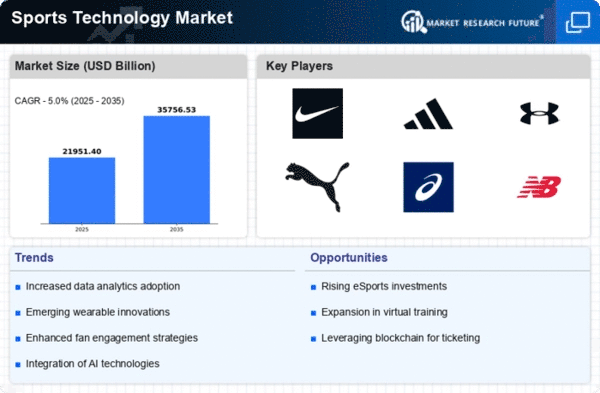
As per MRFR analysis, the Sports Technology Market Size was estimated at 20906.1 USD Billion in 2024. The Sports Technology industry is projected to grow from 21951.4 USD Billion in 2025 to 35756.53 USD Billion by 2035, exhibiting a compound annual growth rate (CAGR) of 5.0 during the forecast period 2025 - 2035.

Key Market Trends & Highlights

The Sports Technology Market is experiencing robust growth driven by innovation and increasing engagement.

  • Wearable technology advancements are leading the market, particularly in North America, where adoption rates are highest. Data analytics integration is becoming essential for performance analysis, especially among professional sports teams. E-sports and digital engagement are rapidly expanding, particularly in the Asia-Pacific region, which is the fastest-growing market. Increased investment in sports technology and the rising popularity of e-sports are key drivers propelling market growth.

Market Size & Forecast

2024 Market Size 20906.1 (USD Billion)
2035 Market Size 35756.53 (USD Billion)
CAGR (2025 - 2035) 5.0%
Largest Regional Market Share in 2024 North America

Major Players

Nike (US), Adidas (DE), Under Armour (US), Puma (DE), ASICS (JP), New Balance (US), Reebok (GB), Fitbit (US), Garmin (US), Catapult Sports (AU)

Market Trends

The Sports Technology Market is currently experiencing a dynamic evolution, driven by advancements in technology and an increasing demand for enhanced athletic performance. Innovations such as wearable devices, smart equipment, and data analytics are transforming how athletes train, compete, and recover. This expansion highlights rapid advancement across sports technology worldwide. This market appears to be expanding as organizations and individuals alike recognize the value of integrating technology into sports. The emphasis on performance optimization and injury prevention is likely to propel further investment in this sector, suggesting a robust future for sports technology. Rising adoption of technology in sports is accelerating investment activity. The market reflects strong convergence between sports and tech.

Moreover, the growing popularity of e-sports and virtual competitions is reshaping the landscape of traditional sports. This shift indicates a potential diversification of the Sports Technology Market, as companies explore new avenues for engagement and revenue generation. This evolution reflects growing momentum in sports tech innovation. Wearables are a core pillar of modern sport tech adoption. Athlete development increasingly relies on technology in sports. The integration of augmented reality and virtual reality into training and fan experiences may redefine how sports are consumed and experienced. As the market continues to evolve, it seems poised to attract a broader audience, potentially leading to innovative partnerships and collaborations across various sectors. Overall, sports technology remains a high-growth technology market.

Wearable Technology Advancements

The rise of wearable technology is reshaping the Sports Technology Market. Devices such as fitness trackers and smartwatches are becoming increasingly sophisticated, offering real-time data on performance metrics. This trend underscores rapid progress in wearable sports technology. Such innovations define next-generation sports technical solutions. This trend suggests that athletes and coaches are leveraging these insights to enhance training regimens and improve overall performance.

Data Analytics Integration

The integration of data analytics into sports is gaining traction, allowing teams and organizations to make informed decisions based on performance data. This trend indicates a shift towards a more analytical approach in sports management, where data-driven strategies may lead to improved outcomes and competitive advantages. Data-driven decision-making reflects deeper integration of sports and tech. Analytics platforms are central to modern sports tech ecosystems.

E-sports and Virtual Engagement

The emergence of e-sports is significantly influencing the Sports Technology Market. Leading sports technology companies are heavily invested in this space. As virtual competitions gain popularity, there appears to be a growing interest in technologies that enhance the spectator experience. Virtual formats highlight emerging sport tech business models. This trend suggests that traditional sports may increasingly adopt elements from the e-sports realm to engage a wider audience. E-sports expansion is broadening the scope of sports technology.

Sports Technology Market Market Drivers

Market Growth Projections

The Global Sports Technology Market Industry is poised for substantial growth, with projections indicating a rise from 20.9 USD Billion in 2024 to 89.7 USD Billion by 2035. This trajectory suggests a compound annual growth rate of 14.15% from 2025 to 2035, reflecting the increasing integration of technology in sports. The growth is driven by various factors, including advancements in wearable technology, data analytics, and the rising popularity of esports. These elements collectively indicate a dynamic and evolving market landscape, where technology continues to redefine the sports industry.

Technological Advancements

The Global Sports Technology Market Industry is experiencing rapid growth driven by continuous technological advancements. Innovations in wearable technology, such as smartwatches and fitness trackers, enhance athlete performance monitoring and injury prevention. For instance, devices that track biometric data provide real-time insights, allowing coaches to make informed decisions. The market is projected to reach 20.9 USD Billion in 2024, reflecting a growing demand for these technologies. As athletes and teams increasingly adopt these tools, the industry is likely to see a surge in investment, further propelling growth and innovation.

Health and Fitness Awareness

The increasing awareness of health and fitness is a significant driver of the Global Sports Technology Market Industry. As more individuals prioritize physical well-being, the demand for fitness-related technologies, such as mobile applications and wearable devices, continues to grow. This trend is reflected in the projected compound annual growth rate of 14.15% from 2025 to 2035, indicating a sustained interest in health-oriented technologies. The proliferation of fitness challenges and community-driven initiatives further encourages technology adoption, suggesting that the market will continue to expand as consumers seek innovative solutions to enhance their fitness journeys.

Growing Popularity of Esports

The rise of esports is reshaping the Global Sports Technology Market Industry, as it creates new opportunities for technology integration. With millions of viewers and participants worldwide, esports requires advanced technology for streaming, analytics, and player performance tracking. This segment is expected to drive significant growth, as companies invest in platforms that enhance user experience and engagement. The increasing popularity of esports events suggests a shift in how technology is utilized in traditional sports, potentially leading to a more tech-savvy audience and innovative solutions tailored to this demographic.

Increased Investment in Sports

Investment in sports technology is on the rise, significantly impacting the Global Sports Technology Market Industry. Organizations and teams are allocating substantial budgets to enhance performance and fan engagement through technology. This trend is evidenced by partnerships between sports teams and tech companies, aimed at developing cutting-edge solutions. The anticipated growth to 89.7 USD Billion by 2035 indicates a robust commitment to integrating technology into sports. Such investments not only improve athletic performance but also enhance the overall spectator experience, suggesting a dual benefit that could attract further funding.

Data Analytics and Performance Optimization

Data analytics plays a crucial role in the Global Sports Technology Market Industry, as teams leverage data to optimize performance and strategy. Advanced analytics tools enable coaches and athletes to analyze game footage, track player statistics, and assess opponent strategies. This data-driven approach enhances decision-making processes and can lead to improved outcomes on the field. As the market evolves, the integration of artificial intelligence and machine learning into analytics tools is likely to further refine performance optimization, suggesting a transformative impact on how sports are played and managed.

Market Segment Insights

By Application: Wearable Technology (Largest) vs. Health Monitoring (Fastest-Growing)

In the Sports Technology Market, wearable technology holds the largest market share among the various applications, dominating the landscape due to widespread consumer adoption and continuous innovations. This segment encompasses devices such as fitness trackers and smartwatches that not only enhance athletic performance but also provide valuable data insights. Following closely, health monitoring applications are becoming increasingly popular as they leverage advanced technology to track vital signs and overall well-being, attracting tech-savvy users who prioritize health and fitness. This dominance reinforces demand for wearable sports technology. Such devices strengthen links between sportswear technology and analytics.

Wearable Technology (Dominant) vs. Performance Analysis (Emerging)

Wearable Technology has established itself as a dominant force in the Sports Technology Market, providing athletes with innovative solutions to monitor their health and enhance performance. With a focus on real-time data collection and user-friendly interfaces, this segment supports a wide range of applications, from retail fitness trackers to sophisticated professional gear. In contrast, Performance Analysis is recognized as an emerging segment that emphasizes the importance of data-driven decision-making. By offering cutting-edge tools for analyzing athlete performance, such as video analysis and biometric tracking, it enables coaches and sports organizations to refine techniques and strategies, subsequently driving the demand for more sophisticated analytical solutions.

By End Use: Professional Sports (Largest) vs. Fitness Enthusiasts (Fastest-Growing)

The Sports Technology Market is diversified across various end-use segments such as professional sports, amateur sports, fitness enthusiasts, educational institutions, and sports organizations. Among these, professional sports capture the largest market share, driven by elite athletes and well-funded organizations investing in cutting-edge technology to enhance performance. In contrast, fitness enthusiasts, fueled by the rising trend of personal health and wellness, have emerged as the fastest-growing demographic within the market, reflecting a growing consumer base focused on integrated fitness solutions. Elite teams increasingly partner with sports technology companies. This collaboration is reshaping the sports equipment industry. Consumer adoption continues to drive growth in sports tech.

Fitness Tech: Professional Sports (Dominant) vs. Fitness Enthusiasts (Emerging)

In the Sports Technology Market, professional sports are seen as the dominant force, driven by substantial funding and endorsement from major leagues, leading to the adoption of cutting-edge analytics and performance-enhancing technologies. This segment is characterized by its focus on optimizing team strategies and player health. In contrast, fitness enthusiasts represent the emerging segment, motivated by personal health goals and the integration of technology into workouts. The growth of wearable fitness trackers, mobile apps, and smart gym equipment has made it easier for individuals to monitor their progress, thus elevating their status in the market.

By Technology Type: Data Analytics (Largest) vs. Artificial Intelligence (Fastest-Growing)

In the Sports Technology Market, the segment of Data Analytics holds the largest market share, reflecting its significance in enhancing team performance and fan engagement. It allows for in-depth analysis of player statistics, game strategies, and consumer behaviors, making it a critical tool for organizations. Meanwhile, Artificial Intelligence is the fastest-growing segment, driven by advancements in machine learning and data processing technologies that provide personalized experiences and actionable insights to teams and viewers alike. AI adoption is redefining competitive dynamics within sports technology. This transition supports long-term technology in sports investment.

Data Analytics (Dominant) vs. Virtual Reality (Emerging)

Data Analytics is a dominant force in the Sports Technology Market, widely adopted for its ability to transform raw data into actionable insights, thus helping teams and organizations understand performance metrics and optimize strategies. This technology allows for advanced statistical analyses, video analysis, and predictive modeling, fostering a culture of performance enhancement. In contrast, Virtual Reality is an emerging technology that is gaining traction, offering immersive experiences for training and fan engagement. Through VR, athletes can simulate real-game scenarios, enhancing their skills and preparation, while fans enjoy unprecedented interactive experiences. As teams begin to recognize the potential of VR, its adoption rate is increasing, opening up new avenues for engagement within the sports sector.

By Product Type: Wearable Devices (Largest) vs. Software Solutions (Fastest-Growing)

The Sports Technology Market exhibits a diverse array of product types, showcasing significant disparity in ownership and preference. Among these, wearable devices dominate the market, appealing to both amateur and professional athletes for their ability to monitor performance metrics and improve training efficiency. In contrast, software solutions are emerging rapidly, capturing the interest of teams and organizations seeking innovative ways to analyze data and enhance athlete development.

Wearable Devices (Dominant) vs. Software Solutions (Emerging)

Wearable devices have established themselves as a dominant player in the Sports Technology Market by offering functionalities such as heart rate monitoring, GPS tracking, and performance analytics. These devices are particularly appealing for their ease of use and integration into daily training regimens. On the other hand, software solutions, while still growing, are increasingly gaining traction as organizations invest in data analytics capabilities to optimize training and performance strategies. This growing trend is fueled by advancements in machine learning and AI, allowing for more personalized coaching and insight based on the performance data gathered by wearables.

By Service Type: Consulting Services (Largest) vs. Training Services (Fastest-Growing)

In the Sports Technology Market, Consulting Services dominate the service type segment, accounting for the largest share due to organizations increasingly recognizing the importance of expert guidance for implementing technological solutions. Following Consulting Services, Integration, and Support Services also play significant roles in ensuring smooth operations and leveraging technology effectively. However, as digital transformation accelerates, Training Services are emerging rapidly, focusing on equipping sports professionals with the necessary skills to leverage advanced technologies effectively. The growth in this segment is fueled by the rising demand for tailored technology solutions, increasing partnerships between tech companies and sports organizations, and the need for continual support and training to adapt to ongoing technological advancements. The rapid development of smart sports equipment and analytics platforms has created opportunities for training, enabling professionals to enhance their performance and decision-making abilities. Furthermore, the increasing emphasis on data-driven strategies in sports is driving enthusiasm for support and integration services as well.

Consulting Services (Dominant) vs. Training Services (Emerging)

Consulting Services have established themselves as the dominant force in the Sports Technology Market, offering strategic insights that help organizations navigate the complex landscape of sports technology adoption. These services typically encompass evaluation, strategy formulation, and expert implementation that are crucial in optimizing technology investments for sports entities. On the other hand, Training Services are characterized as an emerging segment, gaining momentum as sports organizations strive to empower their personnel with cutting-edge skills and knowledge. This shift is particularly evident as training programs begin to focus on analytics, performance tracking, and fitness technology integration. The growing awareness of the necessity for continuous professional development is positioning Training Services as a critical pillar that supports both individual athlete performance and overall organizational effectiveness.

Get more detailed insights about Sports Technology Market Research Report - Forecast till 2035

Regional Insights

North America : Market Leader in Sports Tech

North America continues to lead the Sports Technology market, holding a significant share of 10409.0 million in 2024. The region's growth is driven by increasing consumer demand for innovative sports gear and wearable technology, alongside supportive regulations promoting health and fitness. The rise of e-commerce and digital platforms has further accelerated market expansion, making advanced sports technology more accessible to consumers. The region leads commercialization of sports tech platforms. The competitive landscape is robust, with key players like Nike, Under Armour, and Fitbit dominating the market. The U.S. is the primary contributor, leveraging its technological advancements and strong brand presence. Additionally, partnerships between tech firms and sports organizations are fostering innovation, ensuring that North America remains at the forefront of sports technology development.

Europe : Emerging Market with Growth Potential

Europe's Sports Technology market is valued at 6000.0 million, showcasing a growing interest in health and fitness solutions. Regional startups are emerging as agile sports technology companies. The region benefits from a strong regulatory framework that encourages innovation and sustainability in sports technology. Increasing participation in sports and fitness activities, coupled with rising health awareness, is driving demand for advanced sports equipment and wearables across various demographics. Leading countries such as Germany, the UK, and France are pivotal in this growth, with major brands like Adidas and Puma leading the charge. The competitive landscape is characterized by a mix of established players and emerging startups, fostering a dynamic environment for innovation. The European market is poised for further growth as consumer preferences shift towards smart and connected sports solutions.

Asia-Pacific : Rapidly Growing Sports Market

The Asia-Pacific region, valued at 4000.0 million, is witnessing rapid growth in the Sports Technology market. Rising demand accelerates adoption osport tech solutions. Factors such as increasing disposable incomes, urbanization, and a growing interest in fitness and sports are driving demand. Governments are also promoting sports initiatives, which further catalyze market growth. The region's diverse population is increasingly adopting technology-driven fitness solutions, enhancing overall market dynamics. Global players view APAC as a strategic technology market. Countries like Japan, Australia, and China are leading the charge, with significant investments in sports technology. Key players such as ASICS and Catapult Sports are capitalizing on this trend, offering innovative products tailored to local markets. The competitive landscape is evolving, with both The Sports Technology share, making Asia-Pacific a vibrant hub for sports technology innovation.

Middle East and Africa : Emerging Frontier for Sports Tech

The Middle East and Africa region, with a market size of 1497.1 million, is emerging as a frontier for Sports Technology. The growth is fueled by increasing interest in sports and fitness, supported by government initiatives aimed at promoting healthy lifestyles. The region's young population is driving demand for innovative sports solutions, creating opportunities for market expansion. Additionally, investments in sports infrastructure are enhancing the overall landscape. Countries like South Africa and the UAE are at the forefront, with local and international brands competing to capture market share. The presence of key players is growing, and partnerships with tech firms are fostering innovation. As the region continues to develop, the Sports Technology market is expected to flourish, driven by a combination of consumer demand and supportive policies.

Key Players and Competitive Insights

The Sports Technology Market is currently characterized by a dynamic competitive landscape, driven by rapid technological advancements and an increasing consumer demand for enhanced athletic performance. Major players such as Nike (US), Adidas (DE), and Garmin (US) are at the forefront, each adopting distinct strategies to solidify their market positions. Nike (US) emphasizes innovation through its investment in smart apparel and wearable technology, while Adidas (DE) focuses on sustainability initiatives, integrating eco-friendly materials into its product lines. Garmin (US) leverages its expertise in GPS technology to enhance its fitness tracking devices, thereby appealing to a tech-savvy consumer base. Collectively, these strategies contribute to a competitive environment that is increasingly focused on innovation and sustainability. Competition is intensifying across the global sports technology ecosystem. Innovation in sportswear technology remains a key differentiator. Strategic alignment of sports and tech defines market leadership. Key business tactics within the Sports Technology Market include localizing manufacturing and optimizing supply chains to enhance efficiency and responsiveness to market demands. The market structure appears moderately fragmented, with a mix of established brands and emerging players vying for market share. The influence of key players is substantial, as their strategic initiatives often set industry standards and trends, thereby shaping consumer expectations and competitive dynamics. In November 2025, Nike (US) announced a partnership with a leading tech firm to develop a new line of smart footwear that integrates real-time performance analytics. This strategic move is likely to enhance Nike's product offerings, positioning the company as a leader in the intersection of sports and technology. By leveraging advanced analytics, Nike aims to provide athletes with personalized insights, potentially revolutionizing training methodologies. In October 2025, Adidas (DE) launched its "End Plastic Waste" campaign, which includes a new range of performance gear made from recycled ocean plastics. This initiative not only aligns with global sustainability trends but also strengthens Adidas's brand image as an environmentally conscious leader. The campaign is expected to resonate with eco-aware consumers, thereby driving brand loyalty and market penetration. In September 2025, Garmin (US) unveiled a new smartwatch that features advanced health monitoring capabilities, including blood oxygen saturation and stress tracking. This product launch reflects Garmin's commitment to innovation in health technology, catering to the growing consumer interest in wellness and fitness. By continuously enhancing its product features, Garmin is likely to maintain its competitive edge in the wearable technology segment. As of December 2025, current competitive trends in the Sports Technology Market are heavily influenced by digitalization, sustainability, and the integration of artificial intelligence (AI). Strategic alliances among companies are increasingly shaping the landscape, fostering innovation and expanding market reach. The shift from price-based competition to a focus on technological advancement and supply chain reliability is evident, suggesting that future competitive differentiation will hinge on the ability to innovate and respond to consumer needs effectively.

Key Companies in the Sports Technology Market include

Industry Developments

Recent developments in the Sports Technology Market include significant advancements in data analytics and wearable technology, with companies like Catapult Sports and Whoop pushing the boundaries in athlete performance monitoring. In August 2023, HawkEye Innovations announced the expansion of its officiating solutions, further enhancing the accuracy of sports refereeing worldwide. Each sports technology company is prioritizing performance analytics.

Meanwhile, PlaySight released a new AI-driven platform aimed at improving coaching efficiency in youth sports. Companies like IBM and SAP continue to leverage big data, offering analytics tools that are increasingly important for team strategy and fan engagement. In a notable acquisition, SportRadar acquired a leading betting data provider in September 2023, bolstering its position in sports betting technology. 

The market is seeing growth, with Zebra Technologies reporting an increase in smart equipment sales, while Pioneer Athletics has focused on sustainable innovations in sports field management. The push for advanced technology solutions has increased investment, facilitating partnerships among these key players. The trend toward integrating technology in sporting events continues to gain traction, highlighting the importance of maintaining a competitive edge in the sports industry globally.

Future Outlook

Sports Technology Market Future Outlook

The Sports Technology Market is projected to grow at a 5.0% CAGR from 2025 to 2035, driven by advancements in wearable technology, data analytics, and increased consumer engagement.

New opportunities lie in:

  • <p>Integration of AI-driven performance analytics platforms Development of smart sports equipment with IoT capabilities Expansion of virtual reality training solutions for athletes</p>

By 2035, the Sports Technology Market is expected to be robust, driven by innovation and strategic investments.

Market Segmentation

Sports Technology Market End Use Outlook

  • Professional Sports
  • Amateur Sports
  • Fitness Enthusiasts
  • Sports Organizations
  • Educational Institutions

Sports Technology Market Application Outlook

  • Wearable Technology
  • Performance Analysis
  • Training Management
  • Fan Engagement
  • Broadcasting Solutions

Sports Technology Market Product Type Outlook

  • Wearable Devices
  • Software Solutions
  • Mobile Applications
  • Smart Equipment
  • Video Analysis Tools

Sports Technology Market Service Type Outlook

  • Consulting Services
  • Maintenance Services
  • Integration Services
  • Support Services
  • Training Services

Sports Technology Market Technology Type Outlook

  • Data Analytics
  • Artificial Intelligence
  • Virtual Reality
  • Augmented Reality
  • Internet of Things

Report Scope

MARKET SIZE 2024 20906.1(USD Billion)
MARKET SIZE 2025 21951.4(USD Billion)
MARKET SIZE 2035 35756.53(USD Billion)
COMPOUND ANNUAL GROWTH RATE (CAGR) 5.0% (2025 - 2035)
REPORT COVERAGE Revenue Forecast, Competitive Landscape, Growth Factors, and Trends
BASE YEAR 2024
Market Forecast Period 2025 - 2035
Historical Data 2019 - 2024
Market Forecast Units USD Billion
Key Companies Profiled Nike (US), Adidas (DE), Under Armour (US), Puma (DE), ASICS (JP), New Balance (US), Reebok (GB), Fitbit (US), Garmin (US), Catapult Sports (AU)
Segments Covered Application, End Use, Technology Type, Product Type, Service Type
Key Market Opportunities Integration of artificial intelligence and data analytics in athlete performance enhancement.
Key Market Dynamics Technological advancements drive innovation in sports equipment, enhancing performance and consumer engagement across various athletic disciplines.
Countries Covered North America, Europe, APAC, South America, MEA

FAQs

What was the market size of the Sports Technology Market in 2024?

The Sports Technology Market was valued at 20.91 USD Billion in 2024.

What is the projected market size of the Sports Technology Market by 2035?

By 2035, the Sports Technology Market is projected to reach a value of 89.66 USD Billion.

What is the expected CAGR for the Sports Technology Market from 2025 to 2035?

The expected Compound Annual Growth Rate (CAGR) for the Sports Technology Market from 2025 to 2035 is 14.17%.

Which region held the largest market share in 2024?

In 2024, North America held the market with a valuation of 8.31 USD Billion.

What is the market size for the Devices segment in the Sports Technology Market in 2024?

The Devices segment of the Sports Technology Market was valued at 8.0 USD Billion in 2024.

What will be the market size for the Smart Stadium segment by 2035?

By 2035, the Smart Stadium segment is projected to reach a value of 19.8 USD Billion.

Who are some key players in the Sports Technology Market?

Major players in the Sports Technology Market include Catapult Sports, PlaySight, Whoop, and IBM.

What is the expected growth rate for the Asia Pacific region in the Sports Technology Market by 2035?

The Asia Pacific region is expected to grow to 17.62 USD Billion by 2035.

What is the market value of the Analytic & Statistics segment in 2024?

The Analytic &amp; Statistics segment is valued at 5.0 USD Billion in the year 2024.

What challenges might affect the Sports Technology Market growth?

Challenges may include technological advancements and competition among leading firms in the sports technology landscape.

  1. SECTION I: EXECUTIVE SUMMARY AND KEY HIGHLIGHTS
    1. EXECUTIVE SUMMARY
      1. Market Overview
      2. Key Findings
      3. Market Segmentation
      4. Competitive Landscape
      5. Challenges and Opportunities
      6. Future Outlook 2
  2. SECTION II: SCOPING, METHODOLOGY AND MARKET STRUCTURE
    1. MARKET INTRODUCTION
      1. Definition
      2. Scope of the study
    2. RESEARCH METHODOLOGY
      1. Overview
      2. Data Mining
      3. Secondary Research
      4. Primary Research
      5. Forecasting Model
      6. Market Size Estimation
      7. Data Triangulation
      8. Validation 3
  3. SECTION III: QUALITATIVE ANALYSIS
    1. MARKET DYNAMICS
      1. Overview
      2. Drivers
      3. Restraints
      4. Opportunities
    2. MARKET FACTOR ANALYSIS
      1. Value chain Analysis
      2. Porter's Five Forces Analysis
      3. COVID-19 Impact Analysis
  4. SECTION IV: QUANTITATIVE ANALYSIS
    1. Semiconductor & Sports Technology Market, BY Application (USD Billion)
      1. Wearable Technology
      2. Performance Analysis
      3. Training Management
      4. Fan Engagement
      5. Broadcasting Solutions
    2. Semiconductor & Sports Technology Market, BY End Use (USD Billion)
      1. Professional Sports
      2. Amateur Sports
      3. Fitness Enthusiasts
      4. Sports Organizations
      5. Educational Institutions
    3. Semiconductor & Sports Technology Market, BY Technology Type (USD Billion)
      1. Data Analytics
      2. Artificial Intelligence
      3. Virtual Reality
      4. Augmented Reality
      5. Internet of Things
    4. Semiconductor & Sports Technology Market, BY Product Type (USD Billion)
      1. Wearable Devices
      2. Software Solutions
      3. Mobile Applications
      4. Smart Equipment
      5. Video Analysis Tools
    5. Semiconductor & Sports Technology Market, BY Service Type (USD Billion)
      1. Consulting Services
      2. Maintenance Services
      3. Integration Services
      4. Support Services
      5. Training Services
    6. Semiconductor & Sports Technology Market, BY Region (USD Billion)
      1. North America
      2. Europe
      3. APAC
      4. South America
      5. MEA
  5. SECTION V: COMPETITIVE ANALYSIS
    1. Competitive Landscape
      1. Overview
      2. Competitive Analysis
      3. Market share Analysis
      4. Major Growth Strategy in the Semiconductor & Electronics
      5. Competitive Benchmarking
      6. Leading Players in Terms of Number of Developments in the Semiconductor & Electronics
      7. Key developments and growth strategies
      8. Major Players Financial Matrix
    2. Company Profiles
      1. Nike (US)
      2. Adidas (DE)
      3. Under Armour (US)
      4. Puma (DE)
      5. ASICS (JP)
      6. New Balance (US)
      7. Reebok (GB)
      8. Fitbit (US)
      9. Garmin (US)
      10. Catapult Sports (AU)
    3. Appendix
      1. References
      2. Related Reports

Semiconductor & Sports Technology Market Segmentation

Semiconductor & Sports Technology Market By Application (USD Billion, 2025-2035)

  • Wearable Technology
  • Performance Analysis
  • Training Management
  • Fan Engagement
  • Broadcasting Solutions

Semiconductor & Sports Technology Market By End Use (USD Billion, 2025-2035)

  • Professional Sports
  • Amateur Sports
  • Fitness Enthusiasts
  • Sports Organizations
  • Educational Institutions

Semiconductor & Sports Technology Market By Technology Type (USD Billion, 2025-2035)

  • Data Analytics
  • Artificial Intelligence
  • Virtual Reality
  • Augmented Reality
  • Internet of Things

Semiconductor & Sports Technology Market By Product Type (USD Billion, 2025-2035)

  • Wearable Devices
  • Software Solutions
  • Mobile Applications
  • Smart Equipment
  • Video Analysis Tools

Semiconductor & Sports Technology Market By Service Type (USD Billion, 2025-2035)

  • Consulting Services
  • Maintenance Services
  • Integration Services
  • Support Services
  • Training Services
Infographic

Free Sample Request

Kindly complete the form below to receive a free sample of this Report

Get Free Sample

Customer Strories

Compare Licence

×
Features License Type
Single User Multiuser License Enterprise User
Price $4,950 $5,950 $7,250
Maximum User Access Limit 1 User Upto 10 Users Unrestricted Access Throughout the Organization
Free Customization
Direct Access to Analyst
Deliverable Format
Platform Access
Discount on Next Purchase 10% 15% 15%
Printable Versions