×
Hero Background
English
Chinese
French
Japanese
Korean
German
Spanish

Space Lander Rover Market Analysis

ID: MRFR/AD/10785-HCR
168 Pages
Sejal Akre
October 2025

Space Lander and Rover Market Research Report Information By Type (Lunar Surface Exploration, Mars Surface Exploration, Asteroids Surface Exploration), By Solution (Hardware, Software) By Region (North America, Europe, Asia-Pacific, Middle East and Africa and South America) - Forecast Till 2035

Share:
Download PDF ×

We do not share your information with anyone. However, we may send you emails based on your report interest from time to time. You may contact us at any time to opt-out.

Space Lander Rover Market Infographic
Purchase Options

Market Analysis

In-depth Analysis of Space Lander Rover Market Industry Landscape

The market for space landers and rovers symbolizes a new frontier in discovery and humanity's pursuit of understanding the secrets of the universe. International cooperation, space exploration assignments, and technical innovation are the driving forces behind market dynamics in this industry. The market for space landers and rovers is shaped by the unwavering quest of scientific knowledge and the desire to investigate celestial objects. In this industry, the most important factor influencing the marketplace is technological progress. Innovations in systems for propulsion, robotic arms, along with self-navigating systems improve space landers and rovers' adaptability and performance. The market reacts to scientific and engineering advances that push the limits of technical feasibility by developing innovative solutions that support increasingly ambitious ventures into space missions. The changing conditions of the space lander and rover industry are significantly influenced by space agencies and commercial aerospace companies. Significant exploratory initiatives are led by funded by the government aerospace organizations including NASA, ESA, and numerous others, which increases demand for advanced landings and rover systems. In addition, the commercial aspect that private enterprises' involvement in the space sector brings to the market encourages competitiveness and innovation. One of the key differentiators within the market is worldwide collaboration. Through joint ventures, nations and space agencies can pool assets and expertise, which lowers costs and broadens the area of exploration. The Global Lunar Gateway is one example of a collaborative project that demonstrates the close knit nature of the space community is worldwide and how this influences market conditions. One of the main forces influencing the market landscape is the investigation of celestial planets, such as the Moon and Mars. Dedicated landers and rovers are becoming more and more necessary as space-related agencies and private companies organize and carry out missions to these locations. These automated explorers are vital for carrying out research, acquiring data, and obtaining specimens that advance our knowledge of the galaxy. The market trends regarding space landers & rovers are also influenced by commercial potential in the study of space. Influenced by the potential for lunar tourism, meteorite mining, and other business endeavors, private corporations invest in the development of dependable and affordable landing and rover technology. The confluence of business goals and scientific discoveries generates a vibrant marketplace with a wide range of participants. One significant trend impacting the market for space landers and rovers is the shrinking of technology. Smaller and lighter rovers and landers provide more affordable options for exploring outer space. The deployment of these small systems on tiny spacecraft can lower launch costs and increase the viability of space missions. A wider spectrum of businesses can now take part in the space program because to the trend toward downsizing. The market patterns for space landers & rovers are also influenced by legislative and financial considerations. The choices regarding investments undertaken by authorities and private companies are influenced by funding allotted for space exploration expeditions modifications to space regulations, and geopolitical variables. In order to guarantee the long-term viability of their space-related projects, market participants need to manage these outside forces. In summary, the market for space landers and rovers functions at the nexus of international cooperation, technological advancement, and scientific investigation. The market dynamics are always changing as mankind grows beyond Earth because of the global space community's combined efforts, commercial opportunities, and knowledge-seeking endeavors. Uncovering the mysteries of space and laying the groundwork for upcoming space missions projects depend heavily on the fabrication of sophisticated and adaptable space landers and rovers.

Author
Sejal Akre
Senior Research Analyst

She has over 5 years of rich experience, in market research and consulting providing valuable market insights to client. Hands on expertise in management consulting, and extensive knowledge in domain including ICT, Automotive & Transportation and Aerospace & Defense. She is skilled in Go-to market strategy, industry analysis, market sizing, in depth company profiling, competitive intelligence & benchmarking and value chain amongst others.

Leave a Comment

FAQs

What is the current valuation of The Global Space Lander and Rover?

The market valuation was 1047.23 USD Million in 2024.

What is the projected market size for The Global Space Lander and Rover by 2035?

The projected valuation for 2035 is 2847.61 USD Million.

What is the expected CAGR for The Global Space Lander and Rover during the forecast period 2025 - 2035?

The expected CAGR during this period is 9.52%.

Which companies are considered key players in The Global Space Lander and Rover?

Key players include NASA, SpaceX, Lockheed Martin, Northrop Grumman, European Space Agency, ISRO, China National Space Administration, Roscosmos, and JAXA.

Market Summary

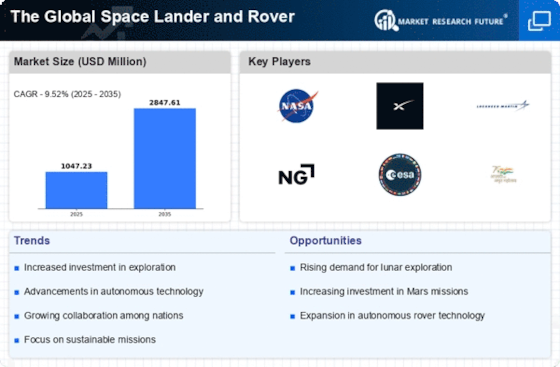
As per MRFR analysis, The Global Space Lander and Rover was estimated at 1047.23 USD Million in 2024. The space lander and rover industry is projected to grow from 1146.93 USD Million in 2025 to 2847.61 USD Million by 2035, exhibiting a compound annual growth rate (CAGR) of 9.52 during the forecast period 2025 - 2035.

Key Market Trends & Highlights

The Global Space Lander and Rover is poised for substantial growth driven by technological advancements and increased investment in space exploration.

  • North America remains the largest market for space landers and rovers, reflecting its robust investment in space missions.
  • The Asia-Pacific region is emerging as the fastest-growing market, fueled by increasing governmental and private sector initiatives in space exploration.
  • Lunar surface exploration continues to dominate the market, while Mars surface exploration is rapidly gaining traction as a key focus area.
  • Rising demand for planetary exploration and advancements in autonomous navigation technologies are significant drivers propelling market growth.

Market Size & Forecast

2024 Market Size 1047.23 (USD Million)
2035 Market Size 2847.61 (USD Million)
CAGR (2025 - 2035) 9.52%
Largest Regional Market Share in 2024 North America

Major Players

<p>NASA (US), SpaceX (US), Lockheed Martin (US), Northrop Grumman (US), European Space Agency (EU), ISRO (IN), China National Space Administration (CN), Roscosmos (RU), JAXA (JP)</p>

Market Trends

The Global Space Lander and Rover is currently experiencing a transformative phase, driven by advancements in technology and increasing interest from both governmental and private sectors. The exploration of celestial bodies, such as Mars and the Moon, has gained momentum, with various nations and organizations investing in innovative landers and rovers. This surge in activity is not merely a reflection of scientific curiosity; it also indicates a strategic move towards potential resource utilization and habitation beyond Earth. As missions become more ambitious, the demand for sophisticated equipment that can withstand harsh environments and perform complex tasks is likely to rise. Moreover, collaboration between countries and private enterprises appears to be a defining characteristic of the market. Partnerships are forming to share knowledge, reduce costs, and enhance capabilities. This collaborative spirit may lead to the development of more efficient and versatile landers and rovers, which could ultimately accelerate the pace of exploration. The market seems poised for growth, with a focus on sustainability and the long-term vision of human presence on other planets. As the landscape evolves, stakeholders must remain adaptable to emerging technologies and shifting priorities in space exploration.

Increased Investment in Space Exploration

There is a noticeable rise in funding directed towards space exploration initiatives. Governments and private entities are allocating resources to develop advanced landers and rovers, reflecting a growing commitment to exploring extraterrestrial environments.

Technological Advancements in Robotics

The market is witnessing rapid advancements in robotics, which are crucial for the functionality of landers and rovers. Innovations in artificial intelligence and automation are enhancing the capabilities of these vehicles, allowing for more complex missions.

Focus on International Collaboration

International partnerships are becoming increasingly common in The Global Space Lander and Rover. Collaborative efforts among nations and organizations are fostering knowledge sharing and resource pooling, which may lead to more ambitious exploration projects.

Space Lander Rover Market Market Drivers

Increased Focus on Scientific Research

The emphasis on scientific research in space exploration is a significant driver for the Space Lander and Rover Market. Missions aimed at understanding planetary geology, climate, and potential for life are gaining traction. For instance, the European Space Agency's ExoMars program aims to search for signs of past life on Mars, necessitating advanced rover technology. The global scientific community is increasingly advocating for missions that can provide valuable data, which in turn fuels demand for sophisticated landers and rovers. As research objectives become more ambitious, the market is likely to see a corresponding increase in the development of specialized vehicles.

Rising Demand for Planetary Exploration

The increasing interest in planetary exploration is a primary driver for the Space Lander and Rover Market. Various space agencies and private companies are investing heavily in missions to Mars, the Moon, and beyond. For instance, the projected budget for NASA's Artemis program, aimed at returning humans to the Moon, is estimated to reach billions of dollars. This surge in funding is likely to stimulate the development of advanced landers and rovers, enhancing capabilities for scientific research and resource utilization. As nations and corporations seek to establish a presence on other celestial bodies, the demand for innovative landers and rovers is expected to grow significantly, thereby propelling the market forward.

Growing Interest in Commercial Space Ventures

The rise of commercial space ventures is reshaping the Space Lander and Rover Market. Companies such as SpaceX and Blue Origin are actively pursuing lunar and Martian missions, which necessitate the development of reliable landers and rovers. The commercial sector's involvement is expected to drive innovation and reduce costs, making space exploration more accessible. According to recent estimates, the commercial space market could reach a valuation of over 1 trillion dollars by the end of the decade. This influx of private investment is likely to accelerate the development of new technologies and capabilities in landers and rovers, further stimulating market growth.

International Collaboration in Space Missions

International collaboration is emerging as a crucial driver for the Space Lander and Rover Market. Joint missions, such as the Lunar Gateway project involving multiple space agencies, highlight the trend towards cooperative exploration. These partnerships not only pool resources but also share technological expertise, leading to the development of more advanced landers and rovers. The collaborative nature of these missions is expected to enhance the capabilities of space vehicles, making them more versatile and efficient. As nations work together to achieve common goals in space exploration, the market for landers and rovers is likely to expand, reflecting the collective ambition of the global community.

Advancements in Autonomous Navigation Technologies

Technological innovations in autonomous navigation are transforming the Space Lander and Rover Market. The integration of artificial intelligence and machine learning into rover systems allows for enhanced decision-making capabilities in unstructured environments. For example, NASA's Perseverance rover employs sophisticated algorithms to navigate the Martian terrain autonomously. This capability not only increases mission efficiency but also reduces the need for constant human oversight. As these technologies continue to evolve, they are likely to attract further investment and interest from both governmental and private sectors, thereby expanding the market for landers and rovers.

Market Segment Insights

By Type: Lunar Surface Exploration (Largest) vs. Mars Surface Exploration (Fastest-Growing)

<p>In The Global Space Lander and Rover, the segment of Lunar Surface Exploration holds the largest share, largely due to increased governmental and private investments aimed at establishing a sustainable human presence on the Moon. This focus on lunar missions has sparked significant advancements in technology and increased collaboration between countries and commercial entities. In contrast, Mars Surface Exploration, while currently a smaller segment, is rapidly gaining traction, driven by ambitious projects from agencies such as NASA and SpaceX, which seek to send humans to Mars.</p>

<p>Exploration Types: Lunar Surface (Dominant) vs. Mars Surface (Emerging)</p>

<p>Lunar Surface Exploration is seen as a dominant force in the market, distinctly characterized by its well-established missions and ongoing projects that focus on long-term habitation and resource utilization. This segment enjoys robust support from both public and private sectors, leading to advanced robotics and innovative lander designs. Conversely, Mars Surface Exploration emerges as a hotbed of innovation, bolstered by high-profile missions and an intensifying fervor for interplanetary exploration. This segment focuses on developing technologies that may enable human colonization, creating a unique niche that attracts significant interest and investment, positioning it as an exciting frontier in space exploration.</p>

By Solution: Hardware (Largest) vs. Software (Fastest-Growing)

<p>In The Global Space Lander and Rover, the solution segment is primarily divided into hardware and software. The hardware aspect holds a significant share, driven by the need for robust and reliable physical components essential for landers and rovers. This includes structures, propulsion systems, communication devices, and scientific instruments, all critical for mission success. In contrast, the software segment, while smaller in market share, is experiencing rapid growth. This is largely due to increasing advancements in artificial intelligence and machine learning applications in space exploration, which enhance navigation, autonomy, and data analysis capabilities of both landers and rovers.</p>

<p>Technology: Hardware (Dominant) vs. Software (Emerging)</p>

<p>The hardware segment is considered the dominant force within The Global Space Lander and Rover due to its integral role in the functionality and reliability of space missions. Key characteristics include its reliance on advanced materials and engineering techniques to endure the harsh conditions of space and planetary surfaces. On the other hand, the software segment is emerging as a critical enabler of innovation. It focuses on developing sophisticated algorithms for navigation and mission control, which are essential for autonomous operations and efficient data management. As space missions become more complex and technology-driven, the synergy between robust hardware and advanced software solutions will be crucial.</p>

Get more detailed insights about Space Lander and Rover Market Research Report—Global Forecast till 2035

Regional Insights

FIGURE 3: GLOBAL SPACE LANDER AND ROVER  MARKET, BY REGION, 2022 VS 2032 (USD MILLION)

Based on Region, the Global Space Lander and Rover is segmented into North America, Europe, Asia-Pacific, Middle East & Africa, and South America. Further, the major countries studied in the market report are the U.S., Canada, Germany, France, the UK, Italy, Spain, China, Japan, India, Australia, South Korea, and Brazil.

North America comprises of US, Canada, and Mexico. The market is dominated by North America, because of the growing investment by NASA. NASA's budget for the year 2021 is USD 23.3 billion, representing a 3% increase as compared to the previous year. NASA's Perseverance rover is advanced to touch down safely on Mars planet. The design as well construction of the rover along with its related components accounts for 81% of the whole project cost, while the rest components for launch as well as operations.

The rover's dependency on Plutonium-238 as a power source has grown the launch costs because of the elevated environmental as well as safety regulations for launching nuclear material. Players are also concentrating on several lunar missions. Intuitive Machines, a private company, is working on its first lunar mission in Q3 of 2023. The space sector is witnessing the development of advanced technologies, for instance, reusable launch vehicles, CubeSats, and smallsats.

Technological advancement has made it cost-effective to develop new space systems as well launching payloads into space, which in turn has enhanced a broad range of organizations for participating in the space sector. The agency's government investment in the sector, as it allows for affordable access to space as well as new business models, for instance, constellations. SmallSats witnessed around 95% of spacecraft launched in the year 2022. Satellite constellations will also drive the space lander and rover market in the future. There could be growth in demand for satellite integrations, launch vehicles, and components.

Satellite constellations can provide global coverage, for example, at least one satellite anywhere on earth. Furthermore, investment in the private sector, a growing number of venture capital firms, as well as private equity firms, have been doing investments in the space sector as well as many private players are entering the market for providing space-related products as well as services. Till the end of the year 2022, the global space sector had attracted investment of around USD 272 billion in 1,791 companies since the year 2013. Moreover, investment in national security space is growing quickly.

For example, in the US the financial year 2023 allocated a budget of USD 20.8 billion national security space budget which is a 19.5% increase for the year 2022.    The roundtrip mission will take about two years.Technology development for a crewed Mars mission is already underway. Many of the technologies will be tested on the Moon during the Artemis missions, while others are more suited for deep space. Here are six technologies NASA is working on to make Mars a reality. In order to create a robotic lunar rover that will launch in 2026, Canada is working with NASA.

Two scientific equipment, one from Canada and one from the United States, will be carried by the rover. The rover's capacity to last a whole lunar night is one of the mission's primary objectives, along with collecting photos and measurements of the lunar surface.The rover is a component of Canada's 2022-released Space Policy Framework. With a focus on the Moon and Mars, the framework outlines Canada's goals for space exploration in the upcoming years. The rover represents a significant advancement for Canada's space programme and will be a useful tool for the Artemis programme of NASA.

Europe comprises countries like the UK, Germany, France, Italy, Spain, and the Rest of Europe. Space rovers are vehicles designed for traviling over the rugged as well as mountainous terrain of moon, other planets and astriods. A rover is robot is used for exploring the surface of celestial body.  Rovers and Lander are used for variety of purpose includes Planetary exploration, asteriod mining, Search for life, space tourism. Many rovers have been sent to moon, mars and even asteriods in previous year.

Space mining market obtained momentum as well as different space agencies are planning for launching rovers and orbiters to various different celestial bodies for detecting the presence of different material platinum, gold, titanium, silver, cobalt, iron and nickel. The European Space Agency has launched a space lander under its exploration efforts. The advanced lander, equipped with advance technology, focus to delve into the study of celestial bodies within the solar system. The region has experrienced significant growth in sector. Missons such as ExoMars as well as upcoming the Phiae lander for the for the Rosetta mission.

A as advancement in technology as well as new missions are planned, the European space rover and lander market is continuously evolving, contributing to understanding of universe. In the region scientific exploration as well as research initiatives drives demand for advance rovers and landers, fostering discoveries on astronomical bodies such as moon and mars. Government investment such as The European Space Agency (ESA) has approved a record-breaking budget of nearly USD 18.9 billion.

The budget will help fund a range of ambitious projects, including the rebuilding of the landing platform for the ExoMars rover, the development of Europe's own secure communications satellite constellation, and a lunar lander called Argonaut. The budget represents a 17% increase from the previous budget approved in 2019. It was approved at ESA's Council at the Ministerial level in Paris on Wednesday, November 23.

The European Space Agency (ESA) is committed to the UK-built Rosalind Franklin Mars Rover. The rover is set to launch to Mars in 2028, and UK industry will play a leading role in developing a new landing platform for the rover.

The UK is also a leader in space sustainability. The UK is developing technologies to manage, maintain, and retrieve satellites in space. This will help to reduce the amount of space debris in orbit and support the UK's ambitions to lead in global space sustainability regulation and innovation.

Asia Pacific New comprises countries like the China, India, Japan, South Korea, Australia, Rest of Asia Pacific.  In the region technologies are making it easier and more affordable to land and operate rovers on other planets. Autonomous landing systems can land rovers with greater precision than human-controlled systems, reducing the risk of damage during landing. Lightweight and powerful materials are making it possible to build rovers that can traverse difficult terrain, allowing them to explore more of a planet's surface. Improved communication systems allow scientists to control rovers and receive data in real time, even from remote areas.

These advances are making space exploration more accessible and affordable, leading to a new era of cooperation between countries and private companies to explore the solar system and beyond.  Robots like the Perseverance rover are teaching us about the surface of Mars. This information will help us plan future human missions to the Red Planet.

We will need to develop new technologies to get humans to Mars, explore the surface, and safely return them home.  Developing countries such as India, the space agency launched a rocket in July 2023 that sent a spacecraft into orbit as well as toward a planned landing in month of August on the lunar south pole. ISRO (The Indian Space Research Organisation’s)  LVM3 launch rocket blasted off the major spaceport in Andhra Pradesh.

Key Players and Competitive Insights

The Space Lander and Rover market is highly competitive, with a number of established players competing for market share. The market is primarily driven by the demand for efficient and reliable air start units in the aviation industry. There are several domestic, regional, and global players operating in the Space Lander and Rover market who continuously strive to gain a significant share of the overall market.

During the study, MRFR has analyzed some of the major players in the Air Start Unit market who have contributed to the market growth. These include Some notable players in the ASU market include National Aeronautics and Space Administration (US), Lockheed Martin COrporation (US), The Boeing Company (US), Indian Space Research Organization (India), Airbus Defence and Space (Germany), Astrobotic Technology Inc (US), Roscomos (Russia), European Space Agency (France), China National Space Administration (China), Blue Orgin (US), and Japan Aeropace Exploration Agency (Japan), Others.

Key Companies in the Space Lander Rover Market market include

Industry Developments

May 2021, Lockheed Martin and General Motors have partnered to develop the next generation of lunar rovers, which will be able to travel farther than previous rovers and transport astronauts to more remote areas of the moon.

March 2021, NASA has awarded Northrop Grumman a contract to develop and manufacture the solid propulsion systems and controls for the Mars Ascent Vehicle (MAV). The MAV is a critical part of NASA's Mars Sample Return (MSR) program, which aims to bring samples of Martian rock and soil back to Earth for study. The MAV will be launched in 2026 along with a Sample Fetch Rover, which will collect the samples prepared by NASA's Perseverance rover.

The MAV will then launch the samples into Mars orbit, where they will be picked up by an Earth Return Orbiter and brought back to Earth.

August 2023, Canadensys Aerospace Corporation, a Bolton-based organization, has been awarded an $800,000 contract from the Canadian Space Agency (CSA) to develop a new lunar rover concept. The contract will fund the development of a prototype lunar rover that can be used to explore the moon's surface.

Future Outlook

Space Lander Rover Market Future Outlook

<p>The Global Space Lander and Rover is projected to grow at a 9.52% CAGR from 2024 to 2035, driven by advancements in technology, increased government funding, and rising commercial interest.</p>

New opportunities lie in:

  • <p>Development of autonomous navigation systems for enhanced operational efficiency.</p>
  • <p>Partnerships with private space companies for joint missions and technology sharing.</p>
  • <p>Expansion of in-situ resource utilization technologies for sustainable lunar and Martian exploration.</p>

<p>By 2035, the market is expected to be robust, driven by innovation and strategic collaborations.</p>

Market Segmentation

Space Lander Rover Market Type Outlook

  • Lunar Surface Exploration
  • Mars Surface Exploration
  • Asteroids Surface Exploration

Space Lander Rover Market Solution Outlook

  • Hardware
  • Software

Report Scope

MARKET SIZE 20241047.23(USD Million)
MARKET SIZE 20251146.93(USD Million)
MARKET SIZE 20352847.61(USD Million)
COMPOUND ANNUAL GROWTH RATE (CAGR)9.52% (2024 - 2035)
REPORT COVERAGERevenue Forecast, Competitive Landscape, Growth Factors, and Trends
BASE YEAR2024
Market Forecast Period2025 - 2035
Historical Data2019 - 2024
Market Forecast UnitsUSD Million
Key Companies ProfiledMarket analysis in progress
Segments CoveredMarket segmentation analysis in progress
Key Market OpportunitiesAdvancements in autonomous navigation technologies enhance capabilities in The Global Space Lander and Rover.
Key Market DynamicsTechnological advancements drive competition and innovation in the space lander and rover market, reshaping exploration capabilities.
Countries CoveredNorth America, Europe, APAC, South America, MEA

FAQs

What is the current valuation of The Global Space Lander and Rover?

The market valuation was 1047.23 USD Million in 2024.

What is the projected market size for The Global Space Lander and Rover by 2035?

The projected valuation for 2035 is 2847.61 USD Million.

What is the expected CAGR for The Global Space Lander and Rover during the forecast period 2025 - 2035?

The expected CAGR during this period is 9.52%.

Which companies are considered key players in The Global Space Lander and Rover?

Key players include NASA, SpaceX, Lockheed Martin, Northrop Grumman, European Space Agency, ISRO, China National Space Administration, Roscosmos, and JAXA.

  1. EXECUTIVE SUMMARY
    1. Market Attractiveness Analysis
  2. Global Space Lander and Rover Market, By Solution
  3. Global Space Lander
  4. and Rover Market, By Type
  5. Global Space Lander and Rover Market, by Region
  6. MARKET INTRODUCTION
    1. Definition
    2. Scope of the Study
    3. Market Structure
  7. RESEARCH METHODOLOGY
    1. Research Process
    2. Primary Research
    3. Secondary Research
    4. Market Size Estimation
    5. Forecast Model
    6. List of Assumptions
  8. MARKET DYNAMICS
    1. Introduction
    2. Drivers
      1. Growing interest
    3. in space exploration
    4. Emerging technology in aerospace sector
    5. Restraints
      1. Restraint 1
    6. Opportunities
    7. • The Emerging technology in aerospace sectors
    8. • Increasing number
    9. of lunar and mars missions
    10. Impact Analysis of COVID-19
      1. Impact on Overall Aerospace & Space Industry
      2. Impact on Space
      3. Impact on Market Demand of Space Lander and Rover Market
    11. Lander and Rover Market
    12. restrictions/lockdown
  9. MARKET FACTOR ANALYSIS
    1. Porter’s Five Forces Model
  10. Bargaining Power of Suppliers
  11. Bargaining Power of Buyers
  12. Threat of New Entrants
  13. Threat of Substitutes
  14. Intensity of Rivalry
    1. Regulatory Framework
  15. GLOBAL SPACE LANDER
  16. AND ROVER MARKET , BY SOLUTION
    1. Introduction
    2. Hardware
    3. Software
  17. GLOBAL SPACE LANDER AND ROVER MARKET , BY TYPE
    1. Introduction
    2. Lunar Surface Exploration
    3. Mars Surface Exploration
    4. Asteroids
    5. Surface Exploration
  18. GLOBAL AIR START UNIT MARKET, BY REGION
    1. North America
      1. US
      2. Canada
      3. Mexico
    2. Europe
      1. Germany
      2. France
      3. UK
      4. Spain
      5. Italy
      6. Netherlands
      7. Sweden
      8. Norway
      9. Rest of Europe
    3. Asia-Pacific
      1. China
      2. India
      3. Japan
      4. South Korea
      5. Indonesia
      6. Australia
      7. Rest of Asia-Pacific
    4. Middle East & Africa
    5. South America
  19. COMPETITIVE LANDSCAPE
    1. Introduction
    2. Competitive Analysis
    3. Competitor Dashboard
    4. Market Share Analysis 2022 (%)
    5. Major Growth Strategy in
    6. the Global Air Start Unit Market
    7. Competitive Benchmarking
    8. XXX: The Leading Player in terms of Number of
    9. Developments in Global Air Start Unit Market
    10. Key Developments & Growth Strategies
      1. New Product Launch/Service
      2. Joint Ventures
    11. Deployment
    12. Merger & Acquisition
  20. COMPANY PROFILES
    1. Lockheed Martin Corporation (US)
      1. Company Overview
      2. Financial Overview
      3. Product Manufactured
      4. Consumption Overview
      5. SWOT Analysis
      6. Key Strategies
    2. The Boeing Company
      1. Company Overview
      2. Financial Overview
      3. Product Manufactured
      4. Consumption
      5. SWOT Analysis
      6. Key Strategies
    3. (US)
    4. Company Overview
    5. Financial Overview
    6. Product Manufactured
    7. Consumption Overview
    8. SWOT Analysis
    9. Key Strategies
    10. Indian Space Research Organization (India)
    11. Airbus Defence and Space (Germany)
      1. Company Overview
      2. Financial Overview
      3. Products Manufactured
      4. Consumption Overview
      5. SWOT Analysis
      6. Key Strategies
    12. Astrobotic Technology
      1. Company Overview
      2. Financial Overview
      3. Product Manufactured
      4. Consumption Overview
      5. SWOT Analysis
      6. Key Strategies
    13. Inc (US)
    14. Company Overview
    15. Financial Overview
    16. Product Manufactured
    17. Consumption Overview
    18. SWOT Analysis
    19. Key Strategies
    20. Roscomos (Russia)
    21. Company Overview
    22. Financial Overview
    23. Product Manufactured
    24. Consumption Overview
    25. SWOT Analysis
    26. Key Strategies
    27. Northrop Grumman Corp.(US)
    28. Blue Origin Enterprises LP (US)
      1. Company Overview
      2. Financial Overview
      3. Product Overview
      4. Consumption Overview
      5. SWOT Analysis
      6. Key Strategies
    29. Planetary Transportation
    30. Systems GmbH (Germany)
    31. Company Overview
    32. Financial Overview
    33. Product Overview
    34. Consumption Overview
    35. SWOT Analysis
    36. Key Strategies
    37. ispace Inc. (Japan)
    38. Company Overview
    39. Financial Overview
    40. Product Overview
    41. Consumption Overview
    42. SWOT Analysis
    43. Key Strategies
    44. NOTE:
    45. This table of content
    46. is tentative and subject to change as the research progresses.
    47.  In section 10, only the top
    48. and emerging companies will be profiled. Each company will be profiled based on
    49. the Market Overview, Financials, Product Portfolio, Business Strategies, and Recent
    50. Developments parameters.
    51.  Please note: The financial details of the company cannot be provided
    52. if the information is not available in the public domain and or from reliable sources.

Space Lander and Rover Market Segmentation


  • Global Outlook (USD Million, 2019-2032)


Global Space Lander and Rover Market- Type Outlook (USD Million, 2019-2032)

  • Lunar Surface Exploration
  • Mars Surface Exploration
  • Asteroids Surface Exploration


Global Space Lander and Rover Market- Solution Outlook (USD Million, 2019-2032)

  • Hardware
  • Software


  • North America Outlook (USD Million, 2019-2032)


North America Space Lander and Rover Market- Type Outlook (USD Million, 2019-2032)

  • Lunar Surface Exploration
  • Mars Surface Exploration
  • Asteroids Surface Exploration


North America Space Lander and Rover Market- Solution Outlook (USD Million, 2019-2032)

  • Hardware
  • Software


  • US Outlook (USD Million, 2019-2032)

US Space Lander and Rover Market- Type Outlook (USD Million, 2019-2032)

  • Lunar Surface Exploration
  • Mars Surface Exploration
  • Asteroids Surface Exploration


US Space Lander and Rover Market- Solution Outlook (USD Million, 2019-2032)


  • Hardware
  • Software


  • Canada Outlook (USD Million, 2019-2032)

Canada Space Lander and Rover Market- Type Outlook (USD Million, 2019-2032)

  • Lunar Surface Exploration
  • Mars Surface Exploration
  • Asteroids Surface Exploration


Canada Space Lander and Rover Market- Solution Outlook (USD Million, 2019-2032)

  • Hardware
  • Software


  • Mexico Outlook (USD Million, 2019-2032)

Mexico Space Lander and Rover Market- Type Outlook (USD Million, 2019-2032)

  • Lunar Surface Exploration
  • Mars Surface Exploration
  • Asteroids Surface Exploration


Mexico Space Lander and Rover Market- Solution Outlook (USD Million, 2019-2032)

  • Hardware
  • Software


  • Europe Outlook (USD Million, 2019-2032)

Europe Space Lander and Rover Market- Type Outlook (USD Million, 2019-2032)

  • Lunar Surface Exploration
  • Mars Surface Exploration
  • Asteroids Surface Exploration


Europe Space Lander and Rover Market- Solution Outlook (USD Million, 2019-2032)

  • Hardware
  • Software


  • Germany Outlook (USD Million, 2019-2032)

Germany Space Lander and Rover Market- Type Outlook (USD Million, 2019-2032)

  • Lunar Surface Exploration
  • Mars Surface Exploration
  • Asteroids Surface Exploration


Germany Space Lander and Rover Market- Solution Outlook (USD Million, 2019-2032)

  • Hardware
  • Software


  • France Outlook (USD Million, 2019-2032)

France Space Lander and Rover Market- Type Outlook (USD Million, 2019-2032)

  • Lunar Surface Exploration
  • Mars Surface Exploration
  • Asteroids Surface Exploration


France Space Lander and Rover Market- Solution Outlook (USD Million, 2019-2032)

  • Hardware
  • Software


  • UK Outlook (USD Million, 2019-2032)

UK Space Lander and Rover Market- Type Outlook (USD Million, 2019-2032)

  • Lunar Surface Exploration
  • Mars Surface Exploration
  • Asteroids Surface Exploration


UK Space Lander and Rover Market- Solution Outlook (USD Million, 2019-2032)

  • Hardware
  • Software


  • Italy Outlook (USD Million, 2019-2032)

Italy Space Lander and Rover Market- Type Outlook (USD Million, 2019-2032)

  • Lunar Surface Exploration
  • Mars Surface Exploration
  • Asteroids Surface Exploration


Italy Space Lander and Rover Market- Solution Outlook (USD Million, 2019-2032)

  • Hardware
  • Software


  • Spain Outlook (USD Million, 2019-2032)

Spain Space Lander and Rover Market- Type Outlook (USD Million, 2019-2032)

  • Lunar Surface Exploration
  • Mars Surface Exploration
  • Asteroids Surface Exploration


Spain Space Lander and Rover Market- Solution Outlook (USD Million, 2019-2032)

  • Hardware
  • Software


  • Rest of Europe Outlook (USD Million, 2019-2032)


Rest of Europe Space Lander and Rover Market- Type Outlook (USD Million, 2019-2032)

  • Lunar Surface Exploration
  • Mars Surface Exploration
  • Asteroids Surface Exploration


Rest of Europe Space Lander and Rover Market- Solution Outlook (USD Million, 2019-2032)

  • Hardware
  • Software


  • Asia-Pacific Outlook (USD Million, 2019-2032)

Asia Pacific Space Lander and Rover Market- Type Outlook (USD Million, 2019-2032)

  • Lunar Surface Exploration
  • Mars Surface Exploration
  • Asteroids Surface Exploration


Asia Pacific Space Lander and Rover Market- Solution Outlook (USD Million, 2019-2032)

  • Hardware
  • Software


  • India Outlook (USD Million, 2019-2032)

India Space Lander and Rover Market- Type Outlook (USD Million, 2019-2032)

  • Lunar Surface Exploration
  • Mars Surface Exploration
  • Asteroids Surface Exploration


India Space Lander and Rover Market- Solution Outlook (USD Million, 2019-2032)

  • Hardware
  • Software


  • China Outlook (USD Million, 2019-2032)

China Space Lander and Rover Market- Type Outlook (USD Million, 2019-2032)

  • Lunar Surface Exploration
  • Mars Surface Exploration
  • Asteroids Surface Exploration


China Space Lander and Rover Market- Solution Outlook (USD Million, 2019-2032)

  • Hardware
  • Software
    • Japan Outlook (USD Million, 2019-2032)

Japan Space Lander and Rover Market- Type Outlook (USD Million, 2019-2032)

  • Lunar Surface Exploration
  • Mars Surface Exploration
  • Asteroids Surface Exploration


Japan Space Lander and Rover Market- Solution Outlook (USD Million, 2019-2032)

  • Hardware
  • Software


  • Australia Outlook (USD Million, 2019-2032)


Australia Space Lander and Rover Market- Type Outlook (USD Million, 2019-2032)

  • Lunar Surface Exploration
  • Mars Surface Exploration
  • Asteroids Surface Exploration


Australia Space Lander and Rover Market- Solution Outlook (USD Million, 2019-2032)

  • Hardware
  • Software


  • Rest of Asia-Pacific Outlook (USD Million, 2019-2032)


Rest of Asia-Pacific Space Lander and Rover Market- Type Outlook (USD Million, 2019-2032)

  • Lunar Surface Exploration
  • Mars Surface Exploration
  • Asteroids Surface Exploration


Rest of Asia-Pacific Space Lander and Rover Market- Solution Outlook (USD Million, 2019-2032)

  • Hardware
  • Software


  • Middle East & Africa Outlook (USD Million, 2019-2032)

Middle East & Africa Space Lander and Rover Market- Type Outlook (USD Million, 2019-2032)

  • Lunar Surface Exploration
  • Mars Surface Exploration
  • Asteroids Surface Exploration


Middle East & Africa Space Lander and Rover Market- Solution Outlook (USD Million, 2019-2032)

  • Hardware
  • Software


  • South America Outlook (USD Million, 2019-2032)

South America Space Lander and Rover Market- Type Outlook (USD Million, 2019-2032)

  • Lunar Surface Exploration
  • Mars Surface Exploration
  • Asteroids Surface Exploration


South America Space Lander and Rover Market- Solution Outlook (USD Million, 2019-2032)

  • Hardware
  • Software


Infographic

Free Sample Request

Kindly complete the form below to receive a free sample of this Report

Get Free Sample

Customer Strories

Compare Licence

×
Features License Type
Single User Multiuser License Enterprise User
Price $4,950 $5,950 $7,250
Maximum User Access Limit 1 User Upto 10 Users Unrestricted Access Throughout the Organization
Free Customization
Direct Access to Analyst
Deliverable Format
Platform Access
Discount on Next Purchase 10% 15% 15%
Printable Versions