×
Request Free Sample ×

Kindly complete the form below to receive a free sample of this Report

Leading companies partner with us for data-driven Insights

clients tt-cursor
Hero Background

South America Facial Rejuvenation Market

ID: MRFR/HC/49500-HCR
200 Pages
Rahul Gotadki
October 2025

South America Facial Rejuvenation Market Research Report By Treatment Type (Surgical Procedures, Non-Surgical Procedures, Injectables, Laser Treatments), By Procedure Category (Facelift, Botox Injections, Dermal Fillers, Chemical Peels), By Skin Type (Aging Skin, Dry Skin, Oily Skin, Combination Skin), By Target Group (Men, Women, Aging Population) and By Regional (Brazil, Mexico, Argentina, Rest of South America) - Forecast to 2035

Share:
Download PDF ×

We do not share your information with anyone. However, we may send you emails based on your report interest from time to time. You may contact us at any time to opt-out.

South America Facial Rejuvenation Market Infographic
Purchase Options

South America Facial Rejuvenation Market Summary

As per MRFR analysis, the South America facial rejuvenation market Size was estimated at 2074.0 USD Million in 2024. The South America facial rejuvenation market is projected to grow from 2171.06 USD Million in 2025 to 3430.1 USD Million by 2035, exhibiting a compound annual growth rate (CAGR) of 4.68% during the forecast period 2025 - 2035.

Key Market Trends & Highlights

The South America facial rejuvenation market is experiencing a transformative shift towards non-invasive procedures and advanced technologies.

  • The market is witnessing a notable rise in non-invasive treatments, particularly in Brazil, which remains the largest market in the region.
  • Technological advancements are driving innovation in facial rejuvenation, enhancing the efficacy and safety of procedures across South America.
  • There is an increased focus on achieving natural results, reflecting changing consumer preferences in aesthetic treatments.
  • The growing demand for aesthetic procedures and rising disposable incomes are key drivers propelling market growth in both Brazil and Mexico.

Market Size & Forecast

2024 Market Size 2074.0 (USD Million)
2035 Market Size 3430.1 (USD Million)

Major Players

Allergan (US), Revance Therapeutics (US), Galderma (CH), Medytox (KR), Hugel (KR), Ipsen (FR), Medytox (KR), Sientra (US), Hugel (KR)

South America Facial Rejuvenation Market Trends

The facial rejuvenation market in South America is currently experiencing notable growth, driven by increasing consumer awareness regarding aesthetic procedures and advancements in technology. The rise in disposable income among the population has led to a greater willingness to invest in personal appearance, which is reflected in the growing demand for various treatments. Additionally, the influence of social media and celebrity endorsements has played a crucial role in shaping consumer perceptions and preferences, further propelling the market forward. As a result, a diverse range of products and services is becoming available, catering to different demographics and preferences. Moreover, the regulatory environment in South America appears to be evolving, with governments increasingly recognizing the importance of regulating aesthetic procedures to ensure safety and efficacy. This shift may lead to enhanced consumer confidence in the facial rejuvenation market, as well as the establishment of higher standards for practitioners. Furthermore, the market is likely to witness innovations in non-invasive techniques, which could attract a broader audience seeking effective yet less invasive options. Overall, the landscape of the facial rejuvenation market in South America is dynamic, with various factors contributing to its expansion and transformation.

Rise of Non-Invasive Treatments

There is a growing preference for non-invasive procedures within the facial rejuvenation market. Consumers are increasingly seeking options that offer minimal downtime and reduced risk, such as fillers and laser treatments. This trend reflects a shift towards more accessible and less intimidating solutions for enhancing appearance.

Technological Advancements

Innovations in technology are significantly impacting the facial rejuvenation market. New devices and techniques are emerging, enhancing the effectiveness and safety of treatments. This trend suggests that practitioners are likely to adopt advanced technologies to meet consumer demands for better results.

Increased Focus on Natural Results

Consumers are showing a preference for treatments that provide subtle, natural-looking results. This trend indicates a shift away from overly dramatic enhancements, as individuals seek to maintain their unique features while improving their appearance. Practitioners are adapting their approaches to align with this demand.

South America Facial Rejuvenation Market Drivers

Rising Disposable Incomes

In South America, the rise in disposable incomes among the middle and upper classes contributes significantly to the facial rejuvenation market. As economic conditions improve, more individuals are willing to invest in personal care and aesthetic treatments. Reports indicate that disposable income levels have increased by approximately 15% over the past five years, allowing consumers to allocate funds towards facial rejuvenation services. This financial capability enables a broader segment of the population to access treatments that were previously considered luxury services. Consequently, the market is likely to expand as more individuals prioritize their appearance and seek out facial rejuvenation options. The correlation between rising disposable incomes and increased spending on aesthetic procedures suggests a promising future for the facial rejuvenation market in the region.

Influence of Cultural Norms

Cultural norms in South America significantly shape consumer attitudes towards beauty and aesthetics, thereby impacting the facial rejuvenation market. In many South American countries, there exists a strong cultural emphasis on physical appearance, which drives individuals to pursue various cosmetic enhancements. This cultural inclination is reflected in the increasing acceptance of facial rejuvenation treatments across different age groups. Surveys indicate that approximately 60% of individuals in urban areas express a willingness to undergo aesthetic procedures, highlighting the normalization of such practices. As societal standards evolve, the demand for facial rejuvenation services is expected to grow, encouraging providers to tailor their offerings to meet the specific preferences of local consumers. This cultural influence plays a pivotal role in shaping the dynamics of the facial rejuvenation market.

Increased Awareness of Skin Health

There is a growing awareness of skin health and its importance in South America, which positively influences the facial rejuvenation market. Consumers are becoming more educated about the effects of aging, environmental factors, and lifestyle choices on skin quality. This heightened awareness leads to a greater demand for preventive and corrective treatments aimed at maintaining youthful skin. Reports suggest that approximately 70% of consumers actively seek information on skincare and rejuvenation options, indicating a proactive approach to personal care. As individuals prioritize skin health, the market for facial rejuvenation services is likely to expand, with providers responding by offering specialized treatments and products. This trend underscores the importance of education and awareness in driving growth within the facial rejuvenation market.

Advancements in Treatment Technologies

Technological advancements in the field of facial rejuvenation are transforming the market landscape in South America. Innovations such as laser therapies, radiofrequency treatments, and advanced injectables are becoming increasingly accessible to consumers. These technologies not only enhance the effectiveness of treatments but also improve safety and recovery times, making procedures more appealing. The facial rejuvenation market benefits from these advancements, as they allow practitioners to offer a wider range of options tailored to individual needs. Furthermore, the integration of artificial intelligence and machine learning in treatment planning is expected to optimize results and patient satisfaction. As these technologies continue to evolve, they are likely to drive further growth in the facial rejuvenation market, attracting a more diverse clientele seeking effective solutions.

Growing Demand for Aesthetic Procedures

The facial rejuvenation market in South America experiences a notable increase in demand for aesthetic procedures. This trend is driven by a rising awareness of personal appearance and the desire for youthful looks among various demographics. In recent years, the market has seen a growth rate of approximately 10% annually, indicating a robust interest in cosmetic enhancements. The increasing influence of social media platforms also plays a crucial role, as individuals seek to enhance their online presence through improved aesthetics. Moreover, the availability of diverse treatment options, ranging from minimally invasive to advanced surgical procedures, caters to a wide range of consumer preferences. This growing demand for aesthetic procedures significantly impacts the facial rejuvenation market, prompting providers to innovate and expand their service offerings.

Market Segment Insights

By Treatment Type: Injectables (Largest) vs. Non-Surgical Procedures (Fastest-Growing)

In the treatment type segment, injectables hold the largest market share, reflecting their widespread acceptance and demand among consumers seeking facial rejuvenation solutions. Non-surgical procedures closely follow, gaining traction as they offer less invasive options that appeal to a broader audience. Surgical procedures, while still relevant, have seen a relative decline in preference due to the increasing popularity of non-invasive methods and concerns regarding recovery times associated with surgical interventions. The growth trends in this segment are predominantly driven by advancements in technology and a shift in consumer preferences towards minimally invasive treatments. Injectables, such as botulinum toxin and dermal fillers, continue to perform well, bolstered by their immediate results. Meanwhile, non-surgical procedures are emerging rapidly, fueled by a younger demographic willing to invest in aesthetic treatments without significant downtime, emphasizing the market's evolution in favor of convenience and efficiency.

Injectables: Injectables (Dominant) vs. Non-Surgical Procedures (Emerging)

Injectables are the dominant force in the facial rejuvenation market, celebrated for their effectiveness and immediate results. Characterized by treatments such as Botox and hyaluronic acid fillers, they cater to a diverse clientele ranging from young adults to middle-aged individuals, making them a go-to option for facial enhancement. On the other hand, non-surgical procedures are emerging strongly, appealing to those seeking non-invasive alternatives. These include options like chemical peels and microdermabrasion, which are gaining popularity due to their accessibility and minimal recovery time. As consumer awareness grows, these segments are poised for continued growth, reflecting a shift in consumer behaviors favoring effective yet less invasive cosmetic interventions.

By Procedure Category: Facelift (Largest) vs. Botox Injections (Fastest-Growing)

The procedure category in the market is primarily dominated by Facelift procedures, capturing a significant portion of market share due to their effectiveness in achieving long-lasting results. This is followed by Botox Injections, which have become increasingly popular among younger demographics seeking non-invasive options for facial rejuvenation. Dermal Fillers and Chemical Peels, while important, hold a smaller share compared to these primary procedures. Growth trends in this segment are buoyed by rising disposable incomes, increasing beauty consciousness, and an expanding acceptance of aesthetic procedures. The demand for minimally invasive treatments is on the rise, particularly for Botox Injections, which are seen as quick solutions with minimal recovery time. Social media influence and celebrity endorsements further drive interest in these rejuvenation options.

Facelift (Dominant) vs. Botox Injections (Emerging)

Facelift procedures stand out as the dominant force in this segment due to their ability to deliver substantial and long-lasting improvements in facial appearance, appealing to an older demographic seeking significant results. In contrast, Botox Injections are emerging as a preferred choice for younger individuals, offering a non-invasive way to address aging signs. While Facelifts require a longer recovery and are often viewed as more committed, Botox treatments are quick and can be done during a lunch break, capturing the interest of busy professionals. This dynamic showcases a balance between traditional and modern approaches to facial enhancement, with each fulfilling distinct consumer needs.

By Skin Type: Aging Skin (Largest) vs. Oily Skin (Fastest-Growing)

In the South America facial rejuvenation market, Aging Skin represents the largest segment, capturing significant market share due to the increasing awareness and concern regarding skin aging among consumers. Following closely is the Oily Skin segment, which is rapidly gaining traction as more individuals seek solutions tailored to their specific skin type needs. Dry Skin and Combination Skin segments also contribute to the market, but their share is relatively smaller compared to the dominant Aging Skin segment, highlighting a clear consumer preference. The growth trends in the skin type segment are largely driven by rising disposable incomes, evolving lifestyles, and an increase in skin health awareness. Consumers in South America are increasingly investing in products that cater specifically to the needs of their skin types, propelling the evolution of facial rejuvenation products. Additionally, social media and beauty influencers play a pivotal role in shaping consumer preferences, further accelerating the demand for specialized products in both the Aging and Oily Skin categories.

Aging Skin (Dominant) vs. Oily Skin (Emerging)

The Aging Skin segment holds a dominant position in the South America market, characterized by a broad range of products formulated to combat the visible signs of aging, such as wrinkles and sagging skin. This segment appeals to a mature demographic eager to rejuvenate their appearance, driven by both aesthetic and self-care motivations. On the other hand, the Oily Skin segment is emerging strongly among younger consumers, who are seeking innovative solutions to manage oily skin problems like acne and shine. These products often incorporate advanced formulations that promise long-lasting results, reflecting changing consumer attitudes towards skincare. As such, while Aging Skin remains a robust leader, Oily Skin is rapidly expanding its influence, indicating a dynamic shift in market trends.

By Target Group: Women (Largest) vs. Aging Population (Fastest-Growing)

The facial rejuvenation market in South America exhibits a diverse distribution among key target groups. Women hold the largest share, driven by a high inclination towards aesthetic procedures, reflecting societal beauty standards and increased disposable income. Conversely, the aging population is gaining momentum, marking a significant shift in demand as older adults seek solutions to maintain youthful appearances, thereby diversifying the customer base within this segment. Growth trends indicate a rising interest in facial rejuvenation among aging individuals, particularly as advancements in non-invasive techniques make treatments more accessible. As awareness of aesthetic options expands, the likelihood of older adults opting for such procedures increases, driven by factors including improved skin health awareness and a desire to enhance self-image, positioning them as a major influence in the market going forward.

Women (Dominant) vs. Aging Population (Emerging)

Women represent the dominant force in the facial rejuvenation market, characterized by a proactive approach to beauty and self-care, often prioritizing aesthetic enhancements as part of their lifestyle. This demographic is influenced by trends in social media and celebrity culture, fueling demand for various rejuvenating treatments. On the other hand, the aging population is emerging as a significant segment, driven by a desire to address age-related skin changes. This group's increasing participation in the market is crucial, as they are seeking both preventative and corrective treatments to maintain their appearance and confidence. The contrast between these segments highlights a well-rounded market, balancing established preferences with growing interest from older consumers.

Get more detailed insights about South America Facial Rejuvenation Market

Regional Insights

Brazil : Brazil's Robust Facial Aesthetic Growth

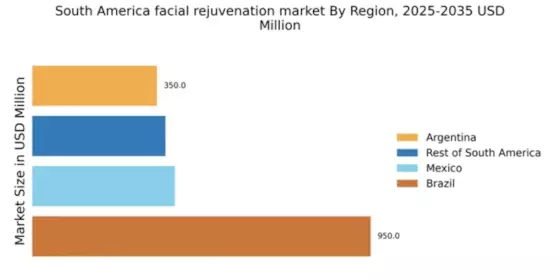
Brazil holds a commanding market share of 50% in the South American facial rejuvenation sector, valued at $950.0 million. Key growth drivers include a rising middle class, increased awareness of aesthetic procedures, and a strong cultural emphasis on beauty. Demand trends show a shift towards minimally invasive treatments, supported by favorable regulatory policies that encourage innovation. Government initiatives promoting health and wellness further bolster market growth, alongside advancements in medical infrastructure and technology.

Mexico : Mexico's Growing Aesthetic Demand

Mexico accounts for a 20% market share in the South American facial rejuvenation market, valued at $400.0 million. The growth is driven by increasing disposable incomes and a burgeoning interest in cosmetic procedures among younger demographics. Regulatory frameworks are becoming more supportive, facilitating the entry of new technologies. The demand for non-surgical treatments is on the rise, reflecting changing consumer preferences towards less invasive options.

Argentina : Argentina's Resilient Aesthetic Sector

Argentina holds a 17.5% market share in the facial rejuvenation market, valued at $350.0 million. Despite economic fluctuations, the demand for aesthetic treatments remains strong, driven by a cultural affinity for beauty and self-care. Government initiatives aimed at regulating the cosmetic industry are gradually improving market conditions. The trend towards personalized treatments is gaining traction, with consumers seeking tailored solutions to their aesthetic needs.

Rest of South America : Varied Growth Across South America

The Rest of South America represents a 19% market share in the facial rejuvenation sector, valued at $374.0 million. This sub-region showcases diverse market dynamics, with varying levels of demand influenced by local economic conditions and cultural attitudes towards beauty. Countries like Chile and Colombia are emerging as key players, with increasing investments in aesthetic clinics. The competitive landscape features both local and international brands, creating a vibrant market environment.

South America Facial Rejuvenation Market Regional Image

Key Players and Competitive Insights

The facial rejuvenation market in South America is characterized by a dynamic competitive landscape, driven by increasing consumer demand for aesthetic procedures and advancements in technology. Key players such as Allergan (US), Revance Therapeutics (US), and Galderma (CH) are strategically positioned to leverage innovation and regional expansion. Allergan (US) focuses on enhancing its product portfolio through continuous research and development, while Revance Therapeutics (US) emphasizes its commitment to novel therapies that offer longer-lasting results. Galderma (CH), on the other hand, is actively pursuing partnerships to broaden its market reach, thereby shaping a competitive environment that is increasingly collaborative and innovation-driven.

In terms of business tactics, companies are localizing manufacturing to reduce costs and optimize supply chains, which is particularly relevant in a region where logistics can be challenging. The market structure appears moderately fragmented, with several players vying for market share. However, the collective influence of major companies is significant, as they set trends and standards that smaller firms often follow, thereby creating a ripple effect throughout the market.

In October 2025, Allergan (US) announced the launch of a new line of injectable fillers specifically designed for the South American market, aiming to cater to local preferences and skin types. This strategic move not only enhances their product offering but also demonstrates a keen understanding of regional consumer needs, potentially increasing their market share in a competitive landscape.

In September 2025, Revance Therapeutics (US) secured a partnership with a leading South American aesthetic clinic chain to introduce its innovative DaxibotulinumtoxinA injection. This collaboration is likely to enhance brand visibility and consumer trust, as it aligns the company with established local players, thereby facilitating market penetration and acceptance of its advanced products.

In August 2025, Galderma (CH) expanded its distribution network by collaborating with local distributors across several South American countries. This strategic action is expected to improve product availability and accessibility, which is crucial in a market where consumer awareness and demand for facial rejuvenation treatments are on the rise.

As of November 2025, current trends in the facial rejuvenation market include a strong emphasis on digitalization, sustainability, and the integration of artificial intelligence in treatment planning and product development. Strategic alliances are increasingly shaping the competitive landscape, allowing companies to pool resources and expertise. Looking ahead, it seems that competitive differentiation will evolve from traditional price-based strategies to a focus on innovation, technological advancements, and reliable supply chains, which are likely to become the new benchmarks for success in this vibrant market.

Key Companies in the South America Facial Rejuvenation Market market include

Industry Developments

Recent developments in the South America Facial Rejuvenation Market are marked by significant growth and innovation. Companies such as Ipsen and Allergan are expanding their product lines and enhancing their marketing strategies to meet the rising demand for non-surgical aesthetic treatments. In August 2023, Galderma announced new initiatives aimed at increasing accessibility to its products across Brazil and Argentina. 

Medytox and Revive Medical have also reported advancements in their Research and Development efforts for innovative injectables in the region. In terms of mergers and acquisitions, Sientra acquired certain assets from another company in June 2023, which is expected to bolster its portfolio in the South American market. 

Additionally, Revance Therapeutics has signed strategic partnerships with local distributors to enhance its footprint in key markets like Colombia and Chile in April 2023. The widespread acceptance of aesthetic treatments among the growing middle-class population in South America continues to propel market growth, with projections indicating that the sector could double over the next five years, fueled by advancements in technology and product offerings by key players such as InMode, Hugel, and CromaPharma.

Future Outlook

South America Facial Rejuvenation Market Future Outlook

The Facial Rejuvenation Market is projected to grow at a 4.68% CAGR from 2024 to 2035, driven by technological advancements, increasing consumer awareness, and rising disposable incomes.

New opportunities lie in:

  • Expansion of telemedicine consultations for aesthetic procedures.
  • Development of personalized skincare products using AI technology.
  • Investment in eco-friendly and sustainable rejuvenation solutions.

By 2035, the market is expected to achieve substantial growth, reflecting evolving consumer preferences and innovative solutions.

Market Segmentation

South America Facial Rejuvenation Market Skin Type Outlook

  • Aging Skin
  • Dry Skin
  • Oily Skin
  • Combination Skin

South America Facial Rejuvenation Market Target Group Outlook

  • Men
  • Women
  • Aging Population

South America Facial Rejuvenation Market Treatment Type Outlook

  • Surgical Procedures
  • Non-Surgical Procedures
  • Injectables
  • Laser Treatments

South America Facial Rejuvenation Market Procedure Category Outlook

  • Facelift
  • Botox Injections
  • Dermal Fillers
  • Chemical Peels

Report Scope

MARKET SIZE 20242074.0(USD Million)
MARKET SIZE 20252171.06(USD Million)
MARKET SIZE 20353430.1(USD Million)
COMPOUND ANNUAL GROWTH RATE (CAGR)4.68% (2024 - 2035)
REPORT COVERAGERevenue Forecast, Competitive Landscape, Growth Factors, and Trends
BASE YEAR2024
Market Forecast Period2025 - 2035
Historical Data2019 - 2024
Market Forecast UnitsUSD Million
Key Companies Profiled["Allergan (US)", "Revance Therapeutics (US)", "Galderma (CH)", "Medytox (KR)", "Hugel (KR)", "Ipsen (FR)", "Medytox (KR)", "Sientra (US)", "Hugel (KR)"]
Segments CoveredTreatment Type, Procedure Category, Skin Type, Target Group
Key Market OpportunitiesEmergence of advanced non-invasive technologies driving consumer demand in the facial rejuvenation market.
Key Market DynamicsRising consumer demand for non-invasive procedures drives innovation and competition in the facial rejuvenation market.
Countries CoveredBrazil, Mexico, Argentina, Rest of South America

Leave a Comment

FAQs

What is the projected market size of the South America Facial Rejuvenation Market in 2024?

The South America Facial Rejuvenation Market is expected to be valued at 1.04 USD billion in 2024.

How large is the South America Facial Rejuvenation Market anticipated to be by 2035?

By 2035, the South America Facial Rejuvenation Market is projected to reach approximately 1.63 USD billion.

What is the expected compound annual growth rate (CAGR) for the South America Facial Rejuvenation Market from 2025 to 2035?

The market is expected to exhibit a CAGR of 4.22% from 2025 to 2035.

Which country holds the largest market share in the South America Facial Rejuvenation Market in 2024?

Brazil is anticipated to hold the largest market share, valued at 0.4 USD billion in 2024.

What is the market value of non-surgical procedures in the South America Facial Rejuvenation Market in 2024?

Non-surgical procedures are valued at approximately 0.25 USD billion in 2024.

Who are the key players in the South America Facial Rejuvenation Market?

Major players include Ipsen, Allergan, Galderma, Medytox, and Revive Medical among others.

What is the anticipated market size for injectables in the South America Facial Rejuvenation Market by 2035?

Injectables are expected to reach a market size of around 0.5 USD billion by 2035.

How much is the market for laser treatments valued at in 2024?

The laser treatments segment is valued at approximately 0.17 USD billion in 2024.

What are the market values for Argentina in the South America Facial Rejuvenation Market in 2024?

In 2024, the market value for Argentina is approximately 0.15 USD billion.

What growth is expected for the Rest of South America segment in 2035?

The Rest of South America segment is projected to grow to about 0.37 USD billion by 2035.

Download Free Sample

Kindly complete the form below to receive a free sample of this Report

Compare Licence

×
Features License Type
Single User Multiuser License Enterprise User
Price $4,950 $5,950 $7,250
Maximum User Access Limit 1 User Upto 10 Users Unrestricted Access Throughout the Organization
Free Customization
Direct Access to Analyst
Deliverable Format
Platform Access
Discount on Next Purchase 10% 15% 15%
Printable Versions