Request Free Sample ×

Kindly complete the form below to receive a free sample of this Report

* Please use a valid business email

Leading companies partner with us for data-driven Insights

clients tt-cursor
Hero Background
English
Chinese
French
Japanese
Korean
German
Spanish

Software Defined Data Center Market Size

ID: MRFR/ICT/3478-HCR
100 Pages
Garvit Vyas
December 2024

Software Defined Data Center Market Size, Share and Research Report: By Solution (SDC, SDS, SDN), by Services (Managed, Consulting, Assessment), by Vertical (BFSI, Retail, IT, Healthcare, Government), And By Region (North America, Europe, Asia-Pacific, And Rest Of The World) –Market Forecast Till 2035

Share:
Download PDF ×

We do not share your information with anyone. However, we may send you emails based on your report interest from time to time. You may contact us at any time to opt-out.

Software Defined Data Center Market Infographic
Purchase Options

Software Defined Data Center Size

Software Defined Data Center Market Growth Projections and Opportunities

The Software-Defined Data Center (SDDC) Market is growing rapidly, and companies are positioning themselves to gain market share. Industry players use separation. Organizations emphasize advanced SDDC features including virtualization, automation, and coordination. VMware and Microsoft intend to attract businesses seeking innovative and flexible SDDC solutions by providing a comprehensive and adaptable base that meets changing business demands, giving them a market advantage.

Another essential Software-Defined Data Center Market strategy is cost initiative. Companies provide feasible SDDC solutions to make them more accessible to a wide variety of organizations, especially those with financial plan needs. Streamlining asset utilization, using open-source technologies, and providing flexible permission methods are part of this approach. Organizations may attract more customers and establish key strengths by positioning themselves as cost-effective alternatives. This is particularly important in areas where cost considerations strongly influence IT framework investment decisions.

Market division is crucial for Software-Defined Data Center Market companies to meet industry demands. Dissecting the requirements of sectors like money, medical services, and broadcast communications allows firms to tailor SDDC contributions to unique consistency principles and functional issues. Under specific agreements, Dell Technologies and Nutanix provide specialist markets within the SDDC sector, meeting the needs of distinct corporations.

Software-Defined Data Center Market share depends on key companies and coordinated efforts. SDDC arrangements may be improved by working with equipment manufacturers, cloud specialist co-ops, and other technology suppliers. Cisco and SDDC providers collaborate to integrate software-defined innovations into system administration and framework elements, providing customers with a complete and interoperable data center setup.

Companies seeking to grow in the Software-Defined Data Center Market must develop globally. With global enterprises, SDDC arrangements that can adapt to data residency and administrative requirements are in demand. HPE and IBM focus on global expansion to service global projects, allowing them to provide predictable and adaptive software-defined framework across regions.

Mechanical development leads Software-Defined Data Center Market share positioning. Organizations become industry leaders by coordinating computerized reasoning for computerization, performing edge registering skills, or expanding security features. Continuous innovation allows companies to deliver cutting-edge solutions that fulfill the framework demands of software-defined design companies.
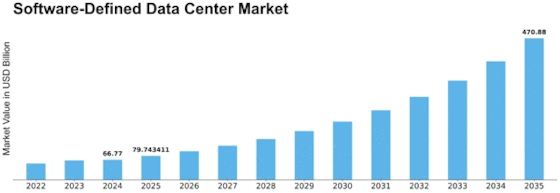
Software Defined Data Center Market Size Graph
Author
Garvit Vyas
Analyst

Explore the profile of Garvit Vyas, one of our esteemed authors at Market Research Future, and access their expert research contributions in the field of market research and industry analysis

Leave a Comment

FAQs

What is the current valuation of the Software-Defined Data Center Market as of 2024?

<p>The Software-Defined Data Center Market was valued at 66.77 USD Billion in 2024.</p>

What is the projected market valuation for the Software-Defined Data Center Market in 2035?

<p>The market is projected to reach a valuation of 470.88 USD Billion by 2035.</p>

What is the expected CAGR for the Software-Defined Data Center Market during the forecast period 2025 - 2035?

<p>The expected CAGR for the Software-Defined Data Center Market during 2025 - 2035 is 19.43%.</p>

Which companies are considered key players in the Software-Defined Data Center Market?

<p>Key players in the market include VMware, Microsoft, Cisco, Hewlett Packard Enterprise, IBM, Oracle, Dell Technologies, Nutanix, and Red Hat.</p>

What are the main segments of the Software-Defined Data Center Market?

<p>The main segments include Solutions, Services, and Verticals.</p>

What was the valuation of the Software-Defined Data Center Solutions segment in 2024?

<p>The Solutions segment was valued at 66.77 USD Billion in 2024, with SDC at 20.0 USD Billion, SDS at 25.0 USD Billion, and SDN at 21.77 USD Billion.</p>

How is the Services segment of the Software-Defined Data Center Market expected to perform?

<p>The Services segment is projected to grow from 25.0 USD Billion in 2024 to 180.0 USD Billion by 2035.</p>

What is the projected growth for the IT vertical within the Software-Defined Data Center Market?

<p>The IT vertical is expected to grow from 25.0 USD Billion in 2024 to 200.0 USD Billion by 2035.</p>

How does the Software-Defined Data Center Market compare across different verticals?

<p>In 2024, the BFSI vertical was valued at 10.0 USD Billion, Retail at 8.0 USD Billion, IT at 25.0 USD Billion, Healthcare at 12.0 USD Billion, and Government at 11.77 USD Billion.</p>

What trends are influencing the growth of the Software-Defined Data Center Market?

<p>Trends such as increased demand for cloud services and automation are likely driving the growth of the Software-Defined Data Center Market.</p>

Market Summary

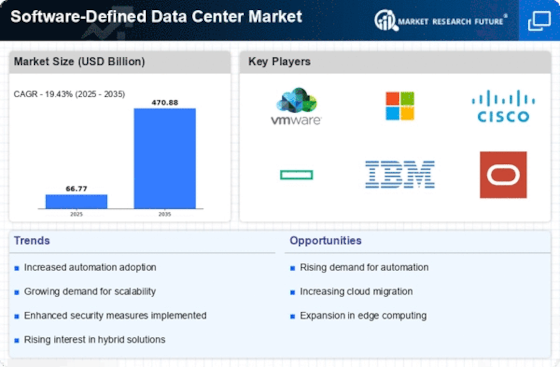
As per Market Research Future analysis, the Software-Defined Data Center Market Size was estimated at 66.77 USD Billion in 2024. The Software-Defined Data Center industry is projected to grow from 79.74 USD Billion in 2025 to 470.88 USD Billion by 2035, exhibiting a compound annual growth rate (CAGR) of 19.43% during the forecast period 2025 - 2035

Key Market Trends & Highlights

The Software-Defined Data Center Market is poised for substantial growth driven by technological advancements and evolving business needs.

  • The market is witnessing increased adoption of hybrid cloud solutions, particularly in North America, which remains the largest market. Automation and orchestration are becoming focal points, enhancing operational efficiency across various sectors. Advanced security measures are being integrated to address the growing emphasis on data security, especially in the Asia-Pacific region. Rising demand for scalability and cost reduction are major drivers propelling the growth of the SDC segment, while the SDN segment is rapidly expanding.

Market Size & Forecast

2024 Market Size 66.77 (USD Billion)
2035 Market Size 470.88 (USD Billion)
CAGR (2025 - 2035) 19.43%
Largest Regional Market Share in 2024 North America

Major Players

VMware (US), Microsoft (US), Cisco (US), Hewlett Packard Enterprise (US), IBM (US), Oracle (US), Dell Technologies (US), Nutanix (US), Red Hat (US)

Market Trends

The Software-Defined Data Center Market is currently experiencing a transformative phase, driven by the increasing demand for flexible and efficient IT infrastructure. Organizations are increasingly adopting software-defined technologies to enhance their operational agility and reduce costs. This shift towards virtualization and automation allows for more streamlined management of resources, enabling businesses to respond swiftly to changing market conditions. As enterprises seek to optimize their data center operations, the integration of artificial intelligence and machine learning into software-defined solutions appears to be gaining traction, potentially revolutionizing how data centers are managed and operated.

Moreover, the growing emphasis on sustainability and energy efficiency is influencing the Software-Defined Data Center Market. Companies are recognizing the importance of reducing their carbon footprint and are exploring innovative solutions that align with environmental goals. This trend suggests a potential shift towards greener technologies, which may include energy-efficient hardware and intelligent resource allocation strategies. As the market evolves, it is likely that the convergence of these factors will shape the future landscape of data center operations, fostering a more adaptive and sustainable environment for businesses worldwide.

The Software Defined Data Center Market represents a rapidly evolving segment of the global data center industry, driven by the adoption of software-defined data center architectures that enable centralized control, automation, and efficient resource management. The transition from traditional infrastructure to a software defined datacenter model is transforming the software data center landscape, allowing organizations to improve scalability, agility, and cost efficiency. Software defined compute forms the foundation of SDDC software, enabling virtualized control of processing resources through software-defined server architectures. In a datacenter software defined environment, compute, storage, and networking resources are abstracted from hardware and delivered through intelligent software layers. VMware software defined data center solutions play a critical role in enabling virtualization, cloud integration, and automated infrastructure management across enterprise environments. Enterprises across Europe are increasingly adopting software defined data centre solutions to comply with data sovereignty regulations and enhance operational efficiency.

Increased Adoption of Hybrid Cloud Solutions

Organizations are increasingly gravitating towards hybrid cloud architectures, which combine on-premises infrastructure with public cloud services. This trend allows businesses to leverage the benefits of both environments, enhancing flexibility and scalability while optimizing costs.

Focus on Automation and Orchestration

The emphasis on automation within the Software-Defined Data Center Market is becoming more pronounced. Companies are investing in orchestration tools that streamline operations, reduce manual intervention, and improve overall efficiency in resource management.

Integration of Advanced Security Measures

As cyber threats continue to evolve, there is a growing focus on integrating advanced security protocols within software-defined environments. This trend indicates a proactive approach to safeguarding data and ensuring compliance with regulatory standards.

Software Defined Data Center Market Market Drivers

Rising Demand for Scalability

The Software-Defined Data Center Market is experiencing a notable surge in demand for scalability. Organizations are increasingly seeking solutions that allow them to scale their IT resources dynamically, responding to fluctuating workloads and business needs. This trend is driven by the necessity for businesses to remain agile in a competitive landscape. According to recent data, the market for scalable solutions is projected to grow at a compound annual growth rate of approximately 25% over the next five years. As enterprises migrate to software-defined architectures, they are finding that these solutions not only enhance operational efficiency but also reduce costs associated with over-provisioning. The ability to scale resources on-demand is becoming a critical factor in the decision-making process for IT investments.

Enhanced Operational Efficiency

Operational efficiency remains a pivotal driver within the Software-Defined Data Center Market. Organizations are increasingly adopting software-defined solutions to streamline their operations, reduce manual intervention, and optimize resource utilization. By automating routine tasks and leveraging orchestration tools, companies can achieve significant improvements in efficiency. Recent studies indicate that businesses utilizing software-defined data centers report up to a 40% reduction in operational costs. This efficiency is particularly crucial as organizations strive to maximize their return on investment in IT infrastructure. Furthermore, the integration of advanced analytics within these environments allows for better decision-making and resource allocation, further enhancing overall operational performance.

Growing Focus on Cost Reduction

Cost reduction is a fundamental driver influencing the Software-Defined Data Center Market. As organizations face increasing pressure to optimize their IT budgets, software-defined solutions offer a pathway to significant savings. By consolidating hardware and utilizing virtualization technologies, companies can reduce capital expenditures and operational costs. Market analysis suggests that organizations can achieve up to 30% savings in IT spending by transitioning to software-defined architectures. This financial incentive is compelling, particularly for small to medium-sized enterprises that may have limited resources. Additionally, the ability to leverage existing infrastructure while adopting new technologies further enhances the cost-effectiveness of software-defined data centers.

Increased Emphasis on Data Security

Data security is becoming an increasingly critical concern within the Software-Defined Data Center Market. As cyber threats evolve, organizations are prioritizing the implementation of robust security measures within their data center environments. Software-defined solutions offer enhanced security features, such as micro-segmentation and automated compliance checks, which help mitigate risks. Recent reports indicate that the market for security solutions in software-defined environments is expected to grow by over 20% in the coming years. This emphasis on security not only protects sensitive data but also ensures compliance with regulatory requirements, making it a vital consideration for organizations looking to adopt software-defined architectures.

Adoption of Artificial Intelligence and Machine Learning

The integration of artificial intelligence (AI) and machine learning (ML) technologies is emerging as a significant driver in the Software-Defined Data Center Market. These technologies enable organizations to analyze vast amounts of data, optimize resource allocation, and predict future workloads. By leveraging AI and ML, businesses can enhance their operational capabilities and improve decision-making processes. Current trends suggest that the adoption of AI-driven solutions within software-defined data centers could increase by approximately 35% over the next few years. This shift not only enhances efficiency but also positions organizations to better respond to market demands and technological advancements.

Market Segment Insights

By Solution: SDC (Largest) vs. SDN (Fastest-Growing)

The Software-Defined Data Center (SDDC) market is characterized by its distribution across various segments, notably Software-Defined Compute (SDC), Software-Defined Storage (SDS), and Software-Defined Networking (SDN). Among these, SDC emerges as the largest contributor, demonstrating substantial market control, while SDN positions itself as the fastest-growing segment due to increasing demand for efficient <a href="network%20management%20-%20https://www.marketresearchfuture.com/reports/network-management-market-5242">network management </a>and virtualization.

Market Dynamics: SDC (Dominant) vs. SDN (Emerging)

Software-Defined Compute (SDC) remains the cornerstone of the Software-Defined Data Center market, offering unparalleled control and flexibility in managing computing resources. Its dominance is attributed to its robust architecture that supports various applications and workloads efficiently. In contrast, Software-Defined Networking (SDN) is rapidly emerging, driven by the need for dynamic <a href="network%20management%20-%20https://www.marketresearchfuture.com/reports/network-management-market-5242">network management</a>. It facilitates seamless integration, faster provisioning, and improved scalability, making it increasingly vital for businesses seeking to enhance their infrastructure agility in the digital era. Both solutions reflect distinct attributes that cater to different operational priorities, shaping the future of data centers.

By Services: Managed (Largest) vs. Consulting (Fastest-Growing)

In the Software-Defined Data Center (SDDC) market, the services segment is significantly influenced by three primary areas: Managed, Consulting, and Assessment services. <a href="managed%20services%20-%20https://www.marketresearchfuture.com/reports/managed-services-market-2424">Managed services </a>currently dominate the segment, leveraging their robust frameworks and extensive capabilities to handle complex IT environments. While they hold the largest share, consulting services are rapidly emerging as the fastest-growing option due to increasing demands for tailored solutions and expert guidance in transitioning to software-defined infrastructures.

Services: Managed (Dominant) vs. Consulting (Emerging)

Managed services in the SDDC market are characterized by their comprehensive offerings that allow organizations to offload complex operations. These services provide continuous monitoring and support, ensuring optimal performance and security. In contrast, consulting services are increasingly appealing to enterprises seeking strategic insights and implementation guidance. They focus on aligning technology with business goals and enhancing operational efficiency. As organizations pivot towards digital transformation, both managed and consulting services fulfill essential roles, with <a href="managed%20services%20-%20https://www.marketresearchfuture.com/reports/managed-services-market-2424">managed services </a>providing stability and consulting driving innovation.

By Vertical: BFSI (Largest) vs. Healthcare (Fastest-Growing)

In the Software-Defined Data Center Market, the BFSI sector holds the largest market share, driven by the increasing reliance on technology for efficient financial transactions and secure data management. This sector has embraced data center virtualization to enhance flexibility, reduce costs, and improve regulatory compliance. Following closely, the healthcare sector is rapidly expanding, leveraging software-defined solutions to streamline operations, enhance patient care, and manage vast amounts of data securely. As healthcare organizations evolve, their dependency on software-defined data centers is crucial for supporting their <a href="digital%20transformation%20-%20https://www.marketresearchfuture.com/reports/digital-transformation-market-8685">digital transformation </a>efforts. The growth trends within these segments are influenced by the ongoing digital revolution that prioritizes agility and operational efficiency. BFSI is bolstering its investments in SDDC solutions to maintain competitive advantages, while healthcare organizations are adopting technologies that support remote patient monitoring and telehealth services. These trends are further fueled by increasing cyber threats necessitating robust security measures and compliance with stringent regulations. As such, BFSI continues to dominate, while healthcare emerges as a key growth area in the market.

BFSI: Dominant vs. Healthcare: Emerging

The BFSI segment within the Software-Defined Data Center Market is characterized by its substantial investment in advanced IT infrastructure to support operational efficiency and consumer demands for digital services. Banks and financial institutions are prioritizing data security, compliance, and availability, driving the adoption of software-defined solutions. On the other hand, the healthcare sector is emerging as a critical player, rapidly embracing software-defined data centers to manage electronic health records, enhance data sharing among providers, and improve patient outcomes. While BFSI stands firm as the dominant force, healthcare is experiencing an unprecedented surge, propelled by technological innovations and the necessity for remote healthcare solutions.

Get more detailed insights about Software Defined Data Center Market Research Report – Forecast till 2035

Regional Insights

By region, the research provides market insights into North America, Europe, Asia-Pacific, and the Rest of the World. The North American Software Defined Data Center Market area will dominate during the projected timeframe, owing to the worldwide development of large enterprises through introducing goods and collaborations that will boost the market growth in the North American region.

Further, the major countries studied in the market report are the US, Canada, German, France, the UK, Italy, Spain, China, Japan, India, Australia, South Korea, and Brazil.

Figure 3: Software Defined Data Center Market Share by Region 2022 (USD Billion)

Europe region’s Software-Defined Data Center market accounts for the second-highest market share due to supportive economic factors, such as tax breaks, plentiful renewable energy supplies, and solid data security and privacy legislation, which drive data centers' needs. Further, the German Software-Defined Data Center market holds the largest market share, and the UK Software-Defined Data Center market is expected to grow and expand significantly in the European region during the projected timeframe.

The Asia-Pacific Software Defined Data Center Market is expected to grow quickly during the projected timeframe. This is due to rising industrialization and the emergence of new markets. The APAC region's fundamental IT infrastructure rapidly evolves, creating a self-replicating cycle that drives more investment and development. Moreover, China’s Software-Defined Data Center market dominates the market share, and the Indian Software-Defined Data Center market is expected to expand and grow steadily in the Asia-Pacific region during the projected timeframe.

Key Players and Competitive Insights

Leading market players invested heavily in research and Development (R&D) to scale up their manufacturing units and develop technologically advanced solutions, which will help the Software Defined Data Center Market grow worldwide. Market participants are also undertaking various organic or inorganic strategic approaches to strengthen and expand their global footprint, with significant market developments including new product portfolios, contractual deals, mergers and acquisitions, capital expenditure, higher investments, and strategic alliances with other organizations. Businesses are also coming up with marketing strategies such as digital marketing, social media influencing, and content marketing to increase their scope of profit earnings. The Software-Defined Data Center industry must offer cost-effective and sustainable options to survive in a highly fragmented and dynamic market climate. Manufacturing locally to minimize operational expenses and offer aftermarket services to customers is one of the critical business strategies organizations use in the global Software Defined Data Center industry to benefit customers and capture untapped market share and revenue. The Software-Defined Data Center industry has recently offered significant advantages to the Information and Communications Technology industry. Moreover, more industry participants are utilizing and adopting cutting-edge technology has grown substantially. Major players in the Software-Defined Data Center market, including VMware Inc. (US), EMC Corporation (US), IBM Corporation (US), Microsoft Corporation (US), Cisco Systems, Inc. (US); Hitachi, Ltd. (Japan), Fujitsu, Ltd. (Japan), NEC Corporation (Japan), Citrix Systems (US), HPE Co (US) are attempting to expand market share and demand by investing in R&D operations to produce sustainable and affordable solutions. IBM (International Business Machines) is a computer, technology, and IT consulting firm headquartered in the United States. It is the world's largest technology business and the second most valuable worldwide brand. It produces and sells software and computer components, web hosting, and consulting services in fields including mainframe systems and nanotechnology. On June 16, 1911, Charles Ranlett Flint and Thomas J. Watson Sr. created the corporation, which is located in Armonk, New York. IBM Corporation introduced an upgraded storage solution in April 2021 that improved data accessibility and availability throughout the hybrid cloud. The company expects to release innovative container-native SDS technologies to help enterprises boost data availability throughout complex hybrid clouds for better company efficiency and resilience. Cisco Systems, Inc. is an IT and communications firm that designs, manufactures, and sells Internet Protocol-based networking devices and services. The company operates in three regional segments: North America, EMEA, and Asia-Pacific. Switches, NMI & Modules, Routers, Optical Communication, Network Points, Next-Generation Firewalls, Sophisticated Malware Protection, VPN Clients, and Web Security are among its product categories. Sandra Lerner and Leonard Bosack formed the firm on December 10, 1984, headquartered in San Jose, California. Cisco and Microsoft strengthened their networking agreements to make it easier for IT to directly link branches to Microsoft Azure Virtual WAN. Cisco SD-WAN is going to be hosted in Microsoft Azure.

Key Companies in the Software Defined Data Center Market include

Industry Developments

June 2021: NTT Limited introduced updated worldwide data center interconnect network services for optimizing hybrid cloud systems in June 2021, based on advanced SDN technology. A worldwide unified networking fabric solution that allows NTT's global data centers and major cloud service suppliers to connect confidentially and safely.

April 2021: IBM Corporation introduced an upgraded storage solution in April 2021 that improved data accessibility and availability throughout the hybrid cloud. The company expects to release innovative container-native SDS technologies to help enterprises boost data availability throughout complex hybrid clouds for better company efficiency and resilience.

Cisco and Microsoft strengthened their networking agreements to make it easier for IT to directly link branches to Microsoft Azure Virtual WAN. Cisco SD-WAN is going to be hosted in Microsoft Azure.

Future Outlook

Software Defined Data Center Market Future Outlook

The Software-Defined Data Center Market is projected to grow at a 19.43% CAGR from 2025 to 2035, driven by cloud adoption, automation, and enhanced data management solutions.

New opportunities lie in:

  • <p>Development of AI-driven resource allocation tools Expansion of <a href="hybrid%20cloud%20-%20https://www.marketresearchfuture.com/reports/hybrid-cloud-market-1018">hybrid cloud </a>integration services Creation of advanced security frameworks for data centers</p>

By 2035, the market is expected to be robust, reflecting substantial growth and innovation.

Market Segmentation

Software Defined Data Center Market Services Outlook

  • Managed
  • Consulting
  • Assessment

Software Defined Data Center Market Solution Outlook

  • SDC
  • SDS
  • SDN

Software Defined Data Center Market Vertical Outlook

  • BFSI
  • Retail
  • IT
  • Healthcare
  • Government

Report Scope

MARKET SIZE 2024 66.77(USD Billion)
MARKET SIZE 2025 79.74(USD Billion)
MARKET SIZE 2035 470.88(USD Billion)
COMPOUND ANNUAL GROWTH RATE (CAGR) 19.43% (2025 - 2035)
REPORT COVERAGE Revenue Forecast, Competitive Landscape, Growth Factors, and Trends
BASE YEAR 2024
Market Forecast Period 2025 - 2035
Historical Data 2019 - 2024
Market Forecast Units USD Billion
Key Companies Profiled VMware (US), Microsoft (US), Cisco (US), Hewlett Packard Enterprise (US), IBM (US), Oracle (US), Dell Technologies (US), Nutanix (US), Red Hat (US)
Segments Covered Solution, Services, Vertical, Region
Key Market Opportunities Integration of artificial intelligence enhances operational efficiency in the Software-Defined Data Center Market.
Key Market Dynamics Rising demand for automation and scalability drives innovation in the Software-Defined Data Center Market.
Countries Covered North America, Europe, APAC, South America, MEA

FAQs

What is the current valuation of the Software-Defined Data Center Market as of 2024?

<p>The Software-Defined Data Center Market was valued at 66.77 USD Billion in 2024.</p>

What is the projected market valuation for the Software-Defined Data Center Market in 2035?

<p>The market is projected to reach a valuation of 470.88 USD Billion by 2035.</p>

What is the expected CAGR for the Software-Defined Data Center Market during the forecast period 2025 - 2035?

<p>The expected CAGR for the Software-Defined Data Center Market during 2025 - 2035 is 19.43%.</p>

Which companies are considered key players in the Software-Defined Data Center Market?

<p>Key players in the market include VMware, Microsoft, Cisco, Hewlett Packard Enterprise, IBM, Oracle, Dell Technologies, Nutanix, and Red Hat.</p>

What are the main segments of the Software-Defined Data Center Market?

<p>The main segments include Solutions, Services, and Verticals.</p>

What was the valuation of the Software-Defined Data Center Solutions segment in 2024?

<p>The Solutions segment was valued at 66.77 USD Billion in 2024, with SDC at 20.0 USD Billion, SDS at 25.0 USD Billion, and SDN at 21.77 USD Billion.</p>

How is the Services segment of the Software-Defined Data Center Market expected to perform?

<p>The Services segment is projected to grow from 25.0 USD Billion in 2024 to 180.0 USD Billion by 2035.</p>

What is the projected growth for the IT vertical within the Software-Defined Data Center Market?

<p>The IT vertical is expected to grow from 25.0 USD Billion in 2024 to 200.0 USD Billion by 2035.</p>

How does the Software-Defined Data Center Market compare across different verticals?

<p>In 2024, the BFSI vertical was valued at 10.0 USD Billion, Retail at 8.0 USD Billion, IT at 25.0 USD Billion, Healthcare at 12.0 USD Billion, and Government at 11.77 USD Billion.</p>

What trends are influencing the growth of the Software-Defined Data Center Market?

<p>Trends such as increased demand for cloud services and automation are likely driving the growth of the Software-Defined Data Center Market.</p>

  1. SECTION I: EXECUTIVE SUMMARY AND KEY HIGHLIGHTS
    1. | 1.1 EXECUTIVE SUMMARY
    2. | | 1.1.1 Market Overview
    3. | | 1.1.2 Key Findings
    4. | | 1.1.3 Market Segmentation
    5. | | 1.1.4 Competitive Landscape
    6. | | 1.1.5 Challenges and Opportunities
    7. | | 1.1.6 Future Outlook
  2. SECTION II: SCOPING, METHODOLOGY AND MARKET STRUCTURE
    1. | 2.1 MARKET INTRODUCTION
    2. | | 2.1.1 Definition
    3. | | 2.1.2 Scope of the study
    4. | | | 2.1.2.1 Research Objective
    5. | | | 2.1.2.2 Assumption
    6. | | | 2.1.2.3 Limitations
    7. | 2.2 RESEARCH METHODOLOGY
    8. | | 2.2.1 Overview
    9. | | 2.2.2 Data Mining
    10. | | 2.2.3 Secondary Research
    11. | | 2.2.4 Primary Research
    12. | | | 2.2.4.1 Primary Interviews and Information Gathering Process
    13. | | | 2.2.4.2 Breakdown of Primary Respondents
    14. | | 2.2.5 Forecasting Model
    15. | | 2.2.6 Market Size Estimation
    16. | | | 2.2.6.1 Bottom-Up Approach
    17. | | | 2.2.6.2 Top-Down Approach
    18. | | 2.2.7 Data Triangulation
    19. | | 2.2.8 Validation
  3. SECTION III: QUALITATIVE ANALYSIS
    1. | 3.1 MARKET DYNAMICS
    2. | | 3.1.1 Overview
    3. | | 3.1.2 Drivers
    4. | | 3.1.3 Restraints
    5. | | 3.1.4 Opportunities
    6. | 3.2 MARKET FACTOR ANALYSIS
    7. | | 3.2.1 Value chain Analysis
    8. | | 3.2.2 Porter's Five Forces Analysis
    9. | | | 3.2.2.1 Bargaining Power of Suppliers
    10. | | | 3.2.2.2 Bargaining Power of Buyers
    11. | | | 3.2.2.3 Threat of New Entrants
    12. | | | 3.2.2.4 Threat of Substitutes
    13. | | | 3.2.2.5 Intensity of Rivalry
    14. | | 3.2.3 COVID-19 Impact Analysis
    15. | | | 3.2.3.1 Market Impact Analysis
    16. | | | 3.2.3.2 Regional Impact
    17. | | | 3.2.3.3 Opportunity and Threat Analysis
  4. SECTION IV: QUANTITATIVE ANALYSIS
    1. | 4.1 Information and Communications Technology, BY Solution (USD Billion)
    2. | | 4.1.1 SDC
    3. | | 4.1.2 SDS
    4. | | 4.1.3 SDN
    5. | 4.2 Information and Communications Technology, BY Services (USD Billion)
    6. | | 4.2.1 Managed
    7. | | 4.2.2 Consulting
    8. | | 4.2.3 Assessment
    9. | 4.3 Information and Communications Technology, BY Vertical (USD Billion)
    10. | | 4.3.1 BFSI
    11. | | 4.3.2 Retail
    12. | | 4.3.3 IT
    13. | | 4.3.4 Healthcare
    14. | | 4.3.5 Government
    15. | 4.4 Information and Communications Technology, BY Region (USD Billion)
    16. | | 4.4.1 North America
    17. | | | 4.4.1.1 US
    18. | | | 4.4.1.2 Canada
    19. | | 4.4.2 Europe
    20. | | | 4.4.2.1 Germany
    21. | | | 4.4.2.2 UK
    22. | | | 4.4.2.3 France
    23. | | | 4.4.2.4 Russia
    24. | | | 4.4.2.5 Italy
    25. | | | 4.4.2.6 Spain
    26. | | | 4.4.2.7 Rest of Europe
    27. | | 4.4.3 APAC
    28. | | | 4.4.3.1 China
    29. | | | 4.4.3.2 India
    30. | | | 4.4.3.3 Japan
    31. | | | 4.4.3.4 South Korea
    32. | | | 4.4.3.5 Malaysia
    33. | | | 4.4.3.6 Thailand
    34. | | | 4.4.3.7 Indonesia
    35. | | | 4.4.3.8 Rest of APAC
    36. | | 4.4.4 South America
    37. | | | 4.4.4.1 Brazil
    38. | | | 4.4.4.2 Mexico
    39. | | | 4.4.4.3 Argentina
    40. | | | 4.4.4.4 Rest of South America
    41. | | 4.4.5 MEA
    42. | | | 4.4.5.1 GCC Countries
    43. | | | 4.4.5.2 South Africa
    44. | | | 4.4.5.3 Rest of MEA
  5. SECTION V: COMPETITIVE ANALYSIS
    1. | 5.1 Competitive Landscape
    2. | | 5.1.1 Overview
    3. | | 5.1.2 Competitive Analysis
    4. | | 5.1.3 Market share Analysis
    5. | | 5.1.4 Major Growth Strategy in the Information and Communications Technology
    6. | | 5.1.5 Competitive Benchmarking
    7. | | 5.1.6 Leading Players in Terms of Number of Developments in the Information and Communications Technology
    8. | | 5.1.7 Key developments and growth strategies
    9. | | | 5.1.7.1 New Product Launch/Service Deployment
    10. | | | 5.1.7.2 Merger & Acquisitions
    11. | | | 5.1.7.3 Joint Ventures
    12. | | 5.1.8 Major Players Financial Matrix
    13. | | | 5.1.8.1 Sales and Operating Income
    14. | | | 5.1.8.2 Major Players R&D Expenditure. 2023
    15. | 5.2 Company Profiles
    16. | | 5.2.1 VMware (US)
    17. | | | 5.2.1.1 Financial Overview
    18. | | | 5.2.1.2 Products Offered
    19. | | | 5.2.1.3 Key Developments
    20. | | | 5.2.1.4 SWOT Analysis
    21. | | | 5.2.1.5 Key Strategies
    22. | | 5.2.2 Microsoft (US)
    23. | | | 5.2.2.1 Financial Overview
    24. | | | 5.2.2.2 Products Offered
    25. | | | 5.2.2.3 Key Developments
    26. | | | 5.2.2.4 SWOT Analysis
    27. | | | 5.2.2.5 Key Strategies
    28. | | 5.2.3 Cisco (US)
    29. | | | 5.2.3.1 Financial Overview
    30. | | | 5.2.3.2 Products Offered
    31. | | | 5.2.3.3 Key Developments
    32. | | | 5.2.3.4 SWOT Analysis
    33. | | | 5.2.3.5 Key Strategies
    34. | | 5.2.4 Hewlett Packard Enterprise (US)
    35. | | | 5.2.4.1 Financial Overview
    36. | | | 5.2.4.2 Products Offered
    37. | | | 5.2.4.3 Key Developments
    38. | | | 5.2.4.4 SWOT Analysis
    39. | | | 5.2.4.5 Key Strategies
    40. | | 5.2.5 IBM (US)
    41. | | | 5.2.5.1 Financial Overview
    42. | | | 5.2.5.2 Products Offered
    43. | | | 5.2.5.3 Key Developments
    44. | | | 5.2.5.4 SWOT Analysis
    45. | | | 5.2.5.5 Key Strategies
    46. | | 5.2.6 Oracle (US)
    47. | | | 5.2.6.1 Financial Overview
    48. | | | 5.2.6.2 Products Offered
    49. | | | 5.2.6.3 Key Developments
    50. | | | 5.2.6.4 SWOT Analysis
    51. | | | 5.2.6.5 Key Strategies
    52. | | 5.2.7 Dell Technologies (US)
    53. | | | 5.2.7.1 Financial Overview
    54. | | | 5.2.7.2 Products Offered
    55. | | | 5.2.7.3 Key Developments
    56. | | | 5.2.7.4 SWOT Analysis
    57. | | | 5.2.7.5 Key Strategies
    58. | | 5.2.8 Nutanix (US)
    59. | | | 5.2.8.1 Financial Overview
    60. | | | 5.2.8.2 Products Offered
    61. | | | 5.2.8.3 Key Developments
    62. | | | 5.2.8.4 SWOT Analysis
    63. | | | 5.2.8.5 Key Strategies
    64. | | 5.2.9 Red Hat (US)
    65. | | | 5.2.9.1 Financial Overview
    66. | | | 5.2.9.2 Products Offered
    67. | | | 5.2.9.3 Key Developments
    68. | | | 5.2.9.4 SWOT Analysis
    69. | | | 5.2.9.5 Key Strategies
    70. | 5.3 Appendix
    71. | | 5.3.1 References
    72. | | 5.3.2 Related Reports
  6. LIST OF FIGURES
    1. | 6.1 MARKET SYNOPSIS
    2. | 6.2 NORTH AMERICA MARKET ANALYSIS
    3. | 6.3 US MARKET ANALYSIS BY SOLUTION
    4. | 6.4 US MARKET ANALYSIS BY SERVICES
    5. | 6.5 US MARKET ANALYSIS BY VERTICAL
    6. | 6.6 CANADA MARKET ANALYSIS BY SOLUTION
    7. | 6.7 CANADA MARKET ANALYSIS BY SERVICES
    8. | 6.8 CANADA MARKET ANALYSIS BY VERTICAL
    9. | 6.9 EUROPE MARKET ANALYSIS
    10. | 6.10 GERMANY MARKET ANALYSIS BY SOLUTION
    11. | 6.11 GERMANY MARKET ANALYSIS BY SERVICES
    12. | 6.12 GERMANY MARKET ANALYSIS BY VERTICAL
    13. | 6.13 UK MARKET ANALYSIS BY SOLUTION
    14. | 6.14 UK MARKET ANALYSIS BY SERVICES
    15. | 6.15 UK MARKET ANALYSIS BY VERTICAL
    16. | 6.16 FRANCE MARKET ANALYSIS BY SOLUTION
    17. | 6.17 FRANCE MARKET ANALYSIS BY SERVICES
    18. | 6.18 FRANCE MARKET ANALYSIS BY VERTICAL
    19. | 6.19 RUSSIA MARKET ANALYSIS BY SOLUTION
    20. | 6.20 RUSSIA MARKET ANALYSIS BY SERVICES
    21. | 6.21 RUSSIA MARKET ANALYSIS BY VERTICAL
    22. | 6.22 ITALY MARKET ANALYSIS BY SOLUTION
    23. | 6.23 ITALY MARKET ANALYSIS BY SERVICES
    24. | 6.24 ITALY MARKET ANALYSIS BY VERTICAL
    25. | 6.25 SPAIN MARKET ANALYSIS BY SOLUTION
    26. | 6.26 SPAIN MARKET ANALYSIS BY SERVICES
    27. | 6.27 SPAIN MARKET ANALYSIS BY VERTICAL
    28. | 6.28 REST OF EUROPE MARKET ANALYSIS BY SOLUTION
    29. | 6.29 REST OF EUROPE MARKET ANALYSIS BY SERVICES
    30. | 6.30 REST OF EUROPE MARKET ANALYSIS BY VERTICAL
    31. | 6.31 APAC MARKET ANALYSIS
    32. | 6.32 CHINA MARKET ANALYSIS BY SOLUTION
    33. | 6.33 CHINA MARKET ANALYSIS BY SERVICES
    34. | 6.34 CHINA MARKET ANALYSIS BY VERTICAL
    35. | 6.35 INDIA MARKET ANALYSIS BY SOLUTION
    36. | 6.36 INDIA MARKET ANALYSIS BY SERVICES
    37. | 6.37 INDIA MARKET ANALYSIS BY VERTICAL
    38. | 6.38 JAPAN MARKET ANALYSIS BY SOLUTION
    39. | 6.39 JAPAN MARKET ANALYSIS BY SERVICES
    40. | 6.40 JAPAN MARKET ANALYSIS BY VERTICAL
    41. | 6.41 SOUTH KOREA MARKET ANALYSIS BY SOLUTION
    42. | 6.42 SOUTH KOREA MARKET ANALYSIS BY SERVICES
    43. | 6.43 SOUTH KOREA MARKET ANALYSIS BY VERTICAL
    44. | 6.44 MALAYSIA MARKET ANALYSIS BY SOLUTION
    45. | 6.45 MALAYSIA MARKET ANALYSIS BY SERVICES
    46. | 6.46 MALAYSIA MARKET ANALYSIS BY VERTICAL
    47. | 6.47 THAILAND MARKET ANALYSIS BY SOLUTION
    48. | 6.48 THAILAND MARKET ANALYSIS BY SERVICES
    49. | 6.49 THAILAND MARKET ANALYSIS BY VERTICAL
    50. | 6.50 INDONESIA MARKET ANALYSIS BY SOLUTION
    51. | 6.51 INDONESIA MARKET ANALYSIS BY SERVICES
    52. | 6.52 INDONESIA MARKET ANALYSIS BY VERTICAL
    53. | 6.53 REST OF APAC MARKET ANALYSIS BY SOLUTION
    54. | 6.54 REST OF APAC MARKET ANALYSIS BY SERVICES
    55. | 6.55 REST OF APAC MARKET ANALYSIS BY VERTICAL
    56. | 6.56 SOUTH AMERICA MARKET ANALYSIS
    57. | 6.57 BRAZIL MARKET ANALYSIS BY SOLUTION
    58. | 6.58 BRAZIL MARKET ANALYSIS BY SERVICES
    59. | 6.59 BRAZIL MARKET ANALYSIS BY VERTICAL
    60. | 6.60 MEXICO MARKET ANALYSIS BY SOLUTION
    61. | 6.61 MEXICO MARKET ANALYSIS BY SERVICES
    62. | 6.62 MEXICO MARKET ANALYSIS BY VERTICAL
    63. | 6.63 ARGENTINA MARKET ANALYSIS BY SOLUTION
    64. | 6.64 ARGENTINA MARKET ANALYSIS BY SERVICES
    65. | 6.65 ARGENTINA MARKET ANALYSIS BY VERTICAL
    66. | 6.66 REST OF SOUTH AMERICA MARKET ANALYSIS BY SOLUTION
    67. | 6.67 REST OF SOUTH AMERICA MARKET ANALYSIS BY SERVICES
    68. | 6.68 REST OF SOUTH AMERICA MARKET ANALYSIS BY VERTICAL
    69. | 6.69 MEA MARKET ANALYSIS
    70. | 6.70 GCC COUNTRIES MARKET ANALYSIS BY SOLUTION
    71. | 6.71 GCC COUNTRIES MARKET ANALYSIS BY SERVICES
    72. | 6.72 GCC COUNTRIES MARKET ANALYSIS BY VERTICAL
    73. | 6.73 SOUTH AFRICA MARKET ANALYSIS BY SOLUTION
    74. | 6.74 SOUTH AFRICA MARKET ANALYSIS BY SERVICES
    75. | 6.75 SOUTH AFRICA MARKET ANALYSIS BY VERTICAL
    76. | 6.76 REST OF MEA MARKET ANALYSIS BY SOLUTION
    77. | 6.77 REST OF MEA MARKET ANALYSIS BY SERVICES
    78. | 6.78 REST OF MEA MARKET ANALYSIS BY VERTICAL
    79. | 6.79 KEY BUYING CRITERIA OF INFORMATION AND COMMUNICATIONS TECHNOLOGY
    80. | 6.80 RESEARCH PROCESS OF MRFR
    81. | 6.81 DRO ANALYSIS OF INFORMATION AND COMMUNICATIONS TECHNOLOGY
    82. | 6.82 DRIVERS IMPACT ANALYSIS: INFORMATION AND COMMUNICATIONS TECHNOLOGY
    83. | 6.83 RESTRAINTS IMPACT ANALYSIS: INFORMATION AND COMMUNICATIONS TECHNOLOGY
    84. | 6.84 SUPPLY / VALUE CHAIN: INFORMATION AND COMMUNICATIONS TECHNOLOGY
    85. | 6.85 INFORMATION AND COMMUNICATIONS TECHNOLOGY, BY SOLUTION, 2024 (% SHARE)
    86. | 6.86 INFORMATION AND COMMUNICATIONS TECHNOLOGY, BY SOLUTION, 2024 TO 2035 (USD Billion)
    87. | 6.87 INFORMATION AND COMMUNICATIONS TECHNOLOGY, BY SERVICES, 2024 (% SHARE)
    88. | 6.88 INFORMATION AND COMMUNICATIONS TECHNOLOGY, BY SERVICES, 2024 TO 2035 (USD Billion)
    89. | 6.89 INFORMATION AND COMMUNICATIONS TECHNOLOGY, BY VERTICAL, 2024 (% SHARE)
    90. | 6.90 INFORMATION AND COMMUNICATIONS TECHNOLOGY, BY VERTICAL, 2024 TO 2035 (USD Billion)
    91. | 6.91 BENCHMARKING OF MAJOR COMPETITORS
  7. LIST OF TABLES
    1. | 7.1 LIST OF ASSUMPTIONS
    2. | | 7.1.1
    3. | 7.2 North America MARKET SIZE ESTIMATES; FORECAST
    4. | | 7.2.1 BY SOLUTION, 2025-2035 (USD Billion)
    5. | | 7.2.2 BY SERVICES, 2025-2035 (USD Billion)
    6. | | 7.2.3 BY VERTICAL, 2025-2035 (USD Billion)
    7. | 7.3 US MARKET SIZE ESTIMATES; FORECAST
    8. | | 7.3.1 BY SOLUTION, 2025-2035 (USD Billion)
    9. | | 7.3.2 BY SERVICES, 2025-2035 (USD Billion)
    10. | | 7.3.3 BY VERTICAL, 2025-2035 (USD Billion)
    11. | 7.4 Canada MARKET SIZE ESTIMATES; FORECAST
    12. | | 7.4.1 BY SOLUTION, 2025-2035 (USD Billion)
    13. | | 7.4.2 BY SERVICES, 2025-2035 (USD Billion)
    14. | | 7.4.3 BY VERTICAL, 2025-2035 (USD Billion)
    15. | 7.5 Europe MARKET SIZE ESTIMATES; FORECAST
    16. | | 7.5.1 BY SOLUTION, 2025-2035 (USD Billion)
    17. | | 7.5.2 BY SERVICES, 2025-2035 (USD Billion)
    18. | | 7.5.3 BY VERTICAL, 2025-2035 (USD Billion)
    19. | 7.6 Germany MARKET SIZE ESTIMATES; FORECAST
    20. | | 7.6.1 BY SOLUTION, 2025-2035 (USD Billion)
    21. | | 7.6.2 BY SERVICES, 2025-2035 (USD Billion)
    22. | | 7.6.3 BY VERTICAL, 2025-2035 (USD Billion)
    23. | 7.7 UK MARKET SIZE ESTIMATES; FORECAST
    24. | | 7.7.1 BY SOLUTION, 2025-2035 (USD Billion)
    25. | | 7.7.2 BY SERVICES, 2025-2035 (USD Billion)
    26. | | 7.7.3 BY VERTICAL, 2025-2035 (USD Billion)
    27. | 7.8 France MARKET SIZE ESTIMATES; FORECAST
    28. | | 7.8.1 BY SOLUTION, 2025-2035 (USD Billion)
    29. | | 7.8.2 BY SERVICES, 2025-2035 (USD Billion)
    30. | | 7.8.3 BY VERTICAL, 2025-2035 (USD Billion)
    31. | 7.9 Russia MARKET SIZE ESTIMATES; FORECAST
    32. | | 7.9.1 BY SOLUTION, 2025-2035 (USD Billion)
    33. | | 7.9.2 BY SERVICES, 2025-2035 (USD Billion)
    34. | | 7.9.3 BY VERTICAL, 2025-2035 (USD Billion)
    35. | 7.10 Italy MARKET SIZE ESTIMATES; FORECAST
    36. | | 7.10.1 BY SOLUTION, 2025-2035 (USD Billion)
    37. | | 7.10.2 BY SERVICES, 2025-2035 (USD Billion)
    38. | | 7.10.3 BY VERTICAL, 2025-2035 (USD Billion)
    39. | 7.11 Spain MARKET SIZE ESTIMATES; FORECAST
    40. | | 7.11.1 BY SOLUTION, 2025-2035 (USD Billion)
    41. | | 7.11.2 BY SERVICES, 2025-2035 (USD Billion)
    42. | | 7.11.3 BY VERTICAL, 2025-2035 (USD Billion)
    43. | 7.12 Rest of Europe MARKET SIZE ESTIMATES; FORECAST
    44. | | 7.12.1 BY SOLUTION, 2025-2035 (USD Billion)
    45. | | 7.12.2 BY SERVICES, 2025-2035 (USD Billion)
    46. | | 7.12.3 BY VERTICAL, 2025-2035 (USD Billion)
    47. | 7.13 APAC MARKET SIZE ESTIMATES; FORECAST
    48. | | 7.13.1 BY SOLUTION, 2025-2035 (USD Billion)
    49. | | 7.13.2 BY SERVICES, 2025-2035 (USD Billion)
    50. | | 7.13.3 BY VERTICAL, 2025-2035 (USD Billion)
    51. | 7.14 China MARKET SIZE ESTIMATES; FORECAST
    52. | | 7.14.1 BY SOLUTION, 2025-2035 (USD Billion)
    53. | | 7.14.2 BY SERVICES, 2025-2035 (USD Billion)
    54. | | 7.14.3 BY VERTICAL, 2025-2035 (USD Billion)
    55. | 7.15 India MARKET SIZE ESTIMATES; FORECAST
    56. | | 7.15.1 BY SOLUTION, 2025-2035 (USD Billion)
    57. | | 7.15.2 BY SERVICES, 2025-2035 (USD Billion)
    58. | | 7.15.3 BY VERTICAL, 2025-2035 (USD Billion)
    59. | 7.16 Japan MARKET SIZE ESTIMATES; FORECAST
    60. | | 7.16.1 BY SOLUTION, 2025-2035 (USD Billion)
    61. | | 7.16.2 BY SERVICES, 2025-2035 (USD Billion)
    62. | | 7.16.3 BY VERTICAL, 2025-2035 (USD Billion)
    63. | 7.17 South Korea MARKET SIZE ESTIMATES; FORECAST
    64. | | 7.17.1 BY SOLUTION, 2025-2035 (USD Billion)
    65. | | 7.17.2 BY SERVICES, 2025-2035 (USD Billion)
    66. | | 7.17.3 BY VERTICAL, 2025-2035 (USD Billion)
    67. | 7.18 Malaysia MARKET SIZE ESTIMATES; FORECAST
    68. | | 7.18.1 BY SOLUTION, 2025-2035 (USD Billion)
    69. | | 7.18.2 BY SERVICES, 2025-2035 (USD Billion)
    70. | | 7.18.3 BY VERTICAL, 2025-2035 (USD Billion)
    71. | 7.19 Thailand MARKET SIZE ESTIMATES; FORECAST
    72. | | 7.19.1 BY SOLUTION, 2025-2035 (USD Billion)
    73. | | 7.19.2 BY SERVICES, 2025-2035 (USD Billion)
    74. | | 7.19.3 BY VERTICAL, 2025-2035 (USD Billion)
    75. | 7.20 Indonesia MARKET SIZE ESTIMATES; FORECAST
    76. | | 7.20.1 BY SOLUTION, 2025-2035 (USD Billion)
    77. | | 7.20.2 BY SERVICES, 2025-2035 (USD Billion)
    78. | | 7.20.3 BY VERTICAL, 2025-2035 (USD Billion)
    79. | 7.21 Rest of APAC MARKET SIZE ESTIMATES; FORECAST
    80. | | 7.21.1 BY SOLUTION, 2025-2035 (USD Billion)
    81. | | 7.21.2 BY SERVICES, 2025-2035 (USD Billion)
    82. | | 7.21.3 BY VERTICAL, 2025-2035 (USD Billion)
    83. | 7.22 South America MARKET SIZE ESTIMATES; FORECAST
    84. | | 7.22.1 BY SOLUTION, 2025-2035 (USD Billion)
    85. | | 7.22.2 BY SERVICES, 2025-2035 (USD Billion)
    86. | | 7.22.3 BY VERTICAL, 2025-2035 (USD Billion)
    87. | 7.23 Brazil MARKET SIZE ESTIMATES; FORECAST
    88. | | 7.23.1 BY SOLUTION, 2025-2035 (USD Billion)
    89. | | 7.23.2 BY SERVICES, 2025-2035 (USD Billion)
    90. | | 7.23.3 BY VERTICAL, 2025-2035 (USD Billion)
    91. | 7.24 Mexico MARKET SIZE ESTIMATES; FORECAST
    92. | | 7.24.1 BY SOLUTION, 2025-2035 (USD Billion)
    93. | | 7.24.2 BY SERVICES, 2025-2035 (USD Billion)
    94. | | 7.24.3 BY VERTICAL, 2025-2035 (USD Billion)
    95. | 7.25 Argentina MARKET SIZE ESTIMATES; FORECAST
    96. | | 7.25.1 BY SOLUTION, 2025-2035 (USD Billion)
    97. | | 7.25.2 BY SERVICES, 2025-2035 (USD Billion)
    98. | | 7.25.3 BY VERTICAL, 2025-2035 (USD Billion)
    99. | 7.26 Rest of South America MARKET SIZE ESTIMATES; FORECAST
    100. | | 7.26.1 BY SOLUTION, 2025-2035 (USD Billion)
    101. | | 7.26.2 BY SERVICES, 2025-2035 (USD Billion)
    102. | | 7.26.3 BY VERTICAL, 2025-2035 (USD Billion)
    103. | 7.27 MEA MARKET SIZE ESTIMATES; FORECAST
    104. | | 7.27.1 BY SOLUTION, 2025-2035 (USD Billion)
    105. | | 7.27.2 BY SERVICES, 2025-2035 (USD Billion)
    106. | | 7.27.3 BY VERTICAL, 2025-2035 (USD Billion)
    107. | 7.28 GCC Countries MARKET SIZE ESTIMATES; FORECAST
    108. | | 7.28.1 BY SOLUTION, 2025-2035 (USD Billion)
    109. | | 7.28.2 BY SERVICES, 2025-2035 (USD Billion)
    110. | | 7.28.3 BY VERTICAL, 2025-2035 (USD Billion)
    111. | 7.29 South Africa MARKET SIZE ESTIMATES; FORECAST
    112. | | 7.29.1 BY SOLUTION, 2025-2035 (USD Billion)
    113. | | 7.29.2 BY SERVICES, 2025-2035 (USD Billion)
    114. | | 7.29.3 BY VERTICAL, 2025-2035 (USD Billion)
    115. | 7.30 Rest of MEA MARKET SIZE ESTIMATES; FORECAST
    116. | | 7.30.1 BY SOLUTION, 2025-2035 (USD Billion)
    117. | | 7.30.2 BY SERVICES, 2025-2035 (USD Billion)
    118. | | 7.30.3 BY VERTICAL, 2025-2035 (USD Billion)
    119. | 7.31 PRODUCT LAUNCH/PRODUCT DEVELOPMENT/APPROVAL
    120. | | 7.31.1
    121. | 7.32 ACQUISITION/PARTNERSHIP
    122. | | 7.32.1

Information and Communications Technology Market Segmentation

Information and Communications Technology By Solution (USD Billion, 2025-2035)

  • SDC
  • SDS
  • SDN

Information and Communications Technology By Services (USD Billion, 2025-2035)

  • Managed
  • Consulting
  • Assessment

Information and Communications Technology By Vertical (USD Billion, 2025-2035)

  • BFSI
  • Retail
  • IT
  • Healthcare
  • Government
Infographic

Free Sample Request

Kindly complete the form below to receive a free sample of this Report

Get Free Sample

Customer Strories

Compare Licence

×
Features License Type
Single User Multiuser License Enterprise User
Price $4,950 $5,950 $7,250
Maximum User Access Limit 1 User Upto 10 Users Unrestricted Access Throughout the Organization
Free Customization
Direct Access to Analyst
Deliverable Format
Platform Access
Discount on Next Purchase 10% 15% 15%
Printable Versions