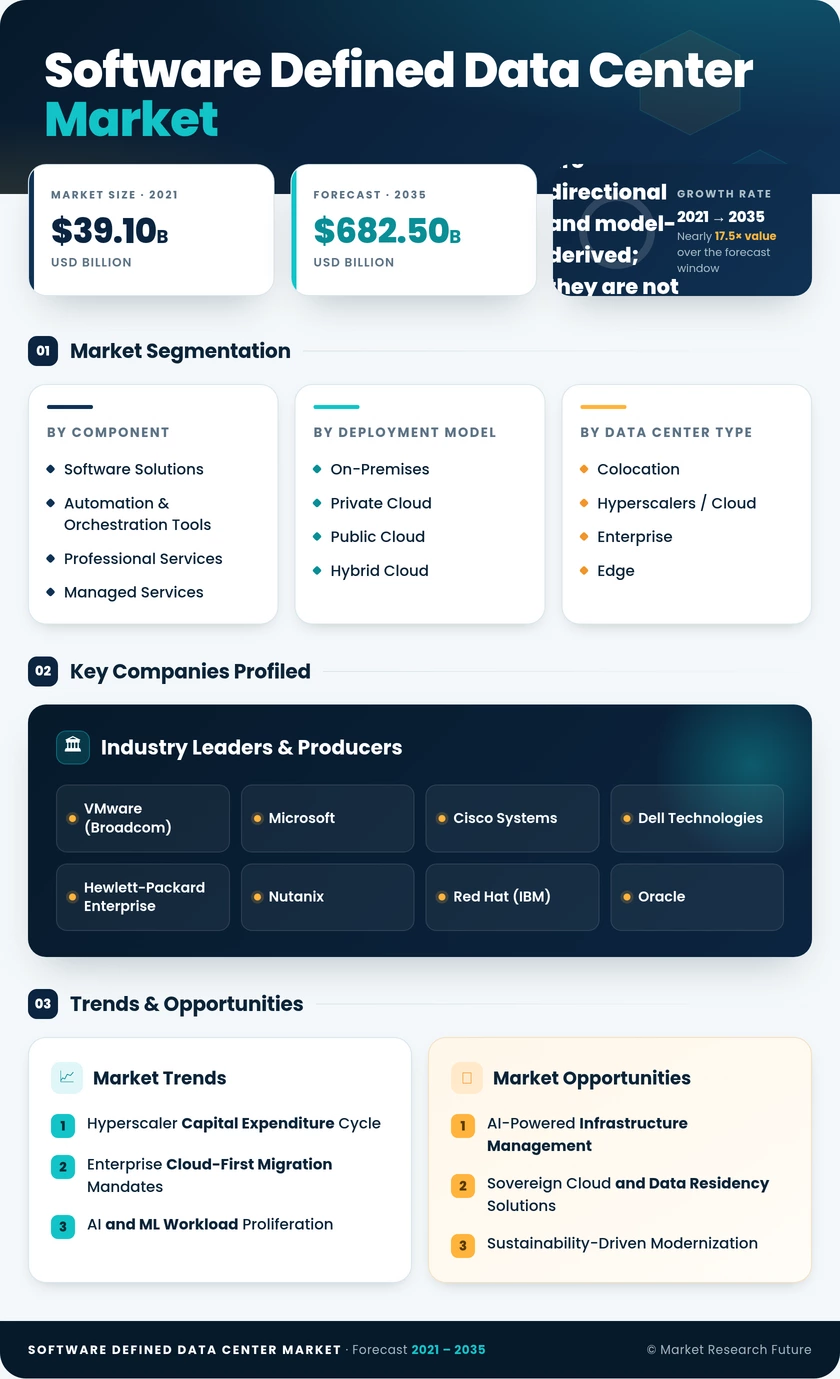
Software Defined Data Center Market

ID: MRFR/ICT/3478-HCR
100 Pages
Nirmit Biswas
Last Updated: June 22, 2026
Software Defined Data Center Market Size, Share and Research Report By Component (Software Solutions, Automation & Orchestration Tools, Professional Services, Managed Services), By Deployment Model (On-Premises, Private Cloud, Public Cloud, Hybrid Cloud), By Data Center Type (Colocation, Hyperscalers / Cloud, Enterprise and Edge), By End-User Vertical (IT and Telecom, BFSI, Healthcare, Retail, Government and Defense, Others) and By Region (North America, Europe, South America, Asia Pacific, Middle East and Africa) - Industry Forecast to 2035.
Download PDF ×

We do not share your information with anyone. However, we may send you emails based on your report interest from time to time. You may contact us at any time to opt-out.

Software Defined Data Center Market

Market Size

Forecast Period2026-2035
CAGR (2026-2035)24.0%
2025 Market SizeUSD 78.30 Billion
2035 Market SizeUSD 682.50 Billion

Key Players

VMware
Microsoft
Cisco Systems
Dell Technologies
Hewlett-Packard Enterprise
Nutanix
Opportunities
  • AI-Powered Infrastructure Management
  • Sovereign Cloud and Data Residency Solutions
  • Sustainability-Driven Modernization
  1. 1 Market Overview |
    1. 1.1 Study Assumptions & Market Definition |
    2. 1.2 Scope of the Study |
    3. 1.3 Research Methodology
  2. 2 Market Summary & Key Takeaways
  3. 3 Market Dynamics |
    1. 3.1 Market Drivers Analysis | |
      1. 3.1.1 Hyperscaler Capital Expenditure Cycle | |
      2. 3.1.2 Enterprise Cloud-First Migration Mandates | |
      3. 3.1.3 AI and ML Workload Proliferation | |
      4. 3.1.4 Edge Computing and 5G Convergence | |
      5. 3.1.5 Sustainability and Carbon-Neutral Data Center Policies | |
      6. 3.1.6 Government Digital Sovereignty Programs | |
      7. 3.1.7 Cost Optimization Through Automated Data Center Operations |
    2. 3.2 Market Restraints Analysis | |
      1. 3.2.1 Legacy Infrastructure Lock-In and Migration Complexity | |
      2. 3.2.2 Cybersecurity Attack Surface Expansion | |
      3. 3.2.3 Skills Shortage in Software-Defined Infrastructure Management | |
      4. 3.2.4 Interoperability Gaps Across Multi-Vendor Stacks | |
      5. 3.2.5 Regulatory Fragmentation on Data Residency |
    3. 3.3 Market Opportunity Analysis | |
      1. 3.3.1 AI-Powered Infrastructure Management | |
      2. 3.3.2 Sovereign Cloud and Data Residency Solutions | |
      3. 3.3.3 Sustainability-Driven Modernization | |
      4. 3.3.4 Emerging-Market Digitalization | |
      5. 3.3.5 Data Monetization and As-a-Service Models |
    4. 3.4 Industry Value Chain Analysis |
    5. 3.5 Porter's Five Forces Analysis
  4. 4 Global Software Defined Data Center Market Size & Forecast (2021–2035) |
    1. 4.1 Historical Market Size (2021–2025) |
    2. 4.2 Current & Forecast Market Size (2026–2035) |
    3. 4.3 Market Size by Revenue (USD Billion) |
    4. 4.4 Year-over-Year Growth Analysis
  5. 5 Segmentation Analysis |
    1. 5.1 By Component | |
      1. 5.1.1 Software Solutions | |
      2. 5.1.2 Automation & Orchestration Tools | |
      3. 5.1.3 Professional Services | |
      4. 5.1.4 Managed Services |
    2. 5.2 By Deployment Model | |
      1. 5.2.1 On-Premises | |
      2. 5.2.2 Private Cloud | |
      3. 5.2.3 Public Cloud | |
      4. 5.2.4 Hybrid Cloud |
    3. 5.3 By Data Center Type | |
      1. 5.3.1 Colocation | |
      2. 5.3.2 Hyperscalers / Cloud | |
      3. 5.3.3 Enterprise and Edge |
    4. 5.4 By End-User Vertical | |
      1. 5.4.1 IT and Telecom | |
      2. 5.4.2 BFSI | |
      3. 5.4.3 Healthcare | |
      4. 5.4.4 Retail | |
      5. 5.4.5 Government and Defense | |
      6. 5.4.6 Others
  6. 6 Regional Analysis |
    1. 6.1 North America | |
      1. 6.1.1 United States | |
      2. 6.1.2 Canada | |
      3. 6.1.3 Mexico |
    2. 6.2 Europe | |
      1. 6.2.1 Germany | |
      2. 6.2.2 United Kingdom | |
      3. 6.2.3 France | |
      4. 6.2.4 Italy | |
      5. 6.2.5 Spain | |
      6. 6.2.6 Nordic Countries | |
      7. 6.2.7 Russia | |
      8. 6.2.8 Rest of Europe |
    3. 6.3 Asia-Pacific | |
      1. 6.3.1 China | |
      2. 6.3.2 India | |
      3. 6.3.3 Japan | |
      4. 6.3.4 South Korea | |
      5. 6.3.5 ASEAN | |
      6. 6.3.6 Rest of Asia-Pacific |
    4. 6.4 South America | |
      1. 6.4.1 Brazil | |
      2. 6.4.2 Argentina | |
      3. 6.4.3 Rest of South America |
    5. 6.5 Middle East & Africa | |
      1. 6.5.1 Saudi Arabia | |
      2. 6.5.2 UAE | |
      3. 6.5.3 South Africa | |
      4. 6.5.4 Egypt | |
      5. 6.5.5 Rest of MEA
  7. 7 Competitive Landscape |
    1. 7.1 Market Share Analysis (2025) |
    2. 7.2 Competitive Benchmarking Matrix |
    3. 7.3 Company Profiles | |
      1. 7.3.1 VMware (Broadcom) | |
      2. 7.3.2 Microsoft | |
      3. 7.3.3 Cisco Systems | |
      4. 7.3.4 Dell Technologies | |
      5. 7.3.5 Hewlett Packard Enterprise | |
      6. 7.3.6 Nutanix | |
      7. 7.3.7 Red Hat (IBM) | |
      8. 7.3.8 Oracle | |
      9. 7.3.9 Juniper Networks (HPE) | |
      10. 7.3.10 Huawei
  8. 8 Future Outlook & Strategic Recommendations (2026–2035) |
    1. 8.1 Autonomous Data Center Operations |
    2. 8.2 Platform Economics and Ecosystem Lock-In |
    3. 8.3 Sustainability-Linked Infrastructure Investment |
    4. 8.4 Quantum-Safe and Zero-Trust Architecture Integration
  9. 9 Recent Developments & News
  10. 10 Frequently Asked Questions (FAQs)
  11. 11 Report Scope & Methodology |
    1. 11.1 Study Period & Base Year |
    2. 11.2 Data Sources & Citations |
    3. 11.3 Abbreviations
  12. 12 LIST OF TABLES |
  13. TABLE 1 Global Software Defined Data Center Market Size & Forecast, by Revenue (USD Billion), 2021–2035 |
  14. TABLE 2 Global Software Defined Data Center Market – Year-over-Year Growth Analysis, 2021–2035 |
  15. TABLE 3 Global Software Defined Data Center Market – Driver Impact Analysis |
  16. TABLE 4 Global Software Defined Data Center Market – Restraint Impact Analysis |
  17. TABLE 5 Global Software Defined Data Center Market Size, by Component, 2021–2035 (USD Billion) |
  18. TABLE 6 Global Software Defined Data Center Market Size, by Deployment Model, 2021–2035 (USD Billion) |
  19. TABLE 7 Global Software Defined Data Center Market Size, by Data Center Type, 2021–2035 (USD Billion) |
  20. TABLE 8 Global Software Defined Data Center Market Size, by End-User Vertical, 2021–2035 (USD Billion) |
  21. TABLE 9 Global Software Defined Data Center Market Size, by Region, 2021–2035 (USD Billion) |
  22. TABLE 10 North America Software Defined Data Center Market Size, by Country, 2021–2035 (USD Billion) |
  23. TABLE 11 Europe Software Defined Data Center Market Size, by Country, 2021–2035 (USD Billion) |
  24. TABLE 12 Asia-Pacific Software Defined Data Center Market Size, by Country, 2021–2035 (USD Billion) |
  25. TABLE 13 South America Software Defined Data Center Market Size, by Country, 2021–2035 (USD Billion) |
  26. TABLE 14 Middle East & Africa Software Defined Data Center Market Size, by Country, 2021–2035 (USD Billion) |
  27. TABLE 15 North America Software Defined Data Center Market Size, by Component, 2021–2035 (USD Billion) |
  28. TABLE 16 North America Software Defined Data Center Market Size, by Deployment Model, 2021–2035 (USD Billion) |
  29. TABLE 17 North America Software Defined Data Center Market Size, by Data Center Type, 2021–2035 (USD Billion) |
  30. TABLE 18 North America Software Defined Data Center Market Size, by End-User Vertical, 2021–2035 (USD Billion) |
  31. TABLE 19 Europe Software Defined Data Center Market Size, by Component, 2021–2035 (USD Billion) |
  32. TABLE 20 Europe Software Defined Data Center Market Size, by Deployment Model, 2021–2035 (USD Billion) |
  33. TABLE 21 Europe Software Defined Data Center Market Size, by Data Center Type, 2021–2035 (USD Billion) |
  34. TABLE 22 Europe Software Defined Data Center Market Size, by End-User Vertical, 2021–2035 (USD Billion) |
  35. TABLE 23 Asia-Pacific Software Defined Data Center Market Size, by Component, 2021–2035 (USD Billion) |
  36. TABLE 24 Asia-Pacific Software Defined Data Center Market Size, by Deployment Model, 2021–2035 (USD Billion) |
  37. TABLE 25 Asia-Pacific Software Defined Data Center Market Size, by Data Center Type, 2021–2035 (USD Billion) |
  38. TABLE 26 Asia-Pacific Software Defined Data Center Market Size, by End-User Vertical, 2021–2035 (USD Billion) |
  39. TABLE 27 South America Software Defined Data Center Market Size, by Component, 2021–2035 (USD Billion) |
  40. TABLE 28 South America Software Defined Data Center Market Size, by Deployment Model, 2021–2035 (USD Billion) |
  41. TABLE 29 South America Software Defined Data Center Market Size, by Data Center Type, 2021–2035 (USD Billion) |
  42. TABLE 30 South America Software Defined Data Center Market Size, by End-User Vertical, 2021–2035 (USD Billion) |
  43. TABLE 31 Middle East & Africa Software Defined Data Center Market Size, by Component, 2021–2035 (USD Billion) |
  44. TABLE 32 Middle East & Africa Software Defined Data Center Market Size, by Deployment Model, 2021–2035 (USD Billion) |
  45. TABLE 33 Middle East & Africa Software Defined Data Center Market Size, by Data Center Type, 2021–2035 (USD Billion) |
  46. TABLE 34 Middle East & Africa Software Defined Data Center Market Size, by End-User Vertical, 2021–2035 (USD Billion) |
  47. TABLE 35 Competitive Benchmarking Matrix – Global Software Defined Data Center Market, 2025 |
  48. TABLE 36 Company Profiles – Key Players, Global Software Defined Data Center Market |
  49. TABLE 37 Recent Developments & Strategic Announcements, 2023–2025 |
  50. TABLE 38 Report Scope & Methodology Summary |
  51. TABLE 39 Detailed Sources and Citations
  52. 13 LIST OF FIGURES |
  53. FIGURE 1 Global Software Defined Data Center Market Dynamics (Drivers, Restraints, Opportunities) |
  54. FIGURE 2 Industry Value Chain Analysis – Software Defined Data Center Market |
  55. FIGURE 3 Porter's Five Forces Analysis – Software Defined Data Center Market |
  56. FIGURE 4 Global Software Defined Data Center Market Size Trend (USD Billion), 2021–2035 |
  57. FIGURE 5 Global Software Defined Data Center Market Share, by Component, 2025 |
  58. FIGURE 6 Global Software Defined Data Center Market Share, by Deployment Model, 2025 |
  59. FIGURE 7 Global Software Defined Data Center Market Share, by Data Center Type, 2025 |
  60. FIGURE 8 Global Software Defined Data Center Market Share, by End-User Vertical, 2025 |
  61. FIGURE 9 Global Software Defined Data Center Market Share, by Region, 2025 |
  62. FIGURE 10 North America Software Defined Data Center Market Share, by Country, 2025 |
  63. FIGURE 11 Europe Software Defined Data Center Market Share, by Country, 2025 |
  64. FIGURE 12 Asia-Pacific Software Defined Data Center Market Share, by Country, 2025 |
  65. FIGURE 13 South America Software Defined Data Center Market Share, by Country, 2025 |
  66. FIGURE 14 Middle East & Africa Software Defined Data Center Market Share, by Country, 2025 |
  67. FIGURE 15 Competitive Landscape – Market Share Analysis, 2025 |
  68. FIGURE 16 Competitive Landscape – Company Positioning Matrix, 2025

Segmentation Quick Reference

DimensionSub-SegmentsDominant SegmentFastest Growing Segment
ComponentSoftware Solutions; Automation & Orchestration Tools; Professional Services; Managed ServicesSoftware SolutionsManaged Services
Deployment ModelOn-Premises; Private Cloud; Public Cloud; Hybrid CloudPrivate CloudHybrid Cloud
Data Center TypeColocation; Hyperscalers / Cloud; Enterprise and EdgeColocationHyperscalers / Cloud
End-User VerticalIT and Telecom; BFSI; Healthcare; Retail; Government and Defense; OthersIT and TelecomGovernment and Defense


Market Segmentation Overview

By Component

Sub-SegmentKey Trend
Software SolutionsConsolidation into full-stack suites combining compute, network, and storage virtualization
Automation & Orchestration ToolsAI-powered intent-based orchestration replacing script-driven provisioning
Professional ServicesMigration assessments and hybrid architecture design engagements are growing rapidly.
Managed ServicesConsumption-based managed SDDC offerings are lowering entry barriers for mid-market firms


The component landscape is shifting toward bundled platform licensing as vendors like Broadcom and Nutanix retire à la carte SKUs. Automation and orchestration tools are increasingly embedded into base platform subscriptions rather than sold as standalone modules, blurring traditional component boundaries.

By Deployment Model

Sub-SegmentKey Trend
On-PremisesDeclining share but persistent demand in air-gapped defense and industrial environments
Private CloudData sovereignty requirements sustaining demand across BFSI and healthcare
Public CloudHyperscaler-native SDDC management tools are gaining traction.
Hybrid CloudWorkload portability and burst-to-cloud capabilities are driving the fastest adoption.


Hybrid cloud deployments are outpacing single-mode architectures as enterprises realize that no single environment satisfies all workload requirements. Policy-driven orchestration across on-premises and public cloud endpoints is the primary capability accelerating hybrid adoption.

By Data Center Type

Sub-SegmentKey Trend
ColocationSelf-service tenant portals powered by software-defined networking overlays
Hyperscalers / CloudCustom silicon and liquid-cooled racks demanding next-generation orchestration.
Enterprise and EdgeMicro-data centers at the edge are replicating centralized SDDC architectures.


Colocation operators are differentiating through software-defined interconnection fabrics that enable tenants to provision cross-connects and cloud on-ramps in minutes rather than weeks. Hyperscaler sites, meanwhile, are driving innovation in large-scale automated workload placement.

By End-User Vertical

Sub-SegmentKey Trend
IT and Telecom5G core network cloudification accelerating SDDC adoption
BFSIReal-time risk analytics demand low-latency virtualized infrastructure.
HealthcareEHR migration and medical-imaging AI workloads are driving private-cloud SDDC builds
RetailOmnichannel commerce platforms requiring elastic compute at seasonal peaks
Government and DefenseSovereign cloud mandates creating dedicated SDDC procurement pipelines.
OthersManufacturing IoT and energy-sector digital twins are expanding the addressable base.


IT and telecom remain the anchor vertical, but government and defense represent the fastest-growing end-user category as national security imperatives push agencies toward domestically hosted, policy-controlled software-defined data center environments.