
Request Free Sample ×

Kindly complete the form below to receive a free sample of this Report

* Please use a valid business email

Leading companies partner with us for data-driven Insights

clients tt-cursor
Hero Background
English
Chinese
French
Japanese
Korean
German
Spanish

Soft Robotics Market Analysis

ID: MRFR/SEM/6535-HCR
111 Pages
Nirmit Biswas
April 2026

Soft Robotics Market Size, Share and Research Report By Type (Soft Grippers, Co-Robots, Inflated Robots, Wearable Robots, Edible Robots and Others), by Application (Medical and Healthcare, Food and Beverages, Logistics, Entertainment & Gaming, Automotive, Survey & Exploration and Others) And By Region (North America, Europe, Asia-Pacific, And Rest Of The World) –Industry Forecast Till 2035

Share:
Download PDF ×

We do not share your information with anyone. However, we may send you emails based on your report interest from time to time. You may contact us at any time to opt-out.

Soft Robotics Market Infographic
Purchase Options

Market Analysis

In-depth Analysis of Soft Robotics Market Industry Landscape

Soft robotics, which is distinguished using flexible and deformable resources, has become increasingly popular due to its ability to provide a special set of features not present in conventional rigid robotics. The need for more secure human-robot interactions, the requirement for flexible robotic solutions, and the rise in automation in a variety of industries all influence the market dynamics. The need for safer human-robot cooperation is one of the main factors propelling the soft robotics market. Because of their inflexible construction, regular industrial robots have frequently been restricted to regulated surroundings, which has limited their ability to interact with people. Because soft robotics is flexible and obedient, robots can work side by side with humans without endangering them. This has led to a rise in usage in industries including manufacturing, wherein soft robotic exoskeletons help people with movement problems, and healthcare, where they enable human workers to collaborate with robotic counterparts. Furthermore, new opportunities for automation across industries have been made possible by the adaptability of soft robots. Soft robots are highly adaptable to intricate and chaotic settings, which makes them ideal for jobs requiring quick reflexes and dexterity. For example, soft robotic grippers in agriculture may handle fruits gently without breaking them, and soft robotic platforms in search and rescue can easily maneuver across difficult terrain. Due to its versatility, soft robots have been integrated into a wide range of industries, propelling the market's expansion. The need for lightweight and compact robotic systems has added to the fluid market situation in addition to security and adaptability. Soft robotics, which are frequently made of lightweight components and parts, are ideal for uses where weight and space restrictions are important considerations. This is especially true in the realm of medical automation, where surgeons may perform minimally invasive procedures with greater precision and agility in limited locations thanks to the use of soft robotic equipment. Novel materials that combine durability and flexibility are being investigated by academics and businesses to create soft robots that will last longer and perform better. Furthermore, the use of sophisticated sensors and algorithms for machine learning amplifies the self-sufficiency and judgment of soft robotic systems. Associations between corporate companies and educational organizations becomes increasingly important as the soft robotics industry continues to expand. Soft robotics is a multidisciplinary area that requires knowledge from computer science, materials science, engineering, and other disciplines.


Author
Author Profile
Nirmit Biswas
Senior Research Analyst

With 5+ years of expertise in Market Intelligence and Strategic Research, Nirmit Biswas specializes in ICT, Semiconductors, and BFSI. Backed by an MBA in Financial Services and a Computer Science foundation, Nirmit blends technical depth with business acumen. He has successfully led 100+ projects for global enterprises and startups, including Amazon, Cisco, L&T and Huawei, delivering market estimations, competitive benchmarking, and GTM strategies. His focus lies in transforming complex data into clear, actionable insights that drive growth, innovation, and investment decisions. Recognized for bridging engineering innovation with executive strategy, Nirmit helps businesses navigate dynamic markets with confidence.

Leave a Comment

FAQs

What is the projected market valuation of the Soft Robotics Market by 2035?

<p>The Soft Robotics Market is projected to reach approximately 7.794 USD Billion by 2035.</p>

What was the market valuation of the Soft Robotics Market in 2024?

<p>In 2024, the Soft Robotics Market was valued at 0.58 USD Billion.</p>

What is the expected CAGR for the Soft Robotics Market during the forecast period 2025 - 2035?

<p>The expected CAGR for the Soft Robotics Market during the forecast period 2025 - 2035 is 26.64%.</p>

Which companies are considered key players in the Soft Robotics Market?

<p>Key players in the Soft Robotics Market include Boston Dynamics, Festo AG, Soft Robotics Inc., and Universal Robots.</p>

What are the primary segments of the Soft Robotics Market by type?

<p>The primary segments by type include Soft Grippers, Co-Robots, Inflated Robots, Wearable Robots, and Edible Robots.</p>

How much is the Soft Grippers segment projected to be worth by 2035?

<p>The Soft Grippers segment is projected to reach approximately 1.95 USD Billion by 2035.</p>

What applications are driving growth in the Soft Robotics Market?

Key applications driving growth include Medical and Healthcare, Food and Beverages, and Automotive.

What is the projected valuation for the Co-Robots segment by 2035?

The Co-Robots segment is projected to reach around 1.56 USD Billion by 2035.

How does the market valuation of the Food and Beverages application compare to others?

The Food and Beverages application is projected to be valued at approximately 1.3 USD Billion by 2035, indicating robust growth.

What is the expected valuation for the Logistics application by 2035?

The Logistics application is expected to reach a valuation of about 1.0 USD Billion by 2035.

Market Summary

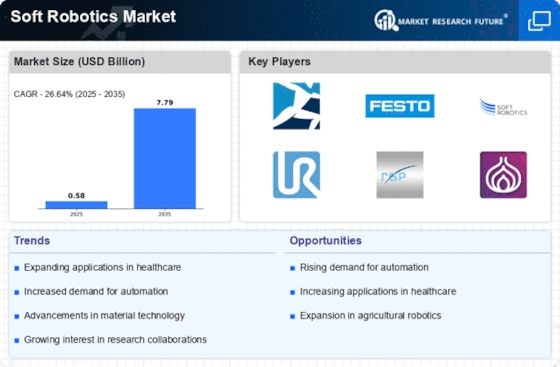
As per Market Research Future analysis, the Soft Robotics Market Size was estimated at 0.58 USD Billion in 2024. The Soft Robotics industry is projected to grow from USD 0.7345 Billion in 2025 to USD 7.794 Billion by 2035, exhibiting a compound annual growth rate (CAGR) of 26.64% during the forecast period 2025 - 2035

Key Market Trends & Highlights

The Soft Robotics Market is experiencing robust growth driven by technological advancements and increasing applications across various sectors.

  • North America remains the largest market for soft robotics, driven by significant investments in automation and healthcare. The Asia-Pacific region is emerging as the fastest-growing market, fueled by rapid industrialization and technological adoption. Soft grippers dominate the market, while co-robots are witnessing the fastest growth due to their versatility in various applications. Key market drivers include advancements in soft robotics technology and the growing demand in healthcare applications.

Market Size & Forecast

2024 Market Size 0.58 (USD Billion)
2035 Market Size 7.794 (USD Billion)
CAGR (2025 - 2035) 26.64%
Largest Regional Market Share in 2024 North America

Major Players

Boston Dynamics (US), Festo AG (DE), Soft Robotics Inc. (US), Universal Robots (DK), Robot System Products (SE), Miso Robotics (US), Pneubotics (US), Mikrotron GmbH (DE), Denso Corporation (JP)

Market Trends

The Soft Robotics Market is currently experiencing a transformative phase, characterized by advancements in materials and design methodologies. This sector is increasingly integrating soft materials that mimic biological systems, allowing for enhanced adaptability and safety in various applications. Industries such as healthcare, manufacturing, and agriculture are beginning to recognize the potential of soft robotics to improve efficiency and reduce risks associated with traditional rigid robotic systems. As the technology matures, the market is likely to witness a surge in demand for innovative solutions that can operate in complex environments, thereby expanding the scope of robotic applications. The soft robotics market is experiencing steady growth, driven by increasing demand for flexible, adaptive robotic systems across manufacturing, healthcare, and logistics applications. Moreover, the Soft Robotics Market appears to be influenced by a growing emphasis on automation and the need for more versatile robotic systems.

Companies are investing in research and development to create robots that can perform delicate tasks, such as handling fragile objects or assisting in surgical procedures. This trend suggests a shift towards more human-like interactions, where robots can work alongside humans without the fear of causing harm. As the market evolves, it may also see increased collaboration between academia and industry, fostering a rich ecosystem for innovation and growth in soft robotics. Key soft robotics market trends include the integration of AI-enabled control systems, lightweight elastomeric materials, and collaborative robotic applications.

Advancements in Material Science

The Soft Robotics Market is witnessing a notable trend towards the development of advanced materials that enhance the functionality and performance of robotic systems. Innovations in soft materials, such as elastomers and hydrogels, are enabling robots to exhibit greater flexibility and adaptability. This trend is likely to facilitate the creation of robots that can safely interact with humans and navigate complex environments.

Integration of Artificial Intelligence

Another emerging trend within the Soft Robotics Market is the integration of artificial intelligence technologies. By incorporating AI, soft robots can improve their decision-making capabilities and learn from their surroundings. This advancement may lead to more autonomous systems that can adapt to varying tasks and environments, thereby increasing their utility across diverse applications.

Focus on Human-Robot Collaboration

The Soft Robotics Market is increasingly emphasizing human-robot collaboration, where robots are designed to work alongside humans in various settings. This trend suggests a shift towards creating robots that can assist in tasks requiring dexterity and sensitivity, such as in healthcare or manufacturing. The focus on collaboration may enhance productivity while ensuring safety and efficiency in operations.

Soft Robotics Market Market Drivers

Advancements in Soft Robotics Technology

The Soft Robotics Market is experiencing a surge in technological advancements, particularly in the development of soft actuators and sensors. These innovations enhance the capabilities of soft robots, allowing for more precise and adaptable movements. For instance, the introduction of new materials such as silicone and hydrogels has enabled the creation of robots that can mimic biological organisms. This has led to increased applications in fields such as healthcare, where soft robots are utilized for minimally invasive surgeries. The market is projected to grow at a compound annual growth rate of approximately 30% over the next five years, driven by these technological breakthroughs.

Growing Demand in Healthcare Applications

The Soft Robotics Market is witnessing a notable increase in demand within the healthcare sector. Soft robots are being integrated into surgical procedures, rehabilitation, and patient care, providing enhanced safety and efficiency. For example, soft robotic grippers are being used in delicate surgeries, reducing the risk of tissue damage. The market for soft robotics in healthcare is expected to reach USD 1.5 billion by 2026, reflecting a growing recognition of the benefits these technologies offer. This trend is likely to continue as healthcare providers seek innovative solutions to improve patient outcomes and operational efficiency.

Rising Adoption in Manufacturing and Automation

The Soft Robotics Market is experiencing a shift as manufacturers increasingly adopt soft robotic solutions for automation. These robots offer flexibility and adaptability, making them suitable for handling delicate items in packaging and assembly lines. The market for soft robotics in manufacturing is projected to grow at a rate of 25% annually, driven by the need for more efficient and versatile automation solutions. Companies are recognizing the potential of soft robots to enhance productivity while minimizing damage to products, thereby improving overall operational efficiency.

Increased Investment in Research and Development

Investment in research and development is a critical driver for the Soft Robotics Market. As companies and academic institutions allocate resources towards exploring new applications and improving existing technologies, the market is poised for substantial growth. Funding for soft robotics research has increased significantly, with estimates suggesting that R&D expenditures could exceed USD 500 million annually by 2027. This influx of capital is likely to accelerate innovation, leading to the development of more sophisticated soft robotic systems that can be applied across various industries, including manufacturing and logistics.

Environmental Sustainability and Energy Efficiency

The Soft Robotics Market is also influenced by the growing emphasis on environmental sustainability and energy efficiency. Soft robots are often designed to consume less energy compared to traditional rigid robots, making them an attractive option for companies aiming to reduce their carbon footprint. Furthermore, the materials used in soft robotics are frequently more sustainable, aligning with global efforts to promote eco-friendly technologies. This trend is likely to drive further adoption of soft robotics across various sectors, as organizations seek to implement solutions that are both effective and environmentally responsible.

Market Segment Insights

By Type: Soft Grippers (Largest) vs. Co-Robots (Fastest-Growing)

<p>In the Soft Robotics Market, the distribution of market share among various types has illustrated a clear dominance of Soft Grippers, which are widely utilized for their adaptability in handling delicate objects. Co-Robots, while not leading in total market share, have gained significant traction thanks to advancements in collaborative technologies that enable machines to work alongside humans without safety concerns. Other segment values, including Inflated Robots, Wearable Robots, and Edible Robots, contribute to the market with unique functionalities, but they currently hold smaller shares compared to these two dominant categories. Growth trends within the Soft Robotics Market are primarily driven by the increasing demand for automation across industries, such as manufacturing, healthcare, and logistics. As industries focus on enhancing efficiency and reducing labor costs, the appeal for Soft Grippers will continue to grow. Likewise, Co-Robots are anticipated to experience rapid growth due to the push for safer human-robot collaboration and improvements in AI technologies that make robots more intelligent and capable of complex tasks, making these two segments crucial for the future of soft robotics.</p>

<p>Soft Grippers (Dominant) vs. Co-Robots (Emerging)</p>

<p>Soft Grippers have established themselves as the dominant type in the Soft Robotics Market due to their versatility and ability to safely interact with various objects without causing damage. Their soft and compliant nature allows for applications in sensitive environments such as food handling, delicate assembly, and medical devices. On the other hand, Co-Robots represent an emerging segment, focusing on collaboration with human workers. They are designed to assist rather than replace, providing a bridge in automation and enhancing productivity in sectors like manufacturing and logistics. As companies invest in these collaborative solutions, Co-Robots are expected to carve out a significant presence in the market, capitalizing on trends towards enhancing workplace synergy.</p>

By Application: Medical and Healthcare (Largest) vs. Food and Beverages (Fastest-Growing)

<p>In the Soft Robotics Market, the application segment is prominently dominated by Medical and Healthcare, showcasing extensive utilization across surgical robots, rehabilitation devices, and assistive technologies. This segment holds a significant share due to the increasing adoption of automation in patient care and surgical procedures, facilitating precision and efficiency in healthcare services. Conversely, the Food and Beverages segment is emerging as the fastest-growing application, driven by the need for automation in packaging, sorting, and handling processes. Factors such as heightened consumer demand for efficiency, hygiene, and the adoption of robotics in food processing lines intensify this growth, indicating a robust shift towards enhanced productivity in this sector.</p>

<p>Medical and Healthcare: Dominant vs. Food and Beverages: Emerging</p>

<p>The Medical and Healthcare application of soft robotics stands out as a dominant market player, characterized by its extensive integration in surgical assistance, rehabilitation, and patient care applications. These robotic systems enhance surgical precision and improve patient outcomes, while innovation continually fuels advancements in this domain. On the other hand, the Food and Beverages sector represents an emerging domain with increasing adoption of robotic solutions for various processes such as packaging and sorting. This segment is evolving rapidly, driven by a focus on operational efficiency and safety in food handling, impacting everything from production lines to consumer interactions. As these segments progress, the juxtaposition of their growth trajectories illustrates the diverse applicability and future potential of soft robotics across various industries.</p>

Get more detailed insights about Soft Robotics Market Research Report - Global Forecast till 2035

Regional Insights

North America : Innovation and Investment Hub

North America is the largest market for soft robotics, holding approximately 45% of the global share. The region's growth is driven by significant investments in automation and robotics technology, particularly in manufacturing and healthcare sectors. Regulatory support for innovation and safety standards further catalyzes market expansion, with a focus on enhancing productivity and efficiency. The United States is the primary player, with key companies like Boston Dynamics and Soft Robotics Market Inc. leading the charge. Canada also shows promise with its growing tech ecosystem. The competitive landscape is characterized by rapid advancements and collaborations among industry leaders, ensuring a robust market presence and continuous innovation.

Europe : Emerging Robotics Powerhouse

Europe is the second-largest market for soft robotics, accounting for around 30% of the global market share. The region benefits from a strong manufacturing base and increasing demand for automation in various sectors, including food processing and logistics. Regulatory frameworks promoting sustainability and innovation are key drivers of growth, encouraging investment in advanced robotics technologies. Germany and the UK are leading countries in this sector, with companies like Festo AG and Universal Robots making significant contributions. The competitive landscape is marked by a mix of established firms and startups, fostering innovation and collaboration. The presence of research institutions further enhances the region's capabilities in soft robotics development.

Asia-Pacific : Rapidly Growing Market

Asia-Pacific is witnessing rapid growth in the soft robotics market, holding approximately 20% of the global share. The region's expansion is fueled by increasing automation in manufacturing and logistics, driven by the need for efficiency and cost reduction. Government initiatives promoting technological advancements and smart manufacturing are also significant growth catalysts. Japan and China are the leading countries in this market, with major players like Denso Corporation actively investing in soft robotics technologies. The competitive landscape is dynamic, with numerous startups emerging alongside established firms, creating a vibrant ecosystem for innovation and development in soft robotics.

Middle East and Africa : Emerging Market Potential

The Middle East and Africa region is in the early stages of soft robotics market development, holding about 5% of the global share. Growth is driven by increasing investments in automation and robotics, particularly in sectors like oil and gas, agriculture, and healthcare. Government initiatives aimed at diversifying economies and enhancing technological capabilities are crucial for market expansion. Countries like the UAE and South Africa are leading the way, with a growing interest in robotics applications. The competitive landscape is still developing, with a mix of local and international players entering the market. As infrastructure improves and awareness increases, the potential for soft robotics in this region is significant.

Key Players and Competitive Insights

Leading market players are investing heavily in research and development in order to expand their product lines, which will help the soft robotics market grow even more. Market participants are also undertaking various strategic activities to expand their footprint, with important market developments including new product launches, contractual agreements, mergers and acquisitions, higher investments, and collaboration with other organizations. To expand and survive in a more competitive and rising market climate, soft robotics industry must offer cost-effective items. A growing number of soft robotics company players are focusing on material innovation, advanced actuation mechanisms, and application-specific robotic solutions to strengthen market positioning. Manufacturing locally to minimize operational costs is one of the key business tactics manufacturers use in the soft robotics industry to benefit clients and increase the market sector. The soft robotics industry has offered some of the most significant advantages recently.
Major players in the soft robotics market, including KAWADA Robotics Corporation (Japan), F&P Robotics AG (Switzerland), Ekso Bionics Holdings Inc. (US), Soft Robotics Market Inc. (US), RightHand Robotics Inc. (US), ReWalk Robotics Ltd. (Israel), Rethink Robotics (Germany), Kawasaki (Japan), Yaskawa Electric Corporation (Japan), AUBO Robotics Inc. (US), KUKA AG (Germany), ABB Ltd. (Switzerland), Techman Robot (Taiwan), FANUC Corporation (Japan), Universal Robots A/S (Denmark), and others, are attempting to increase market demand by investing in research and development operations. The soft robotics grippers market is gaining traction due to rising adoption in food handling, e-commerce fulfillment, and delicate object manipulation tasks. Kawada Robotics Corporation is a Japanese company specializing in the development, manufacture and sale of advanced robotics technology. The company was founded in 1990 and is headquartered in Tokyo, Japan. Kawada Robotics is famous for its HRP series of humanoid robots used in various applications such as research, education and entertainment.
The company also makes industrial robots designed to work alongside humans, such as the DUO collaborative robot. Kawada Robotics is committed to advancing the field of robotics through research and development, and the company works with the world's leading research institutes and universities to develop advanced robotics technology. Overall, Kawada Robotics Corporation is a well-respected company in the robotics industry, and its innovative products and technologies continue to push the boundaries of what is possible with robotics. Analysis of soft robotics market share highlights competitive dynamics shaped by technological differentiation, strategic partnerships, and expanding product portfolios.
ABB Corporation is a multinational corporation headquartered in Zurich, Switzerland. It is a leading technology company specializing in the development and manufacture of robotics, energy and automation solutions for a variety of industries, including utilities, transportation and manufacturing. The company was established in 1988 as a result of the merger between the Swedish company ASEA and the Swiss company Brown, Boveri & Cie. ABB operates in more than 100 countries and has approximately 110,000 employees worldwide. ABB's products include a range of industrial robots, such as the IRB 360 FlexPicker, for high-speed picking and packaging applications in the food, pharmaceutical and consumer goods industries. The company also manufactures power systems such as transformers and switchgear and offers a range of automation solutions including control systems and software. In addition to focusing on technology, ABB is committed to sustainability and has set ambitious goals to reduce its environmental impact and increase the use of renewable energy in its operations. The company was also recognized for its efforts to promote diversity and inclusion in the workplace.

Key Companies in the Soft Robotics Market include

Industry Developments

  • Q2 2024: Soft Robotics Market raises $23M Series C to expand food automation solutions Soft Robotics Market, a company specializing in robotic grippers for food handling, announced a $23 million Series C funding round to accelerate the deployment of its mGripAI platform in food production and logistics environments.
  • Q2 2024: Soft Robotics Market Appoints Mark Chiappetta as CEO Soft Robotics Market announced the appointment of Mark Chiappetta as its new Chief Executive Officer, effective immediately, to lead the company’s next phase of growth in the food automation sector.
  • Q3 2024: Festo Opens New Soft Robotics Market Innovation Center in Boston Festo, a leader in automation technology, inaugurated a new Soft Robotics Market Innovation Center in Boston to accelerate research and development of adaptive robotic solutions for manufacturing and healthcare.
  • Q2 2024: ABB partners with Soft Robotics Market to develop flexible automation for e-commerce ABB announced a strategic partnership with Soft Robotics Market to co-develop flexible robotic picking systems for e-commerce fulfillment centers, aiming to improve speed and accuracy in order processing.
  • Q1 2025: Yaskawa Electric acquires minority stake in Soft Robotics Market startup for $15M Yaskawa Electric invested $15 million to acquire a minority stake in a U.S.-based soft robotics startup, aiming to integrate soft gripper technology into its industrial robot lineup.
  • Q2 2025: Soft Robotics Market secures FDA clearance for soft robotic surgical gripper Soft Robotics Market received FDA clearance for its new soft robotic surgical gripper, enabling broader adoption of minimally invasive procedures in hospitals across the United States.
  • Q1 2024: Soft Robotics Market and Tyson Foods announce pilot program for automated poultry processing Soft Robotics Market and Tyson Foods launched a pilot program to deploy soft robotic grippers in poultry processing plants, aiming to improve efficiency and reduce labor costs.
  • Q3 2024: Soft Robotics Market launches mGripAI 2.0 platform for high-speed food sorting Soft Robotics Market introduced the mGripAI 2.0 platform, featuring enhanced machine vision and AI capabilities for high-speed, accurate sorting of delicate food products.
  • Q2 2025: Festo and Siemens announce joint venture to develop soft robotic actuators Festo and Siemens formed a joint venture to develop next-generation soft robotic actuators for use in industrial automation and medical devices.
  • Q1 2025: Soft Robotics Market opens European headquarters in Munich Soft Robotics Market expanded its global footprint by opening a new European headquarters in Munich, Germany, to better serve customers in the region and support local R&D.
  • Q4 2024: Soft Robotics Market wins contract to supply grippers for Amazon fulfillment centers Soft Robotics Market secured a contract to supply its adaptive gripper technology to Amazon fulfillment centers, supporting the automation of order picking and packaging operations.
  • Q2 2024: Soft Robotics Market closes $10M Series B extension to scale manufacturing Soft Robotics Market raised an additional $10 million in a Series B extension round to expand its manufacturing capacity and meet growing demand from food and logistics customers.

Future Outlook

Soft Robotics Market Future Outlook

The Soft Robotics Market is projected to grow at a 26.64% CAGR from 2025 to 2035, driven by advancements in materials, automation, and demand for flexible manufacturing solutions.

New opportunities lie in:

  • <p>Development of soft robotic exoskeletons for rehabilitation services. Integration of AI-driven soft robots in logistics and warehousing. Creation of customizable soft robotic grippers for diverse industrial applications.</p>

By 2035, the Soft Robotics Market is expected to achieve substantial growth and innovation.

Market Segmentation

Soft Robotics Market Type Outlook

  • Soft Grippers
  • Co-Robots
  • Inflated Robots
  • Wearable Robots
  • Edible Robots
  • Others

Soft Robotics Market Application Outlook

  • Medical and Healthcare
  • Food and Beverages
  • Logistics
  • Entertainment & Gaming
  • Automotive
  • Survey & Exploration
  • Others

Report Scope

MARKET SIZE 2024 0.58(USD Billion)
MARKET SIZE 2025 0.7345(USD Billion)
MARKET SIZE 2035 7.794(USD Billion)
COMPOUND ANNUAL GROWTH RATE (CAGR) 26.64% (2025 - 2035)
REPORT COVERAGE Revenue Forecast, Competitive Landscape, Growth Factors, and Trends
BASE YEAR 2024
Market Forecast Period 2025 - 2035
Historical Data 2019 - 2024
Market Forecast Units USD Billion
Key Companies Profiled Boston Dynamics (US), Festo AG (DE), Soft Robotics Inc. (US), Universal Robots (DK), Robot System Products (SE), Miso Robotics (US), Pneubotics (US), Mikrotron GmbH (DE), Denso Corporation (JP)
Segments Covered Type, Application, Region
Key Market Opportunities Integration of artificial intelligence in Soft Robotics Market enhances automation and adaptability across various industries.
Key Market Dynamics Rising demand for automation drives innovation and competition in the soft robotics sector across various industries.
Countries Covered North America, Europe, APAC, South America, MEA

FAQs

What is the projected market valuation of the Soft Robotics Market by 2035?

<p>The Soft Robotics Market is projected to reach approximately 7.794 USD Billion by 2035.</p>

What was the market valuation of the Soft Robotics Market in 2024?

<p>In 2024, the Soft Robotics Market was valued at 0.58 USD Billion.</p>

What is the expected CAGR for the Soft Robotics Market during the forecast period 2025 - 2035?

<p>The expected CAGR for the Soft Robotics Market during the forecast period 2025 - 2035 is 26.64%.</p>

Which companies are considered key players in the Soft Robotics Market?

<p>Key players in the Soft Robotics Market include Boston Dynamics, Festo AG, Soft Robotics Inc., and Universal Robots.</p>

What are the primary segments of the Soft Robotics Market by type?

<p>The primary segments by type include Soft Grippers, Co-Robots, Inflated Robots, Wearable Robots, and Edible Robots.</p>

How much is the Soft Grippers segment projected to be worth by 2035?

<p>The Soft Grippers segment is projected to reach approximately 1.95 USD Billion by 2035.</p>

What applications are driving growth in the Soft Robotics Market?

Key applications driving growth include Medical and Healthcare, Food and Beverages, and Automotive.

What is the projected valuation for the Co-Robots segment by 2035?

The Co-Robots segment is projected to reach around 1.56 USD Billion by 2035.

How does the market valuation of the Food and Beverages application compare to others?

The Food and Beverages application is projected to be valued at approximately 1.3 USD Billion by 2035, indicating robust growth.

What is the expected valuation for the Logistics application by 2035?

The Logistics application is expected to reach a valuation of about 1.0 USD Billion by 2035.

  1. SECTION I: EXECUTIVE SUMMARY AND KEY HIGHLIGHTS
    1. | 1.1 EXECUTIVE SUMMARY
    2. | | 1.1.1 Market Overview
    3. | | 1.1.2 Key Findings
    4. | | 1.1.3 Market Segmentation
    5. | | 1.1.4 Competitive Landscape
    6. | | 1.1.5 Challenges and Opportunities
    7. | | 1.1.6 Future Outlook
  2. SECTION II: SCOPING, METHODOLOGY AND MARKET STRUCTURE
    1. | 2.1 MARKET INTRODUCTION
    2. | | 2.1.1 Definition
    3. | | 2.1.2 Scope of the study
    4. | | | 2.1.2.1 Research Objective
    5. | | | 2.1.2.2 Assumption
    6. | | | 2.1.2.3 Limitations
    7. | 2.2 RESEARCH METHODOLOGY
    8. | | 2.2.1 Overview
    9. | | 2.2.2 Data Mining
    10. | | 2.2.3 Secondary Research
    11. | | 2.2.4 Primary Research
    12. | | | 2.2.4.1 Primary Interviews and Information Gathering Process
    13. | | | 2.2.4.2 Breakdown of Primary Respondents
    14. | | 2.2.5 Forecasting Model
    15. | | 2.2.6 Market Size Estimation
    16. | | | 2.2.6.1 Bottom-Up Approach
    17. | | | 2.2.6.2 Top-Down Approach
    18. | | 2.2.7 Data Triangulation
    19. | | 2.2.8 Validation
  3. SECTION III: QUALITATIVE ANALYSIS
    1. | 3.1 MARKET DYNAMICS
    2. | | 3.1.1 Overview
    3. | | 3.1.2 Drivers
    4. | | 3.1.3 Restraints
    5. | | 3.1.4 Opportunities
    6. | 3.2 MARKET FACTOR ANALYSIS
    7. | | 3.2.1 Value chain Analysis
    8. | | 3.2.2 Porter's Five Forces Analysis
    9. | | | 3.2.2.1 Bargaining Power of Suppliers
    10. | | | 3.2.2.2 Bargaining Power of Buyers
    11. | | | 3.2.2.3 Threat of New Entrants
    12. | | | 3.2.2.4 Threat of Substitutes
    13. | | | 3.2.2.5 Intensity of Rivalry
    14. | | 3.2.3 COVID-19 Impact Analysis
    15. | | | 3.2.3.1 Market Impact Analysis
    16. | | | 3.2.3.2 Regional Impact
    17. | | | 3.2.3.3 Opportunity and Threat Analysis
  4. SECTION IV: QUANTITATIVE ANALYSIS
    1. | 4.1 Semiconductor & Electronics, BY Type (USD Billion)
    2. | | 4.1.1 Soft Grippers
    3. | | 4.1.2 Co-Robots
    4. | | 4.1.3 Inflated Robots
    5. | | 4.1.4 Wearable Robots
    6. | | 4.1.5 Edible Robots
    7. | | 4.1.6 Others
    8. | 4.2 Semiconductor & Electronics, BY Application (USD Billion)
    9. | | 4.2.1 Medical and Healthcare
    10. | | 4.2.2 Food and Beverages
    11. | | 4.2.3 Logistics
    12. | | 4.2.4 Entertainment & Gaming
    13. | | 4.2.5 Automotive
    14. | | 4.2.6 Survey & Exploration
    15. | | 4.2.7 Others
    16. | 4.3 Semiconductor & Electronics, BY Region (USD Billion)
    17. | | 4.3.1 North America
    18. | | | 4.3.1.1 US
    19. | | | 4.3.1.2 Canada
    20. | | 4.3.2 Europe
    21. | | | 4.3.2.1 Germany
    22. | | | 4.3.2.2 UK
    23. | | | 4.3.2.3 France
    24. | | | 4.3.2.4 Russia
    25. | | | 4.3.2.5 Italy
    26. | | | 4.3.2.6 Spain
    27. | | | 4.3.2.7 Rest of Europe
    28. | | 4.3.3 APAC
    29. | | | 4.3.3.1 China
    30. | | | 4.3.3.2 India
    31. | | | 4.3.3.3 Japan
    32. | | | 4.3.3.4 South Korea
    33. | | | 4.3.3.5 Malaysia
    34. | | | 4.3.3.6 Thailand
    35. | | | 4.3.3.7 Indonesia
    36. | | | 4.3.3.8 Rest of APAC
    37. | | 4.3.4 South America
    38. | | | 4.3.4.1 Brazil
    39. | | | 4.3.4.2 Mexico
    40. | | | 4.3.4.3 Argentina
    41. | | | 4.3.4.4 Rest of South America
    42. | | 4.3.5 MEA
    43. | | | 4.3.5.1 GCC Countries
    44. | | | 4.3.5.2 South Africa
    45. | | | 4.3.5.3 Rest of MEA
  5. SECTION V: COMPETITIVE ANALYSIS
    1. | 5.1 Competitive Landscape
    2. | | 5.1.1 Overview
    3. | | 5.1.2 Competitive Analysis
    4. | | 5.1.3 Market share Analysis
    5. | | 5.1.4 Major Growth Strategy in the Semiconductor & Electronics
    6. | | 5.1.5 Competitive Benchmarking
    7. | | 5.1.6 Leading Players in Terms of Number of Developments in the Semiconductor & Electronics
    8. | | 5.1.7 Key developments and growth strategies
    9. | | | 5.1.7.1 New Product Launch/Service Deployment
    10. | | | 5.1.7.2 Merger & Acquisitions
    11. | | | 5.1.7.3 Joint Ventures
    12. | | 5.1.8 Major Players Financial Matrix
    13. | | | 5.1.8.1 Sales and Operating Income
    14. | | | 5.1.8.2 Major Players R&D Expenditure. 2023
    15. | 5.2 Company Profiles
    16. | | 5.2.1 Boston Dynamics (US)
    17. | | | 5.2.1.1 Financial Overview
    18. | | | 5.2.1.2 Products Offered
    19. | | | 5.2.1.3 Key Developments
    20. | | | 5.2.1.4 SWOT Analysis
    21. | | | 5.2.1.5 Key Strategies
    22. | | 5.2.2 Festo AG (DE)
    23. | | | 5.2.2.1 Financial Overview
    24. | | | 5.2.2.2 Products Offered
    25. | | | 5.2.2.3 Key Developments
    26. | | | 5.2.2.4 SWOT Analysis
    27. | | | 5.2.2.5 Key Strategies
    28. | | 5.2.3 Soft Robotics Inc. (US)
    29. | | | 5.2.3.1 Financial Overview
    30. | | | 5.2.3.2 Products Offered
    31. | | | 5.2.3.3 Key Developments
    32. | | | 5.2.3.4 SWOT Analysis
    33. | | | 5.2.3.5 Key Strategies
    34. | | 5.2.4 Universal Robots (DK)
    35. | | | 5.2.4.1 Financial Overview
    36. | | | 5.2.4.2 Products Offered
    37. | | | 5.2.4.3 Key Developments
    38. | | | 5.2.4.4 SWOT Analysis
    39. | | | 5.2.4.5 Key Strategies
    40. | | 5.2.5 Robot System Products (SE)
    41. | | | 5.2.5.1 Financial Overview
    42. | | | 5.2.5.2 Products Offered
    43. | | | 5.2.5.3 Key Developments
    44. | | | 5.2.5.4 SWOT Analysis
    45. | | | 5.2.5.5 Key Strategies
    46. | | 5.2.6 Miso Robotics (US)
    47. | | | 5.2.6.1 Financial Overview
    48. | | | 5.2.6.2 Products Offered
    49. | | | 5.2.6.3 Key Developments
    50. | | | 5.2.6.4 SWOT Analysis
    51. | | | 5.2.6.5 Key Strategies
    52. | | 5.2.7 Pneubotics (US)
    53. | | | 5.2.7.1 Financial Overview
    54. | | | 5.2.7.2 Products Offered
    55. | | | 5.2.7.3 Key Developments
    56. | | | 5.2.7.4 SWOT Analysis
    57. | | | 5.2.7.5 Key Strategies
    58. | | 5.2.8 Mikrotron GmbH (DE)
    59. | | | 5.2.8.1 Financial Overview
    60. | | | 5.2.8.2 Products Offered
    61. | | | 5.2.8.3 Key Developments
    62. | | | 5.2.8.4 SWOT Analysis
    63. | | | 5.2.8.5 Key Strategies
    64. | | 5.2.9 Denso Corporation (JP)
    65. | | | 5.2.9.1 Financial Overview
    66. | | | 5.2.9.2 Products Offered
    67. | | | 5.2.9.3 Key Developments
    68. | | | 5.2.9.4 SWOT Analysis
    69. | | | 5.2.9.5 Key Strategies
    70. | 5.3 Appendix
    71. | | 5.3.1 References
    72. | | 5.3.2 Related Reports
  6. LIST OF FIGURES
    1. | 6.1 MARKET SYNOPSIS
    2. | 6.2 NORTH AMERICA MARKET ANALYSIS
    3. | 6.3 US MARKET ANALYSIS BY TYPE
    4. | 6.4 US MARKET ANALYSIS BY APPLICATION
    5. | 6.5 CANADA MARKET ANALYSIS BY TYPE
    6. | 6.6 CANADA MARKET ANALYSIS BY APPLICATION
    7. | 6.7 EUROPE MARKET ANALYSIS
    8. | 6.8 GERMANY MARKET ANALYSIS BY TYPE
    9. | 6.9 GERMANY MARKET ANALYSIS BY APPLICATION
    10. | 6.10 UK MARKET ANALYSIS BY TYPE
    11. | 6.11 UK MARKET ANALYSIS BY APPLICATION
    12. | 6.12 FRANCE MARKET ANALYSIS BY TYPE
    13. | 6.13 FRANCE MARKET ANALYSIS BY APPLICATION
    14. | 6.14 RUSSIA MARKET ANALYSIS BY TYPE
    15. | 6.15 RUSSIA MARKET ANALYSIS BY APPLICATION
    16. | 6.16 ITALY MARKET ANALYSIS BY TYPE
    17. | 6.17 ITALY MARKET ANALYSIS BY APPLICATION
    18. | 6.18 SPAIN MARKET ANALYSIS BY TYPE
    19. | 6.19 SPAIN MARKET ANALYSIS BY APPLICATION
    20. | 6.20 REST OF EUROPE MARKET ANALYSIS BY TYPE
    21. | 6.21 REST OF EUROPE MARKET ANALYSIS BY APPLICATION
    22. | 6.22 APAC MARKET ANALYSIS
    23. | 6.23 CHINA MARKET ANALYSIS BY TYPE
    24. | 6.24 CHINA MARKET ANALYSIS BY APPLICATION
    25. | 6.25 INDIA MARKET ANALYSIS BY TYPE
    26. | 6.26 INDIA MARKET ANALYSIS BY APPLICATION
    27. | 6.27 JAPAN MARKET ANALYSIS BY TYPE
    28. | 6.28 JAPAN MARKET ANALYSIS BY APPLICATION
    29. | 6.29 SOUTH KOREA MARKET ANALYSIS BY TYPE
    30. | 6.30 SOUTH KOREA MARKET ANALYSIS BY APPLICATION
    31. | 6.31 MALAYSIA MARKET ANALYSIS BY TYPE
    32. | 6.32 MALAYSIA MARKET ANALYSIS BY APPLICATION
    33. | 6.33 THAILAND MARKET ANALYSIS BY TYPE
    34. | 6.34 THAILAND MARKET ANALYSIS BY APPLICATION
    35. | 6.35 INDONESIA MARKET ANALYSIS BY TYPE
    36. | 6.36 INDONESIA MARKET ANALYSIS BY APPLICATION
    37. | 6.37 REST OF APAC MARKET ANALYSIS BY TYPE
    38. | 6.38 REST OF APAC MARKET ANALYSIS BY APPLICATION
    39. | 6.39 SOUTH AMERICA MARKET ANALYSIS
    40. | 6.40 BRAZIL MARKET ANALYSIS BY TYPE
    41. | 6.41 BRAZIL MARKET ANALYSIS BY APPLICATION
    42. | 6.42 MEXICO MARKET ANALYSIS BY TYPE
    43. | 6.43 MEXICO MARKET ANALYSIS BY APPLICATION
    44. | 6.44 ARGENTINA MARKET ANALYSIS BY TYPE
    45. | 6.45 ARGENTINA MARKET ANALYSIS BY APPLICATION
    46. | 6.46 REST OF SOUTH AMERICA MARKET ANALYSIS BY TYPE
    47. | 6.47 REST OF SOUTH AMERICA MARKET ANALYSIS BY APPLICATION
    48. | 6.48 MEA MARKET ANALYSIS
    49. | 6.49 GCC COUNTRIES MARKET ANALYSIS BY TYPE
    50. | 6.50 GCC COUNTRIES MARKET ANALYSIS BY APPLICATION
    51. | 6.51 SOUTH AFRICA MARKET ANALYSIS BY TYPE
    52. | 6.52 SOUTH AFRICA MARKET ANALYSIS BY APPLICATION
    53. | 6.53 REST OF MEA MARKET ANALYSIS BY TYPE
    54. | 6.54 REST OF MEA MARKET ANALYSIS BY APPLICATION
    55. | 6.55 KEY BUYING CRITERIA OF SEMICONDUCTOR & ELECTRONICS
    56. | 6.56 RESEARCH PROCESS OF MRFR
    57. | 6.57 DRO ANALYSIS OF SEMICONDUCTOR & ELECTRONICS
    58. | 6.58 DRIVERS IMPACT ANALYSIS: SEMICONDUCTOR & ELECTRONICS
    59. | 6.59 RESTRAINTS IMPACT ANALYSIS: SEMICONDUCTOR & ELECTRONICS
    60. | 6.60 SUPPLY / VALUE CHAIN: SEMICONDUCTOR & ELECTRONICS
    61. | 6.61 SEMICONDUCTOR & ELECTRONICS, BY TYPE, 2024 (% SHARE)
    62. | 6.62 SEMICONDUCTOR & ELECTRONICS, BY TYPE, 2024 TO 2035 (USD Billion)
    63. | 6.63 SEMICONDUCTOR & ELECTRONICS, BY APPLICATION, 2024 (% SHARE)
    64. | 6.64 SEMICONDUCTOR & ELECTRONICS, BY APPLICATION, 2024 TO 2035 (USD Billion)
    65. | 6.65 BENCHMARKING OF MAJOR COMPETITORS
  7. LIST OF TABLES
    1. | 7.1 LIST OF ASSUMPTIONS
    2. | | 7.1.1
    3. | 7.2 North America MARKET SIZE ESTIMATES; FORECAST
    4. | | 7.2.1 BY TYPE, 2025-2035 (USD Billion)
    5. | | 7.2.2 BY APPLICATION, 2025-2035 (USD Billion)
    6. | 7.3 US MARKET SIZE ESTIMATES; FORECAST
    7. | | 7.3.1 BY TYPE, 2025-2035 (USD Billion)
    8. | | 7.3.2 BY APPLICATION, 2025-2035 (USD Billion)
    9. | 7.4 Canada MARKET SIZE ESTIMATES; FORECAST
    10. | | 7.4.1 BY TYPE, 2025-2035 (USD Billion)
    11. | | 7.4.2 BY APPLICATION, 2025-2035 (USD Billion)
    12. | 7.5 Europe MARKET SIZE ESTIMATES; FORECAST
    13. | | 7.5.1 BY TYPE, 2025-2035 (USD Billion)
    14. | | 7.5.2 BY APPLICATION, 2025-2035 (USD Billion)
    15. | 7.6 Germany MARKET SIZE ESTIMATES; FORECAST
    16. | | 7.6.1 BY TYPE, 2025-2035 (USD Billion)
    17. | | 7.6.2 BY APPLICATION, 2025-2035 (USD Billion)
    18. | 7.7 UK MARKET SIZE ESTIMATES; FORECAST
    19. | | 7.7.1 BY TYPE, 2025-2035 (USD Billion)
    20. | | 7.7.2 BY APPLICATION, 2025-2035 (USD Billion)
    21. | 7.8 France MARKET SIZE ESTIMATES; FORECAST
    22. | | 7.8.1 BY TYPE, 2025-2035 (USD Billion)
    23. | | 7.8.2 BY APPLICATION, 2025-2035 (USD Billion)
    24. | 7.9 Russia MARKET SIZE ESTIMATES; FORECAST
    25. | | 7.9.1 BY TYPE, 2025-2035 (USD Billion)
    26. | | 7.9.2 BY APPLICATION, 2025-2035 (USD Billion)
    27. | 7.10 Italy MARKET SIZE ESTIMATES; FORECAST
    28. | | 7.10.1 BY TYPE, 2025-2035 (USD Billion)
    29. | | 7.10.2 BY APPLICATION, 2025-2035 (USD Billion)
    30. | 7.11 Spain MARKET SIZE ESTIMATES; FORECAST
    31. | | 7.11.1 BY TYPE, 2025-2035 (USD Billion)
    32. | | 7.11.2 BY APPLICATION, 2025-2035 (USD Billion)
    33. | 7.12 Rest of Europe MARKET SIZE ESTIMATES; FORECAST
    34. | | 7.12.1 BY TYPE, 2025-2035 (USD Billion)
    35. | | 7.12.2 BY APPLICATION, 2025-2035 (USD Billion)
    36. | 7.13 APAC MARKET SIZE ESTIMATES; FORECAST
    37. | | 7.13.1 BY TYPE, 2025-2035 (USD Billion)
    38. | | 7.13.2 BY APPLICATION, 2025-2035 (USD Billion)
    39. | 7.14 China MARKET SIZE ESTIMATES; FORECAST
    40. | | 7.14.1 BY TYPE, 2025-2035 (USD Billion)
    41. | | 7.14.2 BY APPLICATION, 2025-2035 (USD Billion)
    42. | 7.15 India MARKET SIZE ESTIMATES; FORECAST
    43. | | 7.15.1 BY TYPE, 2025-2035 (USD Billion)
    44. | | 7.15.2 BY APPLICATION, 2025-2035 (USD Billion)
    45. | 7.16 Japan MARKET SIZE ESTIMATES; FORECAST
    46. | | 7.16.1 BY TYPE, 2025-2035 (USD Billion)
    47. | | 7.16.2 BY APPLICATION, 2025-2035 (USD Billion)
    48. | 7.17 South Korea MARKET SIZE ESTIMATES; FORECAST
    49. | | 7.17.1 BY TYPE, 2025-2035 (USD Billion)
    50. | | 7.17.2 BY APPLICATION, 2025-2035 (USD Billion)
    51. | 7.18 Malaysia MARKET SIZE ESTIMATES; FORECAST
    52. | | 7.18.1 BY TYPE, 2025-2035 (USD Billion)
    53. | | 7.18.2 BY APPLICATION, 2025-2035 (USD Billion)
    54. | 7.19 Thailand MARKET SIZE ESTIMATES; FORECAST
    55. | | 7.19.1 BY TYPE, 2025-2035 (USD Billion)
    56. | | 7.19.2 BY APPLICATION, 2025-2035 (USD Billion)
    57. | 7.20 Indonesia MARKET SIZE ESTIMATES; FORECAST
    58. | | 7.20.1 BY TYPE, 2025-2035 (USD Billion)
    59. | | 7.20.2 BY APPLICATION, 2025-2035 (USD Billion)
    60. | 7.21 Rest of APAC MARKET SIZE ESTIMATES; FORECAST
    61. | | 7.21.1 BY TYPE, 2025-2035 (USD Billion)
    62. | | 7.21.2 BY APPLICATION, 2025-2035 (USD Billion)
    63. | 7.22 South America MARKET SIZE ESTIMATES; FORECAST
    64. | | 7.22.1 BY TYPE, 2025-2035 (USD Billion)
    65. | | 7.22.2 BY APPLICATION, 2025-2035 (USD Billion)
    66. | 7.23 Brazil MARKET SIZE ESTIMATES; FORECAST
    67. | | 7.23.1 BY TYPE, 2025-2035 (USD Billion)
    68. | | 7.23.2 BY APPLICATION, 2025-2035 (USD Billion)
    69. | 7.24 Mexico MARKET SIZE ESTIMATES; FORECAST
    70. | | 7.24.1 BY TYPE, 2025-2035 (USD Billion)
    71. | | 7.24.2 BY APPLICATION, 2025-2035 (USD Billion)
    72. | 7.25 Argentina MARKET SIZE ESTIMATES; FORECAST
    73. | | 7.25.1 BY TYPE, 2025-2035 (USD Billion)
    74. | | 7.25.2 BY APPLICATION, 2025-2035 (USD Billion)
    75. | 7.26 Rest of South America MARKET SIZE ESTIMATES; FORECAST
    76. | | 7.26.1 BY TYPE, 2025-2035 (USD Billion)
    77. | | 7.26.2 BY APPLICATION, 2025-2035 (USD Billion)
    78. | 7.27 MEA MARKET SIZE ESTIMATES; FORECAST
    79. | | 7.27.1 BY TYPE, 2025-2035 (USD Billion)
    80. | | 7.27.2 BY APPLICATION, 2025-2035 (USD Billion)
    81. | 7.28 GCC Countries MARKET SIZE ESTIMATES; FORECAST
    82. | | 7.28.1 BY TYPE, 2025-2035 (USD Billion)
    83. | | 7.28.2 BY APPLICATION, 2025-2035 (USD Billion)
    84. | 7.29 South Africa MARKET SIZE ESTIMATES; FORECAST
    85. | | 7.29.1 BY TYPE, 2025-2035 (USD Billion)
    86. | | 7.29.2 BY APPLICATION, 2025-2035 (USD Billion)
    87. | 7.30 Rest of MEA MARKET SIZE ESTIMATES; FORECAST
    88. | | 7.30.1 BY TYPE, 2025-2035 (USD Billion)
    89. | | 7.30.2 BY APPLICATION, 2025-2035 (USD Billion)
    90. | 7.31 PRODUCT LAUNCH/PRODUCT DEVELOPMENT/APPROVAL
    91. | | 7.31.1
    92. | 7.32 ACQUISITION/PARTNERSHIP
    93. | | 7.32.1

Semiconductor & Electronics Market Segmentation

Semiconductor & Electronics By Type (USD Billion, 2025-2035)

  • Soft Grippers
  • Co-Robots
  • Inflated Robots
  • Wearable Robots
  • Edible Robots
  • Others

Semiconductor & Electronics By Application (USD Billion, 2025-2035)

  • Medical and Healthcare
  • Food and Beverages
  • Logistics
  • Entertainment & Gaming
  • Automotive
  • Survey & Exploration
  • Others
Infographic

Free Sample Request

Kindly complete the form below to receive a free sample of this Report

Get Free Sample

Customer Strories

Compare Licence

×
Features License Type
Single User Multiuser License Enterprise User
Price $4,950 $5,950 $7,250
Maximum User Access Limit 1 User Upto 10 Users Unrestricted Access Throughout the Organization
Free Customization
Direct Access to Analyst
Deliverable Format
Platform Access
Discount on Next Purchase 10% 15% 15%
Printable Versions