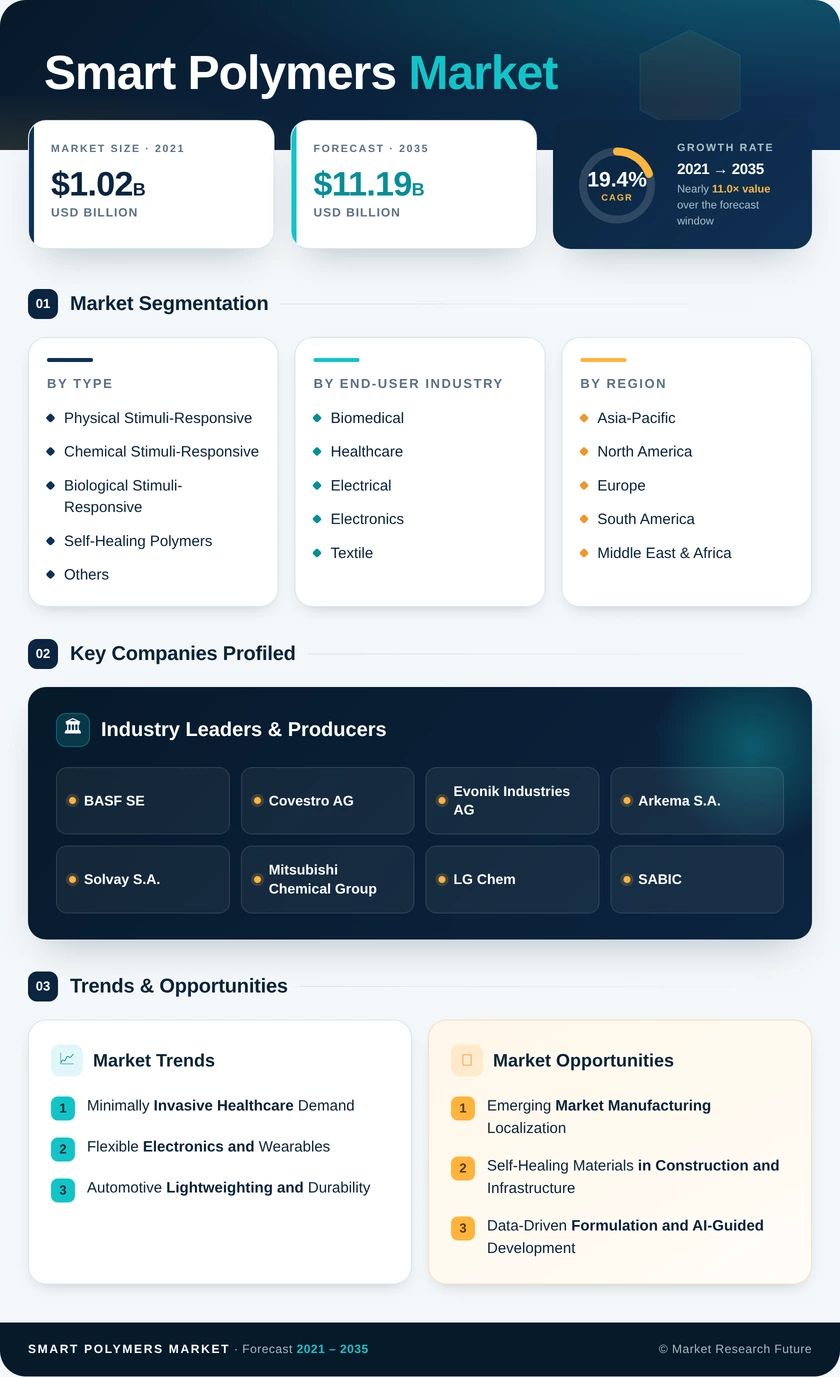
Smart Polymers Market (2026 - 2035)

ID: MRFR/CnM/3297-HCR
111 Pages
Chitranshi Jaiswal
Last Updated: July 14, 2026
Smart Polymers Market Research Report Information By Type (Physical Stimuli-Responsive, Chemical Stimuli-Responsive, Biological Stimuli-Responsive, Self-Healing Polymers, and Others), By End-User Industry (Biomedical and Healthcare, Electrical and Electronics, Textile, Automotive, and Others) – Forecast Till 2035
Smart Polymers Market
Market Size
Forecast Period2026-2035
CAGR (2026-2035)19.4%
2025 Market SizeUSD 1.90 Billion
2035 Market SizeUSD 11.19 Billion
Key Players
BASF SE
Covestro AG
Evonik Industries AG
Arkema S.A.
Solvay S.A.
Mitsubishi Chemical Group
Opportunities
  • Emerging Market Manufacturing Localization
  • Self-Healing Materials in Construction and Infrastructure
  • Data-Driven Formulation and AI-Guided Development
  1. 1 Market Overview |
    1. 1.1 Study Assumptions & Market Definition |
    2. 1.2 Scope of the Study |
    3. 1.3 Research Methodology
  2. 2 Market Summary & Key Takeaways
  3. 3 Market Dynamics |
    1. 3.1 Market Drivers Analysis | |
      1. 3.1.1 Minimally Invasive Healthcare Demand | |
      2. 3.1.2 Flexible Electronics and Wearables | |
      3. 3.1.3 Automotive Lightweighting and Durability | |
      4. 3.1.4 Multi-Trigger Polymer Chemistry Advances | |
      5. 3.1.5 Continuous-Flow Manufacturing Scale-Up |
    2. 3.2 Market Restraints Analysis | |
      1. 3.2.1 Cost Premium Over Conventional Plastics | |
      2. 3.2.2 Regulatory Fragmentation for Biomedical-Grade Materials | |
      3. 3.2.3 Recycling and End-of-Life Complexity | |
      4. 3.2.4 Skilled Polymer Chemistry Talent Shortage |
    3. 3.3 Market Opportunity Analysis | |
      1. 3.3.1 Emerging Market Manufacturing Localization | |
      2. 3.3.2 Self-Healing Materials in Construction and Infrastructure | |
      3. 3.3.3 Data-Driven Formulation and AI-Guided Development | |
      4. 3.3.4 Value-Tier Adoption in Packaging and Apparel | |
      5. 3.3.5 Biodegradable and Circular-Economy Formulations |
    4. 3.4 Industry Value Chain Analysis |
    5. 3.5 Porter's Five Forces Analysis
  4. 4 Smart Polymers Market Size & Forecast (2021–2035) |
    1. 4.1 Historical Market Size (2021–2025) |
    2. 4.2 Current & Forecast Market Size (2026–2035) |
    3. 4.3 Market Size by Revenue (USD Billion) |
    4. 4.4 Year-over-Year Growth Analysis
  5. 5 Segmentation Analysis |
    1. 5.1 By Type | |
      1. 5.1.1 Physical Stimuli-Responsive | |
      2. 5.1.2 Chemical Stimuli-Responsive | |
      3. 5.1.3 Biological Stimuli-Responsive | |
      4. 5.1.4 Self-Healing Polymers | |
      5. 5.1.5 Others |
    2. 5.2 By End-User Industry | |
      1. 5.2.1 Biomedical and Healthcare | |
      2. 5.2.2 Electrical and Electronics | |
      3. 5.2.3 Textile | |
      4. 5.2.4 Automotive | |
      5. 5.2.5 Others
  6. 6 Regional Analysis |
    1. 6.1 North America | |
      1. 6.1.1 US | |
      2. 6.1.2 Canada | |
      3. 6.1.3 Mexico |
    2. 6.2 Europe | |
      1. 6.2.1 Germany | |
      2. 6.2.2 UK | |
      3. 6.2.3 France | |
      4. 6.2.4 Italy | |
      5. 6.2.5 Spain | |
      6. 6.2.6 Nordic Countries | |
      7. 6.2.7 Russia | |
      8. 6.2.8 Rest of Europe |
    3. 6.3 Asia-Pacific | |
      1. 6.3.1 China | |
      2. 6.3.2 India | |
      3. 6.3.3 Japan | |
      4. 6.3.4 South Korea | |
      5. 6.3.5 ASEAN | |
      6. 6.3.6 Rest of Asia-Pacific |
    4. 6.4 South America | |
      1. 6.4.1 Brazil | |
      2. 6.4.2 Argentina | |
      3. 6.4.3 Rest of South America |
    5. 6.5 Middle East & Africa | |
      1. 6.5.1 Saudi Arabia | |
      2. 6.5.2 UAE | |
      3. 6.5.3 South Africa | |
      4. 6.5.4 Egypt | |
      5. 6.5.5 Rest of MEA
  7. 7 Competitive Landscape |
    1. 7.1 Market Share Analysis |
    2. 7.2 Competitive Benchmarking Matrix |
    3. 7.3 Company Profiles | |
      1. 7.3.1 BASF SE | |
      2. 7.3.2 Covestro AG | |
      3. 7.3.3 Evonik Industries AG | |
      4. 7.3.4 Arkema S.A. | |
      5. 7.3.5 Solvay S.A. | |
      6. 7.3.6 Mitsubishi Chemical Group | |
      7. 7.3.7 LG Chem | |
      8. 7.3.8 SABIC | |
      9. 7.3.9 Toray Industries | |
      10. 7.3.10 DuPont de Nemours
  8. 8 Future Outlook & Strategic Recommendations (2026–2035) |
    1. 8.1 AI-Guided Formulation |
    2. 8.2 Platform-Based Supply Models |
    3. 8.3 Electrification and Lightweighting Convergence |
    4. 8.4 Circularity and End-of-Life Design
  9. 9 Recent Industry Developments
  10. 10 Frequently Asked Questions (FAQs)
  11. 11 Report Scope & Methodology |
    1. 11.1 Study Period & Base Year |
    2. 11.2 Data Sources & Citations |
    3. 11.3 Abbreviations
  12. 12 LIST OF TABLES |
  13. TABLE 1 Smart Polymers Market Size & Forecast, by Revenue (USD Billion), 2021–2035 |
  14. TABLE 2 Smart Polymers Market — Year-over-Year Growth Analysis, 2021–2035 |
  15. TABLE 3 Smart Polymers Market Size, by Type, 2021–2035 (USD Billion) |
  16. TABLE 4 Smart Polymers Market Size, by End-User Industry, 2021–2035 (USD Billion) |
  17. TABLE 5 Smart Polymers Market Size, by Region, 2021–2035 (USD Billion) |
  18. TABLE 6 North America Smart Polymers Market Size, by Country, 2021–2035 (USD Billion) |
  19. TABLE 7 Europe Smart Polymers Market Size, by Country, 2021–2035 (USD Billion) |
  20. TABLE 8 Asia-Pacific Smart Polymers Market Size, by Country, 2021–2035 (USD Billion) |
  21. TABLE 9 South America Smart Polymers Market Size, by Country, 2021–2035 (USD Billion) |
  22. TABLE 10 Middle East & Africa Smart Polymers Market Size, by Country, 2021–2035 (USD Billion) |
  23. TABLE 11 North America Smart Polymers Market Size, by Type, 2021–2035 (USD Billion) |
  24. TABLE 12 North America Smart Polymers Market Size, by End-User Industry, 2021–2035 (USD Billion) |
  25. TABLE 13 Europe Smart Polymers Market Size, by Type, 2021–2035 (USD Billion) |
  26. TABLE 14 Europe Smart Polymers Market Size, by End-User Industry, 2021–2035 (USD Billion) |
  27. TABLE 15 Asia-Pacific Smart Polymers Market Size, by Type, 2021–2035 (USD Billion) |
  28. TABLE 16 Asia-Pacific Smart Polymers Market Size, by End-User Industry, 2021–2035 (USD Billion) |
  29. TABLE 17 South America Smart Polymers Market Size, by Type, 2021–2035 (USD Billion) |
  30. TABLE 18 South America Smart Polymers Market Size, by End-User Industry, 2021–2035 (USD Billion) |
  31. TABLE 19 Middle East & Africa Smart Polymers Market Size, by Type, 2021–2035 (USD Billion) |
  32. TABLE 20 Middle East & Africa Smart Polymers Market Size, by End-User Industry, 2021–2035 (USD Billion) |
  33. TABLE 21 Competitive Benchmarking Matrix — Smart Polymers Market, 2026 |
  34. TABLE 22 Company Profiles — Key Players, Smart Polymers Market |
  35. TABLE 23 Recent Industry Developments, 2023–2025 |
  36. TABLE 24 Report Scope & Methodology Summary |
  37. TABLE 25 Detailed Sources and Citations
  38. 13 LIST OF FIGURES |
  39. FIGURE 1 Smart Polymers Market Dynamics — Drivers, Restraints, Opportunities |
  40. FIGURE 2 Industry Value Chain Analysis |
  41. FIGURE 3 Porter's Five Forces Analysis — Smart Polymers Market |
  42. FIGURE 4 Smart Polymers Market Size Trend, 2021–2035 (USD Billion) |
  43. FIGURE 5 Market Share by Type, 2025 vs. 2035 |
  44. FIGURE 6 Market Share by End-User Industry, 2025 vs. 2035 |
  45. FIGURE 7 Regional Market Share, 2025 |
  46. FIGURE 8 Regional CAGR Comparison, 2026–2035 |
  47. FIGURE 9 Competitive Landscape Positioning Map

Segmentation Quick Reference

DimensionSub-SegmentsDominant SegmentFastest Growing Segment
By TypePhysical Stimuli-Responsive; Chemical Stimuli-Responsive; Biological Stimuli-Responsive; Self-Healing Polymers; OthersPhysical Stimuli-ResponsiveBiological Stimuli-Responsive
By End-User IndustryBiomedical and Smart Polymers Market; Electrical and Electronics; Textile; Automotive; OthersBiomedical and Smart Polymers MarketElectrical and Electronics
By RegionAsia-Pacific; North America; Europe; South America; Middle East & AfricaAsia-PacificAsia-Pacific


Market Segmentation Overview

By Type

Sub-SegmentKey Trend
Physical Stimuli-ResponsiveTemperature/pressure-responsive electronics integration
Chemical Stimuli-ResponsivepH-responsive drug delivery formulations
Biological Stimuli-ResponsiveEnzyme- and biomarker-responsive implant materials
Self-Healing PolymersAutomotive seal and construction sealant adoption
OthersNiche industrial and specialty applications


Physical stimuli-responsive materials remain the volume leader given their entrenched role in electronics, while biological stimuli-responsive chemistries are pulling R&D investment as biomedical device makers seek materials that respond to physiological conditions directly.

By End-User Industry

Sub-SegmentKey Trend
Biomedical and Smart Polymers MarketMinimally invasive device and implant adoption
Electrical and ElectronicsFlexible display and wearable sensor integration
TextileSmart and performance apparel expansion
AutomotiveSelf-healing seals and adaptive interior materials
OthersPackaging and industrial coatings


Biomedical and healthcare anchors overall demand with the most consistent R&D funding, while electrical and electronics is scaling fastest as flexible-device manufacturing matures across Asia-Pacific production hubs.

By Region

Regional trends and country-level detail are covered in Section 7 of the main report.

Download PDF ×

We do not share your information with anyone. However, we may send you emails based on your report interest from time to time. You may contact us at any time to opt-out.