×
Request Free Sample ×

Kindly complete the form below to receive a free sample of this Report

* Please use a valid business email

Leading companies partner with us for data-driven Insights

clients tt-cursor
Hero Background
English
Chinese
French
Japanese
Korean
German
Spanish

Smart Mirrors Market Size

ID: MRFR/SEM/2409-HCR
100 Pages
Ankit Gupta
October 2025

Smart Mirror Market Size, Share and Research Report: By Application (Beauty and Personal Care, Healthcare, Automotive, Retail, Home Automation), By Technology (LCD, LED, OLED, Projection, Virtual Reality), By End Use (Residential, Commercial, Automotive), By Connectivity (Wi-Fi, Bluetooth, NFC, Wired) and By Regional (North America, Europe, South America, Asia Pacific, Middle East and Africa) - Industry Forecast Till 2035

Share:
Download PDF ×

We do not share your information with anyone. However, we may send you emails based on your report interest from time to time. You may contact us at any time to opt-out.

Smart Mirrors Market Infographic
×
Smart Mirrors Market Infographic Full View
Purchase Options

Smart Mirrors Size

Smart Mirrors Market Growth Projections and Opportunities

The market is being driven in large part by consumers' growing preference for smart and connected gadgets. Customers are looking for creative solutions that improve ease and provide a distinctive user experience as technology becomes more and more integrated into daily life. This need for intuitive and networked technology is met by smart mirrors, which come equipped with capabilities like voice recognition, touchscreens, and networking to other smart devices. Therefore, the market is driven by consumers' increasing interest in and knowledge of smart mirrors' ability to modernize daily activities. Advancements in display technologies, including OLED and high-definition screens, enhance the overall functionality and attractiveness of smart mirrors. These advancements in technology make mirrors interactive surfaces by improving the visual experience and allowing for the inclusion of augmented reality capabilities. In addition, smart mirrors are becoming more portable and adaptable due to the shrinking of electrical components and the rising effectiveness of sensors. The form and functionality of smart mirrors will probably continue to evolve because of technological developments, supporting market expansion. By enabling real-time information display, such as weather conditions or schedules, and interaction with other IoT-enabled devices, connectivity improves the usefulness of smart mirrors. As smart mirrors become essential parts of these high-tech living spaces, the growing trend toward smart homes and the interconnectivity of devices greatly contribute to the market's growth. Furthermore, the market is affected by the adaptability and variety of uses of smart mirrors in various sectors. Smart mirrors, which first gained popularity in the retail industry for their virtual changing rooms, can also be used in residential, automotive, and healthcare contexts. These mirrors are used in healthcare to monitor patients and visualize health data, demonstrating how they might enhance medical procedures. Smart mirrors for cars improve driving experiences and safety by providing functions like blind-spot detection and navigation displays. The market relevance of smart mirrors is attributed to its adaptability to different industries and their ability to meet individual needs. The market for smart mirrors is shaped by a variety of factors, including consumer preferences, affordability concerns, IoT integration, and technological improvements. The way these market elements are continuing to change suggests that smart mirrors will be a big part of the everyday experiences that people have in the future—from living rooms to shopping malls and beyond. The market's reaction to these issues will determine how innovative and profitable the smart mirror sector can stay.
Smart Mirrors Market Size Graph
Author
Ankit Gupta
Senior Research Analyst

Ankit Gupta is an analyst in market research industry in ICT and SEMI industry. With post-graduation in "Telecom and Marketing Management" and graduation in "Electronics and Telecommunication" vertical he is well versed with recent development in ICT industry as a whole. Having worked on more than 150+ reports including consultation for fortune 500 companies such as Microsoft and Rio Tinto in identifying solutions with respect to business problems his opinions are inclined towards mixture of technical and managerial aspects.

Leave a Comment

FAQs

What was the market size of the Global Smart Mirror Market in 2024?

The Global Smart Mirror Market was valued at 3.08 USD Billion in 2024.

What is the projected market value of the Global Smart Mirror Market by 2035?

By 2035, the Global Smart Mirror Market is projected to reach a value of 15.0 USD Billion.

What is the anticipated compound annual growth rate (CAGR) for the Global Smart Mirror Market from 2025 to 2035?

The anticipated CAGR for the Global Smart Mirror Market from 2025 to 2035 is 15.48%.

Which region is projected to have the highest market value in 2035 in the Global Smart Mirror Market?

North America is projected to have the highest market value of 4.725 USD Billion in 2035.

What will be the market value of the Smart Mirror Market in Europe by 2035?

The market value of the Smart Mirror Market in Europe is expected to reach 4.192 USD Billion by 2035.

What are the market values of the Global Smart Mirror Market for Healthcare application in 2024 and 2035?

The market value for the Healthcare application is expected to be 0.528 USD Billion in 2024 and reach 3.5 USD Billion by 2035.

Who are some of the key players operating in the Global Smart Mirror Market?

Key players in the Global Smart Mirror Market include Samsung Electronics, Sony, LG Electronics, and Xiaomi among others.

What is the expected market size of Smart Mirrors in the Beauty and Personal Care application by 2035?

The expected market size in the Beauty and Personal Care application is projected to be 4.0 USD Billion by 2035.

What is the projected market size for the Automotive application of Smart Mirrors by 2035?

The projected market size for the Automotive application of Smart Mirrors is anticipated to be 2.5 USD Billion by 2035.

What challenges does the Global Smart Mirror Market face in achieving its growth targets?

The Global Smart Mirror Market may face challenges related to competition, technological advancements, and consumer adoption rates.

Market Summary

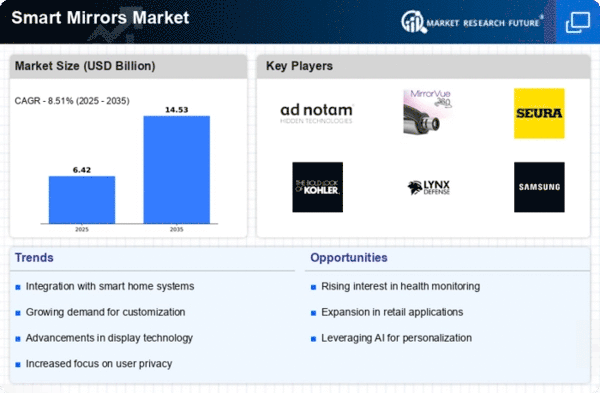
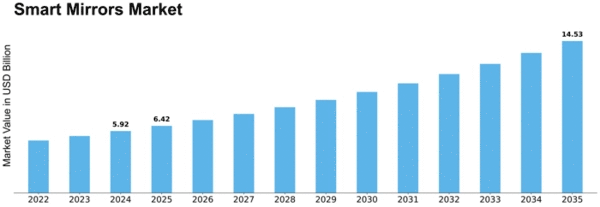
As per MRFR analysis, the Smart Mirrors Market Size was estimated at 5.92 USD Billion in 2024. The Smart Mirrors industry is projected to grow from 6.42 in 2025 to 14.53 by 2035, exhibiting a compound annual growth rate (CAGR) of 8.51 during the forecast period 2025 - 2035.

Key Market Trends & Highlights

The Smart Mirrors Market is poised for substantial growth driven by technological advancements and increasing consumer demand.

  • North America remains the largest market for smart mirrors, driven by high consumer adoption rates. The Asia-Pacific region is emerging as the fastest-growing market, fueled by rapid urbanization and technological innovation. The personal use segment dominates the market, while the healthcare segment is experiencing the fastest growth due to rising health awareness. Technological advancements in display technology and the rising demand for smart home devices are key drivers propelling market expansion.

Market Size & Forecast

2024 Market Size 5.92 (USD Billion)
2035 Market Size 14.53 (USD Billion)
CAGR (2025 - 2035) 8.51%
Largest Regional Market Share in 2024 North America

Major Players

Ad Notam (DE), MirrorVue (US), Seura (US), Kohler (US), Lynx (US), Samsung (KR), Xiaomi (CN), Häfele (DE), MIRROR (US)

Market Trends

The Smart Mirrors Market is currently experiencing a notable evolution, driven by advancements in technology and changing consumer preferences. These mirrors, which integrate digital displays with reflective surfaces, are increasingly being adopted in various sectors, including retail, healthcare, and personal grooming. The growing demand for smart home devices appears to be a significant factor propelling this market forward. As consumers seek enhanced convenience and connectivity, smart mirrors are being designed to offer features such as voice control, personalized interfaces, and integration with other smart home systems. Moreover, the emphasis on aesthetics and functionality in home decor is likely to further stimulate interest in smart mirrors. Manufacturers are focusing on creating sleek, stylish designs that not only serve practical purposes but also enhance the overall ambiance of living spaces. This trend suggests a shift towards multifunctional products that cater to both technological needs and aesthetic desires. As the Smart Mirrors Market continues to expand, it may also witness increased competition, prompting innovation and diversification in product offerings.

Integration with Smart Home Ecosystems

The Smart Mirrors Market is increasingly aligning with broader smart home ecosystems. This trend indicates a growing consumer preference for interconnected devices that enhance home automation. Smart mirrors are being designed to seamlessly integrate with other smart devices, allowing users to control lighting, security, and entertainment systems through a single interface.

Personalization and Customization Features

There is a rising demand for personalized experiences within the Smart Mirrors Market. Consumers appear to favor mirrors that can adapt to individual preferences, offering tailored content such as weather updates, news feeds, and beauty tutorials. This trend suggests that manufacturers are focusing on developing customizable interfaces that cater to diverse user needs.

Health and Wellness Applications

The Smart Mirrors Market is witnessing an increasing emphasis on health and wellness functionalities. These mirrors are being equipped with features that monitor skin conditions, provide fitness guidance, and even track vital signs. This trend indicates a potential shift towards mirrors that not only serve aesthetic purposes but also contribute to overall well-being.

Smart Mirrors Market Market Drivers

Rising Health Awareness

Increasing health consciousness among consumers drives the Global Smart Mirror Market Industry. Smart mirrors equipped with health monitoring features, such as heart rate and skin analysis, cater to the growing demand for wellness products. This trend is particularly evident in the beauty and fitness sectors, where consumers seek tools that provide insights into their health and appearance. The potential for smart mirrors to offer personalized health advice and track fitness goals positions them as valuable assets in modern households. Consequently, the market is expected to grow significantly, with projections indicating a rise to 15 USD Billion by 2035.

Technological Advancements

The Global Smart Mirror Market Industry is experiencing rapid growth due to continuous technological advancements. Innovations in display technologies, such as OLED and LCD, enhance the visual quality and interactivity of smart mirrors. Additionally, the integration of artificial intelligence and voice recognition systems allows for personalized user experiences. For instance, smart mirrors can now provide real-time health monitoring and beauty recommendations based on user preferences. As a result, the market is projected to reach 3.08 USD Billion in 2024, reflecting the increasing consumer demand for high-tech home solutions.

Sustainability and Energy Efficiency

Sustainability concerns are shaping the Global Smart Mirror Market Industry as consumers increasingly prioritize eco-friendly products. Smart mirrors that incorporate energy-efficient technologies and sustainable materials appeal to environmentally conscious buyers. Features such as energy-saving modes and the ability to monitor energy consumption align with global efforts to reduce carbon footprints. This growing emphasis on sustainability is likely to influence purchasing decisions, as consumers seek products that contribute to a greener lifestyle. The market's focus on sustainable innovations may further enhance its growth trajectory, aligning with broader environmental goals.

Integration with Smart Home Ecosystems

The Global Smart Mirror Market Industry benefits from the increasing integration of smart mirrors into broader smart home ecosystems. As consumers adopt smart home devices, the demand for interconnected products rises. Smart mirrors can serve as central hubs, controlling lighting, temperature, and security systems through voice commands or touch interfaces. This seamless integration enhances user convenience and promotes energy efficiency. The trend towards smart homes is likely to accelerate the adoption of smart mirrors, contributing to a compound annual growth rate of 15.48% from 2025 to 2035, as more households seek cohesive smart solutions.

Growing Demand in Retail and Hospitality

The Global Smart Mirror Market Industry is significantly influenced by the growing demand for smart mirrors in retail and hospitality sectors. Retailers utilize smart mirrors to enhance customer experiences through virtual try-ons and personalized recommendations, thereby increasing sales and customer engagement. Similarly, hotels and spas adopt smart mirrors to provide guests with interactive services, such as personalized greetings and entertainment options. This trend not only elevates the customer experience but also drives revenue growth for businesses. As a result, the market is poised for expansion, with increasing investments in smart mirror technology across various industries.

Market Segment Insights

By Application: Personal Use (Largest) vs. Healthcare (Fastest-Growing)

The Smart Mirrors Market is segmented into five main applications: Personal Use, Commercial Use, Healthcare, Retail, and Automotive. Among these, Personal Use currently holds the largest market share, driven by an increased focus on home automation and smart home technologies. This segment benefits from the growing demand for connected devices that integrate seamless functionality with daily routines. Additionally, the Healthcare segment is rapidly gaining traction as hospitals and clinics seek advanced solutions to improve patient engagement and experience. This shift indicates a diversification in application across the landscape, reflecting significant opportunities for growth within the industry.

Personal Use: Dominant vs. Healthcare: Emerging

The Personal Use segment of the Smart Mirrors Market leverages the increasing trend of smart home devices, making it a dominant force. Consumers are drawn to mirrors that offer personalized features such as streaming media, health monitoring, and connectivity with other smart home devices. In contrast, the Healthcare segment is emerging rapidly, propelled by innovative applications in telemedicine and patient care. Smart mirrors in healthcare settings facilitate remote consultations and provide interactive displays for patient education, positioning this segment as a compelling growth area as the demand for smarter healthcare solutions rises.

By Technology: Touchscreen (Largest) vs. Voice Recognition (Fastest-Growing)

In the Smart Mirrors Market, the technology segment is significantly diversified. Touchscreen technology dominates the market, offering intuitive interfaces that enhance user interaction. This segment is characterized by a large consumer base that favors tactile engagement with smart mirrors, solidifying its position as the leading technology. Meanwhile, voice recognition technology is emerging as the fastest-growing segment, driven by rising consumer demand for hands-free operations and smart home integrations. This innovative feature is appealing to tech-savvy users looking for convenience and efficiency, further catalyzing its rapid market penetration.

Technology: Touchscreen (Dominant) vs. Voice Recognition (Emerging)

Touchscreen technology serves as a key characteristic of smart mirrors, providing a familiar and interactive experience that appeals to a wide range of consumers. Its user-friendly interface allows for easy navigation and control over various functionalities, making it dominant in the market. In contrast, voice recognition technology is on the rise, appealing particularly to users who prioritize hands-free convenience. It not only enhances user experience by allowing effortless commands but also integrates seamlessly into smart home ecosystems. This rising trend reflects the growing consumer preference for automation and voice-activated solutions, positioning voice recognition as an essential emerging technology in the smart mirrors landscape.

By End Use: Home (Largest) vs. Fitness Centers (Fastest-Growing)

In the Smart Mirrors Market, the distribution of market share among various end-use segments reveals significant insights. The 'Home' segment currently dominates the market as consumers increasingly adopt smart home technology, integrating smart mirrors for enhanced convenience and aesthetics. Other segments, such as 'Hotels' and 'Beauty Salons', also contribute to the overall market but at a comparatively lower share due to niche applications. The demand for smart mirrors in high-traffic areas like shopping malls showcases emerging trends, signaling growth potential.

Home (Dominant) vs. Fitness Centers (Emerging)

The 'Home' segment is characterized by its broad appeal to consumers seeking innovative technologies to enhance their living spaces. Smart mirrors augment functionality by integrating features like touch screens, voice activation, and home automation, making them popular among homeowners. In contrast, the 'Fitness Centers' segment represents an emerging market, driven by the rising trend of incorporating technology in personal wellness programs. These mirrors serve dual purposes, providing users with exercise guidance and performance tracking. As fitness enthusiasts seek personalized experiences, the demand for smart mirrors in fitness environments is rapidly gaining momentum, positioning them as a key player in the segment.

Get more detailed insights about Smart Mirror Market Research Report-Global Forecast till 2035

Regional Insights

North America : Market Leader in Smart Mirrors

North America is poised to maintain its leadership in the Smart Mirrors Market, holding a significant market share of 2.96 billion. The region's growth is driven by increasing consumer demand for smart home technologies, coupled with advancements in IoT and AI. Regulatory support for energy-efficient products further catalyzes market expansion, as consumers seek innovative solutions that enhance convenience and functionality in their daily lives. The competitive landscape in North America is robust, featuring key players such as Kohler, Samsung, and MirrorVue. The U.S. stands out as the leading country, with a strong focus on integrating smart technology into home environments. The presence of established brands and continuous innovation in product offerings contribute to a dynamic market, ensuring that North America remains at the forefront of the Smart Mirrors industry.

Europe : Emerging Market with Growth Potential

Europe is witnessing a growing interest in smart mirrors, with a market size of 1.68 billion. The region's growth is fueled by rising consumer awareness of smart home technologies and increasing investments in home automation. Regulatory initiatives aimed at promoting energy efficiency and sustainability are also driving demand, as consumers look for products that align with eco-friendly practices. Leading countries in Europe include Germany, France, and the UK, where companies like Ad Notam and Häfele are making significant strides. The competitive landscape is characterized by a mix of established brands and innovative startups, fostering a dynamic environment for growth. As the market evolves, European consumers are increasingly seeking personalized and multifunctional smart mirror solutions.

Asia-Pacific : Rapid Growth in Smart Technology

The Asia-Pacific region is emerging as a significant player in the Smart Mirrors Market, with a market size of 1.76 billion. The growth is primarily driven by increasing urbanization, rising disposable incomes, and a growing interest in smart home technologies. Countries in this region are witnessing a surge in demand for innovative products that enhance lifestyle and convenience, supported by favorable government policies promoting technology adoption. China and Japan are leading the charge in the Asia-Pacific market, with companies like Xiaomi and Samsung actively participating. The competitive landscape is vibrant, with numerous local and international players vying for market share. As consumer preferences shift towards smart and connected devices, the region is expected to see continued growth in smart mirror adoption, reflecting broader trends in home automation.

Middle East and Africa : Emerging Market with Untapped Potential

The Middle East and Africa region is gradually emerging in the Smart Mirrors Market, with a market size of 0.52 billion. The growth is driven by increasing urbanization and a rising middle class seeking modern home solutions. Additionally, government initiatives aimed at enhancing smart city infrastructure are catalyzing demand for innovative home technologies, including smart mirrors. Countries like the UAE and South Africa are at the forefront of this market, with a growing number of consumers interested in smart home products. The competitive landscape is still developing, with opportunities for both local and international players to establish a foothold. As awareness of smart technologies increases, the region is expected to experience significant growth in the adoption of smart mirrors, aligning with global trends in home automation.

Key Players and Competitive Insights

The Smart Mirrors Market is currently characterized by a dynamic competitive landscape, driven by technological advancements and increasing consumer demand for integrated smart home solutions. Key players such as Samsung (KR), Kohler (US), and Xiaomi (CN) are at the forefront, each adopting distinct strategies to enhance their market presence. Samsung (KR) focuses on innovation, leveraging its extensive R&D capabilities to integrate advanced features such as AI and IoT connectivity into its smart mirrors. Kohler (US), on the other hand, emphasizes partnerships with interior designers and architects to create bespoke solutions that cater to luxury markets, thereby positioning itself as a premium brand. Xiaomi (CN) appears to be pursuing aggressive pricing strategies while expanding its product range, which may attract a broader consumer base and enhance its competitive edge.
The business tactics employed by these companies reflect a trend towards localizing manufacturing and optimizing supply chains to reduce costs and improve responsiveness to market demands. The Smart Mirrors Market is moderately fragmented, with a mix of established players and emerging startups. This fragmentation allows for diverse offerings, yet the collective influence of major companies shapes the competitive dynamics, as they set benchmarks for innovation and customer service.
In November 2025, Samsung (KR) announced the launch of its latest smart mirror model, which incorporates a state-of-the-art AI assistant capable of personalized skincare recommendations. This strategic move not only reinforces Samsung's commitment to innovation but also positions the company to capture a growing segment of health-conscious consumers. The integration of AI into everyday products is likely to enhance user engagement and loyalty, thereby solidifying Samsung's market position.
In October 2025, Kohler (US) unveiled a new line of smart mirrors designed specifically for the hospitality sector, featuring customizable lighting and integrated entertainment options. This initiative reflects Kohler's strategic focus on expanding its footprint in commercial markets, which could lead to increased revenue streams. By catering to the unique needs of hotels and resorts, Kohler is likely to differentiate itself from competitors who primarily target residential consumers.
In September 2025, Xiaomi (CN) entered into a strategic partnership with a leading home automation platform to enhance the interoperability of its smart mirrors with other smart home devices. This collaboration suggests a forward-thinking approach to creating a seamless user experience, which is increasingly important in the smart home ecosystem. By ensuring compatibility with a wide range of devices, Xiaomi may strengthen its market position and appeal to tech-savvy consumers.
As of December 2025, the Smart Mirrors Market is witnessing trends such as digitalization, sustainability, and AI integration, which are reshaping competitive strategies. Strategic alliances among key players are becoming more prevalent, fostering innovation and enhancing product offerings. The shift from price-based competition to a focus on technological advancement and supply chain reliability is evident, suggesting that companies will need to prioritize differentiation through innovation to maintain a competitive edge in the evolving landscape.

Key Companies in the Smart Mirrors Market include

Industry Developments

The Smart Mirror Market has seen significant developments recently, particularly with advancements in technology and features such as voice recognition, interactive displays, and connectivity with smart home devices. Companies like Samsung Electronics and LG Electronics are at the forefront, integrating Artificial Intelligence to enhance user experience. In March 2023, Infiniti Peripherals expanded its line of smart mirrors to cater to the growing demand in the retail and hospitality sectors. Gentex has been focusing on automotive smart mirrors, showcasing innovations that integrate Heads-Up Display technologies. 

Notably, mergers and acquisitions have also shaped the landscape; for instance, in August 2023, Sony acquired a tech startup specializing in augmented reality, strengthening its position in the smart mirror niche. Overall, the market valuation for smart mirrors is expected to grow considerably due to increasing consumer interest and investment in smart home products, demonstrating a robust trajectory for industry players such as Adexa, Evervue, and Holoactive. Regulatory changes in various countries are also influencing market dynamics, enhancing the adoption rate of smart mirrors in commercial spaces.

Future Outlook

Smart Mirrors Market Future Outlook

The Smart Mirrors Market is projected to grow at 8.51% CAGR from 2025 to 2035, driven by advancements in technology, increasing consumer demand, and integration with smart home systems.

New opportunities lie in:

  • Expansion into healthcare facilities for patient monitoring solutions.
  • Development of customizable smart mirrors for retail environments.
  • Integration with AI-driven personal assistant technologies for enhanced user experience.

By 2035, the Smart Mirrors Market is expected to be a pivotal segment in the smart home industry.

Market Segmentation

Smart Mirrors Market End Use Outlook

  • Home
  • Hotels
  • Fitness Centers
  • Beauty Salons
  • Shopping Malls

Smart Mirrors Market Technology Outlook

  • Touchscreen
  • Voice Recognition
  • Gesture Control
  • Augmented Reality
  • Artificial Intelligence

Smart Mirrors Market Application Outlook

  • Personal Use
  • Commercial Use
  • Healthcare
  • Retail
  • Automotive

Report Scope

MARKET SIZE 2024 5.92(USD Billion)
MARKET SIZE 2025 6.42(USD Billion)
MARKET SIZE 2035 14.53(USD Billion)
COMPOUND ANNUAL GROWTH RATE (CAGR) 8.51% (2025 - 2035)
REPORT COVERAGE Revenue Forecast, Competitive Landscape, Growth Factors, and Trends
BASE YEAR 2024
Market Forecast Period 2025 - 2035
Historical Data 2019 - 2024
Market Forecast Units USD Billion
Key Companies Profiled Ad Notam (DE), MirrorVue (US), Seura (US), Kohler (US), Lynx (US), Samsung (KR), Xiaomi (CN), Häfele (DE), MIRROR (US)
Segments Covered Application, Technology, End Use
Key Market Opportunities Integration of artificial intelligence and augmented reality enhances user experience in the Smart Mirrors Market.
Key Market Dynamics Rising consumer demand for personalized experiences drives innovation and competition in the Smart Mirrors Market.
Countries Covered North America, Europe, APAC, South America, MEA

FAQs

What was the market size of the Global Smart Mirror Market in 2024?

The Global Smart Mirror Market was valued at 3.08 USD Billion in 2024.

What is the projected market value of the Global Smart Mirror Market by 2035?

By 2035, the Global Smart Mirror Market is projected to reach a value of 15.0 USD Billion.

What is the anticipated compound annual growth rate (CAGR) for the Global Smart Mirror Market from 2025 to 2035?

The anticipated CAGR for the Global Smart Mirror Market from 2025 to 2035 is 15.48%.

Which region is projected to have the highest market value in 2035 in the Global Smart Mirror Market?

North America is projected to have the highest market value of 4.725 USD Billion in 2035.

What will be the market value of the Smart Mirror Market in Europe by 2035?

The market value of the Smart Mirror Market in Europe is expected to reach 4.192 USD Billion by 2035.

What are the market values of the Global Smart Mirror Market for Healthcare application in 2024 and 2035?

The market value for the Healthcare application is expected to be 0.528 USD Billion in 2024 and reach 3.5 USD Billion by 2035.

Who are some of the key players operating in the Global Smart Mirror Market?

Key players in the Global Smart Mirror Market include Samsung Electronics, Sony, LG Electronics, and Xiaomi among others.

What is the expected market size of Smart Mirrors in the Beauty and Personal Care application by 2035?

The expected market size in the Beauty and Personal Care application is projected to be 4.0 USD Billion by 2035.

What is the projected market size for the Automotive application of Smart Mirrors by 2035?

The projected market size for the Automotive application of Smart Mirrors is anticipated to be 2.5 USD Billion by 2035.

What challenges does the Global Smart Mirror Market face in achieving its growth targets?

The Global Smart Mirror Market may face challenges related to competition, technological advancements, and consumer adoption rates.

  1. SECTION I: EXECUTIVE SUMMARY AND KEY HIGHLIGHTS
    1. | 1.1 EXECUTIVE SUMMARY
    2. | 1.1.1 Market Overview
    3. | 1.1.2 Key Findings
    4. | 1.1.3 Market Segmentation
    5. | 1.1.4 Competitive Landscape
    6. | 1.1.5 Challenges and Opportunities
    7. | 1.1.6 Future Outlook
  2. SECTION II: SCOPING, METHODOLOGY AND MARKET STRUCTURE
    1. | 2.1 MARKET INTRODUCTION
    2. | 2.1.1 Definition
    3. | 2.1.2 Scope of the study
    4. |-- 2.1.2.1 Research Objective
    5. |-- 2.1.2.2 Assumption
    6. |-- 2.1.2.3 Limitations
    7. | 2.2 RESEARCH METHODOLOGY
    8. | 2.2.1 Overview
    9. | 2.2.2 Data Mining
    10. | 2.2.3 Secondary Research
    11. | 2.2.4 Primary Research
    12. |-- 2.2.4.1 Primary Interviews and Information Gathering Process
    13. |-- 2.2.4.2 Breakdown of Primary Respondents
    14. | 2.2.5 Forecasting Model
    15. | 2.2.6 Market Size Estimation
    16. |-- 2.2.6.1 Bottom-Up Approach
    17. |-- 2.2.6.2 Top-Down Approach
    18. | 2.2.7 Data Triangulation
    19. | 2.2.8 Validation
  3. SECTION III: QUALITATIVE ANALYSIS
    1. | 3.1 MARKET DYNAMICS
    2. | 3.1.1 Overview
    3. | 3.1.2 Drivers
    4. | 3.1.3 Restraints
    5. | 3.1.4 Opportunities
    6. | 3.2 MARKET FACTOR ANALYSIS
    7. | 3.2.1 Value chain Analysis
    8. | 3.2.2 Porter's Five Forces Analysis
    9. |-- 3.2.2.1 Bargaining Power of Suppliers
    10. |-- 3.2.2.2 Bargaining Power of Buyers
    11. |-- 3.2.2.3 Threat of New Entrants
    12. |-- 3.2.2.4 Threat of Substitutes
    13. |-- 3.2.2.5 Intensity of Rivalry
    14. | 3.2.3 COVID-19 Impact Analysis
    15. |-- 3.2.3.1 Market Impact Analysis
    16. |-- 3.2.3.2 Regional Impact
    17. |-- 3.2.3.3 Opportunity and Threat Analysis
  4. SECTION IV: QUANTITATIVE ANALYSIS
    1. | 4.1 Semiconductor & Electronics, BY Application (USD Billion)
    2. | 4.1.1 Personal Use
    3. | 4.1.2 Commercial Use
    4. | 4.1.3 Healthcare
    5. | 4.1.4 Retail
    6. | 4.1.5 Automotive
    7. | 4.2 Semiconductor & Electronics, BY Technology (USD Billion)
    8. | 4.2.1 Touchscreen
    9. | 4.2.2 Voice Recognition
    10. | 4.2.3 Gesture Control
    11. | 4.2.4 Augmented Reality
    12. | 4.2.5 Artificial Intelligence
    13. | 4.3 Semiconductor & Electronics, BY End Use (USD Billion)
    14. | 4.3.1 Home
    15. | 4.3.2 Hotels
    16. | 4.3.3 Fitness Centers
    17. | 4.3.4 Beauty Salons
    18. | 4.3.5 Shopping Malls
    19. | 4.4 Semiconductor & Electronics, BY Region (USD Billion)
    20. | 4.4.1 North America
    21. |-- 4.4.1.1 US
    22. |-- 4.4.1.2 Canada
    23. | 4.4.2 Europe
    24. |-- 4.4.2.1 Germany
    25. |-- 4.4.2.2 UK
    26. |-- 4.4.2.3 France
    27. |-- 4.4.2.4 Russia
    28. |-- 4.4.2.5 Italy
    29. |-- 4.4.2.6 Spain
    30. |-- 4.4.2.7 Rest of Europe
    31. | 4.4.3 APAC
    32. |-- 4.4.3.1 China
    33. |-- 4.4.3.2 India
    34. |-- 4.4.3.3 Japan
    35. |-- 4.4.3.4 South Korea
    36. |-- 4.4.3.5 Malaysia
    37. |-- 4.4.3.6 Thailand
    38. |-- 4.4.3.7 Indonesia
    39. |-- 4.4.3.8 Rest of APAC
    40. | 4.4.4 South America
    41. |-- 4.4.4.1 Brazil
    42. |-- 4.4.4.2 Mexico
    43. |-- 4.4.4.3 Argentina
    44. |-- 4.4.4.4 Rest of South America
    45. | 4.4.5 MEA
    46. |-- 4.4.5.1 GCC Countries
    47. |-- 4.4.5.2 South Africa
    48. |-- 4.4.5.3 Rest of MEA
  5. SECTION V: COMPETITIVE ANALYSIS
    1. | 5.1 Competitive Landscape
    2. | 5.1.1 Overview
    3. | 5.1.2 Competitive Analysis
    4. | 5.1.3 Market share Analysis
    5. | 5.1.4 Major Growth Strategy in the Semiconductor & Electronics
    6. | 5.1.5 Competitive Benchmarking
    7. | 5.1.6 Leading Players in Terms of Number of Developments in the Semiconductor & Electronics
    8. | 5.1.7 Key developments and growth strategies
    9. |-- 5.1.7.1 New Product Launch/Service Deployment
    10. |-- 5.1.7.2 Merger & Acquisitions
    11. |-- 5.1.7.3 Joint Ventures
    12. | 5.1.8 Major Players Financial Matrix
    13. |-- 5.1.8.1 Sales and Operating Income
    14. |-- 5.1.8.2 Major Players R&D Expenditure. 2023
    15. | 5.2 Company Profiles
    16. | 5.2.1 Ad Notam (DE)
    17. |-- 5.2.1.1 Financial Overview
    18. |-- 5.2.1.2 Products Offered
    19. |-- 5.2.1.3 Key Developments
    20. |-- 5.2.1.4 SWOT Analysis
    21. |-- 5.2.1.5 Key Strategies
    22. | 5.2.2 MirrorVue (US)
    23. |-- 5.2.2.1 Financial Overview
    24. |-- 5.2.2.2 Products Offered
    25. |-- 5.2.2.3 Key Developments
    26. |-- 5.2.2.4 SWOT Analysis
    27. |-- 5.2.2.5 Key Strategies
    28. | 5.2.3 Seura (US)
    29. |-- 5.2.3.1 Financial Overview
    30. |-- 5.2.3.2 Products Offered
    31. |-- 5.2.3.3 Key Developments
    32. |-- 5.2.3.4 SWOT Analysis
    33. |-- 5.2.3.5 Key Strategies
    34. | 5.2.4 Kohler (US)
    35. |-- 5.2.4.1 Financial Overview
    36. |-- 5.2.4.2 Products Offered
    37. |-- 5.2.4.3 Key Developments
    38. |-- 5.2.4.4 SWOT Analysis
    39. |-- 5.2.4.5 Key Strategies
    40. | 5.2.5 Lynx (US)
    41. |-- 5.2.5.1 Financial Overview
    42. |-- 5.2.5.2 Products Offered
    43. |-- 5.2.5.3 Key Developments
    44. |-- 5.2.5.4 SWOT Analysis
    45. |-- 5.2.5.5 Key Strategies
    46. | 5.2.6 Samsung (KR)
    47. |-- 5.2.6.1 Financial Overview
    48. |-- 5.2.6.2 Products Offered
    49. |-- 5.2.6.3 Key Developments
    50. |-- 5.2.6.4 SWOT Analysis
    51. |-- 5.2.6.5 Key Strategies
    52. | 5.2.7 Xiaomi (CN)
    53. |-- 5.2.7.1 Financial Overview
    54. |-- 5.2.7.2 Products Offered
    55. |-- 5.2.7.3 Key Developments
    56. |-- 5.2.7.4 SWOT Analysis
    57. |-- 5.2.7.5 Key Strategies
    58. | 5.2.8 Häfele (DE)
    59. |-- 5.2.8.1 Financial Overview
    60. |-- 5.2.8.2 Products Offered
    61. |-- 5.2.8.3 Key Developments
    62. |-- 5.2.8.4 SWOT Analysis
    63. |-- 5.2.8.5 Key Strategies
    64. | 5.2.9 MIRROR (US)
    65. |-- 5.2.9.1 Financial Overview
    66. |-- 5.2.9.2 Products Offered
    67. |-- 5.2.9.3 Key Developments
    68. |-- 5.2.9.4 SWOT Analysis
    69. |-- 5.2.9.5 Key Strategies
    70. | 5.3 Appendix
    71. | 5.3.1 References
    72. | 5.3.2 Related Reports

Semiconductor & Electronics Market Segmentation

Semiconductor & Electronics By Application (USD Billion, 2025-2035)

  • Personal Use
  • Commercial Use
  • Healthcare
  • Retail
  • Automotive

Semiconductor & Electronics By Technology (USD Billion, 2025-2035)

  • Touchscreen
  • Voice Recognition
  • Gesture Control
  • Augmented Reality
  • Artificial Intelligence

Semiconductor & Electronics By End Use (USD Billion, 2025-2035)

  • Home
  • Hotels
  • Fitness Centers
  • Beauty Salons
  • Shopping Malls
Infographic

Free Sample Request

Kindly complete the form below to receive a free sample of this Report

Get Free Sample

Customer Strories

Compare Licence

×
Features License Type
Single User Multiuser License Enterprise User
Price $4,950 $5,950 $7,250
Maximum User Access Limit 1 User Upto 10 Users Unrestricted Access Throughout the Organization
Free Customization
Direct Access to Analyst
Deliverable Format
Platform Access
Discount on Next Purchase 10% 15% 15%
Printable Versions