×
Request Free Sample ×

Kindly complete the form below to receive a free sample of this Report

* Please use a valid business email

Leading companies partner with us for data-driven Insights

clients tt-cursor
Hero Background
English
Chinese
French
Japanese
Korean
German
Spanish

Smart Home Projector Market Trends

ID: MRFR/SEM/9516-CR
110 Pages
Shubham Munde
November 2022

Smart Home Projector Market Size, Share and Research Report By Type (Android Smart Home Projectors, Linux Smart Home Projectors), by Resolution (XGA {1024 x 768 }, WXGA{1280 x 800}, HD {1920 x 1080 }, 4K {3840 x 2160 }, 8K {7680 x 4320 }), BY Technology (DLP, LCD, LED, LCos and Others), by Pricing (Low End, Mid End, and High End), by Sales Channel (Online, Offline), and Region (North America, Europe, Asia-Pacific, Middle East & Africa, and South America)—Forecast till 2035

Share:
Download PDF ×

We do not share your information with anyone. However, we may send you emails based on your report interest from time to time. You may contact us at any time to opt-out.

Smart Home Projector Market Infographic
Purchase Options

Market Trends

Key Emerging Trends in the Smart Home Projector Market

The Smart Home Projector Market is experiencing dynamic trends that are shaping the future of this industry. These trends reflect the evolving needs and preferences of consumers, as well as advancements in technology. Let's explore some of the key trends driving the Smart Home Projector Market.

Integration with Smart Home Ecosystems: One prominent trend in the Smart Home Projector Market is the increasing integration of projectors with broader smart home ecosystems. Consumers today seek seamless connectivity and interoperability between various smart devices in their homes. Smart projectors are now designed to integrate with voice assistants, smart lighting, security systems, and other connected devices, providing users with a unified and convenient smart home experience.

Enhanced Connectivity and Wireless Capabilities: With the proliferation of wireless technologies, Smart Home Projectors are now equipped with advanced connectivity options. Wi-Fi and Bluetooth capabilities allow users to effortlessly stream content from their smartphones, tablets, or laptops directly to the projector. This wireless connectivity enhances convenience and eliminates the need for cumbersome cables, contributing to a clutter-free and aesthetically pleasing home environment.

Focus on Energy Efficiency: As consumers become increasingly environmentally conscious, there is a growing emphasis on energy-efficient solutions in the Smart Home Projector Market. Manufacturers are incorporating energy-saving features such as LED light sources and power-efficient components. These energy-efficient projectors not only contribute to sustainability but also result in cost savings for users over the long term.

Advancements in Display Technology: The Smart Home Projector Market is witnessing continuous advancements in display technologies. High-definition (HD), 4K, and even 8K resolutions are becoming standard features in modern smart projectors, delivering crisp and immersive visuals. Additionally, improvements in color accuracy, contrast ratios, and brightness levels contribute to an enhanced viewing experience, making smart projectors a compelling choice for home entertainment.

Compact and Portable Designs: The trend towards compact and portable designs is gaining traction in the Smart Home Projector Market. Consumers value the flexibility to set up their projectors in different rooms or take them outdoors for movie nights or presentations. Compact, lightweight, and portable smart projectors cater to the modern lifestyle, providing users with versatility and convenience.

Smartphone Control and Mobile Apps: Smart Home Projectors are increasingly designed to be controlled through dedicated mobile apps. Users can adjust settings, change input sources, and even control smart projector functions remotely using their smartphones. This trend aligns with the growing reliance on mobile devices for seamless home automation control.

Augmented Reality (AR) and Interactive Features: Some Smart Home Projectors are incorporating augmented reality (AR) and interactive features, allowing users to interact with projected content. This can be particularly appealing for educational purposes, gaming, or interactive presentations. The integration of sensors and gesture control enhances user engagement and introduces a new dimension to home entertainment.

Customization and Personalization: Personalization features are becoming more prevalent in the Smart Home Projector Market. Users can customize settings, create personalized profiles, and even tailor the projected visuals to suit their preferences. This trend caters to the diverse needs and tastes of users, enhancing the overall user experience.

Affordability and Market Accessibility: As technology advances, the cost of manufacturing smart projectors has decreased, leading to more affordable options in the market. This trend promotes accessibility, making Smart Home Projectors available to a broader consumer base. Affordability, coupled with an expanding range of features, drives market growth and adoption.

Rise of Hybrid Projectors: Hybrid projectors that combine traditional projection capabilities with additional functionalities are gaining popularity. Some smart projectors now integrate features such as built-in speakers, streaming platforms, and even voice control. This convergence of technologies in hybrid projectors caters to users looking for all-in-one solutions in their smart home setups.

The Smart Home Projector Market is marked by a dynamic interplay of technological advancements, consumer preferences, and the broader trends shaping the smart home industry. The future holds exciting possibilities as smart projectors continue to evolve, offering innovative features and enhancing the overall smart home experience for users around the world.


Author
Shubham Munde
Team Lead - Research

Shubham brings over 7 years of expertise in Market Intelligence and Strategic Consulting, with a strong focus on the Automotive, Aerospace, and Defense sectors. Backed by a solid foundation in semiconductors, electronics, and software, he has successfully delivered high-impact syndicated and custom research on a global scale. His core strengths include market sizing, forecasting, competitive intelligence, consumer insights, and supply chain mapping. Widely recognized for developing scalable growth strategies, Shubham empowers clients to navigate complex markets and achieve a lasting competitive edge. Trusted by start-ups and Fortune 500 companies alike, he consistently converts challenges into strategic opportunities that drive sustainable growth.

Leave a Comment

FAQs

What is the projected market valuation for the Smart Home Projector Market in 2035?

<p>The projected market valuation for the Smart Home Projector Market in 2035 is 15.78 USD Million.</p>

What was the market valuation for the Smart Home Projector Market in 2024?

<p>The market valuation for the Smart Home Projector Market in 2024 was 2.68 USD Million.</p>

What is the expected CAGR for the Smart Home Projector Market from 2025 to 2035?

<p>The expected CAGR for the Smart Home Projector Market during the forecast period 2025 - 2035 is 17.7%.</p>

Which companies are considered key players in the Smart Home Projector Market?

<p>Key players in the Smart Home Projector Market include Epson, BenQ, LG Electronics, Samsung, Sony, ViewSonic, Anker, XGIMI, and Kodak.</p>

How does the Home Theater segment perform in terms of market valuation?

<p>The Home Theater segment had a valuation of 0.8 USD Million in 2024 and is projected to reach 4.5 USD Million by 2035.</p>

What is the market performance of the Gaming segment in the Smart Home Projector Market?

The Gaming segment recorded a valuation of 0.5 USD Million in 2024 and is expected to grow to 3.0 USD Million by 2035.

What are the projected valuations for the Business Presentations segment?

The Business Presentations segment had a valuation of 0.4 USD Million in 2024 and is anticipated to reach 2.5 USD Million by 2035.

What is the expected growth for the Outdoor Events segment?

The Outdoor Events segment was valued at 0.68 USD Million in 2024 and is projected to grow to 3.98 USD Million by 2035.

How does the market for portable projectors compare to fixed projectors?

The Portable segment had a valuation of 0.9 USD Million in 2024, while the Fixed segment was valued at 0.8 USD Million, indicating a competitive market.

What is the market outlook for the Smart Home Projector Market by 2035?

The Smart Home Projector Market is likely to experience substantial growth, reaching an estimated valuation of 15.78 USD Million by 2035.

Market Summary

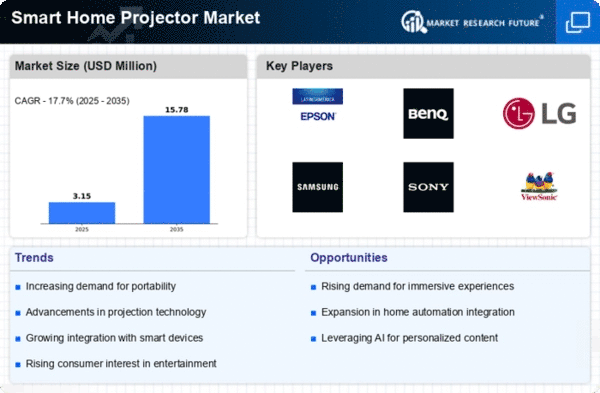
As per MRFR analysis, the Smart Home Projector Market Size was estimated at 2.68 USD Million in 2024. The Smart Home Projector industry is projected to grow from 3.09 in 2025 to 15.78 by 2035, exhibiting a compound annual growth rate (CAGR) of 17.7% during the forecast period 2025 - 2035.

Key Market Trends & Highlights

The Smart Home Projector Market is experiencing robust growth driven by technological advancements and evolving consumer preferences.

  • The market is increasingly integrating with smart home ecosystems, enhancing user convenience and functionality. Portability and compact design are becoming essential features, appealing to consumers seeking versatile entertainment solutions. Enhanced image quality and resolution are critical factors influencing consumer purchasing decisions, particularly in the home theater segment. Rising demand for home entertainment solutions and advancements in projection technology are key drivers propelling growth in North America and Asia-Pacific, particularly in the DLP and gaming segments.

Market Size & Forecast

2024 Market Size 2.68 (USD Million)
2035 Market Size 15.78 (USD Million)
CAGR (2025 - 2035) 17.7%
Largest Regional Market Share in 2024 North America

Major Players

Epson (JP), BenQ (TW), LG Electronics (KR), Samsung (KR), Sony (JP), ViewSonic (US), Anker (CN), XGIMI (CN), Kodak (US)

Market Trends

The Smart Home Projector Market is currently experiencing a notable transformation, driven by advancements in technology and changing consumer preferences. As individuals increasingly seek immersive home entertainment experiences, the demand for high-quality projectors that integrate seamlessly with smart home systems appears to be on the rise. This trend is further fueled by the growing popularity of streaming services and the desire for larger-than-life viewing experiences in domestic settings. Additionally, the incorporation of features such as wireless connectivity, voice control, and compatibility with various smart devices enhances the appeal of these projectors, making them a desirable addition to modern households. Moreover, the Smart Home Projector Market seems to be influenced by the increasing emphasis on aesthetic design and compactness. Consumers are likely to favor projectors that not only deliver exceptional performance but also complement their home decor. This shift towards stylish and unobtrusive designs indicates a broader trend where functionality meets aesthetics. As manufacturers continue to innovate and refine their offerings, the market is poised for further growth, with potential expansions into new segments and applications, such as outdoor entertainment and educational environments.

Integration with Smart Home Ecosystems

The Smart Home Projector Market is witnessing a trend towards enhanced integration with existing smart home ecosystems. Projectors that can connect with other smart devices, such as voice assistants and home automation systems, are becoming increasingly popular. This integration allows users to control their projectors through voice commands or mobile applications, streamlining the user experience and enhancing convenience.

Focus on Portability and Compact Design

Another emerging trend in the Smart Home Projector Market is the emphasis on portability and compact design. Consumers are showing a preference for lightweight and easily transportable projectors that can be set up in various locations within the home or even taken outdoors. This trend reflects a desire for flexibility in viewing options, allowing users to enjoy their favorite content in different settings.

Enhanced Image Quality and Resolution

The demand for superior image quality and resolution is a prominent trend within the Smart Home Projector Market. As technology advances, consumers are increasingly seeking projectors that offer high-definition visuals and vibrant colors. This focus on image quality is driving manufacturers to innovate and develop projectors that deliver an immersive viewing experience, catering to the discerning tastes of modern audiences.

Smart Home Projector Market Market Drivers

Market Growth Projections

The Global Smart Home Projector Market Industry is poised for substantial growth in the coming years. Projections indicate that the market will reach 2.73 USD Billion in 2024, with an anticipated expansion to 16.4 USD Billion by 2035. This growth trajectory suggests a robust compound annual growth rate (CAGR) of 17.7% from 2025 to 2035. Such figures reflect the increasing consumer interest in smart home technologies and the evolving landscape of home entertainment. The market's expansion is likely to be driven by technological innovations, changing consumer preferences, and the integration of projectors into smart home ecosystems. These projections underscore the market's potential and the opportunities it presents for stakeholders.

Emerging Markets and Urbanization

Emerging markets and urbanization are key drivers of the Global Smart Home Projector Market Industry. As urban populations grow, the demand for space-efficient entertainment solutions increases. Projectors offer a practical alternative to bulky televisions, making them appealing to urban dwellers with limited space. Countries in Asia-Pacific and Latin America are experiencing rapid urbanization, leading to a rise in disposable income and consumer spending on home entertainment. This demographic shift presents significant opportunities for projector manufacturers to tap into new markets. As urbanization continues, the market is likely to see accelerated growth, with projections indicating a potential market size of 16.4 USD Billion by 2035.

Growing Interest in Outdoor Entertainment

The Global Smart Home Projector Market Industry is witnessing a growing interest in outdoor entertainment solutions. Consumers increasingly seek ways to enhance their outdoor experiences, leading to a rise in demand for portable projectors suitable for outdoor use. This trend is particularly relevant during warmer months when families and friends gather for outdoor movie nights or events. The versatility of projectors allows for large-screen viewing in various settings, from backyards to parks. As outdoor entertainment becomes a popular pastime, the market is expected to expand, catering to consumers' desires for unique and engaging experiences. This shift may contribute to the projected growth of the market.

Increasing Adoption of Smart Home Devices

The increasing adoption of smart home devices significantly influences the Global Smart Home Projector Market Industry. As households integrate more smart technologies, the demand for compatible projectors rises. Projectors that can connect with smart assistants and other devices enhance user convenience and control. This trend is particularly pronounced in regions with high smart home penetration, such as North America and Europe. The synergy between smart home systems and projectors creates a seamless entertainment experience, appealing to tech-savvy consumers. As the market evolves, the integration of projectors into smart home ecosystems is likely to become a standard feature, further driving market growth.

Rising Demand for Home Entertainment Solutions

The Global Smart Home Projector Market Industry experiences a notable surge in demand for home entertainment solutions. As consumers increasingly seek immersive viewing experiences, projectors are becoming a preferred choice over traditional televisions. The market is projected to reach 2.73 USD Billion in 2024, driven by advancements in projection technology and enhanced image quality. This trend is particularly evident in urban areas where space constraints make projectors an appealing alternative. The growing popularity of streaming services further fuels this demand, as users desire larger screens for an enhanced viewing experience. Consequently, the market is likely to witness substantial growth in the coming years.

Technological Advancements in Projection Technology

Technological advancements play a pivotal role in shaping the Global Smart Home Projector Market Industry. Innovations such as 4K resolution, laser projection, and smart connectivity features are enhancing the functionality and appeal of projectors. These advancements not only improve image quality but also facilitate seamless integration with smart home ecosystems. As consumers become more tech-savvy, the demand for high-performance projectors is expected to rise. The introduction of compact and portable models further caters to the needs of modern consumers, allowing for versatile usage in various settings. This trend indicates a promising future for the market, potentially leading to a CAGR of 17.7% from 2025 to 2035.

Market Segment Insights

By Application: Home Theater (Largest) vs. Gaming (Fastest-Growing)

In the Smart Home Projector Market, the application segment is diversified among Home Theater, Gaming, Business Presentations, Education, and Outdoor Events. Home Theater holds the largest market share, driven by consumer demand for immersive viewing experiences at home. Meanwhile, the Gaming segment is rapidly gaining traction, reflecting a shift towards interactive and high-quality visuals in gaming experiences. This distribution signifies varying user engagements and preferences across different contexts.

Home Theater (Dominant) vs. Gaming (Emerging)

Home Theater is the dominant application within the Smart Home Projector Market, appealing to consumers looking for cinema-quality experiences in their living rooms. This segment benefits from advancements in projector technology, enabling enhanced resolution and color accuracy, making it a preferred choice for movie enthusiasts. Conversely, the Gaming segment is emerging as a significant player, propelled by the rise of at-home gaming and virtual reality experiences. Gamers seek projectors that offer high refresh rates and low input lag, pushing manufacturers to innovate rapidly. Both segments exhibit distinct characteristics, catering to diverse user needs, yet they increasingly overlap as technology advances.

By Technology: DLP (Largest) vs. LED (Fastest-Growing)

<p>Among the various technologies in the Smart Home Projector Market, DLP (Digital Light Processing) projectors hold the largest market share due to their versatility, reliability, and superior color reproduction. Following DLP, LCD (Liquid Crystal Display) projectors maintain a steady presence, appealing to budget-conscious consumers, while LCoS (Liquid Crystal on Silicon) projectors carve out a niche for high-end consumers seeking unparalleled image quality. Meanwhile, LED and Laser projectors are gaining traction as more consumers prioritize energy efficiency and longer lifespans in their purchasing decisions. In terms of growth trends, LED projectors are emerging as the fastest-growing technology in the Smart Home Projector Market. This growth is driven by the increasing demand for compact and portable projectors, along with advancements in LED technology that enhance brightness and color accuracy. Additionally, the rise of smart home integration facilitates the adoption of projectors, creating an environment where consumers seek user-friendly and multifunctional devices. As home entertainment continues to evolve, the synergy between consumer preferences and technological advances will shape the future of the projector market.</p>

<p>Technology: DLP (Dominant) vs. LED (Emerging)</p>

<p>DLP technology dominates the Smart Home Projector Market due to its fundamental advantages, such as high brightness, excellent color accuracy, and longevity. The use of micro mirrors allows for a compact design and superior image quality, making DLP projectors a favorite for home theaters and multimedia presentations. In contrast, LED projectors are rapidly gaining popularity as an emerging technology. Their longer lifespan, reduced energy consumption, and compact size make them particularly appealing to modern consumers looking for versatility and convenience. The increasing affordability of LED projectors coupled with greater market awareness is fostering their acceptance, positioning them as a legitimate alternative to traditional projector technologies. As both segments evolve, the market is likely to see enhanced competition driving innovation and further developments.</p>

By End User: Residential (Largest) vs. Educational Institutions (Fastest-Growing)

<p>In the Smart Home Projector Market, the end-user segmentation reveals a significant market share for the residential sector, which stands as the largest segment. Homeowners are increasingly adopting smart projectors due to their versatility and ease of integration into existing smart home systems. In contrast, the educational institutions segment is emerging as one of the fastest-growing categories, driven by the rising demand for interactive learning solutions and advancements in technology that facilitate engaging teaching methods.</p>

<p>Residential (Dominant) vs. Educational Institutions (Emerging)</p>

<p>The residential segment is characterized by a strong preference for smart projectors that offer features such as wireless connectivity, high resolution, and user-friendly interfaces. Homeowners seek devices that enhance their entertainment experience while seamlessly blending in with their smart home ecosystem. On the other hand, educational institutions are showing increasing interest in smart projectors due to their ability to create interactive and collaborative learning environments. This segment is driven by the need for modern educational tools that can capture students' attention and provide immersive learning experiences, marking it as an emerging force in the market.</p>

By Brightness Level: Ultra High (Largest) vs. High (Fastest-Growing)

<p>The Smart Home Projector Market exhibits a diverse distribution among the brightness segment values, with Ultra High brightness holding the largest market share. This segment is driven by consumers who prioritize high-quality visuals for home theaters and entertainment setups. Following closely, High brightness projectors are gaining traction due to their versatility and affordable pricing, attracting a wider audience, especially in the education and home office spaces. As a result, both Ultra High and High brightness projectors remain pivotal in shaping market dynamics.</p>

<p>Ultra High (Dominant) vs. High (Emerging)</p>

<p>Ultra High brightness projectors are positioned as the premium offering in the Smart Home Projector Market, appealing to audiophiles and cinephiles who seek superior picture quality and performance. Their dominance is owed to advancements in light source technologies, enhancing color accuracy and luminosity. In contrast, High brightness projectors present a compelling value proposition for mainstream consumers, offering solid performance for everyday viewing needs at a more accessible price point. As remote working and online learning become more prevalent, the demand for High brightness projectors is on the rise, marking them as a key player in the segment's evolution.</p>

By Portability: Fixed (Largest) vs. Portable (Fastest-Growing)

In the Smart Home Projector Market, the 'Portability' segment showcases a diverse distribution among its segment values, with 'Fixed' projectors leading as the dominant choice for their reliability and performance in stationary setups. Their strong market presence is attributed to the demand for high-quality home theater experiences. On the other hand, 'Portable' projectors have gained significant traction, appealing to consumers who prioritize mobility and convenience, thus demonstrating a growing market share amidst increasing interest in versatile home entertainment options.

Portability: Fixed (Dominant) vs. Portable (Emerging)

In the context of the Smart Home Projector Market, 'Fixed' projectors stand out as the dominant player due to their robust features designed for high-quality and stable home entertainment environments. These projectors are often characterized by superior brightness, image quality, and advanced connectivity options, making them ideal for dedicated home theater setups. Conversely, 'Portable' projectors are emerging as a popular alternative, particularly among consumers seeking flexibility and ease of use. These compact devices offer the advantage of being lightweight and easy to set up in various locations, catering to a new lifestyle trend that embraces on-the-go entertainment. As consumers continue to value adaptability in technology, the demand for portable options is rapidly increasing.

Get more detailed insights about Smart Home Projector Market Research Report—Global Forecast till 2035

Regional Insights

North America : Market Leader in Innovation

North America continues to lead the Smart Home Projector market, holding a significant share of 1.34B in 2024. The growth is driven by increasing consumer demand for home entertainment solutions, coupled with advancements in projector technology. Regulatory support for energy-efficient devices further catalyzes market expansion, as consumers seek sustainable options. The region's robust infrastructure and high disposable income also contribute to the rising adoption of smart home technologies. The competitive landscape in North America is characterized by the presence of major players such as Epson, BenQ, and LG Electronics. These companies are continuously innovating to meet consumer preferences for high-quality visuals and smart features. The U.S. market, in particular, is witnessing a surge in demand for portable and multifunctional projectors, with brands like ViewSonic and Kodak leading the charge. This dynamic environment positions North America as a hub for smart home projector advancements.

Europe : Emerging Market with Growth Potential

Europe's Smart Home Projector market is poised for growth, currently valued at 0.8B. The increasing trend of home automation and the demand for high-quality visual experiences are key drivers. Regulatory initiatives promoting energy efficiency and sustainability are also influencing consumer choices, encouraging the adoption of smart projectors. As a result, the market is expected to expand significantly, with a focus on integrating advanced technologies into home entertainment systems. Leading countries in this region include Germany, France, and the UK, where consumer interest in smart home devices is rapidly increasing. The competitive landscape features key players like Samsung and Sony, who are investing in innovative features and user-friendly designs. The presence of local manufacturers also enhances competition, driving down prices and improving product offerings. This vibrant market is set to attract further investments and technological advancements.

Asia-Pacific : Rapid Growth in Emerging Markets

The Asia-Pacific region, valued at 0.4B, is witnessing rapid growth in the Smart Home Projector market. Factors such as increasing urbanization, rising disposable incomes, and a growing middle class are driving demand for advanced home entertainment solutions. Additionally, government initiatives aimed at promoting smart technologies are creating a favorable environment for market expansion. The region's diverse consumer base is also pushing for innovative and affordable projector options. Countries like China and India are leading the charge, with a surge in demand for smart projectors among tech-savvy consumers. Key players such as Anker and XGIMI are capitalizing on this trend by offering a range of products tailored to local preferences. The competitive landscape is becoming increasingly dynamic, with both international and local brands vying for market share. This growth trajectory positions Asia-Pacific as a significant player in The Smart Home Projector.

Middle East and Africa : Emerging Market with Unique Challenges

The Middle East and Africa region, currently valued at 0.14B, is gradually emerging in the Smart Home Projector market. The growth is primarily driven by increasing urbanization and a rising interest in home entertainment solutions. However, challenges such as economic fluctuations and varying levels of technological adoption across countries can impact market growth. Regulatory frameworks are also evolving to support the adoption of smart technologies, which may further stimulate demand in the coming years. Leading countries in this region include South Africa and the UAE, where there is a growing trend towards smart home solutions. The competitive landscape is characterized by a mix of international brands and local players, with companies like Epson and LG Electronics making significant inroads. As consumer awareness increases, the market is expected to attract more investments and innovations, paving the way for future growth.

Key Players and Competitive Insights

The Smart Home Projector Market is currently characterized by a dynamic competitive landscape, driven by technological advancements and evolving consumer preferences. Major players such as Epson (JP), LG Electronics (KR), and XGIMI (CN) are actively shaping the market through strategic initiatives focused on innovation and regional expansion. Epson (JP) has positioned itself as a leader in high-quality projection technology, emphasizing energy efficiency and user-friendly features. Meanwhile, LG Electronics (KR) is leveraging its expertise in display technology to enhance the smart home experience, integrating projectors with its broader ecosystem of smart devices. XGIMI (CN), on the other hand, is focusing on affordability and portability, appealing to a younger demographic seeking versatile home entertainment solutions. Collectively, these strategies contribute to a moderately fragmented market, where competition is intensifying as companies strive to differentiate their offerings.
Key business tactics within the Smart Home Projector Market include localizing manufacturing and optimizing supply chains to enhance responsiveness to consumer demands. The competitive structure remains moderately fragmented, with several key players exerting influence over market dynamics. This fragmentation allows for niche players to emerge, catering to specific consumer needs while larger companies continue to dominate through brand recognition and technological prowess. The interplay between established brands and emerging competitors fosters a vibrant market environment, encouraging innovation and diverse product offerings.
In November 2025, Epson (JP) announced the launch of its latest line of eco-friendly projectors, which utilize advanced laser technology to reduce energy consumption by up to 30%. This strategic move not only aligns with global sustainability trends but also positions Epson as a frontrunner in environmentally conscious technology. The emphasis on energy efficiency is likely to resonate with consumers increasingly concerned about their carbon footprint, thereby enhancing Epson's market appeal.
In October 2025, LG Electronics (KR) unveiled a new projector model that seamlessly integrates with its smart home ecosystem, allowing users to control lighting and sound through a single interface. This innovation underscores LG's commitment to creating a cohesive smart home experience, potentially increasing customer loyalty and driving sales across its product range. By enhancing interoperability among devices, LG is likely to strengthen its competitive position in the market.
In September 2025, XGIMI (CN) secured a partnership with a leading streaming service to offer exclusive content bundled with its projectors. This strategic alliance not only enhances the value proposition for consumers but also positions XGIMI as a key player in the entertainment space. By providing unique content access, XGIMI may attract a broader audience, particularly among younger consumers who prioritize streaming capabilities in their home entertainment choices.
As of December 2025, current trends in the Smart Home Projector Market are increasingly defined by digitalization, sustainability, and the integration of artificial intelligence. Strategic alliances are becoming pivotal, as companies collaborate to enhance product offerings and expand market reach. The competitive landscape is shifting from traditional price-based competition to a focus on innovation, technology, and supply chain reliability. As companies navigate these trends, differentiation will likely hinge on their ability to deliver cutting-edge features and sustainable solutions, ultimately reshaping consumer expectations and market dynamics.

Key Companies in the Smart Home Projector Market include

Industry Developments

In September 2023, Portronics launched the Beem 420 to provide an amazing cinematic experience. This small multimedia projector can change the way people watch TV by turning any room into a theater. It even turns a whole wall into a giant screen. They use this product for watching movies and sports, making presentations, conducting video conferences etc, where Beem 420 transforms every wall or flat surface into an entertainment panel instantly. Users can now enjoy their favorite OTT movies or TV series in full HD 1080p on up to 250-inch projection screens.

A 30,000-hour LED lamp is used in projecting their much-loved sporting events and TV series at over 3200 Lumens brightness level to create vivid and sharp images on almost any white flat surface.

In September of 2023, ViewSonic, a leader in visual display technology, announced with great pride the launch of its revolutionary product – M1 Pro, an innovative portable smart projector that completely redefines adaptability as well as portability in visual entertainment and presentations; the M1 Pro creates new benchmark standards for the portable projectors category due to its unique feature of having a stand with flexible positioning mechanism that rotates over all angles.

In October 2023, Sony global leader in digital imaging and projection technology, is proud to introduce its latest laser projectors VPL-PHZ61 and VPL-PHZ51. These are new additions to Sony’s wide range aimed at improving visual experiences within educational and corporate environments by introducing smaller, more versatile versions. The VPL-PHZ61 and VPL-PHZ51 are examples of how companies like Sony have continued investing in specialized projection solutions through compactness coupled with high-quality bright laser projection.

Seraphic Information Technology has announced that it has come out with a new smart projector that supports all major streaming services worldwide, including internet browsing capabilities.

In January of 2023, LG Electronics introduced its newest CineBeam Smart Portable Projector, which aims to create a home theater’s atmosphere in any room. It is lightweight, hence more portable for different rooms or places, and has high display resolution and integrated facilities with smart electronics and streaming services.

Future Outlook

Smart Home Projector Market Future Outlook

The Smart Home Projector Market is projected to grow at a 17.7% CAGR from 2025 to 2035, driven by technological advancements, increasing consumer demand, and enhanced connectivity features.

New opportunities lie in:

  • Development of integrated smart home ecosystems with projectors
  • Expansion into emerging markets with tailored marketing strategies
  • Partnerships with content providers for exclusive streaming services

By 2035, the market is expected to achieve substantial growth, solidifying its position in the smart home industry.

Market Segmentation

Smart Home Projector Market End User Outlook

  • Residential
  • Commercial
  • Educational Institutions
  • Event Organizers
  • Corporate

Smart Home Projector Market Technology Outlook

  • DLP
  • LCD
  • LED
  • Laser
  • Hybrid

Smart Home Projector Market Application Outlook

  • Home Theater
  • Gaming
  • Business Presentations
  • Education
  • Outdoor Events

Smart Home Projector Market Portability Outlook

  • Fixed
  • Portable
  • Compact
  • Mini

Smart Home Projector Market Brightness Level Outlook

  • Low
  • Medium
  • High
  • Ultra High

Report Scope

MARKET SIZE 2024 2.68(USD Million)
MARKET SIZE 2025 3.09(USD Million)
MARKET SIZE 2035 15.78(USD Million)
COMPOUND ANNUAL GROWTH RATE (CAGR) 17.7% (2025 - 2035)
REPORT COVERAGE Revenue Forecast, Competitive Landscape, Growth Factors, and Trends
BASE YEAR 2024
Market Forecast Period 2025 - 2035
Historical Data 2019 - 2024
Market Forecast Units USD Million
Key Companies Profiled Epson (JP), BenQ (TW), LG Electronics (KR), Samsung (KR), Sony (JP), ViewSonic (US), Anker (CN), XGIMI (CN), Kodak (US)
Segments Covered Application, Technology, End User, Brightness Level, Portability
Key Market Opportunities Integration of artificial intelligence enhances user experience in the Smart Home Projector Market.
Key Market Dynamics Rising consumer demand for immersive home entertainment drives innovation and competition in the Smart Home Projector Market.
Countries Covered North America, Europe, APAC, South America, MEA

FAQs

What is the projected market valuation for the Smart Home Projector Market in 2035?

<p>The projected market valuation for the Smart Home Projector Market in 2035 is 15.78 USD Million.</p>

What was the market valuation for the Smart Home Projector Market in 2024?

<p>The market valuation for the Smart Home Projector Market in 2024 was 2.68 USD Million.</p>

What is the expected CAGR for the Smart Home Projector Market from 2025 to 2035?

<p>The expected CAGR for the Smart Home Projector Market during the forecast period 2025 - 2035 is 17.7%.</p>

Which companies are considered key players in the Smart Home Projector Market?

<p>Key players in the Smart Home Projector Market include Epson, BenQ, LG Electronics, Samsung, Sony, ViewSonic, Anker, XGIMI, and Kodak.</p>

How does the Home Theater segment perform in terms of market valuation?

<p>The Home Theater segment had a valuation of 0.8 USD Million in 2024 and is projected to reach 4.5 USD Million by 2035.</p>

What is the market performance of the Gaming segment in the Smart Home Projector Market?

The Gaming segment recorded a valuation of 0.5 USD Million in 2024 and is expected to grow to 3.0 USD Million by 2035.

What are the projected valuations for the Business Presentations segment?

The Business Presentations segment had a valuation of 0.4 USD Million in 2024 and is anticipated to reach 2.5 USD Million by 2035.

What is the expected growth for the Outdoor Events segment?

The Outdoor Events segment was valued at 0.68 USD Million in 2024 and is projected to grow to 3.98 USD Million by 2035.

How does the market for portable projectors compare to fixed projectors?

The Portable segment had a valuation of 0.9 USD Million in 2024, while the Fixed segment was valued at 0.8 USD Million, indicating a competitive market.

What is the market outlook for the Smart Home Projector Market by 2035?

The Smart Home Projector Market is likely to experience substantial growth, reaching an estimated valuation of 15.78 USD Million by 2035.

  1. SECTION I: EXECUTIVE SUMMARY AND KEY HIGHLIGHTS
    1. | 1.1 EXECUTIVE SUMMARY
    2. | | 1.1.1 Market Overview
    3. | | 1.1.2 Key Findings
    4. | | 1.1.3 Market Segmentation
    5. | | 1.1.4 Competitive Landscape
    6. | | 1.1.5 Challenges and Opportunities
    7. | | 1.1.6 Future Outlook
  2. SECTION II: SCOPING, METHODOLOGY AND MARKET STRUCTURE
    1. | 2.1 MARKET INTRODUCTION
    2. | | 2.1.1 Definition
    3. | | 2.1.2 Scope of the study
    4. | | | 2.1.2.1 Research Objective
    5. | | | 2.1.2.2 Assumption
    6. | | | 2.1.2.3 Limitations
    7. | 2.2 RESEARCH METHODOLOGY
    8. | | 2.2.1 Overview
    9. | | 2.2.2 Data Mining
    10. | | 2.2.3 Secondary Research
    11. | | 2.2.4 Primary Research
    12. | | | 2.2.4.1 Primary Interviews and Information Gathering Process
    13. | | | 2.2.4.2 Breakdown of Primary Respondents
    14. | | 2.2.5 Forecasting Model
    15. | | 2.2.6 Market Size Estimation
    16. | | | 2.2.6.1 Bottom-Up Approach
    17. | | | 2.2.6.2 Top-Down Approach
    18. | | 2.2.7 Data Triangulation
    19. | | 2.2.8 Validation
  3. SECTION III: QUALITATIVE ANALYSIS
    1. | 3.1 MARKET DYNAMICS
    2. | | 3.1.1 Overview
    3. | | 3.1.2 Drivers
    4. | | 3.1.3 Restraints
    5. | | 3.1.4 Opportunities
    6. | 3.2 MARKET FACTOR ANALYSIS
    7. | | 3.2.1 Value chain Analysis
    8. | | 3.2.2 Porter's Five Forces Analysis
    9. | | | 3.2.2.1 Bargaining Power of Suppliers
    10. | | | 3.2.2.2 Bargaining Power of Buyers
    11. | | | 3.2.2.3 Threat of New Entrants
    12. | | | 3.2.2.4 Threat of Substitutes
    13. | | | 3.2.2.5 Intensity of Rivalry
    14. | | 3.2.3 COVID-19 Impact Analysis
    15. | | | 3.2.3.1 Market Impact Analysis
    16. | | | 3.2.3.2 Regional Impact
    17. | | | 3.2.3.3 Opportunity and Threat Analysis
  4. SECTION IV: QUANTITATIVE ANALYSIS
    1. | 4.1 Semiconductor & Electronics, BY Application (USD Million)
    2. | | 4.1.1 Home Theater
    3. | | 4.1.2 Gaming
    4. | | 4.1.3 Business Presentations
    5. | | 4.1.4 Education
    6. | | 4.1.5 Outdoor Events
    7. | 4.2 Semiconductor & Electronics, BY Technology (USD Million)
    8. | | 4.2.1 DLP
    9. | | 4.2.2 LCD
    10. | | 4.2.3 LED
    11. | | 4.2.4 Laser
    12. | | 4.2.5 LCoS
    13. | 4.3 Semiconductor & Electronics, BY End User (USD Million)
    14. | | 4.3.1 Residential
    15. | | 4.3.2 Commercial
    16. | | 4.3.3 Educational Institutions
    17. | | 4.3.4 Event Organizers
    18. | | 4.3.5 Corporate Offices
    19. | 4.4 Semiconductor & Electronics, BY Brightness Level (USD Million)
    20. | | 4.4.1 Low
    21. | | 4.4.2 Medium
    22. | | 4.4.3 High
    23. | | 4.4.4 Ultra High
    24. | 4.5 Semiconductor & Electronics, BY Portability (USD Million)
    25. | | 4.5.1 Fixed
    26. | | 4.5.2 Portable
    27. | | 4.5.3 Compact
    28. | | 4.5.4 Mini
    29. | 4.6 Semiconductor & Electronics, BY Region (USD Million)
    30. | | 4.6.1 North America
    31. | | | 4.6.1.1 US
    32. | | | 4.6.1.2 Canada
    33. | | 4.6.2 Europe
    34. | | | 4.6.2.1 Germany
    35. | | | 4.6.2.2 UK
    36. | | | 4.6.2.3 France
    37. | | | 4.6.2.4 Russia
    38. | | | 4.6.2.5 Italy
    39. | | | 4.6.2.6 Spain
    40. | | | 4.6.2.7 Rest of Europe
    41. | | 4.6.3 APAC
    42. | | | 4.6.3.1 China
    43. | | | 4.6.3.2 India
    44. | | | 4.6.3.3 Japan
    45. | | | 4.6.3.4 South Korea
    46. | | | 4.6.3.5 Malaysia
    47. | | | 4.6.3.6 Thailand
    48. | | | 4.6.3.7 Indonesia
    49. | | | 4.6.3.8 Rest of APAC
    50. | | 4.6.4 South America
    51. | | | 4.6.4.1 Brazil
    52. | | | 4.6.4.2 Mexico
    53. | | | 4.6.4.3 Argentina
    54. | | | 4.6.4.4 Rest of South America
    55. | | 4.6.5 MEA
    56. | | | 4.6.5.1 GCC Countries
    57. | | | 4.6.5.2 South Africa
    58. | | | 4.6.5.3 Rest of MEA
  5. SECTION V: COMPETITIVE ANALYSIS
    1. | 5.1 Competitive Landscape
    2. | | 5.1.1 Overview
    3. | | 5.1.2 Competitive Analysis
    4. | | 5.1.3 Market share Analysis
    5. | | 5.1.4 Major Growth Strategy in the Semiconductor & Electronics
    6. | | 5.1.5 Competitive Benchmarking
    7. | | 5.1.6 Leading Players in Terms of Number of Developments in the Semiconductor & Electronics
    8. | | 5.1.7 Key developments and growth strategies
    9. | | | 5.1.7.1 New Product Launch/Service Deployment
    10. | | | 5.1.7.2 Merger & Acquisitions
    11. | | | 5.1.7.3 Joint Ventures
    12. | | 5.1.8 Major Players Financial Matrix
    13. | | | 5.1.8.1 Sales and Operating Income
    14. | | | 5.1.8.2 Major Players R&D Expenditure. 2023
    15. | 5.2 Company Profiles
    16. | | 5.2.1 Epson (JP)
    17. | | | 5.2.1.1 Financial Overview
    18. | | | 5.2.1.2 Products Offered
    19. | | | 5.2.1.3 Key Developments
    20. | | | 5.2.1.4 SWOT Analysis
    21. | | | 5.2.1.5 Key Strategies
    22. | | 5.2.2 BenQ (TW)
    23. | | | 5.2.2.1 Financial Overview
    24. | | | 5.2.2.2 Products Offered
    25. | | | 5.2.2.3 Key Developments
    26. | | | 5.2.2.4 SWOT Analysis
    27. | | | 5.2.2.5 Key Strategies
    28. | | 5.2.3 LG Electronics (KR)
    29. | | | 5.2.3.1 Financial Overview
    30. | | | 5.2.3.2 Products Offered
    31. | | | 5.2.3.3 Key Developments
    32. | | | 5.2.3.4 SWOT Analysis
    33. | | | 5.2.3.5 Key Strategies
    34. | | 5.2.4 Samsung (KR)
    35. | | | 5.2.4.1 Financial Overview
    36. | | | 5.2.4.2 Products Offered
    37. | | | 5.2.4.3 Key Developments
    38. | | | 5.2.4.4 SWOT Analysis
    39. | | | 5.2.4.5 Key Strategies
    40. | | 5.2.5 Sony (JP)
    41. | | | 5.2.5.1 Financial Overview
    42. | | | 5.2.5.2 Products Offered
    43. | | | 5.2.5.3 Key Developments
    44. | | | 5.2.5.4 SWOT Analysis
    45. | | | 5.2.5.5 Key Strategies
    46. | | 5.2.6 ViewSonic (US)
    47. | | | 5.2.6.1 Financial Overview
    48. | | | 5.2.6.2 Products Offered
    49. | | | 5.2.6.3 Key Developments
    50. | | | 5.2.6.4 SWOT Analysis
    51. | | | 5.2.6.5 Key Strategies
    52. | | 5.2.7 Anker (CN)
    53. | | | 5.2.7.1 Financial Overview
    54. | | | 5.2.7.2 Products Offered
    55. | | | 5.2.7.3 Key Developments
    56. | | | 5.2.7.4 SWOT Analysis
    57. | | | 5.2.7.5 Key Strategies
    58. | | 5.2.8 XGIMI (CN)
    59. | | | 5.2.8.1 Financial Overview
    60. | | | 5.2.8.2 Products Offered
    61. | | | 5.2.8.3 Key Developments
    62. | | | 5.2.8.4 SWOT Analysis
    63. | | | 5.2.8.5 Key Strategies
    64. | | 5.2.9 Kodak (US)
    65. | | | 5.2.9.1 Financial Overview
    66. | | | 5.2.9.2 Products Offered
    67. | | | 5.2.9.3 Key Developments
    68. | | | 5.2.9.4 SWOT Analysis
    69. | | | 5.2.9.5 Key Strategies
    70. | 5.3 Appendix
    71. | | 5.3.1 References
    72. | | 5.3.2 Related Reports
  6. LIST OF FIGURES
    1. | 6.1 MARKET SYNOPSIS
    2. | 6.2 NORTH AMERICA MARKET ANALYSIS
    3. | 6.3 US MARKET ANALYSIS BY APPLICATION
    4. | 6.4 US MARKET ANALYSIS BY TECHNOLOGY
    5. | 6.5 US MARKET ANALYSIS BY END USER
    6. | 6.6 US MARKET ANALYSIS BY BRIGHTNESS LEVEL
    7. | 6.7 US MARKET ANALYSIS BY PORTABILITY
    8. | 6.8 CANADA MARKET ANALYSIS BY APPLICATION
    9. | 6.9 CANADA MARKET ANALYSIS BY TECHNOLOGY
    10. | 6.10 CANADA MARKET ANALYSIS BY END USER
    11. | 6.11 CANADA MARKET ANALYSIS BY BRIGHTNESS LEVEL
    12. | 6.12 CANADA MARKET ANALYSIS BY PORTABILITY
    13. | 6.13 EUROPE MARKET ANALYSIS
    14. | 6.14 GERMANY MARKET ANALYSIS BY APPLICATION
    15. | 6.15 GERMANY MARKET ANALYSIS BY TECHNOLOGY
    16. | 6.16 GERMANY MARKET ANALYSIS BY END USER
    17. | 6.17 GERMANY MARKET ANALYSIS BY BRIGHTNESS LEVEL
    18. | 6.18 GERMANY MARKET ANALYSIS BY PORTABILITY
    19. | 6.19 UK MARKET ANALYSIS BY APPLICATION
    20. | 6.20 UK MARKET ANALYSIS BY TECHNOLOGY
    21. | 6.21 UK MARKET ANALYSIS BY END USER
    22. | 6.22 UK MARKET ANALYSIS BY BRIGHTNESS LEVEL
    23. | 6.23 UK MARKET ANALYSIS BY PORTABILITY
    24. | 6.24 FRANCE MARKET ANALYSIS BY APPLICATION
    25. | 6.25 FRANCE MARKET ANALYSIS BY TECHNOLOGY
    26. | 6.26 FRANCE MARKET ANALYSIS BY END USER
    27. | 6.27 FRANCE MARKET ANALYSIS BY BRIGHTNESS LEVEL
    28. | 6.28 FRANCE MARKET ANALYSIS BY PORTABILITY
    29. | 6.29 RUSSIA MARKET ANALYSIS BY APPLICATION
    30. | 6.30 RUSSIA MARKET ANALYSIS BY TECHNOLOGY
    31. | 6.31 RUSSIA MARKET ANALYSIS BY END USER
    32. | 6.32 RUSSIA MARKET ANALYSIS BY BRIGHTNESS LEVEL
    33. | 6.33 RUSSIA MARKET ANALYSIS BY PORTABILITY
    34. | 6.34 ITALY MARKET ANALYSIS BY APPLICATION
    35. | 6.35 ITALY MARKET ANALYSIS BY TECHNOLOGY
    36. | 6.36 ITALY MARKET ANALYSIS BY END USER
    37. | 6.37 ITALY MARKET ANALYSIS BY BRIGHTNESS LEVEL
    38. | 6.38 ITALY MARKET ANALYSIS BY PORTABILITY
    39. | 6.39 SPAIN MARKET ANALYSIS BY APPLICATION
    40. | 6.40 SPAIN MARKET ANALYSIS BY TECHNOLOGY
    41. | 6.41 SPAIN MARKET ANALYSIS BY END USER
    42. | 6.42 SPAIN MARKET ANALYSIS BY BRIGHTNESS LEVEL
    43. | 6.43 SPAIN MARKET ANALYSIS BY PORTABILITY
    44. | 6.44 REST OF EUROPE MARKET ANALYSIS BY APPLICATION
    45. | 6.45 REST OF EUROPE MARKET ANALYSIS BY TECHNOLOGY
    46. | 6.46 REST OF EUROPE MARKET ANALYSIS BY END USER
    47. | 6.47 REST OF EUROPE MARKET ANALYSIS BY BRIGHTNESS LEVEL
    48. | 6.48 REST OF EUROPE MARKET ANALYSIS BY PORTABILITY
    49. | 6.49 APAC MARKET ANALYSIS
    50. | 6.50 CHINA MARKET ANALYSIS BY APPLICATION
    51. | 6.51 CHINA MARKET ANALYSIS BY TECHNOLOGY
    52. | 6.52 CHINA MARKET ANALYSIS BY END USER
    53. | 6.53 CHINA MARKET ANALYSIS BY BRIGHTNESS LEVEL
    54. | 6.54 CHINA MARKET ANALYSIS BY PORTABILITY
    55. | 6.55 INDIA MARKET ANALYSIS BY APPLICATION
    56. | 6.56 INDIA MARKET ANALYSIS BY TECHNOLOGY
    57. | 6.57 INDIA MARKET ANALYSIS BY END USER
    58. | 6.58 INDIA MARKET ANALYSIS BY BRIGHTNESS LEVEL
    59. | 6.59 INDIA MARKET ANALYSIS BY PORTABILITY
    60. | 6.60 JAPAN MARKET ANALYSIS BY APPLICATION
    61. | 6.61 JAPAN MARKET ANALYSIS BY TECHNOLOGY
    62. | 6.62 JAPAN MARKET ANALYSIS BY END USER
    63. | 6.63 JAPAN MARKET ANALYSIS BY BRIGHTNESS LEVEL
    64. | 6.64 JAPAN MARKET ANALYSIS BY PORTABILITY
    65. | 6.65 SOUTH KOREA MARKET ANALYSIS BY APPLICATION
    66. | 6.66 SOUTH KOREA MARKET ANALYSIS BY TECHNOLOGY
    67. | 6.67 SOUTH KOREA MARKET ANALYSIS BY END USER
    68. | 6.68 SOUTH KOREA MARKET ANALYSIS BY BRIGHTNESS LEVEL
    69. | 6.69 SOUTH KOREA MARKET ANALYSIS BY PORTABILITY
    70. | 6.70 MALAYSIA MARKET ANALYSIS BY APPLICATION
    71. | 6.71 MALAYSIA MARKET ANALYSIS BY TECHNOLOGY
    72. | 6.72 MALAYSIA MARKET ANALYSIS BY END USER
    73. | 6.73 MALAYSIA MARKET ANALYSIS BY BRIGHTNESS LEVEL
    74. | 6.74 MALAYSIA MARKET ANALYSIS BY PORTABILITY
    75. | 6.75 THAILAND MARKET ANALYSIS BY APPLICATION
    76. | 6.76 THAILAND MARKET ANALYSIS BY TECHNOLOGY
    77. | 6.77 THAILAND MARKET ANALYSIS BY END USER
    78. | 6.78 THAILAND MARKET ANALYSIS BY BRIGHTNESS LEVEL
    79. | 6.79 THAILAND MARKET ANALYSIS BY PORTABILITY
    80. | 6.80 INDONESIA MARKET ANALYSIS BY APPLICATION
    81. | 6.81 INDONESIA MARKET ANALYSIS BY TECHNOLOGY
    82. | 6.82 INDONESIA MARKET ANALYSIS BY END USER
    83. | 6.83 INDONESIA MARKET ANALYSIS BY BRIGHTNESS LEVEL
    84. | 6.84 INDONESIA MARKET ANALYSIS BY PORTABILITY
    85. | 6.85 REST OF APAC MARKET ANALYSIS BY APPLICATION
    86. | 6.86 REST OF APAC MARKET ANALYSIS BY TECHNOLOGY
    87. | 6.87 REST OF APAC MARKET ANALYSIS BY END USER
    88. | 6.88 REST OF APAC MARKET ANALYSIS BY BRIGHTNESS LEVEL
    89. | 6.89 REST OF APAC MARKET ANALYSIS BY PORTABILITY
    90. | 6.90 SOUTH AMERICA MARKET ANALYSIS
    91. | 6.91 BRAZIL MARKET ANALYSIS BY APPLICATION
    92. | 6.92 BRAZIL MARKET ANALYSIS BY TECHNOLOGY
    93. | 6.93 BRAZIL MARKET ANALYSIS BY END USER
    94. | 6.94 BRAZIL MARKET ANALYSIS BY BRIGHTNESS LEVEL
    95. | 6.95 BRAZIL MARKET ANALYSIS BY PORTABILITY
    96. | 6.96 MEXICO MARKET ANALYSIS BY APPLICATION
    97. | 6.97 MEXICO MARKET ANALYSIS BY TECHNOLOGY
    98. | 6.98 MEXICO MARKET ANALYSIS BY END USER
    99. | 6.99 MEXICO MARKET ANALYSIS BY BRIGHTNESS LEVEL
    100. | 6.100 MEXICO MARKET ANALYSIS BY PORTABILITY
    101. | 6.101 ARGENTINA MARKET ANALYSIS BY APPLICATION
    102. | 6.102 ARGENTINA MARKET ANALYSIS BY TECHNOLOGY
    103. | 6.103 ARGENTINA MARKET ANALYSIS BY END USER
    104. | 6.104 ARGENTINA MARKET ANALYSIS BY BRIGHTNESS LEVEL
    105. | 6.105 ARGENTINA MARKET ANALYSIS BY PORTABILITY
    106. | 6.106 REST OF SOUTH AMERICA MARKET ANALYSIS BY APPLICATION
    107. | 6.107 REST OF SOUTH AMERICA MARKET ANALYSIS BY TECHNOLOGY
    108. | 6.108 REST OF SOUTH AMERICA MARKET ANALYSIS BY END USER
    109. | 6.109 REST OF SOUTH AMERICA MARKET ANALYSIS BY BRIGHTNESS LEVEL
    110. | 6.110 REST OF SOUTH AMERICA MARKET ANALYSIS BY PORTABILITY
    111. | 6.111 MEA MARKET ANALYSIS
    112. | 6.112 GCC COUNTRIES MARKET ANALYSIS BY APPLICATION
    113. | 6.113 GCC COUNTRIES MARKET ANALYSIS BY TECHNOLOGY
    114. | 6.114 GCC COUNTRIES MARKET ANALYSIS BY END USER
    115. | 6.115 GCC COUNTRIES MARKET ANALYSIS BY BRIGHTNESS LEVEL
    116. | 6.116 GCC COUNTRIES MARKET ANALYSIS BY PORTABILITY
    117. | 6.117 SOUTH AFRICA MARKET ANALYSIS BY APPLICATION
    118. | 6.118 SOUTH AFRICA MARKET ANALYSIS BY TECHNOLOGY
    119. | 6.119 SOUTH AFRICA MARKET ANALYSIS BY END USER
    120. | 6.120 SOUTH AFRICA MARKET ANALYSIS BY BRIGHTNESS LEVEL
    121. | 6.121 SOUTH AFRICA MARKET ANALYSIS BY PORTABILITY
    122. | 6.122 REST OF MEA MARKET ANALYSIS BY APPLICATION
    123. | 6.123 REST OF MEA MARKET ANALYSIS BY TECHNOLOGY
    124. | 6.124 REST OF MEA MARKET ANALYSIS BY END USER
    125. | 6.125 REST OF MEA MARKET ANALYSIS BY BRIGHTNESS LEVEL
    126. | 6.126 REST OF MEA MARKET ANALYSIS BY PORTABILITY
    127. | 6.127 KEY BUYING CRITERIA OF SEMICONDUCTOR & ELECTRONICS
    128. | 6.128 RESEARCH PROCESS OF MRFR
    129. | 6.129 DRO ANALYSIS OF SEMICONDUCTOR & ELECTRONICS
    130. | 6.130 DRIVERS IMPACT ANALYSIS: SEMICONDUCTOR & ELECTRONICS
    131. | 6.131 RESTRAINTS IMPACT ANALYSIS: SEMICONDUCTOR & ELECTRONICS
    132. | 6.132 SUPPLY / VALUE CHAIN: SEMICONDUCTOR & ELECTRONICS
    133. | 6.133 SEMICONDUCTOR & ELECTRONICS, BY APPLICATION, 2024 (% SHARE)
    134. | 6.134 SEMICONDUCTOR & ELECTRONICS, BY APPLICATION, 2024 TO 2035 (USD Million)
    135. | 6.135 SEMICONDUCTOR & ELECTRONICS, BY TECHNOLOGY, 2024 (% SHARE)
    136. | 6.136 SEMICONDUCTOR & ELECTRONICS, BY TECHNOLOGY, 2024 TO 2035 (USD Million)
    137. | 6.137 SEMICONDUCTOR & ELECTRONICS, BY END USER, 2024 (% SHARE)
    138. | 6.138 SEMICONDUCTOR & ELECTRONICS, BY END USER, 2024 TO 2035 (USD Million)
    139. | 6.139 SEMICONDUCTOR & ELECTRONICS, BY BRIGHTNESS LEVEL, 2024 (% SHARE)
    140. | 6.140 SEMICONDUCTOR & ELECTRONICS, BY BRIGHTNESS LEVEL, 2024 TO 2035 (USD Million)
    141. | 6.141 SEMICONDUCTOR & ELECTRONICS, BY PORTABILITY, 2024 (% SHARE)
    142. | 6.142 SEMICONDUCTOR & ELECTRONICS, BY PORTABILITY, 2024 TO 2035 (USD Million)
    143. | 6.143 BENCHMARKING OF MAJOR COMPETITORS
  7. LIST OF TABLES
    1. | 7.1 LIST OF ASSUMPTIONS
    2. | | 7.1.1
    3. | 7.2 North America MARKET SIZE ESTIMATES; FORECAST
    4. | | 7.2.1 BY APPLICATION, 2025-2035 (USD Million)
    5. | | 7.2.2 BY TECHNOLOGY, 2025-2035 (USD Million)
    6. | | 7.2.3 BY END USER, 2025-2035 (USD Million)
    7. | | 7.2.4 BY BRIGHTNESS LEVEL, 2025-2035 (USD Million)
    8. | | 7.2.5 BY PORTABILITY, 2025-2035 (USD Million)
    9. | 7.3 US MARKET SIZE ESTIMATES; FORECAST
    10. | | 7.3.1 BY APPLICATION, 2025-2035 (USD Million)
    11. | | 7.3.2 BY TECHNOLOGY, 2025-2035 (USD Million)
    12. | | 7.3.3 BY END USER, 2025-2035 (USD Million)
    13. | | 7.3.4 BY BRIGHTNESS LEVEL, 2025-2035 (USD Million)
    14. | | 7.3.5 BY PORTABILITY, 2025-2035 (USD Million)
    15. | 7.4 Canada MARKET SIZE ESTIMATES; FORECAST
    16. | | 7.4.1 BY APPLICATION, 2025-2035 (USD Million)
    17. | | 7.4.2 BY TECHNOLOGY, 2025-2035 (USD Million)
    18. | | 7.4.3 BY END USER, 2025-2035 (USD Million)
    19. | | 7.4.4 BY BRIGHTNESS LEVEL, 2025-2035 (USD Million)
    20. | | 7.4.5 BY PORTABILITY, 2025-2035 (USD Million)
    21. | 7.5 Europe MARKET SIZE ESTIMATES; FORECAST
    22. | | 7.5.1 BY APPLICATION, 2025-2035 (USD Million)
    23. | | 7.5.2 BY TECHNOLOGY, 2025-2035 (USD Million)
    24. | | 7.5.3 BY END USER, 2025-2035 (USD Million)
    25. | | 7.5.4 BY BRIGHTNESS LEVEL, 2025-2035 (USD Million)
    26. | | 7.5.5 BY PORTABILITY, 2025-2035 (USD Million)
    27. | 7.6 Germany MARKET SIZE ESTIMATES; FORECAST
    28. | | 7.6.1 BY APPLICATION, 2025-2035 (USD Million)
    29. | | 7.6.2 BY TECHNOLOGY, 2025-2035 (USD Million)
    30. | | 7.6.3 BY END USER, 2025-2035 (USD Million)
    31. | | 7.6.4 BY BRIGHTNESS LEVEL, 2025-2035 (USD Million)
    32. | | 7.6.5 BY PORTABILITY, 2025-2035 (USD Million)
    33. | 7.7 UK MARKET SIZE ESTIMATES; FORECAST
    34. | | 7.7.1 BY APPLICATION, 2025-2035 (USD Million)
    35. | | 7.7.2 BY TECHNOLOGY, 2025-2035 (USD Million)
    36. | | 7.7.3 BY END USER, 2025-2035 (USD Million)
    37. | | 7.7.4 BY BRIGHTNESS LEVEL, 2025-2035 (USD Million)
    38. | | 7.7.5 BY PORTABILITY, 2025-2035 (USD Million)
    39. | 7.8 France MARKET SIZE ESTIMATES; FORECAST
    40. | | 7.8.1 BY APPLICATION, 2025-2035 (USD Million)
    41. | | 7.8.2 BY TECHNOLOGY, 2025-2035 (USD Million)
    42. | | 7.8.3 BY END USER, 2025-2035 (USD Million)
    43. | | 7.8.4 BY BRIGHTNESS LEVEL, 2025-2035 (USD Million)
    44. | | 7.8.5 BY PORTABILITY, 2025-2035 (USD Million)
    45. | 7.9 Russia MARKET SIZE ESTIMATES; FORECAST
    46. | | 7.9.1 BY APPLICATION, 2025-2035 (USD Million)
    47. | | 7.9.2 BY TECHNOLOGY, 2025-2035 (USD Million)
    48. | | 7.9.3 BY END USER, 2025-2035 (USD Million)
    49. | | 7.9.4 BY BRIGHTNESS LEVEL, 2025-2035 (USD Million)
    50. | | 7.9.5 BY PORTABILITY, 2025-2035 (USD Million)
    51. | 7.10 Italy MARKET SIZE ESTIMATES; FORECAST
    52. | | 7.10.1 BY APPLICATION, 2025-2035 (USD Million)
    53. | | 7.10.2 BY TECHNOLOGY, 2025-2035 (USD Million)
    54. | | 7.10.3 BY END USER, 2025-2035 (USD Million)
    55. | | 7.10.4 BY BRIGHTNESS LEVEL, 2025-2035 (USD Million)
    56. | | 7.10.5 BY PORTABILITY, 2025-2035 (USD Million)
    57. | 7.11 Spain MARKET SIZE ESTIMATES; FORECAST
    58. | | 7.11.1 BY APPLICATION, 2025-2035 (USD Million)
    59. | | 7.11.2 BY TECHNOLOGY, 2025-2035 (USD Million)
    60. | | 7.11.3 BY END USER, 2025-2035 (USD Million)
    61. | | 7.11.4 BY BRIGHTNESS LEVEL, 2025-2035 (USD Million)
    62. | | 7.11.5 BY PORTABILITY, 2025-2035 (USD Million)
    63. | 7.12 Rest of Europe MARKET SIZE ESTIMATES; FORECAST
    64. | | 7.12.1 BY APPLICATION, 2025-2035 (USD Million)
    65. | | 7.12.2 BY TECHNOLOGY, 2025-2035 (USD Million)
    66. | | 7.12.3 BY END USER, 2025-2035 (USD Million)
    67. | | 7.12.4 BY BRIGHTNESS LEVEL, 2025-2035 (USD Million)
    68. | | 7.12.5 BY PORTABILITY, 2025-2035 (USD Million)
    69. | 7.13 APAC MARKET SIZE ESTIMATES; FORECAST
    70. | | 7.13.1 BY APPLICATION, 2025-2035 (USD Million)
    71. | | 7.13.2 BY TECHNOLOGY, 2025-2035 (USD Million)
    72. | | 7.13.3 BY END USER, 2025-2035 (USD Million)
    73. | | 7.13.4 BY BRIGHTNESS LEVEL, 2025-2035 (USD Million)
    74. | | 7.13.5 BY PORTABILITY, 2025-2035 (USD Million)
    75. | 7.14 China MARKET SIZE ESTIMATES; FORECAST
    76. | | 7.14.1 BY APPLICATION, 2025-2035 (USD Million)
    77. | | 7.14.2 BY TECHNOLOGY, 2025-2035 (USD Million)
    78. | | 7.14.3 BY END USER, 2025-2035 (USD Million)
    79. | | 7.14.4 BY BRIGHTNESS LEVEL, 2025-2035 (USD Million)
    80. | | 7.14.5 BY PORTABILITY, 2025-2035 (USD Million)
    81. | 7.15 India MARKET SIZE ESTIMATES; FORECAST
    82. | | 7.15.1 BY APPLICATION, 2025-2035 (USD Million)
    83. | | 7.15.2 BY TECHNOLOGY, 2025-2035 (USD Million)
    84. | | 7.15.3 BY END USER, 2025-2035 (USD Million)
    85. | | 7.15.4 BY BRIGHTNESS LEVEL, 2025-2035 (USD Million)
    86. | | 7.15.5 BY PORTABILITY, 2025-2035 (USD Million)
    87. | 7.16 Japan MARKET SIZE ESTIMATES; FORECAST
    88. | | 7.16.1 BY APPLICATION, 2025-2035 (USD Million)
    89. | | 7.16.2 BY TECHNOLOGY, 2025-2035 (USD Million)
    90. | | 7.16.3 BY END USER, 2025-2035 (USD Million)
    91. | | 7.16.4 BY BRIGHTNESS LEVEL, 2025-2035 (USD Million)
    92. | | 7.16.5 BY PORTABILITY, 2025-2035 (USD Million)
    93. | 7.17 South Korea MARKET SIZE ESTIMATES; FORECAST
    94. | | 7.17.1 BY APPLICATION, 2025-2035 (USD Million)
    95. | | 7.17.2 BY TECHNOLOGY, 2025-2035 (USD Million)
    96. | | 7.17.3 BY END USER, 2025-2035 (USD Million)
    97. | | 7.17.4 BY BRIGHTNESS LEVEL, 2025-2035 (USD Million)
    98. | | 7.17.5 BY PORTABILITY, 2025-2035 (USD Million)
    99. | 7.18 Malaysia MARKET SIZE ESTIMATES; FORECAST
    100. | | 7.18.1 BY APPLICATION, 2025-2035 (USD Million)
    101. | | 7.18.2 BY TECHNOLOGY, 2025-2035 (USD Million)
    102. | | 7.18.3 BY END USER, 2025-2035 (USD Million)
    103. | | 7.18.4 BY BRIGHTNESS LEVEL, 2025-2035 (USD Million)
    104. | | 7.18.5 BY PORTABILITY, 2025-2035 (USD Million)
    105. | 7.19 Thailand MARKET SIZE ESTIMATES; FORECAST
    106. | | 7.19.1 BY APPLICATION, 2025-2035 (USD Million)
    107. | | 7.19.2 BY TECHNOLOGY, 2025-2035 (USD Million)
    108. | | 7.19.3 BY END USER, 2025-2035 (USD Million)
    109. | | 7.19.4 BY BRIGHTNESS LEVEL, 2025-2035 (USD Million)
    110. | | 7.19.5 BY PORTABILITY, 2025-2035 (USD Million)
    111. | 7.20 Indonesia MARKET SIZE ESTIMATES; FORECAST
    112. | | 7.20.1 BY APPLICATION, 2025-2035 (USD Million)
    113. | | 7.20.2 BY TECHNOLOGY, 2025-2035 (USD Million)
    114. | | 7.20.3 BY END USER, 2025-2035 (USD Million)
    115. | | 7.20.4 BY BRIGHTNESS LEVEL, 2025-2035 (USD Million)
    116. | | 7.20.5 BY PORTABILITY, 2025-2035 (USD Million)
    117. | 7.21 Rest of APAC MARKET SIZE ESTIMATES; FORECAST
    118. | | 7.21.1 BY APPLICATION, 2025-2035 (USD Million)
    119. | | 7.21.2 BY TECHNOLOGY, 2025-2035 (USD Million)
    120. | | 7.21.3 BY END USER, 2025-2035 (USD Million)
    121. | | 7.21.4 BY BRIGHTNESS LEVEL, 2025-2035 (USD Million)
    122. | | 7.21.5 BY PORTABILITY, 2025-2035 (USD Million)
    123. | 7.22 South America MARKET SIZE ESTIMATES; FORECAST
    124. | | 7.22.1 BY APPLICATION, 2025-2035 (USD Million)
    125. | | 7.22.2 BY TECHNOLOGY, 2025-2035 (USD Million)
    126. | | 7.22.3 BY END USER, 2025-2035 (USD Million)
    127. | | 7.22.4 BY BRIGHTNESS LEVEL, 2025-2035 (USD Million)
    128. | | 7.22.5 BY PORTABILITY, 2025-2035 (USD Million)
    129. | 7.23 Brazil MARKET SIZE ESTIMATES; FORECAST
    130. | | 7.23.1 BY APPLICATION, 2025-2035 (USD Million)
    131. | | 7.23.2 BY TECHNOLOGY, 2025-2035 (USD Million)
    132. | | 7.23.3 BY END USER, 2025-2035 (USD Million)
    133. | | 7.23.4 BY BRIGHTNESS LEVEL, 2025-2035 (USD Million)
    134. | | 7.23.5 BY PORTABILITY, 2025-2035 (USD Million)
    135. | 7.24 Mexico MARKET SIZE ESTIMATES; FORECAST
    136. | | 7.24.1 BY APPLICATION, 2025-2035 (USD Million)
    137. | | 7.24.2 BY TECHNOLOGY, 2025-2035 (USD Million)
    138. | | 7.24.3 BY END USER, 2025-2035 (USD Million)
    139. | | 7.24.4 BY BRIGHTNESS LEVEL, 2025-2035 (USD Million)
    140. | | 7.24.5 BY PORTABILITY, 2025-2035 (USD Million)
    141. | 7.25 Argentina MARKET SIZE ESTIMATES; FORECAST
    142. | | 7.25.1 BY APPLICATION, 2025-2035 (USD Million)
    143. | | 7.25.2 BY TECHNOLOGY, 2025-2035 (USD Million)
    144. | | 7.25.3 BY END USER, 2025-2035 (USD Million)
    145. | | 7.25.4 BY BRIGHTNESS LEVEL, 2025-2035 (USD Million)
    146. | | 7.25.5 BY PORTABILITY, 2025-2035 (USD Million)
    147. | 7.26 Rest of South America MARKET SIZE ESTIMATES; FORECAST
    148. | | 7.26.1 BY APPLICATION, 2025-2035 (USD Million)
    149. | | 7.26.2 BY TECHNOLOGY, 2025-2035 (USD Million)
    150. | | 7.26.3 BY END USER, 2025-2035 (USD Million)
    151. | | 7.26.4 BY BRIGHTNESS LEVEL, 2025-2035 (USD Million)
    152. | | 7.26.5 BY PORTABILITY, 2025-2035 (USD Million)
    153. | 7.27 MEA MARKET SIZE ESTIMATES; FORECAST
    154. | | 7.27.1 BY APPLICATION, 2025-2035 (USD Million)
    155. | | 7.27.2 BY TECHNOLOGY, 2025-2035 (USD Million)
    156. | | 7.27.3 BY END USER, 2025-2035 (USD Million)
    157. | | 7.27.4 BY BRIGHTNESS LEVEL, 2025-2035 (USD Million)
    158. | | 7.27.5 BY PORTABILITY, 2025-2035 (USD Million)
    159. | 7.28 GCC Countries MARKET SIZE ESTIMATES; FORECAST
    160. | | 7.28.1 BY APPLICATION, 2025-2035 (USD Million)
    161. | | 7.28.2 BY TECHNOLOGY, 2025-2035 (USD Million)
    162. | | 7.28.3 BY END USER, 2025-2035 (USD Million)
    163. | | 7.28.4 BY BRIGHTNESS LEVEL, 2025-2035 (USD Million)
    164. | | 7.28.5 BY PORTABILITY, 2025-2035 (USD Million)
    165. | 7.29 South Africa MARKET SIZE ESTIMATES; FORECAST
    166. | | 7.29.1 BY APPLICATION, 2025-2035 (USD Million)
    167. | | 7.29.2 BY TECHNOLOGY, 2025-2035 (USD Million)
    168. | | 7.29.3 BY END USER, 2025-2035 (USD Million)
    169. | | 7.29.4 BY BRIGHTNESS LEVEL, 2025-2035 (USD Million)
    170. | | 7.29.5 BY PORTABILITY, 2025-2035 (USD Million)
    171. | 7.30 Rest of MEA MARKET SIZE ESTIMATES; FORECAST
    172. | | 7.30.1 BY APPLICATION, 2025-2035 (USD Million)
    173. | | 7.30.2 BY TECHNOLOGY, 2025-2035 (USD Million)
    174. | | 7.30.3 BY END USER, 2025-2035 (USD Million)
    175. | | 7.30.4 BY BRIGHTNESS LEVEL, 2025-2035 (USD Million)
    176. | | 7.30.5 BY PORTABILITY, 2025-2035 (USD Million)
    177. | 7.31 PRODUCT LAUNCH/PRODUCT DEVELOPMENT/APPROVAL
    178. | | 7.31.1
    179. | 7.32 ACQUISITION/PARTNERSHIP
    180. | | 7.32.1

Semiconductor & Electronics Market Segmentation

Semiconductor & Electronics By Application (USD Million, 2025-2035)

  • Home Theater
  • Gaming
  • Business Presentations
  • Education
  • Outdoor Events

Semiconductor & Electronics By Technology (USD Million, 2025-2035)

  • DLP
  • LCD
  • LED
  • Laser
  • LCoS

Semiconductor & Electronics By End User (USD Million, 2025-2035)

  • Residential
  • Commercial
  • Educational Institutions
  • Event Organizers
  • Corporate Offices

Semiconductor & Electronics By Brightness Level (USD Million, 2025-2035)

  • Low
  • Medium
  • High
  • Ultra High

Semiconductor & Electronics By Portability (USD Million, 2025-2035)

  • Fixed
  • Portable
  • Compact
  • Mini
Infographic

Free Sample Request

Kindly complete the form below to receive a free sample of this Report

Get Free Sample

Customer Strories

Compare Licence

×
Features License Type
Single User Multiuser License Enterprise User
Price $4,950 $5,950 $7,250
Maximum User Access Limit 1 User Upto 10 Users Unrestricted Access Throughout the Organization
Free Customization
Direct Access to Analyst
Deliverable Format
Platform Access
Discount on Next Purchase 10% 15% 15%
Printable Versions