×
Hero Background
English
Chinese
French
Japanese
Korean
German
Spanish

Smart Exoskeleton Market Analysis

ID: MRFR/SEM/6507-HCR
111 Pages
Shubham Munde
October 2025

Smart Exoskeleton Market Research Report Information by Type (Ultra-Soft Exoskeleton, Soft Exoskeleton and Rigid Exoskeleton), Component (Hardware and Software), Application (Upper Limbs, Lower Limbs and Full Body), Vertical (Industrial, Healthcare, Military and Others), And By Region (North America, Europe, Asia-Pacific, And Rest Of The World) –Market Forecast Till 2035

Share:
Download PDF ×

We do not share your information with anyone. However, we may send you emails based on your report interest from time to time. You may contact us at any time to opt-out.

Smart Exoskeleton Market Infographic
Purchase Options

Market Analysis

Smart Exoskeleton Market (Global, 2024)

Introduction

The Smart Exoskeleton Market is expected to revolutionize the way people with disabilities and those in physically demanding professions will interact with their environment. As the developments in the fields of artificial intelligence, materials science, and robotics continue to progress, the smart exoskeletons are expected to become more advanced and provide enhanced support and functionality to the users. These smart exoskeletons not only help in the rehabilitation and recovery of patients with spinal cord injuries or other neurological disorders, but also enhance the physical capabilities of workers in industries such as construction, manufacturing, and logistics. The growing awareness among the masses about the importance of safety in the workplace, coupled with the aging population and rising healthcare costs, has prompted the demand for these smart exoskeletons. The smart exoskeleton market is gaining momentum owing to the rise in the number of players, owing to the high level of investment and research and development activities. As the technology evolves, it is expected to find new applications in the near future.

PESTLE Analysis

Political
In 2024, government initiatives to improve the efficiency of industry and to assist in rehabilitation programs are driving the smart exoskeleton market. For example, the U.S. Department of Labor has set aside $50 million to develop assistive technology, including smart exoskeletons, to help workers with disabilities. Also, more than 30 countries have established special tax breaks and other incentives for companies developing exoskeletons.
Economic
The smart exoskeleton market in 2024 is influenced by the rising costs of health care and labor. The world health care budget is expected to reach $12 trillion, with a large portion of it going to rehabilitation technology. And the average cost of a work-related injury in the United States is $800 million a week, which means that companies will spend money on exoskeletons to reduce the rate of injuries and the costs associated with them. This economic pressure has created a favourable environment for the use of smart exoskeletons across various industries.
Social
The social acceptance of the exoskeleton is growing, especially amongst the elderly and people with reduced mobility. Almost one in five people in the world will be over the age of sixty by 2024, which will increase the demand for assistive devices. In addition, public awareness campaigns and the success stories of the users have helped to increase the acceptance of the exoskeleton, and research has shown that 75% of potential users think that it can improve their mobility and independence.
Technological
The market for smart exoskeletons is changing rapidly as a result of technological progress. In 2024, artificial intelligence and machine learning are expected to significantly enhance the functionality of exoskeletons, with more than 40% of new models featuring learning algorithms that can adapt to the movements of their users. Also, the development of lightweight materials such as carbon fibre composites will make exoskeletons more comfortable to wear and make them more suitable for everyday use.
Legal
The legal framework is becoming clearer, and the emphasis is on safety and efficacy. The Food and Drug Administration has established new guidelines for approval of wearable medical devices, requiring that manufacturers provide clinical data demonstrating the safety and effectiveness of their devices for at least 1,000 users before they can enter the market. This new regulatory framework is designed to ensure that exoskeletons meet high standards, thus enhancing consumer confidence and increasing the likelihood of their acceptance.
Environmental
The exoskeleton market is also being increasingly influenced by the environment. In 2024, the manufacture of exoskeletons is under pressure to adopt sustainable practices, with some sixty percent of companies committing themselves to using recyclable materials in their products. And in the process of production, the carbon footprint is being scrutinized, with the aim of reducing the total emissions of greenhouse gases by a third over the next five years. Not only is this trend to greater sustainability beneficial for the environment, but it also fits in with the preferences of consumers for eco-friendly products.

Porter's Five Forces

Threat of New Entrants
The market for smart exoskeletons is characterized by high capital and technical requirements, which can deter new entrants. However, technological developments and increasing interest in rehabilitation and industrial applications may lead to new players entering the market, which is why the threat of new competition is moderate.
Bargaining Power of Suppliers
The supply chain for the components of smart exoskeletons is relatively wide-ranging, with a good number of suppliers of materials and technology. This gives manufacturers some negotiating power, since they can change suppliers without too much trouble.
Bargaining Power of Buyers
Buyers in the Smart Exoskeleton Market, including hospitals and industrial companies, have considerable bargaining power because of the availability of many choices and the potential for volume purchases. This power is further enhanced by the increasing demand for custom-designed solutions, which enables buyers to negotiate better terms.
Threat of Substitutes
“Although there are other solutions for mobility assistance and rehabilitation, such as physical therapy and other assistive devices, the unique features of smart exoskeletons make them a viable alternative.” The existence of viable alternatives, however, makes the threat level medium.
Competitive Rivalry
Competition in the smart exoskeletons market is high. The market is driven by the rapid technological development and the increasing application of smart exoskeletons in various sectors. Competition is characterized by continuous innovation, aggressive marketing strategies, and price competition.

SWOT Analysis

Strengths

  • Advanced technology enhancing mobility and strength for users.
  • Growing demand in healthcare for rehabilitation and assistance.
  • Increased investment from both public and private sectors.
  • Potential to reduce workplace injuries and improve productivity.

Weaknesses

  • High cost of development and production limiting accessibility.
  • Complexity of technology may lead to user resistance.
  • Limited awareness and understanding among potential users.
  • Regulatory hurdles and lengthy approval processes.

Opportunities

  • Expansion into emerging markets with aging populations.
  • Integration with AI and IoT for enhanced functionality.
  • Partnerships with healthcare providers and industries.
  • Growing interest in personal fitness and rehabilitation technologies.

Threats

  • Intense competition from alternative assistive technologies.
  • Rapid technological changes requiring constant innovation.
  • Economic downturns affecting funding and investment.
  • Potential legal and ethical issues surrounding usage.

Summary

In 2024, the smart exoskeleton market offers a unique combination of strengths and opportunities, especially in the areas of health and occupational safety. However, the market must also overcome some challenges such as high costs, the resistance of users and regulatory barriers. Despite the high competition and the threat of an economic crisis, the companies that are able to innovate, form strategic alliances and expand into new markets will be the ones that will prosper.


Author
Shubham Munde
Research Analyst Level II

With a technical background in information technology & semiconductors, Shubham has 4.5+ years of experience in market research and analytics with the tasks of data mining, analysis, and project execution. He is the POC for our clients, for their consulting projects running under the ICT/Semiconductor domain. Shubham holds a Bachelor’s in Information and Technology and a Master of Business Administration (MBA). Shubham has executed over 150 research projects for our clients under the brand name Market Research Future in the last 2 years. His core skill is building the research respondent relation for gathering the primary information from industry and market estimation for niche markets. He is having expertise in conducting secondary & primary research, market estimations, market projections, competitive analysis, analysing current market trends and market dynamics, deep-dive analysis on market scenarios, consumer behaviour, technological impact analysis, consulting, analytics, etc. He has worked on fortune 500 companies' syndicate and consulting projects along with several government projects. He has worked on the projects of top tech brands such as IBM, Google, Microsoft, AWS, Meta, Oracle, Cisco Systems, Samsung, Accenture, VMware, Schneider Electric, Dell, HP, Ericsson, and so many others. He has worked on Metaverse, Web 3.0, Zero-Trust security, cyber-security, blockchain, quantum computing, robotics, 5G technology, High-Performance computing, data centers, AI, automation, IT equipment, sensors, semiconductors, consumer electronics and so many tech domain projects.

Leave a Comment

FAQs

What is the projected market valuation of the Smart Exoskeleton Market by 2035?

The Smart Exoskeleton Market is projected to reach a valuation of 12.76 USD Billion by 2035.

What was the market valuation of the Smart Exoskeleton Market in 2024?

In 2024, the Smart Exoskeleton Market had a valuation of 5.962 USD Billion.

What is the expected CAGR for the Smart Exoskeleton Market during the forecast period 2025 - 2035?

The expected CAGR for the Smart Exoskeleton Market during the forecast period 2025 - 2035 is 7.16%.

Which companies are considered key players in the Smart Exoskeleton Market?

Key players in the Smart Exoskeleton Market include Ekso Bionics, ReWalk Robotics, Cyberdyne, and Honda Motor Co.

What are the different types of exoskeletons in the Smart Exoskeleton Market?

The Smart Exoskeleton Market includes Ultra-Soft, Soft, and Rigid exoskeletons, with Rigid exoskeletons valued at 3.5772 USD Billion in 2024.

How is the Smart Exoskeleton Market segmented by application?

The market is segmented into Upper Limbs, Lower Limbs, and Full Body applications, with Lower Limbs projected to reach 5.25 USD Billion by 2035.

Market Summary

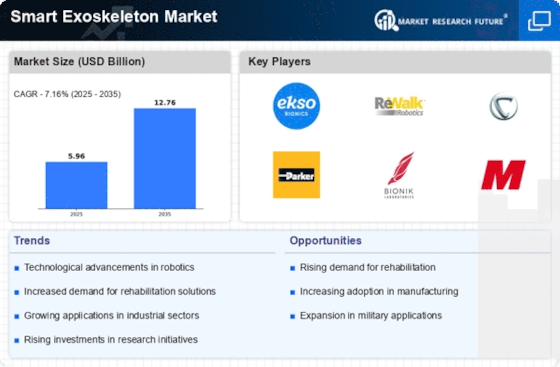
As per MRFR analysis, the Smart Exoskeleton Market Size was estimated at 5.962 USD Billion in 2024. The Smart Exoskeleton industry is projected to grow from 6.389 USD Billion in 2025 to 12.76 USD Billion by 2035, exhibiting a compound annual growth rate (CAGR) of 7.16 during the forecast period 2025 - 2035.

Key Market Trends & Highlights

The Smart Exoskeleton Market is poised for substantial growth driven by technological advancements and increasing applications across various sectors.

  • North America remains the largest market for smart exoskeletons, driven by significant investments in healthcare and industrial applications.
  • The Asia-Pacific region is emerging as the fastest-growing market, fueled by rising demand for rehabilitation solutions and workforce safety.
  • Rigid exoskeletons dominate the market, while soft exoskeletons are rapidly gaining traction due to their versatility and comfort.
  • Technological advancements in robotics and growing demand in rehabilitation are key drivers propelling market expansion.

Market Size & Forecast

2024 Market Size 5.962 (USD Billion)
2035 Market Size 12.76 (USD Billion)
CAGR (2025 - 2035) 7.16%
Largest Regional Market Share in 2024 North America

Major Players

<p>Ekso Bionics (US), ReWalk Robotics (IL), Cyberdyne (JP), Parker Hannifin (US), Bionik Laboratories (CA), Honda Motor Co (JP), Lockheed Martin (US), Sarcos Robotics (US), Adept Robotics (US)</p>

Market Trends

The Smart Exoskeleton Market is currently experiencing a notable evolution, driven by advancements in technology and increasing demand for rehabilitation solutions. These wearable devices, designed to enhance human capabilities, are gaining traction across various sectors, including healthcare, military, and industrial applications. The integration of artificial intelligence and robotics into exoskeletons is enhancing their functionality, allowing for improved mobility and support for individuals with physical limitations. As the population ages and the prevalence of mobility-related disorders rises, the need for effective assistive devices is becoming more pronounced. Moreover, the Smart Exoskeleton Market is witnessing a surge in investment and research initiatives aimed at developing innovative solutions. Collaborations between technology firms and healthcare providers are fostering the creation of tailored exoskeletons that cater to specific user needs. This trend suggests a shift towards personalized rehabilitation strategies, which may lead to better outcomes for users. Additionally, the growing awareness of workplace safety and the need for ergonomic solutions in industries are likely to propel the adoption of exoskeletons, further expanding their market presence. Overall, the Smart Exoskeleton Market appears poised for substantial growth in the coming years, driven by technological advancements and evolving consumer demands.

Technological Advancements

The Smart Exoskeleton Market is witnessing rapid technological progress, particularly in the integration of artificial intelligence and machine learning. These innovations enhance the adaptability and efficiency of exoskeletons, allowing them to respond to user movements more intuitively. As a result, devices are becoming increasingly user-friendly and effective in various applications, from rehabilitation to industrial use.

Growing Demand in Healthcare

There is a rising demand for smart exoskeletons in the healthcare sector, particularly for rehabilitation purposes. As the global population ages, the need for assistive devices that support mobility and recovery is becoming more critical. This trend indicates a shift towards personalized rehabilitation solutions that cater to individual patient needs, potentially improving recovery outcomes.

Industrial Applications

The Smart Exoskeleton Market is expanding into industrial sectors, where these devices are being utilized to enhance worker safety and productivity. By reducing physical strain and preventing injuries, exoskeletons are becoming valuable tools in manufacturing and construction environments. This trend suggests a growing recognition of the importance of ergonomic solutions in the workplace.

Smart Exoskeleton Market Market Drivers

Rising Awareness and Acceptance

The Smart Exoskeleton Market is experiencing a rise in awareness and acceptance among potential users, including healthcare professionals and industrial workers. As more success stories emerge regarding the effectiveness of exoskeletons in rehabilitation and workplace safety, the stigma surrounding their use is diminishing. Educational campaigns and demonstrations are playing a crucial role in informing stakeholders about the benefits of exoskeleton technology. Furthermore, as the technology becomes more user-friendly and affordable, acceptance is likely to increase. Market Research Future indicates that consumer interest in exoskeletons is growing, with a projected increase in adoption rates among healthcare facilities and manufacturing companies. This shift in perception is expected to drive market growth, as more organizations recognize the value of integrating exoskeletons into their operations.

Growing Demand in Rehabilitation

The Smart Exoskeleton Market is witnessing a notable increase in demand for rehabilitation solutions, particularly for individuals with mobility impairments. As the global population ages, the prevalence of conditions such as stroke and spinal cord injuries is rising, necessitating effective rehabilitation tools. Exoskeletons are being recognized for their potential to aid in physical therapy, enabling patients to regain mobility and strength. Recent studies indicate that the use of exoskeletons in rehabilitation can lead to improved outcomes, with some patients experiencing significant recovery in motor functions. This growing recognition of the benefits of exoskeletons in rehabilitation is expected to propel market growth, with estimates suggesting a market value exceeding USD 2 billion by 2026. The increasing collaboration between healthcare providers and technology developers further underscores the potential of exoskeletons in therapeutic settings.

Government Initiatives and Funding

The Smart Exoskeleton Market is benefiting from increased government initiatives and funding aimed at promoting advanced technologies. Various governments are recognizing the potential of exoskeletons in improving healthcare outcomes and enhancing workforce productivity. Initiatives such as grants and subsidies for research and development are being implemented to encourage innovation in this field. For example, funding programs aimed at supporting startups and small businesses in the exoskeleton sector are becoming more prevalent. This financial support is likely to accelerate the development and commercialization of new exoskeleton technologies, thereby expanding their market reach. Additionally, government partnerships with academic institutions and private companies are fostering collaborative research efforts, which may lead to breakthroughs in exoskeleton design and functionality.

Technological Advancements in Robotics

The Smart Exoskeleton Market is experiencing a surge in technological advancements, particularly in robotics and artificial intelligence. Innovations in sensor technology, machine learning, and materials science are enhancing the functionality and efficiency of exoskeletons. For instance, the integration of lightweight materials and advanced actuators allows for greater mobility and user comfort. As a result, the market is projected to grow at a compound annual growth rate of approximately 30% over the next five years. This rapid evolution in technology not only improves the performance of exoskeletons but also expands their applications across various sectors, including healthcare and manufacturing. The continuous investment in research and development is likely to drive further innovations, making exoskeletons more accessible and effective for users.

Industrial Applications and Workforce Safety

The Smart Exoskeleton Market is increasingly being adopted in industrial applications, particularly for enhancing workforce safety and productivity. As industries strive to reduce workplace injuries and improve ergonomics, exoskeletons are emerging as viable solutions. These devices assist workers in lifting heavy objects and performing repetitive tasks, thereby minimizing the risk of musculoskeletal disorders. Recent data indicates that companies implementing exoskeletons have reported a reduction in injury rates by up to 50%. This trend is likely to drive the market as organizations recognize the economic benefits of investing in exoskeleton technology. Furthermore, the integration of exoskeletons into training programs is expected to enhance worker efficiency and reduce downtime, making them an attractive option for various sectors, including construction, manufacturing, and logistics.

Market Segment Insights

By Type: Rigid Exoskeleton (Largest) vs. Soft Exoskeleton (Fastest-Growing)

<p>In the Smart Exoskeleton Market, the distribution of market share among the segment values reveals Rigid Exoskeletons as the largest segment by a significant margin. This segment attracts a wider user base due to its robust structural integrity, making it ideal for heavy-duty applications in industries such as manufacturing and construction. On the other hand, Soft Exoskeletons, though currently smaller in market share, are attracting considerable interest for their adaptability and comfort, appealing primarily to the rehabilitation and personal assistance sectors. Growth trends in the Smart Exoskeleton Market are driven by technological advancements and increasing demand for versatile solutions in various industries. The rise of Soft Exoskeletons is largely attributed to their lightweight design and the growing focus on ergonomic support for users. Meanwhile, Rigid Exoskeletons continue to benefit from advancements in materials and design that provide enhanced performance in more demanding work environments, solidifying their status as the dominant player in this segment.</p>

<p>Rigid Exoskeleton (Dominant) vs. Soft Exoskeleton (Emerging)</p>

<p>Rigid Exoskeletons are characterized by their sturdy construction and are often used in environments that require significant physical support, such as industrial settings and military applications. These exoskeletons provide excellent load-bearing capabilities and are designed to assist users in lifting heavy objects, minimizing the risk of injury. On the other hand, Soft Exoskeletons represent a more innovative approach, focusing on enhancing mobility and comfort. They are typically made from flexible materials and provide support for activities like walking or rehabilitation, appealing to the aging population and healthcare providers looking for effective aids in patient mobility. As the market evolves, both segments are expected to grow, but Soft Exoskeletons are gradually carving out their niche as a solution for more personal and rehabilitation-oriented applications.</p>

By Component: Hardware (Largest) vs. Software (Fastest-Growing)

<p>Within the Smart Exoskeleton Market, the component segment is dominated by hardware, which forms the backbone of these advanced machines. The hardware segment encompasses essential components such as sensors, actuators, and structural elements, contributing significantly to overall market share. Software, though a smaller segment, is gaining traction as it plays a crucial role in controlling and optimizing exoskeleton functionalities, enhancing user experience and interaction.</p>

<p>Hardware (Dominant) vs. Software (Emerging)</p>

<p>The hardware sector of the Smart Exoskeleton Market is characterized by its robustness and essential role in defining the performance and functionality of exoskeletons. Hardware components such as motors and sensors are vital, providing the necessary support for mobility and user assistance. On the other hand, the software segment, while currently emerging, is rapidly evolving due to advancements in artificial intelligence and machine learning. This growth is fueled by increasing demands for smarter and more adaptive exoskeleton systems, which require sophisticated software to interpret data and optimize user interactions. As technology advances, the software is expected to complement and enhance the capabilities offered by hardware, positioning itself as a critical area for future growth.</p>

By Application: Upper Limbs (Largest) vs. Full Body (Fastest-Growing)

<p>The Smart Exoskeleton Market exhibits a distinct distribution of application segments, primarily categorized into Upper Limbs, Lower Limbs, and Full Body. Among these, the Upper Limbs segment commands the largest share, primarily driven by increasing adoption in rehabilitation, elderly assistance, and industrial applications. Meanwhile, the Lower Limbs segment also holds a notable position, often focused on enhancing mobility and support for individuals with physical limitations. Full Body exoskeletons, although presently smaller in market share, represent a rapidly rising area due to their versatility in various fields, including defense, manufacturing, and healthcare.</p>

<p>Upper Limbs (Dominant) vs. Full Body (Emerging)</p>

<p>Upper Limbs exoskeletons are currently the dominant segment in the Smart Exoskeleton Market, primarily due to their extensive applications in rehabilitation and support for individuals with upper limb disabilities. These exoskeletons assist users in performing daily tasks and are widely used in therapeutic settings, enhancing the quality of life for many. In contrast, Full Body exoskeletons represent an emerging segment, providing comprehensive support for the entire body. They are gaining traction in various industries, including manufacturing and defense, due to their ability to significantly reduce physical strain and increase productivity, ultimately promoting safety and efficiency in physically demanding tasks.</p>

By Vertical: Healthcare (Largest) vs. Industrial (Fastest-Growing)

<p>In the Smart Exoskeleton Market, the distribution of market share reveals that the healthcare segment holds a dominant position, driven by increasing demand for rehabilitation and assistance for patients with mobility impairments. The industrial segment follows closely, gaining rapid traction due to the push for enhanced worker safety and productivity in demanding work environments. This shift is significant as industries recognize the potential of exoskeletons to lessen physical strain on workers. As the market evolves, trends indicate that the healthcare sector's growth will continue to be propelled by technological advancements in exoskeleton functionalities, such as improved mobility assistance and rehabilitation methods. Meanwhile, the industrial sector is emerging quickly, fueled by the need for innovation in occupational health and safety measures. Key drivers include the rising incidences of workplace injuries and the increasing implementation of automation in manufacturing operations, leading to efficient labor force management.</p>

<p>Healthcare (Dominant) vs. Industrial (Emerging)</p>

<p>In the Smart Exoskeleton Market, the healthcare segment is characterized by its focus on patient rehabilitation and mobility improvement, making it a dominant player. This segment encompasses exoskeletons designed for physical therapy, enabling patients to regain strength and independence. Advanced technologies such as robotic assistance and personalized training programs further enhance the segment's appeal. Conversely, the industrial segment is emerging rapidly, characterized by innovations aimed at protecting labor workers from physical strain while maximizing productivity. These exoskeletons are tailored for various industries, including construction and manufacturing, where demand for ergonomic solutions is high. As industries adopt these technologies to create safer working environments, the industrial sector is projected for substantial growth, driven by occupational safety regulations and the rise of automation.</p>

Get more detailed insights about Smart Exoskeleton Market Research Report - Global Forecast till 2035

Regional Insights

North America : Innovation and Market Leadership

North America is the largest market for smart exoskeletons, holding approximately 45% of the global share. The region benefits from advanced healthcare infrastructure, significant investments in R&D, and a growing aging population that drives demand for rehabilitation technologies. Regulatory support from agencies like the FDA further catalyzes market growth, ensuring safety and efficacy in new products. The United States leads the market, with key players such as Ekso Bionics, ReWalk Robotics, and Lockheed Martin driving innovation. The competitive landscape is characterized by collaborations between technology firms and healthcare providers, enhancing product offerings. Canada also plays a significant role, with companies like Bionik Laboratories contributing to the market's expansion.

Europe : Regulatory Support and Growth

Europe is the second-largest market for smart exoskeletons, accounting for about 30% of the global share. The region's growth is driven by increasing investments in healthcare technology and supportive regulatory frameworks. The European Union's focus on improving mobility for the elderly and disabled populations has led to initiatives that promote the adoption of exoskeletons in rehabilitation settings. Leading countries include Germany, France, and the UK, where companies like Cyberdyne and Honda Motor Co are making significant strides. The competitive landscape is marked by a mix of established firms and startups, fostering innovation. The presence of regulatory bodies ensures that products meet stringent safety standards, further enhancing market credibility.

Asia-Pacific : Rapid Growth and Adoption

Asia-Pacific is witnessing rapid growth in the smart exoskeleton market, holding around 20% of the global share. The region's expansion is fueled by increasing healthcare expenditures, a rising elderly population, and advancements in robotics technology. Countries like Japan and China are at the forefront, with government initiatives promoting the use of exoskeletons in rehabilitation and industrial applications. Japan is a key player, with companies like Cyberdyne leading the charge. The competitive landscape is evolving, with both local and international firms vying for market share. The region's focus on innovation and technology integration in healthcare is expected to drive further adoption of smart exoskeletons, making it a significant player in the global market.

Middle East and Africa : Untapped Potential and Challenges

The Middle East and Africa represent an emerging market for smart exoskeletons, holding approximately 5% of the global share. The region's growth is hindered by limited healthcare infrastructure and high costs associated with advanced technologies. However, increasing awareness of rehabilitation technologies and government initiatives aimed at improving healthcare access are driving interest in smart exoskeletons. Countries like South Africa and the UAE are beginning to explore the potential of exoskeletons in rehabilitation and industrial sectors. The competitive landscape is still developing, with few key players present. As investments in healthcare technology increase, the region is expected to see gradual growth in the adoption of smart exoskeletons, presenting opportunities for innovation and market entry.

Key Players and Competitive Insights

The Smart Exoskeleton Market is currently characterized by a dynamic competitive landscape, driven by technological advancements and increasing demand for rehabilitation solutions. Key players such as Ekso Bionics (US), ReWalk Robotics (IL), and Cyberdyne (JP) are at the forefront, each adopting distinct strategies to enhance their market positioning. Ekso Bionics (US) focuses on innovation in wearable robotics, particularly in medical applications, while ReWalk Robotics (IL) emphasizes partnerships with healthcare providers to expand its reach. Cyberdyne (JP) leverages its expertise in robotics to develop exoskeletons that cater to both medical and industrial sectors, indicating a diversified operational focus that shapes the competitive environment.

In terms of business tactics, companies are increasingly localizing manufacturing to reduce costs and enhance supply chain efficiency. The Smart Exoskeleton Market appears moderately fragmented, with several players vying for market share. The collective influence of these key players is significant, as they not only drive technological advancements but also set industry standards that smaller companies must adhere to.

In August 2025, Ekso Bionics (US) announced a strategic partnership with a leading rehabilitation hospital to integrate its exoskeleton technology into patient care protocols. This collaboration is likely to enhance patient outcomes and solidify Ekso's position as a leader in the rehabilitation sector. The partnership underscores the importance of aligning technological innovation with clinical applications, thereby fostering greater acceptance of exoskeletons in therapeutic settings.

In September 2025, ReWalk Robotics (IL) launched a new version of its exoskeleton designed specifically for home use, which is a significant shift towards consumer-oriented applications. This move not only broadens their market appeal but also reflects a growing trend towards personal mobility solutions. By addressing the needs of individuals with mobility impairments in everyday environments, ReWalk is likely to capture a new segment of the market, enhancing its competitive edge.

In July 2025, Cyberdyne (JP) expanded its operations into Europe, establishing a manufacturing facility aimed at meeting the rising demand for exoskeletons in the region. This strategic expansion is indicative of Cyberdyne's commitment to The Smart Exoskeleton Market for rehabilitation technologies. By localizing production, Cyberdyne may improve its supply chain responsiveness and reduce lead times, which are critical factors in maintaining competitiveness.

As of October 2025, the Smart Exoskeleton Market is witnessing trends such as digitalization, sustainability, and the integration of artificial intelligence. These trends are reshaping competitive dynamics, with companies increasingly forming strategic alliances to enhance their technological capabilities. The shift from price-based competition to a focus on innovation and supply chain reliability is evident, suggesting that future differentiation will hinge on the ability to deliver advanced, reliable, and user-friendly solutions.

Key Companies in the Smart Exoskeleton Market market include

Industry Developments

  • Q2 2024: Ekso Bionics Announces FDA Clearance for EksoNR Robotic Exoskeleton for Use with Multiple Sclerosis Patients Ekso Bionics received FDA clearance for its EksoNR robotic exoskeleton to be used in rehabilitation of patients with multiple sclerosis, expanding its clinical indications in the U.S.
  • Q2 2024: German Bionic launches Apogee+ smart exoskeleton for industrial workers German Bionic introduced the Apogee+ smart exoskeleton, designed to support industrial workers in logistics and manufacturing, aiming to reduce workplace injuries and improve productivity.
  • Q2 2024: SuitX secures $20 million Series B funding to accelerate development of next-generation exoskeletons SuitX, a U.S.-based exoskeleton startup, raised $20 million in Series B funding to expand its R&D and scale production of smart exoskeletons for medical and industrial applications.
  • Q3 2024: Fourier Intelligence and ReWalk Robotics Announce Strategic Partnership to Co-Develop Smart Exoskeletons Fourier Intelligence and ReWalk Robotics entered a strategic partnership to jointly develop and commercialize advanced smart exoskeletons for rehabilitation and mobility assistance.
  • Q3 2024: Cyberdyne opens new manufacturing facility for HAL exoskeletons in Osaka Cyberdyne inaugurated a new manufacturing facility in Osaka, Japan, to increase production capacity for its HAL exoskeletons, targeting healthcare and industrial markets.
  • Q3 2024: Ottobock acquires French exoskeleton startup RB3D Ottobock, a German medical technology company, acquired RB3D, a French exoskeleton startup, to strengthen its portfolio in smart exoskeleton solutions for industrial and healthcare sectors.
  • Q4 2024: ReWalk Robotics receives CE Mark approval for ReStore Exo-Suit in Europe ReWalk Robotics obtained CE Mark approval for its ReStore Exo-Suit, enabling commercial sales and clinical use of the device for stroke rehabilitation across Europe.
  • Q4 2024: B-Temia raises $15 million in Series A funding to expand wearable exoskeleton technology Canadian exoskeleton company B-Temia secured $15 million in Series A funding to accelerate development and commercialization of its wearable smart exoskeletons for mobility-impaired users.
  • Q1 2025: Hocoma launches new LokomatPro with AI-powered gait analysis Hocoma, a Swiss rehabilitation robotics company, launched the LokomatPro, a smart exoskeleton featuring AI-powered gait analysis for enhanced patient rehabilitation outcomes.
  • Q1 2025: Ekso Bionics signs distribution agreement with Medtronic for exoskeletons in Asia-Pacific Ekso Bionics entered a distribution agreement with Medtronic to expand the reach of its smart exoskeletons in the Asia-Pacific region, focusing on rehabilitation centers and hospitals.
  • Q2 2025: Gogoa.eu wins contract to supply smart exoskeletons to Spanish public hospitals Gogoa.eu, a Spanish exoskeleton manufacturer, secured a contract to supply its smart exoskeletons to several public hospitals in Spain for use in rehabilitation programs.
  • Q2 2025: Raytheon Technologies unveils military-grade exoskeleton for U.S. Army field trials Raytheon Technologies launched a new military-grade smart exoskeleton designed for U.S. Army field trials, aiming to enhance soldier endurance and reduce injury risk.

Future Outlook

Smart Exoskeleton Market Future Outlook

<p>The Smart Exoskeleton Market is projected to grow at a 7.16% CAGR from 2024 to 2035, driven by advancements in robotics, increasing demand for rehabilitation solutions, and industrial automation.</p>

New opportunities lie in:

  • <p>Development of customizable exoskeletons for specific industries</p>
  • <p>Integration of AI for enhanced user experience and efficiency</p>
  • <p>Expansion into emerging markets with tailored solutions</p>

<p>By 2035, the Smart Exoskeleton Market is expected to achieve substantial growth and innovation.</p>

Market Segmentation

Smart Exoskeleton Market Type Outlook

  • Ultra-Soft Exoskeleton
  • Soft Exoskeleton
  • Rigid Exoskeleton

Smart Exoskeleton Market Vertical Outlook

  • Industrial
  • Healthcare
  • Military
  • Others

Smart Exoskeleton Market Component Outlook

  • Hardware
  • Software

Smart Exoskeleton Market Application Outlook

  • Upper Limbs
  • Lower Limbs
  • Full Body

Report Scope

MARKET SIZE 20245.962(USD Billion)
MARKET SIZE 20256.389(USD Billion)
MARKET SIZE 203512.76(USD Billion)
COMPOUND ANNUAL GROWTH RATE (CAGR)7.16% (2024 - 2035)
REPORT COVERAGERevenue Forecast, Competitive Landscape, Growth Factors, and Trends
BASE YEAR2024
Market Forecast Period2025 - 2035
Historical Data2019 - 2024
Market Forecast UnitsUSD Billion
Key Companies ProfiledMarket analysis in progress
Segments CoveredMarket segmentation analysis in progress
Key Market OpportunitiesIntegration of artificial intelligence enhances functionality and user adaptability in the Smart Exoskeleton Market.
Key Market DynamicsRising demand for rehabilitation solutions drives innovation and competition in the Smart Exoskeleton Market.
Countries CoveredNorth America, Europe, APAC, South America, MEA

FAQs

What is the projected market valuation of the Smart Exoskeleton Market by 2035?

The Smart Exoskeleton Market is projected to reach a valuation of 12.76 USD Billion by 2035.

What was the market valuation of the Smart Exoskeleton Market in 2024?

In 2024, the Smart Exoskeleton Market had a valuation of 5.962 USD Billion.

What is the expected CAGR for the Smart Exoskeleton Market during the forecast period 2025 - 2035?

The expected CAGR for the Smart Exoskeleton Market during the forecast period 2025 - 2035 is 7.16%.

Which companies are considered key players in the Smart Exoskeleton Market?

Key players in the Smart Exoskeleton Market include Ekso Bionics, ReWalk Robotics, Cyberdyne, and Honda Motor Co.

What are the different types of exoskeletons in the Smart Exoskeleton Market?

The Smart Exoskeleton Market includes Ultra-Soft, Soft, and Rigid exoskeletons, with Rigid exoskeletons valued at 3.5772 USD Billion in 2024.

How is the Smart Exoskeleton Market segmented by application?

The market is segmented into Upper Limbs, Lower Limbs, and Full Body applications, with Lower Limbs projected to reach 5.25 USD Billion by 2035.

  1. SECTION I: EXECUTIVE SUMMARY AND KEY HIGHLIGHTS
    1. EXECUTIVE SUMMARY
      1. Market Overview
      2. Key Findings
      3. Market Segmentation
      4. Competitive Landscape
      5. Challenges and Opportunities
      6. Future Outlook
  2. SECTION II: SCOPING, METHODOLOGY AND MARKET STRUCTURE
    1. MARKET INTRODUCTION
      1. Definition
      2. Scope of the study
    2. RESEARCH METHODOLOGY
      1. Overview
      2. Data Mining
      3. Secondary Research
      4. Primary Research
      5. Forecasting Model
      6. Market Size Estimation
      7. Data Triangulation
      8. Validation
  3. SECTION III: QUALITATIVE ANALYSIS
    1. MARKET DYNAMICS
      1. Overview
      2. Drivers
      3. Restraints
      4. Opportunities
    2. MARKET FACTOR ANALYSIS
      1. Value chain Analysis
      2. Porter's Five Forces Analysis
      3. COVID-19 Impact Analysis
  4. SECTION IV: QUANTITATIVE ANALYSIS
    1. Semiconductor & Electronics, BY Type (USD Billion)
      1. Ultra-Soft Exoskeleton
      2. Soft Exoskeleton
      3. Rigid Exoskeleton
    2. Semiconductor & Electronics, BY Component (USD Billion)
      1. Hardware
      2. Software
    3. Semiconductor & Electronics, BY Application (USD Billion)
      1. Upper Limbs
      2. Lower Limbs
      3. Full Body
    4. Semiconductor & Electronics, BY Vertical (USD Billion)
      1. Industrial
      2. Healthcare
      3. Military
      4. Others
    5. Semiconductor & Electronics, BY Region (USD Billion)
      1. North America
      2. Europe
      3. APAC
      4. South America
      5. MEA
  5. SECTION V: COMPETITIVE ANALYSIS
    1. Competitive Landscape
      1. Overview
      2. Competitive Analysis
      3. Market share Analysis
      4. Major Growth Strategy in the Semiconductor & Electronics
      5. Competitive Benchmarking
      6. Leading Players in Terms of Number of Developments in the Semiconductor & Electronics
      7. Key developments and growth strategies
      8. Major Players Financial Matrix
    2. Company Profiles
      1. Ekso Bionics (US)
      2. ReWalk Robotics (IL)
      3. Cyberdyne (JP)
      4. Parker Hannifin (US)
      5. Bionik Laboratories (CA)
      6. Honda Motor Co (JP)
      7. Lockheed Martin (US)
      8. Sarcos Robotics (US)
      9. Adept Robotics (US)
    3. Appendix
      1. References
      2. Related Reports
  6. LIST OF FIGURES
    1. MARKET SYNOPSIS
    2. NORTH AMERICA MARKET ANALYSIS
    3. US MARKET ANALYSIS BY TYPE
    4. US MARKET ANALYSIS BY COMPONENT
    5. US MARKET ANALYSIS BY APPLICATION
    6. US MARKET ANALYSIS BY VERTICAL
    7. CANADA MARKET ANALYSIS BY TYPE
    8. CANADA MARKET ANALYSIS BY COMPONENT
    9. CANADA MARKET ANALYSIS BY APPLICATION
    10. CANADA MARKET ANALYSIS BY VERTICAL
    11. EUROPE MARKET ANALYSIS
    12. GERMANY MARKET ANALYSIS BY TYPE
    13. GERMANY MARKET ANALYSIS BY COMPONENT
    14. GERMANY MARKET ANALYSIS BY APPLICATION
    15. GERMANY MARKET ANALYSIS BY VERTICAL
    16. UK MARKET ANALYSIS BY TYPE
    17. UK MARKET ANALYSIS BY COMPONENT
    18. UK MARKET ANALYSIS BY APPLICATION
    19. UK MARKET ANALYSIS BY VERTICAL
    20. FRANCE MARKET ANALYSIS BY TYPE
    21. FRANCE MARKET ANALYSIS BY COMPONENT
    22. FRANCE MARKET ANALYSIS BY APPLICATION
    23. FRANCE MARKET ANALYSIS BY VERTICAL
    24. RUSSIA MARKET ANALYSIS BY TYPE
    25. RUSSIA MARKET ANALYSIS BY COMPONENT
    26. RUSSIA MARKET ANALYSIS BY APPLICATION
    27. RUSSIA MARKET ANALYSIS BY VERTICAL
    28. ITALY MARKET ANALYSIS BY TYPE
    29. ITALY MARKET ANALYSIS BY COMPONENT
    30. ITALY MARKET ANALYSIS BY APPLICATION
    31. ITALY MARKET ANALYSIS BY VERTICAL
    32. SPAIN MARKET ANALYSIS BY TYPE
    33. SPAIN MARKET ANALYSIS BY COMPONENT
    34. SPAIN MARKET ANALYSIS BY APPLICATION
    35. SPAIN MARKET ANALYSIS BY VERTICAL
    36. REST OF EUROPE MARKET ANALYSIS BY TYPE
    37. REST OF EUROPE MARKET ANALYSIS BY COMPONENT
    38. REST OF EUROPE MARKET ANALYSIS BY APPLICATION
    39. REST OF EUROPE MARKET ANALYSIS BY VERTICAL
    40. APAC MARKET ANALYSIS
    41. CHINA MARKET ANALYSIS BY TYPE
    42. CHINA MARKET ANALYSIS BY COMPONENT
    43. CHINA MARKET ANALYSIS BY APPLICATION
    44. CHINA MARKET ANALYSIS BY VERTICAL
    45. INDIA MARKET ANALYSIS BY TYPE
    46. INDIA MARKET ANALYSIS BY COMPONENT
    47. INDIA MARKET ANALYSIS BY APPLICATION
    48. INDIA MARKET ANALYSIS BY VERTICAL
    49. JAPAN MARKET ANALYSIS BY TYPE
    50. JAPAN MARKET ANALYSIS BY COMPONENT
    51. JAPAN MARKET ANALYSIS BY APPLICATION
    52. JAPAN MARKET ANALYSIS BY VERTICAL
    53. SOUTH KOREA MARKET ANALYSIS BY TYPE
    54. SOUTH KOREA MARKET ANALYSIS BY COMPONENT
    55. SOUTH KOREA MARKET ANALYSIS BY APPLICATION
    56. SOUTH KOREA MARKET ANALYSIS BY VERTICAL
    57. MALAYSIA MARKET ANALYSIS BY TYPE
    58. MALAYSIA MARKET ANALYSIS BY COMPONENT
    59. MALAYSIA MARKET ANALYSIS BY APPLICATION
    60. MALAYSIA MARKET ANALYSIS BY VERTICAL
    61. THAILAND MARKET ANALYSIS BY TYPE
    62. THAILAND MARKET ANALYSIS BY COMPONENT
    63. THAILAND MARKET ANALYSIS BY APPLICATION
    64. THAILAND MARKET ANALYSIS BY VERTICAL
    65. INDONESIA MARKET ANALYSIS BY TYPE
    66. INDONESIA MARKET ANALYSIS BY COMPONENT
    67. INDONESIA MARKET ANALYSIS BY APPLICATION
    68. INDONESIA MARKET ANALYSIS BY VERTICAL
    69. REST OF APAC MARKET ANALYSIS BY TYPE
    70. REST OF APAC MARKET ANALYSIS BY COMPONENT
    71. REST OF APAC MARKET ANALYSIS BY APPLICATION
    72. REST OF APAC MARKET ANALYSIS BY VERTICAL
    73. SOUTH AMERICA MARKET ANALYSIS
    74. BRAZIL MARKET ANALYSIS BY TYPE
    75. BRAZIL MARKET ANALYSIS BY COMPONENT
    76. BRAZIL MARKET ANALYSIS BY APPLICATION
    77. BRAZIL MARKET ANALYSIS BY VERTICAL
    78. MEXICO MARKET ANALYSIS BY TYPE
    79. MEXICO MARKET ANALYSIS BY COMPONENT
    80. MEXICO MARKET ANALYSIS BY APPLICATION
    81. MEXICO MARKET ANALYSIS BY VERTICAL
    82. ARGENTINA MARKET ANALYSIS BY TYPE
    83. ARGENTINA MARKET ANALYSIS BY COMPONENT
    84. ARGENTINA MARKET ANALYSIS BY APPLICATION
    85. ARGENTINA MARKET ANALYSIS BY VERTICAL
    86. REST OF SOUTH AMERICA MARKET ANALYSIS BY TYPE
    87. REST OF SOUTH AMERICA MARKET ANALYSIS BY COMPONENT
    88. REST OF SOUTH AMERICA MARKET ANALYSIS BY APPLICATION
    89. REST OF SOUTH AMERICA MARKET ANALYSIS BY VERTICAL
    90. MEA MARKET ANALYSIS
    91. GCC COUNTRIES MARKET ANALYSIS BY TYPE
    92. GCC COUNTRIES MARKET ANALYSIS BY COMPONENT
    93. GCC COUNTRIES MARKET ANALYSIS BY APPLICATION
    94. GCC COUNTRIES MARKET ANALYSIS BY VERTICAL
    95. SOUTH AFRICA MARKET ANALYSIS BY TYPE
    96. SOUTH AFRICA MARKET ANALYSIS BY COMPONENT
    97. SOUTH AFRICA MARKET ANALYSIS BY APPLICATION
    98. SOUTH AFRICA MARKET ANALYSIS BY VERTICAL
    99. REST OF MEA MARKET ANALYSIS BY TYPE
    100. REST OF MEA MARKET ANALYSIS BY COMPONENT
    101. REST OF MEA MARKET ANALYSIS BY APPLICATION
    102. REST OF MEA MARKET ANALYSIS BY VERTICAL
    103. KEY BUYING CRITERIA OF SEMICONDUCTOR & ELECTRONICS
    104. RESEARCH PROCESS OF MRFR
    105. DRO ANALYSIS OF SEMICONDUCTOR & ELECTRONICS
    106. DRIVERS IMPACT ANALYSIS: SEMICONDUCTOR & ELECTRONICS
    107. RESTRAINTS IMPACT ANALYSIS: SEMICONDUCTOR & ELECTRONICS
    108. SUPPLY / VALUE CHAIN: SEMICONDUCTOR & ELECTRONICS
    109. SEMICONDUCTOR & ELECTRONICS, BY TYPE, 2024 (% SHARE)
    110. SEMICONDUCTOR & ELECTRONICS, BY TYPE, 2024 TO 2035 (USD Billion)
    111. SEMICONDUCTOR & ELECTRONICS, BY COMPONENT, 2024 (% SHARE)
    112. SEMICONDUCTOR & ELECTRONICS, BY COMPONENT, 2024 TO 2035 (USD Billion)
    113. SEMICONDUCTOR & ELECTRONICS, BY APPLICATION, 2024 (% SHARE)
    114. SEMICONDUCTOR & ELECTRONICS, BY APPLICATION, 2024 TO 2035 (USD Billion)
    115. SEMICONDUCTOR & ELECTRONICS, BY VERTICAL, 2024 (% SHARE)
    116. SEMICONDUCTOR & ELECTRONICS, BY VERTICAL, 2024 TO 2035 (USD Billion)
    117. BENCHMARKING OF MAJOR COMPETITORS
  7. LIST OF TABLES
    1. LIST OF ASSUMPTIONS
    2. North America MARKET SIZE ESTIMATES; FORECAST
      1. BY TYPE, 2025-2035 (USD Billion)
      2. BY COMPONENT, 2025-2035 (USD Billion)
      3. BY APPLICATION, 2025-2035 (USD Billion)
      4. BY VERTICAL, 2025-2035 (USD Billion)
    3. US MARKET SIZE ESTIMATES; FORECAST
      1. BY TYPE, 2025-2035 (USD Billion)
      2. BY COMPONENT, 2025-2035 (USD Billion)
      3. BY APPLICATION, 2025-2035 (USD Billion)
      4. BY VERTICAL, 2025-2035 (USD Billion)
    4. Canada MARKET SIZE ESTIMATES; FORECAST
      1. BY TYPE, 2025-2035 (USD Billion)
      2. BY COMPONENT, 2025-2035 (USD Billion)
      3. BY APPLICATION, 2025-2035 (USD Billion)
      4. BY VERTICAL, 2025-2035 (USD Billion)
    5. Europe MARKET SIZE ESTIMATES; FORECAST
      1. BY TYPE, 2025-2035 (USD Billion)
      2. BY COMPONENT, 2025-2035 (USD Billion)
      3. BY APPLICATION, 2025-2035 (USD Billion)
      4. BY VERTICAL, 2025-2035 (USD Billion)
    6. Germany MARKET SIZE ESTIMATES; FORECAST
      1. BY TYPE, 2025-2035 (USD Billion)
      2. BY COMPONENT, 2025-2035 (USD Billion)
      3. BY APPLICATION, 2025-2035 (USD Billion)
      4. BY VERTICAL, 2025-2035 (USD Billion)
    7. UK MARKET SIZE ESTIMATES; FORECAST
      1. BY TYPE, 2025-2035 (USD Billion)
      2. BY COMPONENT, 2025-2035 (USD Billion)
      3. BY APPLICATION, 2025-2035 (USD Billion)
      4. BY VERTICAL, 2025-2035 (USD Billion)
    8. France MARKET SIZE ESTIMATES; FORECAST
      1. BY TYPE, 2025-2035 (USD Billion)
      2. BY COMPONENT, 2025-2035 (USD Billion)
      3. BY APPLICATION, 2025-2035 (USD Billion)
      4. BY VERTICAL, 2025-2035 (USD Billion)
    9. Russia MARKET SIZE ESTIMATES; FORECAST
      1. BY TYPE, 2025-2035 (USD Billion)
      2. BY COMPONENT, 2025-2035 (USD Billion)
      3. BY APPLICATION, 2025-2035 (USD Billion)
      4. BY VERTICAL, 2025-2035 (USD Billion)
    10. Italy MARKET SIZE ESTIMATES; FORECAST
      1. BY TYPE, 2025-2035 (USD Billion)
      2. BY COMPONENT, 2025-2035 (USD Billion)
      3. BY APPLICATION, 2025-2035 (USD Billion)
      4. BY VERTICAL, 2025-2035 (USD Billion)
    11. Spain MARKET SIZE ESTIMATES; FORECAST
      1. BY TYPE, 2025-2035 (USD Billion)
      2. BY COMPONENT, 2025-2035 (USD Billion)
      3. BY APPLICATION, 2025-2035 (USD Billion)
      4. BY VERTICAL, 2025-2035 (USD Billion)
    12. Rest of Europe MARKET SIZE ESTIMATES; FORECAST
      1. BY TYPE, 2025-2035 (USD Billion)
      2. BY COMPONENT, 2025-2035 (USD Billion)
      3. BY APPLICATION, 2025-2035 (USD Billion)
      4. BY VERTICAL, 2025-2035 (USD Billion)
    13. APAC MARKET SIZE ESTIMATES; FORECAST
      1. BY TYPE, 2025-2035 (USD Billion)
      2. BY COMPONENT, 2025-2035 (USD Billion)
      3. BY APPLICATION, 2025-2035 (USD Billion)
      4. BY VERTICAL, 2025-2035 (USD Billion)
    14. China MARKET SIZE ESTIMATES; FORECAST
      1. BY TYPE, 2025-2035 (USD Billion)
      2. BY COMPONENT, 2025-2035 (USD Billion)
      3. BY APPLICATION, 2025-2035 (USD Billion)
      4. BY VERTICAL, 2025-2035 (USD Billion)
    15. India MARKET SIZE ESTIMATES; FORECAST
      1. BY TYPE, 2025-2035 (USD Billion)
      2. BY COMPONENT, 2025-2035 (USD Billion)
      3. BY APPLICATION, 2025-2035 (USD Billion)
      4. BY VERTICAL, 2025-2035 (USD Billion)
    16. Japan MARKET SIZE ESTIMATES; FORECAST
      1. BY TYPE, 2025-2035 (USD Billion)
      2. BY COMPONENT, 2025-2035 (USD Billion)
      3. BY APPLICATION, 2025-2035 (USD Billion)
      4. BY VERTICAL, 2025-2035 (USD Billion)
    17. South Korea MARKET SIZE ESTIMATES; FORECAST
      1. BY TYPE, 2025-2035 (USD Billion)
      2. BY COMPONENT, 2025-2035 (USD Billion)
      3. BY APPLICATION, 2025-2035 (USD Billion)
      4. BY VERTICAL, 2025-2035 (USD Billion)
    18. Malaysia MARKET SIZE ESTIMATES; FORECAST
      1. BY TYPE, 2025-2035 (USD Billion)
      2. BY COMPONENT, 2025-2035 (USD Billion)
      3. BY APPLICATION, 2025-2035 (USD Billion)
      4. BY VERTICAL, 2025-2035 (USD Billion)
    19. Thailand MARKET SIZE ESTIMATES; FORECAST
      1. BY TYPE, 2025-2035 (USD Billion)
      2. BY COMPONENT, 2025-2035 (USD Billion)
      3. BY APPLICATION, 2025-2035 (USD Billion)
      4. BY VERTICAL, 2025-2035 (USD Billion)
    20. Indonesia MARKET SIZE ESTIMATES; FORECAST
      1. BY TYPE, 2025-2035 (USD Billion)
      2. BY COMPONENT, 2025-2035 (USD Billion)
      3. BY APPLICATION, 2025-2035 (USD Billion)
      4. BY VERTICAL, 2025-2035 (USD Billion)
    21. Rest of APAC MARKET SIZE ESTIMATES; FORECAST
      1. BY TYPE, 2025-2035 (USD Billion)
      2. BY COMPONENT, 2025-2035 (USD Billion)
      3. BY APPLICATION, 2025-2035 (USD Billion)
      4. BY VERTICAL, 2025-2035 (USD Billion)
    22. South America MARKET SIZE ESTIMATES; FORECAST
      1. BY TYPE, 2025-2035 (USD Billion)
      2. BY COMPONENT, 2025-2035 (USD Billion)
      3. BY APPLICATION, 2025-2035 (USD Billion)
      4. BY VERTICAL, 2025-2035 (USD Billion)
    23. Brazil MARKET SIZE ESTIMATES; FORECAST
      1. BY TYPE, 2025-2035 (USD Billion)
      2. BY COMPONENT, 2025-2035 (USD Billion)
      3. BY APPLICATION, 2025-2035 (USD Billion)
      4. BY VERTICAL, 2025-2035 (USD Billion)
    24. Mexico MARKET SIZE ESTIMATES; FORECAST
      1. BY TYPE, 2025-2035 (USD Billion)
      2. BY COMPONENT, 2025-2035 (USD Billion)
      3. BY APPLICATION, 2025-2035 (USD Billion)
      4. BY VERTICAL, 2025-2035 (USD Billion)
    25. Argentina MARKET SIZE ESTIMATES; FORECAST
      1. BY TYPE, 2025-2035 (USD Billion)
      2. BY COMPONENT, 2025-2035 (USD Billion)
      3. BY APPLICATION, 2025-2035 (USD Billion)
      4. BY VERTICAL, 2025-2035 (USD Billion)
    26. Rest of South America MARKET SIZE ESTIMATES; FORECAST
      1. BY TYPE, 2025-2035 (USD Billion)
      2. BY COMPONENT, 2025-2035 (USD Billion)
      3. BY APPLICATION, 2025-2035 (USD Billion)
      4. BY VERTICAL, 2025-2035 (USD Billion)
    27. MEA MARKET SIZE ESTIMATES; FORECAST
      1. BY TYPE, 2025-2035 (USD Billion)
      2. BY COMPONENT, 2025-2035 (USD Billion)
      3. BY APPLICATION, 2025-2035 (USD Billion)
      4. BY VERTICAL, 2025-2035 (USD Billion)
    28. GCC Countries MARKET SIZE ESTIMATES; FORECAST
      1. BY TYPE, 2025-2035 (USD Billion)
      2. BY COMPONENT, 2025-2035 (USD Billion)
      3. BY APPLICATION, 2025-2035 (USD Billion)
      4. BY VERTICAL, 2025-2035 (USD Billion)
    29. South Africa MARKET SIZE ESTIMATES; FORECAST
      1. BY TYPE, 2025-2035 (USD Billion)
      2. BY COMPONENT, 2025-2035 (USD Billion)
      3. BY APPLICATION, 2025-2035 (USD Billion)
      4. BY VERTICAL, 2025-2035 (USD Billion)
    30. Rest of MEA MARKET SIZE ESTIMATES; FORECAST
      1. BY TYPE, 2025-2035 (USD Billion)
      2. BY COMPONENT, 2025-2035 (USD Billion)
      3. BY APPLICATION, 2025-2035 (USD Billion)
      4. BY VERTICAL, 2025-2035 (USD Billion)
    31. PRODUCT LAUNCH/PRODUCT DEVELOPMENT/APPROVAL
    32. ACQUISITION/PARTNERSHIP

Smart Exoskeleton Market Segmentation

Smart Exoskeleton Type Outlook (USD Billion, 2018-2032)

Ultra-Soft Exoskeleton

Soft Exoskeleton

Rigid Exoskeleton

Smart Exoskeleton Component Outlook (USD Billion, 2018-2032)

Hardware

Software

Smart Exoskeleton Application Outlook (USD Billion, 2018-2032)

Upper Limbs

Lower Limbs

Full Body

Smart Exoskeleton Vertical Outlook (USD Billion, 2018-2032)

Industrial

Healthcare

Military

Others

Smart Exoskeleton Regional Outlook (USD Billion, 2018-2032)

North America Outlook (USD Billion, 2018-2032)

North America Smart Exoskeleton by Type

Ultra-Soft Exoskeleton

Soft Exoskeleton

Rigid Exoskeleton

North America Smart Exoskeleton Component

Hardware

Software

North America Smart Exoskeleton by Application

Upper Limbs

Lower Limbs

Full Body

North America Smart Exoskeleton by Vertical

Industrial

Healthcare

Military

Others

US Outlook (USD Billion, 2018-2032)

US Smart Exoskeleton by Type

Ultra-Soft Exoskeleton

Soft Exoskeleton

Rigid Exoskeleton

US Smart Exoskeleton Component

Hardware

Software

US Smart Exoskeleton by Application

Upper Limbs

Lower Limbs

Full Body

US Smart Exoskeleton by Vertical

Industrial

Healthcare

Military

Others

CANADA Outlook (USD Billion, 2018-2032)

CANADA Smart Exoskeleton by Type

Ultra-Soft Exoskeleton

Soft Exoskeleton

Rigid Exoskeleton

CANADA Smart Exoskeleton Component

Hardware

Software

CANADA Smart Exoskeleton by Application

Upper Limbs

Lower Limbs

Full Body

CANADA Smart Exoskeleton by Vertical

Industrial

Healthcare

Military

Others

Europe Outlook (USD Billion, 2018-2032)

Europe Smart Exoskeleton by Type

Ultra-Soft Exoskeleton

Soft Exoskeleton

Rigid Exoskeleton

Europe Smart Exoskeleton Component

Hardware

Software

Europe Smart Exoskeleton by Application

Upper Limbs

Lower Limbs

Full Body

Europe Smart Exoskeleton by Vertical

Industrial

Healthcare

Military

Others

Germany Outlook (USD Billion, 2018-2032)

Germany Smart Exoskeleton by Type

Ultra-Soft Exoskeleton

Soft Exoskeleton

Rigid Exoskeleton

Germany Smart Exoskeleton Component

Hardware

Software

Germany Smart Exoskeleton by Application

Upper Limbs

Lower Limbs

Full Body

Germany Smart Exoskeleton by Vertical

Industrial

Healthcare

Military

Others

France Outlook (USD Billion, 2018-2032)

France Smart Exoskeleton by Type

Ultra-Soft Exoskeleton

Soft Exoskeleton

Rigid Exoskeleton

France Smart Exoskeleton Component

Hardware

Software

France Smart Exoskeleton by Application

Upper Limbs

Lower Limbs

Full Body

France Smart Exoskeleton by Vertical

Industrial

Healthcare

Military

Others

UK Outlook (USD Billion, 2018-2032)

UK Smart Exoskeleton by Type

Ultra-Soft Exoskeleton

Soft Exoskeleton

Rigid Exoskeleton

UK Smart Exoskeleton Component

Hardware

Software

UK Smart Exoskeleton by Application

Upper Limbs

Lower Limbs

Full Body

UK Smart Exoskeleton by Vertical

Industrial

Healthcare

Military

Others

ITALY Outlook (USD Billion, 2018-2032)

ITALY Smart Exoskeleton by Type

Ultra-Soft Exoskeleton

Soft Exoskeleton

Rigid Exoskeleton

ITALY Smart Exoskeleton Component

Hardware

Software

ITALY Smart Exoskeleton by Application

Upper Limbs

Lower Limbs

Full Body

ITALY Smart Exoskeleton by Vertical

Industrial

Healthcare

Military

Others

SPAIN Outlook (USD Billion, 2018-2032)

Spain Smart Exoskeleton by Type

Ultra-Soft Exoskeleton

Soft Exoskeleton

Rigid Exoskeleton

Spain Smart Exoskeleton Component

Hardware

Software

Spain Smart Exoskeleton by Application

Upper Limbs

Lower Limbs

Full Body

Spain Smart Exoskeleton by Vertical

Industrial

Healthcare

Military

Others

Rest Of Europe Outlook (USD Billion, 2018-2032)

Rest Of Europe Smart Exoskeleton by Type

Ultra-Soft Exoskeleton

Soft Exoskeleton

Rigid Exoskeleton

REST OF EUROPE Smart Exoskeleton Component

Hardware

Software

REST OF EUROPE Smart Exoskeleton by Application

Upper Limbs

Lower Limbs

Full Body

REST OF EUROPE Smart Exoskeleton by Vertical

Industrial

Healthcare

Military

Others

Asia-Pacific Outlook (USD Billion, 2018-2032)

Asia-Pacific Smart Exoskeleton by Type

Ultra-Soft Exoskeleton

Soft Exoskeleton

Rigid Exoskeleton

Asia-Pacific Smart Exoskeleton Component

Hardware

Software

Asia-Pacific Smart Exoskeleton by Application

Upper Limbs

Lower Limbs

Full Body

Asia-Pacific Smart Exoskeleton by Vertical

Industrial

Healthcare

Military

Others

China Outlook (USD Billion, 2018-2032)

China Smart Exoskeleton by Type

Ultra-Soft Exoskeleton

Soft Exoskeleton

Rigid Exoskeleton

China Smart Exoskeleton Component

Hardware

Software

China Smart Exoskeleton by Application

Upper Limbs

Lower Limbs

Full Body

China Smart Exoskeleton by Vertical

Industrial

Healthcare

Military

Others

Japan Outlook (USD Billion, 2018-2032)

Japan Smart Exoskeleton by Type

Ultra-Soft Exoskeleton

Soft Exoskeleton

Rigid Exoskeleton

Japan Smart Exoskeleton Component

Hardware

Software

Japan Smart Exoskeleton by Application

Upper Limbs

Lower Limbs

Full Body

Japan Smart Exoskeleton by Vertical

Industrial

Healthcare

Military

Others

India Outlook (USD Billion, 2018-2032)

India Smart Exoskeleton by Type

Ultra-Soft Exoskeleton

Soft Exoskeleton

Rigid Exoskeleton

India Smart Exoskeleton Component

Hardware

Software

India Smart Exoskeleton by Application

Upper Limbs

Lower Limbs

Full Body

India Smart Exoskeleton by Vertical

Industrial

Healthcare

Military

Others

Australia Outlook (USD Billion, 2018-2032)

Australia Smart Exoskeleton by Type

Ultra-Soft Exoskeleton

Soft Exoskeleton

Rigid Exoskeleton

Australia Smart Exoskeleton Component

Hardware

Software

Australia Smart Exoskeleton by Application

Upper Limbs

Lower Limbs

Full Body

Australia Smart Exoskeleton by Vertical

Industrial

Healthcare

Military

Others

Rest of Asia-Pacific Outlook (USD Billion, 2018-2032)

Rest of Asia-Pacific Smart Exoskeleton by Type

Ultra-Soft Exoskeleton

Soft Exoskeleton

Rigid Exoskeleton

Rest of Asia-Pacific Smart Exoskeleton Component

Hardware

Software

Rest of Asia-Pacific Smart Exoskeleton by Application

Upper Limbs

Lower Limbs

Full Body

Rest of Asia-Pacific Smart Exoskeleton by Vertical

Industrial

Healthcare

Military

Others

Rest of the World Outlook (USD Billion, 2018-2032)

Rest of the World Smart Exoskeleton by Type

Ultra-Soft Exoskeleton

Soft Exoskeleton

Rigid Exoskeleton

Rest of the World Smart Exoskeleton Component

Hardware

Software

Rest of the World Smart Exoskeleton by Application

Upper Limbs

Lower Limbs

Full Body

Rest of the World Smart Exoskeleton by Vertical

Industrial

Healthcare

Military

Others

Middle East Outlook (USD Billion, 2018-2032)

Middle East Smart Exoskeleton by Type

Ultra-Soft Exoskeleton

Soft Exoskeleton

Rigid Exoskeleton

Middle East Smart Exoskeleton Component

Hardware

Software

Middle East Smart Exoskeleton by Application

Upper Limbs

Lower Limbs

Full Body

Middle East Smart Exoskeleton by Vertical

Industrial

Healthcare

Military

Others

Africa Outlook (USD Billion, 2018-2032)

Africa Smart Exoskeleton by Type

Ultra-Soft Exoskeleton

Soft Exoskeleton

Rigid Exoskeleton

Africa Smart Exoskeleton Component

Hardware

Software

Africa Smart Exoskeleton by Application

Upper Limbs

Lower Limbs

Full Body

Africa Smart Exoskeleton by Vertical

Industrial

Healthcare

Military

Others

Latin America Outlook (USD Billion, 2018-2032)

Latin America Smart Exoskeleton by Type

Ultra-Soft Exoskeleton

Soft Exoskeleton

Rigid Exoskeleton

Latin America Smart Exoskeleton Component

Hardware

Software

Latin America Smart Exoskeleton by Application

Upper Limbs

Lower Limbs

Full Body

Latin America Smart Exoskeleton by Vertical

Industrial

Healthcare

Military

Others

Infographic

Free Sample Request

Kindly complete the form below to receive a free sample of this Report

Get Free Sample

Customer Strories

Compare Licence

×
Features License Type
Single User Multiuser License Enterprise User
Price $4,950 $5,950 $7,250
Maximum User Access Limit 1 User Upto 10 Users Unrestricted Access Throughout the Organization
Free Customization
Direct Access to Analyst
Deliverable Format
Platform Access
Discount on Next Purchase 10% 15% 15%
Printable Versions