×
Request Free Sample ×

Kindly complete the form below to receive a free sample of this Report

* Please use a valid business email

Leading companies partner with us for data-driven Insights

clients tt-cursor
Hero Background
English
Chinese
French
Japanese
Korean
German
Spanish

Smart Doorbell Market Size

ID: MRFR/SEM/7155-HCR
100 Pages
Shubham Munde
October 2025

Smart Doorbell Market Size, Share and Research Report By Type (Wired doorbell and Wireless doorbell), Component (Hardware and Software), End-User (Residential and Commercial), Sales Channel (Store-Based and Non-Store Based) and Region (North America, Europe, Asia-Pacific and Rest of the World) - Industry Forecast Till 2035

Share:
Download PDF ×

We do not share your information with anyone. However, we may send you emails based on your report interest from time to time. You may contact us at any time to opt-out.

Smart Doorbell Market Infographic
×
Smart Doorbell Market Infographic Full View
Purchase Options

Smart Doorbell Size

Smart Doorbell Market Growth Projections and Opportunities

A big reason for the market's growth is that more people care about and understand home security. Smart doorbells with features like motion detection, real-time video tracking, and two-way communication are gaining momentum as consumers are concerned regarding their home safety and are seeking high-tech solutions. A big reason for the popularity of smart doorbells is that people want to make their homes better. It's getting stronger because of things like more people being aware of security risks and more crime. A bigger shift toward smart houses is also needed for the market to grow. More and more smart home devices mean that systems need to be able to talk to each other. Technology growth and new ideas are also very important to the market. As artificial intelligence, camera technology, and connection choices keep getting better, smart doorbells are getting smarter and more feature-packed. Adding cutting edge features like face recognition, smart analytics, and cloud-based storage helps companies stay ahead of their rivals. Consumers who want better, more effective home solutions will also like these new technologies. E-commerce and changes in the way people shop are also making the smart alarm business very different. Getting more items delivered is easier now that more people shop online. Homeowners can benefit from features like being able to find packages and talk to delivery workers. There are also factors like market growth and the way competition works that affect the smart alarm market. As more companies come into the market, competition gets tougher. This leads to price wars and differences between products. When markets in developed areas get too full, manufacturers may look at new markets and demographics. A smart doorbell manufacturer's strategic ties and agreements with other smart home ecosystem players also affect the market place and competitive landscape.

Smart Doorbell Market Size Graph
Author
Shubham Munde
Research Analyst Level II

With a technical background in information technology & semiconductors, Shubham has 4.5+ years of experience in market research and analytics with the tasks of data mining, analysis, and project execution. He is the POC for our clients, for their consulting projects running under the ICT/Semiconductor domain. Shubham holds a Bachelor’s in Information and Technology and a Master of Business Administration (MBA). Shubham has executed over 150 research projects for our clients under the brand name Market Research Future in the last 2 years. His core skill is building the research respondent relation for gathering the primary information from industry and market estimation for niche markets. He is having expertise in conducting secondary & primary research, market estimations, market projections, competitive analysis, analysing current market trends and market dynamics, deep-dive analysis on market scenarios, consumer behaviour, technological impact analysis, consulting, analytics, etc. He has worked on fortune 500 companies' syndicate and consulting projects along with several government projects. He has worked on the projects of top tech brands such as IBM, Google, Microsoft, AWS, Meta, Oracle, Cisco Systems, Samsung, Accenture, VMware, Schneider Electric, Dell, HP, Ericsson, and so many others. He has worked on Metaverse, Web 3.0, Zero-Trust security, cyber-security, blockchain, quantum computing, robotics, 5G technology, High-Performance computing, data centers, AI, automation, IT equipment, sensors, semiconductors, consumer electronics and so many tech domain projects.

Leave a Comment

FAQs

What is the growth rate of smart doorbell market?

At 17.20% CAGR, the global market of the smart doorbell can value at USD 15.9 Billion by 2032.

What are the key players of the smart doorbell market?

Shenzhen VStarcam Technology Co., Ltd, SkyBell Technologies Inc., and Ring Inc. are some reputed companies in the smart doorbell market.

What is the historical value of the smart doorbell market?

In 2024, the smart doorbell market was valued at 1.25 Bn.

What are the smart doorbell market drivers?

Launch of innovative home security solutions can impel the smart doorbell market.

What is the regional analysis of the smart doorbell market?

The APAC smart doorbell market can thrive at the highest CAGR by 2030.

Market Summary

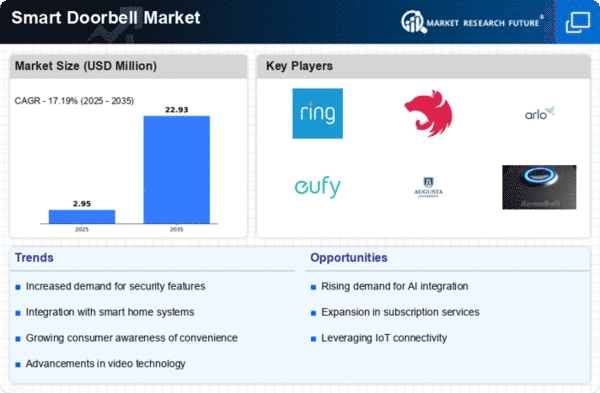
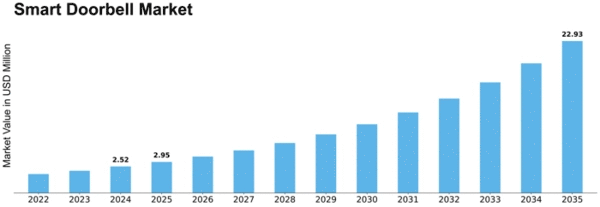
As per MRFR analysis, the Smart Doorbell Market Size was estimated at 2.52 USD Million in 2024. The Smart Doorbell industry is projected to grow from 3.01 USD Million in 2025 to 22.93 USD Million by 2035, exhibiting a compound annual growth rate (CAGR) of 17.19% during the forecast period 2025 - 2035.

Key Market Trends & Highlights

The Smart Doorbell Market is experiencing robust growth driven by technological advancements and increasing consumer demand for security solutions.

  • The integration of smart doorbells with broader smart home ecosystems is becoming increasingly prevalent in North America. Enhanced security features are a primary focus, particularly in the home security segment, which remains the largest market. Sustainability and energy efficiency are gaining traction, especially in the Asia-Pacific region, which is the fastest-growing market. Rising demand for home security solutions and technological advancements in smart doorbell features are key drivers propelling market growth.

Market Size & Forecast

2024 Market Size 2.52 (USD Million)
2035 Market Size 22.93 (USD Million)
CAGR (2025 - 2035) 17.19%
Largest Regional Market Share in 2024 North America

Major Players

<p>Ring (US), Nest (US), Arlo (US), Eufy (CN), August (US), RemoBell (US), TMEZON (US), Amcrest (US), SkyBell (US)</p>

Market Trends

The Smart Doorbell Market is currently experiencing a notable transformation, driven by advancements in technology and increasing consumer demand for enhanced home security solutions. As households become more connected, the integration of smart devices into everyday life appears to be a growing trend. Smart doorbells, equipped with features such as high-definition video, two-way audio, and motion detection, are becoming essential components of modern home security systems. This shift reflects a broader movement towards smart home automation, where convenience and safety are paramount. Moreover, the rising awareness of home security issues, coupled with the desire for remote monitoring capabilities, suggests that consumers are increasingly inclined to invest in smart doorbell technology. The market is likely to witness further innovations, including improved artificial intelligence functionalities and seamless integration with other smart home devices. As a result, manufacturers are focusing on enhancing user experience and expanding product offerings to cater to diverse consumer preferences. The Smart Doorbell Market is poised for continued growth, driven by these evolving consumer needs and technological advancements.

Integration with Smart Home Ecosystems

The Smart Doorbell Market is witnessing a trend towards integration with broader smart home ecosystems. Consumers increasingly prefer devices that can seamlessly connect with other smart technologies, such as security cameras, lighting systems, and home assistants. This interconnectedness enhances user convenience and allows for more comprehensive home security solutions.

Focus on Enhanced Security Features

There is a growing emphasis on advanced security features within the Smart Doorbell Market. Features such as facial recognition, package detection, and real-time alerts are becoming more prevalent. These enhancements not only improve safety but also provide users with greater peace of mind, making smart doorbells a preferred choice for many.

Sustainability and Energy Efficiency

Sustainability is emerging as a significant consideration in the Smart Doorbell Market. Manufacturers are increasingly focusing on energy-efficient designs and eco-friendly materials. This trend reflects a broader societal shift towards environmental consciousness, as consumers seek products that align with their values regarding sustainability.

Smart Doorbell Market Market Drivers

Market Growth Projections

The Global Smart Doorbell Market Industry is projected to experience remarkable growth in the coming years. With an anticipated market value of 1.25 USD Billion in 2024, the industry is set to expand significantly, reaching an estimated 25.6 USD Billion by 2035. This growth trajectory suggests a robust compound annual growth rate (CAGR) of 31.58% from 2025 to 2035. Such projections indicate a strong consumer demand for smart doorbells, driven by factors such as technological advancements, increased urbanization, and heightened security concerns. The market's expansion reflects the evolving landscape of home security solutions and the increasing integration of smart technologies.

Rising Demand for Home Security Solutions

The Global Smart Doorbell Market Industry experiences a notable surge in demand for enhanced home security solutions. As homeowners increasingly prioritize safety, smart doorbells equipped with video surveillance and motion detection features become essential. This trend is underscored by the projected market value of 1.25 USD Billion in 2024, reflecting a growing consumer inclination towards smart home technologies. The integration of advanced features such as two-way audio and cloud storage further enhances the appeal of these devices, making them a preferred choice for security-conscious consumers. Consequently, the industry is poised for substantial growth as more households adopt these innovative solutions.

Growing Urbanization and Population Density

Urbanization and increasing population density significantly influence the Global Smart Doorbell Market Industry. As more individuals move to urban areas, the need for enhanced security solutions becomes paramount. Smart doorbells offer a practical response to the challenges posed by densely populated environments, where traditional security measures may fall short. The convenience of remote monitoring and the ability to interact with visitors from anywhere provide urban dwellers with peace of mind. This demographic shift is likely to drive demand for smart doorbells, as urban residents seek innovative solutions to enhance their home security in increasingly crowded living conditions.

Increased Adoption of Smart Home Ecosystems

The Global Smart Doorbell Market Industry benefits from the rising adoption of comprehensive smart home ecosystems. As consumers seek seamless integration of various smart devices, smart doorbells serve as a critical component of these ecosystems. The ability to connect with other smart devices, such as security cameras and smart locks, enhances the overall user experience. This interconnectedness not only improves convenience but also elevates security measures within households. As more consumers invest in smart home technologies, the demand for smart doorbells is expected to rise, further propelling the industry forward and contributing to a projected CAGR of 31.58% from 2025 to 2035.

Technological Advancements in Smart Home Devices

Technological advancements play a pivotal role in driving the Global Smart Doorbell Market Industry. Innovations such as artificial intelligence, machine learning, and improved connectivity options significantly enhance the functionality of smart doorbells. These advancements enable features like facial recognition and real-time alerts, which are increasingly appealing to consumers. As the market evolves, manufacturers are likely to incorporate cutting-edge technologies to differentiate their products. This focus on innovation is expected to contribute to the industry's projected growth, with an estimated market value of 25.6 USD Billion by 2035, indicating a robust trajectory fueled by continuous technological enhancements.

Consumer Awareness and Education on Smart Technologies

Consumer awareness and education regarding smart technologies are crucial drivers of the Global Smart Doorbell Market Industry. As individuals become more informed about the benefits of smart home devices, including energy efficiency and enhanced security, the adoption of smart doorbells is expected to rise. Educational initiatives by manufacturers and industry associations play a vital role in demystifying these technologies, making them more accessible to the average consumer. This growing awareness is likely to translate into increased sales and market growth, as consumers recognize the value of integrating smart doorbells into their homes.


Market Segment Insights

By Application: Home Security (Largest) vs. Package Delivery (Fastest-Growing)

<p>In the Smart Doorbell Market, the application segment showcases a diverse distribution of market share among its key players. Home Security emerges as the most substantial component, appealing to consumers' need for enhanced safety and surveillance. Following closely are Package Delivery and Visitor Notification, which cater to the growing demand for convenient and secure parcel management and real-time visitor alerts, respectively. Remote Monitoring, while also an essential application, holds a smaller percentage of the overall market share. The growth trends within the Smart Doorbell application segment are largely driven by advancements in technology and changing consumer preferences. As online shopping increases, the need for reliable package delivery solutions has accelerated the adoption of smart doorbells, making it the fastest-growing application. Additionally, heightened concerns about home security combined with technological innovations in remote monitoring are propelling these devices to new heights, solidifying their position in home automation systems.</p>

<p>Home Security (Dominant) vs. Remote Monitoring (Emerging)</p>

<p>Home Security stands as the dominant application in the Smart Doorbell Market, with its primary appeal lying in its ability to bolster residential safety. Consumers are increasingly opting for smart doorbells equipped with high-definition cameras and motion detection capabilities, allowing them to monitor their properties proactively. In contrast, Remote Monitoring is an emerging segment that is gaining traction among tech-savvy users. This segment focuses on providing homeowners with the ability to manage their security systems remotely via smartphones or other devices. The integration of cloud storage and advanced analytics is enhancing the functionalities of remote monitoring solutions, making them appealing to those seeking convenient and flexible security options. As both segments evolve, the synergy between them is likely to enhance user experience further.</p>

By Technology: Wi-Fi (Largest) vs. Battery-Powered (Fastest-Growing)

<p>The Smart Doorbell Market is significantly influenced by technological advancements, with Wi-Fi technology holding the largest market share among segment values. Its seamless connectivity and integration with home automation systems make Wi-Fi doorbells the preferred choice for many consumers. Battery-powered models, while holding less overall market share, are rapidly gaining traction due to their ease of installation and flexibility without the need for wired connections, appealing to a broader audience. In terms of growth trends, battery-powered smart doorbells are the fastest-growing segment, driven by increasing demand for user-friendly solutions in regions where wiring may not be feasible. The trend toward smart home technology integration further propels this growth, as consumers seek more convenient and adaptive security solutions for their homes, shifting preferences towards innovative and hassle-free installations.</p>

<p>Technology: Wi-Fi (Dominant) vs. Battery-Powered (Emerging)</p>

<p>Wi-Fi smart doorbells dominate the Smart Doorbell Market due to their strong connectivity and compatibility with various smart home devices, which enhances their appeal. They are favored for their ability to provide real-time alerts and video streaming capabilities, allowing homeowners to monitor visitors remotely. However, battery-powered doorbells are emerging as a competitive alternative, particularly for those who prioritize ease of installation and flexibility. These models are typically designed with advanced conservation technology to extend battery life while offering similar functionalities as wired models. As consumers become increasingly aware of smart home automation, the demand for battery-powered doorbells continues to rise, making them a notable player in the market.</p>

By End User: Residential (Largest) vs. Commercial (Fastest-Growing)

<p>The Smart Doorbell Market has seen a diverse distribution among its end users, with the residential segment holding a significant share compared to commercial and institutional segments. The residential market is primarily driven by homeowners seeking enhanced security and convenience, while commercial spaces are increasingly recognizing the need for advanced surveillance solutions. Institutional users, although smaller in number, contribute to specialized demand for durable and high-performance doorbells suitable for educational and healthcare facilities.</p>

<p>End User: Residential (Dominant) vs. Commercial (Emerging)</p>

<p>The residential sector remains dominant in the Smart Doorbell Market, characterized by a widespread adoption of smart home technologies among homeowners. Consumers are prioritizing safety and ease of use, leading to a steady demand for doorbells equipped with features like HD video, two-way audio, and connectivity with home automation systems. In contrast, the commercial segment is emerging rapidly, fueled by businesses keen on adopting smart technology for improved security and operational efficiency. Commercial applications require advanced functionalities like network integration and enhanced surveillance capabilities, positioning them as a significant growth driver in the market.</p>

By Features: Video Recording (Largest) vs. Two-Way Audio (Fastest-Growing)

<p>In the Smart Doorbell Market, video recording holds a dominant position, accounting for the largest share among the various features. This segment appeals to consumers for its ability to provide clear visual evidence of doorstep activities, enhancing security. In contrast, two-way audio is rapidly gaining traction as its share increases markedly, propelled by heightened consumer demand for interactive communication with visitors at the door.</p>

<p>Video Recording (Dominant) vs. Motion Detection (Emerging)</p>

<p>Video recording represents the dominant feature within the smart doorbell market, enabling homeowners to capture visual records of their front entrances. Its popularity stems from consumer desire for enhanced security and peace of mind. Conversely, motion detection is an emerging feature that is gaining prominence. Often integrated with smart notifications, it alerts users to potential movements, enhancing the utility of smart doorbells. This feature complements video recording by allowing users to respond to events proactively, thus offering a comprehensive security solution.</p>

By Price Range: Economical (Largest) vs. Premium (Fastest-Growing)

<p>In the Smart Doorbell Market, the distribution of market share among price segments reveals that Economical smart doorbells hold the largest share, appealing to budget-conscious consumers seeking basic security features. Mid-Range models capture a significant portion as well, providing a balance between affordability and advanced functionality. Premium smart doorbells, although smaller in current market share, are rapidly gaining traction. The growth trends show a clear demand shift towards Premium smart doorbells, driven by increasing consumer interest in advanced features like video analytics, smart home integration, and superior design. Innovations and technological advancements are attracting more buyers willing to invest in high-quality security solutions, indicating a strong potential for the Premium segment to grow in the near future.</p>

<p>Economical: Budget-Friendly (Dominant) vs. Premium: Advanced Features (Emerging)</p>

<p>The Economical segment in the Smart Doorbell Market is characterized by its accessibility and affordability, making it the top choice for consumers seeking basic security without high costs. These models typically offer essential functions such as motion detection, app notifications, and basic video capabilities. They appeal to a wide audience, particularly in first-time buyers and those not heavily invested in smart home ecosystems. On the other hand, the Premium segment, though currently smaller, is emerging strongly as consumers become more tech-savvy. Premium smart doorbells are equipped with cutting-edge features like HD video quality, two-way audio, enhanced security protocols, and seamless integration with smart home systems. As the market evolves, Premium options are increasingly perceived as investments that offer enhanced safety and convenience.</p>

Get more detailed insights about Smart Doorbell Market Research Report - Global Forecast till 2035

Regional Insights

North America : Market Leader in Smart Doorbells

North America continues to lead the Smart Doorbell Market, holding a significant share of 1.26 billion. The growth is driven by increasing consumer demand for home security solutions, technological advancements, and favorable regulatory frameworks. The rise in smart home adoption and the integration of AI features in doorbells are key trends fueling this market expansion. Additionally, government initiatives promoting smart home technologies further enhance market growth. The competitive landscape in North America is robust, with key players like Ring, Nest, and Arlo dominating the market. These companies are continuously innovating, introducing new features such as facial recognition and two-way audio. The U.S. market is particularly strong, supported by a high penetration rate of smart devices. As consumer awareness of security solutions increases, the presence of established brands and new entrants is expected to intensify competition, driving further advancements in the sector.

Europe : Emerging Market with Growth Potential

Europe is witnessing a growing interest in smart doorbells, with a market size of 0.75 billion. The demand is driven by increasing urbanization, rising security concerns, and a shift towards smart home technologies. Regulatory support for energy-efficient and secure home solutions is also a catalyst for growth. Countries like Germany and the UK are leading this trend, with consumers increasingly prioritizing smart security features in their homes. The competitive landscape in Europe is characterized by a mix of established brands and emerging players. Companies like Eufy and August are gaining traction, offering innovative solutions tailored to European consumers. The market is also seeing collaborations between tech firms and security service providers, enhancing product offerings. As the region embraces smart home technology, the presence of key players is expected to expand, further driving market growth.

Asia-Pacific : Rapid Growth in Smart Technologies

The Asia-Pacific region is emerging as a significant player in the Smart Doorbell Market, with a market size of 0.4 billion. The growth is fueled by increasing disposable incomes, urbanization, and a rising awareness of home security solutions. Countries like China and Japan are at the forefront, with consumers increasingly adopting smart technologies. Government initiatives promoting smart city projects are also contributing to market expansion, creating a favorable environment for smart doorbell adoption. The competitive landscape in Asia-Pacific is diverse, with both local and international players vying for market share. Eufy and other regional brands are gaining popularity, offering affordable yet feature-rich products. The presence of key players is expected to grow as consumer preferences shift towards integrated smart home solutions. As the market matures, innovation and competitive pricing will be crucial for success in this rapidly evolving landscape.

Middle East and Africa : Emerging Market with Untapped Potential

The Middle East and Africa region is in the early stages of adopting smart doorbell technology, with a market size of 0.11 billion. The growth is driven by increasing urbanization, rising security concerns, and a growing middle class. As more consumers seek advanced security solutions, the demand for smart doorbells is expected to rise. Government initiatives aimed at enhancing smart city infrastructure are also contributing to market growth, creating opportunities for innovation in this sector. The competitive landscape in the region is still developing, with a mix of local and international players entering the market. Companies are focusing on educating consumers about the benefits of smart doorbells, which is crucial for market penetration. As awareness increases and technology becomes more accessible, the presence of key players is expected to expand, driving further growth in the smart doorbell market.

Key Players and Competitive Insights

The Smart Doorbell Market is currently characterized by a dynamic competitive landscape, driven by technological advancements and increasing consumer demand for home security solutions. Major players such as Ring (US), Nest (US), and Arlo (US) are at the forefront, each adopting distinct strategies to enhance their market presence. Ring (US) focuses on innovation through continuous product enhancements and integration with smart home ecosystems, while Nest (US) leverages its strong brand reputation and Google’s backing to expand its product offerings. Arlo (US) emphasizes user-friendly designs and advanced features, positioning itself as a leader in high-definition video quality and cloud storage solutions. Collectively, these strategies contribute to a competitive environment that is increasingly centered around technological differentiation and customer-centric innovations.

Key business tactics within the Smart Doorbell Market include localizing manufacturing and optimizing supply chains to enhance efficiency and reduce costs. The market structure appears moderately fragmented, with several key players holding substantial market shares while numerous smaller companies also compete. This fragmentation allows for a diverse range of products and price points, catering to various consumer preferences and needs. The collective influence of these key players shapes market dynamics, as they continuously innovate and adapt to changing consumer demands.

In November 2025, Ring (US) announced the launch of its latest smart doorbell model, which features enhanced AI capabilities for facial recognition and package detection. This strategic move is significant as it not only reinforces Ring's commitment to innovation but also addresses growing consumer concerns regarding package theft, thereby potentially increasing its market share. The integration of advanced AI technology positions Ring to better compete against rivals by offering unique features that enhance user experience and security.

In October 2025, Nest (US) unveiled a new subscription service that provides users with enhanced cloud storage options and advanced analytics for their doorbell cameras. This initiative is strategically important as it not only generates recurring revenue but also strengthens customer loyalty by offering added value. By enhancing its service offerings, Nest aims to differentiate itself in a crowded market, appealing to consumers who prioritize data security and accessibility.

In September 2025, Arlo (US) entered into a partnership with a leading home automation platform to integrate its smart doorbells with a broader range of smart home devices. This collaboration is crucial as it expands Arlo's ecosystem, allowing users to seamlessly connect their doorbells with other smart devices. Such strategic alliances are likely to enhance Arlo's competitive positioning by providing a more comprehensive solution for consumers seeking integrated smart home experiences.

As of December 2025, current competitive trends in the Smart Doorbell Market are heavily influenced by digitalization, sustainability, and AI integration. The emphasis on strategic alliances is reshaping the landscape, enabling companies to leverage complementary strengths and enhance their product offerings. Looking ahead, competitive differentiation is expected to evolve, with a notable shift from price-based competition towards innovation, technology, and supply chain reliability. Companies that prioritize these aspects are likely to gain a competitive edge in an increasingly sophisticated market.

Key Companies in the Smart Doorbell Market include

Industry Developments

According to a news published in 2024, Xalient’s customer, Abode, a leading provider of DIY smart home security solutions, has been recognized for their innovative new product, the Abode Edge Camera. The Abode Edge Camera has Xailient AI running inside it which can observe things like package delivery or people who do not belong there and filter out regular activities such as family members coming and going or natural movements that simple cameras may mistake for something else.

In 2022 Google released the 2nd generation wired Nest Doorbell. Google's second-generation Nest Doorbell has a wire which gives it an advantage over its battery-powered ones; it is approximately thirty percent smaller than its predecessor’s wired variant.

In December 2021, Irida Labs, a European AI vision solution provider, partnered with Hikvision.

In November 2021, Latch, Inc. announced a partnership with Marks USA, as well as Town Steel, Inc., coupled with another imminent partnership with dormakaba Holding AG. These series of developments are expected to increase the adoption of LatchOS among new visitors, tenants as well as property managers.

Vivint Smart Home Inc made an announcement that in July 2021 it entered into a strategic alliance with Freedom Forever.

Future Outlook

Smart Doorbell Market Future Outlook

<p>The Smart Doorbell Market is projected to grow at a 17.19% CAGR from 2024 to 2035, driven by technological advancements, increased security concerns, and smart home integration.</p>

New opportunities lie in:

  • <p>Expansion into AI-driven facial recognition features</p>
  • <p>Partnerships with home security service providers</p>
  • <p>Development of subscription-based cloud storage solutions for video footage</p>

<p>By 2035, the market is expected to be robust, reflecting substantial growth and innovation.</p>

Market Segmentation

Smart Doorbell Market End User Outlook

  • Residential
  • Commercial
  • Institutional

Smart Doorbell Market Features Outlook

  • Video Recording
  • Two-Way Audio
  • Motion Detection
  • Night Vision

Smart Doorbell Market Technology Outlook

  • Wi-Fi
  • Wired
  • Battery-Powered
  • Smartphone Integration

Smart Doorbell Market Application Outlook

  • Home Security
  • Package Delivery
  • Visitor Notification
  • Remote Monitoring

Smart Doorbell Market Price Range Outlook

  • Economical
  • Mid-Range
  • Premium

Report Scope

MARKET SIZE 2024 2.52(USD Million)
MARKET SIZE 2025 3.01(USD Million)
MARKET SIZE 2035 22.93(USD Million)
COMPOUND ANNUAL GROWTH RATE (CAGR) 17.19% (2024 - 2035)
REPORT COVERAGE Revenue Forecast, Competitive Landscape, Growth Factors, and Trends
BASE YEAR 2024
Market Forecast Period 2025 - 2035
Historical Data 2019 - 2024
Market Forecast Units USD Million
Key Companies Profiled Ring (US), Nest (US), Arlo (US), Eufy (CN), August (US), RemoBell (US), TMEZON (US), Amcrest (US), SkyBell (US)
Segments Covered Application, Technology, End User, Features, Price Range
Key Market Opportunities Integration of artificial intelligence enhances security features in the Smart Doorbell Market.
Key Market Dynamics Rising consumer demand for enhanced security features drives innovation and competition in the Smart Doorbell Market.
Countries Covered North America, Europe, APAC, South America, MEA

FAQs

What is the growth rate of smart doorbell market?

At 17.20% CAGR, the global market of the smart doorbell can value at USD 15.9 Billion by 2032.

What are the key players of the smart doorbell market?

Shenzhen VStarcam Technology Co., Ltd, SkyBell Technologies Inc., and Ring Inc. are some reputed companies in the smart doorbell market.

What is the historical value of the smart doorbell market?

In 2024, the smart doorbell market was valued at 1.25 Bn.

What are the smart doorbell market drivers?

Launch of innovative home security solutions can impel the smart doorbell market.

What is the regional analysis of the smart doorbell market?

The APAC smart doorbell market can thrive at the highest CAGR by 2030.

  1. SECTION I: EXECUTIVE SUMMARY AND KEY HIGHLIGHTS |
    1. EXECUTIVE SUMMARY 2
  2. SECTION II: SCOPING, METHODOLOGY AND MARKET STRUCTURE |
    1. MARKET INTRODUCTION |
    2. RESEARCH METHODOLOGY 3
  3. SECTION III: QUALITATIVE ANALYSIS |
    1. MARKET DYNAMICS |
    2. MARKET FACTOR ANALYSIS 4
  4. SECTION IV: QUANTITATIVE ANALYSIS |
    1. Semiconductor & Electronics, BY Application (USD Million) |
    2. Semiconductor & Electronics, BY Technology (USD Million) |
    3. Semiconductor & Electronics, BY End User (USD Million) |
    4. Semiconductor & Electronics, BY Features (USD Million) |
    5. Semiconductor & Electronics, BY Price Range (USD Million) |
    6. Semiconductor & Electronics, BY Region (USD Million) 5
  5. SECTION V: COMPETITIVE ANALYSIS |
    1. Competitive Landscape |
    2. Company Profiles |
    3. Appendix

Smart Doorbell Market Segmentation

Market Segmentation Overview

  • Detailed segmentation data will be available in the full report
  • Comprehensive analysis by multiple parameters
  • Regional and country-level breakdowns
  • Market size forecasts by segment
Infographic

Free Sample Request

Kindly complete the form below to receive a free sample of this Report

Get Free Sample

Customer Strories

Compare Licence

×
Features License Type
Single User Multiuser License Enterprise User
Price $4,950 $5,950 $7,250
Maximum User Access Limit 1 User Upto 10 Users Unrestricted Access Throughout the Organization
Free Customization
Direct Access to Analyst
Deliverable Format
Platform Access
Discount on Next Purchase 10% 15% 15%
Printable Versions