Request Free Sample ×

Kindly complete the form below to receive a free sample of this Report

* Please use a valid business email

Leading companies partner with us for data-driven Insights

clients tt-cursor
Hero Background
English
Chinese
French
Japanese
Korean
German
Spanish

Smart Biosensors Market Size

ID: MRFR/HC/6331-HCR
85 Pages
Vikita Thakur
Last Updated: April 06, 2026

Global Smart Biosensors Market Research Report Information by Product Type (Wearable Biosensors, Non-wearable Biosensors), Technology (Electrochemical Biosensors, Others), Application (Drug Discovery, Others), End User (Point-Of-Care & Others)—Global Forecast till 2035.

Share:
Download PDF ×

We do not share your information with anyone. However, we may send you emails based on your report interest from time to time. You may contact us at any time to opt-out.

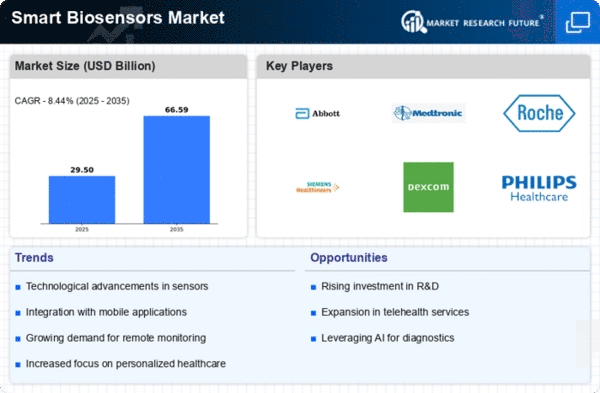
Smart Biosensors Market Infographic
Purchase Options

Smart Biosensors Size

Smart Biosensors Market Growth Projections and Opportunities

The Smart Biosensors market is seeing a popularity surge because of the rising popularity of wearable wellbeing gadgets. These sensors assume a pivotal part in observing different health boundaries, for example, glucose levels, pulse, and hydration, adding to the rising reception of wearable wellness trackers and smartwatches. The universality of constant infections is on the rise universally, prompting an elevated spotlight on compelling illness management. Smart Biosensors assume a significant part in nonstop observing of essential signs and biomarkers, offering important information for overseeing persistent circumstances like diabetes, cardiovascular illnesses, and respiratory issues. The joining of Smart Biosensors with the Web of Things (IoT) is a key market factor. This availability permits consistent information move to smartphones or different gadgets, empowering remote observing and giving medical care experts continuous data. This interconnection upgrades patient consideration and adds to the development of the biosensors market. Smart Biosensors are tracking down applications past medical care, adding to their market extension. Enterprises like natural checking, food and drink, and guard are progressively using biosensors for classifying toxins, guaranteeing sanitation, and upgrading safety efforts. As innovation advances, the expense of assembling Smart Biosensors is diminishing. This cost decrease is making biosensors more open to a more extensive market, including customers and limited scope medical services offices, further driving market development. The worldwide segment shift towards a maturing populace is intensifying the interest for medical care arrangements. Smart Biosensors are becoming fundamental in geriatric consideration, supporting persistent wellbeing observing and early location old enough related conditions, accordingly adding to the market's extension. The pattern towards decentralized medical services and purpose in care testing is helping the reception of Smart Biosensors. These sensors give fast and solid outcomes, diminishing the reliance on united labs and empowering quick dynamic in different medical services settings.
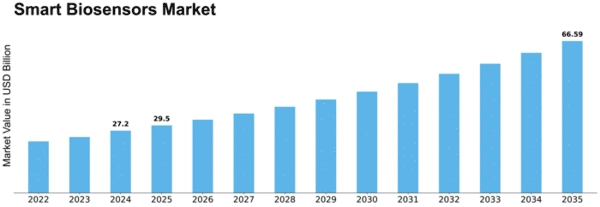
Smart Biosensors Market Size Graph
Author
Author Profile
Vikita Thakur
Senior Research Analyst

She holds an experience of about 5+ years in market research and business consulting projects for sectors such as life sciences, medical devices, and healthcare IT. She possesses a robust background in data analysis, market estimation, competitive intelligence, pipeline analysis market trend identification, and consumer behavior insights. Her expertise lies in technical Sales support, client interaction and project management, designing and implementing market research studies, conducting competitive analysis, and synthesizing complex data into actionable recommendations that drive business growth.

Leave a Comment

FAQs

What is the projected market valuation of the Smart Biosensors Market by 2035?

<p>The Smart Biosensors Market is projected to reach a valuation of 66.59 USD Billion by 2035.</p>

What was the market valuation of the Smart Biosensors Market in 2024?

<p>In 2024, the Smart Biosensors Market was valued at 27.2 USD Billion.</p>

What is the expected CAGR for the Smart Biosensors Market during the forecast period 2025 - 2035?

<p>The expected CAGR for the Smart Biosensors Market during the forecast period 2025 - 2035 is 8.44%.</p>

Which companies are considered key players in the Smart Biosensors Market?

<p>Key players in the Smart Biosensors Market include Abbott Laboratories, Medtronic, Roche Diagnostics, Siemens Healthineers, and Dexcom.</p>

What are the projected values for Glucose Monitoring in the Smart Biosensors Market by 2035?

<p>The projected value for Glucose Monitoring in the Smart Biosensors Market is expected to reach 12.0 USD Billion by 2035.</p>

How does the market for Infectious Disease Diagnosis compare to other applications by 2035?

By 2035, the market for Infectious Disease Diagnosis is projected to reach 16.0 USD Billion, indicating strong growth compared to other applications.

What is the anticipated market size for Wearable Biosensors by 2035?

The anticipated market size for Wearable Biosensors is expected to reach 15.0 USD Billion by 2035.

What segment is expected to dominate the Smart Biosensors Market by end use in 2035?

By 2035, the Healthcare segment is expected to dominate the Smart Biosensors Market, projected to reach 25.0 USD Billion.

What is the projected value of Optical Biosensors by 2035?

The projected value of Optical Biosensors in the Smart Biosensors Market is expected to reach 15.0 USD Billion by 2035.

What are the expected trends in the Smart Biosensors Market regarding implantable biosensors by 2035?

Implantable Biosensors are expected to see significant growth, with a projected market value of 20.0 USD Billion by 2035.

Market Summary

As per MRFR analysis, the Smart Biosensors Market Size was estimated at 27.2 USD Billion in 2024. The Smart Biosensors industry is projected to grow from 29.8 USD Billion in 2025 to 66.59 USD Billion by 2035, exhibiting a compound annual growth rate (CAGR) of 8.44% during the forecast period 2025 - 2035.

Key Market Trends & Highlights

The Smart Biosensors Market is poised for substantial growth driven by technological advancements and increasing healthcare demands.

  • The integration with wearable technology is enhancing the functionality and appeal of smart biosensors in various applications.
  • Advancements in data analytics are enabling more accurate and timely health monitoring through smart biosensors.
  • Point-of-care testing is gaining traction, particularly in North America, as it offers immediate results and convenience for patients.
  • Rising demand for personalized medicine and increasing prevalence of chronic diseases are key drivers propelling the market forward.

Market Size & Forecast

2024 Market Size 27.2 (USD Billion)
2035 Market Size 66.59 (USD Billion)
CAGR (2025 - 2035) 8.44%
Largest Regional Market Share in 2024 North America

Major Players

Abbott Laboratories (US), Medtronic (US), Roche Diagnostics (CH), Siemens Healthineers (DE), Dexcom (US), Philips Healthcare (NL), Biosense Webster (US), Acon Laboratories (US), NantHealth (US)

Market Trends

The Smart Biosensors Market is currently experiencing a transformative phase, characterized by rapid advancements in technology and increasing demand for personalized healthcare solutions. These biosensors, which integrate biological components with electronic systems, are becoming essential tools in various applications, including disease diagnosis, monitoring, and management. The convergence of miniaturization, connectivity, and data analytics is driving innovation, enabling real-time health monitoring and enhancing patient outcomes. As healthcare systems evolve, the integration of smart biosensors into clinical practices appears to be a pivotal development, potentially reshaping the landscape of medical diagnostics and treatment. Moreover, the growing emphasis on preventive healthcare and the rising prevalence of chronic diseases are likely to propel the Smart Biosensors Market further. Stakeholders, including healthcare providers and technology developers, are increasingly focusing on creating user-friendly devices that facilitate seamless data collection and analysis. This trend suggests a shift towards more proactive health management, where individuals can monitor their health status continuously. The ongoing research and development efforts in this sector indicate a promising future, with the potential for smart biosensors to play a crucial role in enhancing healthcare delivery and improving quality of life.

Integration with Wearable Technology

The Smart Biosensors Market is witnessing a notable trend towards the integration of biosensors with wearable technology. This convergence allows for continuous health monitoring, enabling users to track vital signs and other health metrics in real-time. Such devices not only enhance user engagement but also facilitate timely interventions, thereby improving health outcomes.

Advancements in Data Analytics

Another significant trend in the Smart Biosensors Market is the advancement of data analytics capabilities. Enhanced algorithms and machine learning techniques are being employed to analyze the vast amounts of data generated by biosensors. This development enables more accurate predictions and personalized health insights, which could lead to better management of chronic conditions.

Focus on Point-of-Care Testing

The emphasis on point-of-care testing is increasingly shaping the Smart Biosensors Market. This trend reflects a growing preference for rapid diagnostic solutions that can be deployed outside traditional laboratory settings. By providing immediate results, point-of-care biosensors are likely to enhance decision-making processes in clinical environments.

Smart Biosensors Market Market Drivers

Market Growth Projections

The Global Smart Biosensors Market Industry is poised for substantial growth, with projections indicating a market value of 10.3 USD Billion in 2024 and an anticipated increase to 33.2 USD Billion by 2035. This growth trajectory suggests a compound annual growth rate of 11.25% from 2025 to 2035, reflecting the increasing adoption of biosensor technologies across various applications. Factors such as rising healthcare expenditures, advancements in biosensor technology, and growing consumer awareness about health monitoring are likely to drive this expansion. The market's evolution indicates a promising future for smart biosensors, positioning them as integral components of modern healthcare.

Growing Focus on Personalized Medicine

The Global Smart Biosensors Market Industry is significantly influenced by the growing focus on personalized medicine, which tailors medical treatment to individual characteristics. Smart biosensors enable healthcare providers to gather real-time data on patients, allowing for more precise and effective treatment plans. This shift towards personalized healthcare is driven by advancements in genomics and biotechnology, which emphasize the need for individualized approaches. As the demand for personalized medicine continues to rise, the market for smart biosensors is expected to expand, with a projected compound annual growth rate of 11.25% from 2025 to 2035, highlighting the potential for innovation in this sector.

Rising Demand for Wearable Health Devices

The Global Smart Biosensors Market Industry experiences a surge in demand for wearable health devices, which integrate biosensors for real-time health monitoring. These devices, such as smartwatches and fitness trackers, provide users with continuous data on vital signs, glucose levels, and other health metrics. The increasing prevalence of chronic diseases and the growing emphasis on preventive healthcare drive this demand. As a result, the market is projected to reach 10.3 USD Billion in 2024, reflecting a significant shift towards personalized health management. This trend indicates a broader acceptance of technology in healthcare, enhancing patient engagement and self-management.

Regulatory Support for Biosensor Development

Regulatory bodies are increasingly supporting the development and commercialization of smart biosensors within the Global Smart Biosensors Market Industry. Streamlined approval processes and guidelines for biosensor technologies encourage innovation and facilitate market entry for new products. For instance, regulatory frameworks that promote the use of biosensors in clinical settings enhance their credibility and acceptance among healthcare professionals. This supportive environment not only accelerates the introduction of novel biosensors but also fosters collaboration between industry stakeholders, including researchers, manufacturers, and healthcare providers, ultimately contributing to market growth.

Technological Advancements in Biosensor Design

Technological innovations play a crucial role in the Global Smart Biosensors Market Industry, leading to the development of more efficient and accurate biosensors. Advances in nanotechnology, microfabrication, and materials science have enabled the creation of biosensors that are smaller, more sensitive, and capable of detecting a wider range of biomarkers. For instance, the integration of lab-on-a-chip technology allows for rapid diagnostics in point-of-care settings. These advancements not only improve the performance of biosensors but also expand their applications across various fields, including diagnostics, environmental monitoring, and food safety, thereby driving market growth.

Increasing Investment in Healthcare Infrastructure

The Global Smart Biosensors Market Industry benefits from increasing investments in healthcare infrastructure, particularly in developing regions. Governments and private entities are recognizing the importance of advanced healthcare technologies to improve patient outcomes and streamline healthcare delivery. For example, initiatives aimed at enhancing telemedicine and remote patient monitoring are gaining traction, which necessitates the integration of smart biosensors. This investment trend is expected to contribute to the market's growth, with projections indicating a rise to 33.2 USD Billion by 2035. Enhanced healthcare infrastructure facilitates the adoption of biosensors, making them more accessible to a broader population.

Market Segment Insights

By Application: Glucose Monitoring (Largest) vs. Cardiovascular Monitoring (Fastest-Growing)

<p>The Smart Biosensors Market exhibits a diverse application landscape, with Glucose Monitoring leading the segment with the largest market share. This segment has seen consistent adoption in both clinical and home settings due to the rising prevalence of diabetes globally. Following closely is Cardiovascular Monitoring, which is gaining traction as healthcare providers increasingly leverage biosensors for real-time tracking of heart-related conditions. Other applications such as Cancer Detection and Infectious Disease Diagnosis also contribute significantly to market dynamics, showing potential for growth in specific healthcare contexts.</p>

<p>Glucose Monitoring (Dominant) vs. Cardiovascular Monitoring (Emerging)</p>

<p>Glucose Monitoring stands out as the dominant application in the Smart Biosensors Market primarily due to its pivotal role in diabetes management. This segment utilizes advanced biosensor technologies to provide patients with critical data on glucose levels, enhancing disease management and improving patient outcomes. In contrast, Cardiovascular Monitoring represents an emerging segment, rapidly gaining attention for its potential to revolutionize the monitoring of heart conditions. The advent of wearable biosensors that offer continuous monitoring and data analytics underpins its growth, fostering proactive healthcare management. As these technologies evolve, both segments are expected to play crucial roles in shaping the future of personalized health management.</p>

By End Use: Healthcare (Largest) vs. Fitness and Wellness (Fastest-Growing)

The Smart Biosensors Market is witnessing diverse adoption across various end-use sectors, with healthcare holding the largest share. This segment is propelled by the increasing demand for innovative monitoring solutions to enhance patient care and the ongoing shift towards personalized medicine. Research laboratories and pharmaceuticals also contribute significantly, driven by the need for precise testing and real-time data acquisition, while home care applications are rising due to the shift towards at-home health monitoring solutions. In contrast, the fitness and wellness segment is emerging as the fastest-growing category. This growth is fueled by the rising health consciousness among consumers, with more individuals seeking wearable biosensors for health tracking and performance monitoring. Additionally, technological advancements and the integration of biosensors into everyday fitness devices are driving this surge, making fitness and wellness a dynamic player in the Smart Biosensors Market.

Healthcare (Dominant) vs. Fitness and Wellness (Emerging)

In the Smart Biosensors Market, the healthcare segment stands as the dominant player, characterized by its extensive application in disease management, diagnostics, and patient monitoring. Healthcare biosensors are integral to telemedicine and chronic disease management, enhancing patient outcomes significantly. These sensors are robust, compliant with stringent regulations, and backed by substantial research and development, ensuring their reliability and efficacy. Conversely, the fitness and wellness segment is rapidly emerging, appealing to a broader consumer base interested in health optimization. Fitness biosensors often integrate seamlessly with mobile devices, offering real-time feedback on metrics like heart rate and activity levels. This user-centric design, coupled with the trend toward preventive healthcare, positions fitness biosensors as a formidable entry in the market, particularly among tech-savvy consumers.

By Technology: Wearable Biosensors (Largest) vs. Implantable Biosensors (Fastest-Growing)

<p>The Smart Biosensors Market exhibits a diverse landscape of technological innovations, with wearable biosensors leading in market share due to their increasing demand in personal health monitoring. Their convenience, combined with advancements in sensor technology, positions them at the forefront of consumer adoption. Conversely, implantable biosensors are rapidly gaining traction, representing the fastest-growing segment as healthcare providers and patients seek solutions for continuous monitoring of chronic conditions. Their capacity for real-time data collection is particularly appealing in the age of personalized medicine.</p>

<p>Technology: Wearable Biosensors (Dominant) vs. Implantable Biosensors (Emerging)</p>

<p>Wearable biosensors, such as fitness trackers and smartwatches, have become dominant in the Smart Biosensors Market due to their accessibility and consumer-friendly features. They enable users to track vital signs and health metrics easily, promoting a proactive approach to health management. In contrast, implantable biosensors, while still emerging, show immense potential as they cater to critical health needs, providing continuous monitoring for chronic illnesses without the inconvenience of external devices. Their integration with advanced technologies opens avenues for innovative healthcare solutions, setting a transformative path for future applications.</p>

By Product Type: Electrochemical Biosensors (Largest) vs. Optical Biosensors (Fastest-Growing)

<p>The Smart Biosensors Market is predominantly divided into five major segments: <a href="https://www.marketresearchfuture.com/reports/electrochemical-biosensors-market-2792" target="_blank" title="electrochemical biosensors">Electrochemical Biosensors</a>, Optical Biosensors, Thermal Biosensors, Piezoelectric Biosensors, and Nanomaterial-based Biosensors. Among these, Electrochemical Biosensors hold the largest share, being favored for their sensitivity and portability. They are widely used in medical diagnostics, food safety testing, and environmental monitoring. Conversely, Optical Biosensors, while currently smaller in market share, are recognized for their rapid growth due to advancements in technology that enhance their accuracy and real-time monitoring capabilities, impacting various applications in healthcare and security.</p>

<p>Electrochemical Biosensors (Dominant) vs. Optical Biosensors (Emerging)</p>

<p>Electrochemical Biosensors are the dominant players in the Smart Biosensors Market, known for their high sensitivity and ease of use in medical diagnostics and various industries. They detect analytes through electrochemical reactions, making them suitable for point-of-care testing and portable devices. On the other hand, Optical Biosensors represent an emerging segment that leverages light-based technologies to detect biological changes. Their growth is driven by increasing demand for non-invasive testing methods and real-time monitoring solutions. While Electrochemical Biosensors currently lead, Optical Biosensors are rapidly gaining traction, supported by technological innovations and higher accuracy in specific applications.</p>

By Component: Transducer (Largest) vs. Bioreceptor (Fastest-Growing)

<p>The Smart Biosensors Market is divided into several critical components, namely Transducer, Bioreceptor, Microprocessor, Display Unit, and Power Supply. Among these, the Transducer holds the largest share, serving as the essential element that converts biological responses into electrical signals. The Bioreceptor segment, however, is emerging rapidly, driven by advancements in biotechnology and the increasing demand for personalized medicine. Microprocessors, Display Units, and Power Supplies, while vital, are secondary to the performance and growth of Transducers and Bioreceptors.</p>

<p>Transducer (Dominant) vs. Bioreceptor (Emerging)</p>

<p>The Transducer segment stands out as the dominant force in the Smart Biosensors Market due to its critical role in ensuring accurate signal transduction. This component is typically composed of highly sensitive materials that enhance detection capabilities, influencing the overall performance of biosensors. Conversely, the Bioreceptor segment is gaining traction as an emerging player, spurred by innovation in synthetic biology and nanotechnology. These bioreceptors have the potential to detect a wide range of analytes, pushing the boundaries of application in medical diagnostics, environmental monitoring, and food safety. As technology evolves, both segments will likely showcase unique advantages, catering to different needs in the healthcare and industrial sectors.</p>

Get more detailed insights about Smart Biosensors Market Research Report - Global Forecast till 2032.

Regional Insights

North America : Market Leader in Innovation

North America is poised to maintain its leadership in the Smart Biosensors Market, holding a significant market share of 13.6 in 2024. The region's growth is driven by increasing healthcare expenditure, technological advancements, and a rising prevalence of chronic diseases. Regulatory support from agencies like the FDA further catalyzes innovation and market entry for new products, enhancing consumer access to advanced healthcare solutions. The competitive landscape in North America is robust, featuring key players such as Abbott Laboratories, Medtronic, and Dexcom. These companies are at the forefront of developing cutting-edge biosensor technologies, ensuring high-quality healthcare delivery. The U.S. remains the largest market, supported by a strong infrastructure for research and development, while Canada and Mexico are also emerging as significant contributors to market growth.

Europe : Emerging Market with Potential

Europe is witnessing a growing interest in the Smart Biosensors Market, with a market size of 7.2 in 2024. The region's growth is fueled by increasing awareness of preventive healthcare and the integration of digital health technologies. Regulatory frameworks, such as the EU Medical Device Regulation, are enhancing product safety and efficacy, thereby boosting consumer confidence and market demand. Leading countries in Europe include Germany, France, and the UK, where major players like Roche Diagnostics and Siemens Healthineers are actively innovating. The competitive landscape is characterized by collaborations and partnerships aimed at advancing biosensor technologies. The European market is expected to expand as healthcare systems increasingly adopt smart biosensors for better patient management and monitoring.

Asia-Pacific : Rapid Growth and Adoption

The Asia-Pacific region is emerging as a significant player in the Smart Biosensors Market, with a market size of 5.6 in 2024. The growth is driven by rising healthcare needs, increasing investments in healthcare infrastructure, and a growing aging population. Countries like China and India are witnessing rapid adoption of smart biosensors, supported by government initiatives aimed at enhancing healthcare delivery and accessibility. China and Japan are leading the charge in technological advancements, with key players like Philips Healthcare and Acon Laboratories making substantial contributions. The competitive landscape is evolving, with local startups entering the market, fostering innovation and competition. As the region continues to develop, the demand for smart biosensors is expected to rise significantly, driven by both consumer and healthcare provider needs.

Middle East and Africa : Emerging Market with Challenges

The Middle East and Africa region is gradually emerging in the Smart Biosensors Market, with a market size of 1.6 in 2024. The growth is primarily driven by increasing healthcare investments and a rising prevalence of chronic diseases. However, challenges such as limited healthcare infrastructure and regulatory hurdles remain. Governments are focusing on improving healthcare systems, which is expected to catalyze market growth in the coming years. Countries like South Africa and the UAE are leading the market, with key players beginning to establish a presence. The competitive landscape is still developing, with opportunities for both local and international companies to innovate and expand. As healthcare systems improve, the demand for smart biosensors is anticipated to grow, driven by the need for better patient monitoring and management solutions.

Key Players and Competitive Insights

The Smart Biosensors Market is currently characterized by a dynamic competitive landscape, driven by technological advancements and increasing demand for personalized healthcare solutions. Key players such as Abbott Laboratories (US), Medtronic (US), and Roche Diagnostics (CH) are strategically positioned to leverage innovation and partnerships to enhance their market presence. Abbott Laboratories (US) focuses on developing cutting-edge biosensor technologies that integrate seamlessly with digital health platforms, while Medtronic (US) emphasizes its commitment to expanding its product portfolio through strategic acquisitions and collaborations. Roche Diagnostics (CH) is actively investing in research and development to enhance its biosensor capabilities, thereby reinforcing its competitive edge in the market.The competitive structure of the Smart Biosensors Market appears moderately fragmented, with several players vying for market share. Companies are increasingly localizing manufacturing and optimizing supply chains to enhance operational efficiency and reduce costs. This trend is indicative of a broader strategy among key players to adapt to regional market demands while maintaining a competitive edge. The collective influence of these companies shapes the market dynamics, fostering an environment where innovation and strategic partnerships are paramount.

In November Abbott Laboratories (US) announced the launch of its latest continuous glucose monitoring system, which integrates advanced biosensor technology with AI-driven analytics. This strategic move is significant as it not only enhances patient engagement but also positions Abbott as a leader in the diabetes management segment. The integration of AI is likely to improve the accuracy of glucose readings, thereby providing patients with more reliable data for managing their health.

In October Medtronic (US) completed the acquisition of a promising biosensor startup, which specializes in wearable health monitoring devices. This acquisition is pivotal as it allows Medtronic to diversify its product offerings and tap into the growing demand for wearable health technologies. By incorporating innovative biosensor solutions, Medtronic aims to enhance its competitive positioning in the market and address the evolving needs of healthcare providers and patients alike.

In September Roche Diagnostics (CH) unveiled a new biosensor platform designed for rapid diagnostics in infectious diseases. This development is crucial as it underscores Roche's commitment to addressing urgent healthcare challenges through innovative solutions. The platform's ability to deliver quick and accurate results could significantly impact patient outcomes and solidify Roche's reputation as a leader in diagnostic technologies.

As of December the Smart Biosensors Market is witnessing trends such as digitalization, sustainability, and the integration of AI technologies. Strategic alliances among key players are increasingly shaping the competitive landscape, fostering collaboration that enhances innovation and market reach. Looking ahead, competitive differentiation is likely to evolve, with a pronounced shift from price-based competition to a focus on technological innovation, reliability of supply chains, and the development of sustainable solutions. This evolution suggests that companies that prioritize these aspects will be better positioned to thrive in the rapidly changing market.

Key Companies in the Smart Biosensors Market include

Industry Developments

Future Outlook

Smart Biosensors Market Future Outlook

The Smart Biosensors Market is projected to grow at an 8.44% CAGR from 2025 to 2035, driven by technological advancements, increasing healthcare demands, and rising chronic diseases.

New opportunities lie in:

  • Integration of AI for predictive analytics in biosensor applications.
  • Development of wearable biosensors for continuous health monitoring.
  • Expansion into emerging markets with tailored biosensor solutions.

By 2035, the Smart Biosensors Market is expected to achieve substantial growth, driven by innovation and strategic market expansion.

Market Segmentation

Smart Biosensors Market End Use Outlook

  • Healthcare
  • Research Laboratories
  • Home Care
  • Fitness and Wellness
  • Pharmaceutical

Smart Biosensors Market Component Outlook

  • Transducer
  • Sensor
  • Microcontroller
  • Power Supply
  • Data Transmission Module

Smart Biosensors Market Technology Outlook

  • Electrochemical
  • Optical
  • Piezoelectric
  • Thermal
  • Magnetic

Smart Biosensors Market Application Outlook

  • Glucose Monitoring
  • Cardiovascular Monitoring
  • Cancer Detection
  • Infectious Disease Diagnosis
  • Neurological Monitoring

Smart Biosensors Market Product Type Outlook

  • Wearable Biosensors
  • Implantable Biosensors
  • Invasive Biosensors
  • Non-invasive Biosensors

Report Scope

MARKET SIZE 2024 27.2(USD Billion)
MARKET SIZE 2025 29.8(USD Billion)
MARKET SIZE 2035 66.59(USD Billion)
COMPOUND ANNUAL GROWTH RATE (CAGR) 8.44% (2025 - 2035)
REPORT COVERAGE Revenue Forecast, Competitive Landscape, Growth Factors, and Trends
BASE YEAR 2024
Market Forecast Period 2025 - 2035
Historical Data 2019 - 2024
Market Forecast Units USD Billion
Key Companies Profiled Abbott Laboratories (US), Medtronic (US), Roche Diagnostics (CH), Siemens Healthineers (DE), Dexcom (US), Philips Healthcare (NL), Biosense Webster (US), Acon Laboratories (US), NantHealth (US)
Segments Covered Application, End Use, Technology, Product Type, Component
Key Market Opportunities Integration of artificial intelligence enhances diagnostic capabilities in the Smart Biosensors Market.
Key Market Dynamics Technological advancements and regulatory changes drive innovation and competition in the Smart Biosensors Market.
Countries Covered North America, Europe, APAC, South America, MEA

FAQs

What is the projected market valuation of the Smart Biosensors Market by 2035?

<p>The Smart Biosensors Market is projected to reach a valuation of 66.59 USD Billion by 2035.</p>

What was the market valuation of the Smart Biosensors Market in 2024?

<p>In 2024, the Smart Biosensors Market was valued at 27.2 USD Billion.</p>

What is the expected CAGR for the Smart Biosensors Market during the forecast period 2025 - 2035?

<p>The expected CAGR for the Smart Biosensors Market during the forecast period 2025 - 2035 is 8.44%.</p>

Which companies are considered key players in the Smart Biosensors Market?

<p>Key players in the Smart Biosensors Market include Abbott Laboratories, Medtronic, Roche Diagnostics, Siemens Healthineers, and Dexcom.</p>

What are the projected values for Glucose Monitoring in the Smart Biosensors Market by 2035?

<p>The projected value for Glucose Monitoring in the Smart Biosensors Market is expected to reach 12.0 USD Billion by 2035.</p>

How does the market for Infectious Disease Diagnosis compare to other applications by 2035?

By 2035, the market for Infectious Disease Diagnosis is projected to reach 16.0 USD Billion, indicating strong growth compared to other applications.

What is the anticipated market size for Wearable Biosensors by 2035?

The anticipated market size for Wearable Biosensors is expected to reach 15.0 USD Billion by 2035.

What segment is expected to dominate the Smart Biosensors Market by end use in 2035?

By 2035, the Healthcare segment is expected to dominate the Smart Biosensors Market, projected to reach 25.0 USD Billion.

What is the projected value of Optical Biosensors by 2035?

The projected value of Optical Biosensors in the Smart Biosensors Market is expected to reach 15.0 USD Billion by 2035.

What are the expected trends in the Smart Biosensors Market regarding implantable biosensors by 2035?

Implantable Biosensors are expected to see significant growth, with a projected market value of 20.0 USD Billion by 2035.

  1. SECTION I: EXECUTIVE SUMMARY AND KEY HIGHLIGHTS
    1. | 1.1 EXECUTIVE SUMMARY
    2. | | 1.1.1 Market Overview
    3. | | 1.1.2 Key Findings
    4. | | 1.1.3 Market Segmentation
    5. | | 1.1.4 Competitive Landscape
    6. | | 1.1.5 Challenges and Opportunities
    7. | | 1.1.6 Future Outlook
  2. SECTION II: SCOPING, METHODOLOGY AND MARKET STRUCTURE
    1. | 2.1 MARKET INTRODUCTION
    2. | | 2.1.1 Definition
    3. | | 2.1.2 Scope of the study
    4. | | | 2.1.2.1 Research Objective
    5. | | | 2.1.2.2 Assumption
    6. | | | 2.1.2.3 Limitations
    7. | 2.2 RESEARCH METHODOLOGY
    8. | | 2.2.1 Overview
    9. | | 2.2.2 Data Mining
    10. | | 2.2.3 Secondary Research
    11. | | 2.2.4 Primary Research
    12. | | | 2.2.4.1 Primary Interviews and Information Gathering Process
    13. | | | 2.2.4.2 Breakdown of Primary Respondents
    14. | | 2.2.5 Forecasting Model
    15. | | 2.2.6 Market Size Estimation
    16. | | | 2.2.6.1 Bottom-Up Approach
    17. | | | 2.2.6.2 Top-Down Approach
    18. | | 2.2.7 Data Triangulation
    19. | | 2.2.8 Validation
  3. SECTION III: QUALITATIVE ANALYSIS
    1. | 3.1 MARKET DYNAMICS
    2. | | 3.1.1 Overview
    3. | | 3.1.2 Drivers
    4. | | 3.1.3 Restraints
    5. | | 3.1.4 Opportunities
    6. | 3.2 MARKET FACTOR ANALYSIS
    7. | | 3.2.1 Value chain Analysis
    8. | | 3.2.2 Porter's Five Forces Analysis
    9. | | | 3.2.2.1 Bargaining Power of Suppliers
    10. | | | 3.2.2.2 Bargaining Power of Buyers
    11. | | | 3.2.2.3 Threat of New Entrants
    12. | | | 3.2.2.4 Threat of Substitutes
    13. | | | 3.2.2.5 Intensity of Rivalry
    14. | | 3.2.3 COVID-19 Impact Analysis
    15. | | | 3.2.3.1 Market Impact Analysis
    16. | | | 3.2.3.2 Regional Impact
    17. | | | 3.2.3.3 Opportunity and Threat Analysis
  4. SECTION IV: QUANTITATIVE ANALYSIS
    1. | 4.1 Healthcare, BY Application (USD Billion)
    2. | | 4.1.1 Glucose Monitoring
    3. | | 4.1.2 Cardiovascular Monitoring
    4. | | 4.1.3 Cancer Detection
    5. | | 4.1.4 Infectious Disease Diagnosis
    6. | | 4.1.5 Neurological Monitoring
    7. | 4.2 Healthcare, BY End Use (USD Billion)
    8. | | 4.2.1 Healthcare
    9. | | 4.2.2 Research Laboratories
    10. | | 4.2.3 Home Care
    11. | | 4.2.4 Fitness and Wellness
    12. | | 4.2.5 Pharmaceutical
    13. | 4.3 Healthcare, BY Technology (USD Billion)
    14. | | 4.3.1 Wearable Biosensors
    15. | | 4.3.2 Implantable Biosensors
    16. | | 4.3.3 Invasive Biosensors
    17. | | 4.3.4 Non-invasive Biosensors
    18. | | 4.3.5 Point-of-Care Testing
    19. | 4.4 Healthcare, BY Product Type (USD Billion)
    20. | | 4.4.1 Electrochemical Biosensors
    21. | | 4.4.2 Optical Biosensors
    22. | | 4.4.3 Thermal Biosensors
    23. | | 4.4.4 Piezoelectric Biosensors
    24. | | 4.4.5 Nanomaterial-based Biosensors
    25. | 4.5 Healthcare, BY Component (USD Billion)
    26. | | 4.5.1 Transducer
    27. | | 4.5.2 Bioreceptor
    28. | | 4.5.3 Microprocessor
    29. | | 4.5.4 Display Unit
    30. | | 4.5.5 Power Supply
    31. | 4.6 Healthcare, BY Region (USD Billion)
    32. | | 4.6.1 North America
    33. | | | 4.6.1.1 US
    34. | | | 4.6.1.2 Canada
    35. | | 4.6.2 Europe
    36. | | | 4.6.2.1 Germany
    37. | | | 4.6.2.2 UK
    38. | | | 4.6.2.3 France
    39. | | | 4.6.2.4 Russia
    40. | | | 4.6.2.5 Italy
    41. | | | 4.6.2.6 Spain
    42. | | | 4.6.2.7 Rest of Europe
    43. | | 4.6.3 APAC
    44. | | | 4.6.3.1 China
    45. | | | 4.6.3.2 India
    46. | | | 4.6.3.3 Japan
    47. | | | 4.6.3.4 South Korea
    48. | | | 4.6.3.5 Malaysia
    49. | | | 4.6.3.6 Thailand
    50. | | | 4.6.3.7 Indonesia
    51. | | | 4.6.3.8 Rest of APAC
    52. | | 4.6.4 South America
    53. | | | 4.6.4.1 Brazil
    54. | | | 4.6.4.2 Mexico
    55. | | | 4.6.4.3 Argentina
    56. | | | 4.6.4.4 Rest of South America
    57. | | 4.6.5 MEA
    58. | | | 4.6.5.1 GCC Countries
    59. | | | 4.6.5.2 South Africa
    60. | | | 4.6.5.3 Rest of MEA
  5. SECTION V: COMPETITIVE ANALYSIS
    1. | 5.1 Competitive Landscape
    2. | | 5.1.1 Overview
    3. | | 5.1.2 Competitive Analysis
    4. | | 5.1.3 Market share Analysis
    5. | | 5.1.4 Major Growth Strategy in the Healthcare
    6. | | 5.1.5 Competitive Benchmarking
    7. | | 5.1.6 Leading Players in Terms of Number of Developments in the Healthcare
    8. | | 5.1.7 Key developments and growth strategies
    9. | | | 5.1.7.1 New Product Launch/Service Deployment
    10. | | | 5.1.7.2 Merger & Acquisitions
    11. | | | 5.1.7.3 Joint Ventures
    12. | | 5.1.8 Major Players Financial Matrix
    13. | | | 5.1.8.1 Sales and Operating Income
    14. | | | 5.1.8.2 Major Players R&D Expenditure. 2023
    15. | 5.2 Company Profiles
    16. | | 5.2.1 Abbott Laboratories (US)
    17. | | | 5.2.1.1 Financial Overview
    18. | | | 5.2.1.2 Products Offered
    19. | | | 5.2.1.3 Key Developments
    20. | | | 5.2.1.4 SWOT Analysis
    21. | | | 5.2.1.5 Key Strategies
    22. | | 5.2.2 Medtronic (US)
    23. | | | 5.2.2.1 Financial Overview
    24. | | | 5.2.2.2 Products Offered
    25. | | | 5.2.2.3 Key Developments
    26. | | | 5.2.2.4 SWOT Analysis
    27. | | | 5.2.2.5 Key Strategies
    28. | | 5.2.3 Roche Diagnostics (CH)
    29. | | | 5.2.3.1 Financial Overview
    30. | | | 5.2.3.2 Products Offered
    31. | | | 5.2.3.3 Key Developments
    32. | | | 5.2.3.4 SWOT Analysis
    33. | | | 5.2.3.5 Key Strategies
    34. | | 5.2.4 Siemens Healthineers (DE)
    35. | | | 5.2.4.1 Financial Overview
    36. | | | 5.2.4.2 Products Offered
    37. | | | 5.2.4.3 Key Developments
    38. | | | 5.2.4.4 SWOT Analysis
    39. | | | 5.2.4.5 Key Strategies
    40. | | 5.2.5 Dexcom (US)
    41. | | | 5.2.5.1 Financial Overview
    42. | | | 5.2.5.2 Products Offered
    43. | | | 5.2.5.3 Key Developments
    44. | | | 5.2.5.4 SWOT Analysis
    45. | | | 5.2.5.5 Key Strategies
    46. | | 5.2.6 Philips Healthcare (NL)
    47. | | | 5.2.6.1 Financial Overview
    48. | | | 5.2.6.2 Products Offered
    49. | | | 5.2.6.3 Key Developments
    50. | | | 5.2.6.4 SWOT Analysis
    51. | | | 5.2.6.5 Key Strategies
    52. | | 5.2.7 Biosense Webster (US)
    53. | | | 5.2.7.1 Financial Overview
    54. | | | 5.2.7.2 Products Offered
    55. | | | 5.2.7.3 Key Developments
    56. | | | 5.2.7.4 SWOT Analysis
    57. | | | 5.2.7.5 Key Strategies
    58. | | 5.2.8 Acon Laboratories (US)
    59. | | | 5.2.8.1 Financial Overview
    60. | | | 5.2.8.2 Products Offered
    61. | | | 5.2.8.3 Key Developments
    62. | | | 5.2.8.4 SWOT Analysis
    63. | | | 5.2.8.5 Key Strategies
    64. | | 5.2.9 NantHealth (US)
    65. | | | 5.2.9.1 Financial Overview
    66. | | | 5.2.9.2 Products Offered
    67. | | | 5.2.9.3 Key Developments
    68. | | | 5.2.9.4 SWOT Analysis
    69. | | | 5.2.9.5 Key Strategies
    70. | 5.3 Appendix
    71. | | 5.3.1 References
    72. | | 5.3.2 Related Reports
  6. LIST OF FIGURES
    1. | 6.1 MARKET SYNOPSIS
    2. | 6.2 NORTH AMERICA MARKET ANALYSIS
    3. | 6.3 US MARKET ANALYSIS BY APPLICATION
    4. | 6.4 US MARKET ANALYSIS BY END USE
    5. | 6.5 US MARKET ANALYSIS BY TECHNOLOGY
    6. | 6.6 US MARKET ANALYSIS BY PRODUCT TYPE
    7. | 6.7 US MARKET ANALYSIS BY COMPONENT
    8. | 6.8 CANADA MARKET ANALYSIS BY APPLICATION
    9. | 6.9 CANADA MARKET ANALYSIS BY END USE
    10. | 6.10 CANADA MARKET ANALYSIS BY TECHNOLOGY
    11. | 6.11 CANADA MARKET ANALYSIS BY PRODUCT TYPE
    12. | 6.12 CANADA MARKET ANALYSIS BY COMPONENT
    13. | 6.13 EUROPE MARKET ANALYSIS
    14. | 6.14 GERMANY MARKET ANALYSIS BY APPLICATION
    15. | 6.15 GERMANY MARKET ANALYSIS BY END USE
    16. | 6.16 GERMANY MARKET ANALYSIS BY TECHNOLOGY
    17. | 6.17 GERMANY MARKET ANALYSIS BY PRODUCT TYPE
    18. | 6.18 GERMANY MARKET ANALYSIS BY COMPONENT
    19. | 6.19 UK MARKET ANALYSIS BY APPLICATION
    20. | 6.20 UK MARKET ANALYSIS BY END USE
    21. | 6.21 UK MARKET ANALYSIS BY TECHNOLOGY
    22. | 6.22 UK MARKET ANALYSIS BY PRODUCT TYPE
    23. | 6.23 UK MARKET ANALYSIS BY COMPONENT
    24. | 6.24 FRANCE MARKET ANALYSIS BY APPLICATION
    25. | 6.25 FRANCE MARKET ANALYSIS BY END USE
    26. | 6.26 FRANCE MARKET ANALYSIS BY TECHNOLOGY
    27. | 6.27 FRANCE MARKET ANALYSIS BY PRODUCT TYPE
    28. | 6.28 FRANCE MARKET ANALYSIS BY COMPONENT
    29. | 6.29 RUSSIA MARKET ANALYSIS BY APPLICATION
    30. | 6.30 RUSSIA MARKET ANALYSIS BY END USE
    31. | 6.31 RUSSIA MARKET ANALYSIS BY TECHNOLOGY
    32. | 6.32 RUSSIA MARKET ANALYSIS BY PRODUCT TYPE
    33. | 6.33 RUSSIA MARKET ANALYSIS BY COMPONENT
    34. | 6.34 ITALY MARKET ANALYSIS BY APPLICATION
    35. | 6.35 ITALY MARKET ANALYSIS BY END USE
    36. | 6.36 ITALY MARKET ANALYSIS BY TECHNOLOGY
    37. | 6.37 ITALY MARKET ANALYSIS BY PRODUCT TYPE
    38. | 6.38 ITALY MARKET ANALYSIS BY COMPONENT
    39. | 6.39 SPAIN MARKET ANALYSIS BY APPLICATION
    40. | 6.40 SPAIN MARKET ANALYSIS BY END USE
    41. | 6.41 SPAIN MARKET ANALYSIS BY TECHNOLOGY
    42. | 6.42 SPAIN MARKET ANALYSIS BY PRODUCT TYPE
    43. | 6.43 SPAIN MARKET ANALYSIS BY COMPONENT
    44. | 6.44 REST OF EUROPE MARKET ANALYSIS BY APPLICATION
    45. | 6.45 REST OF EUROPE MARKET ANALYSIS BY END USE
    46. | 6.46 REST OF EUROPE MARKET ANALYSIS BY TECHNOLOGY
    47. | 6.47 REST OF EUROPE MARKET ANALYSIS BY PRODUCT TYPE
    48. | 6.48 REST OF EUROPE MARKET ANALYSIS BY COMPONENT
    49. | 6.49 APAC MARKET ANALYSIS
    50. | 6.50 CHINA MARKET ANALYSIS BY APPLICATION
    51. | 6.51 CHINA MARKET ANALYSIS BY END USE
    52. | 6.52 CHINA MARKET ANALYSIS BY TECHNOLOGY
    53. | 6.53 CHINA MARKET ANALYSIS BY PRODUCT TYPE
    54. | 6.54 CHINA MARKET ANALYSIS BY COMPONENT
    55. | 6.55 INDIA MARKET ANALYSIS BY APPLICATION
    56. | 6.56 INDIA MARKET ANALYSIS BY END USE
    57. | 6.57 INDIA MARKET ANALYSIS BY TECHNOLOGY
    58. | 6.58 INDIA MARKET ANALYSIS BY PRODUCT TYPE
    59. | 6.59 INDIA MARKET ANALYSIS BY COMPONENT
    60. | 6.60 JAPAN MARKET ANALYSIS BY APPLICATION
    61. | 6.61 JAPAN MARKET ANALYSIS BY END USE
    62. | 6.62 JAPAN MARKET ANALYSIS BY TECHNOLOGY
    63. | 6.63 JAPAN MARKET ANALYSIS BY PRODUCT TYPE
    64. | 6.64 JAPAN MARKET ANALYSIS BY COMPONENT
    65. | 6.65 SOUTH KOREA MARKET ANALYSIS BY APPLICATION
    66. | 6.66 SOUTH KOREA MARKET ANALYSIS BY END USE
    67. | 6.67 SOUTH KOREA MARKET ANALYSIS BY TECHNOLOGY
    68. | 6.68 SOUTH KOREA MARKET ANALYSIS BY PRODUCT TYPE
    69. | 6.69 SOUTH KOREA MARKET ANALYSIS BY COMPONENT
    70. | 6.70 MALAYSIA MARKET ANALYSIS BY APPLICATION
    71. | 6.71 MALAYSIA MARKET ANALYSIS BY END USE
    72. | 6.72 MALAYSIA MARKET ANALYSIS BY TECHNOLOGY
    73. | 6.73 MALAYSIA MARKET ANALYSIS BY PRODUCT TYPE
    74. | 6.74 MALAYSIA MARKET ANALYSIS BY COMPONENT
    75. | 6.75 THAILAND MARKET ANALYSIS BY APPLICATION
    76. | 6.76 THAILAND MARKET ANALYSIS BY END USE
    77. | 6.77 THAILAND MARKET ANALYSIS BY TECHNOLOGY
    78. | 6.78 THAILAND MARKET ANALYSIS BY PRODUCT TYPE
    79. | 6.79 THAILAND MARKET ANALYSIS BY COMPONENT
    80. | 6.80 INDONESIA MARKET ANALYSIS BY APPLICATION
    81. | 6.81 INDONESIA MARKET ANALYSIS BY END USE
    82. | 6.82 INDONESIA MARKET ANALYSIS BY TECHNOLOGY
    83. | 6.83 INDONESIA MARKET ANALYSIS BY PRODUCT TYPE
    84. | 6.84 INDONESIA MARKET ANALYSIS BY COMPONENT
    85. | 6.85 REST OF APAC MARKET ANALYSIS BY APPLICATION
    86. | 6.86 REST OF APAC MARKET ANALYSIS BY END USE
    87. | 6.87 REST OF APAC MARKET ANALYSIS BY TECHNOLOGY
    88. | 6.88 REST OF APAC MARKET ANALYSIS BY PRODUCT TYPE
    89. | 6.89 REST OF APAC MARKET ANALYSIS BY COMPONENT
    90. | 6.90 SOUTH AMERICA MARKET ANALYSIS
    91. | 6.91 BRAZIL MARKET ANALYSIS BY APPLICATION
    92. | 6.92 BRAZIL MARKET ANALYSIS BY END USE
    93. | 6.93 BRAZIL MARKET ANALYSIS BY TECHNOLOGY
    94. | 6.94 BRAZIL MARKET ANALYSIS BY PRODUCT TYPE
    95. | 6.95 BRAZIL MARKET ANALYSIS BY COMPONENT
    96. | 6.96 MEXICO MARKET ANALYSIS BY APPLICATION
    97. | 6.97 MEXICO MARKET ANALYSIS BY END USE
    98. | 6.98 MEXICO MARKET ANALYSIS BY TECHNOLOGY
    99. | 6.99 MEXICO MARKET ANALYSIS BY PRODUCT TYPE
    100. | 6.100 MEXICO MARKET ANALYSIS BY COMPONENT
    101. | 6.101 ARGENTINA MARKET ANALYSIS BY APPLICATION
    102. | 6.102 ARGENTINA MARKET ANALYSIS BY END USE
    103. | 6.103 ARGENTINA MARKET ANALYSIS BY TECHNOLOGY
    104. | 6.104 ARGENTINA MARKET ANALYSIS BY PRODUCT TYPE
    105. | 6.105 ARGENTINA MARKET ANALYSIS BY COMPONENT
    106. | 6.106 REST OF SOUTH AMERICA MARKET ANALYSIS BY APPLICATION
    107. | 6.107 REST OF SOUTH AMERICA MARKET ANALYSIS BY END USE
    108. | 6.108 REST OF SOUTH AMERICA MARKET ANALYSIS BY TECHNOLOGY
    109. | 6.109 REST OF SOUTH AMERICA MARKET ANALYSIS BY PRODUCT TYPE
    110. | 6.110 REST OF SOUTH AMERICA MARKET ANALYSIS BY COMPONENT
    111. | 6.111 MEA MARKET ANALYSIS
    112. | 6.112 GCC COUNTRIES MARKET ANALYSIS BY APPLICATION
    113. | 6.113 GCC COUNTRIES MARKET ANALYSIS BY END USE
    114. | 6.114 GCC COUNTRIES MARKET ANALYSIS BY TECHNOLOGY
    115. | 6.115 GCC COUNTRIES MARKET ANALYSIS BY PRODUCT TYPE
    116. | 6.116 GCC COUNTRIES MARKET ANALYSIS BY COMPONENT
    117. | 6.117 SOUTH AFRICA MARKET ANALYSIS BY APPLICATION
    118. | 6.118 SOUTH AFRICA MARKET ANALYSIS BY END USE
    119. | 6.119 SOUTH AFRICA MARKET ANALYSIS BY TECHNOLOGY
    120. | 6.120 SOUTH AFRICA MARKET ANALYSIS BY PRODUCT TYPE
    121. | 6.121 SOUTH AFRICA MARKET ANALYSIS BY COMPONENT
    122. | 6.122 REST OF MEA MARKET ANALYSIS BY APPLICATION
    123. | 6.123 REST OF MEA MARKET ANALYSIS BY END USE
    124. | 6.124 REST OF MEA MARKET ANALYSIS BY TECHNOLOGY
    125. | 6.125 REST OF MEA MARKET ANALYSIS BY PRODUCT TYPE
    126. | 6.126 REST OF MEA MARKET ANALYSIS BY COMPONENT
    127. | 6.127 KEY BUYING CRITERIA OF HEALTHCARE
    128. | 6.128 RESEARCH PROCESS OF MRFR
    129. | 6.129 DRO ANALYSIS OF HEALTHCARE
    130. | 6.130 DRIVERS IMPACT ANALYSIS: HEALTHCARE
    131. | 6.131 RESTRAINTS IMPACT ANALYSIS: HEALTHCARE
    132. | 6.132 SUPPLY / VALUE CHAIN: HEALTHCARE
    133. | 6.133 HEALTHCARE, BY APPLICATION, 2024 (% SHARE)
    134. | 6.134 HEALTHCARE, BY APPLICATION, 2024 TO 2035 (USD Billion)
    135. | 6.135 HEALTHCARE, BY END USE, 2024 (% SHARE)
    136. | 6.136 HEALTHCARE, BY END USE, 2024 TO 2035 (USD Billion)
    137. | 6.137 HEALTHCARE, BY TECHNOLOGY, 2024 (% SHARE)
    138. | 6.138 HEALTHCARE, BY TECHNOLOGY, 2024 TO 2035 (USD Billion)
    139. | 6.139 HEALTHCARE, BY PRODUCT TYPE, 2024 (% SHARE)
    140. | 6.140 HEALTHCARE, BY PRODUCT TYPE, 2024 TO 2035 (USD Billion)
    141. | 6.141 HEALTHCARE, BY COMPONENT, 2024 (% SHARE)
    142. | 6.142 HEALTHCARE, BY COMPONENT, 2024 TO 2035 (USD Billion)
    143. | 6.143 BENCHMARKING OF MAJOR COMPETITORS
  7. LIST OF TABLES
    1. | 7.1 LIST OF ASSUMPTIONS
    2. | | 7.1.1
    3. | 7.2 North America MARKET SIZE ESTIMATES; FORECAST
    4. | | 7.2.1 BY APPLICATION, 2025-2035 (USD Billion)
    5. | | 7.2.2 BY END USE, 2025-2035 (USD Billion)
    6. | | 7.2.3 BY TECHNOLOGY, 2025-2035 (USD Billion)
    7. | | 7.2.4 BY PRODUCT TYPE, 2025-2035 (USD Billion)
    8. | | 7.2.5 BY COMPONENT, 2025-2035 (USD Billion)
    9. | 7.3 US MARKET SIZE ESTIMATES; FORECAST
    10. | | 7.3.1 BY APPLICATION, 2025-2035 (USD Billion)
    11. | | 7.3.2 BY END USE, 2025-2035 (USD Billion)
    12. | | 7.3.3 BY TECHNOLOGY, 2025-2035 (USD Billion)
    13. | | 7.3.4 BY PRODUCT TYPE, 2025-2035 (USD Billion)
    14. | | 7.3.5 BY COMPONENT, 2025-2035 (USD Billion)
    15. | 7.4 Canada MARKET SIZE ESTIMATES; FORECAST
    16. | | 7.4.1 BY APPLICATION, 2025-2035 (USD Billion)
    17. | | 7.4.2 BY END USE, 2025-2035 (USD Billion)
    18. | | 7.4.3 BY TECHNOLOGY, 2025-2035 (USD Billion)
    19. | | 7.4.4 BY PRODUCT TYPE, 2025-2035 (USD Billion)
    20. | | 7.4.5 BY COMPONENT, 2025-2035 (USD Billion)
    21. | 7.5 Europe MARKET SIZE ESTIMATES; FORECAST
    22. | | 7.5.1 BY APPLICATION, 2025-2035 (USD Billion)
    23. | | 7.5.2 BY END USE, 2025-2035 (USD Billion)
    24. | | 7.5.3 BY TECHNOLOGY, 2025-2035 (USD Billion)
    25. | | 7.5.4 BY PRODUCT TYPE, 2025-2035 (USD Billion)
    26. | | 7.5.5 BY COMPONENT, 2025-2035 (USD Billion)
    27. | 7.6 Germany MARKET SIZE ESTIMATES; FORECAST
    28. | | 7.6.1 BY APPLICATION, 2025-2035 (USD Billion)
    29. | | 7.6.2 BY END USE, 2025-2035 (USD Billion)
    30. | | 7.6.3 BY TECHNOLOGY, 2025-2035 (USD Billion)
    31. | | 7.6.4 BY PRODUCT TYPE, 2025-2035 (USD Billion)
    32. | | 7.6.5 BY COMPONENT, 2025-2035 (USD Billion)
    33. | 7.7 UK MARKET SIZE ESTIMATES; FORECAST
    34. | | 7.7.1 BY APPLICATION, 2025-2035 (USD Billion)
    35. | | 7.7.2 BY END USE, 2025-2035 (USD Billion)
    36. | | 7.7.3 BY TECHNOLOGY, 2025-2035 (USD Billion)
    37. | | 7.7.4 BY PRODUCT TYPE, 2025-2035 (USD Billion)
    38. | | 7.7.5 BY COMPONENT, 2025-2035 (USD Billion)
    39. | 7.8 France MARKET SIZE ESTIMATES; FORECAST
    40. | | 7.8.1 BY APPLICATION, 2025-2035 (USD Billion)
    41. | | 7.8.2 BY END USE, 2025-2035 (USD Billion)
    42. | | 7.8.3 BY TECHNOLOGY, 2025-2035 (USD Billion)
    43. | | 7.8.4 BY PRODUCT TYPE, 2025-2035 (USD Billion)
    44. | | 7.8.5 BY COMPONENT, 2025-2035 (USD Billion)
    45. | 7.9 Russia MARKET SIZE ESTIMATES; FORECAST
    46. | | 7.9.1 BY APPLICATION, 2025-2035 (USD Billion)
    47. | | 7.9.2 BY END USE, 2025-2035 (USD Billion)
    48. | | 7.9.3 BY TECHNOLOGY, 2025-2035 (USD Billion)
    49. | | 7.9.4 BY PRODUCT TYPE, 2025-2035 (USD Billion)
    50. | | 7.9.5 BY COMPONENT, 2025-2035 (USD Billion)
    51. | 7.10 Italy MARKET SIZE ESTIMATES; FORECAST
    52. | | 7.10.1 BY APPLICATION, 2025-2035 (USD Billion)
    53. | | 7.10.2 BY END USE, 2025-2035 (USD Billion)
    54. | | 7.10.3 BY TECHNOLOGY, 2025-2035 (USD Billion)
    55. | | 7.10.4 BY PRODUCT TYPE, 2025-2035 (USD Billion)
    56. | | 7.10.5 BY COMPONENT, 2025-2035 (USD Billion)
    57. | 7.11 Spain MARKET SIZE ESTIMATES; FORECAST
    58. | | 7.11.1 BY APPLICATION, 2025-2035 (USD Billion)
    59. | | 7.11.2 BY END USE, 2025-2035 (USD Billion)
    60. | | 7.11.3 BY TECHNOLOGY, 2025-2035 (USD Billion)
    61. | | 7.11.4 BY PRODUCT TYPE, 2025-2035 (USD Billion)
    62. | | 7.11.5 BY COMPONENT, 2025-2035 (USD Billion)
    63. | 7.12 Rest of Europe MARKET SIZE ESTIMATES; FORECAST
    64. | | 7.12.1 BY APPLICATION, 2025-2035 (USD Billion)
    65. | | 7.12.2 BY END USE, 2025-2035 (USD Billion)
    66. | | 7.12.3 BY TECHNOLOGY, 2025-2035 (USD Billion)
    67. | | 7.12.4 BY PRODUCT TYPE, 2025-2035 (USD Billion)
    68. | | 7.12.5 BY COMPONENT, 2025-2035 (USD Billion)
    69. | 7.13 APAC MARKET SIZE ESTIMATES; FORECAST
    70. | | 7.13.1 BY APPLICATION, 2025-2035 (USD Billion)
    71. | | 7.13.2 BY END USE, 2025-2035 (USD Billion)
    72. | | 7.13.3 BY TECHNOLOGY, 2025-2035 (USD Billion)
    73. | | 7.13.4 BY PRODUCT TYPE, 2025-2035 (USD Billion)
    74. | | 7.13.5 BY COMPONENT, 2025-2035 (USD Billion)
    75. | 7.14 China MARKET SIZE ESTIMATES; FORECAST
    76. | | 7.14.1 BY APPLICATION, 2025-2035 (USD Billion)
    77. | | 7.14.2 BY END USE, 2025-2035 (USD Billion)
    78. | | 7.14.3 BY TECHNOLOGY, 2025-2035 (USD Billion)
    79. | | 7.14.4 BY PRODUCT TYPE, 2025-2035 (USD Billion)
    80. | | 7.14.5 BY COMPONENT, 2025-2035 (USD Billion)
    81. | 7.15 India MARKET SIZE ESTIMATES; FORECAST
    82. | | 7.15.1 BY APPLICATION, 2025-2035 (USD Billion)
    83. | | 7.15.2 BY END USE, 2025-2035 (USD Billion)
    84. | | 7.15.3 BY TECHNOLOGY, 2025-2035 (USD Billion)
    85. | | 7.15.4 BY PRODUCT TYPE, 2025-2035 (USD Billion)
    86. | | 7.15.5 BY COMPONENT, 2025-2035 (USD Billion)
    87. | 7.16 Japan MARKET SIZE ESTIMATES; FORECAST
    88. | | 7.16.1 BY APPLICATION, 2025-2035 (USD Billion)
    89. | | 7.16.2 BY END USE, 2025-2035 (USD Billion)
    90. | | 7.16.3 BY TECHNOLOGY, 2025-2035 (USD Billion)
    91. | | 7.16.4 BY PRODUCT TYPE, 2025-2035 (USD Billion)
    92. | | 7.16.5 BY COMPONENT, 2025-2035 (USD Billion)
    93. | 7.17 South Korea MARKET SIZE ESTIMATES; FORECAST
    94. | | 7.17.1 BY APPLICATION, 2025-2035 (USD Billion)
    95. | | 7.17.2 BY END USE, 2025-2035 (USD Billion)
    96. | | 7.17.3 BY TECHNOLOGY, 2025-2035 (USD Billion)
    97. | | 7.17.4 BY PRODUCT TYPE, 2025-2035 (USD Billion)
    98. | | 7.17.5 BY COMPONENT, 2025-2035 (USD Billion)
    99. | 7.18 Malaysia MARKET SIZE ESTIMATES; FORECAST
    100. | | 7.18.1 BY APPLICATION, 2025-2035 (USD Billion)
    101. | | 7.18.2 BY END USE, 2025-2035 (USD Billion)
    102. | | 7.18.3 BY TECHNOLOGY, 2025-2035 (USD Billion)
    103. | | 7.18.4 BY PRODUCT TYPE, 2025-2035 (USD Billion)
    104. | | 7.18.5 BY COMPONENT, 2025-2035 (USD Billion)
    105. | 7.19 Thailand MARKET SIZE ESTIMATES; FORECAST
    106. | | 7.19.1 BY APPLICATION, 2025-2035 (USD Billion)
    107. | | 7.19.2 BY END USE, 2025-2035 (USD Billion)
    108. | | 7.19.3 BY TECHNOLOGY, 2025-2035 (USD Billion)
    109. | | 7.19.4 BY PRODUCT TYPE, 2025-2035 (USD Billion)
    110. | | 7.19.5 BY COMPONENT, 2025-2035 (USD Billion)
    111. | 7.20 Indonesia MARKET SIZE ESTIMATES; FORECAST
    112. | | 7.20.1 BY APPLICATION, 2025-2035 (USD Billion)
    113. | | 7.20.2 BY END USE, 2025-2035 (USD Billion)
    114. | | 7.20.3 BY TECHNOLOGY, 2025-2035 (USD Billion)
    115. | | 7.20.4 BY PRODUCT TYPE, 2025-2035 (USD Billion)
    116. | | 7.20.5 BY COMPONENT, 2025-2035 (USD Billion)
    117. | 7.21 Rest of APAC MARKET SIZE ESTIMATES; FORECAST
    118. | | 7.21.1 BY APPLICATION, 2025-2035 (USD Billion)
    119. | | 7.21.2 BY END USE, 2025-2035 (USD Billion)
    120. | | 7.21.3 BY TECHNOLOGY, 2025-2035 (USD Billion)
    121. | | 7.21.4 BY PRODUCT TYPE, 2025-2035 (USD Billion)
    122. | | 7.21.5 BY COMPONENT, 2025-2035 (USD Billion)
    123. | 7.22 South America MARKET SIZE ESTIMATES; FORECAST
    124. | | 7.22.1 BY APPLICATION, 2025-2035 (USD Billion)
    125. | | 7.22.2 BY END USE, 2025-2035 (USD Billion)
    126. | | 7.22.3 BY TECHNOLOGY, 2025-2035 (USD Billion)
    127. | | 7.22.4 BY PRODUCT TYPE, 2025-2035 (USD Billion)
    128. | | 7.22.5 BY COMPONENT, 2025-2035 (USD Billion)
    129. | 7.23 Brazil MARKET SIZE ESTIMATES; FORECAST
    130. | | 7.23.1 BY APPLICATION, 2025-2035 (USD Billion)
    131. | | 7.23.2 BY END USE, 2025-2035 (USD Billion)
    132. | | 7.23.3 BY TECHNOLOGY, 2025-2035 (USD Billion)
    133. | | 7.23.4 BY PRODUCT TYPE, 2025-2035 (USD Billion)
    134. | | 7.23.5 BY COMPONENT, 2025-2035 (USD Billion)
    135. | 7.24 Mexico MARKET SIZE ESTIMATES; FORECAST
    136. | | 7.24.1 BY APPLICATION, 2025-2035 (USD Billion)
    137. | | 7.24.2 BY END USE, 2025-2035 (USD Billion)
    138. | | 7.24.3 BY TECHNOLOGY, 2025-2035 (USD Billion)
    139. | | 7.24.4 BY PRODUCT TYPE, 2025-2035 (USD Billion)
    140. | | 7.24.5 BY COMPONENT, 2025-2035 (USD Billion)
    141. | 7.25 Argentina MARKET SIZE ESTIMATES; FORECAST
    142. | | 7.25.1 BY APPLICATION, 2025-2035 (USD Billion)
    143. | | 7.25.2 BY END USE, 2025-2035 (USD Billion)
    144. | | 7.25.3 BY TECHNOLOGY, 2025-2035 (USD Billion)
    145. | | 7.25.4 BY PRODUCT TYPE, 2025-2035 (USD Billion)
    146. | | 7.25.5 BY COMPONENT, 2025-2035 (USD Billion)
    147. | 7.26 Rest of South America MARKET SIZE ESTIMATES; FORECAST
    148. | | 7.26.1 BY APPLICATION, 2025-2035 (USD Billion)
    149. | | 7.26.2 BY END USE, 2025-2035 (USD Billion)
    150. | | 7.26.3 BY TECHNOLOGY, 2025-2035 (USD Billion)
    151. | | 7.26.4 BY PRODUCT TYPE, 2025-2035 (USD Billion)
    152. | | 7.26.5 BY COMPONENT, 2025-2035 (USD Billion)
    153. | 7.27 MEA MARKET SIZE ESTIMATES; FORECAST
    154. | | 7.27.1 BY APPLICATION, 2025-2035 (USD Billion)
    155. | | 7.27.2 BY END USE, 2025-2035 (USD Billion)
    156. | | 7.27.3 BY TECHNOLOGY, 2025-2035 (USD Billion)
    157. | | 7.27.4 BY PRODUCT TYPE, 2025-2035 (USD Billion)
    158. | | 7.27.5 BY COMPONENT, 2025-2035 (USD Billion)
    159. | 7.28 GCC Countries MARKET SIZE ESTIMATES; FORECAST
    160. | | 7.28.1 BY APPLICATION, 2025-2035 (USD Billion)
    161. | | 7.28.2 BY END USE, 2025-2035 (USD Billion)
    162. | | 7.28.3 BY TECHNOLOGY, 2025-2035 (USD Billion)
    163. | | 7.28.4 BY PRODUCT TYPE, 2025-2035 (USD Billion)
    164. | | 7.28.5 BY COMPONENT, 2025-2035 (USD Billion)
    165. | 7.29 South Africa MARKET SIZE ESTIMATES; FORECAST
    166. | | 7.29.1 BY APPLICATION, 2025-2035 (USD Billion)
    167. | | 7.29.2 BY END USE, 2025-2035 (USD Billion)
    168. | | 7.29.3 BY TECHNOLOGY, 2025-2035 (USD Billion)
    169. | | 7.29.4 BY PRODUCT TYPE, 2025-2035 (USD Billion)
    170. | | 7.29.5 BY COMPONENT, 2025-2035 (USD Billion)
    171. | 7.30 Rest of MEA MARKET SIZE ESTIMATES; FORECAST
    172. | | 7.30.1 BY APPLICATION, 2025-2035 (USD Billion)
    173. | | 7.30.2 BY END USE, 2025-2035 (USD Billion)
    174. | | 7.30.3 BY TECHNOLOGY, 2025-2035 (USD Billion)
    175. | | 7.30.4 BY PRODUCT TYPE, 2025-2035 (USD Billion)
    176. | | 7.30.5 BY COMPONENT, 2025-2035 (USD Billion)
    177. | 7.31 PRODUCT LAUNCH/PRODUCT DEVELOPMENT/APPROVAL
    178. | | 7.31.1
    179. | 7.32 ACQUISITION/PARTNERSHIP
    180. | | 7.32.1

Healthcare Market Segmentation

Healthcare By Application (USD Billion, 2025-2035)

  • Glucose Monitoring
  • Cardiovascular Monitoring
  • Cancer Detection
  • Infectious Disease Diagnosis
  • Neurological Monitoring

Healthcare By End Use (USD Billion, 2025-2035)

  • Healthcare
  • Research Laboratories
  • Home Care
  • Fitness and Wellness
  • Pharmaceutical

Healthcare By Technology (USD Billion, 2025-2035)

  • Wearable Biosensors
  • Implantable Biosensors
  • Invasive Biosensors
  • Non-invasive Biosensors
  • Point-of-Care Testing

Healthcare By Product Type (USD Billion, 2025-2035)

  • Electrochemical Biosensors
  • Optical Biosensors
  • Thermal Biosensors
  • Piezoelectric Biosensors
  • Nanomaterial-based Biosensors

Healthcare By Component (USD Billion, 2025-2035)

  • Transducer
  • Bioreceptor
  • Microprocessor
  • Display Unit
  • Power Supply
Infographic

Free Sample Request

Kindly complete the form below to receive a free sample of this Report

Get Free Sample

Customer Strories

Compare Licence

×
Features License Type
Single User Multiuser License Enterprise User
Price $4,950 $5,950 $7,250
Maximum User Access Limit 1 User Upto 10 Users Unrestricted Access Throughout the Organization
Free Customization
Direct Access to Analyst
Deliverable Format
Platform Access
Discount on Next Purchase 10% 15% 15%
Printable Versions