Request Free Sample ×

Kindly complete the form below to receive a free sample of this Report

* Please use a valid business email

Leading companies partner with us for data-driven Insights

clients tt-cursor
Hero Background
English
Chinese
French
Japanese
Korean
German
Spanish

Skin Graft Market Analysis

ID: MRFR/MED/1142-CR
172 Pages
Nidhi Mandole
August 2025

Skin Graft Market Research Report Information by Graft Type (Autograft, Allograft, Xenograft), by Product Type (Dermatome (Powered Dermatome, Drum and Knife Dermatome), Wound Debridement Devices, Others), by Application (Pressure & Venous Ulcers, Diabetic Foot Ulcers, Burns, Surgical Wounds, Others), by End User Hospitals, Ambulatory Surgery Centers, Specialty Centers) and Region (North America, Europe, Asia-Pacific, Latin America, Middle East & Africa) - Forecast till 2035

Share:
Download PDF ×

We do not share your information with anyone. However, we may send you emails based on your report interest from time to time. You may contact us at any time to opt-out.

Skin Graft Market Infographic
Purchase Options

Market Analysis

In-depth Analysis of Skin Graft Market Industry Landscape

The Skin Graft market is experiencing increased demand due to the growing incidence of skin disorders, burns, and injuries. As the prevalence of conditions like chronic wounds, trauma, and skin cancers rises, the need for effective skin grafting procedures becomes crucial for promoting wound healing and restoring skin function.Market dynamics reveal continuous efforts on surgical techniques pertaining to skin grafting. Technological advancements such as autologous, allografts, xenografts and synthetic grafts are redefining the Skin Graft market, providing healthcare personnel with a range of product options to suit patients’ needs. The growing cases of chronic wounds including diabetic ulcers and venous ulcers significantly add to the need for skin grafts. The aforementioned market dynamics represent skin grafting as an absolute need in wound management, making it an essential intervention, which alleviates complications and enhances patient’s quality of life. The technology innovation as graft materials are continuously affecting the Skin Graft market. The advancement of bioengineered skin substitutes, smart grafts with embedded sensors, as well as 3D printed skin grafts are moving the sphere further to provide better custom-tailored solutions to patients with challenging skin defects. Approval of and regulations and compliance rules for skin graft products are strict. The market dynamics focus on the compliance with regulatory guidelines; adhering to the regulatory requirement ensures the safety and performance of graft materials and procedures as per the standards set by the health authorities. In skin transplantation, minimally invasive techniques are getting momentum in the marketscape. Peoples as well as medical professionals, it has been noted prefer procedures that minimize scarring, reduce recovery periods, and offer more humble interventions for a variety of skin graft becomes applications. Xenografts derive their source from non-human skin, homografts proceed from another human while autologous grafts are of skin tissue from an individual. With such a market dynamics one can appreciate the advantages of autologous grafts such as rejection risk reduction, tissue host integration improvement, and long-term outcomes improving in patients undergoing skin grafting. In the Skin Graft market, there are indicating signs of consolidation through mergers and acquisitions. By taking over the more specific manufacturers the bigger companies can enhance their product ranges and capabilities which increase overall market competitiveness and innovation. Market dynamics underscore the shift towards patient-centric approaches and personalized medicine in skin grafting. Tailoring graft solutions to individual patient needs, considering factors like skin type, medical history, and specific conditions, is becoming integral to optimizing outcomes and patient satisfaction in the Skin Graft market.


Author
Author Profile
Nidhi Mandole
Senior Research Analyst

She is an extremely curious individual currently working in Healthcare and Medical Devices Domain. Nidhi is comfortably versed in data centric research backed by healthcare educational background. She leverages extensive data mining and analytics tools such as Primary and Secondary Research, Statistical Analysis, Machine Learning, Data Modelling. Her key role also involves Technical Sales Support, Client Interaction and Project management within the Healthcare team. Lastly, she showcases extensive affinity towards learning new skills and remain fascinated in implementing them.

Leave a Comment

FAQs

What is the current valuation of the Skin Graft Market as of 2024?

<p>The Skin Graft Market was valued at approximately 4580.11 USD Million in 2024.</p>

What is the projected market valuation for the Skin Graft Market in 2035?

<p>The Skin Graft Market is projected to reach approximately 9652.39 USD Million by 2035.</p>

What is the expected CAGR for the Skin Graft Market during the forecast period 2025 - 2035?

<p>The expected CAGR for the Skin Graft Market during the forecast period 2025 - 2035 is 7.01%.</p>

Which application segment is expected to have the highest valuation in the Skin Graft Market?

<p>The Surgical Procedures segment is expected to have the highest valuation, projected between 1800.0 and 3800.0 USD Million.</p>

How does the Chronic Wound Care segment perform in terms of market valuation?

<p>The Chronic Wound Care segment had a valuation range of 1200.0 to 2500.0 USD Million.</p>

What are the key types of grafts in the Skin Graft Market?

<p>The key types of grafts include Autograft, Allograft, Xenograft, and Synthetic Graft, with Autograft valued between 1832.04 and 3850.0 USD Million.</p>

Which end-use segment is projected to grow significantly in the Skin Graft Market?

<p>The Hospitals segment is projected to grow significantly, with a valuation range of 1832.04 to 3850.0 USD Million.</p>

Who are the leading players in the Skin Graft Market?

<p>Key players in the Skin Graft Market include Integra LifeSciences, MediWound Ltd., and Smith & Nephew, among others.</p>

What is the valuation range for the Allograft type in the Skin Graft Market?

<p>The Allograft type is valued between 1374.03 and 2850.0 USD Million.</p>

What is the market outlook for the Trauma Care segment in the Skin Graft Market?

<p>The Trauma Care segment had a valuation range of 780.11 to 1652.39 USD Million, indicating potential for growth.</p>

Market Summary

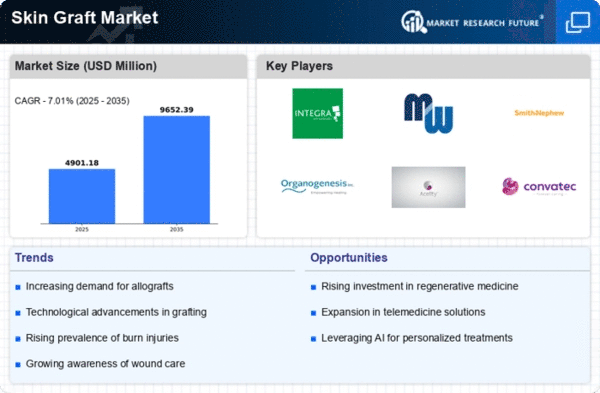
As per MRFR analysis, the Skin Graft Market Size was estimated at 4580.11 USD Million in 2024. The Skin Graft industry is projected to grow from 4901.27 in 2025 to 9652.39 by 2035, exhibiting a compound annual growth rate (CAGR) of 7.01% during the forecast period 2025 - 2035.

Key Market Trends & Highlights

The Skin Graft Market is poised for substantial growth driven by technological advancements and increasing awareness.

  • North America remains the largest market for skin grafts, primarily due to advanced healthcare infrastructure and high demand for burn treatment. The Asia-Pacific region is emerging as the fastest-growing market, fueled by rising healthcare investments and demographic shifts. Burn treatment represents the largest segment, while chronic wound care is rapidly gaining traction as a key growth area. Market drivers include the rising incidence of chronic wounds and advancements in surgical techniques, which are significantly influencing market dynamics.

Market Size & Forecast

2024 Market Size 4580.11 (USD Million)
2035 Market Size 9652.39 (USD Million)
CAGR (2025 - 2035) 7.01%
Largest Regional Market Share in 2024 North America

Major Players

Integra LifeSciences (US), MediWound Ltd. (IL), Smith &amp; Nephew (GB), Organogenesis Holdings Inc. (US), Acelity L.P. Inc. (US), Convatec Group PLC (GB), Systagenix Wound Management (GB), Mölnlycke Health Care (SE)

Market Trends

The Skin Graft Market is currently experiencing notable transformations driven by advancements in medical technology and an increasing prevalence of chronic wounds. Innovations in grafting techniques, such as bioengineered skin substitutes, are enhancing the efficacy of treatments, thereby improving patient outcomes. Furthermore, the rising incidence of conditions requiring skin grafts, including burns and diabetic ulcers, is propelling demand for these procedures. Healthcare providers are increasingly adopting minimally invasive techniques, which not only reduce recovery times but also minimize complications associated with traditional grafting methods. This shift towards more efficient practices appears to be reshaping the landscape of the Skin Graft Market. In addition, the growing awareness of skin grafting options among patients and healthcare professionals is likely to contribute to market expansion. Educational initiatives and improved access to information are empowering patients to seek timely interventions, which may lead to better management of skin-related ailments. As the market evolves, collaboration between medical device manufacturers and healthcare institutions seems essential for fostering innovation and ensuring the availability of advanced grafting solutions. Overall, the Skin Graft Market is poised for growth, driven by technological advancements and an increasing focus on patient-centered care.

Technological Advancements in Grafting Techniques

Recent innovations in skin grafting methods, particularly the development of bioengineered skin substitutes, are enhancing treatment effectiveness. These advancements are likely to improve patient recovery times and outcomes, thereby influencing the overall dynamics of the Skin Graft Market.

Rising Incidence of Chronic Wounds

The increasing prevalence of chronic wounds, such as diabetic ulcers and pressure sores, is driving demand for skin graft procedures. This trend suggests a growing need for effective treatment options, which may further stimulate market growth.

Minimally Invasive Procedures

The shift towards minimally invasive skin grafting techniques is transforming the market landscape. These procedures are associated with reduced recovery times and lower complication rates, making them more appealing to both patients and healthcare providers.

Skin Graft Market Market Drivers

Minimally Invasive Procedures

The Skin Graft Market is witnessing a shift towards minimally invasive procedures, which are becoming increasingly favored by both patients and healthcare providers. These techniques, which often involve smaller incisions and reduced recovery times, are appealing due to their potential to minimize patient discomfort and complications. As a result, there is a growing demand for skin grafts that can be applied using these less invasive methods. Market data suggests that the adoption of minimally invasive skin grafting techniques could lead to a 15% increase in procedure volume over the next few years. This trend is likely to enhance patient satisfaction and encourage more individuals to seek skin grafting as a viable treatment option.

Rising Incidence of Chronic Wounds

The Skin Graft Market is significantly influenced by the rising incidence of chronic wounds, which are becoming increasingly prevalent due to factors such as diabetes and an aging population. Chronic wounds, including diabetic foot ulcers and pressure sores, often require advanced treatment options, including skin grafts, to promote healing. According to recent estimates, the prevalence of chronic wounds is expected to reach 2.5 million cases annually, creating a substantial demand for skin grafting solutions. This surge in chronic wound cases is likely to drive the market, as healthcare providers seek effective methods to manage these complex conditions. Consequently, the skin graft market is poised for growth as it addresses the needs of this expanding patient population.

Growing Awareness and Education on Skin Grafting

The Skin Graft Market is experiencing growth due to increasing awareness and education regarding skin grafting procedures among both healthcare professionals and patients. Educational initiatives and campaigns are being implemented to inform stakeholders about the benefits and advancements in skin grafting techniques. This heightened awareness is likely to lead to an increase in the number of procedures performed, as patients become more informed about their treatment options. Market analysis indicates that as awareness grows, the demand for skin grafts could rise by approximately 10% over the next few years. This trend suggests that informed patients are more likely to seek out skin grafting as a solution for their medical needs.

Increased Investment in Healthcare Infrastructure

The Skin Graft Market is benefiting from increased investment in healthcare infrastructure, particularly in developing regions. Governments and private entities are recognizing the importance of enhancing healthcare facilities to provide better treatment options for patients. This investment is leading to the establishment of specialized centers for wound care and skin grafting, which are equipped with advanced technologies and skilled personnel. As a result, the accessibility and quality of skin graft procedures are improving, potentially leading to a market growth rate of 6% annually. Enhanced healthcare infrastructure is likely to facilitate the adoption of skin grafting techniques, thereby expanding the market and improving patient outcomes.

Technological Advancements in Grafting Techniques

The Skin Graft Market is experiencing a notable transformation due to technological advancements in grafting techniques. Innovations such as bioengineered skin substitutes and improved surgical methods are enhancing the efficacy of skin grafts. For instance, the introduction of 3D bioprinting technology allows for the creation of customized grafts that closely mimic natural skin properties. This not only improves healing times but also reduces the risk of complications. As a result, the market is projected to grow at a compound annual growth rate of approximately 7.5% over the next five years. These advancements are likely to attract more healthcare providers to adopt skin grafting procedures, thereby expanding the market further.

Market Segment Insights

By Application: Burn Treatment (Largest) vs. Chronic Wound Care (Fastest-Growing)

<p>The Skin Graft Market showcases a diverse application segment with significant variations among its different areas. Burn Treatment holds a major share, leading the market due to the high prevalence of burn injuries requiring advanced intervention and grafting techniques. Chronic Wound Care follows closely, reflecting the increasing geriatric population and prevalence of diabetic ulcers, which necessitate effective and specialized wound management strategies to prevent complications. As we analyze the growth trends, Chronic Wound Care emerges as the fastest-growing application, driven by technological advancements in grafting materials and techniques, increasing awareness of chronic wound management, and rising healthcare expenditure. Additionally, the growing global burden of chronic diseases fuels the demand for effective treatment solutions, positioning Chronic Wound Care as a key area for innovation and expansion in the Skin Graft Market.</p>

<p>Burn Treatment (Dominant) vs. Trauma Care (Emerging)</p>

<p>Burn Treatment is currently the dominant application in the Skin Graft Market, supported by a well-established framework for treatment protocols and extensive clinical experience. It encompasses advanced techniques that emphasize the healing process, catering to various degrees of burn injuries. In contrast, Trauma Care, deemed an emerging segment, focuses on the treatment of traumatic injuries that require skin grafting, such as abrasions, lacerations, and surgical wounds. While still developing, the Trauma Care segment is gaining traction due to rising accident rates and increasing <a href="https://www.marketresearchfuture.com/reports/emergency-medical-services-market-8363" target="_blank" title="emergency medical services">emergency medical services</a> capabilities. The favorable regulatory environment and growing interest in trauma treatments are likely to accelerate the market presence of Trauma Care in the coming years.</p>

By Type: Autograft (Largest) vs. Synthetic Graft (Fastest-Growing)

<p>In the Skin Graft Market, Autografts hold the largest share as they are widely regarded as the gold standard in skin grafting procedures. Their use is prevalent due to their compatibility with the patient's tissue and lower risk of rejection, leading to better graft take rates. The market distribution, however, is also influenced by the increasing acceptance of various alternatives such as Allografts and Xenografts, which cater to specific patient needs across different demographics.</p>

<p>Autograft (Dominant) vs. Synthetic Graft (Emerging)</p>

<p>Autografts, taking the lead in the skin graft market, are favored due to their autologous nature and superior healing properties, which minimize complications like graft rejection. In contrast, Synthetic Grafts are emerging swiftly, offering innovative solutions from biomaterials that mimic human skin. They provide advantages like wide availability, reduced surgical site complications, and versatility in clinical applications. The growing demand for minimally invasive procedures and advancements in technology are propelling the synthetic graft market forward, indicating a future trend towards hybrid approaches that may incorporate both autologous and synthetic options.</p>

By End Use: Hospitals (Largest) vs. Ambulatory Surgical Centers (Fastest-Growing)

<p>The Skin Graft Market is segmented by end-use, with hospitals commanding the largest share due to their comprehensive facilities and wide-ranging capabilities for conducting skin graft procedures. This segment serves a broad spectrum of patients, including those with severe burns and chronic wounds, leading to increased demand for both surgical services and associated products. Ambulatory surgical centers, while currently smaller in market share, represent a dynamic segment where patients seek cost-effective and convenient options for surgical care, contributing to their rapid growth. Growth trends in the Skin Graft Market are heavily influenced by advancements in surgical techniques and an increase in awareness about skin graft procedures. The shift towards minimally invasive outpatient procedures has propelled ambulatory surgical centers to the forefront, attracting patients looking for quicker recovery times. Additionally, the rising incidence of skin-related disorders and the aging population are significant factors driving growth across these segments, ultimately expanding the overall market landscape.</p>

<p>Hospitals (Dominant) vs. Ambulatory Surgical Centers (Emerging)</p>

<p>Hospitals are the dominant players in the Skin Graft Market due to their advanced facilities, skilled medical professionals, and ability to provide extensive perioperative care. They accommodate a wide range of complex skin graft procedures, supported by research and clinical trials that drive innovation in grafting materials and techniques. On the other hand, ambulatory surgical centers are gaining recognition as an emerging choice for many patients seeking efficient and effective skin graft surgeries. These centers focus on outpatient procedures, enabling quicker recovery and reduced hospital stays, making them attractive for cost-sensitive patients. With decreasing healthcare costs and increasing patient autonomy, ambulatory centers are likely to become a more prevalent option for skin graft treatment in the coming years.</p>

Get more detailed insights about Skin Graft Market Research Report – Forecast Till 2035

Regional Insights

North America : Market Leader in Skin Grafts

North America is poised to maintain its leadership in the skin graft market, holding a significant share of $2290.06M in 2024. The region's growth is driven by increasing incidences of burn injuries, chronic wounds, and surgical procedures requiring skin grafts. Regulatory support from agencies like the FDA has also catalyzed innovation and product approvals, enhancing market accessibility and consumer trust. The competitive landscape is robust, with key players such as Integra LifeSciences, Organogenesis Holdings, and Acelity leading the charge. The U.S. remains the largest market, supported by advanced healthcare infrastructure and high R&D investments. The presence of established companies fosters a dynamic environment for new entrants, ensuring continuous advancements in skin graft technologies.

Europe : Emerging Market with Growth Potential

Europe's skin graft market is projected to grow significantly, with a market size of $1150.03M in 2024. Factors such as an aging population, rising prevalence of diabetes, and increasing awareness of advanced wound care are driving demand. Regulatory frameworks in the EU, including the Medical Device Regulation (MDR), are enhancing product safety and efficacy, thereby boosting market confidence. Leading countries like Germany, the UK, and France are at the forefront of this growth, supported by strong healthcare systems and innovative research. Key players such as Smith & Nephew and Mölnlycke Health Care are actively investing in R&D to develop advanced grafting solutions. The competitive landscape is characterized by collaborations and partnerships aimed at expanding product offerings and market reach.

Asia-Pacific : Rapidly Growing Market Segment

The Asia-Pacific skin graft market is witnessing rapid growth, with a market size of $850.02M in 2024. This growth is fueled by rising healthcare expenditures, increasing awareness of advanced wound care, and a growing population with chronic conditions. Governments in the region are also implementing policies to improve healthcare access, which is expected to further drive demand for skin graft products. Countries like China, India, and Japan are leading the market, supported by a mix of local and international players. Companies such as MediWound and Tissue Regenix are expanding their presence, focusing on innovative solutions tailored to regional needs. The competitive landscape is evolving, with a focus on affordability and accessibility of skin graft technologies to meet the diverse needs of the population.

Middle East and Africa : Emerging Market with Challenges

The Middle East and Africa skin graft market is emerging, with a market size of $290.0M in 2024. Growth is driven by increasing healthcare investments and rising incidences of burn injuries and chronic wounds. However, challenges such as limited access to advanced medical technologies and varying regulatory environments can hinder market expansion. Governments are working to improve healthcare infrastructure, which is expected to positively impact the market. Countries like South Africa and the UAE are leading the market, with a growing number of healthcare facilities adopting advanced wound care solutions. Key players such as Convatec and Systagenix are focusing on expanding their footprint in the region. The competitive landscape is characterized by a mix of local and international companies striving to meet the unique needs of the market.

Key Players and Competitive Insights

The Skin Graft Market is characterized by a dynamic competitive landscape, driven by advancements in technology, increasing prevalence of chronic wounds, and a growing geriatric population. Key players such as Integra LifeSciences (US), Smith & Nephew (GB), and Organogenesis Holdings Inc. (US) are strategically positioned to leverage these growth drivers. Integra LifeSciences (US) focuses on innovation in regenerative medicine, while Smith & Nephew (GB) emphasizes a robust portfolio of advanced wound management products. Organogenesis Holdings Inc. (US) is enhancing its market presence through strategic partnerships and product diversification, collectively shaping a competitive environment that is increasingly focused on technological advancements and patient-centric solutions.

In terms of business tactics, companies are localizing manufacturing to reduce costs and optimize supply chains, which appears to be a response to the increasing demand for rapid product availability. The market structure is moderately fragmented, with several players vying for market share, yet the influence of major companies remains substantial. This competitive structure fosters an environment where innovation and operational efficiency are paramount, as companies strive to differentiate themselves in a crowded marketplace.

In November 2025, Integra LifeSciences (US) announced the launch of a new bioengineered skin graft product designed to enhance healing in diabetic foot ulcers. This strategic move not only underscores the company's commitment to innovation but also positions it to capture a larger share of the growing diabetic wound care segment. The introduction of this product is likely to strengthen Integra's competitive edge by addressing a critical need in the market.

In October 2025, Smith & Nephew (GB) expanded its partnership with a leading telehealth provider to integrate digital health solutions into its wound management offerings. This initiative reflects a broader trend towards digital transformation in healthcare, suggesting that Smith & Nephew is keen on enhancing patient engagement and monitoring through technology. Such a strategy may improve patient outcomes and streamline care processes, thereby reinforcing the company's market position.

In September 2025, Organogenesis Holdings Inc. (US) completed the acquisition of a smaller biotech firm specializing in advanced wound care technologies. This acquisition is indicative of a trend towards consolidation in the Skin Graft Market, as companies seek to enhance their product portfolios and technological capabilities. By integrating these new technologies, Organogenesis is likely to bolster its competitive stance and expand its reach in the market.

As of December 2025, current trends in the Skin Graft Market include a pronounced shift towards digitalization, sustainability, and the integration of artificial intelligence (AI) in product development and patient care. Strategic alliances are increasingly shaping the competitive landscape, enabling companies to pool resources and expertise. Looking ahead, competitive differentiation is expected to evolve from traditional price-based competition to a focus on innovation, technological advancements, and supply chain reliability. This shift may redefine market dynamics, compelling companies to invest in R&D and collaborative ventures to maintain a competitive edge.

Key Companies in the Skin Graft Market include

Industry Developments

Future Outlook

Skin Graft Market Future Outlook

The Skin Graft Market is projected to grow at a 7.01% CAGR from 2024 to 2035, driven by technological advancements, increasing burn cases, and rising awareness of skin grafting procedures.

New opportunities lie in:

  • Development of bioengineered skin grafts for enhanced healing
  • Expansion of telemedicine platforms for remote consultations
  • Investment in regenerative medicine research for innovative graft solutions

By 2035, the Skin Graft Market is expected to achieve substantial growth and innovation.

Market Segmentation

Skin Graft Market Type Outlook

  • Autograft
  • Allograft
  • Xenograft
  • Synthetic Graft

Skin Graft Market End Use Outlook

  • Hospitals
  • Ambulatory Surgical Centers
  • Specialty Clinics

Skin Graft Market Application Outlook

  • Burn Treatment
  • Chronic Wound Care
  • Surgical Procedures
  • Trauma Care

Report Scope

MARKET SIZE 20244580.11(USD Million)
MARKET SIZE 20254901.27(USD Million)
MARKET SIZE 20359652.39(USD Million)
COMPOUND ANNUAL GROWTH RATE (CAGR)7.01% (2024 - 2035)
REPORT COVERAGERevenue Forecast, Competitive Landscape, Growth Factors, and Trends
BASE YEAR2024
Market Forecast Period2025 - 2035
Historical Data2019 - 2024
Market Forecast UnitsUSD Million
Key Companies ProfiledIntegra LifeSciences (US), MediWound Ltd. (IL), Smith & Nephew (GB), Organogenesis Holdings Inc. (US), Acelity L.P. Inc. (US), Convatec Group PLC (GB), Mölnlycke Health Care AB (SE), Systagenix Wound Management (GB), Tissue Regenix Group PLC (GB)
Segments CoveredApplication, Type, End Use
Key Market OpportunitiesAdvancements in bioengineered skin grafts enhance treatment options and patient outcomes in the Skin Graft Market.
Key Market DynamicsRising demand for advanced skin graft technologies drives innovation and competition among key market players.
Countries CoveredNorth America, Europe, APAC, South America, MEA

FAQs

What is the current valuation of the Skin Graft Market as of 2024?

<p>The Skin Graft Market was valued at approximately 4580.11 USD Million in 2024.</p>

What is the projected market valuation for the Skin Graft Market in 2035?

<p>The Skin Graft Market is projected to reach approximately 9652.39 USD Million by 2035.</p>

What is the expected CAGR for the Skin Graft Market during the forecast period 2025 - 2035?

<p>The expected CAGR for the Skin Graft Market during the forecast period 2025 - 2035 is 7.01%.</p>

Which application segment is expected to have the highest valuation in the Skin Graft Market?

<p>The Surgical Procedures segment is expected to have the highest valuation, projected between 1800.0 and 3800.0 USD Million.</p>

How does the Chronic Wound Care segment perform in terms of market valuation?

<p>The Chronic Wound Care segment had a valuation range of 1200.0 to 2500.0 USD Million.</p>

What are the key types of grafts in the Skin Graft Market?

<p>The key types of grafts include Autograft, Allograft, Xenograft, and Synthetic Graft, with Autograft valued between 1832.04 and 3850.0 USD Million.</p>

Which end-use segment is projected to grow significantly in the Skin Graft Market?

<p>The Hospitals segment is projected to grow significantly, with a valuation range of 1832.04 to 3850.0 USD Million.</p>

Who are the leading players in the Skin Graft Market?

<p>Key players in the Skin Graft Market include Integra LifeSciences, MediWound Ltd., and Smith & Nephew, among others.</p>

What is the valuation range for the Allograft type in the Skin Graft Market?

<p>The Allograft type is valued between 1374.03 and 2850.0 USD Million.</p>

What is the market outlook for the Trauma Care segment in the Skin Graft Market?

<p>The Trauma Care segment had a valuation range of 780.11 to 1652.39 USD Million, indicating potential for growth.</p>

  1. SECTION I: EXECUTIVE SUMMARY AND KEY HIGHLIGHTS
    1. | 1.1 EXECUTIVE SUMMARY
    2. | | 1.1.1 Market Overview
    3. | | 1.1.2 Key Findings
    4. | | 1.1.3 Market Segmentation
    5. | | 1.1.4 Competitive Landscape
    6. | | 1.1.5 Challenges and Opportunities
    7. | | 1.1.6 Future Outlook
  2. SECTION II: SCOPING, METHODOLOGY AND MARKET STRUCTURE
    1. | 2.1 MARKET INTRODUCTION
    2. | | 2.1.1 Definition
    3. | | 2.1.2 Scope of the study
    4. | | | 2.1.2.1 Research Objective
    5. | | | 2.1.2.2 Assumption
    6. | | | 2.1.2.3 Limitations
    7. | 2.2 RESEARCH METHODOLOGY
    8. | | 2.2.1 Overview
    9. | | 2.2.2 Data Mining
    10. | | 2.2.3 Secondary Research
    11. | | 2.2.4 Primary Research
    12. | | | 2.2.4.1 Primary Interviews and Information Gathering Process
    13. | | | 2.2.4.2 Breakdown of Primary Respondents
    14. | | 2.2.5 Forecasting Model
    15. | | 2.2.6 Market Size Estimation
    16. | | | 2.2.6.1 Bottom-Up Approach
    17. | | | 2.2.6.2 Top-Down Approach
    18. | | 2.2.7 Data Triangulation
    19. | | 2.2.8 Validation
  3. SECTION III: QUALITATIVE ANALYSIS
    1. | 3.1 MARKET DYNAMICS
    2. | | 3.1.1 Overview
    3. | | 3.1.2 Drivers
    4. | | 3.1.3 Restraints
    5. | | 3.1.4 Opportunities
    6. | 3.2 MARKET FACTOR ANALYSIS
    7. | | 3.2.1 Value chain Analysis
    8. | | 3.2.2 Porter's Five Forces Analysis
    9. | | | 3.2.2.1 Bargaining Power of Suppliers
    10. | | | 3.2.2.2 Bargaining Power of Buyers
    11. | | | 3.2.2.3 Threat of New Entrants
    12. | | | 3.2.2.4 Threat of Substitutes
    13. | | | 3.2.2.5 Intensity of Rivalry
    14. | | 3.2.3 COVID-19 Impact Analysis
    15. | | | 3.2.3.1 Market Impact Analysis
    16. | | | 3.2.3.2 Regional Impact
    17. | | | 3.2.3.3 Opportunity and Threat Analysis
  4. SECTION IV: QUANTITATIVE ANALYSIS
    1. | 4.1 Healthcare, BY Application (USD Million)
    2. | | 4.1.1 Burn Treatment
    3. | | 4.1.2 Chronic Wound Care
    4. | | 4.1.3 Surgical Procedures
    5. | | 4.1.4 Trauma Care
    6. | 4.2 Healthcare, BY Type (USD Million)
    7. | | 4.2.1 Autograft
    8. | | 4.2.2 Allograft
    9. | | 4.2.3 Xenograft
    10. | | 4.2.4 Synthetic Graft
    11. | 4.3 Healthcare, BY End Use (USD Million)
    12. | | 4.3.1 Hospitals
    13. | | 4.3.2 Ambulatory Surgical Centers
    14. | | 4.3.3 Specialty Clinics
    15. | 4.4 Healthcare, BY Region (USD Million)
    16. | | 4.4.1 North America
    17. | | | 4.4.1.1 US
    18. | | | 4.4.1.2 Canada
    19. | | 4.4.2 Europe
    20. | | | 4.4.2.1 Germany
    21. | | | 4.4.2.2 UK
    22. | | | 4.4.2.3 France
    23. | | | 4.4.2.4 Russia
    24. | | | 4.4.2.5 Italy
    25. | | | 4.4.2.6 Spain
    26. | | | 4.4.2.7 Rest of Europe
    27. | | 4.4.3 APAC
    28. | | | 4.4.3.1 China
    29. | | | 4.4.3.2 India
    30. | | | 4.4.3.3 Japan
    31. | | | 4.4.3.4 South Korea
    32. | | | 4.4.3.5 Malaysia
    33. | | | 4.4.3.6 Thailand
    34. | | | 4.4.3.7 Indonesia
    35. | | | 4.4.3.8 Rest of APAC
    36. | | 4.4.4 South America
    37. | | | 4.4.4.1 Brazil
    38. | | | 4.4.4.2 Mexico
    39. | | | 4.4.4.3 Argentina
    40. | | | 4.4.4.4 Rest of South America
    41. | | 4.4.5 MEA
    42. | | | 4.4.5.1 GCC Countries
    43. | | | 4.4.5.2 South Africa
    44. | | | 4.4.5.3 Rest of MEA
  5. SECTION V: COMPETITIVE ANALYSIS
    1. | 5.1 Competitive Landscape
    2. | | 5.1.1 Overview
    3. | | 5.1.2 Competitive Analysis
    4. | | 5.1.3 Market share Analysis
    5. | | 5.1.4 Major Growth Strategy in the Healthcare
    6. | | 5.1.5 Competitive Benchmarking
    7. | | 5.1.6 Leading Players in Terms of Number of Developments in the Healthcare
    8. | | 5.1.7 Key developments and growth strategies
    9. | | | 5.1.7.1 New Product Launch/Service Deployment
    10. | | | 5.1.7.2 Merger & Acquisitions
    11. | | | 5.1.7.3 Joint Ventures
    12. | | 5.1.8 Major Players Financial Matrix
    13. | | | 5.1.8.1 Sales and Operating Income
    14. | | | 5.1.8.2 Major Players R&D Expenditure. 2023
    15. | 5.2 Company Profiles
    16. | | 5.2.1 Integra LifeSciences (US)
    17. | | | 5.2.1.1 Financial Overview
    18. | | | 5.2.1.2 Products Offered
    19. | | | 5.2.1.3 Key Developments
    20. | | | 5.2.1.4 SWOT Analysis
    21. | | | 5.2.1.5 Key Strategies
    22. | | 5.2.2 MediWound Ltd. (IL)
    23. | | | 5.2.2.1 Financial Overview
    24. | | | 5.2.2.2 Products Offered
    25. | | | 5.2.2.3 Key Developments
    26. | | | 5.2.2.4 SWOT Analysis
    27. | | | 5.2.2.5 Key Strategies
    28. | | 5.2.3 Smith & Nephew (GB)
    29. | | | 5.2.3.1 Financial Overview
    30. | | | 5.2.3.2 Products Offered
    31. | | | 5.2.3.3 Key Developments
    32. | | | 5.2.3.4 SWOT Analysis
    33. | | | 5.2.3.5 Key Strategies
    34. | | 5.2.4 Organogenesis Holdings Inc. (US)
    35. | | | 5.2.4.1 Financial Overview
    36. | | | 5.2.4.2 Products Offered
    37. | | | 5.2.4.3 Key Developments
    38. | | | 5.2.4.4 SWOT Analysis
    39. | | | 5.2.4.5 Key Strategies
    40. | | 5.2.5 Acelity L.P. Inc. (US)
    41. | | | 5.2.5.1 Financial Overview
    42. | | | 5.2.5.2 Products Offered
    43. | | | 5.2.5.3 Key Developments
    44. | | | 5.2.5.4 SWOT Analysis
    45. | | | 5.2.5.5 Key Strategies
    46. | | 5.2.6 Convatec Group PLC (GB)
    47. | | | 5.2.6.1 Financial Overview
    48. | | | 5.2.6.2 Products Offered
    49. | | | 5.2.6.3 Key Developments
    50. | | | 5.2.6.4 SWOT Analysis
    51. | | | 5.2.6.5 Key Strategies
    52. | | 5.2.7 Mölnlycke Health Care AB (SE)
    53. | | | 5.2.7.1 Financial Overview
    54. | | | 5.2.7.2 Products Offered
    55. | | | 5.2.7.3 Key Developments
    56. | | | 5.2.7.4 SWOT Analysis
    57. | | | 5.2.7.5 Key Strategies
    58. | | 5.2.8 Systagenix Wound Management (GB)
    59. | | | 5.2.8.1 Financial Overview
    60. | | | 5.2.8.2 Products Offered
    61. | | | 5.2.8.3 Key Developments
    62. | | | 5.2.8.4 SWOT Analysis
    63. | | | 5.2.8.5 Key Strategies
    64. | | 5.2.9 Tissue Regenix Group PLC (GB)
    65. | | | 5.2.9.1 Financial Overview
    66. | | | 5.2.9.2 Products Offered
    67. | | | 5.2.9.3 Key Developments
    68. | | | 5.2.9.4 SWOT Analysis
    69. | | | 5.2.9.5 Key Strategies
    70. | 5.3 Appendix
    71. | | 5.3.1 References
    72. | | 5.3.2 Related Reports
  6. LIST OF FIGURES
    1. | 6.1 MARKET SYNOPSIS
    2. | 6.2 NORTH AMERICA MARKET ANALYSIS
    3. | 6.3 US MARKET ANALYSIS BY APPLICATION
    4. | 6.4 US MARKET ANALYSIS BY TYPE
    5. | 6.5 US MARKET ANALYSIS BY END USE
    6. | 6.6 CANADA MARKET ANALYSIS BY APPLICATION
    7. | 6.7 CANADA MARKET ANALYSIS BY TYPE
    8. | 6.8 CANADA MARKET ANALYSIS BY END USE
    9. | 6.9 EUROPE MARKET ANALYSIS
    10. | 6.10 GERMANY MARKET ANALYSIS BY APPLICATION
    11. | 6.11 GERMANY MARKET ANALYSIS BY TYPE
    12. | 6.12 GERMANY MARKET ANALYSIS BY END USE
    13. | 6.13 UK MARKET ANALYSIS BY APPLICATION
    14. | 6.14 UK MARKET ANALYSIS BY TYPE
    15. | 6.15 UK MARKET ANALYSIS BY END USE
    16. | 6.16 FRANCE MARKET ANALYSIS BY APPLICATION
    17. | 6.17 FRANCE MARKET ANALYSIS BY TYPE
    18. | 6.18 FRANCE MARKET ANALYSIS BY END USE
    19. | 6.19 RUSSIA MARKET ANALYSIS BY APPLICATION
    20. | 6.20 RUSSIA MARKET ANALYSIS BY TYPE
    21. | 6.21 RUSSIA MARKET ANALYSIS BY END USE
    22. | 6.22 ITALY MARKET ANALYSIS BY APPLICATION
    23. | 6.23 ITALY MARKET ANALYSIS BY TYPE
    24. | 6.24 ITALY MARKET ANALYSIS BY END USE
    25. | 6.25 SPAIN MARKET ANALYSIS BY APPLICATION
    26. | 6.26 SPAIN MARKET ANALYSIS BY TYPE
    27. | 6.27 SPAIN MARKET ANALYSIS BY END USE
    28. | 6.28 REST OF EUROPE MARKET ANALYSIS BY APPLICATION
    29. | 6.29 REST OF EUROPE MARKET ANALYSIS BY TYPE
    30. | 6.30 REST OF EUROPE MARKET ANALYSIS BY END USE
    31. | 6.31 APAC MARKET ANALYSIS
    32. | 6.32 CHINA MARKET ANALYSIS BY APPLICATION
    33. | 6.33 CHINA MARKET ANALYSIS BY TYPE
    34. | 6.34 CHINA MARKET ANALYSIS BY END USE
    35. | 6.35 INDIA MARKET ANALYSIS BY APPLICATION
    36. | 6.36 INDIA MARKET ANALYSIS BY TYPE
    37. | 6.37 INDIA MARKET ANALYSIS BY END USE
    38. | 6.38 JAPAN MARKET ANALYSIS BY APPLICATION
    39. | 6.39 JAPAN MARKET ANALYSIS BY TYPE
    40. | 6.40 JAPAN MARKET ANALYSIS BY END USE
    41. | 6.41 SOUTH KOREA MARKET ANALYSIS BY APPLICATION
    42. | 6.42 SOUTH KOREA MARKET ANALYSIS BY TYPE
    43. | 6.43 SOUTH KOREA MARKET ANALYSIS BY END USE
    44. | 6.44 MALAYSIA MARKET ANALYSIS BY APPLICATION
    45. | 6.45 MALAYSIA MARKET ANALYSIS BY TYPE
    46. | 6.46 MALAYSIA MARKET ANALYSIS BY END USE
    47. | 6.47 THAILAND MARKET ANALYSIS BY APPLICATION
    48. | 6.48 THAILAND MARKET ANALYSIS BY TYPE
    49. | 6.49 THAILAND MARKET ANALYSIS BY END USE
    50. | 6.50 INDONESIA MARKET ANALYSIS BY APPLICATION
    51. | 6.51 INDONESIA MARKET ANALYSIS BY TYPE
    52. | 6.52 INDONESIA MARKET ANALYSIS BY END USE
    53. | 6.53 REST OF APAC MARKET ANALYSIS BY APPLICATION
    54. | 6.54 REST OF APAC MARKET ANALYSIS BY TYPE
    55. | 6.55 REST OF APAC MARKET ANALYSIS BY END USE
    56. | 6.56 SOUTH AMERICA MARKET ANALYSIS
    57. | 6.57 BRAZIL MARKET ANALYSIS BY APPLICATION
    58. | 6.58 BRAZIL MARKET ANALYSIS BY TYPE
    59. | 6.59 BRAZIL MARKET ANALYSIS BY END USE
    60. | 6.60 MEXICO MARKET ANALYSIS BY APPLICATION
    61. | 6.61 MEXICO MARKET ANALYSIS BY TYPE
    62. | 6.62 MEXICO MARKET ANALYSIS BY END USE
    63. | 6.63 ARGENTINA MARKET ANALYSIS BY APPLICATION
    64. | 6.64 ARGENTINA MARKET ANALYSIS BY TYPE
    65. | 6.65 ARGENTINA MARKET ANALYSIS BY END USE
    66. | 6.66 REST OF SOUTH AMERICA MARKET ANALYSIS BY APPLICATION
    67. | 6.67 REST OF SOUTH AMERICA MARKET ANALYSIS BY TYPE
    68. | 6.68 REST OF SOUTH AMERICA MARKET ANALYSIS BY END USE
    69. | 6.69 MEA MARKET ANALYSIS
    70. | 6.70 GCC COUNTRIES MARKET ANALYSIS BY APPLICATION
    71. | 6.71 GCC COUNTRIES MARKET ANALYSIS BY TYPE
    72. | 6.72 GCC COUNTRIES MARKET ANALYSIS BY END USE
    73. | 6.73 SOUTH AFRICA MARKET ANALYSIS BY APPLICATION
    74. | 6.74 SOUTH AFRICA MARKET ANALYSIS BY TYPE
    75. | 6.75 SOUTH AFRICA MARKET ANALYSIS BY END USE
    76. | 6.76 REST OF MEA MARKET ANALYSIS BY APPLICATION
    77. | 6.77 REST OF MEA MARKET ANALYSIS BY TYPE
    78. | 6.78 REST OF MEA MARKET ANALYSIS BY END USE
    79. | 6.79 KEY BUYING CRITERIA OF HEALTHCARE
    80. | 6.80 RESEARCH PROCESS OF MRFR
    81. | 6.81 DRO ANALYSIS OF HEALTHCARE
    82. | 6.82 DRIVERS IMPACT ANALYSIS: HEALTHCARE
    83. | 6.83 RESTRAINTS IMPACT ANALYSIS: HEALTHCARE
    84. | 6.84 SUPPLY / VALUE CHAIN: HEALTHCARE
    85. | 6.85 HEALTHCARE, BY APPLICATION, 2024 (% SHARE)
    86. | 6.86 HEALTHCARE, BY APPLICATION, 2024 TO 2035 (USD Million)
    87. | 6.87 HEALTHCARE, BY TYPE, 2024 (% SHARE)
    88. | 6.88 HEALTHCARE, BY TYPE, 2024 TO 2035 (USD Million)
    89. | 6.89 HEALTHCARE, BY END USE, 2024 (% SHARE)
    90. | 6.90 HEALTHCARE, BY END USE, 2024 TO 2035 (USD Million)
    91. | 6.91 BENCHMARKING OF MAJOR COMPETITORS
  7. LIST OF TABLES
    1. | 7.1 LIST OF ASSUMPTIONS
    2. | | 7.1.1
    3. | 7.2 North America MARKET SIZE ESTIMATES; FORECAST
    4. | | 7.2.1 BY APPLICATION, 2025-2035 (USD Million)
    5. | | 7.2.2 BY TYPE, 2025-2035 (USD Million)
    6. | | 7.2.3 BY END USE, 2025-2035 (USD Million)
    7. | 7.3 US MARKET SIZE ESTIMATES; FORECAST
    8. | | 7.3.1 BY APPLICATION, 2025-2035 (USD Million)
    9. | | 7.3.2 BY TYPE, 2025-2035 (USD Million)
    10. | | 7.3.3 BY END USE, 2025-2035 (USD Million)
    11. | 7.4 Canada MARKET SIZE ESTIMATES; FORECAST
    12. | | 7.4.1 BY APPLICATION, 2025-2035 (USD Million)
    13. | | 7.4.2 BY TYPE, 2025-2035 (USD Million)
    14. | | 7.4.3 BY END USE, 2025-2035 (USD Million)
    15. | 7.5 Europe MARKET SIZE ESTIMATES; FORECAST
    16. | | 7.5.1 BY APPLICATION, 2025-2035 (USD Million)
    17. | | 7.5.2 BY TYPE, 2025-2035 (USD Million)
    18. | | 7.5.3 BY END USE, 2025-2035 (USD Million)
    19. | 7.6 Germany MARKET SIZE ESTIMATES; FORECAST
    20. | | 7.6.1 BY APPLICATION, 2025-2035 (USD Million)
    21. | | 7.6.2 BY TYPE, 2025-2035 (USD Million)
    22. | | 7.6.3 BY END USE, 2025-2035 (USD Million)
    23. | 7.7 UK MARKET SIZE ESTIMATES; FORECAST
    24. | | 7.7.1 BY APPLICATION, 2025-2035 (USD Million)
    25. | | 7.7.2 BY TYPE, 2025-2035 (USD Million)
    26. | | 7.7.3 BY END USE, 2025-2035 (USD Million)
    27. | 7.8 France MARKET SIZE ESTIMATES; FORECAST
    28. | | 7.8.1 BY APPLICATION, 2025-2035 (USD Million)
    29. | | 7.8.2 BY TYPE, 2025-2035 (USD Million)
    30. | | 7.8.3 BY END USE, 2025-2035 (USD Million)
    31. | 7.9 Russia MARKET SIZE ESTIMATES; FORECAST
    32. | | 7.9.1 BY APPLICATION, 2025-2035 (USD Million)
    33. | | 7.9.2 BY TYPE, 2025-2035 (USD Million)
    34. | | 7.9.3 BY END USE, 2025-2035 (USD Million)
    35. | 7.10 Italy MARKET SIZE ESTIMATES; FORECAST
    36. | | 7.10.1 BY APPLICATION, 2025-2035 (USD Million)
    37. | | 7.10.2 BY TYPE, 2025-2035 (USD Million)
    38. | | 7.10.3 BY END USE, 2025-2035 (USD Million)
    39. | 7.11 Spain MARKET SIZE ESTIMATES; FORECAST
    40. | | 7.11.1 BY APPLICATION, 2025-2035 (USD Million)
    41. | | 7.11.2 BY TYPE, 2025-2035 (USD Million)
    42. | | 7.11.3 BY END USE, 2025-2035 (USD Million)
    43. | 7.12 Rest of Europe MARKET SIZE ESTIMATES; FORECAST
    44. | | 7.12.1 BY APPLICATION, 2025-2035 (USD Million)
    45. | | 7.12.2 BY TYPE, 2025-2035 (USD Million)
    46. | | 7.12.3 BY END USE, 2025-2035 (USD Million)
    47. | 7.13 APAC MARKET SIZE ESTIMATES; FORECAST
    48. | | 7.13.1 BY APPLICATION, 2025-2035 (USD Million)
    49. | | 7.13.2 BY TYPE, 2025-2035 (USD Million)
    50. | | 7.13.3 BY END USE, 2025-2035 (USD Million)
    51. | 7.14 China MARKET SIZE ESTIMATES; FORECAST
    52. | | 7.14.1 BY APPLICATION, 2025-2035 (USD Million)
    53. | | 7.14.2 BY TYPE, 2025-2035 (USD Million)
    54. | | 7.14.3 BY END USE, 2025-2035 (USD Million)
    55. | 7.15 India MARKET SIZE ESTIMATES; FORECAST
    56. | | 7.15.1 BY APPLICATION, 2025-2035 (USD Million)
    57. | | 7.15.2 BY TYPE, 2025-2035 (USD Million)
    58. | | 7.15.3 BY END USE, 2025-2035 (USD Million)
    59. | 7.16 Japan MARKET SIZE ESTIMATES; FORECAST
    60. | | 7.16.1 BY APPLICATION, 2025-2035 (USD Million)
    61. | | 7.16.2 BY TYPE, 2025-2035 (USD Million)
    62. | | 7.16.3 BY END USE, 2025-2035 (USD Million)
    63. | 7.17 South Korea MARKET SIZE ESTIMATES; FORECAST
    64. | | 7.17.1 BY APPLICATION, 2025-2035 (USD Million)
    65. | | 7.17.2 BY TYPE, 2025-2035 (USD Million)
    66. | | 7.17.3 BY END USE, 2025-2035 (USD Million)
    67. | 7.18 Malaysia MARKET SIZE ESTIMATES; FORECAST
    68. | | 7.18.1 BY APPLICATION, 2025-2035 (USD Million)
    69. | | 7.18.2 BY TYPE, 2025-2035 (USD Million)
    70. | | 7.18.3 BY END USE, 2025-2035 (USD Million)
    71. | 7.19 Thailand MARKET SIZE ESTIMATES; FORECAST
    72. | | 7.19.1 BY APPLICATION, 2025-2035 (USD Million)
    73. | | 7.19.2 BY TYPE, 2025-2035 (USD Million)
    74. | | 7.19.3 BY END USE, 2025-2035 (USD Million)
    75. | 7.20 Indonesia MARKET SIZE ESTIMATES; FORECAST
    76. | | 7.20.1 BY APPLICATION, 2025-2035 (USD Million)
    77. | | 7.20.2 BY TYPE, 2025-2035 (USD Million)
    78. | | 7.20.3 BY END USE, 2025-2035 (USD Million)
    79. | 7.21 Rest of APAC MARKET SIZE ESTIMATES; FORECAST
    80. | | 7.21.1 BY APPLICATION, 2025-2035 (USD Million)
    81. | | 7.21.2 BY TYPE, 2025-2035 (USD Million)
    82. | | 7.21.3 BY END USE, 2025-2035 (USD Million)
    83. | 7.22 South America MARKET SIZE ESTIMATES; FORECAST
    84. | | 7.22.1 BY APPLICATION, 2025-2035 (USD Million)
    85. | | 7.22.2 BY TYPE, 2025-2035 (USD Million)
    86. | | 7.22.3 BY END USE, 2025-2035 (USD Million)
    87. | 7.23 Brazil MARKET SIZE ESTIMATES; FORECAST
    88. | | 7.23.1 BY APPLICATION, 2025-2035 (USD Million)
    89. | | 7.23.2 BY TYPE, 2025-2035 (USD Million)
    90. | | 7.23.3 BY END USE, 2025-2035 (USD Million)
    91. | 7.24 Mexico MARKET SIZE ESTIMATES; FORECAST
    92. | | 7.24.1 BY APPLICATION, 2025-2035 (USD Million)
    93. | | 7.24.2 BY TYPE, 2025-2035 (USD Million)
    94. | | 7.24.3 BY END USE, 2025-2035 (USD Million)
    95. | 7.25 Argentina MARKET SIZE ESTIMATES; FORECAST
    96. | | 7.25.1 BY APPLICATION, 2025-2035 (USD Million)
    97. | | 7.25.2 BY TYPE, 2025-2035 (USD Million)
    98. | | 7.25.3 BY END USE, 2025-2035 (USD Million)
    99. | 7.26 Rest of South America MARKET SIZE ESTIMATES; FORECAST
    100. | | 7.26.1 BY APPLICATION, 2025-2035 (USD Million)
    101. | | 7.26.2 BY TYPE, 2025-2035 (USD Million)
    102. | | 7.26.3 BY END USE, 2025-2035 (USD Million)
    103. | 7.27 MEA MARKET SIZE ESTIMATES; FORECAST
    104. | | 7.27.1 BY APPLICATION, 2025-2035 (USD Million)
    105. | | 7.27.2 BY TYPE, 2025-2035 (USD Million)
    106. | | 7.27.3 BY END USE, 2025-2035 (USD Million)
    107. | 7.28 GCC Countries MARKET SIZE ESTIMATES; FORECAST
    108. | | 7.28.1 BY APPLICATION, 2025-2035 (USD Million)
    109. | | 7.28.2 BY TYPE, 2025-2035 (USD Million)
    110. | | 7.28.3 BY END USE, 2025-2035 (USD Million)
    111. | 7.29 South Africa MARKET SIZE ESTIMATES; FORECAST
    112. | | 7.29.1 BY APPLICATION, 2025-2035 (USD Million)
    113. | | 7.29.2 BY TYPE, 2025-2035 (USD Million)
    114. | | 7.29.3 BY END USE, 2025-2035 (USD Million)
    115. | 7.30 Rest of MEA MARKET SIZE ESTIMATES; FORECAST
    116. | | 7.30.1 BY APPLICATION, 2025-2035 (USD Million)
    117. | | 7.30.2 BY TYPE, 2025-2035 (USD Million)
    118. | | 7.30.3 BY END USE, 2025-2035 (USD Million)
    119. | 7.31 PRODUCT LAUNCH/PRODUCT DEVELOPMENT/APPROVAL
    120. | | 7.31.1
    121. | 7.32 ACQUISITION/PARTNERSHIP
    122. | | 7.32.1

Healthcare Market Segmentation

Healthcare By Application (USD Million, 2025-2035)

  • Burn Treatment
  • Chronic Wound Care
  • Surgical Procedures
  • Trauma Care

Healthcare By Type (USD Million, 2025-2035)

  • Autograft
  • Allograft
  • Xenograft
  • Synthetic Graft

Healthcare By End Use (USD Million, 2025-2035)

  • Hospitals
  • Ambulatory Surgical Centers
  • Specialty Clinics
Infographic

Free Sample Request

Kindly complete the form below to receive a free sample of this Report

Get Free Sample

Customer Strories

Compare Licence

×
Features License Type
Single User Multiuser License Enterprise User
Price $4,950 $5,950 $7,250
Maximum User Access Limit 1 User Upto 10 Users Unrestricted Access Throughout the Organization
Free Customization
Direct Access to Analyst
Deliverable Format
Platform Access
Discount on Next Purchase 10% 15% 15%
Printable Versions
%>