×
Request Free Sample ×

Kindly complete the form below to receive a free sample of this Report

* Please use a valid business email

Leading companies partner with us for data-driven Insights

clients tt-cursor
Hero Background
English
Chinese
French
Japanese
Korean
German
Spanish

Silver Market Trends

ID: MRFR/CnM/6530-HCR
111 Pages
Chitranshi Jaiswal
February 2026

Silver Market Size, Share & Industry Analysis Research Report By Application (Jewelry, Electronics, Coins and Medals, Photography, Industrial Manufacturing), By End Use Industry (Consumer Goods, Automotive, Medical, Solar Energy, Telecommunications), By Form (Bars, Coins, Powder, Foil, Wire), By Purity (Sterling Silver, Fine Silver, Coin Silver) and By Regional (North America, Europe, South America, Asia Pacific, Middle East and Africa) - Forecast to 2035.

Share:
Download PDF ×

We do not share your information with anyone. However, we may send you emails based on your report interest from time to time. You may contact us at any time to opt-out.

Silver Market Infographic
Purchase Options

Market Trends

Key Emerging Trends in the Silver Market

The silver market has experienced dynamic trends over the past few years, influenced by various factors ranging from industrial demand to investor sentiment. One significant trend observed in the silver market is its correlation with the broader economic landscape. During periods of economic uncertainty or market volatility, silver often serves as a safe-haven asset, attracting investors seeking refuge from riskier assets such as stocks or currencies. This trend was particularly evident during the global financial crisis of 2008 and the uncertainty surrounding the COVID-19 pandemic, where silver prices saw notable increases as investors flocked to precious metals.

Another prominent trend in the silver market is its dual role as both a precious metal and an industrial commodity. Unlike gold, which is primarily viewed as a store of value, silver has extensive industrial applications across various sectors, including electronics, automotive, and solar energy. Consequently, fluctuations in industrial demand can significantly impact silver prices. For instance, increased demand for consumer electronics or solar panels can drive up the price of silver due to its use in manufacturing these products.

Moreover, technological advancements and evolving consumer preferences also influence market trends in the silver industry. The growing adoption of renewable energy sources like solar power has led to increased demand for silver in photovoltaic cells, further bolstering its market dynamics. Additionally, the rise of electric vehicles (EVs) has sparked interest in silver due to its use in automotive components like batteries and electrical systems. As these trends continue to unfold, they are expected to shape the future trajectory of the silver market.

Furthermore, investor sentiment and speculative activity play a significant role in driving short-term fluctuations in the silver market. Like other commodities, silver is susceptible to price speculation and trading activity in financial markets. Factors such as changes in interest rates, currency movements, and geopolitical tensions can influence investor sentiment and trigger buying or selling pressure in the silver market. Additionally, the emergence of silver exchange-traded funds (ETFs) has provided investors with alternative avenues to gain exposure to the metal, further impacting market dynamics.

In recent years, environmental and sustainability considerations have also emerged as key drivers of market trends in the silver industry. As companies and consumers increasingly prioritize eco-friendly practices, there is growing demand for ethically sourced and recycled silver. This trend has prompted industry players to adopt responsible mining practices and explore innovative recycling technologies to meet evolving market expectations.
Author
Chitranshi Jaiswal
Team Lead - Research

Chitranshi is a Team Leader in the Chemicals & Materials (CnM) and Energy & Power (EnP) domains, with 6+ years of experience in market research. She leads and mentors teams to deliver cross-domain projects that equip clients with actionable insights and growth strategies. She is skilled in market estimation, forecasting, competitive benchmarking, and both primary & secondary research, enabling her to turn complex data into decision-ready insights. An engineer and MBA professional, she combines technical expertise with strategic acumen to solve dynamic market challenges. Chitranshi has successfully managed projects that support market entry, investment planning, and competitive positioning, while building strong client relationships. Certified in Advanced Excel & Power BI she leverages data-driven approaches to ensure accuracy, clarity, and impactful outcomes.

Leave a Comment

FAQs

What is the projected market valuation of the Silver Market by 2035?

<p>The projected market valuation of the Silver Market by 2035 is 30.02 USD Billion.</p>

What was the overall market valuation of the Silver Market in 2024?

<p>The overall market valuation of the Silver Market in 2024 was 21.11 USD Billion.</p>

What is the expected CAGR for the Silver Market during the forecast period 2025 - 2035?

<p>The expected CAGR for the Silver Market during the forecast period 2025 - 2035 is 3.25%.</p>

Which companies are considered key players in the Silver Market?

<p>Key players in the Silver Market include Pan American Silver, Fresnillo, Wheaton Precious Metals, and Hecla Mining Company.</p>

How much revenue is generated from the Jewelry segment in the Silver Market?

<p>The Jewelry segment generated revenue of 6.5 USD Billion in 2024 and is projected to reach 9.0 USD Billion.</p>

What is the revenue forecast for the Electronics segment by 2035?

<p>The revenue forecast for the Electronics segment is expected to grow from 5.0 USD Billion in 2024 to 7.0 USD Billion by 2035.</p>

What are the projected revenues for the Industrial Manufacturing segment in the Silver Market?

<p>The Industrial Manufacturing segment is projected to increase from 4.61 USD Billion in 2024 to 7.52 USD Billion by 2035.</p>

What is the expected revenue growth for the Solar Energy end-use industry?

<p>The Solar Energy end-use industry is expected to grow from 4.0 USD Billion in 2024 to 6.0 USD Billion by 2035.</p>

How does the revenue from Wire form compare to other forms of silver?

<p>The Wire form generated 7.11 USD Billion in 2024 and is projected to reach 10.52 USD Billion by 2035, indicating strong demand.</p>

What is the revenue outlook for Fine Silver purity in the Silver Market?

<p>The revenue outlook for Fine Silver purity is expected to rise from 8.44 USD Billion in 2024 to 12.01 USD Billion by 2035.</p>

Market Summary

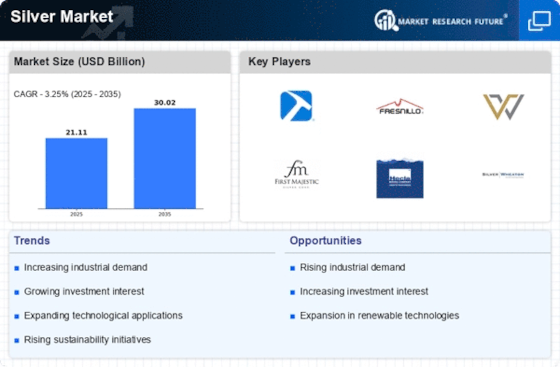
As per Market Research Future analysis, the Silver Market Size was estimated at 21.11 USD Billion in 2024. The Silver industry is projected to grow from 21.8 USD Billion in 2025 to 30.02 USD Billion by 2035, exhibiting a compound annual growth rate (CAGR) of 3.2% during the forecast period 2025 - 2035

Key Market Trends & Highlights

The silver market is currently experiencing a dynamic shift driven by diverse demand across various sectors.

  • North America remains the largest market for silver, primarily fueled by robust jewelry and consumer goods demand. The Asia-Pacific region is emerging as the fastest-growing market, with increasing industrial applications and technological integration. The jewelry segment continues to dominate overall silver consumption, while the electronics segment is witnessing rapid growth due to technological advancements. Investment demand and market sentiment, alongside geopolitical factors, are significant drivers influencing the silver market's trajectory.

Market Size & Forecast

2024 Market Size 21.11 (USD Billion)
2035 Market Size 30.02 (USD Billion)
CAGR (2025 - 2035) 3.25%
Largest Regional Market Share in 2024 North America

Major Players

Pan American Silver (CA), Fresnillo (MX), Wheaton Precious Metals (CA), <a href="https://www.firstmajestic.com/projects/silver-streams/springpole-project/">First Majestic Silver</a> (CA), Hecla Mining Company (US), Silver Wheaton (CA), Coeur Mining (US), Endeavour Silver (CA), Silvercorp Metals (CA)

Market Trends

The Silver Market is currently experiencing a dynamic phase characterized by evolving demand and supply dynamics. Various sectors, including electronics, solar energy, and jewelry, are driving the need for silver, which appears to be gaining traction as a critical component in modern technology. The increasing focus on renewable energy sources seems to bolster the silver market, as silver plays a vital role in photovoltaic cells. Furthermore, the market value of silver is gaining attention as the investment landscape is shifting, with more individuals considering silver as a hedge against inflation and economic uncertainty.  This trend indicates a potential increase in retail investment across global silver markets, which could further influence market stability.

In addition to industrial applications, the Silver Market is witnessing a resurgence in interest from investors. The allure of silver as a tangible asset may attract those seeking diversification in their portfolios. Moreover, geopolitical tensions and fluctuating currency values might contribute to heightened demand for precious metals, including silver. As the market evolves, strategic approaches such as silver lining marketing are being observed in industry communication, and it is essential to monitor these trends closely, as they may shape the future landscape of the silver market significantly.

Industrial Demand Growth

The Silver Market is experiencing heightened interest from various industries, particularly electronics and renewable energy. Silver Market's unique properties make it indispensable in manufacturing components for solar panels and electronic devices, suggesting a robust future for industrial applications.

Investment Trends

There appears to be a growing trend of retail investors turning to silver as a safe haven asset. This shift may be driven by economic uncertainties and inflation concerns, indicating that silver could become a more prominent choice for portfolio diversification.

Geopolitical Influences

The Silver Market seems to be increasingly affected by geopolitical factors. Fluctuations in currency values and international tensions may lead to heightened demand for silver, as investors seek stability in precious metals during uncertain times.

Silver Market Market Drivers

Technological Advancements

The Silver Market is experiencing a notable transformation due to rapid technological advancements. Innovations in mining techniques and refining processes have led to increased efficiency and reduced costs. For instance, the adoption of automated systems in mining operations has improved yield rates, allowing for more silver to be extracted with less environmental impact. Furthermore, advancements in silver applications, particularly in electronics and renewable energy sectors, are driving demand. The integration of silver in photovoltaic cells for solar panels is particularly noteworthy, as it enhances energy conversion efficiency. As these technologies evolve, they are likely to create new opportunities within the Silver Market, potentially leading to increased consumption and investment.

Jewelry and Silverware Demand

The demand for silver  in the jewelry and silverware segments remains a crucial driver for the Silver Market. In recent years, there has been a resurgence in consumer interest in silver jewelry, attributed to changing fashion trends and the growing popularity of artisanal and handcrafted items. According to recent data, the jewelry sector accounts for a substantial portion of silver consumption, with estimates suggesting it represents around 30% of total demand. Additionally, the rise of e-commerce platforms has facilitated access to silver products, further boosting sales. This trend indicates a robust market for silver jewelry price, which may continue to expand as consumers seek unique and sustainable options.

Investment Demand and Market Sentiment

Investment demand plays a pivotal role in shaping the Silver Market outlook. As investors seek to diversify their portfolios, silver is often viewed as a safe-haven asset, particularly during periods of economic uncertainty. Recent trends indicate that silver exchange-traded funds (ETFs) have seen increased inflows, reflecting a growing interest among investors. In 2025, the total holdings in silver ETFs reached record levels, suggesting a strong bullish sentiment towards silver as a long-term investment. This trend is likely to continue, as investors may perceive silver as a hedge against inflation and currency fluctuations, thereby driving demand in the Silver Market.

Geopolitical Factors and Supply Chain Dynamics

Geopolitical factors significantly impact the Silver Market, influencing both supply and demand dynamics. Political instability in key silver-producing regions can lead to supply disruptions, affecting global silver price. For example, recent tensions in South America, a major silver mining area, have raised concerns about potential output reductions. Additionally, trade policies and tariffs can alter the flow of silver across borders, impacting market accessibility. As nations navigate complex geopolitical landscapes, the Silver Market may experience fluctuations in supply and demand, prompting investors and businesses to adapt their strategies accordingly. This interplay of geopolitical factors is likely to remain a critical driver in the evolving landscape of the silver market.

Industrial Applications and Technological Integration

The Silver Market value is significantly influenced by its diverse industrial applications. Silver Market's unique properties, such as high electrical conductivity and antibacterial characteristics, make it indispensable in various sectors, including electronics, healthcare, and automotive industries. For instance, the use of silver in conductive inks and coatings for electronic devices is on the rise, driven by the increasing demand for smart technologies. Additionally, the healthcare sector utilizes silver in wound dressings and medical devices, enhancing patient care. As industries continue to innovate and integrate silver into new applications, the demand for silver is expected to grow, further solidifying its position in the Silver Market.

Market Segment Insights

By Application: Jewelry (Largest) vs. Electronics (Fastest-Growing)

In the silver market, jewelry holds the largest market share, largely due to its timeless appeal and cultural significance in many societies. The demand for sterling silver jewelry continues to be robust, capturing the interest of consumers looking for both traditional and contemporary designs. On the other hand, the electronics segment has seen significant growth in recent years, driven by advancements in technology and increased incorporation of silver in electronic components due to its excellent conductivity.

Jewelry: Dominant vs. Electronics: Emerging

The jewelry segment in the silver market is characterized by a wide range of products that cater to diverse consumer preferences, from luxury pieces to affordable fashion items. The craftsmanship involved and the ability to customize designs contribute to its dominance. In contrast, the electronics segment is emerging rapidly, fueled by innovations in areas such as smartphones, computers, and renewable energy solutions. Silver’s antimicrobial properties, thermal and electrical conductivity make it an ideal choice for varied applications in electronic devices. As technology progresses, the demand for silver in electronics is forecasted to expand, positioning it as a significant player in the overall silver market.

By End Use Industry: Consumer Goods (Largest) vs. Medical (Fastest-Growing)

In the Silver Market, the distribution of market share among various end-use industries reveals significant insights. The Consumer Goods sector leads, underpinning a wide range of applications such as jewelry, cutlery, and electronics, due to the aesthetic and conductive properties of silver. In contrast, the Medical sector, while smaller in current market share, is witnessing rapid adoption driven by silver's antibacterial properties, particularly in wound dressings and medical devices.

Consumer Goods: Dominant vs. Medical: Emerging

The Consumer Goods segment remains the dominant force in the silver market, characterized by a diverse range of applications. Its strong presence is driven by consumer demand for silver's aesthetic appeal and functionality in jewelry and household items. Meanwhile, the Medical segment is emerging rapidly, propelled by advancements in healthcare technology and a growing recognition of silver’s antimicrobial properties. Innovations in surgical instruments and the increasing prevalence of hospital-acquired infections are major drivers of growth, positioning the medical applications of silver as a critical area for future market development.

By Form: Bars (Largest) vs. Coins (Fastest-Growing)

The Silver Market features a diverse range of segment values categorized under the 'Form' segment, including Bars, Coins, Powder, Foil, and Wire. Among these, Bars represent the largest share, contributing significantly to the overall market's strength. Coins, while not the largest, show remarkable potential, gaining traction as collectors and investors alike increasingly favor them. This diversification in demand enhances the resilience of the market, showcasing the varied interests of consumers and investors in silver products. In addition to market share, growth trends signify evolving consumer behavior towards silver investments. Coins, particularly those produced with historical significance or unique designs, are rapidly gaining popularity, indicating a robust trend towards collectible items. Alternatively, Bars continue to remain a stable investment option, appealing to traditional investors looking for substantial weight in silver. Overall, the market is adapting to these changing dynamics, poised for development in both established and emerging segment values.

Bars (Dominant) vs. Coins (Emerging)

The 'By Form' segment of the Silver Market illustrates a clear distinction between Bars and Coins. Bars have established themselves as the dominant value, characterized by their considerable weight and purity, making them a favored choice for investors seeking reliable, large-sized investments. Their standardized dimensions and ease of storage make them practical for significant acquisitions. In stark contrast, Coins have emerged as an enticing alternative. They carry historical and aesthetic value, appealing not only to investors but also to collectors. The intricate designs and limited mintage of specific coins drive their desirability, creating a burgeoning market segment. As consumer preferences shift, the increasing allure of Coins may challenge the dominance of Bars in the silver investment landscape.

By Purity: Sterling Silver (Largest) vs. Fine Silver (Fastest-Growing)

The purity segment in the silver market shows a dynamic distribution of market shares among sterling silver, fine silver, and coin silver. Sterling silver remains the dominant player, often preferred for various applications ranging from jewelry to household items due to its fine blend of durability and malleability. In contrast, fine silver is witnessing significant growth in demand, particularly in investment and premium product sectors, highlighting a shift in consumer interest towards higher purity products. Growth trends indicate that fine silver is rapidly gaining traction among younger consumers who value both quality and sustainability. Coin silver, while traditionally notable, is experiencing slower growth due to its lesser purity level. Factors such as increased awareness of silver’s value as an investment, coupled with emerging market trends pointing towards eco-consciousness, are driving the push toward higher purity options in the silver market.

Sterling Silver (Dominant) vs. Fine Silver (Emerging)

Sterling silver, composed of 92.5% silver and 7.5% other metals, has established itself as the dominant material in the silver market, especially for jewelry and ornamental items. Its resilience and suitability for intricate designs contribute to its popularity across numerous applications. Conversely, fine silver, boasting a purity of 99.9%, is emerging as a preferred choice for high-end jewelry and investment products. This growing demand is fueled by trends favoring sustainable and high-quality materials, as consumers become increasingly aware of silver's value not just in aesthetics but also as a tangible asset. While sterling silver remains a staple due to its affordability and versatility, fine silver is carving out its niche as the luxury option for discerning buyers.

Get more detailed insights about Silver Market Research Report - Global Forecast Till 2035

Regional Insights

North America : Market Leader in Silver Market Production

North America is the largest market for silver, accounting for approximately 40% of global demand. The region's growth is driven by increasing industrial applications, particularly in electronics and renewable energy sectors. Regulatory support for mining operations and sustainable practices further catalyzes market expansion. The U.S. and Canada are the leading countries, with favorable mining regulations and significant investments in silver extraction technologies. The competitive landscape is robust, featuring key players such as Pan American Silver Market, Wheaton Precious Metals, and Hecla Mining Company. These companies leverage advanced mining techniques and sustainable practices to enhance production efficiency. The presence of established mining infrastructure and a skilled workforce in North America positions the region favorably for continued growth in the silver market. The ongoing demand for silver in various industries ensures a strong market outlook.

Europe : Emerging Market with Growth Potential

Europe is witnessing a growing demand for silver, driven by its applications in electronics, photovoltaics, and medical devices. The region holds approximately 25% of The Silver Market, with Germany and the UK being the largest contributors. Regulatory frameworks promoting sustainable mining practices and recycling initiatives are key growth drivers. The European Union's commitment to green technologies further enhances the demand for silver in renewable energy applications. Leading countries in Europe include Germany, the UK, and Spain, with a competitive landscape featuring companies like Fresnillo and Silvercorp Metals. The presence of advanced technology and innovation in mining processes supports the region's growth. Additionally, the European market is increasingly focusing on sustainability, with regulations encouraging responsible sourcing and recycling of silver, which is expected to shape the market dynamics in the coming years.

Asia-Pacific : Rapid Growth in Silver Market Demand

Asia-Pacific is an emerging powerhouse in the silver market, accounting for approximately 30% of global demand. The region's growth is fueled by rising industrial applications, particularly in electronics and solar energy. Countries like China and India are the largest markets, driven by increasing urbanization and industrialization. Regulatory support for mining and investment in renewable energy projects further catalyzes market growth. China leads the region in silver production and consumption, with significant investments in mining infrastructure. India follows closely, with a growing demand for silver in jewelry and electronics. The competitive landscape includes key players such as Silver Market Wheaton and Endeavour Silver Market, which are expanding their operations to meet the rising demand. The focus on sustainable practices and technological advancements in mining is expected to enhance the region's market position in the coming years.

Middle East and Africa : Resource-Rich Frontier for Silver Market

The Middle East and Africa region is emerging as a resource-rich frontier for silver, holding approximately 5% of the global market. The growth is driven by increasing investments in mining and exploration activities, particularly in countries like South Africa and Morocco. Regulatory frameworks are evolving to support sustainable mining practices, which are crucial for attracting foreign investments and enhancing production capabilities. South Africa is the leading country in the region, with a well-established mining sector and significant silver reserves. The competitive landscape includes local players and international companies looking to tap into the region's potential. The focus on sustainable mining and community engagement is expected to shape the market dynamics, fostering growth and development in the silver sector.

Key Players and Competitive Insights

The Silver is currently characterized by a dynamic competitive landscape, driven by various factors including industrial demand, investment trends, and technological advancements. Key players such as Pan American Silver (CA), Fresnillo (MX), and Wheaton Precious Metals (CA) are strategically positioned to leverage these growth drivers. Pan American Silver (CA) focuses on expanding its production capabilities through innovative mining techniques, while Fresnillo (MX) emphasizes sustainable practices to enhance operational efficiency. Wheaton Precious Metals (CA) adopts a unique streaming model, allowing it to mitigate risks associated with price volatility, thereby shaping a competitive environment that prioritizes resilience and adaptability. In terms of business tactics, companies are increasingly localizing their operations and optimizing supply chains to enhance efficiency and reduce costs. The Silver Market appears moderately fragmented, with a mix of large and mid-sized players. This structure allows for a diverse range of strategies, as companies seek to differentiate themselves through operational excellence and strategic partnerships. In September 2025, Fresnillo (MX) announced a significant investment in a new silver processing facility aimed at increasing production capacity by 20%. This strategic move is likely to bolster its market position, enabling Fresnillo to meet rising demand while maintaining its commitment to sustainability. The investment reflects a broader trend within the industry, where companies are prioritizing technological advancements to enhance productivity and reduce environmental impact. In August 2025, Wheaton Precious Metals (CA) entered into a partnership with a leading technology firm to integrate AI-driven analytics into its operational processes. This collaboration is expected to optimize resource allocation and improve decision-making, thereby enhancing overall efficiency. The integration of AI signifies a shift towards more data-driven strategies, which may provide Wheaton with a competitive edge in an increasingly complex market. In July 2025, Pan American Silver (CA) completed the acquisition of a junior mining company, which is anticipated to expand its resource base significantly. This acquisition not only diversifies its portfolio but also positions Pan American to capitalize on future market opportunities. Such strategic moves indicate a trend towards consolidation within the industry, as companies seek to enhance their competitive positioning through mergers and acquisitions. As of October 2025, the Silver Market is witnessing a shift towards digitalization, sustainability, and the integration of advanced technologies. Strategic alliances are becoming increasingly important, as companies collaborate to enhance their capabilities and market reach. The competitive differentiation is likely to evolve from traditional price-based competition to a focus on innovation, technological integration, and supply chain reliability, suggesting a transformative phase for the industry.

Key Companies in the Silver Market include

Industry Developments

  • Q2 2024: Silver Market miner M&A heats up as growth comes into focus Vizsla Silver Market acquired the producing Santa Fe Mine in western Mexico, expanding its land position along the Sinaloa Silver Market Belt. Dolly Varden Silver Market entered a definitive agreement to acquire MTB Metals’ interests in four properties totaling over 20,000 hectares in the Golden Triangle, B.C.
  • Q2 2024: Silver Market miner M&A heats up as growth comes into focus Dolly Varden Silver Market announced the acquisition of Hecla’s Kinskuch property and a deal to acquire Strikepoint’s interest in the Porter Project, further consolidating its position in the Golden Triangle region of British Columbia.
  • Q2 2024: Silver Market miner M&A heats up as growth comes into focus Vizsla Silver Market signed an agreement to acquire the past-producing La Garra-Metates district in March 2024 and the San Enrique prospect in April 2024, strengthening its portfolio in western Mexico.
  • Q2 2025: Pan American Silver Market Announces Agreement to Acquire MAG Silver Market Corp. Pan American Silver Market announced an agreement to acquire MAG Silver Market Corp., adding strategic interest in the tier-one Juanicipio silver mine and strengthening its portfolio of high-margin silver assets
  • Q1 2025: Acquisition | GATOS SILVER INC | 16th January 2025 First Majestic Silver Market Corp. entered into an agreement to acquire all issued and outstanding shares of Gatos Silver Market Inc., with the transaction expected to close on January 16, 2025, following shareholder approval.
  • Q2 2025: First Majestic Silver Market Corp.: Leveraging Acquisitions and Exploration to Outperform in 2025 First Majestic Silver Market Corp. completed the acquisition of the Los Gatos Silver Market Mine in late 2024, which contributed 2.4 million silver equivalent ounces in Q2 2025 and marked the mine’s first zinc and lead shipments.
  • Q3 2025: Completion of Silver Market Acquisition & Appointment of New Managing Director Rapid Critical Metals completed the acquisition of Silver Market Metal Group's subsidiaries and appointed Byron Miles as Managing Director, effective July 24, 2025

Future Outlook

Silver Market Future Outlook

The Silver Market is projected to grow at a 3.25% CAGR from 2025 to 2035, driven by industrial demand, technological advancements, and investment trends.

New opportunities lie in:

  • <p>Expansion into renewable energy applications for silver utilization. Development of innovative silver-based antimicrobial products. Investment in silver recycling technologies to enhance supply chain sustainability.</p>

By 2035, the Silver Market is expected to solidify its position as a vital component of various industries.

Market Segmentation

Silver Market Form Outlook

  • Bars
  • Coins
  • Powder
  • Foil
  • Wire

Silver Market Purity Outlook

  • Sterling Silver
  • Fine Silver
  • Coin Silver

Silver Market Application Outlook

  • Jewelry
  • Electronics
  • Coins and Medals
  • Photography
  • Industrial Manufacturing

Silver Market End Use Industry Outlook

  • Consumer Goods
  • Automotive
  • Medical
  • Solar Energy
  • Telecommunications

Report Scope

MARKET SIZE 2024 21.11(USD Billion)
MARKET SIZE 2025 21.8(USD Billion)
MARKET SIZE 2035 30.02(USD Billion)
COMPOUND ANNUAL GROWTH RATE (CAGR) 3.25% (2025 - 2035)
REPORT COVERAGE Revenue Forecast, Competitive Landscape, Growth Factors, and Trends
BASE YEAR 2024
Market Forecast Period 2025 - 2035
Historical Data 2019 - 2024
Market Forecast Units USD Billion
Key Companies Profiled Pan American Silver (CA), Fresnillo (MX), Wheaton Precious Metals (CA), First Majestic Silver (CA), Hecla Mining Company (US), Silver Wheaton (CA), Coeur Mining (US), Endeavour Silver (CA), Silvercorp Metals (CA)
Segments Covered Application, End Use Industry, Form, Purity, Regional
Key Market Opportunities Growing demand for silver in renewable energy technologies and electronics presents new opportunities in the Silver Market.
Key Market Dynamics Rising demand for silver in electronics and renewable energy sectors drives market dynamics and competitive forces.
Countries Covered North America, Europe, APAC, South America, MEA

FAQs

What is the projected market valuation of the Silver Market by 2035?

<p>The projected market valuation of the Silver Market by 2035 is 30.02 USD Billion.</p>

What was the overall market valuation of the Silver Market in 2024?

<p>The overall market valuation of the Silver Market in 2024 was 21.11 USD Billion.</p>

What is the expected CAGR for the Silver Market during the forecast period 2025 - 2035?

<p>The expected CAGR for the Silver Market during the forecast period 2025 - 2035 is 3.25%.</p>

Which companies are considered key players in the Silver Market?

<p>Key players in the Silver Market include Pan American Silver, Fresnillo, Wheaton Precious Metals, and Hecla Mining Company.</p>

How much revenue is generated from the Jewelry segment in the Silver Market?

<p>The Jewelry segment generated revenue of 6.5 USD Billion in 2024 and is projected to reach 9.0 USD Billion.</p>

What is the revenue forecast for the Electronics segment by 2035?

<p>The revenue forecast for the Electronics segment is expected to grow from 5.0 USD Billion in 2024 to 7.0 USD Billion by 2035.</p>

What are the projected revenues for the Industrial Manufacturing segment in the Silver Market?

<p>The Industrial Manufacturing segment is projected to increase from 4.61 USD Billion in 2024 to 7.52 USD Billion by 2035.</p>

What is the expected revenue growth for the Solar Energy end-use industry?

<p>The Solar Energy end-use industry is expected to grow from 4.0 USD Billion in 2024 to 6.0 USD Billion by 2035.</p>

How does the revenue from Wire form compare to other forms of silver?

<p>The Wire form generated 7.11 USD Billion in 2024 and is projected to reach 10.52 USD Billion by 2035, indicating strong demand.</p>

What is the revenue outlook for Fine Silver purity in the Silver Market?

<p>The revenue outlook for Fine Silver purity is expected to rise from 8.44 USD Billion in 2024 to 12.01 USD Billion by 2035.</p>

  1. SECTION I: EXECUTIVE SUMMARY AND KEY HIGHLIGHTS
    1. | 1.1 EXECUTIVE SUMMARY
    2. | | 1.1.1 Market Overview
    3. | | 1.1.2 Key Findings
    4. | | 1.1.3 Market Segmentation
    5. | | 1.1.4 Competitive Landscape
    6. | | 1.1.5 Challenges and Opportunities
    7. | | 1.1.6 Future Outlook
  2. SECTION II: SCOPING, METHODOLOGY AND MARKET STRUCTURE
    1. | 2.1 MARKET INTRODUCTION
    2. | | 2.1.1 Definition
    3. | | 2.1.2 Scope of the study
    4. | | | 2.1.2.1 Research Objective
    5. | | | 2.1.2.2 Assumption
    6. | | | 2.1.2.3 Limitations
    7. | 2.2 RESEARCH METHODOLOGY
    8. | | 2.2.1 Overview
    9. | | 2.2.2 Data Mining
    10. | | 2.2.3 Secondary Research
    11. | | 2.2.4 Primary Research
    12. | | | 2.2.4.1 Primary Interviews and Information Gathering Process
    13. | | | 2.2.4.2 Breakdown of Primary Respondents
    14. | | 2.2.5 Forecasting Model
    15. | | 2.2.6 Market Size Estimation
    16. | | | 2.2.6.1 Bottom-Up Approach
    17. | | | 2.2.6.2 Top-Down Approach
    18. | | 2.2.7 Data Triangulation
    19. | | 2.2.8 Validation
  3. SECTION III: QUALITATIVE ANALYSIS
    1. | 3.1 MARKET DYNAMICS
    2. | | 3.1.1 Overview
    3. | | 3.1.2 Drivers
    4. | | 3.1.3 Restraints
    5. | | 3.1.4 Opportunities
    6. | 3.2 MARKET FACTOR ANALYSIS
    7. | | 3.2.1 Value chain Analysis
    8. | | 3.2.2 Porter's Five Forces Analysis
    9. | | | 3.2.2.1 Bargaining Power of Suppliers
    10. | | | 3.2.2.2 Bargaining Power of Buyers
    11. | | | 3.2.2.3 Threat of New Entrants
    12. | | | 3.2.2.4 Threat of Substitutes
    13. | | | 3.2.2.5 Intensity of Rivalry
    14. | | 3.2.3 COVID-19 Impact Analysis
    15. | | | 3.2.3.1 Market Impact Analysis
    16. | | | 3.2.3.2 Regional Impact
    17. | | | 3.2.3.3 Opportunity and Threat Analysis
  4. SECTION IV: QUANTITATIVE ANALYSIS
    1. | 4.1 Chemicals and Materials, BY Application (USD Billion)
    2. | | 4.1.1 Jewelry
    3. | | 4.1.2 Electronics
    4. | | 4.1.3 Coins and Medals
    5. | | 4.1.4 Photography
    6. | | 4.1.5 Industrial Manufacturing
    7. | 4.2 Chemicals and Materials, BY End Use Industry (USD Billion)
    8. | | 4.2.1 Consumer Goods
    9. | | 4.2.2 Automotive
    10. | | 4.2.3 Medical
    11. | | 4.2.4 Solar Energy
    12. | | 4.2.5 Telecommunications
    13. | 4.3 Chemicals and Materials, BY Form (USD Billion)
    14. | | 4.3.1 Bars
    15. | | 4.3.2 Coins
    16. | | 4.3.3 Powder
    17. | | 4.3.4 Foil
    18. | | 4.3.5 Wire
    19. | 4.4 Chemicals and Materials, BY Purity (USD Billion)
    20. | | 4.4.1 Sterling Silver
    21. | | 4.4.2 Fine Silver
    22. | | 4.4.3 Coin Silver
    23. | 4.5 Chemicals and Materials, BY Region (USD Billion)
    24. | | 4.5.1 North America
    25. | | | 4.5.1.1 US
    26. | | | 4.5.1.2 Canada
    27. | | 4.5.2 Europe
    28. | | | 4.5.2.1 Germany
    29. | | | 4.5.2.2 UK
    30. | | | 4.5.2.3 France
    31. | | | 4.5.2.4 Russia
    32. | | | 4.5.2.5 Italy
    33. | | | 4.5.2.6 Spain
    34. | | | 4.5.2.7 Rest of Europe
    35. | | 4.5.3 APAC
    36. | | | 4.5.3.1 China
    37. | | | 4.5.3.2 India
    38. | | | 4.5.3.3 Japan
    39. | | | 4.5.3.4 South Korea
    40. | | | 4.5.3.5 Malaysia
    41. | | | 4.5.3.6 Thailand
    42. | | | 4.5.3.7 Indonesia
    43. | | | 4.5.3.8 Rest of APAC
    44. | | 4.5.4 South America
    45. | | | 4.5.4.1 Brazil
    46. | | | 4.5.4.2 Mexico
    47. | | | 4.5.4.3 Argentina
    48. | | | 4.5.4.4 Rest of South America
    49. | | 4.5.5 MEA
    50. | | | 4.5.5.1 GCC Countries
    51. | | | 4.5.5.2 South Africa
    52. | | | 4.5.5.3 Rest of MEA
  5. SECTION V: COMPETITIVE ANALYSIS
    1. | 5.1 Competitive Landscape
    2. | | 5.1.1 Overview
    3. | | 5.1.2 Competitive Analysis
    4. | | 5.1.3 Market share Analysis
    5. | | 5.1.4 Major Growth Strategy in the Chemicals and Materials
    6. | | 5.1.5 Competitive Benchmarking
    7. | | 5.1.6 Leading Players in Terms of Number of Developments in the Chemicals and Materials
    8. | | 5.1.7 Key developments and growth strategies
    9. | | | 5.1.7.1 New Product Launch/Service Deployment
    10. | | | 5.1.7.2 Merger & Acquisitions
    11. | | | 5.1.7.3 Joint Ventures
    12. | | 5.1.8 Major Players Financial Matrix
    13. | | | 5.1.8.1 Sales and Operating Income
    14. | | | 5.1.8.2 Major Players R&D Expenditure. 2023
    15. | 5.2 Company Profiles
    16. | | 5.2.1 Pan American Silver (CA)
    17. | | | 5.2.1.1 Financial Overview
    18. | | | 5.2.1.2 Products Offered
    19. | | | 5.2.1.3 Key Developments
    20. | | | 5.2.1.4 SWOT Analysis
    21. | | | 5.2.1.5 Key Strategies
    22. | | 5.2.2 Fresnillo (MX)
    23. | | | 5.2.2.1 Financial Overview
    24. | | | 5.2.2.2 Products Offered
    25. | | | 5.2.2.3 Key Developments
    26. | | | 5.2.2.4 SWOT Analysis
    27. | | | 5.2.2.5 Key Strategies
    28. | | 5.2.3 Wheaton Precious Metals (CA)
    29. | | | 5.2.3.1 Financial Overview
    30. | | | 5.2.3.2 Products Offered
    31. | | | 5.2.3.3 Key Developments
    32. | | | 5.2.3.4 SWOT Analysis
    33. | | | 5.2.3.5 Key Strategies
    34. | | 5.2.4 First Majestic Silver (CA)
    35. | | | 5.2.4.1 Financial Overview
    36. | | | 5.2.4.2 Products Offered
    37. | | | 5.2.4.3 Key Developments
    38. | | | 5.2.4.4 SWOT Analysis
    39. | | | 5.2.4.5 Key Strategies
    40. | | 5.2.5 Hecla Mining Company (US)
    41. | | | 5.2.5.1 Financial Overview
    42. | | | 5.2.5.2 Products Offered
    43. | | | 5.2.5.3 Key Developments
    44. | | | 5.2.5.4 SWOT Analysis
    45. | | | 5.2.5.5 Key Strategies
    46. | | 5.2.6 Silver Wheaton (CA)
    47. | | | 5.2.6.1 Financial Overview
    48. | | | 5.2.6.2 Products Offered
    49. | | | 5.2.6.3 Key Developments
    50. | | | 5.2.6.4 SWOT Analysis
    51. | | | 5.2.6.5 Key Strategies
    52. | | 5.2.7 Coeur Mining (US)
    53. | | | 5.2.7.1 Financial Overview
    54. | | | 5.2.7.2 Products Offered
    55. | | | 5.2.7.3 Key Developments
    56. | | | 5.2.7.4 SWOT Analysis
    57. | | | 5.2.7.5 Key Strategies
    58. | | 5.2.8 Endeavour Silver (CA)
    59. | | | 5.2.8.1 Financial Overview
    60. | | | 5.2.8.2 Products Offered
    61. | | | 5.2.8.3 Key Developments
    62. | | | 5.2.8.4 SWOT Analysis
    63. | | | 5.2.8.5 Key Strategies
    64. | | 5.2.9 Silvercorp Metals (CA)
    65. | | | 5.2.9.1 Financial Overview
    66. | | | 5.2.9.2 Products Offered
    67. | | | 5.2.9.3 Key Developments
    68. | | | 5.2.9.4 SWOT Analysis
    69. | | | 5.2.9.5 Key Strategies
    70. | 5.3 Appendix
    71. | | 5.3.1 References
    72. | | 5.3.2 Related Reports
  6. LIST OF FIGURES
    1. | 6.1 MARKET SYNOPSIS
    2. | 6.2 NORTH AMERICA MARKET ANALYSIS
    3. | 6.3 US MARKET ANALYSIS BY APPLICATION
    4. | 6.4 US MARKET ANALYSIS BY END USE INDUSTRY
    5. | 6.5 US MARKET ANALYSIS BY FORM
    6. | 6.6 US MARKET ANALYSIS BY PURITY
    7. | 6.7 CANADA MARKET ANALYSIS BY APPLICATION
    8. | 6.8 CANADA MARKET ANALYSIS BY END USE INDUSTRY
    9. | 6.9 CANADA MARKET ANALYSIS BY FORM
    10. | 6.10 CANADA MARKET ANALYSIS BY PURITY
    11. | 6.11 EUROPE MARKET ANALYSIS
    12. | 6.12 GERMANY MARKET ANALYSIS BY APPLICATION
    13. | 6.13 GERMANY MARKET ANALYSIS BY END USE INDUSTRY
    14. | 6.14 GERMANY MARKET ANALYSIS BY FORM
    15. | 6.15 GERMANY MARKET ANALYSIS BY PURITY
    16. | 6.16 UK MARKET ANALYSIS BY APPLICATION
    17. | 6.17 UK MARKET ANALYSIS BY END USE INDUSTRY
    18. | 6.18 UK MARKET ANALYSIS BY FORM
    19. | 6.19 UK MARKET ANALYSIS BY PURITY
    20. | 6.20 FRANCE MARKET ANALYSIS BY APPLICATION
    21. | 6.21 FRANCE MARKET ANALYSIS BY END USE INDUSTRY
    22. | 6.22 FRANCE MARKET ANALYSIS BY FORM
    23. | 6.23 FRANCE MARKET ANALYSIS BY PURITY
    24. | 6.24 RUSSIA MARKET ANALYSIS BY APPLICATION
    25. | 6.25 RUSSIA MARKET ANALYSIS BY END USE INDUSTRY
    26. | 6.26 RUSSIA MARKET ANALYSIS BY FORM
    27. | 6.27 RUSSIA MARKET ANALYSIS BY PURITY
    28. | 6.28 ITALY MARKET ANALYSIS BY APPLICATION
    29. | 6.29 ITALY MARKET ANALYSIS BY END USE INDUSTRY
    30. | 6.30 ITALY MARKET ANALYSIS BY FORM
    31. | 6.31 ITALY MARKET ANALYSIS BY PURITY
    32. | 6.32 SPAIN MARKET ANALYSIS BY APPLICATION
    33. | 6.33 SPAIN MARKET ANALYSIS BY END USE INDUSTRY
    34. | 6.34 SPAIN MARKET ANALYSIS BY FORM
    35. | 6.35 SPAIN MARKET ANALYSIS BY PURITY
    36. | 6.36 REST OF EUROPE MARKET ANALYSIS BY APPLICATION
    37. | 6.37 REST OF EUROPE MARKET ANALYSIS BY END USE INDUSTRY
    38. | 6.38 REST OF EUROPE MARKET ANALYSIS BY FORM
    39. | 6.39 REST OF EUROPE MARKET ANALYSIS BY PURITY
    40. | 6.40 APAC MARKET ANALYSIS
    41. | 6.41 CHINA MARKET ANALYSIS BY APPLICATION
    42. | 6.42 CHINA MARKET ANALYSIS BY END USE INDUSTRY
    43. | 6.43 CHINA MARKET ANALYSIS BY FORM
    44. | 6.44 CHINA MARKET ANALYSIS BY PURITY
    45. | 6.45 INDIA MARKET ANALYSIS BY APPLICATION
    46. | 6.46 INDIA MARKET ANALYSIS BY END USE INDUSTRY
    47. | 6.47 INDIA MARKET ANALYSIS BY FORM
    48. | 6.48 INDIA MARKET ANALYSIS BY PURITY
    49. | 6.49 JAPAN MARKET ANALYSIS BY APPLICATION
    50. | 6.50 JAPAN MARKET ANALYSIS BY END USE INDUSTRY
    51. | 6.51 JAPAN MARKET ANALYSIS BY FORM
    52. | 6.52 JAPAN MARKET ANALYSIS BY PURITY
    53. | 6.53 SOUTH KOREA MARKET ANALYSIS BY APPLICATION
    54. | 6.54 SOUTH KOREA MARKET ANALYSIS BY END USE INDUSTRY
    55. | 6.55 SOUTH KOREA MARKET ANALYSIS BY FORM
    56. | 6.56 SOUTH KOREA MARKET ANALYSIS BY PURITY
    57. | 6.57 MALAYSIA MARKET ANALYSIS BY APPLICATION
    58. | 6.58 MALAYSIA MARKET ANALYSIS BY END USE INDUSTRY
    59. | 6.59 MALAYSIA MARKET ANALYSIS BY FORM
    60. | 6.60 MALAYSIA MARKET ANALYSIS BY PURITY
    61. | 6.61 THAILAND MARKET ANALYSIS BY APPLICATION
    62. | 6.62 THAILAND MARKET ANALYSIS BY END USE INDUSTRY
    63. | 6.63 THAILAND MARKET ANALYSIS BY FORM
    64. | 6.64 THAILAND MARKET ANALYSIS BY PURITY
    65. | 6.65 INDONESIA MARKET ANALYSIS BY APPLICATION
    66. | 6.66 INDONESIA MARKET ANALYSIS BY END USE INDUSTRY
    67. | 6.67 INDONESIA MARKET ANALYSIS BY FORM
    68. | 6.68 INDONESIA MARKET ANALYSIS BY PURITY
    69. | 6.69 REST OF APAC MARKET ANALYSIS BY APPLICATION
    70. | 6.70 REST OF APAC MARKET ANALYSIS BY END USE INDUSTRY
    71. | 6.71 REST OF APAC MARKET ANALYSIS BY FORM
    72. | 6.72 REST OF APAC MARKET ANALYSIS BY PURITY
    73. | 6.73 SOUTH AMERICA MARKET ANALYSIS
    74. | 6.74 BRAZIL MARKET ANALYSIS BY APPLICATION
    75. | 6.75 BRAZIL MARKET ANALYSIS BY END USE INDUSTRY
    76. | 6.76 BRAZIL MARKET ANALYSIS BY FORM
    77. | 6.77 BRAZIL MARKET ANALYSIS BY PURITY
    78. | 6.78 MEXICO MARKET ANALYSIS BY APPLICATION
    79. | 6.79 MEXICO MARKET ANALYSIS BY END USE INDUSTRY
    80. | 6.80 MEXICO MARKET ANALYSIS BY FORM
    81. | 6.81 MEXICO MARKET ANALYSIS BY PURITY
    82. | 6.82 ARGENTINA MARKET ANALYSIS BY APPLICATION
    83. | 6.83 ARGENTINA MARKET ANALYSIS BY END USE INDUSTRY
    84. | 6.84 ARGENTINA MARKET ANALYSIS BY FORM
    85. | 6.85 ARGENTINA MARKET ANALYSIS BY PURITY
    86. | 6.86 REST OF SOUTH AMERICA MARKET ANALYSIS BY APPLICATION
    87. | 6.87 REST OF SOUTH AMERICA MARKET ANALYSIS BY END USE INDUSTRY
    88. | 6.88 REST OF SOUTH AMERICA MARKET ANALYSIS BY FORM
    89. | 6.89 REST OF SOUTH AMERICA MARKET ANALYSIS BY PURITY
    90. | 6.90 MEA MARKET ANALYSIS
    91. | 6.91 GCC COUNTRIES MARKET ANALYSIS BY APPLICATION
    92. | 6.92 GCC COUNTRIES MARKET ANALYSIS BY END USE INDUSTRY
    93. | 6.93 GCC COUNTRIES MARKET ANALYSIS BY FORM
    94. | 6.94 GCC COUNTRIES MARKET ANALYSIS BY PURITY
    95. | 6.95 SOUTH AFRICA MARKET ANALYSIS BY APPLICATION
    96. | 6.96 SOUTH AFRICA MARKET ANALYSIS BY END USE INDUSTRY
    97. | 6.97 SOUTH AFRICA MARKET ANALYSIS BY FORM
    98. | 6.98 SOUTH AFRICA MARKET ANALYSIS BY PURITY
    99. | 6.99 REST OF MEA MARKET ANALYSIS BY APPLICATION
    100. | 6.100 REST OF MEA MARKET ANALYSIS BY END USE INDUSTRY
    101. | 6.101 REST OF MEA MARKET ANALYSIS BY FORM
    102. | 6.102 REST OF MEA MARKET ANALYSIS BY PURITY
    103. | 6.103 KEY BUYING CRITERIA OF CHEMICALS AND MATERIALS
    104. | 6.104 RESEARCH PROCESS OF MRFR
    105. | 6.105 DRO ANALYSIS OF CHEMICALS AND MATERIALS
    106. | 6.106 DRIVERS IMPACT ANALYSIS: CHEMICALS AND MATERIALS
    107. | 6.107 RESTRAINTS IMPACT ANALYSIS: CHEMICALS AND MATERIALS
    108. | 6.108 SUPPLY / VALUE CHAIN: CHEMICALS AND MATERIALS
    109. | 6.109 CHEMICALS AND MATERIALS, BY APPLICATION, 2024 (% SHARE)
    110. | 6.110 CHEMICALS AND MATERIALS, BY APPLICATION, 2024 TO 2035 (USD Billion)
    111. | 6.111 CHEMICALS AND MATERIALS, BY END USE INDUSTRY, 2024 (% SHARE)
    112. | 6.112 CHEMICALS AND MATERIALS, BY END USE INDUSTRY, 2024 TO 2035 (USD Billion)
    113. | 6.113 CHEMICALS AND MATERIALS, BY FORM, 2024 (% SHARE)
    114. | 6.114 CHEMICALS AND MATERIALS, BY FORM, 2024 TO 2035 (USD Billion)
    115. | 6.115 CHEMICALS AND MATERIALS, BY PURITY, 2024 (% SHARE)
    116. | 6.116 CHEMICALS AND MATERIALS, BY PURITY, 2024 TO 2035 (USD Billion)
    117. | 6.117 BENCHMARKING OF MAJOR COMPETITORS
  7. LIST OF TABLES
    1. | 7.1 LIST OF ASSUMPTIONS
    2. | | 7.1.1
    3. | 7.2 North America MARKET SIZE ESTIMATES; FORECAST
    4. | | 7.2.1 BY APPLICATION, 2025-2035 (USD Billion)
    5. | | 7.2.2 BY END USE INDUSTRY, 2025-2035 (USD Billion)
    6. | | 7.2.3 BY FORM, 2025-2035 (USD Billion)
    7. | | 7.2.4 BY PURITY, 2025-2035 (USD Billion)
    8. | 7.3 US MARKET SIZE ESTIMATES; FORECAST
    9. | | 7.3.1 BY APPLICATION, 2025-2035 (USD Billion)
    10. | | 7.3.2 BY END USE INDUSTRY, 2025-2035 (USD Billion)
    11. | | 7.3.3 BY FORM, 2025-2035 (USD Billion)
    12. | | 7.3.4 BY PURITY, 2025-2035 (USD Billion)
    13. | 7.4 Canada MARKET SIZE ESTIMATES; FORECAST
    14. | | 7.4.1 BY APPLICATION, 2025-2035 (USD Billion)
    15. | | 7.4.2 BY END USE INDUSTRY, 2025-2035 (USD Billion)
    16. | | 7.4.3 BY FORM, 2025-2035 (USD Billion)
    17. | | 7.4.4 BY PURITY, 2025-2035 (USD Billion)
    18. | 7.5 Europe MARKET SIZE ESTIMATES; FORECAST
    19. | | 7.5.1 BY APPLICATION, 2025-2035 (USD Billion)
    20. | | 7.5.2 BY END USE INDUSTRY, 2025-2035 (USD Billion)
    21. | | 7.5.3 BY FORM, 2025-2035 (USD Billion)
    22. | | 7.5.4 BY PURITY, 2025-2035 (USD Billion)
    23. | 7.6 Germany MARKET SIZE ESTIMATES; FORECAST
    24. | | 7.6.1 BY APPLICATION, 2025-2035 (USD Billion)
    25. | | 7.6.2 BY END USE INDUSTRY, 2025-2035 (USD Billion)
    26. | | 7.6.3 BY FORM, 2025-2035 (USD Billion)
    27. | | 7.6.4 BY PURITY, 2025-2035 (USD Billion)
    28. | 7.7 UK MARKET SIZE ESTIMATES; FORECAST
    29. | | 7.7.1 BY APPLICATION, 2025-2035 (USD Billion)
    30. | | 7.7.2 BY END USE INDUSTRY, 2025-2035 (USD Billion)
    31. | | 7.7.3 BY FORM, 2025-2035 (USD Billion)
    32. | | 7.7.4 BY PURITY, 2025-2035 (USD Billion)
    33. | 7.8 France MARKET SIZE ESTIMATES; FORECAST
    34. | | 7.8.1 BY APPLICATION, 2025-2035 (USD Billion)
    35. | | 7.8.2 BY END USE INDUSTRY, 2025-2035 (USD Billion)
    36. | | 7.8.3 BY FORM, 2025-2035 (USD Billion)
    37. | | 7.8.4 BY PURITY, 2025-2035 (USD Billion)
    38. | 7.9 Russia MARKET SIZE ESTIMATES; FORECAST
    39. | | 7.9.1 BY APPLICATION, 2025-2035 (USD Billion)
    40. | | 7.9.2 BY END USE INDUSTRY, 2025-2035 (USD Billion)
    41. | | 7.9.3 BY FORM, 2025-2035 (USD Billion)
    42. | | 7.9.4 BY PURITY, 2025-2035 (USD Billion)
    43. | 7.10 Italy MARKET SIZE ESTIMATES; FORECAST
    44. | | 7.10.1 BY APPLICATION, 2025-2035 (USD Billion)
    45. | | 7.10.2 BY END USE INDUSTRY, 2025-2035 (USD Billion)
    46. | | 7.10.3 BY FORM, 2025-2035 (USD Billion)
    47. | | 7.10.4 BY PURITY, 2025-2035 (USD Billion)
    48. | 7.11 Spain MARKET SIZE ESTIMATES; FORECAST
    49. | | 7.11.1 BY APPLICATION, 2025-2035 (USD Billion)
    50. | | 7.11.2 BY END USE INDUSTRY, 2025-2035 (USD Billion)
    51. | | 7.11.3 BY FORM, 2025-2035 (USD Billion)
    52. | | 7.11.4 BY PURITY, 2025-2035 (USD Billion)
    53. | 7.12 Rest of Europe MARKET SIZE ESTIMATES; FORECAST
    54. | | 7.12.1 BY APPLICATION, 2025-2035 (USD Billion)
    55. | | 7.12.2 BY END USE INDUSTRY, 2025-2035 (USD Billion)
    56. | | 7.12.3 BY FORM, 2025-2035 (USD Billion)
    57. | | 7.12.4 BY PURITY, 2025-2035 (USD Billion)
    58. | 7.13 APAC MARKET SIZE ESTIMATES; FORECAST
    59. | | 7.13.1 BY APPLICATION, 2025-2035 (USD Billion)
    60. | | 7.13.2 BY END USE INDUSTRY, 2025-2035 (USD Billion)
    61. | | 7.13.3 BY FORM, 2025-2035 (USD Billion)
    62. | | 7.13.4 BY PURITY, 2025-2035 (USD Billion)
    63. | 7.14 China MARKET SIZE ESTIMATES; FORECAST
    64. | | 7.14.1 BY APPLICATION, 2025-2035 (USD Billion)
    65. | | 7.14.2 BY END USE INDUSTRY, 2025-2035 (USD Billion)
    66. | | 7.14.3 BY FORM, 2025-2035 (USD Billion)
    67. | | 7.14.4 BY PURITY, 2025-2035 (USD Billion)
    68. | 7.15 India MARKET SIZE ESTIMATES; FORECAST
    69. | | 7.15.1 BY APPLICATION, 2025-2035 (USD Billion)
    70. | | 7.15.2 BY END USE INDUSTRY, 2025-2035 (USD Billion)
    71. | | 7.15.3 BY FORM, 2025-2035 (USD Billion)
    72. | | 7.15.4 BY PURITY, 2025-2035 (USD Billion)
    73. | 7.16 Japan MARKET SIZE ESTIMATES; FORECAST
    74. | | 7.16.1 BY APPLICATION, 2025-2035 (USD Billion)
    75. | | 7.16.2 BY END USE INDUSTRY, 2025-2035 (USD Billion)
    76. | | 7.16.3 BY FORM, 2025-2035 (USD Billion)
    77. | | 7.16.4 BY PURITY, 2025-2035 (USD Billion)
    78. | 7.17 South Korea MARKET SIZE ESTIMATES; FORECAST
    79. | | 7.17.1 BY APPLICATION, 2025-2035 (USD Billion)
    80. | | 7.17.2 BY END USE INDUSTRY, 2025-2035 (USD Billion)
    81. | | 7.17.3 BY FORM, 2025-2035 (USD Billion)
    82. | | 7.17.4 BY PURITY, 2025-2035 (USD Billion)
    83. | 7.18 Malaysia MARKET SIZE ESTIMATES; FORECAST
    84. | | 7.18.1 BY APPLICATION, 2025-2035 (USD Billion)
    85. | | 7.18.2 BY END USE INDUSTRY, 2025-2035 (USD Billion)
    86. | | 7.18.3 BY FORM, 2025-2035 (USD Billion)
    87. | | 7.18.4 BY PURITY, 2025-2035 (USD Billion)
    88. | 7.19 Thailand MARKET SIZE ESTIMATES; FORECAST
    89. | | 7.19.1 BY APPLICATION, 2025-2035 (USD Billion)
    90. | | 7.19.2 BY END USE INDUSTRY, 2025-2035 (USD Billion)
    91. | | 7.19.3 BY FORM, 2025-2035 (USD Billion)
    92. | | 7.19.4 BY PURITY, 2025-2035 (USD Billion)
    93. | 7.20 Indonesia MARKET SIZE ESTIMATES; FORECAST
    94. | | 7.20.1 BY APPLICATION, 2025-2035 (USD Billion)
    95. | | 7.20.2 BY END USE INDUSTRY, 2025-2035 (USD Billion)
    96. | | 7.20.3 BY FORM, 2025-2035 (USD Billion)
    97. | | 7.20.4 BY PURITY, 2025-2035 (USD Billion)
    98. | 7.21 Rest of APAC MARKET SIZE ESTIMATES; FORECAST
    99. | | 7.21.1 BY APPLICATION, 2025-2035 (USD Billion)
    100. | | 7.21.2 BY END USE INDUSTRY, 2025-2035 (USD Billion)
    101. | | 7.21.3 BY FORM, 2025-2035 (USD Billion)
    102. | | 7.21.4 BY PURITY, 2025-2035 (USD Billion)
    103. | 7.22 South America MARKET SIZE ESTIMATES; FORECAST
    104. | | 7.22.1 BY APPLICATION, 2025-2035 (USD Billion)
    105. | | 7.22.2 BY END USE INDUSTRY, 2025-2035 (USD Billion)
    106. | | 7.22.3 BY FORM, 2025-2035 (USD Billion)
    107. | | 7.22.4 BY PURITY, 2025-2035 (USD Billion)
    108. | 7.23 Brazil MARKET SIZE ESTIMATES; FORECAST
    109. | | 7.23.1 BY APPLICATION, 2025-2035 (USD Billion)
    110. | | 7.23.2 BY END USE INDUSTRY, 2025-2035 (USD Billion)
    111. | | 7.23.3 BY FORM, 2025-2035 (USD Billion)
    112. | | 7.23.4 BY PURITY, 2025-2035 (USD Billion)
    113. | 7.24 Mexico MARKET SIZE ESTIMATES; FORECAST
    114. | | 7.24.1 BY APPLICATION, 2025-2035 (USD Billion)
    115. | | 7.24.2 BY END USE INDUSTRY, 2025-2035 (USD Billion)
    116. | | 7.24.3 BY FORM, 2025-2035 (USD Billion)
    117. | | 7.24.4 BY PURITY, 2025-2035 (USD Billion)
    118. | 7.25 Argentina MARKET SIZE ESTIMATES; FORECAST
    119. | | 7.25.1 BY APPLICATION, 2025-2035 (USD Billion)
    120. | | 7.25.2 BY END USE INDUSTRY, 2025-2035 (USD Billion)
    121. | | 7.25.3 BY FORM, 2025-2035 (USD Billion)
    122. | | 7.25.4 BY PURITY, 2025-2035 (USD Billion)
    123. | 7.26 Rest of South America MARKET SIZE ESTIMATES; FORECAST
    124. | | 7.26.1 BY APPLICATION, 2025-2035 (USD Billion)
    125. | | 7.26.2 BY END USE INDUSTRY, 2025-2035 (USD Billion)
    126. | | 7.26.3 BY FORM, 2025-2035 (USD Billion)
    127. | | 7.26.4 BY PURITY, 2025-2035 (USD Billion)
    128. | 7.27 MEA MARKET SIZE ESTIMATES; FORECAST
    129. | | 7.27.1 BY APPLICATION, 2025-2035 (USD Billion)
    130. | | 7.27.2 BY END USE INDUSTRY, 2025-2035 (USD Billion)
    131. | | 7.27.3 BY FORM, 2025-2035 (USD Billion)
    132. | | 7.27.4 BY PURITY, 2025-2035 (USD Billion)
    133. | 7.28 GCC Countries MARKET SIZE ESTIMATES; FORECAST
    134. | | 7.28.1 BY APPLICATION, 2025-2035 (USD Billion)
    135. | | 7.28.2 BY END USE INDUSTRY, 2025-2035 (USD Billion)
    136. | | 7.28.3 BY FORM, 2025-2035 (USD Billion)
    137. | | 7.28.4 BY PURITY, 2025-2035 (USD Billion)
    138. | 7.29 South Africa MARKET SIZE ESTIMATES; FORECAST
    139. | | 7.29.1 BY APPLICATION, 2025-2035 (USD Billion)
    140. | | 7.29.2 BY END USE INDUSTRY, 2025-2035 (USD Billion)
    141. | | 7.29.3 BY FORM, 2025-2035 (USD Billion)
    142. | | 7.29.4 BY PURITY, 2025-2035 (USD Billion)
    143. | 7.30 Rest of MEA MARKET SIZE ESTIMATES; FORECAST
    144. | | 7.30.1 BY APPLICATION, 2025-2035 (USD Billion)
    145. | | 7.30.2 BY END USE INDUSTRY, 2025-2035 (USD Billion)
    146. | | 7.30.3 BY FORM, 2025-2035 (USD Billion)
    147. | | 7.30.4 BY PURITY, 2025-2035 (USD Billion)
    148. | 7.31 PRODUCT LAUNCH/PRODUCT DEVELOPMENT/APPROVAL
    149. | | 7.31.1
    150. | 7.32 ACQUISITION/PARTNERSHIP
    151. | | 7.32.1

Chemicals and Materials Market Segmentation

Chemicals and Materials By Application (USD Billion, 2025-2035)

  • Jewelry
  • Electronics
  • Coins and Medals
  • Photography
  • Industrial Manufacturing

Chemicals and Materials By End Use Industry (USD Billion, 2025-2035)

  • Consumer Goods
  • Automotive
  • Medical
  • Solar Energy
  • Telecommunications

Chemicals and Materials By Form (USD Billion, 2025-2035)

  • Bars
  • Coins
  • Powder
  • Foil
  • Wire

Chemicals and Materials By Purity (USD Billion, 2025-2035)

  • Sterling Silver
  • Fine Silver
  • Coin Silver
Infographic

Free Sample Request

Kindly complete the form below to receive a free sample of this Report

Get Free Sample

Customer Strories

Compare Licence

×
Features License Type
Single User Multiuser License Enterprise User
Price $4,950 $5,950 $7,250
Maximum User Access Limit 1 User Upto 10 Users Unrestricted Access Throughout the Organization
Free Customization
Direct Access to Analyst
Deliverable Format
Platform Access
Discount on Next Purchase 10% 15% 15%
Printable Versions